PART the SECOND. (continued 3)
Johann Reinhold Forster translation
Some people likewise thought they had seen the footsteps of a tyger-cat. We have killed some large pigeons of great beauty. Their plumage was green-gold; their neck and belly of a greyish-white; and they have a little crest on the head. Here are likewise turtle-doves, 331some widow-birds larger than those of the Brasils, parrots, crown-birds; and another kind, whose cry so well resembles the barking of a dog, that every one who hears it for the first time, must be deceived by it. We have likewise seen turtle in different parts of the channel; but this was not the season when they lay eggs. In this bay are fine sandy creeks, where I believe a good number of turtle could be caught at the proper time.
All the country is mountainous; the soil is very light, and the rocks are hardly covered with it. However, the trees are very tall, and there are several species of very fine wood. There we find the Betel, the Areca, and the fine Indian-reed, which we get from the Malays. It grows here in marshy places; but whether it requires a peculiar culture, or whether the trees, which entirely overshadow the earth, hinder its growth, and change its quality, or whether we were not here at the proper season when it is in maturity, so much is certain, that we never found any fine ones here. The pepper-tree is likewise common to this country; but it had neither fruit nor. flowers at this season. The country, upon the whole, is not very rich for a botanist. There remain no marks in it of any fixed habitation: it is certain that the Indians come this way from time to time; we frequently found places upon the sea-shore, where they had 332stopped; the remnants of their meals easily betrayed them.
Cruel famine which we suffer.
On the 10th, a sailor died on board the Etoile, of a complication of disorders, without any mixture of the scurvy. The three following days were fine, and we made good use of them. We refitted the heel of our mizen-mast, which was worm-eaten in the step; and the Etoile shortened hers, the head of it being sprung. We likewise took in, from on board the store-ship, the flour and biscuit which still belonged to us, in proportion to our number. There were fewer pulse than we at first thought, and I was obliged to cut off above a third part of the allowance of the (gourganes) pease or caravanses for our soup: I say ours, for every thing was equally distributed. The officers and the sailors had the same nourishment; our situation, like death, rendered all ranks of men equal. We likewise profited of the fair weather, to make good observations.
Observation of longitude.
On the 11th, in the morning, M. Verron brought his quadrant and pendulum on shore, and employed them the same day, to take the sun’s altitude at noon. The motion of the pendulum was exactly determined by several corresponding altitudes, taken for two days consecutively. On the 13th, there was an eclipse of the sun visible to us, and we got every thing in readiness to observe it, if the weather permitted. It was very fair; and 333we saw both the moment of immersion, and that of emersion. M. Verron observed with a telescope of nine feet; the chevalier du Bouchage with one of Dollond’s acromatic telescopes, four feet long; my place was at the pendulum. The beginning of the eclipse was to us, on the 13th, at 10h. 5′ 45″ in the morning, the end at 00 h. 28′ 16″ true time, and its magnitude 3′ 22″. We have buried an inscription under the very spot where the pendulum had been; and we called this harbour Port Praslin.
This observation is so much the more important, as it was now possible, by its means, and by the astronomical observations, made upon the coast of Peru, to determine, in a certain fixed manner, the extent of longitude of the vast Pacific Ocean, which, till now, had been so uncertain. Our good fortune, in having fair weather at the time of the eclipse, was so much the greater, as from that day to our departure there was not a single day but what was dreadful. The continued rains, together with the suffocating heat, rendered our stay here very pernicious to us. On the 16th, the frigate had completed her works, and we employed all our boats to finish those of the Etoile. This store-ship was quite light, and as there were no stones proper for ballast, we were obliged to make use of wood for that purpose; this was a long troublesome labour, which in these forests, 334where an eternal humidity prevails, is likewise unwholesome.
Description of two insects.
Here we daily killed snakes, scorpions, and great numbers of insects, of a singular sort. They are three or four inches long, and covered over with a kind of armour; they have six legs, projecting points on the sides, and a very long tail. Our people likewise brought me another creature, which appeared extraordinary to us all. It is an insect about three inches long, and belongs to the Mantis genus. Almost every part of its body is of such a texture, as one would take for a leaf, even when one looks closely at it. Each of its wings is one half of a leaf, which is entire when the two wings are closed together; the under side of its body resembles a leaf, of a more dead colour than the upper one. The creature has two antennæ and six legs, of which the upper joints are likewise similar to parts of leaves. M. de Commerçon has described this singular insect; and I placed it in the king’s cabinet, preserved in spirits.
Here we found abundance of shells, many of them very fine. The shoals offered treasures for the study of Conchology. We met with ten hammer-oysters in one place, and they are said to be a scarce species[120]. The curiosity 335of some of our people was accordingly raised to a great pitch; but an accident happening to one of our sailors abated their zeal. |Sailor bit by a water-snake.| He was bit in the water by a kind of snake as he was hauling the seine. The poisonous effects of the bite appeared in half an hour’s time. The sailor felt an excessive pain all over his body. The spot where he had been bit, which was on the left side, became livid, and swelled visibly. Four or five scarifications extracted a quantity of blood, which was already dissolved. Our people were obliged to lead the patient walking, to prevent his getting convulsions. He suffered greatly for five or six hours together. At last the treacle (theriaque) and flower de luce water which had been given him, brought on an abundant perspiration, and cured him.
This accident made every one more circumspect and careful in going into the water. Our Taiti-man curiously observed the patient during the whole course of his sickness. He let us know that in his country were snakes along the sea-shore, which bit the people in the sea, and that every one who was thus bit died of the wound. They have a kind of medicinal knowledge, but I do not believe it is extensive at all. The Taiti-man was surprised to see the sailor return to his work, four or five days after the accident had happened to him. When he examined the productions of our arts, 336and the various means by which they augment our faculties, and multiply our forces, this islander would often fall into an extatic fit, and blush for his own country, saying with grief, aouaou Taiti, fy upon Taiti. However, he did not like to express that he felt our superiority over his nation. It is incredible how far his haughtiness went. We have observed that he was as supple as he was proud; and this character at once shews that he lives in a country where there is an inequality of ranks, and points out what rank he holds there.
Bad weather which persecutes us.
On the 19th in the evening we were ready to sail, but it seemed the weather always grew worse and worse. There was a high south wind, a deluge of rain, with thunder and tempestuous squalls, a great sea in the offing, and all the fishing birds retired into the bay. | Earthquake.| On the 22d in the morning, towards half an hour past ten o’clock, we sustained several shocks of an earthquake. They were very sensibly felt on board our ships, and lasted about two minutes. During this time the sea rose and fell several times consecutively, which greatly terrified those who were fishing on the rocks, and made them retreat to the boats. It seems upon the whole, that during this season the rains are uninterrupted here. One tempest comes on before the other is gone off, it thunders continually, and the nights 337are fit to convey an idea of chaotic darkness. Notwithstanding this, we daily went into the woods in search of thatch palms and cabbage trees, and endeavouring to kill some turtle doves. | Unsuccessful endeavours to find provisions.| We divided into several bodies, and the ordinary result of these fatiguing caravans, was, that we returned wet to the skin, and with empty hands. However, in these last days, we found some mangle-apples, and a kind of fruit called Prunes de Monbin[121]. These would have been of some service to us, had we discovered them sooner. We likewise found a species of aromatic ivy, in which our surgeons believed they had discovered an antiscorbutic quality; at least, the patients who used an infusion of it, and washed with it, found themselves better.
Description of a fine cascade.
We all went to see a prodigious cascade, which furnished the Etoile’s brook with water. In vain would art endeavour to produce in the palaces of kings, what nature has here lavished upon an uninhabited spot. We admired the assemblage of rocks, of which the almost regular gradations precipitate and diversify the fall of the waters; with admiration we viewed all these masses, of various figures, forming an hundred different basons, which contain the limpid sheets of water, coloured and 338shaded by trees of immense height, some of which have their roots in the very reservoirs themselves. Let it suffice that some men exist, whose bold pencil can trace the image of these inimitable beauties: this cascade deserves to be drawn by the greatest painter.
Our situation grows worse every day.
Mean while our situation grew worse every moment of our stay here, and during all the time which we spent without advancing homeward. The number of those who were ill of the scurvy, and their complaints encreased. The crew of the Etoile was in a still worse condition than ours. Every day I sent boats out to sea, in order to know what kind of weather there was. The wind was constantly at south, blowing almost a storm with a dreadful sea. Under these circumstances it was impossible to get under sail, especially as this could not be done without getting a spring upon an anchor that was to be slipped all at once; and in that case it would have been impossible in the offing to hoist in the boats that must have remained to weigh the anchor, which we could not afford to leave behind us. These obstacles determined me to go on the 23d to view a passage between Hammer island and the main land. I found one, through which we could go out with a south wind, hoisting in our boats in the channel. This passage had indeed great inconveniences, and happily we were not obliged to make use of it. |We leave Port Praslin.| It rained without intermission 339all the night between the 23d and 24th. At day-break the weather became fair and calm. We immediately weighed our small bower, fastened a warp to some trees, bent a hawser to a stream-anchor, and hove a-peek on the off-anchor. During the whole day we waited for the moment of setting sail; we already despaired of it, and the approach of night would have obliged us to moor again, when at half past five o’clock a breeze sprung up from the bottom of the harbour. We immediately slipt our shore-fast, veered out the hawser of the stream-anchor, from which the Etoile was to set sail after us, and in half an hour’s time we were got under sail. The boats towed us into the middle of the passage, where there was wind enough to enable us to proceed without their assistance. We immediately sent them to the Etoile to bring her out. Being got two leagues out to sea, we lay-to in order to wait for her, holding in our long-boat and small boats. At eight o’clock we began to see the Etoile which was come out of port; but the calm did not permit her to join us till two hours after midnight. Our barge returned at the same time, and we hoisted her in.
During night we had squalls and rain. The fair weather returned at day break. The wind was at S. W. and we steered from E. by S. to N. N. E. turning to 340northward with the land. It would not have been prudent to endeavour to pass to windward of it: we suspected that this land was New Britain, and all the appearances confirmed us in it. Indeed the lands which we had discovered more to the westward came very close to this, and in the midst of what one might have taken for a passage, we saw separate hummocks, which doubtless joined to the other lands, by means of some low grounds. Such is the picture Dampier gives of the great bay, which he calls St. George’s Bay, and we have been at anchor at the N. E. point of it, as we verified on the first days after our leaving the port. Dampier was more successful than we were. He took shelter near an inhabited district, which procured him refreshments, and whereof the productions gave him room to conceive great hopes concerning this country; and we, who were as indigent as he was, fell in with a desart, which, instead of supplying all our wants, has only afforded us wood and water.
When I left Port Praslin, I corrected my longitude by that which we obtained from the calculation of the solar eclipse, which we observed there; my difference was about 3°, which I was to the eastward. The thermometer during the stay which we made there, was constantly at 22° or 23°; but the heat was greater than it seemed to shew. I attribute the cause of this 341to the want of air, which is common here; this bason being closed in on all sides, and especially on the side of the reigning winds.
CHAP. VI.
Run from Port Praslin to the Moluccas; stay at Boero.
We put to sea again after a stay of eight days, during which time, as we have before observed, the weather had been constantly bad, and the wind almost always southerly. The 25th it returned to S. E. veering round to E. and we followed the direction of the coast at about three leagues distance. It rounded insensibly, and we soon discovered in the offing a succession of islands, one after the other. We passed between them and the main, and I gave them the names of the principal officers. We now no longer doubted that we were coasting New Britain. This land is very high, and seemed to be intersected with fine bays, in which we perceived fires, and other marks of habitations.
Distribution of cloaths to the sailors.
The third day after our departure I caused our field-tents to be cut up, and distributed trowsers to the two ships companies. We had already, on several occasions, 342made the like distributions of cloathing of all kinds. Without that, how would it have been possible that these poor fellows should be clad during so long a voyage, on which they were several times obliged to pass alternately from cold to hot, and to endure frequent deluges of rain? | Extreme want of victuals.| I had, upon the whole, nothing more to give them, all was exhausted, and I was even forced to cut off another ounce of the daily allowance of bread. Of the little provisions that remained, part was spoiled, and in any other situation all our salt provisions would have been thrown over-board; but we were under the necessity of eating the bad as well as the good, for it was impossible to tell when our situation would mend. Thus it was our case to suffer at once by what was past, which had weakened us; by our present situation, of which the melancholy circumstances were every instant repeated before us; and lastly, by what was to come, the indeterminate duration of which was the greatest of all our calamities. My personal sufferings encreased by those of others. However, I must declare that not one suffered himself to be dejected, and that our patience under sufferings has been superior to the most critical situations. The officers set the example, and the seamen never ceased dancing in the evenings, as well in the time of scarcity, as in that of the greatest 343plenty. Nor has it been necessary to double their pay[122].
Description of the inhabitants of New Guinea.
We had New Britain constantly in sight till the 3d of August, during which time we had little wind, frequent rain, the currents against us, and the ships went worse than ever. The coast trenched more and more to the westward, and on the 29th in the morning, we found ourselves nearer it than we had yet been: this approach procured us a visit from some periaguas; two came within hail of the frigate, and five others went to the Etoile. They carried each of them five or fix black men, with frizled woolly hair, and some of them had powdered it white. They had pretty long beards, and white ornaments round their arms, in form of bracelets. Their nudities were but indifferently covered with the leaves of trees. They are tall, and appeared active and robust. They shewed us a kind of bread, and invited us by signs to go ashore. We desired them to come on board; but our invitations, and even the gift 344of some pieces of stuff which we threw over-board, did not inspire them with confidence sufficient to make them venture along-side. They took up what was thrown into the water, and by way of thanks one of them with a sling flung a stone, which did not quite reach on board; we would not return them evil for evil, so they retired, striking all together on their canoes, and setting up loud shouts. They without doubt carried their hostilities farther on board the Etoile, for we saw our people fire several muskets, which put them to flight. Their periaguas are long, narrow, and with out-riggers; they all have their heads and sterns more or less ornamented with sculptures, painted red, which does honour to their skill.
The next day there came a much greater number of them, who made no difficulty of coming along-side the ship. One of their conductors, who seemed to be the chief, carried a staff about two or three feet long, painted red, with a knob at each end, which, in approaching us, he raised with both hands over his head, and continued some time in that attitude. All these negroes seemed to be dressed out in their best, some had their woolly hair painted red, others had plumes on their heads, certain seeds in their ears by way of ear-rings, or large white round plates hanging to their necks; some had rings passed through the cartilage of the nose; but an ornament pretty common 345to them all was bracelets, made of the mouth of a large shell, sawed asunder. We were desirous of forming an intercourse, in order to engage them to bring us some refreshments, but their treachery soon convinced us that we could not succeed in that attempt. They strove to seize what was offered them, and would give nothing in exchange. We could scarce get a few roots of yams from them; therefore we left off giving them, and they retired. Two canoes rowed towards the frigate at the beginning of night, but a rocket being fired for some signal, they fled precipitately.
They attack the Etoile.
Upon the whole, it seemed that the visits they made us these two last days had been with no other view than to reconnoitre us, and to concert a plan of attack; for the 31st, at day-break, we saw a swarm of periaguas coming off shore, a part of them passed athwart us without stopping, and all directed their course for the Etoile, which they had no doubt observed to be the smallest vessel of the two, and to keep astern. The negroes made their attacks with stones and arrows, but the action was short, for one platoon disconcerted their scheme, many threw themselves into the sea, and some periaguas were abandoned: from this time we did not see any more of them.
Description of the northern part of New Britain.
The coast of New Britain now ran W. by N. and W. and in this part it became considerably lower. It was 346no longer that high coast adorned with several rows of mountains; the northern point which we discovered was very low land, and covered with trees from space to space. The five first days of the month of August were rainy, the weather thick and unsettled, and the wind squally. We discovered the coast only by piecemeal, in the clear intervals, without being able to distinguish the particulars of it: however, we saw enough of it to be convinced that the tides continued to carry us a part of the moderate run we made each day. I then steered N. W. and N. W. by W. to avoid a cluster of islands that ly off the northern extremity of New Britain. |1768. August.| The 4th in the afternoon we discovered two islands, which I take to be those that Dampier calls Matthias Island and Stormy or Squally Island. Matthias Island is high and mountainous, and extends to N. W. about eight or nine leagues. The other is not above three or four leagues long, and between the two lies a small isle. An island which we thought we perceived the 5th, at two o’clock in the morning, to the westward, caused us again to stand to the northward. We were not mistaken; for at ten o’clock the fog, which till then had been thick, being dissipated, we saw that island, which is small and low, bearing S. E. by S. The tides then ceased to set to the southward and eastward which seemed to arise from our having got beyond the 347northern point of New Britain, which the Dutch have called Cape Salomaswer. We were then in no more than 00° 41′ south lat. We had sounded almost every day without finding bottom.
Isle of Anchorets.
We steered west till the 7th, with a pretty fresh gale and fair weather, without seeing land. The 7th in the evening, the sky being very hazy, and appearing at sun-set to be a horizon of land from W. to W. S. W. I determined to steer S. W. by S. for the night; at daylight we steered west again. In the morning we saw a low land, about five or six leagues a-head of us. We steered W. by S. and W. S. W. to pass to the southward of it, and we ranged along it at about a league and a half distance. It was a flat island, about three leagues long, covered with trees, and divided into several parts, connected together by breakers and sand-banks. There are upon this island a great quantity of cocoa-nut trees, and the sea-shore is covered with a great number of habitations, from which it may be supposed to be extremely populous. The huts were high, almost square, and well covered. They seemed to us larger and handsomer than the huts built with reeds generally are, and we thought we again beheld the houses of Taiti. We discovered a great number of periaguas employed in fishing all round the island; none of them seemed to be disturbed at seeing us pass, from which we judged that these 348people, who were not curious, were contented with their fate. We called this island the Isle of Hermits, or Anchorets. Three leagues to the westward of this, we saw another low island from the mast-head.
Archipelago; by us called the Echiquier.
The night was very dark, and some fixed clouds to the southward made us suppose there was land; and, in fact, at day-light we discovered two small isles, bearing S. S. E. ¾ E. at eight or nine leagues distance. We had not yet lost sight of them, at half past eight o’clock, when we discovered another low island, bearing W. S. W. and a little after, an infinite number of little islands extending to W. N. W. and S. W. of this last, which might be about two leagues long; all the others, properly speaking, are nothing but a chain of little flat isles, or keys, covered with wood; which, indeed, was a very disagreeable discovery to us. There was, however, an island separated from the others, and more to the southward, which seemed to us more considerable. We shaped our course between that and the Archipelago of isles, which I called the Chess-board, (l’Echiquier) and which I wanted to leave to the northward. We were not yet near getting clear of it, This chain discovered, ever since the morning, extended much farther to the south-westward, than we were at that time able to determine.
Danger which we run there.
We endeavoured, as I have observed before, to double it to the southward; but in the beginning of the 349night, we were still engaged with it, without knowing precisely how far it extended. The weather being continually squally, had never shewn us at once, all that we had to fear; to add to our embarrassment, it became calm in the beginning of the night, and the calm scarce ended at the return of day. We passed the night under continual apprehensions of being cast ashore by the currents. I ordered two anchors to be got clear, and the cables bitted with a range along the deck, which was almost an unnecessary precaution; for we sounded several times without finding bottom. This is one of the greatest dangers of these coasts; for you have not the resource of anchoring at twice the ship’s length from the ledges, by which they are bounded. The weather fortunately continued without squalls; and about midnight a gentle breeze sprung up from the northward, which enabled us to get a little to the south-eastward. The wind freshened in proportion as the sun ascended, and carried us from these low islands; which, I believe, are uninhabited; at least, during the time we were carried near enough to discern them, we distinguished neither fires, nor huts, nor periaguas. The Etoile had been, during the night, in still greater danger than us; for she was a very long time without steerage-way, and the tide drew her insensibly towards the shore, when the wind sprung up to her relief. At two o’clock, in the 350afternoon, we doubled the westermost of the islands, and steered W. S. W.
We get sight of New Guinea.
The 11th, at noon, being in 2° 17′ south latitude, we perceived, to the southward, a high coast, which seemed to us to be that of New Guinea. Some hours after, we saw it more distinctly. The land is high and mountainous, and in this part extends to the W. N. W. The 12th, at noon, we were about ten leagues from the nearest land; it was impossible to observe the coast minutely at that distance there: it appeared to us only a large bay, about 2° 25′ south latitude; in the bottom of which, the land was so low, that we only saw it from the mast-head. We also judged from the celerity with which we doubled the land, that the currents were become favourable to us; but in order to determine with any exactness, the difference they occasioned in our estimated run, it would have been necessary to sail at a less distance from the coast. We continued ranging along it, at ten or twelve leagues distance; its direction was constantly W. N. W. and its height immense. We remarked particularly two very high peaks, neighbours to each other, which surpassed all the other mountains in height. We called them the Two Cyclops. We had occasion to remark, that the tides set to the N. W. The next day we actually found ourselves further off from the coast of New Guinea; which here tended away west. 351The 14th, at break of day, we discovered two islands and a little isle or key, which seemed to be between them, but more to the southward. Their corrected bearings are E. S. E. and W. N. W. They are at about two leagues distance from each other, of a middling height, and not above a league and a half in extent each.
Direction of the winds and currents.
We advanced but little each day. Since our arrival on the coast of New Guinea, we had pretty regularly a light breeze from east to N. E. which began about two or three o’clock in the afternoon, and lasted till about midnight; this breeze was succeeded with a longer or shorter interval of calm, which was followed by the land-breeze, varying from S. W. to S. S. W. and that terminated also towards noon, in two or three hours calm. The 15th, in the morning, we again saw the westmost of the two islands we had seen the preceding evening. We discovered at the same time other land, which seemed to us to be islands, extending from S. E. to W. S. W. very low, over which, in a distant point of view, we perceived the high mountains of the continent. The highest, which we set at eight o’clock in the morning, bearing S. S. E. by compass, detached from the others, we called the Giant of Moulineau, and we gave the name of la Nymphe Alice to the westmost of the low islands, to the N. W. of Moulineau. At ten in the morning we fell into a race of a tide, where the current seemed to 352carry us with violence to N. and N. N. E. It was so violent, that till noon it prevented our steering; and as it carried us much into the offing, it became impossible for us to fix a positive judgment of its true direction. The water, in the first tide-line, was covered with the trunks of drift trees, sundry fruits and rock-weeds; it was at the same time so agitated, that we dreaded being on a bank; but sounding, we had no bottom at 100 fathom. This race of a tide seems to indicate either a great river in the continent, or a passage which would here divide New Guinea; a passage whose entrance would be almost north and south. According to two distances, between the sun and moon, observed with an octant, by the chevalier du Bouchage and M. Verron, our longitude, the 15th at noon, was 136° 16′ 30″ east of Paris. |Observations compared with the reckoning.| My reckoning continued from the determined longitude of Port Praslin; differed from it 2° 47′. We observed the same day 1° 17′ south latitude.
The 16th and 17th it was almost calm; the little wind that did blow, was variable. The 16th, we did not see the land till seven in the morning; and then only from the mast-head, extremely high and rugged. We lost all that day in waiting for the Etoile, who, overcome by the current, could not keep her course; and the 17th, as she was very far from us, I was obliged to bear down to join her; but this we did not 353accomplish, till the approach of night, which proved very stormy, with a deluge of rain and frightful thunder. The six following days were all as unpropitious to us; we had rain and calms; and the little wind that did blow was right a-head. It is impossible to form an idea of this, without being in the situation we were then in. The 17th, in the afternoon, we had seen from S. by W. ½ W. to S. W. ½ W. by compass, at about sixteen leagues distance, a high coast, which we did not lose sight of till night came on. The 18th, at nine in the morning, we discovered a high island, bearing S. W. by W. distance about twelve leagues: we saw it again the next day; and at noon it bore from S. S. W. to S. W. at the distance of 15 or 20 leagues. During these three last days, the currents gave us ten leagues northing: we could not determine what they had helped us in longitude.
We cross the Equator.
The 20th we crossed the line, for the second time the voyage. The currents continued to set us from the land; and we saw nothing of it the 20th or 21st, although we had kept on those tacks by which we approached it most. It became, however, necessary to make the coast, and to range along it, near enough, so as not to commit any dangerous error, which might make us miss the passage into the Indian Sea, and carry us into one of the gulphs of Gilolo. The 22d, at break of day, we 354had sight of a higher coast than any part of New Guinea that we had yet seen. We steered for it, and at noon we set it, when it bore from S. by E. ½ E. to S. W. where it did not seem to terminate. We passed the line for the third time. |Cross the line again.| The land ran W. N. W. and we approached it, being determined not to quit it any more till we arrived at its extremity, which geographers call Cape Mabo. In the night we doubled a point, on the other side of which the land, still very high, trenched away W. by S. and W. S. W. The 23d at noon, we saw an extent of coast, of about twenty leagues; the westmost part of which bore from us S. W. thirteen or fourteen leagues. We were much nearer two low islands, covered with wood, distant from each other about four leagues. |Unsuccessful attempt on shore.| We stood within about half a league; and whilst we waited for the Etoile, who was a great distance from us, I sent the chevalier de Suzannet, with two of our boats armed, to the northermost of the two islands. We thought we saw some habitations there, and were in hopes of getting some refreshments. A bank, which lies the length of the island, and extends even pretty far to the eastward, obliged the boats to take a large circuit to double it. The chevalier de Suzannet found neither dwellings, inhabitants, nor refreshments. What had seemed to us at a distance to form a village, was nothing 355but a heap of rocks, undermined and hollowed into caverns by the sea. The trees that covered the island, bore no fruits proper to be eaten by man. We buried an inscription here. The boats did not return on board till ten o’clock at night, when the Etoile had joined us. The constant sight of the land shewed us that the currents set here to the N. W.
Continuation of New Guinea.
After hoisting in our boats, we strove to keep the shore on board, as well as the winds, which were constantly at S. and S. S. W. would permit us. We were obliged to make several boards, with an intent to pass to windward of a large island, which we had seen at sun-set, bearing W. and W. by N. The dawn of day surprised us, still to leeward of this island. Its eastern side, which may be about five leagues long, runs nearly N. and S. and off the south point lies a low island of small extent. Between it and the coast of New Guinea, which runs here nearly S. W. by W. there appeared a large passage, the entrance of which, of about eight leagues, lay N. E. and S. W. The wind blew out of it, and the tide set to the N. W. it was not possible to gain in turning to windward against wind and sea; but I strove to do it till nine in the morning. I saw with concern that it was fruitless, and resolved to bear away, in order to range the northern side of the island, abandoning with regret a passage, which I thought a fine one, to extricate me out of this everlasting chain of islands.
Hidden danger.
356We had two successive alarms this morning. The first time they called from aloft, that they saw a long range of breakers a-head, and we immediately got the other tacks on board. These breakers, at length, more attentively examined, turned out to be the ripling of a violent tide, and we returned to our former course. An hour after, several persons called from the forecastle, that they saw the bottom under us; the affair was pressing; but the alarm was fortunately as short as it had been sudden. We should even have thought it false, if the Etoile, who was in our wake, had not perceived the same shoal for near two minutes. It appeared to them a coral-bank. Almost north and south of this bank, which may have still less water in some places, there is a sandy creek, in which are built some huts, surrounded with cocoa-trees. This mark may so much the better serve for a direction, as hitherto we had not seen any traces of habitations on this coast. At one o’clock in the afternoon, we doubled the N. E. point of the great island; which from thence extended W. and W. by S. near 20 leagues. We were obliged to hug our wind to coast it; and it was not long ere we perceived other islands, bearing W. and W. by N. We saw one at sun-set, which bore even N. E. by N. to which there joined a ledge, which seemed to extend as far as N. by W. thus were we once more hemmed in.
Loss of the master of the ship.
357This day we lost our first master, called Denys, who died of the scurvy. He was a native of St. Malo’s, and aged about fifty years; most of them spent in the king’s service. The sentiments of honour, and extensive knowledge, that distinguished him in his important charge, caused him to be universally regretted among us. Forty-five other persons were afflicted with the scurvy; lemonade and wine only suspended its fatal progress.
Difficult course.
We spent the night upon our tacks; and the 25th, at day-light, found ourselves surrounded with land. Three passages presented themselves to us; one opened to the S. W. the second to W. S. W. and the third almost east and west. The wind was fair for none but the east; and I did not approve of it, as I did not doubt that it would carry us into the midst of the isles of Papua. It was necessary to avoid falling any farther to the northward; for fear, as I have before observed, we should be imbayed in one of the gulphs, on the east side of Gilolo. The essential means for getting out of these critical parts, was therefore to get into a southern latitude; for on the other side of the S. W. passage we observed to the southward an open sea, to the utmost extent of our view, therefore I resolved to ply to windward, in order to gain that outlet. All these islands, which inclosed us, are very steep, of a moderate height, and covered with trees. We did not perceive the least appearance of their being inhabited.
Fourth passage of the line.
358At eleven o’clock in the afternoon, we sounded 45 fathom, a sandy bottom; this was one resource. At noon we observed in 00° 5′ N. latitude, having crossed the line a fourth time. At six in the evening we were so far to windward, as to be able to fetch the W. S. W. passage, having gained about three leagues by working the whole day. The night was more favourable, thanks to the moon-shine, which enabled us to turn to windward between the rocks and islands. The current, which had been against us whilst we were passing by the two first passages, likewise became favourable for us as soon as we opened the S. W. passage.
Description of the channel through which we pass.
The channel through which we at last passed out this night, may be about three leagues broad. It is bounded to the westward by a cluster of pretty high islands and keys. Its eastern side, which at first sight we took for the westmost point of the great island, is also nothing but a heap of small islands and rocks, which, at a distance, seemed to form only one body; and the separations between these islands shew at first the appearance of fine bays; this is what we discovered in each tack, that we made towards that shore. It was not till half past four o’clock in the morning, that we were able to double the southmost of the little islands of the new passage, which we called the French Passage. We deepened our water in the midst of this Archipelago of Islands, 359in advancing to the southward. Our soundings were from 55 to 75 and 80 fathom, grey sand, ooze, and rotten shells. When we were entirely out of the channel, we sounded and found no bottom. We then steered S. W.
Pass the line a fifth time.
The 26th, at break of day, we discovered an island, bearing S. S. W. and a little after another bearing W. N. W. At noon we saw no more of the labyrinth of islands we had left, and the meridian altitude gave us 00° 23′ south latitude. This was the fifth time of our passing the line. We continued close on a wind, with the larboard tacks on board, and in the afternoon we had sight of a small island in the S. E. The next day, at sun-rise, we saw it somewhat elevated, bearing N. E. about nine or ten leagues distance, seeming to extend N. E. and S. W. about two leagues. A large hummock, very steep, and of a remarkable height, which we named Big Thomas, (Gros Thomas) shewed itself at ten in the forenoon. At its southern point there is a small island, and there are two at the northern one. The currents ceased settingsetting us to the northward; we had, on the contrary, a difference to the southward. This circumstance, together with our observed latitude, which made us to the southward of Cape Mabo, totally convinced me that we were at length entered into the Archipelago of the Moluccas.
Discussion concerning Cape Mabo.
360Let me now ask, which this Cape Mabo is, and where it is situated? Some make it the Cape, which, to the northward, terminates the western part of New Guinea. Dampier and Woods Rogers place it the former, in one of the gulphs of Gilolo in 30′ S. lat. The second, eight leagues at farthest from this great island. But all this part is an extensive Archipelago of little isles; which, on account of their number, were called the Thousand Isles, by admiral Roggewein, who passed through them in 1722. Then in what manner does this Cape Mabo, which is in the neighbourhood of Gilolo, belong to New Guinea? Where shall we place it, if (as there is so much reason to believe) all New Guinea itself is a heap of great islands? the various channels between which are as yet unknown. It must certainly belong to the westmost of these considerable isles.
Entrance into the Archipelago of the Moluccas.
On the 27th, in the afternoon, we discovered five or six islands, bearing from W. S. W. ½ W. to W. N. W. by compass. During night we kept the S. S. E. tack; so that we did not see them again the 28th in the morning. We then perceived five other little isles, which we stood in for. At noon they bore from S. S. W. 1° W. to S. 10° W. at the distance of two, three, four, and five leagues. We still saw Big Thomas bearing N. E. by E. ½ E. about five leagues. We likewise got sight of another island, bearing W. S. W. seven or eight leagues distant. During 361the last twenty-four hours we felt several strong tides, which seemed to set from the westward. However, the difference between my reckoning, and the observation at noon, and at the setting of the bearings, gave us ten or eleven miles to S. W. by S. and S. S. W. At nine o’clock in the morning I ordered the Etoile to mount her guns, and sent her cutter to the S. W. isles, in order to see whether there was any anchorage, and whether these isles had any interesting productions.
Meeting with a negro.
It was almost a calm in the afternoon, and the boat did not return before nine o’clock in the evening. She had landed on two isles, where our people had found no signs of habitation, or cultivation, and not even any kind of fruits. They were going to return, when, to their great surprise, they saw a negro, quite by himself, coming towards them in a periagua, with two outriggers. In one ear he had a golden ring, and his arms were two lances. He came up to our boat without shewing any marks of fear or surprize. Our people asked him for something to eat and to drink, and he offered them water, and a small quantity of a sort of flour, which seemed to be his ordinary food. Our men gave him a handkerchief, a looking-glass, and some other trifles of that sort. He laughed when he received these presents, and did not admire them. He seemed to know the Europeans, and we thought that he might possibly 362be a run-away negro from one of the neighbouring islands where the Dutch have settlements; or that he had perhaps been sent out a-fishing. The Dutch call these islands the Five Isles, and send some people to visit them from time to time. They told us that they were formerly seven in number, but that two have been sunk by earthquakes, which happen frequently in these parts. Between these isles there is a prodigious current, without any anchorage. The trees and plants are almost all the same here as upon New Britain. Our people took a turtle here of about two hundred weight.
Sight of Ceram.
From this time we continued to meet with violent tides, which set to the southward, and we kept the course which came nearest to their direction. We sounded several times without finding bottom, and till the 30th in the afternoon, we got sight of no other land than a single isle to the westward, ten or twelve leagues from us; but then we saw a considerable land bearing south at a great distance. The current, which was of more service to us than the wind, brought us nearer to it during night, and on the 31st at day-break we were about seven or eight leagues from it. This was the Isle of Ceram. Its coast, which is partly woody and partly cleared, runs nearly east and west, and we could not see it terminated. This isle is very 363high; prodigious mountains rise on it from space to space, and the numerous fires which we saw on all sides of it, indicate its being very populous. We passed the day and the next night in ranging the northern coast of this isle, making our tacks in order to gain to the westward, and double its westermost point. The current was favourable to us, but the wind was scant.
Observations on the monsoons in these parts.
I shall here take an opportunity from the contrary winds we had now met with for a long time, to observe, that in the Moluccas, they call the westerly monsoon the northern one, and the easterly monsoon the southern one; because, during the former, the winds blow more generally from N. N. W. than from W. and during the latter, they come most frequently from S. S. E. These winds likewise prevail in the isles of Papua, and on the coasts of New Guinea; we got this information by fatal experience, having employed thirty-six days to make four hundred and fifty leagues in.
1768. September.
The first of September, at the dawn of day, we were at the entrance of a bay, in which we saw several fires. Soon after we perceived two vessels under sail, built in form of the Malay boats. We hoisted a Dutch ensign and pendent, and fired a gun, by which I committed a fault without knowing it. We have since learnt that the inhabitants of Ceram are at war with the Dutch, and that they have expelled the latter from almost every part 364of their isle. Therefore we made a board into the bay without success, the boats retreated on shore, and we profited of the fresh breeze to proceed on our course. The shore at the bottom of the bay is low and level, surrounded by high mountains; and the bay itself contains several islands. We were obliged to steer W. N. W. in order to double a pretty large island, at the point of which you see a little isle or key, and a sand bank, with some breakers which seem to extend a league out to sea. This island is called Bonao; it is divided into two by a very narrow channel. When we had doubled it, we steered W. by S. till noon.
It blew very fresh from S. S. W. to S. S. E. and we plyed the remainder of the day between Bonao, Kelang, and Manipa, endeavouring to make way to the S. W. At ten o’clock in the evening we discovered the lands of the isle of Boero, by means of the fires which burnt on it; and as it was my intention to put in there, we passed the night on our tacks, in order to keep within reach, and if possible to the windward of it. |Project for our safety.| I knew that the Dutch had a weak factory on this isle, which was however abundant in refreshments. As we were perfectly ignorant of the situation of affairs in Europe, it was not prudent to venture to learn the first intelligence concerning them among strangers, but at a place where we were almost the strongest.
Sad condition of the ship’s companies.
365Excessive marks of joy accompanied our discovering the entrance of the gulph of Cajeli, at break of day. There the Dutch have their settlement; there too was the place where our greatest misery was to have an end. The scurvy had made cruel havock amongst us after we had left Port Praslin; no one could say he was absolutely free from it, and half of our ship’s companies were not able to do any duty. If we had kept the sea eight days longer, we must have lost a great number of men, and we must all have fallen sick. The provisions which we had now left were so rotten, and had so cadaverous a smell, that the hardest moments of the sad days we passed, were those when the bell gave us notice to take in this disgusting and unwholesome food. I leave every one to judge how much this situation heightened in our eyes the beautiful aspect of the coasts of Boero. Ever since midnight, a pleasant scent exhaled from the aromatic plants with which the Moluccas abound, had made an agreeable impression upon our organs of smell, several leagues out at sea, and seemed to be the fore-runner which announced the end of our calamities to us. The aspect of a pretty large town situated in the bottom of the gulph; of ships at anchor there, and of cattle rambling through the meadows caused transports which I have doubtless felt, but which I cannot here describe.
366We were obliged to make several boards before we entered into this gulph, of which the northern point is called the point of Lissatetto, and that on the S. E. side, point Rouba. It was ten o’clock before we could stand in for the town. Several boats were sailing in the bay; we hoisted Dutch colours, and fired a gun, but not one of them came along-side; I then sent a boat to sound a-head of the ship. I was afraid of a bank which lies on the S. E. side of the gulph. At half an hour past noon, a periagua conducted by Indians came near the ship; the chief person asked us in Dutch who we were, but refused to come on board. However, we advanced, all sails set, according to the signals of our boat, which sounded a-head. |Shoal of the gulph of Cajeli.| Soon after we saw the bank of which we had dreaded the approach. It was low water, and the danger appeared very plain. It is a chain of rocks mixed with coral, stretching from the S. E. shore of the gulph to within a league of point Rouba, and its extent from S. E. to N. W. is half a league. About four times the length of a boat from its extremities, you have five or six fathoms of water, a foul coral bottom, and from thence you immediately come into seventeen fathoms, sand and ooze. Our course was nearly S. W. three leagues, from ten o’clock to half past one, when we anchored opposite the factory, near several little Dutch vessels, not quite a quarter of a 367league off shore. We were in twenty-seven fathoms, sand and ooze, and had the following bearings:
Point Lissatetto, N. 4° E. two leagues.
Point Rouba, N. E. 2° E. half a league.
A peninsula, W. 10° N. three quarters of a league.
The point of a shoal, which extends above half a league to the offing from the peninsula, N. W. by W.
The flag of the Dutch factory, S. by W. ½ W.
We put in at Boero.
The Etoile anchored near us more to the W. N. W. We had hardly let go our anchor, when two Dutch soldiers, without arms, one of them speaking French, came on board to ask me on the part of the chief of the factory, what motives brought us to this port, when we could not be ignorant that the ships of the Dutch India company alone had the privilege of entering it. I sent them back with an officer to declare to the chief, that the necessity of taking in provisions forced us to enter into the first port we had met with, without permitting us to pay any regard to the treaties that exclude our ships from the ports in the Moluccas, and that we should leave the harbour as soon as he should have given us what help we stood most in need of. | Embarrassment of the chief.|The two soldiers returned soon after, to communicate to me an order, signed by the governor of Amboina, upon whom the chief of Boero immediately depends, by which the latter is expressly forbid to receive foreign ships into his port. 368The chief at the same time begged me to give him a written declaration of my motives for putting in here, in order that he might thereby justify his conduct in receiving us here, before his superior, to whom he would send the above declaration. His demand was reasonable, and I satisfied it by giving him a signed deposition, in which I declared, that having left the Malouines, and intending to go to India by the South Seas, the contrary monsoon, and the want of provisions, had prevented our gaining the Philippinas, and obliged us to go in search of the indispensable supplies at the first port in the Moluccas, and that I desired him to grant me these supplies in consideration of humanity, the most respectable of obligations.
Good reception he gives us.
From this moment we found no difficulties; the chief having done his duty for his company, happily acted a very good natured character, and offered us all he had in as easy a manner as if he had every thing in his disposal. Towards five o’clock I went on shore with several officers, in order to pay him a visit. Notwithstanding the embarrassment which our arrival had caused him, he received us extremely well. He even offered us a supper, and we did not fail to accept of it. When he saw with what pleasure and avidity we devoured it, he was better convinced than by our words, that we had reason to complain of being pinched by 369hunger. All the Hollanders were struck with the highest degree of surprise, and none of them durst eat any thing for fear of wronging us. One must have been a sailor, and reduced to the extremities which we had felt for several months together, in order to form an idea of the sensation which the sight of greens and of a good supper produced in people in that condition. This supper was for me one of the most delicious moments of my life, especially as I had sent on board the vessels what would afford as good a supper as ours to every one there.
We agreed that we should have venison every day to supply our companies with fresh meat, during their stay; that at parting we were to receive eighteen oxen, some sheep, and almost as much poultry as we should require. We were obliged to supply the want of bread with rice, which the Dutch live upon. The islanders live upon sago bread, which they get out of a palm of that name; this bread looks like the cassava. We could not get great quantities of pulse, which would have been extremely salutary to us. The people of this country do not cultivate them. The chief was so good as to give some to our sick from the company’s garden.
Police of the company.
Upon the whole, every thing here, directly or indirectly, belongs to the company; neat and small cattle, 370grain, and victuals of all kinds. The company alone buys and sells. The Moors indeed have sold us fowls, goats, fish, eggs, and some fruit, but the money which they got for them will not long remain in their hands. The Dutch know how to get at it, by selling them very coarse kinds of cloth, which however bear a very great price. Even stag-hunting is not allowed to every one, for the chief alone has a right to it. He gives his huntsmen three charges of powder and shot, in return they are obliged to bring him two deer, for which they are paid six-pence a-piece. If they bring home only one, he deducts from what is due to them the value of one charge of powder and shot.
On the 3d in the morning we brought our sick on shore, to ly there during our stay. We likewise daily sent the greatest part of the crews on shore, to walk about and divert themselves. I got the slaves of the company, whom the chief hired to us by the day, to fill the water of both ships, and to transport every thing from the shore to the ships, &c. The Etoile profited of this time to adjust the caps of her lower masts, which had much play. We had moored at our arrival, but from what the Dutch told us of the goodness of the bottom, and of the regularity of the land and sea breezes; we weighed our small bower. Indeed, we saw all the Dutch vessels riding at single anchor.
371During our stay here we had exceeding fine weather. The thermometer generally rose to 23° during the greatest heat of the day; the breeze from N. E. and S. E; blowing in day time, changed in the evenings; it then came from the shore, and the nights were very cool. We had an opportunity of seeing the interior parts of the isle; we were allowed to go out a stag-hunting several times, in which we took a great deal of pleasure. The country is charmingly interspersed with woods, plains, and hillocks, between which the vallies are watered by fine rivulets. The Dutch have brought the first stags hither, which have multiplied prodigiously, and are delicious eating. Here are likewise wild boars in great plenty, and some species of wild fowls.
Particulars concerning the isle of Boero.
The extent of the isle of Boero or Burro from east to west is reckoned at eighteen leagues, and from north to south at thirteen. It was formerly subject to the king of Ternate, who got a tribute from thence. The principal place in it is Cajeli, situated at the bottom of the gulph of that name, in a marshy plain, stretching about four miles between the rivers Soweill and Abbo. The latter is the greatest river in the whole island, and its water is always very muddy. The landing is very inconvenient here, especially at low water, during which, the boats are obliged to stop at a good distance from 372the beach. The Dutch settlement, and fourteen Indian habitations, formerly dispersed in several parts of the isle, but now drawn together round the factory, form the village or town of Cajeli. At first, the Dutch had built a fort of stone here; it was blown up by accident in 1689, and since that time they have contented themselves with a simple enclosure of pallisadoes, mounted with six small cannon, forming a kind of battery; this is called Fort of Defence, and I took this name for a sort of ironical appellation. The garrison is commanded by the chief, and consists of a serjeant and twenty-five men; on the whole island are not above fifty white people. Some habitations of black people are dispersed on it, and they cultivate rice. Whilst we were here, the Dutch forces were encreased by three vessels, of which, the biggest was the Draak, a snow, mounting fourteen guns, commanded by a Saxon, whose name was Kop-le-Clerc; she was manned by fifty Europeans, and destined to cruise among the Moluccas, and especially to act against the people of Papua and Ceram.
Account of the natives of the country.
The natives of the country are of two classes, the Moors (Maures) and the Alfourians (Alfouriens). The former live together under the factory, being entirely submitted to the Dutch, who inspire them with a great fear of all foreign nations. They are zealous observers of the Mahomedan religion, that is, they make frequent 373ablutions, eat no pork, and take as many wives as they can support, being very jealous of them, and keeping them shut up. Their food is sago, some fruits, and fish. On holidays they feast upon rice, which the company sells them. Their chiefs or orencaies are always about the Dutch chief, who seems to have some regard for them, and by their means keeps the people in order. The company have had the art of sowing the seeds of a reciprocal jealousy among these chiefs; this allures them of a general slavery, and the police which they observe here with regard to the natives, is the same in all their other factories. If one chief forms a plot, another discovers it, and immediately informs the Dutch of it.
These moors are, upon the whole, ugly, lazy, and not at all warlike. They are greatly afraid of the Papous, or inhabitants of Papua; who come sometimes in numbers of two or three hundred to burn their habitations, and to carry off all they can, and especially slaves. The remembrance of their last visit, made about three years ago, was still recent. The Dutch do not make slaves of the natives of Boero; for the company gets those, whom they employ that way, either from Celebes, or from Ceram, as the inhabitants of these two isles sell each other reciprocally.
Wise people.
The Alfourians are a free people, without being enemies of the company. They are satisfied with being independent, 374and covet not those trifles, which the Europeans sell or give them in exchange for their liberty. They live dispersed in the inaccessible mountains, which the interior parts of this isle contain. There they subsist upon sago, fruits, and hunting. Their religion is unknown; it is said, that they are not Mahommedans; for they feed hogs, and likewise eat them. From time to time the chiefs of the Alfourians come to visit the Dutch chief; they would do as well to stay at home.
Productions of the Boero.
I do not know whether there were formerly any spice plantations on this isle; but be this as it will, it is certain that there are none at present. The company get from this station nothing but black and white ebony, and some other species of wood, which are much in request with joiners. There is likewise a fine pepper plantation; the sight of which has convinced us, that pepper is common on New Britain, as we conjectured before. Fruits are but scarce here; there are cocoa-nuts, bananas, shaddocks, some lemons, citrons, bitter-oranges, and a few pine-apples. There grows a very good sort of barley, called ottong, and the sago-borneo, of which they make soups, which seemed abominable to us. The woods are inhabited by a vast number of birds of various species, and beautiful plumage; and among them are parrots of the greatest beauty. Here is likewise that 375species of wild cat[123], which carries its young in a bag under its belly; the kind of bat, whose wings are of a monstrous extent[124]; enormous serpents, which can swallow a whole sheep at once, and another species of snakes, which is much more dangerous; because it keeps upon trees, and darts into the eyes of those who look into the air as they pass by. No remedy is as yet found against the bite of this last kind; we killed two of them in one of our stag-hunts.
The river Abbo, of which the banks are almost every where covered with trees of a thick foliage, is infested by enormous crocodiles, which devour men and beasts. They go out at night; and there are instances of their taking men out of their periaguas. The people keep them from coming near, by carrying lighted torches. The shores of Boero do not furnish many fine shells. Those precious shells, which are an article of commerce with the Dutch, are found on the coast of Ceram, at Amblaw, and at Banda, from whence they are sent to Batavia. At Amblaw they likewise find the most beautiful kind of cockatoes.
Good proceedings of the resident on our account.
376Henry Ouman, the chief at Boero, lives there like a sovereign. He has a hundred slaves for the service of his house, and all the necessaries and conveniencies of life in abundance. He is an Under-Merchant[125]; and this degree is the third in the company’s service. This man was born at Batavia, and has married a Creole from Amboina. I cannot sufficiently praise his good behaviour towards us. I make no doubt, but the moment when we entered this port, was a critical one for him; but he behaved like a man of sense. After he had done what his duty to his superiors required, he did what he could not be exempted from, with a good grace, and with the good manners of a frank and generous man. His house was ours; we found something to eat and drink there at all times; and I think this kind of civility was as good as any other, especially to people who still felt the consequences of famine. He gave us two repasts of ceremony; the good order, elegance, and plenty of which, quite surprised us in so inconsiderable a place. The house of this honest Dutchman was very pretty, elegantly furnished, and built entirely in the Chinese taste. Every thing is so disposed about it as to make it cool; it is surrounded by a garden, and a river runs across it. You come to it from the sea-shore, through an avenue of very great trees. His wife 377and daughter were dressed after the Chinese fashion, and performed the honours of the house very well. They pass their time in preparing flowers for distillation, in making nosegays, and getting some betel ready. The air which you breathe in this agreeable house is most deliciously perfumed, and we should all very willingly have made a long stay there: how great was the contrast between this sweet and peaceful situation, and the unnatural life we had now led for these ten months past?
Conduct of Aotourou at Boero.
I must mention what impression the sight of this European settlement made upon Aotourou. It will easily be conceived that his surprise must have been great at seeing men dressed like ourselves, houses, gardens, and various domestick animals in abundance, and great variety. He could not be tired with looking at these objects, which were new to him. He valued above all that hospitality, which was here exercised with an air of sincerity and of acquaintance. As he did not see us make any exchanges, he apprehended that the people gave us every thing without being paid for it. Upon the whole, he behaved very sensibly towards the Dutch. He began with giving them to understand, that in his country he was a chief, and that he had undertaken this voyage with his friends for his own pleasure. In the visits, at table, and in our walks, he endeavoured to 378imitate us exactly. As I had not taken him with me on the first visit which we made, he imagined it was because his knees are distorted, and absolutely wanted some sailors to get upon them, to set them to rights. He often asked us, whether Paris was as fine as this factory?
Goodness of the provisions there.
On the 6th, in the afternoon, we had taken on board our rice, cattle, and all other refreshments. The good chief’s bill was of a considerable amount; but we were assured, that all the prices were fixed by the company, and that he could not depart from their tariff. The provisions were indeed excellent; the beef and mutton are better by a great deal, than in any other hot country I know; and the fowls are most delicious there. The butter of Boero has a reputation in this country, which our sailors from Bretany found it had not lawfully acquired.
The 7th, in the morning, I took on board the sick people, and we made every thing ready, in order to set sail in the evening with the land-breeze. The fresh provisions, and the salubrious air of Boero, had done our sick much good. This stay on shore, though it lasted only six days, brought them so far, that they could be cured on board, or at least prevented from growing worse, by means of the refreshments which we could now give them.
Observations on the monsoons and currents.
379It would doubtless have been very desirable for them, and even for the healthy men, to have made a longer stay here; but the end of the eastern monsoon being at hand, pressed us to set sail for Batavia. If the other monsoon was once set in, it became impossible for us to go there; because at that time, besides having the winds contrary to us, we had likewise the currents against us, which follow the direction of the reigning monsoon. It is true, they keep the direction of the preceding monsoon for near a month after it; but the changing of the monsoon, which commonly happens in October, may come a month sooner, as well as a month later. In September there is little wind: in October and November still less; that being the season of calms. The governor of Amboina chooses at this season to go his rounds to all the isles which depend upon his government. June, July, and August, are very rainy. The eastern monsoon generally blows S. S. E. and S. S. W. to the north of Ceram and Boero; in the isles of Amboina and Bandas it blows E. and S. E. The western monsoon blows from W. S. W. and N. W. The month of April is the term when the western winds cease blowing; this is the stormy monsoon, as the easterly one is the rainy monsoon. Captain Clerk told us, that he had in vain cruized before Amboina, in order to enter it, during the whole month of July: he had there suffered continual rains, 380which had made all his people sick. It was at the same time that we were so well soaked in Port Praslin.
Remarks on the earthquakes.
There had been three earthquakes this year at Boero, almost close after each other, on the 7th of June, the 12th and on the 17th of July. It was the 22d of the same month that we felt one on New Britain. These earthquakes have terrible consequences for navigation in this part of the world. Sometimes they sink known isles and sand-banks, and sometimes they raise some, where there were none before; and we gain nothing by such accidents. Navigation would be much safer, if every thing remained as it is.
We leave Boero.
On the 7th after noon, all our people were on board, and we only waited for the land-breeze, in order to set sail. It was not felt till eight o’clock at night. I immediately sent a boat with a light to anchor at the point of the bank, which lies on the S. E. side, and we began to make every thing ready for setting sail. We had not been misled, when we were informed that the bottom was very good in this anchorage. We made fruitless efforts at the capstan for a long time; at last the voyal broke, and we could only by the help of our winding-tackle get our anchor out of this strong ooze, in which it was buried. We did not get under sail before eleven o’clock. Having doubled the point of the bank, we hoisted in our boats, as the Etoile did hers, and we 381steered successively N. E. N. E. by N. and N. N. E. in order to go out of the gulph of Cajeli.
Astronomical observations.
During our stay here, M. Verron had made several observations of distances on board; the mean result of which enabled him to determine the longitude of this gulph; and places it 2° 53′ more to the westward than our reckoning, which we had followed after determining the longitude on New Britain. Upon the whole, though we found the true European date current in the Moluccas, from which it was very natural, we had lost a day by going round the world with the sun’s course, yet I shall continue the date of our journals, only mentioning, that instead of Wednesday the 7th, they reckoned Thursday the 8th in India. I shall not correct my date, till I come to the isle of France.
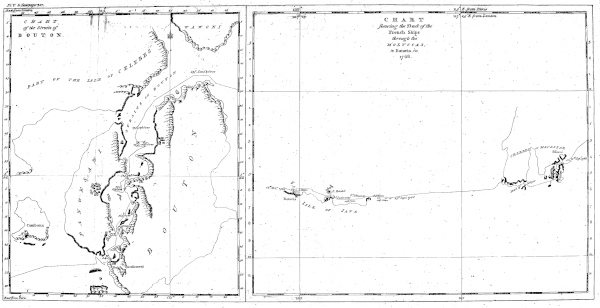
CHART
of the Straits of
BOUTON.
CHART
shewing the Track of the
French Ships
through the
MOLUCCAS,
to Batavia, in
1768.
382
CHAP. VII.
Run from Boero to Batavia.
1768. September.
Although I was convinced that the Dutch represent the navigation between the Moluccas as much more dangerous than it really is, yet I well knew that it was full of shoals and difficulties. |Difficulties of the navigation in the Moluccas.| The greatest difficulty for us was to have no accurate chart of these parts of India, the French charts of them being more proper to cause the loss of ships than to guide them. I could get nothing but vague information, and imperfect instructions from the Dutch at Boero. When we arrived there, the Draak was going to leave the port in a few days, in order to bring an engineer to Macassar, and I intended to follow her to that place; but the resident gave orders to the commander of this snow to stay at Cajeli till we were gone. Accordingly we set sail alone, and I directed my course so as to pass to the northward of Boero, and to go in search of the straits of Button, which the Dutch call Button-straat.
Course which we take.
We ranged the coast of Boero at the distance of about a league and a half, and the currents did not seem to make any sensible difference till noon. On the 8th in 383the morning we perceived the isles of Kilang and Manipa. From the low land which you find after going out of the gulph of Cajeli, the coast is very high, and runs W. N. W. and W. by N. On the 9th in the morning we got sight of the isle of Xullabessie; it is a very inconsiderable one, and the Dutch have a factory there, in a redoubt, called Cleverblad, or the Clover-leaf. The garrison consists of a serjeant and twenty-five men, under the command of M. Arnoldus Holtman, who is only book-keeper. This isle formerly was one of the dependences of the government of Amboina, at present it belongs to that of Ternate. Whilst we ran along Boero we had little wind, and the settled breezes almost the same as in the bay. The currents during these two days set us near eight leagues to the westward. We determined this difference with precision enough, on account of the frequent bearings which we took. On the last day they likewise set us a little to the southward, which was verified by the meridian altitude observed on the 10th.
We had seen the last lands of Boero on the 9th, at sun-setting; we found pretty fresh S. and S. S. E. winds out at sea, and we passed several very strong races of a tide. We steered S. W. whenever the winds permitted, in order to fall in with the land between Wawoni and Button, as I intended to pass through the straits of that 384name. |Nautical advice.| It is pretended that during this season it is dangerous to keep to the eastward of Button, that one runs the risk of being thrown upon the coast by the winds and currents, and that then it is necessary, in order to lay it again, to wait for the western monsoon’s being perfectly set in. This I have been told by a Dutch mariner, but I will not answer for the truth of it. I will however positively assert that the passage of the straits is infinitely preferable to the other course, either to the northward or to the southward of the shoal called Toukanbessie: this latter being full of visible and hidden dangers, which are dreaded even by those who know the coast.
On the 10th in the morning, one Julian Launai, taylor, died of the scurvy. He began already to grow better, but two excesses in drinking brandy carried him off.
Sight of the straits of Button.
The 11th, at eight o’clock in the morning, we saw the land, bearing from W. by S. to S. S. W. ½ W. At nine o’clock, we found that it was the isle of Wawoni, which is high, especially in its middle: at eleven o’clock we discovered the northern part of Button. At noon we observed in 4° 6′ of south lat. The northermost point of the isle of Wawoni then bore W. ½ N. its southermost point S. W. by W. 4° W. eight or nine leagues distant, and the N. E. point of Button, S. W. ½ W. about 385nine leagues distant. In the afternoon we stood within two leagues of Wawoni, then stood out into the offing, and kept plying all night, in order to keep to windward of the straits of Button, and be ready to enter them at day-break. The 12th, at six o’clock in the morning, it bore between N. W. by W. and W. N. W. and we stood in for the north point of Button. At the same time we hoisted out our boats, and kept them in tow. At nine o’clock we opened the straits, with a fine breeze, which lasted till half past ten o’clock, and freshened again a little before noon.
Description of the entrance.
When you enter these straits, it is necessary to range the land of Button, of which the north point is of a middling height, and divided into several hummocks. The cape on the larboard side of the entrance is steep and bold-to. Several white rocks ly before it, pretty high above the water, and to the eastward is a fine bay, in which we saw a small vessel under sail. The opposite point of Wawoni is low, tolerably level, and projects to the westward. The land of Celebes then appears before you, and a passage opens to the north, between this great isle and Wawoni; this is a false passage: the southern one indeed appears almost entirely shut up; there you see at a great distance a low land, divided as it were into little isles or keys. As you advance in the straits, you discover upon the coast 386of Button, great round capes, and fine creeks. Off one of these capes are two rocks, which one must absolutely take at a distance for two ships under sail; the one pretty large, and the other a small one. About a league to the eastward of them, and a quarter of a league off the coast, we sounded in forty-five fathoms, sand and ooze. The straits from the entrance run successively S. W. and south.
At noon we observed in 4° 29′ south lat. and were then somewhat beyond the rocks. They ly off a little isle, behind which there appears to be a fine inlet. There we saw a kind of vessel in form of a square chest, having a periagua in tow. She made way both by sailing and rowing, and ranged the shore. A French sailor, whom we took in at Boero, and who for these four years past had sailed with the Dutch in the Moluccas, told us that it was a boat of piratical Indians, who endeavour to make prisoners in order to sell them. They seemed to be rather troubled at meeting with us. They furled their sail, and set their vessel with setting poles close under the shore, behind the little isle.
Aspect of the country.
We continued our course in the straits, the winds turning round with the channel, and permitting us to come by degrees from S. W. to south. Towards two o’clock in the afternoon we thought the tide began to set against us; the sea then washed the lower parts of 387the trees upon the coast, which seems to prove that the flood-tide comes here from the northward, at least during this season. At half an hour after two o’clock we passed a very fine port upon the coast of Celebes. This land offers a charming prospect, on account of the variety of low lands, hills, and mountains. The landscape is adorned with a fine verdure, and every thing announces a rich country. Soon after, the isle of PangasaniPangasani, and the keys to the northward of it, appear separated, and we distinguished the several channels which they form. The high mountains of Celebes appeared above, and to the northward of these lands. The straits are afterwards formed by this long isle of Pangasani, and by that of Button. At half past five o’clock we were locked in so that we could not see either the entrance or the out-let, and we sounded in twenty-seven fathoms of water, and an excellent oozy bottom.
First anchorage.
The breeze which then came from E. S. E. obliged us to sail close upon it, in order to keep the coast of Button on board. At half past six o’clock, the wind coming more contrary, and the tide setting pretty strong against us, we let go a stream-anchor almost in the midst of the channel, in the same soundings which we had before, twenty-seven fathoms, soft ooze; which is a mark of an equal depth in all this part. The breadth of the straits from the entrance to this first anchorage, 388varies from seven to eight, nine and ten miles. The night was very fine. We supposed there were habitations on this part of Button, because we saw several fires there. Pangasani appeared much better peopled to us, if we judge by the great number of fires on every part of it. This isle is here low, level, and covered with fine trees, and I should not wonder if it contained spices.
Traffic with the inhabitants.
On the 13th, a great many periaguas, with outriggers, surrounded the ships. The Indians brought us fowls, eggs, bananas, perrokeets and cockatoes. They desired to be paid in Dutch money, and especially in a plated coin, which is of the value of two French sous and a half. They likewise willingly took knives with red handles. These islanders came from a considerable plantation on the heights of Button, opposite our anchorage, occupying the skirts of five or six mountains. The land is there entirely cleared, intersected with ditches, and well planted. The habitations lay together in villages, or solitary in the midst of fields, surrounded by hedges. They cultivate rice, maize, potatoes, yams, and other roots. We have no where eaten better bananas than we got at this place. Here are likewise abundance of cocoa-nuts, citrons, mangle-apples, and ananas or pine-apples. All the people are very tawny, of a short stature, and ugly. Their language, the same 389as that of the Molucca isles, is the Malays, and their religion the Mahometan. They seem to have a great experience in their trade, but are gentle and honest. They offered us for sale some pieces of coloured but very coarse cotton. I shewed them some nutmegs and cloves, and asked them to give me some. They answered that they had some dried in their houses, and that whenever they wanted any, they went to get it upon Ceram, and in the neighbourhood of Banda, where the Dutch certainly are not the people to provide them with it. They told me that a great ship belonging to the company had passed through the straits about ten days ago.
From sun-rising the wind was weak and contrary, varying from south to S. W. I set sail at half past ten, with the first of the flood, and we made many boards without gaining much way. At half past four o’clock in the afternoon we entered a passage, which is only four miles broad. It is formed on the side of Button, by a low, but much projecting point, and leaves to the northward a great bay, in which are three isles. On the side of Pangasani it is formed by seven or eight little isles or keys, covered with wood, and lying at most half a quarter of a league from the coast. In one of our boards we ranged these keys almost within pistol shot, sounding close to them with fifteen fathoms without 390finding bottom. In the channel our soundings were in thirty-five, thirty, and twenty-seven fathoms, oozy bottom. We passed without, that is, on the west side of the three isles, upon the coast of Button. They are of a considerable size, and inhabited.
Second anchorage.
The coast of Pangasani here rises like an amphitheatre, with a low land at bottom, which I believe is often overflowed. I conclude it from seeing the islanders always fix their habitations upon the sides of the mountains. Perhaps too, as they are almost always at war with their neighbours, they choose to leave an interval of wood between their huts and the enemies who should attempt the landing. It seems even that they are dreaded by the inhabitants of Button, who consider them as pirates, upon whom no reliance can be had. Both parties are likewise used to wear the criss or dagger constantly in their girdle. At eight o’clock in the evening, the wind dying away entirely, we let go our stream-anchor in thirty-six fathoms, bottom of soft ooze. The Etoile anchored to the northward, nearer the land. Thus we had passed the first narrow gut or gullet.
Third and fourth anchorage.
The 14th, at eight o’clock in the morning, we weighed and made all the sail possible, the breeze being faint, and we plied till noon; when, upon seeing a bank to the S. S. W. we anchored in twenty fathoms, sand and 391ooze, and I sent a boat to sound round the bank. In the morning several periaguas came alongside, one among them displaying Dutch colours at her poop. At her approach, all the others retired to make way for her. She had on board one of their orencaies or chiefs. The company allow them their colours, and the right to carry them. At one o’clock in the afternoon we set sail again, with a view to gain some leagues farther; but this was impossible, the wind being too light and scant; we lost about half a league, and at half past three o’clock we let go our anchor again, in thirteen fathom bottom of sand, ooze, shells, and coral.
Nautical advice.
Mean while M. de la Corre, whom I had sent in the boat, to sound between the bank and the shore, returned and made the following report: Near the bank there is eight or nine fathom of water; and as you go nearer the coast of Button, which is high and deep, opposite a fine bay, you always deepen your water, till you find no bottom with eighty fathom of line, almost mid-channel between the bank and the land. Consequently, if one was becalmed in this part, there would be no anchoring, except near the bank. The bottom is, upon the whole, of a good quality hereabouts. Several other banks ly between this and the coast of Pangasani. We cannot therefore sufficiently recommend it, to keep as close as possible to the land of Button in all this strait. 392The good anchorages are along this coast; it hides no danger; and, besides this, the winds most frequently blow from thence. From hence, almost to the out-let of the strait, it seems to be nothing but a chain of isles; but the reason of this is, its being intersected by many bays, which must form excellent ports.
Continuation and description of the straits.
The night was very fair and calm. The 15th, at five o’clock in the morning, we set sail with a breeze at E. S. E. and we steered so as to come close to the east of Button. At half past seven o’clock we doubled the bank, and the breeze dying away, I hoisted out the long-boat and barge, and made signal for the Etoile to do the same. The tide was favourable, and our boats towed us till three o’clock in the afternoon. We passed by two excellent bays, where I believe an anchorage might be found; but all along, and very near the high-shores, there is no bottom. At half after three o’clock the wind blew very fresh at E. S. E. and we made sail to find an anchorage near the narrow pass, by which one must go out of these straits. We did not yet discover any appearances of it. On the contrary, the farther we advanced, the less issue did we perceive. The lands of both shores, which over-lap here, appear as one continued coast, and do not so much as let one suspect any out-let.
393At half past four o’clock we were opposite, and to the westward of a very open bay, and saw a boat of the country-people’s, which seemed to advance into it, to the southward. I sent my barge after her, with orders to bring her to me, as I intended to get a pilot by this means. During this time our other boats were employed in sounding. Somewhat off shore, and almost opposite the north point of the bay, they found twenty-five fathom, sand and coral bottom; and after that they were out of soundings. I put about, then lay-to under top-sails, in order to give the boats time to sound. After passing by the entrance of the bay, you find bottom again, all along the land which joins to its southerly point. Our boats made signal of 45, 40, 35, 29, and 28 fathom, oozy bottom; and we worked to gain this anchorage with the help of our long-boats. At half past five, we let go one of our bower-anchors there, in thirty-five fathom of water, bottom of soft ooze. The Etoile anchored to the southward of us.
Fifth anchorage.
As we were just come to an anchor, my barge returned with the Malayo boat. He had not found it difficult to determine the latter to follow her; and we took an Indian, who asked four ducatoons (about thirteen shillings sterling) for conducting us; this bargain was soon concluded. The pilot came to ly on board, and his periagua went to wait for him on the other side of the 394passage. He told us, she was going thither through the bottom of a neighbouring bay, from whence there was but a short portage, or carrying-place, for the periagua. We were, upon the whole, enabled to do without the assistance of this pilot; for some moments before we anchored, the sun shining very favourably upon the entrance of the gut, was the occasion of our discovering the larboard point of the out-let, bearing S. S. W. 4° W. but one must guess which it is; for it laps over a double rock, which forms the starboard point. Some of our gentlemen employed the rest of the day in walking about on shore; they found no habitations near our anchorage. They likewise searched the woods, with which all this part is entirely covered, but found no interesting production in it. They only met with a little bag near the shore, containing some dried nutmegs.