Volume 1 — GENERAL PATHOLOGY. (continued 4)
Reading edition
Previous diseases constitute an often overlooked class of factors in predisposing to new attacks, and also in determining their course and results. Of some affections one attack prepares the way for another, as is the case with intermittent fever, convulsions, delirium tremens, and insanity. Just the reverse is true of yellow fever and of all the exanthemata, as scarlet fever, measles, small-pox; likewise of the analogous disorders, mumps and whooping cough. The moot question in this regard concerning syphilis may be left for discussion elsewhere.
Our classification of the causes of disease may be set forth in simple form, thus:
1. Pre-natal causation—viz. hereditary transmission of a proclivity to certain disorders, and also the influence of circumstances acting on either parent at the time of conception or on the mother during gestation.
2. Conditional causation—i.e. that belonging to variations of temperature, humidity, etc., affecting individuals.
3. Functional causation—that which is connected with excessive, deficient, or abnormal exercise of any of the functions of the economy.
4. Ingestive causation—e.g. bad diet, intemperance, poisoning.
5. Enthetic causation—viz. that of all contagious, endemic, and epidemic diseases. Closely allied to this is epithelic morbid influence—namely, that of the parasites producing certain affections of the skin, as itch, favus, etc.
6. Mechanical causation. The effects of this belong chiefly, though not exclusively, to the domain of surgery.
Pre-natal causation is of immense consequence, and its study takes in the whole scope of the influences of species, race, family, and individual parentage. Darwin's observations and speculations, and those of other evolutionists, have not ignored the field of human life in considering the struggle for existence and the survival of the fittest. If we are obliged to admit that such a struggle and survival do exist for men as well as for animals and for plants, it is nevertheless obvious that either man's reason and will introduce exceptions to the ordinary laws of development and selection in nature, or else a very peculiar standard of fitness must be recognized in the survivals of humanity. Many feeble, inert, deformed, and diseased forms survive and perpetuate offspring through a long series of generations, while strong and admirable ones perish, often even destroying each other.
Leaving this theme, upon which biological science has not yet pronounced its last word, we may inquire, What diseases are reasonably ascribed to hereditary transmission? First, it must be remarked that seldom is a disease actually received directly from a parent. Putting aside a few asserted instances of variola and allied or analogous affections in utero, congenital constitutional syphilis and (more rarely) scrofulosis seem to afford almost the only examples of this. Nearly always it is a predisposition merely that is inherited. This, however, may be very strongly marked. Its seat is evidently in that (as yet) occult law or process of individual organic development to whose manifestation we give the name of the constitution. In some families all the men grow bald before forty; in others, scarcely so at eighty. Some may expect deafness in middle life, others blindness in old age, and others, again, have a probability of death from disease of the heart at about fifty or apoplexy at about sixty years of age. Such considerations enter into every examination for life insurance, and they are no less important in our prognostications of the results of diseases in practice.
Speaking more definitely, gout is undoubtedly often hereditary. That is, a healthy childhood may be followed by liability to gout in adult or middle age, even in the absence of direct provocatives to that disorder, but much more frequently when they are present. Gout affords an example of the general fact that inherited proclivity to special diseases shows itself at nearly the same time of life in each generation—scrofula in childhood, phthisis in adolescence or early maturity, gout from thirty to forty, apoplexy after sixty, etc. But exceptions to such rules are not at all rare. Gout also exemplifies another important fact—viz. the occasional modification of the transmitted morbid tendency or "diathesis." Parents who have regular gout—i.e. painful attacks of acute inflammation of the smaller joints, followed by deposits of urates, carbonates, etc.—not unfrequently have children who are subject to neuralgia or dyspepsia or modified rheumatic attacks (not sufficiently recognized in practical treatises), to which the name "gouty rheumatism" is most applicable. Again, in one generation there may be a marked tendency to insanity; in the next, to paralysis; in a third, to tubercular meningitis during infancy.1 Or some of these successions may occur in a reverse order.
1 For example, in one family known to me the grandmother had paralysis, the mother died insane, and her three children all died of tubercular meningitis.
Constitutional syphilis is undoubtedly often conveyed by inheritance from either parent. Sometimes the impression of this diathesis is so intense as to devitalize the foetus in utero, causing still-birth. Or the manifestations of the disease occur early in infancy, with symptoms like those of the secondary or tertiary affection in the original subject of it. Not often, indeed, is the exhibition, in some manner, of inherited constitutional syphilis delayed beyond the time of childhood.
Scrofulosis is well known to follow in the same family through successive generations, in a manner apparently demonstrative of hereditary derivation. It is true that here we have a problem not without complication. Certain circumstances, as poverty of living, dampness of locality, want of fresh air in houses, etc., promote scrofula in children. Now, are we sure that it is from its parents that each child, exposed to these morbific surroundings, has obtained its disposition to strumous disorders? or may it not be that every time the diathesis is thus originated de novo? It is to be answered that decisive evidence in favor of inheritance is present in a number of cases where the affection occurs so early in infancy as to be almost or quite congenital in its beginnings; and in other instances where removal of the parents into improved localities, and with better living altogether, has not prevented the manifestation of the same tendency in their offspring for two or three generations. The inquiry does not differ very greatly in its nature from that concerning cases of enthetic diseases—e.g. cholera, yellow fever, typhoid fever; as to which the succession of cases may be such as to allow hypothetical explanation, either by transmission from one individual to another or by the subjection of all to a common local infection or epidemic influence. But in both sorts of cases crucial instances may, with care, be found which determine at least the general etiological law for each malady.
Pulmonary phthisis has been always considered to be, in a marked degree, a hereditary disease, until, latterly, the hypothesis of a tubercular virus has threatened to displace old views about it. If, however, we accept the classification of cases of pulmonary consumption approved by several leading pathologists, in which a position is provided for non-tubercular phthisis, we may at least place hereditary vulnerability, or proclivity to consumption, in this category, while awaiting the final decision of science upon the real nature and origin of tubercle. My own conviction continues to be positive, that tubercular phthisis is often transmitted by inheritance, in the same sense as other diseases are generally so—namely, by the bestowal upon offspring of a constitution especially liable to the occurrence of the disorder at the time of life when it is generally most apt to appear. The investigations of Villemin, Cohnheim, Schüller, Koch, Baumgarten, and others have given (1882) much prominence to the idea of the possibility of the transplantation of tubercle from one human or animal body to another. Koch's elaborate experiments especially are asserted to have shown the existence of a bacillus tuberculosis, a true, minute vegetative organism, which can be cultivated outside of the body, in a suitable material, at a temperature like that of living blood, and which, when inoculated, produces tubercular disease. The discussion of this subject will occur on a later page as a part of the general topic of the causation of enthetic diseases.
Rickets occupies a much less prominent place in the experience of American practitioners than in that of some countries abroad, and it is therefore less easy here to obtain materials for the study of its etiology. Among those who have had large opportunities for its observation, opinion is divided very much in the manner above referred to. Thus, Wiltshire and Herring assert it to be certainly hereditary; Jenner denies this altogether, while Aitken adopts the ground that predisposing causes are derived from the parents or the nurse, which are so capable of influencing the health of the child as to lead in course of time to the establishment of the disease.
Goitre is manifestly a family disorder to a large extent in certain regions, most familiarly in Alpine valleys in Switzerland. But this local feature takes us back to the same kind of question: Is it the transmission of a specially modified constitution from parents, or the direct action of morbid local influences on the children themselves, that produces bronchocele and its frequent attendant, cretinism? Undoubtedly, goitre often occurs in children of healthy parents brought from another locality into one where the disease is common; and, per contra, goitrous subjects not infrequently recover from the affection when removed for a length of time from the place where it was developed in them. We are, apparently, at least safe in taking here a position like that of Aitken concerning rickets: viz. that predisposing causes are derived from parentage, whereby, more easily than in those of different descent, certain influences will develop goitre or cretinism, or both together.
As to leprosy, there seems no more room for doubt that it is often—nay, generally—hereditary. The obscurity attending its history, however (more than one cutaneous affection having been from time to time classed under the same name), will justify our referring the reader for the particular discussion of its etiology to another part of this work. (See DISEASES OF THE CUTANEOUS SYSTEM.)
Hæmophilia is clearly hereditary in certain families. Immermann asserts it to be even a race-liability in the Jews. "Bleeders" upon occasion of very small wounds of the skin, gums, etc. have been known in several successive generations, including (Börner; Kehrer) women at the time of parturition, who then are apt to have dangerous hemorrhages./
Cancer presents as unmistakable examples of inheritance as any other disease. Paget asserts this to be traceable in one case out of three; Sibley, in one of nine; and Bryant, one of ten cases. De Morgan and others have shown the same thing to be true of non-malignant morbid growths. But, as Paget has remarked, when other local disease or deformity is inherited, it usually involves in the offspring the same tissue, often the same part of the body, as in the parent, but the transmitted cancerous tendency may show itself anywhere: "Cancer of the breast in the parent is marked as cancer of the lip in the offspring. The cancer of the cheek in the parent becomes cancer of the bone in the child. There is in these cases absolutely no relation at all of place or texture."
Cataract is believed by good authorities to be promoted by hereditary tendency. It is of the nature of a degeneration. Possibly, in a greatly-prolonged decay of all the organs with age, all eyes tend to become cataractous from structural alteration of the crystalline lens. Under observation a quite different rate of degenerative change takes place among the organs of the body in different individuals and families. Thus, the lens becomes opaque in some at an age when the hearing continues good and the muscles retain considerable vigor, while in members of other families the eyes remain in a sound condition at a time when other organs and powers have failed. Congenital cataract appears to be altogether independent of any proclivity transmitted from parents in the nature of an inheritance.
Affections of the nervous system very often show hereditary descent. Neuralgia prevails strongly in certain families. Particularly, that form of cephalalgia called sick headache is apt to appear, in the periodical form, through several generations. Apoplexy and paralysis are prone to occur at nearly the same time of life under the transmission of like constitutions by parentage. Still more often this has been observed of epilepsy and hysteria, and, most of all the neuroses, in insanity. Monomania and melancholia have been in a great number of instances traced to generative succession—sometimes, especially suicidal monomania, through four or five generations. Predisposition to intemperance, methomania, is also a terrible inheritance in some families. Although the production of this malady requires the provocative of indulgence in the use of alcohol for its development, yet the facility with which this result occurs under the same circumstances in different families is too marked to leave room for doubt of its hereditary nature.
Less certainly, but with much probability, we may assign parental endowment as one of the factors in the causation of organic disease of the heart, arteries, liver, and kidneys, as well as of angina pectoris, asthma, croup, dyspepsia, and hemorrhoids.
Is a special proclivity to any of the group of enthetic febrile diseases ever inherited? Dr. George B. Wood believed this to be the case with enteric or typhoid fever. Few others have shared this opinion, but it is not impossible that it has a basis of truth.
Reference has been made already to the difference between periodical malarial fevers (intermittent, etc.) and yellow fever, in that an attack of the latter does, and one of the former does not, protect the individual, usually, from liability to the disease on exposure to its cause. Does this protection extend to offspring of parents who have been "acclimatized" to yellow fever? Facts on this point are not easy to obtain. While, however, there appears to be no proof that a single generation can ever suffice to outgrow (so to speak) liability to this disease, it is well known that creoles in Louisiana and the West Indies are less susceptible to it than recent white residents, and that the negroes are much less so, as a race, than the whites. Furthermore, negroes whose ancestors have long been domesticated in our Southern States appear to re-acquire susceptibility to yellow fever in a degree more nearly like that of white people than is observed in natives of Western Africa imported within one or two generations.
As to autumnal malarial fevers (remittent, intermittent), the black race exhibits a sort of race-acclimatization, giving negroes, both in Africa and in America, a much less degree of liability than is common to all races of European descent.
How far any similar modification may occur in the course of generations in regard to susceptibility to small-pox and allied diseases remains at present a matter of speculation. Some authors insist that there must be at least a kind of natural selection, according to which a great epidemic of variola, destroying the lives of many of those most predisposed to suffer from it, will leave the remaining population less likely to be attacked by it. The endeavor has even been made to explain away in this manner much of the diminution of mortality from small-pox commonly credited to vaccination. But the statistics of the ravages of variola in different countries before and after the introduction of vaccination show that, while we cannot deny that some alternation (of generations respectively more and less susceptible) may occur, no such law can compare in influence with that of vaccination in the protection of individuals subjected to it. Indeed, the argument may be inverted; thus: if in the days before Jenner small-pox itself weeded out the persons most liable to it, or in some way prepared a partial family- or race-protection, such a protection ought to be gradually conferred upon a whole population through universal and persistent vaccination carried on for several generations.
Is it possible for one hereditary constitution or diathesis to become, in transmission, not only modified, but transmuted, into another? Some of the older pathologists imagined this to be the case with syphilis, to whose past influence upon parents and ancestors they traced the origin of scrofula. But no sufficient ground for such a pathogeny can be ascertained. All that appears to be left after scrutiny of the facts is, that syphilis is a depressing and perverting agency, and so may join with other depressing causes in preparing the way for the engendering of scrofulosis.
A few points still remain to be briefly mentioned in connection with the hereditary conveyance of proclivity to disease. One or several members of a family will often pass through life without any manifestation of such transmission, while others, their brothers or sisters, give marked evidence of it. Sometimes a whole generation may be passed over, and yet the predisposition may be abundantly shown in that next following. This is closely similar to atavism, as it is called in zoology and general biology, according to which traits occurring under admixture or variation of animal or vegetable stocks may be absent in the immediate offspring of a couple, but reappear in their next succeeding descendants, or even a still later reversion may take place. Such instances are not rare, and they need to be considered in the proper study of the influence of parentage, intermarriage, etc. upon health and disease.
A practical question of much importance (belonging, however, rather to sanitary than to medical science) is, how far confirmation or modification of hereditary proclivities may occur through the effect of the conditions of marriage upon offspring. Consanguineous marriages have been, time out of mind, held to be very objectionable. The question has been much discussed whether the ground of sanitary objection is properly against such marriages as per se injurious to offspring, or whether the bad effect consists merely in reduplicating and intensifying family constitutional taints. It would not be in place here to go into this controversy. My own conclusion is, that a natural law of sexual polarity or affinity exists, according to which, in all the higher organisms, reproduction is most normal and gives the best results when a considerable genetic difference (within the limits of species) exists between parents. While, however, this is probable, but difficult to demonstrate, it appears to be certain that when a father and mother both possess morbid constitutional predispositions (say, to phthisis, insanity, or gout), their children will be at least twice as likely to suffer from the same as if only one parent were so endowed. Whether or not, then, the marriage of two perfectly healthy first-cousins may be expected (as several statisticians aver to have been shown) to be attended by defects of health in their progeny, the union of such relations when their common progenitors were in marked degree consumptive, or scrofulous, or liable to insanity, epilepsy, etc., has attached to it so unfavorable a prognosis for offspring as to be rightly forbidden. Moreover, so few families possess an absolutely faultless health-record that the chances of increasing existing morbid traits by intermarriages are quite sufficient to justify the commonly held objection against them.
We must allude very briefly to the influence of conditions affecting conception and gestation upon the health of offspring. Intemperance in parents has, in many instances, been known to promote convulsions, infantile or epileptic, and other cerebral or nervous disorders in children, besides a general feebleness of constitution. Even intoxication at the time of procreation has been asserted to mark a similar difference between one child and another of the same parents.
All are familiar with the (no doubt often quite imaginary) accounts of the effect on infants in utero of powerful sensory or mental impressions upon the mother during gestation. Abortion has, unquestionably, been often produced by violent nervous shocks. Without deciding the question whether "monsters" are ever developed in correspondence with particular experiences of the mother, we may hold it to be clear that all depressing and disturbing agencies may interfere with the process of nutrition of the foetus, and thus develop mental anomalies, and that constitutional impairments may thus be greatly promoted.
All inherited predispositions, it is important to remember, are aggravated, and each proclivity changed to actuality, by those influences which in individuals tend to like effects upon health. Such become exciting causes of various diseases. If these be constantly avoided, and all the surroundings and the mode of life of the individual be maintained in a manner most favorable to health, the hereditary tendency may remain inert through a long lifetime. Every physician must have seen this in scores of instances. The application of the principle through special precepts belongs to personal hygiene. But no physician can rightly ignore the study of this subject, or omit the utilization of his acquaintance with it by preventive advice to members of the families under his professional care.
Our last remark in connection with pre-natal causation must be upon the effects of circumstances and modes of living on masses of men, especially in large cities and populous countries. Something has been said already of race-acclimatization by which there may be acquired a lessened susceptibility to certain endemic fevers.2 Almost a reverse action is exhibited in the gradual lowering of vital energy under what has been called the "great-town system." While those having all the comforts of life and avoiding excesses may manifest but little of this deterioration, it is very observable in that mass of men, women, and children who become the subjects of medical charities. Closeness and uncleanliness of living, with more or less exposure to dampness and extremes either of heat or cold, with intemperance and syphilis, are the main causes of this general constitutional impairment. So important is it that it should never be forgotten, not only in our estimate of the causation of diseases, but in our anticipation of their results, and also in our adaptation of measures of treatment, medical and surgical, to different classes of patients. All that it is allowable here to suggest in this regard may be summed up (although very imperfectly) in the word hospitalism.
2 It is important (but not before remarked in this article) that cholera does not appear to allow of any such diminution of liability to it among the natives of the country in which it is endemic.
Conditional causation has been, to a certain extent, included under what has been above said, as it is the action, in part at least, of surrounding conditions, that establishes a family- or race-proclivity and inheritance. But we must say something more about the direct action of conditions upon individuals.
Man, although organized with great delicacy of structure, is capable, by the use of his intelligence, of adapting himself to a wider variety of external conditions than any other animal. He is the only truly cosmopolitan being on the earth. From the remote Arctic regions to the hottest tropical climates there are tribes whose ancestors have dwelt for centuries in the same localities. Not that no unfavorable influence attends these extremes. The Esquimaux are stunted, the Southern Hindoo and Central African are enfeebled and degenerate, partly from climate. But with man's numerous protective devices, great cold and great heat only exceptionally affect individual health. Freezing to death follows unusual exposures; the loss of an extremity by sphacelus from congelation is more often met with; heat-stroke also is tolerably frequent; and the influence of heat in producing cholera infantum in some large cities is very important; but much the most common kind of conditional morbid causation is produced either by sudden changes of temperature or by diversity of exposure of different parts of the body. These are the two usual modes of "taking cold." When dampness accompanies a relatively low temperature, such an effect is much more apt to follow than in a cold dry atmosphere.
Actual cold-stroke, the analogue of heat-stroke, may sometimes happen. I once saw such a case in a previously healthy boy twelve years of age, who, after standing for an hour in his night-shirt on a cold winter night, became almost immediately ill, fell into a comatose state, and died in about thirty-six hours.
A simple rationale may be discerned for the phenomena of catching cold. When, for example, a draught of air blows for a time upon the back of a person at rest (especially one who has just before used active exertion), the local refrigerant impression induces constriction of the superficial blood-vessels. Hence follow two effects: one, the repulsion of blood in undue amount toward interior organs; the other, diminution, perhaps arrest, of excretion from the skin of the exposed portion of the body, and consequent retention of some effete material, promoting esotoxæmia.3 If, then, there be in the body any weak organ—that is, one whose circulation is partially impeded or whose nutritive and functional activity is low—it suffers first and most from the impulsion of blood from the surface. Congestion, irritation, and inflammation may follow, and we have an attack of pneumonia, pleurisy, bronchitis, or some phlegmasia.
3 That is, blood-poisoning, originating within the body itself; exotoxæmia being that which is enthetic—i.e. resulting from a poison derived from without.
Excessive heat with dryness, as under the blasts of the Simoon or the Harmattan of Arabia or Northern Africa (apart from insolation, sunstroke, or heat-stroke), may sometimes parch the body even to a fatal degree. Much more common is the combination of high temperature with humidity. This has a relaxing effect, promoting indolence of temperament and predisposing to disorders of a catarrhal nature, especially of the digestive organs, such as were called fluxes by the older writers.
Cold climates are well known to present the greatest number of cases of acute and chronic affections of organs of the respiratory system; warm and hot climates, those of the stomach, liver, spleen, and bowels. But we must recollect what various complications belong to climate. Two important factors, especially, must be kept in view in comparing the causation of diseases in colder and warmer countries—namely, the difference in the articles of food partaken of in each, and the external sources of enthetic disorders; e.g. endemic and epidemic fevers, etc.
With humidity must be considered variations in atmospheric pressure. Physicists have long known that while watery vapor, by itself, is heavier than air which is perfectly dry, moist air is lighter than air containing little or no moisture. Hence the barometer falls as the quantity of atmospheric moisture approaches saturation. Other causes, however, also affect barometric pressure. With the same degree of humidity, cold air is denser and heavier than warm air, and by its contraction lowering the "column" of atmosphere—the temperature of which is reduced—a flow toward the upper part of the column increases the actual mass of air pressing upon a particular place. Elevation of a locality above the general level of the earth reduces atmospheric pressure, sensibly as well as measurably. So "the difficult air of the iced mountain-top" has become proverbial.
These variations are familiar, though all their effects upon human health have been by no means, as yet, fully studied. Most difficult to determine and analyze are the influences of changes of pressure, chiefly hygrometric, upon the course of diseases and upon the result of severe surgical operations. Among the few important series of observations bearing on this topic have been those of Dr. S. Weir Mitchell on neuralgia,4 and Dr. Addinell Hewson on the prognosis of major operations,5 in connection with the state of the weather. The former ascertained a marked relation between the approach of a wave of low barometric pressure and attacks of irregularly periodic neuralgia; the latter proved, by the statistics of the Pennsylvania Hospital for a number of years, that the most favorable time for amputations or other capital operations is when the barometer is high, or at least on the ascent.
4 American Journal of Medical Sciences, April, 1877, p. 305.
5 Pennsylvania Hospital Reports, 1868.
Electrical atmospheric states and vicissitudes have, quite probably, a practical consequence beyond what is usually ascribed to them in connection with health and disease. But their effects are so difficult to disentangle from those of other meteorological causes that we must be content at present without attempting their exact specification. The same observation may be made with reference to ozone.
Elevation of site has importance, not only in regard to climatic hygiene, but also to its therapeutic use, particularly in the treatment of phthisis, goitre, and some affections of the nervous system. But in our brief and general survey of Etiology this topic must be left without discussion, since no disorder appears to be traceable to elevation alone, beyond the temporary prostration on exertion, with hemorrhages from the nose, lungs, etc., often produced in those who climb to great mountain-heights or ascend rapidly in balloons. It has been shown by ample experience that considerable populations may live in ordinary health through long periods at altitudes more than 10,000 feet above the level of the ocean.
Depression below the surface of the earth has never become a part of human experience beyond the limit of a few hundred feet. Miners living underground in a few places in Europe have been found to exhibit comparatively feeble health, but the privation of sunlight, the confined atmosphere, and the dampness of such unnatural abodes will suffice to account for these effects.
Under functional causation of disease we may include all excessive, deficient, or abnormal exercise of any of the organs of the body. To simple excess may be ascribed the scrivener's or bank-officer's paralysis of the muscles of the hand used in continuous writing; brain exhaustion from mental labor or anxiety, unrelieved by sufficient sleep; and sexual impotence, temporary or lasting (or sometimes even general paralysis), from inordinate sexual or sensual indulgence.
Deficiency of functional exercise is observed to produce disability, as when the muscles of a limb, for instance, are for a long time restrained from use. Surgeons meet with this inconvenience (unless assiduously guarded against) when a fractured limb is kept long at rest in a fixed position. Atrophy of the mammæ in single women of retired lives is common; atrophy of the testicles in unmarried men much less so. These changes, however, are physiological, not pathological; upon alteration of conditions—e.g. marriage—the atrophy will disappear altogether.
Abnormal functional action as a cause of morbid results is seen when the eyes are injured by reading, writing, or doing any delicate work in a bad light; for instance, late twilight. Also, in a secondary or accessory manner, when a near-sighted person, having the action of the muscles of convergence in excess of his accommodation, or a long-sighted (hyperopic) person, whose accommodation is in excess of convergence, suffers from asthenopia, perhaps with headache, distress, nausea, etc. Another example of abnormal functional exercise and its effects is that of self-abuse, where the unnatural mechanical imitation of the physiological act of sexual coition induces disturbances of the nervous and circulatory systems, besides debility from excess.
Ingestive causation is a sufficiently fit designation for all errors of diet, as well as misuse of medicines, and poisoning. Starvation or inanition belongs to the same category by negation. Gluttony and intemperance are major members in the ingestive series, while haste in taking food, without mastication, and the use of heavy bread, unripe fruit, and other indigestible articles, account for many cases of dyspepsia and some of colic, cholera morbus, diarrhoea, etc. With young children, especially, no more frequently acting cause of disorder exists than dietetic mismanagement, most of all during the period of dentition, and earlier, when, from absence or insufficiency of mother's milk, they have to be artificially fed. Then the supply of good fresh cow's, goat's, or ass's milk may carry them well through infancy, while a regimen of arrowroot or gum-arabic and water, or stale, half sour milk, may either starve or sicken them to death. On the subject of poisons and of misuse of medicines we have no occasion here to make special remark. Only it may be mentioned that the possibility of either is always to be remembered by the physician in making up his mind in regard to the origin of symptoms observed.
Enthetic causation is a large subject, including all origination of disease by the introduction of morbid materials from without the body.6 Medical opinion has generally accepted, and facts fully sustain, the recognition of three groups of enthetic disorders, viz.: those which are personally contagious; such as are locally epidemic; and epidemic diseases. Of the first group it will suffice to mention, as an example, syphilis; of the second, intermittent fever; of the third, influenza.
6 Simon has proposed the term exopathic to indicate the origin of such maladies; autopathic disorders being those which originate within the body itself.
Were all maladies whose causation is evidently of external origin capable of the same clear discrimination as these, we should have no difficulty with the present topic. But, in fact, no subject connected with the history of disease has become surrounded by more intricate controversy. Many times the same facts are, or appear to be, explicable in two or three different ways. What some hold to be proofs of contagion from person to person, others are ready to account for by the subjection of a number of persons or of a whole community to either a common local or a widespread migrating (epidemic) influence. It is sometimes impossible, in the nature of things, to obtain an absolute demonstration of the truth of one or another of these theories without such experiments upon human beings as are impracticable.
While endeavoring to ascertain the limits of our present knowledge upon these questions, let us first notice what are the most positive facts concerning them, some of which are common to the whole group or class of what have been, since Liebig, often called zymotic,7 but latterly more often enthetic, diseases.
7 The term zymotic has, with many authors, fallen into disrepute, chiefly because Liebig's hypothesis concerning the chemico-physical action of ferments, as well as of contagia, has lost ground in comparison with the vital or disease-germ theory. Yet the analogy between fermentation, putrefaction, and the action of a virus on an animal organism persists; whatever may be the theory of their explanation, something appears to be common or similar in all these processes.
These diseases may be enumerated as follows:
1. Only produced by contact or inoculation.
Primary Syphilis, Gonorrhoea, Vaccinia, Hydrophobia.
2. Contagious also by atmospheric transmission through short distances.
Variola, Varioloid, Varicella, Measles, Diphtheria, Scarlatina, Rötheln, Mumps, Whooping Cough, Typhus, Relapsing Fever.
3. Endemic, occasionally epidemic.
Malarial Fevers (Intermittent, Remittent, and Pernicious Fever), Dengue, Yellow Fever.
4. Other zymotic or enthetic diseases.
Influenza, Cerebro-spinal Fever, Erysipelas, Puerperal Fever, Tropical Dysentery, Typhoid Fever, Cholera, Plague.
As all observers are agreed in regard to the personal transmission of the first named of these series (variola, etc.), we need to give attention here only to the other groups; except merely to say that the easily demonstrable existence of a morbid material (virus) in the instances of primary syphilis, gonorrhoea, variola, and vaccinia presents a very cogent analogical argument for the presumption that all clearly contagious (even though non-eruptive) maladies, such as mumps and whooping cough, must also have a morbid material as their essential cause; and also in favor of the supposition that a morbid material may probably be the "causa sine quâ non" of each of the other maladies which are known to be endemic or epidemic. A few theorists only have argued in favor of any other view than this. Sir James Murray and Dr. Craig of Scotland, and Dr. S. Littell of Philadelphia, have sustained an electrical hypothesis, and Oldham and others have advocated one connected with changes of bodily temperature, or ozone, etc., for the origination of certain endemic and epidemic diseases. But all the facts point toward the existence of material causes, specific for each of these disorders, and many observations and much ingenuity of reasoning have been brought to bear upon the question as to their intimate nature.
Are these materiæ morborum merely inorganic elements or compounds entering human bodies and acting there as chemical poisons? Against such a supposition we have, as almost decisive objections, not only the absence, under the most searching analysis, of any chemical peculiarity in the air of malarious or otherwise infected regions, but also the clinging of many endemic and epidemic causes (as known by their effects) to particular localities, notwithstanding the recognized law of the diffusion of gases which must antagonize such concentration. Therefore, we may rule out, as highly improbable at least, the hypothesis of the inorganic gaseous nature of malaria, as well as of the essential causes of yellow fever, cholera, plague, and the other analogous diseases.
By the once general use of the term zymotic, there is suggested a line of thought which has been quite prevalent since the prominence of Liebig's teachings in chemical physiology, until recently. That great chemist did not imagine that a true zymosis or fermentation occurs under the action of a virus upon the human economy. His thought was more clearly expressed, in the phraseology of the late Dr. Snow of London, as the theory of continuous molecular change. Its most striking physical instance or analogue is the extension of flame from a burning body to combustible matter within its reach. Sugar formation from starch by diastase, and the change of albumen into peptone by pepsin, are familiar examples, in organic materials, of the propagation of molecular movement in special directions and with characteristic results.8 It does not seem to be more than a short step from these to the processes which we study in fermentation, putrefaction, septicæmia, and the multiplication of small-pox contagion, from the smallest inoculation, in the human body.9
8 In anticipation of the argument concerning the necessity of the action of minute living organisms to produce fermentation, putrefaction, and specific diseases, emphasis may be here laid upon the fact that the above named changes, and many others like them, are produced, in the absence of such organisms, by chemical agents formed in the body, or even (as when sulphuric acid changes starch to sugar) by inorganic substances. Pasteur considers that the yeast-cell secretes a sort of diastase which changes starch or cane-sugar into glucose, on which the cell then lives, decomposing the glucose into alcohol, carbonic acid, etc. Koch and others now assert that a bacillus produces the souring of milk, and another the butyric acid fermentation.
9 The assertion of some advocates of the "germ theory of disease," that only living organisms reproduce their kind, loses weight as an argument in view of the natural history of small-pox and analogous diseases; unless it be proved that every particle of contagious matter is (at one time at least) a living organism.
But here comes in a new hypothetical factor, introduced by the aid of the microscope, although anticipated conjecturally before actual discoveries in this field were made certain. So prominent is this subject in the discussions of the present time, under the expression "the germ theory of disease," that we are justified in giving attention to it here somewhat at length.
Stahl proposed a purely chemical theory of fermentation early in the seventeenth century. Not much later Hauptmann suggested the probable causation of epidemic diseases by minute living organisms. Linnæus10 revived this hypothesis in the eighteenth century. These two topics of inquiry, with the intermediate one of putrefaction, then received much attention, at first apart, but afterward with recognition of their analogies. When Fabroni, Cagniard de la Tour, Schwann, and Kützing had, with the aid of the microscope, made familiar the life-history of the yeast-fungus11 (Saccharomyces cerevisiæ), more close consideration still was given to these remarkable changes in organic materials and forms, dead and living.
10 Linnæus accepted the asserted observation by Rolander of acari in the stools in dysentery. The great naturalist deviated somewhat here from his usual carefulness and accuracy, as that observation was not afterward verified.
11 Lëuwenhoek, however, had observed and described it in 1680.
Starting from the physical basis of inorganic chemistry, Liebig followed the series up from the so-called catalytic12 action by which the presence of a substance, itself apparently unchanged, induces reaction between two or more other bodies, to those which occur within plants and animals, as examples of vital chemistry. Such is the influence of diastase or invertin, which in the seeds of plants brings on the conversion of starch into sugar and of cane-sugar into glucose and levulose. Such is the agency of ptyalin in the saliva, of pepsin in the gastric juice, and of pancreatin or trypsin in the secretion of the pancreas, in the processes of digestion. From these it appears to be an easy transition to those changes which occur in organic matter no longer living, as in the fermentation of vegetable juices and the putrefaction of animal tissues.13 Liebig endeavored to explain these also in the same manner as the chemico-vital processes; and he then went farther to apply the same generalization to the propagation of disease, by what is called virus, in the instances of contagious, endemic, and epidemic maladies.
12 The idea expressed by this term was especially favored by Berzelius and Mitscherlich.
13 It is noticeable, however, although generally forgotten, that the one set of changes and assimilations (namely, those of digestion) are formative actions of life, and the others destructive, in the direction of, or subsequent to, death.
But, meanwhile, observation and speculation gave almost equal prominence to the importance of minute living organisms in the apparent instigation of all these evidently analogous changes of fermentation, putrefaction, suppuration, septicæmia (Piorry, 1835), infection, and contagion.
Upon this side the leading investigator for many years has been Pasteur. As long ago, however, as 1813 Astier, and in 1840 Henle of Berlin, and near the same time Sir Henry Holland of London and Dr. J. K. Mitchell of Philadelphia, gave expression to opinions of a similar kind, based upon many important facts before very much overlooked. By exact experimentation, moreover, Schwann, Helmholtz, Schroeder, and Dusch ascertained that the agent or agents causative of fermentation and putrefaction can be detained by heated tubes, by animal membranes, and by cotton wool, anticipating the later observations of Pasteur,14 Tyndall, Chauveau, and others to the same or similar effect. These results of experiments are commonly understood to prove the particulate character of the agents so studied. What may be called an era in the practical application of etiological inquiry dates from the introduction by Lister (about 1860) of the principles of antiseptic surgery, based upon the theory that disease-germs, derived from the atmosphere or other external sources, are the essential causes of suppuration, septicæmia, pyæmia, gangrene, etc. following injuries or operations.
14 Pasteur's experiments with long-drawn bent tubes had especial significance.
So far from this inquiry being yet terminated, while experiments and observations have become more and more numerous and elaborate, opinions continue to differ; and we must yet await the time when, by successively excluding, one after another, all the sources of error, a truly scientific conclusion may be obtained.
Roughly speaking, it may be said that parties in the debate are chiefly ranged upon two sides—those who favor the probability that only chemical, not vital, action is to be traced in fermentation, putrefaction, suppuration, infection, and contagion; and those who regard minute organisms, discovered or undiscovered, as causative of, and indispensable to, all these processes.
Without intention of injustice to other able investigators, the principal names so far associated with the former of these views may be thus mentioned: Panum (1856), Robin, Bergmann, Liebig, Colin, Lebert, Vulpian, Onimus, B. W. Richardson,15 Beale,16 Senator, Rosenberger, Hiller, Nægeli, Schottelius, Harley, Jacobi, Curtis, and Satterthwaite. Of those maintaining, in some form and with more or less positiveness, the disease-germ theory, the most conspicuous, especially as observers, have been Tuchs (1848), Royer (1850), Davaine, Branell, Pollender, Pasteur, Tyndall, Lister, Mayrhofer, Ortel, Letzerich, Nassiloff, Hueter, Toussaint, Hansen, Salisbury, Klob, Hallier, Basch, Virchow, Neisser, Eberth, Tommasi Crudeli, Klebs, Talamon, Schüller, Tappeiner, Cohnheim, Koch, Baumgarten, Buchner, Aufrecht, Birch-Hirschfeld, Greenfield, and Ogston. Besides these the elaborate studies of microphytes by Cohn, and those of Coze and Feltz, Waldeyer, Recklinghausen, and others upon septic poisoning, have been of acknowledged importance; and the experimental labors of Burdon Sanderson in England, and Sternberg,17 H. C. Wood, and Formad in the United States (under the auspices of the National Board of Health), possess great value. But the scientific caution of these last inquirers, like that of Magnin, has prevented them from formulating, as yet, positive and final opinions upon the subject. It is not saying too much to assert nearly the same of several of those mentioned above, as inclining to one or the other side of the controversy.18
15 Dr. Richardson has long contended for the doctrine first proposed by Panum, that a peculiar chemical agent, (called by Bergmann sepsin) is the cause of blood-poisoning from virulent absorption or inoculation. Latterly, attention has been called by Selmi and other observers to the existence of complex compounds called ptomaïnes in decomposing animal substances—e.g. the human body after death—these having considerable resemblance in their toxic action to the poisonous vegetable alkaloids.
16 Opposed at least to the ordinary form of the germ theory of disease.
17 Sternberg's observations and experiments (following those of Pasteur) with the inoculation of animals with saliva, proving that even when taken from perfectly healthy men this may be fatally poisonous to animals, possess remarkable interest. They do not seem, however, to be decisive either way in regard to the germ theory of infection.
18 Billroth and Cohnheim are among those who have changed their opinions on this subject after prolonged investigation.
It would appear, then, that the data for a final conclusion have not yet been made certain. Several hypotheses are conceivable, and capable, each, of plausible support:
1. The purely chemical theory of Liebig, Gerhardt, Bergmann, Snow of London, and B. W. Richardson.
2. The bioplastic hypothesis of Beale, according to which germinal matter may be detached from a living body and planted, while yet retaining vitality, upon another, and there may undergo changes more or less morbid, and destructive of the body by which it has been received. This theory of migrating or transplanted bioplasts has received very little support besides that of its distinguished author.
3. That the minute organisms discovered so constantly upon diseased parts of plants and animals (e.g. ergot of rye, Peronospora infestans of potato-rot, Botrytis Bassiana of silk-worm muscardine, Panhistophyton of silk-worm pebrine, Empusa muscæ of the fly, Achorion, Tricophyton, Oidium, and Leptothrix of human affections of the skin and mucous membranes) are incidental or accidental only19—acting, as R. Owen observes, most commonly as natural scavengers in the consumption of effete organic material; but that they may become noxious under two sorts of circumstances—viz. when their numbers are enormously increased, as is known to be the case with trichinæ in the human body, and also when they are brought in considerable number into contact with bodies already diseased, or at least suffering under depression of vital energy.
19 This possibility has not been as yet altogether ruled out in regard to Koch's Bacillus tuberculosis; concerning which active discussion has been going on during the past year or two (1882-83). A very large number of observers confirm the statement that the bacilli are found in most specimens of tubercle. Several, also, have repeated with success Koch's inoculation experiments, in which tubercle appeared to be propagated by carefully isolated bacilli. But many facts still stand in the way of the conclusion that the bacillus is the causa sine quâ non of tuberculosis. First, examples of the production of phthisis by apparent contagion or infection are few. Although Dr. C. T. Williams found bacilli in the air of the wards of the Hospital for Consumptives at Brompton, yet of the experience of that hospital Dr. Vincent Edwards, for seventeen years its resident medical officer, reports as follows: "Of fifty-nine resident medical assistants who lived in the hospital an average of six months each, only two are dead, and these not from phthisis. Three of the living are said to have phthisis. The chaplain and the matron had each lived there for over sixteen years. Very many nurses had been in residence for periods varying from months to several years. The head-nurses," says the writer, "sleep each in a room containing fifty patients. Two head-nurses only are known to have died—one from apoplexy; the other head-nurse was here seven months, was unhappily married, and some time afterward died of phthisis. Of the nurses now in residence, one has been here twenty-four years, two twelve years, one eight years, one seven years, one six and a half years, and one five years. No under-nurse, as far as I am aware, has died of phthisis. All the physicians who have attended the in-and-out patients during the past seventeen years are living, except two, who did not die from phthisis."
Against the inoculation and inhalation experiments of Villemin, Tappeiner, Koch, Wilson Fox, and others, by which the specific character of tubercle has been said to be proved, must be placed those of Sanderson, Foulis, Papillon, Lebert, Waldenburg, Schottelius, Wood and Formad, Robinson, and others, by which tubercles have been induced by the injection, inoculation, or inhalation of various non-tubercular materials. In answer to the argument from these, it is asserted by Koch and his supporters that "there is no anatomical or morphological characteristic of tubercle," its only sufficient test being its inoculability. This is almost begging the question; at all events, it leaves it, for the present, unsettled. Moreover, tubercular deposits do not always contain bacilli, as has been shown by Spina, Sternberg, Formad, Prudden (N.Y. Medical Record, April 14 and June 16, 1883). The last named made, in one well marked case, six hundred and ninety-five sections from ninety-nine tubercles in different portions of a tuberculous pleura, all of Koch's precautions being observed in the examination. Belfield (Lectures on Micro-Organisms and Disease) admits the possibility that tuberculosis may be produced by either of several causes. It has, at least, not yet been demonstrated that the tubercular tissue is more than a nidus or favorable "culture-ground" for the bacilli, or that, in the presence of a constitutional predisposition, they may not merely promote a more rapid destruction of the invaded organs or tissues.
4. That such organisms are the essential and direct causes of enthetic maladies by invading the human and other living bodies as parasites, consuming and disorganizing their tissues, blood corpuscles,20 etc. Pasteur considers the abstraction of oxygen an important part of their action.
20 Against this view stands especially the objection that, as Cohn, Burdon Sanderson, and others have fully shown, bacteria and other Schizomycetæ obtain their nitrogen, not from organized tissues, but from ammonia, and their carbon and hydrogen from the results of decomposition in organic tissues. (See B. Sanderson, in Brit. Med. Journal, Jan. 16, 1875.) Pasteur has regarded the relation of these organisms to oxygen as important; some of them requiring it for their existence (ærobic), and others not (anærobic). He has defined fermentation as "life without free oxygen."
5. That these microbes, microphytes, or mycrozymes act not as parasites, but as poison-producers, secreting a sort of ferment which is the specific morbid material (Virchow); or, when multiplying in excess of their food-material, they may die, and their dead bodies, like other decaying organic matter, may become poisonous. This possibility, although not distinctly suggested (so far as I know) hitherto, appears to me to be not unworthy of consideration. That the numbers of micro-organisms present have some important relation to morbid conditions has long since been inferred from familiar facts.
6. That they are not generators, but carriers, of disease-producing poisons; their vitality giving to the latter a continuance of existence and capacity of accumulation and transportation not otherwise possible.
Briefly, the following is a summary of the most generally accepted classification of those microscopic organisms21 whose rôle in the causation of diseases is now under discussion; chiefly following Cohn and Klebs:
Orders: Hyphomycetæ, Algæ, Schizomycetæ.
Hyphomycetæ, genera: Achorion, Tricophyton, Oidium.
Algæ, genera: Sarcina, Leptothrix.
Schizomycetæ, or Bacteria, genera: Micrococcus, Rod-bacterium, Bacillus, Spirillum.22
21 For further details concerning these the reader is referred to the works of Magnin, Belfield, and Gradle on The Bacteria, and on the Germ Theory of Disease.
22 Cohn also separates vibrio and spirochæte as genera distinct from spirillum. They may, however, be regarded rather as species of that genus. Some recent authors included bacterium and bacillus under one genus, bacillus; against which simplification there seems to be no valid objection.
FIG. 1.
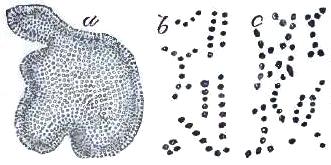
Micrococci: a, zoogloea form; b, micrococcus from urine, in rosary chain; c, rosary chain from spoiled solution of sugar of milk (Cohn).
Micrococci (Sphærobacteria of Cohn) are asserted (under certain conditions) by Letzerich, Wood, and Formad23 to be causative of diphtheria; Ogston has found them in ordinary pus; Rindfleisch, Recklinghausen, Waldeyer, Birch-Hirschfeld, and others report them to be always present in the abscesses of pyæmia; Buhl, Waldeyer, and Wagner state their occurrence in intestinal mycosis; Eberth, Köster, Maier, Burkhardt, and Osler, in ulcerative endocarditis; Orth, Lukomsky, Fehleisen, and Loeffler, in erysipelas; Coats and Stephen in pyelo-nephritis; Friedländer, in pneumonia; Eklund (Plax scindens) in scarlet fever; Keating24 and Le Bel, in measles; Leyden and Gaudier, in cerebro-spinal meningitis; Carmona del Valle, in yellow fever; Prior, in dysentery; Gaffky, Leistikow, Bokai, and Bockhardt, in gonorrhoea;25 besides other similar observations by numerous writers.
23 Bulletin of National Board of Health, Supplement No. 17, Jan. 21, 1882.
24 The Medical News, Philadelphia, July 29, 1882.
25 Sternberg's careful experimentation seems to show the identity of Neisser's gonococcus with the Micrococcus ureæ, commonly found in decomposing urine.
Bacterium termo is regarded by leading authorities as the special ferment or causative agent of putrefaction26 (Billroth, Cohn).
26 Others have referred putrefaction to vibriones, less precisely described.
FIG. 2.
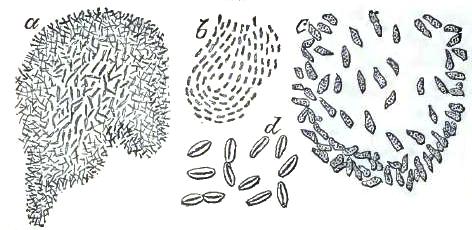
Bacteria: a, zoogloea of Bacterium termo; b, pellicle of bacteria from surface of beer; c, Bacterium lineola, free; d, zoogloea form of B. lineola.
Bacillus includes, hypothetically at least, several species; as Bacillus subtilis, the innocent hay-fungus; Bacillus anthracis, the microbe of malignant pustule (anthrax, milzbrand, charbon) and the splenic fever of sheep; Bacillus typhosus (Klebs, Eberth, Meyer) of typhoid fever; Bacillus lepræ (Hansen, Neisser, Cornil, Koebner) of leprosy;27 Bacillus malariæ, reported as having been demonstrated28 by Klebs and Tommasi Crudeli, Marchand, Ceri, and Ziehl; Bacillus tuberculosis (Koch, Baumgarten, 1882); the bacillus of malignant oedema (Gaffky, Brieger, Ehrlich); that of syphilis (Aufrecht, Birch-Hirschfeld,29 Morrison); of glanders (Loeffler, Schuetz, Israel, Bouchard); of pertussis (Burger); besides the Actinomycosis of Israel, Ponfick,30 Bollinger, and others. Koch has very recently (1883) been reported to have discovered in Egypt the bacillus of cholera.
27 Dr. H. D. Schmidt of New Orleans, an experienced pathologist, reported (Chicago Medical Journal and Examiner, April, 1882) that critical examination of numerous specimens of tissues from three cases of leprosy under his care failed to verify the existence of bacilli as characteristic of that disease.
28 Not certainly, however, as shown by Sternberg (Bulletin of Nat. Board of Health, Supplement No. 14, July 23, 1881). Dr. Salisbury of Ohio in 1866 made a series of observations, on the basis of which he asserted the discovery of a genus of malarial microphytes, which he referred to the family of Palmellæ.
The oval and spherical organisms described by Richard and Laveran as found in the blood of malarial patients resembled micrococci rather than bacilli.
29 More recently described by him as micrococci.
30 Die Actinomykose, 1881.
FIG. 3.
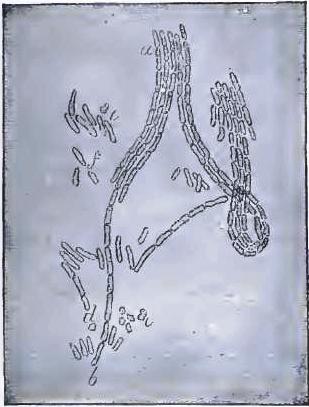
Bacillus malariæ of Klebs and Tommasi Crudeli.
FIG. 4.
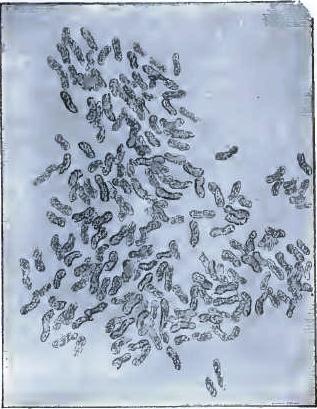
Bacteria from gelatin solution, inoculated from swamp-mud, X 1500 (Sternberg).
FIG. 5.
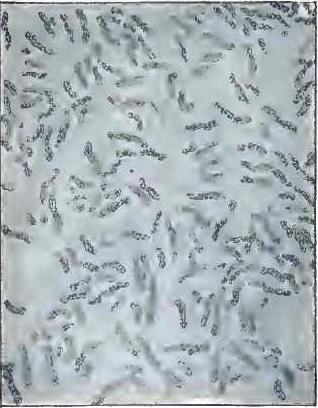
Vibrios in gelatin culture-fluid, X 1000 (Sternberg).
FIG. 6.
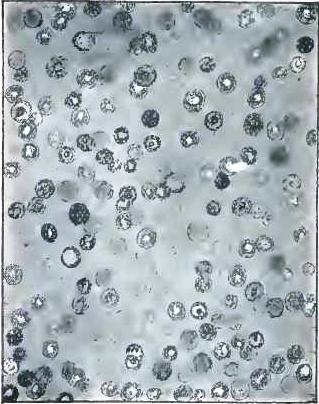
Protococcus from slides exposed over swamp-mud, X 400 (Sternberg).
FIG. 7.
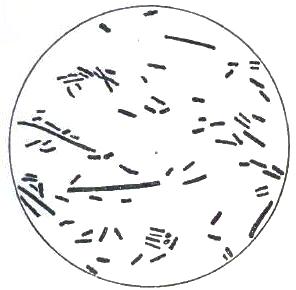
Bacilli from swamp-mud, X 1000 (Sternberg).
FIG. 8.
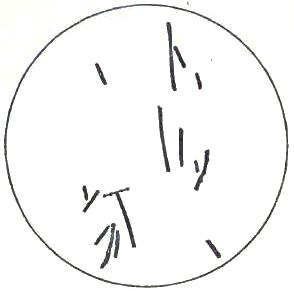
Bacilli from septicæmic rabbit, X 1000 (Sternberg).
FIG. 9.
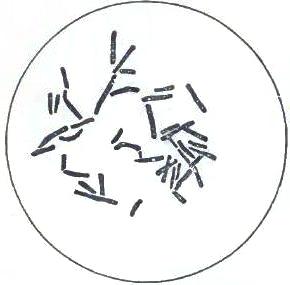
Bacilli from human saliva, X 1000 (Sternberg).
FIG. 10.
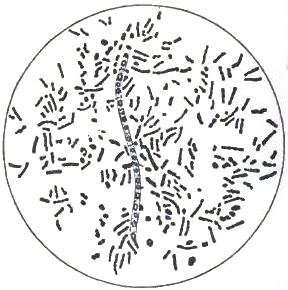
Bacillus anthracis (Sternberg).
FIG. 11.
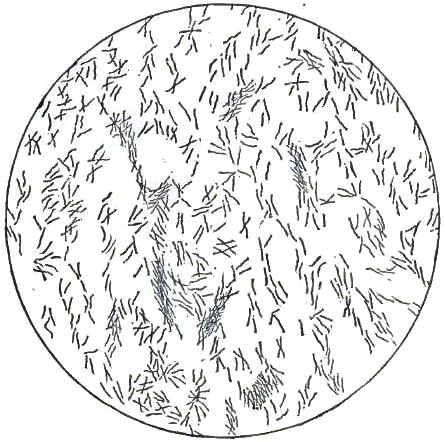
Bacillus tuberculosis, within and outside of pus-corpuscles (Sternberg).
Spirillum (Spirochæta of Ehrenberg) has its best ascertained example in the minute forms first observed by Obermeier, and afterward by many other observers, in the blood of patients suffering with relapsing fever. They have been found present in the blood only during the febrile paroxysm, disappearing in the intermission and through convalescence.
Hastening to close our consideration of this subject, we may note, without much argument, a few of the points of difficulty needing yet to be more fully illuminated by careful observation before any form of the germ theory can take its place as an established doctrine in etiology:
1. The absence of the characters belonging to definite organisms31 in the easily-studied virus of small-pox and vaccinia stands, a priori, against the probability of such organisms being essential to the causation of other enthetic diseases.
31 The particulate character of variolous and vaccine virus has been already alluded to, as asserted to have been shown by Chauveau and others. Yet it is not absolutely demonstrated that filtration may not produce an important chemical alteration in some kinds of highly unstable organic material subjected to it. Cohn figures a Micrococcus vacciniæ in his article on Bacteria (Microscopical Journal, vol. xiii., N. S., pl. v., Fig. 2). Beale denies (Microscope in Medicine, 4th ed.) the existence of any organisms in vaccine virus. Lugginbuhl, Weigert, Klebs, Pohl-Pincus, and others have asserted their existence, but, especially in the absence of any successful culture experiments, it does not seem to be proved.
2. Analogy in nature, showing the commonly beneficial action of nutritive processes in re-appropriating the products of organic decay on a large or on a small scale, makes the scavenger theory of the general function of minute cryptogamic organisms more probable, per se, than that which holds many of them to be destructive parasites or poison-producers in the bodies which they may inhabit. Few well known parasites are capable of causing death in higher animals or in man.
3. These microbes are among the minutest objects which can be studied under the microscope. Bacteria average about 1/9000 of an inch in their longest diameter; micrococci and spores (Dauersporen, Billroth) are yet smaller. Much care, therefore, as well as skill, must be exercised in making observations upon them.32 Huxley asserted a few years ago that a distinguished English pathologist had mistaken for movements of minute living organisms the "Brownian movements" seen in the particles of many not living substances under a high magnifying power. One observer, at least,33 considers that the forms designated as bacteria and micrococci, etc. are either forms of coagulated fibrin or granules from morbidly-altered blood-corpuscles (zoogloea of Billroth, Wood, Formad, and others). Koch denies the validity of the observation of organisms in tubercle by Klebs and Schüller, while insisting upon his own demonstration of a bacillus tuberculosis. Authorities must, by mutual confirmation or correction, remove these obscurities.
32 A very interesting discovery was made by Tyndall, to the effect that while one boiling of a liquid would sterilize it for the time by destroying all the bacteria present, their spores might still retain vitality and be afterward developed. By repeated exposure to a boiling temperature, taking these spores in their developing stage, they were destroyed, and complete sterilization was effected.
33 R. Gregg, N.Y. Med. Record, Feb. 11, 1882. Sternberg, however, has replied to him (N.Y. Med. Record, April 8, 1882, p. 368). The latter admits a doubt as to whether the granules seen within the leucocytes by Wood and Formad in diphtheritic material, and believed by them to be micrococci, are such, or are merely granules formed or set free by disorganization of protoplasm within the leucocytes. This uncertainty well illustrates the difficulty of these investigations.
A chemical test much relied upon is, that bacteria resist the action of acids and alkalies, which destroy granular material of animal origin; also, that all these organisms are deeply stained by aniline dyes and by hæmatoxylin. The most decisive test, however, is cultivation in a liquid sterilized by heat. Koch prefers a process of dry culture for the bacillus of tubercle.
Gradle (Lectures on the Germ Theory of Disease, Chicago, 1883, p. 28) says that the absolute criterion of the life of bacteria is their power of multiplication.
4. Bacteria and micrococci have been abundantly discovered (Kolaczck; J. G. Richardson) in healthy bodies upon the various mucous membranes and in the blood. The correctness of such observations has been denied, but, so far at least as the mucous membranes are concerned, it has been well established by Nothnagel, Sternberg, and others. Bacteria have sometimes been found in countless numbers in fecal discharges.
5. Bacteria become most numerous in materials of a septic or infectious character after their period of toxic intensity has passed by.
6. Suppuration can be produced (Uskoff, Orthmann) without the presence of minute organisms of any kind. Bacteria have been found under Lister's antiseptic dressings without suppuration following. Paul Bert destroyed all the microbes in a septic liquid, and yet found it to retain its poisonous quality. Rosenberger (1881) has made similar observations.
Panum, Coze, and Seltz, Bergmann and Schmiedeberg, Hiller, Vulpian, Rosenberger, Clementi, Thin, and Dreyer have, by various elaborate investigations, proved that fatal septic poisoning can be produced in animals by the products of organic decomposition, without the presence of living organisms. Zweifel's experiments seem to have shown that normal blood, when deprived of oxygen, in the absence of micro-organisms, may acquire septic properties.
As stated by Belfield,34 many experiments by Schmidt, Edelberg, Köhler, Nencki, and others, have shown that septicæmia may be induced by the injection into the blood of free fibrin ferment and other substances, in the absence of minute organisms. To such an affection some authors now give the name sapræmia, to distinguish it from bacterial infective disorders.
34 Lectures on the Relation of Micro-organisms to Disease, 1883.
Griffini ascertained that mixed saliva, filtered through porous plates, and thus containing no microbes, will still produce septicæmia in animals, when subcutaneously injected. Colin (1876) has denied the conclusiveness of the experiments of Chauveau, which have been held to prove the particulate nature of variolous and vaccine virus. Moreover, it is well known that eggs with shells unbroken are tainted when placed near others which are unsound.
7. While Klebs and Koch maintain the definite specificity of each minute microphytic organism, Nægeli and Billroth assert their mutual convertibility. Burdon Sanderson avers35 that "the influence of environment on organisms such as bacteria is so great that it seems as if it were paramount." Buchner, Grawitz, Greenfield, Pasteur, Wernich, Thorne, Willems, Law, Wood, and Formad report experiments making it appear that modification by culture is possible with bacilli and micrococci, converting an innocent into a malignant parasitic organism, or a death-producing microbe into one capable only of causing a transitory and not dangerous local affection; which nevertheless secures to the animal thus treated immunity when subsequently exposed to the deadly infection. Most interesting have been the successes with such culture-inoculations obtained by Buchner, Greenfield, and Pasteur with anthrax in sheep; by Pasteur also in chicken cholera; and by Willems and Law36 with the lung-plague of cattle.
35 Brit. Med. Journal, Jan. 16, 1875.
36 N.Y. Med. Record, June 18, 1881, p. 679. Exposure to the air for a considerable period seems to be the agency chiefly relied upon for what may be called the dynamic modification of these microphytes. When cultivated in the depth of a liquid, so that air is excluded, they are supposed to acquire a habit of obtaining oxygen by decomposing organic substances, and thus act destructively upon the cell-elements of living bodies. Analogous differences have long since been observed in the study of fermentation between surface and sedimentary yeast.
In none of these cases is there reported any morphological change whatever in the bacillus (Grawitz) or micrococcus (Wood and Formad); the change in the effects noted, and, in the case of the micrococci of malignant diphtheria, the acquired capacity of reproduction through several generations, are all.
8. The immunity against subsequent attacks on exposure (similar to the protection given by vaccination) continues to be without full explanation upon any theory. But it is especially difficult to reconcile it with the hypothesis of the infection being caused by, and dependent upon, the presence of peculiar microphytes. Why should not these, whether as parasites or as poisons, always produce the same effects?
9. The view entertained by Thorne, Wood, and Formad, that a common benignant affection, such as ordinary sore throat, may be converted into a violent infectious disease—e.g. malignant diphtheria—by modification of innocent micrococci into those with lethal characters, through local or bodily conditions, is sufficiently contravened by the great frequency of such conditions compared with the decided relative rarity of such malignant epidemics or endemics.
10. Throughout all the investigations which have been, and are likely to be, conducted, there remains the extreme difficulty, if not impossibility, of total separation between the microbes themselves and the matter of the vehicle in which they exist—the membrane, urine, blood, virus, artificial culture-material, or whatever it may be. All the effects ascribable to the disease germs may be, with no more difficulty, attributed to the toxic action of a portion, however minute, of the soil in which they have lived, whose modifications must be concomitant with those which they undergo. It appears necessary, therefore, at the present time, to regard this whole question as still undecided, with a predominance of probability, however, in favor of the view that these minute organisms, or some of them, have a direct and important relation of some kind to the causation of specific endemic, epidemic, and contagious diseases. Altogether, the strongest arguments are on the side of the view that the micrococci, bacilli, etc. cause diseases, not as parasites, living upon their victims, but as poison-producers infecting them.37 The germ theory continues to be in the position of a probable hypothesis, not in that of an established doctrine of etiological science.
37 This comports much the best with the general natural history of parasites on the one hand, and of venoms, ptomaïnes, etc. on the other. Gautier, Ogston, and others have expressed the opinion that microphytes may produce ptomaïnes.
Practically, the result is nearly the same as if it were altogether settled, since it is admitted on all sides that the presence of microphytes (bacteria, micrococci, spirilla) coincides with those conditions under which originate several of the most malignant diseases. Measures which prevent the appearance or promote the destruction of these minute organisms are at least often, and to a great degree, preventive, if not curative, of such disorders; and the glory of Jenner's discovery, by which the ravages of small-pox have been made (potentially at least) controllable, seems not unlikely to be paralleled by the achievements of Pasteur and others in a similar preventive mastery over other maladies of men and animals. There is, therefore, no branch of inquiry in connection with medical science more worthy of being assiduously encouraged and extended. The present may almost be said to be, in the history of medicine, an era of myco-pathology.
For an exhaustive study of Etiology attention would now have to be given to the modifying influences affecting the occurrence and character of diseases in connection with age, sex, and temperament. But, as neither of these is ever, per se, causative of any malady, and they merely determine some modification of the action of morbid causes when these occur, want of space must be our justification for leaving them to be considered, in this work, in connection with the special causation of the different diseases which will be hereafter described. A larger treatment of our present subject belongs rather to hygiene than to practical medicine.
MEDICAL DIAGNOSIS.
For the purposes of the medical practitioner all professional studies unite to the end of furnishing preparation for the diagnosis and treatment of diseases. At the bedside the cardinal questions are, How does the present condition of our patient differ from health? and, What ought we to do to bring about his recovery?
Diagnosis involves three main directions of inquiry: 1, as to the general bodily state of the patient; 2, morbid changes in particular organs, tissues, or functions; 3, as to what name properly designates the disorder, according to accepted nomenclature.
Pathology can never be out of view in connection with either the theoretical or the practical study of diagnosis. But it is most closely regarded when the last of these questions is before us, since the names of diseases generally have a more or less distinct reference to their pathological nature. Yet clinical observation always suggests the early use of provisional terms for recognized groupings of morbid phenomena; and sometimes these clinical designations remain for a long time in use because of the imperfection of pathology.
We ascertain, in practice, the nature of a given case, first, by considering its symptoms. These are those obvious evidences of deviation from health which the patient himself is aware of, or which the physician readily discerns or elicits by simple inquiry or examination.
Secondly, taking the clue furnished by symptoms, a closer inspection is made, with the intent of finding what is the actual state of important organs, as the heart, lungs, liver, spleen, kidneys, and alimentary canal.
Lastly, when these means fail to remove all obscurity, or when special scientific investigation is practicable, instruments of precision are employed, as the thermometer, sphygmograph, ophthalmoscope, æsthesiometer, or aspirator; or by the microscope and chemical analyses still more minute examination is made into the particulars of the morbid processes present and their results.
We may subdivide diagnosis, then, into: 1, symptomatology; 2, organoscopy or physical diagnosis; 3, instrumental diagnosis.
Symptomatology.
Semeiology (from [Greek: sêmeion], a sign) is a term much in use, with essentially the same meaning as symptomatology, but less conveniently distinctive, since it does not so well indicate the contrast between obvious signs, or symptoms, and those more recondite, obtained by the methods of physical diagnosis.
Signs of disease cannot be recognized as such except by one who is familiar with the appearances, actions, and manifestations which belong to health. Nor can they be understood, so as to infer what they mean, without knowledge of normal physiology on the one hand, and, on the other, of the natural history of diseases. Physiology constitutes the etymological grammar, symptomatology the vocabulary, and diagnosis the syntax of practical medicine. Just as grammatical knowledge will not enable any one to read or speak a language without acquaintance with its words, so clinical observation is necessary to the physician over and above all the knowledge he may have of physiology and pathology. He must learn to know diseases by sight, or at least by personal contact and observation.
Every one has, of course, a general familiarity with the state and actions of his own and other bodies in health, yet a more exact knowledge of the movements of respiration, circulation, secretion, etc., as well as the form, size, and relative location of all the organs of the body, is needed. Physiology and medical anatomy furnish such information. The more thorough this knowledge is appropriated, the better fitted the student is for practical diagnosis. For its application, however, cultivation of all the perceptive powers is very important. Some men have a genius for quick and clear discernment of symptoms and for their interpretation, as well as for that of physical signs. But all can much improve their senses, and their sagacity in using them, by experience. For this, if for no other reason, scientific training, in field or laboratory studies, affords the best introduction to the work of the medical student and physician. The traits most needed for success in diagnosis are exactness and comprehensiveness. First, to be sure precisely what each sign is that comes under observation; next, to overlook no existing symptoms or physical signs; and, last, so to combine them into a mental map, diagram, or picture, as to make a coherent and rational whole. This nosogram may then be compared with the descriptions of standard authorities, to find its place (if it has one) in technical classification. First, however, ascertain the thing, the morbid state or combination of states; afterward the name, or morbid species, when practicable. It is always to be remembered that complication of diseases, or at least the existence of some irregular manifestations along with those which are characteristic, is more common than the occurrence of purely typical cases. The portraits of most diseases in the books are averages, like the composite class-photographs of Douglas Galton. Not nearly every case will correspond with such an average in all respects. Moreover, so great is the possible variety of alterations among the different organs of the body that the chances of two instances of disease being precisely alike in every particular are hardly greater than those in favor of every move being the same in two games of chess with the same opening.
In an essay like the present it is not easy to decide upon the best manner of treating the subject before us. Too much or too little may be said. With advanced readers the whole history of symptoms and physical signs might be left to the special discussions occurring in articles upon different diseases. But it may be taken for granted that those who consult the present work will do so either at a comparatively early stage of their studies or when time has made desirable a renewal of what may have been once known and then forgotten. Since, then, it is impossible to anticipate what may be the exact needs of either class, a somewhat elementary statement of main facts appears justifiable here.
Following the natural method, we may suppose a call to visit a patient. Arriving in his presence, the first question (mostly left out of view and rarely expressed) may be, Is it a case of real or only imaginary indisposition? Army medical officers, more than most others, can appreciate the possibility of this inquiry sometimes disposing of the whole case.
Supposing it to be real, is it an illness or an accident or other injury? Is it severe or of trifling account? Acute or chronic? We observe the position of the patient, lying quietly in bed, sitting up, or walking restlessly about the room. Then the countenance is observed—pale or flushed, tranquil or excited in expression. We feel the forehead, touch the cheek and hand. Is the skin hot or cold, dry or moist? The pulse is felt; the breathing also is counted.
Of the patient himself or of another (in serious acute cases better of his care-taker, in another apartment) we ask questions whose answers give us the general history of the case. When not before known these should include his antecedent personal history, even extending to that of the family, as far as can be learned. What tendencies have they, or has he or she, shown by previous attacks and their results?
So we come to the present attack: When did it begin, and how? What have been its prominent symptoms since? Questions are then to be put concerning the heat of the body, appetite, complaint of pain, sleep, movement of the bowels, discharge of urine: in the female, menstruation; if married, pregnancy or parturition, how often and when occurring last. Thus the practitioner is enabled to get a clue to the diagnosis, to be followed out through his own observation and closer examination. If the patient be a child and the attack be acute and febrile, an early question must be as to its having passed or not through the different diseases of childhood—viz. the exanthemata, mumps, and whooping cough, and also what exposure to any of these it may have been recently subjected to.
Going farther into particulars, let us review some of the possible developments obtained in the above questioning of symptoms.
When lying in bed the decubitus may be significant, as, upon the back with the knees drawn up in peritonitis; with the hands pressing the abdomen in colic; tossing to and fro in the delirium of fever or of early cerebral inflammation; on one side constantly in acute inflammation of the liver or in pleurisy. Or the patient may be obliged to be propped in a sitting posture (orthopnoea) from heart-disease, asthma, or ascites, or leaning forward upon the back of a chair or a pillow with aneurism of the aorta. More remarkable still may be the subsultus tendinum of low fever, the opisthotonos of tetanus, the respiratory spasms of hydrophobia, or the clonic movements of epileptic, hysterical, or occasional convulsions.
In the face we see pallor in syncope and in anæmia in any of its varieties and with varied associations; a general redness in some cases of apoplexy and in remittent fever; flushing of the forehead and eyes especially in yellow fever; dusky redness in typhus, and a more purple hue in typhoid fever; yellowness in jaundice, in some cases of remittent and in most of yellow fever; sallowness in cancer; a bright central glow upon each cheek in early pneumonia or the hectic of phthisis; a blue or ashen appearance in the collapse of cholera, and blackish-blue in cyanosis or carbonic acid poisoning; bronzed in Addison's disease; puffy about the eyelids in Bright's disease; the surface swollen, yet resistant to the touch, in myxoedema. The eyes (one or both) glare prominently in exophthalmic goitre; squint in advanced cerebro-meningitis; roll to and fro often in the prostration of cholera infantum and in convulsions; are clear and bright in phthisis; yellowish in hepatic disorder; dull and clouded in low fevers; without expression in imbecility and general paralysis.
Contraction of the pupil is observed in inflammation of the retina or of the brain, narcotism from opium (until near death) or eserine, or apoplectic effusion near the pons varolii. Dilatation of the pupil is seen in most cases of hydrocephalus and of apoplexy; in nerve-blindness (amaurosis), glaucoma, cataract, and narcotism from atropia, duboisia, or hydrocyanic acid. Inactivity of the pupil (Argyll Robertson) under changes of light and darkness is common in locomotor ataxia. Different states of the two pupils under the same light show disorder, either ophthalmic or cerebral in site, or may indicate pressure on the cervical sympathetic ganglia, as from aortic aneurism.
In elderly persons we ought always to look for the arcus senilis, which is a sign of a tendency to fatty degeneration. It is a ring, or part of a ring, with ill-defined edges, best seen by lifting or depressing an eyelid, at the junction of the cornea and sclerotic coat of the eye. In some quite healthy old persons there may be seen at the same junction a clearly-defined circular line of calcareous nature. This must be distinguished from the true fatty arcus senilis.
Of the face we may also notice the pinched nose, hollow eyes, and falling jaw of the facies Hippocratica, presaging death; the square forehead of the rickety child (not common in this country); ulcers on the forehead, scars at the mouth-corners, or copper-colored eruptions in syphilis; the full, flabby lips of scrofula. In peritonitis or gastritis the mouth is apt to be drawn up with a peculiar expression of suffering and nausea. Very striking is the characteristic one-sided appearance in facial palsy, from lesion of the seventh nerve. There may be a smile, a frown, or other expression on the sound side of the face, while the paralyzed side is quite immovable. As the seventh nerve (portio dura) supplies the orbicularis muscles, its paralysis (so often temporary) may cause inability to close the eye upon the affected side. Ptosis, or inability to open the eye, involving the levator palpebræ, which is innervated by the third nerve (motor oculi) is more significant of cerebral lesion.
Even the ears may have language, as when their lobes are full and glistening red in the gouty diathesis, or wrinkled in prolonged cachexiæ, or when they are running with discharges in the struma (scrofula) of childhood. The hair becomes dry and lustreless in phthisis, and falls out during convalescence from many acute diseases.
If we look at the gums in a case of lead-poisoning, we may expect to find a blue line along their edges. Scurvy is betokened by a swollen, spongy, and easily-bleeding state of the gums. Many scorbutic cases, however, lack this so-called pathognomonic feature. It may be remarked, by the way, that absolutely pathognomonic signs of particular diseases, never absent and exclusively seen in them, are very few. Albuminuria, for example, is not always present in Bright's disease, and is also met with in a number of other affections. Sugar in the urine may follow inhalation of chloroform or an attack of cholera, as well as diabetes mellitus. Rice-water discharges may be absent in the collapse of cholera, and patients may die with yellow fever without black vomit. Still, these symptoms have great diagnostic value, and, taken with others associated with them, may often enable us to attain to a diagnosis of much importance.
Perfect teeth in an adult in this country are rather the exception than the rule. In the notched incisors of inherited syphilis, however, there is something quite distinctive. The notches in Hutchinson's teeth are vertical, not horizontal.
Old as medicine is the examination of the tongue in disease. It may be protruded with difficulty, as in low fevers, in apoplexy, and in cerebral paralysis (bulbar sclerosis, glosso-labio-pharyngeal paralysis) or thrust to one (the paralyzed) side in hemiplegia. It is pallid in anæmia; yellow in bilious disorder; red in glossitis (then swollen also), in scarlet fever, and in gastritis; furred in indigestion, gastro-hepatic catarrh, and the early stage of various febrile attacks; dry, brown, cracked, or fissured in typhus or typhoid fevers and in the typhoid state of malarial remittent fever; bare of epithelium in advancing phthisis and in imperfect convalescence from severe acute diseases. Coldness of the tongue is one of the worst signs in the collapse of cholera.
As we examine the throat internally we look for signs of faucial inflammation in redness and swelling, with or without enlargement of the tonsils, or relaxation and elongation of the uvula, or ulceration, or the gray or brown membranous deposit of diphtheria. In the mouth of a child we may find the little white vesicular patches called aphthæ, the curd-like exudations of thrush, or possibly the much worse grayish ulcerations of cancrum oris, or the rarer ashen sloughs of gangrene of the mouth.
Outside of the throat we must remember the significance of glandular swellings or scars of suppurated glands in children; nor overlook, if present, stiffness of the muscles, or torticollis, or goitrous enlargement of the thyroid gland. Observation should be made also of the site of the carotid artery on each side, and of the jugular veins, since aortic regurgitation may be indicated by violent action of those arteries or tricuspid regurgitation by pulsation of the veins in the neck.
Long before vaso-motor physiology had any place in science the pulse was known to afford valuable indications in disease. Either of the accessible arteries will answer instead of the radial; its convenience merely makes the wrist the common place of comparison. By careful examination of the pulse something may be learned of several of the factors concerned in its production. These factors are—1, the muscular force of the walls of the heart; 2, the state of the cardiac valves; 3, the muscularity of the arteries; 4, the elasticity of the arterial coats; 5, the state of the capillary circulation; 6, the qualities of the blood; 7, the condition of the nervous system as to excitability or apathy.
A feeble heart must induce a feeble pulse. Moderate debility may be attended by slowness of the pulse, but usually a weak circulation is marked by frequent, small beats, like the vibrations of a short pendulum. A strong heart-beat (other things being equal) is relatively slow, with a proportionate pause after the second sound.
Valvular lesions produce various effects upon the pulse. Most notable are the irregularity connected often with mitral insufficiency and the jerking pulse (Corrigan) of aortic regurgitation.
Believing, as the present writer does, in the existence of a true arterial systole following and supplementing the ventricular contraction,38 it must be urged that a vigorous muscularity in the arteries promotes strength in the pulse—not by resistance, but by auxiliary propulsion of the blood. Another condition altogether is tonic, spasmodic contraction of the arteries. This is not often met with pure and simple, but a measure of it is seen in the corded or wiry pulse of acute enteritis or peritonitis.
38 This view, although advocated by Sir Charles Bell, Legros and Onimus, Hermann of Zurich, and others, is opposed to the most prevailing vaso-motor physiology. Several complications and some contradictions in pathological discussion at the present time would be cleared up by the abandonment of the now commonly-held stopcock theory of arterial function, which has really nothing whatever to support it except the misinterpretation of some experiments upon arteries made many years since.
Deficient elasticity of the arteries is not easily separated in observation from muscular relaxation. When arteries undergo degeneration (atheromatous, fatty, or calcareous), their middle coat suffers the deterioration of both elastic and muscular tissues, these being substituted by materials either more or less yielding, and always less resilient, than the natural fabric of the vessels.
The influence of the condition of the capillary circulation upon that of the arterial system and the heart is manifest in inflammations. By reflex excitation the arteries are made to contract actively and impel the blood more forcibly than in the normal state toward the centre of impeded nutrition (stasis). This has been abundantly proved by the comparison of the amount of blood flowing through the arteries of a sound limb and those of its fellow, when the latter is the seat of a violent acute inflammation.
Blood-states also affect the pulse by the differences in direct stimulation to which the heart and arteries are subjected according to the qualities and composition of the blood. It is probable that the fever-pulse of typhus, typhoid, the exanthemata, septicæmia, and pyæmia has its origin in morbid conditions of the blood, acting in a twofold manner—directly upon the heart and arteries themselves, and mediately through the vaso-motor ganglia.
Lastly, the nervous system stands in an important relation to the action of the heart and arteries, and thus to the pulse. In a nervous, excitable person, changes in the rate of the pulse may take place, with slight significance, which in a different constitution might be of serious import.
To understand the language of the pulse care must be taken in several respects:
1. Both wrists should be felt. Sometimes there is an abnormal variation in the course of the main radial trunk which may pass over the thumb. Again, an aneurism may cause a great difference between the two radial pulses, or, possibly, an embolus may occlude one of the radial vessels, annulling its pulsation.
2. Other arteries also, especially the carotids, should be examined—in all obscure cases at least. Visibly beating, distended, and tortuous temporal arteries are occasionally met with. They are not pathognomonic of any one malady, although often referred to the gouty diathesis. They may attend irregular malarial attacks, or may be connected simply with a hyperæmic state of the brain.
3. The heart's impulse should always be compared with the arterial pulsation. The former may be strong and regular, while the latter is small, feeble, or intermittent. Something must then be wrong, either in the aortic valves or in the arterial system.
5. On account of possible nervous agitation, the pulse should usually be examined more than once, during each visit to the patient.
6. Sex, age, position of the body, and time of day must all be taken account of. In men the average rate of the pulse is between 65 and 75 per minute; in women, between 70 and 80. The pulse-rate of early infancy varies from 100 to 120, and is very easily hurried. That of old persons is commonly between 60 and 70, until, at a very advanced age, with debility, its frequency may be increased, especially upon exertion. Lying down, we find the slowest pulse; sitting, somewhat more rapid; and most so in the standing position. In health the time of day makes no constant difference apart from the effects of food and exercise. In disorders attended by fever there are important changes to be regularly observed. Excepting the variable paroxysms of remittent and intermittent, which are a law unto themselves, in febrile affections the pulse may be expected to be slowest in the morning and most excited in the early part of the night. A diminution of this difference is a favorable sign. Sleep generally slows the pulse decidedly. The ordinary statement is, that the pulse is always slower during sleep, but I have several times found that in states of exhaustion without fever it may be considerably more rapid while the patient is asleep. Nothing is more sure to increase the strength and rapidity of the pulse than high temperature.
7. Very important is the relation between the pulse and respiration. Normally, four pulsations occur to each respiratory act. In pulmonary affections, while the circulation is often disturbed pari passu with the breathing, it may be quite otherwise. Great acceleration of the rate of breathing, with little increase in the rapidity of the pulse, should lead us to suspect disease involving the respiratory organs. Conversely, a much hurried or otherwise perturbed pulse, with little or no change in the breathing, points toward the heart as either functionally or organically the seat of disorder.
Let us further consider, briefly, the kinds of pulse to be met with and interpreted in practice.
A natural pulse is always, per se, a good sign. Yet in the history of a disease usually so well marked as yellow fever some fatal cases have been recorded (walking cases) in which the pulse, almost to the last, was natural.
Strength of the pulse, to a certain degree, belongs to it normally. But this is often exaggerated, and we may have the strong, hard, full, perhaps bounding, pulse of an inflammatory affection (of the brain, for example, or of the joints in acute rheumatism) in a person of vigor. A bounding pulse often accompanies mere palpitation of the heart, whose source may be the sympathetic influence of indigestion or nervousness. A similar pulse is apt to be constantly present in hypertrophy of the heart. In this case it is made more forcible as well as more rapid by active exertion; while palpitation, without organic trouble, is usually diminished by moderately active exercise.
A full pulse is not always strong, nor is a small pulse necessarily weak. Mention has been made already of the tense, corded pulse met with in acute peritonitis, and sometimes in enteritis. Gastric inflammation, with nausea, may exhibit a depressed pulse, weak and but little accelerated. Under still other circumstances we may find a full pulse which is soft, easily compressible, even gaseous. Most frequently a feeble pulse is rapid, and a very rapid pulse is weak. Slowness, in marked degree, attends apoplexy, opium narcotism, and fracture of the skull compressing the brain. Functional disturbance of the heart may occasionally exceed in effect these causes of retardation. I have met, under such circumstances, with a pulse of 20 in the minute; one of 18 has been recorded. A few apparently healthy persons have habitually a pulse with but 40 or 50 beats in the minute.
Quickness in each beat may occur, while a long interval makes the rate per minute slow. The jerking pulse of aortic regurgitation is the most remarkable example of this. Galabin asserts that without imperfection of the valves of the aorta a decidedly abrupt pulse may attend great lowering of arterial tension. Something of the same kind may be noticed in the temporarily excited pulse of very nervous subjects under agitation.
Dicrotism, or reduplication of the pulse-beat, is not uncommon in typhus and typhoid fever. Here relaxation of the heart as well as of the blood-vessels appears to allow a momentary interruption in the succession of the arterial upon the cardiac systole.39
39 An exceptional phenomenon, noticed by a few observers, is the recurrent pulse; i.e. a pulsation felt below the finger, whose pressure interrupts the flow of blood through an artery. It may be explained by supposing unusual fulness of the vessels (local, if not general) with, at the same time, relaxation of their walls; bearing in mind, also, the manner of anastomosis of the radial and ulnar branches which favors recurrence.
Intermittence and irregularity of the pulse are not exactly the same thing. Occasional intermittence may be merely a nervous symptom or a muscular twitch of the heart, like the twitches now and then occurring without significance in voluntary muscles. Persistent intermittence, with feebleness of the pulsations (these being generally somewhat rapid), is among the signs of dilatation of the heart.
It is possible for intermittence of the radial pulse to accompany regularity in the heart-beat. This usually results from narrowing (stenosis) of the aortic valvular outlet from the left ventricle. Only a certain number of impulses fairly reach the more distant arteries. This symptom may result also from fatty degeneration of the heart.
Absence of pulse in one radial vessel, while it is present in the other, shows the presence of an obstacle to the circulation on one side, which may be an aneurism, or an embolus plugging the artery.
Irregularity of the pulse, a total derangement of its rhythm, while not often important in young children, is a serious symptom at other times of life. In one disease most common in childhood, acute hydrocephalus, the pulse in the first stage is apt to be hard and rapid, in the middle stage slow and tolerably full, in the third rapid, feeble, and often irregular. Mitral disease frequently presents considerable irregularity of the pulse; and so does dilatation, even without mitral lesion. Brain trouble, especially late in life, whether structural or functional, may produce the same symptom. B. W. Richardson has pointed this out as one of the effects of the excessive use of tobacco, even in young persons.
The pulse of continued, relapsing, and remittent fevers is, during the febrile exacerbation, rapid (100 to 120); in the earlier part of the attack full, but only moderately hard, or even soft and yielding. As the attack passes its height and critical defervescence occurs, the pulse grows slower, unless great prostration has supervened; in which case it increases in rapidity, while it fails more and more in fulness and resistance.
The pulse of the moribund state is nearly always small, very rapid (130-150), and thready, without force or fulness. It may become imperceptible before death. A pulse of 140 beats in the minute is always alarming; if much beyond that rate the case is desperate. A pulse of more than 150 beats in the minute is very difficult to count accurately.
Exophthalmic goitre is attended characteristically by a full, somewhat rapid, and bounding pulse, the cardiac impulse being also proportionately violent and extended. Exercise much increases this hyper-pulsation.
Pulsation of the jugular veins is ordinarily explained by tricuspid regurgitation, a portion of the blood being sent back to the vena cava with an impulse reaching to the jugulars. In some instances, however, as the writer has repeatedly observed, jugular pulsation takes place without any abnormality in the action or condition of the heart, from a local inflammation (as tonsillitis) causing a marked exaggeration of the muscular contractility resident in the larger veins.