Volume 1 — GENERAL DISEASES. (continued 13)
Reading edition
Leaving out of consideration sucklings under six months of age, in whom measles is rare and said to be slight, most deaths from the disease occur among very young children, from their greater liability to complications. According to Beddoes,39 the mortality from measles is, beyond all comparison, greatest in the second year of life, and by the tenth has become quite trifling. An examination of the statistics bearing on this question coincides with this general statement; but Fox's tables, already quoted, would show that more infants under one year of age die of measles than has hitherto been supposed. The susceptibility to measles decreases with years, perhaps on account of the fact that most adults have already contracted the disease; but when it does attack the unprotected adult it may prove fatal. This statement is borne out by the large death-rate in the so-called camp measles of our late war.40 The ravages of measles in virgin communities have been referred to in preceding pages. The general temper of the epidemic must also be considered, since it is well recognized that the essential character of epidemics differs much as to severity.
39 Art. "Mortality" in Quain's Dictionary Med., p. 1002.
40 In the general field hospital at Chattanooga the death-rate was 22.4 in 100 cases. In General Hospital No. 1, at Nashville, it was 19.6 in 100, or nearly 1 in 5. Many died or became permanently disabled from the sequelæ (Bartholow).
Such complications as diphtheria, catarrhal pneumonia, diarrhoea, convulsions, etc. necessarily affect the prognosis of measles most seriously. More patients die of measles in the second than in the first week of the disease. The careful studies of temperature made by Thomas, Bohn, and others show that an unusually high and increasing fever in the prodromal stage is of ill omen, particularly on the second and third days, and a fever heat measuring over 105° F. at any stage should be considered as very unfavorable.41 Particularly to be feared is continuation of the fever after the subsidence of the eruption, or a sudden elevation after the normal curve has been reached. In fact, it is a safe rule to look upon all anomalies of the curve with suspicion. Secondary measles, or measles grafted upon some serious existing affection, is particularly fatal.
41 In adolescence a body heat of 107° F. has been safely passed during the decline of measles with no marked complication (Squire).
TREATMENT.—There is no remedy which will destroy the susceptibility to measles. The future may develop some form of vaccination against rubeola, for, certainly, the hopes held out by the inoculation of measles upon the healthy subject have not been realized, as this procedure merely reproduces the original complaint, without any diminution in its intensity, and does not lessen the probability of complications (Mayr). The matter of carrying out a practical and efficient quarantine in measles is one of unusual difficulty, for the reason that the disease is capable of active propagation at a time—the prodromal stage—when it is not yet sufficiently characteristic for positive diagnosis. But, as measles is by no means as trivial a disease as would seem to be the common impression, I hold it as a well-established principle of preventive medicine that a strict isolation should be enforced whenever, from the nature of the case, it is at all possible; certainly, very young children and those suffering from or showing a tendency to other diseases should be jealously shielded from exposure.
The usual precautions as to disinfection and purification of the room, bedding, and utensils used by patients should be observed, as in other infectious diseases. Squire is of opinion that there is danger of personal infection for perhaps a month, and Hillairet that isolation for forty days should be enjoined. It is quite certain that inunction lessens the danger of infection, and Kaposi42 is authority for the statement that a warm bath administered after the completion of desquamation, or about fourteen days from the beginning of the attack, will effectually prevent contagiousness.
42 Pathologie u. Therapie der Hautkrankh., Wien, 1880.
The apartment occupied by a patient suffering from measles should be kept at a uniform temperature of from 66° to 70° F., and free ventilation, at the same time avoiding draughts, should be enforced. The room should be kept moderately dark. The bed-clothing should be light, yet sufficiently warm, and the old notion of keeping the patient in a profuse sweat the better to bring out the eruption should be discouraged. The diet should be bland and nutritious, and may preferably consist of milk, gruel, tapioca, and such like substances. As convalescence progresses there may be a gradual return to more substantial food. The patient may be allowed cool water in moderation, as it is cruel and useless, and even harmful, to restrict one suffering with fever to warm or sweetened drink. The patient should be confined to his room until convalescence has been fully established, and should not be allowed to leave the house, both on his own account and that of others, until the usual health has been regained. Any of the lingering results of the disease, such as bronchitis, otorrhoea, conjunctivitis, etc., should receive prompt attention; iron and cod-liver oil should be prescribed for the weakly and strumous, and regular hours of sleep, careful diet, and appropriate bathing and exercise should be advised. It may be said, without exaggeration, that neglect of the after-care of measles patients is, in some instances, more to be deprecated than a similar neglect in the actual treatment of the disease itself.
Since we are powerless to cut short an attack of measles by any remedial agents at present known to therapeutics, the intervention of the physician is limited to assisting the cases through to a safe termination. Quite a number of cases, as seen in private practice, require no special medicinal treatment, or at most one that is merely symptomatic. The value of the so-called specific treatment, such as by carbonate of ammonium, etc., has not been verified by experience.
In ordinary uncomplicated attacks, if the temperature should run high, in addition to the general rules as to diet and hygiene referred to before it will usually be found advisable to put the patient on some diaphoretic mixture, to which may be added a mild opiate. I know of nothing better than the formula found in the work of Meigs and Pepper on the Diseases of Children:
Rx. Potass. Citrat. drachm i;
Spt. Ætheris Nit. fl. drachm ii;
Tr. Opii Deodorat. minim xii vel xxiv;
Syrupi fl. drachm ii;
Aquæ fl. oz. ii. M.
S. A teaspoonful every two or three hours for a child of five years of age.
Aconite in small doses has been well spoken of in this connection, but I have no personal experience in its use. Bromide of potassium, together with a few drops of syrup of ipecac., dissolved in syrup of wild cherry, acts pleasantly both on the cough and the nervous system.
The inunction of fatty substances, as originally proposed by Schonemann, and recently urged by Milton,43 is an excellent routine practice, and in addition to adding very much to the patient's comfort, has, perhaps, the merit of lessening somewhat the danger of infection to others. For this purpose one may use leaf lard, cold cream, or vaseline, to each ounce of which it is well to add a few minims of carbolic acid.
43 Archives of Dermatology.
Stimulants are rarely needed in uncomplicated measles, but Squire very wisely calls attention to the great value of wine in the depression following upon the crisis.
In spite of some excellent authority to the contrary, I cannot see that any benefit is to be derived from using severe measures to bring out an eruption that has undergone retrocession. As stated in another part of this article, the so-called striking-in of the rash is the result of the supervention of some complication, and not the cause of it; therefore, a rational course of action would be to ascertain the nature of the complicating trouble, and to endeavor to correct it, which, at the same time, would be the very best means of restoring the normal course of the disease.
Quinia is of great value in controlling the excessively high temperature which is sometimes observed either in connection with, or independent of, complications. If the quinia should prove ineffectual or else be rejected by the patient, the physician should not hesitate to abstract heat by cold water in the shape of the wet pack or the general bath. I think the latter method is to be preferred. It is but to employ the gradually cooled bath of Ziemssen, perhaps, commencing at 90° F. and going to 80° or 70° F. The condition of the patient, as ascertained by the thermometer and also the state of the pulse, must be the guide as to the duration and repetition of the baths. In Germany excellent results are claimed for the treatment of hyperpyrexia in measles by the cold pack, even when the excessive temperature is due to such a complication as broncho-pneumonia.
There is little hope from therapeutical interference in malignant forms of measles, but the medical attendant should endeavor to reduce temperature and support the strength by free stimulation and nourishing food.
It will now be advisable, at the risk of some repetition, to call attention to the treatment of some of the more prominent disturbances and complications of measles.
Epistaxis, if severe, should be checked by cold applications and astringents. Plugging will rarely be found necessary. Trousseau recommends the injection of water as hot as can be borne. Ergotine by the mouth or hypodermically will sometimes prove highly valuable.
The lids should be anointed with vaseline or cold cream to prevent their sticking together, and it is well to occasionally evert them to see that no serious mischief has happened to the eye. If the conjunctivitis is intense, the discharges should be removed and cold compresses applied.
Since aural complications are due to extension of inflammation from the oral and nasal cavities, Spencer urges the importance of early and systematic treatment of these parts. He advises astringent applications (Monsell's solution 1 to 4 of glycerine) to the pharyngeal mucous membrane. Ointments of boracic acid, zinc, or iodoform are likewise useful when introduced through the nostril. Earache will require warm opiated poultices and inflation. Otorrhoea is best treated after the dry method.
For sickness of the stomach a spice poultice may be applied and small bits of ice given to suck. If constipation exist, a little oil or syrup of rhubarb or some stewed prunes, or an enema, may be ordered. Active purgation should be withheld.
The early diarrhoea need give little concern, as it usually soon ceases; but if it should persist, recourse must be had to more energetic measures, such as the use of opium by mouth or enema, given cautiously in the case of children, vegetable and metallic astringents, and the application of hot poultices to the abdomen. The diet should be carefully guarded.
The cough, even in mild cases, generally requires some slight palliative, such as syrup of ipecac., and an occasional small dose of Dover's powder. Loeri very properly advises against the use of irritating expectorants. I think it advisable to keep the chest well smeared with camphorated oil, over which should be worn an oil-silk jacket. These simple measures, perhaps, diminish the tendency to thoracic complications. The sometimes violent paroxysms of false croup are very satisfactorily managed, after the manner of Graves, by gently pressing a sponge, soaked in very hot water, under the chin and over the front of the neck. When the dyspnoea is alarming, emetics, and the general warm bath should be brought into requisition.
Convulsions in the early stage require little treatment other than the warm bath and appropriate doses of the bromide of potassium; occurring later, they are very fatal under any treatment, as they generally supervene in connection with some of the grave complications of the disease. Chloral, preferably by enema, and chloroform may be tried. The management of the severe bronchitis and pneumonia of measles requires great care and circumspection on the part of the physician. The application of a well-made flaxseed poultice, which should be neither too heavy nor too hot, is to be regarded as invaluable. To the flaxseed may be added a small quantity of mustard. Over the whole is to be placed an oil-silk jacket. Alcoholic stimulants, nourishing, easily-digested food, and expectorants containing carbonate of ammonium are to be recommended.
For the treatment of the other complications and sequelæ of measles the reader is referred to the appropriate sections of this work.
RÖTHELN.1
BY W. A. HARDAWAY, M.D.
1 In the preparation of this article the author has consulted the following authorities: Emminghaus, in Gerhardt's Handb. der Kinderkrankh., Zweiter Band, 1877; Thomas, in Ziemssen's Cyclop. Pract. Med., vol. iii., Am. ed., 1875; Squire, in Quain's Dict. Med., 1883. References to current literature will be found in foot-notes to the text.
SYNONYMS.—Rubeola, Rubella, Roseola, Epidemic Roseola, German Measles, French Measles, Hybrid Measles, False Measles, Rubeola Morbillosæ et Scarlatinosæ.
DEFINITION.—Rötheln is an acute infectious disease, presenting an eruption of reddish macules upon the skin, accompanied by mild catarrhal symptoms, and usually producing but slight disturbance of the general system. It is self-protective, and occurs but once in the same individual. It has no relationship to measles or scarlatina.
HISTORY.—A rapid glance at the interesting historical evolution of rötheln to a specific position among the acute infectious diseases is all that our space will allow. Some writers have attempted to show that this affection was known to the Arabian physicians; but since it is only in comparatively recent times that the contagious epidemic exanthemata in general have been thoroughly differentiated, it is quite likely that the modern conception of it was not held by them nor by other medical men till many centuries later. Indeed, in our day, physicians are yet to be found, though the number is rapidly diminishing, who refuse to recognize in rötheln a distinctive specific malady. Certain German observers in the middle of the last century (De Bergen, 1752; Orlow, 1758) favored the idea of specificity, but these views were soon disputed. In the years following a number of other physicians announced their belief in the specific nature of rötheln, while, on the other hand, various noted authorities still insisted upon its connection with scarlet fever or measles. In 1815, Maton, an English physician, most unequivocally declared that he had observed cases of an eruptive disorder which resembled neither measles, scarlatina, nor roseola, and which was worthy of a new designation.2 In the second and third decades of this century Hildebrand, and afterward the celebrated Schönlein, taught that rötheln was a hybrid of measles and scarlatina, although at this time Wagner (1834) advocated the essential independence of rötheln. There is no doubt that under the name of rubeola sine catarrho Willan, Bateman, and later writers described what we now call rötheln, for they stated that this variety of measles was not self-protective. Space will not allow of a detailed mention of the various writers who, during the first half of this century, have contended for or against the autonomy of rötheln. It will be well to state, however, that Hebra, from the standpoint of the dermatologist, very properly regards the manifold roseolæ of Willan as in many instances merely symptomatic erythemata, or else as irregular forms of measles or scarlatina; but he also fails to recognize the distinctive features of rötheln. Even so recent a writer as Niemeyer declares that roseola arising from infection consists in a modification of measles or scarlet fever. It is only in the last twenty years that our present exact ideas of rötheln have obtained. For example, while Trousseau3 asserts that rubeola (rötheln) is a perfectly distinct nosological species, he speaks of the rash as appearing and disappearing alternately for some days, of its frequent recurrence in the same individual, etc. American physicians were almost entirely ignorant of rötheln till within the last ten years, when they were made acquainted with it through the medium of a careful paper on the subject from the pen of J. Lewis Smith of New York.4 Before this time, however, cases had been described by Homans, Sr., of Boston (1845), and in 1853 and 1871 by Cotting. Very few authorities now dispute the distinctive specific nature of rötheln; which statement is borne out by the fact that at the last meeting of the International Medical Congress, held at London in 1881, there were but two dissentients to this view in the section before which it was discussed.5
2 Squire, Trans. Internat. Med. Congress, London, 1881.
3 Clinical Medicine, vol. ii.
4 Archives of Dermatology, Oct., 1874.
5 See especially Kassowitz's paper, "Die Wirkliche Stellung der sogenannten Rubeola," etc., Trans. Internat. Med. Cong., 1881.
ETIOLOGY.—The contagium of rötheln is unknown, but that the disease is contagious has been fully demonstrated by numerous observations of epidemics and sporadic cases. From my own experience I should judge that unprotected persons are not so susceptible of it as is known to be the case under similar conditions in measles;6 yet cases are recorded which would prove that the contagion may be conveyed through a third person and for some distance. It is probable that the vehicles of contagion are the same as in measles. At what period of its course the disease is most capable of transmission has not been satisfactorily determined. Squire is of the opinion, however, that the disease is contagious before the appearance of the rash, and may continue so for some days or for two or three weeks. Rötheln may be called a disease of childhood for the same reason that the other contagious exanthemata are—namely, that the majority of adults have already been attacked. From an examination of available statistics I am inclined to regard the ages between five and fifteen—the years of school attendance—as the period of life most susceptible of the influence of rötheln, although, of course, no time of life is entirely exempt. The non-susceptibility of sucklings, as in measles, holds true as a rule, although I am in a position to supply exceptions to this from my own experience, as well as from that of others. Sex seems to be without influence in determining liability to the disease.
6 In this regard it resembles scarlatina more than measles, for I have a number of times seen the disease introduced into families, where it would attack one or two of a number equally exposed. J. L. Smith regards it as feebly contagious, and quotes Chadbourne's experience to the same effect. Liveing declares that rötheln is more distinctly epidemic in Great Britain than either measles or scarlet fever, although probably less contagious.
The period of incubation is not very definitely settled, and, indeed, owing to the generally trivial character of the affection, evidence on this point is difficult to obtain. Taken as a whole, it is probably longer than is observed in measles. According to J. Lewis Smith, in the epidemic observed by him the incubation period varied from seven, or less than seven, to twenty-one days; Emminghaus places it at from two to three weeks; Thomas, from two and a half to three weeks; Squire, mostly a fortnight, the extreme being twenty-one days; Cheadle, from eleven to twelve days.
There is nowhere recorded a trustworthy instance of a second attack of rötheln, although from analogy such an event is to be expected. As in measles, true recurrences of rötheln—that is, the result of a fresh infection—are not to be confounded with relapses. I have never witnessed a relapse, but cases of such a nature have been recorded by other observers (Lindwurm, Emminghaus, Körtlin, Kingsley).
Rötheln is a disease sui generis, and is in no way related to either measles or scarlatina; that is to say, it is not an irregular form of either of these nor a hybrid of them, nor has it ever been observed to propagate anything but itself. That it is not connected with any of the symptomatic skin eruptions—the so-called roseolæ—is proved by its contagiousness and epidemic character. I quite agree with other observers in declaring that rötheln has very little clinical resemblance to scarlatina, and that, on the other hand, in the greatest number of cases the points of likeness are with measles. In the section on diagnosis the differential points between rötheln, measles, and scarlatina will be considered; therefore in this place it will only be necessary to call attention to certain general facts. Thus, aside from the marked divergence in clinical symptoms—incubation, invasion, fever, eruption, complications, and sequelæ—we are at once met by the positive fact that epidemics of rötheln, while always presenting identical features, prevail without regard to the existence of similar epidemics of measles and scarlatina—following or preceding them—and that attacks of rötheln offer no bar to the reception of their contagions, or vice versâ. Literature is so full of examples of this statement that it need scarcely be dwelt upon. By way of illustration, however, the accurate observations of J. Lewis Smith may be quoted in this connection. Of 48 cases recorded by him prior to May 1st in the New York epidemic of 1874, 19 had had measles. Rötheln in the N.Y. Foundling Hospital in 1873-74 followed an epidemic of measles. During the epidemic of 1880-81 the same fact was observed—namely, that a previous attack of measles, as well as scarlatina, afforded no protection from rötheln. I could multiply such examples from my own experience. A single interesting instance may be noted here. A physician asked the writer to examine his child, suffering, as he thought, from measles. A careful investigation revealed a typical rötheln. A number of weeks later an older child got measles, from which the rötheln patient acquired a characteristic attack of the same. In the following year both children were taken with scarlet fever.
The only escape for those who would deny the autonomy of rötheln is in the bold assertion that both measles and scarlatina more frequently recur in the same individual than universal experience and observation will allow; and this leaves them in the dilemma of determining to which group rötheln must be relegated. The hypothesis of the hybrid nature of rötheln cannot be accepted by the pathologist nor the clinician, if for no other reason than that no one has ever seen rötheln generate anything but rötheln, and in no case give rise to either scarlatina or measles.
SYMPTOMS AND COURSE.—As already stated, the probable average duration of the incubation period in rötheln is about fourteen days, varying, however, within the limits of from six to twenty-one days. In this respect rötheln resembles scarlatina more than measles, the period of latency in the latter observing considerable uniformity. No deviations from the general health are to be noted in the incubation stage.
In most cases prodromal symptoms are entirely absent, the presence of the eruption being the first thing to show the existence of rötheln in the system. On the other hand, in a certain proportion of cases there will be present for a half day, or even longer, the general symptoms of malaise, such as slight nausea, some sore throat, pain in the limbs, stiffness of the neck, etc. Vomiting is generally absent. J. L. Smith records one case of convulsions in the stage of invasion, and I have notes of a single case in which the prodromal stage was initiated by mild delirium and fever, the latter anticipating the eruption for two days and a half, and disappearing when the rash came out. As Thomas well observes, however, such cases are anomalous, and indicate either abnormal sensibility on the part of the patient or are due to a secondary rötheln.
Most observers (Emminghaus, Thomas, Smith, Squire) describe the rash as coming out in the order usual in measles—namely, first upon the face, scalp, and neck, then the trunk and arms, and finally the legs. Others (Liveing, Morris) have stated that the rash first appears upon the back and chest. In many cases in my own experience this has seemed to be true. It is quite probable that the situation of the exanthem in rötheln, as in measles and scarlatina, may present various irregularities; but I am inclined to believe that a careful investigation will in most instances show that the normal course of the eruption is as first stated. Now, a marked characteristic of the rash of rötheln is that, unlike that of measles, there is no period, however short, in which its maximum is simultaneous over the whole body; on the contrary, the eruption will have reached its full development upon the face, and will be almost or quite faded again, before the exanthem, for example, will have blossomed upon the trunk, and especially upon the lower extremities. The duration of the eruption upon individual parts of the body is probably from a few hours to half a day at most (Thomas). A consideration of these facts explains, according to Emminghaus, how different observers have described the eruption as having its seat upon this or that region of the body; in other words, it is probable that in a certain proportion of the cases in which the rash was supposed to have begun on the chest it had already run its course upon the face. The eruption usually continues altogether about four days, sometimes disappearing sooner, and sometimes being visible, especially as a fine mottling, for some days longer. So far as the individual lesions of the eruption are concerned, there is no question that they present, within a certain range, varying aspects; and this clinical fact has been taken advantage of by the opponents of the idea of specificity in order to make it appear that the disease is not sui generis, inasmuch as it lacks uniformity of expression. Such an argument wants force when we consider that in making up a given diagnosis we lay stress not upon special, but upon the ensemble of, symptoms. For example, no one would deny to measles an independent position because the eruption, as is well known, may assume this or that form (morbilli lævis, m. papulosi, etc.); on the contrary, we recognize a particular case or series of cases to be measles from a due appreciation of all the symptoms present. So it is to be expected that while the cutaneous lesions will present a certain similarity of feature, as they do, there will also exist minor differences in detail.
In the greatest number of cases in my own experience the exanthem is composed of ill-defined, roundish, punctate macules, without special grouping. These are usually discrete, but in certain situations they may coalesce. The color is of a pale rosy red, quite difficult to describe, but less purplish than in measles, and not so livid a red as in scarlatina. I have occasionally observed large irregular spots not unlike those of measles.7
7 According to Emminghaus (op. cit., p. 345), the eruption generally forms roseolæ of pin-head, lentil, or small bean size. They are mostly round, sometimes oval, and bordered by well-defined or by blurred edges. The intervening skin is not always unchanged, for here and there we find upon it small dilated blood-vessels, and from the spots processes extend with a certain regularity to other spots in such a way as to give the skin a marbled appearance.
Thomas distinguishes three types of eruption—one with large spots, which is rare; one with medium-sized spots; and one with small spots. Emminghaus describes a discrete and a more confluent variety. I have observed one case where the maculæ on the back had undergone a vesicular transformation. Others have mentioned this occurrence. Itching of the skin is marked in some cases, and a fine desquamation is observed after the rash, but by no means invariably.
The mucous membranes are implicated to a slight degree in rötheln, but the amount of involvement varies considerably. In some cases that I have observed the catarrh of the mucous membranes has been barely appreciable. As a rule, however, the eyes are somewhat suffused, and there is slight lachrymation and photophobia. Sneezing may be noted, but there is little discharge from the nose. Sore throat is not uncommon, perhaps the most constant feature, and, according to Liveing, is apt to persist after the subsidence of the rash. The fauces are injected, and the tonsils are red and swollen, but with no evidence of ulceration. J. Lewis Smith and others state that the buccal mucous membrane shows a more or less diffuse patchy and spotted redness. The tongue may be, and usually is, covered by a white fur, through which protrude a few enlarged red papillæ. There may be slight cough. Loeri8 describes the mucous membranes of the pharynx, larynx, and trachea as presenting a spotted or uniform hyperæmia. There is no marked participation of the intestines in the catarrh. Some few writers have noted a transient albuminuria, but it is safe to say that such cases are entirely anomalous, if not, indeed, in some instances, examples of mistaken diagnosis.
8 Jahrb. f. Kinderk., xix. Bd., 1 Heft.
A very constant feature is the swelling of the lymphatic glands of the neck, especially those back of the sterno-mastoid; the swellings may come on before the rash appears. In all the cases that have fallen under my notice this symptom has not been absent in a single instance. Less constantly, and it would seem in proportion to the development of the rash, engorgement of the glands may be noted elsewhere.
There is but slight disturbance of the temperature in rötheln, and when it does occur it is usually limited to the first few hours of the eruption. This has been the rule in my observation, and certainly holds good for the majority of cases. In a minority, varying degrees of fever may be present; thus, the temperature may reach 102° F. or 103° F., and then rapidly sink by the second day of the disease, or, having fallen a degree, it may continue at this point till the subsidence of the rash, or, it is said, may retain its initial height till the end of the disease. During the following week Squire states that the temperature may be readily disturbed—either elevated by exertion or depressed by fatigue or chill. A relapse or recrudescence of the rash may be looked for at this time.9
9 Cheadle (Trans. Internat. Med. Congress, London, 1881) has reported an epidemic of rötheln of a very severe type, all the symptoms of the disease as ordinarily recognized being very much exaggerated.
COMPLICATIONS AND SEQUELÆ.—In the vast majority of cases neither complications nor sequelæ have been observed in connection with rötheln. J. Lewis Smith has recorded instances of diphtheritic inflammation as a complication, which, however, as he justly remarks, may, when prevalent, attack any inflamed surface. Pneumonia and bronchitis have been occasionally reported as complicating or following rötheln. Liveing and Duckworth mention albuminuria, but, so far as I know, they are alone in this experience. I have known otorrhoea and ciliary blepharitis to occur as sequelæ. It would not be a matter of surprise that in weakly children various chronic ailments should be set up by rötheln, as by any other disturbance of the general health.
DIAGNOSIS.—There is no other disease which so much resembles rötheln as measles. Especially is this true of atypical cases occurring sporadically. In rötheln the whole course of the disease is much milder than in measles, the incubation is longer as a rule, and the fact of a previous attack of rubeola is of much importance, since we know that recurrences are very rare. In measles there is a prodromic period, having a characteristic temperature curve, and presenting pathognomonic catarrhal symptoms, which precedes the eruption for three or four days; in rötheln the appearance of the rash is often the first sign of the affection. The sore throat of rötheln resembles that seen in scarlatina more than the angina of measles, and the general catarrhal implication of the mucous membranes, so marked a feature of measles, is either absent in rötheln or exists to a very trivial extent. Measles is essentially a febrile disease, having a peculiar type of fever; rötheln may run its whole course without appreciable rise of temperature. As will be seen in the preceding pages, the development and progress of the exanthem of measles differs materially from that witnessed in rötheln. In measles the lesions are larger, more vivid, more angular and indented, more frequently provided with processes, and therefore more apt to assume the crescentic arrangement, than in rötheln. Finally, it must be urged that the tout ensemble of the case should be taken into consideration, and not some special feature of the skin eruption.
The incubation period of scarlet fever is much shorter than in rötheln, and all of the constitutional symptoms are, as a rule, infinitely graver. In scarlatina there is a febrile invasion stage of twenty-four hours; in rötheln, if fever is present at all, it is most generally simultaneous with the rash, and rapidly disappears, while in the former it persists for a number of days longer. Vomiting is common in scarlet fever, rare in rötheln. In scarlet fever the lymphatic glands are notably involved at the angles of the jaw, in rötheln at the sides and back of the neck. Sore throat is a feature common to both scarlet fever and rötheln, but it is very much less marked in the latter. Thomas10 says that in scarlatina only the posterior parts, the uvula, the arches of the palate and their vicinity are affected, while in rötheln the anterior parts are also affected, and both in much the same degree. In scarlet fever the rash, which mostly begins on the neck and chest, is made up of large patches formed of minute red spots on a bright-red hyperæmic base; in rötheln the eruption is composed of roundish pea-sized macules, with normal integument intervening. In cases of doubt—for example, when the rash of rötheln consists of very small spots which have become confluent—the further development and persistence of the scarlatinal efflorescence, the temperature, the pulse, the angina, and the character of the desquamation must be taken into consideration. The complications and sequelæ are very different in the two diseases.
10 Article "Scarlatina," op. cit.
The symptomatic eruptions of the skin which pass under the name of roseola bear no resemblance to rötheln. They usually occur as the result of some trivial derangement of the system or in the course of some primary affection. They are not contagious, the lymphatic glands and the mucous membranes are not involved, and the rash is quite different in character.
PROGNOSIS.—The prognosis of simple uncomplicated rötheln is invariably good. Complications arising in delicate children necessarily affect the prognosis, as would any other disturbance of the general health.
TREATMENT.—Simple cases of rötheln require no treatment, as the patients are rarely sick enough to be confined to bed. Graver forms of the disease must be met by such measures as are indicated by the symptoms present. The after-management must be conducted on general principles having reference to the previous and present condition of the person attacked.
MALARIAL FEVERS.
BY SAMUEL M. BEMISS, M.D.
In the medical nomenclature of this country the term malaria is synonymous with swamp or ague poison.
Malarial affections, therefore, comprise all those diseases or morbid manifestations which the swamp poison produces in the human organism.
This article is not designed to notice in a systematic manner any of these disorders which are not properly classifiable under the head of malarial fevers. It will, however, be necessary to make such references to the pathology of chronic malarial toxæmia as may serve to explain the influence this condition exerts in occasioning departures from type in the febrile attacks.
When a poison generated outside the human system obtains admission to it, and produces deleterious effects, three questions naturally arise: What is the essential character and natural history of this noxious agent? How does it obtain access to the human system? What is its mode of action when received?
In reference to the first of these questions, it must be admitted that the substantive essentiality of the malarial poison remains as yet undemonstrated. It is true, however, that the attempts at an objective study of this poison by means of the microscope and the cultivating retort point to the conclusion that it is an organism.
Its subjective or analogical study affords quite incontestable evidence in support of this conclusion. The leading features in the natural history of malaria are closely coincident with those of certain known organisms. It requires for its production suitable conditions of moisture, temperature, and a properly circumstanced breeding-place. Within certain bounds these conditions are requisite to the life and perpetuity of all organisms.
Again, when all the above-enumerated conditions correspond apparently in the most favorable degree, their continuous concurrence for a lapse of time is necessary before the poison manifests its presence. It is not improbable that this period of development may differ in different climates, but in this country we assume it to be about thirty days. If these facts related to some noxious organism visible to the eye, no doubt would be entertained that the presence of its germs in the places where it appeared was the indispensable condition. It would then follow that the concurrence of suitable meteorologic and telluric conditions with sufficient time for its growth and maturity were merely accessories to its perfect development. According to this theory, the coincidence of five circumstances is necessary before malaria can be fully matured—viz.: Its own specific germ; suitable soil or pabulum; suitable moisture; suitable temperature; sufficient time for its growth and development.
Certain physical qualities which pertain to the malarial poison can also be profitably made points of subjective study. These are very closely connected with the answer to the second question, or "How the malarial poison obtains access to the human system." They will therefore be briefly noticed in relation to the instrumentality of each in conveying malaria into the system.
The first to be mentioned is ponderability, which the following facts prove that malaria possesses:
Those different atmospheric states which affect the range of diffusion of known air-borne yet ponderable substances exert similar influences upon the malarial poison.
Altitude illustrates the ponderability of malaria by powerfully retarding its diffusion.
High readings of the barometer favor its aërial dissemination.
Fogs, smoke, dust, or floating particles presumably more buoyant than this poison may exert greater or less influence in overcoming the obstacle which ponderability attaches to malaria as an air-borne agent.
Currents of air passing continuously and steadily in one direction over the breeding-places of malaria increase the limits and intensity of toxic range.
The atmosphere is undoubtedly the medium by means of which malarial poison is most frequently brought into the human system. Liability to intoxication is increased in direct ratio to the proximity of points of exposure to places of development; to similarity of level; to situation in the line of prevailing winds which have traversed the breeding-ground; and, lastly, to the extent and fertility of the locality of production.
Whether malaria passes through the respiratory apparatus directly into the circulation, or is lodged upon the fauces and absorbed through some other surface, is not clearly ascertainable. It is certainly not deprived of its noxious qualities by stomach digestion, and therefore, sometimes at least, may reach the blood through the alimentary canal.
Malaria is miscible with water. It is capable of being carried by currents of water through distances and periods of time altogether undetermined, without losing either its toxic effects or, perhaps, the faculty of reproduction. It is more than likely that this means of conveyance has effected its distribution to continents and islands too widely separated to justify a belief that it was wind-wafted. No observations need be adduced to establish the water-borne habit of the malarial poison, or the positive liability to its toxic effects when received into the stomach through this medium. These facts have been well understood from the time of Hippocrates.
The matter of communicability of malaria by means of drinking water should not be dismissed without some allusion to the great probability that other fluids or solids are open to a similar charge. There is a widespread popular prejudice, especially notable in the southern part of the United States, that drinking milk occasions attacks of the endemic fevers. It is the usual custom to pour the evening supply of milk into broad uncovered pans, and allow it to remain exposed in the open air for consumption at the morning meal. This viscid fluid, so tenacious of ordinary air-borne particles, may well be suspected of entangling sufficient quantities of swamp poison to produce sickness if exposed where it is rife during a whole night.
A similar popular prejudice exists in regard to the muscadine grape, which flourishes best in swampy localities. The rough skin of this fruit, frequently covered with its own juice, offers favorable conditions for the adhesion of air-borne particles.
The malarial poison is not reproduced within the human system. This proposition is undeniable, since no intensification of the poison is produced by any degree of crowding of the sick which can be practised; neither do any conditions of contact with the sick ever impart malarial affections.
Malarial poison is specific. This allegation is sufficiently established by its specific effects on the human economy. There is no other agent known which is capable of originating morbid phenomena characterized by such marked diurnal periodicity.
It is not interchangeable with other specific poisons. This statement may be rested upon all fairly collected clinical observations.
There are no facts which justify the belief that malaria is capable of becoming mixed in the atmosphere, or outside the system, with any other specific morbific germ, so as to produce a third something which may give rise to compound forms of disease.
The answer to the second question which is best supported is, that the malarial poison is brought into the system principally by breathing an atmosphere impregnated with this miasm.
It is also ingested by being held in suspension in fluids used as drink or food; perhaps also by eating certain fruits or vegetables in their natural state whose external surfaces afford favorable conditions for its lodgment.
MORBID EFFECTS AND PHENOMENA WHICH FOLLOW ITS INTRODUCTION INTO THE HUMAN SYSTEM.—The discussion of the morbid process established by the malarial poison involves some difficult problems. A period of incubation must be admitted to follow the inception of the ague germs. But this period has no definitely marked limits. Perhaps it is a shifting one, according to the quantity or quality of the poison received, or the sudden or gradual manner in which it is received, or the state of receptivity of the system.
Certain facts seem to indicate very clearly that malarial poison is very slowly removed from a system which has been brought under its influence. These evidences of long systemic residence of the poison are principally displayed in those attacks which occur after long periods of removal from any surrounding where intoxication was possible. Vernal attacks may be classed in the same connection. In many instances the subjects of these long-delayed attacks have never suffered a paroxysmal seizure, and yet when some accidental derangement of health occurs, as from a fit of indigestion or a sudden wetting, they fall sick with one or another form of malarial fever.
It does not appear to me that we are justified in assuming that such attacks as I refer to are to be ascribed to secondary changes produced in either the fluids or solids of the system by the malarial poison. In so far as the clinical phenomena are worth anything in demonstrating the presence and agency of the specific malarial poison in these deferred attacks, they are precisely similar to those observed in paroxysms arising after a few hours' or a few days' exposure to marsh miasm.
But we find further proofs of the long-continued and silent manner in which malaria exerts its pathological influences in those enlargements of the spleen which occur without specific attacks of sickness. The alterations of nutrition in this organ are so characteristic of malaria that they can scarcely be supposed to depend upon those chances which determine the nature of secondary blood-impurities.
Intermittent Fever—Simple Forms.
The clinical phenomena of intermittent fevers afford strong support to the opinion that this type of malarial attacks illustrates more strongly than any other the primary influence of the poison upon the human system. Fits of ague often occur very shortly after exposure in infected localities, and the persons thus suddenly attacked may present little or no evidence of cachexia before or after the paroxysm. Indeed, they frequently resume their ordinary avocations after the paroxysms, apparently as well as if they had not occurred.
It is therefore my opinion that the pathology of an intermittent fever does not necessarily involve an hypothesis that the attacks are the results of certain changes which the poison undergoes after its inception, nor, on the other hand, that certain perversions of systemic chemistry are required to inaugurate the paroxysms.
In accordance with these conclusions, it seems likely that the phenomena of intermittent malarial fever result from the primary effects of its specific poison exerted directly upon the fluids and solids of the system, and disturbing their functions, and especially the nerve-function.
Those malarial attacks which ensue almost immediately after exposure are principally manifested in persons exposed at points of unusually abundant evolution. The rule of malarial attacks in temperate latitudes is, that they require repeated exposure to infection for their production. The long residence of the poison in the system may render additional doses possible, until a point of saturation is reached which occasions paroxysmal explosions. In these cases the period of incubation is reckoned from the first date of exposure, thus forming the most striking contrast with the incubative periods of the cases occurring almost immediately after exposure.
Whether the quiescent period after exposure to malaria be long or short, attacks are seldom abrupt in their announcement. The symptoms which usually precede pronounced attacks consist, for the most part, in some derangement of the functions presided over by the organic nervous system. Derangement of digestion, vitiated taste, coating of the tongue, loaded urine, and sallow skin are ordinarily found among the prodromic symptoms. Next in succession come feelings of malaise, hot and cold flushes, and those neuralgias which precede and attend malarial paroxysms.
The symptoms of an ordinary or typical malarial paroxysm are so characteristic, as to be generally readily interpreted. Creeping, chilly, sensations over the surface, especially along the spine, yawning, livid coloration beneath the finger-nails, retreat of blood from superficial capillaries, and that consequent papillary elevation which is commonly called goose-skin, comprise the earliest symptoms. Then decided shiverings with chattering of the teeth come on, and the patient asks for blankets to be heaped upon him and hot applications to be made, even though the atmospheric temperature may be decidedly elevated.
Nausea and vomiting are frequent symptoms, no doubt due to the fact that the portal system of blood-vessels is so often the seat of congestion during a chill. No intelligent practitioner can watch a patient during the cold stage of a malarial paroxysm without realizing how important the attendant congestion is as a pathological state. It should first be considered that every chill necessarily implies a condition of congestion in some part of the system. The blood driven from the surface and extremities must be accounted for elsewhere; and the amount of blood which is lost from one part of the circulatory tree must correspond with that accumulated elsewhere. But in treating of the pernicious forms of malarial fevers this question will again receive notice.
In our present state of knowledge we are no more able to explain those perversions of the normal action of the physical forces of the system which occasion the phenomena of a chill than we are to explain how the altered circulation in the first steps of an inflammation is brought about. The theory which Cullen adopted is quite as explanatory and consistent as any which has been promulgated since his time. According to this, a state of spasm of the arterioles and capillaries causes the chill, while the fever is merely the rebound of functions held in abeyance during the chill.
After a variable length of time there occurs a change in these symptoms: the patient begins to remove the blankets which covered him; the face shows signs of returning circulation; the veins of the whole surface gradually fill again, apparently beyond their normal state. But the reaction goes far beyond any normal physiological state. The face becomes flushed and the eyes injected, and the patient complains of headache, thirst, dryness and heat of the surface; he will not permit any covering, and constantly shifts his place in the bed in the hope that some new position may afford him more comfort. Nausea and vomiting are commonly present. If the fever runs high, delirium is apt to occur. The thermometer seldom shows a temperature above 105°, but I have seen 106.5° recorded in the axilla in the hot stage of a paroxysm of simple intermittent fever.
The duration of the hot stage is different in different cases. According to Aitken, the mean duration is three to eight hours.
There is a very old and quite well-supported opinion, that the cold stage is shorter in the quotidian than in the tertian type, and also that the hot stage is longer in the former than in the latter. It may certainly be affirmed that in individual cases of either type there is no fixed relation between the duration of the chill and that of the hot stage.
The decline of the hot stage begins by the appearance of a gentle perspiration, limited at first to the forehead, face, and neck. This gradually extends itself over the surface and increases in quantity until the whole body is bathed in a profuse sweat. During this period the patient's symptoms, both subjective and objective, undergo wonderful mitigation, and, although this stage is usually short, it often happens that by the time it is concluded a restoration to ordinary health seems to have occurred.
The sweating stage terminates a malarial paroxysm. The intermission now begins, and lasts until the inauguration of another paroxysm. The intermission is longer or shorter accordingly, first, as the paroxysm occupies less or more time; and, second, as the interval may affect it. The interval is that period of time which reaches from the beginning of one paroxysm to the beginning of another. It therefore furnishes the basis of classification of simple intermittents into the following forms: quotidian, tertian, and quartan.
Statistics gathered from a great many sources and relating to many countries and climates indicate that quotidian intermittents are more common than tertian. It may then be assumed that the natural type of intermittents is that form characterized by diurnal paroxysms. It must be remarked, however, that if any natural law does exist establishing the quotidian as the typical form of intermittent fevers, it is very often set aside by unknown influences. In certain epidemics the tertian cases preponderate, and under all circumstances convertibility may be witnessed between the various forms.
It is probable that the statistics gathered by the medical staff of the United States Army during the late Civil War afford the most valuable data which we possess touching these points, in so far as they relate to this country. During three years of the war 724,284 cases of intermittent fever were recorded, tabulated as follows:
Quotidian, 370,401 cases, 388 deaths—equivalent to 1047 + deaths per 1,000,000 cases.
Tertian, 318,704 cases, 324 deaths—equivalent to 1007 + deaths per 1,000,000 cases.
Quartan, 35,179 cases, 79 deaths—equivalent to 2245 + deaths per 1,000,000 cases.
It has been remarked by several writers that quartan attacks have a smaller ratio in the Southern States than in other parts of the Union. My observations on this point have not been sufficiently well recorded to make them especially authoritative, but they support such a conclusion.
The morbid anatomy of malarial fevers is more properly discussed in treating of the graver forms, since the paroxysms of simple intermittent do not often occasion death.
TREATMENT.—This must necessarily vary with the stage of the paroxysm and condition of the patient at the time of the first visit.
Let us suppose this to be the incipiency of the paroxysm, or the early part of the cold stage. However little the danger to life from the paroxysm of a simple intermittent attack, the practitioner should not forget that whatever danger does exist is to be ascribed to damages suffered during or in consequence of the chill. There are few exceptions to this rule, and those will be noticed presently. With this fact in view the practitioner's duties are much simplified. He should first endeavor to remove any complications present which tend to aggravate the cold stage. If the chill has come on after a full meal or after eating indigestible food, the stomach should be promptly emptied; otherwise the cold stage will be prolonged and rendered more violent. Large draughts of warm water will frequently produce sufficient emesis. If this should fail, ipecacuanha may be added. The warm infusion of eupatorium perfoliatum answers well as an emetic, producing also a laxative effect. But it is disgusting to the palate, and sometimes prolongs its action beyond desired results. The effect of an emetic in abridging a chill by revulsive action are uncertain, and I avoid resorting to them for this purpose alone in simple intermittents.
The patient's subjective complaints of suffering should receive a due degree of attention. Additional blankets and warm applications should be allowed when solicited. I always discourage hot or heating drinks, except for the purpose just mentioned. I especially oppose alcoholic stimulants, because they seldom do any good in mitigating the chill, oftener aggravating the patient's symptoms during the hot stage, particularly the headache and vomiting, and sometimes directly occasioning perplexing perturbations. For example, I have seen convulsions speedily follow a strong brandy toddy given to shorten a chill.
While the removal of complications is imperatively indicated, it is also important to use promptly those means which are designed to modify and shorten the chill. It is a remarkable fact that all the agents found to be useful for this purpose are such as directly influence nervous function. Opium in some form enters into all prescriptions which I have found efficient in modifying a chill. It is quite efficacious when given alone, but I think its therapeutic energy and certainty are increased by the addition of other agents of the same class. I have often exhibited twenty to thirty drops of chloroform with an equal quantity of laudanum with excellent results. The tincture of opium may be combined with aromatic spirit of ammonia, or with bromide of potassium, or with chloral hydrate. In combination with either of the latter medicines it may be given by rectal injection. If the stomach is intolerant, or by preference because of facility of dosage and quickness of effect, the opiate may be given hypodermically. For this purpose one-sixth to one-quarter of a grain of morphia may be given, together with one-sixtieth to one-fortieth of a grain of atropia. It is rarely necessary to repeat the dose whichever form may be adopted.
After much experience in these methods of mitigating and abridging the chills of intermittent fever, I feel entitled to say that, whether the objects be achieved or not, no injurious consequences ensue.
The conditions of the circulatory and digestive organs are not favorable for the introduction of quinia or of any preliminary purgative which may be supposed to be necessary, and I therefore delay their exhibition. It may be excepted, however, that sometimes a very obstinately irritable stomach or exceedingly vitiated state of the fluids can be appropriately met by gr. x to xx of calomel.
The hot stage of a simple intermittent seldom calls for medical interference on account of excessive temperature. If the headache is very violent or the vomiting troublesome, a subcutaneous dose of morphia will bring speedy relief. The existence of high temperature does not contra-indicate its use.
I am in the habit of giving opium in the following combinations:
Rx. Morphiæ Acet. gr. ss;
Liq. Ammon. Acet. fl. oz. iv. M.
S. Two tablespoonfuls every second hour.
Or, occasionally, the following:
Rx. Sodii Bicarb. gr. xx.
Morphiæ Sulph. gr. i;
Aquæ Lauro-Cerasi,
Aquæ Menth. Pip. aa. fl. drachm iv. M.
S. Teaspoonful pro re nata.
I do not limit the use of opiates in the hot stage to old and infirm subjects, as Dickson suggests, but give them in all cases where vomiting, headache, or other neuralgias are excessive, or where unusual restlessness and jactitation are present.
The propriety of giving purgatives as a preliminary measure of treatment during the hot stage must be determined by symptoms connected with individual cases. In the majority of cases falling under my care purgatives are avoided. When regarded necessary, gentle purgation is solicited by administering bitartrate of potassium in lemonade or by combining mild mercurial doses with antiperiodics when these latter are resorted to during the fever. In some cases a very furred tongue, sallow skin, and costive bowels indicate more active purgatives, which may be exhibited during the febrile stage.
The most important question which relates to medication during the hot stage is in respect to the administration of antiperiodics. It may be safely stated that practitioners of this country were the first to adopt this method of procedure in malarial fevers. Here it has been well demonstrated that a competent dose of quinia, given during any part of the hot stage, is so often followed by the defervescence of the fever that it would be illogical to attribute the change to any other cause. Sometimes the remedy fails in producing this result; then excessive physiological disturbances may follow, and perhaps some general aggravation of the patient's symptoms.
There are four different circumstances, each of which, in my opinion, calls for the exhibition of quinia during the hot stage, whether the fever has reached its maximum point or not:
First. If the period which has elapsed since the beginning of the paroxysm is so considerable that further delay might prevent sufficient cinchonism to intercept the next accession.
Second. When the fever is so excessive that quinia should be given as an antipyretic.
Third. When apprehensions exist that the fever will occasion some complication or accident.
Fourth. When the tongue is clean and the state of the system is favorable to absorption.
The hot stage is not usually favorable to absorption, and consequently the economical use of quinia must not be attempted. It should be given in doses varying from ten to twenty grains, preferably in solution. I may remark that I have seldom failed in getting good results from the powder or pills if lemonade or some fluid facile of absorption be given at the same time. The mixtures previously formulated answer this purpose very well, and at the same time mitigate the disagreeable physiological effects of the quinia.
Allusion has been made to certain symptoms occasionally connected with the hot stage which involve danger. Convulsions are among the most important of these. They occur most often among children, but occasionally with adults. They should be met by chloroform, cold to the head, hypodermic injection of morphia, and cupping or leeching if the face is flushed, the eyes injected, and the carotids pulsating forcibly.
The sweating stage may be classed with the intermission in respect to medication. No time should be lost in securing cinchonism. From the moment the sweating stage announces itself the fluids of the system begin to resume their normal physiological functions. Absorption from the intestinal surfaces is again restored, and remedies may be administered with confidence in their effects.
The question is now no longer whether antiperiodics should be administered, but how they shall be given. Many practitioners prefer exhibiting them in one large dose; others think it better to give them in repeated small doses. I have usually adopted the latter method. Beginning with the sweating stage, I give three grains of quinia every hour or two hours, until eighteen grains have been taken. This would occupy periods of five to ten hours to complete the doses, ordinarily quite a sufficient length of time to obtain cinchonism before the advent of another paroxysm. If the physician elects to give his antiperiodic in one or two large doses, he should not trust to so small an amount as eighteen grains. Allowance must be made for the loss incident to the probable over-taxation of the power to dissolve and receive a large amount into the circulation.
Purgation should not be induced to a sufficient degree to hurry the quinia off before absorption takes place. Some practitioners favor the employment of adjuvants to the quinia. Very few of these have appeared to me to be of service except opium. A very convenient formula is a solution of quinia in peppermint-water by addition of dilute sulphuric acid, in such proportions that fl. drachm j of the solution shall represent five grains of quinia and seven and a half drops of laudanum.
But, however we may boast of the efficacy of cinchona as the anceps remedium for malarial diseases, we are forced to admit that it is not certainly an immediate cure, and very commonly fails in producing a permanent curative effect. If we could in all cases discern and remove the impediments to its immediate or temporarily curative action, its claims to be regarded as a practical specific would be undeniable. It is probable that these impediments generally rest upon the fact that either the remedy does not gain admission to the circulation or that some complication exists not within the range of its therapeutic action.
The failure of cinchona to cure a malarial attack in such a permanent manner that it shall not be liable to return is probably owing to the incompetent action of the drug because of its transitory stay in the system as compared with that of the malarial poison. Some objections apply to this theory, because when the succession of intermittent attacks is broken by quinia and it is continuously administered afterward, the paroxysms occasionally recur in spite of its presence in the system. These objections may be answered by pleading that under these circumstances secondary blood-poisons precipitate the attacks, and cinchona should not be expected to cure these conditions.
The best methods of practice I know of to prevent a recurrence of intermittent fever after having interrupted the succession of attacks are, first, to continue the cinchona for at least forty-eight hours, giving at least three three-grain doses a day. After this no medicine need be given except such as may be required to correct chronic toxæmic states of the system or to act as blood-restoratives until such time as prodromes of another paroxysm may exhibit themselves. At the instant when these manifest themselves ten to fifteen grains of quinia in solution should be taken. In order that no loss of time should occur in applying this method, I always advise patients to keep a solution of quinia within immediate reach. The following prescription has sometimes appeared to effect a permanent exemption from recurrence of paroxysms:
Rx. Ferri Redacti gr. xl;
Acid. Arseniosi gr. j;
Quiniæ Sulph. gr. xl;
Ol. Pip. Nigr. gtt. x. M.
Ft. pil. No. xx.
S. One pill three times daily.
It seems sometimes to occur that intermittent attacks so impress the nervous system that they become, like epilepsy, more liable to recur because of an established habit. I have known chills to occur when the ears were ringing with quinia. Strychnia fails to arrest them; arsenic has more value, but frequently fails. Pure nitric acid, properly diluted, in doses of six to ten drops, given every four to six hours without regard to the stage of the paroxysm, succeeds more often than any medication I have ever resorted to.
Before dismissing the subject of the treatment of simple intermittent fever it may be proper to mention that I have made trials of cure by carbolic acid, administered by mouth and subcutaneously, and also of the sulphites, with no results worthy of recommendation.
Remittent Fever.
The difference in definition between the words remittent and intermittent expresses the clinical distinction between these two forms of fever in a very satisfactory manner.
Remittent fever exhibits oscillations of temperature regulated as to hours of recurrence by laws similar to those which govern the periodic returns of intermittent fever; but there is no complete defervescence of the fever. While the lowest angles of the fever curve approximate the normal body heat more or less closely, they never decline to a standard of apyrexia.
That remittent fever is a malarial disease, produced by a cause identical with that which produces intermittent fever, is well proven by the following facts:
First. Cases occur in close relation with cases of intermittent fever in populations similarly exposed to malaria, and at the same periods of the year.
Second. The two forms of disease are readily convertible, the one with the other.
In non-tropical countries remittent fever cannot be regarded as the natural type of malarial fevers. At least, it may be affirmed that the proportion of cases which begin as remittent attacks is so small that we are warranted in looking upon them as departures from type. In the United States army during the years 1861-66, inclusive, there occurred 286,490 cases of remittent fever. The fatal cases were 3853, being a mortality-rate of 13,450 per 1,000,000 cases. By comparing these statistics with those of intermittent fever recorded in a previous section it will be found that remittent fever is more than twelve times as fatal to life as the simple intermittent forms.
If we accept this view of the pathology of remittent fever, it is of interest to the sanitarian or practitioner to endeavor to arrive at the causes which occasion these departures from type. Some of these are undoubtedly extraneous to the system, and relate wholly to circumstances affecting the malarial poison as a disease-producing agent. Increased quantity of malaria is well understood to enlarge the ratio of remittent cases. There is also strong presumptive evidence supporting the hypothesis that different annual crops of malaria vary in respect to the noxious qualities of this agent. The same presumption relates to all crops produced in certain localities as contrasted with others. Other causes which determine remittent rather than intermittent attacks are personal to patients. They may be classed as follows:
First. Unusual personal receptivity or impressibility to malaria may exist, either because of some constitutional idiosyncrasy or of some state the system at the time of exposure.
Second. Want of timely medical treatment or of proper medical treatment may convert intermittents into remittents.
Third. The rapid occurrence of secondary blood infections, extraordinary in character or amount, may cause the fever to be continuous.
Fourth. The existence of complications, inflammatory in their nature, may change intermittent into remittent attacks.
However various or complex the causes may be which operate to convert intermittent attacks into remittent forms of fever, each one must be supposed to act by disturbing the functions of those centres which preside over the normal physiological and chemical changes of the system.
SYMPTOMS AND DIAGNOSIS.—Attacks of remittent fever are, as a rule, more abrupt in their advent than intermittents. When prodromic symptoms exist, they are similar to those which precede ordinary cases of ague.
The chill is seldom attended by such violent symptoms as the cold stage of intermittents. The duration of the cold stage is also more brief. In a small proportion of cases severe vomiting with large bilious ejections complicate the cold stage. The chill is quickly followed by the hot stage.
The mildest cases of remittent fever are not readily distinguishable from the intermittent forms. In these cases the temperature curves are marked by sharp angles and long tracings between the lowest and highest records. As cases become more decided in diagnosis, and consequently represent higher degrees of departure from the intermittent type, the angles of temperature curves become more obtuse and exhibit a more or less high average range. The accompanying temperature diagram (Fig. 23) shows the thermometric record of an unusually protracted and grave case. The patient was a near relative of my colleague, Prof. Logan, a leading practitioner of New Orleans, and the clinical records may be accepted as altogether accurate. It is somewhat to be regretted that the records of temperature were not begun at an earlier period, but the gravity of the case was not manifest until the continued type of fever was found to exist. The latter part of the diagram illustrates the lapse of the remittent fever into an intermittent. This is so commonly a mode of cure that the practitioner watches with solicitude for increasing oscillations of temperature to announce mitigations of severity in his gravest cases.
FIG. 23.
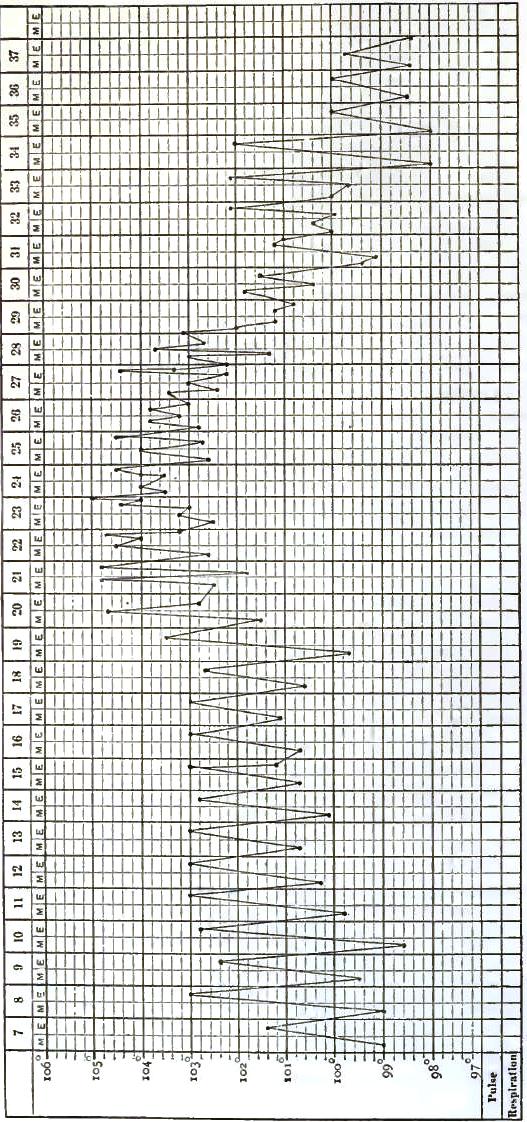
Temperature chart showing the lapse of a remittent fever into an intermittent.
NOTE.—From the third to the fifteenth day after attack a half drachm of quinia was given daily. Observing no good result, it was omitted until the twenty-ninth day, on which date two doses of eight grains each were administered. On the morning of the thirty-fourth day eight grains were again given; on the thirty-fifth day one scruple was given.
The differential diagnosis of intermittent and remittent fevers may be looked upon as practically unimportant. All cases so near the borderline as to make differential diagnosis a question should receive identical treatment.
There are, however, two other very grave forms of fever which are liable to give trouble in differentiation from remittent fever. These are typhoid and yellow fevers. The sanitary protection of communities exposed to cases of the latter, and also the practical treatment of the sick, call for early and correct differentiation.
But it is only in the early stages of the pathological processes of these affections that difficulties of diagnosis are liable to obtain. The facial expression of patients suffering with remittent is sufficiently characteristic to afford some diagnostic inferences. During the pyrexia the face is flushed and the eyes injected, but the redness is more vivid and the countenance more animated than in either typhoid or yellow fever. It would not be inaccurate to say that, however great may be the flushing or other alterations of the countenance in remittent fever, the natural facial expression is better preserved than in either of the fevers under comparison with it. Sallowness of the skin is an early and almost constant event in remittent fever. It comes on as a secondary manifestation, and appears in a large ratio of cases to bear some relation to the high temperature preceding its occurrence. The icteric hue is seldom intense, indeed very infrequently equalling the orange-yellow of jaundice resulting from obstruction. There is an exception to this statement in those cases in which remittent fever attacks a person already jaundiced. I have seen many cases in which the jaundice preceded the remittent fever, and became more strongly marked after its incursion, particularly in those persons who had remained for some time in a malarial region and suffered repeated attacks. In all cases of remittent fever it seems reasonable to ascribe the more or less jaundiced state to one or both of two factors, viz.—the accumulation of excrementitious material and bile constituents in the blood from primary derangement of its chemistry; and that excessive activity of the liver which the malarial poison appears to induce. Whether the latter mentioned factor results from some action of malaria directly affecting the nutritive processes of the liver, as it does those of the spleen, or whether the altered blood-currents during the paroxysms cause this supposed hypersecretion of bile, we certainly know that to malaria only can we ascribe those fevers which are marked by such peculiar symptoms of biliousness or superabundance of bile as to justify the prefix bilious fever or bilious remittent fever.
The state of the alimentary tract may properly receive notice after these remarks. In the early stages of remittent fever the tongue may be moist and large, and covered with a white or lead-colored or yellowish coat. The edges may be indented with imprints of the teeth. This is Osborne's malarial tongue, and its appearance is worth something in diagnosis.
Later in the progress of remittent fever the tongue may become dry, brown, cracked, and difficult of protrusion, but seldom showing the tremulousness of a typhoid-fever tongue, and differing also from the yellow-fever tongue in the fact that in this disease the appearance of the tongue is usually indifferent as a symptom, except that in advanced stages it is liable to be smeared with blood.
The stomach is irritable from the very beginning of an attack, and the acts of emesis are generally in striking contrast with those of typhoid or yellow fever, both in respect to their violence and to the relative amount of bile they eject.
The bowels are ordinarily costive, and when moved by purgatives the stools contrast strongly with those of typhoid or yellow fever by presenting evidences of the bile-coloring principles which attend all excretions in malarial fever, and are found in the urine, the perspiration, and occasionally the sputa.
Some unusually violent cases of malarial fever, which may become remittent, are inaugurated with convulsions, profuse diarrhoea, and coma.
Before closing the remarks concerning the digestive organs in remittent fever I should mention that in the long array of cases I have treated I cannot recall one solitary instance of black vomit. It is, however, true that I have observed hemorrhage from the bowels in quite a number of cases. These occurred late in protracted cases, and were sometimes the cause of death. Whether it be merely a coincidence I am unable to say, but it is true that the majority of these cases have been in young females just after the establishment of the catamenia.
Hemorrhage from the nose is frequent in remittent fever, but I have never seen a case with general tendency to hemorrhage.
The pulse in remittent fever differs from that of the typhoid or yellow fevers by being more synochal in character, firmer, and more resisting to pressure. The longer the duration of the case the less is this characteristic discernible.
The nervous system shows less ataxia. Delirium may occur in any stage of the disease, but differs from the delirium of typhoid and yellow fevers in showing a lessened degree of perversion of the reasoning faculties. The neuralgias have nothing special.
The urine is acid, high-colored, and scanty. I have never found much albumen in the urine of a case of remittent fever, unless there was some other cause to account for its presence. A small amount may be detected during excessive fever. Blood is a rare constituent.
Mild cases of remittent fever should terminate in recovery in from five to seven days. Fatal attacks usually end from the fifth to the tenth day. Many cases pursue a course which lasts from twenty to forty days. Under proper treatment the usual termination is in recovery, either directly or by conversion into the intermittent type.
POST-MORTEM APPEARANCES.—When death occurs in remittent fever the post-mortem changes generally consist of those which are principally due to chronic malarial toxæmia and those ascribable to the acute attack.
Under the former division are permanent enlargements of the spleen and liver, and pigmentary matter in the blood and deposited in various organs. Under the latter are to be classed hyperæmic or even inflammatory states of the stomach and intestines, and those degenerative changes which are the consequence of continuous hyperpyrexia. The post-mortem changes which are so uniformly found as to be most often appealed to in the establishment of diagnoses are enlargements of the liver and spleen. These may be due in part to hyperplasia and in part to blood-engorgement. The brown or slate color of an enlarged liver is strongly diagnostic of malarial affections. It contrasts strongly with the yellow and natural-sized liver of yellow fever and with the negative liver of typhoid fever.
The skin is generally yellow, sometimes quite intensely icteric, but seldom showing the ecchymotic extravasations of yellow fever. In remittent fever we never find the cadaver oozing blood from the nose and the mouth, nor are the stomach or intestines ever found to contain black vomit.
TREATMENT.—The indications of treatment in remittent fevers differ from those of intermittents in two leading essentials.
First. It is a far graver form of fever, and calls for more promptitude and energy in treatment for its successful management.
Second. The important pathological condition to be combated is the hyperpyrexia, and not the cold stage, as in intermittents.
But even with a clear realization of the practical importance of these facts in governing the treatment of remittents, the practitioner must still exercise care and self-control, lest he shall unconsciously adopt the doctrine that inflammatory lesions must be present to occasion such violent pyrexia as often exists. The physician who comes directly from a case of pneumonia or rheumatic fever and finds a patient suffering from remittent fever, with temperature higher and pulse more bounding than those of the patient he has just left, is pardonable for finding it difficult to realize that these furious symptoms are not also associated with inflammation.
Attempts to cure remittent fevers by an exclusively antiphlogistic treatment either result fatally or induce long periods of confinement and suffering before recovery is reached. The great indication is to secure cinchonism as promptly and completely as possible. Nothing should divert our attention from this object. The condition of the patient as it respects fever, delirium, or state of the tongue, should form no bar to the administration of quinia. There are no practitioners who have had much experience in treating these grave forms of malarial fever after this method who are not able to recall the numerous instances of most astonishing and gratifying amelioration of symptoms as soon as saturation with quinia was brought about. The dry tongue becomes moist, the skin is bathed in gentle perspiration, the delirium ceases, and the patient sinks into a quiet sleep.
The amount of quinia necessary to produce cinchonism must be estimated for each particular case according to the measure of its severity or to states of the system more or less favorable to its absorption. It must be borne in mind, however, that questions concerning the patient's safety are paramount to those of economy. In the mildest cases I never trust to a smaller amount than from twenty to thirty grains. In violent attacks I have administered scruple doses every fourth hour until a sufficient test had been made of its capability to arrest or modify the febrile paroxysm. I have never met with any of those exaggerated physiological effects which some observers teach us to fear from the exhibition of cinchona preparations during fever. Certainly, I can declare that no permanent deafness or other lasting lesion of nerve-function has ever occurred under my observation. I must also add that I know of no reasons why remissions afford more favorable conditions for the administration of quinia, beyond the fact that the system is in a better state for its absorption and assimilation. The quinia is preferably given in solution, but may be exhibited in the form of pills, or in powder suspended in black coffee, or in the thick mucilage of the slippery elm.
The considerations of treatment which are naturally connected with those just advocated relate to measures which it may be proper to associate with the quinia. The answers to the two following questions comprise all that is necessary to be said on this point—viz.:
Are conditions of the system present which may interfere with the specific treatment by quinia, and which are not, in themselves, curable by it?
Are any medicines to be given as succedanea to the specific remedy for the purpose of rendering its action more sure or prompt?
In regard to the first inquiry, it must be admitted that in quite a large proportion of cases of remittent fever specific treatment fails to cure. I suppose that may be a reasonable proposition which holds that in the majority of these cases the presence of secondary blood-impurities annuls the ordinary specific effects of cinchona. These must be gotten rid of by depurative medicines. The intestinal canal, the skin, and the kidneys are the emunctories through which elimination must be effected. It is therefore proper for the physician to endeavor to recognize cases where such impurities exist, and to so modify his treatment as to remove them. The indications for depurative treatment are jaundiced skin and eyes, furred tongue, costive bowels, and scanty, loaded urine. These are more or less positively expressed symptoms in a large majority of cases. It is therefore proper that in this large majority of cases of remittent fever depurative treatment should be conjoined with the specific treatment. In my opinion, no drugs meet this indication so well as mercurials and saline purges and diuretics. Calomel or blue mass may be given either simultaneously with the quinia or in alternate doses.
There are three very important rules to be observed in regard to cathartics: They should never be carried to such an extent that absorption of the quinine is interrupted. They should not be given in such large or repeated doses as to produce prolonged irritation, or it may be even inflammation, of the alimentary canal. Purgatives should be used for their depurative effects, and never as antiphologistics.
Opium exercises excellent effects in preventing local irritation or hypercatharsis, and in relieving derangements of nerve-function and insomnia. It is preferably given in small doses, combined either with purgatives or with the quinia.
I have found bitartrate of potassium the most grateful and efficient saline for depurative action. I have generally given it in lemonade in such amounts as to secure a gentle aperient and diuretic effect. I hold strongly to a conviction that all drugs as soluble as this facilitate the absorption of those less soluble—as, for example, of quinia.
If the first efforts to break the febrile paroxysms fail, it is better to discontinue the quinia and place the patient under symptomatic treatment, and await conditions of the system more favorable for its repetition. Of course the high temperature is generally the symptom requiring most care and attention.
Vomiting is one of the troublesome symptoms of remittent fever. As internal medication minute doses of morphia, dry upon the tongue or in solution in cherry-laurel water, or in combination with eight or ten drops of chloroform, are generally efficacious. Swallowing pellets of ice or frequently taking iced effervescing mixtures are good measures of treatment. Occasionally, a mild emetic, such as warm chamomile infusion, or warm water alone, will arrest the vomiting temporarily. It is doubtful, however, whether this relief is secured by the ejection of any offending matter from the stomach. It is more than probable that the forced dilatation of the stomach has arrested the spasms, for filling this viscus with cold drinks to repletion will often effect the same result.
Of all applications to the epigastrium, a cold wet towel occasionally sprinkled with chloroform is the best.
A tympanitic or tender abdomen requires stupes wrung from warm water. They may be dashed with turpentine at first, and afterward consist of warm water with whiskey. I have occasionally given two or three doses of turpentine emulsion with benefit, but from much observation I am forced to protest against the turpentine treatment, as it is called, which is to give twenty drops of turpentine every two to four hours as a curative agent.
Hemorrhage from the bowels must be met by hæmostatic treatment—preferably, in my experience, by the use of five grains of gallic acid in half an ounce of camphor-water every two hours, of morphia subcutaneously, and of cold cloths over the bowels. As in all diseases liable to cause death from exhaustion, careful attention must be paid to the nutriment, and stimulants must be administered as required.
Pernicious Malarial Fever.
Certain departures from the ordinary types of malarial fever are termed pernicious, because of their great tendency to inflict more than usual systemic damage and danger to life upon those who suffer such attacks. The word pernicious is used in its common English sense of being hurtful or injurious.
It is entirely unnecessary to enter upon a discussion respecting the propriety of employing this adjective to designate a class of cases of disease which are primarily due to the same poison which produces simple intermittent attacks. The extreme hurtfulness and danger of the attacks to be described in this section, and the awful suddenness with which they often occasion death, form striking contrasts with the more typical forms of malarial fever, and appear fully to justify the use of the qualifying adjective pernicious.
While all these various departures from type to be grouped under the term pernicious possess the quality ascribed to them, they nevertheless differ so widely in their modes of inflicting injury that it seems desirable to arrange them under distinct sub-classifications.
Some cases of pernicious malarial fever preserve the periodicity of simple attacks sufficiently well to enable one to classify them as intermittent or remittent in form. But more commonly it is impossible to determine this classification, and for practical purposes it is unimportant to attempt to make any such distinction.
The classification which appears to me most true to nature is the following:
First. The algid or congestive form; Second. The comatose form; Third. The hemorrhagic form.
The algid or congestive form occurs more frequently than either of the others. Its perniciousness is due to an aggravation or sheer exaggeration of the cold stage of an intermittent attack.
The following brief clinical histories of two cases will serve to illustrate the symptomatic phenomena of this form of pernicious malarial fever:
M. S., aged fourteen, had accompanied his father to a malarious locality in the country, and had remained with him during September and a portion of October. Shortly after his return I was asked to visit him because of some unusual symptoms attending a chill. I found him in a stupor, from which he was with difficulty aroused sufficiently to be able to swallow a dose of quinia combined with laudanum. His face was pallid and inexpressive; the skin cool and moist; extremities shrunken and cold; pulse small, easily obliterated by pressure, and irregular; tongue large and moist; and pupils rather dilated.
My second visit was at 12 M., one hour and a half later than the first. Patient was found in a deep stupor; surface cold; extremities and face shrunken and blue; pulse barely perceptible; large liquid and offensive stools occasionally escaped from the bowels without the consciousness of the patient. Death at 3 o'clock P.M.
Miss H., living in a malarious situation, complained about noon of September 19th of great cerebral fulness and unaccountable sleepiness and debility. She retired to her room, and after a few hours' sleep resumed her household occupations. On the 20th similar symptoms manifested themselves, but earlier in the day. She again slept for some hours, but complained of great prostration after the sleep. On the 21st, about 10 A.M., she complained of a return of the stupor, and while retiring to her room requested that I should be called if she did not awake in a better condition. At 1 P.M. she was found profoundly comatose, with cold extremities and surface and bathed in perspiration. When I reached her residence at 3 P.M. she had expired.
There is a common belief among non-professional people that the third congestive chill is necessarily fatal. There is no foundation for this opinion, except in the fact that when congestive chills are waxing in their perniciousness the subject is seldom able to survive the third recurrence if the second or first should not prove fatal.
It is difficult to account for the pathological dissimilarity between the simple and congestive types of malarial fevers. If we say that congestive chills are produced by an intensification of those causes which produce and govern an ordinary chill, we make an explanation which, however unsatisfactory, represents very nearly the full extent of our knowledge on this point.
It cannot be admitted that alterations of quantity or quality of the malarial poison exercise the sole influence in determining the occurrence of congestive cases. All experienced practitioners understand that certain constitutional conditions may pervert simple chills into congestive forms by producing prolongation or aggravation of the states of congestion always present in ordinary chills. Weakened cardiac function, from whatever cause, may be reckoned among these conditions. In these cases the feeble vis a tergo yields readily to those perturbations of vaso-motor influence which occasion passive blood-accumulations in the small veins and capillaries. I may say further, in speaking of the influence of the vaso-motor nerves in governing the phenomena of a chill, that we know that in congestive chills the cerebro-spinal system is much less the seat of symptomatic phenomena than in simple attacks. On the other hand, the organic system is far more profoundly affected.
However we may account for the perversions of normal circulation underlying and producing congestive chills, the great degree of injury they are liable to inflict is so well understood as to awaken the most serious apprehensions whenever we are called upon to treat them. Congestion, however occasioned, may destroy life through abolishment of function by the sheer physical change of infarction, or, again, through those inevitable consequences which arrested circulation entails upon the blood. Blood-stasis is followed by separation of its constituents, and its disqualification as a circulatory fluid in a degree proportionate to the duration of the stoppage, and probably also to the actual extent of the passive engorgement. Thence result the formation of coagula in the congested vessels and deposits of pigmentary matter. If partial reaction should occur, portions of this blood-débris may be floated to various parts of the circulatory system, and give rise to greater or less important alterations of function.
Among the white soldiers of the United States army from May 1, 1861, to June 20, 1866, 13,673 cases were diagnosed as congestive intermittent fever. Of this number, 3370 died, being a mortality-rate of 23.91 per cent. The aggregate number of malarial cases returned was 1,255,623. It would therefore appear that 1 case in not quite 372 was congestive in its type, or 1.08 per cent. The late Dr. Cook of Washington, La., estimated 2 per cent. of his malarial cases to be of the congestive type. It can scarcely be doubted that the ratio of congestive attacks is greater in the more southern belts of latitude than in the middle or northern parts of the United States. Chronic malarial toxæmia and the enervating effects of long-continued heat upon the circulation must occasion an increased proportion of such attacks, but my own observations show slightly more than 1 per cent. of the cases treated in the Charity Hospital to have been of the congestive form.
The cure of a congestive chill is one of the most difficult problems the physician can possibly encounter. It is nothing less than the proposition to remove a perverted state of the blood-vessels which is dependent upon some influence exerted through a nervous apparatus whose therapeutics and experimental physiology are imperfectly understood. While a satisfactory solution of this problem will probably be a remote achievement in medicine, it was long ago empirically ascertained that certain agents exercised some degree of control over the cold stage of febrile attacks. For the most part, these agents are addressed to those perversions of nerve-function which constitute so important a part of the pathology of a chill. They are identically the same remedies whose aid we invoke to allay many other forms of perturbed nervous action. Opium, chloroform, belladonna, chloral hydrate, and bromide of potassium have proved more or less valuable, according to the idiosyncrasy of the patient or the circumstances under which they have been used. I consider opium the most valuable of these remedies. It should be given in moderate doses, and preferably combined with chloroform or ammonia, or, if more expedient to administer per rectum, combined with solutions of chloral hydrate or bromide of potassium. One-sixth of a grain of morphia, combined with one-fortieth or one-fiftieth of a grain of atropia, is an available and useful prescription when given hypodermically. Rubbing the extremities or the spine, or indeed the whole surface, with ice, is a mode of practice well worthy of attention. In the event of inability to procure ice, douches of cold water, followed by frictions with coarse towels, may be substituted. I have used nitrite of amyl by inhalation, but its effects are too transitory to prove serviceable.
Some practitioners speak highly of alcoholic stimulants. My own experience has not been favorable to their use. Perhaps their benefits are altogether restricted to those cases in which previously weakened heart-function existed. But it is important that alcohol be added in all those cases of pernicious malarial fever, whatever the type may be, where cardiac stimulation and improvement of nutrition are leading indications.
I am sure I have often derived benefit from enemas consisting of four ounces of well-prepared beef essence with a half ounce of whiskey or brandy and a half ounce of strong infusion of coffee.
The value of the hypodermic syringe in treating congestive chills must never be lost sight of. The suspension, or even reversal, of normal systemic currents is made evident by the serous vomiting and purging attending congestion of the abdominal cavity. Medicine placed in the stomach under these circumstances is virtually thrown away.
The term comatose is applied to certain cases of pernicious malarial fever because they present coma as a marked symptom. To appreciate the propriety of this classification, it must be well understood that the coma present is not due to cerebral congestion. Further than this one restriction upon the application of the word there is in its employment no declaration of any pathological views respecting the cases it is intended to define. While, therefore, the term is unquestionably liable to criticism, I suppose its use may still be admitted, provided it is accompanied by a satisfactorily explicit account of the symptoms and probable pathological conditions of the cases included under its caption.
There is a sharp line of distinction between the symptoms and conjectural pathology of comatose cases and of those of the congestive form of pernicious fever. The following notes of cases will sufficiently establish this statement:
C. L., fisherman, aged forty-four, brought into Ward 20, Charity Hospital, in an insensible condition, November 18, 1875. Temperature at time of admission 104.8°, pulse 120, respiration 40; able to swallow liquids placed far back in his mouth. Ordered scruple ij of quinia in solution, ten grains to be given every fourth hour. Nov. 19th, patient has taken and retained all the quinia ordered; is perspiring profusely; temperature 97.8°, pulse 88; more conscious; takes food and water when offered him. Ordered blue mass, comp. extr. colocynth., aa gr. v, to be taken at once. To drink through the day bitartrate potass. oz. j, dissolved in lemonade, until bowels are moved. Evening temperature 99.3°. Nov. 20th, temperature 98°; patient placed under convalescent treatment; discharged from hospital Nov. 29th.
Another comatose patient was admitted to Ward 19 on the 29th of October, entirely insensible. He was treated by large doses of quinia in solution per rectum, and by calomel gr. xx, sodii bicarb. gr. v, placed upon base of tongue, and caused to be swallowed by a tablespoonful of water trickled over the powder. As the patient began to recover it was noticed that his right arm was paralyzed. A history subsequently obtained showed that the patient was an engineer, and had been engaged in making some land surveys in a swampy portion of the State of Louisiana, and had been often obliged to wade or swim across the bayous and to sleep at night in the open air, sometimes without any protection from the weather. He had previously enjoyed good health, and was altogether unable to account for the paralysis of his arm. During convalescence he was treated with iron, strychnia, and preparations of cinchona, and by cold douches and frictions to the paralyzed arm. Convalescence was slow, but he was discharged, completely recovered, on November 20th.