Volume 1 — GENERAL DISEASES. (continued 2)
Reading edition
40 Medical Times and Gazette, Feb. 8, 1879, p. 149, from Berl. klin. Wochenschrift, No. 39, 1878.
Ludwig Letzench41 asserts that he has produced some of the intestinal appearances of typhoid fever, as well as a high degree of pyrexia, in rabbits by the subcutaneous injection of the sputa and stools of typhoid fever patients.
41 Arch. f. exper. Pathol. u. Pharmak., 1878 and 1881.
THE BACILLUS TYPHOSUS.—From what has preceded, it will be seen that the writer is disposed to range himself with those who hold that the exciting cause of typhoid fever is an organized germ, or, in other words, a contagium vivum. Although this view cannot be regarded as positively proven as yet, it has recently received some support through the investigations of Klebs, Eberth of Zurich, and others,42 who believe that they have found in the bodies of those who have died of typhoid fever a micro-organism peculiar to that disease.
42 Klebs (Philadelphia Medical Times, Dec. 3, 1881, from Archiv für experimentelle Pathologie und Pharmakologie, Bd. xiii. H. 5 and 6) claims that he has proved "that there exists in typhoid fever a separate and distinct bacillus—the Bacillus typhosus; that it undergoes certain transformations, consisting at first of little rods and small fine threads, containing a spore in the centre and often at the end, which spores divide off and form new bacilli. It later assumes a larger thread-like form, twisted at the end, and frequently taking a beautiful spiral shape; that the bacilli are observed first in the masses of epithelial cells which accumulate in the alimentary tract or in the air-passages; that they later penetrate the tissues, and are carried along by the blood-vessels and the lymphatics, and form a large network among the tissues they invade; that under a certain procedure, which never causes this same staining in any other living organism or tissue, they appear of a blue color; that they are found only in enteric fever, in which disease every part of the human body is the seat of masses of these bacilli, their quantity corresponding exactly with the severity of the symptoms; and that they produce, when carried into the system of animals, exactly the same disease with the same morbid alterations as in men." He says, further, that "the Bacillus typhosus enters the system by the respiratory passages and by the alimentary canal. This is the cause that in some cases of typhoid fever almost no abdominal symptoms are present, but a low form of pneumonia, developing from the very beginning, so that the lung seems alone to bear the brunt of the disease." He has found these bacilli in greatest numbers in Peyer's patches.
Eberth (British Medical Journal, Nov. 26, 1881, from Virchow's Archiv, Bd. lxxxi. and lxxxiii.) has shown that in typhoid fever the intestinal mucous membrane, the mesenteric glands, and the spleen contain rod bacteria, differing, as he believes, from organisms found in the body in other conditions (among others in phthisis with extensive ulceration of the intestinal mucous membrane). In seventeen cases of typhoid these bacilli were found in six and wanting in eleven. In the six cases the number of bacilli were in inverse proportion to the duration of the disease. They were not found in the spleen in the cases of the longest duration, and only scantily in the mesenteric glands. These bacilli appear not to differ in shape and size from the ordinary rod bacteria, but Eberth believes that they differ from them in their small capacity for taking on the staining of hæmatoxylon, methyl-violet, and Bismarck brown.
Wernich's views (Vjhrschr. f. Off. Geshpfl., xiii. 4, p. 513, 1881) in regard to the nature of the Bacillus typhosus differ from those held by the two authors just quoted. He regards the specific Bacillus typhosus as nothing but the ordinary Bacillus subtilis of the large intestines, which under certain circumstances acquires the power to accommodate itself to the small intestines, to undergo a higher development and to become the exciting cause of disease.
PERIOD OF INCUBATION.—The conditions under which typhoid fever occurs in large cities render it difficult, if not impossible, to arrive at a definite conclusion as to its period of incubation. Occasionally, however, the time which has intervened between the exposure to the cause and the invasion of the disease may be ascertained with precision in the outbreaks which occur in small towns or in isolated country-houses. Under these circumstances it has been found to vary within very wide limits. In the three cases related by Griesinger the attack began the day after exposure to the infection, and in the outbreak at the school at Clapham, referred to by Murchison, twenty out of twenty-two boys were seized with the disease within four days of exposure to the causes. Other instances of a similar character are on record. In cases like the above the rapidity with which the attack follows upon exposure to the cause is no doubt due to the intensity of the poison—a view which is to a certain extent at least supported by the fact that the invasion of the disease under these circumstances is very apt to be abrupt; the attack being often ushered in with vomiting and purging or with grave cerebral symptoms. Sometimes, indeed, the gastro-intestinal symptoms have been so violent as to have given rise to suspicions of criminal or accidental poisoning. In the majority of cases, however, the period of incubation is probably very much longer than in those above referred to. In the outbreak which recently occurred in a farm-house about seven miles distant from Philadelphia, the history of which has already been given in detail, the second case began three weeks after the first, the other six following in rapid succession. In the celebrated epidemic which occurred at Lausen in Switzerland in 1872, and which is referred to by Cayley,43 the first ten patients were attacked within three weeks of the time when the contamination of the spring which supplied the village must have taken place, and these ten cases were followed in the course of nine days by fifty-seven others. In the town of Over Darwen 1500 persons were seized with typhoid fever within three weeks after a patient suffering from this disease was brought to a particular house, the sewage of which was allowed to soak into the ground through which the water-supply pipes of the town passed, and at a point at which they were leaky. Lothholz observed in an epidemic which occurred in the neighborhood of Jena that the average period of incubation was three weeks, the shortest period eighteen days, the longest twenty-eight days. Haegler found in three cases produced by contaminated water a period of at least three weeks.44 There are, however, epidemics on record in which the period of incubation was under two weeks, as, for instance, that of Basle, referred to by Liebermeister, in which a few persons were attacked who had only been in the city from seven to fourteen days. Cayley also refers to localized outbreaks of the disease, as those of Calne and Nunney, in which persons were attacked within fourteen days of their exposure to the cause. C. J. C. Muller of Posen45 says that the average period of incubation of the disease is fourteen days; that it may be not more than ten days, or, on the other hand, as long as from three to four weeks; and that he has known a case in which it was thirty-four days. Murchison believed that it was most commonly about two weeks, and William Budd arrived at the conclusion, from the observation of a large number of cases, that it varied from ten to fourteen days.
43 Brit. Med. Jour., Mar. 15, 1880.
44 Ziemssen's Cyclopædia, vol. i.
45 Neue Beiträge zur Aetologie des Unterleibs-Typhus, Posen, 1878.
From this review of the opinions of various authors the conclusion would seem to be justifiable that the period of incubation in typhoid fever is usually between two and three weeks, but that in many cases it does not exceed ten days, and in rare instances has unquestionably been very much less. On the other hand, there are authentic cases on record in which it is said to have reached, or even exceeded, twenty-eight days. Unfortunately, we do not possess any reliable data with which to decide the question whether it is shorter or longer when the poison is imbibed with the ingesta than when it is inhaled. It would seem, however, that there is a difference in the susceptibility of different individuals to the poison of this disease, in many persons a single exposure to the cause being sufficient to induce an attack, while in others the disease is contracted only after repeated exposure.
MORBID ANATOMY.—As a thorough knowledge of the morbid anatomy of typhoid fever is absolutely necessary to a correct understanding of its pathology, it seems to me better to deviate from the order usually observed in systematic treatises and to proceed at once to a description of the former, rather than to defer it, as it is usual to do, until after the symptomatology of the disease has been discussed.
Rigor mortis is generally more marked and more prolonged than after typhus. Emaciation is often extreme in cases in which death has taken place after the third week, especially if they have been attended by much diarrhoea and fever. No traces of the characteristic rose-colored eruption are found after death, no matter how profuse it may have been during life. Sudamina, on the other hand, persist, and discolorations of the dependent portions from settling of blood are always present in the dead body.
The lesions of typhoid fever may be divided into two classes. The first class includes certain changes in the glands of Peyer, the solitary glands of the intestines, the spleen, and other lymphatic structures of the body. These changes, which consist essentially in a medullary infiltration of these glands, will be minutely described presently. They are peculiar to the disease, and are just as characteristic of it as the condition of the lungs and their membranes found in pneumonia and pleurisy are characteristic of those diseases. They are usually most developed in grave cases, but occasionally they are slight and but little marked in cases in which the general symptoms were severe. They therefore cannot be regarded as the sole cause of the latter. It is more probable that they are themselves the results of the local action of the typhoid poison, and bear somewhat of the same relation to typhoid fever that the eruption in small-pox does to that disease. The second class is made up of lesions which are met with not only in this disease, but in other diseases accompanied by high fever, and are therefore unquestionably the result of the general process. They consist essentially of parenchymatous degenerations of various organs and tissues, and are generally more marked in typhoid fever because the pyrexia is not only of high grade, but also of longer duration than in other diseases.
We shall first consider the lesions peculiar to typhoid fever. Among the most important of these are the changes which occur in the agminated and solitary glands of the intestines. These have been usually described as passing through four stages, as follows: (1) the stage of medullary infiltration; (2) the stage of softening or sloughing; (3) the stage of ulceration; (4) the stage of cicatrization. These stages are said to last almost a week, and correspond to certain definite periods of the disease, but it is not uncommon to find in the same intestine glands in two or more of these stages. Indeed, the same gland may sometimes be found ulcerating at one side while cicatrization is going on at the other.
In the first stage the agminated glands are enlarged, each patch preserving its oblong shape, and being flattened on the surface and elevated from half a line to two lines above the surrounding mucous membrane, from which it is separated by an abrupt border, and which it may in a few cases overhang like a fungous growth. The solitary follicles are also swollen, and may vary in size from a hempseed to a split pea. In very severe cases all the glands may be more or less involved, but in mild cases the changes may be limited to three or four of the patches of Peyer, although the solitary glands rarely wholly escape. It is uncommon also for the latter to be alone affected, but a few such cases have been reported. In these the mucous membrane appears to be studded with pustules, and hence Cruveilhier designated this variety as the forme pustuleuse. The mucous membrane covering the affected glands is reddish-green in color, and that in their immediate vicinity is often injected. The changes above described occur early in the disease—Murchison has seen them in two cases in which death took place at the end of the first day—and they are often well marked at the end of the third or fourth day. They are usually limited to the glands in the lower part of the ileum, the agminated glands being often found perfectly healthy four feet above the ileo-cæcal valve. In mild cases, indeed, the lesions may be confined to those nearest to this valve. So, too, the changes in the solitary glands may be confined to the last twelve inches of the smaller intestine, but this is by no means universally the case, for these glands are not only often found enlarged higher up in the small intestine, but also occasionally in the cæcum. The agminated glands are sometimes found enlarged in the bodies of those who have died of measles and of some other diseases, but the degree of enlargement is rarely as great as in typhoid fever, and the further changes presently to be described are never found except in the latter disease.
Under the microscope the medullary infiltration upon which the enlargement of the glands depends is found to be due to proliferation of the cellular elements. In the case of the agminated glands this proliferation may be limited to the follicles or it may extend to the intercellular tissue, and even to the adjacent mucous membrane. In the former case the patches have a reticulated aspect; they are soft and but little elevated. These are the plaques molles of Louis and the plaques reticulées of Chomel. In the latter they are harder, smoother, and more elevated. To this variety Louis has given the name of plaques dures, Chomel that of plaques gauffrées. The morbid process is also very apt to extend from the solitary follicles to the surrounding mucous membrane.
In a large number of the glands in many cases, and probably in all of them in the abortive form of the disease, the changes never advance beyond the first stage, a restoration to their normal condition taking place by colliquative softening.46 The morbid material upon which their enlargement depends breaks down into an oily débris which is gradually absorbed. This retrograde process takes place faster in the follicles than in the interfollicular tissue, and, as pigment is very apt to be deposited in the depressions thus formed, the patches acquire an appearance which has been compared to that of a recently shaven beard. This appearance is met with, however, in other diseases, and is therefore not peculiar to typhoid fever.
46 Rindfleisch, Pathological Histology, Sydenham Society Translation, vol. i. p. 441.
The description of the changes in these glands in the subsequent stages of the disease which follows is taken mainly from Rindfleisch's work on Pathological Histology.
In the stage of necrosis small portions of single Peyerian patches, varying in size from that of a lentil to from three-quarters of an inch to an inch and a quarter in diameter, assume a yellowish-white, opaque tint instead of their former reddish and translucent aspect, gradually become separated from the surrounding tissue by a sharp line of demarcation, and then pass into a state of cheesy necrosis. Here and there the same changes are observed to have taken place in the solitary glands. When once this has occurred, recovery can only take place by expulsion of the necrosed parts and consequent ulceration. Necrosis of the glands probably rarely occurs before the beginning of the second week, but it has occasionally been observed much earlier. Murchison reports cases in which he saw it as early as the first and second days. The process usually involves the mucous membrane only, but it may extend to the muscular and even to the peritoneal coats.
In the third stage the dead parts are gradually thrown off, the process of separation usually occupying several days. At first an increased degree of congestion, followed by suppuration, is observed at the edges of the sloughs, which before their complete detachment may often acquire a yellow, green, or brown color from the imbibition of bile. The ulcers which result correspond in size and form with the sloughs. They are, therefore, in the case of the agminated glands elliptical in shape, with their long diameter corresponding to the axis of the intestine. Their edges are swollen and overhanging, and their floor is generally formed by the deepest layer of the submucous connective tissue. They sometimes penetrate much more deeply, and may even extend to the peritoneal coat, and thus give rise to perforation of the bowel. The ulcers which result from sloughing of the solitary glands are, as a rule, small and round. Murchison says that ulceration may also be produced in the following way: The mucous membrane becomes softened, and one or more superficial abrasions appear on the surface of the diseased patch, which extend and unite into one large ulcer, and this ulcer proceeds to various depths through the coats of the bowel, and even to completed perforation, but Rindfleisch and other recent German writers do not allude to this process.
The fourth stage, or that of cicatrization, usually commences with the beginning of the fourth week. The swelling of the edges of the ulcers gradually diminishes, and they become adherent to the tissues beneath. The floor of the ulcers covers itself with delicate granulations, which in course of time are converted into connective tissue. This is ultimately coated with epithelium, but neither the villi nor the glands of the mucous membrane are ever reproduced. The resulting cicatrices may be recognized by the affected parts of the bowel being thin and more translucent than in health, and may retain these characters after the lapse of several years. They never give rise to contraction of the bowel. The time occupied in the cicatrization of each ulcer is said to be about two weeks. It occasionally happens that while cicatrization is taking place at one end of the ulcer the process of necrosis and ulceration is still going on at the other, so that two or more ulcers may occasionally run together. This form of ulcer may often retard recovery, and may sometimes end in perforation of the bowel, even after convalescence seems to have been established.
The color and consistence of the mucous membrane of the cæcum and colon are in a large proportion of cases normal. In a few the membrane is paler than in health, and in others it is of an ash-gray color. It is also sometimes injected and softened. The solitary glands are frequently enlarged and ulcerated, like those of the ileum. In the former case the mucous membranes of the large intestine throughout its whole extent, but especially that of the cæcum and of the part of the colon adjacent to it, is studded with minute elevations about a line in diameter. When ulceration has occurred the ulcers are generally round and small, but they may occasionally be oval and of considerable size. In the latter case their long diameter will correspond in direction with that of the circular fibres of the intestine. Murchison has known them to measure fully an inch and a half in length. The colon is generally found much distended with flatus.
Enlargement of the mesenteric glands from cellular hyperplasia and hypertrophy of the connective tissue is constantly associated with the morbid changes of the intestines just described. This enlargement varies in different cases. In some the glands are not larger than a pea or bean; in others they are said to have reached the size of a hen's egg. It is always more marked in the glands which lie in the angle between the lower end of the ileum and the cæcum, and usually bears some proportion to the intensity of the local disease; but it is not to be regarded merely as a result of the local irritation, as it has been observed in parts of the mesentery corresponding to perfectly healthy portions of the intestine, and as the meso-colic glands have been involved in cases in which the colon was free from disease. It has, moreover, been observed in cases in which death has occurred very early in the disease, and there can therefore be little doubt that it is as much the result of the infective process as the infiltration of Peyer's patches. In addition to being enlarged, if death has taken place before the end of the second week the glands are hyperæmic and of a purplish color. Later than this, when the sloughs become detached from Peyer's patches, the swelling of the glands diminishes; they lose their color and become pale, and if convalescence ensues they return finally to their former healthy condition. Still, Murchison has seen them shrivelled and pale or bluish for some time after convalescence. In other cases the substance of the glands softens, with the formation of a puriform liquid. If the softening only involves a small part of the glandular structure, restoration to health may take place through the absorption of this liquid. If it is more extensive, the whole of the glands may break down into this puriform liquid, which, when the patient recovers, undergoes caseous and finally calcareous degeneration. Occasionally, a gland in this condition is the cause of death from rupture and extravasation of its contents into the cavity of the peritoneum.
The glands in the fissure of the liver, the gastric, lumbar, inguinal glands, and indeed all the lymphatic glands in the body, have occasionally been found swollen and congested, but their enlargement cannot be classed among the specific lesions of the disease, but is merely the result of a local irritation. Thus, Jenner says that in the case of extensive ulceration of the oesophagus which came under his observation there was marked enlargement of the oesophageal glands. Liebermeister says that the lymphatic follicles which surround the glands at the root of the tongue and in the tonsils are often affected in the same way as the glands. In most cases after a time the swelling disappears, but sometimes softening and rupture take place.
The spleen is almost invariably found to be increased in volume and to have undergone changes in consistence and color. The degree of enlargement and the other changes vary of course with the stage of the disease at which death has occurred. The enlargement occurs with less frequency in elderly than in young people, and is most marked at the height of the disease, the organ being then often twice or three times its normal size, and in some cases, it is said, even larger. Later, and especially during convalescence, the enlargement has generally very much diminished. During the first ten days of the disease the spleen is generally tense and firm, engorged with blood, and dark red in color. Between the tenth and thirtieth days its appearance remains the same, but the organ is found to be soft and friable. During convalescence it becomes paler and firmer again, and is often so shrunken in size that its capsule is relaxed and wrinkled. Hemorrhagic infarctions are often met with. These sometimes soften and break down into a puriform liquid, which may sometimes cause peritonitis by rupture into the peritoneal cavity. Rupture of the spleen is also said to have occurred from mechanical violence. These changes are due in part to variations in the amount of blood, and in part to a medullary infiltration of Malpighian corpuscles similar to that which takes place in Peyer's patches and the glands of the mesentery.
LESIONS WHICH ARE NOT PECULIAR TO TYPHOID FEVER, BUT ARE OF MORE OR LESS FREQUENT OCCURRENCE.—The mucous membrane of the pharynx and oesophagus may present a perfectly healthy appearance, but occasionally it is congested and the seat of ulcerations which are for the most part superficial. Sometimes, however, they have been found to extend to the muscular coat, but they have never been known to penetrate all the coats of these organs. Jenner refers to one case in which there was extensive ulceration of the oesophagus, but usually the number of ulcers is not large. In a few cases the mucous membrane of the pharynx is coated with diphtheritic false membrane, and the submucous tissue is infiltrated with serum and pus (Murchison).
The stomach and the upper part of the intestinal tract present no lesions which are at all peculiar to typhoid fever. In a certain number of cases congestion, softening, and even superficial ulceration, of the mucous membrane of the stomach, and less frequently of that of the duodenum, have been found. The mucous membrane of the jejunum and of the upper part of the ileum is not usually much reddened, and may be even paler than in health. In cases which have been protracted it may be of an ashy-gray or slate color. The contents of this part of the intestinal tract, which is rarely much distended by flatus, do not differ materially in appearance or consistence from the matter which generally composes the typhoid stool. The bowels may, of course, be found filled with blood in cases in which a recent hemorrhage has taken place. Invaginations of the small intestines, unaccompanied by any evidences of inflammation, are occasionally met with in the bodies of those who have died of typhoid fever. They are produced, there is good reason to believe, during the death agony, but are not peculiar to this disease, as they occur in many other diseases.
Enlargement of the liver has been found in only a few cases after death from typhoid fever. Softening is more common, but even this is not a frequent result of the disease, for it was absent in 41 out of 73 cases examined with special reference to this point by Louis, Jenner, and Murchison. The organ is occasionally hyperæmic, and darker in color than in health, but it is oftener pale or normal in appearance. Even, however, where it appears to be perfectly healthy to the unassisted eye, the microscope shows that its cells are very granular and filled with oil-globules which often render the nucleus indistinct or completely conceal it. When death has taken place at an advanced stage of the disease many of the cells are found to be completely broken down into a granular detritus. These changes are usually proportional to the degree of pyrexia which has been present during life. Rarer lesions of the liver are pyæmic deposits, embolism, abscess, and emphysema.
The mucous membrane of the gall-bladder has been found to be the seat of ulcers by Jenner and numerous other observers. It also occasionally presents the evidences of catarrhal or diphtheritic inflammation. The gall-bladder usually contains a pale watery liquid of a less density than bile. When, however, inflammation of its lining membrane has existed, its contents are mixed with pus and shreds of false membrane.
The mucous membrane of the larynx is sometimes found to have been the seat of catarrhal or diphtheritic inflammation, and sometimes also of ulceration. Jenner says that in typhoid fever laryngitis independent of pharyngitis is extremely rare, but the German writers express a different opinion. Griesinger estimated that laryngeal ulcers were present in one-fifth of the fatal cases. Hoffmann found them twenty-eight times in two hundred and fifty autopsies, and that the ulcers had extended to and involved the cartilages in twenty-two out of the twenty-eight cases. They are most commonly found in the posterior wall of the larynx, and may involve the vocal cords. These are often discovered after death in cases in which their existence was not suspected during life. They were formerly supposed to be the result of typhoid infiltration of the laryngeal glands, but careful investigation has shown that they are the consequence of diphtheritic inflammation of the mucous membranes. Inflammation and ulceration of the trachea are comparatively rare. Hypostatic congestion and infarction of the lungs are not uncommonly found after death from typhoid fever, and less frequently the lesions of pneumonia. Evidences of recent pleurisy are also discovered in a few cases. Acute miliary tuberculosis of the lungs is more often met with as a sequela than as a complication.
The changes in the brain and its membranes caused by typhoid fever are few and unimportant, even in cases attended by severe nervous symptoms. Those most frequently found are adhesions of the dura mater to the inner surface of the cranium, injection or oedema of the pia mater, congestive oedema, and sometimes softening of the brain and effusion at the base of the brain. The microscopic changes do not appear to have been carefully studied. Liebermeister says that the gray substance of the cortical portion of the brain and of the interior is sometimes of a rather yellowish-brown color, and that he noticed besides diffuse yellow and blackish-brown spots in different places, particularly in the corpus striatum and thalamus opticus. In such places, he says, the microscope shows a diffuse yellow coloration, a deposit of small brown pigment-granules, and also, especially in the optic thalamus and corpus striatum, the ganglion-cells thickly crowded with brownish or blackish pigment-granules in such numbers as to conceal the outlines of many of the cells. These changes Hoffmann,47 who has specially studied them, is inclined to place by the side of the parenchymatous degeneration of other organs. The ganglion-cells of the sympathetic ganglia are said by Virchow also to contain an unusual amount of pigment.
47 Quoted by Murchison.
The muscles are frequently the seat of marked changes in typhoid fever. Their macroscopic appearances vary with the stage of the disease at which they are examined. When death takes place in the first or second week they are usually dark red or reddish-brown in color, and very dry. If it is delayed until later, they "present a peculiar fawn or yellow tint permeating the ordinary red in patches and veins not unlike the appearance of veined marble." Their consistence is also so much diminished that the finger may be readily passed through them. Occasionally, pseudo-abscesses and hemorrhages into the muscular sheath are found, and Dauvé and B. Ball48 report cases in which, in addition to these changes, rupture of muscles had occurred. Zenker, who was the first to call attention to them, ranged the changes seen under the microscope under two heads: (1) granular or fatty degeneration; (2) waxy degeneration. In the first variety the transverse striæ disappear and the sarcolemma appears filled with finely granular matter. In the second variety the striated muscles become, as it were, pervaded by a coagulating material which sets, and in contracting breaks up the fibres into great numbers of short waxy-looking lumps, not unlike a certain variety of casts of the tubuli recti of the kidneys. When recovery takes place the affected fibre is believed to be regenerated by a cell-growth within the sarcolemma. These changes occur in most fevers, as typhus, small-pox, scarlet fever, and are attributed by authors generally to the hyperpyrexia which is a frequent accompaniment of these diseases. Hayem, however, asserts that he has found them well marked in cases not characterized by a high temperature, and that, on the other hand, they are sometimes absent in cases where this has been present. The waxy form of degeneration may affect all the striped muscles, but is oftenest seen in the muscles of the abdominal walls, the adductors of the thigh, the muscles of the diaphragm, and tongue.
48 L'Union Médicale, 1866, quoted by Biennial Retrospect of Medicine and Surgery and their Allied Sciences, for 1865-66.
The heart, in common with the other muscles of the body, suffers from both the forms of degeneration above described, but the granular form appears to be more common than the waxy. In protracted cases it is usually much softened, and when thrown upon a plate no longer retains its form. It has usually lost its normal color and acquired the tint described by the French as feuille morte (faded leaf). Upon minute examination the degeneration is found to have taken place in patches, the diseased fibres being found alongside of others which have scarcely undergone any alteration. These patches are especially common in the papillary muscles of the mitral valve—a fact which explains the occasional presence of systolic murmurs in typhoid fever. In addition to the microscopic appearances of the muscles already described, Hayem49 has observed in his examinations of the heart a cellular infiltration of the connective tissue and a proliferation of the muscle nuclei. These changes are sufficient in his opinion to establish the existence of myocarditis. The same observer thinks he has also found evidences of the frequent occurrence of endoarteritis in the multiplication of the cellular elements of the internal coat of the small arteries, which he has discovered under the microscope.
49 Leçons cliniques sur les Manifestations cardiaques de la Fievre typhoide, Paris, 1875.
Some discrepancy of opinion exists in regard to the condition of the blood in typhoid fever. Trousseau, for instance, speaks of it as being profoundly altered and in a state of dissolution; Liebermeister says that at the height of the disease the blood is very dark-colored, and that after coagulation it presents a small and soft clot; and Murchison, that a dark, liquid condition of the blood is rarer than in typhus, and that fine white coagula are more common. Harley too has frequently found firm colorless clots of fibrin in the heart and roots of the great vessels in subjects dead in the third week of the disease. Forget concludes from an examination "of one hundred and twenty-three specimens of blood derived from patients in all stages of the disease that an appreciable alteration of the blood in the several periods of enteric fever cannot be accepted as a general fact; that the blood is rarely altered in the first period; that the alteration is more marked in proportion as the disease is more advanced; that the alteration is not always in proportion to the gravity of the disease."50 I have myself seen the disorganization of the blood as complete in severe cases of typhoid fever which have rapidly proved fatal as in cases of diphtheria or of other malignant diseases. On the other hand, in protracted cases and during convalescence the blood is often thin and watery.
50 Quoted by Harley, Reynolds's System of Medicine, vol. i.
The kidneys are sometimes engorged with blood, sometimes pale and flabby. Under the microscope the appearances are similar to those just described as occurring in the liver, and it is therefore unnecessary to refer to them more fully here. As a rule, the epithelium becomes granular earlier and to a marked degree in the cortical than in the tubular portion. The absence of albuminuria must not always be accepted as proof of a healthy condition of the kidneys, as this symptom has been wholly wanting in cases in which the organs have been extensively diseased.
Analogous changes have also been observed in the salivary glands and pancreas, except that, according to Hoffmann, a cellular proliferation precedes the degenerative process.
CLINICAL DESCRIPTION.—The invasion of the disease is usually so gradual that it is often impossible to obtain from patients exact information as to the time of the beginning of their illness. Among those who present themselves for treatment at the Pennsylvania Hospital it is not uncommon to find that many have suffered for several days, it may be as long as a week, or even longer, before taking to their beds, from vague feelings of discomfort, from headache more or less intense, aching pains in the back or limbs, or from sensations of chilliness alternating with flashes of heat. In other cases derangements of the digestive system are more prominent, such as nausea, or even vomiting, diarrhoea, or irritability of the bowels. Notwithstanding these symptoms, and the indisposition to exertion engendered by them, they have frequently continued to follow their usual avocations up to the time of their application at the hospital for admission. There is generally, however, no difficulty in recognizing at once the nature of their disease. Upon examination the pulse is found to be frequent, the respiration accelerated, the tongue furred, the skin hot and dry, and the abdomen tympanitic.
Among patients whose position in life enables them to pay greater attention to trifling symptoms than those who are compelled to seek hospital relief, opportunity is frequently afforded to the physician to study the disease at a period less remote from its commencement. The symptoms it presents when seen as early as the second day are generally of a very indefinite character. There may be a feeling of malaise, headache with a tendency to giddiness, pain in the back and limbs, a slightly coated tongue, thirst, and anorexia. The patient may complain of chilly sensations alternating with flashes of heat, but it will rarely be found that the attack has commenced with a decided chill. Diarrhoea may also be present at this time, or may not supervene until later. Even in cases in which it is absent the bowels will generally act inordinately after the administration of a gentle purgative. Occasionally, the attack begins with vomiting, but this is not, in my experience, a frequent mode of commencement. If the visit be made in the morning, the febrile symptoms will be little marked, the pulse being only slightly accelerated and the temperature being rarely more than from a half to a degree above the normal. In the evening, however, the thermometer usually indicates a greater elevation of temperature.
At subsequent visits the same symptoms are presented. It will be observed, however, that the fever is decidedly remittent in character, the evening temperature being always from a degree to a degree and a half higher than that of the morning, while the temperature of each succeeding day is a little higher than that of the day which preceded it. The patient is restless and wakeful at night, or sleep, when obtained, is unrefreshing and disturbed by dreams. He grows dull and slightly deaf, and although able to answer questions intelligently when roused, does so with an effort, and soon after lapses into his former condition. Although obviously growing weaker every day, it is sometimes difficult to get him to take to his bed. The diarrhoea continues and increases in severity; the stools become watery in character and ochrey-yellow in color; they may exceed six, or even twelve, in the twenty-four hours. Epistaxis either consisting of a few drops of blood only, or so profuse as to endanger life, may also occur during the first week. Examination of the abdomen toward the middle or close of the first week will almost always reveal the existence of tympany and of tenderness and gurgling in the right iliac fossa, and very frequently also of slight enlargement of the spleen. The urine at this stage of the disease is dense, scanty, and of high color. The tongue too will be observed to be more heavily coated than at first, and to be dryish, the fur being disposed on the middle of the dorsum of the organ, while the tip and edges are free from it and abnormally red in color. Usually, toward the close of the first week, the pulse will be found to be between 100 and 120 in frequency. It often, however, does not attain this frequency, and in some cases does not exceed 50 throughout the whole of the attack. At the same time, the thermometer generally indicates a temperature of from 102° to 104°, and in bad cases even one much higher than the latter.
These symptoms are not pathognomonic, but Murchison regards their existence in a young person as warranting the suspicion that he is suffering from this disease. About this time, however, or, to speak more accurately, usually from the seventh to the twelfth day, a new symptom occurs which is more characteristic. This is an eruption of isolated rose-colored spots, the tâches roses lenticulaires of Louis, occurring principally upon the surface of the abdomen, but not infrequently seen also upon the chest, back, limbs, and even, according to some authors, upon the face. They are round in shape, with a well-defined margin, usually about a line in diameter, but sometimes considerably larger, slightly elevated above the surface, and disappearing upon pressure, but returning when the pressure is removed. They can almost always be found at this stage of the disease if diligently sought for.
If the disease tends to run a severe course, all the symptoms become aggravated toward the end of the second week. The tongue grows dry and brown, the pulse more frequent, feeble, and markedly reduplicated in character, the diarrhoea still more severe, and the fever higher than before, with little or no tendency to remit in the morning. The nervous symptoms also come into prominence. The headache may grow more violent or may be replaced by increased dulness, which may sometimes be so decided as to render it difficult to fully rouse the patient. At other times delirium is a prominent symptom. This may only occur at night, but not infrequently is observed during the daytime as well. It is usually more active in character than that which accompanies typhus. Trembling of the tongue and of the limbs is not uncommon at this time. The urine becomes more abundant, paler, and less dense than before. Even in cases characterized by symptoms as severe as those above detailed some improvement is, however, often observed to take place between the fourteenth and twenty-first days. The morning remission becomes more decided, the evening temperature less high than that of the preceding day; the stools lessen in number, and gradually assume a more healthy appearance; the pulse diminishes in frequency and gains in force; the tongue becomes moist, and shows a tendency to throw off its fur; the trembling grows less marked; the dulness and delirium lessen; and the patient falls into a refreshing sleep. In other cases, in many of which recovery eventually takes place, there is at this time, instead of an improvement, a still further aggravation of the symptoms. The pulse becomes more feeble and frequent; the tongue is not only excessively dry and brown, but shrivelled and fissured; the lips and teeth are encrusted with sordes; the stools contain shreds of membrane, and often blood; the subsultus tendinum increases; carphololgia, or picking at the bed-clothes, occurs. The prostration becomes so extreme that the patient frequently slips down in bed from sheer weakness. The active delirium of the previous stage is replaced by the low muttering form, or the patient lies upon his back with his eyes half closed in a semi-unconscious condition, from which he is with difficulty aroused, and which may deepen into coma. Occasionally, however, the active delirium continues, and is associated with an obstinate wakefulness; the urine and feces are passed involuntarily, or, with an apparent incontinence of the former, there may be retention, which is very apt to be overlooked. If these symptoms continue for any length of time, bed-sores may form not only over the sacrum, but on other parts subject to pressure, and the patient, worn out by long-continued suffering, dies from exhaustion.
Occasionally, in the midst of these symptoms, and sometimes even in cases in which the condition is not so alarming, prostration approaching collapse, without obvious cause, suddenly supervenes. The pulse becomes a mere thread, the surface is bathed in a clammy sweat, and the temperature is found to have fallen from four to seven degrees, and in some cases even more. These symptoms almost always indicate that intestinal hemorrhage has taken place, and are followed by the discharge of blood either in the course of a few hours or not until a day or two subsequently. If the hemorrhage be moderate in amount, and does not recur, reaction usually takes place in a short time; but if, on the other hand, it is profuse or frequently repeated, death may occur, either immediately or later, as the result of the exhaustion it has induced. Very much the same set of symptoms attend the occurrence of perforation of the bowel, an accident which is also liable to happen in the course of typhoid fever, but which may generally be distinguished from intestinal hemorrhage by its being accompanied by a sharp pain in the abdomen, which is frequently so severe as to cause the patient to cry out, by its not being attended with the same reduction of temperature, and by the absence of blood in the discharges. In a day or two all doubt will be set at rest, if the case be one of perforation, by the occurrence of general peritonitis.
A fatal termination is by no means the usual result, even in cases in which the disease has assumed its worst features. Indeed, it may be said that there is no condition in typhoid fever so grave that recovery from it is impossible. Many authors would make perforation of the bowel an exception to this general rule, but there are observations on record which would seem to show that this accident is not invariably fatal. Even in cases in which the patient has lain helplessly on his back in a semi-unconscious or comatose condition, passing his discharges under him, the physician will often be gratified to find at one of his visits some evidence of improvement, trifling as it will probably be. It may be only a slight change of position, an inconsiderable fall of temperature, or a scarcely appreciable moistening of the tongue; but these changes, insignificant as they apparently are, are sufficient to indicate to the practised eye of the observant physician the approach of convalescence. Next day there will be a still further reduction of temperature, a more decided moistening of the tongue, a sensible diminution of the nervous symptoms, and a reduction in the frequency of pulse. In this condition, however, as may be readily imagined, convalescence may be retarded by numerous accidents, and life may hang trembling in the balance for several days, or even weeks, before it is fully established. It is not necessary to recount here the various steps by which a return to health is reached, as they are essentially the same as those which mark the convalescence of the less severe variety of the disease, and have already been fully referred to in the description of that form.
But even after the establishment of convalescence, and after the patient has been free from fever for several days, febrile attacks lasting for a day or two, or even longer, may occur as the consequence of very slight causes, such as undue excitement, or fatigue of any kind, or the immoderate indulgence of the appetite, which in this condition frequently needs to be restrained. These attacks are usually spoken of as recrudescences of fever, and do not differ materially from attacks of irritative fever occurring under other circumstances. They usually subside under appropriate treatment with the removal of their cause, but leave the patient somewhat weaker than they found him. In other cases, it may be a week or ten days after the fall of the temperature to the normal, and frequently at a time when all danger seems to have been passed, a true relapse of the disease occurs. In this, of course, all the symptoms of the primary attack are reproduced, including even the eruption of rose-colored spots. The temperature usually, however, attains the maximum more rapidly, and the duration of the fever is generally shorter, than that of the original attack. A second relapse is also not very uncommon, and even a third may occur. Various complications and sequelæ also occur in the course of typhoid fever, which will be referred to fully hereafter.
Another form of the disease, which it may be well to allude to briefly here before closing the general description of the disease, is the abortive form. In this variety the attack begins and runs its course up to a certain point, including often even the occurrence of the eruption, as it does in the majority of cases; but at a period which varies between the seventh and fourteenth day the symptoms suddenly subside and the patient rapidly convalesces. In some cases it may be difficult to distinguish this form from an attack of simple continued fever, and, in fact, in cases in which the eruption is absent it will be impossible, unless other cases of typhoid fever have occurred in the same house or family, or unless the patient has been unmistakably exposed to the influences under which the disease arises.
In a few cases the disease begins abruptly with a chill, intense headache, or with gastro-intestinal symptoms, which have in rare instances been so violent as to have suggested to the mind of the attending physician the possibility of corrosive poisoning. This, according to Chomel, is the most frequent mode of commencement, but his experience on this point is opposed to that of the great majority of observers.
I shall now proceed to describe in detail some of the most important of the symptoms presented by the disease.
Even in the beginning of an attack of typhoid fever the face has a listless and languid expression, although the eyes are usually bright and the pupils dilated. In mild cases no further alteration of the physiognomy than this may be noticeable throughout the whole course of the disease, but in bad cases, when the typhoid condition is fully developed, the expression becomes dull and heavy. There is, however, never the general suffusion of the face seen in typhus. On the contrary, the face is often pallid, or there is at most a circumscribed flush on one or both cheeks, which is most marked during the exacerbations of fever or after the administration of food and stimulants. During convalescence the effects of the long illness are fully visible in the face.
Prostration, or loss of muscular strength, is present from the beginning in a large number of cases of typhoid fever, but is generally not so marked in the early stages as in typhus fever. It is usually most intense in grave cases, but to this rule there are numerous exceptions. It is not rare to find patients, in whom the other symptoms are severe, able to sit up in bed, and even to rise to stool, throughout the attack. Bartlett records a case in which the patient did not confine herself to bed until the occurrence of perforation, and I have had under my care a man who, supposing he was suffering only from a slight diarrhoea, performed the duties of a nurse in a military hospital until two days before his death, although the autopsy showed very extensive ulceration of the intestine. Several cases have come under my care in the second week in which patients have walked a considerable distance to make application for admission to a hospital. Generally, however, the prostration becomes extreme in the third and fourth weeks of bad cases, the patient lying helplessly on his back, and frequently slipping down in bed from sheer weakness.
Epistaxis may occur at any stage of typhoid fever, but is most common in the forming stage. Observers differ in opinion in regard to its frequency. Murchison noted it in only 15 of 58 cases, and gives it as his belief that it is more common in France than in England or this country. Flint found that it had occurred in 21 only of 73 cases, and Jenner in 5 of 15 fatal cases. On the other hand, Bartlett says that it is quite a common symptom, and Wood and Gerhard, from the frequency with which they had met with it in the beginning of the disease, were accustomed to regard its presence as of importance in a diagnostic point of view. Part of this divergence of opinion is probably due to the fact that it is usually small in amount, and therefore very apt to be overlooked. I have in many cases, after having been told there had been no epistaxis, found the evidence of it upon the fingers or bed-clothes of the patient. It may, however, be so profuse as to endanger life and render necessary the use of the tampon. Except in the latter case it is without influence upon the course of the disease.
The skin may be almost constantly dry as well as warm throughout the whole course of the fever in a small proportion of severe cases. But, on the whole, perspiration occurs with greater frequency in typhoid fever than in any other acute disease, unless it be rheumatism. It takes place most commonly at night after the evening exacerbation, or in the morning when the patient awakes from sleep, but it is not very rare to find the skin clammy at other times. The sweating is usually general, but in a few cases it is local only. When colliquative, it is frequently exhausting, and is then a grave symptom. It is sometimes prolonged into convalescence, when it is not only annoying, but in consequence of the prostration it induces may sometimes retard the restoration to health.
I have never been able to satisfy myself that any peculiar odor is given off by the skin in typhoid fever, and most observers make a similar statement. Chomel, however, asserted that the perspiration has a strong acid odor, and Bartlett agreed with Nathan Smith in thinking that typhoid fever patients exhale a peculiar odor, not pungent and ammoniacal, like that of typhus, but "of a semi-cadaverous and musty character," which is especially noticeable during the later stages of severe and fatal cases.
The eruption is one of the most characteristic symptoms of the disease. Indeed, in many cases, without it the diagnosis would be impossible. It is rarely absent in a well-developed case. Murchison says that it was noted in 4606 cases only out of 5988 admitted into the London Fever Hospital in twenty-three years, but admits that it would probably have been found in some of the others if it had been properly looked for. Wood says that he has seldom met with cases in which it was absent. It is oftener absent in children than adults—a circumstance which makes the diagnosis of the disease in the former often a matter of great difficulty. It consists of isolated rose-colored spots, slightly elevated above the surface, circular in form or nearly so, having well-defined margins, usually about a line in diameter, but sometimes varying from half a line to two and even three lines in diameter, and disappearing on pressure, to return when the pressure is removed. They are generally first observed some time between the seventh and fourteenth days, but cases are on record, especially in children, in which they are said to have appeared much earlier, and others in which they could not be discovered until the twentieth day. In the latter cases, however, it is not improbable they had really been present at an earlier period, but had escaped detection. The eruption occurs in crops at intervals of three or four days, each spot lasting from three to five days, and the whole duration of the eruption being usually from ten to twenty, and varying of course with the severity of the attack. It may continue to appear as late as the twentieth day, and in cases of relapses very much later. Spots are sometimes seen on the abdomen or elsewhere after the subsidence of fever, and whenever seen indicate that the diseased process is not at an end. They are usually scattered over the lower part of the front of the chest and the abdomen, but are also not infrequently met with upon the back, and if they are not found upon the abdomen, the patient should be gently turned upon his side and this part of his body carefully examined. When very abundant they are often also seen upon the extremities, and occasionally even upon the face. Wood has seen them abundant on the upper and inner part of the thigh, and confined to that place. When tardy in making their appearance, they may often be brought out by application of a mustard plaster or by that of heat in any form; and it is probably, therefore, owing in large measure to the warmth of the bed that they are often so fully developed upon the back. In number they may vary from two or three to several hundred. In one case Murchison counted one thousand, and in three cases which came under my care in the winter of 1881-82 the body was so thickly covered by spots of an unusually large size that when I first saw the patients I directed them to be isolated under the fear that the disease would prove to be typhus fever. When very numerous the edges of two or three of the spots may run together, giving the eruption an irregular character. No relation between the copiousness of the eruption and the severity of the disease has ever been proved to exist. While the prevailing impression, therefore, that cases in which the eruption is freely developed are apt to be of a mild character, is true in many instances, it is by no means so in all. The three cases above referred to all ran a severe course, and one of them proved fatal. The spots disappear after death, and are rarely converted into petechiæ, but in bad cases I have seen purpura spots, and even vibices, developed independently of them. Sometimes the appearance of the eruption is preceded for a day or two by a delicate scarlet rash, which Tweedie says resembles roseola and has been mistaken for scarlet fever.
Sudamina, so called from their resemblance to sweat-drops, also occur not infrequently in this disease. They are minute vesicles, often not larger than a pin's head, but sometimes two lines in diameter, and occasionally, in cases in which two or three have coalesced, much larger. They usually contain at first a clear serum, which may, however, subsequently become turbid, and when very minute must, in consequence of their transparency, be viewed obliquely to be seen. Frequently, when they cannot be distinguished by the eye, they are readily detected by the touch. They rarely occur before the twelfth day, and often not before the close of the third week. Their most usual seat is the neck, the folds of the axillæ, and the groin, but there is no part of the body except the face in which they may not occur. They are most frequently seen in those cases attended by profuse sweating, and are by no means peculiar to typhoid fever, but are met with in other diseases—as, for instance, acute rheumatism—which are attended by this symptom. They are generally followed by branny desquamation of the cuticle in the position they have occupied.
Spots of a delicate blue tint—the "taches bleuâtres" of French writers—are sometimes observed on the skin in cases of enteric fever. They must be of infrequent occurrence in this country, for, although I have looked carefully for them in every case that has come under my care, I have rarely been able to detect them. According to Murchison, "they are of an irregularly rounded form and from three to eight lines in diameter. They are not in the least elevated above the skin, nor affected by pressure, even at their first appearance. They have a uniform tint throughout their extent, and they never pass through the successive stages observed in the spots of typhus. Two or three of them are sometimes confluent. They are most common on the abdomen, back, and thighs." They are said in some cases to be distributed along the course of the small cutaneous veins, and to occur most frequently in cases which are mild. They are met with in other diseases, and usually precede in appearance the characteristic eruption of typhoid fever.
The hair is very apt to fall out after an attack of typhoid fever. The nails suffer in their nutrition in common with other parts of the body—a fact which may be recognized by the peculiar markings which are found upon them after recovery, and to which attention has been particularly drawn by Morris Longstreth in a paper in the Transactions of the College of Physicians of Philadelphia, vol. iii., 3d Series.
The circulation is usually accelerated from the beginning of an attack of typhoid fever. The degree of acceleration is commonly proportioned to the severity of the other symptoms, and especially to the elevation of the temperature, and is generally more marked in the evening than in the morning. It is subject, however, to numerous variations, not only in different cases, but even in the same case from day to day, and even from hour to hour. Murchison refers to a case in which the pulse sank to 37, and never exceeded 56 during the fever, although it rose to 66 during the convalescence. I have never had the opportunity myself of observing such an infrequent pulse in the febrile period of the disease, but have had cases under my care in which the pulse often fell below 60, and in which it never exceeded 80 until after the commencement of convalescence. A comparatively infrequent pulse may coexist with a high temperature. Thus, for example, a pulse of 80 was noted in one of my cases at the same time that the thermometer showed that the temperature was 105°, and on another occasion in the same case the pulse was 82 and the temperature 104½°. As a rule, the pulse is more frequent in cases which terminate fatally than in those which end in recovery; but to this rule there are numerous exceptions. In eight of Louis's cases it never went above 90, and in some of my own it did not reach 100 on more than one or two occasions. On the other hand, in mild cases the pulse may be exceedingly frequent, reaching, and even exceeding in many cases, 120. When the disease is prolonged and the prostration is extreme, a pulse of from 140 to 150 is not uncommon. In the majority of cases which have come under my care the pulse has varied in frequency from 80 to 120. In some cases the range has been between these two figures, in others it has been very much less.
During convalescence the pulse usually gradually diminishes in frequency, and may sometimes fall below the normal standard. I have known it in a few instances to fall to 38, and have often met with pulses ranging between 40 and 60 at this period. In other cases, on the contrary, the pulse continues frequent during convalescence, or readily becomes so after a slight exertion or excitement of any kind. A slow pulse during convalescence has been in my experience most frequent in men whose health previous to the attack was good, and a frequent pulse in women and delicate men. If the convalescence is retarded by a complication, the pulse will maintain its frequency until this is removed.
The pulse will of course present other changes than those above referred to. It is in the beginning firm and full, but after the first week becomes small and compressible, and acquires the peculiarity known as reduplication. Sometimes, when this is not well developed, it will be rendered quite distinct by elevating the patient's arm. Irregularity or intermission of the pulse, although not commonly observed in this disease, occasionally occurs. The heart's action will also be observed to grow feeble in the course of severe cases, and its first sound indistinct, but neither of these changes is as marked in typhoid as in typhus fever. Hayem asserts that in a certain number of cases a systolic bellows murmur, with its point of greatest intensity at the apex, is heard during the course or at the close of the second week. This murmur is sometimes soft in the beginning, but becomes harsh and intense later, or may have these characters from the start to such a degree as to give the impression that endocarditis exists. During convalescence an anæmic murmur is not infrequently present.
The respiratory movements are accelerated in typhoid fever, as they are in all febrile conditions, independently of any disease of the lungs, and their frequency is generally proportional to that of the pulse. In looking over my records of cases I find that the former are less liable to fluctuate from day to day than the pulse, and that when the latter becomes abnormally infrequent they do not sink below the standard of health. In several cases of which I have notes the respiration was from 20 to 28, while the pulse was below 60, and in a case referred to by Murchison the pulse was 42 at the same time that the respirations, although no pulmonary lesion could be discovered, were 48. The respiration is often, as in the case just alluded to, very much accelerated when the most careful examination of the chest will not lead to the detection of any disease there. This is sometimes the consequence of very great tympanites, which, by interfering with the descent of the diaphragm, gives rise to dyspnoea, but it may also occur as a purely nervous phenomenon. The air expired by patients has been examined, and has been found sometimes, in the later stages of the disease, to contain ammonia.
Bronchitis is so common an accompaniment of typhoid fever that auscultation rarely fails to reveal its presence in some form or other. In some cases there may be only slight harshness of the respiratory murmur at the base of the chest, but in a large number of cases the auscultatory signs will be sonorous, sibilant, and mucous râles. The last named may be so numerous that I have known the disease in the beginning mistaken for acute bronchitis, and even acute phthisis, by accomplished diagnosticians.
Headache is one of the most constant symptoms of typhoid fever. Bartlett says that it is rarely absent, Louis found it in all but 7 of 133 cases, and Jackson noted it in nearly all his cases. It is often the first symptom of which the patient complains, and, when not present at the beginning of the attack, makes its appearance soon after. It is almost as common, although less severe, in mild cases as in grave ones. It sometimes persists throughout the attack, but oftener subsides at the close of the first week or toward the middle of the second, or the patient may cease to complain of it in consequence of the dulness which is very apt to supervene. It is usually referred to the forehead and temples, but may extend over the whole head. It is usually dull and heavy, but in a few cases is throbbing. It is said by authors rarely to be severe, but I have known it so intense and acute as to cause the disease at its commencement to be mistaken for meningitis, and Jackson asserted that it is sometimes so severe that local bloodletting, and even venesection, had to be employed for its relief. It would appear to be as common in children as adults.
The headache is sometimes accompanied by vertigo and dizziness, and even by retraction of the head. Distressing pains in the back and limbs may also occur, and in rare cases even contraction of the hands and feet.
In the beginning of an attack of typhoid fever the patient usually suffers from wakefulness and restlessness at night, and it occasionally happens that the wakefulness becomes a distressing symptom. But in a great many cases, sooner or later in the course of the disease, drowsiness supervenes. In mild cases this symptom is late in making its appearance, and is generally slight and evanescent, but in grave cases it may come on as early as the eighth day, and when once present may gradually become more profound until it deepens at last into unconsciousness. It usually persists until the occurrence of death or of convalescence, but may alternate with periods of delirium, the delirium being more frequent at night and the somnolence by day. It is as frequent in children as in adults. Occasionally, the wakefulness of the earlier stage may reappear at the beginning of the third week, and coexist with muttering delirium, or occasionally with delirium of a more violent character. It then constitutes a most unfavorable symptom, the patient frequently passing several days and nights in incessant agitation, and sinking finally from exhaustion due to want of sleep.
Some degree of mental hebetude is rarely absent, even in the mildest cases of typhoid fever, and is usually among its earliest symptoms. It may, however, be absent occasionally in cases which run a severe course. It exhibits itself in the beginning in an indisposition to be disturbed, a slight inability to fix the thoughts, or a loss of memory. Generally, the patient will be able at first, by an effort, to rouse himself from this apathy, but the moment he relaxes this effort will lapse into his former condition. As the disease progresses the hebetude becomes more profound and is overcome with greater difficulty. In mild cases it may continue until the occurrence of convalescence, but in grave cases it is soon lost in delirium. This is one of the commonest symptoms of the disease. If I should rely solely upon my own experience, I should say that it was rare for any but the mildest cases to run their course without its occurring at some time or other. Louis found, however, that it was absent in 32 cases, 8 of which were fatal, out of 134 cases, and Murchison in 33 cases, 3 of which ended in death, out of 100 cases. In 8 of these fatal cases death was due to perforation—a fact which would seem to show, as suggested by James C. Wilson, that this symptom is not dependent upon the intensity of the local disease alone. The delirium of course varies with the severity of the other symptoms, and especially with the intensity of the fever. In its mildest form it consists of a slight confusion of ideas, which is readily dissipated by fixing the patient's attention, and is most apt to occur in the night or when he first wakes up from sleep. In other cases it is much more marked; occasionally it is violent and noisy; the patient may talk wildly and incoherently, he may break out into a paroxysm of screaming, or, possessed with a sudden terror, he may leave his bed and attempt to rush from the room or to jump from the window. Later in the course of the disease the active delirium subsides, and low muttering delirium takes its place. The latter may go on until convalescence occurs, or the patient may gradually fall into a comatose condition, which very often ends in death.
The delusions from which the patient suffers are various. I have known in two instances a perfectly pure young girl call loudly for her baby, which she accused her mother and sister of keeping from her. Very frequently patients insist that they are in a strange place, and beg piteously to be taken to their home and friends; occasionally, in grave cases, the patient declares that there is nothing the matter with him. This Louis was accustomed to regard as a bad symptom, having never known recovery to take place after it. Delirium generally first makes its appearance some time in the course of the second week, but occasionally the invasion of the disease is marked by maniacal excitement. I have known delirium to occur on the second or third day. Louis records two cases in which it was present during the first night, and Bristowe51 one in which it was noted on the fourth night. It is sometimes so prominent a symptom in the beginning of an attack that the patient has at first been supposed to be affected with acute mania. M. Motet52 indeed refers to a case in which a man was actually admitted into an insane asylum before the true nature of his disease became known. On the other hand, delirium may not occur until much later in the disease—sometimes not before the close of the third or even the fourth week, when it may suddenly make its appearance when least expected. I have known it to be present in a marked degree during a relapse when it had been wholly wanting in the primary attack.
51 Trans. Path. Soc. Lond., vol. xiii.
52 Archiv. gén. de Méd., 1868, quoted by Murchison.
During convalescence, especially in cases in which there has been much mental disturbance during the febrile period, the intellect may be weak, and continues so in some cases even after recovery in other respects is complete; but it is rarely permanently impaired. Insanity may also occur during the convalescence or after recovery, but it is usually under these circumstances amenable to treatment. In some cases the moral sense appears to be weakened after an attack, as in the case reported by Nathan Smith, in which a young man of previously good habits developed thieving propensities after his recovery.
Hyperæsthesia of the skin exists, according to Murchison, in about 5 per cent. of the cases, and may occur at any stage of the disease. It is chiefly observed in the abdomen and lower extremities, and is more frequently met with in women and children than in adult males. In a case which was partially under my care during the past summer the slightest touch made the patient, a boy of fifteen years, cry out with pain, and the administration of an enema gave him excruciating agony. Occasionally, the tenderness over the abdomen is so great that it is sometimes difficult to distinguish it from that due to peritonitis, except by the coexistence of hyperæsthesia in other parts of the body. It is very often associated with spinal tenderness, and sometimes with other spinal symptoms. Murchison does not regard it as a formidable symptom.
Cutaneous anæsthesia may also occur, but it is certainly less common in the earlier stages than hyperæsthesia. Rilliet and Barthez look upon it as of grave diagnostic import when it occurs in children.
Muscular tremor is also a common symptom of typhoid fever. A little tremulousness of the tongue when protruded may often be detected before the close of the first week. A little later the hands will be observed to tremble when held up, and still later twitching of the tendons at the wrist may be appreciable while the pulse is being felt. When muttering delirium supervenes this subsultus tendinum becomes constant, and extends to other parts of the body. The hands of the patient are frequently then in constant motion, either picking at the bed-clothes—a very unfavorable symptom—or moving in an objectless manner through the air. This condition presents many points of resemblance to that often seen in delirium tremens, and is said to come on earlier and to be more marked in those who are addicted to the abuse of alcoholic liquors. Hiccough is occasionally observed toward the close of grave cases, and is justly regarded as a bad symptom.
Spasmodic contraction of various groups of muscles is occasionally observed in severe cases, but is less frequent than muscular tremor, and in my experience is generally met with in the earliest period of the disease. The muscles of the extremities, especially those of the legs, are oftenest affected, but I have known the head as rigidly retracted as in tubercular meningitis, and have seen cases in which strabismus has been an early symptom. Murchison has had patients under his care who have suffered from constriction of the pharynx to such an extent that they could not swallow. He also reports cases in which trismus and spasm of the glottis have been present. General convulsions are not common, but occasionally do occur. Although a very grave symptom, they are not invariably fatal. Recovery took place in one of two cases which came under my own observation, and in four of the six recorded by Murchison. They are not always associated with an albuminous condition of the urine. In neither of my cases was there albuminuria, and in only one of the four of Murchison's cases in which the urine was examined was it present. In one of my cases—the fatal one—the convulsions seemed to have been induced by giving the patient improper food; in the other no cause could be discovered.
Ringing or buzzing noises in the ears are present in the early stage of the disease in a large proportion of the cases, and may sometimes persist until the disease is well advanced. Usually, however, after a few days they subside and give place to deafness. This is a very common symptom, and may either affect both ears or be limited to one. In the former case it is probably generally due to the blunted perceptions of the patient, although in a few instances it may be caused, as suggested by Trousseau, by inflammation of the Eustachian tube. When only one ear is affected the deafness is of more serious import, as it is then dependent upon the presence of local inflammation, which may possibly extend to the meninges. It is, as a rule, most marked in the severest cases. Unless there has been a local inflammation it is not followed by permanent impairment of the hearing. It has even been regarded by some observers as a favorable symptom, but this opinion does not appear to rest upon a more substantial basis than the observation of Louis, that the most profound deafness adds nothing to the gravity of the prognosis.
Imperfect or perverted vision occasionally occurs in the course of typhoid fever. In a case which was recently under my care, and which has already been referred to in another connection, there was double vision associated with strabismus. Sometimes haziness of vision, and sometimes even visual illusions, are observed. Bartlett and Murchison have often known intolerance of light present in cases characterized by active febrile excitement. As a general rule, the pupils are widely dilated and the conjunctiva pearly white—a condition which is in marked contrast with what is seen in typhus fever. When, however, stupor supervenes in bad cases, the pupils are frequently as much contracted and the conjunctivæ as much injected as in the latter disease. In a few cases unequal dilatation of the pupils has been noticed. Trousseau was accustomed in his clinical lectures to call attention to the frequency with which sloughing of the cornea occurred in the condition known as coma vigil, in which the patient lies with his eyes wide open. He attributed this accident to the fact that the eye in this condition is not kept constantly moist by the occasional closure of the eyelids, and hence, as its innervation is also impaired, is especially prone to take on ulcerative inflammation. In other cases there is a free secretion of viscid matter, which often glues the eyelids together.
The sense of taste is often lost or perverted. This is partly due to impaired innervation of the tongue and palate, and partly to the thick deposits which usually cover the mucous membrane of these organs.
FIG. 12.
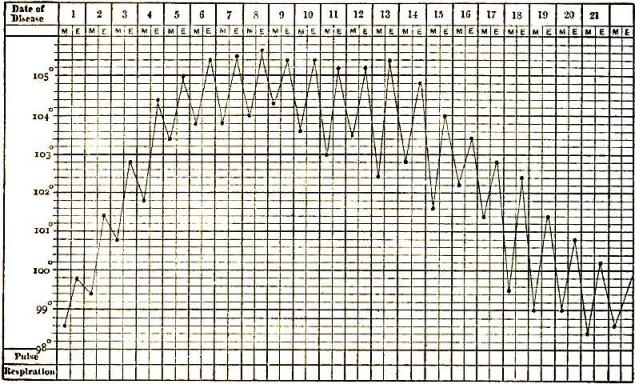
Chart of typical range of temperature in typhoid fever, after Wunderlich.
Frequent observations of the temperature in typhoid fever not merely give most important information in a diagnostic and prognostic point of view, but also often furnish valuable indications for treatment. From a close study of a large number of cases, Wunderlich and other physicians have discovered that the pyrexia has certain characters which distinguish it from other fevers, and which, being present in a case in which the other symptoms are obscure or ill defined, will often enable us to recognize its true nature. The pyrexia may be divided into three periods, each having its own peculiarities. It is usually said that each period lasts about a week, but in severe cases the second and third periods extend over a longer time than this, and the occurrence of a complication or of any other disturbing influence will have its effect in producing either a prolongation of any one or more of these periods, and especially of the last two, or an unwonted elevation or fall of temperature. During the first period there is a progressive rise of temperature, but the rise is never so abrupt as in typhus or in many of the phlegmasiæ. As there are morning remissions, ranging from a degree to two degrees in extent, corresponding to the morning fall in the daily variations of temperature, the tracing upon the temperature chart will be a zigzag line, each evening temperature being from a degree and a half to two degrees higher than that of the preceding evening, while the same difference will be observed in the morning temperature. The temperature ought, therefore, never in an uncomplicated case to be much over 100° on the first evening or 102° on the second. A temperature of 104° at any time during the first or second day will consequently exclude typhoid fever from the diagnosis. From six to eight days are usually occupied before the maximum is reached. I have seen it attained as early as the fourth day in mild cases, and, on the other hand, not until much later in severe ones. It is usually 104° or 105°, but will of course vary with the gravity of the other symptoms. The temperature rarely rises higher than 106° at this period. On the other hand, I have known cases in which it never exceeded 103° during their whole course. It would therefore be wrong to exclude typhoid fever from the diagnosis, as Wunderlich does, if this temperature is not reached by the sixth, or at latest the eighth, day.
In the next period the temperature usually ceases to rise, but has a tendency to oscillate about the maximum temperature of the previous period as a fixed point, occasionally not quite reaching it, at other times rising a little above it. The morning remissions, too, become less decided. In other words, the fever now becomes continuous. This period, although usually lasting about a week, may extend over more than two weeks, even in the absence of complications, in cases which run a severe course, and when it is prolonged from this cause the temperature may again show a tendency to rise, and may even attain an elevation considerably above that of the preceding period. The prognosis in all such cases in which the temperature rises after the middle of the second week is grave. Temperatures of 108°, and even of 110.3°, have been noted at this time. Death invariably follows such high temperatures as these, but before death actually occurs a considerable fall of temperature very often takes place. Wunderlich has also called attention to the fact that it is not uncommon for a sudden and temporary remission of temperature to take place at this stage, varying from one degree to two degrees and a half, which may last from ten to twelve hours, and which usually has occurred in his experience from the sixteenth to the eighteenth day. Toward the close of the second period the morning remissions will be observed to be more decided, while the evening temperature remains about the same as before. The beginning of the third period is indicated by a diminution of the evening exacerbation, while the morning remissions become still more marked. The diminution is progressive, but slow, the temperature each evening falling short by from half a degree to a degree of the point it reached the preceding evening. The morning remissions, on the other hand, each day become greater, a fall of three and a half degrees being not uncommon. The lysis, therefore, occupies usually a longer time than was required by the pyrexia in reaching its maximum. Toward the close of this period the morning temperatures may be normal, as even subnormal, while an elevation of temperature may continue to take place in the evening. Occasionally, however, an abrupt defervescence takes place. The duration of this period will be very much prolonged if complications are present or if the intestinal ulcers are slow in healing. I have known it to last for more than three weeks. During convalescence the temperature is frequently subnormal even in the evening, but the slightest cause is often sufficient to produce a considerable though temporary elevation of temperature. I have known the temperature in one case to rise from 99° F. to 105.6° in a few hours in consequence of an indiscretion in diet, and in another from 100° to 104° from the suffering and excitement caused by a severe attack of toothache. Indiscretions in diet are a fruitful source of these recrudescences of fever. The fever of the third period has all the characters of an irritative fever, and is probably kept up by the irritation arising from the intestinal ulcers. On the other hand, that of the first two periods is due to the action of the specific poison upon the nervous system and the other tissues of the body, and corresponds exactly with the primary fever of the eruptive diseases.
FIG. 13.
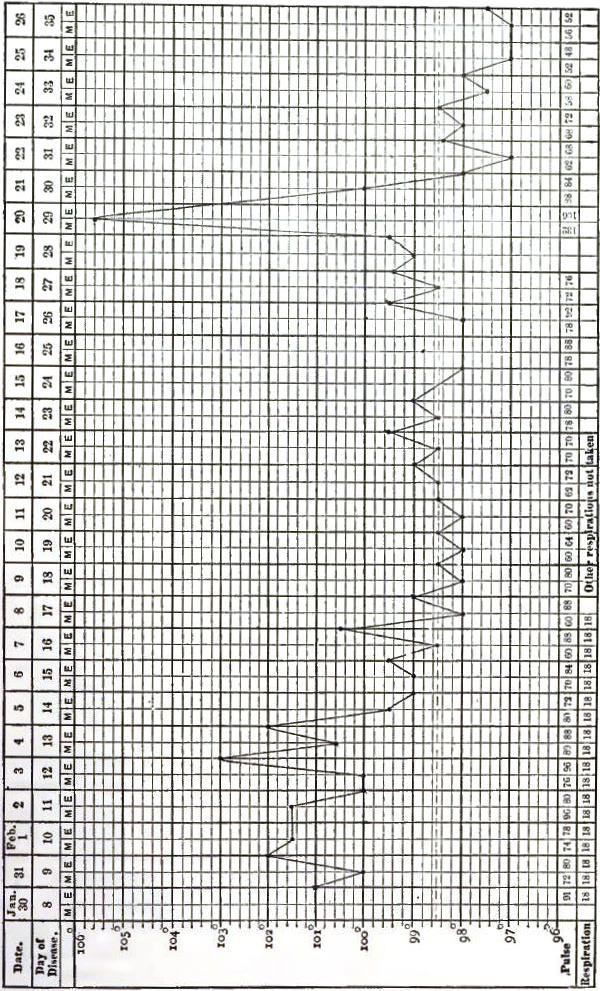
Chart showing recrudescence of fever from indiscretion of diet.
The febrile movement, however, rarely follows a perfectly typical course, and I consequently find, in looking over the temperature sheets of a large number of cases, very few which bear, except during the first period, anything more than a general resemblance to the chart which Wunderlich has prepared as typical. A very slight cause will exercise, as has already been said, a disturbing influence upon the course of the fever, and serious complications or accidents will of course produce a still more marked effect. An intestinal hemorrhage, for example, will cause a rapid and decided fall of temperature. I have often known it to fall from 104° to the normal temperature, or even below it. This depression, unless the bleeding continues and the case ends fatally in the course of a few hours, is only temporary, the temperature rising within twenty-four hours to its former height, and sometimes even beyond it. A free epistaxis or a copious diarrhoea will in the same way cause a fall of the temperature, but it is rarely so marked as in the preceding case. The same effect is produced by the administration of large doses of quinia or by the application of cold water either in the form of the bath, the douche, or any other form, to the surface of the body. On the other hand, the occurrence of a complication will cause a rise of temperature, often considerably above the maximum of the first period.
FIG. 14.
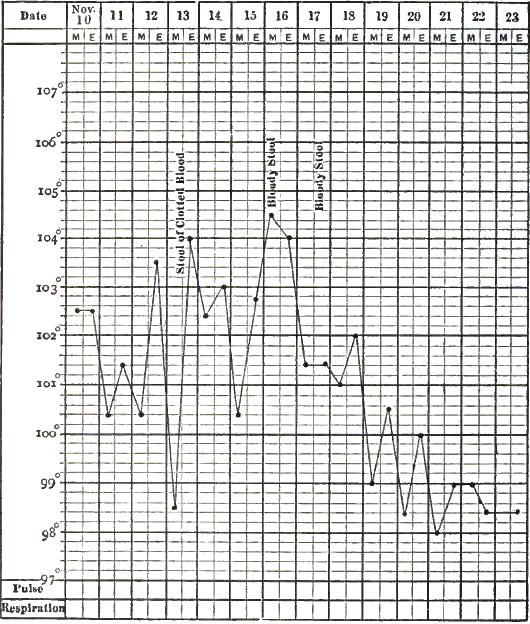
Chart showing fall of temperature from intestinal hemorrhage in typhoid fever.
The thermometer should be used at least twice daily. In this country it is generally introduced into the axilla, and less frequently into the mouth, for the purpose of making an observation. In other countries it is not infrequently inserted into the rectum, and even into the vagina. The best hours for making the thermometric observations are eight in the morning and eight in the evening, since it has been ascertained from frequent observations that the daily remissions are more marked between the hours of 6 and 8 A.M., and that the temperature usually reaches its maximum some time between those of 7 and 12 P.M.
Loss of appetite is, except in mild cases, one of the earliest symptoms of the disease, and usually persists as long as the fever lasts. It is sometimes accompanied by positive loathing for food, but generally there is no great difficulty in persuading the patient to take the necessary amount of nourishment. During convalescence the appetite returns, and is occasionally immoderate, so that it is frequently necessary to curb it lest harm should be done by over indulgence.
Thirst, usually proportionate to the degree of fever, is also present in the beginning of the fever. Later, when the patient sinks into a semi-unconscious condition and becomes insensible to the wants of the system, he will cease to call for water, although it is still urgently needed.
Nausea and vomiting sometimes occur at the beginning of the disease, but they have not been such frequent symptoms in my experience as they would appear to have been in that of Murchison, who says that they are of such common occurrence that the patient is often supposed at first to be suffering merely from a bilious attack. He does not regard them, when occurring at this stage, as serious symptoms. Indeed, he expresses the belief that the subsequent course of the disease is sometimes favorably modified by them. They may also occur later in the disease, and are then of grave import, as they are not infrequently the consequence of peritonitis. Louis regarded vomiting as a grave symptom, but it is probable it occurred in the cases from which he makes his deductions late in the course of the disease. It may sometimes occur during convalescence, and may then interfere very materially with the proper nutrition of the patient. The matter vomited usually consists of a greenish bilious fluid, with the food last taken. In some cases blood has been thrown up.
The tongue at the beginning of an attack of typhoid fever is usually moist and coated with a thin white fur, and in mild cases may retain these characters until the close. Even in some cases which terminate fatally in the course of the second week, the tongue, with the exception of being less moist than in health, may present no marked deviation from this appearance. Generally, however, as the disease progresses, and sometimes as early as the tenth day, it becomes dry and brownish, and is protruded with a tremulous motion. Still later it tends to cover itself with a thick brown coating. This coating is disposed principally along the middle of the organ, leaving uncovered the edges and tip, which are very apt to be unnaturally red in color. The bare portion at the tip is often rudely triangular in shape—a point which is regarded as of some importance in the diagnosis of the disease by Da Costa. In bad cases, during the course of the third week the tongue is frequently crossed by cracks and fissures, which are the cause of much discomfort to the patient, and when deep may bleed and leave behind them scars which are recognizable during the remainder of his life. In other cases the tongue is dry, brown, and shrivelled, or covered with a tenacious, viscid secretion which renders it difficult to protrude it.
In favorable cases, as convalescence approaches the tongue regains by degrees its normal appearance. At first the only noticeable change may be that the organ is a little less dry than before. In a few days it will be observed to have become moist and to be gradually throwing off its coating. The process is, however, a slow one, and one, moreover, subject to frequent interruption. Very often, when it seems nearly completed it will be suddenly arrested, and the tongue become dry and brown. Sometimes, instead of cleaning itself gradually, the tongue throws off its coating in large flakes, leaving the mucous membrane red and shining, as if deprived of its papillary structure. Wood was accustomed to teach that if the tongue when thus cleaned remained moist convalescence might be expected, but would always be tedious. This is an observation the correctness of which I have had abundant opportunity to confirm. If anything happens, however, to interfere with the progress of convalescence, it not infrequently becomes dry and coats itself over again. When the restoration to health is retarded by the continuance of diarrhoea or by the occurrence of any intercurrent affection, the tongue will often become pale and flabby and be the seat of superficial ulcerations or of aphthous exudations.
The mucous membrane of the posterior fauces is also often red and dry and covered with a glutinous secretion, which often materially interferes with swallowing. The lips and teeth are in bad cases encrusted with sordes, and the former are dry and cracked, and bleed readily when picked.
Meteorism or tympanites is observed in the greater number of cases of typhoid fever, having been noted by Murchison in 79 out of 100 cases, and by Hale in 130 out of 179 cases, and in only 43 of the remainder of his cases is it expressly stated to have been absent. My own experience leads me to believe that it is present in even a larger proportion of cases; in fact, that it is rarely absent. It is, as a rule, later in making its appearance than the other abdominal symptoms, showing itself usually about the end of the first or the beginning of the second week. It is generally most marked in grave cases, especially those attended by severe diarrhoea, but I have seen it highly developed in cases in which the symptom was not present at all or but little developed. It may vary, moreover, frequently in degree at different times in the same case, but when once present generally persists until convalescence is established or death occurs. When extreme, it may give rise to distressing dyspnoea by preventing the descent of the diaphragm.
The meteorism is usually preceded and accompanied by gurgling and tenderness on pressure in the right iliac fossa. The former of these symptoms is most marked in cases in which diarrhoea exists, and is caused by the presence of liquid and gas in the lower part of the ileum. The tenderness is unquestionably due to the presence of ulcers in the same part of the bowel. There is also occasionally pain in the region of the umbilicus, but this is a much less frequent symptom.
Enlargement of the spleen was noted by Hale as being present in some of the cases which he has described. It is a frequent symptom of the disease, and may be generally demonstrated by percussion in the course of the second week. It has not, however, often happened to me to be able to feel the organ enlarged through the abdominal walls, as Murchison asserts he has been able to do. Indeed, tympanites is usually present in a sufficient degree to render this difficult. The enlargement occurs more frequently in persons under thirty years of age than in those over it.
Diarrhoea is one of the most frequent symptoms of the disease, especially in severe cases, and there are very few mild cases in which it does not occur at some period of their course. Louis noted it in all but three of his fatal cases, Murchison in 93 out of 100, and M. Barth in 96 out of 101. It varies in different cases in severity, in duration, and in the time at which it appears. It may be one of the earliest symptoms, presenting itself frequently on the first day, and often being the only one which occasions uneasiness to the patient or his physician. At other times its appearance may be postponed until the end of the first week, or even until the patient is apparently entering on convalescence. It may be mild in the beginning and become more severe as the disease progresses, or after having been at first acute may cease spontaneously in a few days to occasion any uneasiness. In degree it may vary from two stools to three or four, or even twenty, in the course of the twenty-four hours. It is absent in a few cases, but in many even of these cases the bowels will be found to act inordinately after a very moderate dose of purgative medicine. I have known, for instance, the administration of a single teaspoonful of castor oil to be followed by five or six stools in an adult. Constipation does, however, actually exist in a certain number of cases. Murchison has known the bowels in cases in which a relapse has occurred to be constipated in the primary attack and relaxed in the relapse. There is no relation between the severity of the diarrhoea and the extent of the local lesion. Although oftenest met with in mild cases, constipation has existed in cases in which perforation of the bowel or intestinal hemorrhage has occurred during life, or very extensive lesions been found after death.