Volume 1 — GENERAL DISEASES. (continued 14)
Reading edition
In typical cases the differential diagnosis between the congestive form and the comatose is made without difficulty. In a congestive chill the surface is cold, blue, or livid, the pupils dilated, and the pulse generally slower than natural and irregular. In the comatose form the surface is preternaturally warm, of a muddy, semi-jaundiced hue, and the pulse and temperature both indicate the feverish rather than the algid state.
The subjects of attacks of the comatose form of malarial fever are for the most part persons who, having contracted attacks of fever in malarial regions, continue to reside in the same localities and yet use no proper medication, either for cure or for prophylaxis. We have in these cases accumulations of secondary blood-poisons quite sufficient to greatly impede brain-function, and the additional doses of the primary toxic agent must exercise more or less influence in determining the phenomena of the attacks.
Very little need be said of treatment, beyond a recommendation of the courses pursued in the cases cited. Hypodermic medication must be resorted to when necessary. Efforts to nourish the patient must never be relaxed. One must see many of these cases before he can realize how often they recover, from conditions apparently utterly hopeless, when promptly treated and properly nourished.
The hemorrhagic form of pernicious malarial fever can scarcely be regarded as an original type. Malaria is not a hemorrhage-inducing poison. Indeed, it may be positively stated that malaria never establishes the hemorrhagic diathesis as a primary effect; and it is only by changes effected in the human economy by its prolonged influence that it appears to become capable of doing so. The most experienced and accurate observers of malarial affections concur in the opinion that this rule is almost without exception.
The morbid conditions whose concurrence entails upon malarial fevers a tendency to hemorrhages may be classed together as follows: First. The blood-changes of chronic malarial toxæmia so alter the consistency of that fluid as to favor the occurrence of hemorrhage. Second. The long persistent states of malnutrition in chronic malarial cachexias produce textural weakening of the vascular walls and increased liability to their rupture. Third. There should be added to these one other factor, which is mainly operative during a malarial paroxysm—namely, the increased blood-pressure put upon the vascular walls by passive congestions.
Two of these factors, as above enumerated, are more or less general to the system, being the consequence of general cachectic states. The third factor acts in a purely dynamical manner in causing hemorrhages, and must necessarily have its area of influence confined to some certain portion or portions of the vascular tree, since the congestions of malarial paroxysms cannot by any possibility be general. It is an interesting fact that the influence of this last-mentioned factor is so frequently paramount in producing malarial hemorrhages. These hemorrhages occur in such immediate relation to chills that we are forced to the conclusion that while altered blood and weakened blood-vessels were previously present, yet some increase of pressure beyond the normal was required to precipitate the hemorrhage.
More than once in the presence of medical classes I have illustrated the influence of these various factors, respectively, by showing the arm of a patient suffering with chronic malarial cachexia, with no extravasation of blood, but upon which the slightest suction with the lips would produce exaggerated ecchymoses. This explains the fact that hemorrhages in malarial fevers are never general, but only manifest themselves upon those surfaces or into those structures which are the seats of congestion during the cold stage of an intermittent.
I do most earnestly assert that during a practice of almost half a century, nearly all of which has been passed in malarious localities, I have never once seen a malarial-fever patient with a general hemorrhagic tendency, if yellow fever and other hemorrhage-inducing diseases could be authoritatively excluded. The medical profession cannot be too watchful in guarding itself against erroneous entries upon mortuary records to account for deaths from fevers accompanied by hemorrhages from multiple surfaces of the body. Such aliases as hemorrhagic malarial fever, climatic fever, rice fever, hæmatemesic paludal fever, and many more of the same character, should receive the severest examination before approval and adoption.
When hemorrhage does attend malarial fevers, it may occur from one or another of a variety of surfaces or into shut cavities or in parenchymatous structures. Some years ago I visited a gentleman who was suffering from an attack of malarial fever, with hæmaturia. He made a rapid and, apparently, a complete recovery. Disobeying my injunctions, he returned to the intensely malarious locality where he had formerly resided. After a few weeks he was seized with a chill, followed by apoplectic symptoms, hemorrhage, and death on third day. It is hardly to be doubted that his death was caused by cerebral hemorrhage. But, however much in consonance with ascertained facts the foregoing remarks may appear to be, there are certain points of pathology connected with malarial hemorrhagic fevers not easy of explanation. Within the last score of years hæmaturia has been a far more common form of hemorrhage in malarial fevers than formerly. In many localities and during certain seasons it has been very prevalent.
In the present state of our knowledge it is not at all possible to explain why it is that different epidemics of malarial diseases should give rise to such a diversity of phenomena, so that one epidemic will be characterized by a peculiar train of symptoms which shall be absent in another, being there replaced by different symptoms equally distinctive of the second epidemic. Whatever may be the cause of these epidemical peculiarities, it must rest in a something which is capable of acting as a force upon the human system. We must think of that unknown agency which exercises this force and gives it some peculiar direction as possessing at least a conventional essentiality. It is not satisfactory to say that the renal blood-vessels are the first to give way, because they are accidentally more weakened than other parts of the vascular system, or accidentally more often the seat of congestion. When accidents become as numerous as these cases sometimes are, they acquire the authority of laws.
The following notes of two cases of malarial hemorrhagic fever may be found of interest:
C. E., aged twenty-six years, was admitted to Ward 19, Charity Hospital, Nov. 18, 1872. Had been in America more than a year, and for several months had been working in an intensely malarial district preparing the bed of a railroad; has had malarial diseases for several months, and suffered a severe chill the day before admission. A few hours after admission temp. 103°, pulse 120, respiration 29; effusion in both thoracic cavities, and very marked in abdominal cavity; lower lobe of right lung oedematous, legs anasarcous, pitting greatly on pressure, with several ulcers of long standing. Urine loaded with albumen and showing under the microscope abundant blood-corpuscles; considerable jaundice present, which the patient states to have occurred suddenly. Ordered five grains each of calomel and bicarbonate of sodium, to be followed after catharsis with ten grains of quinia in solution every two hours. Nov. 22d, patient has taken and retained one hundred and eight grains of quinia; secretion of urine abundant; no blood present, and only a trace of albumen; ordered twenty drops of tincture of chloride of iron three times daily. Discharged cured December 12th. The above comprises the whole treatment in this case, except one important measure, which consisted in determined and persistent efforts at forced nutrition. Meat essences, milk, eggs, and milk-punch were given as methodically as drugs.
H. K., fifteen years of age, was admitted to Charity Hospital Sept. 15, 1872; has a history of malarial poisoning for several months; was considerably jaundiced at time of admission, with anasarcous legs. Under the administration of a mercurial, followed by quinia and iron, he improved so greatly that he was discharged from my wards and placed upon some duty in the hospital. Dec. 19th, at 11 A.M., had a chill which lasted several hours; this was followed by violent fever, with rapid but compressible pulse; much jactitation; incessant vomiting of a greenish-black fluid; urine loaded with blood; and sudden supervention of intense jaundice. Ordered quinia gr. xij by hypodermic injection; small doses of calomel and soda to be placed upon the base of the tongue and washed down with ice-water. Secretion of urine ceased on the morning of the 20th, followed by death at 11 P.M. Autopsy showed both kidneys dark-colored and swollen from complete blood-engorgement.
The treatment of hemorrhagic malarial fevers may be included under the following indications:
First, to secure cinchonism as early as possible;
Second, to arrest the extravasation of blood;
Third, to sustain the patient's strength, and to preserve the systemic fluids at as near a healthy standard as may be possible.
The first-mentioned indication is certainly the first in importance. If the hemorrhage originates during a chill, or exhibits degrees of aggravation in such close relation to the cold stage of malarial paroxysms as to point to a relation of cause and effect, then that course of treatment which breaks the recurrence of paroxysms will at the same time mitigate the hemorrhage, if, in truth, it should fail to stop it entirely. Quinia should be given in large doses by the mouth or rectum, or both, or subcutaneously if demanded by the urgency of the symptoms. I have generally used carefully prepared solutions of the sulphate for hypodermic injections, but many practitioners prefer solutions of the hydrobromate for this mode of exhibition. I have never witnessed any symptoms following the administration of cinchona salts which justified a belief that they increased the hemorrhage. My rule of practice has invariably been to endeavor to prevent the occurrence of another paroxysm, without regard to this very questionable charge.
In regard to the second indication, it may be stated that patients are not likely to die from actual loss of blood in any form of hemorrhagic malarial fever. The blood which is poured out on free surfaces and escapes by some outlet is seldom so much as to endanger life, but the hemorrhagic process is likely to involve deeper-seated vessels. This is especially true in malarial hæmaturia. Hemorrhages into the stroma of the kidneys, the Malpighian tufts, and the uriniferous tubules arrest urinary secretion, and thus entail death. In order to prevent these results hæmostatics should be resorted to as often as attendant circumstances will permit. Generally these are such as to admit of the use of hæmostatics without prejudicing the effects of other remedies. In my experience ergot in combination with gallic acid and dilute sulphuric acid has been very efficient. The following prescription has been usually given:
Rx. Ext. Ergot. Fluid. fl. drachm iv;
Acid. Gallic. gr. xl;
Acid. Sulphuric. dil. fl. drachm j;
Syr. Zingiber. fl. drachm iij;
Aquæ q. s ad fl. oz. ij. M.
S. Dessertspoonful every four hours, diluted with water.
Some practitioners place a very high estimate upon the hæmostatic effects of turpentine. This is undoubtedly a most valuable and accessible remedy. Dr. Schnell of Plaquemine Parish, La., has found the tincture of chloride of iron the best hæmostatic. He places fl. drachm ij in fl. oz. iv of water, and directs a dessertspoonful every hour as long as the hemorrhage continues. In a great majority of cases of malarial hæmaturia occurring under my observation solutions of bitartrate of potassium have been given with great apparent benefit. Its action is certainly not that of a direct hæmostatic, but by setting up currents through the kidneys, and perhaps by some solvent power over exudations in the uriniferous tubules, it has acted as a renal deobstructive.
In the arrest of renal secretion diuretics, cupping over the lumbar region, and large injections of warm water into the bowels may be resorted to. Some practitioners state that they have found buchu beneficial.
The third indication involves a twofold duty. One relates to judicious and vigilant attention to the patient's nutrition; the other relates to such measures for depuration as may be called for in each particular case.
It must be admitted that there is a degree of antagonism in the measures of practice proper to effect these two purposes, which renders their coincident exercise a difficult practical question. In many cases of hemorrhagic malarial fever a competent supply of properly prepared foods is sufficient. In other cases—and this is especially true of malarial hæmaturia—depurative medication becomes paramount. A person suffering under the effects of chronic malarial poisoning is seized with a chill; this is followed by bloody urine, and in the course of four or five hours intense jaundice appears. Incessant vomiting, delirium, and jactitation also occur. The experienced physician is at once brought to the conclusion that he has to deal with a case of blood-poisoning bearing a close resemblance in symptoms to uræmia. To render this conclusion still more absolute, he has only to recall the suddenness of the occurrence of the jaundice and to inquire what has occasioned it. Its appearance is too rapid to permit us to ascribe it to obstruction. It is altogether improbable that it is due to sudden hypersecretion in such pathological states of the system as are present. If, however, we account for it by saying that the addition of a new toxic constituent, urea and its congeners, to an already profoundly poisoned fluid suddenly arrests those processes which dispose of bile in physiological conditions of the system, it seems to me that we adopt the most rational theory. It is then jaundice from lack of consumption. The mere probability of truth in this theory will impress the practitioner with the great importance of eliminant practice in these conditions.
Calomel has been the medicine to which I have principally trusted. I give it merely as a depurative, and not as an alterative. Doses of from two to ten grains may be repeated at suitable intervals until catharsis has been produced. Bitartrate of potassium, Seidlitz powders, or solutions of citrate of magnesia may be also administered if indicated. After purgation the vomiting is mitigated, if not altogether relieved. On this account, and because of bettered states of the system for absorption and assimilation, the way is now clear to the physician. He can ply his antiperiodics, his properly prepared sustenance, and his alcoholic stimulants according to the exigencies of each particular case.
The following propositions may seem not inappropriate in closing this section:
1st. Attacks of pernicious malarial fever are attended by more danger to life or subsequent health than simple attacks; therefore more prompt and energetic efforts should be made to cut them short by cinchonism.
2d. The blood depravations of pernicious malarial fevers far exceed those of simple cases; and therefore it becomes a leading indication of treatment to correct faulty conditions of this fluid as early as possible. In endeavoring to secure this end assimilable foods, stimulants, and depurants must have a shifting scale of value according to the exigencies of each particular case.
3d. The complications of attacks of pernicious fever are far more important than those of simple forms; and therefore symptomatic treatment is often urgently required.
4th. Attacks of pernicious fever may be greatly diminished in number by properly directed treatment of chronic malarial toxæmia, and especially also by the removal of persons suffering under this cachexia to non-malarious localities.
Typho-Malarial Fever.
The prefix typho- is properly applicable to a class of malarial fevers which are complicated by the specific poison which produces typhoid fever.
This term was introduced into medical nomenclature by Surgeon J. J. Woodward of the United States Army. His classical paper on this subject has been published in the Transactions of the International Medical Congress at Philadelphia in 1876. The following extract from the proceedings of this congress will show the interpretation of this term by Woodward:
"On motion of Dr. Woodward, seconded by Dr. Pepper, the following was adopted as expressing the opinion of the section: Typho-malarial fever is not a specific or distinct type of disease, but the term may be conveniently applied to the compound forms of fever which result from the combined influence of the causes of the malarious fevers and of typhoid fever."
It follows, therefore, that the term should be so restricted as to define a disease compounded of the two pathological factors which when acting separately produce either typhoid or malarial fever.
When understood in this sense, and carefully employed, the term appears to me unobjectionable. Perhaps, indeed, it may be a convenient addition to medical nomenclature. If such a name had not been introduced, we would be forced to speak of these cases of compound disease as complications. As it is customary to regard the minor or less important affection as the complicating disorder, we would often have confusion in determining whether the case should be typhoid fever complicated by malaria or malarial fever complicated by typhoid. This term leaves all questions of precedence or predominance in abeyance.
There are no facts, however, which support a conclusion that the malarial poison is capable of forming combinations with the particular poisons of other specific fevers and give birth to a new special poison, which may be perpetuated by successive generations, and thus produce epidemics of a new but compound disease.
The importance of a proper use of the term typho-malarial implies co-ordinate care in diagnosing the true nature of the malady it should define.
It may be said, in brief, that the diagnosis of typho-malarial fever must rest upon the blending of the symptomatic phenomena peculiar to each one of the two fevers which enter into combination. In other words, if the differential diagnosis between the two diseases when they are distinct is made by contrasting the symptoms peculiar to each, the compound disease is to be recognized by more or less positive combinations of these symptoms.
These blended symptoms should not be expected to exhibit the results of a copartnership in which each member exerts equal influence. It is well understood that when two diseases coincide, that one which is more violent or excessive in its morbid process holds so much sway as in some cases almost to extinguish the symptoms of the weaker member of the combination. Consequently, in typho-malarial fever, the typhoid, being the graver of the two forms of disease, ordinarily rules the pathology.
The following notes, accompanied by a temperature chart, will illustrate the clinical course of a case of typho-malarial fever:
J. L., aged thirty years, of French nativity, but a resident of New Orleans for three years, was admitted to Ward 21, Bed 311, Charity Hospital, on the night of December 10, 1881. Had been ill some days with ague. The house-surgeon administered gr. x. of quinia in solution and gtt. xv. of tincture of opium.
The records and temperature date from the 12th of December. During the 11th he took drachm ij sulph. cinch. in solution.
FIG. 24.
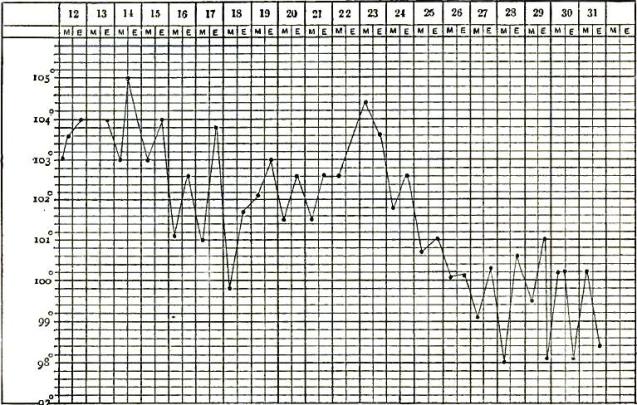
PART I., showing the temperature curve from December 12th to 31st, inclusive, during which time the more characteristic typhoid symptoms predominated.
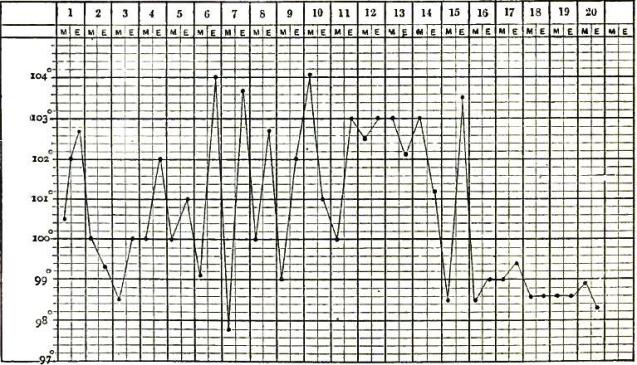
PART II., showing the temperature curve in same case from January 1st to 20th, inclusive, during which the influence of the associated malarial poison was prominent.
Dec. 13th, tenderness and gurgling in ileo-cæcal region; epistaxis; rose spots on abdomen; deafness and ataxia; no stools since 11th. Ordered
Rx. Acid. Sulphuric. dil.,
Syr. Aurantii Cort. aa. fl. drachm ij;
Tinct. Cinchonæ Co. fl. oz. j. M.
S. Teaspoonful in water every four hours.
Also ordered beef-essence, milk-punch, and milk.
Dec. 13th, two very offensive liquid stools; ataxia greater; skin yellow and countenance dull and listless. Dec. 14th, fresh rose spots; tongue brown and dry; three stools; much jactitation. Dec. 15th, more ataxia; some delirium; pulse 100, weak. Gave gr. iiss quinia in solution, with tincture opium gtt. iii, every two hours. Dec. 16th, pulse 128, weak; delirious. Dec. 17, new rose spots; belly tympanitic; tongue brown, dry; sordes on teeth and lips; eyes injected; very delirious. Treatment continued; nutrition and stimulants given methodically. From 17th to 22d but little change in condition or treatment. Diet and stimulants administered regularly. Dec. 22d, coma vigil; completely delirious. Ordered
Rx. Liq. Morphiæ Sulph.,
Tinct. Digitalis aa. fl. drachm iij;
Spts. Æther. Nitrosi fl. drachm ij;
Liq. Potass. Citrat. fl. oz. iij. M.
S. Tablespoonful every three hours.
As the oscillations of temperature became more marked, quinia was resorted to, apparently with good effect. The patient was discharged from the hospital Feb. 8, 1882.
It should be observed that after the 14th of December the patient's bowels were rather costive, and the stools occasionally moulded and very dark in color. On the forty-fifth day after admission the patient had a severe chill, followed by a rise of temperature to 104°. This yielded to competent doses of sulphate of cinchonidia.
This was a typical case of typho-malarial fever. The blended symptoms, as well as those special to each disease, are sufficiently exhibited in the clinical account. The presence of typhoid fever was established by the rose spots and the marked nervous symptoms. The typhoid process seems to have been unusually mild in so far as evidence of bowel lesions were made manifest.
The history of the patient before admission, the color of his skin and stools, and the temperature curves gave abundant proofs of the malarial element in the pathology of the case.
Perhaps nothing need be added on the subject of diagnosis. I may, however, remark that I am very cautious in asserting the diagnosis of typho-malarial cases unless the nervous symptoms, positively-marked bowel symptoms, or rose spots are present to vindicate such a decision. The presence of malarial poison may be determined with less difficulty from the previous history of the case and its special symptoms in the early stages of an attack. But if the morbid processes of the typhoid poison are violent, there are likely to be stages of the disease when it is not possible to detect symptoms which indicate the presence of malaria. On the other hand, it is unquestionably true that the typhoid condition, as it is termed, which so often complicates malarial fevers, can very generally be differentiated from true typhoid fever. While certain cases, or even epidemics, of malarial fevers are attended by remarkable adynamia, often manifesting itself from the very incipiency of attacks, it differs widely from that utter nervous ataxia which characterizes typhoid fever. Again, the adynamia of malarial attacks is generally ascribable to some cause not essential to those affections. Imperfect reaction from a chill, long persistent hyperpyrexia, diarrhoea or vomiting, or chronic paludal cachexia, or, it may be, some epidemic influence, may produce it. The ataxia of typhoid fever is part of its morbid process.
Woodward's statistics show that 49,871 cases of fever diagnosed as typho-malarial occurred among the white forces of the United States during the late Civil War. Of this number, 4059 proved fatal, a mortality-rate of 8.13 + per cent. Among the colored troops 7529 cases occurred, with 1301 deaths, a mortality-rate of 17.27. Statistics borrowed from the same excellent authority give the number of cases of unmixed typhoid fever (or fever classed as typhoid without reference to any complication) as 75,368 among the white troops, with 27,056 deaths, a mortality-rate of 35.89. Among the colored troops 4094 cases occurred, and 2280 died, a mortality-rate of 55.68. These figures show very singular comparative results. They prove that typhoid fever as an uncomplicated malady, was four and a half times as fatal among the whites as the same disease when in combination with malarial poison. Among the colored troops typhoid fever was three and a half times more fatal than typho-malarial fever.
It is highly probable that inaccuracies exist in statistics gathered in the confusion of a great civil war, but I am not prepared to say that the conclusions they point to are incorrect. When an acute inflammation is complicated by malaria, its prognosis is rendered more grave. This, no doubt, is due in part to degradations of the fluids of the system by the malarial poison, and in part to the revulsions of circulation during paroxysms. But it does not follow from this fact that the presence of malaria in the blood, or its effects upon that fluid, exercise an unhappy influence upon diseases due to other specific poisons. It may, on the contrary, be ascertained in the future that it modifies the typhoid process, so as to deprive it of some of its most dangerous features.
Further investigations are required to determine the facts in regard to these questions. But it may be premised that if such a conclusion shall ever be reached, it will influence our expectations of cure rather than our practice. If the malarial poison is capable of modifying the toxic effects of the typhoid poison, it must do so in the very formative stages of that affection, if not in its incubative period, so that, having accomplished all the good it is capable of effecting, we may proceed at once to rid ourselves of its presence.
In entering upon the treatment of two diseases compounded in the same patient, if one should ordinarily be amenable to specific treatment, it must certainly be wise practice to endeavor to simplify the case by subtracting that one from its composition. This is more especially true if the treatment does not affect the course of the other disease in any injurious manner. It is therefore proper to begin the treatment of a case of typho-malarial fever by administering large doses of quinia. A scruple may be given every fourth hour, until its effects in eliminating symptoms ascribable to malaria, and also as an antipyretic, have been sufficiently tested. In the early stages of typho-malarial attacks the febrile exacerbations conform to those laws of periodicity which govern uncomplicated malarial fevers. After the first week, or when the typhoid process has become well established, periodic returns of the fever are less plainly observable. It is possible that in some cases in which the typhoid process manifests itself with great severity the temperature curves may be very characteristic of that disease. I am satisfied that the indications for giving quinia to eliminate the malarial element must be based upon the fever curves which mark the case. Perhaps a more frequent application of the thermometer would often exhibit malarial periodicity where it may otherwise remain unsuspected. I know this to be very often the case in pneumonia complicated by a malarial fever.
Whether thorough cinchonism in the early progress of the attack rids the case of symptoms due to malaria or not, only a very few days are likely to elapse before oscillations of temperature call for its repetition.
The typhoid processes require very much the same measures which are applicable in uncomplicated cases of that disease. The stools of the early stages of attacks should not be checked unless excessive, and mercurials and laxatives should be more freely used than in simple typhoid fever. The effects of the malarial fever and of the hyperpyrexia of typhoid fever, when combined, must almost necessarily entail more accumulation of excrementitious material in the blood than would occur either disease existing separately. On this account eliminating treatment is an important indication. When it becomes necessary to check the diarrhoea because excessive or on account of failing strength, diuretics subsequently prove serviceable. Effervescing solutions of potassium or ammonium, lemonade, Apollinaris water, iced tea, strawberry, mulberry, or raspberry juice, are grateful beverages and increase renal activity. The mineral acids may be given during the ulcerative periods of the disease. Insomnia must be relieved by opiates, chloral hydrate, or other hypnotics.
Tympanites should be met by warm stupes, large enemas of warm water with fl. drachm j tincture of asafoetida or fl. oz. j of whiskey. Small doses of turpentine in emulsion are often beneficial.
In the early progress of cases the diet should consist of farinaceous foods, with milk and the pulps or juices of fresh fruits, given either cooked or in their natural state as the physician may determine for each patient. Methodical and forced nutrition becomes necessary at more or less early periods in different cases.
The stools and all ejecta of the sick should be disinfected and disposed of with the same care and for the same purpose as those of unmixed typhoid fever.
PAROTITIS.
BY JOHN M. KEATING, M.D.
The term parotitis is applied to a condition of painful enlargement of one or both parotid glands, inflammatory in nature, acute in its course, and usually subsiding by resolution, but sometimes ending in suppuration. The different methods of termination, together with certain etiological distinctions, form the basis of a division of the affection into two sub-classes—namely, 1, idiopathic parotitis; and 2, symptomatic or metastatic parotitis. These demand separate consideration.
I. Idiopathic Parotitis.
Idiopathic parotitis, parotitis epidemica, or mumps, as it is variously named, is an acute contagious inflammation of one or both parotid glands, which usually appears but once in a lifetime, and which, although by no means limited to children, is commonly met with between the second year and the age of puberty. In certain exceptional cases the disease affects the submaxillary glands alone.
NATURE.—The undoubted contagiousness of mumps, with the fact of its frequently occurring in extended epidemics, entitles it to a place among the zymotic diseases, from which it differs, however, in the marked disproportion between the local and constitutional symptoms, the former being well developed, the latter but slight or altogether absent.
ETIOLOGY.—While it is more than probable that, like the other diseases of the zymotic class, mumps is due to a contagium that finds its way into the body in the inspired air or with the food or drink, nothing is known of the nature of this infecting principle.
The predisposing agencies are better understood. Age is one of these, the greater number of cases occurring, as already stated, between the second and the fifteenth year. Infants at the breast are almost entirely exempt, and so, too, are individuals advanced in years. In extended epidemics it is not unusual to meet with cases in adults, but it will generally be found on careful examination that these patients have escaped the disease during childhood. Sex exerts some influence, a much larger percentage of males being attacked than females. Epidemics appear more frequently in the spring and fall than at the other seasons of the year, so that cold and dampness of the atmosphere must be looked upon as predisposing causes. Mumps bears a peculiar relation to measles, scarlet fever, and diphtheria, epidemics being apt to occur directly before, during, or immediately after the prevalence of either of these affections, especially the first. The popular idea of mutual protection is entirely without foundation.
Certain peculiarities are presented by the disease in its mode of occurrence and in the duration and intensity of its epidemics. Thus, some localities are visited annually, others only at intervals of thirty years or more; again, one epidemic may last but a few weeks and affect a small number of individuals, while another extends over months and attacks all the children and many of the adults in the affected region.
ANATOMICAL APPEARANCES.—The exact pathological lesion in mumps is obscure, since the trifling nature of the disease and the almost invariable termination in recovery afford no opportunity for post-mortem investigation. According to Foerster, who seems to have made examinations in cases where mumps occurred as one of the accidental complications of other and fatal diseases, the affected gland at first becomes hyperæmic, and is then the seat of serous exudation. It is reddened, swollen, and on section presents a uniform flesh-like, moist appearance, in place of the ordinary granular aspect. The tumor is often greatly increased in size by a simultaneous serous infiltration of the periglandular connective tissue, and occasionally this tissue alone is involved, the gland itself being entirely free from lesion. The great point in favor of this view of the pathology is the rapid and complete subsidence of the parotid swelling by resolution—a termination to be expected only when the inflammatory process stops short of suppuration or fibrinous exudation.
Virchow regards all cases of parotitis as the result of an extension of a more or less malignant catarrh originally affecting the gland-ducts. This is undoubtedly true in some cases, but that it is far from being the rule is proved by the infrequency of parotitis as a secondary complication of catarrhal affections of the mucous membrane of the mouth.
COURSE AND SYMPTOMS.—The course of the disease is susceptible of a division into three stages—a period of incubation, of invasion, and of actual attack.
The stage of incubation extends over a period variously estimated as from seven to fourteen days. It is marked by no symptoms, though sometimes a history of impaired appetite and digestion, irregular bowels, and languor during the last two or three days may be obtained.
The period of invasion is short, lasting only twelve, or at the most twenty-four, hours. The patient is pale and languid, has slight rigors, pains in the breast and head, and loss of appetite; later, local pain in the parotid region on moving the jaws or on taking acid liquids into the mouth. The surface temperature increases from hour to hour, and just before the glandular swelling appears it reaches 100° or 101° F. In some cases the invasion is characterized by the same train of symptoms that ushers in the acute exanthemata, such as repeated vomiting, diarrhoea, restlessness and anxiety, a disposition to syncope, and, in very irritable children, convulsions. Contrasted with this violent invasion other cases are met with, in which there are no prodromes whatever except a gradual rise in temperature, imperceptible without the use of the thermometer.
The first symptom of actual attack is a peculiar slight stitch-like pain in one parotid region, usually the left. This radiates toward the ear of the affected side, and is increased by movements of the jaw, as in chewing or talking, and by external pressure. The pain rapidly grows more intense, and soon becomes associated with swelling. The tumor first appears in the depression between the mastoid process and the ramus of the jaw, which it fills up, and at the same time thrusts outward the lobe of the ear. As the gland alone is swollen at first, the tumor has the outline of a triangle, with the apex directed downward and forward; soon, however, the connective tissue becomes oedematous and the swelling is greatly extended, involving the cheeks and neck, in the latter region, in severe cases, running forward as far as the median line, downward nearly to the shoulder and backward toward the spine. The most prominent point is directly in front of the ear. The oedema also extends internally, involving the pharynx, the tonsils, and sometimes even the larynx. The skin covering the tumor is either perfectly natural in color or slightly reddened. The central portion is firm and elastic to the touch, the periphery doughy, and pressure here often produces pitting. There is but moderate tenderness. The swelling reaches its height in three days, remains stationary for two days longer, and then rapidly declines, the oedema first disappearing and afterward the glandular swelling, the process of resolution occupying four or five days and being attended with a slight desquamation of the cuticle.
While mumps almost uniformly begins on one side, both glands are, as a rule, affected during the attack. The second tumor begins to develop twenty-four to forty-eight hours after the first, though its appearance may be delayed much longer, even until resolution has begun on the side primarily affected. As the course of the inflammation is similar in both parotids, the whole duration of the attack will depend on the time of involvement of the second gland.
Among the other symptoms an alteration of expression is prominent. At first, the head is inclined toward the affected side; later, when both glands are involved, it is held perfectly erect, and, as the slightest movement increases the pain, it is maintained stiffly in this position. The swelling of the cheeks prevents all play of the features, and this, combined with widely-open, staring eyes and increased thickness of the neck, gives the patient a stupid, almost idiotic, expression. The swelling of the neck is sometimes so great that its diameter exceeds that of the head, and the shoulders, neck, and head, viewed together, have the outline of a truncated pyramid.
As any movement of the lower jaw greatly augments the suffering, the mouth is kept closed, often so tightly that it is impossible to see more than the tip of the tongue. All efforts at mastication are suspended, and deglutition is so painful, especially when the tonsils become enlarged, that the sufferer bears the pangs of hunger and thirst rather than endure the agony entailed in satisfying his wants. The act of speaking even augments the pain; the voice, when heard, has a nasal tone. The acuteness of hearing is impaired, there are singing noises and shooting pains in the ears, headache, and sometimes, in extreme cases, symptoms of cerebral hyperæmia due to pressure upon the cervical veins.
The tongue is heavily coated, the mouth is either dry or there is an increased flow of saliva, and the fluid dribbling from the mouth adds another element to the idiotic expression already referred to. There is loss of appetite, increased thirst, occasionally vomiting, and commonly constipation. The temperature is elevated and the pulse increased in frequency, both to a moderate degree. The respiration is unaffected, except when the oedema has invaded the submucous connective tissue of the larynx; then the movements are increased in frequency and difficult.
Throughout the attack the pain, unless intensified by some extraneous influence, as pressure or the act of speaking or swallowing, is only moderately severe. In ordinary cases the patient rests quietly and sleep is undisturbed, unless the tonsils are enlarged, when it is liable to interruption from loud snoring. When the attack is severe and in nervous, excitable children there is restlessness, sleeplessness, and slight delirium at night.
The general symptoms keep pace with the local in their increase, but they commence to subside before, beginning to disappear while the swelling remains stationary. As soon as resolution sets in the general and local improvement are both rapid, and by the end of the week nothing is left but a trifling weakness and pallor, which disappear in a few days more, leaving the patient perfectly well.
Besides the ordinary symptoms, mumps in certain instances shows a peculiar tendency to metastasis, or secondary involvement, of the testicle and scrotum in males, and the mammæ, vulva, and ovaries in females. This metastasis occurs much more frequently in males than in females, and is usually met with in pubescents and adults, being very rare either in childhood or old age. It generally begins six or eight days after the appearance of the parotid tumor. The latter, as a rule, subsides on the occurrence of any of these metastatic affections, though occasionally the two run a simultaneous course. This occurrence, together with the fact of the secondary inflammation appearing at the date on which the parotitis naturally begins to disappear, tends to support Niemeyer's view, that the two affections are in reality due to the same cause, and that no true transference of inflammation takes place from one point to the other. Occasionally, the parotitis disappears a variable time before the onset of the metastatic affection; then the interval is marked by grave symptoms of depression and cerebral disturbance, but there are no proofs of actual meningeal involvement. In these cases there is, at times, an excessive elevation of temperature, which may account for the brain symptoms.
The most constant secondary manifestation is swelling of the testicle proper, or true orchitis; less frequently there is epididymitis, and with it acute hydrocele and oedema of the scrotum. The orchitis in most cases is unilateral, the right testicle being affected, just the opposite to the parotids, of which the left is the one first involved. When the orchitis is double, both testicles do not become swollen at once, the one preceding the other by an interval of several days.
The course of the orchitis is very similar to that of the mumps, the inflammation increasing gradually for from three to six days, then undergoing rapid resolution, the gland returning to its normal condition by the end of two weeks.
The local symptoms are swelling, the testicle being enlarged to two or three times its natural size, dull pain, and moderate tenderness, while in very severe cases there is burning on micturition and a purulent discharge from the urethra. The spermatic cord does not sympathize in the inflammation, and neither the swelling, pain, nor tenderness is so great as in specific orchitis.
The general symptoms are confined to a moderate elevation of temperature and increase in the frequency of the pulse, thirst, and loss of appetite. This fever is separated from that of the parotitis by an interval of two or three days.
The course of bilateral orchitis is longer by forty-eight hours than that of the unilateral form, and the attending fever is more intense.
The rapid return of the testicle to its natural size and shape shows that, as in the parotid glands, the inflammation does not extend beyond the stage of serous exudation.
THE DIAGNOSIS of mumps is easy after the disease is sufficiently developed to produce the characteristic alterations in the facial expression. In the earlier stages the position of the swelling, immediately beneath and in front of the ear, its triangular shape, and the elevation and outward displacement of the lobe of the ear of the affected side, distinguish it from the enlargement of the cervical lymph-glands so liable to occur in strumous subjects. The acute onset and course of mumps are the points of distinction between it and morbid growths, or the very rare condition of chronic hypertrophy of the parotid gland. The metastatic orchitis cannot be mistaken for gonorrhoeal orchitis if the least care is taken to investigate the history in either case.
THE PROGNOSIS is extremely favorable, there being no record of a fatal case of uncomplicated mumps. Suppuration may occur, but it is an exceedingly rare event. In scrofulous children the course may be protracted for several weeks, and in them resolution is occasionally imperfect, a degree of enlargement and induration of one or both parotids remaining for some time.
Metastatic orchitis, as a rule, leaves the testicle in a normal condition, but, according to Vogel, in some epidemics complete atrophy results.
Dogmy reports an epidemic which raged in a garrison of Mount Louis in January, 1828. Of sixty-nine bilateral and eighteen unilateral cases of parotitis, metastasis to both testicles occurred in four cases, all of which resulted in atrophy of the affected testicle.
THE TREATMENT is simple. The patient should be kept in a uniform temperature, confined to one room, or, better still, to bed, until resolution is well established. While the difficulty in swallowing and fever continue the food should consist of milk and beef-tea; later, other nutritious articles of diet may be added as the appetite demands. Water, iced carbonic acid water, or lemonade may be allowed as freely as the patient will take them, to allay the thirst. A daily evacuation of the bowels must be secured by the use of saline laxatives. During the early stage, if the fever be high, tincture of aconite-root should be cautiously administered; afterward liquor potassii citratis will sufficiently fill the indications for a febrifuge. Tonics are required during the decline of the disease; of this class of remedies, syrup of the iodide of iron, bitter wine of iron, and ferrated elixir of cinchona are most useful.
Special symptoms may demand attention. For example, headache and delirium should be relieved by hot mustard foot-baths and moist cold to the forehead; difficult deglutition from enlargement of the tonsils, by the frequent swallowing of bits of ice, or, if possible, by the application of astringent lotions, as tannic acid and glycerine (one drachm to the ounce); sleeplessness, by the administration of bromide of potassium, with or without small doses of hydrate of chloral in children and of some preparation of opium in adults.
In the way of local treatment the best results and greatest relief to suffering will be obtained by gently rubbing the swollen glands with a mixture of tincture of opium and sweet oil (one drachm to the ounce), three times daily, and in the mean while keeping the parts enveloped with a moderately thick layer of cotton wadding covered by oiled silk. Water dressings or light poultices may be used with advantage. When resolution begins a more stimulating lotion will hasten the disappearance of the swelling.
In the exceptional instances in which the skin covering the tumor becomes tense and red, and suppuration is threatened, two or three leeches may be applied behind the ear of the affected side. When suppuration has actually taken place the abscess should be immediately opened to prevent further destruction of the gland-tissue and perforation into the external auditory meatus.
If, particularly in strumous subjects, resolution be incomplete and glandular enlargement and induration remain after the cessation of the acute symptoms, cod-liver oil and iodide of iron are demanded for internal administration and the compound ointment of iodine for external application. It is well to dilute the latter sufficiently to prevent its causing irritation of the skin, and to apply it twice daily.
When metastasis occurs, the return of fever calls for the same general treatment as in the early stage of parotitis. In addition, an emetic should be given, as this often cuts short the fever or causes it to disappear more rapidly. The patient must be kept at perfect rest in bed, with the scrotum elevated by a cushion and covered with warm anodyne lotions. Salines must be administered sufficiently often to secure regular and free action of the bowels.
When the mammæ or ovaries are secondarily attacked, the seat for local treatment is of course different, but in all other respects the management must be the same.
For the uncommon cases in which the transference of the inflammation is attended with depression stimulants are required, and for those in which meningitis is threatened cutting off the hair and the application of cold to the head, hot mustard foot-baths, local and general venesection, drastics, and irritants to the cutaneous surface, are necessary.
II. Symptomatic or Metastatic Parotitis.
Symptomatic, metastatic, malignant, or suppurative parotitis, as the condition is variously designated, is an inflammation of the parotid gland which occurs during the course of different grave acute diseases, is usually unilateral, and terminates in suppuration, or much more rarely in gangrene, of the gland involved.
ETIOLOGY.—It may occur in association with typhus, typhoid, relapsing, puerperal, and scarlet fevers, or with the plague, measles, dysentery, cholera, and pyæmia, springing into notice at different periods of the course of these affections, which may be regarded as predisposing causes. The exciting cause is perhaps mechanical in nature—namely, the excessive dryness of the mucous membrane of the mouth so common in the severe fevers. This dryness may lead to an occlusion of the orifice of the parotid duct, with retention of the saliva, which fluid, undergoing decomposition, may act as an irritant, producing inflammation, and finally suppuration, of the glandular tissue. This is a likely enough explanation of the causation in some cases, but dryness of the mouth is such a uniform symptom in fever, and suppurative parotitis such a comparatively rare complication, that it cannot be a very active or common cause. Nevertheless, it is impossible to fix upon any other direct cause, though the altered condition of the blood in the conditions mentioned must not be lost sight of as an important etiological factor.
ANATOMICAL APPEARANCES.—The character of the pathological lesions have been well established, owing to the frequent opportunities that arise of examining the diseased gland at different stages of the inflammatory process. When the inflammation has lasted a short time, a day or two, the tubes and acini of the gland are seen on section to be swollen and reddened, and the connective tissue infiltrated with serum and yellowish-red in color; a fluid, either viscid, ropy, grayish in color, or more purulent in character, fills the duct, and may be forced out into the mouth by stroking it in the direction of the orifice. If of several days' longer duration, purulent softening will be noticed in the centre of the acini; this gradually extends until each acinus is converted into a little sac of pus. Then the inter-acinous connective tissue breaks down, and the multiple, minute, purulent collections become converted into a single large abscess or into two or more smaller ones. Next, the pus seeks an outlet. The position of pointing may be on the cheek or in the external auditory meatus—a very common location; again, the abscess may break into the mouth, the pharynx, the oesophagus, or into the anterior mediastinum, the pus burrowing its way along the sheath of the sterno-cleido-mastoid muscle.
While the parotid abscess is forming, suppurative inflammation is apt to be set up in the masseter, pterygoid, and temporal muscles, and from these positions the pus forces its way upward to the temporal or zygomatic fossæ. The periosteum of the neighboring bones, and even the bones themselves, may become involved, and sometimes the cranial bones are partially destroyed, and there is an extension of the inflammation to the brain or its membranes. The middle ear may participate in the general destruction, and the patient is left permanently deaf, if indeed he escape with his life.
The lymphatics, veins, and nerves traversing the parotid are affected by the suppuration in the gland. Irritation of the lymph-vessels results in swelling, tenderness, and suppuration of the lymph-glands. Thrombi form in the jugular vein and its branches, and by breaking down lead to septicæmia and ichorization of the sinuses of the dura mater. The nerves resist for a long time, but seem to act as paths of conduction of the inflammation, the facial nerve leading it to the ear, and the branches of the trifacial to the brain. When gangrene of the gland takes place, the traversing nerves as well as the gland elements are rapidly destroyed.
SYMPTOMS.—Symptomatic parotitis, occurring during the course of any of the diseases already named, produces no change in the general symptoms; if, on the other hand, it occurs during convalescence, the onset is marked by a moderate elevation of temperature and increase in the frequency of the pulse, by thirst, loss of appetite, and sluggish bowels. The tumor, which occupies the same position and thrusts outward the ear-lobe as in mumps, is hard, dense, well defined, and the seat of considerable pain until suppuration takes place, when the latter subsides greatly. The skin over it is red, hot, and tense, and there is much tenderness and little or no pitting on pressure. After the abscess has formed there is well-defined fluctuation on palpation, and at the position of pointing the skin becomes very thin and assumes a bluish-red hue. Gangrene of the gland is manifested by the cadaverous odor, blackening of the skin, the formation of a cavity, and the discharge of ichor and shreds of tissue. The alteration in the expression, the pain in the ear, the difficulty in moving the jaw and in swallowing, are as constantly present here as in idiopathic mumps. It must not be forgotten, though, that when the disease arises during the course of any of the severe infectious diseases, the brain may be so overcome that the subjective symptoms are frequently not complained of.
The course is usually rapid, the abscess pointing on the fourth or fifth day after the appearance of the parotid tumor; occasionally, however, the inflammatory process is much slower, extending over a period of several weeks. The course is also much protracted when secondary abscesses form in other parts of the gland or in the surrounding tissues, when the abscess is transformed into an ichorous cavity, and when gangrene sets in. Ordinarily, where the pus is evacuated by spontaneous rupture or by incision the abscess heals quickly by granulation, leaving the gland enlarged and indurated for some time.
THE PROGNOSIS depends upon the gravity of the original disease, the period of the disease at which the complication occurs, and whether or no mortification sets in. When the vital processes are greatly impaired by the primary disease, the onset of the parotitis, trifling in itself, may prove sufficient to determine a fatal result. The danger of such a result is much increased, too, if the inflammation begins in the earlier stages or during the height of the disease which it complicates, while if it commences during convalescence by far the most frequent result is recovery. Gangrene of the gland involves great risk of life—a risk which increases in proportion to the early date of its onset in the course of the original disease. Even when the gangrenous process ends in recovery, the face is much distorted, the hearing is lost in the ear, and the facial muscles are paralyzed on the affected side. Bilateral symptomatic parotitis has naturally a graver prognosis than the unilateral form.
DIAGNOSIS.—The disease is readily distinguished from idiopathic mumps by the history, the less marked degree of the enlargement and surrounding oedema, the greater degree of pain and tenderness, the hardness of the tumor, the red discoloration of the skin covering it, and the termination in suppuration. Further, it never displays an epidemic tendency.
TREATMENT.—The general treatment of this form does not differ from that of the disease it complicates, though the employment of stimulants in increased quantities may be indicated.
Before the first appearance of tumefaction of the parotid the introduction of a probe or canula into the duct of Steno, associated with pressure on the gland from the outside, may, by forcing from the duct a collection of mucus or muco-pus, abort the inflammation. If this is unsuccessful, a poultice should be applied over the gland to encourage suppuration and pointing externally. As soon as the abscess points the pus must be evacuated by an incision, and, as this has a tendency to close again, a piece of lint must be kept between the lips of the wound.
The enlargement and induration left after the healing of the abscess require the application of tincture of iodine or of compound iodine ointment to the surface.
When gangrene occurs it demands the same treatment, both local and general, as when it is seated elsewhere.
ERYSIPELAS.
BY JAMES NEVINS HYDE, M.D.
DEFINITION.—Erysipelas is an acute disorder, characterized by the systemic symptoms common to the febrile state, and by an involvement of the integument and deeper parts, the affected surface being tumid, hot, reddened, painful, and often the seat of well-defined bullæ, the process terminating either in complete resolution after cutaneous desquamation or in a fatal result commonly due to complications of the malady.
SYNONYMS.—Eng. St. Anthony's Fire; Fr. Érysipèle; Germ. Rothlauf; Ital. Risipolo.
CLASSIFICATION.—Erysipelas is properly recognized as one of the acute infectious diseases. Though by its symptoms and career it would seem to be properly assigned to the category of the exanthemata, it is yet by most authors set apart from the latter—first, because its career is less specifically defined; second, because its contagiousness is less demonstrable in every case; third, because one attack is not known to confer upon its victims immunity against a second; fourth, because the occasional prevalence of the disease in apparently epidemic form is evidently due to extrinsic causes, and does not depend exclusively upon its sudden appearance among the unprotected; fifth, because no definite period of incubation precedes its earliest manifestations; and, sixth, because at times it appears in local manifestations apparently unaccompanied by systemic phenomena.
HISTORY.—The earliest writers on medicine bear witness to the fact that the disease was recognized at the date when men first made record of human ailments. It has occurred in all parts of the world and at all seasons of the year, sparing neither age nor sex in its development. Zuelzer1 refers to epidemic occurrences of the disorder, described by Rayer, as visiting the Paris hospitals in 1828; by Schönlein, as existing in Zürich in 1836; by Gintrac, as spreading in Bordeaux in 1844-45; and by Trousseau, as prevailing in the Maternité in Paris in 1858.
1 Cyclop, of the Prac. of Med., Ziemssen, vol. iv. p. 424.
ETIOLOGY.—Authors have in general assigned different causes to the forms of erysipelas hitherto regarded as either idiopathic (or medical) or traumatic (or surgical). The modern view, however, is that which regards all cases as alike produced by the absorption of the toxic agent capable of exciting this peculiar inflammation of the skin. The peculiarly well-characterized symptoms of the disease—for example, when it affects the head and face—were long regarded as etiologically distinct from the affection which complicates surgical injuries and wounds. But a closer study of many of the cases first named has again and again disclosed the fact that they originated in such traumatism, for example, as the piercing of the lobule of the ear for the insertion of an ear-ring, a carious tooth, an alveolar abscess, or a pathological product in the antrum of Highmore.
The disease is equally common—apart from the puerperal state—in both sexes and at all ages, and occurs under favorable circumstances in all seasons of the year. It is unquestionably at times spread by direct contagion, either from the living or dead body affected with the disease. Such contagion may occur mediately or immediately. It is, however, not readily shown to be producible by the media of clothing and other articles which have been in contact with a diseased surface. The contents of the bullous lesions which appear upon the erysipelatous surface are inoculable; and the disease has in this way been transferred not only to men, but also, by Orth and others, to the lower animals, and even from one of the latter to another of the same species.
Certain it is, however, that the disease does occur, characterized by symptoms indistinguishable from those to be recognized in the contagious type of the malady, where the most careful investigation wholly fails to reveal the cause, and where the disorder rapidly spreads if the conditions for its extension are favorable. Under these circumstances it is wisest at present to admit that the exact etiology of erysipelas is unknown. Its relative frequency in the puerperal state is unquestionably to be explained by the favorable local conditions which at such times exist in the female for the development of all septic disorders.
As regards the circumstances which might be supposed to specially favor its development, these the capriciousness of the disease, which is its striking characteristic, often quite disregards. Thus, on the one hand, it may and often does prevail, year after year, in certain hospitals, and even in certain wards of a single hospital, especially where these are crowded with patients. But it may also repeatedly spare masses of men affected with disease of a different type when the latter are gathered together in prisons or camps, and indeed even may appear among such individuals and fail to spread to others who are in close proximity to them.
With respect to the propagation of erysipelas from infected to sound individuals, a contrast is exhibited when the transmission of variola, for example, is compared with it. Thus, it is well known that the mildest cases of varioloid may be sources of malignant forms of variola to the unprotected, while those who are partially protected and exposed to the virus of confluent forms of the disease may exhibit the mildest symptoms of varioloid. In erysipelas, however, it is tolerably certain that there are different degrees of virulence to be recognized in different cases, and that the disease at times is transmitted in its different types. Thus, traumatic erysipelas is much more closely related to childbed fever than the varieties of the disease appearing upon the head and face, which cannot be attributed to traumatism, surgical accidents, dental abscesses, or local injuries of the antrum of Highmore. Parturient women frequently escape infection when the erysipelatous disorder is of the so-called medical type. Per contra, it is to be noted that women who are prone to the relapsing and so-called chronic forms of erysipelas are particularly apt to suffer from that involvement of the genital organs, peritoneum, spleen, and febrile movement whose sudden occurrence after confinement is so portentous.
SYMPTOMATOLOGY.—The disease is usually announced by the occurrence of a chill, which may precede by a day or but a few hours the appearance of the cutaneous disorder. The rigor may be severe or mild in grade, so that it may even be forgotten by the patient till his attention reverts to it in connection with the resulting symptoms. There may be simultaneously some gastric distress, rarely of severe character. These symptoms are commonly followed by a febrile reaction. In other cases the first recognized symptoms of the malady occur in the skin, the patient scarcely recalling the fact of a slight preceding malaise.
The cutaneous lesions appear in the form of a circumscribed oedema and redness of the surface, often preceded and usually accompanied by a sensation of tension, heat, and burning pain. This macule, plaque, or patch of diseased integument is in its typical features characteristic. It is distinctly or irregularly circumscribed; its oedematous condition elevates its level decidedly above that of the adjacent integument, so that there is a somewhat sudden descent from the former to the latter for a space of from one to two or more lines. The redness is also of a bright crimson hue, and the reddened surface has a sheen or glossy appearance uniformly displayed over its area. It disappears under the pressure of the finger, leaving a yellowish-white color in the region of impact, the erysipelatous blush rapidly returning when the circulation at the surface is restored. This smooth and shining condition of the reddened patch is so characteristic of erysipelas that it arrests the attention of the diagnostician as soon as he observes it. According to Zuelzer, it is caused simply by the tension of the epidermis. When first observed it may occur in the form of circular, small or large coin-sized patches, or in streaks, striæ, and radiations, or as very irregularly disposed, rosy, and shining marblings or mottlings of an oedematous surface.
The skin thus affected is hot to the touch, tender, firm, and smooth. It is occasionally the seat of pruritic sensations, more commonly of a peculiar sensation of heat and burning.
In the course of two or three days the involved area spreads uniformly or irregularly and centrifugally from the point first involved, after which time, in mild cases, the disease persists without apparent change for a few days more, prior to its decadence by resolution. This final stage of the malady is characterized by a progressively diminishing fever, moderate desquamation, gradual disappearance of the oedema, and a color-change to the darker shades of bluish-red or to a light brown. In this form of the disease the erysipelatous patch, after being fully developed, does not tend to spread from the affected to the unaffected surfaces; and, as a consequence, the affection may complete its entire career in less than a fortnight.
In other cases, however, a remarkable tendency is developed to the progressive spreading of the inflammation from one point or surface of the body to another, the parts first affected paling as the disease passes on to involve those in the vicinity, or being yet deeply involved while the process of peripheral extension is in progress. In yet other cases the red blush sweeps away from its first position in tongue-like projections over a tumid and painful skin, while the region first invaded becomes paler, though still preserving its oedematous features. In still another class of cases the advancing ribbon or band of elevated and reddened integument passes over to a new area, leaving the regions it has traversed tumid, painful, and here and there streaked with rosy lines, patches, or irregular gyrations.
In yet severer types of the malady the intensity of the inflammatory process is such that the epidermis is raised from the tissues below by the free exudation of the serum of the blood. In this way vesicles, or, more commonly, bullæ, develop upon the surface. Bullæ thus formed may be typically perfect, but are often exceedingly irregular in contour, having an appearance which is suggestive of the blistering of a surface by boiling water. The bullæ may be well distended and filled with a perfectly limpid serum. This fluid may, however, in the course of a few days become purulent, the contents in such case drying into crusts. In the severest types of the disease gangrene results from the intensity of the dermatitis, and the loss of tissue which thus occurs is repaired by the processes of granulation and cicatrization.
The migration of erysipelas from one part to another of the surface is sometimes so extensive as to invade from time to time the larger part of the superficies of the body. Erysipelas of this ambulant character may also, after invading the entire surface of the body, be relighted at the point where it first appeared. In other cases this phenomenon of recurrence or reawakening on patches of skin traversed by the disease may be noticed only after moderate extension from a given point. Reddish or rosy-colored islets then appear as new centres of a fresh extension-process upon an integument whose swollen tissues still exhibit the evidences of the prior invasion. In still other cases similar islands of fresh disease are recognized in advance of the elevated edge and tongue-like prolongations which mark the onward progress of the erysipelatous inflammation over areas previously unaffected.
The swelling of the involved tissues is one of the most characteristic features of erysipelas. By this is meant not the tumefaction simply of the superficial portions of the integument, nor the tumefaction which may be measured by the height of the affected above the level of the unaffected skin at the edge of the involved area, but a swelling much more than this, involving the entire skin, and often indeed the subcutaneous tissues, differing, of course, in the extent to which it advances in different cases. In those of severe grade the swelling is enormous, an affected limb assuming the elephantiasic aspect, while the deformity thus induced in the head is fully as great as that seen in the height of confluent variola. In such cases the neighboring ganglia are, as a rule, enlarged and often painful.
It is indeed this swelling which gives to erysipelas of the head and face its peculiar physiognomy. The disorder is apt to find its starting-point in the ear, the side or point of the nose, or one cheek. At this moment it may be possible to recognize the fact that the adjacent mucous membrane is also involved. Thence the disease progresses over the face, and possibly over the scalp also, the resulting tumefaction being occasionally, as already stated, enormous. Thus the eyes are usually closed and sealed by the swollen lids and the orbital depressions are effaced. The lips, enormously pouting and reddened, project from the swollen visage to as great an extent as the tumid ears, which, for similar reasons, depart from the usual plane. The mouth, nares, and eyes alike are covered with mucous secretions, possibly commingled with the contents of bullæ which have formed and broken. Crusts may thus collect near the mucous outlets. The tongue is dry, parched, and cracked, and exhibits a reddish-brown hue. In less severe cases it may be seen to be covered uniformly with a thick yellowish or yellowish-white paste. The fauces and buccal membrane are reddish in color, glazed, and dry.
The patient having this serious form of the malady is indeed in a critical condition. There is usually a coincident coma or delirium. The pulse is either greatly accelerated and full, or thready, fluttering, and destitute of rhythm. The temperature rises to 105° F., and even higher. In this condition a fatal issue may be heralded by collapse, with decadence of the external evidences of the disease, or by the occurrence of blood-filled blebs, or indeed by larger or smaller areas of the surface falling into gangrene. This latter accident may also involve the mucous surfaces, large patches of the buccal membrane, the gums, and even the palate, losing their vitality and showing as greenish-black, insensitive tracts, quite firmly attached to the healthy tissue. These accidents may be of very rapid occurrence, more particularly in the case of individuals prone to exhibit the severest forms of the malady, such as very young infants and those enfeebled by advanced age, by alcoholism, or by any of the cachexiæ.
Other types of erysipelas, chiefly noticeable by reason of their location, are those spreading from the umbilicus, the genital region, the sites of vaccination, of varices of the lower extremities, and the surfaces near the seat of surgical accidents and operations.
The various names which have been, especially by older writers, given to the several expressions of this disorder relate almost exclusively to their external characteristics. Among these may be mentioned—E. ambulans, e. erythematosum, e. bullosum, e. glabrum, e. levigatum, e. miliare, e. oedematosum, e. pemphigoides, e. phlyctenulosum, e. puerperale, e. vaccinale, e. variegatum, e. verrucosum, and e. vesiculosum.
The resolution of erysipelas in favorably terminating cases is accomplished by very gradual amelioration of symptoms. The swelling begins to subside, usually between the third and sixth days. The blebs that have formed then disappear by absorption, bursting, desiccation, or crusting, and subsequent exfoliation. Desquamation of the involved surface may be a prominent or a very insignificant feature. When the patient with erysipelas capitis enjoys a favorable crisis in his disease, there is occasionally noted a very rapid amelioration of the symptoms. The tumefaction speedily subsides, the features become recognizable, and defervescence is complete. Throughout the course of all attacks the febrile process and the erysipelatous blush proceed pari passu with but little deviation of the severity of the one from the intensity of the other.
The complications and sequelæ of the disease are less numerous than they are grave. In erysipelas of the head there is usually a rapid shedding of the hair, though in convalescence the growth of the hair may be restored. An obstinate seborrhoea sicca may, as after variola, linger long afterward upon the scalp; here also, as in other portions of the body, one or many abscesses may form in the subcutaneous tissue after the resolution of the dermatitis; while in phlegmonous erysipelas these abscesses may accompany the disease at its height.
Lymphangitis and adenopathy are common complications of erysipelas, the former betrayed in thickened and often knotted cords, which may be felt radiating from involved areas to neighboring glands. A singular modification is often undergone by the integument affected with erysipelas which has also been the seat of other cutaneous disorders. In this way lupus, psoriasis, chronic eczema, and some of the syphilodermata have been relieved.
Besides the surfaces of the nasal, pharyngeal, and buccal mucous membranes which have been indicated as at times involved by the disease, the inflammatory redness and swelling may extend to the epiglottis, the larynx, and the trachea. Croupous and other forms of pneumonia, pulmonary oedema, and pleuritis have been not rarely noted. In erysipelas of the head the membranes of the brain may inflame and serous effusions distend the ventricles.
The joints may be inflamed either by sympathy or by direct extension of the erysipelatous inflammation to the periarticular tissues, or yet by the occurrence, in or about them, of metastatic abscesses in septicæmic conditions.
The peritoneum may be also acutely or subacutely inflamed in erysipelas, though it is doubtful whether the accident occurs in consequence of the extension of the disease to this membrane from the skin of the abdominal wall. The same may be said of the endocarditis and pericarditis noted by several authors. Of all other complications, it may be said that they can usually be assigned to the occurrence of either septicæmia, or pyæmia, or to the development of metastatic abscesses.
With respect to the eyes, a distinction should be drawn between those attacks originating in deep or superficial affections of the globes and those in which the visual organs are merely involved as by accident in the extension of the disease. In the former case deep orbital abscesses or inflammatory affections of the iris and retina may be followed by erysipelas of the lids or neighboring parts, while in the latter event the issue is more commonly a transitory conjunctivitis, lachrymation, and photophobia, which soon disappear when the disease has declined. The cornea, being unmacerated with pus as in severe variola, commonly escapes perforation.
Erysipelas is a disorder which, without question, produces in a certain proportion of patients a susceptibility to recurrent attacks. This susceptibility, however, is less a systemic tendency to the development of the disease than a peculiar liability to recrudescence originated by chronic local ailments. Thus catarrhal, ulcerative, and other affections of the nasal mucous membrane are particularly apt to originate repeated erysipelatous attacks in the integument covering the nose, and the same is true of the skin in the vicinity of the orifices of fistulous sinuses and varicose veins.
The forms of disease which are often described as instances of chronic erysipelas belong to several classes. There are, first, those in which are observed recurrent attacks of true erysipelas. Second, those in which a chronic eczema or dermatitis produces a circumscribed patch of infiltration in a skin having a lurid reddish hue, which is also the seat of marked subjective sensations, chiefly itching. The well-known forms of chronic eczema erythematosum of the face in middle years or advanced life are commonly, and erroneously, regarded as erysipelatous in character. Third, there is a peculiar dermatitis, of the cheeks chiefly, with regard to whose identity as an erysipelatous affection there is much doubt. The skin is infiltrated in a circumscribed patch, and has a peculiarly glossy red hue. It is essentially a chronic disorder, the affected patch remaining unchanged for months at a time, and then exhibiting aggravation in consequence of accidental exposure to heat or traumatism. These patches may be relics of relapsing forms of erysipelas; and in my experience are more commonly encountered in the subjects of chronic alcoholism.
PATHOLOGY AND MORBID ANATOMY.—The pathological changes exhibited in the erysipelatous skin are those of an exudative process involving the cutaneous and subcutaneous tissues. Nothing specially different from the phenomena observed in a simple dermatitis can be recognized by the microscope alone. Biesiadecki's careful investigations2 certainly do not disclose any such specificity. The epithelia are swollen with serous fluid, and the exudate, though largely serous, contains also the corpuscles recognized in plastic lymph. It is this serum, rapidly invited to the surface by the acuity of the exudative process, which raises the epidermis into the bullæ described above. The nuclei of the bodies recognized in the exudate are evidently in a state of division and consequent multiplication. The epithelia of the rete mucosum are swollen and stretched. The connective-tissue elements in the derma are also swollen, and exhibit reversion to the embryonal state. There is within each a relative increase of protoplasm, as a consequence of which they undergo a species of liquefaction. The blood- and lymph-vessels enlarge and are crowded with corpuscles. The subcutaneous tissue participates in this process, its elements being filled with finely granular cells disseminated or in aggregated masses. The chief peculiarity of this exudation, and of these changes in the tissue-elements where it recurs, is the rapidity with which, when involution is in progress, the fluid is absorbed and the inflammatory elements disappear. When abscess or gangrene complicates the erysipelatous inflammation the changes are not different from those recognized in dermatitis calorica.
2 Sitzungsber. d. k. Acad. der Wissen., Wien, ii., 1867.
The changes noted in the viscera are also of a congestive and inflammatory type. According to Ponfick,3 there is at times a parenchymatous degeneration of the muscular tissues of the large vessels, and of the extremities, as well as of the kidneys, liver, and spleen, the latter organ occasionally undergoing softening. The mucous surfaces of the mouth, larynx, lungs, and alimentary canal have also been found affected with oedema, congestion, and infiltration, rarely terminating in ulcerative changes.
3 Deutsch. klin., No. 20, 1868.
DIAGNOSIS.—The diagnosis of a typical case of erysipelas is so simple that the nature of the malady is often recognized by those unskilled in such matters. It is difficult to mistake for any other affection the circumscribed, swollen, shining, and rosy-reddish patch of skin, accompanied by fever or marked malaise, with adenopathy of near glands, and often with a history of traumatism to which the origin of the disorder may be readily referred.
It is to be distinguished from dermatitis in its various forms (venenata, medicamentosa, phlegmonosa, suppurativa) by its characteristic features, and by the frequent absence in these inflammations of a febrile reaction and of a shining, rosy-red hue of the skin, and by the peculiarities described above of the elevated margin of the erysipelatous area.
Eczema, especially in its chronic erythematous forms, exhibited in the face of adults in middle and later life, is of much slower development, is productive of itching, is ill-defined in contour, and is not accompanied by fever.
Erythema in all its varieties is a purely hyperæmic affection and unaccompanied by fever. In erythema multiforme there is an exudative process by reason of which various papules, nodosities, and at times even bullæ, appear upon the surface. None of them, however, are accompanied by a diffused area of redness spreading at the periphery. All of its lesions are circumscribed, and rarely affect the face.
Pemphigus could only be mistaken for the form of erysipelas bullæ, but its lesions do not rise from a broadly inflamed area; they rather have attended with each a distinct individual halo when the integument from which they spring is at all congested. They are also rarely accompanied by a febrile process.
Scarlatina, though a febrile affection, is readily distinguished from erysipelas by the appearance of its exanthem, symmetrically and generally developed over the entire surface of the body, or progressively and symmetrically from the upper to the lower segment of it. The exanthem has also a dull scarlet color or the boiled lobster hue, differing thus from the rosy-red and shining patch of erysipelas.
Urticaria also is often of symmetrical development, is rarely accompanied by fever, and is characterized by typical wheals, which, however closely packed together, never have the smoothness of the surface affected with erysipelas.
PROGNOSIS.—The prognosis of a simple case of uncomplicated erysipelas occurring in an individual in fair health and possessed of a reasonable degree of vigor may be regarded as favorable. Even in the weakness of infancy a large area may be involved in the disease and a high degree of fever be aroused without alarming results.
Erysipelas should, however, always be regarded as a serious disease or a serious complication of any existing malady. It is often a grave feature in surgical injuries. Erysipelas involving the entire surface of the face and head is always a formidable affection. In the puerperal state it is dreaded by every accoucheur.
All these circumstances are rendered more portentous by the existence of the disorder as a complication of any other grave malady, or by its occurrence among the subjects of alcoholism, struma, phthisis, or various other cachexias, and among the aged. Occurring in epidemic form among the inmates of prisons, camps, and hospitals, the mortality of the disease may be increased tenfold.
TREATMENT.—The prophylaxis of erysipelas is that of all contagious diseases. It involves isolation of the affected individual, disinfection of body- and bed-clothing before the latter are again employed upon the persons of others, and destruction by fire of all dressings which have been in contact with the integument.
The hygienic management of the patient is not to be neglected. The complete ventilation of the sick chamber is to be secured, and its temperature uniformly sustained at a point between 65° and 70° F.
The general treatment of the sufferer need not greatly differ from that commonly pursued in the febrile state by modern therapeutists. There is but little confidence to-day in the methods by venesection and purgation, upon which at one time reliance was placed. Cool or cold water may be freely employed when there is hyperpyrexia, either by general bathing or by wrapping the patient in sheets dipped in and wrung out of the same fluid. The results are favorable as regards the bodily temperature, and are not productive of danger, though water thus applied has no effect upon the local disorder of the skin. Iced or cool water, by the ice-bag or compresses, is specially indicated as a topical application for the head when there is delirium or other indication of disturbance of the cephalic centres, irrespective of the invasion of the scalp and face by the erysipelatous inflammation. The sulphate of quinia in full doses is indicated especially when there is any tendency to remittence in the febrile accessions, but is not known to possess any power to cut short the disease. In many cases of erysipelas the febrile condition is readily managed by the administration of the simpler remedies found grateful to the palate of the sufferer, such as iced, acidulated, and effervescing draughts, with perhaps the employment of the spiritus Mindereri or the spirit of nitrous ether. In other cases the mineral acids can be substituted with advantage for the latter. With many American physicians it is customary to add to these remedies the tincture of the root of aconite, with a view to its effect upon the pulse.
Few internal remedies, however, have in this country enjoyed as much popularity with the profession in the treatment of erysipelas as the muriated tincture of iron in full doses. Its use, first suggested for this purpose by Bell in 1851, has here steadily gained in favor since its general adoption. It is well to give it in doses of not less than 20 or 30 drops, repeated every two or three hours, diluted with water. When there is high fever, and especially if the secretion of urine is scanty, the following formula will be found valuable:
Rx. Tr. Ferri Chloridi;
Sp. Ætheris Nitrosi;
Glycerinæ aa. fl. drachm i. M.
S. A teaspoonful in water every three hours.
This preparation of iron certainly seems, in many cases, to shorten the disease, but, per contra, it is to be remembered—first, that in many other cases it has been found to exercise no control whatever over the severest manifestations of the disease; second, that in other countries, especially in Germany, where it is rarely employed, the mortality from the disease is no greater than elsewhere.
The widest difference in practice has obtained relative to the local treatment of the affection. They who have had the fortitude to content themselves with watching the evolution of the specific dermatitis, merely protecting the skin by dusting over it a simple powder or leaving it covered with a cold compress, have certainly no worse results to tabulate than those who entertain a belief in the efficacy of the abortive treatment of the local disorder.
No remedies, locally applied, can be recognized as certainly possessing the power to cut short the inflammation. Those which enjoy the highest reputation for topical employment are saturated solutions, hot and cold, of the hyposulphite of sodium, of boracic acid, and of the bicarbonate of sodium; salicylic acid; iodoform in powder; and, quite lately, resorcin. Hot fomentations of the erysipelatous patch are in general most grateful to the patient, and with these an opiate and astringent effect can be obtained, as by a hot lead and opium wash or by solutions of the sulphate of iron or of alum and tannin. Useful methods of applying these are by the medium of borated cotton, oakum, tow, or spongiopiline, covered with oiled silk or the Lister protective material.
Other medicaments which have enjoyed favor in the topical treatment of the disease are lime-water and linseed oil (carron oil), sulphur in powder, carbolic acid, camphor, the oil of turpentine, collodium, cataplasms and ointments containing mercury, lead, zinc, tar, and tannin.
Respecting the measures adopted with a view to checking the extension of the disease at the periphery of the patch, the belief in such a possibility has been wellnigh abandoned. For this purpose the nitrate of silver, caustic potash, tincture of iodine, and similar substances have been boldly and broadly applied, alike over the sound and affected integument, with the production of an artificial dermatitis intended to supplant that which was previously in progress. Again and again has the local inflammation transgressed these artificial limits; and when they have been by it apparently respected there has been little ground for believing that the result was due to the treatment pursued. Inasmuch as the disease is often self-limited and distinctly limited in its progression over the surface, it is manifestly difficult to determine that its limitation in any given case is the result of topical agencies. These agencies have, moreover, the marked disadvantage of adding their irritative effects to those incidental to the dermatitis.
The surgical treatment of erysipelas invading special regions of the body or the deeper tissues is a matter of importance. Free incisions are requisite for the liberation of pus, and all abscess cavities should be treated antiseptically and stuffed with iodoform or resorcin. Great tension of the lids demands free incisions in the long diameter of either, and the same surgical procedures are often demanded in erysipelas of the scrotum or of the labia in the female. Gangrene and sloughing are to be treated in accordance with the principles recognized as important in the management of these accidents in general.
The mouth when involved may be benefited by gargles containing the chlorate of potassium, alum, tannin, the compound tincture of cinchona, or by the use of the spray with a saturated solution of boracic acid in rosewater. Kaposi lays stress, in all cases of erysipelas of the face, upon the importance of searching for and evacuating all dental abscesses and pustules seated upon the Schneiderian membrane. Crusts in the nasal cavity are to be soaked with vaseline and removed by washing, their re-formation being prevented by the insertion of small tampons smeared with a bland ointment or oily fluid. Abscesses in other portions of the body, not suspected as being etiologically significant, are to be carefully searched for and emptied, whether occurring about the anus, the genitals, or the legs.
Subcutaneous injections of carbolic acid and other antiseptic solutions have not been rewarded by such results as to establish in any degree their special efficacy.
In all ordinary cases the expectant treatment recommended by Zuelzer is abundantly to be commended. The inflamed tissue is to be dusted with finely-powdered starch, and protected by a layer of soft cotton-wool which exercises a moderate degree of pressure upon it. Antiseptically, the highest ends are thus reached.
The diet of the patient should consist of animal broths, soups, milk, and eggs, with a view to the reparation of the waste incidental to the febrile process. Stimulants are to be freely used in all asthenic conditions. In convalescence the warm water and soap bath is to be employed, followed by dusting of the surface with starch powder or by inunction with vaseline.
YELLOW FEVER.
BY S. M. BEMISS, M.D.
Yellow fever is a specific, infectious, and communicable disease of one febrile paroxysm.
This definition includes some of the most prominent characteristics of the disease. The malady, however, derives its name from a symptom not mentioned in the definition. The yellow color of the skin and scleroticæ which appears in advanced stages of grave cases of yellow fever, and which becomes especially marked in the cadaver, has ruled its nomenclature. Whatever objections may be urged against the term "yellow fever" as being founded upon a symptom of the disease not always present, it is too strongly fixed in both medical literature and popular usage to justify efforts to change it.
Neither is it liable to beget confusion as long as it is understood that it is to be restricted in its application to a specific fever induced by a specific poison, and that as an incident of its morbid process it produces yellow coloration of the surface so frequently as to suggest the prefix yellow to its title.
ETIOLOGY AND SYMPTOMATOLOGY.—In this day of almost general belief in the theory which holds that each specific disease has its own specific poison or morbific germ, it is scarcely expedient to occupy much space in discussing the propriety of classing yellow fever among the specific maladies.
Whether we rest the decision of this question upon the uniformity of those circumstances and conditions which originate and develop epidemics of yellow fever, or upon the sameness of its symptomatic phenomena wherever observed, we find very nearly as substantial claims to a specific individualization of the disease as any one of the eruptive fevers possesses. Not only are its morbid phenomena so characteristic that even non-professional observers designate it by such epithets as Bronze John, Yellow Jack, Vomito Prieto, etc., but it is inconvertible with other specific affections. This inconvertibility of yellow fever with other diseases is absolute, and affords irrefrangible evidence of the specificity of that germ or poisonous principle which produces it.
The study of yellow-fever poison after the objective method has hitherto been unproductive of definite results. When such experienced and truthful observers as Sternberg, Woodward, and Schmidt, working with the most approved microscopes, have failed to identify any organism or object peculiar to the products from the bodies of yellow-fever subjects or to the circumfusa of the sick, this declaration is sufficiently supported.
But when we turn to a subjective method of investigating that toxic agent which causes yellow fever, it is found to possess sufficiently well-marked characteristics to justify practically valuable conclusions. Some of these characteristics or modes of behavior merit notice.
1st. The human system is a field of reproduction and multiplication of yellow-fever poison. This is sufficiently established by two facts:
(a) A person in the incubative stage of yellow-fever intoxication may be divested of all fomites and yet originate other cases after a developed attack.
(b) The infection is intensified by aggregation of the sick.
These propositions are indisputably true.
2d. The poison or infection undergoes some change after leaving the human system. This appears to be susceptible of proof, because communication of the disease from person to person is not a common event. When this does apparently occur, there is often very strong reason for a belief that the contagion was resident in some fomites connected with the patient's bed or clothing.
3d. There are no sustained observations which prove that yellow-fever poison is ever created de novo.
The autochthonous birthplace of the poison is unknown. The suggestion of Niebuhr, that yellow fever may have been one of the causes of death during the plagues of Athens, can not be authoritatively denied. It may have been called into existence at the moment when all things else were created which were to perpetuate each its kind.
4th. Some of those conditions and circumstances which favor or retard the development or maturation of yellow-fever poison outside the human body are quite well understood. Warm, damp weather is most prominent among those climatic conditions which are favorable to the growth of yellow-fever epidemics.
5th. A freezing temperature ordinarily destroys the contagium of yellow fever. A high degree of artificial heat produces a similar result. It is highly probable that certain chemical agents would also effect its destruction if brought in contact with it.
6th. If yellow-fever fomites are hermetically enclosed in situations protected from cold or other agents which are destructive to their infection, its vitality may be preserved for an undetermined length of time, and its toxic qualities again made manifest when unacclimated persons are exposed to it.
7th. Yellow-fever poison possesses ponderability. This characteristic is so distinctly marked that it has been frequently termed a "low-lying poison."
8th. It is incapable of being air-borne through any great distance, at least without being deprived of its toxic effects.
9th. It is transportable in fomites through great distances, either on sea or land, and as often as its toxic effects are manifested after these portations they are so uniform as to be promptly recognizable.
A great number of different materials in common use may act as fomites, such as loose wool, cotton, or hair, or textile fabrics of various descriptions.
The following facts, which illustrate how yellow-fever infection may be conveyed in the most unsuspecting and innocent manner, are well authenticated. There can be no ground for accusation of error except in the hypothesis that the infection was encountered simultaneously in some unexplained manner. The facts are furnished by Dr. Shannon of Ocean Springs, Mississippi: "On the 14th of October, 1883, Maj. J. B. B. died of yellow fever in Ocean Springs, Miss. I moved the family at once to the healthy locality where you saw Miss B., not allowing them to take any article from the room where the husband and father had died. The children applied to me for a lock of their father's hair, which I refused, but the oldest daughter, now dead, prevailed upon the nurse to give it her. She placed it in an old envelope that had been torn open at the end and carefully folded the torn end down, thus practically sealing it, and laid it away among other old letters. On Sunday, the 4th of November, at 12.30 P.M., she brought this envelope out upon the open gallery, and opened it for the first time to examine the lock of hair and show it to her aunt, Miss S., who was visiting her, and upon inhaling the concentrated poison confined in the envelope and emanating from the hair, exclaimed, 'Oh, what a peculiar smell!' She then handed the envelope to her aunt, Miss S., who, unconscious of danger, also inhaled the 'messenger of death' with a similar exclamation, when Mrs. B., who was standing near, reached out her hand for the envelope, but was prevented from getting it by the entreaties of a fretful child to be taken up in her arms. This gave time for sufficient reflection, and she admonished the young ladies of the possible danger. The envelope was then carefully folded, and with its fatal contents replaced in the drawer where it had been since the 14th of October. This drawer had been almost daily opened. On the following Saturday night, Nov. 10th, at 9 P.M., Miss S. was taken sick with a chill, and Miss B. at about 2 A.M., some five hours later, the period of incubation being less than seven days in both cases. No other person handled the fatal envelope or in any way came in contact with it, and there is, after the most careful inquiry, no suspicion of any other source of infection in these two cases. Miss S. died on Oct. 14th, Miss B. on Oct. 16th."
10th. These qualities of yellow-fever infection, and especially its faculty of reproduction (which only organisms possess), furnish almost conclusive evidence that yellow fever is a germ disease produced by a specific contagium vivum.
Many facts are patent which sustain the generally accepted opinion that yellow-fever poison gains admission to the system through the medium of atmospheric air. On the other hand, I know of no observations which prove that the disease is ever communicated by food or drinks, or through any other vehicle than atmospheric air.