Volume 1 — GENERAL DISEASES. (continued 3)
Reading edition
The stools are fetid and ammoniacal, and are alkaline in reaction, instead of acid as in health. They are usually liquid and of the color of yellow ochre. Murchison says that they separate, on standing, into two layers—a supernatant fluid and a flaky sediment—but that, occasionally, instead of being watery they are pultaceous, frothy, and fermenting, and so light as to float in water. I have myself often seen the appearance which Bartlett compares to that of new cider. They may contain blood, and when they do, occasionally present the appearance of coffee-grounds. They are not infrequently, in grave cases, passed involuntarily.
Intestinal hemorrhage is fortunately not a frequent symptom of typhoid fever. It may occur as early as the fifth or sixth day, but is more common after the middle of the second week or in the third or fourth week. In 60 cases observed by Murchison in which the hemorrhage exceeded six ounces it began during the second week (mostly toward its close) in 8; during the third week in 28; during the fourth in 17; during the fifth in 1; during the sixth in 3; during the seventh in 1; and during the eighth week in 1; while in one case the date of its occurrence is not noted. In the cases observed by Liebermeister and Griesinger, 113 in all, the bleeding took place in a much larger proportion of cases at an early period of the disease, occurring in as many as 43 in the second week, and in only 27 during the third. In 7 cases in which I had the opportunity of observing it in patients under my own care it occurred on the seventeenth day in 1; on the twenty-third day in 1; during the third week in 2; during the fifth week in 2; and on the fifth day of a relapse in 1. There may be a single hemorrhage, or the bleeding may be repeated one or more times. In 5 of my cases there was a second hemorrhage, and in 2 of them a third; and in several of Murchison's cases it recurred at varying intervals after its first appearance.
When the bleeding occurs early in the disease it is usually insignificant in amount, and is due either to extreme congestion of the mucous membrane of the intestine, giving rise to rupture of the capillaries, or to disintegration of the blood, allowing its ready passage through the walls of the vessels. In the latter case it usually coexists with petechiæ or a hemorrhage from some other part of the body, as, for instance, epistaxis or hematuria. After the middle of the second week the hemorrhage is generally the result of the laying open of a small artery, either by the detachment of a slough from one of the glands of Peyer or by the involvement of its walls in the ulcerative process. It is then often profuse, and may even reach several pints in quantity. Murchison has, however, seen profuse hemorrhage at such an early stage of the disease that it was impossible that ulceration could have taken place. The blood is not always voided immediately after a hemorrhage has taken place; it may be retained for some days. Indeed, if the amount be large the patient may die within a few hours of its occurrence without any appearance of blood externally. This is, however, rare; it is more usual for the hemorrhage to be repeated before death takes place, but the occurrence of the bleeding may be suspected in such cases by the abrupt fall of temperature, sometimes below the normal standard, and by the extreme prostration and pallor which come on suddenly without other assignable cause. The depression of the temperature does not continue long. It generally reaches its former elevation, or even exceeds it, in the course of twenty-four hours.
There would appear to be a slight difference in the frequency with which intestinal hemorrhage occurs in different times and at different places. Murchison noted it in 58 cases of 1564, or 3.77 per cent.; Louis in 8 cases of 134, or 5.9 per cent.; Liebermeister in 127 cases of 1743, or 7.3 per cent.; Griesinger in 32 cases of 600, or 5.3 per cent.; and I have noted it 7 times in 81 cases, or in about 8.5 per cent. Liebermeister makes it twice as frequent in women as in men. It seems to be much less common in children than in adults, for in 252 patients under fifteen years of age observed by Taupin, Rilliet, and Barthez it occurred in 1 only. There is considerable diversity of opinion among observers in regard to the importance of this symptom. Murchison lost 32 of his 60 cases. In 11 of the 32 fatal cases the immediate cause of death was peritonitis; in 14 of the remaining 21 cases the patients died within three days of the bleeding, and in 8 of the 14 within a few hours. Of Liebermeister's 127 cases 49, and of Griesinger's 32 cases 10, terminated fatally; 3 of my own cases ended in death, but none of them until several days had elapsed after the bleeding. In the face of facts such as these there have not been wanting authors to assert that the effect of the hemorrhage was sometimes beneficial. Chief among these are the celebrated Irish physician Graves and his devoted admirer Trousseau. There may occasionally be a slight subsidence of the nervous symptoms upon the occurrence of a hemorrhage, consequent upon the reduction of temperature which usually accompanies it, but this relief is only temporary, and procured at too great expense to be really of service to the patient.
The bleeding is most frequently observed in bad cases. All the cases which were under my care in which it occurred were of great severity from the very start. In 18 of Murchison's 60 cases the antecedent symptoms were mild. In 3 of my cases there was severe diarrhoea. In 2 of the other cases, 1 of which was fatal, the bowels were constipated, and in another one, also fatal, they were slightly loose. In 8 of Murchison's cases, 6 of which were fatal, the bowels had been constipated up to the time of its occurrence. The blood, if voided immediately after its escape into the intestines, is generally fluid and bright red in color. When retained for a day or two it is passed in dark clots, and if retained longer than this it is usually mixed with fecal matter when discharged from the bowels, and gives the stools a tarry appearance and consistence, which is not always recognized by inexperienced attendants as due to blood.
It has been asserted that intestinal hemorrhage has become more frequent since the introduction of the cold-water treatment, but Liebermeister shows this to be an error, for he has found that of 861 cases treated before the introduction of this treatment, 72, or 8.4 per cent., had intestinal hemorrhage, but that of 882 cases treated since its introduction hemorrhage occurred in 55, or in 6.2 per cent. Other methods of treatment have also been charged with inducing a tendency to hemorrhage, but probably not upon more substantial grounds than the above.
The occurrence of perforation may be suspected when the patient is suddenly seized with acute pain in the abdomen, accompanied by symptoms of collapse and occasionally by rigors. The fall of temperature is often considerable. Liebermeister refers to one case in which it was as much as 5½°, or from 104° to 98½°. Very soon the abdomen becomes tender on pressure, and, if it were not so before, hard and tympanitic; the pulse grows frequent, small, and sometimes almost imperceptible; the breathing is thoracic; the physiognomy expresses great suffering; the features are contracted, and the face is bathed in profuse perspiration. Nausea and vomiting come on soon after inflammation has commenced, and rapidly exhaust the patient. The decubitus is dorsal, and the legs are generally drawn up so as to relax the abdominal muscles. Prostration rapidly increases until death puts an end to the patient's sufferings. Occasionally, the symptoms are more obscure. Pain and rigors may both be wanting, and nothing but the extreme prostration, the frequent and feeble pulse, and the distended condition of the abdomen will indicate the gravity of the danger. This is not infrequently the case in delirious patients. Death may take place during the collapse, but this is rare. It more frequently takes place on the second or third day; on the other hand, it may be postponed until much later. Liebermeister and Murchison refer to cases in which there was an interval of two or three weeks between the first symptom of perforation and the fatal result.
Perforation of the intestine was formerly regarded as an inevitably fatal accident, but this view is no longer entertained. I have had under my observation cases in which all the symptoms of this accident were present, and in which recovery took place. In some of these cases there may have been an error of diagnosis, but all of them will not admit of this explanation. Moreover, cases of a similar character have been reported by physicians whose skill in diagnosis is universally recognized. Thus, Murchison reports six such cases, Tweedie two, and Wood one. Liebermeister and Bristowe53 also both say that recovery is possible. This view is sustained by the results of certain autopsies. In one of these, reported by Buhl,54 a perforation was found completely closed by adhesions to the mesentery, and in others reported by Murchison partial adhesion had taken place between the edges of the perforation and the abdominal walls or to an adjoining coil of intestine. Occasionally, the inflammation excited by the perforation may be circumscribed and terminate in an abscess, which may permit recovery by discharging itself into the bowel or externally. At other times, however, it ruptures into the peritoneal cavity, when death speedily ensues.
53 Transactions of the Pathological Society of London, vol. xi. p. 115.
54 Cited by Murchison.
Perforation is, fortunately, not a frequent accident in typhoid fever. It was the cause of death in 20 only of 250 fatal cases collected by Hoffmann. It occurred, according to Liebermeister, in only 26 cases, 3 of which ended in recovery, in more than 2000 cases observed at the hospital at Basle. Murchison observed it 48 times in 1580 cases, Griesinger 14 times in 118 cases, and Flint twice in 73 cases. Murchison found that in a total of 1721 autopsies, the details of which were collected from various sources, it was the cause of death in 196, or 11.38 per cent. It would appear to be rather more common on the continent of Europe than in England or in this country. Perforation is much more frequently met with in men than in women. The patients were men in 15 of 21 of Liebermeister's cases, in 51 of 73 of Murchison's, and in 72 of 106 cases collected by Näcke. It is rarer in children than in adults. Rilliet, Barthez, and Taupin met with it only three times in 232 children under treatment. Murchison has, however, had a fatal case in a child of five years of age. It is also not common after forty years of age, but does occasionally occur, although the contrary has been asserted.
Perforation is most likely to happen during or after the third week of the disease, but it has been met with as early as the eighth day, as in a case reported by Peacock. On the other hand, in three cases cited by Morin55 it did not occur until the seventy-second, seventy-sixth, and one hundred and tenth day, respectively. Instances are on record in which it has taken place after the patient was supposed to be thoroughly convalescent and had returned to his occupation. When it occurs early it is due to the separation of a slough. After the middle or end of the third week it is probably always the result of the extension of the ulcerative process to the peritoneal coat. In a large proportion of cases the perforation has been preceded by symptoms of great gravity, such as severe diarrhoea, great tympany and tenderness of the abdomen, and intestinal hemorrhage, but in a certain number of instances the cases in which it has occurred have been of a mild character, the patient in many of them not considering himself sick enough to take to his bed or even to abstain from his daily labor. After death the perforating ulcer has been found to be the only one.
55 Quoted by Murchison.
The most frequent causes of perforation are the irritation arising from indigestible and unsuitable food, distension of the bowels by feces or gas, vomiting, and movements on the part of the patient. Liebermeister calls attention to the frequency with which ascarides are found in the intestines of those who die of perforation, and is inclined to think they may have something to do with causing it. Morin56 reports a case in which the perforation appeared to be caused by the administration of an enema.
56 Quoted by Murchison.
For our knowledge of the changes in the composition of the urine we are largely indebted to Parkes and certain German observers. As the disease generally begins insidiously, the condition of the urine before the attack and during the first two or three days has not been ascertained with certainty. During the latter part of the first week the amount of water is greatly diminished, occasionally falling to one-fourth or one-sixth of the usual quantity. In the second and third weeks it increases, and at the end of the fourth week may again be normal. The amount may, however, vary from day to day, but its variations do not stand in close relation to those of the febrile heat; that is, the thermometer may mark one day 104°, and the next day 100°, while the amount of urine remains the same. Still, when the temperature begins to fall permanently it increases at once, or, according to Thierfelder, two or three days after. The specific gravity is usually high in almost all cases in which the urine is scanty, and may be as high 1038. With the establishment of convalescence the specific gravity often diminishes before the water begins to increase. In other words, the lessening of the solids of the urine frequently takes place prior to the increase of the water.
The reaction of the urine is very acid in the beginning, but the acidity is not due to an increased secretion of acid, but simply to concentration. Later it may become alkaline, and even ammoniacal. The color of the urine is darker than in health during the early part of the febrile period. This is due partly to concentration, and partly to increased disintegration of the blood-corpuscles, which is a consequence of the fever.
The quantity of urea is augmented during the fever, and especially during the first week, when the water and chlorides of sodium are most diminished. As a general rule, the higher the temperature the greater the amount of urea. It may, however, be very much diminished during the presence of inflammatory complications. On the other hand, it is not affected by diarrhoea. Uric acid is uniformly increased, the amount of increase being relatively greater than that of the urea; it is often doubled, and sometimes the increase is even more than this. This increase takes place, according to Zimmer, up to the fourteenth day. It diminishes after this, and during convalescence may fall below the normal amount. Copious deposits of urates may occur at any time in the course of the disease. The chloride of sodium is usually diminished in amount. This diminution is partly due to a less amount of this salt being taken with the food, and partly to the fact that large quantities of it pass away with the stools. As the diminution cannot always be fully accounted for in this way, it would appear that it is also stored up in the body during the fever. In cases in which sweating and purging are absent the sulphuric acid is increased in amount. The phosphoric acid is at first slightly diminished, but later undergoes an increase. The hippuric acid is also diminished.
Parkes found albumen in the urine in 7 out of 21 cases. In 5 of these it was temporary, and entirely disappeared before the patients left the hospital. Becquerel found it in 8 out of 38 cases, Andral in only 4 out of 34 cases. Griesinger found it commonly, though it was usually temporary. He met with only four or five cases in which it was never present. Kerchensteiner found albumen in a fourth part of the severe cases. Brattler noticed it in 9 out of 23 cases. I have very frequently found it myself, but it has always been in my cases a temporary phenomenon. Desquamative nephritis may occur occasionally in the course of typhoid fever, and give rise to the appearance of a large amount of albumen in the urine, and also occasionally of blood. Renal epithelia and casts are sometimes seen in cases in which there is albuminuria, but usually soon disappear. Zimmermann asserts that in all but very slight cases casts may be found even when no albumen can be detected. The statement is probably too general, but there is no doubt of the occasional presence of casts under these circumstances. Bladder epithelia and pus-cells are seen in a few cases in small quantities, but decided cystitis is rare, unless it has ensued upon retention of urine. Sugar has not been found except in the urine of diabetic patients, who may have happened to contract typhoid fever. In these patients the sugar diminishes, and is sometimes wholly absent during the continuance of the fever. Leucin and tyrosin have been found by Frerichs, but at present no observations have been made as to the frequency or import of their occurrence.
In many cases, when the prostration is extreme, the urine is passed involuntarily, but in some of these cases the incontinence of the urine is only apparent, and is really the result of over-distension of the bladder. This is a condition which is very apt to be overlooked, and I have known paralysis of the bladder to result in consequence of this neglect, and to continue sometimes after convalescence has been established.
COMPLICATIONS AND SEQUELÆ.—Although cerebral symptoms are among the commonest manifestations of the disturbing effects produced in the economy by the typhoid fever poison, they are almost always independent of inflammation of the brain and its membranes. In a few cases, however, the lesions of meningitis have been found after death. In some of these it has come on without assignable cause, in others it has been the consequence of pyæmia, of tubercles, or of the extension of inflammation from the petrous portion of the temporal bone. Occasionally, during convalescence, some impairment of the intellect is observed. This may consist in simply some loss of memory or childishness of manner. At other times delusions of a mild form are present, or else the patient is liable to attacks of acute mania, sometimes violent, coming on suddenly and without fever. In a few instances the moral sense seems to have been perverted, as in the case reported by Dr. Nathan Smith, already referred to, in which a young man of previously good character developed a propensity to steal after his attack. Recovery with the re-establishment of the physical health almost occurs in these cases. Murchison says he knows of no case in which this condition has been permanent. On the other hand, Dr. C. M. Campbell,57 who had the opportunity of observing an attack of typhoid fever among some insane patients at the Durham County Asylum, reports that the mental state was in no case injuriously affected by the disease, but, on the contrary, underwent a marked improvement in several of the cases. Indeed, in two of the cases, in which the prognosis had become very unfavorable, mental recovery began during the attack of fever.
57 The Journal of Mental Science, July, 1882.
Paralysis, muscular tremors, and chorea are also occasionally observed after attacks of typhoid fever. According to Murchison, paralysis does not supervene until several weeks after the commencement of convalescence. It may last for several weeks or months, but recovery in the majority of instances eventually takes place. According to Nothnägel,58 the most common form is paraplegia, but it may also take the form of hemiplegia, strabismus, paralysis of the portio dura, motor paralysis of individual spinal nerves, such as the ulnar or peroneal, or local anæsthesia. On the other hand, neuralgias and disturbances of sensation are not common sequelæ of typhoid fever.
58 Cited by Murchison. See also article by Paget, St. Bartholomew's Hospital Report, vol. xii.
Degeneration of the muscular tissue of the heart is probably present in some degree in every case of typhoid fever, being, of course, most marked in the severest cases. There would seem, however, to be no special tendency to disease of its valves or membranes. Arterial thrombosis or embolism, giving rise to gangrene of the part supplied by the obstructed artery, is of occasional occurrence. Patry,59 Hayem,60 Trousseau,61 and others report or refer to several cases in which gangrene of the leg, hand, or cheek was observed, and among others a case in which sphacelus depending upon obstruction of the carotid artery, the result, as Patry thought, of arteritis, commenced in the left ear, and extended from there to the forehead and cheek.62 A. Martin63 reports the case of a woman who expelled from the vagina a fetid-smelling structure of cylindrical form, which proved to be the cervix of the uterus, with the upper part of the vagina, and in whom menstruation was not re-established until after the performance of an operation. Spillmann64 has also called attention to the occurrence of gangrene of the vagina and vulva in cases of typhoid fever. This complication is generally met with toward the end of the febrile period.
59 Archives générales de Médicine, 1863, vol. i. pp. 129-549.
60 Loc. cit.
61 Clinique médicale.
62 Since the above was written Barié has called attention in the Revue de Médicine, Jan. and Feb., 1884, to the frequency with which acute inflammation of the arteries occurs as a sequel of typhoid fever. The author, whose investigations were limited to the larger arteries, found that the vessels generally implicated are in the order of their frequency, the posterior tibial, the femoral, and the dorsal artery of the foot. The affection is usually unilateral, appears during convalescence or when the patient leaves his bed, and occurs just as often after light as after severe cases. He distinguishes two varieties: 1, acute obliterating arteritis, and, 2, acute parietal arteritis. The first variety is characterized by embryonal infiltration of all the tissues, by disappearance of the smoothness of the intima, which becomes uneven and granular, and by the formation of a secondary thrombus, and almost invariably terminates in dry gangrene. The second is merely an inflammation without such a clot, and always terminates in recovery without gangrene.
The symptoms of obliterating arteritis are—pain, more or less sudden in its onset, directly over the course of affected vessels, and increased by pressure, by the erect position, and by walking; diminution, and then absence, of pulsation; swelling of the limb, without oedema or redness; and, later, the appearance of bluish mottling of the surface, and, more rarely, of patches of purpura; lowering of the temperature, with or without troubles of sensibility, such as formication, anæsthesia, etc., and the appearance of a hard and painful cord, due to the formation of the thrombus. In the parietal form the diminution of the pulsations is sometimes preceded by a considerable exaggeration of their amplitude, and, while the temperature on the affected side is usually lowered, it may sometimes be increased.
63 Centralblatt f. Gynakol, 1881.
64 Archives générale, Mars, 1881.
Venous thrombosis, the result of weakness of the heart's action, is more frequently observed. It occurs generally during the convalescence of cases which have run a severe course, and usually affects the veins of the lower extremities. I have seen both the femoral veins obstructed from this cause at the same time. All the cases which have come under my own observation have ended in recovery, and only 2 of 31 collected by Liebermeister terminated fatally. Death occurred in 3 of the 17 cases collected by Murchison, but in none of them was this result attributable to this complication alone. There is, however, always danger of a portion of the thrombus becoming detached and producing embolism of the pulmonary artery.
Pyæmia is said by Murchison and other authors to be an occasional complication, but it is certainly rare in this country. In the milder cases abscesses form during convalescence beneath the skin in different parts of the body. In the more severe cases pus is deposited in the joints or in the internal organs. Albert Robin65 has reported two cases in which there was suppurative joint affection. In one of these the joints of the fingers and toes, with the sheaths of the corresponding extensor tendons and both knee-joints and one shoulder-joint, were affected. In the other the left knee was filled with pus. In both cases the fever soon assumed an adynamic character.
65 Gazette de Paris, 1881.
Laryngitis may sometimes occur in the course of typhoid fever, and when it assumes the diphtheritic form and runs on to the formation of ulcers is a very serious complication of typhoid fever, as it is not infrequently accompanied by oedema of the glottis and gives rise to the necessity for tracheotomy. It is fortunately, at least in its worst forms, rare in this country. In Germany, judging from the number of cases collected by Hoffmann and Griesinger, it is of more common occurrence. The ulcers are oftener met with in some epidemics than in others. During the winter of 1860-61, which I passed in Vienna, the frequency with which they occurred was the subject of remark among those who were in attendance upon the various clinics.
I have already called attention to the frequency with which bronchitis in some form or other attends upon typhoid fever. When it invades the smaller bronchial tubes it occasionally gives rise to lobular pneumonia or to collapse of some of the lobules of the lung. Lobar pneumonia may also occur in the course of typhoid fever. It was observed 52 times in 1420 cases of typhoid fever under treatment at the Basle hospital from 1865-68. When it comes on late in the disease, especially if the patient is comatose, or even semi-conscious, it may be entirely overlooked, unless the lungs are carefully examined, as it often does not reveal itself to us by any of the ordinary symptoms. It may, however, occur early, and I have known it so prominent in the beginning of an attack that the existence of typhoid fever was not suspected. It sometimes terminates in abscess or gangrene, but is more usually followed by chronic pneumonia, which may eventually either end in recovery or lay the foundation for phthisis. Pleurisy with effusion is also not an uncommon complication. It was observed, according to Liebermeister, at the hospital at Basle 64 times in 1743 cases of fever. It is also a serious complication, as 21 of the 64 cases terminated fatally. Murchison refers to three cases in which it was followed by empyema. Other morbid conditions of the respiratory organs which may occur as complications of typhoid fever are oedema, infarction, hypostatic congestion of the lungs, emphysema, and pneumothorax. Acute miliary tuberculosis is also an occasional complication, but is oftener met with as a sequel. According to Liebermeister, the tendency to pulmonary complications has diminished since the introduction of the cold-water treatment.
Catarrhal or diphtheritic inflammation of the fauces and pharynx occurs in a large number of cases, and frequently gives rise to a great deal of difficulty in swallowing. Indeed, it has been so frequently observed in some epidemics that a few writers have regarded it as a symptom rather than a complication of the disease. Either of the varieties of inflammation may extend through the Eustachian tube to the middle ear and be the cause of deafness, which usually passes off as the inflammation subsides. Occasionally, however, the affection of the middle ear gives rise to perforation of the tympanum or to caries of the petrous portion of the temporal bone.
Murchison says he has known the symptoms of and lesions of dysentery to coexist with those of typhoid fever in several cases, and Liebermeister asserts that diphtheria of the intestinal mucous membrane is an occasional sequel to severe cases, especially when other mucous membranes are the seat of diphtheritic inflammation. In a few instances which have come under his observation it had given rise to perforation of the bowel or to gangrene of the intestinal mucous membrane.
Jaundice occasionally occurs in the course of the disease. I have never happened to see this complication, and am inclined to think it is rare in this country. Liebermeister, however, met with it 6 times in 1420 cases, and Griesinger 10 times in 600 cases. Hoffmann found it in 10 of 250 fatal cases, and Murchison was able to collect 9 cases, all of which but one terminated in death. Several of Griesinger's cases, however, ended in recovery. In a few cases the jaundice may be attributed to catarrh of the biliary ducts, but this solution of the question will not explain those cases in which the feces remain colored throughout. In fatal cases marked degeneration of the liver has been found, which Liebermeister regards as of similar character to that which occurs in acute yellow atrophy. In two of Murchison's cases the liver was small and its secreting cells loaded with oil. In most cases it does not appear until late in the disease, but it has been observed as early as the fifth day.
Abscess of the liver and diphtheritic inflammation of the mucous membrane of the gall-bladder are among the rarer sequelæ of typhoid fever.
Peritonitis is the most serious of all the complications of typhoid fever. Its most common cause is perforation of the bowel, but it may also be due to the extension of inflammation to the peritoneal membrane without ulceration. Liebermeister believes that it is sometimes the result of the typhoid infiltration so frequent in various tissues of the body taking place in the serous membrane. In other cases it arises from the rupture of softened mesenteric glands, of softened infarctions in the spleen, or of the abscesses which are sometimes the consequence of the circumscribed inflammation by which perforation is occasionally prevented from proving immediately fatal. Less frequent causes of it are rupture of the gall-bladder, with the escape of gall-stones into the cavity of the abdomen, abscesses of the ovary, and abscesses in the walls of the urinary bladder. It is said by Murchison to have been in one case the result of a pseudo-abscess in the sheath of the rectus muscle bursting inward.
Swelling of the parotid gland occasionally occurs in typhoid fever, but is much less common than in typhus. It is most frequently met with in bad cases about the end of the third week or later, and generally involves one side only. The swelling is hard and firm in the beginning, and may terminate in resolution or suppuration. I have seen it three times only, twice in my own practice, and once in that of a medical friend. One of my cases was fatal, the other ended in recovery, as did, I believe, the third case. Murchison saw it in only 6 cases, 5 of which were fatal. According to Hoffmann,66 16 cases of suppurative parotitis were found at Basle among about 1600 typhoid fever patients, 7 of the 16 ending fatally. Parotitis without suppuration occurred three times. In 15 cases the attack was confined to one side, 9 times to the right and 6 to the left; in 4 it was double. Trousseau67 looks upon these swellings as a very grave accident, and says that he has scarcely ever seen a case recover in which it has occurred, either in the course of typhoid fever or any other disease. Chomel, on the other hand, is said to have regarded them as critical and auspicious.
66 Quoted by Liebermeister.
67 Clinique médicale de l'Hôtel Dieu, t. i. 1861.
Menstruation occasionally occurs during typhoid fever, and may be profuse. Bartels,68 who has investigated the histories of 172 patients in reference to this point, says that the catamenia always appear if the menstrual period falls within the first five days of the fever, and that they do so in two-thirds of the cases if they are expected between the sixth and fourteenth days. On the other hand, menstruation does not occur if the time for it falls in the third week. He says also that the catamenia generally appears about the time they are expected, or later, and very seldom earlier. Liebermeister, on the contrary, says that they often occur prematurely. Other uterine hemorrhages seldom occur, and never in those who have ceased to menstruate or in whom the function has not been established.
68 Petersb. Med. Wochenschr., 1881.
Suppuration of Bartholini's glands is said by Speilman to have taken place in one case.69 In the fourth week the patient complained of violent pains in the right nympha, which, upon examination, was found to be swollen. A tumor as large as a nut, which was red and painful on pressure, could also be felt in the vagina.
69 Arch. générales, Mars, 1882.
Pregnancy was formerly thought to confer an entire immunity from typhoid fever, but recent and accurate investigations have shown that if this immunity really exists, it is only relative, not absolute. Gusserow70 says that the disease is more frequently met with in the first half than in the latter half of pregnancy. Abortion under these circumstances commonly occurs. Gusserow says that it takes place in from 60 to 80 per cent. of the cases. He believes it to be due to the high temperature, which causes the death of the foetus, which is then expelled from the uterus. In a few cases, however, the child is born living. Of Murchison's 14 cases, 10 recovered, and two of the ten patients carried the child, at the fourth and eighth months respectively, throughout the attack. All the others miscarried or aborted, only one of them being delivered of a living child. Out of 18 pregnant women71 treated in the hospital of Basle for typhoid fever, between the years 1865 and 1868, 15 miscarried or aborted. In the three years following the introduction of the anti-pyretic treatment only five cases of abortion occurred, and but one of these proved fatal. This accident generally happens during the second or third week of the fever. It is always a serious complication, and if it occurs in the first three months of pregnancy it generally gives rise to profuse hemorrhage, which is usually followed by a fall of temperature as marked as that observed in hemorrhage from the intestines. Just as in the latter case, the fall is only temporary, being soon succeeded by a rapid rise of the temperature to its former height, or even beyond it.
70 Schmidt's Jahrbuch, Bd. 193, No. 1, 1880, from Berl. klin. Wochenschr., 1880.
71 Liebermeister, loc. cit.
The danger of bed-sores occurring in typhoid fever is in consequence of the impaired nutrition of the tissues, the length of time the disease lasts, and the great emaciation which usually attends it—greater than in any other acute disease. They constitute a very serious and troublesome complication, and may occur on any part of the body subjected to pressure, but are most frequent over the sacrum and trochanters. Oedema of the lower extremities from feebleness of the circulation is occasionally observed in the convalescence from protracted attacks. Lendel has published a series of 7 cases observed at Rouen, in which the entire body became very oedematous in the second or third week of the attack or during convalescence. In none of the cases was the urine albuminous. All the patients recovered except one, who died of peritonitis. Similar cases have been reported by other observers. Barthez and Rilliet have seen several cases in children.
Periostitis is an occasional sequel. I have seen it in one case only. Sir James Paget,72 who appears to have met with it in several cases, says that it never occurs in the continuity of the fever, but always when the patient is apparently convalescent, when his temperature is normal and constant, and he is beginning to move about and to grow stronger and stouter. Its most usual seat is the tibia, but it is also met with in the femur, ulna, and parietal bone. Except in one case, Sir James has never seen it in more than one bone in the same person. It is always circumscribed within a space of from one to three inches in extent, and usually subsides without necrosis or other abiding change of structure; but in some cases the patient has remained for some time subject to repeated attacks of pain and swelling of periosteum. In the few cases, he says, in which the periostitis is followed by necrosis the extent of dead bone has always been less than that of the inflammation over it. Murchison, however, refers to two cases of necrosis of the tibia, to one of the temporal bone, and to two in which extensive necrosis of the lower jaw occurred. Gay73 also reports a case of extensive necrosis of the thigh-bone in a child three years old, following an attack of typhoid fever.
72 St. Bartholomew's Hospital Report, vol. xxi.
73 Path. Trans. Lond., vol. xx., p. 290.
Very frequently after an attack of typhoid fever the patient evinces a tendency to grow stout, which is either continuous or else is gradually lost after he fully recovers his health. This increase in flesh is not always accompanied by a corresponding gain in physical strength, and he may remain for a long time after convalescence is apparently complete incapacitated for much bodily or mental exertion. Sometimes, on the other hand, the patient, instead of gaining flesh and strength, may continue weak and emaciated, even when he is taking a full amount of nourishment, which he is, however, unable to assimilate. Cases of this kind may terminate in phthisis, but they occasionally prove fatal, without any discoverable lesion after death except an abnormally smooth appearance of the mucous membrane of the ileum and a shrivelled condition of the mesenteric glands.74
74 Murchison.
Patients suffering from typhoid fever may occasionally contract other specific diseases. Murchison has notes of eight cases in which the eruption of this disease coexisted with that of scarlatina, and says that it was not uncommon in the London Fever Hospital for a patient suffering from the former disease to contract the latter. Similar cases are recorded by other observers. Typhoid fever may also be complicated with rubeola, pertussis, diphtheria, variola, and vaccinia. I have repeatedly seen children convalescent from typhoid fever in the hospitals of Paris contract one or other of the eruptive fevers.
VARIETIES.—A great variety of forms of typhoid fever has been described by various authors, but as many of them present few points of difference from the usual form of the disease, it will not be necessary to discuss them at any length. They derive their names from some peculiarity of the mode of seizure, from the prominence of some one symptom or set of symptoms, or from the presence of complications. They are—(1) The adynamic form, in which prostration is marked in the beginning and throughout the attack. (2) The ataxic or nervous form, which is characterized by the predominance of delirium, subsultus tendinum, and other nervous symptoms. (3) The hemorrhagic form, in which there is a special tendency to hemorrhage from the different mucous membranes. (4) The abdominal form, in which the abdominal symptoms, such as diarrhoea and tympanites, are well developed. (5) The thoracic form, so called from the presence of some thoracic complication. (6) The gastric or bilious form, in which the disease is complicated at its commencement by gastro-intestinal catarrh. La forme muqueuse of French authors is probably identical with the above. (7) The acute form, in which the disease begins abruptly and with great violence, and runs a very rapid course, terminating usually in death before the end of the first week or early in the second, before ulceration can have taken place. Delirium is an early and prominent symptom in this form, so that it has sometimes been mistaken for meningitis.
Certain forms of the disease deserve a little fuller consideration. One of the most important of these is the abortive form, in which, as its names implies, the fever is cut short in its course, and in which there is every reason to believe that infiltration of Peyer's glands takes place as usual, but that the subsequent course of the disease is different, the glands undergoing resolution instead of advancing to ulceration. The majority of observers agree that in the beginning there is nothing to distinguish such attacks from those which follow their usual course. Liebermeister and Jaccoud state, however, that their commencement is usually more abrupt than in the ordinary variety, the former asserting that the temperature generally reaches its maximum earlier, and the same opinion is expressed by other authors. They are occasionally characterized by severe symptoms, including a high temperature. In the few cases which have come under my own observation the symptoms have been mild, but they were sufficiently developed to leave no doubt on the mind as to the nature of the disease. In a case which aborted on the twelfth day there were hebetude, diarrhoea, tympany, and rose-colored spots persisting even after the subsidence of the fever. Constipation would appear, however, to be more frequent than diarrhoea in this class of cases. The subsidence of the fever may occur at any time between the seventh and fourteenth days; Griesinger has seen it occur as early as the fifth day. Sometimes the defervescence occurs abruptly, with copious perspiration; at others it is gradual and similar to that which takes place in ordinary attacks. Between the abortive form of typhoid fever and simple continued fever there are, of course, many points of resemblance, but cases of the former may generally be recognized by the presence of this rose-colored eruption and enlargement of the spleen, or, where these are absent, by their occurring in the same house or under the same circumstances as typical cases of the disease.
Liebermeister has called attention in his article on typhoid fever in Ziemssen's Cyclopædia to a class of cases which, he thinks, is also caused by the typhoid infection, and of which the prominent feature is the insignificance of the fever or the entire absence of it which characterizes them. Such cases appear to be of frequent occurrence in Basle. Many of them, he says, never show during their entire course any rise of the temperature, or occasionally a slight elevation only, but an enlargement of the spleen could generally be detected, and occasionally an unmistakable rose-colored eruption. The action of the bowels was usually irregular; sometimes there was diarrhoea, and sometimes, on the other hand, obstinate constipation. The other symptoms were prostration, pains throughout the body, often headache, persistent loss of appetite, with more or less swollen and furred tongue, and markedly diminished frequency of the pulse, which disappears with convalescence, while its quality is not appreciably altered. The long duration of an apparently trifling indisposition he considers as especially characteristic. Cayley also refers to cases, and even epidemics, of typhoid fever in which the temperature has been below the normal throughout the whole course of the attack. Strube75 had the opportunity of observing such an outbreak during the siege of Paris by the Germans in 1870. "In many of the cases," he says, "the temperature throughout was subnormal, and in others never exceeded the normal point. The roseola was usually profuse; the nerve symptoms were of marked severity, and were in inverse ratio to the temperature, consisting of violent delirium alternating with stupor; the duration of the fever was very short, defervescence usually taking place at the end of a fortnight. Of the 23 fatal cases, in 20 death took place during the first fourteen days. The abdominal symptoms were slight, but the characteristic lesions were found on post-mortem examination. All the cases were characterized by great prostration. These cases presented some features which were probably due to this peculiarity of the temperature; thus, the pulse was but little accelerated, seldom exceeding a hundred; the tongue did not become dry and brown; and the enlargement of the spleen was either absent or much less marked than usual. Strube attributed the peculiar features of this epidemic to the depressed condition of the troops; they had been exposed to great hardships on the way to Paris, over-fatigued by forced marches, and very insufficiently supplied with food."
75 Quoted by Dr. Cayley.
A mild form of the disease has been described by certain authors, in which the symptoms, although not severe, are characteristic, and in which there is therefore, with due care, little danger of making a mistake in diagnosis. It therefore seems an unnecessary refinement to set apart such cases under a separate head.
The latent form, or the typhus ambulatorius of the Germans, is of more importance from the fact that the symptoms are so mild, or that so many of the ordinary symptoms are wanting or masked by those due to complications, that there is great danger of regarding the attack as of little moment. In many cases there is no symptom present but prostration and fever to indicate that the patient is ill, and these may be so slight that he may positively refuse to go to his bed, and may even insist upon pursuing his ordinary avocation, in the midst of which he is often suddenly seized with alarming symptoms, such as violent delirium, intestinal hemorrhage, or, what is more common, those due to perforation of the bowel. Still, even in these cases a careful examination will often disclose the presence of some symptom which had failed before to attract attention, and which will often reveal to us the true nature of the disease. I was myself the subject of such an attack nearly twenty years ago. Supposing that the excessive prostration from which I was suffering was due to overwork at a large army hospital in the neighborhood of Philadelphia, I determined to seek repose in travel and in change of scene. On the eve of doing so I fortunately sent for a medical friend, who, after a thorough investigation of my symptoms, succeeded in finding a few rose-colored spots upon my abdomen. The attack subsequently ran a mild but well-marked course. Occasionally, the symptoms due to a complication so predominate over those arising from the disease itself that they completely mask it. I have known bronchitis so severe as to divert in this way the attention of a skilful diagnostician from the primary disease. When vomiting, together with other symptoms of hepatic derangement, is especially prominent in the beginning of typhoid fever, the mistake is not infrequently made of attributing these symptoms to a "bilious attack."
TYPHO-MALARIAL FEVER.—Under this name, which was originally suggested by J. J. Woodward, Surgeon U.S.A., early in the summer of 1862, as a designation for a class of cases in which the symptoms of typhoid fever are associated with those of remittent, and which was especially common among the soldiers of the United States Army during the late Civil War, are probably included at least two distinct conditions: 1st, remittent fever, in which the disease, on account of the depressing circumstances surrounding the patient, assumes a typhoid form; and, 2d, typhoid fever, occurring in a patient who has also been exposed to malarial influence. This association of diseases is of course not new, or even undescribed before this name was suggested for it. Woodward thinks that he has found enough in the description of Röderer and Wagler to justify him in concluding that the epidemic which occurred at Göttingen in 1762 was really of this character. There would seem also to be no doubt from the descriptions of Dawson76 and Davis77 that the fever which decimated the British army in the Walcheren expedition was typhoid fever, modified by the malarial influence to which the soldiers were subjected. The latter of these authors says that the ileum and jejunum in the bodies of those who died of this disease were frequently found interspersed with tubercles, inflamed and ulcerated in different parts.
76 Observations on the Walcheren Diseases, Ipswich, 1810, by G. P. Dawson.
77 A Scientific and Popular View of the Fever of Walcheren, J. B. Davis, London, 1810.
In our own country the occasional association of these two diseases has also long been recognized. Drake describes it under the name of remitto-typhoid, and Dickson seems to have been perfectly familiar with it, for he says that typhoid lesions will sometimes be found in the bodies of those dead of bilious remittent. Levick recognized the presence of the symptoms of both diseases in some patients who were under his care as early as the spring of 1862, and proposed the name of miasmatic typhoid fever for this class of cases in the following June.78 Meredith Clymer has also frequently met with cases in which the symptoms of the two diseases were coexistent.79
78 Med. and Surg. Reporter, June 21, 1862.
79 The Science and Practice of Medicine, by William Aitken, M.D., 3d Amer. ed.; with additions by Meredith Clymer, M.D., Philadelphia, 1872.
As is indicated by the name given to it, the symptoms in this form of typhoid fever are modified by the presence of malarial poisoning. The cases always manifest a decided tendency to periodicity, the evening exacerbations are more decided than in the ordinary form, the remissions are often ushered in with a profuse sweating, gastric and hepatic derangements are more marked, and headache is more severe. There is frequently less mental hebetude or dulness than in ordinary typhoid fever. In some of the cases observed by Levick80 the symptoms were those of pernicious congestive remittent fever, such as copious serous discharges, not unlike those of Asiatic cholera, colliquative sweats, and other symptoms of exhaustion.
80 Amer. Journal of the Med. Sci., April, 1864.
TYPHOID FEVER IN CHILDREN.—It was formerly thought that infants and very young children were not often the subjects of typhoid fever, but, so far is this opinion from being correct, it is now known that they are especially liable to suffer from it. The rose-colored eruption is more often wanting in them than in adults, and the fever more apt to assume a distinctly remittent type; and hence, no doubt, the difficulty which is often experienced in diagnosticating this fever from other forms of fever in children. There is no doubt that many cases which have been described by authors under the head of infantile remittent fever are really examples of typhoid fever modified simply by the age of the patient. It may occur in infants not more than six months old, and is not infrequent in children of two or three years of age. Henoch,81 who has had the opportunity of observing a large number of cases, says that the rise of temperature is commonly more abrupt in children than in adults, and that the disease generally runs its course in a shorter time. The pulse is more frequent, and may be as high as 144 in cases in which the prognosis is not grave. Dicrotism is very rare. Slowness and irregularity of the pulse, like that observed in basillar meningitis, he has never seen. The nervous symptoms are not so pronounced even when the temperature is high, and they bear no relation in severity to the height of the temperature. Diarrhoea in the cases observed by Henoch was often absent during the whole course of the attack, and the stools were often brownish or greenish instead of yellow.
81 Charité Ann., 1875.
TYPHOID FEVER OF AGED PERSONS.—The modifications which the disease undergoes when it occurs in patients advanced in life are precisely those to be expected from the diminished activity of the processes of life in them, as compared with those of younger persons. The febrile movement is generally prolonged, although of low grade, the temperature rarely rising high, and frequently during convalescence sinking below the normal. The diarrhoea is commonly not so severe, the delirium so violent, or the rose-colored eruption so often present. On the other hand, adynamic symptoms, such as excessive prostration, tremors, subsultus tendinum, and the like, are frequently prominent from the beginning of the attack.
Several authors, among whom may be mentioned Arnat,82 Hornburger,83 and Greenhow,84 have described a renal form of typhoid fever. In this form the urine is blood red in color or like dark broth. It often contains albumen during the first week of this disease, usually hyaline or more or less granular casts, and occasionally red blood-discs, white cells, epithelia of kidneys and bladder, and epithelial detritus. The specific gravity is high, and the quantity is usually diminished. The prominent symptoms are pain in the region of the kidneys, oedema of face, tense and frequent pulse, great prostration, profuse epistaxis, violent delirium, and hyperpyrexia. The temperature may be 105.8°. On the other hand, the intestinal symptoms are less marked. In fatal cases the lesions of intestinal nephritis have been found at the autopsy.
82 Thesis, Sur la Fievre typhoide à forme renale.
83 Berlin klin. Wochenschrift, 1881.
84 Transactions of Clinical Society of London, 1880.
RELAPSES.—Much difference of opinion will be found to exist among authors in regard to the frequency with which relapses occur in typhoid fever, and this difference does not appear to be due to any greater frequency of this accident in some countries than in others, since Liebermeister met with them in 8.6 per cent. of the cases treated at the hospital at Basle, while, according to other German observers quoted by him, they occur in 6.3 per cent. (Gerhardt), in 11 per cent. (Bäumler), and in 3.3 per cent. (Biermer). Murchison noted them in 80 of 2591 cases in the London Fever Hospital, or in 3 per cent., and Maclagan in 13 of 128 cases at Dundee, or in 10 per cent. about. Immermann85 of Basle says that they occur in 15 per cent. of the cases, and that in very unfavorable years the proportion may be as high as 18 or 19 per cent. Prof. Henoch86 observed relapses in 16 cases out of 96, or 16.6 per cent. In my own practice they have not been very numerous. I find that in 80 cases of which I have full notes they are recorded five times, or in 6.25 per cent., and I believe this ratio correctly represents the frequency with which they have happened in all the other cases which have come under my care. Part of this difference of opinion is unquestionably attributable to the fact that under the term relapse are sometimes included two distinct conditions: (1) Mere recrudescences of fever, which occur during the stage of defervescence or that of convalescence, and which are provoked by errors of diet, mental or bodily fatigue, or some other irritating cause. They usually last a day or two, and are entirely distinct from (2), true relapses, in which all the characteristic symptoms of the primary attack are reproduced, and which commonly occur some time after the disease has apparently run its course. There is occasionally no distinct apyretic interval between the two attacks, but in by far the greater number of instances the relapse occurs in the second or third week, or even later, after the establishment of convalescence. In 20 cases reported by W. M. Ord and Seymour Taylor87 the relapse occurred in the third week of the disease in 1; in the fourth week in 5; in the sixth week in 3; in the seventh week in 7; in the eighth week in 3; in the ninth week in 1. James Jackson refers to a case in which the date of the relapse is not given, but in which he was able to detect the rose-colored eruption in the sixty-sixth day88 from the commencement of the disease. In my five cases the relapse occurred on the seventh, eighth, ninth, eleventh, and twentieth day after the apparent establishment of convalescence. In these cases the duration of the relapse was 11, 13, 17, 20, and 13 days respectively. The highest temperature noted in any of the relapses was 105°, which occurred in two cases. In both of these this temperature had also occurred in the original attacks. In one of the others, however, a temperature of over 104° F. was repeatedly observed in the relapse, while in the primary attack it had never risen above 102°.
85 Schweiz. Corr. Bl., viii. 1878.
86 Charité Ann., ii. 1875.
87 St. Thomas's Hospital Report, vol. ix., London, 1879.
88 Since the above was written I have had under my care a case of typhoid fever in which a third relapse occurred nearly four months after the patient, a woman aged thirty years, was first taken ill. The following is a brief abstract of the history of this remarkable case: The original attack began about Sept. 20, 1883, was of moderate severity, and lasted between three and four weeks. Convalescence, which seems to have been nearly complete, as the patient had left her bed, was interrupted on Nov. 1st by a relapse, during which she was admitted into the Pennsylvania Hospital. This relapse was severe, and before it had entirely run its course was itself interrupted, on Nov. 17th, by an intercurrent relapse, which lasted two weeks. During these two relapses extensive bed-sores formed upon the nates, occasioning more or less irritation and consequent febrile reaction. On Jan. 11, 1884, a third relapse occurred. This relapse was accompanied by diarrhoea, rose-colored spots, tympany, dry and brown tongue, and other characteristic symptoms of typhoid fever, the diagnosis being fully concurred in by my colleague, Dr. Morris Longstreth, who saw the case with me. Convalescence was again interrupted on Feb. 13th by fever, which continued for two weeks, but which possessed none of the characters of typhoid fever, and was clearly due to imprudence on the part of the patient. The patient is now (April 25, 1884) entirely well, and will shortly be discharged from the hospital.
The onset of a relapse is usually much more abrupt than that of the original attack. It is rarely preceded by prodromata. The temperature rises more rapidly and attains its maximum earlier, which may be much greater than in the original attack. In one case under my care it reached 105° on the evening of the first day, and temperatures of 103.5° and 104° on the evening of the second day are not infrequent.
The rose-colored eruption appears earlier. In 38 cases investigated by Murchison with reference to this point, it appeared on the third day in 7; on the fourth in 8; on the fifth in 7; on the sixth in 2; on the seventh in 12; and at a later date in 2. In the case the history of which is given below it was detected on the second day. The delirium also comes on sooner. The relapse is usually less severe, and is of shorter duration, than the primary attack. All my cases terminated in recovery. Occasionally, however, it is much more severe. In one case in which the primary attack was so mild that the patient could scarcely be persuaded to remain in bed, the relapse was so severe that for many days it was uncertain whether the patient would recover. In another intestinal hemorrhages to an alarming extent occurred on two occasions. Moreover, of Murchison's 53 cases, 7 were fatal; in 2 of the cases death was due to perforation; in 2 to peritonitis, induced by infarction of the spleen; and in 1 to abortion; and of Ebstein's 13 cases, 3 were also fatal. Occasionally, a second, and it is said even a third, relapse is noted. In one of Da Costa's cases hemorrhage from the bowels took place during a second relapse.
FIG. 15.

Pulse.
The following histories and temperature charts illustrate the prominent peculiarities of relapses occurring in typhoid fever:
TYPHOID FEVER (with a relapse).—G—— L——, æt. 20, single, seaman, Italian, admitted March 6, 1878; April 30, 1878, left in ward. Patient is unable to speak English. The following history is obtained through an interpreter: His family history is good, and he is naturally a healthy man, never having had any serious illness—no venereal disease, no cough or rheumatism, no intermittent fever, and he has not been in the habit of drinking to excess. His vessel has been lying off Gloucester Point, and two seamen have recently been similarly affected on another vessel anchored near by. For about two weeks he has had malaise, but not until three days ago was he so ill that he was obliged to give up work. He was then taken with cough, chills followed by fever, diarrhoea, headache, and pain in the abdomen. Has had no epistaxis or vomiting.
Upon admission patient has fever, his face is flushed, his tongue coated with a brown fur in the centre, dry, fissured, and red and glossy at the tip and edges. He has hebetude and some delirium, though not very active; he is deaf. His abdomen is somewhat tense and tympanitic, and covered with very numerous rose-colored spots, which disappear momentarily on pressure; they are also distributed over thighs and chest. There seems to be no tenderness on pressure over abdomen, and there is no gurgling felt. Has moderate diarrhoea, having about three stools daily, which are light yellow in color and are loose and fetid. Urine cloudy orange red, acid, 1021. No albumen.
3.7. Ord. Ol. Terebinth. gtt. x; Acid. Muriat. dil. gtt. v every two hours, with Quinine gr. viij daily, and restricted diet.
3.8. Tongue not so dry; is better. Whiskey fl. oz. ij.
3.9. Temperature elevated. Ord. to be sponged.
3.10. Has had four stools in the last twenty-four hours. Some sonorous râles over chest posteriorly. Sponging to be repeated when temperature rises.
3.11. There is some subsultus. There are more numerous râles heard over chest posteriorly.
Ord. whiskey fl. oz. v daily; turpentine stupes to chest. His diarrhoea is better; considerable hebetude.
3.12. Tongue is not so dry, and is cleaner. The spots over his body are beginning to assume more the appearance of petechiæ. They are found everywhere on his body. Has had but one stool within the last twenty-four hours.
3.13. He is brighter; skin feels better; tongue cleaner; pulse but 80. Fewer râles heard in chest. No change in his treatment.
3.14. Spots disappearing. Two stools in last twenty-four hours, not so loose in character. Pulse dicrotic.
3.15. There is no tympany. Had one natural stool yesterday. Sudaminæ over abdomen.
3.16. Doing well. Pulse very slow.
3.17. Tongue moist and clean; no diarrhoea.
3.18. No diarrhoea; spots are still to be seen, but are fading every day.
3.20. Takes a little lemon-juice, as the gums are disposed to be a little spongy.
Stop turpentine and muriatic acid.
3.25. Bowels somewhat constipated.
Ord. enema of castor oil.
3.26. Stop quinine; give whiskey fl. oz. iij only. Allowed chicken and two eggs daily.
Ord. Tr. Cinch. Co. fl. drachms ij s.t.d.
4.4. Slight chill, headache, and pain in side. Temp. 101°.
4.5. Temp. normal again; as well as before.
4.8. Has been up for a week, and steadily gaining in strength, except the slight attack on the 4th, when to-day, without his having taken any indigestible food, or indeed any reason to which it could be assigned, he was seized with a relapse, his temperature rising to 105°, but being reduced a half degree by sponging.
4.9. Spots have again appeared in great numbers, and they are very large. Last evening his temperature reached 104¾°, and was reduced to 101° by sponging.
4.10. Doing very well; spots are still making their appearance.
4.12. Diarrhoea not at all excessive.
4.15. Spots are very numerous.
4.20. Temperature nearly normal.
4.25. Doing perfectly well; up and about.
4.30. Left in ward, upon completion of my term of service.
FIG. 16.
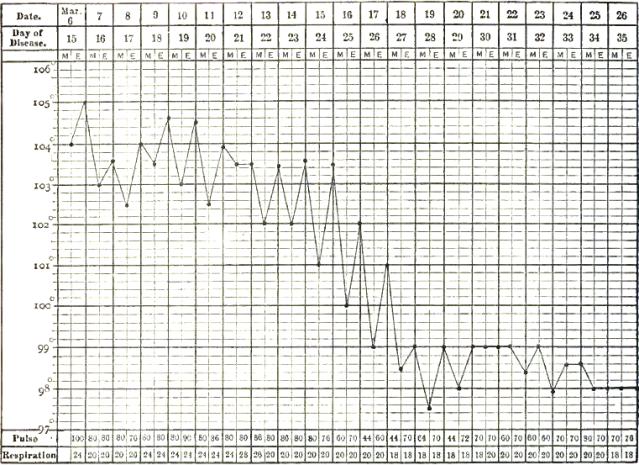
Chart of temperature in typhoid fever with relapse.—Original attack.
FIG. 17.
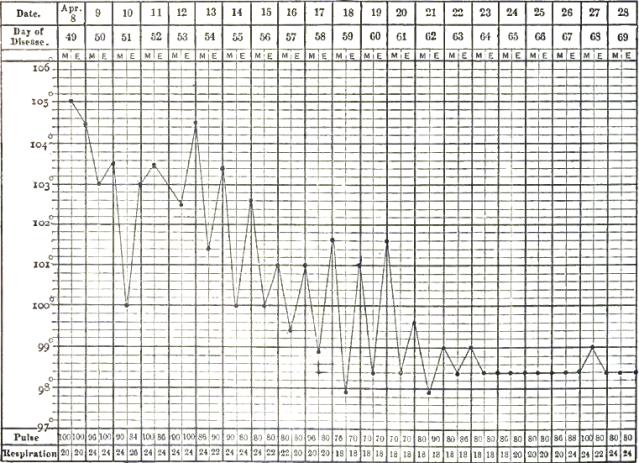
Chart of temperature in typhoid fever with relapse.—Relapse.
ABORTIVE ATTACK, FOLLOWED BY TYPICAL ATTACK.—Thomas Rogers, October 15, born in Philadelphia, assistant nurse. Admitted January 25, 1883; discharged March 26, 1883, cured. Father died of hemorrhage from the lungs; mother living and healthy. Two years ago he sustained a compound fracture of the left leg from a bale of cotton falling on him; otherwise he has always enjoyed good health. For the past three months he has been assisting the nurse in the receiving ward of this hospital. Four days before admission, without unusual exposure, he had a slight chill, and felt cold for several hours. This was followed by fever and a feeling of weakness. He also had slight headache and the bowels were constipated; no epistaxis.
Upon admission patient has a good deal of hebetude, face flushed, temperature 102°, pulse 106, tongue slightly coated, moist. Has slight pain in right lumbar region, but no distension of abdomen. Urine negative.
Ord. quinine gr. viij. daily; liq. ammon. acet. fl. drachms ij. q.q.h.
Jan. 29th. More hebetude; tongue more coated with brownish fur, red at tip; bowels continue costive; opened by an enema.
31st. Is brighter and better. One doubtful rose-colored spot seen on abdomen.
Feb. 4th. The morning temperatures for the past two days have been subnormal and the evening rise is very slight. All the symptoms also indicate the approach of convalescence.
6th. More fever; pulse weaker; functional murmur heard over heart; sudamina out over abdomen. Ord. whiskey fl. oz. ij.
8th. Some fulness of abdomen; had three loose yellowish-colored stools in the last twelve hours.
9th. A few doubtful rose spots out over abdomen and back; sudamina still abundant.
10th. More tympany; numerous rose-colored spots out over abdomen and back; slight epistaxis and bronchitis.
11th. Pulse more feeble; still slight diarrhoea. Increase whiskey to fl. oz. iv.
15th. Has a good deal of hebetude, but no headache; fewer spots; pulse weaker; temperature lower. Increase whiskey to fl. oz. vj.
17th. Temperature high again; most of the spots have disappeared; slight epistaxis and subsultus; no delirium; bowels not open for two days.
20th. Temperature falling; spots disappearing; still fulness of abdomen.
25th. Temperature has been subnormal for several days, and he is doing well; tongue cleaning. Has emaciated a good deal, and is weak.
March 1st. Is convalescent; tongue has lost its redness.
8th. Continues to improve; allowed semi-solid food.
17th. Is now quite well; has gained a good deal in flesh, and is stronger.
FIG. 18.
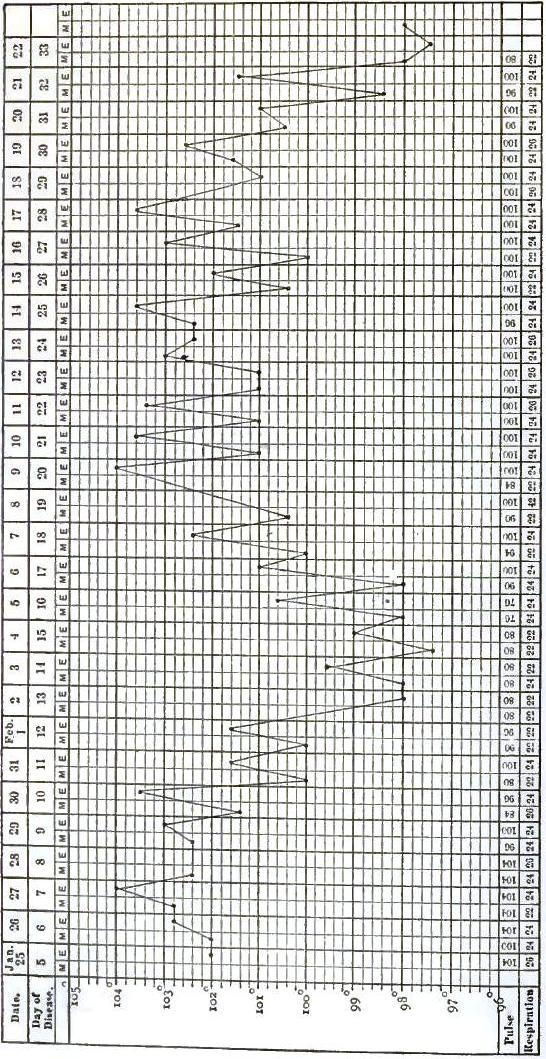
Temperature chart of typhoid fever.—Abortive attack, followed by typical attack.
The examination of the bodies of those who have died during a relapse reveals the presence of two sets of lesions in the cicatrizing ulcers of the primary attack and the recent ulcerations of the relapse. The latter are usually less extensive, and are found to be situated at a greater distance from the lower end of the small intestine, than the former, for the reason that the Peyer's patches most remote from the ileo-cæcal valve are least apt to be affected in the primary attack.
No satisfactory explanation of these relapses has as yet been discovered. They occur in patients of both sexes and of all ages with about the same frequency. They have been attributed to errors of diet, mental and bodily fatigue, and the like, but, while we know that causes of this character often provoke recrudescences of fever, and can understand that they may act as exciting causes of a relapse in cases in which the predisposition exists, it does not seem possible that they should by themselves be able to bring back all the characteristic symptoms of a specific disease. It has been maintained by some authors that a relapse indicates that a new infection has taken place; but this hypothesis, even if we admit that it accounts for those cases in which the patient is allowed to remain in the place in which he has acquired the disease, does not explain those in which he is removed during the first attack to a hospital where all the sanitary arrangements are presumably perfect. Griesinger has endeavored to explain relapses occurring in hospitals by suggesting that they may possibly be due to a fresh contagion from other patients with typhoid fever in the same ward; but this explanation is rendered improbable by the fact that relapses have occurred when cases have been thoroughly isolated. As I have already said, during a long connection with the Pennsylvania Hospital I have only known a single case of typhoid fever to originate within its walls, although relapses probably occur in its wards with the same frequency as in other hospitals. To adopt Griesinger's explanation, it would therefore be necessary to assume that a patient just recovered from an attack of the disease is more susceptible to the action of its contagion than patients suffering from other disease; which seems improbable, to say the least. It has also been maintained that relapses are due to the inoculation of the previously healthy Peyer's patches by the typhoid poison which is thrown off with the sloughs from those first affected. Maclagan alleges that relapses are more frequently met with in cases in which constipation is present in the primary attack, a condition which he regards as favorable to absorption; but this is opposed to the experience of almost every one who has paid any attention to the subject. In the cases which have come under my own observation it certainly was not the case, diarrhoea having been present in all of them. It is more likely, as suggested by Liebermeister, that part of the poison remains latent somewhere in the body, not developed, destroyed, nor expelled during the first attack, but brought later into activity by some exciting cause. Da Costa adopts this view, and says that relapses of typhoid fever are not unlike the outbreaks of malarial fever which occur after worry or fatigue and when there has been no chance for a fresh infection. Different plans of treatment have at various times been charged with increasing the predisposition to relapses. This is especially true of the cold-water treatment, and the records at the hospital at Basle show that the proportion of relapses and the number of deaths from them are both increased under the use of cold water. Liebermeister thinks, however, that this does not necessarily prove that this treatment favors the occurrence of relapses, since before the introduction of this plan of treatment many more typhoid fever patients died in the first attack of the disease. Employing those cases only for statistical purposes in which the patients have survived the first attack, he finds that the difference at once disappears, there being 9 per cent. of relapses before the use of cold water, and 10.3 per cent. after its use.
Gerhardt89 asserts that in cases in which relapses occur the enlargement of the spleen does not diminish during the non-febrile period that intervenes between the original attack and the relapse.
89 Ziemssen's Cyclopædia, vol. i. p. 193.
Da Costa90 has shown that the appearance of the white line and furrow left by the primary attack, to which attention has already been drawn, may sometimes be of service to us in diagnosis when we see the patient for the first time during the relapse. In a case which was recently under my care their appearance certainly rendered the nature of the previous illness from which the patient had suffered much clearer than it would otherwise have been.
90 Transactions of the College of Physicians of Philadelphia, 3d S., vol. iii.
DURATION.—The mode of invasion of typhoid fever is generally so insidious, and the first symptoms so little pronounced, that the patient, even if free from mental hebetude and confusion at the time when he first comes under the care of a physician, is usually unable to fix with certainty the time of the beginning of his illness. This inability is of course most marked in what are known as walking cases, in which, notwithstanding that the disease is far advanced, the patient continues to pursue his ordinary avocations or at least refuses to go to bed. In a few cases, however, either in consequence of the violence of the first symptoms or from some other cause, opportunity is afforded to the physician of observing the disease from its onset. In many others the date of commencement may be approximately ascertained. The average duration of such cases, if uncomplicated, has been found to be between three and four weeks. According to Bartlett, the average duration of 255 cases at the Massachusetts General Hospital between the years 1824 and 1835, inclusive, was twenty-two days. It was a little less than this in patients under twenty-one years of age, and a little more in those over. As these cases occurred before the introduction into use of the clinical thermometer, and as the commencement of convalescence is fixed in them at the time when the patients were able to take a little solid food, it is possible the fever may have continued in them some time after convalescence was supposed to have been established. Of 200 cases which ended in recovery, and in which Murchison was able to ascertain with precision the date of commencement, the duration was 10 to 14 days in 7 cases, 15 to 21 days in 49 cases, 22 to 28 days in 111 cases, and 29 to 35 days in 33 cases. The mean duration of these 200 cases was 24.3 days, while that of 112 fatal cases was 27.67 days. From the same author we learn that the average stay in hospital of 500 cases which recovered was 31.24 days, and of 100 fatal cases was 16.52 days, while the average duration of the illness before admission in the 600 cases was 10.78 days. During the twenty years from Jan. 1, 1862, to Dec. 31, 1881, 621 cases of typhoid fever, 121 of which were fatal, were admitted into the Pennsylvania Hospital. No notes of many of these cases were taken, and of some of the others the notes are incomplete or inaccessible, so that they cannot, unfortunately, be used for the purpose of determining the duration of the disease. The books of the hospital, however, show the length of time each patient remained in the wards. From these we learn that the average stay of the 500 patients who recovered was 43.5 days, while that of the 121 patients who died was only 8.75 days, and that of these a large number (28) died within 48 hours after their admission to the hospital. As a rule, patients are retained at the Pennsylvania Hospital until they are fully able to return to work, while at the English and continental hospitals it is usual to discharge them when they cease to need active treatment. This circumstance probably explains the much greater average duration of the cases admitted to the Pennsylvania Hospital than that of the cases referred to by Murchison. In the abortive form the duration of the disease may not exceed ten days, and there are authors who contend that it may occasionally be very much less.
Death may occur at almost any time in the course of typhoid fever. I have never seen it myself take place before the seventh day. Murchison reports two cases in one of which the disease terminated fatally within twenty-seven hours of its commencement, and in the other on the second day. Instances are more numerous in which death has occurred on the fourth, fifth, or sixth day, but still they are comparatively infrequent, and, as a rule, the fatal termination takes place most frequently during the course of the third week. On the other hand, death may sometimes occur at a very much later period. This is, of course, the case when it occurs during a relapse, but if the fever continues after the third week the patient may sometimes die from exhaustion or from the intercurrence of a complication. Death may also be the result of a sequela long after the disease has run its course.
DIAGNOSIS.—The insidious invasion of typhoid fever, together with the absence of pathognomonic symptoms in the beginning, always renders the diagnosis difficult, and sometimes impossible, during the first week. Still, even at this time the existence of the disease may be suspected if the frequent use of the thermometer reveals from day to day a gradual increase of the fever and the existence of evening exacerbations followed by morning remissions, the temperature rising each evening from a degree to two degrees higher than it had done the preceding evening. If in addition to this character of the pyrexia there are diarrhoea with ochrey-yellow stools or an increased susceptibility to the action of cathartic medicines, epistaxis, enlargement of the spleen, slight fulness of the abdomen, with tenderness and gurgling in the right iliac region, slight hebetude and some confusion of ideas upon awakening, the diagnosis becomes more probable. During the next week the symptoms are usually much more characteristic. The presence of marked abdominal symptoms, together with the eruption of rose-colored spots, will generally render the recognition of the disease at this time an easy matter. There are, however, a few cases in which no rose-colored spots can be found, and in which the abdominal symptoms, if they exist at all, are so little marked that they do not arrest attention. Even in these cases the temperature record, when carefully studied, will often throw a good deal of light upon the nature of the disease. If the febrile movement resembles that usual in typhoid fever, if it has continued for more than a week, if the patient has not been recently exposed to malarial influences, and presents no symptoms of local disease, the diagnosis may still be made with at least an approach to certainty.
The following are the diseases which are most likely to be mistaken for typhoid fever:
Typhus fever has a course which is so essentially different from that of typhoid that in well-marked cases it would scarcely be possible to mistake one for the other. Cases, however, do occur which, in consequence of a very profuse and dark-colored eruption in the latter, or of the existence of abdominal symptoms in the former, present at first a good deal of difficulty in diagnosis. The invasion of the former is more abrupt and its duration shorter than in typhoid fever. The eruption is usually also much more copious, and appears in the former as early as the fourth, fifth, or sixth day, while that of the latter is rarely observed before the seventh day. The fever in the former is much more nearly continued in type than that of the latter. Defervescence occurs in the former by crisis; in the latter, by lysis. The expression of the physiognomy is different in the two diseases. In typhus there is a uniform dusky hue of the face, with injection of the conjunctivæ and contraction of the pupils. In typhoid fever the pupils are often widely dilated, the conjunctivæ clear, and the face pallid, with the exception of a circumscribed flush on each cheek. Diarrhoea is much less frequent in the former than in the latter, and when it does occur is not accompanied by ochrey-yellow stools. Epistaxis, tympanites, pain, and gurgling in the right iliac region, and intestinal hemorrhage, common symptoms in the latter, are very infrequently met with in the former. On the other hand, petechiæ and vibices, which are of almost constant occurrence in the former, are rarely met with in the latter. The circumstances also under which the two diseases are contracted are different. Typhus originates from overcrowding or is due to direct contagion. The origin of typhoid fever is often involved in more obscurity, but it can generally be traced either to a polluted water-supply or to defective drainage.
Relapsing fever, with due care, is not likely to be confounded with typhoid fever. The abrupt commencement of the former, the high fever, lasting for from five to seven days only, and terminating by crisis with a profuse sweat, and the period of complete apyrexia of a week's duration, followed by the relapse in which the temperature rises even higher than in the primary paroxysm, and which also terminates by crisis, form a chain of symptoms which has no counterpart in the latter. The mind in relapsing fever is usually clear, there being none of the hebetude and mental confusion commonly observed in typhoid fever. The rose-colored eruption is, moreover, wanting, and diarrhoea and tympanites are absent. On the other hand, jaundice and tenderness in the epigastric zone are more common than in typhoid fever.
Influenza sometimes, Murchison says, when epidemic, closely simulates typhoid fever, but as the two diseases occur in this country the resemblance between them is not often sufficiently strong to lead the careful observer astray. In both there are fever, prostration, sleeplessness, delirium and sweating, and occasionally deafness, diarrhoea, epistaxis, and a dry red tongue; but the onset of the attack in the former is more abrupt, its duration shorter, and subsequent convalescence more rapid than in typhoid fever. The prostration, too, is more decided in proportion to the degree of fever present. Coryza and bronchial catarrh are much more marked symptoms in the former than in the latter, while hyperæsthesia of the surface, which is present in almost every case of influenza, is only rarely met with in typhoid fever.
Remittent and typhoid fevers often prevail together in the malarious districts of this country, and, as they present many points of resemblance, they are sometimes with difficulty distinguished from each other. They both may begin with nausea and vomiting; abdominal and cerebral symptoms are common to both, and so is enlargement of the spleen. The typhoid state may supervene in either, and in both the febrile movement is remittent in character. In remittent fever, however, the remissions are more marked, and are usually accompanied with more profuse sweating, than in typhoid fever. Jaundice and other symptoms of hepatic derangement are also more common, and the pains in the back and limbs are more frequent and more severe. The effect, too, of quinine in producing a permanent reduction of the temperature, is generally more decided. On the other hand, the rose-colored eruption of typhoid fever is never present in pure remittent fever. Occasionally, in cases of the variety of typhoid fever known as typho-malarial fever, the symptoms of the latter may be so prominent as entirely to mask those of the former. In such cases the discovery of a few rose-colored spots somewhere on the surface will clearly reveal the true nature of the disease.
Epidemic cerebro-spinal meningitis differs from typhoid fever by its more abrupt invasion, by the retraction of the head which rapidly supervenes, and by the appearance a short time afterward upon different parts of the body of petechiæ, which are not likely, even at first, to be mistaken for the rose-colored spots of typhoid fever. The fever has, moreover, no constant character, but is remarkable, on the contrary, for its great irregularity. The duration of the disease is in fatal cases much shorter, death taking place not infrequently within the first week, and occasionally as early as the second or third day. On the other hand, the duration in cases which recover may be even longer than in typhoid fever.
Simple continued fever may readily be mistaken in the beginning for typhoid fever, especially in those cases complicated by diarrhoea, but, as a general rule, the different character of the febrile movement, its more abrupt commencement and termination, and its shorter duration, together with the absence of the rose-colored eruption, will usually serve to distinguish it.
The eruptive fevers are always readily distinguishable at the period of invasion from typhoid fever, and the mistake of confounding them with the latter disease may generally be avoided by a close study of the character of the pyrexia. In the eruptive fevers the temperature rises abruptly, frequently attaining its maximum in the course of twenty-four hours, and sometimes in very much less time. There are also in all of them early symptoms which indicate pretty clearly their true nature, as, for instance, the sore throat of scarlatina, the naso-pulmonary catarrh of measles, and the rachialgia of small-pox. The uncertainty, moreover, is of short duration, as the characteristic eruption appears in all of them before the fourth day.
Acute tuberculosis of the lungs is the condition which in my experience has been the most difficult to distinguish from typhoid fever. Indeed, in some cases which have come under my observation physicians of recognized skill as diagnosticians have been unable to make the discrimination until after the death of the patient. Muscular prostration, a dry brown tongue, delirium, stupor, bronchitic râles, dyspnoea, and even cyanosis, are symptoms frequently met with in both diseases, so that when the rose-colored eruption and enlargement of the spleen happen to be wanting in typhoid fever, or diarrhoea and tympany present in acute tuberculosis, as they may be, the distinction is often impossible. The diagnosis may, however, even in these cases, be sometimes made after a careful study of the temperature range, which in acute tuberculosis is irregular and rarely presents any resemblance to that which is typical of typhoid fever.
Acute tubercular meningitis has also many symptoms in common with typhoid fever, such as high fever, headache, vomiting, delirium, and stupor, but in the former disease the rose-colored eruption, epistaxis, enlargement of the spleen, and intestinal hemorrhage do not occur. Diarrhoea is also rare, and the abdomen, instead of being tympanitic, is flat, and in many cases even scaphoid. The headache, too, is much more acute than in typhoid fever, and is very apt to be associated with retraction of the head. Here, again, the frequent use of the thermometer will yield very important results in diagnosis, as the temperature range in tubercular meningitis is always irregular and does not present any resemblance to that usually observed in typhoid fever.
Several of the inflammations, especially when associated with the typhoid state, have so many symptoms in common with typhoid fever that they may very readily be mistaken for one another by a careless observer. I have known, for instance, the general disease to be entirely overlooked in a case of typhoid fever complicated by pneumonia, and, on the other hand, it has sometimes been supposed to be present in a case of pure typhoid pneumonia. Gastro-enteritis is another disease which is also occasionally confounded with typhoid fever. The diagnosis in these cases will rest principally upon the presence or absence of epistaxis, enlargement of the spleen, tympanites, the rose-colored eruption, and of a temperature range presenting some similarity to that usual in typhoid fever.
Trichiniasis is not likely to give rise to much difficulty in diagnosis, for although vomiting, diarrhoea, and the typhoid state occur in it as well as in typhoid fever, the former disease may usually be recognized by the severe muscular pains and the local oedema which are constant accompaniments of it, and by the absence of the characteristic symptoms of the latter.
PROGNOSIS.—There is no other disease in which the physician should be more careful in making a positive prognosis than in typhoid fever. On the one hand, accidents of a fatal character frequently occur in cases which are apparently progressing favorably, and, on the other, recovery has often taken place after all hope of it had been abandoned. But, although it is impossible to foretell with absolute certainty the result in any particular case, there are certain symptoms which furnish very important indications for prognosis, and the proper appreciation of which will generally enable us to arrive at a correct conclusion as regards the gravity of the disease. Prominent among these is the character of the pyrexia. A fever characterized by high temperature should always give occasion for great anxiety. This is very fully shown by the statistics of the hospital at Basle. Thus of those patients in whom the temperature did not reach 104°, only 9.6 per cent. died; of those in which it reached or exceeded 104°, 29.1 per cent. died; and, finally, of those in whose axilla the temperature rose to or above 105.8°, more than half died. Wunderlich has arrived at very nearly the same conclusions, for he says that the prognosis is very unfavorable when the temperature rises to 106.16°, that the deaths are almost twice as numerous as the recoveries when it rises to 107.06°, and that recoveries are rare when it rises to 107.24°. Murchison has, however, known recovery to follow a temperature of 108°. The highest temperature recorded in any of my cases was 106° F. In this case, which proved fatal, the temperature reached 105° F. five times. In three other cases, in all of which recovery took place, a temperature of 105.5° F. was observed. In twelve cases the temperature reached 105° F. on more than one occasion. Six of these ended fatally; in the others the patients recovered.
The prognosis is more unfavorable in a fever in which the temperature is continuously high, and in which the morning remissions are slight or wanting, than in one in which the daily fluctuations are greater, even though the temperature may reach a higher point during the evening exacerbations in the latter variety than is attained at any time in the former. Occasional remissions, even if produced by quinia or other remedies, are to be regarded as favorable omens, as they indicate that the fever tends to subside. A high morning temperature ought, therefore, to give rise to more alarm than a high evening temperature. The prognosis is grave when the morning temperature rises to 104° or is persistently above 103°. Murchison says that recovery is rare after a morning temperature of 105°. Fiedler91 saw, with a single exception, all patients die whose temperature in the morning rose to or exceeded 106.25°, while of those whose temperature in the morning rose to 105.44°, if only on one day, more than half died. Any marked deviation from the usual temperature range in the course of the fever is unfavorable. A rapid rise of temperature indicates increased danger: it may be due to the occurrence of a complication or of some other cause acting unfavorably upon the patient. A sudden and decided fall should excite even more alarm, as it is generally the consequence of a free intestinal hemorrhage. A temporary abatement of the fever, with amelioration of the other symptoms, occurring between the tenth and twentieth days, and giving rise to the hope that convalescence is about to commence, but followed by a return of the symptoms in an aggravated form, is also unfavorable. Such cases, according to Chomel, Louis, Bartlett, and Murchison, almost invariably terminate fatally.
91 Quoted by Liebermeister.
The prognosis is bad in cases in which coma or wild or violent delirium comes on early. A moderate amount of delirium, especially when it occurs only at night or upon wakening in the morning, and is readily dissipated by attracting the patient's attention, or stupor which disappears when he is thoroughly roused, is not unfavorable. Insomnia, subsultus tendinum, carphologia, slipping down in bed, incontinence of the urine or feces, and retention of urine, are all symptoms of bad omen. Rigidity of the limbs is also a bad symptom; Dr. Jackson reports six cases in which this symptom occurred, only one of which recovered. Excessive subsultus is especially unfavorable, as it is generally most marked in cases in which the ulcerations of the intestines are most extensive. Extreme deafness occurs in mild as well as severe cases; it is therefore without significance in prognosis.
In estimating the importance, in a prognostic point of view, of these various nervous symptoms, it is important to bear in mind that a degree of fever which produces no disturbance of the mental functions in a phlegmatic person will give rise to active delirium and other marked cerebral symptoms in a person of an excitable temperament.
A change in the character of the pulse and of the action of the heart is often the earliest indication of the approach of danger in typhoid fever, and both pulse and heart should therefore be carefully examined at every visit. The first change is usually a diminution in the intensity of the first sound of the heart. This is significant, as it is frequently the earliest premonition of cardiac failure, to which a large proportion of the deaths in typhoid fever is due. A pulse of 120 and over, especially if it is at the same time feeble, is also unfavorable. The important part which the frequency of the pulse plays in the prognosis is shown by the following observations made by Liebermeister at the hospital in Basle: Of 63 cases in which the pulse rose to or above 120, 40 were fatal, or nearly two-thirds. Among these 63 were 37 in which it did not rise to 140; of these, 19 were fatal, or about one-half; in 26 it rose above 140; of these, 21, or about four-fifths, were fatal. In 12 patients it rose above 150; of these, 11 died. Of those in which the pulse rose to 160, the only case that ended in recovery was that of a girl twenty-one years old suffering from an imperfectly developed typhoid. Intermittence of the pulse is unfavorable, especially, according to Hayem,92 when it occurs during the first week of the disease. In convalescence intermittence is not to be regarded as an unfavorable symptom. The prognosis is bad also in those cases in which, with excessive weakness of the pulse, there are other evidences of cardiac failure, as, for instance, congestion of the lungs, cyanosis of the surface, coldness of the extremities. A very frequent pulse is not so unfavorable in a child as in an adult, or in a person of a nervous temperament as in one of a different disposition.
92 Loc. cit.
Other unfavorable symptoms are a dry, brown tongue, excessive tympanites with great abdominal tenderness, severe diarrhoea, vomiting when it occurs late in the disease, intestinal hemorrhage, and colliquative sweats. The delusion sometimes observed in very severe cases, in which the patient declares that he is not ill, is a very bad sign, many authors, and among them Louis, asserting that they have never known recovery to take place after it has been manifested. Peritonitis is a very serious complication, whether due to perforation or to some other cause. Still, it would appear not to be invariably fatal, since recovery has occurred in cases in which all the symptoms of this complication were present.
Favorable symptoms, on the other hand, are a gradual decrease of the temperature with increasing morning remissions, moistening and cleansing of the tongue, a lessening of the delirium, and other nervous symptoms, reappearance of an intelligent expression, recognition by the patient of friends and attendants, and a diminution of the diarrhoea. A copious eruption is also regarded by many as a favorable symptom. Cases in which constipation exists generally do well. Nathan Smith never knew a patient to die whose bowels were constipated throughout the attack.