Volume 1 — GENERAL DISEASES. (continued 6)
Reading edition
In the Philadelphia Hospital twenty-three persons lying sick in the wards with other affections contracted relapsing fever from the patients admitted with that disease; two of the visiting staff, five resident physicians, and nine nurses also suffered attacks of varying severity. This corresponds with the general experience of those connected with fever hospitals during the prevalence of relapsing fever.
As in the case of typhus and other contagious diseases, the distance at which relapsing fever can be contracted by direct contagion through the atmosphere is a very short one, not exceeding a few feet at most.
The poison may be carried by fomites. Instances are on record where persons having visited infected districts have conveyed the disease to others at a distance without contracting it themselves.
When rooms which have been occupied by relapsing-fever patients are subsequently occupied by other persons, these are very liable to acquire the disease. Parry relates two remarkable cases in which relapsing fever was transported to a distance by infected clothes; and it has been more than once observed that during epidemics of this disease laundry-women engaged in washing the clothes of fever patients, but without any means of more direct communication with the sick, were frequently attacked (Cormack, Wyss and Bock).
In connection with the etiology of relapsing fever it is necessary to consider the rôle played by a minute organism which has been frequently detected in the blood of patients suffering with this disease. This spiro-bacterium was first observed in relapsing fever by Obermeier7 in 1873, and has since been identified as a spirillum or spiroechete. The very numerous observations of Obermeier, Albrecht, H. V. Carter, Motschutkoffsky, Koch, Cohen, Holsti, Enke, Meschede, and others leave no doubt that this peculiar parasite does occur at least very frequently in the blood of patients with this disease. The failure to detect it, which has been reported by several good observers, may readily have been due to the extreme delicacy of the organism, or to the neglect of the proper method of preparing the slides of blood for examination, or to delaying the examination of the blood until after death, when it rapidly disappears. Thus no value can be attached to the negative observations of Rhoads and myself, made prior to Obermeier's discovery, since our method of examination was not sufficiently exact.
7 Centralbl. f. die med. Wissensch., 1873, No. 10.
The following description of the mode of examining the blood, and of the spirillum, is condensed from H. V. Carter's account: It is necessary to employ magnifying powers of not less than 500 diameters. The fresh blood may be examined immediately after obtaining it by pricking the washed finger of the patient. For preservation dried specimens are needed: a very thin layer of fresh blood is evenly spread with the needle over the glass cover, exposed to the weak fumes of a solution of osmic acid, and allowed to dry under protection from dust; the dried film of blood may then be treated with glacial acetic acid or may be stained.
FIG. 19.
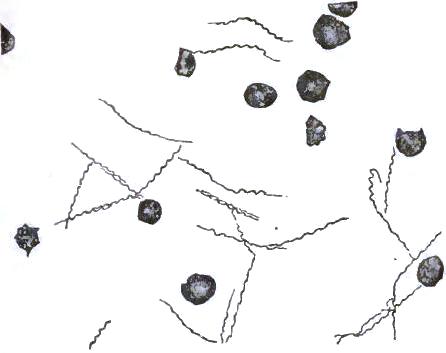
Spirillum from the blood in a case of relapsing fever, X 700 (Koch).
The spirillum [See Fig. 19] is a colorless, slender, twisted filament, which when quiescent has a length of 2.66 times the diameter of a blood-disc (1/1500 to 1/500 inch = 0.012 to 0.043 millimetre). When unfolded they become distinctly elongated. They are very narrow (not more than 1/40000 inch), and present four to ten spiral turns; when fresh they are in active movement and unfold in part, becoming wavy or bent. They resist the action of concentrated acetic acid, and are readily stained by certain dyes. In number, five or ten may be visible in a field or they may be too numerous to count. They have not been detected either in the secretions or in the evacuations. Both Koch and Carter have succeeded in cultivating this special form of bacteria outside of the body.
To judge from the observations thus far made on this difficult question, the parasite is found first toward the close of the period of inoculation or soon after the beginning of the fever, or it may be detected throughout the febrile stage; but shortly before the cessation of the fever it quickly disappears, to reappear at the time of the relapse. There would seem, therefore, to be some close connection between the febrile paroxysms and this organism, and it is not remarkable that many observers have concluded that this spirillum is the essential and specific cause of the fever, and that it is impossible to have this disease present without the appearance of the parasite in the blood; nor that the name spirillum fever has been applied to the disease by Carter.
Such conclusions appear to be premature, however, and we prefer to regard the undoubted existence of the spirillum in the blood of relapsing-fever patients as at present only an important aid in diagnosis, and to await the occurrence of other epidemics and the repetition of careful studies upon this organism, both within and without the human system, before venturing to decide whether it is merely one of the phenomena of the disease or whether it is its true cause and specific contagious principle.
It must be added that both Carter and Koch have succeeded in inoculating monkeys with relapsing fever, and Motschutkoffsky8 of Odessa, who had the opportunity of inoculating a human being, asserts that he succeeded in producing the disease, and found the incubation period to be not less than five nor more than eight days. Carter also gives an interesting table9 of six instances of inoculation, four of them by cuts while making autopsies, with consequent development of relapsing fever in each instance. Some allowance must be made for the fact that in all the instances of this series there had been exposure to contagion by close communication with fever patients, though this exposure had existed for several months previously without leading to the development of relapsing fever.
8 Centralblatt f. d. med. Wissenschaften, 1876, No. 11, p. 194.
9 Op. cit., p. 403.
GENERAL CLINICAL DESCRIPTION.—After a period of not less than five or six days from the reception of the contagion the disease begins abruptly with a chill of variable severity, accompanied by headache and aching pains in the back and limbs. The patient feels weak and is often giddy, but is not always obliged to go to bed the first day. Nausea and vomiting are among the earliest symptoms, and distress at the epigastrium, with tenderness, may attend or even precede the chill. Fever quickly follows; the pulse runs up from 110 to 130 in a few hours; the temperature reaches from 103.5° to 106° by the end of twenty-four hours; the pains increase, and there are insomnia and great restlessness; appetite fails; thirst is extreme; the tongue is moist and furred, and the bowels quiet. During the subsequent six days these symptoms persist. The temperature presents a daily remission at some period of the twenty-four hours amounting to one or two degrees, the maximum reached in fully-developed cases varying from 104° to 108°. The pulse continues very rapid, and not rarely exceeds 140; the respirations are hurried and rapid, and cough attends many cases. Delirium is rare, but insomnia, restlessness, headache, and rheumatic pains in the back and limbs may prove constantly annoying. Appetite is variable, more frequently lost; nausea and vomiting are common; thirst is very troublesome; and the bowels are constipated or loose. No characteristic eruption appears, but sudamina are frequently present, since in a large proportion of cases there is more or less sweating, even during the continuance of high fever. Abdominal pain, tenderness in the epigastrium and hypochondria, and demonstrable enlargement of the liver and spleen are almost invariable. The urine is concentrated and dark or bile-stained. Jaundice is a common symptom, though its frequency varies greatly in different epidemics. The same may be said of epistaxis.
While these symptoms are at their height and the patient is suffering severely the paroxysm suddenly ceases, and in a few hours he is entirely relieved. This remarkable crisis occurs usually at the close of the seventh day, but may occur as early as the third or as late as the fifteenth day. It is attended with a critical discharge, copious sweating being by far the most common, though diarrhoea, free epistaxis, or hemorrhage from some other surface may replace it. The patient feels weak and languid; the temperature and pulse have fallen below the normal, and remain so for a day or two. Soon there is a rapid improvement in the appetite and the appearance of the tongue, and the patient regains strength day by day, and often feels so well that it is difficult to persuade him that he must avoid exertion and exposure. The enlargement of the spleen subsides rapidly, that of the liver more gradually; epigastric tenderness subsides, but in many cases some degree of it persists for several days. This interval or apyretic period lasts about a week, when, again without warning or provocation, the patient relapses, and is seized abruptly with the same set of symptoms which attended the first attack. This relapse does not usually last more than three days (one to five are the limits), and is terminated by a similar crisis, after which a slow convalescence is entered upon, or else after an apyretic interval of some days' duration a second relapse ensues, and this may, in rare cases, be in turn followed by a third, fourth, fifth, or even sixth similar relapse. In addition, it must be noted that many serious complications are liable to occur. The total duration of the disease thus varies from eighteen to ninety days. Convalescence is often tedious, and there are many troublesome sequelæ. The mortality, however, is not great, averaging 5 or 6 per cent. Death may occur suddenly from collapse at the close of the first paroxysm or from heart-clot; it may be produced by exhaustion in protracted cases; or be hastened by any serious complication; or the patient may sink into a typhoid condition, with low delirium, coma, and suppression of urine for several days before the fatal termination.
DETAILED STUDY OF SPECIAL CONDITIONS.—It is usually difficult to determine the period of incubation. In the unique case in which Motschutkoffsky is said to have produced relapsing fever by inoculation the initial symptoms occurred seven days after the inoculation. Wyss and Bock had several good opportunities of determining the minimum period of incubation, and found it to be six days. We may assume that the ordinary period is six to eight days, but that it varies, in accordance with the virulence of the virus or the susceptibility of the system, from four to fourteen days. During this time the patient feels as well as usual, or at most suffers for a day or two from slight malaise, with vague rheumatoid pains, headache, giddiness, and anorexia. In only 13 out of 181 of our cases in which this point is noted was the invasion gradual. Examination of the blood prior to the invasion does not discover any spirilla.
The invasion is usually abrupt and during the daytime; the patient can often fix the very hour of its occurrence, a severe chill attacking him while at work or at meal-time. This is the most common initial symptom (138 out of 168 our cases of sudden invasion); less commonly, obstinate vomiting and nausea or sudden vertigo are the first symptoms (each 8 times out of 168), or violent headache (14 times out of 168), or sharp epigastric pain. Parry also observed that the occurrence of obstinate and profuse vomiting as the initial symptom was especially frequent in children.
The physiognomy is carefully noted in one hundred and seventy of our records. The countenance is often flushed, with watery eyes and anxious, suffering expression. The flush is less dingy and dull than in typhus; the eye is comparatively rarely injected; and the expression is much less dull and stupid than in that disease. In cases where grave nervous symptoms supervene and the typhoid condition is developed the facies assumes all the characteristics of that state.
The livid bronzing of the face, described by Cormack in 1843 and by Carter (Bombay epidemic of 1877), was noticed in a moderate degree in only nine of our cases, and seems to be of infrequent occurrence. When we observed it it seemed due to an admixture of a faint jaundice tinge with a deep flush. Jaundice, as already stated, is of common occurrence, though its frequency varies greatly in different epidemics. It was present in 25 per cent. of our cases, rather more frequently in the negro patients than in whites, and in degree varied from a slight tinge of the conjunctiva and skin to the deepest staining of the entire body. The presence of jaundice in combination with the general features of high fever imparts a most peculiar and alarming appearance to such patients.
With the occurrence of the crisis the flush rapidly subsides and the face becomes pale, or, if the discharges have been profuse, it may appear sunken, haggard, and almost choleraic. Parry described a peculiar puffed, velvety look at this stage, as though the skin had been much thickened and softened at the same time.
There is no characteristic eruption in relapsing fever. In 150 out of 180 cases where the condition of the skin was carefully noted there was no eruption of any kind; in 4 cases there were small roseolar spots, with peculiar subcuticular mottling, which resembled the early stages of typhus eruption, but soon faded away without becoming petechial. A similar eruption was noticed by Murchison in 8 out of 600 cases. It appears from the third to the seventh day of the first paroxysm; it may or may not recur in the relapse, or it may occur then only. Eruptions apparently similar to this have been described by others as quite common in certain epidemics. Carter describes minutely an eruption which was noted in at least 10 per cent. of his Bombay cases, the spots of which were at first small, slightly raised, and pinkish or rose-colored, and which either faded away soon or changed into purplish, more persistent stains. In a valuable report on the Königsberg epidemic of 1879-80, Meschede10 remarks that roseola was observed in cases complicated by exanthematic typhus, which prevailed simultaneously, but in no case of uncomplicated relapsing fever. While, however, this suggestion may apply to some few of the cases of eruption observed by others, it is certainly inapplicable to the vast majority of them. We also noticed an eruption of pale-reddish, slightly elevated papules in seven cases. It must be borne in mind that persons of such a low class as are the great majority of relapsing-fever patients would naturally be expected to present a variety of cutaneous eruptions from filth or vermin, and that in consequence some of the appearances above described may have been of such origin. It is certain that the bites of either mosquitoes, fleas, or bedbugs may in this disease be followed by persistent reddish papules passing into petechiæ. Apart from this, however, true petechiæ have been quite common in some epidemics, while very rare in others. Parry saw "small spots of purpura" once only, in a delicate girl; and we did not observe petechiæ once in several hundred cases, many of which had extensive internal ecchymoses. On the other hand, they have been found in as much as 30 per cent. of all cases (314 out of 1000 cases, Smith at Glasgow). They do not appear on any fixed day, but are more common in the first paroxysm than in the relapses; and although sometimes associated with a tendency to hemorrhages from other surfaces, they have been so often observed in cases of ordinary severity that scarce any unfavorable prognostic value can be attached to them.
10 Virchow's Arch., Bd. lxxxvii., p. 405.
Vibices and extensive ecchymoses of the surface are of much more grave import, and in cases where fatal sinking is threatened they may appear accompanying a purplish lividity of the countenance.
Herpetic eruptions about the mouth or nostrils were observed in 20 out of 181 of our cases in which this point is noted. They appeared usually toward the close of the febrile stage, and their development was found to have value in determining the approach of the crisis. Bärensprung mentions especially the occurrence of herpes labialis in cases of irregular relapsing fever which bore considerable resemblance to typhus. Sudamina are, as might be expected in a disease attended with so much sweating, of quite common occurrence, though much more so in some epidemics than in others, unless searched for with greater care by the one set of observers. Desquamation was noted in 42 out of 181 of our cases, and invariably at the close of the relapse. It was usually confined to the hands and face, and occurred in the form of comparatively small flakes. This is more frequent than has been the case in most epidemics. Murchison quotes a case in which a piece of epidermis ten inches square separated from the body of a lad convalescent from relapsing fever.
A peculiar odor exhaling from patients with relapsing fever has been repeatedly noticed. A description of this unpleasant symptom, given by Kelly, as quoted by Murchison,11 accords closely with what was frequently manifest in our own cases: "The smell was peculiar, not fetid or heavy, but somewhat like burning straw with a musty odor." Carter, in describing a similar odor in some of his cases, notes that the skin was not in these instances in a particularly foul state.
11 Op. cit., p. 346.
From what has already been said, it will be anticipated that the variations of the temperature in relapsing fever constitute the most peculiar and characteristic feature of that disease. A careful study of the accompanying charts will convey a more accurate impression than can be given by any description. The temperature begins to rise before the chill is fully developed, and when there is no initial chill the patient may be found within a few hours of the appearance of giddiness and headache with a temperature of 102.5° to 103.5°. Before twenty-four hours have passed it has risen to from 104° to 106°. During the paroxysm the febrile movement is continued, presenting merely a diurnal variation of one to two degrees, sometimes attended with sweating and partial relief of distressing symptoms, the minimum being observed at different hours in different cases, or even in the same case, though more frequently it occurs in the morning.
In a case reported by Parry a chill recurred at the same morning hour on three successive days. Wyss and Bock report some unusual cases in which a brief intermission occurred, with a fall of pulse and temperature to the normal, most frequently on the day before the real termination of the paroxysm. The highest temperature varies from 104.5° to 108.75°; in our cases the highest observed was 107.5°. This occurs, as a rule, on the last day or the day before the last of the initial paroxysm, and Obermeier has observed a sudden rise of four degrees in half an hour just before the crisis. Meschede,12 however, found the highest temperature on the corresponding days of the first relapse.
12 Loc. cit.
The duration of the primary paroxysm is usually six or seven days; but this is subject to considerable variations, as will be seen from the following table of 160 cases in which the duration was accurately ascertained: Initial paroxysm lasted—2 days in 1 case; 3 days in 2 cases; 4 days in 10 cases; 5 days in 19 cases; 6 days in 40 cases; 7 days in 58 cases; 8 days in 18 cases; 9 days in 2 cases; 10 days in 5 cases; 11 days in 2 cases; 14 days in 2 cases; 15 days in 1 case; and Parry, observing the same epidemic, found the duration of the first paroxysm to vary from 4 to 11 days. It is, however, rare for the duration to exceed ten days unless some complication be present.
FIG. 20.
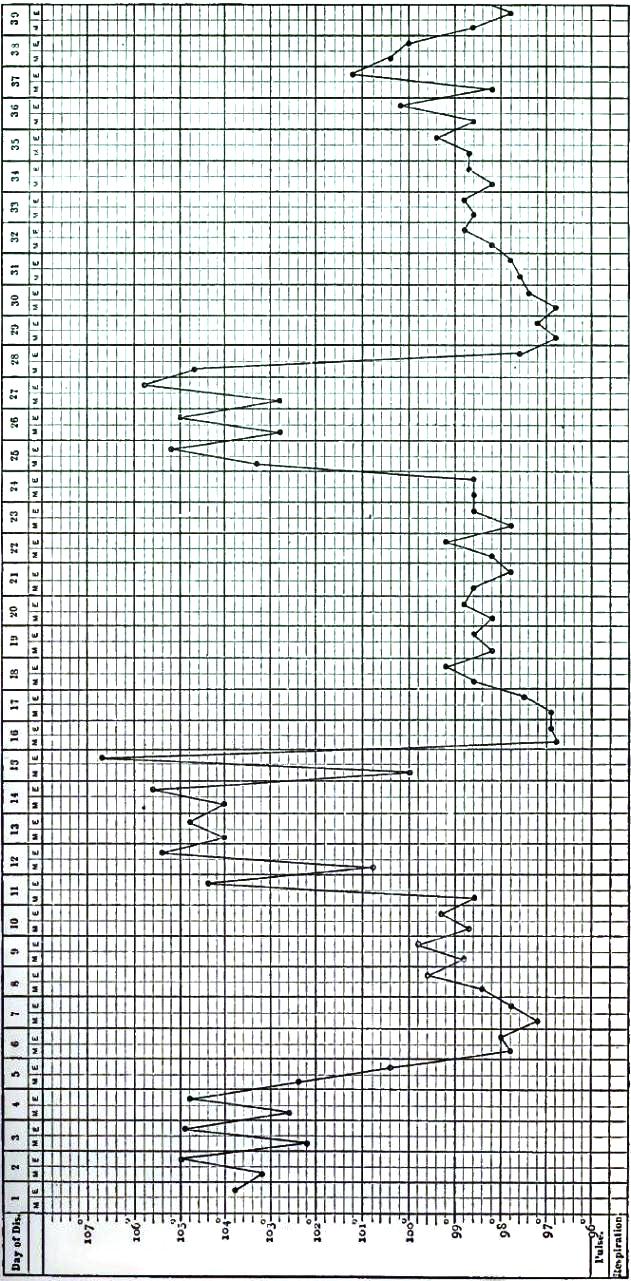
Typical case of relapsing fever, with three relapses, terminating in recovery. (From Motschutkoffsky)
With the beginning of the crisis there is a prodigious and sudden fall of temperature, unequalled in any other condition of disease. Within a few hours it may fall six or eight degrees (going down at the rate of 1.5° or 2° an hour); and falls of 12°, 13°, or even 14.4° (Murchison), in the course of twelve hours have been noted. In our own cases the greatest fall was from 107.2° to 95°, or 12.2°; and this is as low a point as is usually reached, though temperatures of 94°, 93°, or even 92°, have repeatedly been observed. Murchison refers to one case in which collapse supervened, where the rectal temperature was 90.6°. In nearly all of our cases a subnormal temperature occurred at the crisis, and lasted for a day or two subsequently, when it gradually rose and remained normal until the relapse, unless some transient complication caused a temporary rise in the interval.
FIG. 21.
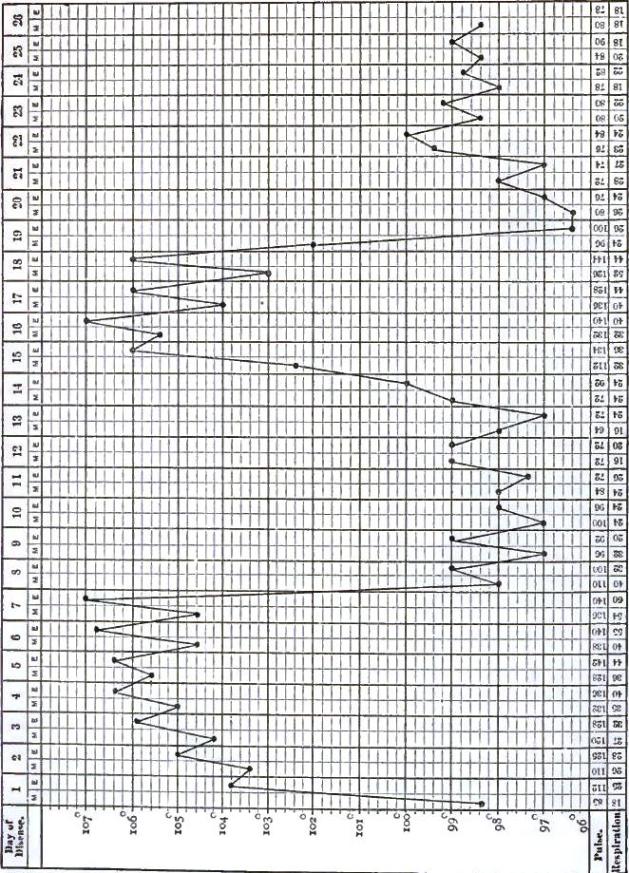
Typical case of relapsing fever (Mary Collins, aged 32), terminating in recovery. One relapse, with slight post-critical rise of temperature.
Occasionally, there is no relapse whatever, but convalescence follows the initial paroxysm. This occurred in 10 out of 181 of our cases, and Murchison found that of 2425 cases reported by various authors no relapses occurred in about 30 per cent. Carter describes these under the name of the abortive form, and found them to constitute 23.8 per cent. of all his cases. It is probable, however, that in many cases so regarded either a relapse of very transient duration has been overlooked, or else that an attack of ephemeral fever has been regarded as of specific nature. In ordinary cases the duration of the intermission averages six or seven days, but here, again, considerable variation occurs. In 139 of our cases where its duration could be accurately determined it was as follows:
3 days in 4 cases. 7 days in 64 cases. 11 days in 1 case.
4 days in 3 cases. 8 days in 22 cases. 12 days in 1 case.
5 days in 12 cases. 9 days in 9 cases. 13 days in 1 case.
6 days in 12 cases. 10 days in 9 cases. 20 days in 1 case.
Despite these variations in the duration of the initial paroxysm and of the first intermission, the average date of the occurrence of the relapse in any large series of cases is about the twelfth day from the primary chill.
The relapse is ushered in with the same striking abruptness as the initial attack. The temperature again rises rapidly to 104° or 106°, and then pursues a continuous course resembling ordinarily that of the primary paroxysm. The difference between the maximum of the two paroxysms is rarely more than 1.5° or 2°, though either may be much milder than the other; as a rule, the highest temperature is attained on the last or penultimate day of the first attack. The duration of the relapse averages three or four days, though it may last but a few hours or a single day, and yet exhibit a rise of 5°, 6°, or 7°; or, on the other hand, it may be prolonged to six, seven, or even more days. Lyons, observing the disease in the Crimea, reports some relapses as having lasted twenty-one days, though it is improbable that a greater duration than seven days occurs without the presence of some complication. The relapse usually terminates by crisis, with an abrupt fall to an abnormally low temperature; though we observed at this time, much more frequently than at the close of the first paroxysm, a gradual subsidence of fever, or lysis. Again the patient regains strength and appetite, but in a considerable proportion of cases subsequent relapses ensue. As a rule, the second, third, and later relapses are attended with a febrile movement of shorter duration and of less severity than the first two paroxysms, and are also separated by intermissions of increasing length. Meschede13 found from a study of 360 cases that the average duration was for the first paroxysm six or seven days; second paroxysm, four or five days; third paroxysm, three or four days; fourth paroxysm, one or two days; fifth paroxysm, one day.
13 Loc. cit.
In a remarkable case given in full below, the duration of the paroxysms and intermissions were as follows:
First paroxysm, 8 days; first intermission, 9 days.
Second paroxysm, 5 days; second intermission, 1 day.
Third paroxysm, 1 day; third intermission, 6 days.
Fourth paroxysm, 6 days; fourth intermission, 8 days.
Fifth paroxysm, 5 days; fifth intermission, 9 days.
Sixth paroxysm, 4 days; sixth intermission, 10 days.
Seventh paroxysm, 3 days; seventh intermission, 11 days.
Eighth paroxysm, 3 days; followed by convalescence.
The proportion of cases in which more than a single relapse occurs appears to vary in different epidemics. Murchison found that in 1500 cases reported by various authors a second relapse occurred 109 times (1 out of 14); a third relapse, 9 times (1 out of 166); and a fourth relapse, once. Of 182 cases noted carefully by ourselves, a second relapse occurred 24 times (1 out of 7½); a third relapse, 5 times (1 out of 36); a fourth relapse, once; and in the above-mentioned case six or seven relapses.
It follows that the total duration of the morbid process varies from the average of about eighteen or twenty days, in cases with a single relapse, to forty, sixty, or even ninety days. Of course the occurrence of complications may lead to very great modifications of the febrile movement and of the total duration of the disease.
There are several additional points about the febrile process requiring mention. In all the paroxysms there is a greater tendency to local or general perspirations than is met with in other continued fevers, and occasionally there are rigors or slight chills about the same hour on several days after the invasion or on the day preceding the crisis. It has been noted also that, even when the temperature is very high, the quality of the heat, as judged by the feeling of the skin, is different from that in typhus fever, and that the peculiar pungent irritating sensation known as calor mordax is rarely marked. But a more important peculiarity is the fact that the extreme temperatures (106°, 107°, or 108°) that are frequently observed in relapsing fever for several days in succession do not appear to involve any great increase of danger, and in particular are not attended with the production of the grave nervous symptoms so often met with in connection with hyperpyrexia in typhus and typhoid, and often regarded as the direct result of the exalted temperature itself. This striking fact is of much interest in its bearing on the theory of hyperpyrexia, and may possibly be explained by some marked difference in the conditions of heat-dispersion in these different diseases.
The pulse in relapsing fever is very rapid, and on the whole the rate corresponds with the movement of the temperature. It usually rises above 110, the limits being 90 and 140, the lower rate being noticed in the milder and uncomplicated cases and in subjects of phlegmatic constitution. The pulse rises rapidly at the invasion, and may reach 120 in the course of a few hours. Its maximum is usually noticed when the temperature is highest, shortly before the crisis; and when this actually begins the pulse may fall with a rapidity as remarkable as that of the decline of the temperature. Thus, within twenty-four hours it may fall from 152 to 80, or in even a shorter time from 140 to 54, or even as low as 48 (Obermeier) or 44 (Muirheid), or even 30 (Stillé). While this great fall is often noted, it is by no means constant. In our own cases it was frequently observed that the critical fall in temperature was not accompanied by a commensurate fall in pulse. Thus, at the close of a very severe initial paroxysm lasting nine days the temperature was 107°, and fell in the course of twenty-four hours to 99°, and in twenty-four hours more to 96°; during the first day of this fall the pulse was from 96 to 100, and during the second it fell to 76.
This want of correspondence was more marked at the close of the relapse than of the primary attack; thus, in a well-marked case, where the maximum temperature (105.4°) occurred eighteen hours before the crisis of relapse, the temperature fell in four hours from 104.4° to 96.2°, while the pulse, which was 130, fell in twelve hours to 108, and in twelve more to 92. In another case, in a man aged twenty, the temperature at the close of the second relapse was 106.4°, with a pulse of only 100; after the crisis, as the temperature fell, the pulse rose to 120, and did not descend until the end of twenty-four hours; and later, at the close of thirty-six hours, the temperature was 98° and the pulse 72, lower than which it did not go. Carter14 states that in the Bombay epidemic it was invariably the case that the pulse did not decline to an extent corresponding with the temperature.
14 Op. cit., p. 140.
During the remainder of the intermission the pulse may be normal, or it may continue accelerated in consequence of some irritative condition; as the time for the relapse approaches it frequently again becomes abnormally slow. In either event it is found that any muscular exertion causes marked acceleration of the pulse.
During the paroxysm the character of the pulse is full and bounding, and there is considerable arterial tension. This is well shown in some of the sphygmographic tracings by Carter;15 while in one of our tracings from the right radial of a man æt. 32, taken on the fourth day of a severe initial paroxysm, the line of ascent is steep and the summit sharp. During the crisis, and for a day or two thereafter, the pulse may be weak, compressible, and dicrotic, and occasionally irregular.
15 Op. cit., p. 103.
The sounds of the heart and its impulse are weakened, except possibly during the first few days of the primary paroxysm. Blood-murmurs over the base of the heart and along the great vessels in relapsing fever were first noticed by Stokes, and have been frequently observed in subsequent epidemics. They were found in a large proportion of our cases, not rarely in both paroxysms, and during the early stage of convalescence when anæmia was marked; but during the intermissions they are rarely audible, and when the action of the heart was slow they were replaced by prolongation of the first sound.
It must be further noted that the pulse-rate is not a reliable indication of the danger in this disease, since, just as is the case with the hyperpyrexia, extreme rapidity of pulse may be present when the general symptoms denote no unusual danger, and when the patient ultimately recovers most satisfactorily.
There is a remarkable disproportion and dissimilarity between the cerebral and peripheral nervous phenomena in relapsing fever and those familiar to us in typhus and typhoid fevers. We have seen that patients almost invariably complain of headache. When prodromes are present it is commonly among them, and it may be the initial symptom to usher in each paroxysm. When the attack is fully developed headache is usually very severe, and no symptom is more bitterly complained of. It varies in seat and character. More commonly it is frontal or general; occasionally we found it occipital, and still more rarely it was unilateral, constituting hemicrania. It rarely continues during the relapse. Headache of an equally acute and violent character may be present in typhoid, but the headache of typhus is much more dull and contusive.
The mental condition is only exceptionally affected, a circumstance which greatly increases the patient's perception of his sufferings. Delirium is not present in ordinary cases, even though very severe and attended with hyperpyrexia; or if present is limited to the period immediately preceding the crisis, when there may be violent and noisy delirium of transient character. In some of our cases forcible restraint was necessary under these circumstances.
There are numerous instances on record showing the abruptness with which noisy, demonstrative, or even destructive delirium may appear, and the equal suddenness with which in the course of a few hours, or even of fifteen minutes, the patient may become rational and composed. Such attacks resemble hysteroidal spells, and probably occur more readily in patients of a nervous or hysterical temperament. They were certainly more common when the patients had been of intemperate habits; and, further, we had opportunities of noting that the occurrence of relapses in habitual drunkards who had previously suffered with delirium tremens was apt to develop a form of delirium which was to all appearance of that nature.
Delirium of a different and much more grave type may appear in connection with the symptoms of the typhoid state. In some cases this results from the presence of serious complications which induce a state of great prostration, while in others it is associated with great diminution or entire suppression of urine. The delirium under these circumstances is apt to be low and muttering, with a tendency to pass into stupor or profound coma.
Vertigo is present more frequently and in a more persistent form than in any other febrile disease. It was noticed as among the occasional prodromes, and was especially severe for the first few days of the initial paroxysm, though it often continued throughout this stage and recurred with the relapse. Occasionally it was complained of in the recumbent position, but usually it was excited only by a change of position.
Wakefulness was one of the most distressing symptoms in all cases, and appears to have been noted in all epidemics. Although the severity of the pain in various parts of the body and the absence of blunting of the perceptions would naturally cause much loss of sleep, the degree of the insomnia and the obstinate resistance it offers to the action of anodynes are apparently far in excess of what could thus be accounted for. Parry found that several of his patients could take as much as three grains of opium every second hour throughout the afternoon and night without either inducing sleep or causing contraction of the pupils.
Convulsions are rare and of very grave import. They may occur at the period just preceding crisis, when the nervous irritation is most intense, and are then somewhat less indicative of a fatal result than if occurring in the course of the paroxysm, when they are apt to be associated with extreme prostration of the nervous centres, with a tendency to subsequent fatal coma. No connection has been observed between their occurrence and the presence of albumen in the urine.
General tremor is rare, and was observed only in those of our cases where there had been habitual intemperance, with presumably a tendency to delirium tremens. Muscular rigidity was noticed occasionally, but may have been only apparent, being induced by the hyperæsthesia and soreness which were marked in some cases. The hyperæsthesia which was observed was both cutaneous and muscular, and was attended with tenderness of the body of the muscle, and also of the nerve-trunk supplying it. Meschede speaks of opisthotonos as a rare complication in his cases.
Motor paralysis involving single muscles or groups of muscles is occasionally noticed, as of the deltoid or of one arm (Meschede). Parry observed transient loss of power of the extremities in several cases, chiefly during the intermission or the period of convalescence. In one of our cases temporary hemiplegia occurred, with partial loss of sensation on the affected side.
The bladder and rectum are rarely affected, except in cases where the typhoid state with tendency to coma is present. Disorders of sensation are, however, much more common. When motor palsy occurs the affected part may also be the seat of impaired sensibility, while in a large proportion of all cases numbness of the extremities, with or without a sense of tingling, is complained of; out of 182 cases we noted this symptom in 94, affecting the fingers alone in 62, the feet alone in 6, and all the extremities in 25 cases. Cutaneous hyperæsthesia or partial anæsthesia are also occasionally observed. But the most noteworthy and constant symptom of this class are the pains in the muscles and joints which are bitterly complained of by nearly all patients with relapsing fever. They constitute, indeed, one of the highly characteristic features of the disease, and possess a diagnostic value. They may occur among the rarely present prodromes, but usually they appear with the chill and increase in intensity during the paroxysm; they may persist with even greater severity during the intermission, or, if they have then subsided, recur with the relapse, and may constitute one of the most troublesome hindrances to convalescence. It will thus be seen that in frequency, severity, and persistency they differ widely from the aching pains in the extremities complained of in typhus and other specific fevers. They are one of the most potent causes of the extreme insomnia, and are apt to dwell in the mind of the patient so vividly that he dreads each relapse on this account, and consequently looks back upon his attack of relapsing fever as a terribly painful experience. These pains are usually described as rheumatic in character, and several times patients presenting themselves at the hospital on the second or third day of the initial paroxysm stated that they had inflammatory rheumatism. As a fact, we observed the utmost intensity of these pains in a few cases where the patients were of marked rheumatic diathesis. The nape of the neck, the muscles of the trunk or extremities, or the large or small joints, or lower parts of the spinal region, may be the seat. At times they extend along the course of nerve-trunks. In character they are described as a deep intense aching, with occasional severe or excruciating, sharp, lancinating pains. Pressure or movement increases them. The joints are not red or swollen (though swelling may appear as a sequel), and the pains seemed to us rather to be referred to the joints than to be caused by any local irritation therein. As already stated, there is often tenderness of the body of the muscles, and this was especially marked in many of our cases on pressure along the course of the nerve-trunk.
Murchison suggests that they are due to the circulation in the blood of an abnormal substance, such as uric, lactic, or phosphoric acid; but it appears to us altogether probable that they are rather to be connected with states of congestive irritation of the sheaths of the nerve-trunks (early stage of perineuritis), or possibly in some cases of the spinal membranes also. It is true that they are sometimes shifting in their seat and fluctuating in their severity, but this is not inconsistent with the above suggestion, while the widespread irritative processes found in this remarkable disease, the resemblance of these pains and the frequently attendant numbness and tingling to the sensations caused by other forms of perineuritis, and the occasional development of local palsies of a single muscle or group of muscles, all are in its support.
The special senses are acute, sometimes painfully so. The eyes are watery and occasionally injected, but this latter condition is rare and slight in relapsing as compared with typhus fever. At the crisis and for a few days subsequently wide dilatation of the pupils is not infrequently observed. Dulness of hearing was present during the paroxysm in 14 of our cases, and a few patients complained of tinnitus; but these symptoms are not at all common in the disease, although it will be seen hereafter that affections of the middle ear are among its sequelæ.
Debility is not such a prominent symptom as in typhus and typhoid fevers. Patients manage to drag themselves about for several days during the initial paroxysm with all the symptoms fully developed, and after admission to the hospital will often be able to help themselves, or even to rise from bed, unless prevented by the severe pains or the vertigo. Still, there are many cases, not necessarily of very grave type, in which there is a marked sense of weariness and exhaustion, and of course in all cases of typhoid character the prostration is great. It must constantly be borne in mind that even when the patient feels or seems able to sit up he must on no account be permitted to do so, since the occurrence of sudden and fatal syncope is one of the accidents constantly to be apprehended. It is not only during the pyrexia that this precaution must be enforced; we meet with extreme debility during the intermission in some cases, and syncope has followed exertions made at that period as well as at others.
During the paroxysms the respirations are much accelerated, at times to a greater degree than would correspond with the pulse-rate, while at others extreme rapidity of pulse may be associated with moderate elevation of the rate of respirations.
As examples of the relation between temperature, pulse, and respirations we quote the following from our records of adult cases:
(a) Temperature, 108°; pulse, 124; respiration, 40. In the relapse; no chest trouble.
(b) Temperature, 107.5°; pulse, 120; respiration, 28; falling to temperature, 96°; pulse, 68; respiration, 18, within twelve hours, during which crisis occurred.
(c) Temperature, 107°; pulse, 144; respiration, 31. In the relapse.
(d) Temperature, 107°; pulse, 108; respiration, 44. Initial paroxysm; no pulmonary congestion.
Temperature, 106°; pulse, 116; respiration, 28. Relapse; no pulmonary congestion.
Temperature, 97°; pulse, 76; respiration, 24. Critical fall; cough, congestion of lungs posteriorly, and left one relatively dull on percussion, but pneumonia did not develop.
In many epidemics bronchitis, hypostatic congestion, and pneumonia are of rare occurrence, while in others, as in Philadelphia in 1870, they are comparatively frequent and lead to serious respiratory symptoms. While the pyrexia was high there was very frequently an irritative dry cough, with the fine crepitant and subcrepitant râles attending congestion and imperfect expansion of the lungs heard at the middle and lower portions of the chest posteriorly. In numerous instances the râles would disappear entirely after a few full inspirations in the sitting posture, just as in the corresponding condition in typhoid fever. But in a considerable proportion of all the cases (fully 35 per cent.) there was more troublesome bronchial cough, associated with sonorous, sibilant and subcrepitant râles, with mucous or muco-purulent expectoration.
Bronchitis of this character was a source of serious annoyance to many patients. In several cases there was impaired resonance at the lower margins of the lungs posteriorly, with imperfect bronchial respiration, but without the symptoms of fully-developed pneumonia. Such conditions were regarded as due to hypostatic congestion, and proved amenable to treatment. Pneumonia occurred in eleven cases out of 200 recorded with reference to this complication. It will be more fully discussed under the head of Complications. It was attended with the usual physical signs, and gave rise to extremely rapid and labored breathing, especially when associated with painful enlargement of the liver and spleen. In a case of double pneumonia, with enlarged and ruptured spleen, the respirations were from 80 to 90 for two days, the pulse being 130 to 136. It was a very fatal complication, death resulting in all but two instances.
Leyden16 has shown that though the percentage of carbonic acid in the air expired during the pyrexia is diminished, the total quantity exhaled is increased, the proportion being as 1.5 to 1 in the non-febrile state.
16 "U. d. Resp. in Fieber," Deutsch. Arch. f. klin. Med., 1870, 536, quoted by Murchison.
Elaborate investigations have been made of the condition of the urine in relapsing fever by numerous observers, and in the Philadelphia epidemic of 1870 we had the great advantage of being assisted by the distinguished chemist, the late Horace B. Hare, who conducted an extensive series of analyses in our cases. In a number of cases quantitative analyses were continued daily throughout the entire course of the disease.
As a rule, the quantity of the urine is comparatively free during the febrile periods, very scanty at the time of crisis, except in the cases where critical discharges of urine occur, and excessive for some days after the crisis.
Still, there were not rare exceptions, especially to the first of these statements. Thus on four successive days of the relapse of a severe case with delirium, but without albumen, and which ultimately recovered, the analysis gave—
Temperature. Amount in ccm. Sp. gr. Urea in Grm. Na. Cl.
103 400 1024 23.8 2.64
105 300 1025 15.27 1.95
106 500 1024 24.7 4.3
106 to 97 850 1021 24.735 5.525
And in another severe case, also resulting in recovery, the analysis was, for two days preceding the crisis of the initial paroxysm—
Amount. Sp. gr. Urea. Na. Cl.
500 1014 12.9 Traces of albumen.
650 1014 15.85 1.365
After the crisis:
2250 1004 18.9 15.75 No albumen.
And again, in another case at the height of the initial paroxysm, within twenty-four hours of the crisis, no vomiting, purging, or epistaxis being present; temperature 105°; only 500 ccm. was passed of dark reddish colored urine, non-albuminous, and with sp. gr. 1011.
In a fatal case there was total suppression of urine for three days, the catheter drawing off only a few drops of almost pure liquid blood.
When crisis occurs by copious urination the discharges are frequent, large, and of light color and low specific gravity.
The urine of the intermissions is of similar character, and for several days after crisis it is not rare to have 2000 to 2500 ccm. passed. The largest amounts we noted were in a man who recovered, and who passed at the crisis of the relapse and during the following days the amounts here given.
Amount. Sp. gr. Urea. Na. Cl.
1000 ccm. 1010 14.9 2.6
2000 ccm. 1003 20.2 42.8
3550 ccm. 1002 26.625 130.995
2600 ccm. 1002 19.24 27.30
2800 ccm. 1005 24.96 22.66
2500 ccm. 1013 47.25 11.25
2700 ccm. 1014 59.13 7.29
Carter reports a case where the patient continued for two weeks after the relapse to pass 130 oz. of sp. gr. 1002.6.
The amount of urea varies considerably, and is evidently under the influence of complicated conditions. The rule appears to be that it increases during the paroxysms, diminishes during the crisis, increases during the few days following crisis, and then falls off again. These results are stated upon the authority of Murchison, quoting from Pribram and Robitschek, Wyss and Bock, and others. Our own observations, however, while agreeing in the main with these, show that there are numerous and important exceptions, especially to the occurrence of the post-febrile increase in the elimination of urea.
The largest amount of urea excreted in twenty-four hours by any of our patients was 59.13 grammes, or 912 grains, on the sixth day after the end of the relapse, but as much as 74 grammes (1142 grains) have been found.
Deposits of urates were very common in the urine of the paroxysms and of the crisis. The uric acid has been found increased, and so also have the phosphates, crystals of which are frequently found mixed with the urates.
The chlorides diminish during the paroxysms, until just before the crisis their amount is very small, or they may even have disappeared. Immediately after the crisis they reappear slowly or quickly, and even very large amounts may be discharged, as seen in the figures given by Hare's analyses: 2.6 grm. on day of crisis, 42.8 grm. the following day, and the enormous amount of 130.995 grm. on the next day. A copious flow of urine corresponds with great augmentation in the amount of the chlorides.
Bile-pigment was constantly present in jaundiced cases, the amount being proportioned to the depth of the jaundice and the quantity of the urine. Bile-acids have been detected (Carter and Schmidt), and also leucin and tyrosin (Pribram and Robitschek).
Albumen, with or without tube-casts, is not uncommonly found, and traces of sugar have been detected in a few cases. More careful consideration will be given to these under the head of Complications.
The following appearance of the tongue has been repeatedly described, and when present may be regarded as possessing some diagnostic value: The body of the tongue slightly swollen, so as to show the impressions of the teeth, and by the second day the central part of the dorsum covered with a peculiarly white fur, while the edges and a small triangular space at the tip are clean and red. Such a tongue was seen in many cases at the beginning of the Philadelphia epidemic, but later it was present in but a small proportion. We find it specially mentioned in 97 of our recorded cases, or about 50 per cent., the general description being given that it was moist, rather large, with pink, clear edges, and a triangular clear space at the tip, and with heavy white fur in the centre.
Some accurate observers, as Wyss and Bock, did not notice anything peculiar about the tongue, but merely described it as moist and coated with a thick white fur. The tongue often remains moist throughout the case, the coat becoming yellowish, and later brownish. Of course if there is nasal obstruction from epistaxis or catarrh, and the patient breathes through the mouth, the tongue will soon become dry and brown; but in addition, this state of the tongue with sordes on the teeth and lips, appears in a small proportion of cases (3 per cent., Zuelzer; 12 per cent. of our own patients) in conjunction with grave typhoid symptoms.
During the intermissions the tongue clears off quite rapidly, unless marked gastric disturbance persists, but regains its former state as soon as the relapse occurs.
In rare cases the tongue is red and glazed, and Parry and ourselves observed peculiar painful cracks continuing obstinately after the relapse. It is apparent, therefore, that the tongue presents evidences of vitiated secretions, of local catarrh of the buccal mucous membranes, and of the high grade of gastric irritation so constantly attendant on this disease.
As a rule, there is complete anorexia during all of the febrile paroxysm, while in the intermission the appetite soon returns, and is sometimes truly ravenous. We did not, however, observe in any case a voracious appetite during the febrile paroxysms, such as was very often present during the London epidemic of 1843 and the Irish epidemic of 1847, and is particularly mentioned by Murchison.17
17 Op. cit., p. 360.
Thirst is constant and intense, and is excited not only by the high temperature, but by the irritation of the stomach; it may continue through the intermission, when natural appetite and the power of digesting solid food have returned.
Nausea and vomiting are always prominent symptoms, and most especially so in children. In some cases nausea occurs among the prodromes; and occasionally the attack is ushered in by profuse and uncontrollable vomiting instead of by a chill, and the stomach continues entirely non-retentive throughout the paroxysm. Vomiting is not usually so obstinate and severe, however, and with extreme care in feeding and medication it will often be allayed after two or three days. It occasionally recurs profusely immediately before the crisis, as in the case given in full below, where after a violent attack of vomiting the patient fell asleep, and awakened in a profuse sweat.
This symptom was present in 146 out of 182 of our cases, was usually confined to the febrile stages, and was, as a rule, worse in the initial paroxysm.
The matters vomited consist of the ingesta colored with bile, of glairy mucus tinged with bile, or of green bile, sometimes in considerable quantity. Small particles of blood may occasionally be noticed in the matters vomited, and in rare instances true hematemesis occurs. Judging from the frequency with which in fatal cases we find ecchymoses of the gastric mucous membranes with blood-stained mucus in the cavity of the stomach, we should expect black vomit to be more often observed than is the case. Murchison (p. 361) states that it was not noted in any British epidemic except that of 1843, and then it occurred in only a few cases, although it seems to have varied in frequency at different places. Arrott at that time described the symptoms as "quite common" in the fever at Dundee; and W. Reid of Glasgow recorded the case of a girl in the same epidemic who vomited large quantities of clotted blood, and who also had hemorrhages from the bowels and from the ears. It has occasionally been observed in the continental epidemics. It was observed in four of our cases. By all who have observed blood-vomiting in relapsing fever it is recognized as a symptom of almost invariably fatal import. Three of the four cases in which we observed it proved fatal, but one patient, who had copious hematemesis, both at the close of the first relapse and during the second relapse, recovered after a desperate and protracted struggle.
The bowels are not so often constipated as in typhus, and it is not rare for diarrhoea and constipation to alternate, or for the bowels to be loose throughout the paroxysms. They are noted in 181 of our cases as regular in 32, loose in 61, and constipated in 88 instances. Meschede states that diarrhoea was present in nearly one-half the cases of the Königsberg epidemic of 1879, though usually as a late symptom, the early stage being marked by constipation, which in a few cases persisted throughout. The stools may be consistent and dark or thin and bilious, or occasionally, when gastric or intestinal hemorrhage has occurred, they contain black coffee-ground matter. Occasionally, the diarrhoea has a critical character, and occurs at the close either of the initial paroxysm or of the relapse, though it may not entirely substitute sweating. This mode of crisis occurred in two of our cases, but Douglas observed it in 6 out of 33 cases.
The abdomen may appear enlarged, but this is as much the result of the enlargement of the liver and spleen as of gaseous distension, which is rarely present in a high degree. Abdominal pain is almost constant, and may be very severe. It is especially mentioned as having been present in 148 out of 182 of our cases. It commonly extends throughout the epigastrium and both hypochondria, but may be present on one or the other side, while, on the other hand, there may be general abdominal soreness. It is associated with tenderness on pressure, which may be so great as to hinder the movements of the trunk and to render the descent of the diaphragm in breathing painful. This may be the first symptom to usher in the attack, and it occurs at an early stage in most cases. Many of our patients when admitted to the hospital had already been cupped or blistered over the region of the liver or spleen. This distress was greatest in cases attended with jaundice and marked gastric irritation; and Parry reports that in his cases (occurring in the early part of the epidemic which we studied) jaundice was rare (4 out of 37), and abdominal tenderness was not present. It is not difficult to explain its almost universal presence in view of the severe lesions of the substance of the liver and spleen, the distension of their capsules from the acute swelling of the organs, and the implication of the coats of the stomach.
Enlargement of the liver and spleen probably exists to a greater or less degree in every case of relapsing fever without exception. This statement is based on the concurrent testimony of accurate observers in all epidemics and upon the evidence of post-mortem examinations.
The enlargement of the liver can be demonstrated in nearly all instances by careful percussion. It varies greatly in its degree, however; in mild cases it may be slight, while in severe ones the liver may be found extending at least three inches below the margin of the ribs within three or four days from the initial symptom. In our own fatal cases the weight of the liver averaged between four and four and a half pounds.
The spleen enlarges even more rapidly and to a greater degree than the liver. In fact, its enlargement in relapsing fever is greater than in any other acute disease. It may be detected by percussion by the first or second day, and may then continue to rapidly increase until by the fifth or sixth day a large painful mass is readily recognized by palpation and percussion, or even by inspection. The organ often weighs twelve or sixteen ounces, not rarely twenty to twenty-five, and, as an instance of the extreme limit that may be reached, Küttner reports sixty-eight ounces in one case. This enlargement is greatest toward the close of the first or second paroxysm, and subsides quite rapidly in most cases during the intermissions and as convalescence progresses; we have, however, known a moderate degree of enlargement of the spleen to persist for some weeks after the crisis of the last paroxysm.
The occurrence of jaundice in a considerable proportion of cases of relapsing fever is a clinical fact of much interest. Its frequency varies greatly in different epidemics, and even at different stages of the same epidemic. At times it is rarely met with (1 out of 14, 20, or 35 cases), while in other epidemics it is present in 1 out of every 6, 5, or even 4 cases. Of 182 of our own cases jaundice is recorded in 45, or exactly in 1 out of 4. According to our observation, it occurred in a larger proportion of cases among negroes (14 out of 32) than in whites, and Stillé states that it occurred in nearly every such case that came under his observation. When present it usually occurs during the first paroxysm, and may be limited to that stage; or, again, it may be present in each of three or four successive paroxysms in the same case; or, finally, it may first appear in the relapse. As a rule, it subsides speedily after the crisis, though Carter states that in two or three cases the symptom made its first appearance just after the crisis. It varied from the slightest yellow tinge of the conjunctiva to the deepest staining of the whole surface. The urine is discolored in proportion to the intensity of the jaundice, and the serum of a blister will be deeply tinged. It must be carefully noted, however, that the feces are not decolorized, but, as already described, contain fully a normal amount of biliary coloring matter. This fact has been relied on by Murchison and others to prove that the jaundice in relapsing fever is purely dependent on the morbid state of the blood, and is not due to obstruction of the biliary passages; and we are prepared to admit that the element of blood-dyscrasia may play a part in the production of the jaundice. The anatomical evidence, however, given below, renders it probable that in many cases at least the essential cause is to be sought in an obstructed state of the minute gall-ducts of certain areas of the liver. If the main hepatic duct or the common duct were obstructed, there would of course be paleness of the feces, as the bile would be prevented from entering the duodenum. But when a large amount of highly-colored bile is being secreted, as in relapsing fever, it seems clear that the obstruction of a certain number of minute ducts would cause sufficient resorption of the bile to induce jaundice of varying degrees of intensity, while at the same time allowing a flow of bile through the patulous ducts.
Jaundice must be regarded as an unfavorable or even a grave symptom in relapsing fever, but not to the extent that would be the case were it directly connected with the intensity of the blood-dyscrasia. Many of the most violent cases in all epidemics have been unattended with jaundice, while, on the other hand, many cases in which jaundice has been marked "have had not a single symptom that made them differ from ordinary cases excepting the yellowness" (Henderson). It follows, therefore, that the gravity of a certain proportion of the jaundiced cases does not follow directly from the presence of bile in the blood and tissues, but from the lesions of the liver of which the jaundice is a symptom, or from the existence of widespread irritation of many parts of the body. Thus jaundice is present in an unusually large proportion of the cases attended with marked enlargement and tenderness of the liver and spleen, whether vomiting is also present in extreme degree or not. It was noteworthy that it was disproportionately frequent in negroes, and that in these patients the lesions of the liver and spleen were also unusually pronounced. Again, jaundice is present in an unusually large proportion of the cases attended with low delirium, extreme prostration, defective secretion of urine, and the other features of the typhoid state—so much so that such cases have been described by various writers under the name of bilious typhoid fever.
But, as already stated, it is not legitimate to consider the gravity of these cases as the result of the jaundice, but rather that the jaundice is merely a symptom of the widespread irritative lesions, which in such cases not only involve the liver and spleen, but the kidneys, the lungs, the marrow of the bones, the muscle of the heart, and occasionally the membranes or substance of the brain and cord.
The true prognostic value of jaundice in relapsing fever would then seem to be, that of itself it indicates merely an obstructed state of a certain number of minute bile-ducts, but that its presence justifies the apprehension that the local lesions of the liver may become excessively developed, or that there is a tendency to widespread tissue-changes which at a later stage of the disease may lead to the appearance of grave constitutional disturbance of a typhoid type.
Hemorrhage in relapsing fever is not uncommon, and may occur from various surfaces. Epistaxis is, however, the only form which is frequent enough to justify being regarded as a symptom. It usually occurs in from 5 to 15 per cent. of cases of relapsing fever, but in the Philadelphia epidemic it was much more frequent than this, occurring in not less than 83 out of 182 of our cases. It was not more frequent or profuse in grave cases than in those of ordinary severity, and consequently could not be regarded as a reliable indication of the intensity of the blood-dyscrasia. Although ordinarily moderate in amount, it was occasionally so copious and persistent as to require prolonged plugging of the nostrils, and in at least one case contributed chiefly to cause an intense anæmia, which long delayed convalescence. It occurs at all periods of the paroxysms, but more commonly toward the close. In fifteen of our cases extraordinarily profuse epistaxis attended the crisis, and evidently replaced in part the copious sweating by which the paroxysm more commonly terminates.
SYMPTOMS ATTENDING THE CRISIS.—We have already described the aggravation of all the symptoms which immediately precedes the crisis in typical cases of relapsing fever, and the abrupt fall of temperature, and usually of the pulse, that follows. But this extraordinary change is nearly always attended with some profuse critical discharge, of which sweating is by far the most common, though copious epistaxis, metrorrhagia, diarrhoea, or vomiting may also occur, and to a greater or less degree, but seldom entirely, replace the sweating. In 182 cases in which we carefully noted the mode of termination of the paroxysm there was no definite crisis (termination by lysis or gradual and irregular defervescence) in 76; profuse sweating, 89; profuse epistaxis, 15; profuse diarrhoea, 2.
In most epidemics the proportion of true crises is greater than in the above table—a fact dependent upon the unusually severe and complicated form of the disease which we were studying. The beginning of the sweat may be preceded by chilliness or rigors, by extreme and dangerous prostration, or by violent nervous disturbances; or there may be an attack of profuse vomiting, followed by sleep, during which sweating begins. The sweat may be moderate in amount, but is often extraordinarily copious; the patient is literally bathed in it, the bed- and body-clothing is saturated, and we have seen the mattress saturated. It has an acid reaction, but we do not know of any accurate analyses of it. Some writers have attributed to it a characteristic disagreeable odor, but we did not notice any in our cases that could be considered peculiar to this disease.
CONVALESCENCE.—We have already stated the average duration of relapsing fever to be eighteen or twenty days, while the extreme limits are from eighteen to ninety days. Despite the fact, however, that the mortality is in most epidemics only about 5 or 7 per cent.—greatly less, therefore, than in typhus fever—the convalescence from relapsing fever is frequently slow and protracted. The obvious cause is, just as in the case of typhoid fever, the existence of numerous and serious lesions of the solids and the tendency to many troublesome complications and sequelæ. We have, however, seen many instances of rapid recovery of strength and health, even after prolonged attacks with several successive relapses.
The following case is quoted partly on account of the numerous relapses, and the long duration of the sickness:
B. B. Y., medical student, was much exposed to the contagion of relapsing fever in the wards of the Philadelphia Hospital during the spring of 1870, and in May had an attack apparently of this disease, which, however, subsided in four or five days and was followed by no immediate relapse. He continued his attendance at the hospital during the remainder of May and the whole of June; in July took a trip to the South, where there was no relapsing fever prevailing, and after exerting himself for several days during intensely hot weather, he became sleepless and much prostrated. He returned home, and after recovering from the fatigue felt quite well for about a week, until 3 A.M., August 1st, when he was attacked with a severe chill, followed by great insomnia, obstinate vomiting, intense headache, especially in the back of the neck, occasional sweating, violent fever, recurrence of very severe chill the following day at 11 A.M., epigastric and hypochondriac tenderness, decided jaundice, costive bowels, and scanty, high-colored urine. This paroxysm lasted till the morning of August 9th, when severe vomiting took place, followed by sleep, during which crisis occurred by drenching sweat lasting several hours. Appetite and strength soon began to return, though some jaundice persisted, and by August 17th he felt able to drive out a short distance, and retired feeling somewhat fatigued. He awoke with pain in the back of the neck, which continued increasing till 11 A.M., August 18th (second paroxysm), when a severe chill occurred, lasting three hours and followed by the same train of symptoms, including jaundice, which persisted five days, till Aug. 23d, when crisis again occurred by sweating. On the 24th he felt well enough to use slight exercise, which was followed by prostration and by a return of chill (third paroxysm) the next day at 11 A.M., with subsequent headache, fever, irregular sweats, etc., lasting but one day. Again felt well until Aug. 30th, when he was attacked (fourth paroxysm) at 11 A.M. with severe chill, lasting three hours, followed by severe paroxysm, lasting six days, till Sept. 5th, when crisis again occurred by sweating. Again felt well for eight days, until Sept. 13th, when the fifth paroxysm occurred, lasting five days, ending Sept. 18th by critical sweating. This was followed by an intermission of nine days, until Sept. 27th, at 11 A.M., when the sixth paroxysm occurred, lasting four days, and less severe than the preceding ones. This was followed by an intermission of ten days, till Oct. 11th, when the seventh paroxysm occurred at the same hour of the day, and lasted three days. He then went sixty miles from home to a fine, pine-bearing district, and enjoyed an intermission of eleven days, when the eighth and last paroxysm occurred at the same hour, and lasted three days, until Oct. 25th. His convalescence was very satisfactory, and he was enabled to resume his studies by the middle of November. No sequelæ occurred. In 1878 Dr. Y., who had been working very steadily with a rapidly-growing practice, was attacked with severe typhoid fever, with grave nervous symptoms and with albumen and tube-casts in the urine, and died on the twelfth day.
It will thus be seen that in this unusually protracted case there were seven distinct relapses, one of which was brief and interrupted one of the regular intermissions, while the rest were all severe.
Duration of 1st paroxysm, violent, 8 days. 1st intermission, 9 days.
Duration of 2d paroxysm, violent, 5 days. 2d intermission, 1 day.
Duration of 3d paroxysm, less violent, 1 day. 3d intermission, 6 days.
Duration of 4th paroxysm, severe, 6 days. 4th intermission, 8 days.
Duration of 5th paroxysm, severe, 5 days. 5th intermission, 9 days.
Duration of 6th paroxysm, less severe, 4 days. 6th intermission, 10 days.
Duration of 7th paroxysm, less severe, 3 days. 7th intermission, 11 days.
Duration of 8th paroxysm, mild, 3 days, followed by convalescence.
The total duration of the case, which was entirely free from complications, was therefore ninety days.
VARIETIES.—The foregoing clinical description prepares us to appreciate the varieties of relapsing fever that may be said to exist. They consist of—
The abortive form, in which a single paroxysm of variable length and severity occurs, terminating in a critical fall of temperature and usually with some critical discharge, but not followed by any relapse. There can be no doubt of the existence of such cases, although they are not common; and at times the paroxysm is so slight that were it not for the known exposure of the individual to the prevalent epidemic influence, in the absence of any other adequate cause, the case might readily be regarded as one of non-specific febricula. The caution must, however, be borne in mind as to the occurrence of relapses of such extreme shortness of duration (less even than twenty-four hours) as to readily escape notice unless a careful watch be kept for their detection.
The ordinary or typical form, including the cases with one or two relapses, presenting the usual variations in the severity of the symptoms and in the duration of the paroxysms and of the intermissions.
The multiple or protracted form, if it be thought desirable to thus particularize cases presenting an excessive and unusual number of relapses, as three, four, five, six, or even seven.
The grave or subintrant form, which is designed to include the highly congestive form of Cormack and the bilious typhoid of Griesinger and Lebert.
Under another heading (see relations to other diseases, below) we shall give reasons for regarding the bilious typhoid fever of Griesinger and Lebert as merely a form of relapsing fever, with which a certain proportion of cases of true typhoid fever complicated with hepatic catarrh may have been included.
The characteristics of this grave subintrant form are as follows: Jaundice, occasionally absent, but usually present in an intense degree; marked enlargement of the liver and spleen; a tendency to hemorrhage from various mucous surfaces; extreme prostration; defective or suppressed secretion of urine; hypostatic congestion or inflammation of the lungs in a large proportion of cases; dry brownish tongue; low muttering delirium, often passing into stupor or coma; hiccough; imperfect crisis; and a continuance of some morbid phenomena, so that merely a remission occurs to separate the paroxysms; and a high percentage of mortality. The great modification of the intermission which is so highly characteristic of typhoid relapsing fever is doubtless due in chief part to the serious local lesions developed, and seems to justify the name of subintrant as above suggested. The course of such fever is well illustrated by the following case, in which the characters of typhoid relapsing fever were present in the highest degree, death occurring on the fifteenth day:
Charles Hood, colored, æt. 28, of temperate habits, was taken ill on April 5, 1870, after malaise lasting thirty-six hours, with fever, nausea and vomiting, headache, and general aching throughout body; and was admitted to the hospital April 6th. There was already marked jaundice, and epistaxis had occurred; there were also insomnia; wandering delirium; extreme tenderness over the liver and spleen, both of which were enlarged; dryness of tongue, vomiting, and distension of the abdomen. These symptoms continued, his condition becoming daily more aggravated. Restless delirium alternated with heavy sopor. The jaundice grew deeper. Marked digital formication existed, but the arthritic pains were not so severe as in ordinary cases. The tongue was dry and of a red orange color. Profuse epistaxis occurred on the seventh day of the disease, requiring plugging of both anterior and posterior nares, and followed by great prostration. A gradual fall in the temperature occurred during the sixth, seventh, and eighth days, reaching 99° on the latter day. During this decline the delirium ceased and the mind remained merely dull; the jaundice decreased, as did also the tenderness of the hypochondriac zone. The pulse and respirations improved, and diarrhoea ceased. The improvement was but brief; for about eighteen hours he lay apyretic, with cool hands and feet, and with eyes closed and mind dull but free from delirium. Fever then reappeared and with the ascent of the temperature the unfavorable symptoms recurred. The relapse lasted but two days, and was followed by irregular decline of fever till death occurred on the fifteenth day of the disease. Obstinate hiccough appeared on the eleventh day, and continued, accompanied with occasional vomiting on the fourteenth day. Delirium alternating with sopor reappeared. Jaundice again became marked, and again there was extreme tenderness over the liver and spleen. The pulse grew small and feeble, the respirations shallow and labored, with an expiratory moan. Cough began on the twelfth day, and was soon followed by the physical signs of pneumonia of the lower lobe of both lungs. The urine continued free from albumen. The patient sank into deeper coma, and died on the fifteenth day. Post-mortem examination showed highly-developed characteristic lesions of the spleen and liver, with red hepatization of lower lobe of both lungs. There was no affection of the glands of Peyer. The course of the fever is shown in the following tracing (see Fig. 22).
FIG. 22.
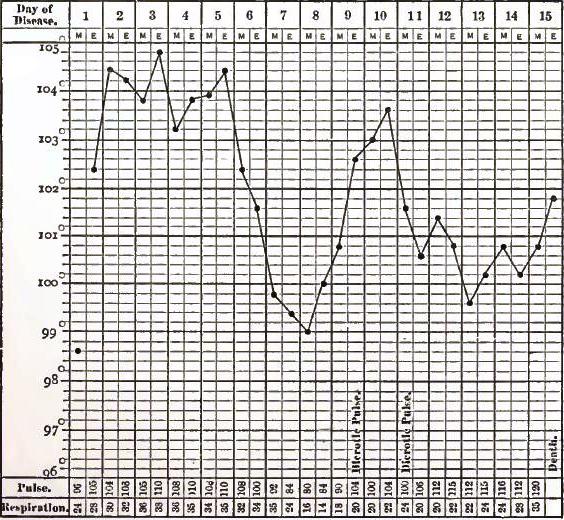
From a case of the bilious typhoid or grave subintrant form of relapsing fever.
COMPLICATIONS AND SEQUELÆ.—As would be anticipated from what has been said of the wide range of the symptoms and of the remarkable course of the temperature in relapsing fever, there are many complications and sequelæ liable to occur, and which require special consideration. They may be classified according as they affect the febrile movement, the state of the blood, or one or other of the groups of organs.
We have already described the various irregularities presented by the febrile paroxysms and the intermissions, and no further allusion need be made to mere variations in length, severity, or number of the former. In rare cases, however, a peculiarity is presented, usually in the first intermission, which is difficult of explanation. About twenty-four hours after an apparently complete crisis, with a fall of temperature to a subnormal point, there may be a sudden and rapid rise or rebound of temperature to 104° or 105°, attended with distressing symptoms of high fever, but lasting only twenty-four or forty-eight hours. A good example of this is given in the case described above and Carter18 cites several examples of it terminating either in recovery or in rapid death. He asserts that examinations of the blood during such post-critical febrile rebounds invariably showed an absence of spirilla, so that in his opinion such fever must be considered non-specific. Their explanation seems difficult, since the pyrexia is too brief to be associated with any local inflammatory complication.
18 Op. cit., p. 172.
More frequent and serious is the protracted post-critical pyrexia which we have already described as modifying the interval, so as to produce a subintrant type by maintaining continuous though irregular fever until the accession of the relapse, unless cut short by death. This post-critical fever is non-specific, is unattended with spirilla in the blood, and is to be associated with the extensive irritative processes in the liver, spleen, kidneys, lungs, and other parts that are present in these grave and complicated cases. It is to be noted that the course of those paroxysms which terminate in lysis indicates that they may represent a milder type of the above process.
The peculiarities of the delirium, amounting sometimes to maniacal excitement, which attends some cases of relapsing fever, has been fully described.
Less common are the following: mental hebetude, lasting some days or even weeks after the close of the last paroxysm, or, as in a case of Carter's, gradually increasing mental feebleness, terminating in imbecility. In such cases suspicion must arise of the occurrence of some local lesion of the membranes or substance of the brain.
Partial palsy is mentioned by numerous authors as occurring during or shortly after attacks of relapsing fever. Paralysis of one or both deltoids has been noted, the latter by Cormack, who saw it continue ten days after the patient was well in all other respects. Temporary paralysis of the forearm (Douglas) or of the whole arm (Parry, Meschede) has been observed; and Parry also describes loss of power in the legs lasting for one week. In one of our cases temporary loss of power of the left arm and leg occurred, attended with such impairment of sensibility that the woman had to feel for the fingers of the left hand to assure herself of their existence. This loss of power occurred during the initial paroxysm, and gradually passed away, but she was unable to stand alone on the thirty-first day of the disease. In a case reported by Tennent19 facial palsy was developed six days after the second crisis.
19 Glasgow Med. Jour., May, 1871, p. 379.
Various explanations have been offered for these local palsies, but, as already stated (see above), it seems probable that they are referable to morbid conditions of the nerve-trunks, or, less commonly, of the spinal cord. It must be noted, however, that in a certain number of autopsies serious intracranial lesions are found, which are evidently the results of the attack of relapsing fever. These consist of abscess of the brain, meningitis, and specially cerebral hemorrhage. This was present in one of our cases, but Carter found copious hemorrhage in no less than 8 out of 54 autopsies, and in 5 others there were minute capillary cerebral hemorrhages. Still, in nearly all the cases of large hemorrhage we have found recorded the effusion was upon the surface of the brain, and this, combined with the absence of true hemiplegia from the forms of paralysis noted in relapsing fever, and the transient character of these palsies, makes it clear that they are not to be explained by any considerable cerebral hemorrhage. On the other hand, however, it must be admitted that an additional possible cause of them is to be found in minute hemorrhage into small areas known to govern the movements of certain groups of muscles. Again, we have had occasion to note the occurrence of both thrombosis and embolism among the lesions of relapsing fever, and it is evident that either of these accidents, if involving a comparatively small branch of a cerebral vessel in certain motor areas, might cause transient paralysis, such as has been described. Nor can we fail to see that, while such symptoms as the delirium, mania, coma, or subsequent mental impairment may receive other explanations, it is possible that they may arise from similar processes of minute hemorrhage, thrombosis, or embolism involving other parts of the brain.
The frequent occurrence of severe rheumatic pains in the muscles and joints during the course of the disease has been dwelt upon (above); but in some cases they persisted during the intermissions and for a considerable time after all other symptoms of disease had passed away. Occasionally they greatly retarded convalescence by interfering with exercise and sleep. These pains were mostly in the legs, and were increased by exercise, and also seemed to be influenced by changes of weather. Patients who suffered thus were also liable, after exposure or in consequence of severe atmospheric changes, to sharp attacks of similar pains elsewhere, and especially in the course of the intercostal nerves. Occasionally violent and persistent headache follows the disease, not improbably associated with changes in the membranes of the brain, although in other cases severe neuralgia occurs in consequence of the anæmia which may remain in an intense degree after the fever. Troublesome numbness and soreness of the soles of the feet and of the palms of the hands, increased by pressure, has been noted as a sequel persisting for several days or weeks.
Affections of the special senses are not rare. The most remarkable among these is the affection of the eyes, which is apt to occur far more frequently in connection with relapsing fever than with typhus or typhoid. The proportion of cases in which this sequel appears varies greatly in different epidemics. In the British epidemics of 1826 and 1843, when this form of post-febrile ophthalmia was first accurately described by Mackenzie of Glasgow, it was very frequent; and it was equally so in Finland in 1867-68, when Estlander20 again carefully studied it.
20 "U. Choroiditis nach Febris Recurrens," Arch. f. Ophth., 1869, Bd. xv., Abth. ii., 108.
On the other hand, so far as can be stated in regard to a sequel which may appear after convalescence is far advanced and the patient discharged from medical care, it was very uncommon in the Philadelphia epidemic of 1869-70. This ophthalmia may occur during the course of the fever, but more frequently it begins during convalescence, and even some months after convalescence has been established. It occurs in patients of both sexes and at all ages. Usually it affects but one eye, but both may be attacked simultaneously or consecutively. Patients who were very ill-nourished and debilitated were most apt to present this sequel, and Murchison regards previous starvation as one of its main causes. The exciting cause and true pathology appear obscure as yet, however, and the existence of a neural origin is not improbable. In some cases the ophthalmia has seemed to result directly from exposure to cold. Among our own patients, as already stated, eye symptoms were less common and severe. A careful record of 184 cases was kept in reference to this question. Several patients complained of diplopia during the febrile stage, and one asserted that every object appeared fourfold to him. Conjunctivitis of moderate severity, usually associated with otorrhoea, occurred in about 5 per cent. of our cases; it generally affected only one eye, and occurred in a few instances as late as the third week after the relapse. In a few cases (four) also there was dulness of vision in one eye, noted during the course of the disease and persisting for some time after convalescence began. In only one instance, however, did permanent impairment of vision ensue, and this man had passed through a violent attack of the fever with unusually grave nervous symptoms. It left him with optic neuritis on the right side, which induced partial atrophy of the nerve and great limitation of the field of vision. Meschede reports intraocular affections in 6 cases out of 180 specially examined, though it is not certain that such affections were directly connected with the febrile process. Ocular ecchymosis occurs in a small proportion of cases, especially of the graver types.
Dulness of hearing is not so common in relapsing fever as it is in typhoid. It was present in 14 out of 184 of our cases during the course of the disease, and in a few instances partial or almost complete deafness in one ear persisted after convalescence, owing doubtless to a slight affection of the middle ear. In one case marked deafness appeared suddenly on the day after the termination of the relapse by crisis. Meschede21 found disease of the middle ear in no less than 8 per cent. of his cases.
21 Loc. cit.
Purulent otorrhoea from one or both ears is of more frequent occurrence, and without any special exciting cause may present itself at any time during the course of the disease or more commonly after the relapse. In the same manner purulent coryza may occur.
The eruptions occasionally present during the fever have been described. Bed-sores from pressure are much less common than in typhus, but are met with in a small proportion of cases. As a rule, they are of moderate size and heal quickly. Superficial gangrene of the lips, nose, and ears has also been noted in rare cases (Zuelzer) in connection with gangrene of the extremities, probably from embolism. The occasional occurrence of painful boils, of abscesses in the cellular tissues (Wyss and Bock), and the more rare occurrence of erysipelas may be mentioned among the sequelæ.
As already stated, the severe pains in the joints and members which so frequently occur during relapsing fever are, as a rule, unattended by any redness or swelling of the joints. In rare cases, however, there is effusion into the joints during the fever, or more commonly there are attacks during convalescence which simulate subacute rheumatic arthritis. Such attacks may last but a few days, but in several of our cases there was painful swelling of the knees, wrists, and fingers which persisted for several weeks after the fever, being attended with slight crepitation on motion, and altogether behaving like subacute rheumatism.
As would be expected from the severity of the fever, the marked disorder of digestion, and the lesions of the spleen and liver in relapsing fever, anæmia is a common sequel. In cases where there has also been free hemorrhage, usually in the form of epistaxis, the anæmia may indeed reach an intense degree.
The cardiac murmurs which have been described as present in a certain proportion of cases are dependent upon the blood-changes, and when the anæmia is extreme these murmurs are also audible over the large veins and the pulmonary artery, and persist after convalescence is fully established.
Oedema of the lower extremities occurs in a considerable number of cases. It is clearly due in part to the anæmia, but the cardiac debility which follows the fever is also largely concerned in its production. It was, indeed, marked in some of our cases where no anæmic murmurs existed, but where there was great nervous and muscular debility. Usually limited to the feet and ankles, it occasionally extended above the knees, and in one case, where great anæmia and debility from fever and over-exertion coexisted, there was oedema of the hands and wrists, with great distension of the legs up to the hips. It is not associated with albuminuria as a rule, and yields readily to treatment and rest, in the course of a few weeks.
Hemorrhages from various surfaces have already been mentioned, and a full account given of epistaxis, which is by far the most common form. Bloody vomiting has been noticed in a small proportion of cases in various epidemics. It varies in amount, but is always attended with great gravity of the attack, and usually is followed by fatal results. It occurred in four of our cases, two of which presented also black stools containing altered blood, and suppression of urine; while in another it occurred at the close of the first relapse, and during the second relapse was copious and repeated. In this case it was attended with alarming symptoms of collapse, from which the patient rallied, and after a desperate struggle recovered.
Blood may also be discharged from the bowels in such large amount as to constitute actual hemorrhage—a symptom of great gravity; or in small quantity and completely altered, so as to impart an inky black color to the stools—a condition not necessarily attended with urgent danger; or, finally, there may be frequent bloody dysenteric stools.
Hemorrhage has also been observed from the uterus, from the kidneys, from the ears, and from the old cicatrix of a syphilitic chancre. Hemorrhage occurred in 87 out of 183 of our cases, or in nearly 50 per cent. It was from the nostrils in 82 cases, from the uterus in 1 case, from the stomach in 4 cases, and from the cicatrix of a chancre in 1 case.
Sudden collapse occurs with such comparative frequency in relapsing fever as to require special attention as one of its complications. It may occur at any period of the disease, but it is most common at the crisis of the first paroxysm or of the relapse. The symptoms are usually those of cardiac failure, with rapid, small, and feeble pulse; shallow and hurried, or slow, labored, and imperfect respiration; coldness of the extremities, while the central temperature may remain elevated; muttering delirium, rapidly passing into unconsciousness. Occasionally almost instantaneous death occurs from syncope induced by some muscular exertion, as standing up or even rising in bed. In other cases the symptoms indicate the development of cardiac thrombosis, and subsequent examination has verified this opinion. In still other cases the symptoms resemble those which occur in extreme hyperpyrexia dependent upon overwhelming and paralysis of the nervous centres. Copious hemorrhage from the stomach and nose may also induce syncope of alarming and even fatal severity. When from the latter cause, reaction may be induced and the patient may ultimately recover, as we saw in a case where after repeated hematemesis the patient sank into profound collapse. In all of its forms, however, this complication is of extreme and imminent danger, and death follows, as a rule, in a few hours. The cases in which it occurs are usually of severe type, occurring in persons who have previously been in poor health or intemperate, or who have been subjected to privation and improper exposure previous to and during the early stages of their attack. Still, collapse may occur in mild cases also, and whatever the type of the disease there may be no special indication of approaching trouble, when the patient rapidly passes into collapse, to be followed by death in a few hours. It occurred in nine of about two hundred cases under our observation. In one it was the result of hemorrhage from the stomach, and ended in recovery; in one, at the close of the initial paroxysm the patient, who was stupid, with muttering delirium, sank into collapse as the temperature rapidly fell from 105° to 97°, and died in a few hours; in one, on the fourth day of the relapse the temperature suddenly fell from 102° to 96°, with free sweating, but suddenly rebounded to 102°, with very rapid, feeble pulse, distinct basic cardiac murmur, constriction of chest, restlessness and delirium, slight convulsions, and death in eight hours; in one, a man at the end of the initial paroxysm, immediately after his admission to the hospital in apparently fair condition, became violently delirious, with bounding pulse, soon grew comatose, and died in one hour; in one, a man who was in feeble condition, on the nineteenth day, with irregular persistent fever (he had splenic abscess), sat up on the edge of the bed, sank back in syncope, and died in less than an hour; in one, a man who did well until the second day of the relapse, when pleuro-pneumonia and pericarditis were developed, died suddenly four days later: there was considerable pericardial effusion; in one, sudden death from syncope or cardiac thrombosis occurred on the twelfth day in a man who had suppurative parotitis and metastatic abscesses of the lungs; in one, sudden collapse and death occurred in one and a half hours at the end of the initial paroxysm; in one, a drunkard with large fatty liver had pyrexia continuing after the initial paroxysm, and on the ninth day, while in a state of hebetude, with mild delirium and a pulse of 112, coma suddenly occurred, and death followed in two hours.
Pericarditis is a rare complication, and is apt to coexist with pleuro-pneumonia. This combination occurred in one of our cases where pleuro-pneumonia and pericarditis were developed on the second day of relapse, and proved fatal by sudden collapse on the fifth day, with the pericardial sac distended with serum and its layers coated with plastic lymph.
Thrombosis of veins, as in phlegmasia alba dolens, occurs much more rarely than after typhoid fever. Arterial embolism, on the other hand, is not uncommon. Murchison22 reports a case in which gangrene of the left foot from obstruction of the left femoral artery, together with cerebral softening from obstruction of the left middle cerebral artery, occurred in connection with cardiac thrombosis. Zuelzer alludes to similar cases in the St. Petersburg epidemic of 1865-66, where, in addition to the extremities, the nose, ears, and lips became gangrenous. Other examples of embolism are found in lesions of the spleen and kidneys, where infarctions are of frequent occurrence.
22 Op. cit., p 384.
Heart-clot, or cardiac thrombosis, appears to occur more frequently than in any other acute zymotic disease, with the exception of diphtheria. Even when the occurrence of passive hemorrhages and of ecchymoses of various tissues indicates marked dyscrasia of the blood, there will not rarely be found firm white clots in one or other of the cavities of the heart. These frequently present unmistakable evidences of ante-mortem formation, and, as already stated, there is a certain proportion of the cases of rapid and unexpected death where the fatal result is directly due to cardiac thrombosis, attended with the usual symptoms.
The constant affection of the spleen has been fully described; it is not therefore surprising that both complications and sequelæ arise in connection with it. At times, in cases which ultimately recover, the pain in the splenic region is so violent and continuous, and is attended with so much tenderness over the enlarged organ, that localized peritonitis is undoubtedly present. Occasionally this perisplenitis persists, and in conjunction with the inflammatory changes in the substance of the spleen maintains an irregular fever after the specific pyrexia has run its course. This was noticed in several of our cases, but especially so in a case where, after the initial paroxysm, an irregular fever was kept up, obscuring the relapse, until the nineteenth day, when death occurred suddenly from syncope on rising on the edge of the bed, and where examination showed splenic peritonitis, with a splenic abscess as large as a pigeon's egg.
The enlargement of the spleen usually subsides during the intermission, and disappears speedily or in the course of a few weeks after convalescence is established. Occasionally, however, it persists, and is attended with marked anæmia. In one case, where death occurred from pneumonia, the sequel of relapsing fever, at about the thirtieth day, the spleen weighed twenty-nine ounces; and in another case, where death occurred from gangrenous pleuro-pneumonia, at the fortieth day, the spleen was still enlarged and presented characteristic changes in its pulp. On the other hand, in a case where death occurred on the twelfth day of typhus, occurring forty-four days after recovery from a very bad case of relapsing fever, making it altogether the one hundredth day, none of the lesions of the first disease were discoverable.