Part 2 / Book 3 — BOOK III. Grecian States and Colonies from their Earliest Period to the Accession of Alexander the Great.
Reading edition
GEOGRAPHICAL OUTLINE OF GREECE.
1. Of the three peninsulas which extend southward into the Mediterranean, the most easterly was first settled, and became the seat of the highest civilization which the ancient world could boast. Its southern portion only was occupied by Greece, which extended from the 40th parallel southward to the 36th. Continental Greece never equaled in size the state of Ohio. Its greatest length, from Mount Olym´pus to Cape Tæn´arum, was 250 miles; and its greatest breadth, from Actium to Marathon, was but 180. Yet this little space was divided into twenty-four separate countries, each of which was politically independent of all the rest.
2. The most peculiar trait of the Grecian peninsula is the great extent of its coast as compared with its area. It is almost cut into three distinct portions by deep indentations of the sea, northern Greece being separated from the central portion by the Ambra´cian and Ma´lian, and central Greece from the Peloponnesus by the Corinth´ian and Saron´ic gulfs. A country thus surrounded and penetrated by water, of necessity became maritime. The islands of the Ægean afforded easy stepping-stones from Europe to Asia. Opposite, on the south, was one of the most fertile portions of Africa; and, on the west, the Italian peninsula was only thirty miles distant at the narrowest portion of the channel.
3. The northern boundary of Greece is the Cambu´nian range, which crosses the peninsula from east to west. About midway between the two seas, this range is intersected by that of Pin´dus, which runs from north to south, like the Ap´ennines of Italy. This lofty chain sends off a branch toward the eastern coast, which, running parallel to the Cambunian at a distance of sixty miles, incloses the beautiful plain of Thes´saly. West of Mount Pindus is Epi´rus, a rough and mountainous country inhabited by various tribes, some Greek, some barbarian. Its ridges, running north and south, were alternated with well-watered valleys. Through the most easterly of these flows the Achelo´us, the largest river in Greece. Near its source were the sacred oaks of Dodo´na, in the rustling of whose leaves the voice of the supreme divinity was believed to be heard.
4. Central Greece was occupied by eleven states: At´tica, Meg´aris, Bœo´tia, Malis, Ænia´nia, eastern and western Locris, Phocis, Doris, Æto´lia, and Ac´arna´nia. Between Ætolia and Doris, Mount Pindus divides into two branches. One of these runs south-easterly into Attica, and comprises the noted summits of Parnas´sus, Hel´icon, Cithæ´ron, and Hymet´tus; the other turns to the southward, and reaches the sea near the entrance of the Corinthian Gulf.
Attica is a triangular peninsula, having two sides washed by the sea and its base united to the land. Protected by its mountain barriers of Cithæron and Par´nes, it suffered less from war in early times than other parts of the country; and the olive, its chief production, became for all ages a symbol of peace.
5. Southern Greece contained eleven countries: Cor´inth, Sicyo´nia, Acha´ia, E´lis, Arca´dia, Messe´nia, Laco´nia, Ar´golis, Epidau´ria, Trœze´nia, and Hermi´onis.
The territory of Corinth occupied the isthmus between the Corinthian and Saronic gulfs; and by its two ports, Lechæ´um and Cen´chreae, carried on an extensive commerce both with the eastern and western seas. Thus admirably situated, Corinth, the chief city, was noted for its wealth even in the time of Homer.
Sicyonia was considered the oldest state in Greece, and Argolis next. The ruins of Tir´yns and Myce´næ, in the latter, existed long before the beginning of authentic history.
Elis was the Holy Land of the Helle´nes. Every foot of its territory was sacred to Zeus, and it was sacrilege to bear arms within its limits. Thus it was at peace when all Greece beside was at war; and though its wealth surpassed that of all the neighboring states, its capital remained unwalled.
Arcadia, the Switzerland of the Peloponnesus, was the only Grecian state without a sea-coast. Its wild, precipitous rocks were clothed in gloomy forests, and buried during a great part of the year in fogs and snows. Its people were rustic and illiterate; they worshiped Pan, the god of shepherds and hunters, but if they returned empty-handed from the chase, they expressed their disgust by pricking or scourging his image.
Messenia occupied the south-western corner of Greece, and encircled a gulf to which it gave its name. Laconia embraced the other two promontories in which the Peloponnesus terminates, together with a larger tract to the northward. It consisted mainly of a long valley bounded by two high ranges, whence it was sometimes called Hollow La´cedæ´mon. Down the center of the vale flowed the Euro´tas, whose sources were in the steep recesses of Mount Tay´getus. Sparta, the capital, was the only important town. It lay on the Eurotas about twenty miles from the sea, inclosed by an amphitheater of mountains which shut out cooling winds and concentrated the sun’s rays, so as to produce intense heat in summer.
6. Although the name of Greece is now strictly limited to the peninsula which we have described, it was often more generally applied by the ancients to all the homes and colonies of the Hellenic race. The south of Italy was long known as Mag´na Græ´cia; the eastern shores of the Ægean constituted Asiatic Greece, and the cities of Cyrene in Africa, Syracuse in Sicily, and Massilia in southern France, were all, to the Greeks, equally essential parts of Hellas. The description of the numerous and important colonies belongs to a later period. A few of the islands more immediately belonging to Greece will alone be mentioned here.
7. Chief of these was Eubœ´a, the great breakwater of the eastern coast, which extended a distance of 100 miles in length and 15 in width. Nearly as important, though smaller, was Corcy´ra, on the western coast; and south of it lay Paxos, Leuca´dia, Ith´aca, Cephalle´nia, and Zacyn´thus. On the south were the Œnus´sæ and the important island of Cythe´ra. On the east, among others were Hy´drea, Ægina, and Salamis. Besides these littoral, or coast, islands there were, in the northern Ægean, Lemnos, Imbros, Thasos, and Samothra´ce; in the central, the Cyc´lades; and, in the southern, the large island of Crete.
HISTORY OF GREECE.
Periods.
I. Traditional and Fabulous History, from the earliest times to the Dorian Migrations, about B. C. 1100.
II. Authentic History, from the Dorian Migrations to the beginning of the Persian wars; B. C. 1100-500.
III. From the beginning of the Persian wars to the victory of Philip of Macedon at Chæronea, B. C. 500-336.
8. First Period. The name of Greece was unknown to the Greeks, who called their country Hellas and themselves Helle´nes. But the Romans, having probably made their first acquaintance with the people of that peninsula through the Grai´koi, a tribe who inhabited the coast nearest Italy, applied their name to the whole Hellenic race. A more ancient name, Pelas´gia, was derived from the earliest known inhabitants of the country—a widely extended people, who may be traced by the remains of their massive architecture in various parts of Italy as well as Greece. The Pelasgi were among the first of the Indo-Germanic family to migrate from Asia to Europe.
9. By conquest or influence, the Hellenes very early acquired the control of their neighbors, and spread their name, language, and customs over the whole peninsula. They were then regarded as consisting of four tribes, the Dorians, Achæ´ans, Æo´lians, and Ionians; but the last two, if not all four, were probably members of the earlier race.
10. Though of the same family with the Medes, Persians, Bactrians, and the Brahmins of India, the Greeks had no tradition of a migration from Asia, but believed that their ancestors had sprung from the ground. They, however, acknowledged themselves indebted, for some important elements of their civilization, to immigrants from foreign lands. Ce´crops, a native of Sais in Egypt, was said to have founded Athens, and to have established its religious rites. The citadel bore, from him, the name Cecro´pia in later times. Better authorities make Cecrops a Pelasgian hero. Da´naus, another reputed Egyptian, was believed to have founded Argos, having fled to Greece with his fifty daughters. To him the tribe of the Da´nai traced their name, which Homer sometimes applied to all the Greeks; but the story is evidently a fable.
Pe´lops was said to have come from Phrygia, and by means of his great wealth to have gained the kingdom of Mycenæ. The whole peninsula south of the Corinthian Gulf bore his name, being called Peloponnesus. A fourth tradition which describes the settlement of the Phœnician Cad´mus at Thebes, in Bœotia, rests upon better evidence. He is said to have introduced the use of letters, the art of mining, and the culture of the vine. It is certain that the Greek alphabet was derived from the Phœnician; and Cadmus may be regarded, in this elementary sense, as the founder of European literature. The fortress of Thebes was called, from him, Cadme´a.
11. The earliest period of Grecian history is called the Heroic Age. In later times, poets and sculptors loved to celebrate its leaders as a nobler race than themselves, ranking between gods and men; differing from the former by being subject to death, but surpassing the latter both in strength of body and greatness of mind. The innumerable exploits of the Heroes must be read rather in Mythology than History. The three who had the strongest hold in the belief, and influence upon the character of the people, were Hercules, the great national hero; The´seus, the hero of Attica; and Minos, king of Crete.
The “Twelve Labors of Hercules” represent the struggle of Man with Nature, both in the destruction of physical evil and the acquisition of wealth and power. To understand his reputed history, we must bear in mind that, in that early age, lions as well as other savage beasts were still numerous in southern Europe; that large tracts were covered by undrained marshes and impenetrable forests; and that a wild, aboriginal race of men, more dangerous than the beasts, haunted land and sea as robbers and pirates.
12. Theseus was the civilizer of Attica. He established a constitutional government, and instituted the two great festivals, the Panathenæa[32] and Synoikia, in honor of the patron goddess of Athens. The Isthmian Games, in honor of Neptune, were also traced to him.
13. Minos, king of Crete, was regarded by the Greeks as the first great law-giver, and thus a principal founder of civilization and social order. After his death he was believed to be one of the judges of souls in Hades. It is worth noticing that the traditional law-givers of many nations have borne similar names; and Menu in India, Menes in Egypt, Manis in Lydia, Minos in Crete, and Mannus in Germany may all be mythical names for Man the Thinker, as distinguished from the savage.
B. C. 1194.
B. C. 1184.
14. Of the many remarkable enterprises of the Grecian heroes, the last and greatest was the Siege of Troy. Zeus,[33] pitying the earth—so says the fable—for the swarming multitudes she was compelled to sustain, resolved to send discord among men that they might destroy each other. The occasion of war was found in the wrong inflicted upon Menelaus, king of Sparta, by Paris, son of Priam, king of Troy. All the Greek princes, resenting the injury, assembled their forces from the extremities of Hellas—from Mount Olympus to the islands of Ithaca, Crete, and Rhodes—and crossing the Ægean under the command of Agamem´non, spent ten years in the siege of Troy. The story of the tenth year must be read in the Iliad of Homer.[34] It is impossible to separate the historical from the poetical part in his spirited narration. Some historians have assigned a definite period to the siege, while others have doubted whether Troy, as described by Homer, ever existed.
15. Though much doubt may be felt as to the character of their heroes and events, the poems of Homer give us a true picture of the government and manners of the Greeks at this early age. From them we learn that each of the petty states had its own king, who was the father, the judge, the general, and the priest of his people. He was supposed to be of divine descent and appointment. But unlike the blind believers in “divine right” in modern times, the Greeks demanded that their kings should prove themselves superior to common men in valor, wisdom, and greatness of soul. If thus shown to be sons of the gods, they received unquestioning obedience.
16. A council of nobles surrounded the king and aided him by their advice. The people were often assembled to witness the discussions in the council and the administration of justice, as well as to hear the intentions of the king; but in this early age they had no voice in the proceedings. The nobles, like the king, were descended from the gods, and were distinguished by their great estates, vast wealth, and numerous slaves.
17. The Greeks of the Heroic Age were distinguished by strong domestic attachments, generous hospitality, and a high sense of moral obligation. Every stranger was welcomed and supplied with the best cheer before he was asked his name or errand. If he came to seek protection, the family were under a still stronger obligation to receive him, even if he were an enemy; for Zeus had no mercy on him who turned away from the prayer of a suppliant.
18. The manners of the age were simple and homely. The sons of the gods cooked their own dinners, and were proud of their skill in so doing. Ulysses built his bed-chamber and constructed his raft, beside being an excellent plowman and reaper. The high-born ladies, in like manner, carded and spun the wool of their husbands’ sheep, and wove it into clothing for themselves and their families; while their daughters brought water from the wells, or assisted the slaves to wash garments in the river.
19. Though simple, these people were not uncivilized. They lived in fortified towns, adorned by palaces and temples. The palaces of the nobles were ornamented with vases of gold, silver, and bronze, and hung with rich Tyrian draperies. The warriors were protected by highly wrought and richly embellished armor. Agriculture was highly honored. Wheat, flax, wine, and oil were the chief productions.
20. The arts of sculpture and design had already made some progress. Poetry was cultivated by minstrels, who wandered from place to place singing songs of their own composition, and were sure of an honorable welcome in every palace. In this way, doubtless, the blind Homer[35] related the brave deeds done before the walls of Troy, and praised the heroes of that epoch in the houses of their descendants.
21. The religion of the Greeks had some of its first elements in common with that of the Hindus. Zeus, the king of gods and men, who reigned upon the snowy summit of Olympus, was doubtless the same conception with Dyaus´, the Bright Ether or Serene Heaven of the Brahmin worship. But as the forces of Nature were the objects of adoration, each system borrowed its distinctive features from those of the country in which it was developed, and that of the Greeks became incomparably the more delicate and refined. The Asiatic origin of their faith was recognized by the Greeks themselves, in the fable that Zeus had brought Euro´pa, daughter of Age´nor (the same with Canaan), in her early youth, across the Hellespont and through Thrace. An old tradition said that the people of the ante-Hellenic age worshiped all the gods, but gave names to none; a mystical expression of the truth that the Greeks, like most other ancient people, had descended from the worship of One God to the belief in many.
Watching with keen eyes the various and apparently conflicting operations of Nature, the Greeks, unaided by revelation, were led to believe in many distinct and sometimes hostile gods; for their science, as imperfect as their religion, had not yet arrived at a perception of unity beneath the apparent variety, nor taught them that all forces may be resolved into one. Hence we read of conflicts and jealousies among the divine inhabitants of Olympus, of which the most ignorant child should be ashamed. In more enlightened ages, philosophers severely censured this ascription of unworthy passions to the gods, and taught that they should only be conceived as serene, beneficent, and superior to human excitements.
22. Much of the mythology of the Greeks belonged merely to poetry, and had no religious character whatever. Many stories of the gods may be explained by the familiar appearances of nature. E´os, the dawn, was the sister of He´lios, the sun, and Sele´ne, the moon. She dwelt upon the banks of Ocean, in a golden-gated palace, whence she issued each morning to announce to gods and men the approach of her greater brother. She was the mother of the Winds and of the Morning Star. I´ris was the messenger of the gods. The many-colored rainbow was the road over which she traveled, and which vanished, when she no longer needed it, as suddenly as it had appeared.
23. The twelve who constituted the Olympian Council were Zeus, the supreme; Posi´don, the god of the sea; Apollo, the sun-god, and patron of music, poetry, and eloquence; A´res, the god of war; Hephæs´tus, of fire and the useful arts; Her´mes, the herald of the gods, and promoter of commerce and wealth; Hera, the great goddess of Nature; Athe´na, the favorite daughter of Zeus, and patroness of all wisdom, civilization, and art; Ar´temis, the goddess of the moon or of hunting; Aphrodi´te, of beauty and love; Hestia, of domestic life; and Deme´ter, the bountiful mother of harvests,—six gods and six goddesses.
24. Beside these, and in some cases equal in rank, were Hades, the god of the under-world; Helios and Hec´ate; Diony´sus, the patron of the vine, whose rites bore some resemblance to the drunken So´ma worship of the Hindus; the nine Muses, daughters of Zeus and Memory, who presided over music, literature, and all the arts; the Oceanids and the Nereids, daughters of Posidon; and multitudes more, whom to enumerate would require a volume, instead of a few pages.
25. The religion of the Greeks, properly so called, consisted in reverence toward a moral Ruler of the world, ever present and actively concerned in human affairs; and in obedience to him by truthfulness in thought, word, and deed. Zeus himself was believed to watch over the sacred performance of all oaths. Athena was the divine Wisdom, especially as exercised in civil affairs. Nem´esis was the divine Justice, as heard either in warnings of conscience within or the reproaches of the world without. The Erin´nyes, or as they were flatteringly called, Eumen´ides,[36] were the avengers of crime, older than all the Olympian divinities, and dreaded alike by gods and men. The cries of the injured aroused them from their dark abode in Tartarus; and to the guilty man they appeared as fierce, implacable furies, with flaming eyes and extended talons, who never slept, but walked or waited constantly by his side from the moment of his crime till its punishment; while to the innocent victim, whom they avenged, they wore the form of serene and stately goddesses, with faces beautiful though stern.
26. At a later period, new elements entered into the religious life of the Greeks, through their intercourse with other nations, especially with Egypt, Asia Minor, and Thrace. The most important of these was the idea of purification for sins, which was unknown to Homer and Hesiod, and was probably borrowed from the Lydians. The earliest sacrifices were merely expressions of gratitude, or means of obtaining the favor of the gods, and had nothing of the character of sin-offerings. In case of crime, it was impossible to turn aside the wrath of the Eumenides, either by prayers or sacrifices; the guilty person must suffer the extremest consequences of his guilt. But under the new system it was believed that the divine anger might be averted, and the stain of sin removed.
Persons guilty of homicide, whether intentional or accidental, were excluded from the society of man and the worship of the gods until certain rites had been performed. In earlier times, a chief or king might officiate in the ceremony of purification, but later it was intrusted to priests, or to persons supposed to be specially marked for the favor of heaven by holiness of life. In case of public calamity, such as plague, famine, or defeat in war, whole cities or states underwent the process of purification, with a view to appease the supposed wrath of the gods for some hidden or open crime.
27. Among other foreign observances were the ecstatic rites in honor of various divinities. Such were the Bacchanalian dances, celebrated at Thebes and Delphi, in honor of Dionysus, in which troops of women spent whole nights upon the mountains in a state of the wildest frenzy, shouting, leaping, clashing noisy instruments, tearing animals to pieces and devouring the raw flesh, and even cutting themselves with knives without feeling the wounds. Those who abandoned themselves freely to this excitement were supposed to secure the favor of the god and escape future visitations, while those who resisted were punished with madness.
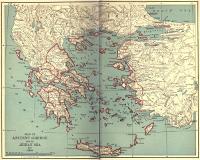
MAP OF ANCIENT GREECE and the ÆGEAN SEA.
28. Among the most solemn rites were the Mysteries celebrated at Eleusis in honor of Demeter and Perseph´one. These could only be approached by a long and secret course of preparation, and it was a crime even to speak of them in the presence of the uninitiated. They commanded the deepest reverence of the Greeks, and the participants were regarded as more secure than others, both in temporal and spiritual perils. When exposed to shipwreck, passengers commonly asked each other, “Have you been initiated?”
The Eleusinian Mysteries, at least in their earlier form, are supposed to have been a remnant of the old Pelasgic worship, and thus “grounded on a view of nature less fanciful, more earnest, and better fitted to awaken both philosophical thought and religious feeling” than the Hellenic mythology.
29. Another custom adopted from abroad was the formation of secret societies, whose members bound themselves by ascetic vows, and the obligation to perform, at fixed seasons, certain solemnities. Such were the Orphic, and afterward the Pythagorean brotherhoods. Those who entered upon the “Orphic Life,” as it was called, promised to abstain wholly from animal food, except the mystic sacrificial feast of raw flesh, and wore white linen garments like the Egyptian priests. Though worshipers of Dionysus, the Orphic brotherhood abstained from all wild and unseemly demonstrations, and aimed at the most severe simplicity and purity of life and manners. Their reputation for wisdom and holiness was abused by certain impostors, who used to visit the houses of the rich and offer to release them from the consequences both of their own sins and those of their forefathers, by sacrifices and expiatory songs prescribed in the Orphic books.
30. We have anticipated the five or six centuries which followed the Heroic Age, for the sake of giving a connected though brief account of the religious beliefs and customs of the Greeks, without which their history could not be understood. It only remains to mention those oracles through which, from the earliest times to the latest, and even long after the civil existence of Greece was ended, the gods were believed to make known their will to man.
31. The oldest of the oracles was that of Zeus at Dodona, where the message of the god was believed to be heard in the rustling of the sacred oaks and beeches, and interpreted by his chosen priests or prophetesses. At Olympia, in Elis, the will of Zeus was read in the appearance of victims sacrificed for the purpose. The oracles of Zeus were comparatively few. The office of revealing the divine will to man devolved usually upon Apollo, who had twenty-two oracles in European and Asiatic Greece.
32. Of these the most celebrated was at Delphi, in Phocis, where was a temple of Apollo containing his golden statue and an ever-burning fire of fir-wood. In the center of the temple was a crevice in the ground, whence arose a peculiarly intoxicating vapor. When the oracle was to be consulted, the Pythia, or priestess, took her seat upon the sacred tripod over this opening; and when bewildered or inspired by the vapor, which was supposed to be the breath of the god, she uttered a response in hexameter verses. It was often so obscure,[37] that it required more wit to discern the meaning of the oracle than to determine the best course of conduct without its aid. But so great was the reputation of the Delphic shrine, that not only Greeks, but Lydians, Phrygians, and Romans sent solemn embassies to consult it concerning their most important undertakings.
33. What Europe has been to the rest of the world, Greece was to Europe. The same peculiarities of coast and climate which made Europe the best adapted to civilization of all the continents, long made Greece its most highly civilized portion. But as Europe had her northern barbarians, always pressing upon the great mountain barrier of the Pyrenees, Alps, and Carpathians, sometimes bursting their limits and overrunning the more civilized but weaker nations to the southward, so Greece suffered, toward the close of the Heroic Age, from the incursions of the Illyrians on her north-western frontier. The time of this movement was fixed by Greek historians at sixty years after the fall of Troy, or, in our reckoning, B. C. 1124.
Though the Illyrians did not enter central or southern Greece, their southward movement produced a general change among the tribes of the peninsula. The Thessalians, who had previously been settled on the western coast of Epirus, now crossed the Pindus mountains, and cleared for themselves a place in the fertile basin of the Pene´us, hitherto occupied by the Bœotians. The Bœotians, thus dispossessed of their ancient seats, moved southward, across Mounts O´thrys and Œta, to the vale of the Cephissus, whence they drove the Cadmians and Minyæ. These tribes were scattered through Attica and the Peloponnesus. The Dorians, moving from the northward, occupied the narrow valley between Œta and Parnassus, which thus became Doris; while the Dryo´pians, earlier inhabitants of this region, took refuge in Eubœa and the islands of the Ægean.
34. B. C. 1104. Twenty year’s later, a still more important movement took place. The Dorians, cramped by the narrow mountain limits of their abode, united with their western neighbors, the Ætolians, to invade the Peloponnesus. It is said that they were conducted by Tem´enus, Cresphontes, and Ar´istode´mus, in pursuance of the claims of their great ancestor, Hercules, who had been expelled from the southern peninsula a hundred years before. The Dorian migration is therefore often called the Return of the Heraclidæ. Aristodemus was killed by lightning when about to cross the Corinthian Gulf. His brothers were completely victorious over the king of the Achæans, then the most powerful monarch in the Peloponnesus, and proceeded to divide the peninsula between themselves and their allies. The Ætolians received Elis, on the western coast; the rest of the peninsula, except its northern border on the Corinthian Gulf, remained to the Dorians, who continued for five centuries to be the dominant race in Greece. The Heraclid princes then divided the various crowns by lot. That of Argos fell to Temenus; that of Messenia, to Cresphontes; and that of Sparta, to Eurysthenes and Procles, the twin sons of Aristodemus.
35. The conquered Achæans were forced either to emigrate to Asia and Italy, or to content themselves with the northern coast of their peninsula, from which they expelled its Ionian inhabitants, and gave it their own name, Achaia. The Ionians, after resting a few years in Attica, whose people were their kinsmen, sought more space in the Cyclades, in Chios and Samos, or on the neighboring coasts of Asia Minor. In the fertile region between the Hermus and Mæander, and on the islands, twelve Ionian cities[38] sprang up, and became rich and flourishing states. Though independent of each other in government, they were united in the worship of Posidon at one common temple, the Panio´nium, which crowned the headland of Mycale.
36. The Æolians had already been driven from their ancient home in central Greece, and had found refuge in Lesbos and the north-western coast of Asia Minor, between the Hermus and the Hellespont. They, also, formed twelve independent cities, but Mytile´ne, on the isle of Lesbos, was considered the metropolis.
37. The Dorians, extending their migrations beyond the conquered peninsula, took possession of the south-western coast of Asia Minor, with the islands of Cos and Rhodes. Their six cities—sometimes called the Doric Hexapolis—were Cni´dus and Halicarnassus, on the mainland; Ial´yssus, Cami´rus, and Lindus, on the isle of Rhodes; and Cos, on the island of its own name. Like the Ionians, they worshiped at a common sanctuary, the temple of the Triopian Apollo.
RECAPITULATION.
Greece was first occupied by the Pelasgi, but its ancient name is derived from the Hellenes, who early became the predominant race. Many arts were introduced by foreigners, among whom Cecrops and Danans of Egypt, Pelops of Phrygia, and Cadmus of Phœnicia, are most famous in tradition. The Heroic Age was illustrated by the achievements of sons of the gods, the last and greatest of their works being a ten years’ siege of Troy. Greece was governed at this period by many absolute monarchs: kings and nobles, as well as people, led simple and industrious lives. Not only tillage, weaving, and the manufacture of metals, but architecture, sculpture, music, and poetry were cultivated to a high degree. Greek religion was the most refined and beautiful form of Nature-worship. Six gods and six goddesses constituted the Supreme Council of Olympus, and a multitude of inferior divinities peopled the mountains, woods, and waters. Conscience was personified in Nemesis and the Erinnyes. Rites of atonement for sin, ecstatic celebrations, and ascetic brotherhoods were adopted by the Greeks from foreign nations. Of many oracles, the most celebrated was that of Apollo, at Delphi. The Heroic Age ended with a general migration of the tribes of Greece, which resulted in the settlement of the Dorians in the Peloponnesus, and the planting of many Ionian and Æolian colonies on the shores of Asia Minor.
Second Period. B. C. 1100-500.
38. The Heroic Age had ended with a general migration among the tribes of Greece, which for a time interrupted their improvement of manners. But Grecian liberty arose out of the ruins of the Heroic Age; and instead of absolute monarchies, various forms of free government were established in the several states. A state, indeed, was nothing more than a city with a small portion of land surrounding it. Except in Attica, no city at this time had control over any other town.
39. All the Greeks—though existing under a multitude of governments, and divided by rivalries and jealousies—considered themselves as children of one ancestor, Hellen, and gave the common name of barbarians, or babblers, to all other nations. The poems of Homer, which were chanted at the public festivals and repeated at every hearth-stone, described all the Greeks as united against a common foe, and made the feeling of brotherhood stronger than any occasional animosity. Beside the community of blood, language, and national history, the Greeks were strongly bound together by their equal interest in the oracles and the celebration of religious rites, and their participation in the great national festivals.
B. C. 884.
40. The Games. Of these the oldest and most celebrated were the Olympic Games. The date of their foundation is lost among the fables of the Heroic Age, but it is certain that these athletic contests were the favorite diversion of heroes in those primitive times. They were revived and invested with new importance in the time of Iph´itus, king of Elis, and Lycur´gus, regent of Sparta. In the next century their celebration, once in four years, began to afford the Greek measurement of time.
The first Olympiad was B. C. 776-772. The scene of the festival was upon the banks of the Alpheus, in Elis, near the ancient temple of the Olympian Zeus. During the month of the celebration wars were suspended throughout Greece. Deputies appeared from all the Hellenic states, who rivaled each other in the costliness of their offerings at the temple. The games were in honor of Zeus and Hercules. They were open to all Greeks, without distinction of wealth or birth; but barbarians, even of royal blood, were strictly excluded. They included running, jumping, wrestling, boxing, the throwing of quoits and javelins, and races of horses and chariots. The only reward of the victor was a crown of wild olive; but this was esteemed by every Greek as the highest honor he could attain. Its happy wearer was welcomed home with processions and songs of triumph; he entered the town through a breach made in the walls, to signify that a city possessed of such sons needed no other defense; he was thenceforth exempt from all taxes, as one who had conferred the highest obligation upon the state; he occupied the chief place in all public spectacles; if an Athenian, he ate at the table of the magistrates; if a Spartan, he had the privilege in battle of fighting near the person of the king.
41. Three other periodical festivals, which were at first confined to the states where they occurred, were at length thrown open to the whole Hellenic race. The Pythian Games, in honor of Apollo, were celebrated on the Cirrhæ´an plain, in Phocis, the third year of every Olympiad. They included competition in music and poetry as well as in athletic sports, and were, next to the Olympic, the most celebrated festival in Greece. The Ne´mean and Isthmian Games were celebrated once in two years; the former in the valley of Nemea, in Argolis, in honor of Zeus, and the latter on the Isthmus of Corinth, in honor of the sea-god, Posidon.
Thus every year was marked by at least one great national festival, and every second year by two, reminding the throngs which attended them of their common origin, and the distinction between themselves and barbarians. Beside keeping alive that athletic training which increased the strength of Grecian youth, these yearly assemblies served also the purposes of the modern European fairs, of the lecture hall, and, to a certain extent, of the printing-press; for booths were erected all around the sacred grove, in which the industries of all the Hellenic states and colonies found a ready market; while, in the intervals of athletic display, poets chanted to the eager throng their hymns and ballads; historians related the deeds of foreign and native heroes; and philosophers unfolded to all who were wise enough to listen, their theories of mind and matter, and the relation of gods to men.
42. Another bond of union among the Greeks was found in the Amphic´tyones, or voluntary associations of neighboring or kindred tribes, usually for the protection of some common temple or sanctuary. Such a one had its center at Delos, the religious metropolis of the Cyclades; and the three tribes of Dorians, Ionians, and Æolians in western Asia Minor had each its federal union on the same principle. But the most celebrated and lasting was the Amphictyonic league of twelve tribes, which had its semi-annual meetings, in the spring at Delphi, and in the autumn at Anthela, near Thermopylæ.
43. After the Dorian Conquest, Argos was for several centuries the leading power in Greece. In the earliest part of its history, the government was a monarchy, like those of the Heroic Age, the kings claiming descent from Hercules. But the spirit of freedom having been awakened in the people, they gradually took away power from their kings, and established a republic, though retaining the name of monarchy. About 780 B. C., one Phi´don came to the throne, who, having more talent than his predecessors, won back all the powers which they had lost, and made himself absolute with the now first-used name of “tyrant.” He extended the dominion of Argos over the whole Peloponnese, and sent forth colonies which rendered the Argive name famous in Crete, Rhodes, Cos, Cnidus, and Halicarnassus. His intercourse with Asia led to the first use of coined money in Greece, and of a system of weights and measures which is supposed to be the same with the Babylonian. After the death of Phidon, Argive power rapidly declined. The subject and allied cities threw off the oppressive rule which he had exercised, and a new state was now gaining power in the Peloponnese which was destined to eclipse all the glories of Argos.
Sparta.
44. When the Dorians invaded Peloponnesus, the former inhabitants still retained their foothold in the country, and for three hundred years their fortress of Amy´clæ stood at only two miles distance from the Doric capital of Lacedæmon, defying assault. The Lacedæmonians consisted of three classes: 1. The Doric conquerors; 2. The subject Achæans of the country towns; and, 3. The enslaved Helots, who were bought and sold with the soil.
45. The government of Sparta was a double monarchy, its two kings being descended respectively from Procles and Eurysthenes, the twin sons of Aristodemus. They possessed little power in peace, but as generals, in these early times, they were absolute in war. They were held in great honor as the descendants of Hercules, and thus as connecting links between their people and the gods. The Spartan Senate consisted of thirty members, each of whom had passed the age of sixty, and had been a blameless servant of the state. The popular assembly was of little importance, though, as a matter of form, questions of peace or war and the election of certain officers were referred to it. At a later time, however, this assembly by a free vote chose five Ephors, who had absolute power even over the kings and senate, as well as over the people.
46. However subservient they might be to kings or senate, the people held themselves proudly above the industrious but dependent inhabitants of the towns. There was more difference of rank between Spartan and Achæan than between the meanest Spartan and his king. The Helots were marked for contempt by a garment of sheep-skin and a cap of dog-skin; and every year stripes were inflicted upon them for no fault, but that they might never forget that they were slaves.
47. About 850 B. C., arose Lycurgus, one of the most celebrated of ancient law-givers. He was of the royal family of Sparta; and upon the death of his brother, King Polydec´tes, he exercised supreme command in the name of his infant nephew, Charila´us. His administration was the most wise and just that the Spartans had known; but his enemies raised a report that he was seeking the crown for himself, and he resolved to withdraw from the country until his nephew should be of age.
The Spartans missed the firm and wise government of their regent. The young king came to the throne, but disorders were not checked, and a party of the better sort sent a message to Lycurgus urging his return. He first consulted the oracle at Delphi, and was hailed with the title, “Beloved of the gods, and rather a god than a man.” To his prayer that he might be enabled to enact good laws, the priestess replied that Apollo had heard his request, and promised that the constitution he was about to establish should be the best in the world. Those who might envy the power and deny the authority of Lycurgus as a man, could not refuse obedience to his laws when thus enforced by the god. He effected a great revolution in Sparta, with the consent and coöperation of the king himself.
48. The laws of Lycurgus lessened the powers of the kings and increased those of the people, but their chief end was to secure the continuance of the state by making every Spartan a soldier. Modern nations believe that governments exist for the people; in Sparta, on the contrary, each person existed only for the state. His right to exist was decided upon the threshold of life by a council of old men, before whom each newly-born infant was presented. If it seemed to promise a vigorous and active life, it was accepted as a child of the state, and assigned a nine-thousandth part of the Spartan lands; but if weakly and deformed, it was cast into a ravine to perish.
At seven years of age every boy so allowed to live was taken from his home and subjected to a course of public training. The discipline of his body was considered of more importance than the improvement of his mind. He endured heat and cold, hunger and fatigue; and beside the gymnastic exercises, he was subjected to all the hardships of military service. His garment was the same summer and winter; the food given him was too little to sustain life, but he was expected to make up the deficiency by hunting or stealing. If caught in the latter act, he was severely punished; but it was not for the dishonesty, but for the awkwardness of allowing himself to be detected. It must be remembered, however, that where there was no property there could be no theft in any moral sense. Every thing in Sparta was ultimately the property of the state, and every interest was subordinate to the training of citizens to dexterity in war.
49. Another means of training the Spartan youth to fortitude, was a cruel scourging for no offense at the shrine of Artemis, which they endured without a sound, although the altar was sprinkled with their blood, and some even died under the lash. Those who were educated by such inhuman severities, were not likely to become either just or merciful toward others. The wretched Helots afforded a never-failing exercise for their skill in war. Under the institution called Crypti´a, they were frequently attacked and murdered by the select bands of young Spartans, who ranged the country by night in quest of military practice. When the Helots became more numerous than their masters, so as to be regarded with apprehension, these massacres became more frequent and general.
50. Spartan discipline did not end with youth. At thirty a man was permitted to marry, but he still lived at the barracks and ate at the common table. Public affairs were discussed at these tables with a freedom which partly repaid the suppression of speech in the assembly. The youth were permitted to attend in silence, and thus received their political education. The remaining hours of the day were divided by the men between gymnastic exercises and the instruction of youth. Not until his sixtieth year was a man released from this martial life.
51. Spartan girls were subjected to nearly as rigorous a training as their brothers. Their exercises consisted of running, wrestling, and boxing, and their characters became as warlike as those of men. Like other citizens, the Spartan women considered themselves and all that were most dear to them as the absolute property of the state.
52. That the minds of the Spartans might never be diverted from military pursuits, Lycurgus permitted no citizen to engage in agriculture, trade, or manufactures, all occupations which could be pursued for gain being left in the hands of the subject Achæans. To shut out foreign luxuries, he adopted a still more stringent measure. The possession of gold or silver was forbidden, and money was made of iron rendered worthless by being heated and plunged into vinegar. This bore so low a nominal value in proportion to its weight, that the amount of one hundred dollars was a load for a pair of oxen. So cumbrous a medium of exchange was despised by other nations; the ports of Sparta were unvisited by trading ships, and her villages by traveling minstrels or merchants; and as Spartans were forbidden to journey in other lands without the leave of their magistrates, while, with very rare exceptions, no foreigner was permitted to reside in their capital, the selfish exclusiveness of the nation seemed complete.
Love of country was limited to Laconia, and never included Hellas. Except when Sparta was threatened, they never united with the other Grecian states; and, in time of peace, bore more hatred to Athens than to Persia. The free, intellectual life of the Athenians was the object of their especial disgust; and the philosophy and eloquence which made the glory of Athens, were the scorn of the Spartans, who considered it a crime to use three words where two could be made to suffice.
53. Unlike other cities of Greece, Sparta was never protected by walls. The high mountains on the north and west were a safeguard against assaults by land, while the rock-bound coasts to the eastward prevented invasion by sea. The whole city was a camp, where each man knew his hourly duty, and endured more privation in time of peace than in war. The laws of Lycurgus were successful in making a race of soldiers, narrow-minded, prejudiced, and avaricious; destitute of those finer and sweeter traits which belonged to the higher order of Grecian character, but brave, hardy, self-sacrificing, and invincible.
54. Having completed his legislative work, Lycurgus secured its perpetuity by a sacrifice of himself. He declared that it was necessary to consult the oracle, and exacted an oath from kings, senators, and people that they would obey his laws until his return. He then went to Delphi, made offerings to Apollo, and received an assurance that Sparta should be the most glorious city in the world so long as she adhered to his laws. Having transmitted this message to his countrymen, Lycurgus resolved never to return. He is said to have starved himself to death. The time and place of his death are unknown. Cirrha, Elis, and the island of Crete claimed his tomb, while other accounts declare that his remains were brought to Sparta, and that a stroke of lightning gave the seal of divinity to his last resting-place.
55. Sparta kept her oath five hundred years, and during a great portion of that time maintained the first rank among Grecian states. Amyclæ was taken a few years after the departure of Lycurgus. From a mere garrison in a hostile country, Sparta now became mistress of Laconia, and began to make war with her northern neighbors, Argos and Arcadia. The chief object of her enmity was Messenia, another Doric kingdom to the westward, separated from Sparta by the ridge of Mount Taygetus.
56. First Messenian War. B. C. 743-724. The Messenians had adopted a more liberal policy toward their Achæan subjects than prevailed at Sparta, and the jealousy of the two nations had led to frequent mutual insults, when, at length, a slight occasion plunged them into open war. A distinguished Messenian, who had been crowned at the Olympic Games, pastured his cattle by agreement upon the lands of a certain Spartan. But the Spartan, seizing the opportunity for a fraud, sold both the cattle and the Messenian herdsmen who tended them, and crowned his iniquity by murdering the son of the owner, who came to demand the price. The unhappy father went to Sparta to demand justice from the kings, but his grief was disregarded and his claims unpaid. He then took revenge into his own hands, and murdered every Lacedæmonian who came in his way. The Spartans called upon the Messenians to surrender their countryman, but they refused to give him up, and war broke out.
B. C. 738.
B. C. 730.
B. C. 724.
57. For the first four years the Messenians made effectual resistance, and their invaders gained nothing; but in the fifth a partial reverse compelled them to shut themselves up in the strong fortress of Itho´me. The Spartans took a solemn oath never to return to their families until they had subdued Messenia. In the thirteenth year, Theopompus, king of Sparta, marched against Ithome, and a great battle was fought, in which the king of Messenia was slain. Aristodemus was chosen in his place, and the war went on. In the eighteenth year, Arcadia and Sicyon sent forces to aid the Messenians, while Corinth joined the Spartans. A third great battle was fought, in which the invaders were defeated and driven in disgrace to their own country. But at this time the oracles began to favor the Spartans, while dreams and visions dismayed the soul of Aristodemus. He slew himself, and, with his life, success departed from the Messenians. Ithome was abandoned, the Spartans razed it to the ground, and the Messenians were reduced to slavery.
B. C. 685-668.
58. For thirty-nine years they endured a galling weight of oppression, but at the end of that time a hero of the royal line arose for their deliverance. The exploits of Aristom´enes form the chief history of the Second Messenian War, though almost the entire Peloponnesus was engaged. The Corinthians, as before, fought for Sparta, while the Argives, Arcadians, Sicyonians, and Pisatans took part with the Messenians. After losing one battle, the Spartans sent to Delphi for advice, and received the unwelcome direction to apply to Athens for a leader. The Athenians, too, feared to disobey the oracle; but desiring to render no real assistance to their rivals, they sent a lame school-master, named Tyrtæ´us, to be their general. They found, as usual, that the Pythia was not to be outwitted. Tyrtæus reanimated the rude vigor of the Spartans by his martial songs, and it is to these that their final success is mainly attributed.
B. C. 683.
59. The Spartans were slow in regaining their former ascendency. In the battle of Stenycle´rus they were defeated with great loss, and pursued by Aristomenes to the very summit of the mountains. In the third year the Messenians suffered a signal defeat through the treachery of an ally, and Aristomenes retired to the fortress of Ira. The Spartans encamped around the foot of the hill, and for fourteen years the war was actively prosecuted, the Messenian hero often issuing from his castle, and ravaging with fire and sword the lands held by the enemy. Three times he offered to Zeus Ithomates the sacrifice called Hecatomphonia, in token that he had slain a hundred enemies with his own hand.
B. C. 668.
60. But neither the valor nor the good fortune of the leader availed to save his country. Ira was taken by surprise. Aristomenes ended his days at Rhodes. His sons led a large number of the exiled Messenians into Italy, and settled near Rhegium. A few who remained were admitted to the condition of the subject Achæans; but, as before, the mass of the people were reduced to serfdom, and remained in that condition three hundred years. The conquest of Messenia was followed by a war against Arcadia which continued nearly a hundred years. The sole fruit to Sparta was the capture of the little city of Tegea.
61. From the earliest times Sparta had been the rival of Argos, which then ruled the whole eastern coast of the Peloponnesus. Soon after Lycurgus, the boundaries of Laconia were extended eastward to the sea, and northward beyond the city of Thyr´ea. About B. C. 547, the Argives went to war to recover this portion of their former territory. They were defeated and their power forever humbled.
B. C. 547.
62. Sparta was for a time the most powerful state in Greece. Her own territories covered the south of the Peloponnesus, and the neighboring states were so far subdued that they made no attempt to resist her authority. That authority had hitherto been exerted within the narrow limits of the Peloponnese, but about this time an embassy from Crœsus, king of Lydia, acknowledged her leadership in Greece, and invited her to join him in resisting the Persians. At this point began the foreign policy of Sparta. Her influence among the Grecian states was always in favor of either oligarchy or despotism—against such a government by the people as existed in Athens; and the aristocratic party in every city looked to Sparta as its natural champion and protector.
RECAPITULATION.
After the Dorian migrations, republics replaced most of the monarchies in Greece. Though divided into many rival states, the Hellenes were one race in origin, language, religion, and customs. The Olympic, Pythian, Nemean, and Isthmian Games promoted civilization by the free interchange of ideas. The Amphictyonic Council, at Delphi and Thermopylæ, united twelve Hellenic tribes for mutual defense. Phidon, king of Argos, founded many colonies, and first introduced weights, measures, and the coinage of money from the East.
The Spartan government consisted of a double line of Heraclid kings, a senate, and, in later times, five ephors. Lycurgus, as regent, reformed the laws by subjecting every person to military rule, forbidding lucrative employments, and discouraging all intercourse with foreign nations. By two long wars the Spartans enslaved their neighbors, the Messenians; and their power was always opposed to free institutions in the states of Greece, among which Lacedæmon held for some centuries the foremost rank.
Athens.
63. The history of Athens presents an infinitely greater variety of character and incident than that of Sparta. Unsurpassed by the Spartans in patriotism or valor, the Athenians differed from them in their love for rare sculpture, magnificent architecture, and the refined diversions of music, poetry, and the drama. The consequence is, that while the Spartans won the world’s admiration only by their sacrifice of personal interests to those of the state, the Athenians were at once the models and the leaders of all civilized nations in the arts which give grace and loveliness to life. An Athenian visiting Sparta, and seeing the appointments of the public tables, said that he no longer wondered at Spartan bravery in battle, for life so nourished could not be worth preserving.
B. C. 1050-752.
64. In the Heroic Age Athens was governed by kings. Theseus subdued the country towns of Attica, and made the city the capital of a centralized monarchy. Codrus, the last of the kings, fell in resisting the Dorian invaders, who had conquered the Peloponnesus and designed to subjugate Attica. The invasion was repelled, but the kingdom was not reëstablished. The eupatridæ, or nobles, secured the election of an archon for life, who was in a certain degree responsible to them for his actions. Though of the royal race of Codrus, he had neither the name nor the dignity of a king. This succession of archons continued about 300 years.
B. C. 684.
65. An important change was then made by limiting the term of office to ten years. At the expiration of his service, the archon could be tried and punished if his conduct was proved to have been unjust. At first the election was made, as before, from the descendants of Codrus; but one of these being deposed for his cruelty, the office was thrown open to all nobles. A third change appointed, instead of a single magistrate, a board of nine, who were chosen yearly from among the eupatrids. Nobles alone had the right to vote, and for sixty years the government of Athens was a pure aristocracy.
B. C. 621.
66. But the people of Athens, afterward to fill so important a part in history, now made themselves heard in a demand for written laws, which should stand between them and the arbitrary will of their rulers. The nobles acceded to the demand, but avenged their injured dignity by appointing Draco to prepare the code. This first Athenian law-giver made a collection of statutes so severe that they were said to be indeed the work of a dragon, and to be written not with ink, but with blood. The smallest theft, not less than murder and sacrilege, was punished by death, and the life of every citizen was left absolutely at the mercy of the ruling order.
B. C. 620.
B. C. 596.
67. Great dissatisfaction arose among the Athenians in consequence of these laws, and Cylon, an aspiring young noble, aided by his father-in-law, the tyrant of Megara, took advantage of the disturbance to seize the Acropolis, with a view to making himself tyrant of Athens. The archons quelled this rash rebellion, but in so doing they themselves incurred the guilt of sacrilege, for the criminals were put to death at the very altar of the Eumenides.[39] While the people were thrown into a tumult of superstitious fear, a plague broke out, which was believed to be a judgment of the gods. The Delphic oracle being invoked, commanded that Athens should be purified by priestly rites. Epimen´ides, a sage and seer, who was reputed to have great insight into the healing powers of Nature, was brought from Crete, and by his sacrifices and intercessions the plague was believed to be arrested. The archons, however, saw a cause of their recent danger, deeper than the transient outbreak, and they appointed Solon, the wisest of their number, to frame a new code of laws.
68. The condition of Attica demanded immediate remedies. The three factions, consisting of the wealthy nobles of the Athenian Plain, the merchants of the Shore, and the poor peasantry of the Attic Mountains, were opposed to each other by the most bitter enmities. Some of the latter in their need had been compelled to borrow money, at exorbitant interest, from the nobles, and being unable to pay, had become the slaves of their creditors.
B. C. 594.
69. Solon, though a noble, had been forced by the ruin of his fortune to engage in commerce, choosing this means of support, however, with a view to the improvement of his mind by observation of foreign lands. While he was exchanging his Attic oil and honey for Egyptian millet, at Naucratis, he had not failed to study the laws of the Pharaohs, or to observe their effects upon the interests and character of the people. His wisdom and integrity commanded the confidence of all classes of his fellow-citizens, and he was made sole archon for life, with unlimited power to alter the existing state of things.
70. His first object was to improve the condition of the poor debtors, not merely by alleviating present distress, but by removing its causes. To this end he enacted a bankrupt law, canceling all contracts in which the land or person of a debtor had been given as security; and to avoid such evils in the future, he abolished slavery for debt. The rate of interest was abated, and the value of the currency lowered, so that the debtor gained about one-fourth by paying in a depreciated medium. Above all, provision was made against a recurrence of the same distress, by requiring every father to teach his son some mechanical art. If this was neglected, the son was freed from all responsibility for supporting his father in old age. Foreigners were not allowed to settle in the country, unless skilled in some form of industry which they engaged to carry on.
71. The chief design of the new constitution was to set up a free and moderate government, instead of the oppressive tyranny of the nobles. Solon divided the people into four classes, according to their possessions. The poorest were permitted to vote, but not to hold office. The upper three classes alone were subject to direct taxation, which fell with greatest weight upon the wealthiest. The code of Draco was repealed. Instead of severe punishments, Solon introduced the fear of shame and the hope of honor as preventives of crime. Among the rewards for faithful citizenship were crowns presented by senate or people; public banquets in the hall of state; statues in the Agora or the streets; places of honor in the theater or popular assembly. As persons distinguished by these various honors were constantly seen by the youth of Athens, their ambition was kindled to deserve similar rewards.
72. A new legislative Council of Four Hundred was formed, consisting of one hundred members from each tribe, to be chosen yearly by a free vote in the popular assembly. The source of power was in the assembly of all the people, which elected the archons and councilors, accepted or rejected the laws proposed by the latter, and judged the former at the end of their term of office. Popular courts of law were also instituted, to which a criminal might appeal when condemned by another tribunal. The Council of the Areopagus continued to be the highest court in the state, and was especially charged with the maintenance of religion and morals. Originally it included all the nobles, but Solon restricted it to those who had worthily discharged the duties of the archonship.
73. There were no professional lawyers in Athens, for the knowledge and enforcement of the laws were held to be the duty of every citizen. In case of popular sedition, every man was to be dishonored and disfranchised who took no part on either side. This rule was designed to stimulate public spirit, and to supply the want of a regular police or military force by the active interference of the citizens. Already a large body of wealthy and respectable men kept themselves aloof from public affairs, which fell thus into the hands of unscrupulous and ambitious plotters.
B. C. 570.
74. Solon is reckoned the greatest of the Seven Wise Men[40] of Greece, and some of his sayings have been the maxims of the best legislators of all ages. When asked how injustice could be banished from a republic, he replied, “By making all men feel the injustice done to each.” His new constitution failed, however, to satisfy all classes of his fellow-citizens. The nobles blamed him for having gone too far; the common people, for having withheld too much. He himself admitted that his laws were not the best possible, but the best that the people would receive. He obtained, however, from the government and people, an oath to maintain the constitution ten years; and then, to rid himself of perpetual questions and complaints, he departed into foreign lands.
B. C. 560.
75. On returning to Athens, Solon found that the flames of faction had broken out with more fury than ever. The Plain had for its leader Lycurgus; the Shore, Megacles; and the Mountain, Pisis´tratus, a kinsman of Solon. The latter was idolized by the people for his personal beauty, his military fame, his persuasive eloquence, and his unbounded generosity. But beneath many real virtues he concealed an insatiable ambition, which could not rest short of supremacy in the state. When his plans were ready for execution, he appeared one day in the market-place bleeding with self-inflicted wounds, which he assured the people he had received in defense of their rights, from the hands of his and their enemies, the factious nobles. The people, in their grief and indignation, voted him a guard of fifty clubmen. Solon saw the danger that lurked in this measure, but his earnest remonstrances were unheeded.
Pisistratus did not limit himself to the fifty men allotted him, but raised a much larger force, with which he seized the Acropolis and made himself master of the city. Notwithstanding his resistance to the usurpation, Solon was treated with great deference by his cousin, who constantly asked his counsel in the administration of affairs. But the aged law-giver did not long survive the freedom of Athens. After his death his ashes were scattered, as he had directed, around the island of Salamis, which in his youth he had won for the Athenians.
B. C. 560-554.
76. The First Tyranny of Pisistratus was not of long duration. For six years he had maintained the laws of Solon, when the two factions of the Plain and the Shore combined against him, and he was driven from the city. An incident which occurred during his first reign had an important bearing on the later history of Greece. A noble named Milti´ades, of the highest birth in Athens, was sitting one day before his door, when he saw strangers passing whom he knew to be foreigners by their spears and peculiar garments. With true Athenian hospitality, he invited them to enjoy the comforts of his house, and was rewarded by a singular disclosure.
They were natives of the Thracian Chersonesus—that narrow tongue of land which lies along the north shore of the Hellespont—and had been to consult the oracle at Delphi concerning the war in which their countrymen were now engaged. The priestess had directed them to ask the first man who should offer them hospitality after leaving the temple, to found a colony in the Chersonesus. They had passed through Phocis and Bœotia without receiving an invitation, and they now hailed their host as the person described by the oracle, and entreated him to come to their assistance. Miltiades and his family were regarded with especial enmity by Pisistratus, and were discontented under his rule. He accepted the invitation of his guests, collected a party of the similarly affected among his fellow-citizens, and with them planted an independent principality on the Hellespont. It was his nephew who commanded at Marathon.[41]
B. C. 548, 547.
B. C. 537.
77. Second Tyranny. Within six years from the expulsion of Pisistratus, his rivals quarreled between themselves, and Megacles, the leader of the Shore, invited him to return and resume the sovereignty. But Athens could not yet remain at peace. In a short time Pisistratus offended Megacles, who had brought him back, and who again united with Lycurgus to expel him. This time the tyrant was ten years in exile, but he was constantly engaged in raising men and money in the different states of Greece. He landed at length with a powerful army at Marathon, and, joined by many friends, advanced toward the city. He had pitched his tent near the temple of Athena before his enemies had mustered any force to oppose him, and their hastily gathered troops were then signally defeated. The people willingly changed masters, and Pisistratus became for the third time supreme ruler of Athens.
B. C. 537-527.
78. Third Tyranny. He now established his government upon firmer foundations, and the people forgot its arbitrary character in the liberality and justice which marked his administration. He maintained all the laws of Solon, and in his own person set the example of strict and constant obedience. He took care to fill the highest offices with his own kinsmen, but the wealth which he accumulated was at the service of all who needed assistance. His library, the earliest in Greece, and his beautiful gardens on the Ilissus, were thrown freely open to the public. He first caused the poems of Homer to be collected and arranged, that they might be chanted by the rhapsodists at the greater Panathenæ´a,[42] or twelve days’ festival in honor of Athena. He ministered at once to the taste and the necessities of the people, by employing many poor men in the construction of magnificent public buildings with which he adorned the city. The opinion of Solon was justified, that he was the best of tyrants, and possessed no vice save that of ambition.
B. C. 527.
B. C. 527-514.
79. After a reign of seventeen years in all, Pisistratus died at an advanced age, and his eldest son, Hippias, succeeded to his power, his brother Hippar´chus being so closely associated with him that they were frequently mentioned as the Two Tyrants. Their united government was carried on in the same mild and liberal spirit that had distinguished their father, and their reign was considered a sort of Golden Age in Athens. They reduced the tax on produce from a tenth to a twentieth, and yet, by a prudent management of resources, continued to add embellishments to the city.
Fourteen years had thus passed in peace and prosperity, when Hipparchus gave serious offense to a citizen named Harmo´dius, who thereupon united with his friend Aristogi´ton in a plot to murder the two tyrants. Hipparchus was slain. Hippias saved himself by promptness and presence of mind; but from that day his character was changed. His most intimate friends had been accused by the conspirators as concerned in the plot, and executed. Though the charge was false and made only for revenge, the suspicions of Hippias never again slept. The property and lives of the citizens were alike sacrificed to his cruel and miserly passions.
B. C. 510.
80. The faction of the Alemæon´ids, who had been exiled under their leader, Megacles, now gained strength for an active demonstration. They bribed the Delphic priestess to reiterate in the ears of the Spartans that “Athens must be delivered.” These brave but superstitious people had a friendship of long standing with the Pisistrat´idæ, but they dared not disobey the oracle. An army was sent to invade Attica: it was defeated and its leader slain. A second attempt was more successful: the Thessalian cavalry which had aided the tyrant was now defeated, and Hippias shut himself up in the citadel. His children fell into the hands of the Spartans, who released them only on condition that he and all his kin should withdraw from Attica within five days. A perpetual decree of banishment was passed against the family, and a monument recording their offenses was set up in the Acropolis.
81. Clisthenes, the head of the Alemæonidæ, now rose into power. Though among the highest nobles, he attached himself to the popular party, and his measures gave still greater power to the people than the laws of Solon had done. Instead of the four tribes, he ordained ten, and subdivided each into demes, or districts, each of which had its own magistrate and popular assembly. The Senate, or Great Council, was increased from 400 to 500 members, fifty from each tribe, and all the free inhabitants of Attica were admitted to the privileges of citizens.
To guard against the assumption of power by one man, as in the case of Pisistratus, Clisthenes introduced the singular custom of ostracism, by which any citizen could be banished without accusation, trial, or defense. If the Senate and Assembly decided that this extreme measure was required for the safety of the state, each citizen wrote upon a tile or oyster-shell the name of the person whom he wished to banish. If the name of any one person was found upon six thousand ballots, he was required to withdraw from the city within ten days. The term of his exile was at first ten years, but it was afterward reduced to five.
82. Isag´oras, leader of the nobles, disgusted by the rise of his rival, called again upon the Spartans to interfere in Athenian affairs. Cleom´enes, king of Sparta, advanced upon Athens, and demanded the expulsion of Clisthenes and all his family, as accursed for the sacrilege committed, nearly a hundred years before, in the murder of Cylon. Clisthenes retired, and Cleomenes proceeded with his friend Isagoras to expel seven hundred families, dissolve the Senate, and revolutionize the city. But the people rose against this usurpation, besieged Isagoras and his Spartans in the citadel, and only accepted their surrender on condition of their withdrawing from Attica. Clisthenes was recalled and his institutions restored.
B. C. 507.
83. Cleomenes had been stirring up Greece to aid his vengeance against Athens. He advanced with a considerable army and seized the city of Eleusis, while the Bœotians ravaged the western, and the Chalcidians from Eubœa the eastern borders of Attica. Undismayed by this threefold invasion, the Athenians marched first against Cleomenes; but the irrational conduct of the Spartan had disgusted his allies and defeated his designs before a battle could take place. The Athenians turned upon the Bœotians and defeated them with great slaughter; then pressed on without delay, crossed the channel which divided them from Eubœa, and gained an equally decisive victory over the Chalcidians.
Hippias now covered his old age with infamy, by going over to the king of Persia and exerting all his eloquence in directing the power of the empire against his native city. The Athenians sent to Artaphernes, begging him not to place confidence in one who had been banished only for his crimes. “If you wish for peace, recall Hippias,” was the peremptory reply.
Grecian Colonies.
84. The history of the other continental states is more or less involved in that of Sparta and Athens; but before entering upon the Persian wars, we will take a rapid survey of those foreign settlements which afforded an outlet for the enterprise and the crowded population of the Hellenic peninsula. In very early times, colonies were led forth from Greece by leaders who were afterward worshiped as heroes in the states they founded. Fire, the emblem of civilization, was carried from the prytaneum of the mother city, and placed upon the new hearth-stone of the colony. The Agora, the Acropolis, the temples, and the peculiar worship of the older city were imitated in the new. The colonists bore part in the religious festivals of the metropolis by delegates and offerings, and it was considered sacrilege to bear arms against the parent state.
85. There was, however, a great difference in the relations of the several colonies with the states from which they sprang. The Æolian, Ionian, and Dorian settlements in Asia, and the Achæan in Italy, were independent states. Commerce, literature, and the arts flourished at an earlier period on the eastern side of the Ægean than in the cities of Greece. Homer, the father of Greek poetry, was an Ionian. Alcæ´us and Sappho, the greatest of Greek poetesses, were natives of Lesbos. Ana´creon was an Ionian of Teos; and four of the Seven Wise Men of Greece lived in the Asiatic colonies.
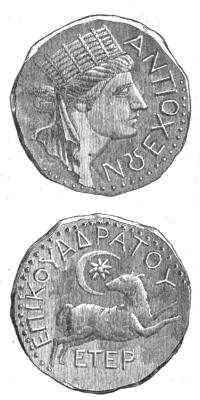
Coin of Ephesus, enlarged one-half.
86. Miletus was for two centuries not only the chief of the Asiatic colonies, but the first commercial city in all Hellas. Her sailors penetrated to the most distant corners of the Mediterranean and its inlets, and eighty colonies were founded to protect and enlarge her commerce. Ephesus succeeded Miletus as chief of the Ionian cities. Its commerce was rather by land than sea; and instead of planting distant colonies, it extended its territory on the land at the expense of its Lydian neighbors. Phocæa, the most northerly of the Ionic cities, possessed a powerful navy, and its ships were known on the distant coasts of Gaul and Spain. The beautiful city of Massilia (now Marseilles) owed to them its origin.
87. The first Greek colony in Italy was at Cumæ, near the modern Naples, which sprang from it. It is said to have been founded about 1050 B. C., and continued five centuries the most flourishing city in Campania. Syb´aris and Croto´na were Achæan colonies upon the Gulf of Taren´tum. Several native tribes became their subjects, and their dominions extended from sea to sea across the peninsula of Calabria. The Crotonians were early celebrated for the skill of their physicians, and for the number of their athletes who won prizes at the Olympic Games. The Sybarites were noted for their wealth, luxury, and effeminacy. In public festivals they mustered 5,000 horsemen fully equipped, while Athens could only show 1,200 even for the grand Panathenæa.
The fall of Sybaris, B. C. 510, was occasioned by war with the sister but now rival city Crotona. The popular party had supplanted an oligarchy in Sybaris, and the exiled citizens had taken refuge in Crotona. The Sybarites demanded their rendition. The Crotonians trembled, for they had to choose between two great perils: they must incur either the wrath of the gods by betraying suppliants, or the vengeance of the Sybarites, whose army was supposed to number 300,000 men. Pythagoras urged them to adopt the more generous alternative, and his disciple, Milo, the most celebrated athlete of his time, became their general. In a battle on the Trais the Crotonians were victorious. They became masters of Sybaris, and determined to destroy it so thoroughly that it should never again be inhabited. For this purpose they turned the course of the river Crathis, so that it overflowed the city and buried its ruins in mud and sand. To this day a wall can be seen in the bed of the river when the water is low, the only monument of the ancient grandeur of Sybaris.
88. The people of Locri were the first of the Greeks who possessed a body of written laws. The ordinances of Zaleucus, a shepherd whom they made their legislator by the command of the Delphic oracle, were forty years earlier than those of Draco, which they resembled in the severity of their penalties. The Locrians, however, held them in so high esteem, that if any man wished to propose a new law or repeal an old one, he appeared in the public assembly with a rope around his neck, which was immediately tightened if he failed to convince his fellow-citizens of the wisdom of his suggestions.
89. Rhegium, on the Sicilian Strait, was founded by the Chalcidians of Eubœa, but greatly increased by fugitives from the Spartans during the first and second Messenian wars. The straits and the opposite town in Sicily, formerly called Zan´cle, received a new name from these exiled people. Taren´tum was a Spartan colony founded about 708 B. C. Its harbor was the best and safest in the Tarentine Gulf, and after the fall of Sybaris it became the most flourishing city in Magna Græcia. Though its soil was less fertile than that of other colonies, its pastures afforded the finest wool in all Italy. Tarentine horses were in great favor among the Greeks; and its shores supplied such a profusion of the shell-fish used for coloring, that “Tarentine purple” was second only to the Tyrian. So extensive were the manufactories of this dye, that great mounds may even yet be seen near the ancient harbor, composed wholly of broken shells of the murex.
90. The prosperity of Magna Græcia declined after the close of the sixth century B. C., when the warlike Samnites and Lucanians began to press southward from their homes in central Italy. The Greek colonies gradually lost their inland possessions, and became limited to mere trading settlements on the coast.
91. Massilia, in Gaul, has already been mentioned as a colony of the Ionic Phocæans. It exerted a controlling influence upon the Celtic tribes by which it was surrounded, and who derived from it the benefits of Greek letters and civilization. A Massiliot mariner, Pytheas, navigated the Atlantic and explored the western coasts of Europe, as far, at least, as Great Britain. Five colonies on the Spanish coast were founded by Massilia.
92. The fertile island of Sicily early attracted the attention of the Greeks. The Carthaginians already occupied the western side of the island, but for two and a half centuries the commercial settlements of either people flourished side by side without collision. Twelve flourishing Greek cities sprang up within 150 years, among which Syracuse, on the eastern, and Agrigentum, on the southern coast, were the most important. Syracuse, the earliest, except Naxos, of the Sicilian colonies, was founded by Corinthians, B. C. 734. Its position made it the door to the whole island, and in Roman times it was the capital of the province. In its greatest prosperity it contained half a million of inhabitants, and its walls were twenty-two miles in extent. Agrigentum, though of later origin (B. C. 582), grew so fast that it outstripped its older neighbors. The poet Pindar called it the fairest of mortal cities, and its public buildings were among the most magnificent in the ancient world.
93. African Colonies. Greek colonization was at first confined to the northern shores of the Mediterranean, Egypt and Carthage dividing between them the southern. But the policy of Psammetichus, and, after him, of Amasis, favored the Greeks, who were thenceforth permitted to settle at Naucratis, and enjoy there a monopoly of the Mediterranean commerce of Egypt. Twenty years after the first establishment at Naucratis, Cyrene was founded by the people of Thera, a Spartan colony on the Ægean. Unlike most Greek colonies, Cyrene was governed by kings during the first two centuries of its existence.
94. The peninsula of Chalcid´ice, in Macedonia, was covered with the settlements of colonists from Chalcis and Eretria, from the former of which it derived its name. Potidæ´a, on the same coast, was planted by Corinthians. Byzantium was founded by Megarians, on the strait which connects the Propontis with the Euxine. Few cities could boast so splendid a position; but the power of the Megarian colony bore little proportion to what it was afterward to attain as the capital of Constantine and the mistress of the world. The most northerly Grecian settlement was Istria, founded by Milesians near the mouth of the Danube.
RECAPITULATION.
Codrus, the last king of Athens, was succeeded during three centuries by archons for life, chosen from his family. Seven archons afterward reigned successively ten years each, and the government was then intrusted to a commission of nine, annually elected. The people demanding written laws, Draco prepared a code of inhuman severity. A more moderate constitution was framed by Solon, one of the Seven Wise Men of Greece; but the contention of the three rival factions of the Plain, the Shore, and the Mountain soon resulted in the subjection of Athens to the tyranny of Pisistratus. Twice expelled, Pisistratus twice re-established his power, and by his justice and liberal encouragement of all the arts, consoled the people for his unwarranted seizure of the government. His son Hippias was expelled by the Alemæonidæ, with the aid of the Spartans. Clisthenes completed the liberal reforms of Solon, and introduced the singular custom of ostracism. In three attempts to overthrow the free constitution of Athens, the Spartans and their allies were signally defeated.
Third Period. B. C. 500-338.
95. The details of the Ionian Revolt (B. C. 499-494) have been found in the History of Persia.[43] Reserving his vengeance for the European Greeks who had interfered in the quarrel, Darius sought to console the conquered Ionians for the loss of their political independence by greater personal freedom. Just laws, equal taxes, peace and good order began to restore their prosperity; and when Mardonius, the son-in-law of Darius, succeeded Artaphernes in the satrapy, he signalized his reign by removing all tyrants and restoring to the cities a republican form of government. All this was done to secure their friendship or neutrality in his approaching expedition against Greece. That expedition (B. C. 492) failed, as we have seen, in its principal object.
B. C. 491.
96. The next year messengers were sent by Darius to each of the states of Greece, demanding earth and water, the customary symbols of obedience. None of the island states and few on the continent dared refuse. The people of Athens and Sparta returned an answer which could not be mistaken. The latter threw the envoys into a well, and the former into a pit where the vilest criminals were punished, telling them to get earth and water for themselves.
97. The youth and ill success of Mardonius led Darius to recall him, and place the command of his new expedition against the Greeks in the hands of Datis, a Mede, and Artaphernes, his own nephew. In the spring of 490 B. C., the great host was drawn up off the coast of Cilicia—a fleet of 600 triremes, carrying not less than 100,000 men. They sailed westward and ravaged the isle of Naxos, but spared Delos, the reputed birth-place of Apollo and Artemis, because the Median Datis recognized them as identical with his own national divinities, the sun and moon. The fleet then advanced to Eubœa, Eretria being the first object of vengeance. Carystus, refusing to join the armament against her neighbors, was taken and destroyed. Eretria withstood a siege of six days; but the unhappy city was a prey to the same dissensions which constituted the fatal weakness of Greece.[44] Two traitors of the oligarchical party opened the gates to the barbarians. The place was given up to plunder, the temples burnt, and the people enslaved.
98. A swift-footed messenger was now dispatched from Athens to Sparta imploring aid. The distance was ninety miles, and he reached his destination the day after his departure. The Spartans did not refuse their assistance, but they declared that religion forbade their marching before the full moon, and it was now only the ninth day. The Persians were already landed on the coast of Attica, and, guided by Hippias, advanced to the plain of Marathon. The Athenian army, posted upon the heights, had to consider whether to await their tardy allies or meet these overwhelming numbers alone. At the last moment there arrived an unexpected reinforcement, which, though small in numbers, raised the spirits of the Athenians by the friendliness it expressed. It was the entire fighting population of the little town of Platæa, a thousand men in all, who came to testify their gratitude for a former service rendered by the Athenians.
99. All the other generals, who were to have commanded in turn, gave up their days to Miltiades, whose genius and experience alike won their confidence; but he, fearful of arousing envy, waited until his own turn came, and then gave orders for battle. The sacrifices and prayers were offered, the trumpets sounded, and, chanting a battle-hymn, the eleven thousand Greeks rushed down from the heights where they had been encamped. Instead of the usual slow march of the phalanx, they traversed the mile or more of level ground which separated them from the Persians at a full run, bearing their level spears in a straight, unwavering line.[45]
The front rank of Asiatics fell instantly before this unusual assault; but the resistance was not less determined. Rushing upon the spears of the Greeks, in the attempt to make an opening in the phalanx where their short swords and daggers might serve them, the Persians freely sacrificed their lives. It was the belief of many on the field that the gigantic shade of Theseus, the great Attic hero, might be seen in the ranks. Night approached before the desperate conflict was decided. But the Greeks, though wearied with the long action, never wavered, and at length the shattered remains of the Asiatic host turned and fled.[46]
100. The Persians had brought with them a mass of white marble, with which they meant to erect upon the field of Marathon a monument of their victory. It was carved by Phid´ias into a gigantic statue of Nemesis, the impersonation of divine vengeance. From the brazen spoils of the Persians was cast that colossal statue of Athena Promachos, whose glittering spear and helmet, from the summit of the Athenian citadel, could be seen far off at sea beyond the point of Sunium. The armed goddess, “First in the Fight,” seemed to be keeping a perpetual guard over her beloved city.
B. C. 489.
101. For a time after the victory at Marathon, Miltiades was the best beloved of the Athenians. Even while prince in the Chersonesus, he had won their gratitude by annexing Lemnos and Imbros to their dominions. To this claim on their regard he now added that of having delivered them from their greatest peril, and there was no limit to their confidence. When, therefore, he promised them a still more lucrative though less glorious enterprise than the recent one against the Persians, they were not slow to consent, though the conditions were a fleet of seventy ships and a large supply of men and money for his use, of which he was to render no account until his return. They were granted, and Miltiades set sail for the isle of Paros, which had furnished a trireme to the Persians during the recent invasion. The chief city was besieged and on the point of being taken, when suddenly, for no sufficient cause, Miltiades burnt his fortifications, drew off his fleet, and returned to Athens, having no treasures and only disgrace and loss to report as the result of his expedition.
Coin of Athens, enlarged three-fourths.
102. The glory of Miltiades was now departed. He was accused by Xanthip´pus, a leader of the aristocracy, of having accepted a bribe from the Persians to withdraw from Paros. Severely wounded, Miltiades was brought into the court upon a couch; and although his brother Tisag´oras undertook his defense, the only plea he cared to make was in the two words, “Lemnos” and “Marathon.” The offense, if proved, was capital; but the people refused to sentence their deliverer to death. They commuted his punishment to a fine of fifty talents; but before it was paid he expired from his wound.
103. The greatest citizen of Athens, after the death of Miltiades, was Aristides, called “the Just.” He was of noble birth and belonged to the Alcmæonid party, but he was ardently devoted to the interests of the people. Stern toward crime, whether in friends or foes, he was yet mild toward all persons; and so proverbial were his truth and impartiality, that when he held the office of archon the courts of law were deserted, all suitors preferring to submit their causes to his arbitration.
104. His chief rival was Themis´tocles, a young man of great talents, and, perhaps, still greater ambition. At length his opposition rose to the pitch of proposing the ostracism, and Aristides was banished. It is said that, during the voting, the great archon was requested by a man who could not write, to inscribe the name of Aristides on an oyster-shell for him. “Has he ever injured you?” Aristides asked. “No,” said the man, “nor do I even know him by sight; but it vexes me to hear him always called the Just.” Aristides wrote his name on the shell, which was cast into the heap. As he left his native city he said, with his usual generosity, “May the Athenian people never know a day which shall force them to remember Aristides!”
105. Themistocles was now without a rival in Athens. His acute mind perceived what his countrymen too willingly ignored, that the Persian invasions were only checked, not ended. Proud of the victory of Marathon, the Athenians believed that the Persians would never again dare to attack them. But Ægina was yet powerful, and a fierce enmity had long existed between the two states. Their merchants regarded each other as rivals in trade, while the free people of Athens hated the oligarchy of Ægina. Themistocles resolved to turn this enmity to account, in arming Athens against the greater though more distant danger. He persuaded the citizens to construct a fleet which should surpass that of Ægina, and to apply to that purpose the revenues from the silver mines of Laurium, near the extremity of the Attic peninsula.
Two hundred triremes were built and equipped, and a decree was passed which required twenty to be added every year. Hitherto Attica had been more an agricultural than a maritime state; but Themistocles clearly saw that, with so small and sterile a territory, her only lasting power must be upon the sea. So strenuous were his exertions, that in the ten years that intervened between the first and the second Persian wars, the Athenians had trained a large number of seamen, organized their naval power, and were ready to be as victorious at Salamis as they had been at Marathon.
106. In 481 B. C., a Hellenic Congress was held at Corinth. The command of the Greek forces, both by land and sea, was assigned to Sparta. An appeal for coöperation was sent to the distant colonies in Sicily, as well as to Corcyra and Crete. Emissaries were also sent into Asia to watch the movements of the Persian army. They were seized at Sardis, and would have been put to death, had not Xerxes believed that their reports would do more to terrify and weaken than to assist their countrymen. He caused them to be led through his innumerable hosts, and to mark their splendid equipments, then to be dismissed in safety.
107. The most difficult duty of the Congress was to silence the quarrels of the several states. Athens, by the entreaties of Themistocles, consented to peace and friendship with Ægina, and all the delegates formally bound their states to act together as one body. Still many elements of disunion remained. Bœotia, with the honorable exceptions of Thespiæ and Platæa, sent earth and water to the Persian king. Argos was at once weakened and enraged against Sparta by the massacre of 6,000 of her citizens, who had been burned, by order of Cleomenes, in a temple where they had taken refuge. Unwilling to refuse her aid in the common danger, she consented to join the league only upon terms which Sparta refused to accept.
108. Even the gods seemed to waver, and the timid answers of the Pythia prevented some states from engaging in the war. The Athenian messengers at Delphi received an oracle that would have appalled less steadfast minds. “Unhappy men!” cried the Pythia, “leave your houses and the ramparts of the city, and fly to the uttermost parts of the earth. Fire and keen Ares, compelling the Syrian chariot, shall destroy; towers shall be overthrown, and temples destroyed by fire. Lo, now, even now, they stand dropping sweat, and their house-tops black with blood, and shaking with prophetic awe. Depart, and prepare for ill!”
109. The Athenians put on the mourning garb of suppliants, and entreated Apollo for a more favorable answer, declaring that they would not depart without it, but remain at his altar until they died. The second response was still more obscure, but possibly more hopeful. “Athena is unable to appease the Olympian Zeus. Again, therefore, I speak, and my words are as adamant. All else within the bounds of Cecropia and the bosom of the divine Cithæron shall fall and fail you. The wooden wall alone Zeus grants to Pallas, a refuge to your children and yourselves. Wait not for horse and foot; tarry not the march of the mighty army; retreat even though they close upon you. O divine Salamis! thou shalt lose the sons of women, whether Demeter scatter or hoard her harvest!” Themistocles, who had, perhaps, dictated the response, now furnished an apt solution. The “walls of wood,” he said, meant the fleet, in which the citizens and their children should take refuge. The last sentence threatened woe not to the Athenians, but to their foes, else why was Salamis called “divine”?
B. C. 480.
110. Arriving with his vast army at the head of the Malian Gulf, Xerxes sent a spy to ascertain the force sent against him. The messenger saw only the Spartan three hundred. They were engaged either in gymnastic exercises or in dressing their long hair as if for a festival. Demaratus, an exiled king of Sparta, was with the Persian army, and he was questioned by the great king as to the meaning of this behavior in the face of overwhelming danger. Demaratus replied, “It is manifestly their intention, sire, to dispute the pass, for it is the custom of the Spartans to adorn themselves on the eve of battle. You are about to attack the flower of Grecian valor.” Xerxes could not yet believe that such a handful of men meant serious resistance. He waited four days to give them time to retreat, but sent a messenger in the interval to Leonidas, demanding his arms. “Come and take them!” replied the Spartan.