Part 2 / Book 5 — BOOK V. History of Rome, from the Earliest Times to the Fall of the Western Empire, A. D. 476. (continued 2)
Reading edition
RECAPITULATION.
The Hellenized Samnites ask the aid of Rome against their highland countrymen. The First Samnite War, B. C. 343-341, opens with success to the Romans. Sedition of troops in Campania. The Latins revolt against Rome and join the Campanians and Volscians. The Romans make peace and alliance with the Samnites for the Latin War, B. C. 340-338. In the battle of Vesuvius, Decius, the consul, devotes himself to death, and the Romans are victorious. The Latin League suppressed, and the supremacy of Rome established. An invasion of Italy by Alexander of Epirus, is followed by the Second Samnite War, B. C. 326-304. The Romans defeated at the Caudine Forks, B. C. 321, but at last completely victorious. They conquer the Æqui, B. C. 304. Third Samnite War, and Italian League against Rome, B. C. 298-290. Great victory at Sentinum over Gauls, Samnites, Etruscans, and Umbrians. Capture of Pontius, B. C. 292, and end of the Samnite wars. Sabine territories conquered and divided among the people, by Hortensian laws.
War with Pyrrhus.
79. Within three years (B. C. 283), the Romans were menaced by a new danger, in a powerful coalition formed by the Tarentines, and including nearly all the nations of Italy. The storm gathered swiftly and burst from all quarters at once. In the south, the Samnites, Lucanians, and Bruttians were in arms; in the north, the Etruscans and Umbrians, with hordes of Gallic mercenaries, were pouring into the field. Arre´tium alone stood firmly by the Roman alliance, and was besieged by an army of Etruscans and Gauls. The consul, Metel´lus, marching to its relief, was defeated with the total loss of his army. Embassadors, sent to remonstrate with the Seno´nian Gauls for the infringement of their treaty with Rome, were murdered, and their bodies hewed to pieces and cast out without burial. This outrage, which the laws of the rudest savages pronounced sacrilege, provoked a speedy vengeance. Dolabel´la, the consul, marched into the Gallic territory with his army, killed every man who was found, carried off the women and children as slaves, and reduced every village to a heap of ashes and rubbish.
80. The Boian Gauls took up arms to avenge their brethren, and, joining the Etruscans, met the Roman forces in the valley of the Tiber, near the little lake Vad´imon. They were defeated so thoroughly that very few escaped from the field. The consul Fabric´ius, the following year, defeated the Samnites, Lucanians, and Bruttians in several great battles, broke up the coalition in the south, and collected an amount of spoils which enabled him to pay all the war expenses of the year, and, beside allowing a liberal share to every soldier, to leave half a million of dollars in the treasury. Tarentum, the prime mover of the war, had never drawn a sword, but had left all its burdens and losses to her allies. To punish this passive but mischievous policy, a Roman fleet was now sent to cruise around the eastern and southern coasts of Italy. It was defeated and sunk by the Tarentines in their own harbor. They then seized Thurii, expelled the Roman garrison, and, in the name of all the Italian Greeks, sent to Pyrrhus, king of Epirus, for aid.
81. This accomplished and ambitious prince was glad of a new field of enterprise. He hastened into Italy with a well-appointed army of 25,500 men, drilled and equipped in the Macedonian fashion, and supplied with twenty elephants. The gay and self-indulgent Tarentines, quite willing that another should fight their battles for them, forgot their promises of service and subsidies; but Pyrrhus showed them that he was master by stopping the sports of the circus and theaters, and the banquets of the clubs, and keeping the citizens under arms from morning to night. Even with inferior forces he was able to defeat the Roman legions at Heracle´a, on the Siris. Seven times the Epirotes and Greeks were driven from the field, and seven times regained it; but when the last Italian reserve was engaged, Pyrrhus brought on his elephants, till then unknown in Italy, and they put to flight the Roman horse. The rout was complete; the Romans did not stay to defend their camp, but fled to Venu´sia, leaving Pyrrhus master of the field.
82. He was now joined by many allies, some of whom had even been subjects or friends of Rome; but the advantage of his victory was not sufficient to balance his loss in officers and men—losses the more serious as Greece was now overrun by the Gauls, and there was little hope of recruits. In these circumstances, Pyrrhus sent to Rome his embassador, Cin´eas, an orator of such brilliant talent, that he was said to have won more cities by his tongue than Pyrrhus by his sword. A large party was inclined to listen to his proposals of “peace, friendship, and alliance.” But Appius Claudius—thirty years ago censor, now a blind old man—heard in his house that Rome was making peace, with a victorious enemy still upon Italian soil. He caused himself to be carried in a litter through the Forum to the Senate-house. When he arrived, all his sons and sons-in-law went out to meet him and lead him to his ancient place. All the Senate listened in breathless silence as the old man rose to speak, protesting against the dishonor of his country. When he ceased, it was voted that no peace should be made while any foreign foe was in Italy, and that the orator who had so nearly persuaded them should leave the city that very day.
83. The war went on between the consummate genius of Pyrrhus and the unconquerable will of the Roman people. They were fighting for existence, while Pyrrhus fought for glory; and though in every pitched battle he was victorious, fresh armies were always ready to oppose him. Still hoping to make peace with Rome, he refused to ransom or exchange the multitude of prisoners whom he had taken, but he allowed them all to return to Rome for the winter holidays—the Saturna´lia—on their simple promise to return if the Senate refused a treaty. The Senate refused, and every man returned. In his second campaign, Pyrrhus gained another brilliant victory, at As´culum, over the Romans and their allies. But his restless ambition now turned to a new field, and he departed into Sicily, where the Greek cities had implored his aid against the Carthaginians. Once master of that fertile island, he believed that he could attempt the conquest of Italy with better resources, and he left troops to hold Tarentum and Locri for his base of future operations in the peninsula.
84. In Sicily his genius and valor for a time drove all before him. The strong town of Eryx was taken, Pyrrhus himself being the first to mount the scaling-ladders. The Carthaginians implored peace, offering ships and money as the conditions of an alliance. Pyrrhus haughtily refused; but a reverse which he afterward suffered at Lilybæ´um, encouraged his enemies and alienated his allies. After two years he returned into Italy, pursued by a Carthaginian fleet, which defeated him with a loss of seventy ships. On landing, he was met by a body of Mamertines,[70] who had crossed the straits from Sicily, and whom he defeated only by a sharp and costly battle. He arrived at Tarentum with an army equal in numbers, but far inferior in character, to that with which he had come from Epirus four years earlier. His faithful Epirotes were slain, and in their places were ill-trained Italian mercenaries, who would serve only as long as pay and plunder abounded.
85. Being in great want of money to satisfy these unruly followers, Pyrrhus yielded to the advice of his Epicure´an courtiers, and appropriated the treasures of the temple of Proser´pina, at Locri. The money was embarked by sea for Tarentum, but a storm drove the sacrilegious vessel back upon the coasts of Locri; and Pyrrhus was so affected by remorse, that he restored the gold and put to death the counselors. He believed that he was ever after haunted by the wrath of Proserpina, which dragged him down to ruin. The following year he was totally defeated near Beneventum, by Curius Dentatus, the consul. Toward the end of the year he passed over into Greece, still leaving a garrison at Tarentum, in token of his unconquered resolution to return.
During the first invasion by Pyrrhus, the Eighth Legion, stationed at Rhegium, and composed chiefly of Campanian mercenaries, had, like the Mamertines in Sicily, thrown off their allegiance, slaughtered the Greek inhabitants, and held the town as an independent military post. They were now reduced, and most of the garrison put to the sword; the rest, consisting of the original soldiers of the legion, were tried at Rome, scourged, and beheaded.
86. Roman supremacy was now speedily established both in northern and southern Italy. Picenum was conquered, and half her inhabitants were forcibly removed to the shores of the Gulf of Salerno. Umbria submitted B. C. 266, the chief cities of Etruria followed, and the entire peninsula south of the Macra and Rubicon became subject to Rome. Hitherto the Romans, like the Spartans, had prided themselves upon the homeliness of their manners. When the Samnites sent envoys to M. Curius to bespeak his kind offices with the Senate, and offer him a present of gold, they found the ex-consul seated by his fire and roasting turnips in the ashes, with a wooden platter before him. To their proffered gift he replied, “I count it my glory not to possess gold myself, but to have power over those who do.”
The eleven years following the departure of Pyrrhus were a period of the greatest prosperity ever enjoyed by the common people of Rome, and the wealth arising from the conquest of Italy materially changed their manner of living. Every freeman received a fresh grant of seven jugera of land or a portion of money. The property of the displaced governments went, of course, to the Roman state, and thus valuable possessions of mines, quarries, forests, fisheries, and public lands were added to its domains. The administration of the public revenues demanded a greatly increased number of officials, and the rich, as well as the poor, profited by the results of war.
87. The new territories were secured by that system of colonies which, in later times, served to establish the Roman power from the Atlantic to the Euphrates. The colonies were of two kinds. Most favored were those composed of “Roman citizens,” who retained all their rights as such, voting in the assembly, and being eligible to any office which they could have filled if remaining at Rome. Those who joined a “Latin colony,” on the other hand, lost their civil rights in Rome, but they had privileges which attached them both by interest and affection to the mother city. Ostia, and the maritime colonies generally, were of the former and higher class. The great system of Roman roads, which ultimately intersected all western Europe, and may be seen to-day in their massive remains, owed its origin to Appius Claudius “the Blind,” who when censor, in 312 B. C., constructed the Appian Way to connect Rome with her new dependency, Campania. He also built the first of the Roman aqueducts, to supply the poorer portion of the city with water.
88. The free-born plebeians of Rome now possessed half the high offices in the state, and even in the sacred colleges of pontiffs and augurs. They were admitted to the Senate when they had served as consuls, or had been appointed to be either prætors or ædiles. Appius Claudius, in his censorship, went still further, and placed upon the rolls of the Senate the names of some who had been born slaves, or who possessed no lands. He enrolled these two very numerous classes in the tribes as voters; and instead of assigning them to those of the city, where they almost exclusively belonged, he distributed them over all the districts, so that they might control all elections. To rescue Rome from the inevitable rule of the mob, his successors in the censorship confined these new votes to the city, thus giving them the control only of four tribes out of thirty-one, and so the danger was averted.
RECAPITULATION.
Coalitions in the north and south against the Romans. Siege of Arretium, and defeat of Metellus. War with the Senonian and Boian Gauls. Victories of Fabricius in the south. Pyrrhus comes to the aid of the Tarentines; defeats the Romans at Heraclea, Asculum, etc.; sends Cineas to Rome, whose persuasions are thwarted by Appius Claudius the Blind; passes into Sicily, and after two years returns to Epirus. All Italy subject to Rome. Increased wealth and luxury of the people. Many new colonies upon the conquered lands. Roads and aqueducts are constructed. Freedmen and non-possessors of land admitted to the suffrage by Appius Claudius.
Third Period, B. C. 264-133.
89. The great commercial Republic of Carthage, though allied with Rome during the wars with Pyrrhus, had regarded with jealousy the steadily increasing power of the Italian state. The Roman people, on the other hand, had been so enriched by their recent wars, that they were eager for fresh plunder and a new allotment of conquered lands. A slight and doubtful pretext was, therefore, sufficient to plunge the two nations into war. The Carthaginians had seized the citadel of Messana, under pretense of aiding the Mamertines against Hi´ero of Syracuse. The Romans had recently punished the buccaneers of Rhegium for precisely the same crime which the “Sons of Mara” had committed at Messana, but when the latter sought their aid against both Syracusans and Carthaginians, the temptation was too great; they accepted the disreputable alliance, and invaded Sicily with 20,000 men.
90. Having gained possession of Messana, they kept it for their own. The combined forces of Syracuse and Carthage, besieging the place, were defeated by Claudius, the consul; and Hiero, being distrustful of his African allies, returned home. The next year he made peace with the Romans, and continued until his death, nearly half a century later, their faithful friend and ally. Most of the Greek cities in Sicily followed his example. Hannibal,[71] son of Gisco, the Carthaginian general, could no longer meet the Romans in the field, but shut himself up in Agrigentum and was besieged. Hanno, attempting to relieve him, was decisively defeated; the city was taken, and its people were sold as slaves.
Hannibal, who escaped to Panor´mus (Palermo) with most of his troops, now carried the war upon the sea, and ravaged the defenseless coasts of Italy with a fleet of sixty vessels. The next year his lieutenant, Boö´des, with a naval detachment, met the consul, Scipio, at Lip´ara, and captured his whole squadron. Hannibal then set out with fifty ships to ravage the coasts of Italy again. But the Romans, wisely learning from their enemies, were now prepared to meet them on their own element. A Carthaginian quin´quereme (a vessel with five rows of oars) had been cast ashore on the coast of Bruttium. It was used as a model, and the Romans, who previously had had nothing greater than triremes, possessed, within two months, one hundred first-class war vessels. While the ships were building, the crews were trained on shore to their peculiar and complicated motions. In the very first encounter, Hannibal was defeated; in the second, off Mylæ, he lost fifty vessels, among them his magnificent flag-ship, which had formerly belonged to Pyrrhus.
91. In 259 B. C., Sardinia and Corsica were attacked, and the town of Ale´ria taken by the Romans. The following year, another great naval victory was gained off Ec´nomus, in Sicily; and the consuls, Manlius and Regulus, invaded Africa. They captured and fortified the town of Cly´pea, which they made their headquarters, and then proceeded to lay waste the lands of Carthage with fire and sword. The beautiful villas of the nobles and merchants afforded inestimable spoils; and 20,000 persons, many of whom were of exalted rank, and accustomed to all the refinements of wealth, were dragged away as slaves.
In the winter, Manlius returned to Rome with half the army and all the plunder, while Regulus remained to prosecute the war. He defeated the Carthaginian generals, captured their camp, and overran the country at pleasure. More than three hundred walled villages or towns were taken. In vain the judges and nobles of Carthage cast their children into the brazen arms of Moloch, whence they rolled into the fiery furnace burning always before him. The hideous idol was not appeased, and the Roman general was equally implacable. To all embassies he refused peace, except on such intolerable terms that even disastrous war seemed better.
92. At the darkest moment, relief arrived in the person of a Spartan general, Xanthippus, who came with a body of Greek mercenaries. His military fame and the evident wisdom of his counsels inspired such confidence, that he was put in the place of the incompetent Punic commanders. With his 4,000 Greeks, added to the Carthaginian infantry and 100 elephants, he defeated and captured Regulus, and wholly destroyed the Roman army. A still more terrible disaster befell the fleet which had been sent to bring away the shattered remnants of the forces from Africa. A violent storm came on, and the southern coast of Sicily was strewn with the remains of 260 vessels and 100,000 men, B. C. 255.
The Romans, though nearly driven to despair of the republic, never relaxed their exertions, but equipped a new fleet, with which, the following year, they captured the important town of Panormus. This fleet was wrecked, B. C. 253, and the next two years were full of discouragements; but, in 250 B. C., a brilliant victory, won at Panormus by the proconsul Metellus, tended to restore the balance of the opposing forces. A hundred elephants, taken alive, were exhibited in the triumph of Metellus.
93. For the next eight years, the advantage was usually with the Carthaginians. Hamilcar Barca, the father of the great Hannibal, ravaged the coasts of Italy, and the Romans had no leader of equal genius to oppose to him. At last they rallied all their forces to put an end to the war. The wealthier citizens at their own expense fitted out a fleet of 200 ships, and the consul Luta´tius gained a decisive victory among the islands west of Sicily. This reverse, following twenty-three years of exhausting war, so disheartened the Carthaginians, that they agreed to abandon Sicily and all the neighboring islands, to pay 2,000 talents, and release all the Roman prisoners without ransom.
94. The First Punic War had lasted nearly twenty-four years, B. C. 264-241 inclusive. Rome emerged from it a great naval power, able to meet on equal terms the well-trained mariners who had hitherto ruled the western Mediterranean. Foreseeing that the struggle must be renewed, both parties spent the twenty-three years which followed in strenuous preparations. Rome seized upon Sardinia and Corsica; and Carthage, absorbed and weakened by a revolt of her mercenary troops, was compelled to submit, and even to pay a heavy fine for having presumed to remonstrate.
These islands, with Sicily, were placed under proconsular government, the system by which Rome afterward managed all her vast foreign possessions. The two consuls, on completing their year of office, divided the “provinces” between them by lot or agreement, and each held in his own, both military and civil control, while the finances were managed by quæstors responsible only to the Senate. When the provinces became numerous, the greater number were governed by pro-prætors. One-tenth of the whole produce of these conquered countries was claimed by Rome, beside a duty of five per cent on all imports and exports.
95. By the request of the western Greeks, Rome exerted her new naval power in clearing the Adriatic of the Illyrian pirates, who were ravaging its coasts and destroying its commerce. Their queen, Teuta, seized the Roman embassadors who were first sent into her country, killed two and imprisoned the third. In the war which immediately followed, she lost the greater part of her dominions, and was compelled to keep her corsairs within stricter limits for the future, beside paying a yearly tribute to her conquerors. In gratitude for this important service, the Romans were admitted to equal rights with the Hellenic race in the Isthmian Games and the Eleusinian Mysteries, B. C. 228.
96. While thus asserting her power in the Greek peninsula, Rome desired to extend her Italian dominion to its natural limit in the Alpine range. The Gauls were not slow in taking the alarm. Obtaining fresh forces from their kinsmen beyond the mountains, they advanced into central Italy, and, overrunning Etruria, threatened Rome again as in the days of Brennus. Three armies were quickly in the field to oppose them; and though one was routed, another, under the consul Æmil´ius, aided by Regulus,[72] who had unexpectedly arrived from Sardinia, gained a decisive victory which nearly destroyed the Gallic host. Within three years all Cisalpine Gaul submitted to Rome, B. C. 222. Mediola´num and Comum (Milan and Como), as well as Placen´tia, Parma, Mode´na, Man´tua, Vero´na, and Brix´ia, were occupied by Roman colonies, connected with the capital by the great military road called the Flaminian Way, and its continuations.
97. Carthage, meanwhile, had yielded only from necessity, and for a time, to the superior power of Rome. A large majority of her citizens were for renewing the war at the earliest possible moment; and to recruit her power and wealth, Hamilcar had devoted all his energies to the conquest of the Spanish peninsula, B. C. 236-228. After his death, his son-in-law, Has´drubal, organized and developed the resources of the country by building towns, encouraging trade and tillage, training the native tribes into efficient soldiers, and working the newly discovered silver mines, which, beside paying all the expenses of the province, were rapidly filling up the home treasury. Rome, with her command of the sea, secured from fear of invasion, saw without uneasiness the prosperity of her rival. But an item which no one could have foreseen, the genius of Hannibal, was now to be added to the resources of Carthage.
98. At nine years of age he had accompanied his father into Spain, and before the altar of his country’s gods had taken a solemn oath of eternal and unrelenting enmity to Rome. The oath of the child had not been forgotten by the youth. At the age of eighteen he fought by his father’s side in the battle where Hamilcar was slain; and during the following eight years of Hasdrubal’s administration, that general intrusted his young brother-in-law with the command of most of his military enterprises. Upon the death of Hasdrubal, the army by acclamation placed Hannibal at its head, and the government at home neither could nor would annul the appointment.
Having confirmed his power in Spain by two years’ war against the native tribes, Hannibal deliberately sought the quarrel with Rome to which he had devoted his life. The Greek city of Saguntum had placed itself under the protection of Rome. It was attacked by Hannibal, and taken after an obstinate defense of eight months. The Romans sent to Carthage to demand the surrender of the young general for this breach of the treaty. The reply was a declaration of war.
99. Leaving his brother Hasdrubal in charge of Spain, Hannibal prepared for a bolder movement than the Romans had foreseen. He knew that the great mountain-barrier of the Alps had already often been traversed by the Gauls, and he relied upon finding able guides among this people, who were mostly friendly to Carthage. He resolved, therefore, on the hitherto unprecedented feat of leading an army from Spain into Italy by land. Having offered, during the winter, solemn sacrifices and prayers for success, at the distant shrine of the Tyrian Hercules at Gades, he set forth from Carthagena, in the spring of 218 B. C., with an army of 90,000 foot, 12,000 horse, and a considerable number of elephants. The Spanish tribes between the Ebro and the Pyrenees were yet to be overcome. They resisted bravely, but were subdued, and a force of 11,000 men was left to hold them in subjection.
100. Having passed the Pyrenees, Hannibal advanced through friendly tribes of Gauls to the Rhone, which he crossed near the modern town of Orange, gaining an advance of three days upon the army of Scipio, the consul, who had intended to stop him. The passage of the Alps, with such a force, was one of the greatest military achievements of ancient times. The higher mountains were already obstructed by the snows of early autumn; hostile tribes contested his passage in narrow and dangerous defiles; and in two fierce battles, the army of Hannibal narrowly escaped total destruction. When, after fifteen days of toilsome and dangerous marching, he emerged into the plain of the Po, it was with scarcely more than one-fourth of the great army which had accompanied him from Carthagena.
101. The Insubrian Gauls welcomed Hannibal as their deliverer from the hated power of Rome. After a short period of rest in their hospitable country, he sought Scipio, and totally routed his forces in a battle on the Tici´nus. By a still greater victory on the Tre´bia, over the forces of the two consuls (Dec., 218 B. C.), Hannibal became master of northern Italy. All the Gauls who had wavered now hastened to join his standard; but the gain from this quarter was balanced by the irreparable loss of his elephants, and the severe suffering of his African and Spanish troops from the unwonted coldness of the winter.
In the spring of 217 B. C., he crossed the Apennines, and traversed the marshes of the Arno, a passage of tremendous difficulty, in which many of his beasts of burden perished. Again seeking battle, Hannibal passed the army of Flaminius at Arretium, and laid waste the country toward Peru´sia, thus provoking the consul to follow. When he had drawn the Roman army into a most perilous position, between precipitous cliffs and the Lake Thrasymene, he let loose his Gauls and Numidians to the attack. The defeat of the Romans was overwhelming: thousands were forced into the lake; thousands fell by the sword, among whom was Flaminius himself; and 15,000 prisoners remained in the hands of the enemy.
102. A panic seized Rome; the conqueror was instantly expected at her gates, and Fabius was elected dictator with unlimited powers. But Hannibal had sought to detach the Italian allies from Rome, by releasing without ransom all their prisoners whom he had taken. Wishing to give time for the disunion to take effect, he turned aside into Apulia, where he rested and recruited his troops worn by so many hardships.
It was already proved in three battles that the Carthaginian was irresistible in the field. The policy of Fabius, therefore, was to avoid a general engagement, while he annoyed and weakened his enemy by cutting off his foraging parties, and otherwise harassing his march. In vain Hannibal crossed the Apennines into the rich Campanian fields, plundering and destroying the crops; he could neither capture a town nor entice Fabius into a battle. The latter fortified the Samnian mountain-passes, thinking to catch his enemy in a trap; but Hannibal eluded the snare and retired safe into Apulia, laden with abundant provision for the comfort of his winter-quarters.
103. Great discontent was felt at Rome with the cautious policy of the dictator, and, in the spring of 216 B. C., an army of nearly 90,000 men was led into Apulia by the two consuls Æmilius Paulus and Terentius Varro. They were met by Hannibal on the plain of the Aufidus, near the little town of Cannæ. The Carthaginians were inferior in numbers but superior in discipline, especially in the Numidian horsemen, who had always been victorious in an open field. Never had the Romans suffered so overwhelming a defeat. Their army was annihilated. From 40,000 to 50,000 men lay dead upon the plain, among whom were Æmilius the consul, eighty senators, and the flower of Roman knighthood. Varro, the other consul, with a small but resolute band, made his way in good order from the battle-field; the rest of the survivors were either dispersed or taken prisoners.
104. Southern Italy was now lost to Rome. Except the Roman colonies and the Greek cities held by Roman garrisons, all submitted to Hannibal. Capua opened her gates and became the winter-quarters of the African army. Philip of Macedon and Hieron´ymus of Syracuse made alliance with Carthage, and wars with these two powers divided the attention of the Romans. Still, beside keeping two armies in the foreign fields, they occupied every province of Italy with a separate force; and though too wise to meet Hannibal again in a general engagement, hemmed him in closely and cut off his supplies. The great general was now but faintly supported at home, and the ungenerous policy of Carthage probably deprived her of the conquest of Italy.
105. Three years, therefore, passed with no decisive events. In 212 B. C., Syracuse was taken by Marcellus after two years’ siege. The attacks of the Romans had been long foiled by the skill of Archimedes, the philosopher, who is said to have burnt their ships at the distance of a bow-shot from the walls, by means of a combination of mirrors which concentrated the sun’s rays. He constructed powerful engines, which, when attached to the walls, grappled the Roman ships and lifted them out of the water; and, in short, the brain of Archimedes was a better defense to Syracuse than the arms of all her soldiers. In the taking of the city, the philosopher was slain by some ignorant troopers; but Marcellus deeply regretted the event. He ordered him to be buried with high honors, and distinguished his family by many marks of friendship.
106. Hannibal had been long anxiously awaiting the arrival of his brother from Spain; but the generalship of the two Scipios, Cneius and Publius, who conducted the war in that country, and more especially the brilliant genius of the son of the latter, afterward known as Africanus, had detained Hasdrubal and involved him in many disasters, even the loss of his capital, Carthagena. At last, in 208 B. C., Hasdrubal left Spain to the care of two other generals, and striking out a new path, as his brother’s route of eleven years before was now guarded by the Romans, he crossed the Pyrenees at their western extremity and plunged into the heart of Gaul. Many of the restless people flocked to his standard, and he “descended from the Alps like a rolling snow-ball, far greater than he came over the Pyrenees.”
He found some of Hannibal’s roads uninjured; the mountaineers made no effort to dispute his passage, and he arrived in Italy before he was expected, so that no Roman army was ready to receive him. He might, perhaps, have settled once for all the supremacy of Carthage by marching directly on Rome, for the resources of the Republic, both in men and money, had been drained to the utmost, and another Thrasymene or Cannæ would have ended her existence.
107. Hasdrubal lost time in the siege of Placentia, and his letter, describing to Hannibal his plan of operations, fell into the hands of Nero, the consul, who, by a rapid and secret march, joined his colleague at Sena with 7,000 men, leaving the main part of his army still facing Hannibal in the south. Hasdrubal was uninformed of the reinforcement of his enemy, but his quick ear caught one more trumpet-note than usual, at sunrise, in the Roman camp; and as he rode forth to reconnoiter, he discovered that the horses appeared over-driven, and the armor of the men stained. He therefore delayed until night-fall, and then moved to cross the river Metau´rus in search of a stronger position. But his guides betrayed him, and when morning dawned his worn and weary troops were still on the nearer side of the river, where they were soon overtaken by the foe. He made the best arrangement of his men which the crisis would admit, placing the ten elephants in front “like a line of moving fortresses,” his veteran Spanish infantry on the right, the Ligurians in the center, and the Gauls on the left.
The battle was fiercely contested, for both armies felt that the decision of the day would be final, and that there was no hope for the vanquished. At last Nero, by a circuitous movement, fell upon the Spanish infantry, which had already borne the brunt of the fighting. Hasdrubal saw that the day was lost, and scorning to survive his men or to adorn a Roman triumph, he spurred his horse into the midst of a cohort, and died, sword in hand, B. C. 207.
108. The consul Nero returned to his camp before Hannibal had even discovered his absence. Hasdrubal’s arrival in Italy, the battle and its result were first made known to the great general by seeing the ghastly head of his brother, which Nero had brutally ordered to be thrown within his lines. Hannibal read the tale of disaster in the terrible message, and groaned aloud that he recognized the fate of Carthage. Though he remained four years strongly posted in the mountain fastnesses of Bruttium, the issue of the war was already decided. In 204 B. C., the younger Scipio crossed into Africa, and the Carthaginians were compelled to recall Hannibal.
The final battle was fought at Zama, B. C. 202. The great Carthaginian displayed again his perfect generalship, but he had no longer his invincible cavalry, and his elephants were rendered useless by the skillful tactics of Scipio. He was defeated with the loss of 20,000 men slain, and an equal number of prisoners. The peace, concluded in the following year, took from Carthage all her possessions beyond the limits of Africa, and all the lands conquered from Numidia, whose king, Mas´sinis´sa, had rendered important aid to Scipio in the recent war. She surrendered, also, her fleet and elephants, promised a yearly tribute of 200 talents, and engaged to make no war without permission from Rome.
RECAPITULATION.
The First Punic War (B. C. 264-241) begins with the invasion of Sicily by the Romans, who are joined by many Greek cities, capture Messana and Agrigentum, equip a fleet upon a Carthaginian model, and gain many naval victories. They invade Africa, and ravage the lands of Carthage almost without opposition; but Xanthippus arrives with auxiliaries, defeats and captures Regulus. Five years of disaster to the Romans are followed by the great victory of Metellus at Palermo; and after eight years of again unsuccessful warfare, the victory of Lutatius among the Ægates ends the contest. During the peace which follows, Sardinia and Corsica are seized by the Romans, and placed under proconsular government; the Illyrian pirates are subdued, B. C. 229, 228; Cisalpine Gaul conquered, B. C. 225-222. The Second Punic War is begun, B. C. 218, by Hannibal. He crosses the Pyrenees and Alps, defeats the Romans on the Ticinus and the Trebia, and still more disastrously near the Lake Thrasymene and at Cannæ. Syracuse, though defended by the science of Archimedes, is captured by Marcellus. The three Scipios make successful war in Spain. Hasdrubal comes at last to the relief of his brother, but is defeated and slain on the Metaurus, B. C. 207. Hannibal is recalled to Africa, and finally defeated at Zama by Scipio Africanus, B. C. 202.
Extension of Roman Power.
109. A triumph was awarded to Scipio, who was received at Rome with unbounded enthusiasm. The Triumph, which was the highest reward a Roman general could attain, may here be described once for all. The victorious chief waited without the walls until the Senate had decided upon his claim to the honor. Several conditions were to be observed: the victory must have been over foreign and not domestic foes; it must have been, not the recovery of something lost, but an actual extension of Roman territory; the war must be completed and the army withdrawn from the field, for the soldiers were entitled to a share in the triumph of their general. The honor was limited to persons of consular or, at least, prætorian rank; an officer of lower grade might receive an ovation, in which he entered the city on foot, but the chariot was a mark of kingly state which could only be permitted to the highest.
110. If a triumph was decreed, a special vote of the people continued to the general his military command for the day within the walls, for without a suspension of the law, he must have laid it down on entering the gates. On the appointed day, he was met at the Triumphal Gate by the Senate and all the magistrates, in splendid apparel. Taking the lead of the procession, they were followed by a band of trumpeters, and a train of wagons laden with the spoils of the conquered countries, which were indicated by tablets inscribed in large letters with their names. Models in wood or ivory of the captured cities; pictures of mountains, rivers, or other natural features of the regions subdued; loads of gold, silver, precious stones, vases, statues, and whatever was most rich, curious, or admirable in the spoils of temples and palaces, made an important part of the display. Then came a band of flute players, preceding the white oxen destined for sacrifice, their horns gilded and adorned with wreaths of flowers and fillets of wool. Elephants and other strange animals from the conquered countries, were followed by a train of captive princes or leaders with their families, and a crowd of captives of inferior rank, loaded with fetters.
Then came the twelve lictors of the imperator in single file, their fasces wreathed in laurel; and, lastly, the triumphant general himself, in his circular chariot drawn by four horses. His robes glistened with golden embroidery; he bore a scepter, and upon his head was a wreath of Delphic laurel. A slave standing behind him held a crown of Etruscan gold; he was instructed to whisper from time to time in his master’s ear, “Remember that thou art but a man.” Behind the general rode his sons and lieutenants, and then came the entire army, their spears adorned with laurels—who either sang hymns of praise, or amused themselves and the by-standers with coarse jokes and doggerel verses at their general’s expense. This rude license of speech was thought to neutralize the effect of overmuch flattery, which the Romans, like the modern Italians, were taught especially to dread. All the people, in gala dress, thronged the streets, and every temple and shrine were adorned with flowers.
111. As a terrible contrast to the joy of the day, just as the procession had nearly finished its course to the Capitol, some of the captured chiefs were led aside and put to death. When their execution was announced, the sacrifices were offered in the temple of the Capitoline Jupiter; the laurel crown of the general was placed in the lap of the image; a magnificent banquet was served, and the “triumphator” was escorted home, late in the evening, by a crowd of citizens bearing torches and pipes. The state presented him a site for a house, and at the entrance to this triumphal mansion, a laurel-wreathed statue of its founder perpetuated the memory of his glory to his latest descendants.
112. Carthage being stripped of her power and possessions, Rome became supreme in the western Mediterranean and the greater part of Spain. The confiscated lands of the Italian nations which had taken sides with Hannibal, afforded settlements for large bodies of veteran soldiers. The Cisalpine Gauls were still in revolt, under the lead of a Carthaginian general; but they were reduced by a ten years’ war (B. C. 201-191), and afterward became Latinized with that wonderful facility which distinguishes their race.
113. The Alexandrine kingdoms in the East were all prematurely old and falling into decay. The campaigns of Flamininus against Philip of Macedon, B. C. 198, 197, have been already described. (See Book IV, §§ 81-83.) A new war for the protectorate of Greece was occasioned by the movements of Antiochus the Great. This ambitious and restless monarch not only welcomed to his court the now exiled Hannibal, but allied himself with the Ætolians and led an army to their aid. He had miscalculated the power of Rome, which met him promptly with much more than twice his numbers, defeated him once by land and twice by sea, and finally, in the great battle of Magnesia, in Lydia, shattered his forces, while beginning her own long career of Asiatic conquest. The lands conquered from Antiochus were divided between the friendly powers of Pergamus and Rhodes, and the example of their good fortune led many other nations to seek the Roman alliance.
114. For more than twenty years, Rome was occupied with continual wars in the west, against the brave and freedom-loving tribes of Spain and the Ligurian Alps, as well as with the natives of Corsica and Sardinia. The latter island was conquered, B. C. 176, by Sempronius Gracchus, who brought away so great a multitude of captives, that “Sardinians for sale” became a proverbial phrase in Rome for anything cheap and worthless.
Meanwhile, Philip V. had died in Macedon, and Perseus had succeeded to the throne. The final struggle of this prince with Rome, and its result in the battle of Pydna (B. C. 168), have been described in Book IV. Rome became for six centuries what Macedon had been only during one man’s short career, the undisputed ruler of the civilized world. None except barbarians any longer hoped to resist her ascendency; and but for a few revolts, like those of the Achæans, the Carthaginians, and the Jews, her progress in absorbing the old states of Asia, Africa, and Europe was both peaceful and rapid.
115. After eighteen years of comparative tranquillity, it was resolved that the time had come for the complete extinction of Carthage. Cato, the censor, now eighty-four years of age, and the sternest of Roman legislators, declared that Rome could never be safe while her former rival was so near, so hostile, and so strong; and whenever he was called upon for his vote in the Senate, whatever might be the subject of debate, his unvarying reply was, “I vote that Carthage no longer be.” The doomed city had more than fulfilled every condition of the treaty which closed the First Punic War, and still made many sacrifices for the sake of peace. But the last command of Rome was not intended to be obeyed. The Carthaginians were ordered to destroy their city, and remove to a situation farther from the sea. They refused, and a war began, in which, for four years, the brave spirit of the people sustained them without the faintest hope of victory.
116. Their fleet, their weapons, and their mines in Spain, Sardinia, and Elba had all been surrendered to the enemy. In two months 120 ships were built in the blockaded port, and a passage cut through the land to enable them to reach the sea. Public buildings were torn down to furnish timber and metal. Every living being toiled night and day at the defenses. An arsenal was established which daily produced 2,000 shields or weapons, and even the women contributed their long hair to make strings for the engines which hurled stones or arrows from the walls.
At length the Romans, under the consul Scipio Æmilia´nus, forced their way into the city. The people defended it house by house, and street by street, and days of carnage were still required to quench the pride of Carthage in ashes and blood. The city was fired in all directions, and when, after seventeen days, the flames were at last extinguished, nothing remained but shapeless heaps of rubbish. The territories of the Punic state became the “Province of Africa,” whose capital was fixed at Utica. Roman traders flocked to the latter city, and took into their own hands the flourishing commerce of the coast.
117. In the same year, B. C. 146, L. Mum´mius, the consul, plundered and destroyed Corinth. Its walls and houses were leveled with the ground, and a curse was pronounced on whomsoever should build on its desolate site. Its commerce passed to Argos and Delos, while the care of the Isthmian Games was intrusted to Sicyon. The policy of Rome toward the Greeks was far more liberal than toward any other conquered people. Her firm and settled government was, indeed, preferable to the dissension and misrule which disfigured the later ages of Greece; and the Greeks themselves declared, in the words of Themistocles, that “ruin had averted ruin.”
118. The natives of western Spain, intrenched among their mountains, still maintained a brave resistance to the power of Rome. The Lusitanians, who had never yet been conquered, were basely deceived by Serto´rius Galba, who enticed 7,000 of them from their strongholds by promising grants of fertile lands; and when, trusting the word of a Roman general, they had descended into the plain, he caused them to be treacherously surrounded, disarmed, and either massacred or enslaved.
Among the few who escaped was a youth named Viria´thus, who lived to become the leader and avenger of his people. The career of this guerrilla chief is full of stirring events. Issuing suddenly from a cleft in the mountains, he seven times defeated a Roman army with tremendous slaughter. In the last of these victories, the forces of Servilia´nus were entrapped in a narrow pass and completely surrounded. Absolute surrender was their only choice. Viriathus, however, preferring peace to vengeance, used his advantage with great moderation. He allowed his enemy to depart unhurt, on his solemn engagement to leave the Lusitanians henceforth unmolested in their own territories, and to recognize him, their chief, as a friend and ally of the Roman people.
119. The terms were ratified by the Senate, but only to be violated. On the renewal of the war, Viriathus sent three of his most trusted friends to remonstrate, and offer renewed terms of peace. The consul bribed these messengers, by promises of large rewards, to murder their chief. The crime was committed, and within a year Lusita´nia (Portugal) was added to the Roman dominions. Numantia, in the north, still held out against the besieging army of Qu. Pompe´ius. A severe winter caused great sickness and suffering in the legions, and Pompey offered peace on terms favorable to the Spaniards, but, according to Roman ideas, disgraceful to the besiegers. These were accepted, and the last payment but one had been made by the Numantines, when Pompey’s successor in the consulship arrived at the camp. Being thus relieved from command, he denied that he had ever made the treaty, and persisted in his falsehood before the Senate.
The war went on six years, with no credit and frequent disgrace to the Romans, until Scipio Æmilianus, the greatest general of his own time, starved the city at last into surrender. Many of the Numantines, rather than fall into the hands of an enemy whose perfidy they had too often proved, set fire to their houses and perished among the burning ruins. The whole peninsula, except its northern coast, was now subject to Rome. It was divided into three provinces—Hither and Farther Spain, and Lusitania—and became eventually the most prosperous and best governed part of the Roman foreign possessions. The Lusitanian mountains were still haunted by brigands, and isolated country houses in that region had to be built like fortresses; yet the country was rich in corn and cattle, and occupied by a thriving and industrious people.
RECAPITULATION.
Rome, supreme in the western Mediterranean, makes war upon Philip V., of Macedon, and Antiochus the Great, of Syria. The battle of Magnesia, B. C. 190, lays the foundation of her power in Asia, and the battle of Pydna makes her the head of the civilized world. In the meanwhile, Sardinia is conquered, and wars carried on in Spain and Liguria. The third and last Punic War ends, B. C. 146, with the destruction of Carthage. The same year, Corinth is destroyed by Mummius. Viriathus holds out nine years in western Spain; he is assassinated B. C. 140; Numantia is captured B. C. 133; and Spain divided into three Roman provinces.
Fourth Period, B. C. 133-30.
120. The possessions of Rome now extended from the Atlantic to the Ægean, and from the Atlas Mountains to the Pyrenees and Alps. But changes in the relations of rich and poor, governing and governed classes, in her own capital, now withdrew her attention for a while from foreign conquests, and led to important civil controversies. The old strife between patricians and plebeians was long ago at an end. Many plebeian houses had become noble through their members having held high offices in the state; and they had their clientage, their share in the public lands, their seat in the Senate, and their right of displaying waxen images of their ancestors in their houses or in funeral processions, equally with the oldest burghers of all. Freedmen were constantly admitted to the franchise.
121. The real cause of trouble was in the sufferings of the poor, who, since the formation of the last colony, in 177 B. C., had had no new allotment of lands. Rome was a “commonwealth of millionaires and beggars.” The Licinian laws (see § 64) were practically set aside. Many rich proprietors held four times the amount of public land to which they were entitled; and instead of employing the required proportion of free labor, preferred to cultivate by means of gangs of slaves. The foreign wars, which formerly so frightfully reduced[73] the numbers of the common people, had now ceased; the labor market became over-stocked, and a mass of paupers, hungry, helpless, and hopeless, began to threaten serious danger to the state. The multitude of slaves, chiefly taken in war, more or less trained for fighting, and conscious of their strength, were a not less dangerous class. The best and wisest of the Romans saw the danger, and sought means to avert it. But among those who most deeply deplored the miseries of the people, a large party believed that nothing could be done.
122. In 133 B. C., the tribune Tiberius Gracchus, a son of the conqueror of Sardinia, and grandson of Scipio Africanus, brought forward a bill for reviving the provisions of the Licinian laws. The great amount of state lands which would thus become vacant, he proposed to divide among the poor; and to compensate the former occupants for their losses, by making them absolute owners of the 500 jugera of land which they could legally retain. This movement, apparently so just, was violently opposed. The leased lands had been, in some instances, three hundred years in the same family. Buildings had been erected at great expense, and the property had been held or transferred as if in real ownership. The strong influence of the wealthy class was therefore made to bear against the bill; and when it was brought before the popular assembly, Octa´vius, a colleague of Gracchus in the tribuneship, interposed his veto and prevented the vote from being taken. But Gracchus moved the people to depose Octavius, and so carried the bill. Three commissioners, Tiberius Gracchus himself, his brother Caius, and his father-in-law, Appius Claudius, were appointed to examine into the extent of the abuse, and enforce the Agrarian laws.
123. Their task was difficult, and Tiberius had to content the people by continually bringing forward more and more popular measures. The kingdom of Pergamus, with its treasury, had just become the inheritance of the Romans. Gracchus proposed that the money should be distributed among the new land-holders, to provide implements and stock for their farms. Other proposals were for shortening the term of military service, for extending the privilege of jury to the common people, and for admitting the Italian allies to the rights of Roman citizens. The aristocratic party had declared from the beginning that this bold innovator should not escape their vengeance. His candidacy for a second tribuneship brought the opposition to a crisis. Tiberius was slain upon the steps of the Capitol, and his body thrown into the Tiber.
124. Though the reformer was dead, his reform went on. The party in power earnestly desired to relieve the public danger and distress, and, by order of the Senate, the commission continued the distribution of lands. A law proposed by Scipio Æmilianus, B. C. 129, withdrew the work from the hands of the commissioners, and placed it permanently in those of the consuls. The lands which were really public property were by this time distributed, and questions had arisen concerning territories which had been granted to Italian allies. “The greatest general and the greatest statesman of his age,” Scipio saw as clearly and lamented as deeply as the Gracchi the needs of his country, and, with unselfishness equal to theirs, he sought to check the reform, when convinced that it had gone as far as justice would permit. But he, too, became a martyr to his efforts. Soon after the passage of his bill, and on the morning of the day appointed for his oration upon popular rights, he was found murdered in his bed.
125. Caius Gracchus returned from his quæstorship in Sardinia, B. C. 124, and became tribune of the people. His plans for relieving the poorer classes were more revolutionary than those of his brother, but many of them were most beneficent and widely reaching in their results. Colonies were formed, both in Italy and beyond the sea, to afford an outlet to the crowded and distressed population of Rome. Six thousand colonists were sent to the deserted site of Carthage; another company to Aquæ Sextiæ (Aix), in southern Gaul; and a third, with the full “Roman right,” to Narbo Martius (Narbonne´). The latter colony, though not founded until after the death of Caius, was equally a fruit of his policy. It was fostered by the commercial class, for the sake of its lucrative trade with Gaul and Britain.
A less beneficent though doubtless needed law, provided for the distribution of grain from the public stores, at less than half price, to all residents in the city who chose to apply for it. An extensive range of buildings, the Sempronian granaries, were erected to supply this demand. The result was the crowding within the walls of Rome of the whole mass of poor and inefficient people from the surrounding country, thus giving to the popular leaders a majority in the assembly, and the absolute control of the elections; creating, at the same time, that lazy, hungry, and disorderly mob which for five hundred years constituted the chief danger of the imperial city.
126. The lowest age for military service was fixed at seventeen years, and the cost of the soldier’s equipment, which formerly had been deducted from his wages, was now defrayed by the government. Having thus won the poorer people, Caius drew to his side the plebeian aristocracy, by placing in their hands the collection of revenues in the provinces, thus creating the class of great merchants and bankers, hitherto scarcely known in Rome. The new “province of Asia” had been formed from the kingdom of Pergamus, and its name, like that of “Africa” given to the Carthaginian territory, doubtless implied that its limits were not considered as fixed. In accordance with the despotic principle that conquered or inherited lands were the private property of the state, the province was now loaded with taxes, and the privilege of collection was publicly sold at Rome to the highest bidder. The “publicans” amassed great fortunes, but the unhappy provincials were reduced to extreme distress.
127. Gracchus would have gone a step farther, and extended the full rights of Roman citizenship to all free Italians. But this liberal policy was equally hateful to the Senate and the commons. The former gained over his colleague, Liv´ius Drusus, who outbade Gracchus by proposing still more popular measures, which, however, were never meant to be fulfilled. Instead of two Italian colonies, composed only of citizens of good character, which had been planned by Gracchus, Drusus proposed twelve, to contain 3,000 settlers each. Caius had left the domain lands subject, as of old, to a yearly rent. Drusus abolished this, and left the lessees in absolute possession of their farms.
At the end of the second year, Caius lost his tribuneship, and the new consuls were opposed to him. His policy was now violently attacked, and especially the formation of the transmarine colonies. It was reported that African hyenas had dug up the newly placed boundary stones of Juno´nia, the successor of Carthage; and the priests declared that the gods in this way signified their displeasure at the attempt to rebuild an accursed city. The auguries were taken anew; a popular tumult arose, in which an attendant of the priests was killed. The next day the Forum was occupied by an armed force, and all the aristocratic party appeared with swords and shields. Caius and his former colleague, Ful´vius Flaccus, retired with their followers to the Aventine, the old stronghold of the commons. The nobility, with their Cretan mercenaries, stormed the mount; 250 persons of humble rank were slain, and the two leaders were pursued and put to death. Three thousand of their adherents were strangled in prison, by order of the Senate. Cornelia,[74] the mother of the Gracchi, was not permitted to wear mourning for the last and noblest of her sons; but the people honored their memory with statues, and on the sacred ground where they had fallen, sacrifices were offered as in temples of the gods.
128. Next to Egypt, the most important client-state of Rome was Numidia, which occupied nearly the same space with the modern province of Algeria. Massinissa, the Numidian king, had been rewarded for his faithful service in the Second Punic War, by a grant of the greater part of the Carthaginian territories. Micip´sa, his son, was now a feeble old man, who cared more for Greek philosophy than for affairs of state, and had dropped the control of his kingdom into the hands of his nephew, Jugur´tha, whom he raised by adoption to a level with his own sons. In his will he divided the civil, military, and judicial offices of the kingdom between the three princes.
After the old king’s death, his sons, Adher´bal and Hiemp´sal, disputed the will, while Jugurtha boldly claimed the supreme and sole authority. Hiempsal was murdered by hired ruffians. Adherbal appealed in person to the Roman Senate, which had undertaken to guarantee his father’s bequests. But Jugurtha had learned in the camps that every senator had his price; and his emissaries worked so skillfully, that the whole blame of the dispute and the murder was thrown upon the suppliant prince. A new division of the kingdom was ordered to be made, by Roman commissioners sent over for the purpose. Jugurtha received the fertile and populous region which was afterward known as Mauritania; Adherbal, with Cirta, the capital, had only a tract of sandy desert toward the east.
129. Jugurtha, however, was not satisfied; and failing by many insults to provoke his cousin to war, he at last besieged him in his capital, and in spite of lame remonstrances from Rome, captured and put him to death with cruel tortures, and ordered an indiscriminate massacre of all the inhabitants of the town. Of these, many were Italians. Even the base venality of the Roman government could no longer withstand the righteous indignation of the people. War was declared and an army promptly sent forward, which received the submission of many Numidian towns. But again the wily usurper was able to buy peace with African gold. He pretended to submit at discretion, but was re-instated in his kingdom upon paying a moderate fine and surrendering his war elephants, which he was soon permitted to redeem. Public indignation again broke out at Rome. Jugurtha was summoned to the city, to answer concerning the means by which he had obtained the peace. His cousin, Massi´va, took this opportunity to prefer his own claim to the kingdom of Massinissa; but he was assassinated by a confidant of Jugurtha, who immediately, with the aid of his master, escaped from Rome.
130. This new insult enraged the people beyond endurance. The Senate canceled the peace and dismissed Jugurtha from the city. His sarcastic remark in leaving expressed a melancholy truth: “If I had gold enough, I would buy the city itself.” The war was renewed, but the army, equally demoralized with its chiefs, was wholly unfit for service. In attempting to besiege the treasure-town of Suthul, the incompetent commander suffered himself to be drawn off into the desert, where his whole army was routed and made to pass under the yoke. By the terms of surrender, Numidia was evacuated and the canceled peace renewed. The generals whose misconduct had led to this disgrace were tried at Rome and exiled, and with them Opim´ius, the head of the Numidian commission, and the real executioner of Caius Gracchus.
In token of the earnestness with which the war was now to be carried on, Qu. Metellus, a stern and upright patrician of the old school, was elected consul for the African campaign. Among his lieutenants was Caius Marius, the son of a Latin farmer, who had risen from the ranks by his sterling ability. He won the hearts of the soldiers by voluntarily sharing all their toils and privations; and through their reports to friends at home, his praise was in every mouth.
131. The wild tribes of the desert flocked to the standard of Jugurtha, whom they hailed as their deliverer from Roman domination; and with his swarms of fleet horsemen, he was able either to dictate the battle-field, or to vanish out of sight at any moment, when the combat seemed to be going against him. The Romans gained one or two victories, but no real advantage. An impression, doubtless false and unjust, sprang up at Rome, that the inaction of Metellus, like the reverses of his predecessors, was owing to a secret understanding with Jugurtha—or, at least, that he was prolonging the war to gratify his own love of power.
Availing himself of this prejudice, Marius returned to Rome, and was elected consul for the year 107 B. C. Instead of having his province allotted by the Senate, he was appointed by the people to the command in Africa. His election was really a revolution which gave power in the state to military talent, rather than to great wealth or noble birth. His quæstor in this expedition was L. Cornelius Sulla, a young nobleman distinguished chiefly hitherto by his unbounded licentiousness, but who, by energetic application to his duties, soon won the entire confidence and approbation of his commander. These two men stood, a few years later, in very different relations to each other, as alternate masters of the Roman world.
132. In spite of some daring adventures and the capture of several towns, the administration of Marius was not much more successful than that of Metellus. He continued in command as proconsul for the year 106 B. C.; and during the second winter, the real victory was gained by Sulla, who passed through the enemy’s camp at great personal risk, and with consummate skill conducted a negotiation with King Bocchus, of Mauritania, for the surrender of Jugurtha. This notorious criminal was brought in chains to Rome, where, with his two sons, he adorned the triumph of Marius, Jan. 1, B. C. 104. A few days later, he perished with hunger in the lower dungeon of the Mamertine prison. A new peril now threatened Rome, and demanded unusual measures. In spite of a law to the contrary, Marius was reëlected to the consulship, and continued to hold that office five successive years, B. C. 104-100.
133. The Cimbri, a mingled horde of Celtic and Germanic tribes, had been dislodged in some unknown manner from their seats beyond the Danube, and were pressing upon the Roman frontier. Before the close of the Jugurthine War, they had four times defeated consular armies in Gaul and the Alpine regions. In the last of these defeats, at Orange, on the Rhone (B. C. 105), an army of 80,000 men had been destroyed, and all Italy was filled with terror. A new army was now on foot, and Marius, with his legate, Sulla, and many other able officers, hastened into Gaul. The Cimbri had turned aside into Spain, where, however, they met a brave resistance, and were soon driven back across the Pyrenees. In western Gaul nothing was able to resist their rapid course of conquest, until they arrived at the Belgian territory beyond the Seine. They were joined by a kindred tribe of Teuto´nes from the shores of the Baltic, and by three cantons of Helve´tii from the mountains of Switzerland. They now arranged a combined invasion of Italy, the Teutones to enter that country from Roman Gaul by the western passes of the Alps, while the Cimbri were to traverse the eastern passes from Switzerland.
134. It was the object of the consuls to prevent their junction, and for this purpose Marius awaited the Teutones on the Rhone, near its confluence with the Is´ara, while Catulus marched into northern Italy to meet the Cimbri. One of the greatest victories ever won by Roman arms was gained by the former, near Aix, B. C. 102. Three successive days the barbarians had assaulted the Roman camp, when, despairing of success, they resolved to leave it behind and continue their march into Italy.
Distrusting his new recruits, Marius would not suffer his men to be drawn from their intrenchments until the entire host had departed; and so great were the numbers, and so cumbrous the baggage of the barbarians, that they were six days in passing the Roman works. When they were gone, Marius broke up his camp and started in pursuit, still maintaining perfect order, and intrenching himself carefully every night. In the neighborhood of Aix he overtook the Teutones, and the pitched battle which was then fought ended in the complete destruction of the nation. The warriors who survived the combat put an end to their own lives; and their wives, preferring death to slavery, followed their example.
135. Meanwhile, the other division, less ably resisted, had advanced through the Brenner Pass and routed the army of Catulus near Trent. But the comfort and plenty of the Lombard plain were, for the moment, a better protection to Rome than the wisdom of her generals. The Cimbri went into winter-quarters, and Marius had time to recruit his army and hasten to join his colleague in the spring of 101 B. C. When the Cimbri ascended the valley of the Po, hoping to effect the proposed junction with their Teutonic comrades, they met, instead, the combined armies of Marius and Lutatius. The battle was fought at Vercel´læ, westward of Milan, July 30, 101 B. C. The barbarians were wholly defeated, and either slaughtered or enslaved; 14,000 were left dead upon the battle-field, and 60,000 were transferred to the slave-markets of Rome.
136. Marius was received at Rome with a brilliant triumph, in which he was hailed as a third Romulus and a second Camillus, and his name in libations was coupled with those of the gods. The common people rejoiced scarcely more for the victory over the barbarians than for that over the government. The triumph of their chosen general, the farmer’s boy of Arpi´num, seemed to them a triumph of the untitled and unprivileged masses over the rich and favored few. Marius was elected to his sixth consulate, and if he had been as great a statesman as general, the Republic might even then have been exchanged for a monarchy. But he had no matured policy, and no skill in adapting means to ends. He allied himself with two unprincipled demagogues, Saturni´nus and Glau´cia, to secure his election, and then abandoned them to the vengeance of the Senate, when their crimes had become too bold for endurance.
The government candidate for the consulship was assailed and beaten to death; and the party which procured the murder, proclaiming Saturninus its chief, broke open the prison doors and gave freedom and arms to both prisoners and slaves. This armed rabble fought the guards of Marius in the very market-place of the city; but it was driven at length to the Capitol, cut off from water, and forced to surrender. Without waiting the forms of trial, some young nobles climbed to the roof of the building where the rioters were imprisoned, tore off the tiles, and stoned them to death. In this disgraceful manner perished four high officers of the Roman people: a prætor, a quæstor, and two tribunes.
137. The beautiful island of Sicily was a second time the scene of a servile war, B. C. 102-99. Its fertility and importance as a grain market to Rome had attracted speculators, who farmed their vast estates by means of multitudes of slaves. In the First Servile War (B. C. 134-132), 200,000 rebels were in arms; the second taxed the best exertions of three successive consuls, and though it was ended, B. C. 99, in victory to Rome, the terror it had excited did not soon die away. The slaves not only outnumbered the ruling class, but surpassed it in strength, and even, in some rare instances, in military talent. They were treated with such inhuman cruelty, that they never lacked a motive for revolt, and thus the rural districts were always liable to outbreaks when the governing force was removed.
The Roman slave-code, it may be hoped, has never been equaled in barbarity by that of any civilized state. The slave was “nothing” in law; his master might torture or kill him with no other punishment than the loss of his property; and when, after such a victory as that of Vercellæ, captives could be bought, as we are told, for less than a dollar a head, that motive could have had no weight against the passion of revenge. Happily, society is sometimes better than its laws. Household servants commonly enjoyed the confidence and affection of their masters; physicians and teachers were usually Greek slaves, and their learning and talents caused them to be respected in spite of the misfortune of their condition.
RECAPITULATION.
Though plebeians enjoy political equality, the poor suffer for want of land and employment. Tiberius Gracchus passes the Agrarian laws, but becomes a martyr to his zeal for reform. Scipio Æmilianus, trying to moderate the Agrarian movement, is also murdered. Caius Gracchus founds colonies in Italy and abroad; provides for the poor by a public distribution of grain; gives to the rich plebeians the collection of provincial revenues, and thus creates a class of great bankers and publicans. He is opposed with armed violence and slain, B. C. 121. The crimes of Jugurtha occasion the Numidian war, B. C. 111-106. Metellus is succeeded in command by Marius, who becomes consul, B. C. 107. Jugurtha is captured by the address of Sulla; Marius defeats the Teutones in a great battle near Aix, B. C. 102; and the Cimbri, the next year, at Vercellæ. A sedition at Rome is followed by the death of several magistrates. Sicily is twice devastated by servile insurrections, B. C. 134-132, and B. C. 102-99.
The Social War.
138. Meanwhile, Rome was shaken by the efforts and death of another reformer, M. Livius Drusus, son of the opponent of Gracchus. As a noble, he was filled with shame for the corruptions of his order, and sought to revive the safest and best of the laws of the Gracchi, by giving the franchise to all Italians, and by taking the judicial power from the knights, who had greatly abused it. He was murdered at his own door by an unknown assassin, B. C. 91, and both of his laws repealed. The allies in the south and center of Italy, disappointed in all their hopes by the death of their champion, now flew to arms. Eight nations, the Marsi, Marrucini, Peligni, Vestini, Picenti´ni, Samnites, Apu´li, and Lucani, formed a federal republic under the name of Italia, chose two consuls, and fixed their capital at Corfin´ium, in the Apennines.
The first movements in the “Social War” were disastrous to Rome. L. Cæsar, the consul, Perper´na, his legate, and Postu´mius, a prætor, were defeated. A consular army under Cæpio was destroyed; Campania was overrun, and the northern Italians were almost ready to join the league. But a late concession saved Rome. The coveted rights of citizenship were conferred on all who had taken no part in the war, and on all who would now withdraw from it. The confederate ranks were thus divided; and, at length, even the Samnites and Lucanians, who were the last to submit, were won by a promise of all that they had asked.
139. The slow and cautious conduct of Marius in this war had been eclipsed by the brilliant activity of Sulla, who was now consul; and the Senate, choosing to consider the old general unequal to the hardships of a campaign, conferred the command against Mithridates upon the young patrician officer. The jealousy which had long ago supplanted the ancient confidence between Marius and Sulla, now broke out into violent opposition. To defeat his rival, Marius persuaded Rufus, the tribune, to propose a law for distributing the newly enfranchised Italians among all the tribes. The old citizens would thus be greatly outnumbered, and the appointment of Sulla reversed, for all the new voters regarded Marius as their friend and benefactor. The consuls interfered, but Marius and his ally occupied the Forum with an armed force, compelled the consuls to withdraw their interdict, passed the law by intimidation, and easily obtained a vote of the tribes appointing Marius to the command of the Pontic War.
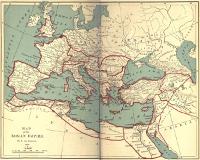
MAP of the ROMAN EMPIRE.
140. This brutal interference with the forms of law was naturally met by an opposing force. The military tribunes sent by Marius to take command, in his name, of the army at Nola, were stoned to death by the soldiers of Sulla, who instantly marched upon Rome at the head of six legions. The city was unprepared for resistance; Sulla became its master, and Marius, with his son and partisans, fled. He wandered, a fugitive and outlaw, along the coast of southern Italy; now half starved in a wood, now buried all night to his chin in a swamp; again indebted for a few hours’ sleep to the charity of a ship-master or to a peasant, who refused the reward offered by Sulla for the head of the outlaw, and enabled him to elude his pursuers.
At Mintur´næ he was sheltered by a woman to whom he had formerly rendered some kindness; but the officers of the town resolved to comply with the orders of the government at Rome, and with difficulty prevailed upon a Gallic or Cimbrian soldier to undertake the work of despatching him. But no sooner had the barbarian entered the room where the old general, unarmed and defenseless, lay upon a bed, than his courage failed, his drawn sword fell from his hand, and he rushed from the house, exclaiming, “I can not kill Caius Marius!”
141. The people of Minturnæ now took more generous counsel, and resolved not to destroy the deliverer of Italy. They provided him with a ship, and conducted him with good wishes to the sea, where he embarked for Africa. Here, too, he was warned by the governor to leave the country, or be treated as an enemy of Rome. But a revolution had by this time taken place in Rome itself, which favored the return of Marius. Cinna, one of the new consuls, was of the Marian party, and wished to enforce the laws of Rufus. The aristocrats armed, under the command of the other consul, Octavius, and a battle was fought in the Forum, in which Cinna was defeated and expelled from the city. Like Sulla, he appealed to the army; and as the army was now composed of Italians, who could not but favor that party which promised them supreme power in the Roman elections, the tide was turned against the aristocrats.
Marius returned, seized upon Ostia and other ports on the Latin coast, captured the corn ships, and thus starved Rome into surrender. This time the captured city was given up to a reign of terror. As Marius walked through the streets, his guards stabbed all persons whom he did not salute. Fresh lists were made out every day of those whom he either feared or hated, as victims for the dagger. Marius and Cinna declared themselves consuls for B. C. 86, in contempt of the usual form of election. But the unrelenting master of Rome did not long enjoy his seventh consulship, which he had all his life superstitiously expected, and now so unscrupulously obtained. He died on the eighteenth day of his magistracy, and in the seventy-first year of his age.
142. Sulla had brought the Mithridatic War to a victorious conclusion, having conducted five difficult and costly campaigns at his own expense, and recovered for Rome the revolted territories of Greece, Macedonia, and Asia Minor. But he never forgot that the Republic which he was serving had declared him a public enemy, confiscated his wealth, and murdered his best friends for their adherence to him. If his vengeance was delayed, it was only the more bitter and effectual. He now returned with a powerful army devotedly attached to his person, and laden with treasure collected from the conquered cities of Asia.
To disarm the enmity of the Italians, who formed the most valuable part of his opponents’ forces, he proclaimed that he would not interfere with the rights of any citizen, old or new. He suffered no injury to be done to either the towns or fields of the Italians, and he made separate treaties with many of their cities, by which he guaranteed their full enjoyment of Roman privileges so long as they should favor his interests. The Samnites alone held out against Sulla, and in concert with the Marian party renewed their old hostilities. Cinna was murdered by his own troops, on his way to meet Sulla in Dalma´tia.
143. Landing at Brundis´ium, Sulla marched without opposition through Calabria, Apulia, and Campania; defeated one consul near Capua, and won over the entire army of the other by means of emissaries well supplied with gold. He was reinforced by three legions, under Cneius Pompey, and by the adherence of many distinguished citizens, among whom were Metellus Pius, Crassus, and Lucullus. He was still outnumbered by the Marians, who, in 82 B. C., brought into the field an army of 200,000 men, under the two consuls Papir´ius Carbo and the younger Marius. The latter was defeated, however, with great loss at Sacripor´tus, and took refuge in Præneste, where he had deposited his military chest, enriched by the treasures of the Capitoline temples. This town was blockaded, while Sulla marched upon Rome. Marius had secretly ordered his partisans in the city to put to death the most illustrious of the Cornelian faction; and thus perished the pontifex maximus, and many others whose sacred office or exalted character would, in more virtuous times, have made them secure from violence.
144. The army of Samnites and Lucanians, by the request of Marius, moved toward Rome, Telesi´nus, their leader, declaring that he would raze the city to the ground. A furious battle was fought near the Colline Gate, in which Sulla was victorious; and, with a cold-blooded ferocity too common in those fearful times, ordered 6,000 prisoners to be cut to pieces in the Campus Martius. Sulla was now master of Rome and of Italy, and his vengeance had begun. A “proscription list” of his enemies was exhibited in the Forum, and a reward of two talents was offered to all who would kill these outlawed persons, or even show the place of their concealment. As usual, private hatred and even the meanest avarice found indulgence under the name of political enmity. Any friend of Sulla was permitted to add names to the list; and as the property of the proscribed usually went to his accuser, the possession of a house, a field, or even a piece of silver plate was often enough to mark a man as a public enemy.
Sulla was appointed dictator, with unlimited power to “restore order to the Republic.” The constitutional changes which he made, were designed to re-instate the Senate and nobles in the preëminence which they had enjoyed in the earliest years after the expulsion of the kings. He limited the sway of the tribunes of the people, and lowered the dignity of their office by prohibiting those who had held it from becoming consuls. Though himself a man of dissolute morals, Sulla clearly saw that the worst miseries of the Roman people proceeded from their own corruption, and he tried to check luxury and crime by the most stringent enactments. But the attempt was hopeless; the character of the nation was so far degraded that no rank or class was fit to rule, and its subjection to the will of a tyrant had become a necessity.
145. Sulla increased the number of the Senate by 300 new members chosen from the knights, all, of course, adherents of his own. He gained, also, a sort of body-guard, by giving the rights of citizenship to 10,000 slaves of those whom he had proscribed. These freedmen all received his own clan-name, Cornelius, and became his clients. He rewarded his veterans with the confiscated lands of the Marian party, thus replacing honest and industrious farmers with too often lawless and thriftless military communities. When Sulla had held the dictatorship three years, he surprised the world by suddenly resigning it, and retiring to his country-seat at Pute´oli. Here he devoted his days to the amusements of literature, mingled, unhappily, with less ennobling pleasures. He died B. C. 78, the year following his abdication. Two days before his death he completed the history of his own life and times, in twenty-two volumes, in which he recorded the prediction of a Chaldæan soothsayer, that he should die, after a happy life, at the very height of his prosperity.
146. A remnant of the Marian faction still held out in the west of Spain. Sertorius had been sent to command that province, chiefly because, as the most honest and keen-sighted of the Marians, he was troublesome to his brother officers. During the proscription by Sulla, he was joined by many exiles, who aided him in drilling the native troops. Though driven for a time into Africa by the proconsul An´nius, he returned, upon the invitation of the Lusitanians, with a Libyan and Moorish army, which defeated the fleet of Sulla in the Straits of Gibraltar, and his land forces near the Guadalquivir. All Roman Spain became subject to Sertorius. With the aid of Cilician pirates, he captured the islands of Ivi´ca and Formente´ra. He formed a government, in which the senate was composed only of Romans; but he distinguished the native Spaniards by many marks of favor, and won their confidence not only by his brilliant genius, but by his perfect justice in the administration of their affairs.
147. Metellus, Sulla’s colleague in the consulship, who commanded his armies in Spain, was completely baffled by the unwearied activity and superior knowledge of the country displayed by Sertorius. At length Cneius Pompey, who had already, in his thirtieth year, gained the title of Great, and the honor of a triumph for his victories over the allies of the Marians in Africa, was sent into Spain with the title of proconsul, to share the command with Metellus. His military skill far surpassed that of his predecessors, but for five years the war was still dragged out with more loss and vexation than success.
At last, Sertorius was murdered by one of his own officers, a man of high birth, who envied the ascendency of genius and integrity, and hoped by removing his general to open the way to his own advancement. He was totally defeated and captured by Pompey in the first battle which he fought as commander-in-chief; and though he tried to save his life by giving up the papers of Sertorius, and thus betraying the secrets of his party in Rome, he was ordered to instant execution, B. C. 72.
148. The Spanish war was now ended, but a nearer and greater danger threatened Rome. The pride and luxury fed by foreign conquest had brought no increase of refinement to the common people; and their favorite amusement for festal days was to see the bravest captives, taken in war and trained for the purpose, slaughter each other in the amphitheater. The ædiles, who provided the public shows, vied with each other in the numbers and training of the gladiators, whom they either bought or hired from their owners for exhibition. Among the unhappy men who were under training in the school at Capua, was a Thracian peasant named Spar´tacus. His soul revolted against the beastly fate to which he was doomed, and he communicated his spirit to seventy of his comrades. Forcibly breaking bounds, they passed out at the gates of Capua, seized upon the road some wagon-loads of gladiators’ weapons, and took refuge in an extinct crater of Vesuvius. They defeated 3,000 soldiers who besieged them, and armed themselves more effectively with the spoils of the slain.
Spartacus proclaimed freedom to all slaves who would join him. The half-savage herdsmen of the Bruttian and Lucanian mountains sprang to arms at his call, and the number of insurgents quickly rose to 40,000. They defeated two legions under the prætor Varinius, stormed and plundered Thurii and Metapon´tum, Nola and Nuce´ria, and many other towns of southern Italy. In the second year their forces were increased to 100,000 men, and they defeated successively two consuls, two prætors, and the governor of Cisalpine Gaul. All Italy, from the Alps to the Straits of Messana, quaked at the name of Spartacus, as it had done, more than a hundred years before, at that of Hannibal; but it only proved the decay of Roman character, that a mere bandit chief could accomplish what had once taxed the genius of the greatest general whom the world had yet produced.
149. Spartacus, however, saw clearly that in the end the organized power and resources of Rome must be superior to his own, and he only proposed to his followers to fight their way to and beyond the Alps, and then disperse to their homes; but the insurgents, spoiled with success, refused to leave Italy, and turned again to the south. Their winter-quarters, near Thurii, were like an immense fair crowded with the plunder of the whole peninsula, which merchants from far and near assembled to buy. Spartacus refused gold or silver, and took in exchange only iron or brass, which he converted into weapons of war by means of foundries established in his camp. In the panic which pervaded Rome, no one was willing to offer himself for the office of prætor. At length, Licinius Crassus accepted the appointment, and led eight legions into the field.
150. Spartacus was twice defeated, and driven to the southern point of Bruttium. Thence he tried to escape into Sicily, where the servile war was still smoldering and ready to be rekindled, and where, by holding the grain fields, he could soon have raised a bread-riot among the hungry mob of Rome. But the Cilician pirates, who had engaged to transport him, proved treacherous; and his attempt to convey his army across the straits on rafts and wicker boats was ineffectual. He then, in despair, broke the lines of Crassus, and once more threw Rome into great consternation.
But the same jealousies which had scattered the forces of Greeks and Romans, doomed the barbarians, also, to destruction. Thirty thousand Gauls separated themselves from Spartacus and his Thracians, and were totally destroyed near Crotona. The final encounter took place on the head-waters of the Silarus. Spartacus fell desperately fighting, and his army was destroyed. Only 5,000 of his men made their way to the north of Italy, where they were met by Pompey on his return from Spain, and all put to the sword. The 6,000 prisoners taken by Crassus were crucified along the Appian Way.
151. The two triumphant generals, Pompey and Crassus, demanded the consulship as their reward. To attain this, it was needful to set aside some of the Sullæan laws, for Pompey had neither reached the required age nor passed through the preliminary offices. But the deliverers of Rome could not ask in vain. On Dec. 31, B. C. 71, Pompey triumphed a second time for his victories in Spain; the next day, Jan. 1, B. C. 70, he entered on the duties of his consulship with Licinius Crassus. Though formerly a chief instrument of the oligarchy under Sulla, Pompey now attached himself to the democratic party, more especially to the wealthy middle class. He restored to the tribunes of the people the power which Sulla had taken away, and caused judges to be chosen no longer exclusively from the Senate, but in equal proportions from the Senate, the knights, and the tribunes of the treasury—a class of moneyed men who collected and paid the revenues due to the soldiers.
Reform in the government of the provinces was a rallying cry of the new party, and the year of Pompey’s consulate was marked by the prosecution of Verres, ex-prætor of Syracuse, for his shameless robbery of the province of Sicily. The impeachment was conducted by Marcus Tullius Cicero, the great lawyer and orator, whose wonderful learning and eloquence had already made him illustrious. Cicero was allowed one hundred and ten days to collect evidence of Verres’s guilt. In less than half the time he returned from Sicily, followed by a long train of witnesses, whose fortunes had been ruined by the fraud and inhumanity of the prætor. Verres himself had been heard to boast that he had amassed wealth enough to support a life-time of luxury, even if he should spend two-thirds of his ill-gotten gains in hushing inquiry or in buying a pardon; and the unhappy provincials plainly declared that, if he were acquitted, they would petition the Senate to repeal all the laws against official injustice, that in future their governors might, at least, only plunder to enrich themselves, and not to bribe their judges. But Verres was condemned, and not even awaiting his sentence, escaped with his treasures to Massilia.
152. At the end of his consulship, Pompey did not accept a province, but remained quietly in Rome, taking no part in public affairs. An increasing danger soon demanded the exercise of his talents. Since the destruction of the naval power of Carthage, Syria, and Egypt, the pirates of the Cilician coast had cruised unchecked throughout the Mediterranean, and had even been encouraged by Mithridates and Sertorius in their enmity against Rome. They captured the corn-ships, plundered the wealthiest cities, and even attacked Roman dignity in its most imposing form, by carrying off great magistrates, with their trains of attendants, from the Appian Way.
The crisis demanded extraordinary measures, and, in B. C. 67, Pompey was intrusted with absolute and irresponsible control of the Mediterranean, with a district extending fifty miles inland from its coasts, and with unlimited command of ships, money, and men. The price of provisions fell instantly upon his appointment, showing the confidence which his great ability had inspired. In forty days he had swept the western sea, and restored the broken communication between Italy, Africa, and Spain. Then sailing from Brundisium, he cleared the sea to the eastward, hunting the corsairs from all their inlets by means of the several squadrons under his fifteen lieutenants, and winning many to voluntary submission by his merciful treatment of the prisoners who fell into his hands.
The final battle took place near the Cilician coast, above which, on the heights of Mount Taurus, the pirates had placed their families and their plunder. They were defeated; 10,000 men were slain, their arsenals, magazines, and 1,300 vessels destroyed, while 400 ships and 20,000 prisoners were taken. Pompey showed no less wisdom in disposing of his captives than energy in defeating them. They were settled in isolated towns, and provided with honest employment; and as a result of the short and decisive conflict of three months, the Mediterranean remained safe and open to peaceful traffic for many years.
153. The Mithridatic War, though conducted with great ability by Lucullus, had become disastrous to the Romans; and a new law, proposed by Manil´ius, now extended Pompey’s jurisdiction over all the forces in Asia, with power to make war, peace, or alliance with the several kings at his own discretion. Within a year, B. C. 66, he received the submission of the king of Armenia, and drove Mithridates beyond the Cau´casus. He deposed the last of the Seleucidæ, and placed Syria, as well as Pontus and Bithynia, under provincial management.
As centers of Roman or Greek civilization, he founded thirty-nine new cities, beside rebuilding or reviving many old ones. Among the former was Nicop´olis—“the city of victory”—which he caused to be built as a home for his veteran soldiers, on the site of the decisive overthrow of Mithridates. He subdued Phœnicia and Palestine, B. C. 63, captured the temple-fortress of Jerusalem by a siege of three months, and established Hyrcanus as “high priest and ruler of the people.” The next year he returned to Italy in a long triumphal procession.
RECAPITULATION.
Death of Drusus is followed by the Social War, in the victorious ending of which Sulla gains great glory. Marius interferes by violence with his appointment to command in the war against Pontus. Sulla overpowers the city by his legions, and Marius becomes an exile. After Sulla’s departure he returns, captures Rome, and massacres his opponents, but dies soon after the beginning of his seventh consulship. Sulla, returning triumphant from the East, defeats the new consuls and their allies, and by his proscriptions makes havoc with life and property at Rome. As dictator, he restores the aristocratic government of the early Republic. He dies in retirement, B. C. 78. Sertorius, ten years sovereign in Spain, is opposed by Pompey, and murdered, B. C. 72. War of the gladiators, under Spartacus, fills all Italy with terror, B. C. 73-71. It is ended by Crassus, who, with Pompey the Great, becomes consul for B. C. 70. Cicero impeaches Verres for extortion in Sicily. Pompey, intrusted with extraordinary powers by the Gabinian law, destroys the Cilician pirates; then completes the Pontic War, and establishes Roman dominion in western Asia.
Conquests of Julius Cæsar.
154. Rome, meanwhile, had narrowly escaped ruin from the iniquitous schemes of one of her own nobles. L. Ser´gius Catili´na, a man of ancient family, but worthless character and ruined fortunes, seized the time when all the troops were absent from Italy, to plot with other nobles, as wicked and turbulent as himself, for the overthrow of the government. The new consuls were to be murdered on the day of their inauguration. Catiline and Autro´nius were to take the supreme command in Italy, and Piso was to lead an army into Spain. The first plot failed through the imprudence of its leader; but a second, of still bolder and more comprehensive character, was formed. Eleven senators were drawn into the conspiracy; magazines of arms were formed, and troops levied in various parts of the peninsula. The wide-spread discontent of the people with the existing government aided the success of the movement; and, in the end, slaves, gladiators, and even criminals from the common prisons, were to be liberated and armed.