Part 2 / Book 5 — BOOK V. History of Rome, from the Earliest Times to the Fall of the Western Empire, A. D. 476. (continued 3)
Reading edition
The secret was kept by a vast number of persons for eighteen months, but the main features of the plot were at length made known to Cicero, then consul, and by his vigilance and prudence it was completely foiled. He confronted Catiline in the Senate—where the arch conspirator had the boldness to take his usual place—with an oration, in which he laid open with unsparing vehemence the minutest circumstances of the plot. The convicted ringleader fled from Rome in the night, and placed himself at the head of his two legions, hoping yet to strike an effective blow before the levies ordered by the Senate could be fit for service. His chief accomplices were seized and strangled in prison, by order of the Senate, while he himself was followed and defeated in Etruria by the proconsul Antonius. The battle was decisive. Catiline fell fighting far in advance of his troops, and 3,000 of his followers perished with him. No free Roman was taken alive. B. C. 62.
155. Though this daring conspiracy was thus happily crushed, the weakness and disorder of society alarmed the best and wisest citizens. It was feared that some man of commanding talent might yet succeed where Catiline had failed, and overthrow the liberties of Rome. Pompey, now returning with his victorious legions from the East, was the immediate object of dread to the Senate and aristocratic party. But he quieted apprehension by disbanding his army as soon as he touched the soil of Italy, and proceeded slowly to Rome accompanied by only a few friends. They could not refuse his claim to a triumph, and from the number and extent of his victories, this pageant was the most imposing that Rome had ever seen. Although there was no army to lengthen the procession, it occupied two days in passing through the city. The inscriptions enumerated 22 kings and 12,000,000 of people as conquered; 800 ships, nearly 900 towns, and 1,000 fortresses taken; and the Roman revenues nearly doubled.
By an unusual act of clemency, Pompey spared the lives of all his captives, and dismissed to their homes all except Aristobulus, of Judæa, and the young Tigranes, of Armenia, who were detained lest they should stir up revolts in their respective countries. But though the aristocrats of the Senate had taken part in the public honors paid to Pompey, they could not forget that his appointment in the East had been in defiance of their opposition. His demands of allotments of land to his veterans, and for himself a second consulship and the ratification of his official acts, were refused; and Pompey, to redeem his pledges to his soldiers, now made an alliance with an abler man, and one far more dangerous to the old order of things—if the Senate could but have foreseen it—than himself. B. C. 60.
156. Caius Julius Cæsar had been proscribed in his eighteenth year, because he had refused to put away his young wife, Cornelia, the daughter of Cinna, at the command of Sulla. He was for a time a fugitive in danger of death, but his friends at length, with great difficulty, procured his pardon from the dictator, on the plea of his youth and insignificance. Sulla was more discerning; he remarked, “That boy will some day be the ruin of the aristocracy, for there are many Marii in him.”
Upon the death of his aunt Julia, the widow of Marius, Cæsar defied the law which had pronounced her husband an enemy of the state, by causing his waxen image to be carried in the funeral procession. It was welcomed by the people with loud acclamations. In his ædileship, three years later—which, in the magnificence of the games celebrated, and the buildings erected at his own expense, surpassed all that had preceded it—Cæsar ventured upon a bolder step. He replaced in the Capitol, during one night, the statues of Marius, and the representations of his victories in Africa and Gaul, which had been removed by Sulla. When morning dawned, the common people and the veterans of Marius wept and shouted for joy at the re-appearance of the well-known features, and greeted Cæsar with rapturous applause. Though formally accused in the Senate of violating a law, he could not be condemned against the voice of the people.
157. Dignities and honors followed in rapid succession. He became pontifex maximus in 63 B. C.; prætor, in 62; and at the end of his prætorship he obtained the government of Farther Spain. In this first military command he acquired not only wealth for himself and his soldiers, but great reputation by subduing the Lusitanian mountaineers. On his return, he desired both a triumph and the consulship; but he could not obtain the one if he entered the city before it was decreed, nor the other without being personally present at the approaching election; so he abandoned the showy for the solid advantage, and was duly chosen consul, with Bib´ulus, a tool of the Senate, for his colleague.
158. He now managed to detach Pompey from the senatorial party, and form with him and Crassus a triumvirate, which, though only a secret agreement, not a public magistracy, ruled the Roman world for several years. The power of Crassus was due to his enormous wealth; that of Pompey, to his great military services; and that of Cæsar, to his unequaled genius and unbounded popularity. Their combined influence was soon felt in the official acts of Cæsar. He brought forward an Agrarian law for dividing the rich public lands of Campania among the poorest citizens. It was passed against the violent opposition of Bibulus and all the aristocratic party; a commission of twenty, with Pompey and Crassus at its head, was appointed to divide the lands, and the veterans thus obtained most of their claims.
The defeated consul, who had declared that he would rather die than yield, now shut himself up in his house, and never re-appeared in public until his year of office had expired. Cæsar obtained a ratification of all Pompey’s acts in Asia, and, at the same time, attached the equites to his party, by giving them more favorable terms in farming the provincial revenues. At the close of his consulship he obtained the government of Illyricum and Gaul, on both sides of the Alps, for a term of five years, with a general commission to “protect the friends and allies of the Roman people.”
159. The religious and national bond between the many Celtic tribes which inhabited the ancient territories of Britain, Belgium, France, Switzerland, and a part of Spain, was strong enough to unite them, now and then, in resistance to their common enemies, the Germans on the north and the Romans on the south, but not strong enough to prevent rivalries among themselves, which often gave the foreign power room to interfere in their affairs. The Roman province, founded B. C. 121, now extended northward along the Rhone as far as Geneva; and a great emigration of Germans had occupied territories west of the Rhine, from the neighborhood of the modern Strasbourg to the German Ocean.
160. During his first summer in Gaul, Cæsar, by the extraordinary swiftness and decision of his movements, subdued two nations and established Roman supremacy in the center of the country. The Helvetii, who lived between Lake Geneva and the Jura, finding themselves in too narrow quarters, had resolved to emigrate and conquer new habitations to the westward. They burned their twelve towns and four hundred villages, and assembled at Geneva to the number of 368,000 persons, men, women, and children, intending to pass through the Roman province into western Gaul. Cæsar prevented this move by a wall nineteen miles in length, which he extended along the left bank of the Rhone; and bringing up three legions from Italy, he followed the Helvetians along their second route, and defeated them near Bibrac´te. The remnant of the nation—less than one-third of the number on their muster-rolls when the migration began—were ordered back to their native hills.
The Seq´uani, a Celtic tribe north of the Helvetii, had called in Ariovis´tus, the most powerful of the German chiefs, against their rivals the Ædui, who were styled allies and kinsmen of the Romans. Having subdued the Ædui, Ariovistus turned upon his late allies, and demanded two-thirds of their lands in payment for his services. All the Gauls begged aid of Cæsar, who met the German prince near the Rhine, in what is now Alsace. So great was the fame of Ariovistus and his gigantic barbarians, who for fourteen years had not slept under a roof, that the Roman soldiers were afraid to fight; and though shamed out of their cowardice by the stirring appeal of their general, every man made his will before going into battle. The result of the combat was the complete destruction of the German host, only Ariovistus and a few followers escaping across the Rhine.
161. The second year, Cæsar conquered the Belgians north of the Seine, and the Senate decreed a public thanksgiving of fifteen days for the subjugation of Gaul. His lieutenant, Decimus Brutus, fought the first naval battle on the Atlantic, with the high-built sailing vessels of the Celts. The maritime tribes revolting the following winter, were subdued; and but for a few brief rebellions, the territories of France and Belgium remained under Roman dominion. Cæsar repaired each winter to his province of Cisalpine Gaul, to watch affairs in Italy. In 56 B. C., he had to reconcile Pompey with Crassus, and re-arrange, in his camp at Luca, the affairs of the triumvirate.
It was agreed that Pompey and Crassus should be consuls the next year, and that, after their term had expired, the former should govern Spain, and the latter Asia, while the proconsular government of Cæsar in Gaul should be prolonged to a second term of five years. In choosing the most arduous and least lucrative province for himself, Cæsar wished to begin the execution of his great scheme for civilizing the West, and organizing the whole Roman dominion into one compact state. The revolution begun by the Gracchi was not yet completed, and it was easy to see that the strife of parties must come again to the sword, as it had in the time of Marius and Sulla. In such a case, Cæsar desired to be near Italy, and to have an army trained to perfect discipline and devotion to himself.
162. In the fourth year, B. C. 55, he threw a bridge across the Rhine and invaded Germany. Late in the autumn, he made a reconnoitering expedition to Britain, and received hostages from the tribes. This time the Senate decreed twenty days’ thanksgiving, though Cato stoutly insisted that Cæsar ought, rather, to be given up to the vengeance of the barbarians, to avert the anger of the gods for his having seized the German embassadors. The next year, B. C. 54, Cæsar again invaded Britain with five legions. Notwithstanding the brave resistance of a native chief, Cas´sivelau´nus, he penetrated north of the Thames, took hostages, and imposed tribute; but he left no military posts to hold the island in subjection.
A formidable revolt of the Gauls, the following winter, destroyed one of the six divisions of the Roman army, and imperiled another, commanded by Quintus Cicero, brother of the orator. Cæsar came to its relief, defeated 60,000 of the enemy, and restored quietness to the north. The Germans having aided in this revolt, he again crossed the Rhine near Coblentz, in the summer of 53 B. C. He fought no battles, for the people took refuge among their wooded hills; but the invasion served, as before, to make an imposing display of Roman power.
163. The following year, Gaul was every-where in a blaze of revolt, and the campaign was the most difficult and brilliant of all Cæsar’s operations. Ver´cinget´orix, king of the Arver´ni, and the ablest of the Gallic chieftains, stirred up all the tribes, and nearly wrested the country from Roman control. While Cæsar was besieging him in Ale´sia, a Gallic army of more than a quarter of a million of men encamped around the Romans and besieged them in turn. But the genius of the proconsul surmounted even this crisis. He kept down all attempts at sortie, while he defeated the outer army; then forced the town to surrender, and captured Vercingetorix himself. Six years later, the Gallic chief adorned the triumph of Cæsar, and was then executed in the Mamertine prison at the foot of the Capitol. The Gauls now saw that resistance was hopeless. The firm and skillful management of Cæsar in pacifying the country and organizing the Roman rule, completed the work that his brilliant victories had prepared; and by the year 50 B. C., Gaul was at peace.
164. Meanwhile, Crassus, fearing that his colleagues would reap all the warlike glory of the league, undertook, after plundering the temples of the East, to make war against Parthia—a war unprovoked by the enemy, unauthorized by the Senate, and unwarranted by his own abilities. Contrary to advice, he plunged into the hot and sandy desert east of the Euphrates, lost the greater part of his army in a battle near Carrhæ (the Haran of Abraham), and was himself slain, soon after, by the treachery of the Parthian general, B. C. 53.
Pompey, now sole consul, no longer pretended any friendship for Cæsar. The conqueror of Mithridates and the Cilician pirates did not fancy that he could be eclipsed by any man; and the relationship between them was lately dissolved by the death of Julia, the daughter of Cæsar, who had been the wife of Pompey. The enemies of the former obtained a decree of the Senate requiring him to surrender his proconsular power, and return to Rome before becoming candidate for a second consulship. Cato had declared that he would prosecute Cæsar for capital offenses as soon as he should resign his command.
It could hardly have been expected that the governor of Gaul would quit his devoted legions, and all the treasures of the conquered province, to place himself unarmed at the mercy of his enemies. Such virtue had been known in the days of Curtius, but self-surrender for the public good had ceased to be fashionable at Rome. Moreover, Cæsar may well have doubted whether the sacrifice of his life would promote the public interests. The Romans required a master; and his own plans for building up a great empire from the scattered fragments of provinces, by extending equal rights to all the conquered peoples, were doubtless the most enlarged and beneficent that had yet been formed. He believed that the great interests of Rome were consistent with his own.
165. His enemies lost no opportunity to deprive him of resources. Under pretext of a war with Parthia, the two former colleagues of Crassus were required to furnish each one legion to be sent to Asia. Pompey had formerly lent a legion to Cæsar, and now demanded its return. Cæsar dismissed the two legions, giving to each man his share of the treasure which was to be distributed at his approaching triumph. He wrote at the same time to the Senate, offering to resign his command if Pompey would do the same, but not otherwise. The two legions were kept in Italy. After a violent debate, it was enacted that Cæsar should, without conditions, disband his army on a certain day, under penalty of being declared an enemy of the state. The tribunes, Antonius and Cassius, vetoed the motion, but their veto was set aside; and believing their lives in danger, they fled to Cæsar’s camp at Raven´na.
RECAPITULATION.
Catiline’s deep-laid conspiracy is defeated by Cicero, and its lender slain in battle. Pompey disbands his army and triumphs for his conquests in Asia. He forms with Cæsar, now consul, and Crassus, the first triumvirate. The next year, B. C. 58, Cæsar, as proconsul, assumes the command in Gaul; subdues the Helvetii and the Germans, under Ariovistus, in one campaign; afterward conquers the Belgæ; twice bridges the Rhine and ravages Germany; twice invades Britain; suppresses revolts in Gaul, and organizes the whole country into a peaceful and permanent part of the Roman dominion. Crassus, in Asia, is overwhelmingly defeated, with the loss of his army and his life, B. C. 53. Pompey breaks with Cæsar, and becomes the champion of the Senate.
Cæsar Master of Rome.
166. It was time for decisive action. Cæsar crossed the Rubicon, a little river which separated his province from Roman Italy, and advanced with one legion, the troops in Gaul having received orders to follow without delay. To enter the country without resigning his command was itself a declaration of war. Panic seized Rome, and the Senate fled, leaving the public treasures behind. Fifteen thousand recruits, destined for Pompey’s army, seized their officers and handed them over, with themselves and the town Corfin´ium, where they were quartered, to Cæsar. Other bodies of recruits followed their example. Pompey, having lost more than half his ten legions, retired to Brundisium; and though besieged by Cæsar, succeeded in escaping with 25,000 men to Greece.
The Roman world was now really divided between the two generals. Pompey controlled Spain, Africa, and the East, and hoped, by commanding the sea and the corn islands, to starve Italy into surrender. Cæsar had only Italy, Illyricum, and Gaul. If Pompey had acted with energy, he might speedily have created an army in the East and regained Rome, but by delay he allowed Cæsar to attack his provinces in detail, and wrest the entire empire from his grasp. The emigrated nobles assembled themselves at Thessalonica and re-organized a senate, in which they made a vain show of keeping up the constitutional forms, while, by their petty jealousies, they hampered every movement of their general-in-chief.
167. Cu´rio, the ablest of Cæsar’s lieutenants, captured Sicily, and thus averted famine from Rome. In Africa he was less fortunate. Drawn into an unexpected combat with the whole army of King Juba, he was defeated, and chose to be slain rather than meet his general in disgrace. Instead of the anarchy and general proscription which his enemies had predicted, Cæsar soon restored order in Italy, and universal confidence, by the moderation and forbearance of his conduct. Friends and foes were equally protected. The moneyed class, which had most to gain from a settled government, came over to the side of Cæsar, and the “rich lords resumed their daily task of writing their rent-rolls.”
His first foreign enterprise was against Spain, where Pompey had seven legions. It was conquered by a severe and toilsome campaign of forty days. Returning through Gaul, Cæsar received the surrender of Massilia, and learned of his appointment to the dictatorship at Rome. He held this high office only eleven days, but long enough to preside at the election of consuls, in which he himself, of course, received the greatest number of votes; to pass laws relieving debtors, and restoring to the enjoyment of their estates the descendants of those whom Sulla had proscribed; and to begin his scheme of consolidating the provinces, by granting the full rights of Roman citizenship to the Gauls.
168. As consul, he then led his army to Brundisium and crossed into Greece. Pompey had assembled from the eastern countries a great army and fleet, the latter of which commanded the sea, and seemed to forbid the passage of Cæsar. But Bibulus, the admiral, confiding in his superior numbers and the wintry season, was off his guard until seven legions were landed in Epirus. The attempt to capture Pompey’s camp and treasures, at Dyrra´chium, failed; but the vain confidence inspired by their partial success, in the proud and frivolous young nobles of the refugee party, eventually proved their ruin.
Cæsar was, indeed, in a perilous position; his fleet was destroyed, and he was cut off in a hostile country where food must soon fail. Nevertheless, with his usual good fortune or consummate skill, he contrived to draw his victorious enemy after him to the interior of the country, where Pompey’s fleet gave him no advantage, and then to choose his own battle-field at Pharsa´lia, in Thessaly. The army of Pompey, in horse and foot, numbered 54,000 men; that of Cæsar, scarcely more than 22,000. The former was abundantly supplied both with provisions and military materials, while the latter was near the point of starvation, and compelled to stake its existence on one desperate venture. So certain did the result appear, that the patricians in Pompey’s camp were already disputing among themselves the succession to Cæsar’s pontificate.
169. On the 9th of August, B. C. 48, the Pompeians crossed the river which separated the two camps, and with their cavalry commenced the attack. Cæsar’s horsemen were driven in, but a picked troop of his legionaries, tried on a hundred Gallic fields, unexpectedly charged the assailants. Their orders were to aim their javelins at the enemies’ faces. Confused by this novel attack, the cavalry turned and fled; and Pompey, who had been urged by the reproaches of his self-appointed counselors to give battle, contrary to his better judgment, and who had never shared their confidence, did not wait to see the general attack, but galloped away to his camp.
His army was completely routed; 15,000 lay dead upon the field, and 20,000 surrendered on the morning after the battle. Many of the aristocracy hastened to make their peace with the conqueror; the “irreconcilables” either betook themselves to the mountains or the sea, to carry on for years a predatory warfare; or to Africa, where King Juba, of Numidia, perceiving that Cæsar’s consolidating policy would deprive him of his kingdom, still stood firmly on the Pompeian side. The other client-states withdrew their quotas of ships and men as soon as they saw that Pompey’s cause was lost.
170. Pompey fled to Egypt. The young queen, Cleopatra, was now in Syria, having been driven from her kingdom by her brother’s guardian, Pothi´nus, who was with an army holding the eastern frontier against her. The perfidious statesmen who surrounded the king, sent out a boat inviting the illustrious fugitive to land; but just as he had reached the shore, he was stabbed by a former centurion of his own, who was now in the service of Ptolemy. Pompey perceived his fate; without a word, he covered his face with his toga, and submitted to the swords of his executioners. His head was cut off, and his body cast out upon the sand, where it was buried by one of his own attendants.
Cæsar soon arrived in pursuit; but when the ghastly head was presented to him, he turned away weeping, and ordered the murderers to be put to death. He remained five mouths at Alexandria, regulating the affairs of the kingdom, which he secured to Cleopatra jointly with her brother. He thus became involved in war with the people, and in a naval battle was once compelled to save his life by swimming from ship to ship, holding his sword in his teeth, and the manuscript of his Commentaries upon the Gallic Wars in one hand over his head. He was victorious at last, and Ptolemy was drowned in the Nile.
171. Cæsar then turned rapidly toward Asia Minor, where Pharnaces of Pontus was trying to regain his father’s lost dominions. The Roman army had been defeated at Nicopolis with great loss, but Cæsar won a decisive victory at Zie´la, and finished the campaign in five days. It was on this occasion that he sent to the Senate his memorable dispatch, “Veni, vidi, vici.”[75] The presence of the chief made a similar transformation of the war in Africa. The Pompeian party had re-established its senate at Utica, and during Cæsar’s long delay in Egypt had raised an army fully equal to that which had been conquered at Pharsalia.
In attempting to carry the war into Africa, Cæsar met an unexpected obstacle in a mutiny of his veterans in southern Italy. Wearied out with the unusual hardships of their last campaigns, and imagining that their general could do nothing without them, they refused to embark for Sicily, and commenced their march toward Rome. Having provided for the security of the city, Cæsar suddenly appeared among the legions, and demanded to know what they wanted. Cries of “discharge!” were heard on every hand. He took them instantly at their word; and then addressing them as “citizens,” not as “soldiers,” promised them, at his approaching triumph, their full share in the treasure and lands which he had destined for his faithful followers, though in the triumph itself they could, of course, have no part.
His presence and his voice revived their old affection; they stood mute and ashamed at the sudden severing of the bond which had been their only glory in the past. At length they began to beg, even with tears, that they might be restored to favor, and honored again with the name of “Cæsar’s soldiers.” After some delay their prayer was granted; the ring-leaders were only punished by a reduction of one-third in their triumphal presents, and the revolt was at an end.
172. The campaign in Africa was not less difficult than the one in Greece. The Pompeians were well supplied with cavalry and elephants, and were able to fight on fields of their own choosing. They gained a battle near Rus´pina, but in the more decisive conflict at Thapsus, they were completely overthrown. The soldiers of Cæsar disregarded his orders to spare their fellow-citizens; they were determined to obtain rest from war at any cost of Roman blood, and 50,000 Pompeians were left dead upon the battle-field. Cæsar was now master of all Africa. Cato, commanding at Utica, provided for the safety of his friends either by flight or surrender; then shutting himself in his room, read all night the treatise of Plato on the Immortality of the Soul, and toward morning killed himself with his own sword.
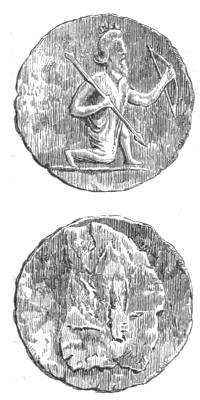
Coin of Cæsar, enlarged twice the size.
173. Cæsar returned to Rome in possession of absolute power. Instead of the proscriptions, which, in similar circumstances, had marked the return of Marius and Sulla, he proclaimed amnesty to all, and sought to avail himself of the wisdom of all parties in reorganizing civil affairs. As he had never triumphed, he now celebrated four days for his victories in Gaul, Egypt, Pontus, and Numidia; but the rejoicings were only for the conquest of foreign foes, for it was regarded as unseemly to triumph over Roman citizens. Twenty thousand tables were spread in the streets and public squares, gifts of grain and money were distributed among soldiers and people, and the games were celebrated with a splendor never before approached. Cæsar now applied himself with diligence to regulate the disorders of the state; and the benefit of one, at least, of his provisions is felt even to the present day. The reckoning of time, through the carelessness or corruption of the pontiffs (see § 29), had fallen into hopeless confusion: harvest festivals took place in spring, and those of the late vintage at midsummer. Cæsar, as chief pontiff, reformed the calendar, by adding ninety days to the current year, and then, with the aid of an Alexandrian astronomer, adapted the reckoning to the sun’s course. He made the Roman year consist of 365 days, and added a day every fourth year. The Julian Calendar, with only one emendation,[76] is that which we now follow. In acknowledgment of his service in this matter, the Senate ordered the month of Cæsar’s birth to be called henceforth from his clan-name, July. His successor, Augustus, on occasion of some trifling improvement in the calendar, gave his own surname to the following month.
174. The Pompeians made one more rally in Spain, but they were defeated and overthrown by Cæsar, in the severe and decisive battle of Munda, March 17, B. C. 45. Cneius Pompey, the younger, was slain; his brother Sextus soon submitted, and received the family estates. He was proscribed during the disorders which followed the death of Cæsar, and for eight years kept up a piratical warfare upon the sea. Having settled the affairs of Spain, Cæsar celebrated a fifth triumph, and was loaded by the servile Senate with unlimited powers and dignities. He became dictator and censor for life, the latter office now receiving its new title, præfecture of morals. He was permitted to make peace or war without consulting either Senate or people. In his highest and most distinctive power, that of perpetual imperator, he was to name his successor. His person was declared sacred, and all the senators bound themselves by oath to watch over his safety. His statues were ordered to be placed in all the temples, and his name in civil oaths was associated with those of the gods.
175. Cæsar availed himself of his unprecedented power to plan many great works of general utility. He projected a much-needed digest of Roman laws, and the founding of a Latin and Greek library on the model of that of Alexandria, which had been almost destroyed by fire during the recent siege. He proposed to turn the course of the Tiber, so as at once to drain the Pontine marshes, to add to the city an extensive tract of land available for building, and to connect with Rome the large and convenient port of Terraci´na, instead of the inferior one of Ostia.
Above all, he desired to substitute a great Mediterranean empire for the mere city government which, for more than a hundred years, had ruled Italy and the world. To atone for the narrow policy of municipal Rome, he rebuilt the two great commercial cities, Carthage and Corinth, which Roman jealousy had demolished; and he effaced, as far as possible, the distinctions between Italy and the provinces. In the many colonies which he founded in Europe, Asia, and Africa, he provided homes for 80,000 emigrants, mostly from the crowded tenement houses of Rome itself. His plans embraced the varied interests of every class and nation within the empire, and aimed to reach, by the union of all, a higher civilization than either had attained alone. In the wildest regions of Germany, Dalmatia, or Spain, the Roman soldier was followed by the Greek school-master and the Jewish trader.
176. Though occupying the highest rank as a general, Cæsar was more a statesman than a warrior, and desired to base his government, not upon military power, but upon the confidence of the people. He was already in his fortieth year when he first assumed the command of an army. Still, his great works as a ruler had all to be executed in the brief intervals of military affairs. The five and a half years which followed his accession to supreme power were occupied by seven important campaigns; and he was about undertaking an expedition against Parthia, to avenge the overthrow of Crassus, when a violent death ended his career. It is said that he desired, before his departure, to receive the title of king.
A conspiracy had already been formed among his personal enemies. It was now strengthened by the accession of several honest republicans, who dreamed that the death of the dictator would restore freedom to the state. At the festival of the Lupercalia, Feb. 15, B. C. 44, the crown was offered to Cæsar, by Antony, his colleague in the consulship; but, perceiving the consternation of the people, he declined it. On the 15th of the following month, in spite of many warnings, Cæsar repaired to the Senate-house. He had just taken his seat, when one of the conspirators stooped and touched his robe. At this signal, Casca stabbed him in the shoulder; the others thronged around with their drawn swords or daggers.
Instead of the flattering crowd, nothing but murderous faces and the gleam of steel met his eye on every side. Still he stood at bay, wounding one assailant with his stylus, throwing back another, and disarming a third, until he received a wound from the hand of Brutus, whom, though an adherent of Pompey, he had honored with his confidence and loaded with benefits. Then drawing his mantle about him, with the reproachful exclamation, “And thou, Brutus!” he fell at the base of Pompey’s statue and expired.
177. Brutus, raising aloft his bloody dagger, cried aloud to Cicero, “Rejoice, father of our country, for Rome is free!” Never was rejoicing more unfounded. If Brutus and his accomplices could have restored to the Roman people the simple and self-denying virtues of the olden time, Rome would indeed have been free. But Cæsar understood the times better than his assassins. In cutting off the only man who was capable of ruling with clear insight, firmness, and beneficence, they had plunged the state again into the horrors of civil war, and made it the easy prey of a less able and less liberal despot. Senate and people were at first paralyzed by the suddenness of the change, and by fear of a return to the old scenes of proscription. Antony, now sole consul, had time to possess himself of Cæsar’s papers and treasures; and by his funeral oration over the body of the dictator—especially by reading his will, in which all the Roman people were remembered with great liberality—he roused the indignant passions of the crowd against the murderers.
Antony was for a time the most popular man in Rome, but a rival soon appeared in the person of Octavia´nus, the grand-nephew and adopted son of Julius Cæsar. This young man, who had been educated with great care under the eye of his adoptive father, arrived from the camp at Apollonia and claimed his inheritance, out of which he carefully distributed the legacies to soldiers and people. Cicero was led to look upon him as the hope of the state, and in his third great series of orations, called the Philip´pics, he destroyed the popularity of Antony and his influence with the Senate. Two of Antony’s legions deserted to Octavian, and Antony himself, in two battles, was routed and driven across the Alps.
178. The two consuls for the year 43 B. C. were slain in the battle before Mu´tina. Octavian, returning to Rome, compelled the popular assembly to elect him to that office, though he was only nineteen years of age. He was appointed to carry on the war against Antony, who had now been joined by Lepidus—formerly master of the horse to Julius Cæsar—and was now descending from the Alps with a formidable army of seventeen legions. But the Senate, almost equally afraid of Antony and Octavian, revoked the outlawry of the former; and the latter, disgusted with its vacillations, resolved upon a league with the two commanders, whose forces alone could give him victory over the assassins.
On a small island in the Reno, near Bono´nia (Bologna), the three met, and the Second Triumvirate, of Antony, Cæsar Octavianus, and Lepidus, was then formed, B. C. 43, proposing to share between them for five years the government of the Roman world. A proscription followed, in which Cicero, though the friend of Cæsar, was sacrificed to the hatred of Antony. The illustrious orator was murdered near his own villa at For´miæ, and his head and right hand were nailed to the rostrum at Rome, from which he had so often discoursed of the sacred rights of citizens. Two thousand knights and three hundred senators perished in this proscription. Those who could escape took refuge with Sextus Pompey in Sicily, or with Brutus and Cassius in Greece.
179. Antony and Octavian crossed the Adriatic, and defeated the last of the conspirators in two battles at Philippi, in the autumn of 42 B. C. Both Brutus and Cassius ended their lives by suicide. Cæsar returned to Italy, where a new civil war was stirred up by Fulvia, the wife of Antony, and Lucius, his brother. Lucius Antonius threw himself into Perusia, where he was besieged and taken by Octavian. The common citizens were spared, but 300 or 400 nobles were slain at the altar of Julius Cæsar, on the anniversary of his death, March 15, B. C. 40. Fulvia died in Greece, and a new agreement between the triumvirs, called the Peace of Brundisium, was sealed by the marriage of Antony with Octavia, the sister of the younger Cæsar.
In the new division of the civilized world, Antony received the East; Octavian, Italy and Spain; and Lepidus, Africa. Sextus Pompey, whose fleets, commanding the sea, threatened the capital with famine, was admitted, next year, to a sort of partnership with the triumvirate, in which he received the islands of the western Mediterranean, on condition of his supplying Rome with grain. The conditions of this treaty were never fulfilled, and a two years’ war between Pompey and Octavian was the result. It was ended B. C. 36, by a great sea-fight off Nau´lochus. Agrippa, the intimate friend of Cæsar, routed the forces of Pompey, who fled in despair to Asia, and the following year was captured and put to death. His land forces, deserted by their leader, prevailed upon Lepidus to become their general, and declare war against Octavian. But the young Cæsar acted with an intrepidity worthy of his name. He went unarmed and almost alone into the camp of Lepidus, and by his eloquence persuaded them to desert their unworthy commander and be faithful to himself.
180. Lepidus being degraded, the two remaining members of the triumvirate continued three years at the head of affairs. But an alliance so purely selfish could not be permanent. Antony neglected his noble wife for the enchantments of the Egyptian queen, on whom he bestowed Phœnicia, Cœle-Syria, and other dominions of Rome. He wasted the forces committed to him in expeditions which resulted only in loss and disgrace; and he laid aside the simple dignity of a Roman citizen for the arrogant ceremony of an Eastern monarch.
In 32 B. C., war was declared against Cleopatra, and in September of the following year the forces of the two triumvirs met off Actium, in Acarnania. Antony had collected a vast fleet and army; but his officers, disgusted by his weak self-indulgence, were ready to be drawn over to the side of Octavian. Disheartened by many desertions, Antony took no active part in the battle, but while those of his forces who still faithfully adhered to him were fighting bravely in his defense, he drew off with a portion of his fleet, and followed Cleopatra to Egypt. His land army, after waiting a week for its fugitive commander, surrendered to Octavian.
From this moment Cæsar was master of the Roman world. The final blow was given the next year in Egypt, where Antony was defeated before Alexandria, and deserted by his fleet and army. Cleopatra negotiated to betray him, but when she found that Octavian wanted to capture her, that she might adorn his triumph, she ended her life by the poison of an asp. Antony, in despair, had already killed himself, and Egypt became a Roman province. Octavian, returning to Rome the following year, celebrated a three-fold triumph, and the gates of Janus were closed the third time, in token of universal peace, B. C. 29.
RECAPITULATION.
Cæsar crosses the Rubicon, and in three months becomes master of Italy. He subdues the Pompeians in Spain, becomes dictator, and afterward consul; pursues Pompey into Greece; is defeated at Dyrrhachium, but victorious at Pharsalia, B. C. 48. Pompey is slain in Egypt. Cæsar re-establishes Cleopatra under the Roman protectorate; re-conquers Pontus; quells a mutiny in his Gallic legions, and overthrows the Pompeians at Thapsus, in Africa. He celebrates four triumphs at Rome; reforms the calendar; finally crushes the Pompeians in Spain; is invested with sovereign powers, and organizes a cosmopolitan empire. On the eve of departure for Asia, he is murdered in the Senate-house by sixty conspirators. Antony aims to succeed him, but Octavian receives his inheritance. Antony, Octavian, and Lepidus form the Second Triumvirate, B. C. 43. In the proscription which follows, Cicero is killed. Brutus and Cassius are defeated at Philippi, B. C. 42. A dispute in the triumvirate is ended by the Peace of Brundisium, and the marriage of Antony and Octavia. Lepidus is degraded from the triumvirate, B. C. 35; the two remaining colleagues quarrel, and the battle of Actium makes Octavian supreme ruler of the empire, B. C. 31.
III. The Roman Empire.
181. First Period, B. C. 31-A. D. 192. The empire founded by Cæsar Octavianus was an absolute monarchy under the form of a republic. Many of the high offices, which had been borne by different persons, were now concentrated in one; but he declined the name dictator, which had been abused by Marius and Sulla, and was careful to be elected only for limited periods, and in the regular manner. The title Imperator, which he bore for life, had always belonged to generals of consular rank during the time of their command. The name Augustus, by which he is henceforth to be known, was a title of honor bestowed by the Senate, and made hereditary in his family. As chief, or “Prince of the Senate,” he had the right to introduce subjects for discussion; and as pontifex maximus, or high priest of the state, he had a controlling influence in all sacred affairs.
He lived in the style of a wealthy senator in his house on the Palatine, walked abroad without retinue, and carefully avoided kingly pomp. The popular assemblies still appointed consuls, prætors, quæstors, ædiles, and tribunes, but the successful candidate was always recommended by the emperor, if he did not himself accept the appointment. These old-fashioned dignities were now little more than empty names, the real power having passed, under Augustus himself, to new officers, especially to the præfect of the city and the commander of the Prætorian Guard.[77] The people, meanwhile, were satisfied with liberal distributions of corn, wine, and oil, and amused by a constant succession of games.
182. In seven centuries the Roman dominion had grown from the few acres on the Palatine Hill, to embrace the Mediterranean with all its coasts, from the Atlantic to the Euphrates, and from the African Desert to the Rhine, the Danube, and the Euxine. The twenty-seven provinces, reorganized by Augustus, were divided between himself and the Senate according to their condition. Those which were securely at peace were called Senatorial Provinces, and governed by proconsuls appointed by the legislative body; those which demanded the presence of an army were Imperial Provinces, and were managed either by the emperor in person or by his legates.
The standing army, which maintained order in the entire empire, consisted, in the time of Augustus, of twenty-five legions, each legion numbering, in horse, foot, and artillery, a little less than 7,000 men. This force of 175,000 was distributed along the Rhine, the Danube, and the Euphrates, or in Britain, Spain, and Africa, according to the danger from the outer barbarians. While internal peace was maintained by the wise management of Augustus, the natural boundaries of the empire above mentioned were only gained and kept by active war. Northern and north-western Spain, the Alpine provinces of Rhætia and Vindelic´ia, and the Danubian countries Nor´icum, Panno´nia, and Mœ´sia, required almost unremitted warfare of more than twenty years, B. C. 12-A. D. 9.
183. The Germans, east of the Rhine and north of the Danube, though often defeated, were never subdued. Drusus, a step-son of Augustus, was the first Roman general who descended the Rhine to the German Ocean. He built two bridges and more than fifty fortresses along the river, and imposed a tribute upon the Frisians north of its mouth. Drusus died in his third campaign, B. C. 9, and was succeeded by his brother Tiberius, who after many years, A. D. 4, seemed to have subdued the tribes between the Rhine and the Elbe.
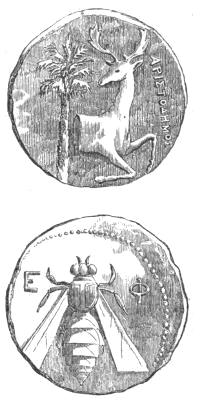
Coin of Drusus, twice the size of the original.
But his successor, Qu. Varus, attempted to establish the same arrogant and arbitrary rule which he had exercised over the slavish Syrians—a people crushed by nearly two thousand years of despotism, Assyrian, Egyptian, Persian, and Macedonian. The free-spirited Germans rose in revolt, under their princely leader, Armin´ius (Herman). Arminius had been educated at Rome, and had thoroughly learned the tactics of the legions; but Roman refinement never weakened his German fidelity to fatherland. Private wrong was now added to national oppression, and he deeply laid and firmly executed his plan for the destruction of the Roman army and the deliverance of Germany.
184. Varus was enticed into the broken and difficult country of the Teutoberg´er Wald, at a season when heavy rains had increased the marshiness of the ground. Barricades of fallen trees blocked his way, and, in a narrow valley, a hail-storm of javelins burst upon his legions from the hosts of Arminius. On the next day the battle was renewed, and the Romans were literally destroyed, for all the captives were sacrificed upon the altars of the old German divinities. The garrisons throughout the country were put to the sword, and within a few weeks not a Roman foot remained on German soil.
The news of the disaster struck Rome with terror. The superstitious believed that supernatural portents had accompanied the event. The temple of Mars was struck by a thunderbolt, comets blazed in the sky, and spears of fire darted from the northward into the prætorian camp. A statue of Victory, which had stood on the Italian frontier looking toward Germany, turned of its own accord and faced toward Rome. Augustus, in his grief, heightened by the weakness of old age, used for months to beat his head against the wall, exclaiming, “Quintilius Varus, give me back my legions!”
By the revolt of Arminius, Germany was once and forever freed. Roman armies were led thither by Germanicus and the younger Drusus, but they gained no permanent advantages; and by the will of Augustus and the policy of his successors, the Rhine continued to be regarded as the frontier until, five centuries later, the tide of conquest turned in the other direction, and the Teutonic races divided the Roman Empire into the kingdoms of modern Europe.
185. The reign of Augustus was a refreshing contrast to the century of revolution which had preceded it, for the security and prosperity that were felt throughout the empire. Commerce revived, agriculture was greatly improved, and the imperial city was adorned with temples, porticos, and other new and magnificent buildings. Augustus could truly boast that he “found Rome of brick and left it of marble.” A more lasting glory surrounds his name from the literary brilliancy of his court. Livy, the historian, and Virgil, Horace, Ovid, Tibul´lus, with other poets, enjoyed his patronage and celebrated his achievements; and in allusion to this, the brightest period of every nation’s literature is commonly called its “Augustan Age.” Augustus had no son, and his choice of an heir fell upon Tiberius, the son of his wife, Livia, by a former marriage. By the same arrangement, Germanicus, the son of Drusus, was adopted by Tiberius, and married to Agrippi´na, granddaughter of Augustus.
186. In the 77th year of his age, Augustus closed his long and wonderfully prosperous reign of forty-five years, A. D. 14. The Senate and people submitted to his appointed successor. The army would more willingly have proclaimed its idolized general Germanicus, but the younger prince absolutely refused to sanction the act. Tiberius, so far from prizing his fidelity, never forgave his popularity; and the court soon understood that the surest way to gain the favor of the emperor was to ill-treat his adopted son.
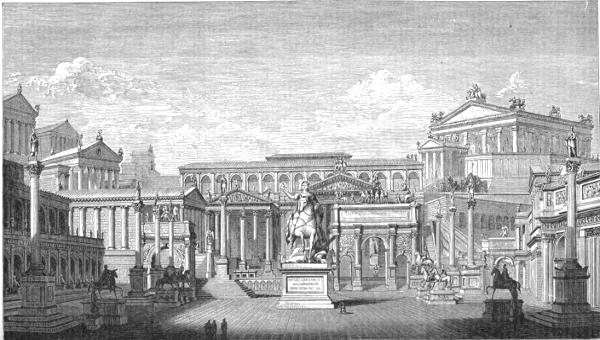
ROMAN FORUM, UNDER THE EMPERORS.
Temple of Juno Moneta. Tabularium, or Hall of Records. Temple of Concord. Temple of Jupiter Tonans. Temple of Saturn. Temple of Vespasian. Arch of Septimius Severus. Temple of Jupiter Capitolinus. Julian Basilica. Arch of Tiberius. Milliarium and Rostra. Statue of Domitian. Mamertine Prison.
The policy of Tiberius was that of many another cowardly and suspicious tyrant. Conscious of his own unworthiness, either by birth or genius, of the high place he filled, he saw a rival in every possessor of great talent or even exalted virtue. He was afraid to call to his assistance the great patricians or the princes of the Julian house, and he regarded his own relations with unmingled jealousy. As he found it impossible, however, to administer alone all the world-embracing affairs of such an empire, he raised to the post of prætorian præfect a Volsinian knight, Seja´nus, whom he fancied too mean to be dangerous, but who became, in fact, the master of the whole dominion.
187. Germanicus, meanwhile, conducted three campaigns, A. D. 14-17; and, after several disasters, gained some important victories over Arminius, between the Rhine and the Elbe. He was recalled A. D. 17, to receive the honor of a triumph, and was met, twenty miles from Rome, by an enthusiastic multitude which had poured forth to welcome him. He was, indeed, dangerously dear both to his legions and to the common people; and though he believed that in one year more he could complete the conquest of Germany, he was now transferred to another army and to the eastern wars. In his new command he settled the affairs of Armenia, and organized Cappadocia as a province; but he died A. D. 19, near Antioch in Syria, believing himself poisoned by Piso, a subordinate, who had been sent by the emperor with express orders to thwart and injure his chief.
188. Drusus, the son of Tiberius, was poisoned by order of Sejanus, who had the boldness to request permission of the emperor to marry the widow of his victim. This was refused; but Tiberius, still blinded to the marvelous ambition of the wretch who ruled him, consented to retire to Capreæ, and leave Rome in the hands of Sejanus. His time was now given up to swinish excesses, while his worthless lieutenant maintained for five years a riot of misrule. His wicked schemes did not spare the best or noblest of the imperial family; but, at length, he perceived his master’s suspicion directed toward him, and prepared to anticipate the blow by assassinating Tiberius himself. His plot was discovered, and he was suddenly seized and executed, A. D. 31.
The fall of this unworthy favorite took from Tiberius the only man whom he had ever trusted, and henceforth all were equally the objects of his fierce and cruel jealousy. Agrippina, the noble wife, as well as Nero, Drusus, and Livil´la, the unworthy sons and daughter of Germanicus, were put to death by his orders. Unlike Augustus, who scrupulously kept within the forms of law, he usurped the right to condemn without trial all who were obnoxious to him; and he extended the definition of treason to words and even thoughts. From his island retreat in the beautiful Bay of Naples, he issued destruction to men, women, and even innocent children who had the misfortune to be of sufficiently noble birth to attract his attention. It was a relief to the world when he died from illness, A. D. 37, at the age of seventy-eight.
189. Tiberius had appointed no successor, but Senate, soldiers, and people united in the choice of Caius Cæsar, the only surviving son of Germanicus and Agrippina. In his childhood he had been the pet of the legions in Germany, and from the little military boots (caligæ) which he wore to please them, he acquired the nickname Caligula. This childish appellation is the name by which he is commonly known in history. Caligula was now twenty-six years of age, and was considered to be of a mild and generous disposition. The first months of his reign justified the impression. He released the prisoners and recalled the exiles of Tiberius, and he restored power to the regular magistrates and the popular assemblies. But his weak head was turned by the possession of absolute power, and of the enormous wealth hoarded by Tiberius. In unbounded self-indulgence, he extinguished the last spark of reason, and exerted his tremendous power only for mischief, and in the most wild and reckless manner. Choosing to be considered as a god, he built a temple to himself, under the name of Jupiter Latiaris; and so servile was Rome now become, that her noblest citizens purchased the honor of officiating as priests to this worthless divinity.
The worst abuse of absolute power was shown in contempt for human life. When the supply of criminals for the public games was exhausted, the emperor ordered spectators, taken at random from the crowd, to be thrown to the beasts; and lest they should curse him in their last agonies, their tongues were first cut out. But this mad career of despotism worked its own destruction; for, in the fourth year of his reign, and the thirtieth of his age, Caius Cæsar was murdered by two of his guards.
190. The Roman world being thus suddenly without a master, the prætorians took upon themselves to decide its fate. Finding Claudius, the uncle of Caligula, a weak and timid old man, hiding himself in the palace, they saluted him as emperor, and hurried him away to their camp, where he received the oaths of allegiance. Considered from childhood as lacking in intellect, Claudius had been treated by his relatives with a contempt, and by his servants with a harshness and cruelty, which only increased the natural irresoluteness of his character. Yet, though feeble, he was a good and honest man, and the evil wrought in his reign was the work of others. His infamous wife, Messali´na, gratified her jealousy and revenge at the expense of the noblest in the state, especially the imperial princesses, without even a show of legal formality. At last she was executed for her crimes, and the emperor procured a law from the Senate which enabled him to marry his niece, Agrippina.
This princess appears to advantage only when compared with her predecessor. She recalled Seneca, the philosopher, from exile, and made him the tutor of her son, Nero. She protected many who were unjustly accused, and she advanced to power the faithful Burrhus, who proved a better servant, both to herself and her son, than either deserved. At the same time, Agrippina persuaded her husband to set aside his own son, Britan´nicus, in favor of her son by a former marriage. This youth bore his father’s name, L. Domitius Ahenobar´bus, but by the emperor’s adoption he became Nero Claudius Cæsar Drusus Germanicus. By the first of these names he is known in history as one of the most wicked of tyrants. Having gained all that she hoped from the weak compliance of Claudius, Agrippina poisoned him, and presented her son to the prætorian guards as their imperator. Some, it is said, cried out, “Where is Britannicus?” but there was no serious resistance, and the new emperor was accepted by the Senate, the people, and the provinces.
191. For the first five years, under the wise and honest administration of Seneca and Burrhus, the Romans believed that the golden age had returned. Taxes were remitted; lands were allotted to the needy and deserving. The delators, that infamous class of people who made their living by accusing others of crime, were suppressed or banished. The Roman arms prospered in Armenia, under the able command of Cor´bulo, who captured the two capitals, Artax´ata and Tigranocerta, and completely subdued the kingdom. In Germany all was quiet, and the legions on the lower Rhine had leisure to complete the embankments which protected the land from inundation.
None of this prosperity was due, however, to the character of Nero, who was a sensual and cruel tyrant even from his youth. In the second year of his reign he poisoned his foster-brother, Britannicus. A few years later, he murdered his mother, his wife, and the too faithful Burrhus, cast off the influence of Seneca, and thenceforth gave free course to his tyrannical caprices. He encouraged the informants again, and filled his treasury with the confiscated property of their victims.
192. He persecuted both Jews and Christians, charging upon the latter the great fire at Rome, which he was more than suspected of having himself caused to be kindled. By this terrible conflagration, ten of the fourteen wards, or “regions,” of the city were made uninhabitable. Nero watched the burning from a tower on the Esquiline, while, in the dress of an actor, he chanted the “Sack of Troy.” Whether or not he had ordered the destruction of Rome in consequence of his disgust with its narrow and winding streets, he wisely availed himself of the opportunity to rebuild it in more regular and spacious proportions. The houses were constructed of stone, and rendered fire-proof; each was surrounded with balconies, and separated from other houses by lanes of considerable width, while a plentiful supply of water was introduced into every tenement.
The palace of Nero having been destroyed, he built his Golden House on a scale of magnitude and splendor which Rome had never seen. The porticos which surrounded it were three miles in length; within their bounds were parks, gardens, and a lake which filled the valley afterward occupied by the Flavian Amphitheater. The chambers of this imperial mansion were gilded and inlaid with gems. The least of its ornaments, though probably the greatest of its objects, was a colossal statue of Nero himself, 120 feet in height.
193. Nero desired to be praised as a musician and a charioteer, and so far forgot his imperial dignity as to appear as an actor in the theaters. He gained prizes at the Olympic Games, A. D. 67, which had been delayed two years that he might be present. He took part, also, in the vocal performances at the Isthmian Games, on which occasion he ordered the death of a singer whose voice drowned his own. On his return, he entered Rome through a breach in the walls, after the ancient Hellenic custom; but the 1,800 garlands with which he had been laden by the servile Greeks, showed the decline of the old heroic spirit, rather than the glory of the victor.
194. The impositions of Nero caused revolts in the provinces, and, among others, Vespasian, the future emperor, was sent to pacify Judæa. But Nero was jealous of his most able and faithful officers. Cor´bulo, the conqueror of Armenia, Rufus and Scribo´nius, the commanders in Germany, were recalled, and avoided public execution only by putting themselves to death. All the generals on the frontier perceived that they could escape a similar fate only by timely revolt, and insurrections broke out at once in Germany, Gaul, Africa, and Spain. The conspirators agreed, at length, in the choice of Galba, the governor of Hither Spain, as their leader and emperor.
Nero perceived that resistance was hopeless. Deserted by the prætorians and all his courtiers, he fled from his Golden House and hid himself in the cottage of Phaon, his former slave, a few miles from the city. After spending a night and part of a day in an agony of terror, he summoned courage to end his own life, just as he heard the tramp of the horsemen who were coming to take him. He was but thirty years of age, and had reigned nearly fourteen years. With him expired the line of Augustus. The imperial power never again remained so long in any one family as it had among the members, by adoption or otherwise, of the Julian house.
RECAPITULATION.
Augustus (B. C. 30-A. D. 14) combines in himself all the dignities of the Republic, but carefully avoids the appearance of royalty. He leaves the peaceful provinces to the Senate, but assumes the command of those which are at war. The Germans, under Arminius, revolt and destroy the legions of Varus. The “Augustan Age” is distinguished for prosperity and enlightenment. Tiberius (A. D. 14-37) succeeds Augustus, but Sejanus rules the empire. Germanicus and many others are persecuted and put to death. Caius Cæsar (Caligula, A. D. 37-41) begins well, but, soon spoiled by power, exhibits “the awful spectacle of a madman, master of the civilized world.” He is succeeded by his uncle Claudius (A. D. 41-54), a weak but honest man. Agrippina, having poisoned him, makes her son Nero emperor (A. D. 54-68). Upon the death of his instructors, he proves a reckless and cruel tyrant. He rebuilds Rome with unprecedented magnificence after the great fire. Having caused the death of his best generals, he kills himself only in time to escape the vengeance of his people.
Decline of the Empire.
195. Galba, the most distinguished general of his time, had gained the favor of the emperor Claudius by refusing to assume the crown upon the death of Caligula. He had proved his ability and worth by his wise and just administration of the province of Africa, and had been honored at Rome with the highest dignities to which his patrician birth and eminent services entitled him. He was now more than seventy years of age, but learning that Nero had sent orders for his death, he resolved to rid the world of a tyrant by accepting the crown. He was a Roman of the ancient style, and the luxurious prætorians were equally disgusted with his strict discipline and his sparing distribution of money. By adopting Piso as his successor, he disappointed Otho, who easily raised a revolt against him, and the aged emperor and his adopted son were slain in the Forum, Jan. 15, A. D. 69.
196. Otho, the early favorite of Nero, had for ten years been governor of Lusitania. He was acknowledged, on the death of Galba, by the Senate and most of the provinces, but the legions in Germany had already (Jan. 3, 69) proclaimed their own general, Vitel´lius. The armies of the two generals met near the confluence of the Adda and the Po. Otho was defeated, and died by his own hand. Vitellius, having gained a crown by the skill and energy of his officers, lost it by his own unworthiness. Without the courage or ability of his predecessors, he surpassed them in contemptible self-indulgence. Vespasian, commander in Judæa, in revolting against this monster, was hailed by the acclamations of all good people, and supported by all the legions of the East. He took possession of Egypt, the grain-market of Rome, and sent his lieutenants into Italy. This time the generals of Vitellius were defeated on the Po, the capital was taken by assault, and the disgraced emperor put to death.
197. During the reign of Vespasian, order and prosperity succeeded to the storms which had convulsed the empire. The old discipline was revived, the revenues were re-organized, the capital was beautified, and the people employed by the construction of such great works as the Coliseum and the Temple of Peace. The space inclosed by Nero for his own enjoyment, was thrown open by Vespasian to the use of the people; and the materials of the Golden House served to enrich many public buildings. The revolt of the Batavians and other tribes on the lower Rhine was suppressed, A. D. 70; the Jewish War of Independence was finally subdued, the Holy City taken, and the people dispersed. Agric´ola completed the subjugation of Britain as far as the Tyne and the Solway, which he connected by earthworks and a chain of forts.
198. Titus, the son of Vespasian, having proved his military talent during the reign of his father, by the capture of Jerusalem, had been rewarded by a triumph, and by the title of Cæsar, which implied his association in the government. At the death of Vespasian, he became sole emperor without opposition. Whatever may have been his personal faults, Titus distinguished himself as a ruler by sincere and constant efforts to promote the happiness of his people. Recollecting, one evening, that he had performed no act of kindness, he exclaimed that he had lost a day.
The circumstances of his reign made peculiar demands upon the emperor’s benevolence. The beautiful Campanian towns, Hercula´neum and Pompe´ii, were destroyed by a sudden eruption of Vesuvius. A fire raged again three days and nights at Rome, followed by a general and fatal pestilence. Titus assumed the pecuniary loss as his own, and even sold the ornaments of his palace to defray the expense of rebuilding the ruined houses. He established public baths on the site of Nero’s gardens on the Esquiline, and completed the Coliseum, or Flavian Amphitheater, which he dedicated by a festival of a hundred days, including combats of 5,000 wild beasts. After a reign of but little more than two years, Titus died of a fever, having named his brother as his successor, A. D. 81.
199. Domitian was regarded by the people with more favor than he deserved, on account of the virtues of his father and brother. His nature was morose and jealous; and when his ill-success in military matters began to be contrasted with the victories of his predecessors, he became cruel and tyrannical, reviving the false accusations, forfeitures, and death-penalties of the reign of Nero. He was partially successful in his wars in Germany, but he was defeated on the Danube with great disaster, and even consented to pay an annual tribute to the Dacians, to keep them from invading Mœsia. When the cruelties of Domitian began to excite the fears of his servants, he was murdered, Sept. 18, A. D. 96.
200. The Senate now asserted a power which it had failed to exercise since the days of Augustus, by naming Nerva as sovereign. He was a childless old man, but he chose for his successor M. Ul´pius Traja´nus, a general whose vigor and ability, already shown in war, promised well for the interests of the state. It was henceforth considered the duty of the emperor to select from all his subjects the man most fit to rule, without reference to his own family, and the heir thus adopted bore the name of Cæsar. The mild, beneficent, and economical government of Nerva afforded a pleasing contrast to the severe and sanguinary rule of Domitian. Upon his death, which occurred A. D. 98, his adopted heir was immediately recognized as emperor.
201. Trajan was born in Spain, and his youth had been passed in military service. The Romans regarded him as the best of all their emperors. In personal character he was brave and generous, diligent and modest; in his policy as a ruler he was both wise and liberal. He scrupulously regarded the rights and dignities of the Senate, and treated its members as his equals. He was most diligent in hearing causes that were presented for his judgment, and in corresponding with the governors of provinces, who consulted him on all important affairs in their administration.
He managed the finances so well, that, without oppressive taxes or unjust confiscations, he always had means for the construction of roads, bridges, and aqueducts; for loans to persons whose estates had been injured by earthquakes or tempests; and for public buildings in Rome and all the provinces. The Ulpian Library and the great “Forum of Trajan,” for the better transaction of public business, among many other useful and elegant works, bore witness to his liberality. The reign of Trajan was a literary epoch only second to that of Augustus. The great historian Tacitus, the younger Pliny, Plutarch, Sueto´nius, and Epicte´tus, the slave-philosopher, were all living at this time.
202. Augustus had enjoined his heirs to regard the Rhine, the Danube, and the Euphrates as the limits of their dominion. Trajan, however, desiring to throw off the disgraceful tribute which Domitian had promised to the Dacians, made war twice against their king, Deceb´alus. He was completely victorious; the king was slain, and his country became a Roman province guarded by colonies and forts. On his return, A. D. 105, Trajan celebrated a triumph, and exhibited games during 123 days. It is said that 11,000 wild beasts were slaughtered in these spectacles, and that 10,000 gladiators, mostly Dacian prisoners, killed each other “to make a Roman holiday.”
In the later years of this reign, the Roman and the Parthian empires came into conflict for the control of Armenia. Trajan quickly reduced the latter country to a Roman province, and, in subsequent campaigns, he wrested from the Parthians the ancient countries of Mesopotamia and Assyria. Trajan died in Cilicia, A. D. 117. His ashes were conveyed to Rome in a golden urn, and placed under the column which bears his name.
203. Ha´drian began his reign by surrendering the Asiatic conquests of Trajan. During the twenty years of almost unbroken peace which marked his administration, Hadrian visited the remotest corners of his empire, studied the wants and interests of his people, and tried impartially to secure the best good of all. York in England, Athens, Antioch, and Alexandria shared with Rome the honors of an imperial capital; and each had its part of those great architectural works which, in some cases, still exist to commemorate the glory of Hadrian. A revolt of the Jews, A. D. 131-135, was ended with the banishment from Palestine of the last remnants of their race. A Roman colony, Æ´lia Capitolina, was founded upon the site of Jerusalem, to which the Christians, expelled by Titus, were freely admitted with the first of their Gentile bishops. Of all the benefits which Hadrian conferred upon the empire, the greatest, perhaps, was his choice of a successor.
204. T. Aurelius Antoni´nus came to the throne A. D. 138. His uneventful reign presents the rare example in Roman annals of twenty-three years’ undisturbed tranquillity, and is a striking example of the truth of the saying, “Happy is the people that has no history.” The happiness of his great family, for so he regarded his subjects, was the ruling purpose of his life. In Britain, the Roman boundary was pushed to its farthest northern limit during this reign, and guarded by the “Wall of Antoninus,” extending from the Frith of Forth to the Clyde.
Marcus Aurelius, the nephew of Hadrian, who, together with L. Verus, had been adopted by Antoninus, assumed the latter’s name[78] with his crown. He resembled his adoptive father in his love of religion, justice, and peace; but his reign was far less happy, owing to calamities which were beyond his power to avert. The barbarians north of the Danube began to be crowded by a new and great immigration from the steppes of Asia. The Scythic hordes, broken up from their ancient seats, we know not by what impulse or necessity, had thrown themselves upon the Germans, and these were driven across the Roman frontier, even into Italy, which they ravaged as far as Aquilei´a, on the Adriatic. The two emperors proceeded against them. Verus died in the Venetian country A. D. 169, but Aurelius remained at his post on the Danube, summer and winter, for three years. He gained a great victory over the Quadi, A. D. 174. A sudden storm, occurring during the battle, decided the result. The pagans attributed it to an intervention of Jupiter Pluvius; but the Christians, to the prayers of Christian soldiers in the “Thundering Legion.”
During the first years of the reign of Aurelius, the Parthians made a formidable attack upon the eastern provinces, destroyed an entire legion, and ravaged all Syria. The general Avidius Cassius, being sent against them as the lieutenant of Verus, more than made good the Roman losses, for he extended the boundary of the empire again to the Tigris. But after the death of Verus, Cassius was led to proclaim himself emperor, and gained possession of most of the Asiatic provinces. Before Aurelius could arrive in the East, the rebel chief was slain by his own officers, after a reign of three months. Aurelius caused his papers to be burnt without reading them, and suffered no man to be punished for his part in the rebellion.
The elevation and self-control which distinguished the emperor were owing, in great measure, to the Stoic philosophy which he studied from his twelfth year. The only blot on his character is the persecution of the Christians, which was doubtless instigated by the harsh and arrogant Stoics who surrounded him. Justin Martyr at Rome, the venerable Polycarp at Smyrna, and multitudes of less illustrious disciples at Vienna and Lyons, suffered death for their fidelity to their religion, A. D. 167-177. Marcus Aurelius died in Pannonia, A. D. 180.
205. Deceived by the youthful promise of his only son, Aurelius had associated Com´modus with him in the government at the age of fifteen. If the young prince could have enjoyed many years of training under the wise and virtuous care of his father, he might indeed have become all that was hoped of him. But the untimely death of the good Aurelius left his son at seventeen a weak, self-indulgent youth, easily controled by worthless associates. For three years the government continued in the course which Aurelius had marked out for it. But, A. D. 183, a plot for the murder of Commodus was detected, and many senators were believed to be involved. His revengeful nature, stimulated by fear, now made him a monster of tyranny. His only use of imperial power was to issue warrants for the death of all whom he suspected. Vain of his strength and skill, he assumed the name of the Roman Hercules, and exhibited himself in the amphitheater as a marksman and gladiator. At last, some of the intended victims of his proscriptions avoided their own destruction by strangling him in his bed-chamber, after he had reigned twelve years and nine months, A. D. 192.
206. The decline of the empire, which had been delayed by the Five Good Emperors—Nerva, Trajan, Hadrian, and the two Antonines—proceeded with frightful rapidity under Commodus. The armies in the provinces, tired of discipline, broke up into petty bands which robbed and murdered on their own account. One historian tells us that Peren´nis, the prætorian præfect, was deposed and slain, with his wife and children, upon the demand of 1,500 insurgent soldiers who had marched unresisted from Britain to Rome. Society was as thoroughly demoralized as the army. Except among the despised and persecuted Christians, purity of life was scarcely to be found. Poverty was creeping upon the nations through the decline of industry, but luxury and self-indulgence were more wildly excessive than ever.
RECAPITULATION.
Galba (A. D. 68, 69) offends his guards by his strict economy, and is murdered after seven months. Otho, three months emperor, is defeated by Vitellius, who reigns from April to December, A. D. 69. Vespasian (A. D. 69-79) restores peace, order, and prosperity. In his reign Jerusalem is destroyed. The short but beneficent reign of Titus (A. D. 79-81) is disturbed by great calamities—earthquake, fire, and pestilence. Domitian (A. D. 81-96) is a gloomy tyrant, disgraced abroad and detested at home. Nerva (A. D. 96-98) restores confidence, and chooses for his successor Trajan (A. D. 98-117), who is called the best and ablest of all the emperors. He gains victories north of the Danube and east of the Euphrates, thus extending the empire to the utmost limits which it ever attains. Hadrian (A. D. 117-138) visits every portion of his dominions, and diffuses every-where the blessings of peace and good government. Antoninus Pius (A. D. 138-161) enjoys a reign of unexampled tranquillity. Marcus Aurelius (A. D. 161-180), though a peaceful philosopher by choice, is involved by necessity in many wars. He generously forgives the rebellion led by Cassius, but permits a persecution of the Christians, at the instance of the Stoics. Commodus (A. D. 180-193), exasperated by a plot against his life, becomes a revengeful tyrant, and under his reckless misrule all order, industry, and safety vanish from the empire.
Second Period, A. D. 193-284.
207. By their unchecked disorders, the soldiers had learned their power, and now assumed to set up and put down emperors at their will. The murderers of Commodus proceeded to the house of Per´tinax, præfect of the city, and offered him the crown. He was a good old man, one of the few surviving friends of Marcus Antoninus, and one to whose care the young prince Commodus had been committed. He reluctantly accepted the dangerous honor, and the result justified his fears. The economy and order which he attempted to introduce, disgusted equally the amusement-loving citizens and the turbulent and grasping soldiers. Pertinax was murdered in his own palace by the prætorians, March 28, A. D. 193, after a reign of less than three months. The guards now put up the imperial crown at public auction, and sold it to Did´ius Julia´nus, a wealthy senator, for $15,000,000. The Senate acknowledged him, and he reigned more than two months at Rome. But the armies in Britain, Pannonia, and Syria, not so much offended by the scandalous insolence as encouraged by the example of their comrades at the capital, set up their own leaders, Albi´nus, Seve´rus, and Niger, as emperors.
208. Severus arrived first at Rome, gained over the prætorians by promises of donatives, and was acknowledged by the Senate. Julianus was deserted and slain in his palace. The first imperial act of Severus was to disarm the prætorians, and to banish them to a distance of 100 miles from the capital. He defeated his two rivals, the one at Cyzicus and Issus, and the other near Lyons (Lugdu´num), in Gaul; and by their death became undisputed master of the empire. Instead of the old prætorians, he garrisoned Rome with 40,000 troops chosen from the legions, and their chief, the prætorian præfect, became, next the sovereign, the most powerful person in the world; for, beside his military command, he had control of the public treasury, and great influence in the making and enforcing of the laws. Severus was an able and successful general. He extended the empire eastward by the capture of the Parthian capital, and the conquest of Adiabe´ne; and northward, by his wars against the Caledonians. He died at York, the Roman capital of Britain, A. D. 211, having reigned eighteen years.
209. The two sons of Severus, Caracal´la and Geta, had been associated by their father in his imperial dignity, and reigned together a year after his death. Then their mutual hatred broke out afresh, and after a vain attempt to divide the empire between them, Caracalla murdered Geta in the arms of their mother. In the five years of his sole reign, he proved one of the worst tyrants that Rome had known. Under the pretext of exterminating the “friends of Geta,” he massacred 20,000 persons, some of whom were the most virtuous and illustrious in the empire. Goaded by his restless conscience, Caracalla then quitted Rome, and wandered through all the eastern and northern provinces, followed every-where by a track of poverty, desolation, and death. At last he plunged into a war with Parthia, in which he had some success; but before his second campaign he was murdered by Macri´nus, his prætorian præfect, whom the guards proclaimed emperor.
210. Macrinus bestowed the title of Cæsar upon his son, and then hastened to follow up Caracalla’s victories over the Parthians. He encountered the Eastern monarch near Nis´ibis, and suffered a shameful defeat, which forced him to retire into Syria. The soldiers were now tired of their chosen imperator, whose severity of discipline was an unwelcome change from the reckless liberality of Caracalla. Julia Mæsa, sister-in-law of Severus, persuaded one division of the army to accept as their prince her grandson, Bassia´nus, whom she declared to be a son of Caracalla. He is more commonly called Elagab´alus, from the Syrian sun-god to whose priesthood he had been dedicated as a child. The wealth which Mæsa had hoarded during her residence at her sister’s court materially aided to convince the soldiers. A body of troops, sent to quell the insurrection, were also, in great measure, gained over to her wishes. A battle was fought near Antioch, in which Macrinus was defeated, and eventually slain, after a reign of fourteen months.
211. Elagabalus, or his ministers, hastened to send a letter to the Senate, in which he loaded himself with all the high-sounding titles of Cæsar, Imperator, son of Antoninus, grandson of Severus, Pius, Felix, Augustus, etc. The Romans passively admitted his claims, and the Arval Brothers offered their annual vows for his health and safety under all these names. The Syrian boy, who, at the age of fourteen, found himself thus clothed with imperial honors, was the most contemptible of all the tyrants that ever afflicted the Roman world. His days and nights were given up to gluttonous feasting and loathsome excesses.
The decorous and solemn rites of Roman religion were replaced by degrading sorceries, which were believed to be accompanied in secret by human sacrifices. The Syrian sun-god was placed above Jupiter Capitolinus himself, and all that was sacred or honorable in the eyes of the people became the object of insult and profanation. The emperor had been persuaded to confer the title of Cæsar on his cousin, Alexander Severus; but perceiving that this good prince soon surpassed him in the respect of the army, he sought to procure his death. A second attempt was fatal to Elagabalus. The prætorians murdered him and cast him into the Tiber.
212. Alexander Severus, now in his seventeenth year, was acknowledged with joy by the soldiers and the Senate. His blameless life and lofty and beneficent aims present a bright, refreshing contrast to the long annals of Roman degradation. Purity and economy returned to public affairs; wise and virtuous men received the highest offices; the Senate was treated with a deference which belonged to its ancient dignity, rather than to its recent base compliance with the whims of the army. If the power of Alexander had been as great as his designs were pure, the world might have been benefited.
A great revolution, about this time, changed the condition of Asia. The new Persian monarchy, under Artaxerxes, the grandson of Sassan, had overthrown the Parthian empire, and now aimed at the recovery of all the dominions of Darius Hystaspes. Artaxerxes actually sent an embassy to Alexander Severus, demanding the restitution to Persia of her ancient provinces between the Ægean and the Euphrates. The reply was a declaration of war. Alexander in person met the forces of Artaxerxes in the plain east of the Euphrates, and defeated them in a great battle, A. D. 232.
Hearing that the Germans were plundering Gaul, he hastened to make peace and returned to Rome. The next year he set out for Germany; but before he could begin his military operations there, he was murdered by a small band of mutinous soldiers. The virtues of Alexander were largely owing to the watchful care of his mother, in guarding his childhood from the wickedness with which he was surrounded. The prince repaid her vigilance by the most dutiful and tender regard; and it is said that her over-cautious and economical policy, which led him to withhold gifts of money demanded by the army, occasioned his death.
213. The ringleader of the mutiny was Max´imin, a Thracian peasant—a brutal and illiterate ruffian, yet with enough natural ability to cause him to be chosen emperor by his comrades. Three years this savage ruled the world, his only policy being hatred toward the noble and covetousness toward the rich; until the people of Africa, roused to fury by the extortions of his agents, revolted and crowned their proconsul, Gor´dian, and his son. The two Gordians were slain within a month; but the Senate supplied their place by two of its own number, and with unwonted spirit prepared for the defense of Italy. Maximin marched from his winter-quarters on the Danube, but he had advanced no farther than Aquileia when he was murdered in his tent by his own soldiers.
214. Though the legions had destroyed the emperor of their choice, they had no intention of yielding to that of the Senate. They murdered Pupie´nus and Balbi´nus within six weeks of their triumph over Maximin, and bestowed the imperial robes upon a younger Gordian, the grandson of the former proconsul of Africa. This boy of twelve years was intended, of course, to be a mere tool of his ministers. Timesith´eus, the prætorian præfect, was an able officer, and, so long as he lived, vigorously upheld the imperial power against Persian assaults and African insurrections. He was succeeded in command by Philip the Arabian, who artfully procured the death of the young emperor, and assumed the purple himself. He wrote to the Senate that Gordian had died of disease, and requested that divine honors should be paid to his memory.
215. Among the few events recorded of the five years (A. D. 244-249) of Philip’s reign, is the celebration of the “Secular Games” at Rome, upon the completion of a thousand years from the building of the city, April 21, A. D. 248. Rival emperors were set up by the Syrians, and by the army in Mœsia and Pannonia. Decius, a senator, was sent by Philip to appease the latter. Their mock-emperor was already dead, but the soldiers, believing their guilt too great to be forgiven by Philip, thronged around Decius with tumultuous cries of “Death or the purple!” The loyal officer, with a hundred swords at his throat, was compelled to be crowned, and to consent to lead his rebellious army into Italy. He wrote to assure his master that he was only acting a part, and would resign his mock-sovereignty as soon as he could escape his troublesome subjects. But Philip did not believe these professions of loyalty. He marched to meet the insurgents at Verona, was defeated and slain, Sept., A. D. 249.
216. The two years’ reign of Decius (A. D. 249-251) was marked by two widely different attempts to restore the ancient religion and morality of Rome—the revival of the censorship and the persecution of the Christians. It was deeply felt that the calamities of the empire were due to the corruption of its people. But the first measure produced no effect, while the second only aroused the evil passions of men, and occasioned untold misery. The bishops of Antioch, Jerusalem, and Rome became martyrs, and Alexandria was the scene of a frightful massacre. Another calamity, for which Decius was not responsible, was the first great incursion of the Goths, who ravaged the provinces of Mœsia and Thrace south of the Danube. Decius was defeated by them in A. D. 250; and the next year, in attempting to cut off their retreat, he lost his life in a great battle.
217. Gallus, an able general, was crowned by the Senate, Hostilia´nus, the son of Decius, being associated with him in the imperial dignity. Calamities thickened; pestilence raged in Rome, and fresh swarms of barbarians, only encouraged by the successes of the Goths, and the sums of money which had been paid them as the price of peace, ravaged the Danubian provinces. Hostilianus died of the plague, and the distress of the people led them to unjust accusations of the emperor. Æmilianus having defeated an army of the invaders, was proclaimed as sovereign by his troops, and, marching into Italy, defeated Gallus and his son at Interam´na. Æmilian was acknowledged by the Senate, but his reign was short. Valerian, a noble and virtuous officer, had been sent by Gallus to bring the Gallic and German legions to his aid. He arrived too late to save his master, but he defeated Æmilian near the scene of his former victory, and himself received the allegiance of Senate and people.
It was no enviable distinction, for the causes that were tending to the destruction of the empire were more numerous and fiercely active than ever. The Franks from the lower Rhine, the Aleman´ni from southern Germany, ravaged Italy, Gaul, and Spain, and even crossed the straits into Africa. The Goths had made themselves fleets from the forests of the Euxine, with which they devastated the coasts of Asia Minor and Greece, capturing and burning innumerable cities, among which were Cyzicus, Chalcedon, Ephesus, and even Corinth and Athens. The new Persian kingdom of the Sassanidæ had increased in power. Its second monarch, Sapor, conquered Armenia, and overran the Roman provinces in the East. He defeated and captured Valerian in a battle near the Euphrates, and gratified his pride by a spectacle which no monarch before had ever been able to exhibit—a Roman emperor, loaded with chains but clothed in purple, a perpetual captive at his court.
The government being thus overwhelmed with calamities, various pretenders claimed the sovereignty of the several fragments of the empire. These adventurers were known in general as the “Thirty Tyrants.” Their reigns were usually too short or too insignificant to be worthy of mention. Palmyra continued to be the royal seat of Odena´tus, and after his death, of his widow, Zenob´ia, for ten years, A. D. 264-273, inclusive. Pos´thumus established a kingdom in Gaul, which lasted seventeen years. Valerian, before his disasters in the East, had associated with him, in the cares of empire, his son Gallie´nus; but that prince could attempt little more than the defense of Italy. Aure´olus, commanding on the upper Danube, assumed the imperial title and crossed the Alps. He was defeated by Gallienus, and besieged in Milan. Through his arts, Gallienus was slain by his own soldiers; but they conferred the purple on a more honest man and better general, whom the murdered prince had named in his dying moments. Milan was taken and Aureolus put to death.
218. Though the Roman Empire seemed to be doomed to destruction, equally by disunion within and the attacks of barbarians from without, its final disruption was delayed by a succession of able emperors. Claudius, who succeeded Gallienus, A. D. 268, vanquished the Alemanni in Italy, and the Goths in Mœsia. Aurelian (A. D. 270-275) again routed the Goths in Pannonia; and then recalling the advice of Augustus, he ceded to the barbarians the provinces north of the Danube, removing the Roman inhabitants to Mœsia. He made a war against Zenobia, which ended in the capture of the “Queen of the East,” and the overthrow of her kingdom. A still more difficult enterprise awaited Aurelian in the west, where Tet´ricus, the last successor of Posthumus, had united Gaul, Spain, and Britain into one powerful monarchy. But he was conquered, and the empire was again established on the borders of the Atlantic, A. D. 274.
Aurelian was about to turn his victorious arms against the Persians, when he was assassinated by several of his officers, owing to a plot formed by his secretary, Mnes´theus. The army, indignant at the crime, applied to the Senate for a new emperor, instead of permitting any general to seize the crown. The Senate, after six months’ hesitation, during which the soldiers respectfully waited, named M. Claudius Tac´itus, a senator of vast wealth and blameless character. He would gladly have declined the laborious and perilous position, on account of his age and infirmities; but the Senate insisted, and Tacitus was crowned. All the acts of his short reign were directed to the improvement of morals, and the establishment of law and order throughout the empire. He was called away to Asia Minor, where a troop of Goths, engaged by Aurelian to serve in his Eastern expedition, were committing disorders for want of pay. They were expelled; but Tacitus, enfeebled by old age, sank under the exertion, and he died two hundred days from his accession to the throne, A. D. 276.
219. Florian, brother of Tacitus, assumed the purple at Rome, while the army in the East proclaimed Probus, their general. The soldiers of Florian, however, refused to fight their comrades, and, after three months, put their leader to death. Probus, thus undisputed master of the Roman world, was an able general and a wise and beneficent sovereign. He not only drove the Germans out of Gaul, subdued the Sarmatians, and terrified the Goths into peaceable behavior, but he provided for the security of his extended frontier by settling the border provinces with numerous colonies of barbarians, who, becoming civilized, made a barrier against further incursions of their countrymen. He wished, also, to improve waste lands by the draining of marshes and the planting of vines, and to employ in these works the dangerous leisure of his soldiers. But the legionaries did not share the thrifty policy of their emperor. They mutinied at Sir´mium, and by another murder ended the beneficent reign of Probus, A. D. 282.
220. Carus, the prætorian præfect, was hailed as emperor by the army, and conferred the title of Cæsar on his two sons, Cari´nus and Nume´rian. Leaving the former to govern the West, Carus, with Numerian, turned toward the East; first gained a great victory over the Sarmatians in Illyricum, and then proceeded to overrun Mesopotamia, and capture the two great cities of Seleucia and Ctes´iphon. He had advanced beyond the Tigris, and seemed about to overthrow the Persian kingdom, when he suddenly died, whether by lightning, by disease, or by the dagger, historians are not agreed.
His son Numerian yielded to the superstitious fears of his soldiers, and withdrew within the Roman boundaries. On the retreat he was murdered by his father-in-law, who was also prætorian præfect, and who hoped to conceal the crime until he could reap the fruits of it. But the army discovered the death of their beloved emperor, and set up Diocle´tian, the captain of the bodyguards, to avenge and succeed him.
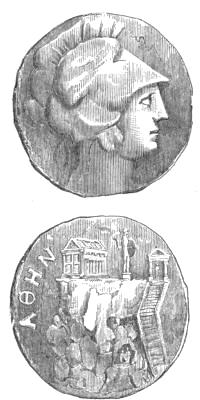
Coin of Diocletian, enlarged twice the size.
Carinus, meanwhile, reigning in the West, was dazzling the Roman world by expensive games, and insulting it by his profligacy. Hearing of the murder and usurpation, he marched with a large and well-disciplined army to meet Diocletian, and joined battle near Margus, in upper Mœsia. The Western troops were victorious, but Carinus, while leading the pursuit, was slain by one of his own officers. His followers came to an agreement with those of Diocletian, who was universally hailed as emperor.
221. His accession began a new period in the empire, when the power of the sovereigns became more absolute, ceasing to be checked either by the lawful authority of the Senate or the insolence of the soldiers. During the ninety-two years which had elapsed since the death of Commodus, the legions had claimed the privilege, not only of raising to the imperial power whomsoever they might choose, but of removing the object of their choice whenever he ceased to content them. No general who desired to be emperor dared stint his donatives, or enforce the needful severity of discipline. But for the almost constant danger from barbarians without, the army, which was the real tyrant of the Roman world, might have already put an end to all order, peace, and civil government.
RECAPITULATION.
Pertinax (A. D. 193) is crowned and murdered by the prætorians, who then sell the throne to Julianus. Severus (A. D. 193-211) buys the adhesion of the guards, and having gained the imperial power, disarms and expels them. He enlarges his dominions by conquests both in the east and west. Caracalla murders his brother, and misgoverns the empire six years, A. D. 211-217. Macrinus (A. D. 217, 218) gains and loses his crown by violence. Elagabalus (A. D. 218-222) introduces Syrian manners and worship into Rome. He is succeeded by his cousin, Alexander Severus (A. D. 222-235), who gains a great victory over the new Persian empire of the Sassanidæ, but is afterward slain in Germany during a mutiny of his troops. Maximin (A. D. 235-238), a Thracian, is set up, and in three years put down, by his comrades in the army. The two Gordians reign less than a month, Pupienus and Balbinus about six weeks, when a younger Gordian (A. D. 238-244) is invested with the purple at the age of twelve. He loses his life through the arts of Philip the Arab, who becomes emperor, and celebrates, A. D. 248, the thousandth year of the existence of Rome. Decius, being sent to quell a revolt in Pannonia, is crowned by the soldiers, A. D. 249, and Philip is slain. Two great calamities mark the reign of Decius: a persecution of Christians and an incursion of Goths. Gallus (A. D. 251-253) is deposed by Æmilianus, who is soon superseded by Valerian (A. D. 254-260). The whole empire is overrun by Gothic and German invaders. Valerian, in his wars in the East, is captured, and spends the last seven years of his life at Sapor’s court. “Thirty Tyrants” spring up in various parts of the empire. Gallienus reigns in Italy, first with his father, Valerian, and afterward alone, A. D. 254-268. He is slain through the management of a pretender, Aureolus, but is succeeded by Claudius (A. D. 268-270), who defeats the barbarians. Aurelian (A. D. 270-275) makes the Danube again the northern boundary of the empire; subdues Zenobia in the east and Tetricus in the west; is murdered on his way to Persia. Tacitus (A. D. 275, 276), being appointed by the Senate, reigns two hundred days. Florian, his brother, is deposed by his own troops. Probus (A. D. 276-282) restores security by a wise and energetic reign. Carus gains great victories in the East; but after his sudden death, his son Numerian abandons his conquests. Numerian is slain in the East, Carinus in the West, and Diocletian becomes emperor.