Part 2 / Book 3 — BOOK III. Grecian States and Colonies from their Earliest Period to the Accession of Alexander the Great. (continued 2)
Reading edition
111. Battle of Thermopylæ. On the fifth day the patience of the great king was exhausted. He sent a detachment of Medes and Cissians into the pass, with orders to bring its defenders alive into his presence. The assailants were repulsed with loss. The Immortal Band were then sent forward, but with no better success. The next day the contest was renewed, with great loss to the Persians and no signs of yielding on the part of the Greeks. But treachery now accomplished what force had failed to do.[47] A council of war was held among the defenders of the pass, and it was resolved to retreat, since defeat was certain. Leonidas did not oppose, but rather favored the decision on the part of the other generals; he only remarked that it was not permitted to Spartans to fly from any foe. He knew, too, that the Delphic oracle had declared that either Sparta must fall or a king of the blood of Hercules be sacrificed. He believed that he should save at least his hereditary kingdom, if not the whole of Greece, by the voluntary devotion of his life.
The Thespians insisted upon sharing the fate of the Spartan three hundred. The four hundred Thebans, whose loyalty had been suspected from the first, were held as hostages. The remainder of the Greeks hastily withdrew before the arrival of the Persians. Thus left alone, the Spartans and Thespians went forth to meet the immense army, which was now in motion to attack them. The Orientals, when their courage failed, were driven into battle by the lash, and thousands were doomed to perish before the desperate valor of the Greeks. At length Hydar´nes, with his Immortal Band, appeared from behind, and the Spartans drew back to the narrowest part of the pass, where they fought to the last breath, and were crushed at last by the numbers, rather than slain by the swords of the Persians.
112. The memory of Leonidas was honored by games celebrated around his tomb in Sparta, in which none but his countrymen were allowed to have part. A lion of stone was placed, by order of the Amphictyonic Council, on the spot where he fell; and other monuments at the same place preserved the memory of his brave companions. That of the Three Hundred bore these words: “Go, stranger, and tell the Spartans that we obeyed the laws, and lie here!”
113. Learning the fate of Leonidas and his men, the fleet retired southward for the protection of the coast. The Spartans acted with their accustomed selfishness, by leaving Athens and the rest of Greece to their fate, while they employed their land forces in fortifying the isthmus, to bar the entrance of their own peninsula. It was with difficulty that Themistocles even persuaded his maritime allies to remain at anchor off Salamis, long enough to allow some measures to be taken for the safety of the Athenian people.
114. Abandonment of Athens. Nor was it easy to persuade the Athenians themselves to leave their beloved city to the revengeful hands of barbarians. But as no other means remained for averting total destruction, Themistocles had recourse, as usual, to a stratagem. The serpent sacred to Athena suddenly disappeared from the Acropolis, the cakes of honey were left untasted, and the priests announced that the goddess herself had abandoned the city, and was ready to conduct her chosen warriors to the sea. The people now consented to depart. Women, children, and old men were hastily removed to places of greater security, while all who could fight betook themselves to the fleet. Only a few Athenians, either too poor to meet the expense of removal, or still convinced that the “wooden walls” of the oracle meant the citadel, remained and perished, after a brave but useless resistance, by the swords of the Persians. Beautiful Athens was reduced to a heap of ashes, in revenge for the destruction of Sardis, twenty years before.
115. The commanders of the fleet now resolved to withdraw from Salamis, and station themselves near the isthmus to coöperate with the Peloponnesian land forces. The Athenians strongly opposed this retreat, which would leave the refuges of their wives and children at the mercy of the barbarians. It was midnight, and the council had broken up, when Themistocles again sought the ship of Eurybi´ades, and convincing him at length of the greater wisdom of his own plan, persuaded him to reassemble the council. The leaders were recalled from their ships and a violent discussion ensued. The Corinthian, Adimantus, opposed Themistocles not only with argument, but with insult. Alluding to the recent destruction of Athens, he maintained that one who had no longer a city to represent should have no voice in the deliberation.
Themistocles kept his temper and replied with dignity and firmness. He showed that the naval advantages of the Greeks in the present war had always been in the narrow seas, where the immense numbers of the Persians gave them no superiority, while their better discipline and acquaintance with the currents and soundings were all in favor of the Greeks. He argued that by transferring the war to the Peloponnesus they would only attract thither the armies and ships of the Persians; while, by defeating them before they could arrive at the isthmus, they would preserve southern Greece from invasion. He ended by declaring that, if Salamis were abandoned, the Athenians would abandon Greece, and taking their wives and children on board their fleet, sail to the coasts of Italy, where the oracle had commanded them to found a new city.
116. Lest even this argument should not be sufficient, Themistocles had recourse to another of his wiles. He retired a moment from the council and dispatched a trusty messenger to the Persian fleet, assuring its commander that the Greeks, struck with consternation, were preparing to flee, and urging him to seize the opportunity, while they were divided among themselves, to gain a decisive victory. The Persian admiral knew too well the frequent dissensions of the Greeks to doubt the truth of the message. He immediately moved his squadrons to cut them off from the possibility of retreat.
In the meantime Themistocles was again called from the council by the arrival of a messenger. It was his ancient rival, the brave and upright Aristides, still in exile through the influence of Themistocles, but watchful as ever for the interests of his country. He had crossed from Ægina in an open boat to inform the Greeks that they were surrounded by the Persians. “At any time,” said the just Athenian, “it would become us to forget our private dissensions, and at this time especially, in contending only who should most serve his country.” Themistocles led him at once to the council. His intelligence was soon confirmed by a Tenian deserter, and the leaders were now forced to unite in preparation for immediate battle.
B. C. 480.
117. Battle of Salamis. When the sun arose upon the straits of Salamis, the Attic shores were seen lined with the glittering ranks of the Persian army, drawn up by order of Xerxes to intercept fugitives from the Grecian fleet. The king himself, on a throne of precious metals, sat to watch the coming contest. His ships were fully three times the number of the Greeks, and no serious disaster had yet stayed his progress. The Greeks advanced, singing that battle-song which the great poet Æschylus, who himself fought on this memorable day, has preserved for us: “On, sons of the Greeks! Strike for the freedom of your country! strike for the freedom of your children and your wives—for the shrines of your fathers’ gods, and for the sepulchers of your sires! All, all are now staked upon your strife!”
Themistocles held them back until a wind began to blow, which usually arose in the morning, causing a heavy swell in the channel. This seriously incommoded the cumbrous vessels of the Persians, while the light and compact Greek craft easily drove their brazen beaks into the sides of the enemy. The Athenians, on the right, soon broke the Phœnician line which was opposed to them; and the Spartans, on the left, gained victories over the Ionian allies of the Persians. The sea was strewn with dead bodies, entangled in the masts and cordage of the ships. Aristides, who had been waiting with his command on the coast of Salamis, now crossed to the little island of Psyt´tali´a, and put the Persian garrison to the sword. Xerxes, from his throne on Mount Ægaleos, helplessly watched the confusion and slaughter of his men. The contest lasted until evening, when the straits of Salamis were abandoned by the barbarians.
118. When morning came, the Greeks were ready to renew the battle. The Persians had still a large fleet and a numerous army; and, in the night, the Phœnician transports had been joined so as to make a bridge between Salamis and the mainland. But this was only a feint to cover the real movement. The fleet was already under orders to sail to the Hellespont, and the army retired in a few days to Bœotia. Leaving 300,000 men with Mardonius to renew the war in the following year, Xerxes hastened into Asia. His army was reduced on the way by famine and pestilence, and it was but a fragment of the great host which had crossed the Hellespont in the spring of 480, that returned in the autumn.
B. C. 479.
119. As spring opened, Mardonius prepared to renew the war; but first he sought to accomplish by diplomacy what he had hitherto failed to do by force. Deeply impressed with the valor of the Athenians, he was sure that if he could withdraw them from the confederacy, the rest of Greece would be an easy prey. To this end he sent Alexander I., king of Macedon, his ally, but a former friend of the Athenians, to flatter them with promises of favor and solicit their alliance. The Athenians refused him an audience until they had time to summon delegates from Sparta. When the Spartans had arrived, Alexander delivered his message. The great king offered to the Athenians forgiveness of the injuries they had done him, the restoration of their country and its extension over neighboring territories, the free enjoyment of their own laws, and the means of rebuilding all their temples. He urged the Athenians to embrace so favorable an offer, for to them alone of all the Greeks was forgiveness extended.
120. The Athenians replied: “We are not ignorant of the power of the Mede, but for the sake of freedom we will resist that power as we can. Bear back to Mardonius this our answer: So long as yonder sun continues his course, so long we forswear all friendship with Xerxes; so long, confiding in the aid of our gods and heroes, whose shrines and altars he has burnt, we will struggle against him for revenge. As for you, Spartans, knowing our spirit, you should be ashamed to fear our alliance with the barbarian. Send your forces into the field without delay. The enemy will be upon us when he knows our answer. Let us meet him in Bœotia before he proceed to Attica.”
121. The Athenians had rightly judged the immediateness of the danger. Scarcely was their answer received when the Persian general was in motion, and advanced by rapid marches to the borders of Attica. He was re-enforced at every halt by northern Greeks, moved either by terror of his power or by long-standing jealousies against the members of the League. The Attic territory was utterly desolate and Athens a second time deserted. Taking possession of that city, Mardonius dispatched a Greek messenger to Salamis, repeating his former propositions, which were as instantly rejected as before.
The Athenians were a second time homeless, and, for the moment, standing alone against the enemies of Greece. The Spartans were engaged in some long-continued solemnities—perhaps the funeral of their regent, Cleom´brotus—and allowed the Athenian messengers to wait ten days for an answer. Not until the indignant envoys had threatened to make terms with Mardonius and leave Sparta to her fate, did the ephors bestir themselves, but then it was with true Spartan energy and dispatch. Five thousand Spartans and 35,000 slaves were sent, under the command of Pausanias, the new regent, to whom the ephors added a guard of 5,000 heavy-armed Laconians.
122. Hearing of the advance of the Spartans, the Persian thought best to retreat. He again set fire to Athens, leveled to the ground whatever remained of its walls and temples, and retired into Bœotia. Here he arranged his camp on a branch of the Asopus, not far from the city of Platæa. The Spartans followed, having been joined at the isthmus by the Peloponnesian allies, and, at Eleusis, by the Athenians. The Greek forces occupied the lower slopes of Mount Cithæron, with the river before them, separating them from the Persians.
123. Battle of Erythræ. The battle was opened by the Persian cavalry, commanded by Masis´tius, the most illustrious general in the army, except Mardonius. His magnificent person, clad in complete scale-armor of gold and burnished brass, was conspicuous upon the battle-field; and his horsemen, then the most famous in the world for their skill and bravery, severely harassed the Megarians, who were posted on the open plain. Olym´piodo´rus with a select body of Athenians went to their assistance, and Masistius spurred his Nisæan steed across the field to meet him. In the sharp combat which followed, the Persian was unhorsed, and as he lay along the ground was assailed by a swarm of enemies. The heavy armor, which prevented his rising, protected him from their weapons, until, at length, an opening in his visor allowed a lance to reach his brain. His death decided the fate of the battle.
124. After this victory the Greek army moved nearer to Platæa, where was a more abundant supply of water and a more convenient ground. It was the strongest force which the Persians had yet encountered in Greece, numbering, with allies and attendants, 110,000 men. For ten days they lay facing each other with no important action. The Persians, however, intercepted convoys of provisions, and succeeded in choking up the spring which supplied the Greeks with water, while, by their arrows and javelins, they prevented their approach to the river. Pausanias then resolved to fall back to a level and well-watered meadow still nearer to Platæa.
B. C. 479.
125. Battle of Platæa. The Spartans were attacked while on the march, and sent immediately to the Athenians for aid. The latter marched to their assistance, but were intercepted by the Ionian allies of the Persians, and cut off from the intended rescue. Pausanias, thus compelled to engage with a small portion of his army, ordered a solemn sacrifice, and his men stood awaiting the result, unflinching, though exposed to a storm of Persian arrows. The omens were unfavorable, and the sacrifices were again and again renewed. At length Pausanias, lifting his eyes streaming with tears toward the temple of Hera, besought the goddess that if fate forbade the Greeks to conquer, they might, at least, die like men. At this moment the sacrifices assumed a more favorable aspect, and the order for battle was given.
The Spartan phalanx in one dense mass moved slowly but steadily against the Persians. The latter acted with wonderful resolution, seizing the pikes of the Spartans or snatching away their shields, while they wrestled with them hand to hand. Mardonius himself, at the head of his chosen guards, fought in the foremost ranks, and animated the courage of his men both by word and example. But he received a mortal wound, and his followers, dismayed by his fall, fled in confusion to their camp. Here they again made a stand against the Lacedæmonians, who were unskilled in attacking fortified places, until the Athenians, who had meanwhile conquered their Ionian opponents, came up and completed the victory. They scaled the ramparts and effected a breach, through which the remainder of the Greeks poured into the camp. The Persians now yielded to the general rout. They fled in all directions, but were so fiercely pursued, that, except the 40,000 of Artaba´zus, who had already secured their retreat, scarcely 3,000 escaped. The victory was complete, and immense treasures of gold and silver, besides horses, camels, and rich raiment, remained in the hands of the Greeks.
126. Mounds were raised over the brave and illustrious dead. Only to Aristodemus, the Spartan, who had incurred disgrace by returning alive from Thermopylæ, no honors were decreed. The soil of Platæa became a second “Holy Land.” Thither every year embassies from the states of Greece came to offer sacrifices to Zeus, the deliverer, and every fifth year games were celebrated in honor of liberty. The Platæans themselves, exempt henceforth from military service, became the guardians of the sacred ground, and to attack them was decreed to be sacrilege.
127. On the day of the victory of Platæa, a no less important advantage was gained by the Greeks at Mycale, in Ionia. Here a large land force, under Tigra´nes, had been stationed by Xerxes for the protection of the coast, and hither the Persian fleet retired before the advance of the Greeks. The Persians drew their ships to land, and protected them by intrenchments and strong earth-works. The Greeks, finding the sea deserted, approached near enough to make the voice of a herald heard, who exhorted the Ionians in the army of Tigranes to remember that they, too, had a share in the liberties of Greece. The Persians, not understanding the language of the herald, began to distrust their allies. They deprived the Samians of their arms, and placed the Milesians at a distance from the front to guard the path to the heights of Mycale. The Greeks, having landed, drove the Persians from the shore to their intrenchments, and the Athenians first became engaged in storming the barricades. The native Persians fought fiercely, even after their general was slain, and fell at last within their camp. All the islands which had given assistance to the Medes were now received into the Hellenic League, with solemn pledges never again to desert it.
RECAPITULATION.
Athens incurred the vengeance of the Persian king by aiding a revolt of the Asiatic Greeks. The first invasion of Greece, by Mardonius, failed; a second and larger force, under Datis and Artaphernes, ravaged Naxos and part of Eubœa, but was defeated by Miltiades and 11,000 Greeks, at Marathon. An unsuccessful attempt, upon Paros destroyed the fame of Miltiades, and he died under a charge of having received bribes from the Persians. Aristides succeeded him in popular favor, but was at length exiled through the influence of Themistocles. The latter urged the naval preparations of his countrymen, and Athens then first became a great maritime power. A congress at Corinth, B. C. 481, united the Greek forces under Spartan command. The Delphic oracle promising safety to the Athenians only within walls of wood, they abandoned their city and took refuge on the fleet. A few hundreds of Spartans and Thespians withstood the Persian host at Thermopylæ, until betrayed by a Malian guide. The invaders were totally defeated in a naval combat at Salamis, and Xerxes retired to Persia. Mardonius, failing to end the war by diplomacy, was finally overthrown in the battles of Erythræ and Platæa; and the land and naval forces of the Persians were at the same time destroyed at Mycale, in Asia Minor.
Growth of Athens.
128. Though their immediate danger was past, the Greeks did not suffer their enemies to rest. A fleet of fifty vessels was prepared, with the intention to rescue every Greek city in Europe or Asia which still felt the power of the Persian. Though Athens, as before, furnished more ships than all the other states, Pausanias commanded. He first wrested Cyprus from the Persians, and then proceeded to Byzantium, which he also liberated and occupied as a residence for seven years.
B. C. 478.
129. Siege of Sestus. The Athenians resolved to win back the colony founded by Miltiades in the Chersonesus. The whole remaining force of the Persians made a last stand at Sestus, and endured a siege so obstinate that they even consumed the leather of their harness and bedding for want of food. They yielded at last, and the natives gladly welcomed back the Greeks. Laden with treasures and secure of a well-earned peace, the Athenians returned home in triumph. Among their relics, the broken fragments and cables of the Hellespontine bridge of Xerxes were long to be seen in the temples of Athens.
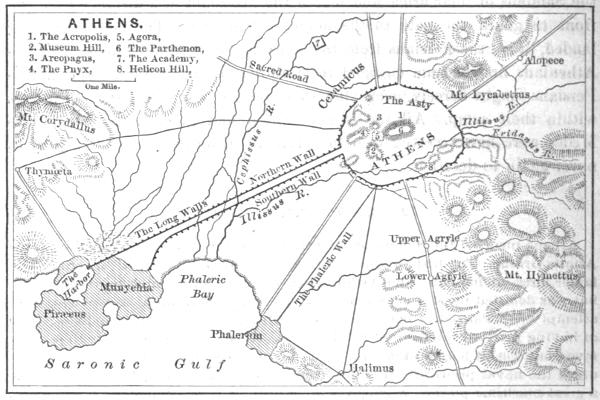
ATHENS.
130. Notwithstanding her losses, Athens came forth from the Persian wars stronger, and with a higher rank among the Grecian states, than she had entered them. Her efforts and sacrifices had called forth a power which she was scarcely conscious of possessing, and with the consent of Sparta, whose constitution illy fitted her for distant enterprises, Athens was now recognized as the leader of the Greeks in foreign affairs. In the meantime important changes had occurred in her internal policy. The power of the great families was broken, and the common people, who had borne the brunt of hardship and peril in the war, were recognized as an important element in the state. Aristides, though the leader of the aristocratic party, proposed and carried an amendment by which all the people, without distinction of rank or property, obtained a share in the government, the only requisites being intelligence and moral character. The archonship, which had hitherto been confined to the eupatrids, was now thrown open to all classes.
Themistocles was the popular leader. His first care was the rebuilding of the walls of Athens, and he provided means by levying contributions upon those islands which had given aid to the Persians. The jealous opposition of the Spartans was overcome by gold and management. To accommodate the greatly increased navy, he improved the port of Piræus and protected it by strong walls. He hoped, by building up the naval power of Athens, to place her at the head of a great maritime empire, comprising the islands and Asiatic coasts of the Ægean, thus eclipsing the Spartan supremacy on the Grecian mainland.
131. Pausanias, now commanding at Byzantium, had lost all his Spartan virtue in the pride of conquest and the luxury of wealth. After the victory at Platæa, he had engraven on the golden tripod dedicated to Apollo by all the Greeks, an inscription in which he claimed for himself the exclusive glory. His government, justly offended, caused this inscription to be replaced by another, naming only the confederate cities, and omitting all mention of Pausanias. Both the pride and the talents of the Spartan commander were too great for the private station into which he must soon descend; for though so long generalissimo of the Greeks, he was not a king in Sparta, but only regent for the son of Leonidas. The conversation of his Persian captives, some of whom were relatives of the great king, opened brilliant views to the ambition and avarice of Pausanias. His own relative, Demara´tus, had exchanged the austere life of a Spartan for all the luxury of an Oriental palace, with the government of three Æolian cities. The greater talents of Pausanias would entitle him to yet higher dignities and honors.
In view of these glittering bribes, the victor of Platæa was willing to become the betrayer of his country. He released his noble prisoners with messages to Xerxes, in which he offered to subject Sparta and the rest of Greece to the Persian dominion, on condition of receiving the king’s daughter in marriage, with wealth and power suitable to his rank. Xerxes welcomed these overtures with delight, and immediately sent commissioners to continue the negotiation. Exalted by his new hopes, the pride of Pausanias became unbearable. He assumed the dress of a Persian satrap, and journeyed into Thrace in true Oriental pomp, with a guard of Persians and Egyptians. He insulted the Greek officers and subjected the common soldiers to the lash. Even Aristides was rudely repulsed when he sought to know the reason of this extraordinary conduct.
Reports reached the Spartan government, and Pausanias was recalled. He was tried and convicted for various personal and minor offenses, but the proof of his treason was thought insufficient to convict him. He returned to Byzantium without the permission of his government, but was expelled by the allies for his shameful conduct. Again recalled to Sparta, he was tried and imprisoned, only to escape and renew his intrigues both with the Persians and with the Helots at home, to whom he promised freedom and the rights of citizenship if they would aid him to overthrow the government and make himself tyrant.
B. C. 471.
He was caught, at length, in his own snares. A man named Argilius, whom he had intrusted with a letter to Artabazus, remembered that none of those whom he had seen dispatched on similar errands, had returned. He broke the seal and found, together with much treasonable matter, directions for his own death as soon as he should arrive at the satrap’s court. The letter was laid before the ephors, and the treason being now fully proved, preparations were made to arrest Pausanias. He was warned and took refuge in the temple of Athena Chalciœ´cus. Here he suffered the penalty of his crimes. The roof was removed, and his own mother brought the first stone to block up the entrance to the temple. When he was known to be nearly exhausted by hunger and exposure, he was brought out to die in the open air, lest his death should pollute the shrine of the goddess.
132. On the first recall of Pausanias, B. C. 477, the allies had unanimously placed Aristides at their head. This was the turning-point of a peaceful revolution which made Athens, instead of Sparta, the leading state in Greece. Cautious still of awakening jealousy, Aristides named, not Athens, but the sacred isle of Delos, as the seat of the Hellenic League. Here the Congress met, and here was the common treasury, filled by the contributions of all the Grecian states, for the defense of the Ægean coasts and the furtherance of active operations against the Persians. In the assessment of these taxes, Aristides acted with so much wisdom and justice, that, though all the treasures of Greece were in his power, no word of accusation or complaint was uttered by any of the allies.
B. C. 476.
133. Having thus laid the foundation of Athenian supremacy by his moderation, Aristides retired from command, and was succeeded by Cimon, the son of Miltiades. This young noble was distinguished by his frank and generous manners, as well as by his bravery in war, which had already been proved against the Persians. The recovery of his father’s estates in the Chersonesus gave him immense wealth, which he used in the most liberal manner. He kept open table for men of all ranks, and was followed in the streets by a train of servants laden with cloaks, which they gave to any needy person whom they met. At the same time he administered to the wants of the more sensitive by charities delicately and secretly offered. Though doubtless injurious to the spirit of the Athenian people, this liberality was gladly accepted, and resulted in unbounded popularity to Cimon. His brave and sincere character commended him to the Spartans, and of all the Athenians he was probably the most acceptable leader to the allies.
134. His first expedition was against the Thracian town Ei´on, now held by a Persian garrison. The town was reduced by famine, when its governor, fearing the displeasure of Xerxes more than death, placed himself, his family, and his treasures upon a funeral pile, and perished by fire. The place surrendered, and its defenders were sold as slaves. Cimon then proceeded to Scyrus, whose people had incurred the vengeance of the League by their piratical practices. The pirates were expelled, and the place occupied by an Attic colony. As the fear of Asiatic invasion subsided, the bond between the allies and their chief relaxed. Carystus refused to pay tribute, and Naxos, the most important of the Cyclades, openly revolted. Cimon was on the alert. Carystus was subdued, and a powerful fleet was led against Naxos. The siege was long and obstinate, but it resulted in favor of Athens. The island was reduced from an ally to a subject.
B. C. 466.
135. Battle of the Eurymedon. The victorious fleet of Cimon now advanced along the southern shores of Asia Minor, and all the Greek cities, either encouraged by his presence or overawed by his power, seized the opportunity to throw off the yoke of the Persians. His force was increased by their accession when he came to the river Eurymedon, in Pamphylia, and found a Persian fleet moored near its entrance, and a powerful army drawn up upon the banks. Already more numerous than the Greeks, they were expecting reinforcements from Cyprus; but Cimon, preferring to attack them without delay, sailed up the river and engaged their fleet. The Persians fought but feebly, and as they were driven to the narrow and shallow portion of the river, they forsook their ships and joined the army on the land. Cimon increased his own fleet by two hundred of the deserted triremes, beside destroying many.
Thus victorious on the water, the men demanded to be led on shore, where the Persian army stood in close array. Fatigued with the sea fight, it was hazardous to land in the face of a superior enemy still fresh and unworn, but the zeal of the Greeks surmounted all objections. The second battle was more closely contested than the first; many noble Athenians fell, but victory came at last; the field and the spoils remained to the Greeks. To make his victory complete, Cimon proceeded to Cyprus, where the Phœnician reinforcements were still detained. These were wholly captured or destroyed, and the immense treasure which fell into the hands of the victors increased the splendor of Athens. The tide of war had now rolled back so powerfully upon Persia, that the coasts of Asiatic Greece were free from all danger. No Persian troops came within a day’s journey on horseback of the Grecian seas, whose waters were swept clear of Persian sails.
136. Aristides was now dead, and Themistocles in exile, having been ostracised in 471 B. C. Cimon was therefore both the greatest and richest of the Athenians; and while his wealth was freely used for the adornment of Athens and the pleasure of her citizens, it continually added to his power. He planted the market-place with Oriental plane-trees; laid out in walks and adorned with groves and fountains the Acade´mia, afterward made celebrated by the teachings of Plato; he erected beautiful colonnades of marble, where the Athenians long loved to assemble for social intercourse; and he caused the dramatic entertainments to be celebrated with greater elegance and brilliancy. With this increase of wealth, the tastes of the citizens became luxurious, and Athens rose from her poverty and secondary rank to be not only the most powerful, but the most magnificent of Grecian cities.
137. Though of the opposite political party to Themistocles, Cimon carried forward that statesman’s great design of exalting by all means the naval power of Athens. To this end he yielded to the request of the allies, who desired to commute their quotas of ships or men for the general defense into a money payment. Other admirals had been less accommodating, but Cimon masked a profound policy under his apparent good-nature. The forces of the other states became enfeebled by want of discipline, while the Athenians were not only enriched by their tribute, but strengthened in the hardy drill of the soldier and sailor, which Cimon never suffered them to relax.
138. The fall of Themistocles was indirectly brought about by that of Pausanias. The great Athenian, living in exile, but watchful as ever in all that concerned the interests of Greece, had entered so far into the intrigues of Pausanias as to become possessed of all his plans. The Spartan ephors, finding his letters among the papers of Pausanias, and glad of such a pretext against their old enemy, sent them to Athens, accusing him of a share in the conspiracy. The party led by Cimon and friendly to Sparta was now predominant in Athens, and the people listened too readily to these suspicions. A combined force of Spartan and Athenian troops was sent forth, with orders to seize Themistocles wherever he could be found.
B. C. 466.
The exile, after many adventures, took refuge at the court of Persia, that power which, more than any man living, he had contributed to destroy, but which was ever personally generous toward its foes. The three cities, Myus, Lamp´sacus, and Magnesia, were assigned him for his support. In the latter city he passed his remaining days in affluence and honor. Two accounts have been given of his death. The more probable one is, that when Egypt revolted and was aided by Athens (B. C. 449), the Persian king called upon Themistocles to make good his promises and begin operations against Greece. But the Athenian had only wished to escape from his ungrateful countrymen, not to injure them, and he could not help to destroy that supremacy of Athens which he had spent the best years of his life in building up. Falsehood to the great king seemed to him a less heinous crime than treason against his country. He made a solemn sacrifice to the gods, took leave of his friends, and ended his days by poison.
B. C. 465.
B. C. 464.
139. The Thasians, meanwhile, had a contest with Athens for some gold mines in Thrace. Cimon conducted a fleet to Thasos, gained a naval victory, and began a three years’ siege of the principal town. The Thasians sent to Sparta for help, and that state was preparing to render it with great alacrity, when her attention was suddenly absorbed at home by unforeseen calamities. An earthquake of unprecedented violence first destroyed the city. Great rocks from Mount Taygetus rolled into the streets, and multitudes of persons were engulfed or buried beneath the ruins of their houses. The shocks were long-continued, and terror of the supposed wrath of Heaven was added to the anguish of poverty and bereavement. The dreaded vengeance soon appeared in human form; for the persecuted Helots, hearing the signal of their deliverance in the stroke of doom to Sparta, flocked together from the fields and villages, and mingled their revenge with the commotions of Nature.
It was a terrible moment for Sparta; but her king, Archidamus, was true to the stern valor of his race. The shocks of the earthquake had hardly ceased, when he ordered the trumpets to sound to arms. Even at that fearful moment Spartan discipline prevailed. Every man who survived hastened to the king, and when the disorderly, servile crowd approached, they found a disciplined force ready to resist them. Sparta was saved for the moment; the insurgents fled and scattered themselves over the country, calling to their standard all who were oppressed. The Messenians rose in a mass, seized Ithome, where their never-forgotten hero, Aristomenes, had so long withstood the Lacedæmonian arms, fortified it anew, and formally declared war against Sparta. The ten years’ conflict which followed is known as the Third Messenian War (B. C. 464-455).
In her extremity, Sparta sent to Athens for aid, and the appeal produced a violent controversy between the two parties into which that city was divided. Cimon favored the Spartans; he had always held up their brave and hardy character as a model to his countrymen, and had even sacrificed much of his popularity by naming his son Lacedæmonius. When others urged that it was well the pride of Sparta should be humbled, and her power for mischief curtailed, Cimon exhorted his countrymen not to suffer Greece to be maimed by the loss of one of her two great powers, thus depriving Athens of her companion. His generous counsel prevailed, and Cimon led a strong force against the insurgents, who were now driven from the open country and compelled to shut themselves up in the castle of Ithome.
140. The influence of Cimon had greatly declined at Athens. The democratic party had recovered from its loss in Themistocles, for a new leader was arising whose popularity and services to the state were destined to eclipse even the great men who had preceded him. This was Per´icles, the son of that Xanthippus who had impeached Miltiades. His mother was niece of Clisthenes, who is called the second founder of the Athenian constitution. Born of an illustrious family, and educated in all the opportunities of Athenian camps and schools, Pericles was said to have nothing to contend against except his advantages. His beautiful face, winning manners, and musical voice reminded the oldest citizens of Pisistratus; and the vigilance with which the Athenians guarded their liberties, turned the admiration of some into jealousy. Pericles, however, made no haste to enter on his public career, but prepared himself by long and diligent study for the influence he hoped to attain. He sought the wisest teachers, and became skilled in the science of government, while he cultivated his gifts in oratory by training in all the arts of expression.
Anaxag´oras, the first Greek philosopher who believed in one supreme Intelligence, creating and governing the universe, was the especial friend and instructor of Pericles, and to his sublime doctrines men attributed the elevation and purity of the young statesman’s eloquence. Instead of relying solely upon the wisdom of his counsels, like Themistocles, or upon his natural gifts, like Pisistratus, Pericles chose every word with care, and was the first who committed his orations to writing, that he might subject every sentence to the highest polish of which it was capable. The Athenian people, the most sensitive, perhaps, to beauty of style of any that ever existed, enjoyed with keen delight the clear reasoning and brilliant language which characterized the discourses of Pericles. Nor was his perfection of detail gained by any sacrifice of energy. His public speaking was compared to thunder and lightning, and he was said to carry the weapons of Zeus upon his tongue. Above all, the sweetness of his temper, and the command which philosophy had enabled him to gain over his passions, gave him advantage over less disciplined orators. The fiercest debate or the most insulting interruptions never disturbed for a moment the cheerful and dignified composure of his manner.
141. Thasos surrendered B. C. 463; its walls were leveled, its shipping transferred to the Athenians, and all its claims upon the Thracian gold mines were given up. The people were compelled to pay all their arrears of tribute to the Delian treasury, beside engaging to meet their dues punctually in future.
B. C. 461.
142. A second time the Spartans asked the aid of Athens in their servile war, and Cimon again led an army to their relief. But the superiority of the Athenians in siege operations aroused the envy of the Lacedæmonians, even when employed in their defense; and the long siege of Ithome afforded time for the rivalries of the two nations to break out into open feuds. The Spartans declared that they had no further need of the Athenians, and dismissed their troops. Other allies were retained, including Ægina, the ancient rival of Athens. The latter, considering herself insulted, made an alliance with the Argives and the Aleuads of Thessaly against Sparta. The Hellenic treasury was removed from Delos to Athens, for safe keeping, it was said, against the needy and rapacious hands of the Spartans.
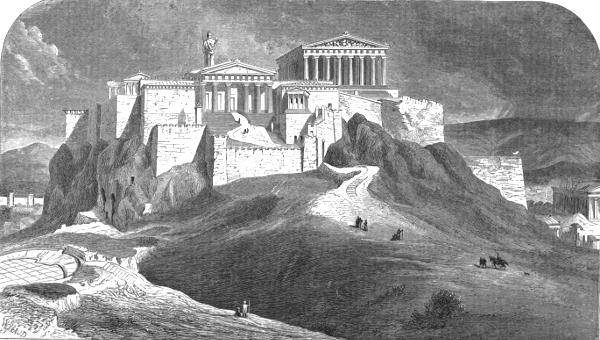
WEST VIEW OF THE ACROPOLIS.
Pelasgian Walls. Erechtheum. Athena Promachos. Parthenon. Walls of Cimon.
Cave of Pan. Propylæa. Temple of Nike Apteros.
The popular resentment naturally extended itself to Cimon. The favor with which he was regarded in Sparta was now his greatest crime. The Athenians had indeed some reason to fear, for the Spartan nobles always maintained a party in their city who were supposed to be secretly plotting against its free government. However honestly Cimon supported aristocratic principles, the people, with equal honesty and greater wisdom, opposed him. He was subjected to the ostracism and banished for ten years.
RECAPITULATION.
The power of Athens was increased by the Persian war; and her home government, which had been confined to the nobles, was thrown open to the people. Themistocles rebuilt the walls and improved the harbor. Pausanias, becoming a traitor, died of starvation in the temple of Athena, at Sparta. Athens became the chief of the Hellenic League, whose seat and treasury were at Delos. Cimon, son of Miltiades, in command of the allied forces, captured Eion, cleared Scyros of pirates, subdued rebellions in Carystus and Naxos, and conquered the Persians, both on sea and land, in the battle of the Eurymedon. He beautified Athens by a liberal use of his enormous wealth, and improved the military and naval discipline of his fellow-citizens, at the expense of their allies. Themistocles, exiled through suspicion, took refuge in the Persian dominion, where he died. Sparta suffered a double calamity, in an earthquake and a servile rebellion, known as the Third Messenian War. Her insulting treatment of her Athenian aids destroyed the popularity of Cimon; and Pericles, the most accomplished of the Athenians, rose into power.
Supremacy of Athens.
143. Athens, under the lead of Pericles, now entered upon the most brilliant period of her history. A dispute between Megara and Corinth involved Athens on the former and Sparta on the latter side, and thus led to the First Peloponnesian War (B. C. 460-457). At the same time, a more distant enterprise tempted the Athenians. Egypt had now cast off the last semblance of obedience to Persia, and hailed a deliverer and sovereign in the person of Inarus. In looking about him for allies, Inarus naturally sought the aid of those who, at Marathon, had first broken the power of the Persians. The Athenians engaged gladly in the war, and sent a fleet of two hundred triremes to the Nile. The events of the campaign have been recorded in the History of Persia.[48]
B. C. 457.
144. The war in Greece went on with great vigor. The Athenians were defeated at Halæ, but soon after won a naval battle at Cec´ryphali´a,[49] which more than retrieved their reputation. Ægina now joined in the war, and the Athenians landed upon the island and besieged the city. A Peloponnesian army came to the aid of Ægina, while the Corinthians seized the opportunity to invade Megaris. With all her forces employed either in Egypt or Ægina, they hoped that Athens would be overcome by this new attack. But Myron´ides mustered an army of boys and old men exempt from service, and marched at once to the assistance of Megara. In the battle which ensued, neither party acknowledged itself defeated, but the Corinthians withdrew to their capital, while the Athenians held the field and erected a trophy. Unable to bear the reproaches of their government, the Corinthian army returned after twelve days and raised a monument upon the field, claiming that the victory had been theirs. But the Athenians now attacked them anew, and inflicted a decisive and disgraceful defeat.
145. In the midst of these enterprises abroad, great public works were going on in Athens. Cimon had already planned a line of fortifications to unite the city with its ports, and the spoils of the Persians, taken at the Eurymedon and at Cyprus, had been assigned for the expense. Under the direction of Pericles, the building began in earnest. One wall was extended to Phalerum, and another to Piræus; but as it was found difficult to defend so large an inclosed space, a second wall to Piræus was added, at a distance of 550 feet from the first. Between these Long Walls a continuous line of dwellings bordered the carriage-road, nearly five miles in length, which extended from Athens to its principal harbor.
146. The Spartans were still too much absorbed in the siege of Ithome to interfere with the great and sudden advancement of Athenian power; but a disaster which befell their little ancestral land of Doris, in war with the Phocians, withdrew their attention even from their own troubles. An army of 1,500 heavy-armed Spartans and 10,000 auxiliaries, sent to the relief of the Dorians, drove the Phocians from the town they had taken, and secured their future good behavior by a treaty. The retreat of the Spartans was now cut off by the Athenian fleet in the Gulf of Corinth and the garrison in the Megarid. Their commander, Nicome´des, had, however, reasons beyond the necessity of the case for remaining a while in Bœotia. He was plotting with the aristocratic party in Athens for the return of Cimon, and he also desired to increase the power of Thebes, as a near and dangerous rival to the former city.
B. C. 457.
The conspiracy becoming known, the Athenians were roused to revenge. They raised an army of 14,000 men and marched against Nicomedes, at Tan´agra. Both sides fought with equal bravery and skill, and the victory was undecided until the Thessalian cavalry deserted to the Spartans. The Athenians and their allies still held out for some hours, but when the contest ended with the daylight, the victory remained with their adversaries. Nicomedes reaped no other fruit from his victory than a safe return home, but Thebes gained from it an increase of power over the cities of Bœotia.
B. C. 456.
147. Battle of Œno´phyta. The Athenians were only spurred to fresh exertions. The brave Myronides entered Bœotia two months after the battle of Tanagra, and gained at Œnophyta one of the most decisive victories ever achieved by Greeks. The walls of Tanagra were leveled with the ground. Phocis, Locris, and all Bœotia, except Thebes, were brought into alliance with Athens. These alliances were rendered effective by the establishment of free governments in all the towns, which, for self-preservation, must always range themselves on the side of Athens; so that Myronides could boast that he had not only subdued enemies, but filled central Greece with garrisons of friends.
B. C. 455.
148. Soon after the completion of the Long Walls, in 456, the island of Ægina submitted at last to Athens. Her shipping was surrendered, her walls destroyed, and the life-long rival became a tributary and subject. A fleet of fifty Athenian vessels, commanded by Tol´mides, cruised around the Peloponnesus; burned Gyth´ium, a port of Sparta; captured Chalcis, in Ætolia, which belonged to Corinth, and defeated the Sicyonians on their own coast. Returning through the Corinthian Gulf, they captured Naupac´tus, in western Locris, and all the cities of Cephallenia.
In the same year, the tenth of its siege, Ithome surrendered to the Spartans. So long and brave a defense won the respect even of bitter enemies. The Helots were reduced again to slavery, but the Messenians were permitted to depart in safety to Naupactus, which Tolmides presented them from the fruits of his victories.
149. In Egypt, the resistance of the Athenians to the Persians ended the same year, but not until after long and desperate adventures. When the citadel of Memphis was relieved by a Persian force, the Greeks withdrew to Prosopi´tis, an island in the Nile around which their ships lay anchored. The Persians following, drained the channel, and thus left the ships on dry land. The Egyptian allies yielded, on this loss of their most effective force; but the Athenians, after burning the stranded vessels, retired into the town of Byblus, resolved to hold out to the last. The siege continued eighteen months. At last the Persians marched across the dry bed of the channel and took the place by assault. Most of the Athenians fell; a few crossed the Libyan desert to Cyrene, and thus returned home. A fleet of fifty vessels, which had been sent to their relief, came too late, and was defeated by the Persians and Phœnicians.
B. C. 449.
150. Other enterprises of the Athenians at this time were scarcely more successful, and Cimon, who had now been recalled from exile, used all his influence in favor of peace. A five years’ truce was made with Sparta in 451 B. C. The Isle of Cyprus was the next object of Athenian ambition. Divided into nine petty states, it seemed to offer an easy conquest; and as the Persian king still claimed the sovereignty, the enterprise was but a renewal of ancient hostilities. Cimon sailed from Athens with a fleet of two hundred vessels; and in spite of the Persian force of three hundred ships which guarded the coast of Cyprus, he landed and gained possession of many of its towns. While besieging Citium the great commander died. By his orders his death was concealed from his men, until they had gained another signal victory, both by land and sea, in his name. The naval battle occurred off the Cyprian Salamis—a name of good omen to the Athenians.
B. C. 448.
151. A slight incident about this time brought on renewed hostilities with Sparta. The city of Delphi, though on Phocian soil, claimed independence in the management of the temple and its treasures. The inhabitants were of Dorian descent, and were, therefore, closely united with the Spartans. Where the interests of Greece were divided, the great influence of the oracle was always on the side of the Doric as opposed to the Ionic race. The Athenians did not therefore object when their allies, the Phocians, seized the Delphian territory and assumed the care of the temple. The Spartans instantly undertook what they called a holy war, by which they expelled the Phocians and reinstated the Delphians in their former privileges. Delphi now declared itself a sovereign state; and to reward the Spartans for their intervention, conferred upon them the first privilege in consulting the oracle. This decree was inscribed upon a brazen wolf erected in the city. The Athenians could not willingly resign their share in a power which, through the superstition of the people, was often able to bestow victory in war and prosperity in peace. No sooner had the Spartans left the sacred city, than Pericles marched in and restored the temple to the Phocians. The brazen wolf was now made to tell another tale, and award precedence to the Athenians.
152. At this signal of war, the exiles from various Bœotian cities, who had been driven out by the establishment of democratic governments, joined for a concerted movement. They seized Chærone´a, Orchom´enus, and other towns, and restored the oligarchic governments which the Athenians had overthrown. These changes caused great excitement in Athens. The people clamored for immediate war; Pericles strongly opposed it: the season was unfavorable, and he considered that the honor of Athens was not immediately at stake. But the counsel of Tolmides prevailed, and with a thousand young Athenian volunteers, assisted by an army of allies, he marched into Bœotia. Chæronea was soon subdued and garrisoned with Athenians.
B. C. 447.
B. C. 445.
Flushed with its speedy victory, the army was returning home, when, in the vicinity of Coronæa, it fell into an ambush and suffered a most signal and memorable defeat. Tolmides himself, with the flower and pride of the Athenian soldiery, was left dead upon the field. A large number of prisoners were taken, and to recover these the government had to enter into a treaty with the new oligarchies, and withdraw its forces from Bœotia. Locris and Phocis lost their free institutions and became allies of Sparta. The island of Eubœa threw off the Athenian yoke, and other subject islands showed signs of disaffection. At the same time, the five years’ truce with Sparta expired, and that state prepared with new zeal to avenge its humiliation at Delphi.
153. Pericles, whose remembered warnings against the Bœotian war only heightened the respect and confidence of the people, now acted with energy and promptness. He landed in Eubœa with a sufficient force to reduce that island, but had scarcely crossed the channel when he learned that the Megarians were in revolt. Aided by allies from Sicyon, Epidaurus, and Corinth, they had put all the Athenian garrisons to the sword, except a few in the fortress of Nisæa, and all the Peloponnesian states had combined to send an army into Attica. To meet this greater danger, Pericles returned home. The Peloponnesian army soon appeared, under the young Spartan king, Plisto´anax; but instead of the decisive operations that were expected, it only plundered the western borders of Attica, and retired without striking a blow. Plistoanax and his guardian were accused, on their return, of having accepted bribes from the Athenians; and as both fled the country, rather than meet the prosecution, we may presume that the charge was just. Returning to Eubœa, Pericles reduced the island to complete subjection, and established a colony at Histiæa.
B. C. 445.
154. All parties now desired peace. A thirty years’ truce was concluded between Athens and Sparta, in which the former submitted to the loss of her empire on land. The foothold in Trœzene, the right to levy troops in Achaia, the possession of the Megarid, the protectorate of free governments in central Greece, all were given up. But the losses of the war had fallen most heavily on the party which began it, while Pericles stood higher than ever in the esteem of his fellow-citizens. Thucyd´ides,[50] a kinsman of Cimon, and his successor as leader of the aristocracy, was summoned to the ostracism, and when he rose to make his defense he had not a word to say. He was banished, and retired to Sparta, B. C. 444.
155. Pericles now united all parties, and for the rest of his life held supreme control of affairs. The nobles respected him as one of their own order; the merchants and alien settlers were enriched by his protection of trade; the shippers and sailors, by his attention to maritime affairs; artisans and artists, by the public works he was incessantly carrying on; while the ears of all classes were charmed by his eloquence, and their eyes by the magnificent buildings with which he adorned the city. At this time was erected the Parthenon, or temple of Athena the Virgin, adorned by Phidias with the most beautiful sculptures, especially with the colossal statue of the goddess in ivory and gold, forty-seven feet in height. The Erechtheum, or ancient sanctuary of Athena Polias, was rebuilt; the Propylæ´a, of Pentelic marble, erected; and the Acropolis now began to be called the “city of the gods.”
B. C. 440.
156. Only three islands in the neighboring seas now maintained their independence, and of these the most important was Samos. The Milesians, who had some cause of complaint against the Samians, appealed to the arbitration of Athens, and were joined by a party in Samos itself which was opposed to the oligarchy. The Athenians readily assumed the judgment of the case, and as Samos refused their arbitration, resolved to conquer the island. Pericles with a fleet proceeded to Samos, revolutionized the government, and brought away hostages from the most powerful families. But no sooner was he departed than some of the deposed party returned by night, overpowered the Athenian garrison, and restored the oligarchy. They gained possession of their hostages, who had been deposited on the Isle of Lemnos, and being joined by Byzantium, declared open war against Athens.
157. When the news of this event reached Athens, a fleet of sixty vessels was immediately sent forth, Pericles being one of the ten commanders. Several battles were fought by sea, and the Samians were at length driven within the walls of their capital, where they endured a nine months’ siege. When at last they were forced to yield, they were compelled to destroy their fortifications, surrender their fleet, give hostages for their future conduct, and pay the expenses of the war. The Byzantines submitted at the same time. Athens was completely triumphant; but the terror she had inspired was mixed with jealousy. During the revolt, the rival states had seriously discussed the question of aiding the rebels; and it was decided in the negative mainly by the influence of Corinth, which, though no friend to Athens, feared that the precedent might be remembered in case of a revolt of her own colonies.
B. C. 435.
158. Corcyra, a colony of Corinth, had itself founded, on the Illyrian coast, the city of Epidamnus. This city, attacked by the Illyrians, led by some of her own exiled nobles, sent to Corcyra for aid, but was refused, as the exiles belonged to the party in power in the mother city. The Epidamnians now resorted to Corinth, which undertook their defense with great energy. Corcyra, alarmed in turn, applied to Athens for assistance. Opinions were divided in the assembly, but that of Pericles prevailed, who urged that war could not in any case be long delayed, and that it was more prudent to make it in alliance with Corcyra, whose fleet was, next to that of Athens, the most powerful in Greece, than to be driven at last to fight at a disadvantage.
Considering, however, that Corinth, as an ally of Sparta, was included in the thirty years’ truce, it was resolved to make only a defensive alliance with Corcyra; i.e., to render assistance in case its territories should be invaded, but not to take part in any aggressive action. A naval battle soon occurred off the coast of Epirus, in which the Corinthians were the victors, and prepared to effect a landing in Corcyra. Ten Athenian vessels were present, under the command of Lacedæmonius, son of Cimon, and they were now, by the letter of their agreement, free to engage. But suddenly, after the signal of battle had been given, the Corinthians drew back and stood away for the coast of Epirus. Twenty Athenian ships had appeared in the distance, which they imagined to be the vanguard of a large fleet. Though this was a mistake, it had the effect of preventing further hostilities, and the Corinthians returned home with their prisoners.
B. C. 432.
159. Incensed at the interference of Athens, the Corinthians sought revenge by uniting with Prince Perdic´cas of Macedonia, to stir up revolts among the Athenian tributaries in the Chalcidic peninsulas. A battle ensued at Olynthus, in which the Athenians were victorious over the Corinthian general, and blockaded him in Potidæa, where he had taken refuge.
A congress of the Peloponnesian states was held at Sparta, and complaints from many quarters were uttered against Athens. The Æginetans deplored the loss of their independence; the Megarians, the crippling of their trade; the Corinthians, that they were overshadowed by the towering ambition of their powerful neighbor. At the same time, the Corinthians contrasted the restless activity of Athens with the selfish inertness of Sparta, and threatened that if the latter still delayed to do her duty by the League, they would seek a more efficient ally.
The envoys having departed, Sparta decided to undertake the war. Before proceeding to actual hostilities, it was thought best to send messengers to Athens, demanding, among other things, that she should “expel the accursed” from her presence—referring to Pericles, whose race they chose to consider as still tainted with sacrilege. But Pericles replied that the Spartans themselves had heavy accounts to settle on the score of sacrilege, not only for starving Pausanias in the sanctuary of Athena, but for dragging away and murdering the Helots who had taken refuge, during the late revolt, in the temple of Posidon. The other demands were rejected, though with more hesitation. They concerned the independence of Megara and Ægina, and, generally, the abdication by Athens of her position as head of the League. The Athenians declared that they would refrain from commencing hostilities, and would make just satisfaction for any infringement on their part of the thirty years’ truce; but that they were ready to meet force with force.
B. C. 431.
160. War in Bœotia. While both parties hesitated to begin the war, the Thebans precipitated matters by a treacherous attack upon the city of Platæa. This city, instead of joining the Bœotian League, had been in friendly alliance with Athens, and was hence regarded with great jealousy by the Thebans. A small oligarchical party in Platæa favored the Thebans, and it was Naucli´des, the head of this party, who, at dead of night, admitted three hundred of them into the town. The Platæans were roused from sleep to find their enemies encamped in their market-place; but though scattered and betrayed, they did not yield. They secretly communicated with each other by breaking through the walls of their houses; and having thus formed a plan for defense, fell upon the enemy a little before daybreak.
The Thebans were exhausted by marching all night in the rain; they were entangled in the narrow, crooked streets of the town; and even women and children fought against them by hurling tiles from the roofs. The reinforcement which they expected was delayed, and before it arrived the three hundred were either slain or captured. The Thebans without the walls now seized whatever persons and property they could lay their hands on, as security for the release of the prisoners. The Platæans sent a herald to declare that the captives would be immediately put to death, unless the ravages should cease; but that, if the Thebans would retire, they should be given up. The marauders withdrew, but the Platæans, instead of keeping their word, gathered their movable property into the town, and then put all their prisoners to death. Fleet-footed messengers had already been sent to Athens with the news. They returned with orders to the Platæans to do nothing of importance without the advice of the Athenians. It was too late, however, to save the lives of the prisoners or the honor of their captors.
RECAPITULATION.
In the First Peloponnesian War (B. C. 460-457), Athens was allied with Megara; Sparta and Ægina, with Corinth. At the same time, the Athenians aided a revolt of Egypt against Persia, and built long walls to connect their city with its ports. Sparta, interfering in a war between Phocis and Doris, defeated the Athenians at Tanagra; but the latter gained a more decisive victory at Œnophyta, which brought Phocis, Locris, and all Bœotia, except Thebes, into their alliance. Ægina was conquered and made tributary to Athens. Ithome surrendered to Sparta; the Helots were re-enslaved and the Messenians exiled. In a new war, occasioned by the interference of Sparta at Delphi, the Athenians, under Tolmides, gained some advantages, but were disastrously defeated at Coronæa, with great loss of influence in central Greece. Assailed at once by rebellions in Eubœa and Megaris, and by a Spartan invasion, Pericles defeated the latter by bribes and the former by arms. The peace which followed was concluded on terms unfavorable to Athens. Being called to aid a popular revolution in Samos, the Athenians captured its chief city and re-established their own influence. Epidamnus, in war with her mother city, was aided by Corinth; while Athens, taking the part of Corcyra, defeated the Corinthians at Olynthus, and besieged them two years in Potidæa. A more general war was hastened by the mutual treachery of the Thebans and Platæans.
The Peloponnesian War.
B. C. 431-404.
161. All Greece now prepared for war—a war of twenty-seven years, which was to be marked by more calamities and horrors than Hellas had ever yet endured. On the side of Sparta fought all Peloponnesus, except Argos and Achaia, together with Megara, Bœotia, Phocis, Opuntian Locris, Ambracia, Leucadia, and Anactoria. Athens had for allies, on the mainland, Thessaly and Anactoria, with the cities of Naupactus and Platæa. There were also her tributaries on the coast of Thrace and Asia Minor, and on the Cyclades, beside her island allies, Chios, Lesbos, Corcyra, Zacynthus, and, later, Cephallenia.
B. C. 431.
162. Archidamus, king of Sparta, having collected his allies at the isthmus, marched into the Attic territory about the middle of June. The inhabitants quitted their fields, and with all the property they could remove, took refuge within Athens and the Piræus. Every corner and recess of the city walls became a dwelling. In the market-place, the public squares, and the precincts of the temples, temporary habitations arose, and the poorer sort found shelter in tents, huts, and even casks, placed against the Long Walls. Among this crowded population, violent debates arose concerning the conduct of the war. Great indignation was felt against Pericles for the inaction of the army, while Archidamus was ravaging the fields almost under their eyes.
But the leader had resolved to carry the war out of Attica. For this purpose a combined fleet of Athenians and Corcyræans sailed around the Peloponnesus, disembarking troops at various points to ravage the country. Two Corinthian settlements in Acarnania were captured, and the island of Cephallenia transferred its allegiance from Sparta to Athens. The Æginetans were expelled, and their island occupied by Athenian settlers. Archidamus, after five or six weeks, marched out of Attica and disbanded his army. The Athenians then put their forces in motion to punish the Megarians, whom they considered as revolted subjects. They laid waste the whole territory to the gates of the capital, and the devastations were renewed every year while the war continued.
B. C. 430.
163. The next spring, with a new Spartan invasion, brought a still greater calamity to the Athenians. The plague, originating in Ethiopia, had traveled along the Asiatic coasts of the Mediterranean until it reached their city, where the crowded condition of the people made it spread with frightful rapidity. A terror seized the populace, some of whom believed that their enemies had poisoned the wells, while a greater number ascribed the pestilence to the wrath of Apollo, who was the especial protector of the Dorian race.
164. In their passion of despair the Athenians turned against Pericles, whose cautious policy they considered as the cause of their misfortunes. Though still refusing battle, which, with the reduced numbers and exhausted spirit of the army, would have been almost certain defeat, he actively pushed his operations against the Peloponnesus. To relieve the crowded city of its mischievous elements, he fitted out a fleet and led it in person to ravage the enemy’s coasts. On his return he found the opposition stronger than ever, and an embassy had even been sent to Sparta to sue for peace. The suit had been contemptuously rejected, and the rage of the Athenians was only increased. Pericles persuaded them to persevere in the war, but his eloquence was unavailing to silence the fury of his personal enemies. By the influence of Cleon, his chief opponent, he was even accused of embezzling the public funds, and was fined to a large amount.
B. C. 429.
165. But the life and adversities of the great statesman were alike near their end. The plague had robbed him in of his nearest relatives. A lingering fever, following an attack of the pestilence, terminated his life. As he lay, seemingly unconscious, the friends surrounding his death-bed were rehearsing his great deeds, when the dying man interrupted them, saying, “All that you are praising was either the result of good fortune, or, in any case, common to me with many other leaders. What I chiefly pride myself upon is, that no Athenian has ever mourned on my account.”
B. C. 430.
166. The second Lacedæmonian foray was more destructive than the first, for the ravages extended over all Attica, even to the silver mines of Laurium. The fleet of the Peloponnesians destroyed the fisheries and commerce of Athens, and devastated the island of Zacynthus. During the following winter Potidæa surrendered, after a blockade of two years, and was occupied by a thousand Athenian colonists.
B. C. 429.
The third campaign of the Spartans was directed against Platæa. On the approach of Archidamus, the Platæans sent a solemn remonstrance, reminding him of the oath which Pausanias had sworn on the evening of their great battle, making Platæa forever sacred from invasion. The king replied that the Platæans, too, were bound by oath to labor for the independence of every Grecian state. He reminded them of their heinous crime in the slaughter of the Theban prisoners, but promised that, if they would abandon the cause of Athens and remain neutral during the war, their privileges should be respected. The Platæans refused to forsake their ancient ally, and the siege of their city began.
B. C. 429-427.
167. The garrison which thus defied the whole Peloponnesian army, consisted of only 480 men, but they made up in energy what they lacked in numbers. Archidamus began by shutting up every outlet of the town with a palisade of wood, then erected against this a mound of earth and stone, forming an inclined plane, up which his troops could march. The Platæans undermined the mound, which fell in, and thus defeated seventy days’ work of the whole besieging army. They also built a new wall within the old one, so that, if this were taken, the Spartans would still be no nearer the possession of the city.
Seeing that the will of the Platæans could only be subdued by famine, the allies now turned the siege into a blockade. They surrounded the city with a double wall, and roofed the intervening space, so as to afford shelter to the soldiers on duty. The Platæans thus endured a complete separation from the outer world for two years. Provisions began to fail; and, in the second year, nearly half the garrison made their escape, by climbing over the barracks and fortifications of their besiegers in the rain and darkness of a December night. The Platæans, though thus reduced in numbers, came at length to absolute starvation. A herald now appeared from the Spartan commander, requiring their submission, but promising that only the guilty should be punished. They yielded. When brought before the five Spartan judges, every man was found guilty and led to execution. The town and territory of Platæa were made over to the Thebans, who destroyed all private dwellings, and with the materials erected a huge barrack, to afford shelter to visitors, and dwellings to the serfs who cultivated the land. The city of Platæa was blotted out from the map of Greece.
B. C. 429.
168. The Athenians, with their ally Sital´ces, a Thracian chief, were warring in the north with little success. Sitalces, with an irregular but powerful host of 150,000 Thracians, invaded Macedonia with the intention of dethroning Perdiccas. The Macedonians, unable to meet him in the open field, withdrew into their fortresses, and Sitalces, who had no means for conducting sieges, retired after thirty days. Phor´mio, an Athenian captain, gained two victories, meanwhile, in the Corinthian Gulf, over a vastly superior number of Spartans. In the first engagement he had but twenty ships, to the Spartan forty-seven; in the second, without reinforcements, he met a fresh Spartan fleet of seventy-seven sail.
B. C. 428.
The fourth year of the war was marked by the revolt of Mytilene, capital of Lesbos. Envoys were sent to Sparta to implore assistance, which was willingly granted, and the Mytilenians were received into the Peloponnesian League.
169. In the spring of 427, the Spartan fleet advanced to Mytilene, but it arrived only to find the town in the possession of the Athenians. Nearly reduced by famine, the governor, by the advice of a Spartan envoy, had armed all the men of the lower classes for a last desperate sortie. The result was contrary to his expectations. The mass of the Mytilenian people preferred the Athenian supremacy to that of their own oligarchic government. Emboldened by their arms, they declared that they would treat directly with the Athenians, unless all their demands were granted. The governor had no choice but to open negotiations himself. The city was surrendered, and the fate of its inhabitants was left to be decided by the popular assembly in Athens, whither the ring-leaders of the revolt were sent.
170. A thousand Athenians assembled in the Agora to decide the fate of their prisoners. Salæ´thus, the Spartan envoy, was instantly put to death. With regard to the rest, a spirited debate ensued. Cleon the tanner, the former opponent of Pericles, took a prominent part; and in spite of more humane and moderate counsels, actually succeeded in carrying his brutal proposition, to put to the sword all the men of Mytilene, and sell the women and children into slavery. Iniquitous as such an order would be in any case, it was the more so in this, because the greater number of the Mytilenians were friendly to Athens, while the revolt had been the act of the oligarchy, who were enemies of the people. So strong had been the opposition, that Cleon feared a reversal of the sentence, and therefore had a galley instantly dispatched to Lesbos, with orders for its immediate execution.
His apprehensions were well founded. A single night’s reflection filled the better sort of Athenians with horror at the inhuman decision into which they had been hurried. They demanded a new assembly to reconsider the question; and though this was contrary to law, the strategi consented and convened the citizens. In the second day’s debate the atrocious decree was rescinded. Every nerve was now strained to enable the mercy-bearing barque to overtake the messengers of death, who were a whole day’s journey in advance. The strongest oarsmen were selected, and urged to their greatest exertion by the promise of large rewards if they should arrive in time. Their food was given them while they plied the oar, and sleep was allowed them only in short intervals, and by turns. The weather proved favorable, and they arrived just as Paches, who had received the first dispatch, was preparing for its execution. The Mytilenians were saved, but the walls of their city were leveled, and its fleet surrendered to the Athenians. The island of Lesbos, with the exception of Methym´na, which had refused all share in the revolt, was divided into 3,000 parts, of which 300 were devoted to the gods, and the rest assigned by lot to Athenian settlers. The prisoners at Athens were tried for their share in the conspiracy, and put to death.
B. C. 427.
171. The Corcyrean prisoners who had been carried to Corinth in 432, were now sent home, in the hope that their account of the generous treatment they had received would induce their countrymen to withdraw from the Athenian alliance. They joined with the oligarchical faction to effect a revolution in Corcyra, killed the chiefs of the popular party, gained possession of the harbor, the arsenal, and the market-place, and thus, by overawing the people, obtained a vote in the assembly to maintain in future a strict neutrality. The people, however, fortified themselves in the higher parts of the town, and called to their aid the serfs from the interior of the island, to whom they promised freedom.
The oligarchists set fire to the town, but while it was burning a small Athenian squadron arrived from Naupactus, and its commander attempted, with great wisdom, to make peace between the contending parties. He had to all appearance effected this design, when a Peloponnesian fleet, more than four times as numerous as his own, appeared, under the command of Alci´das. The Athenians withdrew without loss, and Alcidas had Corcyra for the moment in his power; but with his usual want of promptness, he spent a day in ravaging the island, and, at night, beacon fires on Leucas announced the approach of an Athenian fleet outnumbering his own. Alcidas drew off before daybreak, leaving the oligarchists in the city to their fate. The next seven days were a reign of terror in Corcyra. The popular party, protected by the presence of the Athenians, abandoned itself to revenge. Civil hatred was stronger than natural affection. A father slew his own son; brothers had no pity for brothers. The aristocratic party was nearly exterminated; but five hundred escaped, and fortified themselves on Mount Isto´ne, near the capital.
B. C. 426.
172. The sixth year of the war opened with floods and earthquakes, which seemed an echo in nature of the moral convulsions of Greece. The plague was raging again at Athens. To appease the wrath of Apollo, a solemn purification of the isle of Delos, his birth-place, was performed in the autumn. All bodies that had been buried there were removed to a neighboring island, and the Delian festival was revived with increased magnificence. The usual Spartan invasion of Attica had been prevented this year, either by awe of the supposed wrath of the gods, or by fear of the plague; but in the seventh year of the war (B. C. 425), their king, Agis, again crossed the borders and ravaged the country. He was recalled, after fifteen days, by the news that the Athenians had established a military station on the coast of Messenia.
173. A fleet bound for Sicily, under Eurymedon and Sophocles, had been delayed for a time by a storm, near the harbor of Pylos. The commanders selected this place for a settlement of Messenians from Naupactus, who would thus be able to communicate with their Helot kinsmen, and harass the Spartans. Demosthenes was left with five ships and two hundred soldiers, who were increased, by a reinforcement of Messenians, to a thousand men. The wrath of the Spartans was only equaled by their alarm at this infringement of their territory. Their fleet was instantly ordered from Corcyra, while Agis, with his army, marched from Attica. The long and narrow island of Sphacte´ria, which covered the entrance to the Bay of Pylos, was occupied by Thrasymel´idas, the Spartan, while his ships were sheltered in the basin which it inclosed. Demosthenes, while awaiting reinforcements, had to meet a vastly superior number with his handful of men. The attack from the sea was led by Bras´idas, one of the greatest captains whom Sparta ever produced. He fought on the prow of the foremost vessel, urging his men forward by looks and words; but he was severely wounded, and the battle ended with no advantage to the Spartans. It was renewed the second day with no better success, and the Athenians erected a trophy, which they ornamented with the shield of Brasidas.
B. C. 425.
The arrival of the Athenian fleet was followed by a severe and still more decisive battle. The victorious Athenians proceeded to blockade Sphacteria, which contained the choicest Peloponnesian troops. So serious was the crisis, that the ephors saw no escape except to sue for peace. An armistice was agreed upon, and the better spirits on both sides began to hope for a termination of the war. But the foolish vanity of Cleon and his party demanded the most extravagant terms, and the voice of reason was drowned. Hostilities re-commenced, with equal vexation to both parties. Demosthenes, fearing that the storms of winter would interrupt his blockade, resolved to make an attack upon the island, and sent to Athens explaining his position and demanding reinforcements. The report was disheartening to the Assembly, which now began to accuse Cleon for having persuaded it to let slip the occasion for an honorable peace. Cleon retorted by accusing the officers of cowardice and incapacity, and declared that, if he were general, he would take Sphacteria at once! At this boast of the tanner, the whole assembly broke out into laughter, and cries, “Why don’t you go, then?” were heard on all sides. The lively spirits of the Athenians recovered with a bound from their unusual depression, and the mere joke soon grew into a purpose. Cleon tried to draw back, but the Assembly insisted. At last he engaged, with a certain number of auxiliaries added to the troops already at Pylos, to take the island in twenty days, and either kill all the Spartans upon it, or bring them in chains to Athens.
174. Singular as were the circumstances of Cleon’s commission, his success was equally remarkable. Demosthenes had made all ready for the attack; and to his prudence, aided by the accidental burning of the woods on Sphacteria, rather than to the generalship of Cleon, the victory was due. The Athenians, landing before daybreak, overpowered the guard at the southern end of the island, and then drew up in order of battle, sending out parties of skirmishers to provoke the enemy to a combat. The Spartan general, blinded by the light ashes raised by the march of his men, advanced, with some difficulty, over the half-burnt stumps of the trees. He was greatly outnumbered by his assailants, who harassed him from a distance with arrows, and forced him at length to retire to the extremity of the island. Here the Spartans fought again with their accustomed bravery; but a party of Messenians, who had clambered over some crags usually deemed inaccessible, appeared upon the heights above, and decided the fate of the battle. All the surviving Spartans surrendered, and Cleon and Demosthenes, setting out immediately after the battle, arrived at Athens with their prisoners within the twenty days. This victory was one of the most important that the Athenians had gained. The harbor of Pylos was strongly fortified and garrisoned with Messenian troops, for a base of operations against Laconia.
B. C. 424.
175. At the beginning of the eighth year the Athenians were every-where triumphant, and the Spartans, humbled and distressed, had repeatedly asked for peace. Nicias, in the early part of the year, conquered the island of Cythera, and placed garrisons in its two chief towns, which were a continual defiance of the Lacedæmonians. He then ravaged the coasts of Laconia, and captured, among other places, the town of Thyr´ea, where the Æginetans, after their expulsion from their own island, had been permitted to settle. Those of the original exiles who survived were carried to Athens and put to death. The brutalizing influences of war were more apparent every year, and these cold-blooded massacres had become almost of common occurrence.
The Spartans, about the same time, alarmed by the nearness of the Messenian garrisons of Pylos and Cythera, gave notice that those Helots who had distinguished themselves by their faithful services during the war, should be set at liberty. A large number of the bravest and ablest appeared to claim the promise. Two thousand of these were selected as worthy of emancipation, crowned with garlands, and dignified with high religious honors. But in a few days they had all disappeared, by means known only to the Spartan ephors—men unmoved, either by honor or pity, from their narrow regard to the supposed interest of the state.
B. C. 424.
176. The success of the Athenians did not entirely desert them in their Megarian expedition, but their attempt upon Bœotia resulted only in disaster. The chief movement was executed by Hippoc´rates, who led an army of more than 32,000 soldiers across the Bœotian frontier to Delium, a place strongly situated near Tanagra, among the cliffs of the eastern coast. Here he fortified the temple of Apollo, and placing a garrison in the works, set out for home. The Bœotians had collected a large army at Tanagra, which now moved to intercept the Athenians upon the heights of Delium. The battle commenced late in the day. The Athenian right was at first successful, but their left was borne down by the Theban phalanx. In their ranks were Socrates, the philosopher, and his pupils, Alcibi´ades and Xenophon, all destined to the highest fame in Grecian history. At length the Bœotian cavalry appeared, and decided the fortunes of the day. The Athenians fled in all directions, and only the fall of night prevented their complete destruction. Delium was taken by siege after seventeen days.
177. Soon after these disasters, the Athenians lost all their dominion in Thrace. Brasidas had led a small but well chosen army to the aid of Perdiccas and the Chalcidian towns. The bravery and integrity of this great general led many of the allies of Athens to forsake her party, and when he suddenly appeared before Amphipolis, that city surrendered with scarcely an attempt at resistance. Thucydides,[51] the historian, was general in that region. The Athenian party in Amphipolis sent to him for aid, but he arrived too late. For this failure, whether proceeding from necessity or carelessness, the general was sentenced to banishment, and spent his next twenty years in exile, during which he contributed more by his literary work to the glory of Greece, than he would probably have done in military command. Brasidas proceeded to the easternmost of the three Chalcidian peninsulas, and received the submission of nearly all the towns.
The Athenians were now so disheartened by their losses, that they, in turn, began to propose peace; and the Spartans, anxious for the return of their noble youths who were prisoners in Athens, were equally desirous of a treaty. To this end a year’s truce was agreed upon, in 423, to afford time for permanent negotiations. Unhappily, two days after the beginning of the truce, Scio´ne revolted from the Athenians, who demanded its restitution. The Spartans refused, and the whole year was suffered to pass away without any further efforts toward peace. At its expiration, Cleon advanced into Thrace with a fleet and army. He took the towns of Toro´ne and Galepsus, and was proceeding against Amphipolis, when a battle ensued which ended at once his life and his assumption of power. Brasidas, too, was mortally wounded, but he lived long enough to know that he was victorious.
178. Peace of Nicias. The two great obstacles to peace were now removed, and, in the spring of 421, a treaty for fifty years, commonly called the “Peace of Nicias,” was concluded between Athens and Sparta. Some allies of the latter complained that Sparta had sacrificed their interests to her own, and formed a new league, with Argos for their head. Athens made a new alliance for a hundred years with Argos, Elis, and Mantine´a, B. C. 420.
RECAPITULATION.
In the greater Peloponnesian war (B. C. 431-404), nearly all central and southern Greece were allied with Sparta; most of the maritime states, with Athens. Within the latter city were crowded most of the people of Attica, in terror of the Spartan invasions. Great numbers died of the plague; its most illustrious victim was Pericles. A two years’ blockade of Platæa, by the Spartans, ended with the annihilation of the city. The revolt of Lesbos was subdued by Athens, and the Mytilenians were condemned to death, but the revengeful sentence was reversed. A revolution in Corcyra resulted in a seven days’ massacre of the aristocratic party. A solemn purification of Delos was performed, to mitigate the plague at Athens. The Athenians established a colony at Pylos, to harass Laconia, and were victors in several naval battles. Cleon, the tanner, with Demosthenes, the general, conquered the Spartans at Sphacteria. Nicias captured Cythera, and garrisoned its towns. The brutal character of the war was shown in the massacre of exiled Æginetans at Athens, and of two thousand Helots at Sparta. The disastrous battle or Delium ended the invasion of Bœotia by the Athenians, who lost, at the same time, all their possessions in Thrace. The Peace of Nicias was concluded B. C. 421, and Athens made a new league with some former allies of Sparta.
The Sicilian Expedition.
B. C. 420.
179. From two previous celebrations of the Olympic Games the Athenians had been excluded, but, in the summer of this year, the Elean heralds appeared again to invite their attendance. Those who looked to see Athens poverty-stricken, from her many losses, were surprised at the magnificence of her delegates, who made the most costly display in all the processions. Alcibiades entered on the lists seven four-horse chariots, and received two olive crowns in the races. This young man was among the ablest citizens that Athens ever possessed. His genius, bravery, and quickness in emergencies might have made him her greatest benefactor; but, through his unregulated ambition and utter lack of conscience, he became the cause of her greatest calamities.
180. War soon broke out between the Spartans and the Argives, in which the Spartan king, Agis, won the important battle of Mantinea, B. C. 418. The oligarchical party, gaining power at Argos, cast off the alliance with Athens, and made a treaty with Sparta. But the nobles abused their power in brutal outrages upon the people, who effected another revolution and obtained possession of the city. By their request, Alcibiades came to their aid with a fleet and army. Though the Spartans and Athenians were nominally at peace, the garrison of Pylos was still committing depredations in Laconia, and Spartan privateers were seriously injuring Athenian commerce.
181. About this time, an embassy from Sicily besought the aid of the Athenians for the city of Egesta. It was involved in a contest with its neighbor, Selinus, which had obtained help from Syracuse. The “war of races” had, indeed, broken out twelve years before in Sicily, and the Athenians had more than once sent aid to the Ionian cities, Leonti´ni and Camari´na, against their Dorian neighbors, who had joined the Peloponnesian League. Alcibiades threw his whole influence into the cause of Egesta, hoping at once to improve his wasted fortunes with Sicilian spoils, and gratify his ambition with the glory of conquest. He even hoped, beside making Athens supreme over all the Hellenic colonies, to conquer the empire of Carthage, in the western Mediterranean.
Nicias and all the moderate party opposed the enterprise. They only prevailed in having an embassy sent to Egesta, to ascertain if its people were really able to fulfill their promise of furnishing funds for the war. The envoys were completely outwitted. In the temple of Aphrodite they saw a magnificent display of vessels which appeared to be solid gold, but were really silver-gilt. They were feasted at the houses of citizens, and were surprised by the profusion of gold and silver plate which adorned their sideboards, not suspecting that the same articles were passing from house to house, and doing repeated service in their entertainment. Sixty talents of silver were paid as a first installment, and the commissioners went home with glowing accounts of Egestan wealth.
B. C. 415.
182. All doubt disappeared from most minds in Athens, and Nicias, Alcibiades, and Lamachus were appointed to lead an expedition to Sicily. The zeal of the Athenians knew no bounds. Young and old, rich and poor, alike demanded a share in the great expedition. The generals had difficulty in selecting from the throng of volunteers. The fleet was on the point of sailing, when a mysterious event threw the excited multitude into consternation. The Hermæ, which stood before every door in Athens, before every temple or gymnasium, and in every public square, were found one morning reduced to shapeless masses of stone. Not one escaped. The people, in an agony of superstitious horror, demanded the detection and punishment of the criminal. Suspicion fell upon Alcibiades, because he was known to have burlesqued the Eleusinian mysteries in a drunken frolic, and was supposed to be capable of any sacrilege. He indignantly denied his guilt, and demanded an immediate examination. But his enemies contrived to have it postponed until his return, thus sending him out under the burden of an unproved charge, which might be revived for his condemnation in case of disaster.
183. On the day appointed for the sailing of the armament, nearly the whole population of Athens accompanied the soldiers on their march at day-break to Piræus. When all were on board, the trumpet commanded silence, and the voice of the herald, in unison with that of the people, was heard in prayer. The pæan was then sung, while the officer at the prow of each vessel poured a libation from a golden goblet into the sea. At a given signal, the entire fleet slipped its cables and started at the utmost speed, each crew striving to be first at Ægina.
184. The whole armament of Athenians and allies mustered at Corcyra in July, 415. It numbered 136 vessels of war and 500 transports, carrying 6,300 soldiers, beside artisans and a large provision of food and arms. When the fleet approached the coast of Italy, three fast-sailing triremes were sent to notify the Egestæans of its arrival, and to learn their present condition. These rejoined the fleet at Rhegium, with the unwelcome report that the wealth of Egesta was wholly fictitious, and that thirty talents more were the extent of the aid to be expected. The three admirals were now divided in opinion. Nicias was for sailing at once to Selinus, making the best terms possible, and then returning home. Alcibiades proposed to seek new allies among the Greek cities, and with their aid to attack both Selinus and Syracuse. Lamachus urged an immediate attack upon the latter city, the greatest and wealthiest on the island. This counsel was at once the boldest and the safest, for the Syracusans were unprepared for defense, and their surrender would have decided the fate of the island; but, unhappily, Lamachus was neither rich nor influential. His plan was disregarded, and that of Alcibiades adopted.
185. The fleet, sailing southward, reconnoitered the defenses of Syracuse, and took possession of Catana, which became its headquarters. At this point, Alcibiades received from Athens a decree of the Assembly, requiring his return for trial. A judicial inquiry had acquitted him of the mutilation of the Hermæ, but he was still charged with profaning the Eleusinian Mysteries, by representing them at his own house for the entertainment of his friends. This was an unpardonable crime, and those noble families which had derived from their heroic or divine ancestors an especial right to officiate in the ceremonies, felt themselves grossly insulted. The public trireme which brought the summons to Alcibiades, was under special orders not to arrest him, but to suffer him to return in his own vessel. The wily general availed himself of this courtesy to effect his escape. Landing at Thurii, he eluded his pursuers, and the messengers returned to Athens without him. Here in his absence he was condemned to death, his property confiscated, and the Eumolpidæ solemnly pronounced him “accursed.”
186. The Athenians had spent three months in Sicily with so little effect, that the Syracusans began to regard them with contempt. Nicias, thus shamed into attempting something, spread a report that the Catanæans were inclined to expel the Athenians from their city, and thus drew a large army from Syracuse to their aid. During its absence from home, the whole Athenian fleet sailed into the Great Harbor of Syracuse, and landed a force which intrenched itself near the mouth of the Anapus. A battle followed on the return of the Syracusans, and Nicias was successful. Instead of following up this advantage, he retired into winter-quarters at Catana, and afterward at Naxos, while he sent to Athens for a supply of money, and to his Sicilian allies for a re-enforcement of men.
The Syracusans spent the winter in active preparation. They built a new wall across the peninsula, between the Bay of Thapsus and the Great Port, covering their city on the west and north-west. They sent, at the same time, to Corinth and Sparta for help, and found in the latter city an unexpected ally. Alcibiades had crossed from Italy to Greece, and had received a special invitation to Sparta. Here he indulged his spite against his countrymen by revealing all their plans, and urging the Spartans to send an army into Sicily to disconcert their movements.