Part 2 / Book 5 — BOOK V. History of Rome, from the Earliest Times to the Fall of the Western Empire, A. D. 476.
Reading edition
GEOGRAPHICAL SKETCH OF ITALY.
1. Italy, bounded by the Alps, and the Adriatic, Ionian, and Tyrrhe´nian seas, is the smallest of the three peninsulas of southern Europe. It is inferior to Greece in the number of its harbors and littoral islands, but excels it in the richness and extent of its plains and fertile mountain-sides, being thus better fitted for agriculture and the rearing of cattle than for maritime interests. Still, from its long and narrow shape, Italy has an extended coast-line; the slopes of the Apennines abounded, in ancient times, with forests of oak suitable for ship-timber; and the people, especially of Etru´ria, were early attracted to the sea.
2. The Alps, which separate Italy from the rest of Europe, have had an important effect upon her history. At present they are traversed securely by less than a dozen roads, which are among the wonders of modern engineering. In early times they formed a usually effectual barrier against the barbarous nations on the north and west. The Apennines leave the Alpine range near the present boundary between Italy and France, and extend in a south-easterly and southerly direction to the end of the peninsula, throwing off lateral ridges on both sides to the sea, and forming that great variety of surface and climate which is the peculiar charm of the country. A multitude of rivers contribute vastly to the fertility of the soil, though, from their short and rapid course, they are of little value for navigation. Varro preferred the climate of Italy to that of Greece, as producing in perfection every thing good for the use of man. No barley could be compared with the Campa´nian, no wheat with the Apu´lian, no rye with the Faler´nian, no oil with the Vena´fran.
3. Northern Italy lies between the Swiss Alps and the Upper Apennines, and is almost covered by the great plain of the Po, which is one of the most fertile regions of Europe. It comprised, in the most ancient times, the three countries of Ligu´ria, Upper Etruria, and Vene´tia. The second of these divisions, together with some portions of the Ligurian and Venetian territories, was conquered, in the sixth century before Christ, by a Celtic population from the north and west, and was thenceforth known as Cisalpine Gaul. The region north of the Apennines does not belong to Roman or even Italian history until about the time of the Christian Era, when it became incorporated in the territories of Rome.
4. The peninsula proper is divided into the two regions of central and southern Italy, by a line drawn from the mouth of the Tifer´nus, on the Adriatic, to that of the Sil´arus, on the western coast. Central Italy comprised six countries, of which three, Etruria, La´tium, and Campania, were on the Tyrrhenian Sea, and three others, Um´bria, Pice´num, and the Sabine country, on the Adriatic. Etruria was, in the earliest times, the most important division of Italy proper. It was separated from Liguria by the river Macra; from Cisalpine Gaul, by the Apennines; and from Umbria, the Sabine territory, and Latium, by the Tiber.
Latium, lying south of Etruria, was chiefly a low plain; but its surface was varied by spurs of the Apennines on the north, and by the Vol´scian and Alban ranges of volcanic origin in the center and south. It included the Roman Campagna, now a solitary and almost treeless expanse, considered uninhabitable from the noxious exhalations of the soil, but during and before the flourishing period of Rome, the site of many populous cities. Several foreign tribes occupied portions of the Latin territory, among whom the Volsci, on the mountains which bear their name, and the Æqui, north of Prænes´te, were best worthy of mention. In the view of history, a cluster of low hills—seven east and three west of the Tiber—which constitute in later ages the site of Rome, is not only the most important part of Latium, but that which gives its significance to all the rest.
5. Campania was a fertile and delightful region, extending from the Liris to the Silarus, and from the Apennines to the sea. Greek and Roman writers never wearied of celebrating the excellence of its harbors, the beauty of its landscape, the exuberant richness of its soil, and the enchanting softness of its air. The coast is varied by the isolated cone of Vesu´vius and a range of volcanic hills, including the now extinct crater of Solfata´ra. Umbria was a mountainous country east of Etruria. Before the coming of the Gauls, it extended northward to the Ru´bicon and eastward to the Adriatic; but its coast was wholly conquered by that people, who drove the Umbrians beyond the mountains.
Picenum consisted of a flat, fertile plain along the Adriatic, and a hilly region, consisting of twisted spurs of the Apennines, in the interior. Poets praised the apples of Picenum, and its olives were among the choicest in Italy. The Sabine territory, at its greatest extension, was 200 miles in length, and reached nearly from sea to sea. It was inhabited by many tribes, probably of common origin. Beside the Sabines proper, were the Sam´nites, the Frenta´ni, and the Marsi, Mar´ruci´ni, Pelig´ni, and Vesti´ni, who formed the League of the Four Cantons. The Sabine country, though rough, was fertile, and its wine and oil chiefly supplied the common people of Rome.
6. Southern Italy included four countries: Luca´nia and Brut´tium on the west, Apulia and Cala´bria on the east. Lucania is a picturesque and fertile country, watered by many rivers. Bruttium is of similar character, and was especially valued in old times for its pine forests, which, from their timber and pitch, yielded an important revenue to the Roman government. Both countries attracted multitudes of Greek colonists, whose cities early rose to a high degree of wealth and civilization. (See Book III, §§ 87, 90.) Apulia, unlike any other division of central or southern Italy, consists chiefly of a rich, unbroken plain, from twenty to forty miles in width, gently sloping from the mountains to the sea. In ancient times it maintained great numbers of horses and sheep, the latter of which were famed for the fineness of their wool. When the plain became parched by summer heats, the flocks were driven to the neighboring mountains of Samnium; while, in winter, the Samnite flocks forsook their bleak and snowy heights to find pasturage in the rich meadows of Apulia. The northern portion of Apulia is mountainous, being traversed by two strong spurs of the Apennines, one of which projects into the sea and forms the rocky headland of Mount Garga´nus.
Calabria,[62] called by the Greeks Iapyg´ia or Messa´pia, occupied the long peninsula which is commonly called the heel of Italy. Its soft limestone soil quickly absorbs moisture, rendering the country arid, and the heats of summer intense. The products of the soil were, however, in ancient times, abundant and of great value. Its oil, wine, and honey were widely celebrated, the wool afforded by its flocks was of the finest quality, and the horses which recruited the Tarentine cavalry were among the most excellent in the world.
7. Italy possessed three islands of great importance: Sicily, noted for its excellent harbors and inexhaustible soil; Sardin´ia, for its silver mines and harvests of grain; and Cor´sica, for its dense forests of pine and fir. The position as well as the valuable productions of these islands, early tempted the enterprise of both Greeks and Carthaginians; and rivalry in their possession first drew these nations into hostility with each other, and with the ultimately victorious power of Rome.
HISTORY OF ROME.
8. Our history in this Book falls naturally into three divisions:
I. The Roman Kingdom, B. C. 753-510.
II. The Roman Republic, ” 510-30.
III. The Roman Empire, ” 30-A. D. 476.
The records of the First Period, so far as they relate to persons, are largely mixed with fable, and it is impossible to separate the fanciful from the real. The student is recommended to read the stories of the kings, in their earliest and most attractive form, in Dr. Arnold’s History of Rome. Under their beautiful mythical guise, these legends present, doubtless, a considerable amount of truth. Our limits only admit a statement of the popular ancient belief concerning the rise of Rome, among the other and older nations which inhabited Italy.
9. Central and southern Italy were occupied, from the earliest known times, by three races, the Etrus´cans, Italians, and Iapygians. The latter were nearly related to the Greeks, as has been proved by their language and the identity of their objects of worship. They therefore mingled readily with the Hellenic settlers (see § 6), and Greek civilization quickly took root and flourished throughout southern Italy. The Italians proper—so called because, when united, they became the ruling race in Italy—arrived later in the peninsula than the Iapygians. They came from the north, and crowded into closer quarters the half-Hellenic inhabitants of the south. They consisted of four principal races: the Umbrians, Sabines, Oscans, and Latins. Of these the first three were closely connected, while the Latins were distinct. The latter formed a confederacy of thirty cities, or cantons, and met every year on the Alban Mount to offer a united sacrifice to Jupiter Latia´ris, the protecting deity of the Latin race. During this festival wars were suspended, as in Elis during the Olympic Games.
10. The Etruscans, or Tuscans, were wholly different in language, appearance, and character from the other nations of Italy. Their origin is wrapped in mystery. Some suppose them to have been Turanian, and thus allied to the Lapps, Finns, and Estho´nians of northern Europe, and the Basques of Spain; others, and the greater number, believe the mass of the people to have been Pelasgi—that race which overspread Greece and Italy at a remoter period than history can reach—but to have been absorbed and enslaved by a more powerful people from the north, who called themselves Ras´ena, while they were named by others Etruscans. History first finds these invaders in Rhæ´tia, the country about the head-waters of the Ad´ige, the Danube, and the Rhine; then traces them to the plain of the Po, where, at a very early period, they formed a league of twelve cities; and thence south of the Apennines into Tus´cany, which, reduced in limits, still bears their name.
Here they formed a similar but quite distinct confederacy of the same number of cities. For a time their dominion extended across the peninsula, and their fleets commanded both the “Upper” and the “Lower Sea,” the latter of which derived from them its ancient name, Tyrrhenian. They conquered Campania, and built there a third cluster of twelve cities, of which Cap´ua was the chief; but they lost this portion of their territory in wars with the Samnites. Many relics of Etruscan art exist, in the massive walls of their cities, their castings in bronze, figures in terra-cotta, and golden chains, bracelets, and other ornaments, which prove them to have been a luxurious and wealthy people. Their religion was of a gloomy and superstitious character. They sought to know the will of their gods by auguries drawn from thunder and lightning, from the flight of birds, or from the entrails of slain beasts; and to avert their wrath by sacrifices prescribed and regulated by an elaborate ritual. To learn these rites formed a large part of the education of a young Tuscan noble.
11. The Romans, who were destined to be for nearly twelve centuries the dominant race of Italy and the world, belonged to the Latin branch of the Italian family. A Greek tradition celebrated by Virgil, and believed by most Romans in the days of the empire, traced their origin to a company of Trojan emigrants, led to the shores of Italy by Æne´as, son of Anchises, after the fall of Troy. (See Book III, § 14.) But the Latin coast was at that time densely populated, and the new comers, if any such there were, must soon have been absorbed and lost among the older inhabitants.
12. The common legends assigned the building of Rome to Rom´ulus, grandson of Nu´mitor, an Alban prince. Numitor had been deprived of his crown by his brother Amu´lius, who also killed the son of the deposed king, and compelled his daughter Silvia to become a vestal. Beloved of Mars, she became, however, the mother of Romulus and Remus, whereupon her uncle caused her to be thrown, with her twin sons, into the Anio, a tributary of the Tiber. The rivers had overflowed their banks; when they subsided, the cradle containing the infant princes was overturned at the foot of the Palatine Mount. Nourished by a wolf, and fed by a woodpecker sacred to Mars, they grew to be hardy young shepherds, and distinguished themselves in combats with wild beasts and robbers.
At the age of twenty they became aware of their royal birth, and having conquered Amulius, restored their grandfather to his throne. But they still loved the home of their youth, and resolved to build a new city on the banks of the Tiber. The brothers, differing in their choice of a site, consulted the auspices. After watching all night, Remus, at dawn, saw six vultures; but Romulus, at sunrise, saw twelve. The majority of the shepherds voted the decision to Romulus, and it was ever after believed that the twelve vultures denoted twelve centuries, during which the dominion of the city should endure.
13. His shepherd comrades being too few to satisfy his ambition, Romulus offered asylum on the Cap´itoline to homicides and runaway slaves, thus enrolling among his subjects the refuse of the neighboring tribes. To obtain wives for these adventurers, he invited the Latins and Sabines to witness games in honor of Neptune; and when not only men, but women and children were assembled, the runners and wrestlers rushed into the crowd and carried away whom they would. War followed, in which the Latins were thrice defeated. The Sabine king, Titus Tatius, marched with a powerful army upon Rome, obtained possession of the Capitoline fortress through the treachery of the maiden Tarpe´ia, the daughter of its commander, and nearly defeated the forces of Romulus in a long and obstinate battle.
The Sabine women, however, now reconciled to their fate, came between their fathers and husbands, beseeching them with tears to be reconciled, since, whoever should be conquered, the grief and loss must be their own. A lasting peace was made, and the two kings agreed to reign jointly over the united nations, Romulus holding his court on the Palatine, and Titus Tatius on the Capitoline and Quirinal hills. After the death of Tatius, Romulus ruled alone. At the end of a prosperous reign of thirty-seven years, he was reviewing his troops one day in the Field of Mars, when the sun became suddenly darkened, a tempest agitated earth and air, and Romulus disappeared. The people mourned him as dead, but they were comforted by his appearing in a glorified form to one of their number, assuring him that the Romans should become lords of the world, and that he himself, under the name of Quiri´nus, would be their guardian.
14. After a year’s interregnum, Numa, a Sabine of wise and peaceful character, was chosen king. He was revered in after ages as the religious founder of Rome, no less than Romulus as the author of its civil and military institutions. The wisdom and piety of his laws were attributed to the nymph Ege´ria, who met him by a fountain in a grove, and dictated to him the principles of good government. The few records of this king and his predecessor belong rather to mythology than to history.
15. Tullus Hostil´ius, the third king of Rome, is the first of whose deeds we have any trustworthy account. He conquered Alba Longa, and transferred its citizens to the Cæ´lian Hill in Rome. This new city then became the protectress of the Latin League, with the right of presiding at the annual festival, though it was never, like Alba, a member of the League, but a distinct power in alliance with it. The federal army was commanded alternately by a Roman and a Latin general; and the lands acquired in the wars of the League were equally divided between the two contracting parties, thus giving to Rome, it is evident, a far greater share than to any other city.
16. The citizens of consolidated Rome now constituted three tribes: the Ram´nes, or original Romans, on the Palatine; the Tit´ies, or Sabines, on the Capitoline and Quirinal; and the Lu´ceres, on the Cælian. Each tribe consisted of ten cu´riæ, or wards, and each curia of ten houses, or clans (gentes). The patrician, or noble, houses, which alone enjoyed the rights of citizenship, thus numbered three hundred. The heads of all the houses constituted the Senate, while the Comit´ia Curia´ta, or public assembly, included all citizens of full age.
Rome, at this period, contained only two classes beside the Patricians. These were the clients and slaves. The former were the poorer people who belonged to no gens, and therefore, though free, had no civil rights. They were permitted to choose a patron in the person of some noble, who was bound to protect their interests, if need were, in courts of law. The client, on the other hand, followed his patron to war as a vassal; contributed to his ransom, or that of his children, if taken prisoners; and paid part of the costs of any lawsuit in which the patron might be engaged, or of his expenses in discharging honorable offices in the state. The relation on either side descended from father to son. It was esteemed a glory to a noble family to have a numerous clientage, and to increase that which it had inherited from its ancestors. The clients bore the clan-name[63] of their patron. Slaves were not numerous in the days of the kings. During the Republic, multitudes of captives were brought into the market by foreign wars; and at the close of that period, at least half the inhabitants of Roman territory were bondsmen.
17. Ancus Mar´tius conquered many Latin towns, and transported their citizens to Rome, where he assigned them the Aventine Hill as a residence. Of these new settlers some became clients of the nobility, but the wealthier class scorned this dependent condition, and relied upon the protection of the king. Hence arose a new order in the state, the Plebs, or commonalty, which was destined to become, in later times, equally important with the nobility. It included, beside the conquered people, foreign settlers who came for trade, for refuge, or for employment in the army; clients whose protecting families had become extinct; and sons of patricians who had married wives of inferior rank. Ancus extended the Roman territory to the sea; built the port-town of Os´tia, and established salt-works in its vicinity; fortified the Janiculan Hill, opposite Rome, for a defense against the Etruscans; and constructed the Mamertine, the first Roman prison.
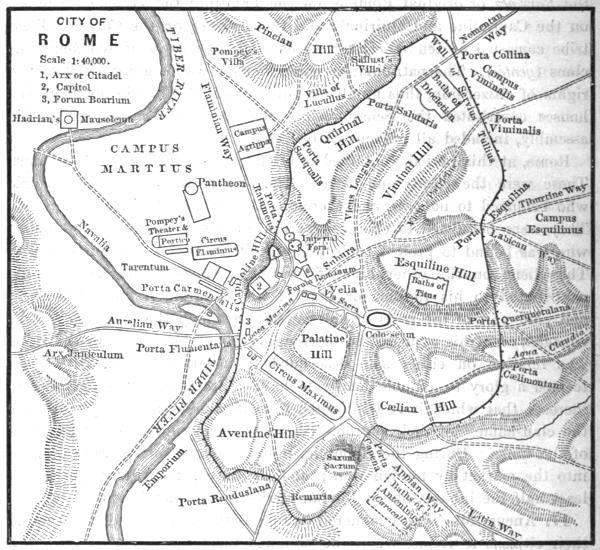
CITY OF ROME.
18. Lucius Tarquin´ius Priscus was of Greek origin, though he took his name from the Etruscan town Tarquinii, where he was born. The characteristics of his race were shown in the magnificent works with which he embellished Rome. He drained the lower parts of the city by a great system of sewers, and restrained the overflow of the Tiber by a wall of massive masonry, at the place where the Cloa´ca Maxima entered the river. In the valley thus redeemed from inundation he built the Forum, with its surrounding rows of porticos and shops; and constructed the Circus Maximus for the celebration of the Great Games, which had been founded by Romulus, and resembled in most of their features the athletic contests of the Greeks.
As a native of Etruria, Tarquin vowed the erection, upon the Capitoline, of a temple to Jupiter, Juno, and Minerva, the three deities who were worshiped together in every Etruscan city, and for this purpose he cleared away from that mountain all the holy places of the Sabine gods. The temple was built by his son. The wars of Tarquin against the Sabines, Latins, and Etruscans were usually victorious, and added largely to the population of Rome. From the noblest of the conquered peoples he formed three new half-tribes of fifty “houses” each, which he joined to the three old tribes of Ramnes, Tities, and Luceres, while he increased the number of Vestal Virgins from four to six, that each race might be equally represented. Tarquin was murdered by hired agents of the sons of Ancus Martius, who hoped thus to secure for themselves the throne of their father. But the Roman monarchy was strictly elective, not hereditary; their crime failed of its purpose, and Servius Tul´lius, an Etruscan general, and son-in-law of the murdered king, obtained the crown.
19. He made radical changes in the constitution, by giving to every free Roman the right of suffrage, though all offices in the government were still held by the nobles. The Greek cities of southern Italy were, at the same time, changing from aristocratic to popular forms of government, and there are many signs of Greek influence in Latium and Rome. The new popular assembly, Comitia Centuria´ta, was so called from the “centuries” in which the entire citizen-soldiery was enrolled. Wealth now acquired in Rome something of the power which had hitherto been reserved for rank. Every man who held property was bound to serve in the armies, and his military position was accurately graded by the amount of his possessions. Highest of all were the Eq´uites, or horsemen. These were divided into eighteen centuries, of which the first six—two for each original tribe—were wholly patrician, while the remaining twelve were wealthy and powerful plebeians.
The mass of the people enrolled for service on foot was divided into five classes. Those who were able to equip themselves in complete brazen armor fought in the front rank of the phalanx. Of this class there were eighty centuries: forty of younger men, from seventeen to forty-five years of age, who were the choicest of Roman infantry in the field; and forty of their elders, from forty-six to sixty, who were usually retained for the defense of the city. The second class were placed behind the first; they wore no coat of mail, and their shields were of wood instead of brass. The third class wore no greaves, and the fourth carried no shields. These three classes consisted of only twenty centuries each. The fifth and lowest military class did not serve in the phalanx, but formed the light-armed infantry, and provided themselves only with darts and slings. Below all the classes were a few centuries of the poorest people, who were not required to equip themselves for war. They were sometimes armed, at the public expense, on occasions of great loss or danger to the state; or they followed the army as supernumeraries, and were ready to take the weapons and places of those who fell.
20. Beside the patrician tribes of Ramnes, Tities, and Luceres, Servius made four tribes in the city and twenty-six in the country, consisting of land-owners without respect to rank. The meeting-place for the whole thirty was the Forum at Rome, while the centuries met without the city on the Field of Mars. The people assembled in the Forum had all the powers of self-government. They elected magistrates and levied taxes for the support of the state, duties which hitherto had belonged to the Comitia Curiata. Of the public lands on the Etruscan side of the Tiber, gained in his early wars, Servius assigned a certain portion to the plebeians, in full ownership. The patricians had leased these lands from the state for the pasturage of their flocks, and they were much exasperated by the new allotment.
21. Servius extended the bounds of the city far beyond the Roma Quadra´ta of the Palatine. The Esquiline, Cælian, and Aventine hills had already been occupied by surburban settlements, while the Capitoline, Quirinal, and Vim´inal were held by the Sabine tribes. These Seven Hills,[64] with a large space between and around them, were inclosed by Servius in a new wall, which lasted more than eight hundred years, until the time of the emperor Aurelian. Servius reigned forty-four years, B. C. 578-534. Desirous above all things for the continuance of his reformed institutions, he had determined to abdicate the throne, after causing the people, by a free and universal vote, to elect two magistrates who should rule but one year. Before the end of their term they were to provide, in like manner, for the peaceful choice of their successors; and thus Rome would have passed, by a bloodless revolution, to a popular government. The nobles, however, revolted against this infringement of their exclusive rights. Led by Tarquin, son of the first monarch of that name, and husband of the wicked Tullia, daughter of Servius, they murdered the beneficent king and placed their leader on the throne.
22. Tarquin, called “the Proud,” set aside all the popular laws of Servius, and restored the privileges of the “houses”; but as soon as he felt secure in his power, he oppressed nobles and people alike. He compelled the poorer classes to toil upon the public works which his father had begun, and upon others which he himself originated. Such were the permanent stone seats of the Circus Maximus, a new system of sewers, and the great Temple of Jupiter on the Capitoline Hill. By wars or intrigues, Tarquin made himself supreme throughout Latium. But his insolence disgusted the patricians; he took away the property or lives of citizens without consulting the Senate, while he imposed upon them civil and military burdens beyond what the law permitted. The vile misconduct of his son Sextus led at last to a revolt, in which kingly government was overthrown. The Tarquins and all their clan were banished. The very name of king was thenceforth held in especial abhorrence at Rome. Only in one case was it tolerated. A “king for offering sacrifices” was appointed, that the gods might not miss their usual mediator with men; but this sacerdotal king was forbidden to hold any civil office.
RECAPITULATION.
Early history of Rome is largely fabulous. Three races in Italy, of whom the Etruscans, before the rise of Rome, were most powerful. Their cities, art, and religion. Rome was founded by Latins, but embraced a mixed population of Sabines, Etruscans, and others, which gave rise to the three tribes. Three hundred noble “houses” constituted the Senate and Comitia Curiata. Clientage. Formation of a commonalty under Ancus Martius. Buildings of Tarquinius Priscus. Free constitution of Servius Tullius. Division of the people into centuries, both as soldiers and citizens. Thirty tribes assemble in the Forum. Inclosure of the Seven Hills by the Tullian Wall. Tyranny of Tarquin the Proud. Royalty abolished at Rome. Supposed Chronology of the Kings: Romulus, B. C. 753-716; Numa, 716-673; Tullius Hostilius, 673-641; Ancus Martius, 641-616; L. Tarquinius Priscus, 616-578; Servius Tullius, 578-534; Tarquinius Superbus, 534-510.
Religion of Rome.
23. Before passing to the history of the Republic, we glance at the religion of Rome. For the first 170 years from the foundation of the city, the Romans had no images of their gods. Idolatry has probably been, in every nation, a later corruption of an earlier and more spiritual worship. Roman religion was far less beautiful and varied in its conceptions than that of the Greeks.[65] It afforded but little inspiration to poetry or art, but it kept alive the homely household virtues, and regulated the transactions of the farm, the forum, and the shop, by principles drawn from a higher range of being.
The chief gods of the Romans were Jupiter and Mars. The former was supreme; but the latter was, throughout the early history of this warlike people, the central object of worship. March, the first month of their year, was consecrated to him, and, in almost all European languages, still bears his name. The great war festival occupied a large portion of the month. During its first few days the twelve Salii, or leapers, priests of Mars, who were chosen from the noblest families, passed through the streets singing, dancing, and beating their rods upon their brazen shields. Quirinus, under whose name Romulus was worshiped, was only a duplicate Mars, arising from the union of the two mythologies of the Romans and Sabines. He had, also, his twelve leapers, and was honored, in February, with similar ceremonies.
24. The celebrations of the several periods of the farmer’s year were next in order to the war festival. The month of April was marked by days of sacrifice to the nourishing earth; to Ceres, the goddess of growth; to the patroness of flocks; and to Jupiter, the protector of vines; while a deprecatory offering was made to Rust, the enemy of crops. In May the Arval Brothers, a company of twelve priests, held their three days’ festival in honor of Dea Dia, invoking her blessing in maintaining the fertility of the earth, and granting prosperity to the whole territory of Rome. August had its harvest festivals; October, its wine celebration in honor of Jupiter; December, its two thanksgivings for the treasures of the granary, its Saturnalia or seed-sowing on the 17th, and its celebration of the shortest day, which brought back the new sun. Sailors had their festivals in honor, respectively, of the gods of the river, the harbor, and the sea. The ceremonial year was closed with the singular Lu´perca´lia, or wolf festival, in which a certain order of priests, girdled with goat-skins, leaped about like wolves, or ran through the city scourging the spectators with knotted thongs; and by the Ter´mina´lia, or boundary-stone festival in honor of Ter´minus, the god of landmarks.
Janus, the double-faced god of beginnings, was a peculiarly Roman divinity. To him all gates and doors were sacred, as well as the morning, the opening of all solemnities, and the month (January) in which the labors of the husbandman began anew in southern Italy. Sacrifices were offered to him on twelve altars, and prayers at the beginning of every day. New-year’s day was especially sacred to him, and was supposed to impart its character to the whole year. People were careful, therefore, to have their thoughts, words, and acts, on that day pure, beneficent, and just. They greeted each other with gifts and good wishes, and performed some part of whatever work they had planned for the year; while they were much dispirited if any trifling accident occurred. A covered passage between the Palatine and Quirinal hills, i. e., between the original Roman and Sabine cities, was known by the name of Janus. Armies going out or returning passed through it, and hence it was always open in time of war and closed in peace. The same ceremony was continued after the passage had ceased to be used, the triumphal gate having been constructed in the walls of Servius.
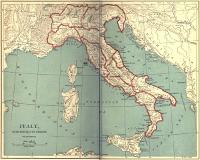
ITALY, WITH THE ELEVEN REGIONS OF AUGUSTUS.
25. Vulcan, the god of fire and the forge, was honored by two festivals, the consecration of trumpets in May, and the Vol´cana´lia in August. Though of inferior rank to the divinities already mentioned, yet dearest of all to the Romans, were the gods of the hearth, the household, and store-room, and of the forest and field. Every house was a temple, and every meal a sacrifice to Vesta, the goddess of the hearth. Her temple was the hearth-stone of the city. There six chosen maidens, daughters of the most illustrious families, guarded the sacred fire, which was the symbol of the goddess, by night and day. Every house had over its main entrance a little chapel of the La´res, where the father of the family performed his devotions immediately on returning from any journey. The Lares were supposed to be the spirits of good men, especially the deceased ancestors of the family. Public Lares were the protecting spirits of the city; they were worshiped in a temple and numerous chapels, the latter being placed at the crossings of streets. There were also rural Lares, and Lares Via´les, who were worshiped by travelers.
26. Like all people in any degree affected by Greek culture, the Romans consulted the Delphic oracle. After the capture of Ve´ii (see § 57), they presented that shrine with a tenth of the spoils. Rome itself possessed only one oracle, that of Faunus (the favoring god), on the Aventine Hill. Several oracles of Fortune, Faunus, and Mars existed in Latium, but in none of them were audible responses given, by the mouth of inspired persons, as at Delphi. At Albu´nea, near Tibur, Faunus was consulted by the sacrifice of a sheep. The skin of the animal was spread upon the ground; the person seeking direction slept upon it, and believed that he learned the will of the god by visions and dreams. The Romans frequently resorted to the Greek oracles in southern Italy; and the most acceptable gift which the inhabitants of Magna Græcia could offer to their friends in Rome, was a palm-leaf inscribed with some utterance of the Cumæan sibyl, a priestess of Apollo at Cumæ, near Naples.
27. The Sibylline Books were believed to have been purchased by one of the Tarquins from a mysterious woman, who appeared at Rome offering nine volumes at an exorbitant price. The king refusing to purchase, the sibyl went away and destroyed three of the books; then brought back the remaining six, for which she asked the same amount of money. The king again sent her away; she destroyed three more books, and demanded the whole price for the remaining three. The curiosity of Tarquin was aroused, and he bought the books, which were found to contain important revelations concerning the fate of Rome. They were kept in a stone chest under the temple of Jupiter Cap´itoli´nus. One of the four sacred colleges was charged with the care of them, and they were only consulted, by order of the Senate, on occasions of great public calamity.
28. The Romans probably learned from the Etruscans their various methods of divination—the interpretation of signs in the heavens, of thunder and lightning, of the flight or voice of birds, of the appearance of sacrifices, and of dreams. The legends ascribed to Tarquinius Priscus the introduction of Etruscan divinities and modes of worship into Rome. At a later time, the Senate provided by special decree for the cultivation of “Etruscan discipline” by young men of the highest birth, lest a science so important to the commonwealth should be corrupted by falling into the hands of low and mercenary persons.
The Augurs constituted the second of the sacred colleges; their number was gradually increased from three to sixteen; they were distinguished by a sacred dress and a curved staff, and were held in the highest honor. No public act of any kind could be performed without “taking the auguries”—no election held, no law passed, no war declared; for, by theory, the gods were the rulers of the state, and the magistrates merely their deputies. If, in the midst of the comitia, an augur, however falsely, declared that it thundered, the Assembly broke up at once. It must be admitted that the augurs often used their great power unfairly in the political strife between patricians and plebeians. The latter, as originally foreigners (see § 17), were held to have no share in the gods of Rome, who thus became the exclusive patrons of the privileged class. When, by a change in the constitution, plebeians were at length elected to high offices, the augurs in several cases declared the election null, on the pretext that the auspices had been irregular; and as no one could appeal from their decision, their veto was absolute.
29. The College of Pontiffs was the most illustrious of the religious institutions attributed to the good king Numa. The pontiffs superintended all public worship according to their sacred books, and were required to give instruction to all who asked it, concerning the ceremonies with which the gods might be approached. Whenever sacred officers were to be appointed, or wills read, they convoked the Assembly. Certain cases of sacrilegious crime could only be judged by them; and in very early times, like the Hebrew scribes, they were the sole possessors of both civil and religious law. The highest magistrate, equally with private persons, submitted to their decrees, provided three members of the college agreed in the decision. They alone knew what days and hours might be used for the transaction of public business. The calendar was in their keeping, and—since these august and reverend dignitaries were only men—it is well known that they sometimes used their power to lengthen the year’s office of a favorite consul, or to shorten that of one whom they disapproved. The title of Pon´tifex Maximus, or Supreme Pontiff, was adopted by the Roman emperors, and passed from them to the popes or bishops of modern Rome.
30. The fourth of the sacred colleges consisted of the Fetia´les, or heralds, who were the guardians of the public faith in all dealings with foreign nations. If war was to be declared, it was the duty of a herald to enter the enemy’s country, and four times—once on either side of the Roman boundary, then to the first citizen whom he chanced to meet, and, finally, to the magistrates at the seat of government—to set forth the causes of complaint, and with great solemnity to call on Jupiter to give victory to those whose cause was just.
The priests of particular gods were called Flamens, or kindlers, because one of their principal duties was the offering of sacrifices by fire. Chief of them all was the Flamen Dialis, or priest of Jupiter; and next to him were the priests of Mars and Quirinus. Though the purity and dignity of the priestly life were guarded by many curious laws, the priest was not forbidden to hold civil offices. He was not allowed, however, to mount a horse, to look upon an army outside the walls, or, in early times, to leave the city for even a single night.
31. After the good king Servius Tullius had completed his census, he performed a solemn purification of the city and people. During the Republic, the same ceremony was repeated after every general registration, which took place once in five years. Sacrifices of a pig, a sheep, and an ox were offered; water was sprinkled from olive-branches, and certain substances were burned, whose smoke was supposed to have a cleansing effect. In like manner, farmers purified their fields, and shepherds their flocks. An army or a fleet always underwent lustration before setting out on any enterprise. In the case of the latter, altars were erected on the shore near which the ships were moored. The sacrifices were carried three times around the fleet, in a small boat, by the generals and priests, while prayers were offered aloud for the success of the expedition.
RECAPITULATION.
Roman religion less imaginative and more practical than the Greek. Jupiter, Mars, and Quirinus its chief divinities. Yearly festivals had reference chiefly to war and husbandry. Worship of Janus. Household gods. The Romans shared their belief in oracles with the Greeks; their arts of divination, with the Etruscans. Four Sacred Colleges: Pontiffs, Augurs, Heralds, and Keepers of the Sibylline Books. Priests might hold civil offices. Ceremonial cleansing of the city after every census; of armies and fleets before every expedition.
II. The Roman Republic.
32. The 480 years’ history of the Roman Republic will be best understood if divided into four periods:
I. The Growth of the Constitution, B. C. 510-343.
II. Wars for the possession of Italy, B. C. 343-264.
III. Foreign Wars, by which Rome became the ruling power in the world, B. C. 264-133.
IV. Internal Commotions and Civil Wars, B. C. 133-31.
The leaders of the revolution which expelled the Tarquins, restored the laws of Servius and carried forward his plans, by causing the election of two chief magistrates, of whom one was probably a plebeian. The consuls, during their year of office, had all the power and dignity of kings. They were preceded in public by their guard of twelve lictors, bearing the fasces, or bundles of rods. Out of the city, when the consul was engaged in military command, an ax was bound up with the rods, in token of his absolute power over life and death.
33. For 150 years the Republic was involved in a struggle for existence, during which its power was much less than that of regal Rome. The Latins threw off their supremacy, and Lars Por´sena, the Etruscan king of Clu´sium, actually conquered the city, and received from the Senate an ivory throne, a golden crown, a scepter, and triumphal robe, in token of homage. In their further attempts upon Latium, the Etruscans were defeated, and Rome became independent, but with the loss of all her territories west of the Tiber. The Latins were defeated at the Lake Regillus, by the aid—so Roman minstrels related—of the twin deities, Castor and Pollux, who appeared at the head of the legions, in the form of two beautiful youths of more than mortal stature, mounted on white horses, and who were the first to break through into the enemy’s camp. A temple was consequently built to them in the Forum, and they were regarded as the especial patrons of the Roman knights.
34. External dangers over, the patricians again made their power felt in the oppression of the common people. The first period of the Republic was absorbed in conflicts between the two great orders in the state—less attractive, certainly, than the romantic stories of the kingly age, or the stirring incidents of the later period of conquest. But the steps by which a great people has gained and established its freedom can never be without importance, especially to the only republic which has rivaled Rome in grandeur, in variety of interests, or in the multitude of races and languages included eventually within its limits.
35. The wealth of Rome hitherto had been chiefly derived from the products of the soil. The lands west of the Tiber were now lost, and all the rural district was open to invasion. Crops were ruined, farm buildings destroyed, cattle driven away. At the same time, through the losses and necessities of the government, taxes were greatly increased; and these were levied, not upon the reduced value of the property, but upon the scale of former assessments. To meet their dues, the poor were obliged to borrow money, at enormous rates of interest, from the rich. The nobles seized the opportunity to enforce to their full extent the cruel laws concerning debt, and the sufferings of the insolvent grew too grievous to be borne. Many sold themselves as slaves to discharge their obligations. Those who refused thus to sign away their own and their children’s liberty were often imprisoned, loaded with chains, and starved or tortured by the cruelty of their creditors. The patrician castles, which commanded the hills of Rome, contained gloomy dungeons, which were the scenes of untold atrocities toward such as had the misfortune to incur the wrath of their owners.
36. Fifteen years after the expulsion of the kings, the plebeians, wearied out with a government which existed only for the rich, and imposed all its burdens on the poor, withdrew in a body to a hill beyond the Anio, and declared their intention of founding a new city, where they might govern themselves by more just and equal laws, B. C. 494. The patricians now perceived that they had gone too far. However much they hated the people, they had no idea of losing their services. They yielded, therefore, and received back the seceded plebeians on their own conditions. These were: (1.) Cancellation of claims against insolvent debtors; (2.) Liberation of all such who had been imprisoned or enslaved; (3.) Annual election of two Tribunes, whose duty it should be to defend the interests of the commons. The number of these officers was soon raised to five, and eventually to ten. Two plebeian Æ´diles were at the same time appointed, and charged with the superintendence of streets, buildings, markets, and public lands; of the public games and festivals, and of the general order of the city. They were judges in cases of small importance, like those of modern police courts; and they were eventually intrusted with the keeping of the decrees of the Senate, which had sometimes been tampered with by the patrician magistrates.
37. The scene of this first decisive battle of the people for their rights, was consecrated to Jupiter, and known in later years as the Sacred Mount (Mons Sacer). The Roman commons had thenceforth an important part in public affairs. To prevent suffering in future, Spurius Cassius, consul in the year following the secession, proposed a division among the plebeians of a certain part of the public lands, while the tithe of produce levied by the state upon the lands leased by the patricians, should be strictly collected and applied to the payment of the common people when they served as soldiers. Hitherto the troops had received no pay, while their burden of war expenses was great. The other consul opposed the law, and charged Cassius with seeking popularity that he might make himself a king. The law—the first of a long series of “Agrarian” enactments—was passed; but when the year of his consulship had expired, Cassius was brought to trial by his enemies, and condemned as a traitor. He was scourged and beheaded, and his house was razed to the ground, B. C. 485.
38. Having destroyed the leader, the patricians went on to rob the people of all the advantage of the law. They insisted on electing both consuls themselves, only requiring their confirmation by the popular assemblies; and with or without this confirmation, their candidates held supreme power, and refused to divide the public lands. The only resource of the commons was to withhold themselves from military service, and the tribunes now made their power felt by protecting them in refusing to enlist. The consuls defeated this measure by holding their recruiting stations outside of the city, while the jurisdiction of the tribunes was wholly within the walls. Though a man might keep himself safe within the protection of the tribunes, yet his lands were laid waste, his buildings burnt, and his cattle confiscated by order of the government. One last expedient remained. Though compelled to enlist, the soldiers could not be made to gain a battle; and considering the consul who led them, and the class to which he belonged, worse enemies than those whom they met in the field, they allowed themselves to be defeated by the Veientians.
39. The noble house of the Fa´bii, as champions of the nobility, had been for six successive years in possession of the consulship. They now saw the danger to Rome of longer opposition to the will of the people; and when Kæso Fabius, in the year 479 B. C., came into power, he insisted upon the execution of the Cassian law. The patricians refused with scorn, and the Fabii resolved to quit Rome. With their hundreds of clients, their families, and a few burghers who were attached to them by friendship and sympathy, they established a colony in Etruria, on the little river Crem´era, a few miles from the city. They promised to be no less loyal and valiant defenders of Roman interests, and to maintain with their own resources this advanced post, in the war then in progress against Veii. Two years from their migration, the settlement was surprised by the Veientians, and every man was put to death, B. C. 477.
40. The consuls still refused to comply with the Agrarian law, and at the expiration of their term were impeached by Genu´cius, one of the tribunes of the people. On the morning of the day appointed for the trial, Genucius was found murdered in his bed, B. C. 473. This treacherous act paralyzed the people for the moment, and the consuls proceeded with the enlistment of soldiers. Vo´lero Publi´lius, a strong and active commoner, refused to be enrolled; and in the tumult which ensued, the consuls with all their retinue were driven from the Forum.
The next year Volero was chosen tribune, and brought forward a law that the tribunes should thenceforth be elected by the commons alone in their tribes, instead of by the entire people in the centuries. This was designed to avoid the overwhelming vote of the clients of the great houses, who were obliged to obey the decrees of their patrons, and who often controlled the action of the general assembly. For a whole year the patricians contrived, by various delays, to prevent the passage of the bill. Ap´pius Clau´dius, one of the consuls, stationed himself with an armed force in the Forum to oppose it; and it was not until the plebeians, resorting in their turn to force, had seized the Capitol, and held it for some time under military guard, that the Publilian law was passed. This “second Great Charter of Roman liberties” gave the tribes not only the power of electing tribunes and ædiles, but of first discussing all questions which concerned the entire nation. It was a long step toward the gaining of equal rights by the commons, B. C. 471.
41. In the meanwhile, the Romans were carrying on wars with the Æqui and Volsci, two Oscan nations which had taken advantage of the changes in the Latin League, to extend their power to the cities on the Alban Mount and over the southern plain of Latium. Their forays extended to the very gates of Rome, driving the country people to take refuge, with their cattle, within the walls, where a plague then raging added the horrors of pestilence to those of war. It is probable that the civil conflicts in Rome had caused the exile of many citizens; and these, in most instances, joined the hostile nations. Rome was the champion of oligarchy among the cities of Italy, as Sparta was among those of Greece. The spirit of party was often stronger than patriotism; the sympathy between Roman and foreign aristocrats was greater than between patrician and plebeian at home; and thus an exiled noble was willing to become the destroyer of his country.
42. The story of Coriola´nus may be partly fictitious, but it truly illustrates the condition of the Republic at that period. Caius Marcius, a descendant of the fourth king of Rome, was the pride of the patricians for his warlike virtues, and had won his surname Coriolanus by capturing the Volscian town of Cori´oli by his individual gallantry. But he was bitterly opposed to the common people, and when he was about to be tried before the comitia for having opposed a distribution of corn, he fled and took refuge among the Volscians, whom he had formerly conquered. The king warmly welcomed him, and seized the first opportunity to stir up a new war with the Romans, that he might turn against them the arms of their best leader. When the Volscian army approached Rome, the Senate sent deputies to demand peace, but Caius refused all terms except such as were impossible for the Republic to grant. The priests and augurs next went to plead with him, but without effect.
At last the noble ladies of Rome, headed by Volum´nia, the mother of Caius, and his wife, Vergil´ia, with her young children, went out in a sad and solemn procession to plead for their sacred city. Coriolanus honored, above all, the mother to whose wise and faithful care he owed his greatness. He sprang to meet her with fitting reverence, but before she would receive his greeting, Volumnia exclaimed: “Let me know whether I stand, in thy camp, thy prisoner or thy mother; whether I am speaking to an enemy or to my son!” Her reproaches silenced Caius; the entreaties of his wife and children, and the tears of the noble ladies, moved him from his purpose. He exclaimed, “Mother, thine is the victory; thou hast saved Rome, but thou hast lost thy son!” He led away the Volscian army. Some say he fell a victim to their revenge; but others, that he lived on among them to extreme old age, and lamented, in the desolateness of his years of infirmity, the factious pride that had exiled him from wife, children, and native land.
43. In the meantime, Rome suffered another visitation of pestilence, in which thousands of people died daily in the streets. The Æquians and Volscians ravaged the country up to the walls of Rome; and in addition to their other miseries, the crowded multitude were threatened with starvation. Their civil grievances were not to be redressed by anything less than a thorough and radical reform. In the year 462 B. C., the tribune Terenti´lius Harsa proposed the appointment of a board of ten commissioners, half patrician and half plebeian, to revise the constitution, define the duties of consuls and tribunes, and frame a code of laws from the mass of decisions and precedents. This movement was the occasion for ten years of violent contention, during which Rome was several times near falling into the hands of the Volscians, and was once actually occupied by a band of exiles and slaves under a Sabine leader, Herdo´nius, who seized the Capitol and demanded the restoration of all banished citizens to their rights in Rome.
44. Chief of the exiles was Kæso Quinc´tius, son of the great Cincinna´tus, who had been expelled for raising riots in the Forum, to prevent any action of the people upon the Terentilian law. The invading party was defeated, and every man slain. The father of Kæso was then consul. In revenge for the fate of his son, he declared that the law should never pass while he was in office; and that he would immediately lead the entire citizen-soldiery out to war, thus preventing a meeting of the tribes. Nay more, the augurs were to accompany him, and so consecrate the ground of the encampment, that a lawful assembly could be held under the absolute power of the consuls, and repeal all the laws which had ever been enacted at Rome under the authority of the tribunes. At the close of his term, Cincinnatus declared that he would appoint a dictator, whose authority would supersede that of all other officers, patrician or plebeian. All these things could be done under the strict forms of the Roman constitution; but the Senate and the wiser patricians saw that the patience of the commons might be taxed too far, and persuaded Cincinnatus to forego so extreme an exercise of his power.
45. War with the Æquians went on, and treaties were only made to be broken. In the year 458 B. C., the entire Roman army was entrapped in a pass of the Alban Hills, surrounded by the enemy, and in imminent danger of destruction. In this crisis, Cincinnatus, who had retired from the consulship to resume his favorite toil of farming, was called to be dictator, with absolute power. The messengers of the Senate found him at his plow, in his little garden-plot across the Tiber. He left the plow in the furrow, hastened to Rome, levied a new army in a single day, went out and defeated the Æquians, and returned the next evening in triumph.
RECAPITULATION.
Consuls are appointed with kingly power, but for a limited time. Rome subject to Porsena. The Latins are defeated at the Lake Regillus. Roman nobles oppress their debtors, and the poor secede. Tribunes of the people and ædiles are appointed. The first Agrarian Law is proposed by Cassius, B. C. 486. To avenge the tyranny of their consuls, the common soldiers refuse to fight. The Fabii take sides with the people, and are destroyed in their colony on the Cremera. The Publilian Laws give the election of officers to the people in their tribes, B. C. 471. War and pestilence. Ten years’ debate upon the Terentilian Laws, which propose a revision of the constitution, B. C. 462-452. The Capitol seized by exiles and Sabines. Cincinnatus, as a noble, opposes the commons, but, as a general, saves Rome.
The Laws of the Twelve Tables.
46. The passage of the Terentilian law was delayed six years, but at length the nobles yielded the main point, and the decemviri were chosen. Though wholly patrician, they were men who enjoyed the confidence of both orders for their proved integrity. Both consuls and tribunes were superseded for the time, and full powers, constituent, legislative, and executive, were intrusted to the Ten. The laws of the Twelve Tables, which were the result of their labors, became the “source of all public and private right” at Rome for many centuries. During the debate upon the bill, commissioners had already been sent to Greece, to study the laws and constitution of the Hellenic states. They returned with an Ionian sophist, Hermodo´rus of Ephesus, who aided in explaining to the lawmakers whatever was obscure in the notes of the commissioners; and so valuable were his services, that he was honored with a statue in the Roman comitium.
47. Only a few points in this celebrated work of legislation can here be noticed. The laws of Rome gave to a father absolute right of property in his family. He might sell his son, his daughter, or even his wife. The latter act, indeed, was denounced as impious by the religious law, but no penalty was attached to it; the curse of the chief pontiff merely marked the guilty person for the wrathful judgments of Heaven. If a father desired to make his son free, the process was more difficult than the emancipation of a slave. The latter, if sold to another master, could be liberated at once, but a son thus sold and liberated returned to the possession of his father. This subjection could only end with the death of the parent, though the son himself might then be an old man. The Twelve Tables enacted that, if a father had three times sold his son, he lost all further control over him; but a son thus emancipated was considered as severed from all relationship with his father, and could no longer inherit his property. Women were all their lives considered as minors and wards. If their father died, they passed under the control of their brothers; or, if they married, they became the absolute property of their husbands. A widow might become the ward of her own son. Marriages between patricians and plebeians were declared unlawful, and children born in such had no claim upon their fathers’ possessions.
48. The ten Law-givers visited with their heaviest penalties the defamation of character; and so stringent was their definition of libel, that neither poets nor historians dared even name the living except in terms of praise. It is much more difficult, therefore, to gain a true idea of public men in the history of Rome than of Greece, whose historians spoke with grand impartiality of men and measures, and the license of whose comic poets, though often used with insolent injustice, yet shows us all the weak points of character, and reveals the man as his contemporaries really saw him. The Roman historians, even when writing of the past, could often draw their materials only from funeral orations, or from the flattering verses of dependent poets, laid up among the records of great families.
49. The decemvirs, during their appointed year of office, completed ten tables of laws; and these, according to Roman ideas, were so just and so acceptable, that the assemblies willingly consented to renew the same form of government for another term, especially as the work of legislation was not quite complete. In the new decemvirate, Appius Claudius was re-elected, and his unscrupulous character now made itself felt in the tyrannical nature of the government. The people found that they had ten consuls instead of two, and the power of the Ten was unchecked by any popular tribune.
50. The domestic rights of the plebeians were rudely invaded. A fair maiden, Virginia, caught the eye of Appius as she went daily to school in the Forum, attended by her nurse. He declared that she was the slave of one of his clients, having been born of a slave-woman in his house, and sold to the wife of Virginius, who had no children of her own. The friends of Virginia and of the people resented this insolent falsehood with such indignation, that the consul’s officers were compelled to release the maiden under bonds to appear the next day before his judgment-seat, where her lineage might be proved.
Virginius, her father, was with the army before Tus´culum. He was hastily summoned, and, riding all night, reached the city early in the morning. In the garb of a suppliant, he appeared in the Forum with his daughter and a great company of matrons and friends. But his plea was not heard. Appius judged the maiden to be, at least, considered a slave until her freedom could be proved, in direct violation of the law which he had himself enacted the year before, that every one should be regarded as free until proved a slave. Virginius perceived that no justice could be expected before such a tribunal. He only demanded one last word with his daughter; and having drawn her aside with her nurse into one of the stalls of the Forum, he seized a butcher’s knife and plunged it into her heart, crying aloud, “Thus only, my child, can I keep thee free!” Then turning to the decemvir, he exclaimed, “On thy head be the curse of this innocent blood!” No one obeyed the consul’s order to seize him. With the bloody knife in his hand, he rushed through the crowd, mounted his horse at the gate of the city, and rode to the camp.
51. The army of plebeians arose at his call and marched upon Rome. They entered and passed through the streets to the Aventine, calling upon the people, as they went, to elect ten tribunes and defend their rights. The other army, near Fide´næ, was aroused in the same manner by Icil´ius, the betrothed lover of Virginia. The common soldiers put aside those of the decemvirs who were with them, chose, likewise, ten tribunes, and marched to the city. The twenty tribunes appointed two of their number to act for the rest, and then leaving the Aventine guarded by a garrison, they passed out of the walls followed by the army, and as many of the people as could remove, and established themselves again on the Sacred Mount beyond the Anio.
52. The Senate, which had wavered, was now compelled to act. The seceders had declared that they would treat with no one but Valerius and Hora´tius, men whom they could trust. These were sent to hear their demands. The people required that the power of the tribunes should be restored, a right of appeal from the decision of the magistrates to the popular assembly established, and the decemvirs given up to be burnt, as nine friends of the commons had been, within the memory of men still living. This latter demand, caused only by the exasperation of the moment, was withdrawn upon maturer council; the others were granted, the decemvirs resigned, and the people returned to Rome, B. C. 449. A popular assembly was held, in which ten tribunes were elected, Virginius and Icilius being of the number. Two supreme magistrates were chosen by a free vote of the people; in the place of the decemvirate, and they were now first called consuls. Their powers were the same with those of the prætors, or generals, who had ruled from the expulsion of the kings to the appointment of the first decemvirate, except that an appeal might be made from their sentence to that of the comitia.
The first consuls under this new act were Valerius and Horatius. They went forth and gained so signal a victory over the Sabines, that Rome suffered no more incursions from that people for 150 years. Ancient custom and even law among the Romans honored victorious generals with a triumphal entry into the city on their return; but the Senate, whose duty it was to decree the triumph, regarding the consuls as false to the interests of their order, forbade any such honor to be paid them. Hereupon the people exerted their supreme authority, and commanded the consuls to “triumph” in spite of the Senate. (See §§ 109-111.) Appius Claudius and one of his colleagues were impeached and died in prison; the rest fled from Rome, and their property was confiscated.
53. A strong reaction now set in, in favor of the patricians; and so determined was their opposition to the new laws, that the people seceded again, but this time only to the Janiculum, west of the Tiber and opposite Rome. At last a law was passed legalizing marriage between the two orders. Instead of throwing open the consulship freely to the plebeians, it was agreed (B. C. 444) to divide its duties and dignities among five officers, of whom two, the censors, should be chosen only from the nobles, though by a free vote of the tribes, while the three military tribunes might be either patricians or plebeians. The censors were to hold office five years, the tribunes only one.
For some alleged defect in the auspices (see § 28), the first three tribunes were set aside, and for six years consuls were regularly appointed as before. In 438 B. C., tribunes were elected, and for three following years consuls again, showing the extreme difficulty with which the people gained their rights, even when conceded by law. In 433 B. C., an important law of Æmilius, the dictator, limited the duration of the censor’s office to eighteen months, though he was still appointed only once in five years, thus leaving the place vacant a much greater time than it was filled.
54. The censors were invested with truly kingly splendor and extraordinary powers. They registered the citizens and their property, administered the revenues of the state, kept the rolls of the Senate, from which they erased all unworthy names, and added such as they considered fit. In this judgment of character they were guided solely by their own sense of duty. If a man was tyrannical to his wife and children, or cruel to his slaves, if he neglected his land, or wasted his fortune, or followed any dishonorable calling, he was degraded from his rank, whatever that might be. If a senator or a knight, he was deprived of his gold ring and purple-striped tunic; if a private citizen, he was expelled from the tribes and lost his vote. The censors were thus the guardians of morals, and their power extended to many matters which could hardly be reached by the general action of the law. The taking of every census was followed by a lustration, or ceremonial purifying of the people (see § 31). Hence, the five years which intervened between two elections of censors were called a lustrum, or greater year.
55. The Romans must have watched with interest, during the years 415 and 414 B. C., the movements of the great Athenian expedition against Syracuse. Had the brilliant schemes of Alcibiades been carried into effect, the Greeks would doubtless have become the leading power in western Europe; “Greece, and not Rome, might have conquered Carthage; Greek, instead of Latin, might have been at this day the principal element of the languages of Spain, of France, and of Italy; and the laws of Athens, rather than of Rome, might be the foundation of the law of the civilized world.”
RECAPITULATION.
Decemviri chosen to make new laws for Rome. Absolute power of the paterfamilias. Laws against libel make Roman history mere eulogium. Tyranny of the second decemvirate. Appius Claudius unjustly claims Virginia for a slave. The people secede, overthrow the decemvirate, and restore consuls and tribunes. The new consuls defeat the Sabines, and triumph in spite of the Senate. By another change of constitution, censors and military tribunes are chosen, instead of consuls. The censors have absolute power to correct public morals. The Athenians fail in their Sicilian expedition, B. C. 415, 414, and leave room for the supremacy of Rome.
Capture of Rome by the Gauls.
56. The Gauls were now beginning their terrible incursions from the north into the valley of the Po, thus absorbing the attention of the Etruscans; and the time favored a fresh attack of the Romans upon Veii, the nearest state across the Tiber. The war began B. C. 405, and lasted ten years. The necessity of keeping an armed force continually in the field, gave rise to the standing army, which ultimately made so essential a part of Roman power; and, at the same time, obliged the patricians to study the interests of the people. It was now agreed that the soldiers should be regularly paid, and money secured for this purpose by a careful collection of the rents for public lands. The number of military tribunes was doubled. Their chief, the præfect of the city, was a patrician, and chosen by that order, but the remaining five were elected from either or both classes, by a free vote of the popular assembly.
57. After ten years’ warfare with varying success, Veii was taken (B. C. 396) by the dictator Camillus. It is said that on the very day of its surrender, Melpum, the Etruscan stronghold in the north, fell before the Gauls. The loss of these two frontier fortresses began the rapid decline of Etrurian power. The joy of the Romans was commemorated by the whimsical custom, long continued, of concluding every festal game with a mock auction called the “Sale of Veientes.” Cape´na, Fale´rii, Nep´ete, and Sunium were likewise conquered, and with their lands became possessions of Rome. Within half a century, the Etruscans lost to the Gauls all their possessions in Campania and north of the Apennines, and to the Romans, all between the Cimin´ian forests and the Tiber. The nation had already lost its force through unbounded excess in luxury. The nobles were enormously rich, while the people were poor and enslaved.
58. The war of the Romans against Volsin´ii was equally successful; but, by a sudden and terrible reverse, Rome was now doomed to suffer the fate which she too often inflicted. The Gauls, after conquering northern Etruria, overflowed the barrier of the Apennines and spread over central Italy. They met the entire Roman force near the little river Al´lia, and defeated it with great slaughter; then pushing on with irresistible power, they captured and burned the city. So overwhelming was the disaster, that the 16th of July, the date of the battle of the Allia, was pronounced a “black day” of ill-omen, on which no business could be safely transacted and no sacrifices acceptably offered.
59. The vestal virgins withdrew with the sacred fire to Cære, in Etruria; the mass of the people, with the fugitives from the conquered army, had taken refuge in Veii and other Etruscan towns; but the noblest of the patricians resolved to hold the Capitol. Those who were too old to fight, hoped to serve their country equally well by an heroic death. They repeated, after the pontifex maximus, a solemn imprecation,[66] devoting themselves and the army of the Gauls to death for the deliverance of Rome. Then, arrayed in their most magnificent apparel, holding their ivory scepters, and seated each upon his ivory throne at the door of his own house, they sat motionless while the tumult of plunder and pillage was going on around. The barbarians were struck with admiration of these venerable figures, and one of them began reverently to stroke the long white beard of Papir´ius. Enraged by this profaning touch, the old senator struck him with his ivory scepter. It was the signal for slaughter. The Gauls, recovering from their momentary awe, massacred the noble old men without delay.
60. The siege of the Capitol continued six or eight months. At one time it was nearly taken, by the enemy scaling the steep cliff by night. The garrison were asleep, but some geese sacred to Juno gave a timely alarm, and the citadel was saved. Marcus Manlius, who was the first to awaken, succeeded in throwing several of the first assailants down the cliff, and thus maintained the fortress until his comrades could come to his aid. At length, though the garrison were nearly exhausted by hunger, the Gauls were equally ready to make terms, for they had heard that the Venetians were invading their northern possessions. A thousand pounds of gold were paid for the ransom of the city, and the barbarians retired. They were followed by Camillus, the conqueror of Veii and Falerii, who was now again dictator, and who, by cutting off straggling parties of the enemy, regained some portion of the rich booty which they were carrying away; but it is probably not true that he gained any important success over them, as was formerly believed.
61. A period of great distress followed the retreat of the Gauls. The farms, upon which the livelihood of so many people depended, had been laid waste; their fruit-trees, buildings, implements, stock and stores, even to the seed-corn needed for next year’s sowing, had been burnt. Rome was a mass of rubbish, in which even the direction of the former streets could no longer be discerned. The government furnished roofing materials, and allowed wood and stone to be taken from the public forests and quarries, on condition that every person so aided would give security to complete his building within the year. But these pledges were often forfeited; and to meet the expense of rebuilding, as well as to pay the extraordinary taxes for restoring the fortress and the temples, money had to be borrowed, and the poor were again at the mercy of the rich. Innocent debtors were dragged from their homes, to toil as slaves in the shops or fields of their creditors.
Many chose to remain in the Etruscan towns where they had taken refuge, and even to make of Veii a new Rome for the plebeians, where they might live free from the overbearing rule of the patricians, and be themselves a privileged class. Though this wholesale secession was prevented, yet the numbers in Rome were so greatly diminished, that a mass of the conquered Etruscans were brought in to fill the vacant places. These were provided with Roman lands, were organized into four new tribes, and admitted to full civil rights. The “new people” formed more than a sixth part of the whole population of the reconstructed city.
62. No one could see without pity the distress of the people; but Marcus Manlius, the same whose alertness and presence of mind had saved the Capitol, had also reasons of his own for trying to relieve them. He was jealous of Camillus, and thought that his own services had not been duly rewarded. He sold at auction the best portion of his lands, and applied the proceeds to paying the debts of needy persons, thus delivering them from imprisonment and torture. He was rewarded by the unbounded gratitude of the poor; his house was continually thronged with partisans, to whom he spoke of the selfish cruelty of the nobles, in throwing the whole burden of the public calamity on others, and even accused them of embezzling the immense sums raised to replace the treasures of the temples, which had been borrowed to purchase the retreat of the Gauls.
63. For this charge Manlius was thrown into prison, and the people began to regard him as a martyr to their cause. On his release, he renewed his attacks upon the government. He fortified his house on the Capitoline, and with his party held the whole height in defiance of the authorities. His treason was so evident, that even the tribunes of the people took part with the patricians against him, and he was brought to trial before the popular assembly.
He appeared, followed by several comrades whose lives he had saved in battle, and by four hundred debtors whom he had rescued from the dungeon. He exhibited the spoils of thirty enemies slain with his own hand, and forty crowns or other honorary rewards received from his generals. He appealed to the gods, whose temples he had saved from pollution, and he bade the people look at the Capitol before they pronounced judgment. It was impossible to convict such a criminal in such a presence, for the very spot on the Capitol where Manlius had stood alone against the Gauls, was visible from the Forum. He was afterward condemned for treason and thrown from the Tarpeian Rock, the precipitous side of the Capitoline Hill, looking toward the Tiber.
64. The power of the patricians was only confirmed by this rash and selfish attempt to overthrow it. For seven years the distress of the people went on increasing; the commons lost heart, and their eldest men refused any longer to accept public office. Two younger men now came forward, who were destined, by their firm and wise procedure, to relieve in great measure the miseries of their class.
C. Licinius Stolo was of one of the oldest and wealthiest plebeian families, connected by many marriages with the nobles. Becoming tribune (B. C. 376), together with his friend, L. Sextius, he proposed a new set of laws, designed to remove both the poverty and the political wrongs under which the commons were suffering. (1.) To relieve immediate distress, it was proposed that the enormous interest already paid upon debts should be reckoned as so much defrayed of the principal, and should, therefore, be deducted from the sum still due. (2.) To prevent future poverty, the public lands, hitherto absorbed in great measure by the patricians, were to be thrown open equally to the plebeians, and no man was to be allowed to hold more than 500 jugera,[67] or to pasture more than 100 oxen and 500 sheep on the undivided portion. Further, to secure employment to the poor, a certain amount of free labor was required upon every farm. (3.) Two consuls were to be elected, of whom one every year should be a plebeian.
65. The strongest objection to a plebeian consulship was on religious grounds; for high patricians held it an impiety to place in the supreme magistracy one who had no right to take the auspices, and whom they regarded as no true Roman. To attack this prejudice in the boldest manner, Licinius proposed to increase the number of keepers of the Sibylline Books from two to ten, and to appoint five of these from the plebeians. These laws were not passed without many years’ violent opposition. At length they were ratified by the Senate and the Comitia Curiata (B. C. 367); and to celebrate this happy agreement between the two orders, a Temple of Concord was built upon the Capitoline Hill. At the same time, a new office, the prætorship, was instituted and confined to the patricians, comprising most of the civil and judicial duties which had hitherto belonged to the consuls, while the latter kept their absolute military power. The first plebeian consul under this arrangement was L. Sextius.
66. The restless and turbulent Gauls re-appeared in Latium, during the same year with the passing of the Licinian laws. They were defeated by the aged general Camillus, who had been six times military tribune and five times dictator. On their second invasion they encamped within five miles of the city, and struck terror, we may well believe, into the hearts of those who remembered the desolations of thirty years before; but, at length, they broke up their camp without fighting, and passed into Campania. On their return through Latium they were signally defeated. In 350 B. C., they spent the winter upon the Alban Mount, and joined the Greek pirates on the coast in ravaging the country, until they were dislodged by L. Furius Camillus, a son of the general.
They made a treaty B. C. 346, after which they never again appeared in Latium. They continued to be the ruling race between the Alps and the northern Apennines, and along the Adriatic as far south as the Abruz´zi. Many towns, like Milan, were held, however, by the Etruscans in a sort of independence, while the Gauls lived in unwalled villages. From their Tuscan subjects, the Gauls learned letters and the arts of civilized life, which spread from them, in a greater or less degree, to all the Alpine populations.
RECAPITULATION.
Veii taken B. C. 396, after a ten years’ siege. Defeat of the Romans on the Allia, and capture of their city by the Gauls, B. C. 390. Massacre of the senators. Manlius saves the Capitol, during a seven months’ siege. Rome in ruins. Distress of the poor. Treason of Manlius. The Licinian laws, passed after nine years’ contest, relieve debtors and divide the public lands among the common people. The Gauls overrun central Italy, B. C. 361-346, but at length retire north of the Apennines.
Second Period, B. C. 343-264.
67. From the political struggles which developed the Roman constitution, we turn to the series of foreign wars between Rome and her most powerful rival for the supremacy of southern Italy. The Samnites were a Sabine race, settled as conquerors in the Oscan country. Their possessions were mostly inland, comprising the snow-covered mountain range which separates the Apulian from the Campanian plains, but they extended to the coast between Naples and Pæstum, where they included the once famous cities of Herculaneum and Pompeii.
The Samnites ranked with the Latins, as the most warlike races of Italy; but the conquests of the former, at the period to which we have now come, had been by far the more brilliant and extensive. In the decline both of Greek and Etruscan power in southern Italy (see Book III, § 90), they had gained control of the whole lower portion of the peninsula, except a few Greek colonies like Tarentum and Neapolis. But Latium, under the leadership of Rome, had advanced surely though slowly, securing each advantage by the formation of Roman colonies, bound by the strongest ties of obedience to the mother city, while the Samnite nation had no settled policy and no regularly constituted head. Each new settlement, therefore, divided and diminished their strength.
68. The conquerors of Cumæ and Capua adopted the luxurious habits of the Greeks and Etruscans, whom they had supplanted, but with whom they continued to live on friendly terms. The Greek-loving inhabitants of the coast dreaded their rude countrymen of the hills, almost as much as did the refined Hellenes themselves, and thus a great division took place in the Samnite stock. The civilized and Hellenized Samnites besought the aid of the Romans against the predatory hordes of their own race, who were constantly swooping down from the Samnian hills to ravage their fields. The Romans consented, on condition of their own supremacy being acknowledged throughout Campania, and their former treaty with Samnium was broken.
69. The First Samnite War began with the march of two Roman armies into Campania, while the Latin allies invaded the Pelignian country on the north. The Roman armies were victorious, and both consuls obtained a triumph. A large force was left, at the request of the Campanians, to guard their cities during the winter. The common soldiers were still burdened with poverty, and the prolonged absence from their farms occasioned serious suffering to their families.
In the second year of the war, mutinous plots were discovered, and a large body of the troops were sent home. On their way they released all the bondmen for debt whom they found working in the fields of their creditors, fortified a regular camp on the slope of the Alban Hills, and were joined by a large body of oppressed common people from the city. But when they met the army hastily raised by the patricians, and sent forth under Valerius the dictator—whose family had always been faithful friends to the people, and who was himself greatly beloved by all classes for his generous character, no less than his military glory—these men, whose revolt had been occasioned by real distress, and not by defect of loyalty, could not bring themselves to fight their fellow-citizens and the defenders of their common country. The two armies stood facing each other, until remorse on one side and pity on the other had overcome all mutual resentment; then, both pressing forward, they grasped hands or rushed into each others’ arms with tears and demands for pardon. The just requirements of the soldiers were granted by the Senate, together with amnesty for their irregular proceedings, and this singular rebellion ended in a lasting peace.
70. The Latins, meanwhile, had been left to carry on the Samnite war by themselves, and their repeated successes encouraged them to assert their independence of Rome. The Romans now (B. C. 341) made peace with the Samnites, and, two years later, turned their arms against the Latins, who were strengthened by alliance with their late opponents, the Campanians and Volscians. The two consuls with their forces moved into Campania, and encamped in the plain of Capua, opposite the army of the three allies. Strict orders were issued against skirmishing or personal encounters, and disobedience was to be punished with death. Ignorant or heedless of the command, Titus Manlius, the consul’s son, accepted a challenge from a Latin warrior, killed his opponent, and brought the spoils in triumph to lay at his father’s feet. The consul turned away his face, and summoning his guards, ordered them to behead the young man before his tent, in the presence of all the soldiers. Roman discipline knew no ties of affection. Manlius, the father, was forever regarded with horror, but Manlius, the consul and general, was strictly obeyed as long as he commanded the armies of Rome.
71. The decisive battle in the Latin war took place at the foot of Vesuvius. The augurs, having taken the auspices as usual, declared that fate demanded the sacrifice of a general on one side and an army on the other. It was therefore made known to the Roman officers that, whichever portion of the army should begin to yield, the consul commanding in that quarter would devote himself to the gods of death and the grave, in order that the army which must perish might be that of the Latins.
Manlius led the Roman right; Publius Decius, the people’s consul, the left. The battle was severe, and bravely fought on both sides; but, at length, the Latin right wing prevailed, and the Roman left began to give way. Decius instantly called the chief pontiff—for, as a plebeian, he himself was ignorant of the ceremonies by which the gods must be addressed—and bade him dictate the form of words in which he was to devote himself to death. By the direction of the pontiff, he wrapped his toga around his face, set his feet upon a javelin, and repeated the imprecation.[68] Then sending his guard of lictors to the other consul to announce his fate, he mounted his horse, plunged into the host of the enemy, and was quickly slain. The Latins saw and understood the act, but they still fought fiercely, like men who struggled against fate. So equally matched were the main forces, that Manlius gained the day at last only by bringing on the poorer supernumeraries, whom he had armed to constitute a double reserve.
72. A second battle was much more easily won, and the Latins had no strength to rally for a third. The Latin League was wholly broken up, Roman law every-where took the place of local constitutions, and some cities even became Roman colonies. The Latins were one in race and language with Rome, and their transient hostility was exchanged for a close and permanent alliance. The battle under Mount Vesuvius was one of the most important in the history of Rome, for by securing the sovereignty of Latium, it opened the way to the conquest of the world.
73. For the next twelve years the Romans were unable to undertake any great foreign war. Italy was invaded by Alexander of Epirus, uncle of the great Macedonian conqueror, B. C. 332. His quarrel was with the Samnites, but if his success had been equal to his ambition, no engagements with the Romans would have prevented his overrunning the whole peninsula. He was defeated and slain, however, in 326 B. C., and the Romans immediately prepared for a renewed contest with the Samnites, which was to last twenty-two years, B. C. 326-304. The two chief states of Italy fought for sovereignty, and their allies included almost all the other nations in the peninsula.
The events of the first five years were too indecisive to be worth recording. The advantage was generally with the Romans, but the Samnite power was still unbroken, and was able, in 321 B. C., to inflict one of the most severe and disgraceful defeats that Roman arms had ever sustained. The combined forces of Rome, led by the two consuls, were entrapped in a mountain-pass between Naples and Ben´even´tum, known as the “Caudine Forks.” Half the soldiers fell in the fight which ensued; the rest surrendered, but were generously spared by Pontius, the Samnite general, on condition of an honorable peace being signed by the two consuls and by two tribunes of the people, who were present with the troops. The soldiers were then made to “pass under the yoke,”[69] in token of surrender, and were permitted to march away, without their arms, toward Rome. But the Senate, having got back its forces, refused to be bound by the agreement of the consuls. The signers of the treaty, stripped and bound, were given up to the vengeance of the Samnites, but Pontius refused to receive them. He did not choose to punish the innocent for the guilty, nor to justify the Roman government in taking all the advantage of the agreement, and refusing all the sacrifices.
74. The war went on six years without any very important event, until, in 315 B. C., the Samnites gained another great success at Lau´tulæ. Almost all the allies of Rome now deserted what seemed the losing cause. Campania revolted; the Ausonians and Volscians joined the Samnite alliance. But, in the following year, a still more severe and decisive battle gave victory to the Romans. The Samnites were crushed beyond all power of recovery. The war was continued, however, ten years longer, chiefly by the efforts of the Etruscans, Oscans, and Umbrians, to preserve the balance of power in Italy. But these efforts were never united, and the Romans were able to defeat them, one by one, until, in 304 B. C., the Samnites became subject to Rome, and all the other parties concluded a peace. Rome was now, without question, the first nation in Italy; and, considering the disputes which weakened the fragments of Alexander’s empire, might almost be considered the greatest in the world. In intellectual culture, the Romans were still inferior to the conquered Samnites. Pontius, the Samnite general, was well versed in Greek philosophy, and in the elevation of his character far surpassed the proudest Romans of his time.
75. Near the close of the Second Samnite War, the Æqui, who had been for eighty years in a state of neutrality, took up arms against Rome; and immediately after the treaty of B. C. 304, the consuls marched 40,000 men into their territory. A sharp and severe struggle of fifty days resulted in the capture and destruction of forty-one towns. A large portion of the people were sold into slavery, and the rest became subjects of Rome. A few years later, however, they received the rights of citizens, were enrolled in the tribes, and served in the wars against the Samnites.
76. The latter people busily employed the six years’ interval between their second and third great struggle with Rome, in forming and strengthening the “Italian League.” Etruscans, Umbrians, and Gauls, on the north, were allied with Lucanians, Apulians, most of the Greek cities, and the Samnites, on the south. Rome had the advantage in compactness, numbers, and wealth; her own or her allies’ territory extended across Italy from the Mediterranean to the Adriatic, and divided the states of her enemies.
The war broke out in 298 B. C., but no important movement was made until, in 295 B. C., the combined armies of the four northern nations advanced toward Rome. The plan of the consuls was at once bold and sagacious. One army awaited the invaders, while another marched directly into Etruria. This movement exposed the weakness of the league, for the Etruscans and Umbrians, deserting their allies, drew off to defend their own territories. The Samnites and Gauls crossed the Apennines to Senti´num, where they were overtaken by the first Roman army. In the battle which followed, the Gallic war-chariots had nearly driven from the field the legions of Decius, the consul, when, remembering the example of his father at Vesuvius, he, likewise, devoted himself to the powers of death for the deliverance of Rome. The legions were at length triumphant; 25,000 of the enemy lay dead upon the field.
77. The Gauls now withdrew from the league, but the Samnites continued the war with unabated resolution. Twenty-eight years after his great victory at the Caudine Forks, Pontius again defeated a Roman army under Fabius Gur´ges. The Romans were so exasperated by this defeat where they were confident of victory, that they would have deprived the consul of his command, had not his old father, Fabius Maximus, offered to serve as his lieutenant.
A great victory was now gained, in which Pontius was captured, and made to walk, loaded with chains, in the triumph of the consul. When the procession reached the ascent to the Capitol, he was led aside and beheaded in the Mamertine prison—he who, thirty years before, had spared the lives and liberty of two Roman armies, and even generously released the officers when given over to his vengeance! This base treatment of a brave foe has been called the greatest stain in the Roman annals. The war was ended with the complete submission of Samnium, and the Romans established a colony of 20,000 people at Venu´sia, to hold the conquered territory in awe, B. C. 290.
78. In the same year, the consul, Curius Denta´tus, began and ended another war against the Sabines, who had come to the aid of their Samnite kinsmen. They were subdued, and their extensive country, rich in oil, wine, and forests of oak, fell into the possession of the Romans. The commons at Rome suffered greatly, nevertheless, from the burdens of the war. Their farms had been neglected during their absence with the army, and those who had the misfortune to have been taken prisoners, had to be ransomed at a cost ruinous to small fortunes.
Curius, the conqueror of the Sabines, proposed a new Agrarian law for the division of their lands among the poor of Rome. A political contest of several years ensued, during which the mass of the people seceded again to the Janiculum. A rumor of foreign invasion induced the Senate to yield and appoint Hortensius, a plebeian of ancient family, to be dictator. By his wise and conciliatory counsels, peace was restored. He convened all the people in a grove of oaks without the walls, and by the solemn oaths of the whole assembly passed the Hortensian laws, which ended the civil strife of Rome for 150 years. Every citizen received an allotment of land, and certain invidious marks of distinction between patricians and plebeians were effaced, B. C. 286.