INTRODUCTION (continued 6)
Reading edition
On board S.S. "Princess Juliana," off Dover, Sunday, October 19, 1914.—Here we are again, coming into England in rain and fog. Up to the last minute, I was in great doubt as to whether we should come at all, but everything was finally straightened out and here we are.
Friday we spent in hard work, aggravated with many conferences. In the morning most of the German civil and military Government came to the Legation and discussed the food question with the members of the Committee, the Spanish Minister and ourselves. They all united in asking that I go to London and lay the situation before the Belgian Minister, the Spanish and American Ambassadors and, under their chaperonage, before the British Government. When this had been agreed to, some bright soul suggested that I be accompanied by a commission of fifteen prominent Belgians, to add impressiveness to what I had to say. The two Ministers rose up and said no, adding that as I was to do the work and bear the responsibility in going on this mission of forlorn hope, I should not be hampered by having to carry the weight of fifteen speech makers. That was knocked in the head, and then to show that we were not unreasonable, we asked that two members of the Committee go along. The men chosen were Baron Lambert and Monsieur Francqui, one of the leading bankers of Brussels and a man of poise and judgment. They expressed reluctance but were soon persuaded.
This morning, during a call at the Political Department, the talk turned on Mexico. I was asked what the President was driving at, and answered that he was clearly trying to give the Mexicans every opportunity to solve their own troubles without interference. I was then asked, rather slyly, whether the President really wanted them to settle their troubles. Without waiting to hear my answer, the oracle went on to tell me what our real policy was as he saw it, and he had no doubts. The President wanted to take Mexico, but was intelligent enough to realise that if he simply seized it, he would forfeit any claim he might have to disinterestedness, and our Anglo-Saxon hypocrisy could not swallow that. Therefore, he was deliberately allowing the Mexicans to drift into a hopeless condition of anarchy, which he knew would get steadily worse, until all the best and most prosperous elements in the country would come to the conclusion that they would be happier and safer under American rule than under the uncertain despotism of changing factions. The President could then yield to their entreaties, and could take over the government of Mexico as a humanitarian service to the people.
I made a feeble attempt to explain what our real feelings were toward Mexico, but it soon became evident that we could not think in the same terms, so I gave up. There was no criticism expressed or implied. On the contrary, there was evidence of real admiration of the President's technique.
The rest of the day was spent in getting ready letters and telegrams and other papers necessary in our work.
Fowler and I dined at the Lambert's, finished up our work at the Legation, and got to bed at midnight. We got up yesterday morning at half-past three, and at half-past four set sail in three motors—one filled with servants and mountains of small baggage.
We sped in the dark through ruined villages to Antwerp, and from there to Esschen on the Dutch frontier, which we reached soon after daylight. We had papers from the Dutch Legation, calling upon the customs authorities to let us pass, but a chuckle-headed douanier would not even read our papers, and held us up for an hour, while he made out papers of various sorts and collected a deposit on our cars. I expostulated in vain, and shall have to get my comfort from making a row later. As a consequence of his cussedness, we missed the morning boat train to Flushing, and had to spend the day in that charming city. We found the place filled with refugees from all parts of Belgium, and were greeted on every hand by people we knew. The hotels were filled to overflowing, and people were living in freight cars, sheds and on the sidewalk. We clung to chairs in the reading room at one of the hotels, and walked the streets until nine o'clock, when we got aboard the boat with eight hundred other people. Cabins were not to be had for love or money, but Francqui, by judicious corruption, got us a place to sleep, and we slept hard, despite the noise, which was tremendous.
London, October 20, 1914.—Here we are, much cheered up by the prospect.
We hammered hard yesterday and to-day, and this afternoon it looks as though we had secured the permission of the British Government to send food to our people in Belgium.
We got into Folkstone at 4 o'clock on Sunday, were passed immediately by the authorities, and then spent an hour and a half waiting for our train to pull out. We got into darkened London about a quarter of eight. We sat around and visited beyond our usual hours, and yesterday morning I was called ahead of anybody else, so as to get down to my day's work.
First, I got things started at the Embassy, by getting off a lot of telegrams and running away from an office full of people who, in some mysterious way, had heard I was here. I saw several of them, but as my day was going, I up and ran.
First, to Alfred Rothschild's house in Park Lane, where I found Baron Lambert waiting for me. He was beaming, as his son (serving in the Belgian army) had turned up safe and well before leaving to rejoin his regiment in France.
Next I went to the Spanish Embassy, and gave the Ambassador details of what we wanted. He caught the idea immediately, and has done everything in his power.
When I got back to our chancery, I found that the Ambassador had come in, so I went over the whole business again, and made an appointment for a conference with him for the Spanish Ambassador and my travelling companions.
At half-past five we had our conference with the two Ambassadors. They made an appointment with Sir Edward Grey for this afternoon, and went over the situation at some length, to make sure of the details.
In view of its significance this meeting was most impressive to me. It was made up of the two Ambassadors, my two companions, and Herbert Hoover, the man who is going to tackle one of the biggest jobs of the time. He has been studying the situation, the needs of the civil population and the difficulties to be overcome ever since Shaler's arrival several weeks ago. While we could enlighten him in regard to recent developments and matters of detail I was astonished to see how clearly he grasped all the essentials of the situation. He sat still while the rest of us talked but his few remarks were very much to the point, particularly when, in answer to a question, he said very quietly: "Yes, I'll take over the work. I have about finished what I have in hand. Now we can take up this."
October 21st.—The Belgian Government has sent over Monsieur de Berryer, the Minister of the Interior, to discuss the food question and the equally important money question.
I had an early morning note from the Spanish Ambassador and went around to see him.
London is filled with war spirit; not hysterics, but good determined work. The streets are full of singing recruits marching hither and yon—mostly yon. The army must be growing at a tremendous rate; in fact, faster than equipment can be provided, and they are not slow about that.
London, October 23, 1914.—On Wednesday we had things pretty well settled, and had also succeeded in raising from official sources about one hundred and fifty thousand pounds. I took a fair amount of satisfaction in gloating over those who had croaked. Then some helpful soul came along and threw a monkey wrench into the machinery, so that a good part of the work has to be done over again. At any rate, we hope to get, some time to-day, permission to export enough food to serve as a stop gap until the general question can be settled.
Monsieur Francqui and Baron Lambert had to start back this morning to organise the Belgian local committees into one central national affair, and I am to stay on until things are settled one way or the other. That may mean not getting back to Belgium for a week or two more.
For some time I have been threatening to get a dog and yesterday, feeling the need of intelligent canine sympathy, I succumbed. At the Army and Navy Stores, I found a hideous brindle bull that some officer had left on going to the front. He was promptly acquired, and given the name of Max in honour of our Burgomaster. The Stores are to take care of him for me until I return to Belgium.
When I got back to the Embassy, from my visit to the Stores, I found Shaler waiting for me with the news that I was expected at a meeting at Mr. Hoover's office in fifteen minutes, to discuss matters with the committee which is being formed to handle the feeding of the Belgian civil population.
I was surprised to find that I had been made a member of this committee, and was expected to attend. It was a comfort to talk with men who know what they are about and who can make up their minds right the first time. Hoover is a wonder and has the faculty of getting big-calibre men about him. We were not in session more than an hour, but in that time we went over the needs of the Belgian civil population, the means of meeting immediate needs, the broader question of finding food from other parts of the world to continue the work, the problem of getting money from public and private sources to pay expenses, and finally the organisation to be set up in Belgium, England, America and Holland, to handle the work. Before we left a tentative organisation had been established and people despatched on various duties with orders to get things started without loss of time, so that food could be pushed across the line into Belgium at the first possible moment.
It is going to be up-hill work for many reasons, but it would be hard to find a group of men who inspire as much confidence as these that everything possible will be done, and occasionally a little that is impossible.
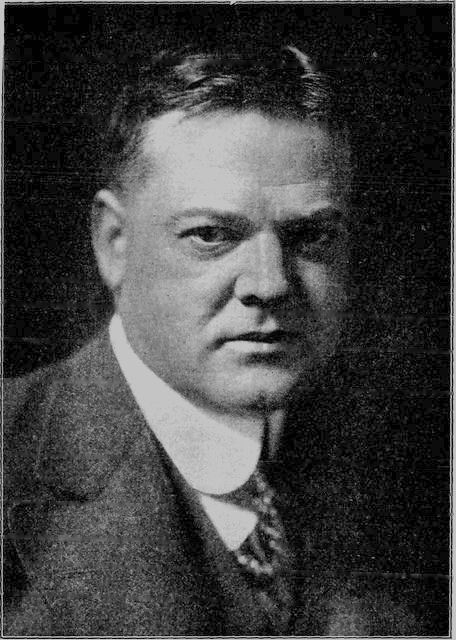
Copyright by Underwood & Underwood Herbert C. Hoover
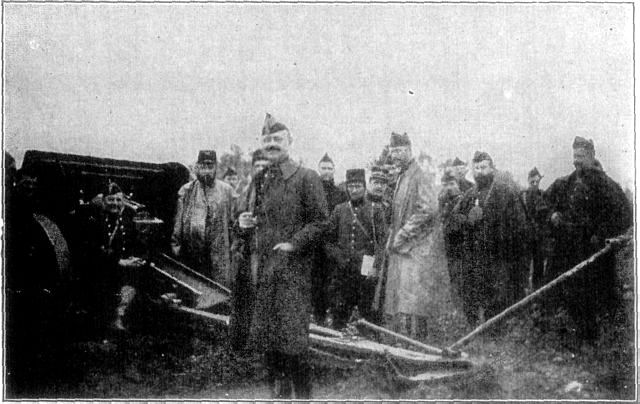
French Howitzer near H——
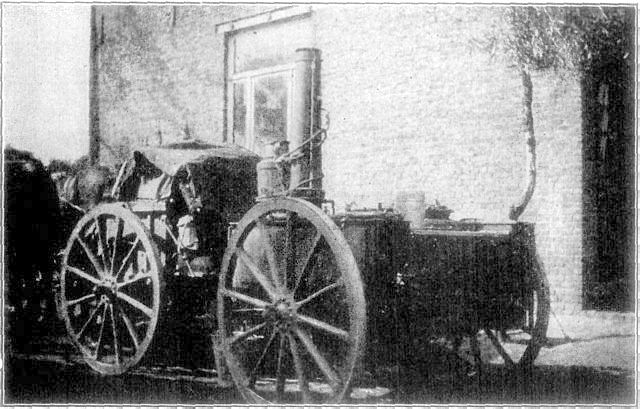
German camp kitchen
October 24th.—Yesterday was another busy day. I did not know that the entire population of Belgium could make such a crowd as I have had in the waiting-room of the chancery. In some mysterious way the news of my coming to London has got about, and swarms of people are coming in with little errands they want done and messages to be delivered to their friends and families in Brussels. It makes work, but that sort of thing is a comfort to lots of people and is worth undertaking. I have made it clear to all of them that anything to be delivered will be turned over to the German authorities first, and hope they will govern themselves accordingly.
The British Government has stipulated that the feeding of the civil population shall be carried on by a neutral organisation, under the patronage of the American and Spanish Ambassadors in London and Berlin, and the American and Spanish Ministers in Brussels. The food is to be consigned to the American Minister in Brussels for distribution by the organisation which is to be known as the American Relief Committee, with Hoover as chairman and motive power. The various local Belgian committees are to be grouped together in a national organisation, to assist in the distribution of the foodstuffs once they are delivered inside the Belgian frontier. The members of the Belgian organisation are, of course, prisoners of the Germans and unable to give any effective guarantees as to the disposal of the supplies. The British Government has, therefore, stipulated that all authority and responsibility are to be vested in the American Committee, and that the Belgians are to be regarded simply as a distributing agency. This is, of course, in no sense a reflection of the Belgians engaged on the work, but merely a recognition of the difficulties of their position.
The neutral composition of the Committee assures it a freedom of travel and action, and an independence of political and personal pressure, and a consequent freedom of administration which the Belgians could not hope to enjoy. It is only by the assumption of complete authority and responsibility by the Committee that the patrons will be able to give the various Governments concerned the necessary assurances as to the disposition of foodstuffs and the fulfillment of guarantees.
There is something splendid about the way Hoover and his associates have abandoned their own affairs and all thought of themselves in order to turn their entire attention to feeding the Belgians. They have absolutely cut loose from their business, and are to give their whole time to the work of the Committee. This is done without heroics. I should hardly have known it was done, but for the fact that Hoover remarked in a matter of fact way:
"Of course everybody will have to be prepared to let business go and give their whole time."
And it was so completely taken for granted that there is nothing but a murmur of assent.
Another strenuous day on the food question and other things.
My plans were to leave for Brussels on Monday morning, but in the evening the Ambassador sent for me and it was decided that I should go to Havre and from there to see the King and Queen. That will take me to within a couple of hours from Brussels, according to old calculations, but under present conditions I shall have to get there by way of France, England and Holland.
Hôtel des Régates, Havre, October 26, 1914.—This is the third town where I have paid my respects to the Belgian Government. I would gladly have foregone the experience, for it is depressing.
I left Waterloo station at 9:15 last night. Instead of the usual two-hour run to Southampton, we puttered along and did not arrive until after one. I had a compartment and made myself as comfortable as possible. When we arrived I found poor Colonel Swalm, the Consul, waiting for me. The Ambassador had telegraphed him to see me off, and he did so regardless of the hour. I felt horribly guilty to have him waiting about for me, but it certainly did make things a lot easier.
I got straight to bed, but had a hard time sleeping, as there was a tremendous racket of loading all night long. Nearly all the passengers were British officers on their way to the front. Among the others I found de Bassompierre of the Foreign Office, and a Mr. and Mrs. W——, who were coming over with a Rolls-Royce, to be presented to the Belgian General Staff. If I go to the front, he will take me. We sailed at daybreak and were here by two o'clock. Our Consul, Osborne, was waiting for me at the dock with Henry Needham, the correspondent of Colliers. I was let straight through the customs, where a woman marked my bag, and then came to this hotel overlooking the sea.
This was the first thing we saw as we came into the harbour. It is in a suburb called Nice Havrais, built by old Dufayel of Paris. It was a curious and pathetic sensation to see the Belgian flags still flying bravely. The different Ministries are set up here, and one villa has been set aside for the King and Queen, who have not yet left Belgian soil. The Legations are all established in this hotel and are bored to extinction, as their work has dropped very much. This little suburb enjoys all the privileges of extraterritoriality, and even the French Minister to Belgium goes through the motions of being accredited to a foreign Government in his country. The cars of the various Legations go buzzing around among the French and Belgian and British cars. The streets are full of troops of the three nations, while some twenty transports ride at anchor in the open roadstead. Fresh troops from England are arriving constantly, and march singing through the town to the camps outside, whence they are sent to the front. There are two British hospitals near this hotel—one of them the Casino—and wounded are everywhere. The place is astonishingly calm, but everybody knows there is a war. The French have their teeth set and are confident of the final outcome. Women are in the custom house, drive the trams, collect the fares and do a hundred other things that are usually out of their line.
I found the hall filled with colleagues, and exchanged greetings with the crowd before going over to the Foreign Office to make my bow. I found Colonel Fairholme packing, and ready to leave this evening for England.
The Foreign Office has a pretty little villa in a pretty little garden and keeps busy. I saw everybody, from Monsieur Davignon down to the porters, and spent an hour and a half there. Then at their request I went to the "Palace" and talked with General Jungbluth. He will try to arrange my business for me by telegraph, and will let me know in the morning whether I am to go up to the front to see the King and Queen.
When I came away from this call, Osborne was waiting for me and took me down to the Consulate for an hour's talk. Then back to the hotel to dine with Sir Francis. After dinner we all went out and bade the Colonel farewell.
Tuesday.—General Jungbluth was waiting for me when I came down this morning, to say that I should go to the front. Osborne was waiting with his car, and took me to the Ministry of War, to ask for a lift to Dunkerque in a military car. As luck would have it, to-day's car had left ten minutes before, so I was put off until to-morrow morning, when I shall go up with the W——s. I have spent a good part of the day getting my papers in order—both French and Belgian—and in the tiresome occupation of being photographed.
October 28th, Hôtel des Arcades, Dunkerque.—Another one-night stand.
We cleared out of Havre this morning over muddy and slippery roads. It rained hard all night, and we made good time by way of Fécamp, Dieppe, Eu, Abbeville, Montreuil, Bologne, Marquise, and Calais, getting to Dunkerque a little after four, just in time to smell the smoke of a couple of bombs dropped by an aeroplane across the street from the office of the Prime Minister, upon whom I called.
We began running into big bunches of troops at Abbeville—English, French and Belgian. I saw some of the Indian troops doing sentry duty and looking cold and uncomfortable, and did not blame them, for it was raw and cheerless. The Rolls-Royce is a beauty and sailed along all day like a gondola.
The Prime Minister had set up his office in the Mayor's room at the Hôtel de Ville, which I found in an uproar because of the bombs. The Prime Minister was said to be at Headquarters, at Furnes, across the Belgian frontier, and I was urged to go there to see him. We made twenty-one kilometers there, in time to find that little town in a great state of excitement, because three big shells had come from nobody knew where, and burst by the railroad station.
But the Prime Minister was not there, and it was dark, so we gathered up a guide and set off for la Panne, where the King and Queen are living. Neither of them was there; nobody but a gendarme on duty. The King was off with the troops and the Queen was looking after the wounded, who have overflowed all the hospitals. In the past week—just this one engagement—the Belgians have suffered 12,000 casualties.
The road from Furnes to la Panne and back lay close behind the lines, so that we could hear the steady roar of the fighting and see the bursting shells, particularly those from the British ships, which made a tremendous flash and roar.
We came on back to town, being stopped every minute by French outposts, and got to this hostelry at seven-thirty. While I was cleaning up, the Prime Minister came in and claimed me for dinner. He had his secretary, Count Lichtervelde, A.B., who is here looking after the wounded, and a couple of officers. And then we talked until the hands dropped off the clock and I was nearly dead for sleep. Then I took A.B. home to her hospital, through the streets darkened for the benefit of Count Zeppelin, and now I am ready for my rest.
I have plans for to-morrow, but shall see what happens to them when I see the Prime Minister in the morning.
October 29th.—Still at Dunkerque.
Another busy and interesting day, and if all goes well, I shall be back in London to-morrow night.
I was up early, did a little writing, and went over to see the Prime Minister, who was waiting for me. Despatched my business with him in short order, to my complete satisfaction. He is a trump, and it is a joy to do business with him, even at a time when he is hounded, as he is now.
He said the King was out with the troops, but had sent in to say he wanted to see me and would come in to headquarters at Furnes at four-thirty for that purpose. The Queen had also sent word in that she wanted to see me. She was busy looking after the wounded, but said she would come to la Panne at four. That suited me, although I was in some doubt as to how I would be able to make connections between the two audiences.
Last night I had talked of going out to look at the fighting, and A.B. had offered to conduct me. I had not taken the offer very seriously, but when I got back to the hotel after seeing the Prime Minister, she was there in a big racing car, with a crack chauffeur, ready for the jaunt. She was in her campaign kit of knickers, with a long rain-coat and a big knitted cap, and an entrancing boy she made. Mr. and Mrs. W—— had asked to go along, and were in their car with Barbaçon, an aide-de-camp of the Prime Minister. Monsieur de Broqueville came out quite seriously and begged A.B. not to lead me into danger, whereat everybody had a good laugh.
We made quick time to Furnes and drew up before Headquarters, where we learned what was known of the lay of the land and the points of the front we could reach without getting in the way. The Belgians, who had for ten days held the line of the Yser from Nieuport to Dixmude, waiting for reinforcements to come up, had been obliged to fall back to the line of the railroad, which forms the chord of the arc, and had inundated the intervening territory to impede the German advance. French and English troops were being brought up in large numbers to relieve the Belgians, who have lost in killed and wounded nearly a third of the 50,000 men engaged.
While waiting for some definite news to be brought in for us, we climbed to the top of the high tower of the market next the Hôtel de Ville, for a look at the battle line. It was pretty misty, but we could see the smoke of shrapnel and of the big shells from the English ships, which were enfilading the German right.
The staircase up this tower was a crazy thing, with rotten steps and places where two or three steps were missing altogether. It was bad enough going up where we could take hold and pull ourselves up, but it was far worse going down, because we were ordered down in a hurry and all came piling down in a steady stream. There were squeaks and screams at the bad moments, but we did manage to get down without mishap and take stock of ourselves.
We found some German prisoners lying on the straw in the entrance hall, and stopped to speak to them. They said that their troops were very tired from long, hard fighting, but that they had plenty of men. They seemed rather depressed themselves.
By the time we got down, our information had come and we set off through a welter of transport trains, artillery, ambulances, marching troops, and goodness knows what else, in the direction of X——. When we got within a couple of kilometers of the place, an officer stopped us and asked if we knew where we were going. He shrugged his shoulders when we said we did, and let us go straight into it. When we were bowling along about one kilometer from the town, three shells burst at once, about two hundred yards to our left, and we stopped to see what was toward. A hundred yards ahead to the right of the road was a battery of five big guns, and the Germans were evidently trying to get their range. The shells kept falling to the left, near a group of farm-houses, and as some of the spent balls of shrapnel kept rolling around near us, we decided we might as well go and see the big guns from nearer to.
In the shelter of the farm-houses were fifty or sixty men, some of them cooking their lunch, others sleeping, all quite oblivious of the roar of bursting shrapnel and the spattering of the bullets near by. And a few months ago probably any of these men would have been frightened into a fit by a shell bursting in his neighbourhood. It is wonderful how soon people become contemptuous of danger. The horses that were tethered by the roadside seemed to take it all as a matter of course, and munched away at their hay, as though all the world were at peace. A wobbly cart came creaking by with an infantryman, who had had a good part of his face shot away. He had been bandaged after a fashion and sat up blinking at us stupidly as the cart lumbered by, bumping into holes and sliding into ruts.
I was not keen on staying longer than was necessary to see what was there, but W.—— was very deliberate and not to be budged for more than half an hour. We finally got him started by calling his attention to the spent balls, which make a tremendous singing noise, but do no harm. The only really safe thing in the neighbourhood was what did the trick. The Germans were making a furious attack, evidently determined to break the line before the fresh troops could be brought up, and the cannonading was terrific. The whole front as far as we could see in either direction was a line of puffs of smoke from bursting shrapnel and black spouts of earth from exploding shells. The crackle of the mitrailleuses rippled up and down the whole line. The Belgians were pounding back as hard as they could and the noise was deafening. Finally, when we decided to leave, the officer in command of the battery loaded all five guns at once and fired a salvo for our benefit. The great shells tore away, roaring like so many express trains, and screaming like beasts in agony—a terrifying combination. My ears ache yet. It was getting hotter every minute and the Germans were evidently getting a better idea of the range, for the shells began falling pretty close on the other side, and I was quieter in my mind when we went back to our cars and pulled out of the actual line. We took a road a few hundred yards back, parallel with the lines, and drove along slowly, watching the effect of the shell fire, until we absolutely had to start back for lunch. On the way we stopped at a peasant's hut, and said hello to Jack Reyntiens.
When we got back to the hotel, about half an hour late for lunch, we found the Prime Minister waiting for us. At the door, in addition to the usual sentry, there were two privates of the chasseurs à cheval, one wearing a commander's star of the Legion of Honor. They saluted and smiled, and I bowed and went on in to my meal. They came in after me, still smiling, and I was taxed with not recognising them. They were the Duc d'Ursel and ————, the heads of their respective houses, who had enlisted, and are still fighting as privates. They had just been relieved and were on their way to the rear, where the Belgian army is being reformed and rested.
As soon as we had got through, I had to start back for my audience of the Queen. W.—— took me out to la Panne, where we found the Villa on the sand dunes, a little way back of the lines. There were a couple of gendarmes on duty, the King's Secretary, and the Countess de Caraman-Chimay, the one Lady-in-Waiting. I had just got inside when the door opened and the King came in. He had heard I was coming to see the Queen and had motored down from Furnes. I was able to satisfy him in a few minutes on the points he had wanted to see me about and then he questioned me about friends in Brussels. I suggested to him that it would probably help our committee in raising funds if he would write an appeal for help from America. He fell in with the idea at once, and together we got out an appeal that is to be sent across the water. Where we sat we could see the British ships shelling the Germans, and the windows of the dining-room were rattling steadily. The King stood beside the table with his finger tips resting on the cloth, watching the stuff ground out word by word. I looked up at him once, but could not bear to do it again—it was the saddest face one can imagine, but not a word of complaint was breathed.
Just as we were finishing, the Queen came and bade us in to tea. She was supposed to wait for her Lady-in-Waiting to bring me, but didn't. The King stayed only a minute or two and then said he must be getting back to Headquarters, where he would see me later.
I suggested to the Queen that she, too, make an appeal to the women of America, to which she agreed. Another appeal was prepared for her, and it, too, will be sent to America by the first post.
The Queen had wanted to see me about the subject of surgeons for the Belgian army. The Belgian surgeons in the Brussels hospitals have been replaced by Germans, and have nothing to do, although they are desperately needed here. The Queen was terribly depressed about the condition of the wounded. There are so few surgeons, and such tremendous numbers of wounded, that they cannot by any possibility be properly cared for. Legs and arms are being ruthlessly amputated in hundreds of cases where they could be saved by a careful operation. Careful operations are, of course, out of the question, with the wounded being dumped in every minute by the score. In these little frontier towns there are no hospital facilities to speak of, and the poor devils are lucky if they get a bed of straw under any sort of roof, and medical attendance, within twenty-four hours. We went to see one hospital in a near-by Villa, and I hope I shall never again have to go through such an ordeal. Such suffering and such lack of comforts I have never seen, but I take off my hat to the nerve of the wounded, and the nurses, most of them the best class of Belgian women, used to every luxury and getting none.
The Queen gave me tea, and one of her small supply of cigarettes, and we talked until after dark. The monitors off shore had been joined by a battleship, and the row was terrific and rendered conversation difficult.
The Queen was still full of courage and said that as long as there was one square foot of Belgian soil free of Germans, she would be on it. She said it simply, in answer to a question from me, but there was a big force of courage and determination behind it. As I was not dismissed, I finally took it on myself to go, and the Queen came with me to the door and sent me on my way. She stood in the lighted doorway until I reached the motor, and then turned slowly and went in—a delicate little woman with a lion's heart. Inglebleek and the Countess de Caraman-Chimay came out after we had cranked the car, and gave me messages for their families and friends. It is a pretty hard change for these people, who three months ago were leading such a dull, comfortable life, but they have risen to it with fine spirit.
The King was with his staff, studying the maps and despatches, when I got to Furnes, and I was shown the whole situation—most interesting on the large scale maps that show every farm-house and pathway. I was to go back to Dunkerque with Monsieur de Broqueville, so waited while they discussed the events of the day and plans for to-morrow.
While they talked reinforcements were pouring through the town, with great rumbling of artillery and blowing of trumpets. It was a comforting sound, as it presaged some relief for the Belgians in their heartbreaking stand.
There was comfort in riding back through the night with the Prime Minister, for there was no long examination of papers, etc. When we came to a post, the aide-de-camp would switch on a strong light in the car, the sentries would salute, and on we would go at a great gait.
Seemingly I was boarding with Monsieur de Broqueville, as I was led back to dine with him.
To-morrow I am off to London. Loewenstein, a young Brussels banker, is to take me over in his racing car, which is a useful institution these days. We take along his mother-in-law, Madame Misonne, and A.B. It means getting up at five to motor to Calais to catch the boat. There the car will be slung aboard, so that we can be whisked up to London without waiting for a train.
On board S.S. "Orange Nassau," North Sea, November 2, 1914.—On Friday morning we were called before dawn, and got under way as per schedule—Loewenstein, Madame Misonne, A.B., and I. We made good time, over slippery roads, to Calais, despite frequent stops to have our papers examined by posts, and got to the dock some twenty minutes before the steamer sailed. The car was hoisted aboard, and we rode across in it. Frederick Palmer was on board, returning in disgust after having been just that far toward the front.
Our suicide wagon was swung off onto the dock without loss of time, and we sped away toward London while our fellow-passengers were doomed to wait for all sorts of formalities. It was a wild ride. At times we were doing as high as one hundred and thirty kilometers an hour over winding English roads, and I was somewhat relieved when I was dropped at the Embassy, safe and sound.
I got off some telegrams about my trip, and was told the Ambassador wanted to see me. Hoover was with him, and I turned over to them the appeals from the King and Queen.
Jack Scranton decided to come back to Brussels with me, to give me a hand in Legation work, and spent the morning packing enough plunder to see him through a siege of three or four years. A.B. came on to London to see her brother who is seriously wounded and in hospital. Now her family want her to return to Brussels and have placed her in my care for the journey.
This morning we had a crowd at the station to see us off. Countess N.—— has also come along, and was entrusted to our care. A.B.'s family was there in force to say good-bye, so altogether the casual observer might have inferred that we were popular.
Brussels, November 5th.—We were met in Flushing by our Consular Agent, who put us through the customs and onto the train.
No motor was waiting for us at Rosendaal, and we had a hard time getting shelter for the night. Finally we succeeded in getting a room for the two women in a little, third-rate hotel, and Jack and I slept on the floor of a sitting-room in the little Hôtel Central. I was so dog-tired that I slept like a log, wrapped up in my fur coat.
While we were having coffee, M. de Leval came up in my little car. He had been to Rotterdam in connection with the first shipment of food, and thought he would find me alone. He had bought a lot of gasoline in Breda, to be called for, so we could take no luggage. We found another car leaving for Brussels at noon, and loaded it up with Countess N., —— Jack and the luggage, while M. de L. and I took A.B. and the mail bags, and started by way of Breda. We came through Aerschot and stopped for a stretch and to look about.
We walked about the streets for a time, and stopped in a shop to ask for a drink of water. After giving it to us, the proprietor asked if we would like to see the state the Germans had left things in. He led us back into his living quarters, opened a door bearing an inscription to the effect that it was an officers' mess, and let us in. I never have seen a more complete mess. Everything in the place was smashed, and the whole room was filthy. The officers had left only a few days before and had taken pains to break everything before they went. Obscene remarks were chalked on the walls, and the pictures were improved with heavy attempts at fun. I always used to think that the term "officer and gentleman" was redundant, but now I begin to understand the need for it.
The church was also in a bad state. The doors have nearly all been battered down. The wooden Gothic statues in the nave have been smashed or destroyed by fire. The altars and confessionals were wantonly destroyed. The collection boxes had been pried open and emptied. We were told that the holy-water font and the vestments of the priests had been profaned and befouled. It is not a pretty sight.
Aerschot was partially destroyed on August 19th and 20th. The Germans claim that their commanding officer was shot by the son of the Burgomaster. The Belgians claim that he was struck by a stray bullet fired at random by one of his own men in the marketplace. However that may be, the whole place was instantly in an uproar, and quiet was not restored until the town had been sacked and over one hundred and fifty people killed, among them women and children. The Burgomaster and his son and a priest were among those shot and buried outside the Louvain gate. One of those taken to the place of execution was spared on condition that he should go to Louvain to tell of what had happened.
Louvain has been cleaned up a lot, and we stopped there only long enough to have our passes examined at Headquarters, getting back a little before six to a warm welcome.
The other motor was due at six, but did not come, and after waiting up till midnight, I turned in. Jack bobbed up yesterday at noon. The car had been stopped at the frontier because several of the passengers had not proper papers. Jack threw out his chest and insisted on being taken to Antwerp to see the Military Governor. His passport, as bearer of despatches, did the business, and they were allowed to proceed under armed guard. They were kept overnight in the Hôtel Webber, and then Jack and Mme. N—— were allowed to come on to Brussels in the car, while the others were detained.
Marshal Langhorne came in to-day from The Hague to effect formal delivery of the first bargeload of food, and had weird tales to tell of his adventures by the way. Thank goodness, the first of the food has arrived in time, and if the flow can be kept up, the worst of our troubles will be averted.
With this first consignment of food came the story of how it was got through in such record time. Hoover is one of these people who is inclined to get things done and attend later to such details as getting formal permission, etc.
With Shaler's forty thousand pounds and promises of five hundred thousand dollars more, he went to work and placed orders for twenty thousand tons of food, costing two million dollars a week. This he did on the theory that money would come along later, when the need was realised, but that the Belgian stomachs would not wait until collections had been made. He purchased the food, got it transported to the docks, and loaded on vessels that he had contrived to charter, while all the world was fighting for tonnage, got them loaded and the hatches closed.
When everything was ready, Hoover went to the proper authority and asked for permission to ship the food, announcing that unless he could get four shiploads of food into Belgium by the end of the week, the people would begin to starve. The functionary was sympathetic, but regretted that in the circumstances, he could not help. It was out of the question to purchase food. The railways were choked with troops, munitions and supplies. Ships were not to be had for love or money. And above all, the Channel was closed to commerce.
Hoover heard him patiently to the end.
"I have attended to all this," he said. "The ships are already loaded and ready to sail. All I need from you is clearance papers. You can let me have them, and everything will be all right."
The high official could hardly believe his ears:
"Young man," he gasped, "perhaps you don't realise what you have done. Men have been sent to the Tower for less. If it were for any other cause, I hesitate to think what would happen to you. But as it is, I can only congratulate you on some very good work."
And that's how we got our food in time.
Fines are being imposed on towns on one pretext or another. The other day two policemen got into a controversy with a German secret-service agent who did not explain who he was, and got a good thumping for doing various things that a civilian had no business to do. This morning von Lüttwitz comes out with this proclamation:
On the 28th of October, 1914, a legally constituted court martial pronounced the following sentences:
The policeman De Ryckere for having attacked, in the legal exercise of his duties, an authorised agent of the German Government, for having deliberately inflicted bodily hurt in two instances with the aid of other persons, for having aided in the escape of a prisoner and for having attacked a German soldier, was condemned to five years' imprisonment.
The policeman Seghers for having attacked, in the exercise of his legal duties, an authorised agent of the German Government, for having deliberately inflicted bodily hurt on this German agent, and for having aided the escape of a prisoner (all these offences constituting one charge), was condemned to three years' imprisonment.
The sentences were confirmed on October 31st by the Governor-General, Baron von der Goltz.
The city of Brussels, not including its suburbs, has been punished for the injury by its policeman De Ryckere to a German soldier, by an additional fine of Five Million Francs.
Brussels, November 1, 1914.
The Governor of Brussels,
Baron von Lüttwitz,
General.
Last night we dined at Ctesse. N——'s to celebrate everybody's safe return.
Brussels, Sunday, November 8, 1914.—Barges of food are beginning to come in, and we have the place filled with people with real business concerning the food and a lot of the usual "halo-grabbers" anxious to give advice or edge into some sort of non-working position where they can reap a little credit.
We are put on German time to-day.
On November 4th the Governor-General came out with a proclamation ordering that German money be accepted in all business transactions. It is to have forced currency at the rate of one mark to one franc, twenty-five centimes. As a matter of fact, it is really worth about one franc, seven centimes, and can be bought at that rate in Holland or Switzerland, where people are glad enough to get rid of their German money. Any shop refusing to accept German paper money at the stipulated rate is to be immediately closed, according to the Governor's threat.
Brussels, November 9, 1914.—Late in the afternoon Jack and I took Max for a run in the Bois. While we were going across one of the broad stretches of lawn, an officer on horseback passed us, accompanied by a mounted orderly. To our surprise the orderly drew his revolver and began waving it at us, shouting at the same time that if that —————— dog came any nearer, he would shoot him down. The officer paid no attention, but rode on ahead. I started after them on foot, but they began to trot and left me in the lurch. I ran back to the motor, overtook them, and placed the car across their path. The officer motioned his orderly to go ahead, and then let me tackle him. He took the high ground that I had no reason to complain since the dog had not actually been shot, not seeming to realize that peaceable civilians might have legitimate objections to the promiscuous waving of revolvers. He declined to give his name or that of the soldier, and I gave up and let him ride on after expressing some unflattering opinions of him and his kind to the delight of the crowd that had gathered. They did not dare say anything direct, but as I got back into the car they set up a loud "Vive l'Amérique." The officer looked peevish and rode away very stiff and haughty. Of course, since he refused to give his name, there was no getting at him, and I was free to be as indignant as I liked.
The Germans are tightening up on the question of travel in the occupied territory, and we are now engaged in a disagreeable row with them over passes for the Legation cars. They want to limit us in all sorts of ways that make no difference to them, but cut down our comfort. They will probably end by giving us what they want; but when it is all done we shall have no feeling of obligation, having been forced to fight for it.
Brussels, November 14, 1914.—On the morning of the 10th, I came down to the Legation and found things in an uproar. A telegram had been received saying that two trainloads of food, the first shipment for the Province of Liège, would cross the frontier in the course of the afternoon, under convoy of Captain Sunderland, our Military Attaché at The Hague. The Minister and I are the only people authorized to receive shipments; and, as no power of attorney had been sent to the Consul at Liège, things were in a nice mess; and, at the request of the German authorities and the Committee, it was decided that I should go down, receive the stuff and make arrangements for its protection and for the reception of future shipments. The German authorities were so excited about my being there to head off any trouble that they hustled me off on an hour's notice without any lunch. I contrived to get Jack's name put on the laisser-passer, so that he could go along and see a little something of the country. Joseph, the Legation butler, was wild to go along as far as his native village to see his aged ma, whom he had not seen since the beginning of the war, and he rode on the front seat with Max who was much delighted to get under way again.
Jack was thrilled with the trip, and nearly fell out of the car going through Louvain and the other ruined villages along the way. As we were in such a rush, I could not stop to show him very much; but in most of these places no guide is needed. Louvain has been cleared up to a remarkable extent, and the streets between the ruined houses are neat and clean. On my other trips I had had to go around by way of Namur, but this time we went direct; and I got my first glimpse of Tirlemont and St. Trond, etc.
When we reached Liège we went straight to the Consulate without pausing to set ourselves up at a hotel, but found that nothing was known of Captain Sunderland or his food trains. Thence to the German headquarters where we inquired at all the offices in turn and found that the gentleman had not been heard from. By the time we got through our inquiries it was dark; and, as we had no laisser-passer to be out after dark, we had to scuttle back to the hotel and stay.
In the morning the Consul and I started off again to see what had become of our man. We went through all the offices again, and as we were about to give up, I found Renner, who used to be Military Attaché of the German Legation here, and is now Chief of Staff to the Military Governor. He cleared up the mystery. Sunderland had arrived about the same time I did, but had been taken in hand by some staff officers, dined at their mess, and kept busy until time for him to be off for Maestricht. He was, however, expected back in time to lunch at the officers' mess. He was also expected to dine with them in the evening. I left word that I wanted to see him and made off to get in touch with the members of the local committee and make arrangements as to what was to be done with the food. We sat and waited until nearly dark, when I decided to go out for a little spin. I gathered Jack and the Consular family into the car and went for a short spin.
After losing our way a couple of times we brought up at the Fort of Chaudefontaine, which was demolished by the Germans. It is on top of a veritable mountain and it took us some time to work our way up on the winding road. When we got there the soldiers on guard made no trouble and told us that we could mouse around for fifteen minutes. We walked out to the earthworks, which had been made by the Belgians and strengthened by the Germans, and then took a look at the fort itself, which was destroyed, and has since been reconstructed by the Germans. They must have had the turrets and cupolas already built and ready to ship to Liège, for the forts are stronger than they ever were before and will probably offer a solid resistance when the tide swings back, unless, of course, the allies have by that time some of the big guns that will drop shells vertically and destroy these works the way the German 42's destroyed their predecessors. It was very interesting to see and hard to realise that up to three months ago this sort of thing was considered practically impregnable.
When we got back we found that our man had come and had left word that he could be found at the Café du Phare at six o'clock. We made straight for that place, and found him. I made an appointment with him for the first thing next morning, and went my way.
I was bid to dine with the German Military Governor and his staff, but told Renner that since we were accredited here to the Belgian Government, accepting German hospitality would certainly be considered as an affront. He saw the point, and did not take offence, but asked me to come over after dinner for a talk and bring Jack along, the which I promised to do. While we were dining, a soldier with a rifle on his shoulder strode into the dining-room and handed me a paper; great excitement, as everybody thought we had been arrested. The paper was a pass for us to circulate on the streets after dark, so that we could go over to the headquarters. It was written on the back of a menu in pencil. Although dinner was over the entire mess was still gathered about the table discussing beer and Weltpolitik. At the head of the table was Excellenz Lieutenant-General von Somethingorother, who was commanding a German army on the eastern front when they got within fifteen miles of Warsaw. After being driven back he had an official "nervous breakdown," and was sent here as Governor of the Province of Liège—quite a descent, and enough to cause a nervous breakdown. There was another old chap who had fought in the Franco-Prussian war and had not yet quite caught up with this one. I foregathered with Renner and got my shop talk done in a very short time. Then everybody set to to explain to us about the war and what they fought each other for. It was very interesting to get the point of view, and we stayed on until nearly midnight, tramping home through a tremendous downpour, which soaked us.
The next morning at eleven I met Sunderland. We saw the Governor and the Mayor and Echevins, and talked things out at length. I had to collect a part of the cost of the food before I could turn it over, and they explained that the chairman of the local committee had gone to Brussels to negotiate a loan; he would be back in four or five days and if I would just wait, they would settle everything beautifully. That did not please me, so I suggested in my usual simple and direct way that the Governor rob the safe and pay me with provincial funds, trusting to be paid later by the committee. It took some little argument to convince him, but he had good nerve, and by half-past twelve he brought forth 275,000 francs in bank-notes and handed them over to me for a receipt. Sticking this into my pocket, I made ready to get under way, but there was nothing for it but that I must lunch with them all. Finally I accepted, on the understanding that it would be short and that I could get away immediately afterward. That was not definite enough, however, for we sat at table until four o'clock and then listened to some speeches.
When we got down the home stretch, the Governor arose and made a very neat little speech, thanking us for what we had done to get food to the people of Liège, and expressing gratitude to the American Government and people, etc. I responded in remarks of almost record shortness, and as soon as possible afterward, we got away through the rain to Brussels.
After getting through that elaborate luncheon, getting our things ready at the hotel, paying our bill, saying good-bye all around once more, etc., it was nearly five o'clock when we got off and nearly eight when we reached Brussels and put our treasure in the safe.
The Germans have begun arresting British civilians and we have had our hands full dealing with poor people who don't want to be arrested and kept in prison until the end of the war and can't quite understand why they have to put up with it. It is pretty tough, but just another of the hardships of the war, and while we are doing our best to have the treatment of these people made as lenient as possible, we can't save them.
Brussels, November 16, 1914.—Some more excitement yesterday morning, when various British subjects were arrested.
Two German civilians tried to force their way into the British Consulate and arrest Mr. Jeffes, the British Consul, and his son, although the American flag was flying over the door and there was a sign posted to the effect that the place was under our protection and all business should be transacted with us. Fortunately Nasmith was there, and after trying to explain the matter politely, he made for the two men, threw them into the street, and bolted the door. The gum-shoe men were so surprised that they went away and have not been back. Last night I was called around to the Consulate and found two more men shadowing the place. There seemed to be no danger of arrest, but Nasmith spent the night there, and this morning I went around and took the Jeffes to our Consulate, so that if any attempt was made to take them, we should have an opportunity to protest. The higher authorities had promised not to seize them, but apparently you can never tell.
Yesterday was the King's Saint's Day, and word was passed around that there would be a special mass at Ste. Gudule. Just before it was to begin, the military authorities sent around and forbade the service. The Grand Marshal of the Court opened the King's book at his house, so that we could all go around and sign, as in ordinary times, for we are accredited to the King of the Belgians, but early in the morning an officer arrived and confiscated the book. The Government of Occupation seems to be mighty busy doing pin-head things for people who have a war on their hands.
Countess de Buisseret's little boy was playing on the street yesterday when the German troops passed by. Being a frightful and dangerous criminal, he imitated their goose-step and was arrested. M. de Leval went around to headquarters to see what could be done, supposing, of course, that when it was seen what a child he was, his release would be ordered. Instead, he was told seriously that the youngster must be punished and would be left in jail for some days.
Brussels, November 18, 1914.—This is another day of disgust. This morning one of the servants of the Golf Club came in to say that there were fifty German soldiers looting the place. In the afternoon Jack and I went out for a look at the place and to get my clubs. We found a lot of soldiers under command of a corporal. They had cleaned the place out of food, wine, linen, silver, and goodness knows what else. Florimont, the steward, had been arrested because he would not tell them which of the English members of the club had gone away and where the others were staying. Having spent his time at the club, the fact was that he did not know who was still in town and could not tell, but the Germans could not be convinced of this and have made him prisoner.
I stopped at headquarters this afternoon to see von der Lancken. As I came out a fine Rolls-Royce limousine drew up on the opposite side of the street—a military car. The chauffeur, in backing out, caught and tore the sleeve of his coat. In a rage, he slammed the door and planted a tremendous kick in the middle of the panel with his heavy boot. I stood agape and watched. He looked up, caught me looking at him, and turned his anger from the motor to me. He put his hands on his hips, shot out his jaw and glared at me. Then he began walking toward me across the street in heavy-villain steps, glaring all the time. He stopped just in front of me, his face twitching with rage, evidently ready to do something cataclysmic. Then the heavens opened, and a tremendous roar came from across the street. The officer to whom the car belonged had seen the display of temper from his window, and had run out to express his views. The soldier did a Genée toe-spin and stood at attention, while his superior cursed him in the most stupendous way. I was glad to be saved and to have such a display of fireworks into the bargain.
November 19th.—One day is like another in its cussedness.
The Germans have been hounding the British Legation and Consulate, and we have had to get excited about it. Then they announced to the Dutch Chargé that our courier could no longer go—that everything would have to be sent by German field post. You would think that after the amount of hard work we have done for the protection of German interests and the scrupulous way in which we have used any privileges we have been accorded, they would exert themselves to make our task as easy as possible and show us some confidence. On the contrary, they treat us as we would be ashamed to treat our enemies.
This morning it was snowing beautifully when I woke up, a light, dry snow that lay on the ground. It has been coming down gently all day and the town is a lovely sight, but I can't get out of my mind the thought of those poor beggars out in the trenches. It seems wicked to be comfortable before a good fire with those millions of men suffering as they are out at the front.
And now Grant-Watson[9] has been put in prison. He stayed on here after the Minister left, to attend to various matters, and was here when the Germans arrived. Recently we have been trying to arrange for passports, so that he and Felix Jeffes, the Vice-Consul, might return to England. The authorities were seemingly unable to make up their minds as to what should be done, but assured the Minister that both men would be allowed to return to England or to remain quietly in Brussels. On Friday, however, the Germans changed their minds and did not let a little thing like their word of honour stand in the way.
The Minister was asked to bring Grant-Watson to headquarters to talk things over—nothing more. When they got there, it was smilingly announced that Grant-Watson was to leave for Berlin on the seven o'clock train, which put us in the position of having lured him to prison. The Minister protested vigorously, and finally Grant-Watson was put on parole and allowed to return to the Legation, to remain there until eleven o'clock yesterday morning. I went over the first thing in the morning to help him get ready for his stay in jail. At eleven Conrad arrived in a motor with Monsieur de Leval. We went out and got in, and drove in state to the École Militaire, and, although I was boiling with rage at the entire performance, I could not help seeing some fun in it.
Grant-Watson's butler was ordered to be ready to go at the same time. At the last minute the butler came down and said perfectly seriously that he would not be able to go until afternoon, as he had broken the key to his portmanteau and would have to have another made. The Germans did not see anything funny in that, and left him behind.
When we got to the École Militaire, we were refused admittance, and had to wrangle with the sentries at the door. After arguing with several officers and pleading that we had a man with us who wanted to be put in prison, we were reluctantly admitted to the outer gate of the building, where British subjects are kept. When the keeper of the dungeon came out, I explained to him that the butler had been detained, but would be along in the course of the afternoon, whereupon the solemn jailer earnestly replied, "Please tell him that he must be here not later than three o'clock, or he can't get in!" And nobody cracked a smile until I let my feelings get the better of me.
I was prepared for an affecting parting with Grant-Watson in consigning him to the depths of a German jail, but he took it as calmly as though he were going into a country house for a week-end party. I suppose there is some chance that they may exchange him for a few wounded German officers and thus get him back to England.
Since our snow-storm the other day, the weather has turned terribly cold and we have suffered even with all the comforts that we have. And the cheerful weather prophets are telling us that without doubt this will be one of the coldest winters ever known. A pleasant prospect for the boys at the front! Mrs. Whitlock and everybody else is busy getting warm clothing for the poor and for the refugees from all parts of Belgium who were unable to save anything from their ruined homes. It is bad enough now, but what is coming....
Gustave has just come in with the cheering news that Ashley, our crack stenographer, has been arrested by the Germans. They are making themselves altogether charming and agreeable to us.
Max is spread out before the fire, snoring like a sawmill—the only Englishman in Brussels who is easy in his mind and need not worry.
Tuesday, November 24th.—Another day of rush without getting very far.
The Germans decided this morning that they would arrest Felix Jeffes, the British Vice-Consul, so I had the pleasant task of telling him that he was wanted. I am to go for him to-morrow morning and take him to the École Militaire with his compatriots. This job of policeman does not appeal to me, even if it is solely to save our friends the humiliation of being taken through the streets by the Germans.
November 25th.—Had a pleasant day.
Had arrangements made with Jeffes to go with him to the École Militaire at 11 o'clock and turn him over to his jailer. The Minister went up with von der Lancken to see the Englishmen and be there when Jeffes arrived, so as to show a friendly interest in his being well treated.
I went around to the Consulate on time, and found that, through a misunderstanding, Jeffes had made no preparations for going, having been assured that another attempt would be made to get him off. I pointed out that the Minister had given his word of honour that Jeffes should be there, and that he would be left in a very unpleasant and annoying position if we did not turn up as promised. Jeffes was perfectly ready, although not willing to go. I went to the École Militaire and explained to von der Lancken that Jeffes' failure to appear was due to a mistake, and asked that he be given time to straighten out his accounts and come later in the day or to-morrow morning. The answer was that he must come some time during the day. The Consul-General went straight to von Lüttwitz with Jeffes, made a great plea on the score of his health or lack of it, and got his time extended until he could be given a medical examination by the military authorities. Late in the afternoon he was looked over and told to go home and be quiet, that he would probably not be wanted, but that if anything came up, they would communicate with him further.
Brussels, November 27, 1914.—More busy days. Each day we swear that we will stop work early and go out to play. Each day we sit at our desks, and darkness comes down upon us, and we do not get away until nearly eight o'clock. "Thanksgiving Day" was no exception, and to-day we are going through the same old performance. Yesterday, by strenuous work, I got down to swept bunkers and had a good prospect of an easy day. Instead of that there has been a deluge of Consuls, mail, telegrams, and excited callers, and we are snowed under a heap of work it will take several days to get out of the way.
We came back to them with a bump, however, when Nasmith came to my flat at midnight to say that Jeffes had been arrested. And it was done in the usual charming manner. In the course of the afternoon, the Consul-General got a note asking him to go to headquarters "to talk over the case of Mr. Jeffes." It asked also that Jeffes accompany the Consul-General "to the conference." When they arrived it was announced that Jeffes was under arrest and to be sent immediately to the École Militaire. The Consul-General, like the Minister, on the occasion of his visit, was placed in the position of having lured his friend into jail. He protested vigorously, but was not even allowed to accompany Jeffes to the École Militaire. It was only after some heated argument that Jeffes was allowed five minutes at home, under guard, to get a few belongings together to take with him. The Consul-General is furious, and so am I when I remember how decently the German Vice-Consul here was treated when the war broke out.
Early in the week Jack is to be sent down to Mons, to bring out some English nurses who have been there nursing the British wounded. Two of them, Miss Hozier and Miss Angela Manners, were in yesterday. They have been working hard during the past three months and are now ready to go back to England if we can arrange for passports.
Under the date of November 26th, General von Kraewel announces that he has succeeded Baron von Lüttwitz, who has been transferred to the army at the front.
Hoover arrived from London this afternoon accompanied by Shaler and by Dr. Rose, Henry James, Jr., and Mr. Bicknell of the Rockefeller Foundation, who have come to look into conditions. There is plenty for them to see, and we shall do our best to help them see it.
As we learned from a confidential source, several days ago, there has been a big shake-up in the Government here. Both von der Goltz and von Lüttwitz have gone and have been replaced—the first by Freiherr von Bissing, and the latter by General von Kraewel. There are several explanations for the changes, but we don't yet know what they mean.
Brussels, December 2, 1914.—We have had a hectic time. Hoover arrived on Sunday evening, accompanied by Shaler and by three representatives of the Rockefeller Foundation. We have had a steady rush of meetings, conferences, etc., and Hoover and Shaler pulled out early this morning. There is not much relief in sight, however, for to-morrow morning at the crack of dawn, I expect to start off on a tour of Belgium, to show the Rockefeller people what conditions really are. We shall be gone for several days and shall cover pretty well the whole country.
Yesterday morning I got Jack off to Mons to bring back the British nurses. Everything in the way of passports and arrangements with the military authorities had been made, and he went away in high spirits for a little jaunt by himself. This morning at half-past three o'clock he rang the doorbell and came bristling in, the maddest man I have seen in a long time. He had suffered everything that could be thought of in the way of insult and indignity, and to make it worse, had been obliged to stand by and watch some brutes insult the girls he was sent down to protect. When he arrived at Mons he got the nurses together and took them to the headquarters, where he explained that he had been sent down by the Minister with the consent of the German authorities, to bring the nurses to Brussels. This was stated in writing on the passport given him by the German authorities here. Instead of the polite reception he had expected, the German officer, acting for the Commandant, turned on him and told him that the nurses were to be arrested, and could not go to Brussels. Then, by way of afterthought, he decided to arrest Jack and had him placed under guard on a long bench in the headquarters, where he was kept for three hours. Luckily, an old gentleman of the town who knew the nurses, came in on some errand, and before they could be shut up, they contrived to tell him what the situation was and ask him to get word to the Legation. Right away after this the three women were taken out and put in the fourth-class cells of the military prison, that is, in the same rooms with common criminals. Jack was left in the guard room. The old gentleman, who had come in, rushed off to the Burgomaster and got him stirred up about the case, although he was loath to do anything, as he knew that a representative of the American Legation could not be arrested. Finally he did come around to headquarters, and after a long row with the Adjutant, they got Jack released and fitted out with a laisser-passer to return to Brussels. He was insulted in good shape, and told that if he came back again, sent by the Minister or by anybody else, he would be chucked into jail and stay there. Before the nurses were taken down to their prison, the Adjutant shook his fist in Miss Hozier's face, and told her that they were going to give her a good lesson, so that the English should have a taste of the sort of treatment they were meting out to German nurses and doctors that fell into their hands.
The Mayor and Aldermen took Jack in charge when he was released, and kept him in one of their homes until time for the train to leave for Brussels at midnight. They were convinced that he would be arrested again at the station, but he did get off in a car filled with sick soldiers and arrived here without mishap at three o'clock or a little after.
I went over to see von der Lancken the first thing in the morning, and told him the whole story, in order that he might be thinking over what he was going to do about it before the Minister went over to see him at eleven. The Minister said his say in plain language, and got a promise that steps would be taken at once to get the girls out of prison and have them brought to Brussels. Later in the day von der Lancken came through with the information that the action of the authorities at Mons was "due to a misunderstanding," and that everything was lovely now. We suppose that the girls will be here to-morrow; if not, inquiries will be made and the Minister will probably go down himself.
Yesterday morning we spent visiting soup kitchens, milk stations, and the distributing centres for supplying old clothes to the poor. The whole thing is under one organisation and most wonderfully handled. It is probably the biggest thing of the sort that has ever been undertaken and is being done magnificently.
It is a curious thing to watch the Commission grow. It started as nothing but a group of American mining engineers, with the sympathetic aid of some of our diplomatic representatives and the good-will of the neutral world. It is rapidly growing into a powerful international entity, negotiating agreements with the Great Powers of Europe, enjoying rights that no Government enjoys, and as the warring governments come to understand its sincerity and honesty, gaining influence and authority day by day.
There is no explanation of the departure of von der Goltz. His successor has come out with a proclamation in three lines, as follows:
His Majesty, the Emperor and King, having deigned to appoint me Governor-General in Belgium, I have to-day assumed the direction of affairs.
Baron von Bissing.
Brussels, December 3, 1914.
Brussels, Sunday, December 6, 1914.—We got away at eight o'clock on Thursday morning, in three cars from the Palace Hotel. We were four cars when we started, but fifty feet from the door the leading car broke down and could not be started, so we rearranged ourselves and left the wreck behind. The party was composed of the three Rockefeller representatives, Dr. Rose, Mr. Bicknell, and Henry James, Jr., Monsieur Francqui, Josse Allard, Jack and I.
It was rainy and cold, but we made good time to Louvain and stopped at the Hôtel de Ville. Professor Neerincxs, of the University, took up the duties of Burgomaster when the Germans shipped the real one away. He speaks perfect English, and led the crowd around the town with the rush and energy of a Cook's tourist agent. He took us first through the Cathedral, and showed us in detail things that we could not have seen if we had gone at it alone. Then around to the library and some of the other sights of particular interest, and finally for a spin through the city, to see the damage to the residence district. This was a most interesting beginning, and made a good deal of an impression on our people. They asked questions about the work being done by the people toward cleaning up the ruins of the town and trying to arrange make-shift shelters to live in during the winter. The Mayor is a man of real force of character, and has accomplished marvels under the greatest difficulties.
From Louvain we cut away to the northeast to Aerschot, where we took a quick look at the welter of ruin and struck out to the west through Diest and Haelen, which I saw on my first trip with Frederick Palmer before there was anything done to them.
We got to Liège about one o'clock and had lunch in a restaurant downtown, where we were joined by Jackson, our delegate sent down there to supervise the distribution of food for the Commission. He told us a lot about the difficulties and incidents of his work, and some details of which we had to think. He is the first delegate we have sent to outlying cities, and is up on his toes with interest. A lot more have already sailed from New York, and will soon be here. They are to be spread all over the country in the principal centres, some to stay in the big cities and watch local conditions, and others to travel about their districts and keep track of the needs of the different villages. It is all working out a lot better than we had hoped for, and we have good reason to be pleased. Our chief annoyance is that every time things get into a comfortable state, some idiot starts the story either in England or America that the Germans have begun to seize foodstuffs consigned to us. Then we have to issue statements and get off telegrams, and get renewed assurances from the German authorities and make ourselves a general nuisance to everybody concerned. If we can choke off such idiots, our work will be a lot easier.
The Burgomaster came into the restaurant to find us, and offered to go on with us to Visé, to show us the town, and we were glad to have him, as he knows the place like the palm of his hand.
I had been through Visé twice, and had marvelled at the completeness of the destruction, but had really had no idea of what it was. It was a town of about forty-five hundred souls, built on the side of a pretty hill overlooking the Meuse. There are only two or three houses left. We saw one old man, two children and a cat in the place. Where the others are, nobody knows. The old man was well over sixty, and had that afternoon been put off a train from Germany, where he had been as a prisoner of war since the middle of August. He had Kriegsgefangener Munster stencilled on his coat, front and back, so that there could be no doubt as to who he was. He was standing in the street with the tears rolling down his cheeks and did not know where to go; he had spent the day wandering about the neighbouring villages trying to find news of his wife, and had just learned that she had died a month or more ago. It was getting dark, and to see this poor old chap standing in the midst of this welter of ruin without a chick or child or place to lay his head.... It caught our companions hard, and they loaded the old man up with bank-notes, which was about all that anybody could do for him and then we went our way. We wandered through street after street of ruined houses, sometimes whole blocks together where there were not enough walls left to make even temporary shelters.
Near the station we were shown a shallow grave dug just in front of a house. We were told who filled the grave—an old chap of over sixty. He had been made to dig his own grave, and then was tied to a young tree and shot. The bullets cut the tree in two just a little above the height of his waist, and the low wall behind was full of bullet holes.
As nearly as we can learn, the Germans appear to have come through the town on their way toward Liège. Nothing was supposed to have happened then, but on the 15th, 16th and 17th, troops came back from Liège and systematically reduced the place to ruins and dispersed the population. It was clear that the fires were all set, and there were no evidence of street fighting. It is said that some two hundred civilians were shot, and seven hundred men bundled aboard trains and sent back to Germany as prisoners of war—harmless people like the old chap we saw.

Von Bulow's greeting to the people of Liège[e]

How the simple pleasures of the German soldier were restricted.[f]
The Burgomaster set out on foot to walk back three kilometers and catch a tram to Liège, and we went southeast to Dalhem, where we spent the night at the Château de Dalhem, on a hill overlooking the picturesque little village snuggled in the bottom of the valley. It was off the main line of march, and had not suffered. The château belongs to General Thyss, who was a great friend of the late King Leopold. He was not there, but the place was being protected by a splendid old dragon in the shape of a German governess who had been with the family for over thirty years, and refused to leave when the war broke out. She had been obliged to lodge a crowd of German officers and some of their men, but held them down with an iron hand, kept them from doing any damage and made them pay for every egg and every bottle of wine they had. We arrived after dark and threw the place into a panic of fear, but Monsieur Francqui soon reassured everybody, and the place was lighted up and placed at our disposal in short order.
Although it was pitch dark when we arrived, it was only half past four and we set out on foot to stretch a little. The moon came out and lighted our way through the country roads. We tramped for a couple of hours through all sorts of little towns and villages and groups of houses, some of them wiped out and some hardly touched.
General Thyss's cellars are famous, and with our dinner of soup and bacon and eggs, we had some of the finest Burgundy I have ever tasted. Early to bed so that we could be up and off at daybreak.
Friday morning we were away early, and made for Herve, where I had never been before. It is a ruin with a few natives and a lot of Landsturm left. We talked to some peasants and to an old priest who gave us something to think about in their stories of happenings there during and after the occupation of their homes. From there to Liège, by way of a lot of little villages whose names I don't remember, but whose condition was pretty bad, past the fort of Fléron and the defensive works that are being put up there.
Wasted some time trying to get gasoline for the other motors, and then the long stretch to Namur, down the valley of the Meuse, and stopped long enough for a look at Andennes, my second visit to the place.
In Andenne and Seilles (a little village across the Meuse) the Germans did a thorough job. They killed about three hundred people and burned about the same number of houses. Most of the houses had been looted systematically. According to the stories of those inhabitants who remain, there was a reign of terror for about a week, during which the Germans rendered themselves guilty of every sort of atrocity and barbarity. They are all most positive that there was no firing upon the German troops by the civil population. It seems to be generally believed that the massacre was due to resistance of retiring Belgian troops and the destruction of bridges and tunnels to cover their retreat. Whatever the provocation, the behaviour of the Germans was that of savages. We were shown photographs showing the corpses of some of those killed. It was to be inferred that they had been wantonly mutilated.
Had lunch at an hotel across the street from the station. After a hasty lunch we made off to Dinant, still following the Meuse. The thin line of houses down the course of the river were thinner than they were a few months ago, and there were signs of suffering and distress everywhere. I had never been to Dinant before, but had seen pictures of it and thought I had an idea of what we were going to see. But the pictures did not give a hint of the horror of the place. The little town, which must have been a gem, nestled at the foot of a huge gray cliff, crowned with the obsolete fort, which was not used or attacked. The town is gone. Part of the church is standing, and the walls of a number of buildings, but for the most part, there is nothing but a mess of scattered bricks to show where the houses had stood. And why it was done, we were not able to learn, for everybody there says that there was no fighting in the town itself. We heard stories, too, and such stories that they can hardly be put on paper. Our three guests were more and more impressed as we went on. The bridge was blown up and had fallen into the river, and as we had little time to make the rest of our day's journey, we did not wait to cross by the emergency bridge farther up the river. While we were standing talking to a schoolmaster and his father by the destroyed bridge, seven big huskies with rifles and fixed bayonets came through, leading an old man and a woman who had been found with a camera in their possession. At first there was no objection raised to the taking of photographs, but now our friends are getting a little touchy about it, and lock up anybody silly enough to get caught with kodaks or cameras.
According to what we were told, the Germans entered the town from the direction of Ciney, on the evening of August 21st, and began firing into the windows of the houses. The Germans admit this, but say that there were French troops in the town and this was the only way they could get them out. A few people were killed, but there was nothing that evening in the nature of a general massacre. Although the next day was comparatively quiet, a good part of the population took refuge in the surrounding hills.
On Sunday morning, the 23rd, the German troops set out to pillage and shoot. They drove the people into the street, and set fire to their houses. Those who tried to run away were shot down in their tracks. The congregation was taken from the church, and fifty of the men were shot. All the civilians who could be rounded up were driven into the big square and kept there until evening. About six o'clock the women were lined up on one side of the square and kept in line by soldiers. On the other side, the men were lined up along a wall, in two rows, the first kneeling. Then, under command of an officer, two volleys were fired into them. The dead and wounded were left together until the Germans got round to burying them, when practically all were dead. This was only one of several wholesale executions. The Germans do not seem to contradict the essential facts, but merely put forward the plea that most of the damage was incidental to the fighting which took place between the armed forces. Altogether more than eight hundred people were killed. Six hundred and twelve have been identified and given burial. Others were not recognisable. I have one of the lists which are still to be had, although the Germans have ordered all copies returned to them. Those killed ranged in age from Félix Fivet, aged three weeks, to an old woman named Jadot, who was eighty. But then Félix probably fired on the German troops.

Announcement by Field-Marshal von der Goltz[g]
There is no end to the stories of individual atrocities. One is that Monsieur Wasseige, director of one of the banks, was seized by the Germans, who demanded that he should open the safes. He flatly refused to do this, even under threat of death. Finally he was led with his two eldest sons to the Place d'Armes and placed with more than one hundred others, who were then killed with machine guns. Monsieur Wasseige's three youngest children were brought to the spot by German soldiers, and compelled to witness the murder of their father and two brothers.
From Dinant we struck across country through Phillipeville and some little by-roads to Rance, where we were expected at the house of G. D——. He and his wife and their little girl of five had just returned that morning to receive us, but the place was brightly lighted and as completely prepared as though they had been there all the time. It was a lovely old place, and we were soon made comfortable. German officers have occupied it most of the time, and it required a good deal of cleaning and repairing after they left, but fortunately this work had just been completed, and we had a chance to enjoy the place before any more enforced guests appeared. One of the Imperial princelings had been there for one night, and his name was chalked on the door of his room. He had been très aimable, and when he left had taken D——'s motor with him.
We took a tramp around the town in a biting wind, and looked at some of the houses of our neighbours. Some of them were almost wrecked after having served as quarters for troops for varying periods. From others all the furniture had been taken away and shipped back to Germany. One man showed us a card which he had found in the frame of one of his best pictures. It was the card of a German officer, and under the name was written an order to send the picture to a certain address in Berlin. The picture was gone, but the frame and card were still there and are being kept against the day of reckoning—if any. We were shown several little safes which had been pried open and looted, and were told the usual set of stories of what had happened when the army went through. Some of the things would be hard to believe if one did not hear them from the lips of people who are reliable and who live in such widely separated parts of the country at a time when communications are almost impossible.
We had a good and ingeniously arranged dinner. All sorts of ordinary foods are not to be had in this part of the country, and our hostess had, by able thinking, arranged a meal which skillfully concealed the things that were lacking. Among other things, I observed that we had a series of most delicious wines—for our host of that evening also had a wonderful cellar. They had told us just before dinner that the Germans had taken an inventory of their wines and had forbidden them to touch another drop, so I wondered whether they were not incurring some risk in order to give us the wine that they considered indispensable. When I asked our hostess, she told me that it was very simple, that all they needed to do was to drink a part of several bottles, refill them partially with water, seal them, and put them back in the cellars; she said scornfully that "les Boches don't know one wine from another," and had not yet been able to detect the fraud. They had a lot of cheap champagne in the cellar and had been filling them up with that, as they prefer any champagne to the best vintage Burgundies. Once in a while there is a little satisfaction reserved for a Belgian.
We were called at daybreak and were on the road at eight o'clock, taking in a series of small villages which had been destroyed, and talking with the few people to be found about the place. This part of Belgium is far worse than the northern part, where the people can get away with comparative ease to one of the larger towns and come back now and then to look after their crops. Here one village after another is wiped out, and the peasants have no place to go unless they travel so far that there is no hope of returning, perhaps for months together. It will be a great problem to provide shelter for these people so that they can return.