INTRODUCTION (continued 5)
Reading edition
Before we left Lierre, nine troopers of the Landsturm were marched into the hallway of the Hôtel de Ville, to be examined by the officer who is there for that purpose. They were a depressed lot who had run away and given themselves up, so as to be spared the hardships and dangers of the rest of the war. They answered questions freely, telling all they knew as to the disposition of troops and making their get-away toward the local lockup with great alacrity as soon as the word was given to move. Most of them were Bavarians. Colonel Fairholme speaks German like a native. He talked with these chaps, and there was some interesting conversation. They were all without enthusiasm for the war, and all expressed indignation at having been brought out of the country, maintaining that the Landsturm cannot be used for anything except the maintenance of order in the Empire. I think they are wrong about that, but this was no joint debate on German law, and no attempt was made to sooth their injured feelings. A lot of men were brought in while we were there, some of them prisoners taken during the fighting, but a great many of them fugitives who were sick of the war, and only asked to get off with a whole skin.
As they marched out of the hall, the King came in from the field for a look at the morning's telegrams. He had been out since long before daybreak, and was covered with rain and mud. He shook himself vigorously, spraying everybody with raindrops, and then stopped to speak to us before going in for a cup of coffee and a look at the news.
From Malines we made back along the northern side of the canal, in an endeavour to find the headquarters of the ——th Division. We went through a little village where all the inhabitants were standing in the road, listening to the cannonading, and spun out upon an empty and suspiciously silent country road. A little way out we found a couple of dead horses which the thrifty peasants had already got out and skinned. I didn't like the looks of it, and in a minute the Colonel agreed that he thought it did not look like a road behind the lines, but our little staff officer was cock-sure that he knew just what he was talking about, and ordered the chauffeur to go ahead. Then we heard three sharp toots on the horn of the car behind—the signal to stop and wait. And it came pulling up alongside with an inquiry as to what we meant by "barging" along this sort of a road which likely as not would land us straight inside the enemy's lines. There was a spirited discussion as to whether we should go ahead or go back and strike over through Rymenam, when we heard a shell burst over the road about half a mile ahead, and then saw a motor filled with Belgian soldiers coming back toward us full tilt. The Colonel stopped them and learned that they had been out on a reconnaissance with a motor-cyclist to locate the German lines, which were found to be just beyond where the shell had burst, killing the motor-cyclist. It would have been a little too ignominious for us to have gone bowling straight into the lines and get taken prisoners. We turned around and left that road to return no more that way. We got about half-way up to Rymenam when we met some Belgian officers in a motor, who told us that a battery of the big French howitzers, which had just gone into action for the first time, were in a wood near H——. We turned around once more, and made for H—— by way of Malines. We found the headquarters of the ——th Division, and went in and watched the news come in over the field telephone and telegraph, and by messengers on motor-cycles, bicycles and horses straight from the field. The headquarters was established in a little roadside inn about half a mile outside the town, and was as orderly as a bank. Officers sat at the various instruments and took notes of the different reports as they came in. Reports were discussed quickly but quietly, and orders sent out promptly but without confusion. The maps were kept up to the minute by changing the little flags to show the positions of the different troops right at the minute. There was telephone communication with the forts, and several times they were ordered to pour fire into a certain spot to cover an advance or a retreat of parts of the Belgian forces, and, at other times, to cease firing, so as to let Belgian troops cross or occupy the exact spot they had been bombarding. It was a wonderful sight to watch, and it was hard to realise that this was merely a highly scientific business of killing human beings on a large scale. It was so business-like and without animus, that to anyone not knowing the language or conditions, it might have passed as a busy day in a war office commissary when ordering supplies and giving orders for shipment.
Just outside the headquarters was one of the fine German kitchen wagons with two fine Norman horses which had pulled it all the way from Germany. It had been stationed in the grounds of a château not far away, and three men of its crew were hard at work getting a meal when a little Belgian soldier with two weeks' growth of beard waltzed into the garden, shot one of the men dead and captured the other two. He disarmed them, put ropes around their necks and drove the kitchen to headquarters in triumph. He was proud as punch of his exploit, and, for that matter, so was everybody else around the place.
In a field of turnips a couple of hundred yards away from the headquarters were the howitzers. There were three of them in a row with three ammunition wagons. They had been sent here only a few days ago, and they were promptly put into action. They were planted here, slightly inside the range of the guns from the outer forts, and were able to drop shells six miles from where we stood, or about five miles outside the range of the fort guns. They toss a shell about two feet long, filled with deadly white powder, six miles in ten seconds, and when the shell strikes anything, "it thoes rocks at yeh!" as the darkey said about our navy guns. The battery was planted down behind a little clump of pines, and was dropping shells into a little village where there was a considerable force of Germans about to be attacked. The Germans must have been puzzled by this development, for they had counted on being able to advance safely up to the range of the forts, feeling sure that the Belgians had no powerful field guns of this sort.
We were introduced to the officers commanding the battery, and watched their work for nearly two hours. One of the officers was Count Guy d'Oultremont, adjutant of the Court, whom I had known in Brussels. He was brown as a berry, had lost a lot of superfluous flesh, and was really a fine-looking man. He had been in Namur, and had got away with the Belgian troops who went out the back door into France and came home by ship.
After we had been watching a little while, an aeroplane came circling around, evidently to spot the place where these deadly cannon were. It cruised around for some time in vain, but finally crossed straight overhead. As soon as we were located, the machine darted away to spread the news, so that the big German guns could be trained on us and silence the battery; but the Belgians were Johnny-at-the-rat-hole again, and he was winged by rifle fire from a crowd of soldiers who were resting near the headquarters. They killed the observer and wounded the pilot himself, to say nothing of poking a hole in the oil tank. The machine volplaned to earth a few hundred yards from where we were, and the pilot was made prisoner. The machine was hauled back to the village and shipped on the first outgoing train to Antwerp as a trophy.
We were leaving the battery and were slipping and sliding through the cabbages on our way back to the road, when we met the King on foot, accompanied only by an aide-de-camp, coming in for a look at the big guns. He stopped and spoke to us and finally settled down for a real talk, evidently thinking that this was as good a time as any other he was likely to find in the immediate future.
After talking shop with the two colonels, he turned to me for the latest gossip. He asked me about the story that the German officers had drunk his wine at the Palace in Laeken. I told him that it was generally accepted in Brussels, and gave him my authority for the yarn. He chuckled a little and then said, in his quiet way, with a merry twinkle: "You know I never drink anything but water." He cogitated a minute and then, with an increased twinkle, he added: "And it was not very good wine!" He seemed to think that he had quite a joke on the Germans.
As we talked, the sound of firing came from the German lines not far away, and shrapnel began falling in a field on the other side of the road. The Germans were evidently trying to locate the battery in that way. Most of the shrapnel burst in the air and did no damage, but some of it fell to the ground before bursting and sent up great fountains of the soft black earth with a cloud of gray smoke with murky yellow splotches in it. It was not a reassuring sight, and I was perfectly willing to go away from there, but being a true diplomat, I remembered that the King ranked me by several degrees in the hierarchy, and that he must give the sign of departure. Kings seem powerless to move at such times, however, so we stayed and talked while the nasty things popped. His Majesty and I climbed to a dignified position on a pile of rubbish, whence we could get a good view up and down the road, and see the French guns which were in action again.
A little later Ferguson, who was standing not far away, got hit with a little sliver and had a hole punched in the shoulder of his overcoat. It stopped there, however, and did not hurt him in the least. He looked rather astonished, pulled the little stranger from the hole it had made, looked at it quizzically, and then put it in his pocket and went on watching the French guns. I think he would have been quite justified in stopping the battle and showing his trophy to everybody on both sides.
The King was much interested in all the news from Brussels, how the people were behaving, what the Germans were doing, whether there were crowds on the streets, and how the town felt about the performances of the army.
He realised what has happened to his little country, and made me realise it for the first time. He said that France was having a hard time, but added that perhaps a sixth of her territory was invaded and occupied, but that every bit of his country had been ravaged and devastated with the exception of the little bit by the sea coast and Antwerp itself, which was getting pretty rough treatment, in order to put it in shape to defend itself. He spoke with a great deal of feeling. And no wonder!
Then to change the tone of the conversation, he looked down at my pretty patent leather shoes, and asked in a bantering way whether those were a part of my fighting kit, and where I had got them. I answered: "I got them several months ago to make my first bow to Your Majesty, at Laeken!" He looked around for a bit at the soggy fields, the marching troops, and then down at the steaming manure heap, and remarked with a little quirk to his lips: "We did not think then that we should hold our first good conversation in a place like this, did we?" He smiled in a sad way, but there was a lot more sadness than mirth in what he said.
Guy d'Oultremont came up and said something that I did not understand, and we started back toward the headquarters. We stopped opposite the inn, and the two colonels were called up for a little more talk.
Just then a crowd of priests, with Red Cross brassards on their arms, came down the road on their way to the battlefield to gather up the wounded. With his usual shyness the King withdrew a few steps to seek shelter behind a motor that was standing near by. As we talked, we edged back a little, forcing him to come forward, so that he was in plain sight of the priests, who promptly broke out in a hearty "Vive le roi!" He blushed and waved his hand at them, and, after they had passed by, shook hands with us and followed them on foot out onto the field. In modern warfare a King's place is supposed to be in a perfectly safe spot, well back of the firing line, but he does not play the game that way. Every day since the war began, he has gone straight out into the thick of it, with the shells bursting all around and even within range of hostile rifle fire. It is a dangerous thing for him to do, but it does the troops good, and puts heart into them for the desperate fighting they are called upon to do. They are all splendidly devoted to him.
The rain stopped as we got into the motors and started back toward Malines, with the idea of locating the other battery of obusiers. There was a sharp volley of three toots on Colonel DuCane's horn, and we came to a sudden stop, with the emergency brakes on, to receive the information that it was two o'clock and time for lunch. None of us had kept any track of time, and all were ready to go sailing along indefinitely without food. As soon as we had noticed the time, however, we all became instantly hungry, and moved along, looking for a good place for lunch. I had the happy idea of suggesting the convent where we had taken refuge on Thursday, and thither we repaired to be most warmly greeted by all the nuns, and most particularly by the little Irish sister who was overjoyed to see British uniforms and hear some war news that she could believe. She hailed me with, "Oh! and it's the riprisintitive of the Prisidint!" The nuns gave us a table in the park and two big benches, and we got out our bread and cheese and chocolate and a few other things that Colonel DuCane had found somewhere, and had a most comfortable meal with a towering pitcher of beer brought out from the convent, to give us valour for the afternoon's work.
After lunch we went back through Malines again, through the railroad yards, bumping over the tracks, and away toward Muysen and Rymenam to see the other batteries. I was struck in going through the railway yards, which I had always seen teeming with activity and movement, to see that all the rails are covered deep with rust—probably for the first time. Think of it!
After leaving Muysen, our road lay for a mile or so along a canal with open fields on either side. Uhlan patrols had been reported in this part of the country, which was in a weak spot in the Belgian lines, and the Colonel told the staff officer to keep a sharp lookout and be ready with his revolver and prepared for a burst of speed. That military genius replied with an air of assurance: "Oh, that's all right. They cannot cross the canal." The Colonel confined himself to saying mildly: "No, but bullets can!" Little Napoleon said nothing more, but I noticed that he unstrapped his revolver without loss of time.
We were bowling along the road, looking for the battery, when there was the most enormous noise which tore the earth asunder and the universe trembled. I looked around to the left, and there not more than a hundred feet away were those three husky French guns which had just gone off right over our heads! We had found them all right, but I should prefer to find them in some other way next time.
We spent a little time looking at them, and Ferguson had them get out some of the explosive and show it to me. It comes in long strips that look for all the world like chewing gum—the strips about the same proportions, only longer. I fail to see, however, how they can be made to blow up.
After a bit we got back into the cars, and started out to cruise around to the Belgian left wing and watch, a little of the infantry fighting at close quarters. We very soon began running into stragglers who informed us that the ——th Division was being driven back, and that a retreat was in progress. Soon we came upon supply trains and ammunition wagons making for the rear, to be out of the way of the troops when they began to move. We were not anxious to be tangled up in the midst of a retreat, and obliged to spend the night trying to work our way out of it, so we forged ahead and got back to Lierre as fast as we could. It was raining hard as we came in, and we took refuge in the Hôtel de Ville, where the colonels read their telegrams and got off a report to London. One of their telegrams brought the unwelcome news that Ferguson was also recalled to England. They are evidently hard put to it to find enough officers to handle the volunteer forces. He will have to stay on for a few days, but Colonel DuCane came back with us and left the next morning for England by way of Ostend.
When we got back to the hotel after a fast run, I found that Inglebleek, the King's Secretary, had been around twice for me, and wanted me to go at once to the Palace. I jumped into the car and ran over there, to learn that the Queen wanted to see me. She was then at dinner, and he thought it would do the next time I came up—she seems to have wanted more news of Brussels—nothing pressing. She had told Inglebleek to give me a set of the pictures she had had taken of the damage done to the Cathedral at Malines. They are interesting as a matter of record.
Sir Francis had another good bulletin from the War Office, and was beaming. The colleagues came and gathered round the table, and chortled with satisfaction.
Heavy cannonading continued well into the night, to cover the advance of the ——th Division, which had been reinforced and was moving back into the dark and rain to take up its old position and be ready for the Germans in the morning.
I was up and about early on Sunday morning. Had breakfast with Count Goblet d'Alviella, one of the Ministers of State. Gathered up Monsieur de Woeste and Faura, and made for the Scheldt and Brussels. Instead of going across on the boat as we had to do the last time, we found a broad and comfortable pontoon bridge placed on canal boats and schooners lashed together and moored from one side of the river to the other. Any time they like, the Belgians can cut the string, and there is no way of getting into the city from that side. There was a tremendous wind blowing and the rain fell in torrents—short showers—from the time we left Antwerp until we came sailing into town here.
The bridge at Termonde had been blown up by the Germans on evacuating the place after having destroyed the entire town, so there was no thought of returning that way. I knew there could be nothing doing the direct way through Malines, so decided on a long swing around the circle by way of Ghent as the only practicable way. We found Belgian troops all the way to Ghent, and had no trouble beyond giving the password which I had. We drew up at a restaurant in a downpour and had a hasty lunch, getting under way again immediately afterward.
About ten kilometers this side of Ghent we came to Melle, a village which had been destroyed, and another where a number of houses had been burned. A nice-looking young chap told us that there had been a fight there the day before and that the Germans had set fire to the place as they retreated—just from cussedness, so far as he could see. There, and at another place along the road, peasants told us that they had been made to march in front of the German troops when they marched against the Belgians. I don't like to believe that there is any truth in that story but it comes from every direction and the people tell it in a most convincing way.
We found no Germans until we were this side of Assche and then our adventures were evidently at an end. As we came in we could hear heavy cannonading from the direction of Vilvorde and Hofstade and knew that the fight was still going on. They had been hearing it in town for a couple of days.
The family at the Legation had been somewhat anxious, but had learned through the Germans that we were all right—evidently from somebody who got through the lines. I had to sit right down and tell the story of my life from one end to the other.
I never got over the idea in Antwerp of the incongruity of going out onto the field all day and fighting a big battle, or rather, watching it fought, and then sailing comfortably home to a big modern hotel in a motor and dressing for dinner. I don't think there has ever been a war quite like this before.
Herwarth has gone to the front for some active service. I am sorry to miss him. He went up to Hofstade the day I was to have returned, and waited for me about an hour, but the fire got too thick for him and he came back and reported that I would not be able to get through.
Monsieur de Woeste called this afternoon and paid his respects. He gave the Minister an account of the attempts we made to get through that made his hair stand on end for an hour afterward.
Brussels, September 16, 1914.—To-day has brought a long string of callers, and between times we took satisfying looks at the passing troops, which have been pouring into town steadily yesterday and to-day. Nobody has established to my satisfaction whence they come or whither they are going. There are all sorts of explanations offered, each explanation being quite convincing to the one who offers it. Most people say that they are being brought in for the siege of Antwerp, which is about to begin. The siege of Antwerp has begun so often and never materialized that I decline to get excited about it at this stage of the game. Another explanation is that the German retreat in France is so precipitate that some of the troops and supply trains are already pouring through here on their way home. I cannot get up much enthusiasm for that either. Some imaginative souls maintain that these are forces being brought back to fight against the Russians. None of these stories sound good to me and I have resigned myself to the belief that the only really safe conjecture is that this "is a movement of troops."
This morning Baron von der Lancken came in and asked me to testify as to what we had seen at Louvain. Of course what we saw had no bearing on the original cause of the trouble and there is no reason for me to push my way into the controversy. Besides, I can't do it without orders from Washington.
We are getting quite accustomed to having no communications with the outside world. Railroads, of course, have ceased to work, except for military purposes, and there is no way for the general public to get about. There has been no postal service since the Germans marched in on August 20th, and we don't know when we shall have any. All telephones were cut off within a few hours of the arrival of the German army. There are no newspapers, and all the information we are supposed to have about happenings in the outside world is fed to us in the form of placards on the walls of the city. Nobody takes any great amount of stock in what these placards tell us, although they have sometimes told us the truth, and consequently there is a great demand for the few copies of Dutch and English newspapers that are smuggled across the border and brought to Brussels. The prices vary according to the number of papers to be had, and run from five francs to one hundred francs for a single copy of the Times. Those who do not care to spend so much can rent a paper by the hour—and customers are not wanting on this basis. By way of discouraging this traffic it is said that the Germans have shot several men caught smuggling papers. Those caught selling them in Brussels are arrested and given stiff terms of imprisonment. All taxis disappeared many days ago and altogether the normal life of the town has ceased. It will be a rollicking place from now on.
Brussels, September 17, 1914.—This morning I spent digging my way out from under a landslide of detail work which has been piling up on my desk, until I could hardly see over it. I now have it out of the way, and can breathe again freely for the moment.
This afternoon Baron de Menten de Horne, a Lieutenant in the Second Regiment of Lancers, was brought in to the Legation, a prisoner, still wearing his Belgian uniform. He was captured last Friday near H—— while I was there. Nyssens, the Major who was in the convent with us, told me that one of his officers had gone off on a reconnaissance and had not reappeared; he was greatly worried about him, but could not send any one out to look for him. This was the man. He was surrounded, in company with several of his men, and took to cover in a field of beets. Night was coming on, and they thought that when the fight was over and the German troops who were all about them had retired, they would be able to work their way out and rejoin their own forces, but twenty-five Germans surrounded them, and after killing all the others, took this man prisoner.
His only idea is to be exchanged and rejoin his regiment; and, as is the case with pretty much everybody else nowadays, he turned to the American Legation. He made such a good plea that the German authorities brought him here yesterday, and left him an hour, on his giving his word of honour not to divulge anything as to the military movements he had seen while a prisoner.
Of course, we could not arrange to make the exchange, but he stayed on for an hour and told us of his adventures. He was a pathetic figure in his dirty uniform, sitting on a little chair in my office and telling in a simple way of all he had been through—laying more stress on the sufferings and death of his soldiers than on anything that had happened to him. His own brother had been killed in the fighting around Liège, and he had heard that his brother-in-law, of whom he was very fond, had also been mortally wounded. While at Louvain, he had visited the military hospitals, and had a list of Belgian officers who were there. I took a list of them, by permission of the German officer who came after the prisoner, and shall send word to their families.
I went around to see the young man's sister, and sent her off to have a look at him at headquarters, where he is being well treated. It is a joy to be able to do some of these little errands. Nobody can realize the amount of bitter sorrow there is in this country—we cannot realize it ourselves, but now and then a wave of it rises up to confront and overwhelm us.
Miss T——, an American owning a school here, was in late this afternoon to complain of the behaviour of a couple of officers and gentlemen who did her the honour of calling upon her. They came swaggering in, asked whether a certain German girl had attended the school and demanded her portrait. On being refused, they became nasty and finally so overawed the two women who were there alone that they found some snap shots and handed over a couple of them. Then they demanded a post card with a picture of the school, wrote a message to the girl, and tried to compel the two women to sign it. They flatly refused, and, in a rage, the elder German tore up the card, threw it at Miss T——, flung down the photographs and stamped out of the house, slamming the doors.
The Minister is going over to see the military authorities in the morning and make some remarks that they will not forget in a hurry. The puppies ought to be horsewhipped.
September 18th.—Repressive measures are getting stronger and more severe. The Germans have now ordered the Belgians to take down their flags. Lüttwitz, the Military Governor, has posted an Avis on the subject which is worth reproducing in full.
The population of Brussels, understanding well its own interests, has generally, since the arrival of the German troops, maintained order and quiet. For this reason, I have not yet forbidden the display of Belgian flags, which is regarded as a provocation by the German troops living in or passing through Brussels. Purely in order to avoid having our troops led to acting on their own initiative, I now call upon houseowners to take down their Belgian flags.
The Military Government, in putting this measure into effect, has not the slightest intention of wounding the susceptibilities and dignity of the citizens. It is intended solely to protect the citizens against harm.
Brussels, September 16, 1914.
Baron von Lüttwitz.
General and Governor.
Dined at the Palace in a din of German officers. Bulle, Pousette and Riseis kept me in countenance. There were also some twenty or thirty Austrian officers—the first we have seen. They were quiet and well behaved, and contrasted sharply with their allies.
Brussels, September 19, 1914.—This morning our Vice-Consul came in from Ghent bringing with him a pouch and a huge bag of letters and telegrams. These had been got through to him from Antwerp yesterday, and he made a run through the lines early this morning, having been turned back several times on account of small engagements between Belgian and German outposts.
This morning a Dutchman came in to see me, and after showing me a lot of papers, to establish that he was somebody entirely different, told me that he was a British spy. He then launched into a long yarn about his travels through the country and the things he had seen, unloading on me a lot of military information or misinformation that he seemed anxious to have me understand. After he had run down I asked why he had honoured me with his confidence, and was somewhat startled to have him answer that he had no way of getting it out and thought that inasmuch as we were charged with the protection of British interests I might have an opportunity to pass it on where it would do the most good. He seemed rather pained at my remarks, and was most reproachful when I threw him out on his head. Yes, my shrewd friend, it has also occurred to me that he may have been a German spy just trying to find out whether we were indulging in dirty work. It would not be the first time that that sort of thing was tried on us.
Monseigneur N—— came around this afternoon and asked me to take him to Antwerp on my next trip. I told him that I could not, as I had already promised to take some other people, and that my car would be full. He said that he had his own car, and that he would ask me to convoy him; he had heard that I had "beaucoup de bravourr, tandis que moi je n'ai pas de bravourrrr et j'aimarais me mettre sous votre protection." I sent him to see von der Lancken, and he came back in a little while to say that he was told that the only safe way was to go by Namur, Liège and Holland, entering Antwerp from the north. He evidently insisted on a perfectly safe route, that could be guaranteed, and they told him a story that they thought would dissuade him from making the trip. They do not like to have a lot of people coming and going.
We have no more news from the outside world; the battle still rages all along the line in France (according to what we hear), but we have no inkling as to whether the German retreat still continues. The only thing we are told at headquarters is that the outcome is as yet undecided, but that the Germans are in a favourable position, and that they will be victorious in a few days. I would give a good deal for a little real news as to how things are going.
This morning Major Langhorne, our Military Attaché from Berlin, breezed in upon us. He is travelling around with six other Military Attachés, seeing as much of the field of operations as the German officer who personally conducts them will permit. They got in this morning, and left about one, so we had only a few minutes' visit, and he carried off all our good wishes and New York papers.
The German affiche of yesterday, ordering the Belgian flags taken down, has made everybody furious, and for a time we thought there might be trouble. If the flags had been ordered down the day the Germans came in there would not have been half as much resentment, but, on the contrary, they began by proclaiming that the patriotic feelings of the people would be scrupulously respected. Max, the Burgomaster, got out a little proclamation of his own which served to soothe the feelings of the people. After expressing some views as to the German order, he says:
I ask the population of the town to give a fresh example of self-restraint and greatness of soul which it has already so often shown during these sad days.
Let us provisionally accept the sacrifice which is imposed upon us; let us take down our flags in order to avoid conflicts, and patiently await the hour of redress.
Soon flags were coming down all over the city, and there was not a murmur. An hour after Max's proclamation was posted, however, German soldiers were running about covering them with sheets of white paper. The Military authorities were furious, because Max had intimated in his poster that the present situation would not endure forever, and that the Belgian flag would fly again over Brussels. In their unimaginative way they sent down a squad of soldiers and arrested him. He was taken to headquarters, and brought before von Lüttwitz, who told him that he was to be taken as a prisoner of war to Berlin. Max replied that he bowed before superior force; that he had done what he knew to be necessary for the preservation of order in his city, and that he was ready to accept the consequences of his act; that at any rate he would have the satisfaction of having maintained order here up to the minute that he was sent to Germany, and that he could not be held responsible for what might happen after his departure. General von Lüttwitz sat up and took notice of the last part of this and rushed off to see von der Goltz. In ten minutes he came back and told Max that he was free and that the Field Marshal desired that he should continue to act as Burgomaster as though nothing had happened. Why don't people have a little imagination!!
The town is still bottled up, and troops are being marched back and forth across it, as, I believe, purely for the purpose of impressing the population with the belief that they are far more numerous than they really are. Late this afternoon I took a drive to the edge of town, and we were stopped half a dozen times and had our papers examined. From all I can gather it would seem that the Germans are entrenching themselves as solidly as they can so as to be ready to resist another sortie without sustaining the terrible losses they suffered last time. They cannot be very happy over the way things have been going in France, although they have this afternoon announced a great victory on their right wing.
One of our friends who has just come back from the coast reports that there were a lot of French troops marching through Belgium on their way from Dunkerque to Lille—evidently an attempt to turn the German right wing. We have heard nothing more about it.
The food supply of the country is being rapidly exhausted and there is urgent need for importations. The public knows little about the situation, but a serious shortage threatens and we must have a considerable stock from abroad. The Brussels committee has raised a goodly sum of money and hopes to get food from Holland and England to meet present needs. Similar committees are being formed in other cities, and they, too, will require food from abroad. The local committee has asked Shaler to go to Holland and from there to England to purchase as much food as possible, make arrangements for sending it across the frontier and investigate the chances of getting future supplies. The German authorities have given assurances that they will not requisition any of the supplies imported for the use of the civil population. They are to issue placards signed by the Military Governor ordering the military authorities to respect our purchases. These placards are to be affixed to the cars and barges bringing in the supplies and we are inclined to believe that they will be effective.
After hurried preparation Shaler got away this afternoon with young Couchman by way of Liège. I went out to lunch with him and see him off. It is not an easy task he has ahead, but he went to it with a good heart.
Yesterday evening the Minister had an interview with Baron von der Lancken about the question of my making a statement as to what I saw at Louvain. I naturally am very reluctant to be brought into the affair, but the Germans have been very insistent, and finally von der Lancken said that he was confident that if he could talk with me for a few minutes he could arrange the matter to the satisfaction of everybody. He asked that I go to see him at the Ministry at half past six. I hurried home and dressed for dinner, so as to be able to go straight to Mrs. Z.'s, and then run over to the Ministry on the minute. The office of von der Lancken was dark and empty. I waited in the chilly corridors for twenty minutes and then went my way.
This morning one of his minions was here on another matter and I took occasion to mention the fact that he had not been there when I called. He came right back with the statement that they had come back from the field particularly early, on my account, and had waited for me in vain for nearly an hour. I assured them that I had been there on the minute and had been in the office, and that there was no one there. Mystery! By way of clinching it I said that the office was dark as the tomb. Then a ray of light struck the German, and he said: "Oh, I see, you came at half past six, Belgian time! Of course von der Lancken expected you at half past six, German time!!!" When he asked me when I would call I felt inclined to set eleven in the morning and then wander over at three in the afternoon, with the statement that, of course, I did everything according to New York time.
I had an hour's talk with von der Lancken about noon, and finally got off without testifying, which is a great comfort to me. He knew from their own troops that I had been in Louvain during the fighting, and had already reported that to Berlin. I finally prevailed upon him to let it go at that.
After we had settled our business, von der Lancken talked to me for half an hour or so about the war in general. He said they had just received a telegram that Reims is in flames, cathedral and all. It is a terrible thing to think of, and I suppose may turn out to be another Louvain before we get through. Von der Lancken explained it on the ground that French troops had come up and occupied the town, and that it was necessary to take it by storm—that troops could never operate against a position of that sort until artillery had cleared the way. I don't know just how far that sort of an explanation explains.
The Germans got out an affiche of news this morning, stating that "les troupes Allemands ont fait des progrès sur certains points." It does not sound very enthusiastic.
People coming in from Mons and Charleroi yesterday and to-day say that the German rear guard has fallen back on villages near those places and ordered the inhabitants to leave; the idea evidently being that they are preparing to resist any further advance of the allies.
After lunch, Baron de Menten de Horne was brought into the Legation again. The Germans seem anxious to get rid of him, and have finally turned him loose. I cannot very well make out their object in setting him free without getting a German officer in exchange, but they were keen to get him off their hands and wanted us to take cognisance of the fact that they had accorded him his liberty. This we have done. I shall be curious to see whether there is any sequel to this case.
Late this afternoon we got a telegram from the Consul at Liège, stating that Shaler and Couchman had been arrested in that city because they were carrying private letters to be posted when they got to England. They had taken a certain number of letters, all of them open and containing nothing but information as to the welfare of individuals here. They were on a mission of interest to the German authorities—getting foodstuffs to prevent a famine here. The Minister got off an urgent telegram to the Consul to get to work and have them released, and also saw von der Lancken about it, with the result that the wires are hot. I hope to hear to-night that they are free. These are parlous times to be travelling with correspondence.
I may have to get away any minute for Antwerp, to see if we cannot arrange to get flour down here for the city. There is enough for only a few days now, and there will be trouble when the bread gives out.
We have now been charged with Japanese interests; that makes six Legations we have to look after.
Wednesday.—Late yesterday afternoon I got a note from Princess P—— de B——, asking me to go to see her. I got away from my toil and troubles at seven, and went up to find out what was the matter. The old lady was in a terrible state. A member of her immediate family married the Duke of ——, a German who has always lived here a great deal. At the beginning of the war, things got so hot for any one with any German taint that they cleared out. For the last few days, German officers have been coming to the house in uniform asking to see the Princess. The servants have stood them off with the statement that she was out, but she cannot keep that up indefinitely. They are undoubtedly anxious to see her, in order to give her some messages from the ——'s, some of her other relatives in Germany; but if it gets around town that she is receiving officers in uniform the town will be up in arms, and the lady's life would be made miserable whenever the Germans do get out. She wanted me to start right away for Antwerp and take her along, so that she could send her intendant around afterward to say that she was away on a journey, and could not see the officers who had been sent to see her. I laboured with her, and convinced her that the best thing was to be absolutely frank. She is going to send her intendant around to see von der Lancken, and explain to him frankly the embarrassment to which she would be subjected by having to receive officers at her home. I am sure that Lancken will realise the difficult situation the old lady is in, and will find some way of calling his people off.
Went down to the Palace and had dinner with Pousette and Bulle and Cavalcanti, who were full of such news as there is floating around the town. There is a growing impression that the Germans do intend to invest Antwerp, and the Belgians are apparently getting ready for that contingency—by inundating a lot more of the country outside the ring of forts.
At noon, day before yesterday, I found a man with a copy of the London Times, and carried it in my overcoat pocket to the Palace Hotel when I went there to lunch. Last night, a lot of German civil officials were sitting at a table near by and holding forth in loud tones on the punishment that should be meted out to people who had forbidden newspapers in their possession. The most vehement one of the lot expressed great indignation that the Amerikanischer Legationsrath had been seen in that very restaurant the day before with an English newspaper in his overcoat pocket. Pretty good spy you have, Fritz.
A telegram has just been received from Liège, saying that Shaler and Couchman have been released and are on their way to Holland. A Dutch messenger was in after lunch, and told me that he had seen the two men at headquarters yesterday afternoon, and that they were far from happy. He said he did not blame them, as the Germans are dealing out summary justice to anybody who falls into their hands that they do not take a fancy to.
A.B. has been after me for a couple of days to take her up to the château near Louvain, where Countess R. is left alone with twenty-eight German officers quartered on her. A man cousin was sent up to defend her, but was so badly frightened that he spent all his time in the cellar and finally ran away and came back to Brussels. Now she wants to go up to the rescue, and stay there. I have asked von der Lancken for a pass, and shall try to take her up to-morrow. She certainly has good nerve, but I am not sure how much protection she would be able to afford.
The supply of flour is getting pretty well used up, and I may have to clear out to-morrow afternoon or the next day to go to Antwerp and negotiate to have some supplies sent down for the relief of the civil population. The Government has volunteered to do this, if the Germans would promise that the food would not be requisitioned for the troops. We have been given these assurances, and it only remains for me to go up and complete the arrangements.
When the Minister came back from Louvain he went over to headquarters and talked about the subject of my trip to Antwerp. He has been nervous about each of my trips and has worried a lot more about it than I have, but when he saw von der Lancken, that worthy made things worse by saying that there was artillery ready to begin business in every part of the country I was to traverse and that it would be a very dangerous trip. Now, the Minister is making superhuman efforts to find some other way to get the letters and papers through to Antwerp.
A note has just come in from Princess P. de Z——, to say that she followed my advice, and that everything has been settled with the German authorities to her complete satisfaction. She is now easy in her mind.
September 25th.—I spent all day yesterday sitting on the edge of my chair waiting for a decision about my leaving for Antwerp, and by dark I was a fit candidate for an asylum. At five o'clock the Minister went around to see von der Lancken to get the laisser-passer. It was then suggested that a letter could be sent around by way of Berlin and The Hague. It would take a week or ten days to get an answer that way. Then we argued the matter out again from the beginning, and after a quarter of an hour of joint debate I went over to see von der Lancken and press for the laisser-passer. He was in a conseil de guerre, but I had him pulled out and put it up to him. He said it was then too late to get anything last night, but that he would attend to it to-day. I am now sitting on the same old edge of my chair waiting for action, so that I can get away. I think that the trip by Namur, Liège and Maestricht, which is the route prescribed, is a lot safer than the other two trips I have made to Antwerp, which really were risky performances. Most of this trip will be in peaceful Holland and I do not contemplate any sort of trouble along the way.
By way of being ready I got passes from the Dutch Legation and the Burgomaster yesterday afternoon, and now all I have to do is take the German Passierschein in my hand and start.
Yesterday evening I dined at the M.'s. Just the two of them and their daughter, who is married to a French officer. As is the case everywhere else, they talk nothing but war, and are most rabid. They have a daughter in Germany, but she does not seem to enter into their calculations, and all their thoughts are for France and Belgium. Their son, who is in the Belgian cavalry, has just got his corporal's stripes for gallantry in action. The old gentleman is bursting with pride. During the evening another old chap came in with a letter from his son, who is in young M.'s regiment; he had some very nice things to say about the young man's behaviour, and there was a great popular rejoicing.
The London Times came in during the evening, and there was a great revamping of war maps to correspond with the latest movement of troops. The daughter keeps the maps up to date, and does it very well, having picked up some training from her husband. She has different coloured lines for each day's progress and it is easy to see at a glance just how the positions compare for any given times.
This morning the Germans have big placards up all over town, trying to explain their action in burning Reims Cathedral. They are doing a lot of explaining these days.
Brussels, September 26, 1914.—My departure for Antwerp has been put off again and again, but if the German authorities live up to their promises, I shall be able to start to-morrow morning early. At the last minute the mothers of Mr. and Mrs. Whitlock decided to avail of the opportunity to go home, so I shall take them as far as Rotterdam before going to Antwerp. I shall attend to my business there and then go back to Rotterdam, take the ladies over to England, turn them over to Mr. N——, spend a day or two there getting a line on the news, and then rush back to Antwerp, and then back to Brussels. I suppose I shall be away ten days or so, but there is no way of telling. I should like the little trip to England and a breath of air in a country where there is no actual fighting.
It is now half past eight and there is no telling when this family will sit down to dine. The Burgomaster has indulged in some more repartee with the German authorities, and they, with their usual finesse, have put him in prison. Yesterday the Germans got out a proclamation announcing that since the city of Brussels had not settled "voluntarily," the whole of the forced loan imposed upon her no more requisitions should be paid in cash, as had been promised.[8] Max thereupon sat down and wrote a letter to the banks, saying that they were to pay nothing on the forced loan unless and until the Germans conformed to their part of the agreement. He further annoyed the Germans by putting up an affiche, giving the lie to a proclamation of the Governor of Liège:
The German Governor of the town of Liège, Lieutenant-General von Kolewe, caused the following notice to be posted yesterday:
"To the inhabitants of the town of Liège.
"The Burgomaster of Brussels has informed the German Commander that the French Government has declared to the Belgian Government the impossibility of giving them any offensive assistance whatever, as they themselves are forced to adopt the defensive."
I absolutely deny this assertion.
Adolphe Max,
Burgomaster.
Lüttwitz replied to this by having Max arrested, and the present prospect is that he is to be sent to Germany as a prisoner of war. That is not very comforting for us, as he has been a very calming influence, and has kept the population of Brussels well in hand. If they do send him away, the Germans will do a very stupid thing from their own point of view, and will make Max a popular hero everywhere.
Early this evening Monsieur Lemonnier, the Senior Alderman, came around with several of his colleagues, and laid the matter before Mr. Whitlock and the Spanish Minister. They immediately went over to see General von Lüttwitz to see whether there was anything to be done for Max, but as they have been gone a long time, I fear they are going through one of those long and thoroughly unsatisfactory discussions that get nowhere.
Monsieur Lemonnier is waiting in my office to hear the result of the visit to Lüttwitz. He is naturally far from cheerful, and looks forward with a good deal of dread to taking over the reins if Max is sent to Germany. He, of course, foresees that the chances are in favour of his following Max into exile sooner or later, if he tries to do his duty. As to his own future he says only—"I succeed only to the troubles of the office—Max a bien emporté sa gloire avec lui." The life of a Belgian official these days is anything but comfortable.
Sunday Morning.—We were all up working until two o'clock this morning. Monsieur Max was spirited away to Namur, and everybody is standing by for trouble. The people are greatly excited and highly resentful, but it is to be hoped that they will not do anything rash. The cooler spirits are going about urging calm. The excitement is not lessened by the fact that there is heavy cannonading from the direction of Antwerp.
Lüttwitz has announced the arrest of Max in the following poster:
NOTICE.
Burgomaster Max having failed to fulfil the engagements entered into with the German Government, I am forced to suspend him from his position.
Monsieur Max will be held in honourable detention in a fortress.
Brussels, September 26, 1914.
The Military Governor,
Baron von Lüttwitz,
General.
We are evidently not yet through the epoch of destruction, for the Governor-General came out to-day with this Proclamation, which is posted on the walls of various towns:
Recently, in regions not occupied by strong forces of German troops, convoys of transport wagons and patrols have been attacked without warning by the inhabitants.
I draw the attention of the public to the fact that a list is kept of the towns and communes in the vicinity of which these attacks have been committed, and that they must expect their punishment as soon as German troops pass near them.
I have not been able to learn of any places where such attacks have taken place, but suppose this is merely an evidence of the well-known nervousness of the army of occupation, and that they are trying to frighten the people to a point where they will not try to start anything.
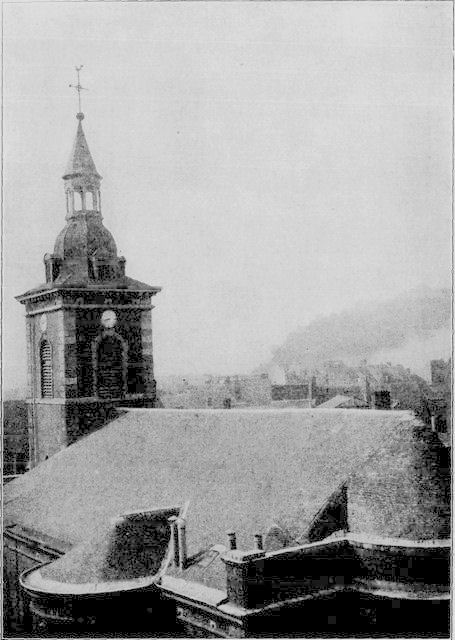
Fire at Namur during the bombardment
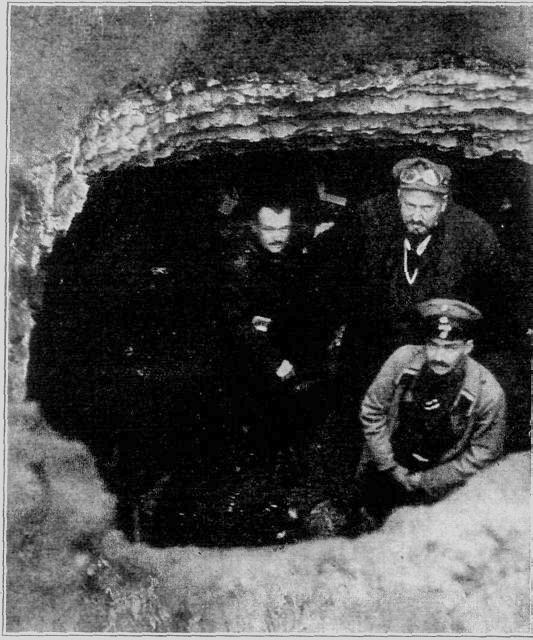
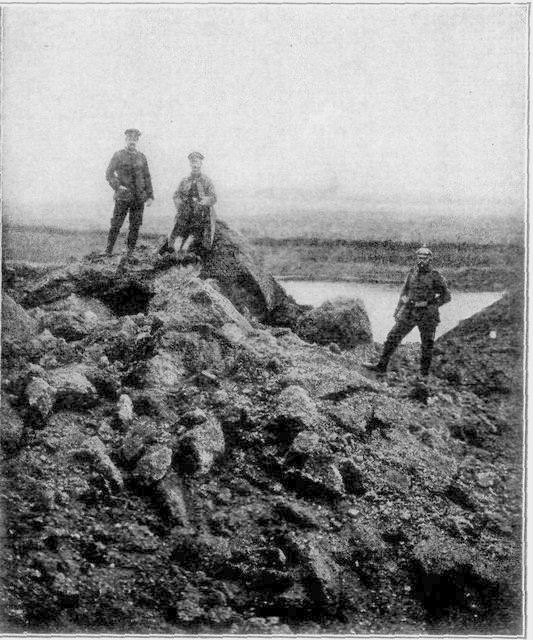
Effect of big German shell on Fort of Waehlem Outside view of the Fort of Waehlem after bombardment by big German guns
General von Lüttwitz has come out with another Proclamation, forbidding the sale of foreign newspapers in Belgium:
I remind the population of Brussels and its suburbs that it is strictly forbidden to sell or distribute newspapers that are not expressly authorised by the German Military Government. Any infraction of this prohibition will entail the immediate arrest of the vendors, as well as long periods of imprisonment.
The German Military Governor,
Baron von Lüttwitz,
General..
My laisser-passer has not come, and there is no telling when we shall get away. The Germans swear it was sent last night.
On board S.S. "Oranje Nassau" off Flushing, Sept. 30, 1914.—We got away on Sunday morning about eleven o'clock, after many calls at headquarters and a mild row about the laisser-passer that had not been sent. It was finally discovered that some boneheaded clerk had sent it by mail—a matter of three days! It was fished out of the military post office, and we got away in a few minutes.
We were in the big car, heavily laden—two trunks, several valises and a mail pouch on top—my two passengers inside with their small stuff, the chauffeur and I in front.
We made quick time out through Tervueren and down to Namur, hearing the heavy booming of cannon all the time away to the north. Ruin was all the way—odd farm-houses burned, towns with half the buildings in them, the Grand Place destroyed, etc. The great square at Namur a heap of brick and mortar.
The great bridge across the Meuse was dynamited, and the three sections hung in the river. All the way to Liège the main bridges had been destroyed, and we had to cross on temporary affairs constructed by the Germans.
And the Germans were thick all the way, holding us up at frequent intervals to look at our papers. They have it in for Belgium, and are in bad humour. We had some fine samples of it during the day.
We stopped not far from Huy for a picnic lunch, and then got under way again, being stopped frequently all the way to Liège, where we sought out the Consulate. The Consul had gone to Spa to look after some English people, but I said my few words to his wife and daughter, and then hurried away toward Visé and the Dutch frontier.
Visé n'existe plus! Goodness knows what was done to the place, but there is nothing left but blackened walls. It took us a long time to find unencumbered roads and get through between the fallen walls. Not far from the edge of town we found the last German outpost, and were promptly put under arrest because my laisser-passer did not bear my photograph. The officer in command cursed me roundly for daring to come through Liège without reporting, placed two armed soldiers in the car, and ordered us sent back. It was futile to point out to him that passes issued by the Military Governor General did not need to conform to the local rules; in fact, it only made him peevish. We scorched back over the road to Liège, but I succeeded in making the soldiers stop at a small town where there was a local headquarters of some sort with a colonel in command, I got him to look at our pass which had been confiscated by our guard, and, after hearing my case and thinking heavily, he unenthusiastically said we might proceed. We went back through Visé even faster, and enjoyed the look of our lieutenant when told he had been overruled. After a minute or so he became very affable and said he had a brother in Jefferson City, Mo., and a nephew in Sacramento, Californien, who runs an Apoteke. Just to show there was no hard feeling, I gave him a cigar, and a few minutes later we crossed the Dutch frontier, where we created a sensation. A big crowd gathered around the car, and, by the time the leisurely custom officers had examined the papers given me by the Dutch Legation, they were packed so tight that it took the united effort of several officers and citizens to get us extricated.
Holland is taking no chances, and has quantities of troops massed in that part of the country. There are frequent posts to stop travellers and examine papers, and there is practically no traffic on the road save that of a military character.
Near Maestricht we ran into a large detachment guarding a bridge. Our papers did not satisfy the commanding officer, so we were once more placed under arrest and hustled through town to headquarters. The officers there were very courteous, and, after examining my papers, made out a laisser-passer for use in Holland and sent me on my way.
By this time it was dark, but we determined to push on as far as Roermond—50 kilometers. Here we found a charming little hotel—the Lion d'Or—and after a good supper, got early to bed.
The next day I planned to take the two ladies—who have good nerve, and don't turn a hair at being arrested—to Rotterdam and then run down to Antwerp, some 280 kilometers, a long run in war time.
We were off at 6:30, and bowled along beautifully in a bitter cold wind until we were in sight of Tilburg, where the engine broke down. Eugène, the chauffeur, tried everything he could think of, and tore his hair in rage and shame. Finally we got a soldier on a bicycle to go into Tilburg and get a motor to tow us in. Then two good hours in a garage before we were in shape to start.
We caught the boat at Moerdyck and got into Rotterdam a little before four. I installed my companions at the Maas Hotel, overlooking the same old Meuse, and then started back through the rain toward Antwerp. At Willemsdorp we just missed the boat for Moerdyck and lost an hour. Eugène raged and smoked many cigarettes, to the danger of his health, because his sacrée machine had lost us so much time.
At eight we got to Rosendaal, near the Belgian frontier, and were forbidden to go any farther until morning, as the outposts were taking no chances.
Had a good supper at the little hotel, had my papers viséed by the Belgian Consul, and at 6 o'clock yesterday morning was up and away, by way of Putte.
The Belgian outposts received us with levelled rifles, but when we got near, one of the officers recognised me through his glasses, and we got through without any more trouble. Arrived at the St. Antoine as everybody was coming down to breakfast. The Germans were bombarding the outer forts, and they could not believe their eyes when I came in. Not a word of news had got through the lines for some days, and I was nearly torn to pieces by the excited friends.
I had coffee with Colonel Fairholme, and got all the news he could tell me. Malines has been bombarded again, and Antwerp is filled with refugees. Before I left, the Germans had occupied Malines itself and were bombarding the fort at Waelhem.
After breakfast I started out on my carefully planned campaign. First to the Consulate-General to get off some telegrams, etc. Then to the Foreign Office with a lot of things to attend to. I was able to give van der Elst word that his son is in Magdebourg—a prisoner, but not wounded. The look on his face when he got the news paid for the whole trip. I saw M. Davignon, and went with him to see the Prime Minister, who had heard I was there and had sent for me.
On the way we saw hundreds of miserable refugees from Malines pouring down from the station. The courage of these Belgians is beyond all words. Save for the two in the freight station yard at Louvain, I have not seen a woman crying! It may be that they are numb, but they have none of the stupidity of numbness. And when you think that these very women will be creeping back to their homes and caring for the German wounded they find there, it gives you a fine lump in the throat.
I paid a call at the French Legation, went back to the Consulate-General to sign my telegrams and mail which had been hammered out, and then to lunch. Got away at 3:30 to the banging of heavy siege artillery and invitations to come back "if we are still here." As I was getting into the car, Prince D—— plucked me by the sleeve and pointed at the Cathedral tower high above us. "Take a good look," he said. "It may not be here when you come back."
We made good time through the rain, but missed the boat at Moerdyck, and spent an hour on the dock. Got in at ten, ravenously hungry, had a snack, and then to bed.
Up again at six and took the seven-thirty train for Flushing. It loafed along through the country, and we did not sail until eleven. We have to go round to Folkstone, but hope to be in by six o'clock.
There are not more than twenty people on the ship, and the way they went through our credentials was a caution. I was glad I had taken the precaution to provide myself with American, British, German, Dutch and Belgian papers for the trip. There is another examination at Folkstone.
On board the S.S. "Brussels," off Flushing, October 5, 1914.—To resume.
We got into Folkstone last Wednesday evening at sunset, and got through to London by eight-fifteen. All the latter part of the crossing we were spoken from time to time by British destroyers, which bobbed up from nowhere to warn of floating mines or give directions as to our course. The entrance to Dover was surrounded by destroyers, and looked grim and warlike, and what's more, businesslike.
Thursday morning I got up as late as I decently could and went down to the Embassy to find Shaler and Couchman waiting for me. They had been in London since Monday, but had not made much progress with their mission of getting food for Brussels. This was due to no lack of energy on their part, but to the general difficulty of getting attention for any matter at this time. I went with them to the Belgian Legation, and after a talk with the Belgian Minister, we got things started.
As the food was intended for the civil population of Brussels, it was necessary to get the Belgian Minister to secure from the Foreign Office permission to ship it through the blockade. He felt that he must have some instructions from the Government at Antwerp for his guidance in the matter, so I telegraphed at some length, with the result that he had ample instructions before the sun went down. The next day he made three or four calls at the Foreign Office and matters were got under way.
Shaler is buying the food and getting it ready for shipment, and now all that is holding things up is the actual permission to go ahead and ship. Shaler has had some talk on the general problems that confront us with Herbert Hoover, an American mining engineer, who has given some very helpful ideas and may do more still.
Shaler and Couchman had an experience at Liège they did not particularly relish. They were pulled up by a Landsturm guard somewhere in Liège, taken to the Kommandantur, where it was discovered that they were carrying a number of messages of the "We-are-well-and-hope-you-are-the-same" variety. Without discussion they were pushed into cells and treated to talk that gave them little comfort. They spent the night in jail, but by some means contrived to get word to the Consul, who arrived and delivered them before breakfast. It evidently grieved the Germans that they could not take these two out and shoot them, but they yielded with a bad grace and turned them loose to hasten to the Consul's breakfast table.
Brussels, October 11, 1914.—On Saturday afternoon late I went with Harold Fowler to call on Sir Claude MacDonald, who had been to the Embassy twice to see me about the English Red Cross nurses in Brussels. I tried to reassure him as to their safety, but he went to see the Ambassador later in the day and asked him to send Harold Fowler back to Brussels with me to bring the nurses out. This suited me perfectly, so we made preparations to get off together.
On Sunday evening we left Fenchurch Street at six, with a little group of friends to see us off. About the only other people on the train were a King's Messenger, a bankrupt Peer and his Man Friday, and a young staff officer. Each set of us had a separate compartment and travelled in lonely state to Tilbury, where the boat was waiting.
As we got aboard the Brussels, her sister ship, the Dresden, just in from Antwerp, pulled up alongside, and Mrs. Sherman, wife of the Vice-Consul, called me to the rail to give me the latest news. She said that everything was going to pieces, that some of the forts had fallen, and that Antwerp might be under bombardment before we got there. Then she went ashore in peace, and we went below to seek the seclusion that the cabin grants, and fortify ourselves for the bombardment.
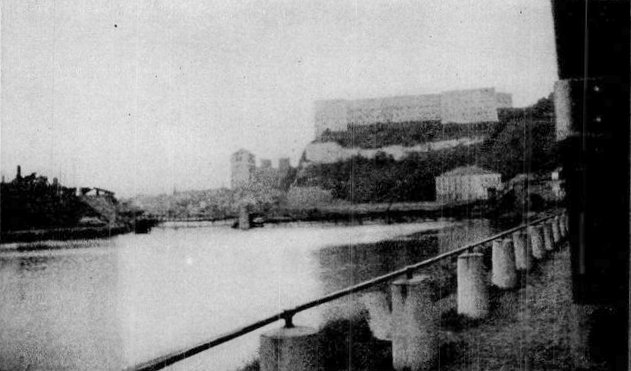
View of the Meuse at Huy
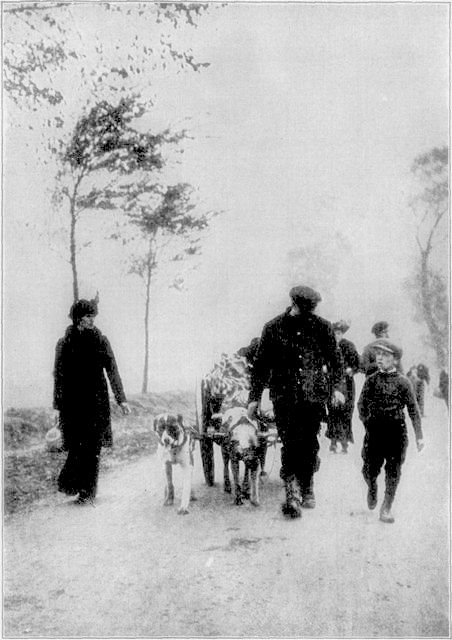
Copyright by the International News Service Refugees fleeing toward Dunkirk before the German advance, after the fall of Antwerp
We got under way during the night and dropped down to the mouth of the Thames, where we lay to until daylight, before starting across. The first sound I heard was a hail from a torpedo-boat destroyer, which sent an officer aboard to lay our course for us through the British mine fields. We made our zigzag course across the North Sea and fetched up at Flushing, where we picked up a pilot to take us through Dutch waters. When darkness overtook us we were just about on the Belgian frontier line and had to lie to for the night, getting to Antwerp Tuesday morning about nine.
We found the place in a great hubbub—everybody packed and ready to leave. They had been on the point of departure since Friday, and the uncertainty had got on everybody's nerves—and no wonder.
Several thousand British Marines had arrived and were doing good work, holding back the Germans, while the exhausted Belgians pulled themselves together for the evacuation. The Belgian forces had been fighting with little rest and no sleep until they were physically incapable of further resistance. How human strength held out so long is the great marvel. Winston Churchill was in the Legation when I arrived, with General Rawlinson and Colonel Seeley.
After a call at the Foreign Office, most of which had been installed on a boat in the river, I went to the Palace to see General Jungbluth. He was not there, but Countess de Caraman-Chimay said that the King wanted to see me.
I was taken straight up to him in his Council Chamber, where I found him seated at a great table covered with maps and papers. He pushed them aside wearily as I came in, and rose to greet me. He talked at some length on the war and the ordeal of Belgium, but was chiefly interested in how the people were being treated. His interest was not only for his own friends, but he showed particular interest in learning how the poorer people were being treated—whether the poorer quarters of the town were keeping calm and avoiding trouble with the Germans. He was most anxious that they should avoid doing anything that would arouse the Germans against them. He spoke simply and touchingly of his confidence in the loyalty and patriotism of all his people, and his certainty that they would come through the war with an even greater love of country.
The rest of the Palace was in confusion, with servants packing and orderlies coming and going. But the King's room was in perfect calm. The King sat quite still in his armchair and talked quietly, without haste. He was very serious, and it was clearly to be seen that he felt his responsibility and the suffering of his army. But his determination was just as evident. He realised that the evacuation was inevitable, and having made up his mind to that, he devoted his whole energies and thoughts to seeing that it was carried out effectively and quickly. He has a very patent faculty of concentration and of eliminating his own personality and feelings. I have seldom felt so sorry for anyone, partly perhaps because all of his sympathy was for others.
When the King finally rose to dismiss me, he said:
"The Queen wants to see you. Will you come back at half-past two?"
I had planned to leave for Brussels immediately after luncheon, but, of course, this was a command to which I gladly yielded.
The St. Antoine was all hurry and confusion, and the dining room was buzzing with conjecture as to whether the bombardment of the city would begin before the exodus was accomplished. The Military Governor had posted a proclamation to warn the population that it might begin at any time. There was a certain amount of unconscious humour in his proclamation. He advised people to retire into their cellars with bedding, food, water and other necessaries; to disconnect the water, gas and electricity; to stuff the staircases with mattresses, as a matter of protection; to take with them picks and shovels, so that they could dig themselves out in case their houses fell in; and after a few more hints of this sort, the Governor genially remarks:
"Having taken these precautions, the population can await the bombardment in calm."
The German authorities have offered to spare the historic monuments of Antwerp in their bombardment, if the Belgian General Staff will send them maps of the city with such monuments and hospitals clearly; marked. I found that it had been arranged in Brussels that I should collect the plans on my way through Antwerp and deliver them to the German authorities in Brussels, and, of course, agreed to do so.
After luncheon I went back to the Palace, where I was immediately received by the Queen in her sitting room. Her Majesty seemed quite oblivious of the confusion in the Palace, and, like the King, she was chiefly concerned as to the welfare of the people left under German domination. I was able to give her comforting news as to the treatment of the people of Brussels. While we were talking, the roar of the German guns seemed to increase and made the windows rattle. There was an outcry in the street, and we went to the window to see a German aeroplane pursued by a British machine. We watched them out of sight, and then went back to our talk. The members of the Court had tried to prevail upon the Queen to leave Antwerp, but when it became evident that the place must be surrendered, she refused to move and told me she would stay until the King left. And she did.
When I got back to the hotel, I found Eugène with news that the differential of my car had broken, so that we could not start. It was important that we lose no time in getting the plans of the town to the German authorities, so I got Baron van der Elst to go with me to the General Staff and explain the situation. General de Guise promptly wrote out an order that I should be given the best car to be found in the city. Armed with this, Eugène set forth and gathered in a very pretty little limousine to bring us back to Brussels. It was evidently a lady's car and almost too pretty, but we were not exacting and took it thankfully. However, it was too late to start out through the lines, so we gave up the idea of leaving before morning. We had thought of taking the route of the army and getting to Brussels by way of Ghent, but the people at the General Staff said the road was so crowded with transport that we would make little progress, and that the better course would be to take exactly the opposite direction and go by way of Tournhout.
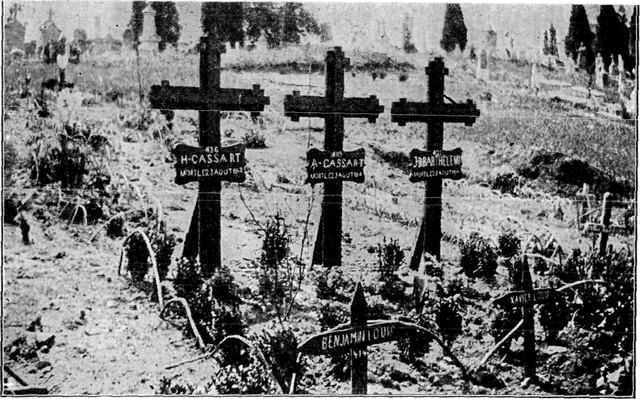
Graves of civilians shot by the Germans
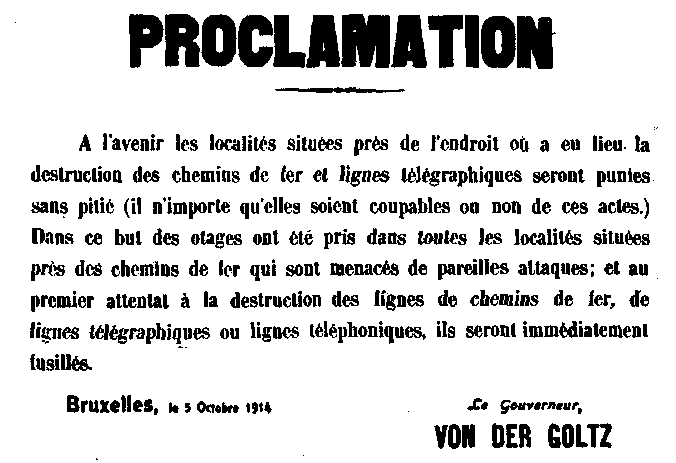
A typical proclamation[d]
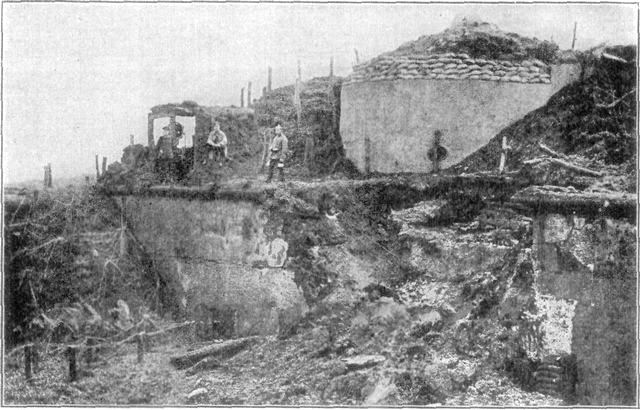
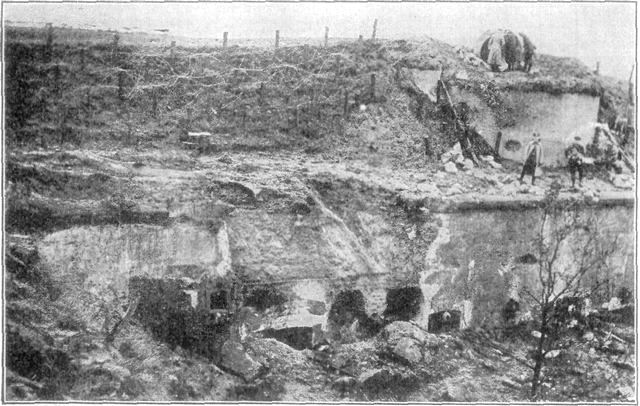
Views of the Fort of Waehlem after its bombardment by the big German guns
I took several of the ladies of the corps down to the boat, which was to take them to Ostend, which was to be the next stand of the Government. They all took it coolly and went to bed, as though there were no bombardment going on. The King and Queen, the Prime Minister, and the representatives of the allies remained in town overnight.
On one of my trips out of the hotel I met the Queen coming in to say good-bye to Princess Koudatcheff (wife of the Russian Minister), who was ill. She stopped to greet us and make inquiries as to each one.
After dark the crowd began to melt. Winston Churchill came down with his party, got into motors, and made off for Bruges. The Belgian officers staying at the hotel got off with their units, and by ten o'clock the staff of the British Legation, Fowler and I, were left in almost undisputed possession of the hotel. The water-supply was cut. The lights were out and the place was far from gay, particularly as nearly all the servants had fled, and we could not get anything to eat or drink.
Most of the town repaired to the cellars for the night, but we decided that if it really came, we saw no choice between going down with the house into the cellar and having the house come down on top of us, so we turned in and got a night's rest, which, I am free to confess, was rather fitful.
All night long motors were snorting away, and all night long the guns kept pounding, although they did not seem to get any nearer. With the intelligence that one has when half awake, I carefully arranged a pillow between me and the window, as a protection against shells!
We got up early and went out into the streets to watch the movement. The few remaining troops were being poured out on the road to Ghent. On foot, in motors, on trains, on bicycles, and on horseback, they streamed. The civil population was also getting away, and all the trams in the direction of the Dutch frontier were loaded with people carrying their little bundles—all they could hope to take away with them. The hospitals were being emptied of the wounded and they were getting away as best they could, those whose legs were all right helping those who had trouble in walking. It was a depressing sight, and above all, the sound of the big guns which we had heard steadily since the morning before.
We got under way about half-past eight, after a wretched and sketchy breakfast, and after saying good-bye to one of our friends of the British Legation.
First, we went to the north gate, only to find that it had been closed to vehicles a few minutes before, and that barbed-wire entanglements had been stretched across the road. Argument was vain, so we worked our way back through the traffic and reached the Porte de Tournhout, only to be turned back again. For nearly an hour we wandered about in the stream of refugees, in vehicles and on foot, before we finally succeeded in making our way through a side door of the Porte de Tournhout, and starting that way. We were not at all sure that we should be able to reach the Dutch frontier through Tournhout, as the Germans were supposed to be that far north, but we did make it after a long series of stops, to be examined by all sorts of Belgian outposts who kept cropping up out of fields to stop us and look through our papers. From some little distance out of town, we could see the shells bursting over the southern part of the town, or possibly over the villages to the south of the town proper.
We plowed along through Holland, being stopped all afternoon by Civil Guards, and reached Maestricht at sunset. We went straight to the German Consulate to have our papers put in order and learn whether it could be arranged for us to pass the lines at night. Our papers were not in order because they bore no photographs, and the Consul could not see that the German interest in our mission made any difference, so that there was nothing to do but wait over until morning, and get some pictures.
It took us until ten in the morning to get our photographs and have our papers arranged, and by good driving we reached Liège in time to lunch with the Consul. Then on to Brussels by way of Namur. On the road we picked up a German officer on his way to Namur, which kindly deed saved us much delay in being stopped by posts.
We reached Brussels at five and hastened to send the precious plans of Antwerp to Lancken. We had just settled down at the Legation to a good talk when word came that Lancken was anxious to see me at once. I went over to the Political Department to find that the gentleman merely wanted a formal statement from me as to when I had received and delivered the plans, so that he could make it a matter of record. I satisfied him on these points and went my way.
Then we gathered at the Legation and talked steadily until after midnight.
While I was away the Minister had got off a train-load of Americans, and with them he had sent the English nurses. That relieved Harold Fowler of the mission that brought him, but we bore up bravely.
The Germans have announced the fall of Antwerp and have apparently occupied the city. At first everybody was much downcast, but on second thought they have been convinced that the evacuation of the army and the surrender of an empty shell was a pretty clever piece of work. With the big siege guns that were in action, it was only a question of days until the Germans would have reduced all the forts. And then if the resistance had been maintained, the greater part of the army would probably have been captured. As it is, the Belgians inundated the country to keep the Germans from cutting off their retreat, and made off for Ostend, leaving only a handful of men with the British Marines, to hold the Germans in check. So far as we can learn, most of the army has succeeded in getting away and forming a junction with the allies.
Brussels, October 14, 1914.—We are quite up in the air about what we are to do next. Monday afternoon I went around to headquarters to get a laisser-passer to take Harold Fowler back to England. While the matter was being attended to, an officer came in and told me that Baron von der Lancken wanted very much to see me. When I went into his room, he said that there was nothing in particular that he wanted to see me about, but that he thought I would be interested in hearing the news and in telling him something of my trip. We talked along for some time about things in general, and then he told me that the movement of troops toward the coast was progressing rapidly and that the Belgian Government would soon be driven from the country. Then putting the tips of his fingers together and looking me coyly in the eye, he inquired: "And then my dear colleague, what will be your position?" He elaborated by pointing out that the Government, to which we are accredited, having left the country, we would be merely in the position of foreigners of distinction residing here, and that we would have no official rank or standing. The idea evidently is that they do not care to have us around any longer than they can help.
I later learned that Villalobar had been more ready than I with his retort. In the course of a call later in the afternoon, Lancken had talked the same matter over with him, and had wound up with the same genial question: "And then my dear colleague, what will be your position?" Without any hesitation, Villalobar replied: "My situation will be just the same as yours. We are both representatives of our country in a country not our own. We shall continue to owe each other respect, and to make the best of conditions."
The latest news we have this afternoon is to the effect that the Government has been driven from Ostend, presumably to the Isle of Guernsey. It would be pleasant, in a way, to retire to a retreat of that sort for a few months' rest, but I fear there is nothing of that sort in store.
To-day I ran across an order from the Governor-General forbidding civilians to ride bicycles. The order concludes as follows:
Civilians who, in spite of this, continue to ride bicycles, expose themselves to being shot by German troops.
If a cyclist is suspected of planning to damage railroad, telegraph or telephone lines, or of the intention of attacking German troops, he will be shot according to martial law.
Apparently it is no longer necessary to go through the forms of proving that the cyclist had any evil intention. The mere suspicion is enough to have him shot.
In the course of a visit to General von Lüttwitz to-day, one of the colleagues remarked that the Germans must keep the Belgians alive, and could not allow them to starve. Lüttwitz was not at all of that mind, for he said with some show of feeling:
"The allies are at liberty to feed the Belgians. If they don't, they are responsible for anything that may happen. If there are bread riots, the natural thing would be for us to drive the whole civil population into some restricted area, like the Province of Luxembourg, build a barbed wire fence around them, and leave them to starve in accordance with the policy of their allies."
And as the German policy is more or less frankly stated as a determination to wipe out as many of the enemy as possible without regard to what is or has been considered as permissible, it is quite within the realm of possibility that they would be prepared to let the Belgian people starve. In any event, you can't gamble with the lives of seven millions of people when all you have to go on is the belief that Germany will be guided by the dictates of humanity.
Fowler was to have left yesterday morning, and had engaged a seat in a new motor that is being run out by way of Maestricht. It was to have called at my house at seven o'clock yesterday morning, and we were up and about bright and early. We waited until a little after nine, when Eugène turned up to say that the chauffeur had been arrested and put in jail for having carried correspondence and having been caught nosing around one of the forts at Liège. The service is now suspended, and we don't see any prospect of his getting off before Friday, when we are sending a courier to the Legation at The Hague.
Yesterday afternoon we went up to Antwerp to see how our old motor-car was getting along. It was out of whack, and we were obliged to get another to come back to Brussels. I took the big car and organised an expedition of Monsieur de Leval, Fowler and a German official named Conrad, who went along to help us over the rough places. It is the first time for weeks that the direct route has been feasible.
I have had enough of ruined towns, and was not able to get the awful sights out of my head all night, but spent my time in bad dreams. From Vilvorde right into Antwerp there is not a town intact. Eppeghem, Sempst, Malines, Waehlem, Berchem—all razed to the ground. In Malines a good part of the town is standing and I suppose that the Cathedral can be restored, but the other towns are done for. There were practically no civilians in any of them—a few poor peasants poking dismally about in the ruins, trying to find some odds and ends that they could save from the general wreck. There were some children sitting on the steps of deserted houses and a few hungry dogs prowling around, but no other signs of life. All the way from the outskirts of Brussels straight through to Antwerp, the road was lined with empty bottles. They gave a pretty good idea of what had gone on along the line of march.
The bombardment of Antwerp lasted from the afternoon that we left up to Friday noon. The damage is pretty evenly distributed. Houses here and there in every street were badly smashed and the whole block across the street from the Hôtel St. Antoine, where we stayed, was burned to the ground. The Cathedral was not damaged.
When we were there last week, the streets were thronged with people and with motors. Yesterday there was not a soul to be seen for blocks together. The town was practically deserted.
The garage where I had left my car had been taken over by the military authorities. The car was put away on the second floor undamaged, but also unrepaired, so we shall have to wait until things settle down a little and we can get some work done. I shall have to go back to Antwerp a little later and attend to that. There is some comfort in the fact that the car has not been smashed.
This morning the Committee for the Provisioning of Brussels came in, and asked whether I was prepared to go to London for them and endeavour to arrange for some sort of permanent agreement with the British Government for the provisioning of the civilian population of Belgium. I am willing.
In the course of some errands this afternoon, I dropped in on Baronne Lambert for a cup of tea. The Baron came in and then Villalobar. About two minutes later, Lambert was called out of the room to speak with a German officer, who demanded that he accompany him to headquarters. Villalobar went with him to see what was up, and I stayed behind to see if I could be of any use. We stood by for a little over half an hour, and then when Mme. Lambert could stand it no longer, I jumped in my car and went down to see what was happening. I found Villalobar on the sidewalk, getting into his car. He was depressed and said that he had been obliged to leave the Baron with the Germans; that he was suspected of nobody would say what, and that the Germans were going to search the house. I went back and had them all ready for the shock of the invasion. They were standing by for the search party, when in walked the Baron, smiling broadly. They had sent him home under guard of two armed men, and were to search the house in the course of a few minutes. While he was telling about it, two officers arrived, profusely apologetic, and asked to be shown over the Red Cross hospital, which had been installed on the ground floor. They were taken all through the place, and found only a lot of German soldiers carrying off the beds and other belongings. Then they searched the Baron's private office and that of his son, and withdrew after more excuses.
There was nothing to show for the whole performance, and nothing had been accomplished beyond making a lot of people nervous and apprehensive. That is the sort of thing that everybody is subject to these days, without any hope of redress. And, of course, this was the least serious thing that could happen.