INTRODUCTION (continued 4)
Reading edition
As we sat in the undignified position imposed on us by circumstances, we exchanged various frivolous remarks, not because we felt particularly gay, but because we had to do something to keep ourselves interested and to keep our courage up. Bulle resented this, and raised his head to look at me reproachfully over the barricade, and say: "Don't talk like that; it is nothing short of tempting Providence."
After a time Blount and I decided to make a reconnaissance in force and see how the car was getting on. We crawled along the floor to a place from which we could see out into the square. The soldiers were flat on their stomachs behind a low wall that extended around the small circular park in the centre of the square, and behind any odd shelter they could find. The car lay in the line of fire but had not been struck. We were sufficiently pessimistic to be convinced that it would go up in smoke before the row was over, and took a good look at our shoes to see whether they would last through a walk back to Brussels.
Our officer came out from behind his barricade and showed us where the attacking force was concealed—at least he told us that they were there and we were willing to take his word for it without going across the street to make a first-hand investigation.
He tried to impress us with the black sinfulness of people who would fire upon the German troops, and called our particular attention to the proof now offered us that civilians had started the row by firing on German troops. According to the German story, which was the only one we had heard, civilians had been hunted down like rats in garrets and cellars and shot down in cold blood in the streets when they sought safety in flight. To my mind it was not surprising that men driven to desperation by seeing their friends and neighbours murdered in cold blood, should decide to do any harm possible to the enemy. Three days of the reign of terror that had been described to us was enough to account for anything, and the fact that civilians were firing now did not in any sense prove that they were guilty of starting the trouble. For all we could tell they may have started it or they may not, but firing by them three days after the row began was no proof to any one with the slightest sense of the value of evidence. On the other hand, the story freely told us by the Germans as to their own behaviour, is enough to create the darkest presumptions as to how the trouble started, and would seem to place the burden of proof on them rather than on the Belgians.
While we were talking about this there came another rattle of fire, and we scuttled back to our shelter, among the horses. Every now and then a surly soldier with two huge revolvers came and looked over the ledge at us, and growled out: Was machen Sie denn hier? followed by some doubting remarks as to our right to be on the premises. As he was evidently very drunk and bad-tempered I was not at all sure that he would not decide on his own responsibility to take no chances and put us out of our misery. After several visits, however, he evidently found something else more interesting, and came back to trouble us no more.
When the row began a motor had been despatched toward Brussels to recall some troops that had left a few hours before. Now and then our officer came in to tell us what he thought of their chances of getting back.
On one of these visits, Blount remarked by way of airy persiflage, that that drink of wine that had been sent for was a long time coming. Anything as subtle as that was lost on our friend, for he walked solemnly away, only to reappear in a few minutes with a bottle and several glasses which he set up on the edge of the platform and filled with excellent Burgundy. We stood up among the horses and drained a bumper of the stuff, while the officer wandered back to his work. He had gone calmly out into the thick of things to rescue this bottle, and took it as a matter of course that we should claim the drink that had been promised us.
Presently, with a good deal of noise, a fairly large force of troops came marching down the boulevard, and took up positions around the station. Our officer returned, waving a smoking revolver, and told us to lie down as flat as we could among the horses, and not to move unless they got restive. He said it looked as though an attempt would be made to take the station by storm, and that there might be a brisk fight.
However, there were only a few scattering shots, and then our friend came back and told us that we had better get out and start for home before things began again. He added, however, that we must have the permission of the commanding officer who was on the other side of the station, but offered to pilot us to the great man and help us get the permission. The way lay straight out into the square, in full view of the houses across the way, along the front of the station just behind the troops and into the railroad yard on the other side.
That station seemed about four miles long, and the officer was possessed of a desire to loiter by the way, recounting anecdotes of his school days. He would walk along for a few steps and then pause to tell Bulle some long and rambling yarn about his uncle. Bulle would take him by the arm and get him in motion again. Then the old chap would transfer his conversational fire to another member of the party, and we were obliged almost to pull him the length of the square.
The commanding officer was a pleasant-faced little man who stood in the shelter of a water tank and received us in a puzzled way, as though he wondered what civilians were doing in that neighbourhood anyway. Permission was readily granted for us to leave, with the ludicrous proviso that we did so "at our own risk." Then Bulle put everybody in good humour by inquiring innocently if there was any danger. Everybody burst into peals of laughter, and we were escorted to our car by the same slow-moving officer, who insisted on exchanging cards with us and expressing the hope that we should meet again, which we could not honestly reciprocate. Then, after an hour and a half in the station, we got away amid a great waving of hands.
The boulevards were deserted save for the troops coming back into the town. New houses were burning that had been intact in the afternoon. After passing the Porte de Tirlemont, we began to see people again—little groups that had come out into the streets through a craving for company, and stood huddled together listening to the fighting in the lower part of the town.
In harmony with the policy of terrorising the population, the Germans have trained them to throw up their hands as soon as any one comes in sight, in order to prove that they are unarmed and defenseless. And the way they do it, the abject fear that is evident, shows that failure to comply with the rule is not lightly punished.
Our worst experience of this was when in coming around a corner we came upon a little girl of about seven, carrying a canary in a cage. As soon as she saw us, she threw up her hands and cried out something we did not understand. Thinking that she wanted to stop us with a warning of some sort, we put on the brakes and drew up beside her. Then she burst out crying with fear, and we saw that she was in terror of her life. We called out to reassure her, but she turned and ran like a hunted animal.
It was hard to see the fear of others—townspeople, peasants, priests, and feeble old nuns who dropped their bundles and threw up their hands, their eyes starting with fear. The whole thing was a nightmare.
We were dreadfully depressed, and rode along in silence until Bulle turned around from the front seat and inquired in a matter-of-fact voice:
"What sort of wine was that we drank at the station?"
We told him, and then he shook his head and said as though to himself:
"I drank a big glass of it, but I was so frightened that I didn't taste it at all."
That broke the edge of the strain we were under, and we had a good laugh in which Bulle joined.
And so back to the Legation without further mishap, to find everybody worrying about us, and the Minister putting his foot down and announcing that there were to be no more expeditions of the sort, no matter what the reason for them.
Note—The foregoing is an impression of one afternoon at Louvain, taken from a journal written at the time. It was intended to pass on the question of responsibility for precipitating the orgy of murder and bestiality indulged in by the German army from the 25th of August until the 30th, when orders were received from Berlin to stop the destruction and restore public order.
Many subsequent visits to Louvain, and conversations with people who were there when the trouble began, have only served to strengthen the impression that the whole affair was part of a cold-blooded and calculated plan to terrorise the civilian population.
While we were there, it was frankly stated that the town was being wiped out; that its destruction was being carried out under definite orders. When the German Government realised the horror and loathing with which the civilised world learned of the fate of Louvain, the orders were cancelled and the story sent out that the German forces had tried to prevent the destruction, had fought the fire, and by good fortune had been able to save the Hôtel de Ville. Never has a government lied more brazenly. When we arrived, the destruction of the town was being carried on in an orderly and systematic way that showed careful preparation. The only thing that saved the Hôtel de Ville was the fact that the German troops had not progressed that far with their work when the orders were countermanded from Berlin.
It was only when he learned how civilisation regarded his crimes, that the Emperor's heart began to bleed.
The true facts as to the destruction of Louvain will startle the world—hardened though it has become to surprise at German crimes. Unfortunately, however, it is impossible to publish the details at this time without endangering the lives of people still in Belgium under German domination. But these people will speak for themselves when the Germans have been driven from Belgian soil, and they are once more free to speak the truth.
During the afternoon Count Clary had come over and announced that Austria-Hungary had declared war on Belgium, and that he had to leave at once. He has turned his Legation over to us. I went around to see him late in the evening, and made the final arrangements. This afternoon the Danish Minister came in and turned his Legation over to us, as he expects to go in a day or two. That will make four Legations besides our own under our protection.
Austrian guns have been in action for some days, and now it has been thought worth while to regularise the situation. The Austrian Minister has, therefore, under instructions from his Government addressed the following note to the Belgian Government:
August 28, 1914.
"Whereas Belgium, having refused to accept the proposals made to her on several occasions by Germany, is affording her military assistance to France and Great Britain, both of which Powers have declared war upon Austria-Hungary, and whereas, as has just been proved (no indication as to how or when it has been proved), Austrian and Hungarian subjects in Belgium have been obliged to submit, under the very eyes of the Belgian authorities, to treatment contrary to the most primitive demands of humanity and inadmissible even toward subjects of an enemy State, therefore Austria is obliged to break off diplomatic relations and considers herself from this moment in a state of war with Belgium. I am leaving the country with the staff of the Legation, and am entrusting the protection of Austrian interests to the United States Minister in Belgium. The Austro-Hungarian Government is forwarding his passports to Count Errembault de Dudzeele.
Clary."
This is the first we have heard of any mistreatment of Austrians in this country, but then they probably had to advance some sort of reason for going to war.[4]
The —— Chargé came around this afternoon to ask about getting to Antwerp, where he wants to flee for protection. He was very indignant because the Military Governor had refused to allow him to go. When I asked him on what ground the permission had been refused, he said that it had not exactly been refused, but that he could go only on his own responsibility. He wanted us to protest against this. I meanly suggested to him that he would be in much more serious danger if he had an escort of German troops to take him to the Belgian lines, and he left in a terrible state of mind.
Mr. Whitlock and the Spanish Minister went to call on the Military Governor this afternoon to get off some telegrams which he had promised to send, and to talk over the general situation. After that they went to call on the Burgomaster, and came back with a pretty good idea of what was happening in our fair city.
The Governor loaded them up with a large budget of official news, showing that Germany was victorious all along every line; that she was not only chasing the French and English armies around in circles, but that Uhlans were within forty kilometers of Paris, and that five Russian army corps had been beaten in Eastern Prussia. It really looks as though things were going pretty badly for the Allies, but we have absolutely nothing but German news and cannot form an accurate opinion.
The Germans are particularly bitter against the Belgian clergy and insist that the priests have incited the people to attack the German troops and mistreat the wounded. So far as I can learn, this is utter rubbish. The authorities of the church have publicly exhorted the people to remain calm and to refrain from hostile acts, pointing out that any provocation would bring sure punishment from the German military authorities. The priests I have seen have been at great pains to set an example that the Germans should be the first to commend.
The clergy has a tremendous influence in Belgium, and is sincerely respected. They will be a vital force in holding the people together in their patriotic devotion, and in maintaining public tranquillity.
A new Governor-General is to be sent us here. The Minister could not remember his name. I am curious. Von Lüttwitz will remain for the present at least.
The Burgomaster reports that the inhabitants of Brussels are calm and that there need be no fear of trouble unless they are allowed to go hungry. A committee has been formed to revictual the town, and is working night and day. Monsieur Solvay has given a million francs, and other Belgians given large sums. Soup kitchens are being started for the poor and the question of bringing food supplies from neutral countries is being taken up and pushed with activity. These Belgians are admirable in the way they handle things of this sort. They all realise the importance of keeping quiet so as to avoid any possibility of a repetition of the Louvain business. It would take very little to start something of the sort here and the result would be the same—the destruction of the city. Naturally everybody is turning to and trying to head off any excuse for violence.
Brussels, Sunday, August 30, 1914.—Our place has got to be the local diplomatic corner grocery, where all the village loafers come to do their heavy loafing. They bring in all the fantastic rumours that are abroad in the land, and discuss them with all solemnity. In the last day or so we have had it "on the best authority" that the Queen of Holland has had her consort shot because of his pro-German sympathies; that the Kaiser has given up all hope and taken refuge in Switzerland; that the United States had declared war on Germany and Austria; that the King and Queen of the Belgians had fled to Holland, and that all was over. These are just a few.
Troops have been pouring through the town steadily all day on the way to Vilvorde, where the Belgians are still fighting, and to the south, where there is heavy cannonading going on. The Belgians are making a big fight on the Antwerp road, evidently to hold the attention of one German army corps and lighten France's load by just that much. It is a hopeless fight so far as they themselves are concerned, but it throws their courage and fighting qualities into higher relief.
We are now the pampered pets of both sides. The German troops cheer our flag when the motor noses its way through them. The people of the town are equally enthusiastic, and many of them are wearing small American flags in their buttonholes. How long it will last there is no telling, but while it does, our work is made just that much easier.
Lunched at the Palace Hôtel with Bulle and Blount. Riseis, the Italian Secretary, came in and joined us. Bulle told him the story of our trip to Louvain with embellishments that made my eyes start from my head. I had not realised what a desperate adventure we had been on until I heard it as it should be told. It made the real thing seem mild.
Before lunch we drove to Blount's to learn whether the cannonading to the south was still going on. It was—heavy booming of German guns; no French guns to be heard. Late in the afternoon Blount and I drove off into the country to see whether we could locate the fighting to the south. We got as far as Nivelles, but all was as peaceful as it should be on a perfect Sunday afternoon. The people there were surprised that anyone should have thought there was fighting there. It was still much farther to the south. We drove around in search of evidence of fighting, but could find none. And this after circumstantial accounts of hand-to-hand struggle through all this part of the country!
August 31st.—This morning began with a troop of people in to tell us that the rough work was about to begin, and that Brussels was to go up in smoke. There is a good deal of unrest in the lower end of town and trouble may break out at any time. Bad feeling has grown a good deal in the past few days and one good row would throw the fat in the fire. I went through the rough part of town late this afternoon and found patrols everywhere, heavily armed and swaggering about in groups of four. For their own sake I hope the people will not do anything foolish.
People are making another effort to get away and are not finding it easy. At six this morning a crowd left here for Ninove, twenty kilometers to the west. Twenty-five hundred of them clung all over the trams that make the trip. At Ninove they walked a mile or so, carrying their belongings, and caught a train to Alost, where they changed for another train for Ghent. Goodness knows how many changes they had ahead of them after that. The trip was supposed to end safely in Ostend some time this evening. It usually takes two hours.
Hearing that the train service was open and that boats were running from Ostend to Folkstone, we decided to verify the tidings and then get off some of our people, who should have gone long ago.
To make sure Blount and I motored down to Ninove after lunch to telephone the Consul at Ostend and learn the true state of affairs. When we reached Ninove we found the station so packed with refugees that there was no getting near the telephone bureau. The Chef de Gare, who had never in his long and honourable career had such a mob to lord it over, was so puffed up that he could not get down near enough to earth to hear our questions, so we decided to proceed to Alost and try our luck there.
We motored over in short order and got quick communication with the Consul at Ostend. He had very little news save that a lot of British Marines had been landed there and had to-day been taken away again. He gave us what we wanted in the way of steamer information.
I got the Consul-General at Antwerp on the telephone and learned that all was well there.
As I came out of the booth from this second call, I was held up by a Garde Civique, who inquired if I was the Monsieur de l'automobile. He would like to see my papers. Certainly. Then I remembered that I had left all my Belgian papers at the Legation and had nothing but papers in German from the military authorities. I showed them anyway. Before he could examine us any further, three eager amateur Sherlocks came bursting into the room and took charge of the proceedings. The leader pointed an accusing finger at Blount, and exclaimed, "You have come from Ninove!" Blount admitted it. "You had a third person in the car when you left there!" "Pas du tout." "On the contrary, I have three witnesses to prove it." Aside from the fact that nobody could have got to Alost in the time we had, it made no real difference how many people we had in the car, and Blount said as much. Then our accuser changed his plan of attack. "I observed you when you arrived, and you were speaking a language which was perhaps not German, but sounded like English." "It was," said Blount. "Aha," triumphantly, "but you said you were Americans!"
By this time the Chef de Gare had come to answer our questions and we waved our persecutors aside while we talked to him. They kept quiet and meekly stood aside, as we bade them. While we talked with our functionary, I looked out on the square and saw that we were a real sensation. The Garde Civique had been called out and was keeping the place clear. The crowd was banked up solid around the other three sides of the square. They looked hopeful of seeing the German spies brought out and shot. By signing our names on a scrap of paper, which the amateurs compared with the signatures on different papers we had about us, we convinced them that we were harmless citizens, and were allowed to go. The crowd seemed greatly disappointed to see us walk out free. The Garde Civique let them loose as we got in the car, and they came thronging around for a good close look at us.
We honk-honked our way through them, thanking our lucky stars we had not had a worse time of it.
At the edge of the town we looked up and saw two German aeroplanes snooping around. A minute later a crowd of people surged across the street to bar our way, shouting that we must go no farther, as the Germans were approaching the town and that it was dangerous to proceed. Two young officers came across the street to tell us in great glee that they had made a dash in a motor at the first German outpost and had brought in four prisoners. They were bursting with joy in their exploit, but by this time they may themselves be prisoners.
In a few minutes we came to the first German outpost, and had our papers carefully examined. From then on we were held up every few yards and nearly had our papers worn out from much handling. At one place a young Lieutenant looked over our papers and burst out into roars of laughter at the name of von Jarotzky. He called to other officers. They came up, looked at the signature, and also burst out into loud laughter. I asked them what the joke was, but they were not telling.
We got in about seven o'clock, without incident.
Went to see von Herwarth after dinner on behalf of a poor Belgian woman whose husband, a Major in the Grenadiers, is dangerously wounded and in the military hospital at Antwerp. The Germans are going to send her up to-morrow on a motor with some Belgian officers, who are being exchanged. I saw the aide-de-camp who is going through with the car and asked him to be nice to her. Then to her house, to shut up a lot of old women of both sexes who were trying to dissuade her from going, on the ground that the Germans would hold her as a hostage. I suppose she will be off.
Mrs. Bridges,[5] wife of the former British Military Attaché, was in this evening for help. A British prisoner told of seeing Colonel Bridges fall from his horse at Mons, mount again, ride a little way and fall. She cannot get to Mons, so we are getting her off to France via England, in the hope that she may find him on that side.
It is a pitiful business, and the worst of it is that they all think we have some miraculous power to do anything we like for them. I only wish we could.
Brussels, September 1, 1914.—- The first thing this morning I had a pow-wow with Hulse about how to handle the funds that are being gathered to relieve the enormous amount of distress that we shall have to meet here. There is a good deal of it even now. All the big factories are closed. Most of the shops have their shutters up, and the streets are filled with idle people. Importations of foodstuffs, even from the outlying districts, have stopped dead. Conditions are bad enough in all conscience, but they are nothing compared to what we have ahead, when cold weather comes on.
A lot of bankers and big business men have got together to wrestle with the financial problem. The Burgomaster has his people at work, trying to get their hands on foodstuffs and coördinate their work.
I went to the Foreign Office and talked things over with von Herwarth. He straightened out some of the tangles, and we were able to get things moving.
I have no trouble with the higher officers at headquarters, but I never go there that I do not want to murder the large brutes of non-commissioned officers who guard the door. They wear large brass plates on their chest and look like bock-beer signs. They have a free and careless way of booting everybody out the door and refusing to listen to anybody. I get fighting mad every time I go there and this morning got sufficiently roused to develop considerable fluency in German. I pictured to the large rough-neck some of the things that were going to happen to him if I was not let in; he was sufficiently impressed to permit me to stand on the sidewalk while my card was sent in. When I got in I made a few well-chosen remarks on the manners, if any, of the watch dogs of the Ministry.
From the Ministry I went to the Société Générale, where I was asked to attend a conference between the bankers of the city. There were ten of them in the big directors' room, and they worked to some purpose. M. Francqui, the director and leading spirit of the Société Générale, presided over the meeting. He explained the general situation simply and clearly, and stated what they had done and wanted to do. They had three points on which they wanted advice, and they were brought up and disposed of one at a time. By twelve o'clock I got away, and felt that the hour I had put in there had been well spent.
When I got back to the Legation, I found a nice Belgian who had no request to make of us, but wanted to tell his story to somebody, and a terrible story it was, too. He had fitted up his château near Mons as a Red Cross hospital. During the battle there a week ago, 102 British wounded had been brought in. The Germans found the château a hindrance in their operations, so got it out of the way by battering down the walls with artillery, and then throwing grenades into the building to set it on fire. There was great difficulty in getting the wounded out and hiding them in such shelter as was to be found. One man, at least, was burned alive in his bed. It seems incredible that Red Cross hospitals should be attacked, but stories come in from every side, tending to show that they are.
Beside this man's property there is a railway crossing. When a troop train passed over it day before yesterday, there was an explosion like the report of a rifle. The train was immediately stopped. The officer in command announced that civilians had fired upon his train, and ordered all the men in the vicinity taken prisoners. Then, refusing to listen to explanation or discussion, he had them all stood up against a wall and shot. When it was all over, he listened to explanations and learned that the report was that of a cap placed in the switch by the German railway men as a signal to stop the train before reaching the next station. By way of reparation, he then graciously admitted that the civilians were innocent. But, as my caller said: "The civilians were also dead."
Another pleasant thing the Germans seem to be doing is arresting peaceful citizens by hundreds and sending them back to Germany to harvest the crops. They will also reap a fine harvest of hatred for generations to come.
Poor Bulle is in considerable doubt as to his status. For many months he has not heard from his Government, if any, and has not been able to get a word as to whether he is Chargé d'Affaires or not. I told him to-day that he had a rather unique situation as the representative of a country without a Government to a Government without a country. He extracted a chuckle from that.
Blount made up his mind to leave for America this afternoon, by way of Ostend and England. His family was all ready to start, but when he went down to headquarters to get a laisser-passer it was refused. Operations are apparently about to be started in tout le bazar, and they don't want stray civilians seeing too much. Blount will now settle down here for the present. His loss is our gain.
The Danish Minister was in again this afternoon. He is going away, and has finally turned his Legation over to us. We now have four Legations besides our own—German, British, Austro-Hungarian, and Danish.
One little thing the Germans have done here that is echt Deutsch is to change the clocks on the railway stations and public buildings to German time. Every other clock in town continues about its business in the same old way, and the change only serves to arouse resentment.
Another thing is, that on entering a town, they hold the Burgomaster, the Procureur du Roi and other authorities as hostages, to ensure good behaviour by the population. Of course the hoodlum class would like nothing better than to see their natural enemies, the defenders of law and order, ignominiously shot, and they do not restrain themselves a bit on account of the hostages. Just lack of imagination.
September 2nd.—A paper, smuggled through the lines from Antwerp this morning, gives the news that the Queen has left for England, with the royal children; adding, "she is expected back in a few days." This move is evidently in anticipation of the bombarding of Antwerp.
Now and then a Belgian has the satisfaction of getting in a gentle dig at the Germans; although, if the dig is too gentle, the chances are the digee does not know it. Last week Countess Z——, aged eighty-four, who is living alone in her château, was obliged to put up a German General and his staff. She withdrew to her own rooms, and did not put in an appearance during the two or three days that they were there. When the time came for them to leave, the General sent word that he would like to see her. She sent back a message, asking to be excused. The General was insistent, however, and finally the little old lady came reluctantly down the stairs into the great hall, stopping three or four steps from the bottom and gazing down upon her lodgers with a quizzical smile. They all clicked their heels and bowed, and then the General stepped forward a few paces and, in his best manner, said that they could not go away without thanking her for all that had been done to make them comfortable during the time they had had the honour of being her guests. When he had quite finished, the little old lady replied in her gentle soft voice:
"Messieurs, vous n'avez pas à me remercier. Je ne vous avais pas invités."
Brussels, September 2, 1914.—A beautiful aide-de-camp of Field-Marshal von der Goltz turned up this afternoon, and announced that, if agreeable, His Excellency the Governor-General, would call to-morrow afternoon between four and five. We are looking forward with a good deal of interest to seeing the big man. He arrived yesterday, but has kept so quiet that nobody knew he was here. The aide-de-camp nearly wept on my shoulder; said there was nobody in the General's party who knew Brussels, and that they were having a terrible time to find their way around the town. He'll probably have greater worries before he gets through.
We have at last heard from McCutcheon, Cobb, Lewis, Bennett, etc. A telegram came to-day from the Consul at Aix-la-Chapelle, asking that we look after their baggage at the Palace Hotel. From this we judge that they were arrested and sent back to Germany on a troop train. They left here for Mons, and goodness only knows what adventures they have been through since we last saw them.
Brussels, September 3, 1914.—This afternoon, at four o'clock, von der Goltz (Field-Marshal Baron von der Goltz Pacha, to be exact) arrived with a staff of seven officers to make a formal call. A crowd quickly gathered in the street, as their big gray military cars snorted up to the door. All the neighbourhood was in a great state of excitement. The great man is pretty old and doddery, wears spectacles about an inch thick, and a large collection of decorations. His staff was also brilliant in decorations and silver helmets, etc. I met them at the foot of the stairs, and escorted them up. The Marshal is apparently blind as a bat, for he never turned on the landings and would have walked straight into the walls if I had not steered him around the corners.
After one good look we decided that he was to be a figure head and leave the real work to the troop of officers and functionaries he had brought with him.
It was supposed to be a purely formal call, but the old gentleman seemed to have no thought of leaving, and did not budge for half an hour. The conversation was not thrilling.
They finally left after much clicking of heels, and the bemonocled Count Ortenburg nearly broke his neck by tripping over his sword. However, we got them safely out of the house, while all the servants leaned out of the windows and took in the show.
The new Governor-General has addressed a Proclamation to the Belgian people, and has had it posted on the walls:
PROCLAMATION.
His Majesty, the Emperor of Germany, after the occupation of the greater part of Belgian territory, has been pleased to appoint me Governor-General in Belgium. I have established the seat of the General Government in Brussels.
By His Majesty's orders, a civil administration has been established with the General Government. His Excellency Herr von Sandt has been made Chief of this Administration.
The German armies advance victoriously in France. My task will be to preserve quiet and public order in Belgium.
Every act of the population against the German military forces, every attempt to interfere with their communications with Germany, to trouble or cut railway, telegraph or telephone communications, will be punished severely. Any resistance or revolt against the German administration will be suppressed without pity.
It is inevitable in war that the punishment of hostile acts falls not only upon the guilty but also on the innocent. It is the duty of all reasonable citizens to exercise their influence with the turbulent elements of the population to restrain them from any infraction of public order. Belgian citizens desiring to return peaceably to their occupations have nothing to fear from the German authorities or troops. So far as is possible, commerce should be resumed, factories should begin to work, and the crops harvested.
BELGIAN CITIZENS
I do not ask any one to forego his patriotic sentiments, but I do expect from all of you a sensible submission and absolute obedience to the orders of the General Government. I call upon you to show confidence in that Government, and accord it your co-operation. I address this summons particularly to the functionaries of the State and of the communes who have remained at their posts. The greater your response to this appeal, the greater the service you will render to your country.
The Governor-General,
Baron von der Goltz,
Field-Marshal.
Brussels, September 2, 1914.
At about five o'clock, Bulle came along, and we went for a long walk together—the first time I have tried anything of the sort since the war began. We tramped out to the Bois and made a swing around the circle, not getting back until half-past seven, when we repaired to the Palace Hotel and had dinner with several of the colleagues. When von der Goltz left us, he had started for the Spanish Legation; but we learned from the Spanish Secretary that he had never arrived. Instead, at the last minute, an aide-de-camp had come clanking in to express His Excellency's regrets that he was unable to come, and say that he would have to defer his visit until a later date. Something happened to him after he left our Legation.
X—— had an experience yesterday which made him boiling mad. He left town in the afternoon with his Consul, to go to Alost for telegrams and letters. He was in a car flying his flag, and had his laisser-passer from the German military authorities. Near Assche, he was stopped by an outpost, and told he could not go any further. He accepted this in good part, and said he would go back. At this point, an old turkey gobbler of a General arrived and lit into him for being there. He replied that he had done nothing to which exception could be taken; that his papers were in order, and that he was ready to return at the first indication from the military authorities. This seemed to enrage the old soldier who announced that they would do nothing of the sort; that they were prisoners of war and would be sent back under armed guard. X—— protested that this was an outrage against the representative of a friendly country, but in spite of this two armed soldiers were placed in the car with them and another beside the driver, and they were brought back to town as prisoners. By dint of arguments and threats they were taken to headquarters instead of jail, and succeeded in seeing General von Lüttwitz who piled on the excuses. It does you no good to have legitimate business and papers in order if it suits some apoplectic officer to clap you into jail.
One of the officers I saw to-day told me that the Germans were deliberately terrorizing the country through which they passed. It is a perfectly convincing explanation of German doings in this country, but I did not think they were prepared to admit it so frankly. This frank fellow made no claim that civilians had attacked the German troops; his only observation was that they might do so unless they were so completely cowed that they dared not raise their hands. He emphasised the fact that it was not done as a result of bad temper, but as part of the scheme of things in general. For my information, he remarked that in the long run this was the most humane manner of conducting war, as it discouraged people from doing things that would bring terrible punishment upon them. And yet some of these Belgians are ungrateful enough to complain at being murdered and robbed.
September 4th.—Autumn is coming with little gusts of wind and falling leaves. Clouds are thick, and there is a sort of hidden chill in the air. It is depressing in itself, and makes us think with some dismay of what is ahead of the millions of men who are in the field, if the war is to continue into the winter as seems probable.
I am sure there is something big in the air to-day. For several days there has been a growing nervousness at headquarters. For four days there has been no official proclamation of German victories. Persistent rumours come in of large numbers of British troops between here and the coast, advancing in the general direction of Brussels. X——'s arrest, while on a trip to Alost, looks as though the Germans had some reason for keeping people from getting out that way with knowledge of military conditions here. Another thing. We were to have returned the call of von der Goltz to-day at noon. Between here and the Spanish Legation yesterday, something happened. He never got to the Spanish Legation. This morning we got a message from the État-Major that von der Goltz had "telegraphed" to ask that we should postpone our call. Where he is, nobody would say. The officer who brought the message merely stated that he had been called away in great haste, and that it was not known when he would return. Troops are marching through the town in every direction, and in large numbers. Supply trains and artillery are creaking through the place night and day, and we are awakened nearly every morning either by the crunching of the heavy siege pieces or the singing of large bodies of troops as they march through the streets. Every day we realise more and more the enormous scale on which the operations are being conducted. It seems tremendous here, and we are seeing only a small part of one section of the field of operations.
Privately, the Germans continue to assure us that they are winning all along the line. They say that they have taken the whole of the first line of defences in France with the single exception of Maubeuge, where there has been long and heavy fighting and where the result still trembles in the balance. In addition to this they claim to have taken a part of the second line of defences. They say that the French Government has removed to Bordeaux, which seems quite possible, and even sensible. They tell us all these things every time that we go over to the General Staff, but they do not publish anything about it.
A British Red Cross doctor was in to-day and told us some items of interest. He said that he had been assigned to care for the wounded prisoners who were being brought back from France on their way to Germany, and that he had seen all the British prisoners who had been brought back by way of Brussels—about three thousand in all. He said that they were in good spirits and were sure that things would come out right in the end. There were the remnants of the Argyle and Sutherland Highlanders, who went into action something over a thousand strong and came out only a handful.
I made two attempts to see Herwarth to-day but was kept on the sidewalk and in the courtyard by the big green dragons who guard the entrance to headquarters. After the second attempt I returned to the Legation and telephoned him that I should like to see him when he could get it through the heads of these people that we were not tramps. He was very nice and apologetic and had all the officers in the German army out in the street waiting for me when I went back for the third time. All the sentries were blown up and given the strictest sort of instructions that I was to be passed along without question whenever I appeared. I was also given another Passierschein to add to my collection, directing everybody to let me pass wherever I wanted to go. In view of the fact that a lot of our work here is in behalf of German subjects, this is about the least they could do.
Some news has been brought down from Antwerp that makes it seem necessary for me to go there and get back again before the siege begins. I had hoped to get away this morning but have not yet been able to get a decision as to exactly what is to be done. I now hope to get away after lunch.
I spent all yesterday afternoon enciphering a telegram which I must get off either through Holland or Antwerp. We are able to send nothing but open messages over the military wire through Berlin and I have a strong suspicion that these are being censored.
Brussels, September 7, 1914.—Did not get off to Antwerp to-day but hope to make it by to-morrow noon. There was too much going on, but arrangements are being made for a laisser-passer, etc., and I anticipate no trouble beyond being shot or made prisoner.
Gherardi[6] came in this morning for a call and then left for Maubeuge, which the Germans had arranged to capture during the day. They seemed very sure of it, but I would not be surprised to see him come sailing back without having seen the surrender.
Baron von der Lancken, of the Foreign Office in Berlin, called this morning. He is here to handle relations with the Foreign Ministers remaining in Brussels. As we have had the care of German interests they all come here first and our position is better than that of any other Legation in the country. We have things on a working basis.
September 8th.—Last night, after dinner, I trotted around and called on the wives of some of the Belgian officials to see whether there was any news of them that I could give to their husbands in Antwerp. I found Madame Davignon, the wife of the Minister for Foreign Affairs, in her son's home, peacefully working away on clothes for the wounded. She told me all the news of the house so that I could repeat it to her husband. She is as calm as you please and far from despairing.
Madame de Broqueville, the wife of the Prime Minister, turned her house into a Red Cross hospital at the outbreak of hostilities; it is a beautiful big place. Of course there are practically nothing but German wounded in the house now, but the good lady conquers her natural feelings and has them as well looked after as though they were of her own race. I went in in an apologetic mood for intruding on her at so late an hour, but she had lots to say and I stayed on for a long time. It did her good to talk, and I was so overawed by her courage and poise that I sat and listened in silent admiration. The wives of the Cabinet Ministers and other officials have shown wonderful nerve and are standing right up to their duty.
Count and Countess de X had an interesting story to tell of their experiences when the first armies went through. When the war broke out they were at their château and were caught by the first onrush of troops. Their fine cellars were emptied for the benefit of the invader, but nothing more serious happened to them until the second wave came along. Then there was a demand for more wine. As all the wine had been carried away they could not comply. The Germans were convinced that they were being fooled, and searched the place very carefully. Finally they imprisoned the X's for three days in the cellar and then brought them forth and stood them up before a firing squad and threatened to shoot them unless they told where the wine was hidden. At the critical moment a big gray military car rolled up, and to their considerable relief they saw that one of the occupants was a German princeling, who had formerly been their guest on several occasions. They called out to him, and by his orders were immediately released. After expressing their thanks to him they went into the château to find that soldiers were engaged in packing up their fine collections of enamels and porcelains to ship them to Germany. Another appeal to the Prince, who was most sympathetic. He was a practical and resourceful man, and said:
"Of course I'll stop this, but you will understand that our men would like to keep some little souvenir of the war in Belgium. That would be hard to prevent. But I would suggest that you pick out all the pieces that you value most and pack them away in that large wardrobe. Then I'll do the rest."
Madame de X was, of course, delighted with this, and scurried about gathering together the finest pieces and packing them carefully into the big wardrobe. She kept it up as long as there was a nook or cranny where odd pieces could be put, and then reported progress to the Prince.
"Are you sure that all the best pieces are there?" says he.
"All that could be packed there," answers Madame de X.
"Good," says the Prince, and then turning to his orderly: "Have that wardrobe sent to Berlin for me."
The way the German army cleaned out the wine of the country was a revelation to everybody. They would not take what they needed for the day's drinking but would clear out whole cellars at a time and load what was not drunk onto carts to be carried away. The result was that people who had a little warning had recourse to all sorts of ingenious tricks to save some of their store. There was one bright man in the province of Namur who removed his stock of wine—all except a few thousand bottles of new wine—and deposited them in the ornamental pond near his château. The Germans arrived a few hours afterward and raised a great fog because they were not satisfied with the amount of wine they found. The owner of the château had discreetly slipped away to Brussels and they could not do anything to him. However, they tapped all the walls for secret hiding places and went over the park to see if anything had been buried—all in vain. The next morning, however, the pond was covered with labels which had soaked off and floated to the surface, and after draining the pond the whole stock was carted away.
Madame B——, who was there, has an interesting souvenir which she proposes to keep if possible. During the first days of the war her château was occupied by a lot of officers, who got gloriously drunk and smashed up pretty well everything in the drawing-room and dining-room. One of them, with a fine sense of humour, took a piece of hard chalk and wrote on the top of her piano in large letters: Deutschland über alles! The crowd left the place in the morning without trying to cover their traces, and Madame B—— came in to put things to rights. The first thing she did was to get a large piece of plate glass to cover the top of the piano so that the legend would not be effaced, and over that she placed an ordinary piano cover so that no future visitor would be inclined to erase the inscription. When the war is over this will be an interesting reminder of her visitors.
This morning I was ready to start for Antwerp. My laisser-passer had been promised for ten o'clock. When it did not come by that hour, I went up to see Baron von der Lancken who had agreed to attend to the matter. He received me most graciously, told me how delighted he was to see me, how it pleased him to see that we came to him with our little troubles, etc. He kept off the subject of the laisser-passer as long as he could, but when he could stave it off no longer he said that he must ask me to see von Herwarth, who had been placed in charge of all matters regarding passports, etc. I made a blue streak over to Herwarth's office, and saw him after a little delay. He kept me as long as he could, and told me all that he knew about the war and perhaps a great deal more. When we got down to the subject of my visit he said that von der Lancken was mistaken, that passports could be granted only by Colonel von Claer who had his office about a block away. I began to smell a rat about this time, but kept plugging away. I spent an hour and a quarter in the antechamber of the Colonel, being unable to get to him or to any of his officers. It was all part of a game. Both von der Lancken and Herwarth harped upon the danger of the trip to Antwerp, advised against it and told how terribly they would feel if anything were to happen to me. I asked each of them point blank if they contemplated an attack while I was there. They both avoided the subject, but said that with the situation as it was now it was impossible to tell from one moment to another what might happen. I saw that they were undecided about what was going to happen next, and that until they did know they did not intend to let me go. They naturally do not wish to have anything happen to me or anyone else connected with the Legation, so I feel entirely safe about going.
After lunch I went back to the siege and stayed until my friend, the Colonel, left by the fire-escape or some equally desperate way so as to avoid seeing me.
Von der Goltz had sent word to the Minister that he was coming here for tea this afternoon, and wanted to meet the Spanish Minister. That was our opportunity, and the Minister was all primed with what he was to say to the old chap. They beat us to it, however. The problem had evidently been decided since I saw von der Lancken in the morning, for he greeted me with the news that the laisser-passer would be around in the course of the evening. He added that the General was anxious to send one of the Belgian Ministers of State to Antwerp, and would appreciate it if I would take him with me. He is Count de Woeste, the man who has always fought against having an army, on the ground that Belgium was so fully guaranteed by her treaties that it was unnecessary. Baron von der Lancken says that they will make out a laisser-passer on which he will be included, and that the military authorities will mark out the route by which we had best go, so as to avoid running into trouble. I imagine it will take us by way of Termonde and St. Nicolas.
The crowd that came to tea included von der Goltz, Pacha, Baron von der Lancken, Herr von Sandt, and Count Ortenburg—a scion of a mediatised Bavarian family. They told us of all the glorious triumphs of the German army, and of the terrible drubbing that was in store for their enemies. They stayed on for about an hour.
When they left, I escorted the old man to his car. Before he climbed in, he looked me over curiously and remarked: "Tiens, c'est fous qui faîtes ce foyage à Anfers! Four afez peaucoup de gourage. Che tacherai d'arranger un petit entr'acte pour fous être agreaple. Mais il vaut refenir aussitot gue bossible!" They evidently intend to hold off for a day to await certain developments, and I am to get the benefit of the delay.
The Marshal also told us that Maubeuge had fallen, and that they had made forty-five thousand prisoners. It seems almost incredible that the French and English would have left that many men at Maubeuge when they knew that it was bound to fall. Perhaps we shall find that this is not altogether accurate. They say nothing about what is happening in Austria. The news from England and Antwerp is to the effect that the Russians are giving the Austrians a hard time of it.
This afternoon the German headquarters issued an order prohibiting the bringing of newspapers to Brussels from the outside world, and announcing that any one who brings newspapers here or is found with papers in his possession will be severely punished. Two German papers will be distributed by the authorities, and everything else is taboo. They evidently intend that their own version of passing events shall be the only one to get out here.
Brussels, September 13, 1914.—Ever since the 9th I have been off on my little jaunt to Antwerp, and have not been able to get a line on paper.
I was not at all sure that I was going to get away at all, until I got down to the Legation on Wednesday morning and found my laisser-passer, signed by von der Goltz, waiting for me—another to add to my already large and interesting collection. With it was a letter from my friend and well-wisher, Baron von der Lancken, who said that an officer would be assigned to accompany us as far as the German outposts. He suggested that I take along a large white flag to be hoisted over the motor for the run between the lines. The note and laisser-passer had arrived at the Legation about one o'clock in the morning, and had looked so important that the slaves waked the Minister from a deep sleep to receive them.
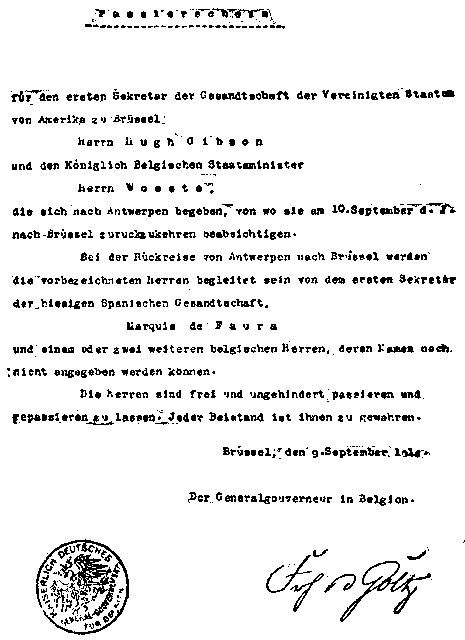
Pass issued by Field-Marshal von der Goltz to enable Mr. Gibson to pass through the German lines to Antwerp. [c]
When I got to the office I found that Villalobar had not sent over his contribution of letters, so I ran up to the Legation and saw him. He bade me farewell as though I were off to certain death, and loaded me with a large bundle of letters and telegrams.
When I got back to the shop, I found my fellow-passenger, the Count de Woeste, waiting for me. He is a leader of the Catholic party which has been in power in Belgium for the past thirty years, and, although he is seventy-five years old, he is still a big figure in the little country. He behaved very well on the trip, and if I were a Belgian citizen I should vote for him on account of his good nerve.
We bowled off to headquarters, where I was mightily pleased to find that von Herwarth had assigned himself to the duty of taking us up to the outposts—just for a visit. It was the only satisfactory one I have had with him since he came. At headquarters there were always too many interruptions. My old travelling companion had a hard time to keep himself in hand and not enter upon a joint debate upon the war, its causes and justification. He did well, however, and my two passengers parted on good terms, even going to the extraordinary length of shaking hands at the outpost.
A big military motor, filled with armed men, was sent ahead to act as guide, and we followed along closely behind in a cloud of dust.
From the outskirts of Brussels right up to the German outposts at Hofstade, the fields were filled with German troops of every sort—infantry, lancers, heavy artillery, and even three or four large detachments of sailors in blue blouses and caps. All the men, except the sailors and a few of the Landsturm who wear conspicuous blue uniforms, were in the new greenish grey, which is about the finest color that has yet seen active service. Frequently we drove several hundred yards beside a field before noticing that it was filled with soldiers. Several of the villages between Dieghem and Hofstade were partially burned, and there were evidences of shell fire—which to these peasants must be a perfectly convincing substitute for hell-fire—and of fighting at really close quarters. Between Perck and Hofstade, the fields were covered with deep entrenchments, and over some of these were stuck dummy heads to draw hostile fire. Some, on the other hand, were fitted with Belgian caps picked up on the battle-field, evidently for the purpose of inducing Belgian troops to approach for a closer look before firing. Most of the big trees along the road had been cut down, and many houses razed to the ground so as to have a cleaner sweep for the artillery. At Dieghem, the German pilot-car picked up a naval officer who was to accompany us as far as the outposts and to inspect his men on the way back.
On the outskirts of Hofstade, under a brick railway bridge, we found the last German troops. They had some hard fighting here at the time of the last Belgian sortie, and the bridge and the surrounding houses showed evidences of shell fire.
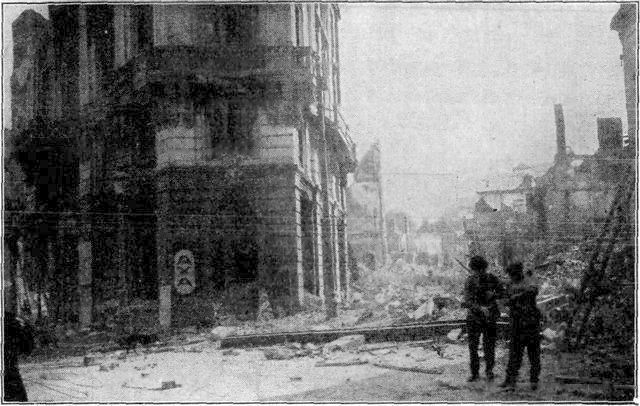
A street in Louvain
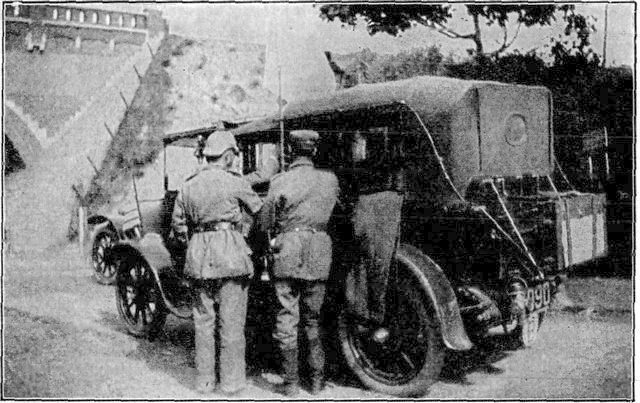
Fixing on the white flag for the dash between the lines
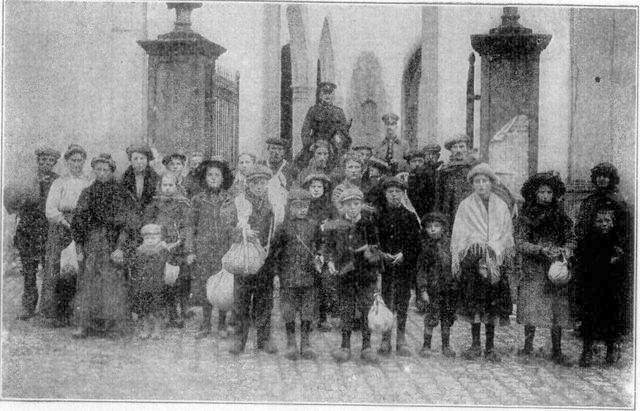
Refugees from the villages near the Antwerp forts
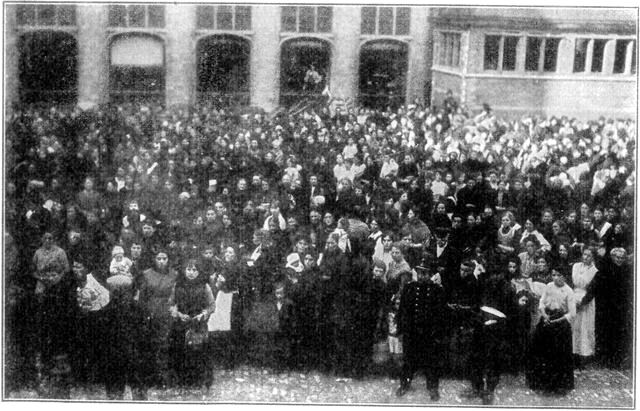
Arrival in Antwerp of refugees from Malines
I was rather against putting up the white flag, but both Herwarth and the naval officer were most insistent that I should do so, saying that the country between the lines was filled with patrols, both Belgian and German; that they felt that hostilities were to be commenced at any moment, and that any one who ventured into the district between the lines would stand a fine chance of being shot unless he carried a conciliatory emblem. They rigged up a long pole on the side of the car with a white flag about six feet square, and bidding a glad farewell to the representatives of Hohenzollern and Company, we started out to feel our way into Malines. About 500 yards beyond the bridge we sighted two Belgian bicycle patrols who, on seeing us, jumped off their machines and ran into an abandoned farmhouse. Knowing that they were at high tension, we crept up very slowly so that they might have a good look at us before trying their marksmanship. They were peeking over the window-ledge, with their rifles trained at us; but after a good look at the black clothes and white whiskers of M. de Woeste they pulled in their weapons and waved us to go ahead. About a kilometer farther on, we came around a turn in the road and nearly ran into the first Belgian outpost—six men and an officer. As we came around upon them they scurried behind stone walls and trees, and gave us the usual pleasant greeting of levelled rifles. As the most prudent things to do under such circumstances, the car was stopped, and I went ahead to parley. The officer proved to be young Z——. He turned quite white when he got a good look at me, and remarked that it was fortunate they had not had a sight of us farther down the road, as we would certainly have been filled with lead.
He said that the Germans had tried three times that morning to get through the lines in cars flying the white flag, in one instance at least, with a machine-gun in the car. As a result of this, the outposts had orders not to take any chance for the rest of the time intervening before the attack which was expected to begin at any minute.
Far be it from me to suggest that our friends had me put up the white flag, so as to offer proof of the Belgian savagery in firing on the white flag.
After this little experience, we took in our white flag and made the rest of our trip without trouble. We found outposts about every hundred yards, and were stopped at the point of the rifle each time; but as we got farther away from the outer lines the behaviour of the posts was noticeably less nervous, and when we got into Malines the mere sight of our papers was sufficient to let us freely through.
Since my last trip, the Belgians have been working steadily at their preparations for defence, and have accomplished wonders. Their large tracts of land, some of them forming natural routes, for entry between the forts, have been inundated with water from the canals so as to be quite impassable. Tremendous barbed wire entanglements form a broad barrier all around the outer and inner fortifications; they are so thick and so strongly braced that artillery fire would be practically useless against them, and cutting with wire nippers would be so slow that it could not be accomplished without a horrible loss of men.
There are any number of huge searchlights placed on the fortifications to sweep the skies for Zeppelins. Since my last visit, one Zeppelin had succeeded in getting over the town, but was surprised and dropped its whole cargo of 15 bombs in a distance of a few hundred yards, taking no lives and doing little material damage. Since then, several big craft have appeared at night, but have always been frightened away by the searchlights and the fire of the small vertical guns which have been ready for them.
All the villages which cluster around the fortifications have been razed to the ground, and the avenues of big trees have been cut down; it is a pretty dreadful sight.
I left M. de Woeste at the Grand Hôtel, where the Cabinet is staying, and then made for the Saint Antoine. Had lunch with Sir Francis Villiers and Colonel Fairholme, and got my first real news since the Prussian headquarters stopped issuing bulletins of German victories. Sir Francis showed me the telegrams he had received about the German check and retreat in France; and Prince Koudacheff, the Russian Minister, who joined us for coffee, vied with him by showing me his telegrams about the Russian advance in Eastern Prussia and in Austria.
After luncheon, I had some pow-wows on the subject that had brought me, and went to see various people for whom I had messages. They are a lot more cheerful than the last time I was in Antwerp, and are ready for anything.
From the Foreign Office, I went to the Consulate General, where I found a mountain of letters and telegrams. Got off my cables, and answered as much of the other correspondence as was absolutely necessary—no more.
On my way back to the hotel, I ran into General Jungbluth coming out of the Palace, and was promptly hauled inside for gossip.
The Queen, who has very properly come back from England, walked in on us and stopped to hear the news from Brussels.
I got back to the hotel, and found all the colleagues waiting for me to hear the latest news from Brussels. I played my part, and was nearly torn to pieces in their eagerness for news from the town where there is none. They were all there except the Papal Nuncio, who is most unhappy in the midst of war's alarms and hardly budges from the episcopal palace.
After dinner I was again asked to go to the Grand Hôtel to see the Prime Minister. He had nothing startling to say, but was anxious to know what was going on in Brussels. He showed me his telegrams from France, England and Russia, and his maps with the recent movements worked out with little flags.
Monsieur de Brocqueville told me an interesting incident that had taken place at Ghent. It seems that when the Germans arrived there, they sent in an officer and several soldiers to arrange for requisitions, etc., a promise having been given that they would not be molested. Of course, the whole town was on the qui vive and everybody had been warned to refrain from incurring their displeasure. Just as the German motor passed in front of our Consulate, a Belgian armoured car came charging in from Antwerp, knowing nothing of the presence of the Germans, and upon seeing the enemy uniform, opened fire, wounding the officer and one of the men.
That was enough to start things, and the town would probably be in ruins to-day but for the quick thinking and action of Van Hee, the American Vice-Consul. He plunged down the staircase, seized the Burgomaster, who happened to be present, pushed him into a motor with the wounded men and went straight to the German headquarters to explain that the attack had been made by two men from Antwerp who knew nothing of the agreement reached between the city and the German forces, and to plead that no reprisals should be made upon the city. The general said that he was prepared to accept the statement of the Vice-Consul on this matter, and that he would not therefore visit retribution on the town if the requisitions which he had demanded were promptly furnished. The requisitions were heavy, and he was apparently afraid that they might not be sent. He said that he would send in troops to occupy the town until the supplies requisitioned were actually in his possession, but finally agreed to refrain from doing so on condition that the Vice-Consul should give his word of honour that the supplies should be forthcoming.
Van Hee took this responsibility, and the General agreed to keep his troops outside the town. When they got back to Ghent, the Military Governor disavowed the arrangement on the ground that the Burgomaster had no right to enter into an agreement with the Germans and that he, as Military Governor, was the only one with any authority to deal with them. He therefore declared that no supplies should be sent. The Burgomaster telegraphed the Prime Minister in Antwerp, and placed the entire situation before him, and Monsieur de Brocqueville promptly telegraphed back that since the American Vice-Consul had given his word of honour to the German General it was impossible to disavow the agreement, and that the supplies should be sent out immediately. This was a pretty high stand for the Belgians to take, but they feel that Van Hee saved Ghent from destruction, and are correspondingly grateful to him.
Getting around Antwerp in the evening is quite an undertaking at this time; no street lamps are lighted, all the window shades lined with black, and heavy black shades are placed over the small electric lights in the courtyards of hotels, etc.—all of this to keep from giving any indication to the Zeppelins as to where to drop their visiting cards. A heavy detachment of soldiers guards the approach to the Saint Antoine, and there are patrols in all the streets. The few motors allowed on the street have no lights, and are stopped by all the patrols, who do not call out but rise up silently in front of you and demand the password. It is a ticklish business finding one's way. The big searchlights on the forts sweep the skies from nightfall until dawn, making a wonderful sort of fireworks.
When I got back to the hotel I found Prince Caraman Chimay waiting for me with a message from the Queen. Also poor Prince Ernest de Ligne, whose son, Badouin, was killed in one of the armoured motors several days ago.
Young de Ligne, who was a volunteer, was in one of three armoured cars that went out on a reconnaissance toward the German lines. Just before entering a sunken road between two fields they stopped a Flemish peasant and asked him whether there were any Germans anywhere about. The peasant told them that three Uhlans had been seen a short time before but they had gone away. The three motors, de Ligne in the first, started down and were attacked by about forty Germans under command of a major. De Ligne was shot in the head and died shortly afterwards. The man who took his place at the wheel was killed, and several others of the party were also badly wounded and have since died. The third motor came up from some little distance behind and opened on the Germans, killing or wounding nearly all of them, including the officer, who was killed.
A young chap named Strauss, whose mother was an American, had the mitrailleuse in his car, and stood upright, firing upon the Germans without being touched by the heavy rifle fire that they directed against him. When the Germans had been put to flight he and the other survivors got the three cars into running order, and brought them all back to Antwerp, where de Ligne and two of the others died.
Prince Ernest had a hard time getting through from Brussels, and was fired on several times by the German troops, who were even more nervous than in the morning, when I came through. One of his nephews has also been killed, and another nephew, Prince Henri de Ligne, is in the aviation corps, and has been in the thick of it ever since the beginning of the war. He and his wife are also staying at the Saint Antoine.
On Thursday morning I got caught in another avalanche of telegrams and had to spend a couple of hours at the Consulate-General polishing off and finishing business. Stopped in at the palace on the way back and saw General Jungbluth, who showed me the latest telegrams. I gathered up what newspapers I could beg or buy and stuffed them into a military pouch to take back. Had an early lunch, gathered up M. de Woeste and Faura, whom I was to bring back, and started about one. We got through Malines, across the only one of the three bridges which is left, and started down the bank of the canal toward Hofstade, where Herwarth was to meet us at two o'clock. There was heavy firing by small guns ahead and a certain amount of protective firing from the forts behind us, with the shells singing high above our heads, but we thought that it was probably aimed further to the south and that we could get through.
Just at the edge of Malines we were startled by a tremendous report near-by, and on getting out to reconnoitre I discovered a Belgian battery, which had been established near the Convent of the Dames de Coloma. The commanding officer of the battery, Major Nyssens, whom I had known in Brussels, advised us to wait a little to see if there was a lull in the fighting, so that we would get through. We went into the convent to wait and were warmly received by a little Irish nun, who showed us the park and pictures by way of entertainment, although we felt a much greater interest in the banging of the battery. After a bit Major Nyssens sent out a messenger to the farthest battery to see whether they were prepared to stop firing for a little while to let us scuttle through to Hofstade. Presently an answer came back that at 2:10 the firing would be stopped for twelve minutes to let us through. We were in the motor ready to start when another messenger came from the outer battery saying that the Germans were prepared to move up their battery from the bridge at Hofstade—the very spot we were making for, if there were any lull in the firing and that the Belgian battery could not stop without endangering its position.
We then decided to go back to Malines and to try a direct road by way of Sempst and Villevorde. On parting I gave Nyssens all my cigars, knowing I should find plenty when I got back to Brussels, and he, in a burst of gratitude, gave me a tiny revolver taken off a dead German officer a few hours before. Immediately after getting the revolver Nyssens' orderly had handled it rather carelessly, and shot himself in the stomach. To make sure of doing nothing equally foolish, I took out the remaining cartridges and chucked them in the canal as we rode back to Malines.
About a kilometer out of Malines we ran into a considerable detachment of Belgian infantry and lancers and a large armoured motor with two mitrailleuses. We were told that the Belgians had taken and retaken Sempst three times during the day, and while neither side occupied the town at that precise moment they were both advancing on it, and that it might be rather warm for ordinary motors. They finally agreed to let us talk to the commanding officer, who turned out to be none other than Colonel Cumont, the owner of the building occupied by the Legation.
He was up on a railway embankment, lying on his stomach between the rails, watching some German patrols through a pair of big field glasses, and when we hailed him, rolled gracefully over the side, and came down to talk to us. He had been out on the track most of the time for three days and was a rather disreputable-looking person, but apparently glad of a chance to talk with someone from the outside world.
He said he thought we would have time to get through before the row began, and in any event he would warn his men so that if we came scuttling back we would be given the right of way to safety.
We passed several Belgian patrols along the way and finally got into the town, which showed clear evidences of fighting; some of the houses were burned to the ground, and all that were standing had their doors and windows smashed, furniture broken, and strewn about the floors with broken bottles and dishes, mattresses and goodness knows what else; and above all arose that terrible smell of burnt flesh.
We were nearly through the town when we were hailed by a detachment of about twenty Belgians, who had got through and occupied the grounds of a villa on the edge of the village. We stopped the car, and I got out and went ahead, they remaining with leveled rifles, in their usual hospitable manner. When I got to within twenty feet of them we heard the whirr of a machine gun—which the Belgian soldiers call a cinema—and a German armoured car poked its nose around the corner for a look-see. It was firing high to draw a return fire and locate any Belgians there might be in the town, but they all scurried behind cover, closely followed by me. They were taking no chances, however, and called me to stay in the middle of the road. Without wasting any time in formality I made clear my identity, and, on being shown through a breach in the wall a disagreeable-looking body of German infantry and lancers about a half a mile away approaching through a field, I decided that we were on the wrong road and made back for the motor.
I told my passengers what was up, and that we had to go back to Malines. M. de Woeste, however, was all for going through on the valid plea that he had no clean linen and did not want to spend another night out of Brussels. Nevertheless we turned around and started back, only to rush into the big Belgian armoured car which Colonel Cumont, hearing firing, had sent down to rescue us and cover our retreat. This car stayed in the village for a few minutes to meet the German car, fired a few shots at it, and then came back to the outposts.
We then tried getting out toward the west from Malines, but soon came to a point where the road was inundated, and had to turn back for the third time. It was then getting pretty late in the afternoon, and even M. de Woeste had to admit that we had best come back to Antwerp rather than try to make a roundabout journey to Brussels after dark.
All the way back into Antwerp we met Belgian forces advancing to the attack. They are getting to know the flag better every day and we were greeted with waving hands and cheers everywhere we went. When nearly in town, a young chap ran out of the ranks to where we were waiting for them to get by, grabbed me by the shoulder, and said:
"I am born an American."
"Where were you born?"
"Aurora, Illinois. My father worked in ——'s glycerine works."
"Who do you know in Aurora?"
"I know Mr. Evans and Mr. —— and Mr. —— and Mr. Beaupré."[7]
"What's your name?"
Just then a non-commissioned officer came along and ordered him back into the ranks; the motor started ahead, and I lost track of the boy in a cloud of dust.
At the edge of town we caught up with a British Legation motor, which was stopped at a railroad barricade. Its occupants roared with laughter when they saw us, and Colonel Fairholme gloated particularly, as he had prophesied that we would not get through. When we got back to the hotel we were met with more laughter. It was the great joke of the week to see the only people who had previously been successful in running the lines, caught like the rest of them. I was not at all down in the mouth, as Antwerp was most interesting, and I had left only because I had felt it my duty to get back to work and to keep the Minister from worrying. When I saw that there was no way of getting through I gladly accepted the decree of fate.
When we got back to Antwerp I soon learned that it would be out of the question to get back to Brussels the next day, or perhaps even the day after that. The Belgians were advancing to an enveloping movement and all the surrounding country was to be covered with Belgian troops in an endeavour to deal a smashing blow to the Germans and compel them to bring back more troops from the front in France. Colonel Fairholme asked me to accompany him to the front next morning, and I accepted with an alacrity which startled him.
After dinner I made another excursion into the darkness and told Monsieur de Woeste that there was no prospect of getting back to Brussels the next day. His colleagues, who were there also, impressed upon him the futility of going, and he finally resigned himself to staying, although he kept insisting that he infinitely preferred danger to boredom, which was his lot so long, as he had nothing to do but sit around the hotel.
Friday morning while I was waiting for the Colonel to get ready and was doing my little errands down town, there came a great roaring of a crowd, and the chauffeur, knowing my curiosity, put on steam and spurted down to the boulevards just in time to run into a batch of three hundred German prisoners being brought in. They were a dejected-looking crowd, most of them Landsturm, haggard and sullen. The crowd, mindful of the things the Germans have been doing to this little country, were in no friendly mood, but did nothing violent. There was only a small guard of Belgian Garde Civique to escort the prisoners, but there were no brickbats or vegetables. The people limited themselves to hoots and catcalls and hisses—which were pretty thick. And even this was frowned upon by the authorities. Within a couple of hours the Military Governor had posted a proclamation begging the people of Antwerp to maintain a more dignified attitude and to refrain from any hostile demonstration against other prisoners. This batch was surrounded, and caught at Aerschot, where the Germans are said to have committed all sorts of atrocities for the past three weeks. Among the prisoners was the commanding officer, who was accused of being responsible for a lot of the outrages. He was examined by the military court, which sits for the purpose, and admitted having done most of the things of which he was accused, pleading in his own defence that he had done them only in obedience to superior orders, to which he had protested. The soldiers who made the capture disclaimed a large part of the credit for it on the ground that most of the Germans were drunk and that they were too dazed to get to their arms. Stories of this sort keep piling in from every side.
We got away at eleven to Lierre, where the King has established his headquarters for his movement. The road lay to the southeast and was through country I had not traversed before. The aspect was the same, however—long stretches of destroyed houses and felled trees, barbed-wire entanglements and inundated fields. It is a mournful sight.
Little Lierre was unharmed, and I hope it may remain so. The Grande Place was filled with staff motors, and there was a constant coming and going of motors and motorcycles bearing messengers to and from the field of operations. Headquarters was established in the Hôtel de Ville, which bears on its tower the date 1369—a fine old building, not large, but beautiful.
In the morning a message had come ordering Colonel DuCane back to England. He was out in the field, and we had to wait until he came in to deliver it to him. The King was also away, but we put in our time talking with the officers on duty as to the movement and its progress, and then went out for a stroll around the town. We looked into the old church, and I stopped and bought an officer's forage cap as a souvenir of the place. By the time we had poked around the neighbourhood and inspected the other Sehenswürdigkeiten of the town it was lunch time and we joined an officers' mess in the back room of a little café on the square, and then, to kill time, sat in front of another café and had coffee and a cigar.
We could not get started until Colonel DuCane had returned and received his message, so we sat in front of our little café and growled. It was maddening to waste our time there while the guns were thundering all around us and we knew from the signs of activity at headquarters that big things were toward. After a time a little man, the Senator for the district, came out and asked us into his house, directly across the street from the Hôtel de Ville. It was raining hard and we were ready for a change, so we accepted gladly and were entertained with champagne and cigars to the music of falling rain and booming cannon.
Our Senator was very much down in the mouth about the situation in general and wanted to talk about it. The Colonel told him of the bulletins that had been published in Antwerp as to the progress of the campaign, and as this went on he cheered up visibly minute by minute—whether as a result of the good news or the champagne, I don't know.
The Colonel was called away after a time to talk to Lord Kitchener over the telephone. Kitchener keeps himself informed directly as to the progress of operations and the knowledge that he may drop in over the telephone at any minute gives his officers a very comforting feeling that they are not forgotten.
Finally, after dark, Colonel DuCane and Captain Ferguson came in, and we got under way. It was too late to go forward with hopes of seeing anything, but it was evident that things would be as hot as ever the next day and that I could not hope to get my charges back to Brussels. Accordingly the Colonel's invitation was extended and accepted, and we turned back toward Antwerp considerably disappointed.
While we were waiting around trying to make up our minds—if any—I ran into young Strauss, the half-American, who was in the armoured car behind young de Ligne. He was really the principal hero of the occasion, having stood bolt upright in his car and riddled the German forces with his mitrailleuse until the few survivors turned and fled. He had with him two of the other survivors of his party. All of them had been decorated with the Order of Leopold for their behaviour. An order like that looks pretty well on a private's uniform, particularly when given with such good reason.
We had retreated inside the Hôtel de Ville during a particularly heavy downpour of rain, when in came the King, who had spent the whole day in the field with the troops. He was drenched to the skin, but came briskly up the steps, talking seriously with his aide-de-camp. He stopped and spoke with us all and took Colonel DuCane into his study and had a few minutes talk with him by way of farewell. The King shows up finely in the present situation and all the foreign military attachés are enthusiastic about his ability. He is in supreme command of the army and no detail is too insignificant for his attention.
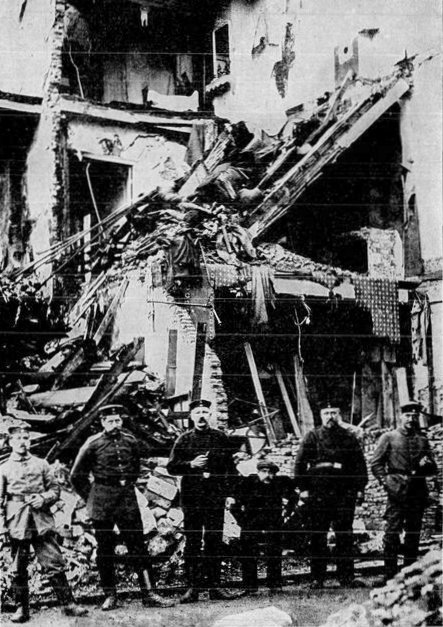
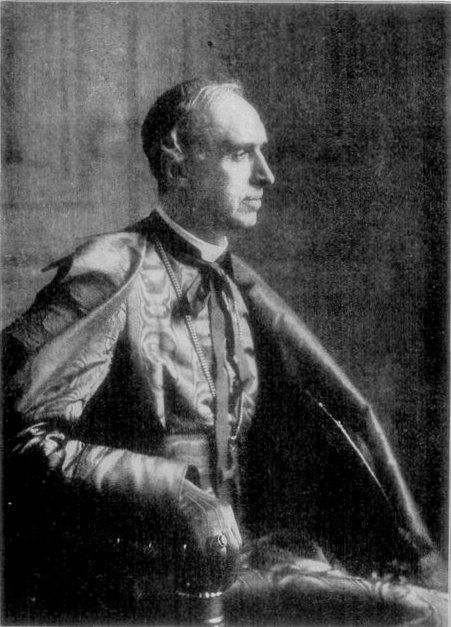
At Malines—a good background for a photograph to send home to Germany His Eminence, Cardinal Mercier, Archbishop of Malines
We got the password and made back for Antwerp in the dark, leaving Colonel DuCane and Captain Ferguson to spend the night at Lierre. We were in bad luck and got stopped at every railroad crossing along the way. Troop and supply trains were pouring down toward the front and Red Cross trains were bringing back the wounded in large numbers. Both sides must have suffered heavily during the day, and there may be several days more of this sort of fighting before there is a lull.
When we got back to the hotel we found Sir Francis waiting for us with a glowing telegram and an equally glowing face. It was the most enthusiastic message yet received from the British War Office, which has been very restrained in its daily bulletins. For the first time that day it spoke with a little punch, speaking of the "routed enemy" and their being "vigorously pressed." We tumbled through a hasty bath and got down to dinner in short order.
After dinner it was the same old performance of going over to the Grand Hôtel and labouring with Monsieur de Woeste, who was still bent on getting home to his clean linen without further delay. It took the united arguments of the Cabinet, which was in session, to convince him that it would be useless and foolish to try to get away. Finally he yielded, with a worse grace than on the previous evening. I had a comfortable visit with several of the Ministers, who were glad to hear news of their families in Brussels, and asked me to remember all sorts of messages to be given on my return. I only hope that I shall not get the messages mixed and get too affectionate with the wrong people. The Cabinet was going through the latest telegrams from the various fields of action. They even had some from Servia and were decidedly cheered up, a big change from the dogged determination with which they were facing bad news the last time I was in Antwerp.
Saturday morning the Colonel and I were called at six, and at seven we got away in a pouring rain over the same road to Lierre that we had travelled the day before. There was a big force of workmen hard at it in the vicinity of the outer forts, burning houses and chopping down trees and building barbed-wire entanglements. It is a scene of desolation, but it is necessary in a fight like this.
We found things moving rapidly at headquarters in Lierre. Messengers were pouring in and orders going out with twice the activity of the day before. The movement had been under way for two hours when we got there and the guns were booming all around. After learning as much as we could of the disposition of the troops we went out and stocked up with bread, cheese, and mineral water, and started forth to see what we could of the operations. We took along a young officer from headquarters to show us the road. We soon saw that he did not know the roads and could not even read a map, and had to take over that work ourselves. Colonel Fairholme and I went in my motor with the headquarters passenger and Colonel DuCane and Ferguson followed in their own car with an orderly. We got to Malines without difficulty and got out for a look at the Cathedral. It is a dreadful sight, all the wonderful old fifteenth century glass in powder on the floor. Part of the roof is caved in and there are great gaping holes in the lawn, showing where the shells struck that fell short of their mark. A few of the surrounding houses, belonging to entirely peaceful citizens, were completely wiped out while they were getting the range. It is hard to see what useful military purpose is served by smashing churches and peaceful habitations, when there are no troops about the place. Malines was bombarded when the troops had withdrawn. It is hard to reconcile with Gott mit uns.