INTRODUCTION (continued 2)
Reading edition
Eight French aeroplanes sailed over the city this afternoon, probably coming from Namur. One of the machines landed on the aviation field at the edge of the city, and the aviator was nearly torn to shreds by admirers who wanted to shake him by the hand and convince him that he was really welcome to Brussels. It is said that some of these fellows are going to lie in wait for the Zeppelins which have been sailing over Brussels by night to terrify the population. We hear that one of the Belgian army aviators did attack a Zeppelin and put it out of business, bringing to earth and killing all the crew. He himself went to certain death in the attempt.
The afternoon papers say that in Paris the name of the Rue de Berlin has been changed to Rue de Liège. Here the Rue d'Allemagne has been changed to Rue de Liège and the Rue de Prusse to Rue du Général Leman, the defender of Liège. The time abounds in beaux gestes and they certainly have their effect on the situation.
Kitchener says that the war may last for some time. At first it seemed to be taken for granted that it could not last long, as the financial strain would be too great and the damage done so enormous that one side or the other would have to yield to avoid national bankruptcy.
Brussels, August 11, 1914.—Our halls have been filled with Germans and Americans, the latter in smaller numbers and the former in larger crowds than ever. They are gradually being got out of the country, however, and those who are going to remain are being induced to go to the right authorities, so that their troubles will soon be settled to a large extent, and they will not be coming here so much. We are getting off hundreds of telegrams about the whereabouts and welfare of Americans and others here and in other parts of Europe; this work alone is enough to keep a good-sized staff working, and we have them hard at it.
This afternoon I went over to the British Legation and saw Colonel Fairholme, the military attaché, for a few minutes. He was just back from a trip out into the wilds with a party of British officers and was so clearly rushed that I had not the heart to detain him, although I was bursting with curiosity about the news he evidently had concealed about him. He appreciates the lenient way I have treated him, and goes out of his way to let me have anything that he can.
While I was out we saw a German monoplane which sailed over the city not very high up. The newspapers have published a clear description of the various aeroplanes that are engaged in the present war, so that nobody will be foolish enough to fire at those of the allies when they come our way. This one was clearly German, and the Garde Civique and others were firing at it with their rifles, but without any success. Our Legation guard, which consists of about twenty-five men, banged away in a perfect fusillade, but the airman was far too high for them to have much chance of hitting him.
Yesterday afternoon when the German biplanes passed over the city, a Belgian officer gave chase in a monoplane, but could not catch them. Contests of this sort are more exciting to the crowd than any fancy aviation stunts that are done at exhibitions, and the whole town turns out whenever an aeroplane is sighted.
This morning I presented myself at the German Legation with the imposing laisser-passer furnished me by the Military Governor of Brabant, but the guard on duty at the door had not received orders to let me in and turned me down politely but definitely. I took the matter up with the Foreign Office and said that I wanted it settled, so that I would not have any more fruitless trips over there. At five an officer from the État-Major of the Garde Civique came for me in a motor and took me over to the Legation, to give orders in my presence that whenever I appeared I was to be allowed to pass without argument. As I got into the motor I noticed that the soldier who was driving the car looked at me with a twinkle in his eye, but paid no attention to him. When I took a second look I saw that it was G. B——, with whom I had played golf several times. I am constantly being greeted by people in uniform whom I had known at one time or another. It is hard to recognise them in uniform.
So far as operations in Belgium are concerned, we may not have anything big for some days to come; but, in the meantime, work of preparation is being pushed rapidly and supplies and reinforcements are being rushed to the front. Half the shops in town are closed, and all the people are working either in the field or taking care of the wounded or prisoners. There are said to be some eight thousand German prisoners in Belgium, and it is some work to take care of them all.
Brussels, August 12, 1914.—A few minutes' gap, so I seize my pen to scratch off a line.
Last night when I left here I rode up the Rue Bélliard on my way home. I was stopped in front of the German Legation by the guard which was placed across the street. They examined the chauffeur's papers carefully and then looked over mine. They compared the tintype on my laisser-passer with the classic lineaments of the original, and after looking wise, told me to move on. When we got up to the Boulevard there was great cheering, and we came out on a thin file of French cavalry, which was on its way through town from the Gare du Midi. The crowd was mad with enthusiasm and the soldiers, although plainly very tired, pulled their strength together every now and then to cry, "Vive la Belgique!" There were crowds on the Boulevards, waiting for news from là bas. A few French officers were going about in cabs, and each time that one appeared the crowd went mad. The officers were smiling and saluting, and every now and then one stood up in his place and cheered for Belgium. In twenty minutes or so, I saw that we could get through, so started for home and bed.
When we got to the Porte de Namur, we heard frenzied cheering down by the Porte Louise. The chauffeur is a regular old war horse who does not want to miss a trick. He cast a questioning glance over his shoulder; and, catching my nod, put on full speed down the Boulevard until we came to a solid crowd banked along the line of march of more French cavalry. The people in the crowd had bought out the nearby shops of cigars and cigarettes and chocolate and small flasks of brandy, and as each man rode by, he was loaded up with as much as he could carry. The défilé had been going on for over an hour, but the enthusiasm was still boundless. All the cafés around the Porte Louise sent out waiters and waitresses with trays of beer to meet the troops as they came into the Avenue Louise. Each man would snatch a glass of beer, swallow it as he rode along and hand it back to others who were waiting with empty trays a hundred yards or so down the line of march. The men were evidently very tired, and it was an effort for them to show any appreciation of their reception, but they made the effort and croaked out, "Vive la Belgique!" The French and British troops can have anything they want in this country. They will be lucky, though, if they escape without acute indigestion.
Yesterday afternoon, as I was coming out of the chancery of the British Legation, a little cockney messenger in uniform came snorting into the court on a motor-cycle. As he got off he began describing his experiences, and wound up his story of triumphant progress—"And when I got to the Boulevards I ran down a blighter on a bicycle and the crowd gave me an ovation!"
More troubles to-day about the German Legation. The État-Major gave orders that nobody but I should be allowed to enter. The laymen who have the onerous duty of protecting the Legation held a council of war, and decided that this precluded them from allowing food to go in; so when the waitress from the Grand Veneur with the lunch of the crowd inside came along, she was turned back and told I should have to go with her. I went around to the Legation and fixed it up with the guard. A few minutes ago the waitress came back with word that more bread and butter was wanted, but that the guard had changed and that she was again barred out. Monsieur de Leval and I went around again and fortunately found some one from the État-Major who was there for inspection. He promised to get proper orders issued and now we hope that we shall not be obliged to take in every bite under convoy.
There are ominous reports to-day of a tremendous German advance in this direction, and it is generally believed that there will be a big engagement soon near Haelen, which is on the way from Liège to Tirlemont. Communications are cut, so I don't quite see where all the news comes from.
After dinner.—News sounds better to-night. Although there is nothing very definite, the impression is that the Belgians have come out victorious to-day in an engagement near Tirlemont. I hope to get some news later in the evening.
During a lull in the proceedings this afternoon, I got in Blount's car and went out to Brooks, to see his horses and arrange to have him send them in for our use every afternoon. He came over here a few months ago to spend the rest of his life in peace and quiet. It looks as though he wouldn't get much of either.
The Avenue de Tervueren, a broad boulevard with a parkway down the centre, is the most direct way into town from the scene of the fighting, and there has been a general belief that the Germans might rush a force into town in motors that way. In order to be ready for anything of the sort, a barricade has been made of heavy tram cars placed at right angles across the road, so that they do not absolutely stop traffic, but compel motors to slow down and pick their way, thus:
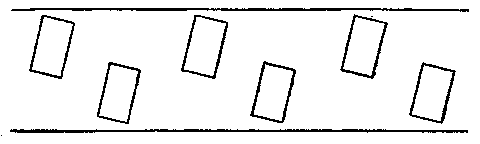
It is close work getting through, and can only be done at a snail's pace.
The latest news we have is that the nearest large German force is just 38 miles away from Brussels.
Brussels, August 13, 1914.—Last night, after dining late, I went out to find my friend, Colonel Fairholme, and see if he had any news. He had just finished his day's work and wanted some air. Fortunately I had the car along and so took him out for a spin to the end of the Avenue Louise. We walked back, followed by the car, and had a nightcap at the Porte de Namur.
The Colonel has been going to Louvain every day, to visit the General Staff and report to the King as the military representative of an ally. The first time he arrived in a motor with Gen. de Selliers de Moranville, the Chief of Staff. As they drew into the square in front of the headquarters, they saw that everything was in confusion and a crowd was gathered to watch arrivals and departures. When their car stopped, a large thug, mistaking him for a German officer, reached in and dealt him a smashing blow on the mouth with his fist, calling him a "sal alboche" by way of good measure. He had to go in and report to the King, streaming with blood—a pleasant beginning. He is just getting back to a point where he can eat with ease and comfort. Life will be easier for some of the attachés when people get used to khaki uniforms and learn that some do not cover Germans.
The day the General Staff left for the front, the Colonel went to see them off. He was called by one of the high officers who wanted to talk to him, and was persuaded to get on the train and ride as far as the Gare du Luxembourg, sending his car through town to meet him there. Word came that the King wanted to see the Chief of Staff, so he asked the Colonel to take him to the Palace. When the crowd saw a British officer in uniform and decorations come out of the station accompanied by the Chief of Staff and two aides, they decided that it was the Commander-in-Chief of the British army who was arriving and gave him a wonderful ovation. Even the papers published it as authentic. He was tremendously fussed at the idea of sailing under false colors, but the rest of us have got some amusement out of it.
Stories are coming in here about the doings of the German troops. According to reports they came into Hasselt and took the money in the town treasury and the local bank—some two and a half millions altogether. The story, whether true or not, has caused a great deal of ill feeling here. There is another story that the commanding officer of one of the forts around Liège was summoned to parley with a white flag. When he climbed on top of his turret, he was shot through both legs and only saved by his men pulling him to cover. Of course there are always a great many stories of this sort scattered broadcast at the beginning of every war, but in this instance they seem to be generally believed and are doing the Germans no good at all.
Mlle. D——, one of our stenographers, has a brother in the French army. She has not heard a word from him since the war began, and had no idea where he was. Yesterday a small detachment of French cavalry came along the street. She ran out, called to one of them that her brother was in the ——, and asked where it was. They told her it had not yet been in action and she has been walking on air ever since. But she could not telegraph the good news to her family, for fear of betraying military movements.
Roger de Leval, the 8-year-old son of our friend, practically broke off diplomatic relations with his father and mother because he was not allowed to be a Boy Scout. His father was at the Legation, his mother at the Red Cross, and he had to stay at home with his governess. He felt so badly about it that we had Monsieur de Leval register him as a B.S., and have him assigned to special duty at the Legation. He attends in full uniform and carries messages and papers from my room to the other offices and vice versa. When we go out he rides on the box with the chauffeur and salutes all the officers we pass. They are used to it now and return the salutes very gravely. The youngster now feels that he is really doing something, but is outraged because we go along. He wants to undertake some of the big missions alone.
Princesse Charles de Ligne was in this morning. Her son, Prince Henri, head of that branch of the house, has enlisted as a private in the aviation corps. There seemed to be no way for him to have a commission at once, so he put his star of the Legion of Honor on his private's uniform and was off to the front yesterday. That's the spirit.
Comtesse d'A—— was at their home in the Grand Duchy when war broke out. No news had been received from her, and her husband was worried sick. We got a message through via The Hague and got word back this morning that she was safe and well. I went up to tell him the good news. He was presiding over some sort of committee meeting, and the maid said I could not see him. I insisted that she should announce me and after some argument she did. As the door opened, the buzz subsided and she announced: "Monsieur le Secrétaire de la Légation d'Amérique." There was a terrible cry of fear and the old Count came running out white as a sheet. Before he had come in sight I called out, "Les nouvelles sont bonnes!" The old chap collapsed on my shoulder and cried like a baby, saying over and over: "J'étais si inquiet: j'étais si inquiet!" He soon pulled himself together and showed me out to the car with the honours of war. We send and receive hundreds of telegrams of inquiry and shoot them through in a perfectly routine way. It is only now and then that we come to a realising sense of the human side of it all.
This afternoon I went over and made inquiry as to the well-being of those who are cooped up in the German Legation. They are getting along perfectly well, but are consumed with curiosity as to the progress of the war. The Government has not allowed them to have any letters or newspapers, and they are completely in the dark as to what is going on. I felt like a brute to refuse them, but could not very well do anything against the wishes of the Government. They were decent enough not to embarrass me by insisting, which made it harder to refuse. The son of Hofrath Grabowsky, the Chancellor of the Legation, is Secretary of the German Consulate at Antwerp. He came down here to say good-bye to his father the day war was declared, and lingered so long that he was cooped up with the others. He is liable for military service in Germany, and having left his post at Antwerp at such a time, he must face a court martial whenever he does get home. There are five or six people there, including the wife of the old Hofrath, who are firmly convinced that they will all be murdered in their beds. It is my daily job to comfort them and assure them that nobody now here is giving any thought to them.
Last night I dined with Colonel Fairholme and Kidston, the First Secretary of the Legation. We went to the usually crowded terrace of the Palace Hotel, where we had no difficulty in getting a table in the best part of the balcony. The few other diners were nearly all colleagues or officers. Military motors and motor-cycles came and went, and orderlies dashed up on horseback and delivered messages; it looked like war.
The proprietor of the hotel, who has given one hundred thousand francs to the Red Cross, rolled up in his motor from a trip to the front and got out with an armful of Prussian helmets and caps, which he had collected. A crowd gathered round the motor and displayed as much pleasure as though he had brought in a whole German Army corps. The novelty of these souvenirs has not yet worn off.
Women with big tin boxes came by every few minutes to collect for the Red Cross or some other fund. Finally the Colonel protested, and asked if there was no way of buying immunity. That was quickly arranged by giving up five francs, in return for which we were given tags of immunity. Dozens of collectors came by during the evening, but our ostentatiously displayed tags saved us.
We ate at our leisure—out of doors—the first unhurried and unharried meal I have had for days, and then got back to the Legation.
This afternoon the Minister and I went over to see Sir Francis Villiers, the British Minister, and spent half an hour with him. He is evidently all ready to make a quick get-away whenever it looks as though the Germans would come to Brussels. A number of the other diplomats are also prepared to depart. Those who are accredited at The Hague will probably go there, and the others will go to Antwerp. We are too busy here to enjoy the luxury of spending a month undergoing a siege, so no matter what happens, we shall probably not go along. The Minister and I shall take turns from time to time, going up to pay our respects.
Having some things to talk over, the Minister and I went for a drive after our visit, and it was well we did, for when we got back, we found the hall filled with callers. As the tourists and the Germans leave, the war correspondents begin to come in, and in a few days we shall probably have the place full of them. I heard to-day that there were 200 of them in London, and that most of them want to come on here.
Maxwell, the British correspondent, told me this afternoon that he looked for a big engagement at Diest to-morrow or the day after. He has been down through the fighting zone ever since the trouble began, and probably knows more about pending operations than any other civilian.
While I was writing, Z—— came in, suffering from a bad case of panic. He announced as he burst into my office that the Germans were within 20 kilometers of Brussels and were going to occupy the city this evening. He was fairly trembling, but got indignant because I denied it, having just talked with Colonel Fairholme and with Maxwell, both of whom had no more than come back from the front. The fact that it had been published in the Soir was enough for him, and although the news had made him nervous, he hated to have his perfectly good sensation spoiled.
The authorities, so as to be prepared for any eventuality, have this evening published a communiqué to impress upon the population the necessity for abstaining from any participation in the hostilities in case of an occupation. It advises everybody to stay indoors and avoid any words or actions that might give an excuse for measures against non-combatants.
August 15th.—Last night I dined with the Colonel, Grant-Watson, and Kidston at the Palace. I was looking forward to a lot of interesting talk, as the Colonel had just come from the front. Just as we were settling down to our conversational Marathon, up walked ——, the —— Chargé and bade himself to dine with us. He is strongly pro-German in his sympathies, and, of course, that put a complete damper on conversation. We talked about everything on earth save the one thing we were interested in, and sat tight in the hope that he would move on. Not only did he stay, but after a time the —— First Secretary came and joined us, and we gave up in despair. The only result of the evening was that I gathered the impression that there is a good deal of apprehension on the part of the allies as to the result of the next big battle, which may occur any day now. The Germans are undoubtedly pretty near now, perhaps a good deal nearer than we know. Just before dinner the War Office announced that there would be no further official communiqués as to the operations. That looks as though they were battening down the hatches for the next big engagement.
Yesterday's papers announced France's declaration of war against Austria. This morning comes the news that Montenegro has also declared her intention of wiping Austria off the map. Our daily query now is—"Who has declared war to-day?"
Every minute we are not hammering away at our work, we sit around and talk of the latest developments. These things make such an impression that I can quite understand old veterans boring everybody to death with reminiscences. I see some forty years from now that people will be saying: "I don't want to let old man Gibson get hold of me and tell me all about the war of 1914!"
This morning I received a telegram from Richard Harding Davis, who wants to join the Belgian forces. We are trying to arrange it this morning, and I expect to see him any day now.
We are going to have a lot of newspaper men in our midst. I met two more of them last night. None of them who have so far appeared speak any language but English, but they are all quite confident that they can get all the news. I look next for Palmer and Jimmy Hare and the rest of the crowd.
Maxwell, the Telegraph correspondent, yesterday showed me a photograph of a French bulldog that has been doing good service at Liège. His master, who is an officer in one of the forts, fastens messages in his collar and shoves him out onto the glacis. The puppy makes a blue streak for home and, as he is always sent at night, has managed so far to avoid the Germans. His mistress brings him back to the edge of town and starts him back for the fort.
The Belgian troops have so far had to dam the flood of Germans with little or no help from the allies. The Kaiser expected, so far as we can make out, to sweep through Belgium with little opposition and be fighting in France in three days! The Belgians have knocked his schedule out by twelve days already, and there is no telling how much longer they may hold out. "My military advisers" tell me that in view of the great necessity for a quick campaign in France, so as to get the army back in time to head off the Russian flood when it begins to pour over the northern frontier, the loss of this much time is equivalent to the loss of the first great battle. The moral effect is also tremendous.
The Minister to-day had a card from Omer which began: "J'ai l'honneur de faire savoir a Votre Excellence que je suis encore toujours vivant!" Encore toujours sounds as though he were pretty emphatically alive. We were all relieved to hear from him.
Villalobar, the Spanish Minister, came in after dinner—just to visit. His household is greatly upset. His cook and three footmen have gone to the war. He apologised for not inviting us to dine during these depressing days, but said he could not, as his cook was a Lucretia di Borgia. He is confident that the war is going to knock Brussels life into a cocked hat this winter. So many of the families will be in mourning, and so much poverty will come as a result of the war. Life goes on so normally now, save for the little annoyances of living under martial law, that it is hard to realise that such great changes are imminent.
Brussels, August 16, 1914.—This morning I walked out of my office and bumped into Frederick Palmer. I had no idea he was so near. Two weeks ago he was in Vera Cruz, but made a bee-line for Brussels at the first news of impending war. In the breathing spaces during the morning I got in a little visiting with him. He stayed to lunch at the Legation and so did I. In the afternoon I took him to the Foreign Office and the War Office and the Gendarmerie, and got him outfitted with passes, so that he can make a try to get towards the front. As a measure of precaution I added another laisser-passer to my collection, with a beautiful photograph on it. The collection grows every day.
I went to the Palace to dine with Palmer and Blount. We had hardly got seated when in walked Richard Harding Davis and Gerald Morgan, and joined us. I had not expected Davis here so soon, but here he is. He was immaculate in dinner jacket and white linen, for war does not interfere with his dressing.
While we were dining, a lot of motors came by filled with British officers. There was a big crowd in the square, and they went crazy with enthusiasm, cheering until the windows rattled.
Brussels, August 18, 1914.—At ten in the morning I started with Frederick Palmer and Blount in the latter's car, to see whether we could get a little way out of town and get a glimpse of what was going on. We were provided with laisser-passers and passports and all sorts of credentials, but as a strict prohibition against sightseers has been enforced for some days, we rather doubted whether we should be able to get farther than the edge of town. Before we got back we had gone more than a hundred kilometers through the heart of things and saw a great deal more than anybody should be allowed to see. We got back to town about eight o'clock, thoroughly tired and with eyes filled with dust and cinders.
Part way out the avenue we were hailed by a soldier, who asked us for a lift as far as Tervueren. He climbed into the car beside me and rode out. The Forêt de Soignes was mournful. Quatre Bras, where the cafés are usually filled with a good-sized crowd of bourgeois, was deserted and empty. The shutters were up and the proprietors evidently gone. The Minister's house, near by, was closed. The gate was locked and the gardener's dog was the only living thing in sight. We passed our Golf Club a little farther on toward Tervueren. The old château is closed, the garden is growing rank, and the rose-bushes that were kept so scrupulously plucked and trim, were heavy with dead roses. The grass was high on the lawns; weeds were springing up on the fine tennis courts. The gardeners and other servants have all been called to the colours. Most of the members are also at the front, shoulder to shoulder with the servants. A few caddies were sitting mournfully on the grass and greeted us solemnly and without enthusiasm. These deserted places are in some ways more dreadful than the real horrors at the front. At least there is life and activity at the front.
Before we got out of town the guards began stopping us, and we were held up every few minutes until we got back to town at night. Sometimes the posts were a kilometer or even two kilometers apart. Sometimes we were held up every fifty yards. Sometimes the posts were regulars, sometimes Gardes Civiques; often hastily assembled civilians, mostly too old or too young for more active service. They had no uniforms, but only rifles, caps, and brassards to distinguish them as men in authority. In some places the men formed a solid rank across the road. In others they sat by the roadside and came out only when we hove in sight. Our laisser-passers were carefully examined each time we were stopped, even by many of the guards who did not understand a word of French, and strangely enough, our papers were made out in only the one language. They could, at least, understand our photographs and took the rest for granted.
When we got to the first outpost at Tervueren, the guard waved our papers aside and demanded the password. Then our soldier passenger leaned across in front of Blount and whispered "Belgique." That got us through everything until midday, when the word changed.
From Tervueren on we began to realise that there was really a war in progress. All was preparation. We passed long trains of motor trucks carrying provisions to the front. Supply depots were planted along the way. Officers dashed by in motors. Small detachments of cavalry, infantry and artillery pounded along the road toward Louvain. A little way out we passed a company of scouts on bicycles. They are doing good work, and have kept wonderfully fresh. In this part of the country everybody looked tense and anxious and hurried. Nearer the front they were more calm.
Most of the groups we passed mistook our flag for a British standard and cheered with a good will. Once in a while somebody who recognised the flag would give it a cheer on its own account, and we got a smile everywhere.
All the farm houses along the road were either already abandoned or prepared for instant flight. In some places the reaping had already begun, only to be abandoned. In others the crop stood ripe, waiting for the reapers that may never come. The sight of these poor peasants fleeing like hunted beasts and their empty houses or their rotting crops were the worst part of the day. It is a shame that those responsible for all this misery cannot be made to pay the penalty—and they never can, no matter what is done to them.
Louvain is the headquarters of the King and his État-Major. The King is Commander-in-Chief of the Allied Forces operating in Belgium, and is apparently proving to be very much of a soldier. The town is completely occupied and troops line the streets, stopping all motors and inspecting papers, then telling you which way you can go. We were the only civilians on the road all day, except the Red Cross people. The big square was completely barred off from general traffic and was surrounded with grenadiers. We got through the town and stopped at the only café we could find open, where we had a bottle of mineral water and talked over what we should do next.
In Louvain there is an American theological seminary. We had had some correspondence with Monseigneur de Becker, its Rector, as to what he should do to protect the institution. At our suggestion he had established a Red Cross Hospital and had hoisted a big American flag, but still he was not altogether easy in his mind. I called on him and did my level best to reassure him, on the ground that the Germans were certainly not making war on seminaries or priests, and that if the Germans reached Louvain, all he had to do was to stay peacefully at home and wait for quiet to be restored. Most of his students were gone and some of the faculty had followed them, so his chief concern was for the library and other treasures. My arguments did not seem to have very much weight, but I left with a promise to look in again at the first opportunity and to respond to any call the Rector might make.
From the seminary we drove out the Tirlemont road, to see if we could get to that little town and see some of the fighting that was known to be going on. At the edge of the town we came to a barricade of carts, road-rollers and cobble stones, where we were courteously but firmly turned back. Everybody was anxious to make it as nice as possible for us, and one of the bright boys was brought forward to tell us in English, so as to be more convincing. He smiled deprecatingly, and said: "Verreh bad. Verreh sorreh. Oui mus' mak our office, not?" So we turned and went back to town. They had told us that nobody could go beyond the barricade without an order from the Commandant de Place at Louvain. On the way back we decided that we could at least try, so we hunted through the town until we found the headquarters of the Commandant. A fierce-looking sergeant was sitting at a table near the door, hearing requests for visés on laisser-passers. Everybody was begging for a visé on one pretext or another, and most of them were being turned down. I decided to try a play of confidence, so took our three cards and walked up to his table, as though there could be no possible doubt of his doing what I wanted. I threw our three laisser-passers down in front of him, and said in a business-like tone: "Trois visés pour Tirlemont, S.V.P." My man looked up in mild surprise, viséed the three papers without a word and handed them back in less time than it takes to tell it. We sailed back to the barricade in high feather, astonished the guard with our visé, and plowed along the road, weaving in and out among ammunition wagons, artillery caissons, infantry, cavalry, bicyclists—all in a dense cloud of dust. Troops were everywhere in small numbers. Machine guns, covered with shrubbery, were thick on the road and in the woods. There was a decidedly hectic movement toward the front, and it was being carried out at high speed without confusion or disorder. It was a sight to remember. All along the road we were cheered both as Americans and in the belief that we were British. Whenever we were stopped at a barricade to have our papers examined, the soldiers crowded around the car and asked for news from other parts of the field, and everybody was wild for newspapers. Unfortunately we had only a couple that had been left in the car by accident in the morning. If we had only thought a little, we could have taken out a cartful of papers and given pleasure to hundreds.
The barricades were more numerous as we drew nearer the town. About two miles out we were stopped dead. Fighting was going on just ahead, between us and the town, and the order had been given out that nobody should pass. That applied to military and civilians alike, so we could not complain, and came back to Louvain, rejoicing that we had been able to get so far.
We hunted up our little café and ate our sandwiches at a table on the sidewalk, letting the house profit to the extent of three glasses of beer. We were hardly seated when a hush fell on the people sitting near. The proprietor was summoned and a whispered conversation ensued between him and a bewhiskered old man three tables away. Then Mr. Proprietor sauntered over our way with the exaggerated carelessness of a stage detective. He stood near us for a minute or two, apparently very much interested in nothing at all. Then he went back, reported to "Whiskers" and the buzz of conversation began again as though nothing had happened. After a bit the proprietor came over again, welcomed us to the city, asked us a lot of questions about ourselves, and finally confided to us that we had been pointed out as Germans and that he had listened to us carefully and discovered that we were nothing of the sort. "J'ai très bonne oreille pour les langues," he said. Of course we were greatly surprised to learn that we had been under observation. Think of German spies within 200 yards of the headquarters of the General Staff! (And yet they have caught them that near.) Every active citizen now considers himself a policeman on special duty to catch spies, and lots of people suffer from it. I was just as glad the proprietor had not denounced us as spies, as the populace has a quite understandable distaste for them. I was glad the bright café proprietor could distinguish our lingo from German.
After lunch we went down to the headquarters of the General Staff, to see if we needed any more visés. We did not, but we got a sight of the headquarters with officers in all sorts of uniforms coming and going. The square was full of staff autos. The beautiful carved Hôtel de Ville is the headquarters. As we walked by, a British Major-General came down the steps, returned everybody's salutes and rolled away—a fine gaunt old type with white hair and moustache—the sort you read about in story books.
After lunch we found that there was no use in trying to get to Tirlemont, so gave that up, and inquired about the road to Diest. Everybody who was in any sort of position to know told us we could not get more than a few kilometers along the road, and that as Uhlans were prowling in that neighbourhood, we might be potted at from the woods or even carried off. On the strength of that we decided to try that road, feeling fairly confident that the worst that could happen to us would be to be turned back.
As we drew out along the road, the traffic got steadily heavier. Motors of all sorts—beautifully finished limousines filled with boxes of ammunition or sacks of food, carriages piled high with raw meat and cases of biscuit. Even dog-carts in large numbers, with the good Belgian dogs straining away at the traces with a good will, and barking with excitement. They seemed to have the fever and enthusiasm of the men and every one was pulling with all his strength. In some places we saw men pushing heavily-laden wheelbarrows, with one or two dogs pulling in front.
From Louvain on most of the barricades were mined. We could see clearly as we passed where the mines were planted. The battery jars were under the shelter of the barricade and the wire disappeared into some neighbouring wood or field. Earthworks were planted in the fields all along the lines, good, effective, well-concealed intrenchments that would give lots of trouble to an attacking force. There was one place where an important intrenchment was placed in a field of hay. The breastworks were carefully covered with hay and the men had it tied around their hats in such a way as to conceal them almost completely. This war is evidently going to be fought with some attention to detail, and with resourcefulness.
Diest itself we reached at about half past three, after having been nearly turned back six or seven times. We were the only civilians that had turned up all day, and although our papers seemed to be all right and we could give a good account of ourselves, our mere presence was considered so remarkable that a good many of the outposts were inclined to turn us back. By virtue of our good arguments and our equally good looks, however, we did manage to get through to the town itself.
Diest is an old town which figures a good deal in the combats of the middle ages. It has a fine old church, quite large, a good Hôtel de Ville, and clean, Dutch-looking streets, with canals here and there. The whole town is surrounded with high earthworks, which constituted the fortifications, which were part of the line of forts erected by the allies after Waterloo, as a line of defence against French aggression. These forts were so numerous that Belgium in her younger days had not sufficient men to garrison them. A number of them were abandoned, finally leaving Antwerp, Liège and Namur to bear the burden. Brialmont, who built the great ring forts at Liège, wanted to build modern fortifications at Diest, but could not get those holding the purse-strings to see things his way.
Diest was attacked by Germans about three days ago. They wanted to take the old fortifications so as to control the road and use the place as a base of operations. It could hardly be called a big battle, but was more probably in the nature of a reconnaissance in force with four or five regiments of cavalry. This part of Belgium is the only place on the whole field of operations where cavalry can be used and they are certainly using it with a liberal hand, probably in attempt to feel out the country and locate the main body of opposing troops. They have got into a lot of trouble so far, and I am sure they have not yet located the main bodies of the allied armies.
The shops were all closed and most of the people were sitting on the sidewalk waiting for something to turn up. Some of them had evidently been to America, and we had an ovation all the way in. The Grande Place was filled with motors and motor trucks, this evidently being a supply depôt. We had some of the local mineral water and talked with the people who gathered round for a look at the Angliches.
They were all ready for anything that might come, particularly Prussians. In the old days the Uhlans spread terror wherever they appeared, to burn and shoot and plunder. Now they seem to arouse only rage and a determination to fight to the last breath. There was a little popping to the north and a general scurry to find out what was up. We jumped in the car and made good time through the crowded, crooked little streets to the fortifications. We were too late, however, to see the real row. Some Uhlans had strayed right up to the edge of town and had been surprised by a few men on the earthworks. There were no fatalities, but two wounded Germans were brought into town in a motor. They were picked up without loss of time and transported to the nearest Red Cross hospital.
Cursing our luck we started off to Haelen for a look at the battlefields. Prussian cavalry made an attack there the same day they attacked Diest, and their losses were pretty bad.
At one of the barricades we found people with Prussian lances, caps, haversacks, etc., which they were perfectly willing to sell. Palmer was equally keen to buy, and he looked over the junk offered, while some two hundred soldiers gathered around to help and criticise. I urged Palmer to refrain, in the hope of finding some things ourselves on the battlefield. He scoffed at the idea, however. He is, of course, an old veteran among the war correspondents, and knew what he was about. He said he had let slip any number of opportunities to get good things, in the hope of finding something himself, but there was nothing doing when he got to the field. We bowed to his superior knowledge and experience, and let him hand over an English sovereign for a long Prussian lance. I decided to do my buying on the way home if I could find nothing myself.
The forward movement of troops seemed to be headed toward Diest, for our road was much more free from traffic. We got into Haelen in short order and spent a most interesting half hour, talking to the officer in command of the village. As we came through the village we saw the effect of rifle fire and the work of machine guns on the walls of the houses. Some of them had been hit in the upper story with shrapnel and were pretty badly battered up. The village must have been quite unpleasant as a place of residence while the row was on. The commanding officer, a major, seemed glad to find some one to talk to, and we stretched our legs for half an hour or so in front of his headquarters and let him tell us all about what had happened. He was tense with rage against the Germans, whom he accused of all sorts of barbarous practices, and whom he announced the allies must sweep from the earth. He told us that only a few hours before a couple of Uhlans had appeared in a field a few hundred yards from where we were standing, had fired on two peasant women working there, and then galloped off. Everywhere we went we heard stories of peaceful peasants being fired on. It seems hard to believe, but the stories are terribly persistent. There may be some sniping by the non-combatant population, but the authorities are doing everything they can to prevent it, by requiring them to give up their arms and pointing out the danger of reprisals.
Before we moved on, our officer presented me with a Prussian lance he had picked up on the battlefield near Haelen. We got careful directions from him for finding the battlefield and set off for Loxbergen, where the fight had taken place the day before. The run was about four kilometers through little farms, where the houses had been set on fire by shrapnel and were still burning. The poor peasants were wandering around in the ruins, trying to save odds and ends from the wreck, but there was practically nothing left. Of course they had had to flee for their lives when the houses were shelled, and pretty much everything was burned before they could safely venture back to their homes.
We had no difficulty in locating the field of battle when we reached it. The ground was strewn with lances and arms of all sorts, haversacks, saddle bags, trumpets, helmets and other things that had been left on the ground after the battle. There were a few villagers prowling around, picking things up, but there were enough for everybody, so we got out and gathered about fifteen Prussian lances, some helmets and other odds and ends that would serve as souvenirs for our friends in Brussels. As everybody took us for English, they were inclined to be very friendly, and we were given several choice trophies to bring back. While we were on the field, a German aeroplane came soaring down close to us and startled us with the sharp crackling of its motor. It took a good look at us and then went its way. A little farther along, some Belgian troops fired at the aeroplane, but evidently went wide of their mark, for it went unconcernedly homeward. We wandered through the ruins of some old farms and sized up pretty well what must have happened. The Germans had evidently come up from the south and occupied some of the farmhouses along the road. The Belgians had come down from the north and opened fire on the houses with rapid-fire guns, for the walls were riddled with small holes and chipped with rifle fire. Then shrapnel had been brought into play, to set the houses on fire and bring the German troops out into the open. Then they had charged the Belgians across an open field and apparently with disastrous results. Part of the ground was in hay which had already been harvested and piled in stacks, the rest was in sugar beets. The Prussians had charged across the field and had come upon a sunken road into which they fell helter-skelter without having time to draw rein. We could see where the horses had fallen, how they had scrambled to their feet and tried with might and main to paw their way up on the other side. The whole bank was pawed down, and the marks of hoofs were everywhere. The road was filled with lances and saddles, etc. All through the field were new-made graves. There was, of course, no time for careful burial. A shallow trench was dug every little way—a trench about thirty feet long and ten feet wide. Into this were dumped indiscriminately Germans and Belgians and horses, and the earth hastily thrown over them—just enough to cover them before the summer sun got in its work. There were evidences of haste; in one place we saw the arm of a German sergeant projecting from the ground. It is said that over three thousand men were killed in this engagement, but from the number of graves we saw I am convinced that this was a good deal overstated. At any rate it was terrible enough; and when we think that this was a relatively unimportant engagement, we can form some idea of what is going to happen when the big encounter comes, as it will in the course of a few days more. It is clear that the Germans were driven off with considerable losses, and that the Belgians still hold undisputed control of the neighbourhood. There were a few scattered Uhlans reconnoitering near by, but they were not in sufficient numbers to dare to attack.
After gathering our trophies we were ready to start for home; and it was well we should, for it was getting rather late in the afternoon and we had a long trip ahead of us with many delays.
Soon after leaving Haelen, on our way back we met a corps of bicycle carabiniers who were rolling along toward Haelen at top speed. The officer in command held us up and asked us for news of the country we had covered. He seemed surprised that we had not seen any German forces, for he said the alarm had been sent in from Haelen and that there were strong forces of Belgians on the way to occupy the town and be ready for the attack. When he had left us, we ran into one detachment after another of infantry and lancers coming up to occupy the little village.
When we got to the barricade at the entrance to Diest, the soldiers of the guard poured out and began taking our trophies out of the car. We protested vigorously, but not one of them could talk anything but Walloon—and French was of no use. Finally, a corporal was resurrected from somewhere and came forth with a few words of French concealed about his person. We used our best arguments with him, and he finally agreed to let a soldier accompany us to the town hall and see what would be done with us there. The little chunky Walloon who had held us up at the barrier climbed in with great joy, and away we sped. The little chap was about the size and shape of an egg with whopping boots, and armed to the teeth. He had never been in a car before, and was as delighted as a child. By carefully piecing words together through their resemblance to German, we managed to have quite a conversation; and by the time we got to the Grande Place we were comrades in arms. I fed him on cigars and chocolate, and he was ready to plead our cause. As we came through the streets of the town, people began to spot what was in the car and cheers were raised all along the line. When we got to the Hôtel de Ville, the troops had to come out to keep back the curious crowd, while we went in to inquire of the officer in command as to whether we could keep our souvenirs. He was a Major, a very courteous and patient man, who explained that he had the strictest orders not to let anything of the sort be carried away to Brussels. We bowed gracefully to the inevitable, and placed our relics on a huge pile in front of the Hôtel de Ville. Evidently many others had met the same fate, for the pile contained enough trophies to equip a regiment. The Major and an old fighting priest came out and commiserated with us on our hard luck, but their commiseration was not strong enough to cause them to depart from their instructions.
The Major told us that they had in the Hôtel de Ville the regimental standard of the Death's Head Hussars. They are keeping it there, although it would probably be a great deal safer in Brussels. Unfortunately the room was locked, and the officer who had the key had gone, so we could not look upon it with our own eyes.
Heading out of town, a young infantryman held us up and asked for a lift. He turned out to be the son of the President of the Court of Appeals at Charleroi. He was a delicate looking chap with lots of nerve, but little strength. His heavy infantry boots looked doubly heavy on him, and he was evidently in a bad way from fatigue. He had to rejoin his regiment which was twelve miles along the road from Diest, so we were able to give him quite a boost. He asked me to get word to his father that he wanted to be given a place as chauffeur or aviator, and in any other place that would not require so much foot work. There must be a lot of this sort. We finally landed him in the bosom of his company and waved him a good-bye.
By this time it was twilight, and the precautions of the guards were redoubled. A short way out from Louvain, a little Walloon stepped out from behind a tree about a hundred yards in front of us and barred the way excitedly. We were going pretty fast and had to put on emergency brakes, and skid up to him with a great smell of sizzling rubber. He informed us that papers were no good any more; that we must know the password, or go back to Louvain for the night. This he communicated to us in his best Walloon, which we finally understood. Blount started to tell him that we did not know, as the word had been changed since we left; but in one of my rare bursts of resourcefulness I thought to try a ruse, so leaned forward very confidently and gave him the password for the morning—"Belgique." With a triumphant look, he shook his head and countered: "No, Haelen!" He had shown the travellers from the outside world that he knew more than they did, and he was without any misgivings as to what he had done, and let us proceed without further loss of time. We got all the way back to Tervueren with this password, which was all that saved us from spending the night in Louvain and getting back nobody knows when. Nearly opposite the Golf Club we were stopped with the tidings that the word was no longer good, but that if we had satisfactory papers we could get into town. For some reason the password had evidently been changed since we left Louvain, so we got through with rare luck all along the line.
We rolled up to the Legation a few minutes before eight o'clock, and found that there was a great deal of anxiety about us. Cheerful people had been spreading the news all day that if we fell into the hands of the Germans they would hold us as hostages, as they did the Bishop and Mayor of Liège. They probably would if they had caught us, but they did not catch us.
Palmer was pleased at the amount we saw. It was by rare good luck that we got through the lines and we were probably the last who will get so far. To-day all laisser-passers have been canceled, and nobody can set foot out of town to the east. It gave us a pretty good idea before we got through as to how the troops must be disposed. I came within an ace of putting off our trip for a day or two. If I had, it would have cut me out of seeing anything.
As usual, when I go out, the lid had blown off the Legation and the place was in a turmoil. During the afternoon the Government had decided to move to Antwerp and take refuge in the enceinte. The Queen, the royal children and some of the members of the Government left at eight o'clock, and this morning more of them left. Most of the Diplomatic Corps have gone, and will have so much time to think of their troubles that they will be more uncomfortable than we are. The Spanish Minister will stay on and give us moral support.
Brussels, August 19, 1914.—Yesterday morning began with a visit from our old friend, Richard Harding Davis, who was still quite wroth because I had not waited for him to arrange for his passes and go with me on my trip. If we had, there would have been no trip, as he was not equipped until afternoon. After lunch he started off boldly for Namur, but got turned back before he reached Wavre, where there had been a skirmish with Uhlans. He was sore and disgusted.
While he was in my office, another troop arrived composed of Irwin Cobb, John McCutcheon, the cartoonist, Lewis and a few others. Later in the day, Will Irwin came in with news that he was closely followed by others. McCutcheon is a great friend of the Minister, and makes this his headquarters.
The Minister took them out to get laisser-passers. While they were away, Sir Francis Villiers came in and showed me a telegram from the Foreign Office, stating that British newspapers and news associations had been requested to recall their correspondents, as they had already done great harm by the news they had given out. He was also to request the Belgian Government to refuse permits of any sort to the press, and get all foreign correspondents out of the country. The Belgian Government realised the importance of this, and has consequently shut down the lid tight.
There was supposed to have been a fair-sized cavalry engagement near Charleroi, in which six regiments of German cavalry were chewed up. We have no details, but it looked as though they were lured into a trap. Practically no news of the operations is leaking out. It looks as though Kitchener had remarked, "We will go into that house where William Hohenzollern is breaking the furniture, and we will close the door and pull down the blinds, and when we get through, we will come out and tell people about it."
Yesterday was just a day of work with a great deal of beating people on the back and assuring them that their lives are not in danger just because the Court has gone to Antwerp. They all seem to be convinced that their throats are going to be cut immediately.
This morning we had the usual deluge of newspaper men and correspondents. The Minister went off with the Spanish Minister to call on the military authorities, who are the only ones with whom we now have any relations, and while he was gone, Sir Francis came in and announced that he had been ordered to leave for Antwerp and place his Legation and British interests under our charge. The news is that the German cavalry in considerable force is marching toward Brussels. The military authorities are getting ready to defend the city, which is quite a futile proceeding, as the available forces are inadequate, so that the only result will be that a lot of innocent people will be killed quite incidentally. The Governor expects to resist about as far as the ring of inner boulevards, which are about four blocks farther in than we are. Our street is probably one of the principal ones by which the Germans would enter. A hundred yards farther out there is a big railroad barricade, where a stand would probably be made, so that our Legation would undoubtedly get a fair share of the wild shots from both sides. The cellar is being made ready for occupancy during the shindy, if it comes. The Burgomaster came in to say that he had a house prepared for our occupancy in the safe part of town; but we were not prepared to abandon the Legation and declined with sincere thanks for his thoughtfulness.
I went over and saw Sir Francis and the Legation staff just as they were leaving. They refused to have their plans upset by any little thing like a German advance, so had their lunch peacefully at the usual hour and then left in motors.
At seven o'clock Cobb, McCutcheon, and the rest of the crowd, were due at my house, so I gathered up the Minister, the Consul-General, and Blount, and repaired thither. Davis and Morgan turned up a little late, but nothing has been heard of the rest of the crowd so far—10:30 p.m. They were to have dined here, but have not appeared or sent word.
Crowds of people are pouring in from the east in all stages of panic, and some small forces of cavalry have also retreated into the city, looking weary and discouraged. There has evidently been a rout. Further than that, we know nothing so far.
Several of the wives of high Belgian officials have come in this evening, having received word from their husbands to put themselves under our protection. There is nothing we can do for them, particularly at this time.
Brussels, August 20, 1914.—To-day has been one full of experience and the end is not yet. Last night there was a great stir in the streets, and crowds of people and weary-looking soldiers. At the Palace Hotel I found the usual collection of diplomats and some other people whom I knew, and from the crowd I elicited the fact that there had been some sort of rout of Belgian forces near Louvain, and the soldiers were falling back. That was about all they knew. I started back to the upper town in the hope of finding some news at the Porte de Namur. On the way up the hill I was stopped by half a dozen groups of Gardes Civiques and soldiers, who asked me to take them to Ghent. They were so excited and in such a hurry that they could hardly be made to realize that the car was not liable to seizure. I took advantage of the opportunity to get a little first-hand news, and learned that they had been driven back all along the line and were ordered to retreat to Ghent by any means they could find. There were no trains available; nobody seemed to know why. The last group that I talked with said that the vanguard of the German cavalry was only about fifteen miles out of town and would be in this morning. They were all tremendously excited and did not dally by the wayside to chat about the situation with me. I can't say that I blame them, particularly in view of what I have seen since.
At the Porte de Namur I found that the Garde Civique in Brussels had been ordered to disband and that the plan for the defense of the city had been completely abandoned. It was the wise thing to do, for there was no hope of defending the town with the small force of Gardes at the disposal of the military governor. It would have been quite futile and would have entailed a big loss of innocent civilian life. The governor wanted to do it purely as a matter of honour, but he would have paid for it heavily and could not have accomplished anything beyond delaying the Germans for an hour or two. The Garde Civique was furious, however, at the idea of not being able to make a stand. There was a demonstration, but the cooler heads prevailed, and the men withdrew to their homes.
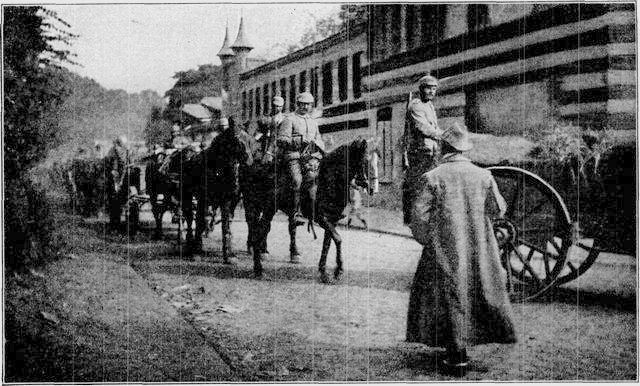
German supply train entering Brussels
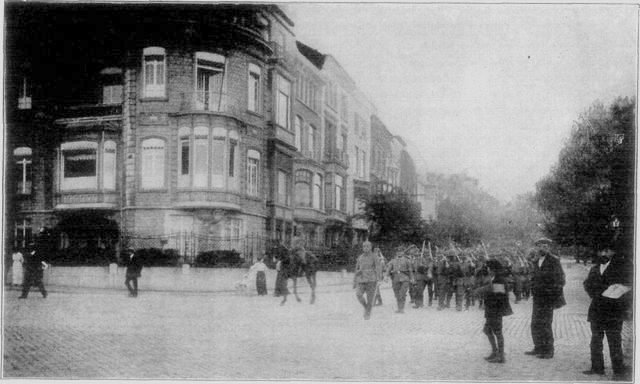
German infantery entering Brussels
I was out by seven this morning and looked about for news before coming to the Legation. I found that the Germans were steadily advancing and that the vanguard was about seven kilometers out of the city. They expected to begin the triumphal march about eleven. The Garde Civique had disappeared from the streets and there were very few police to be found. The shops were closed, shutters down on all houses, and posters everywhere with the proclamation of the Burgomaster urging the people to refrain from hostile acts. It was an abandoned and discouraged-looking city. On the boulevards there were long lines of high carts bringing in the peasants from the surrounding country. They are great high-wheeled affairs, each drawn by a big Belgian draught horse. Each cart was piled high with such belongings as could be brought away in the rush. On top of the belongings were piled children and the old women, all of whom had contrived to save their umbrellas and their gleaming, jet-black bonnets, piled with finery. Those who could not find places in the carts walked alongside, some of them carrying other belongings that could not be put on the carts. It was the most depressing sight so far. Lots of them were crying; all looked sad and crushed. Every one of them was probably without enough money for a week's living. Even those who have money in the banks cannot get it out at this time. They have no place to go to here and have a bad prospect even if this part of the campaign is finished quickly and they are soon able to return to their homes. Their crops are rotting in the ground and many of their homes are already in ruins. That is the hard side of the war—lots harder than the men who go out and have at least a fighting chance for their lives.
When I got down to the Legation I found that the telegraph and telephone communication had been cut off. The train service is abandoned and we are completely isolated from the outside world. I did not think it would come so soon and only hope that before we were cut off the news was allowed to get out that there would be no fighting in the city.
I had a lot of errands to do during the morning and kept both motors busy. I found time to get up signs on my door and that of M. de Leval, warning all comers that both places were inviolate. That was in anticipation of quartering of troops on private citizens, which has not been done.
We got word that the Spanish Minister had some news, so I went over to see him. He had heard from the Burgomaster as to the plans for the entry of the troops, and wanted to pass it along to us. The commanding general, von Jarotzky, was already at the edge of the city, on the Boulevard Militaire, and was expecting to start into town at one o'clock. He was to march down the Chaussée de Louvain, the boulevards, and out the other side of the city, where his men were to be encamped for the present. Other forces, comparatively small, were to occupy the railway stations and the Grande Place. At the Hôtel de Ville he was to establish the headquarters of the staff and administer the city government through the regularly constituted authorities. It was all worked out to a nicety, even to the exact measures for policing the line of march.
As the Garde Civique was withdrawn, the prisoners in the German Legation knew that there was something in the air and ventured forth into the light of day. They were not long in learning just what had taken place, and called upon us to express their thanks for what we had done for them. I suppose they will be trotting away for their own country before there is a chance to lock them up again. It must be pretty dismal for them to be locked up without any news of the outside world when they don't know whether their armies are victorious or badly beaten.
As I was about to start to see the triumphal entry, the Spanish Minister came along with his flag flying from his motor, and bade us to go with him. We made off down the Boulevard and drew up at the Italian Legation—two motors full of us; the whole staff of the Spanish Legation and ourselves. The Italian Minister bade us in to watch the show, which we had intended he should do. This did not work out well, so M. de Leval and I started off down the street together. The first of the Germans appeared as we stepped out the front door, and we saw that they were not coming over the route that had been originally planned. Instead, they were heading down the hill into the lower town. They proved to be the troops that were to occupy the Grande Place and guard the headquarters of the staff at the Hôtel de Ville. We cut across through side streets and came upon them as they were passing Ste. Gudule. There was a sullen and depressed crowd lining the streets, and not a sound was to be heard. It would have been better had the crowd been kept off the streets, but they behaved wonderfully well.
A large part of the reason for bringing the German troops through here was evidently to impress the populace with their force and discipline. It was a wonderful sight, and one which I never expect to see equaled as long as I live. They poured down the hill in a steady stream without a pause or a break; not an order was shouted nor a word exchanged among the officers or men. All the orders and signals were given by whistles and signs. The silence was a large element of the impressiveness.
These troops had evidently been kept fresh for this march, and I should not be at all surprised if it should prove that they had not seen any fighting. If they have suffered any losses, they have closed up their ranks with wonderful precision and show none of the signs of demoralisation. They had clearly been at great pains to brush up and give the appearance of freshness and strength. Nearly all the men were freshly shaven, and their uniforms had been brushed and made as natty and presentable as possible. They swaggered along with a palpable effort to show that they were entirely at home, and that they owned the place. The officers looked over the heads of the crowd in their best supercilious manner, and the men did their best to imitate their superiors.
First came some lancers—a couple of battalions, I should think; then there was a lot of artillery, rapid-fire guns and field pieces. Then more cavalry and a full regiment of infantry. When the last contingent of cavalry came along, they burst into song and kept it up steadily. There was a decidedly triumphant note, and the men looked meaningly at the crowd, as much as to say: "Now do you realise what your little army went up against when it tried to block us?" It seemed to me pretty rough to rub it in on them by singing songs of triumph as they rode into an undefended city. If they had been attacked and had succeeded in driving the invader back into his own capital, it would be understandable; but it seemed to me rather unnecessary to humiliate these people after trampling on their poor country and slaughtering half their army. It was more than de Leval could stand, so I walked home with him to the Legation.
When we got back to the Legation I decided that I ought to see all I could, so Blount and I went back in his car. First we worked our way through to the lower town and got a look at the Grande Place. There were a little more than two full battalions resting there, with their field pieces parked at the lower end of the square. Small squads were being walked around doing the goose step for the delectation of the bons Bruxellois, who were kept a block away up the side streets leading to the square. The men had their arms stacked in the centre of the square, and were resting hard—all but those who were supplying the spectacle.
From there we went down to Luna Park, an amusement place on the edge of the city. The stream was pouring by there just as steadily as it had earlier in the afternoon. We watched the passing of great quantities of artillery, cavalry and infantry, hussars, lancers, cyclists, ambulance attendants, forage men, and goodness only knows what else.
I have never seen so much system and such equipment. The machine is certainly wonderful; and, no matter what is the final issue of the war, nobody can deny that so far as that part of the preparation went, the Germans were hard to beat. The most insignificant details were worked out, and all eventualities met with promptness. The horses were shod for a campaign in the country, and naturally there was a lot of slipping on the smooth cobble pavements. The instant a horse went down there was a man ready with a coarse cloth to put under his head, and another to go under his forefeet, so that he would have some grip when he tried to get up and would not hurt himself slipping and pawing at the cobbles. The moment he fell, all hands rushed to the rescue so effectively that he was on his feet again in no time, and the procession was barely arrested. The men's kits were wonderfully complete and contained all sorts of things that I had never seen or heard of, so I turned for explanation to Davis, who had come along and was lost in admiration of the equipment and discipline. He said he had been through pretty much every campaign for the last twenty years, and thought he knew the last word in all sorts of equipment, but that this had him staggered. I began asking him what a lot of things were for, and he frankly admitted that he was as much in the dark as I was.
A great many of the officers wore, upon their chests, great electric searchlights attached to batteries in their saddle-bags. These are useful when on the march at night, and serve to read sign-posts and study maps, etc.
The supply trains were right with the main body of the troops, and were also carefully equipped for purposes of display. The kitchens were on wheels, and each was drawn by four horses. The stoves were lighted and smoke was pouring from the chimneys. The horses were in fine shape and in huge numbers.
The troops marched down the right side of the boulevard, leaving the left side free. Up and down this side dashed officers on horseback, messengers on motor-cycles and staff officers in military cars. There were no halts and practically no slacking of the pace, as the great army rolled in.
Here and there came large motor trucks fitted out as cobblers' shops, each with a dozen cobblers pounding industriously away at boots that were passed up to them by the marching soldiers. While waiting for repairs to be made, these soldiers rode on the running board of the motor, which was broad enough to carry them and their kits.
After watching them for a while, we moved back to the Boulevard, where we found the Minister with the ladies of the family who had been brought out to watch the passing show. We had hesitated to bring them out at the beginning for fear that there might be riots, or even worse, precipitated by the foolhardy action of some individual. Fortunately, there was nothing of the sort, and while the reception given the troops was deadly sullen, they were offered no affronts that we could see. The entry was effected quietly, and perfect order has prevailed ever since.
Afterwards we drove out to the country and watched the steady stream nearer its source; still pouring in, company after company, regiment after regiment, with apparently no end in sight. We watched until after seven, and decided that the rest would have to get in without our assistance. On the way back a German monoplane flew over the city, and, turning near the Hôtel de Ville, dropped something that spit fire and sparks. Everybody in the neighbourhood let out a yell and rushed for cover in the firm belief that it was another bomb such as was dropped in Namur. It dropped, spitting fire until fairly near the spire of the Hôtel de Ville, when it burst into ten or a dozen lights like a Roman candle—evidently a signal to the troops still outside the city—perhaps to tell them that the occupation had been peacefully accomplished. We learned afterward that the Minister and Villalobar were riding down the hill and the infernal machine seemed right over their car, giving them a nice start for a moment. When I got back to the Legation, I found that the Minister had gone with Villalobar to call on the Burgomaster and the German General. They found the old gentleman in command at the city hall, carrying on the government through the Bourgomaster, who has settled down with resignation to his task. He is tremendously down in the mouth at having to give up his beautiful Grande Place to a foreign conqueror, but he has the good sense to see that he can do more good for his country by staying there and trying to maintain order than by getting out with a beau geste.
The first thing the General did was to excuse himself and go to take a bath and get a shave, whereupon he reappeared and announced his readiness to proceed to the discussion of business.
The General said that he had no intention of occupying the town permanently or of quartering soldiers, or otherwise bothering the inhabitants. He was sent there to keep open a way so that troops could be poured through toward the French frontier. They expect to be several days marching troops through, and during that time they will remain in nominal control of the city. Judging from this, there must be a huge army of them coming. We shall perhaps see some of them after the big engagement, which is bound to take place soon, as they get a little nearer the French frontier.
Brussels has not been occupied by a foreign army since Napoleon's time, and that was before it was the capital of a free country. It has been forty-four years since the capital of a European Power has had hostile troops marching in triumph through its streets, and the humiliation has been terrible. The Belgians have always had a tremendous city patriotism and have taken more pride in their municipal achievements than any people on earth, and it must hurt them more than it could possibly hurt any other people. The Burgomaster, when he went out to meet General von Jarotzky, declined to take his hand. He courteously explained that there was no personal affront intended, but that under the circumstances he could hardly bring himself to offer even such a purely perfunctory manifestation of friendship. The old General, who must be a good deal of a man, replied quietly that he entirely understood, and that under similar circumstances he would probably do the same. The two men are on exceedingly workable terms, but I don't believe they will exchange photographs after the war is over. Poor Max was going to spend the night at the Hôtel de Ville. Most of his assistants cleared out for the night, but he could not bring himself to leave the beautiful old building entirely in control of the enemy. He curled up and slept on the couch in his office, just for the feeling it gave him that he was maintaining some sort of hold on the old place.
The Minister arranged to have his telegrams accepted and transmitted without loss of time, so we shall soon get word home that we are still in the land of the living. We wrote out our message and sent it off right after dinner, but Gustave brought it back, saying that the telegraph office was closed and that he could find no one to whom he could hand his bundle of messages. Evidently the orders for the re-opening of the place did not get around in time for our purposes. We shall try again the first thing in the morning, and hope that some of the newspaper men will have succeeded in getting their stuff out in some other way. They were around in force just after dinner and wild to get an O.K. on their stuff, so that it could be sent. The General had said that he wanted the Minister's O.K. on the men themselves, and that he himself would approve their messages after having them carefully read to him. He gave them an interview on alleged German atrocities and will probably let them send through their stories if they play that up properly.
After dinner I started out on my usual expedition in search of news. I found the Foreign Office closed, and learned upon inquiry that the few remaining men who had not gone to Antwerp were at home and would not be around again for the present—thus we have no dealings through the Foreign Office, but must do the best we can with the military authorities. I went down to the Palace Hotel on the chance of picking up a little news, but did not have much luck. The restaurant was half filled with German officers, who were dining with great gusto. The Belgians in the café were gathered just as far away as possible, and it was noticeable that instead of the usual row of conversation, there was a heavy silence brooding over the whole place.
August 21, 1914.—So far as we can learn we are still as completely cut off from the outside world as we were yesterday. The General promised the Minister that there would be no difficulty in sending his telegrams, either clear or in cipher, but when we came to sending them off, it was quite another story.
The first thing this morning I made an attempt to hand them in, but found all the telegraph offices closed. At ten o'clock I went down to the Hôtel de Ville to see the General, who has taken over the duties of Military Governor, and see what was the matter. He was away somewhere and so was the Burgomaster, so I contented myself with seeing one of the Echevins, whom I had met a number of times. He could not do anything about it on his own responsibility, but made a careful memorandum and said that he would take it up with the General, through the Mayor, when they both got back. I also asked for laisser-passers for everybody in the shop, and he promised to attend to that.
By lunch time we had received no answer from General von Jarotzky, so I got in the motor with my pocket full of telegrams and went down to the Hôtel de Ville once more. It is a depressing sight. The Grande Place, which is usually filled with flower venders and a mass of people coming and going, is almost empty. At the lower end there are parked a number of small guns; in the centre, some camp kitchens, with smoke rising from the chimneys. The courtyard of the Hôtel de Ville itself, where so many sovereigns have been received in state, was filled with saddle-horses and snorting motors. The discarded uniforms of the Garde Civique were piled high along one side, as if for a rummage sale. Beer bottles were everywhere. In the beautiful Gothic room, hung with the battle flags of several centuries, there are a hundred beds—a dormitory for the officers who are not quartered at the neighbouring hotels.
The marvelous order and system which so compelled our admiration yesterday were not in evidence. There were a lot of sentries at the door and they took care to jab a bayonet into you and tell you that you could not enter; but any sort of reply seemed to satisfy them, and you were allowed to go right up to the landing, where the General had established himself in state at a couple of huge tables. Here confusion reigned supreme. There were staff officers in abundance, but none of them seemed to have the slightest authority, and the old man had them all so completely cowed that they did not dare express an opinion or ask for a decision. The General himself is a little, tubby man, who looks as though he might be about fifty-five; his face is red as fire when it is not purple, and the way he rages about is enough to make Olympus tremble. The crowd of frightened people who came to the Hôtel de Ville for laisser-passers and other papers, all found their way straight to his office; no one was on hand to sort them out and distribute them among the various bureaus of the civil administration. Even the staff officers did very little to spare their chief and head off the crowd. They would come right up to him at his table and shove a pièce d'identité under his nose, with a tremulous request for a visé; he would turn upon them and growl, "Bas bossible; keine Zeit; laissez mois dranquille, nom de D——!" He switched languages with wonderful facility, and his cuss words were equally effective in any language that he tried. Just as with us, everyone wanted something quite out of the question and then insisted on arguing about the answer that they got. A man would come up to the General and say that he wanted to get a pass to go to Namur. The General would say impatiently that it was quite impossible, that German troops were operating over all that territory and that no one could be allowed to pass for several days. Then Mr. Man would say that that was no doubt true, but that he must go because he had a wife or a family or a business or something else that he wanted to get to. As he talked, the General would be getting redder and redder, and when about to explode, he would spring to his feet and advance upon his tormentor, waving his arms and roaring at him to get the —— out of there. Not satisfied with that, he invariably availed of the opportunity of being on his feet to chase all the assembled crowd down the stairs and to scream at all the officers in attendance for having allowed all this crowd to gather. Then he would sit down and go through the same performance from the beginning. I was there off and on for more than two hours, and I know that in that time he did not do four minutes' continuous, uninterrupted work. Had it not been for the poor frightened people and the general seriousness of the situation, it would have been screamingly funny and worth staying indefinitely to see.
I had my share of the troubles. I explained my errand to an aide-de-camp and asked him to see that proper instructions were given for the sending of the telegrams. He took them and went away. Then after a few minutes he came gravely back, clicked his heels, and announced that there was no telegraph communication with the outside world and that he did not know when it would be reëstablished. I asked him to go back to the General, who in the meantime had retreated to the Gothic room and had locked himself in with a group of officers. My friend came back again, rather red in the face, and said that he had authority to stamp my telegrams and let them go. He put the rubber stamp on them and said I could take them. I said that was all very well, but where could I take them, since the telegraph offices were closed. He went off again and came back with the word that the office in the central bureau was working for official messages. I got into the motor with the Italian Secretary, who had a similar task, and together we went to the central bureau. It was nailed up tight, and the German sentries on guard at the door swore to us by their Ehrenwort that there was absolutely nothing doing.
Back we went to the Hôtel de Ville. Our friend, the aide-de-camp, had disappeared, but we got hold of another and asked him to inform himself. He went away and we spent a few minutes watching the General blow up everybody in sight; when the aide-de-camp came back, he smilingly announced that there was no way of getting the messages out on the wire; that the best thing we could do would be to send a courier to Holland and telegraph from there. I told him to go back and get another answer. When he came back next time, he had the glad news that the office had really been established in the post office and that orders had been sent over there to have our cables received and sent at once. Away we went again, only to find that the latest bulletin was just as good as the others; the post office was closed up just as tight as the other office, and the sentries turned us away with a weary explanation that there was not a living soul inside, as though they had explained it a thousand times since they had been on duty.
By this time the wild-goose chasing was getting a little bit monotonous, and when we got back to the headquarters, I announced with some emphasis to the first aide-de-camp that I could reach, that I did not care to do any more of it; that I wanted him to get me the right information, and do it right away, so that I should not have to go back to my chief and report any more futile errands. He went away in some trepidation and was gone some time. Presently the General came out himself, seething in his best manner.
"A qui tout ce tas de depeches?" roars he.
"A moi," says I.
He then announced in a voice of thunder that they were all wrong and that he was having them rewritten. Before I could summon enough breath to shout him down and protest, he had gone into another room and slammed the door. I rushed back to my trusty aide-de-camp and told him to get me those telegrams right away; he came back with word that they would be sent after correction. I said that under no circumstances could they send out a word over the signature of the American Minister without his having written it himself. He came back and said that he could not get the cables. I started to walk into the office myself to get them, only to bump into the General coming out with the messages in his hand. He threw them down on a table and began telling a young officer what corrections to make on the telegraph form itself. I protested vigorously against any such proceeding, telling him that we should be glad to have his views as to any errors in our message, but that he could not touch a letter in any official message. At this stage of the game he was summoned to the office of the Burgomaster and rushed off with a string of oaths that would have made an Arizona cow-puncher take off his hat. The young officer started calmly interlining the message, so I reached over and took it away from him, with the statement that I would report to my chief what had happened. He was all aflutter, and asked that I remain, as the General would not be long. I could not see any use in waiting longer, however, and made as dignified a retreat as possible under the circumstances. There were a number of cables in the handful I had carried around that were being sent in the interest of the German Government and of German subjects, and I took good care to tell the young man that while we were glad to do anything reasonable for them or for their people, we had stood for a good deal more than they had a right to expect, and that these cables would stay on my desk until such time as they got ready to make a proper arrangement for our communications. Now we shall settle down and see what happens next.