Chapter III · THE END OF A CENTURY (continued 2)
Reading edition
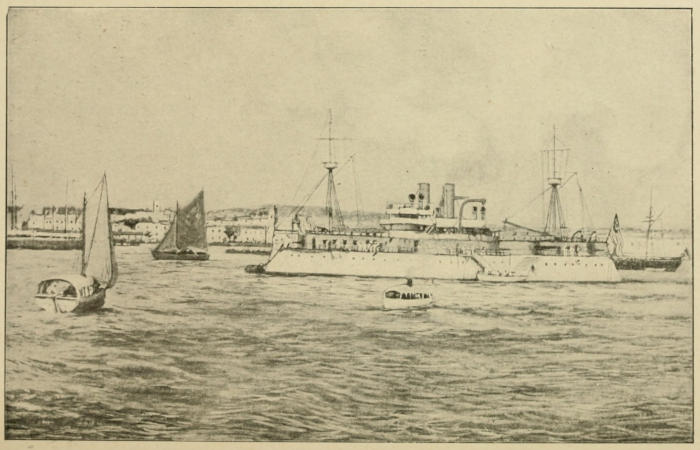
THE UNITED STATES BATTLESHIP MAINE AT ANCHOR IN HAVANA HARBOR
There was no calculating the forces of excitement that were abroad; there was no determining their origin or their real power. No doubt influences were at work which did not wait upon opinion, which made opinion their covert merely and means of justification. Sensational newspapers exaggerated every phase of the disturbing incidents of the time, to make news and increase their sales; men who saw personal gain in store for them amidst the risks of war bestirred themselves to make interest against Spain in the houses at Washington; politicians were quick to say and do what they hoped would enhance their credit and the influence of their party with the country; personal ambitions were not neglected in the eagerness of Congress to make some stroke in behalf of Cuba and for the aggrandizement of the power of the United States in the West Indies. Mr. McKinley had no such mastery as could hold the impulses of members in check. He had spent fourteen years on the floor of the House of Representatives. His point of view with regard to the exercise of his constitutional powers was not that which Mr. Cleveland had exemplified. He did not act as an independent, originative force in the determination of policy, but rather as a power intimately associated with the law-making branch of the government. He was not only sensitive to opinion out-of-doors but also to the intimations of purpose which came to him from the leaders of the houses. The fine quality of the man was evident to all who approached him: his sense of duty, his devotion to the principles which he conceived to be the principles of right action, his kindliness, his modesty, his Christian self-forgetfulness. His unfailing tact seemed to take the sting from the sharpest differences of opinion or of purpose upon whatever matter, and men did not draw off from him because he refused them what they asked or dissented from them in what they thought. But he seemed to stand like a leader who received his ideas, not from his own individual examination of affairs or the action of his own originative powers upon the subject matter of public policy, but from the men about him whom he most trusted, from the subtle airs of opinion abroad out-of-doors, from those who brought him the counsels of Congress and the news of events. There was no impression of weakness to be got in dealing with him, but an impression of sober sensibility, rather, and of sanguine confidence in the movements of opinion.
He had diligently pressed upon the Spanish government every argument for peace with its Cuban subjects, for accommodation, for friendly intervention by the United States, for reform and concession in the government of the island that diplomatic usage and international courtesy permitted, and yet the end of the Cuban trouble seemed no nearer than before. He quickened his pace in the business as he saw opinion advance and the houses grow impatient,—quickened it very much when the destruction of the Maine put a touch of fever into men’s thoughts. Congress was the war-making power: it very soon became evident that it could not much longer be restrained from radical action. Distressing reports poured in every day of the sufferings of the Cuban people, especially in the camps of concentration. The island was nearby: news came fresh from the very scenes of war and desolation. Members of Congress themselves visited the concentration camps and the parts of the island where the insurrection had its chief seats, and told from their places on the floor what they had seen and heard. The President wished to keep the reins in his own hands, but feared every week to see the restive houses break from his control. Fast as negotiation had moved on the heels of the excitement that followed that fatal explosion in Havana harbor it had not moved fast enough to please the impatient spirits who pressed the leaders of Congress for action. Towards the last it had begun to look as if the Spanish government were ready, rather than let the war feeling in the United States put things beyond all possibility of a peaceful solution, to make very substantial concessions to the Cuban insurgents and bring the troubles of the island to an end. But Mr. McKinley doubted the good faith of the concessions offered, found them guarded by proposed processes of execution which might take perilously long in the carrying out, believed that opinion in the country would not justify him in taking any further risks of disappointment, and made a sudden end of negotiation. On the 11th of April, 1898, he asked Congress for authority to put an end to the hostilities in Cuba, and on the 18th Congress declared the Cuban people free and independent and authorized the President to use the military and naval forces of the United States to compel the government of Spain to relinquish its authority and government in the island. The Spanish minister at Washington of course asked for his passports, all diplomatic relations between the two governments were broken off, and on the 25th of April formal declaration of war was made. The resolutions agreed to by the houses in authorizing the President to drive Spain from the island had concluded with this solemn statement of the purposes of the United States: “The United States hereby disclaims any disposition or intention to exercise sovereignty, jurisdiction, or control over said island, except for the pacification thereof, and asserts its determination when that is accomplished to leave the government and control of the island to its people.” Intervention had come, not for the material aggrandizement of the United States, but for the assertion of the right of the government to succor those who seemed hopelessly oppressed, to recover the peace and order of its coasts, to free its trade from the trammels put upon it by a war to which there seemed no end, to quiet the thoughts of its own people in order that they might turn again without distraction to their own affairs.
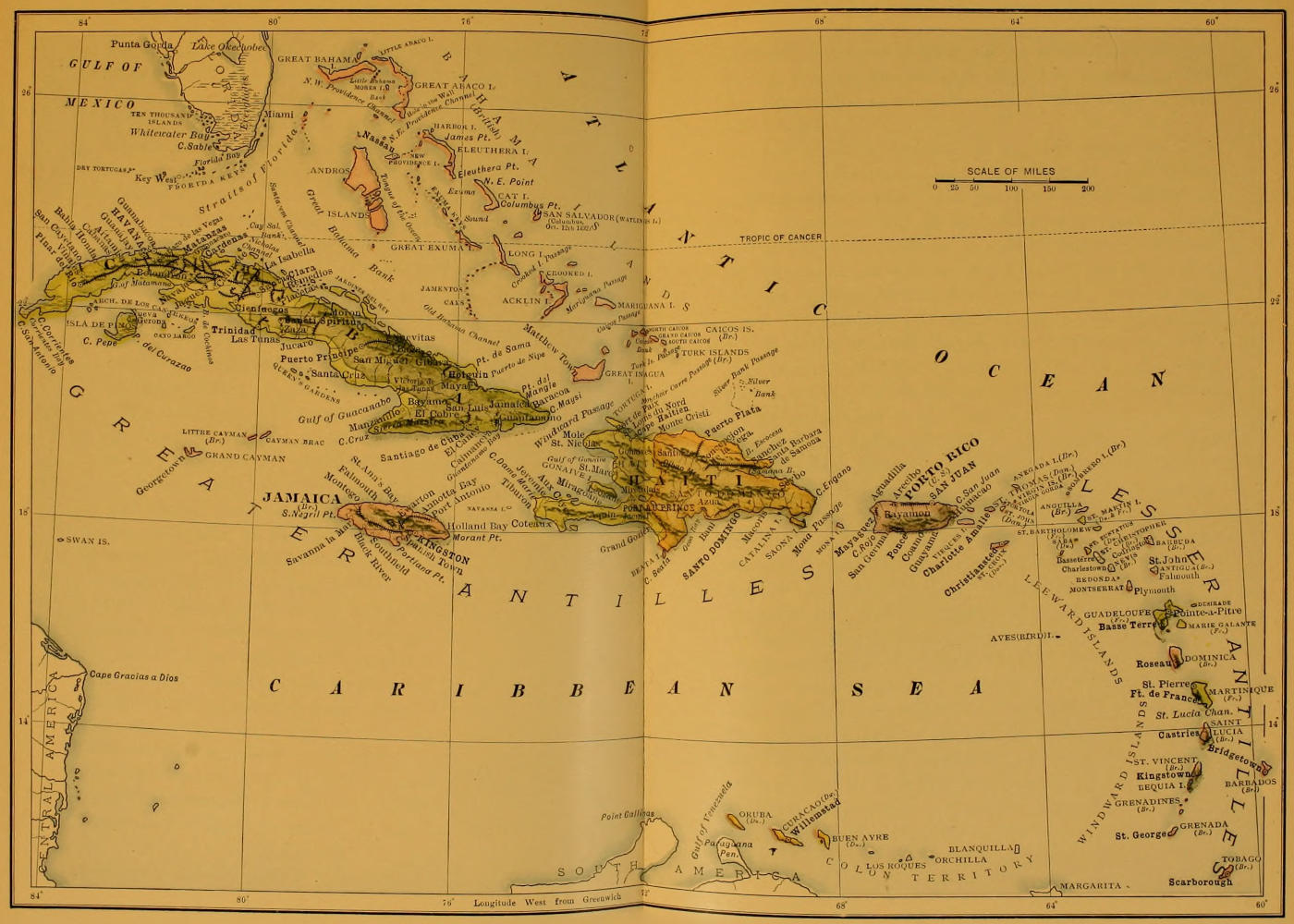
WEST INDIES, 1902.
BORMAY & CO., N. Y.
It was a war of impulse, as any one might see who noted how unprepared the country was for what it had suddenly undertaken. The regular army of the United States numbered but 28,000, officers and men. It fell to volunteers as much as to regular troops to assume the burdens of the field, as in the war for the Union and the war against Mexico fifty years ago. The regular army was increased to more than 42,000 before the month of May was out; but the new men were, of course, mere recruits, and the volunteers mustered faster than the regulars. Before the end of May, in response to the proclamations of the President, more than 118,000 men and six thousand officers had been mustered into the volunteer service, chiefly from the militia of the States, and had been equipped and distributed among the various camps of preparation in which they were to be made ready and await their orders. Congress authorized the increase of the regular army to 65,000 men, and by the close of August more than 56,000 had been mustered in. The volunteer forces had by that time grown to 216,256, men crowding into the ranks from every quarter of the country. It was noted how eagerly the southerners pressed forward for service. Elderly men who had been officers in the armies of the southern Confederacy asked for commands, and got them, under the Act of indemnity passed but two years before. The country was thrilled with a new sense of union and of enthusiasm for a common cause. There was no longer any thought of differences between section and section when the flag was in the field. Those days together in camp and battle set the war between the States another full generation back, into a past now left at last for historians, not politicians, to take care of.
Before the first season of enthusiasm had gone by the war was over. It was ended before the ranks were full. July was not out before the American troops had had their will in Cuba and Porto Rico, and Spain had proposed terms of peace. By the middle of August Manila, in the far Philippines, had been taken; no Spanish force anywhere resisted the arms of the United States; only the full terms of peace remained to be agreed upon. The navy of the United States had been the first to give the Spaniard a taste of its quality. There had been no question of making it ready for war. It was outnumbered by many of the great navies of the world, but its officers were professional experts trained to proficiency by as thorough a schooling and experience in arms as if war were always at hand; and their ships were of the most modern type and equipment, built where the best steel and the best machinists of the world were to be had. Every stroke that they made told. On the 1st of May, in the grey of the early morning, Commodore Dewey, commanding the squadron of the United States in eastern waters, attacked the Spanish fleet in the bay of Manila, the capital city of the Philippines, and by noon had utterly destroyed it, his own fleet suffering little damage, and without the loss of a single life on his ships. He had entered the great bay under cover of the preceding night, steaming past the batteries which stood guard there upon Corregidor Island and through the long channels where he had been told torpedoes had been set, as he had steamed when a boy with Commodore Farragut past the batteries and the torpedoes at the mouths of the Mississippi. The force of his guns was greater than that of the inferior pieces on the Spanish ships, and but few of their shots took effect; the marksmanship of his gunners made their fire precise and terrible; he led his ships slowly back and forth along the line of the Spaniards’ anchorage until the whole fleet he had been bidden destroy lay sunken, burning, and abandoned. That done, the city, with its old-fashioned walls and ancient defences, was at his mercy. It had been a gallant exploit gallantly undertaken, against unknown risks and dangers which he could only guess, against a force whose real power and equipment were not known, and executed with a businesslike thoroughness which caught the imagination of every man who loved thoroughbred service and daring. Congress sent the Commodore increase of rank with its thanks, and troops were hurried aboard the transports at San Francisco to act with him in the capture and occupation of Manila.
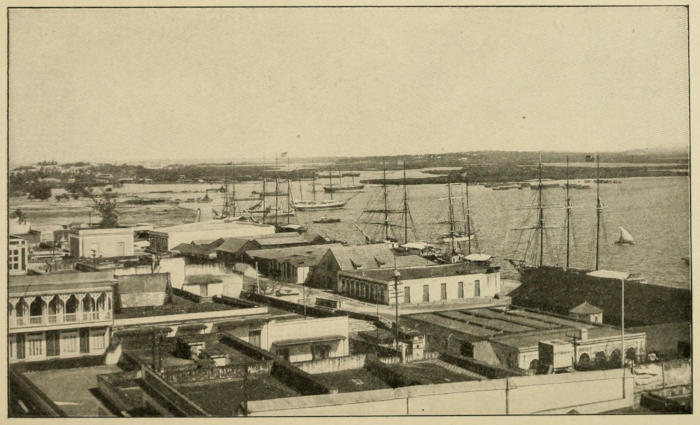
CITY OF SAN JUAN, PORTO RICO
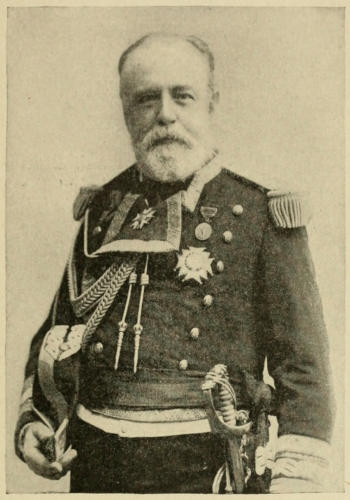
PASCUAL CERVERA
The tasks of the fleets mustered to invest the Cuban ports and convey the troops of the United States to their attack upon the island were by no means so simple. The coasts of the long island had many ports; it was presently known that a Spanish squadron of four armored cruisers and three torpedo-boat destroyers, under Admiral Pascual Cervera, had left the Cape Verde Islands for the West Indies; it was possible to do little more than guess what port they would make for. There were not vessels enough to watch all the coasts of Cuba and Porto Rico. It might be that the Spanish admiral would first make some demonstration against a port of the United States, and it gave the authorities at Washington and all who thought upon the matter no small concern to think how little had been done to supply the open coast of the continent with adequate defences. As it turned out, Admiral Cervera ran straight into Santiago de Cuba, the southern port of the island, which lay nearest the open seas by which he had approached. The Caribbean Sea was wide; the American commanders got word first that he had touched at Martinique, then that he had touched at Curaçoa, close by the Gulf of Venezuela; there was no making his course out from that, and he slipped unobserved into Santiago while the American commander-in-chief searched for him off the harbors of Porto Rico. At Santiago he lay almost a full fortnight before his whereabouts was discovered by the anxious American sailors. High hills shut the closed harbor in, and a narrow, winding channel served it for entrance; no ship at sea, no one who did not stand upon the very hills that overlooked the harbor, could discover what craft lay within the hidden bay. But by the 29th of May a flying squadron of the American fleet, under Commodore Schley, had established a blockade of the port, reasonably assured that the Spanish squadron was within, and by the 1st of June acting Rear Admiral Sampson, the commander-in-chief, had arrived, to add his heavier ships to the blockading force and take command.
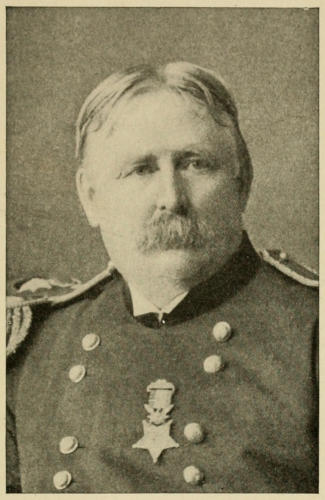
WILLIAM R. SHAFTER
The whereabouts of the Spanish fleet determined the point of attack for the army as well as for the men-of-war. General Shafter, commanding the troops assembled at Tampa, in Florida, was ordered to take some sixteen thousand men under convoy to Santiago, 14,000 regulars and 2,500 volunteers, in order that the town with its garrison and the fleet lying in its bay might be taken together, by the joint action of the land and naval forces. There were not sufficient railway facilities for sending the troops to their place of embarkation; there were not harbor facilities enough for the difficult work of embarking the troops where the transports lay; no one in chief command seemed ever to have seriously studied the handling of men and stores upon the great scale; there was infinite delay and confusion and blundering before the expedition was ready to sail. It took an entire week to effect the embarkation, and the ships were held yet another week at their anchorage after the troops were aboard before they finally put to sea, because of false rumors of Spanish cruisers on the coasts they were to approach. But by the 14th of June they were under weigh, and by the morning of the 20th were off the coasts where they were to be put ashore. On the 22d, 23d, and 24th they were landed at Daiquiri and Siboney, some twelve to fifteen miles east of the town of Santiago, and their painful work began. The country through which they had to pass was broken into abrupt and difficult hills; the roads were hardly more than bridle paths, and ran through thick tangles of tropical undergrowth. The flooding rains of the region were likely at any time to render them impassable and cut the troops off as they advanced alike from further movement upon their objective and from communication with their base of supplies at the rear where the transports lay. The distempers of the unfamiliar climate took immediate hold upon them, and sapped their strength. There were not surgeons or nurses or medical stores enough, and the lack of organized and efficient means and methods of transportation worked an injury there worse by far than it had worked at Tampa. At Tampa the blundering and mismanagement had been stupid, irritating; here they were deeply tragical. It was pitiful what rank and file alike had to endure, with stores unpacked, untouched at the rear, and medicines left where they could be of no service. But pluck and intelligence carried the regiments forward to the overcoming of difficulties and the winning of battles there as they had carried the men like them who went with General Scott to the conquest of Mexico fifty years before. Division commanders proved more efficient and resourceful than their superiors in command; privates knew their duty without orders, shifted for themselves in camp, at mess, and on the march like men who did not need to be cared for, endured what came to them without murmur or discouragement, and moved like those who act confidently without command, carried forward by their own wits and courage and habits of concerted action.
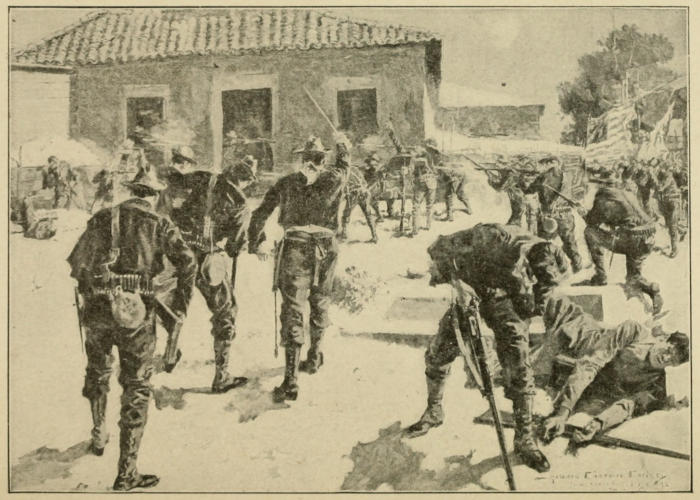
THE CAPTURE OF THE BLOCK HOUSE AT SAN JUAN
By the morning of the 1st of July the decisive movements of the attack were planned and begun and by the evening of that day an advantage had been gained which made it certain what the end must be. The town of El Caney and the strong hill of San Juan had been stormed and taken, the one commanding the road to Guantanamo, by which the garrison of the city might expect succor, and whence they could threaten the flank of any force that moved direct upon Santiago, the other commanding the straight approaches to the city itself. El Caney lay in a position of natural strength and was protected by strong block houses, a stone fort, a stone church, itself a sort of fort loopholed for rifles, and long lines of trenches cut in the solid rock. The hill of San Juan stood steep and guarded, crowned with a block fort set about with a maze of barbed wire entanglements. The American troops, in whatever direction they moved, had either to block one another’s way massed in the narrow miry roads or else to deploy as best they could in the tangled undergrowth of the tropical forests; and came into the open close by the enemy’s position only to expose themselves to a galling fire from foes lying unseen and protected. They had no support from artillery; each position they attacked had to be taken by cool, dogged assault; but the thing was congenial to their spirits, and was done with the steadfast pluck and the unfaltering audacity of men who did not know how to fail or turn back. The general officers who planned and ordered the movements knew, it presently turned out, neither the topography of the country nor the exact position and strength of the enemy; but the men and their immediate commanders made all mistakes good and took what they found. On the 2d the American lines were still further advanced, and an assault by the Spaniards was repulsed. On the 3d General Shafter summoned the commander of the town to surrender; but General Toral had received reinforcements from the east and refused.
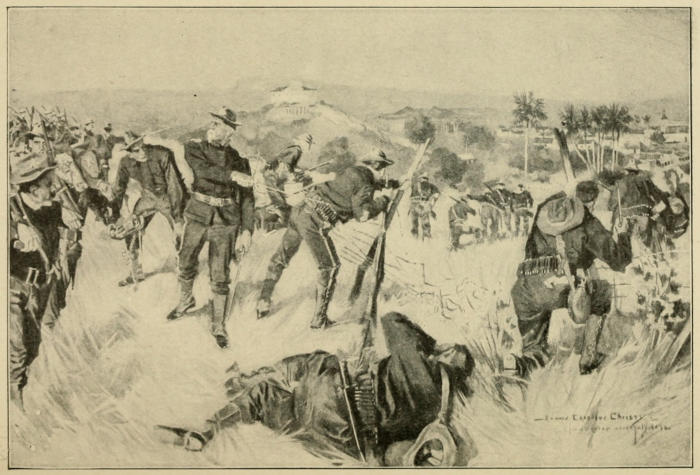
THE CAPTURE OF EL CANEY
That same day the Spanish admiral, fearing himself trapped where he lay, put suddenly to sea, hoping by forcing his craft to their speed to run down the coast to the westward and show the American commander his heels before the blockading fleet could close upon him. But the first glimpse of his smoking funnels in the channel brought the fleet in the offing to the chase. The commander-in-chief was for the moment away, in his flagship, upon an errand to the eastward; Commodore Schley was in immediate command of the blockade. It was Sunday morning a little before ten o’clock, and the men were at quarters for inspection. They sprang to the work of chase and battle with a cheer, and within eight minutes the ships within range had opened fire. Hardly a signal was needed. The Spaniards swung in order down the coast; the American ships followed from their places in instant succession, each captain selecting the Spaniard he could most speedily get within range of for target. The foremost and fleetest of the Spanish vessels was overhauled and forced ashore upon the rocky coast within four hours of its exit from the port; the vessels which followed her had been destroyed before the fight was two hours old. The American gunners, pouring in a fire constant, precise, overwhelming, had cut the fire mains or ignited the ready ammunition or sent destroying heat and ruin to the machinery of the craft they chased, and they were one after the other run aground, burning fiercely fore and aft. It took as gallant work to get their crews off and succor them in their desperate peril as it had taken to bring them to their sudden fate. Six hundred Spanish officers and men lost their lives, killed or drowned; more than seventeen hundred were taken off the burned and ruined vessels as prisoners.
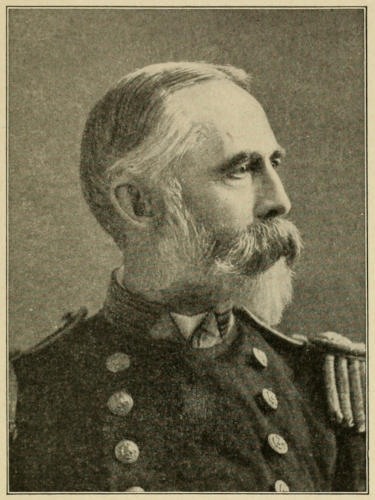
WILLIAM T. SAMPSON
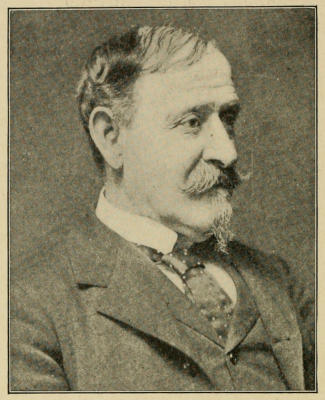
WINFIELD SCOTT SCHLEY
Two weeks more and Santiago, with all the eastern posts and districts of Cuba, was in the hands of the Americans. Reinforcements came in to General Shafter which swelled his numbers to 21,000, and a complete line of investment was drawn around the city. His guns had at last come up. Eighteen thousand women, children, and foreign residents were allowed to pass through his lines before he opened siege fire; but when the bombardment did begin it came at intervals from the heavy guns of the fleet as well as from the batteries on the hills, and the end was inevitable. Negotiations for surrender were opened on the 12th, and on the 17th not only the town itself but also all the eastern posts were rendered up. On the 21st of July Major General Miles sailed from Guantanamo Bay with a small force for Porto Rico. There he was joined by reinforcements out of the United States, and the southern and western portions of the island were taken possession of without opposition, the inhabitants even receiving the American troops with open enthusiasm. News of the arrangement of preliminaries of peace stopped all hostile movements before the occupation could be completed. On the 26th of July overtures of peace had been addressed by the Spanish government to the government of the United States through M. Cambon, the French minister at Washington; and on the 30th definite terms of peace were proposed from the same source. In August most of the troops in Cuba were hurried back to the United States to arrest the alarming progress of malarial fever, dysentery, and yellow fever among them; and the war seemed over,—except in the Philippines. On the 12th of August a peace protocol was signed at Washington.
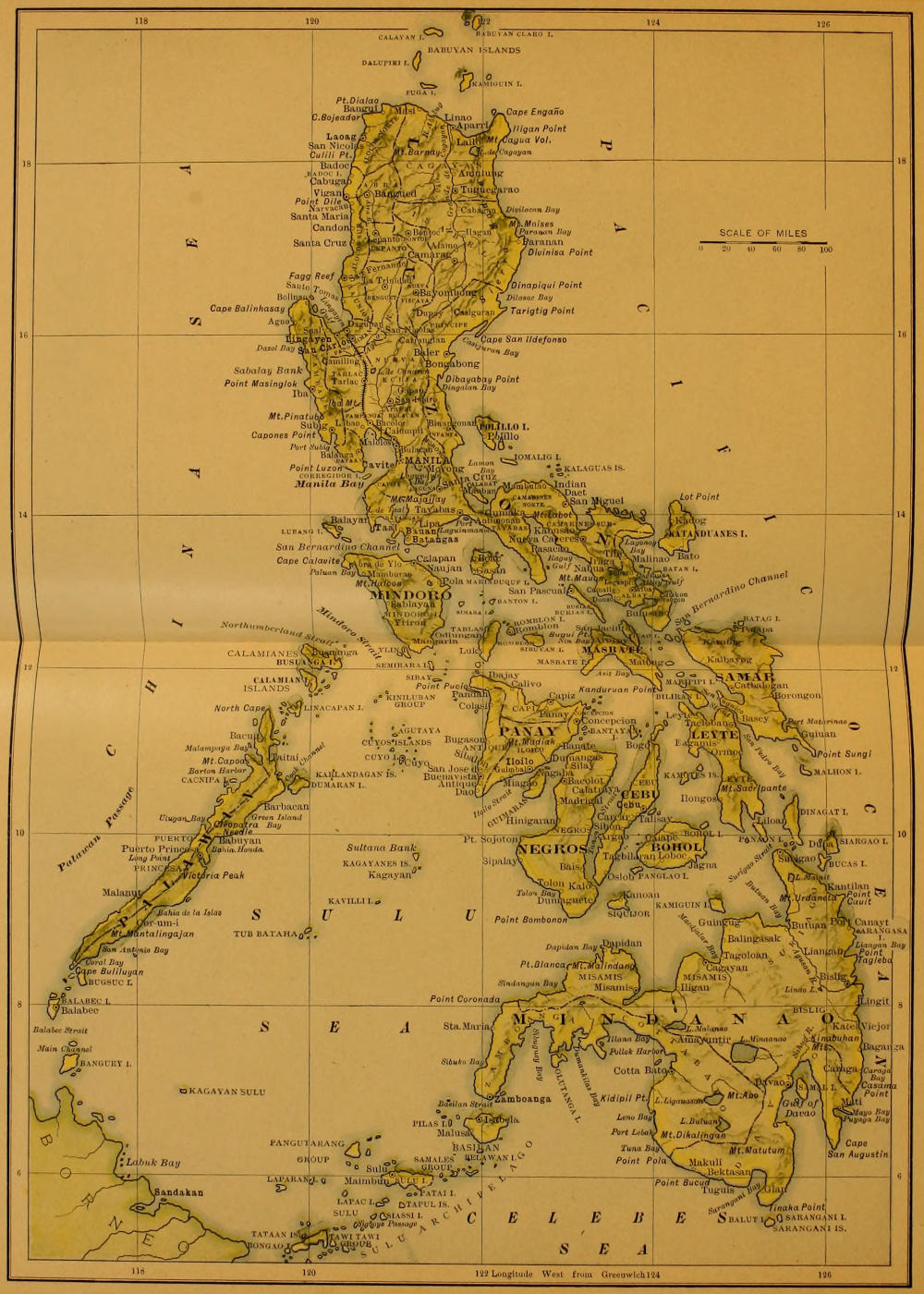
PHILIPPINE ISLANDS, 1902.
BORMAY & CO., N. Y.
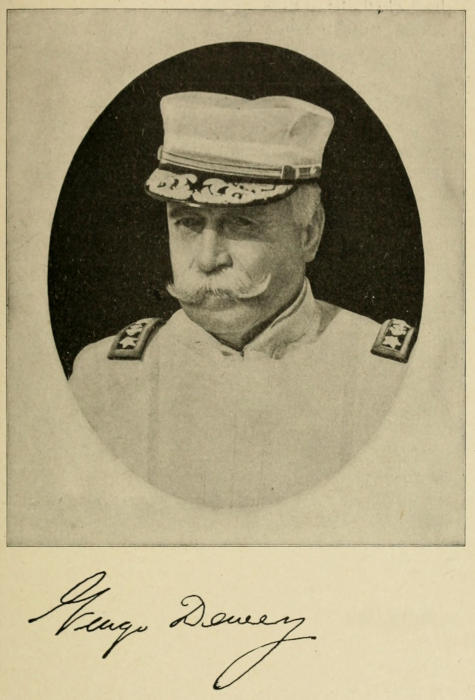
GEORGE DEWEY
In the Philippines Admiral Dewey had waited until troops should be sent which could capture Manila and take military possession of the islands. But he had not waited without armed allies. The Philippines, like Cuba, had been the scene of frequent rebellions against Spanish rule. Peace was, indeed, but a little more than four months old when Commodore Dewey received his orders from Washington to attack the Spanish naval force in eastern waters, and Emilio Aguinaldo, the one-time chief of the insurgents, was at hand, in Singapore, should the American commander wish to avail himself of his advice and aid. Commodore Dewey sent Aguinaldo word to follow him to Manila with all possible despatch, and he was given passage from Hong Kong on the American gunboat McCulloch. His influence with the people of the island of Luzon was well known. Young man though he was, scarcely turned of twenty-nine, they were his to command, so strong a hold had his frank manners, engaging interest in reform, and subtile power to turn men to his way of action taken upon them; and, for lack of troops from over sea, the American commander was willing to supply him with arms and ammunition and put the men whom he should muster in a position to hold the country round about the city until the transports should come out of America and all things should be ready. To make such an arrangement was to play with fire. It was not clear, it could not be clear, what was to be done with the insurgent army thus set afoot again by American aid when the troops of the United States should arrive and the conquest of the islands be finally made.
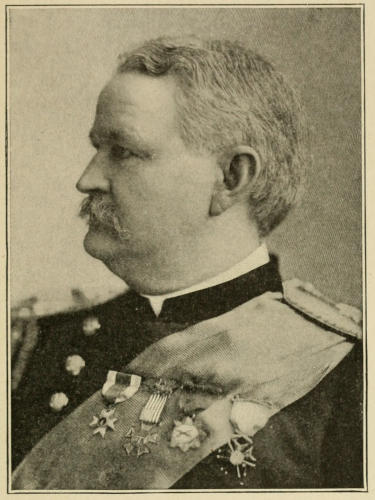
WESLEY MERRITT
Moreover, judicious lookers on wondered not a little to see the plans of the war so widened. Commodore Dewey had been commanded to destroy the Spanish fleet in the East; but he had not, so far as any one had heard, been told to take Manila and set an insurrection afoot in Luzon. It was significant that troops were at once hurried aboard the transports at San Francisco,—significant of the broadened scope and purpose of the war as viewed from Washington. It was not to stop with the relief of the Cubans. Troops were to be sent to the Philippines to take military possession of them. General Miles had been ordered from Cuba to Porto Rico. The power of the United States, once afield, was sweeping the island possessions of Spain into its sudden empire on both sides of the world. By the 13th of August, the day after the peace protocol was signed at Washington, all things were ready for the hostile movement at Manila and the place was easily taken by the American troops, Aguinaldo’s forces looking on and doubting their part in the venture. When the peace commissioners met at Paris in the autumn to frame their final agreements, the United States demanded and got all that their arms had touched: Cuba for the Cubans, Porto Rico and the Philippines, and the tiny island of Guam by the way, for their own possession. While the armies of the United States still lay with their lines drawn about Santiago (July 6, 1898) a joint resolution had passed the two houses of Congress which provided for the annexation of the Hawaiian Islands to the United States and consummated the revolutionary process to which Mr. Cleveland had for a little while given pause.
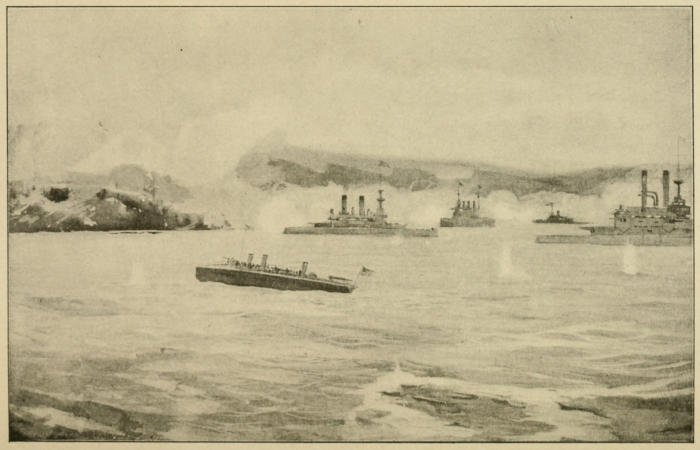
THE BOMBARDMENT OF SAN JUAN, PORTO RICO
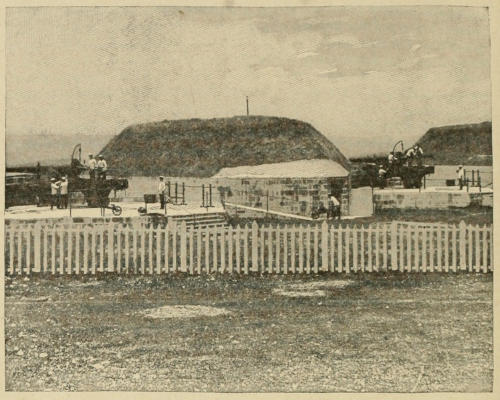
FORT AND EARTHWORKS, CAVITÉ, SILENCED AND CAPTURED BY ADMIRAL DEWEY
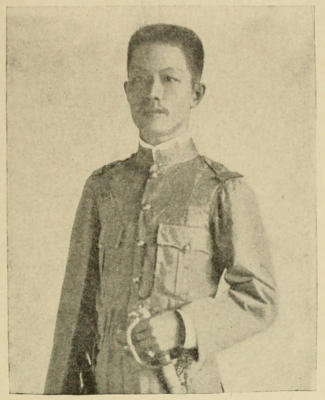
EMILIO AGUINALDO
Of a sudden, as it seemed, and without premeditation, the United States had turned away from their long-time, deliberate absorption in their own domestic development, from the policy professed by every generation of their statesmen from the first, of separation from the embarrassing entanglements of foreign affairs; had given themselves a colonial empire, and taken their place of power in the field of international politics. No one who justly studied the courses of their life could reasonably wonder at the thing that had happened. No doubt it had come about without premeditation. There had been no thought, when this war came, of sweeping the Spanish islands of far-away seas within the sovereignty of the United States. But Spain’s empire had proved a house of cards. When the American power touched it it fell to pieces. The government of Spain’s colonies had everywhere failed and gone to hopeless decay. It would have been impossible, it would have been intolerable, to set it up again where it had collapsed. A quick instinct apprised American statesmen that they had come to a turning point in the progress of the nation, which would have disclosed itself in some other way if not in this, had the war for Cuba not made it plain. It had turned from developing its own resources to make conquest of the markets of the world. The great East was the market all the world coveted now, the market for which statesmen as well as merchants must plan and play their game of competition, the market to which diplomacy, and if need be power, must make an open way. The United States could not easily have dispensed with that foothold in the East which the possession of the Philippines so unexpectedly afforded them. The dream of their own poet had been fulfilled,
“See, vast trackless spaces, As in a dream they change, they swiftly fill, Countless masses debouch upon them, They are now covered with people, arts, institutions.”
The spaces of their own continent were occupied and reduced to the uses of civilization; they had no frontiers wherewith “to satisfy the feet of the young men”: these new frontiers in the Indies and in the far Pacific came to them as if out of the very necessity of the new career set before them. It was significant how uncritically the people accepted the unlooked for consequences of the war, with what naïve enthusiasm they hailed the conquests of their fleets and armies. It was the experience of the Mexican war repeated.
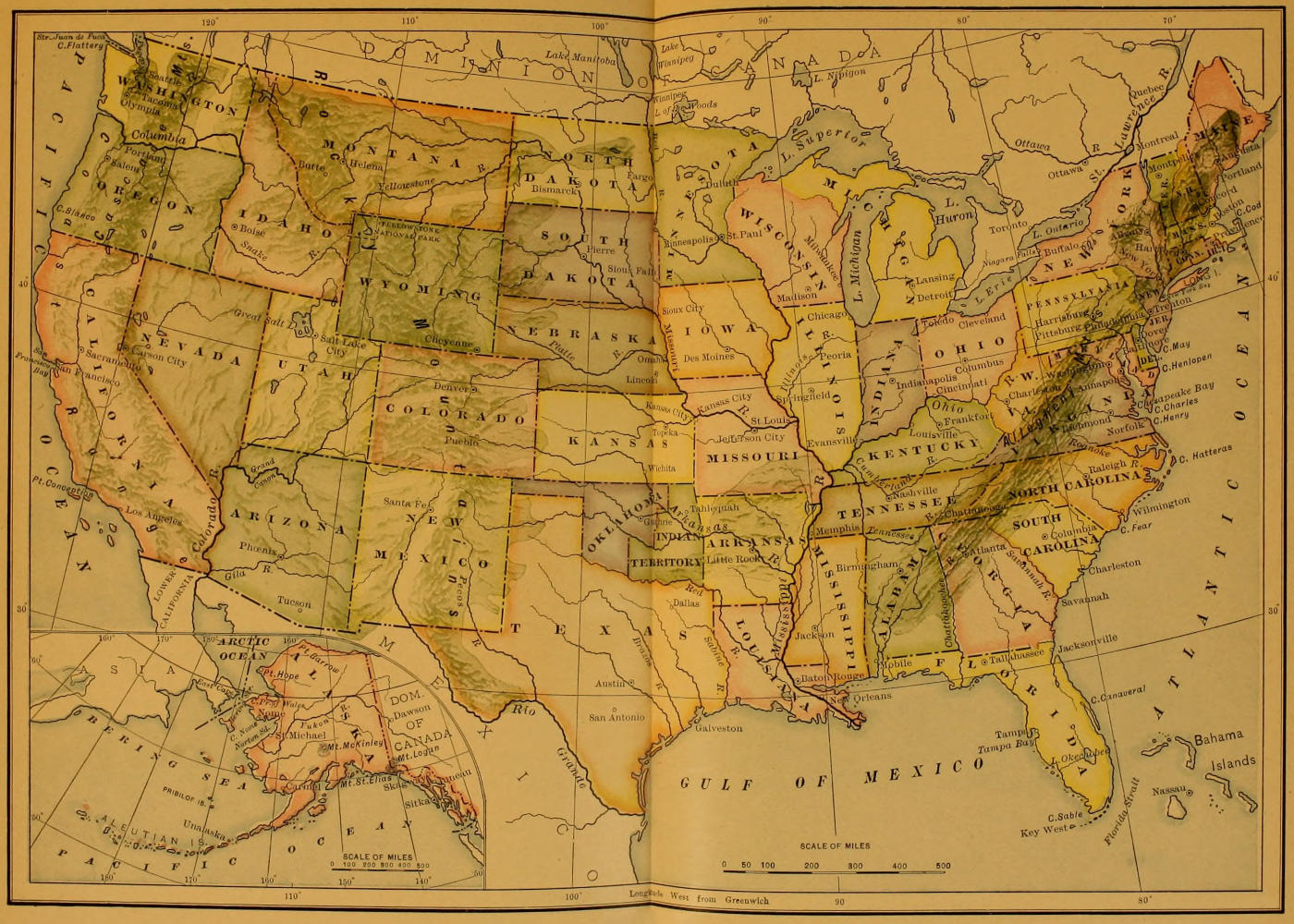
THE UNITED STATES, 1902.
BORMAY & CO., N. Y.
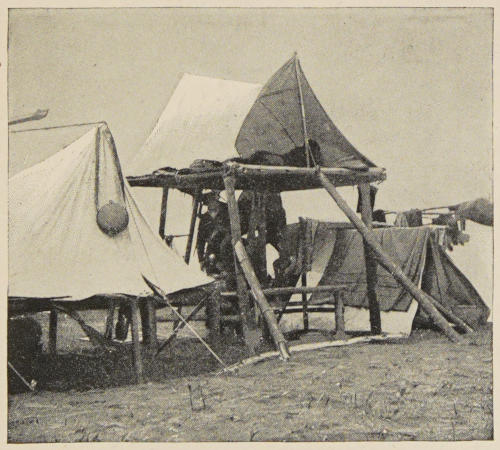
TWO-STORY TENT OF COLORADO TROOPS, CAMP DEWEY, LUZON, PHILIPPINE ISLANDS
What they claimed was not, indeed, yet theirs in fact. A sullen dismay and discontent had come upon the men who served with Aguinaldo outside the American lines at Manila, and who did not clearly know whether they were allies or subjects. They had not taken up arms, they said, merely to make the Americans their masters instead of the Spaniards, but to make themselves free, and had deemed the Americans their allies in that undertaking. The American commanders had made them no promises, but they had seemed tacitly to accord them the place of allies, and their own hopes had drawn the inference. When they found that those hopes were to be denied them they took their cause into their own hands and set up the government as if of an independent republic with Aguinaldo as their president (September 29, 1898). In February, 1899, a dogged war of resistance began which it was to take the troops of the United States, recruited from season to season till their numbers reached quite 70,000 men, more than three years to bring to an end. But the end was visible from the beginning. As the presidential election of 1900 approached the Democratic party made as if it would stake its fortunes on an opposition to the “imperial” policy of the administration; but it found that the thoughts of the people did not run with it, and turned the force of its effort again, as four years before, to the silver question. Mr. Bryan was again made its candidate, against Mr. McKinley, whom the Republicans had renominated as of course, and it once more demanded in its platform the free coinage of gold and silver at the ratio of sixteen to one. But no one feared now that it would win upon that issue. The hopes and energies of the country were turned in another direction, and Mr. McKinley was elected without difficulty.
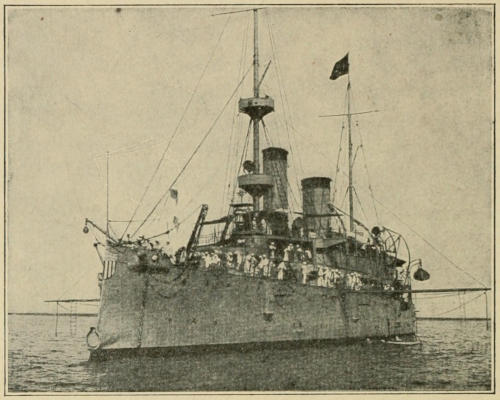
THE U. S. S. OLYMPIA ON THE MORNING SHE LEFT MANILA WITH ADMIRAL DEWEY ON BOARD
It was interesting to note with how changed an aspect the government stood upon the threshold of a new century. The President seemed again to be always in the foreground, as if the first days of the government were to be repeated,—that first quarter of a century in which it was making good its right to exist and to act as an independent power among the nations of the world. Now, full grown, it was to take a place of leadership. The closing year of the century (1900) witnessed a great upheaval of revolutionary forces in China. Insurgent bands filled the country, the very capital itself, in protest against the presence and the growing influence of the foreigner, and particularly the occupation of new ports of entry by Russia, England, and Germany,—the dowager empress, the real mistress of the kingdom, acting as their ally. The very legations at Peking were invested in deadly siege by the insurgents; and America, with the other nations whose representatives were threatened, sent troops to their relief. America played her new part with conspicuous success. Her voice told for peace, conciliation, justice, and yet for a firm vindication of sovereign rights, at every turn of the difficult business; her troops were among the first to withdraw, to the Philippines, when their presence became unnecessary; the world noted a calm poise of judgment, a steady confidence as if of conscious power in the utterances of the American Secretary of State; the new functions of America in the East were plain enough for all to see. The old landmarks of politics within the United States themselves seemed, meanwhile, submerged. The southern States were readjusting their elective suffrage so as to exclude the illiterate negroes and so in part undo the mischief of reconstruction; and yet the rest of the country withheld its hand from interference. Sections began to draw together with a new understanding of one another. Parties were turning to the new days to come and to the common efforts of peace. Statesmen knew that it was to be their task to release the energies of the country for the great day of trade and of manufacture which was to change the face of the world: to ease the processes of labor, govern capital in the interest of those who were its indispensable servants in pushing the great industries of the country to their final value and perfection, and make law the instrument, not of justice merely, but also of social progress.