Chapter I · RECONSTRUCTION (continued 2)
Reading edition
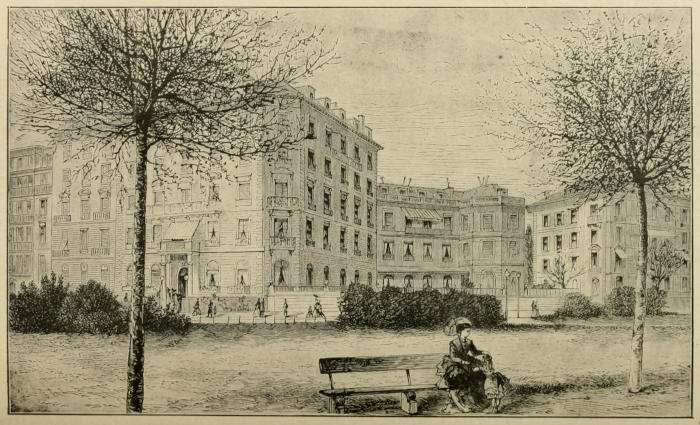
HÔTEL BEAU-RIVAGE, GENEVA, HEADQUARTERS OF THE AMERICAN ARBITRATORS
The strain of domestic politics was enough to withdraw heat from such matters when once they had become mere matters of business. The reconstruction even of those southern States in which the establishment of negro majorities had miscarried and the white voters had mustered strong and stubborn enough to reject the laws Congress tried to thrust upon them (Virginia, Georgia, Mississippi, and Texas) was complete by midsummer, 1870. But the mere completion of the formal process of reconstruction, as planned in Congress, did not mean order or the quiet settlement of affairs in the South. The white men, with whom effective initiative and the real weight of predominance rested in any case, had had their wits quickened and their temper hardened by what the Republican leaders had done. They were shut out from the use of the ballot and from every open and legitimate part in affairs, but they had come at their power in another way. Those who loved mastery and adventure directed the work of the Ku Klux. Those whose tastes and principles made such means unpalatable brought their influence to bear along every line of counsel or of management that promised to thrust the carpet bagger out of office and discourage the negro in the use of his vote. Congress saw where they meant to regain their mastery, at the polls, and by what means, the intimidation and control of the negroes without regard to law,—the law thrust upon them, not their own; and hastened to set up a new barrier of statute against them.
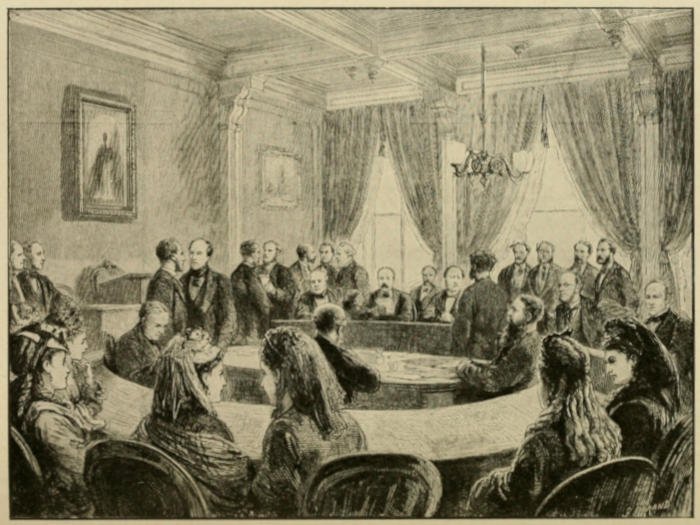
THE FINAL AWARD. THE LAST SITTING OF THE GENEVA CONFERENCE
In May, 1870, it had passed an Act which put southern elections and the registration of voters in the southern States under the superintendence and virtual control of federal supervisors and marshals, who were empowered to protect all voters in the exercise of their right of suffrage, and whose complaints were to be heard, not by the courts of the States, but by the circuit courts of the United States alone. At its next session it still further strengthened the Act. The forty-second Congress met on the 4th of March, 1871, in extraordinary session, to continue legislation to the same end. Not merely the acts of registration and voting needed to be guarded; every privilege conferred upon the negro as an incident of his new freedom seemed in need of protection: the Republican leaders were determined that the Fourteenth as well as the Fifteenth Amendment should be buttressed about by penal legislation and the whole force of the government, if necessary, brought to bear to put them into effectual execution. A committee of seven senators and fourteen representatives was appointed to inquire into the actual condition of the South and ascertain the facts with regard to the alleged outrages there, and a drastic Act was passed (April 20, 1871) which was meant to crush the Ku Klux Klan and all lawless bands acting after its fashion. Its provisions made such acts, whether of violence or of mere intimidation, as the secret societies of the South had committed conspiracy against the government of the United States, punishable by heavy fines or by imprisonment, or by both fine and imprisonment, and authorized the President, whenever the state authorities were unable or unwilling to prevent or check them, to use the land and naval forces of the federal government for their suppression, as against an insurrection. It authorized him, also, until the close of the next regular session of Congress, to suspend at his pleasure the writ of habeas corpus “during the continuance of such rebellion against the United States,” in such portions of the southern country as seemed to him most touched by the disorders of the time or most under the control of the secret associations. The Act gave to the federal courts which were empowered to enforce it the right to exclude from their juries persons suspected of sympathizing with those who violated its provisions. It was meant to destroy root and branch the organizations which had set themselves to annul the rights of the negroes. The Act of May, 1870, had made it a criminal offence “to go in disguise upon the highway, or upon the premises of another” by way of conspiracy “to deprive any citizen of his constitutional rights,” striking directly at the secret orders and their more lawless imitators.
General Grant used the powers conferred upon him with the energy and directness of a soldier, as Congress had expected. On the 12th of October, 1871, singling out nine counties of South Carolina in which such acts as Congress had aimed its blow at were most frequent, he called upon the members of all illegal associations within them to surrender their arms and disguises within five days. Five days afterwards, his proclamation not having been heeded, he suspended the privilege of the writ of habeas corpus in the counties named, and two hundred arrests, followed promptly enough by prosecution and conviction, were immediately made. It was easy, with the powers bestowed by the Act upon the federal judges, to push trials to a quick consummation, and to eliminate all reasonable chance of escaping conviction. And the action of the President in South Carolina was but a beginning of his action throughout the South. Everywhere that the secret orders or the reckless fellows who plied their means of intimidation without scruple or principle or public object had been most active arrests and prosecutions came thick and fast; and within but a little more than a year an end was made of the business.
But, though the Act had worked its drastic remedy, peace, accommodation, the rational relationships between race and race upon which alone a reasonable order of life could rest, were, it might be, further off than ever. The joint committee of Senate and House which Congress had appointed to accompany the execution of the Act with a thorough-going inquiry into the actual condition of the South filled thirteen volumes with the reports of their investigations. They found no justification for what the white men of the South, desperate to free themselves from the rule of negroes and adventurers, had done; they drew forth from their witnesses little but what was dark and of evil omen; they made no serious attempt to understand the causes which underlay conspiracy and chronic disorder; they only laid before the country a mass of undigested testimony, crude, unverifiable, and uttered their expected condemnation of a people at bay. But the country began to see for itself the real philosophy of the painful story. Significant rifts began to show themselves in opinion. It began to be plainly evident to all who were willing to look facts in the face what Mr. Stevens and his radical colleagues had really accomplished by their policy of Thorough. They had made the white men of the South implacable enemies, not of the Union, but of the party that had saved the Union and which now carried its affairs in its hands. Their reconstruction, whose object had been, not the rehabilitation of the southern governments, but the political enfranchisement of the negroes, had wrought a work of bitterness incomparably deeper, incomparably more difficult to undo, than the mere effects of war and a virtual conquest of arms. They had made the ascendency of the party of the Union seem to the men of the South nothing less than the corruption and destruction of their society, a reign of ignorance, a régime of power basely used; and this revolt, these secret orders with their ugly work of violence and terror, these infinite, desperate shifts to be rid of the burden and nightmare of what had been put upon them, were the consequence.
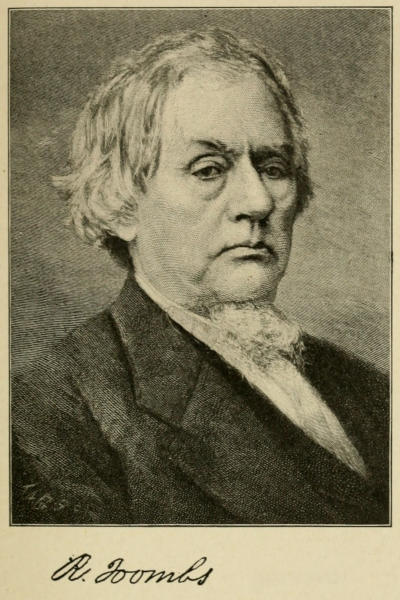
ROBERT TOOMBS
The reactions of opinion were slow. The country, though it grew uneasy, was not yet ready to put itself in the hands of the Democratic party, which had opposed the war, and which still suffered in the thought of the voters the discredit of its old alliance with the slave owners. The presidential election of 1872 came and went without disturbing the supremacy of the majority. But it brought to light many things that gravely disquieted the Republican leaders. Thoughtful and influential men whose support they could ill afford to lose, were, they perceived, being alienated from them. It was a serious matter that their plans in the South had so miscarried and required even yet the policing of whole districts by armed men. Evidently nothing but force sustained them, or could sustain them; and no humane or thoughtful man could look with complaisance upon a perpetual subjection of the South to federal arms. The administration of southern affairs from Washington wore, moreover, from another angle an unhandsome appearance. Its objects seemed to be, not so much the enforcement of constitutional rights as the aggrandizement of personal adherents of the President and of the close partisans of the Republican leaders who were most in his confidence. The troublesome, unwholesome matter of official patronage played too prominent a part in the motives of the government, and made the treatment of southern affairs seem only a phase of the general “spoils system” of appointment to office which seemed to have fastened itself upon the party organization of the country.
It was bad enough that the federal offices should be emptied wholesale upon a change of parties in the administration, to make room for the partisans of the successful leaders, as they had been when Mr. Lincoln came to the presidency,—as they had been at every change of parties since General Jackson’s day; but that had at least given political solidarity to the administration and made the President in some sort master in the counsels of his party. Now a new and sinister sign was added that the official patronage of the government was to be used, not to strengthen and solidify the administration, but to give secure political power to local managers who were to be permitted to dictate to the President whom he should appoint to office. In one State after another there emerged some one man,—a senator, a representative, a federal official of high office,—who was recognized as the President’s only adviser with regard to all appointments within his State; and all federal office holders within that State became by natural consequence his sycophants. In the South these petty masters were too often the political adventurers who had been drawn to their places of preferment by the temptations of the process of reconstruction, when the negroes waited to be used, or men who were themselves the subservient tools of politicians in Washington. General Grant himself felt the demoralization of the system very keenly and desired its radical reformation, but was easily imposed upon by men whom he trusted, and trusted men without discrimination. He had great simplicity of character. He judged men shrewdly enough when he saw them in action, but had little insight into their real motives and character when associated with them in counsel. It seemed to him unnatural, unfaithful, as it had seemed to General Jackson, to doubt or distrust his friends,—not so much because he was a soldier and ready to stand by his comrades with stout allegiance as because, like most men of simple nature, he deemed others as honest as himself, and suspicion a thing for rogues to harbor.
The President had alienated, moreover, certain men whose support he could not afford to dispense with. He had set his heart upon the annexation of Santo Domingo to the United States, and had come to an open breach with Mr. Charles Sumner, chairman of the Senate Committee on Foreign Affairs upon the matter. That and many other things, great and small, had driven Mr. Horace Greeley also into opposition, the erratic, trenchant editor of the New York Tribune. Mr. Sumner seemed to a great many men in the country to stand for the older, better, more elevated traditions of the Republican party, which General Grant seemed to be fast drawing to the lower levels of self-aggrandizement and power. Mr. Greeley wrote editorials every day which told like sharp blows upon the consciousness of all the thousands of plain men the country-sides through who looked to the Tribune for guidance as to an oracle. It was no light matter to have such men set against the administration.
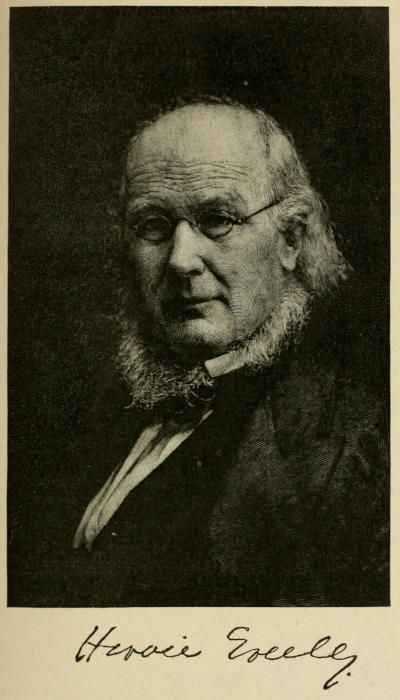
HORACE GREELEY
It was the more embarrassing because there were large matters of policy, as well as scattered items of mistaken action and vague fears for the civil service, upon which an opposition could concentrate. At the heart of these was the disfranchisement of the white men of the South. It was plain to see that the troubles in the southern States arose out of the exclusion of the better whites from the electoral suffrage no less than from the admission of the most ignorant blacks. It was no doubt in part because the South could not use its real leaders in open political contest that impatient men and radicals had been driven to use secret combination and all the ugly weapons of intimidation. The processes of reconstruction were made by those who managed them to depend as much upon withholding the suffrage from all who had participated with any touch of leadership in secession as upon the use of the negroes as voters and the radical amendment of the southern constitutions; and it presently became evident that there was a rapidly growing number of thoughtful men in the Republican ranks who thought it high time to grant a general amnesty and bring affairs to a normal condition again in southern society. Mr. Greeley was strongly of that opinion, and it took form and bred concert of action rapidly enough to play a determining part in the presidential campaign of 1872. In 1870 the question had taken very definite form among the Republicans of Missouri, and the party had split asunder there into a radical and a liberal faction. The radicals wished for the present to maintain the disqualifications imposed by the constitution of the State upon those who had identified themselves with secession during the war; the liberals demanded “universal amnesty and universal enfranchisement,” and won in the state elections. The leaders of the successful revolt were Mr. Benjamin Gratz Brown and Mr. Carl Schurz. Mr. Brown had been politician, editor, soldier, senator these twenty years, and with the success of his party became governor of the State. Mr. Schurz was a member of the Senate, a man but just turned of forty but bred since a lad to the rôle of aggressive liberal in politics,—an exile from his German home because of his participation in the revolutionary movements of 1849. He was an orator whom opponents not prepared to join frank issue found it prudent to avoid in open contest. Mr. Lincoln had named him minister to Spain in 1861, but he had preferred the field and entered the army; and at the close of the war had been sent by the legislature of Missouri to the Senate of the United States.
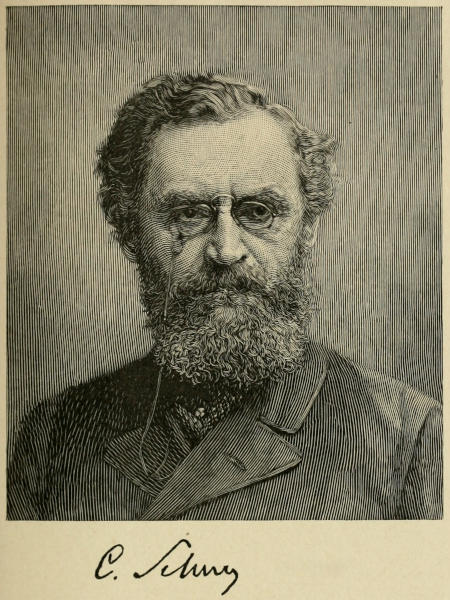
CARL SCHURZ
The “Liberal Republicans” of Missouri, thus led, called upon men of like views everywhere to join them, and their ranks for a little seemed to fill upon a scale which threatened to make them a formidable national faction. The form the presidential campaign of 1872 was to take was determined by their initiative. In May, 1872, a national convention of their partisans came together at Cincinnati, at the call of the Missouri leaders, and nominated Mr. Greeley for the presidency, Mr. Benjamin Gratz Brown for the vice presidency. These were nominations which the country found it hard to take seriously. Mr. Greeley’s irregular genius, useful as it was in the trenchant statement of issues and the sharp challenge of opinion, was not of the kind prudent men were willing to see tried in the conduct of the government. He was too much a man of impulse, without poise or calculable lines of action. Mr. Brown the country did not know, except as a picturesque Missouri soldier and politician. The names of much more statesmanlike men had been proposed in the convention, but it had acted like a great mass meeting rather than like the organ of a party, upon impulse and hastily considered policy rather than with prudent forecast or real knowledge of the true grounds of expediency. Its platform exhibited the same characteristics of half-formed opinion and a hurried compromise of interests. It condemned the existing administration as corrupt in its use of the patronage and absolutely disregardful of constitutional limitations in its use of power in the States, and demanded the “immediate and absolute removal of all disabilities imposed on account of the rebellion,” in the belief that universal amnesty would “result in complete pacification in all parts of the country”; but its formulations of policy were vague and evasive. It was framed to please all elements of a mixed opposition, and to make as acceptable as possible its closing invitation to “all patriotic citizens, without regard to previous political affiliations,” to join with its framers in purifying the government.
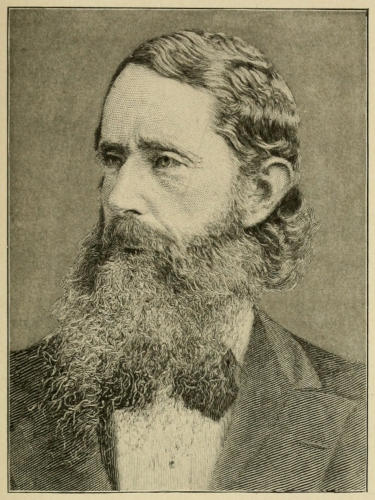
BENJAMIN GRATZ BROWN
The Democratic convention, which met in Baltimore early in July, accepted both the platform and the candidates of the Cincinnati convention, though the Democratic leaders liked neither. The platform spoke no recognizable Democratic doctrine, except, indeed, in its advocacy of the maintenance of the public credit by a speedy return to specie payments, and the candidates were men whom no experienced politician could hope to see elected. But the split in the Republican ranks evidenced by the Cincinnati convention was the only sign anywhere visible to the Democratic leaders of a change in public sentiment likely to weaken the party in power. Without the coalition they knew themselves helpless; with it they hoped to make at least a show of strength. Such allies might be worth the weak candidates and the inconclusive declaration of principles that went with them. The “Liberal Republicans” had given form to the whole campaign, as they had expected.
The result was what every one who had the least sagacity in reading the signs of political weather perceived from the first it must be. The Democrats added but one hundred and thirty thousand to their popular vote of four years before, though the number of voters in the country had greatly increased and for the first time in the history of the government every State chose its electors by the direct suffrage of the people. The Republicans added six hundred thousand to their vote, and General Grant was elected for a second term by an overwhelming majority in the electoral college (286-63). The congressional elections which accompanied the choice of President gave the Republicans again, moreover, their accustomed two-thirds majority in both houses. All things stood as before; the opposition were yet a long way off from power. Mr. Greeley survived the elections but a few weeks. He had not seen how hopeless his candidacy was. He was turned of sixty and had been broken in health. All his years had been full of such keen and unremitting labor as robs a man at last of his elasticity. The sudden stroke of utter defeat, touched almost with farce, so that men laughed to see how complete it was, was more than he could bear. On the 29th of November, 1872, before the electors had voted, he died. The few votes that would have gone to him were given as the electors pleased to men who had been his allies in the novel coalition he had led.
And yet, though the coalition had failed, the Democrats were nearer their day of success than they dreamed. Within two years the Republican majority of nearly one hundred in the House of Representatives had been supplanted by a Democratic majority almost as large, and the men who had led the party of reconstruction found their season of mastery gone by. The country had begun to see with how radical a demoralization the war party it had trusted was beginning to be touched, and how impotent the amiable soldier they had put at the head of the government was to guide or better it. General Grant had found that the appointment of men to political office upon the recommendation of politicians and personal friends, though the friends were his own and the politicians men whom the country honored and whom he would have deemed it a reproach upon himself to distrust, was a very different matter from promoting officers tested under his own eye in camp and field. The leaders of Congress perceived plainly enough the movement of opinion out-of-doors, saw the service of the government steadily sinking to a lower level of efficiency, knew what influences were at work to debase it and what condemnation must come upon them should the use made of the patronage come fully to light. On the 3d of March, 1871, accordingly, they put through Congress an Act which authorized the President to frame and administer, through a commission, such rules as he thought best for the regulation of admissions to the civil service. The President accepted the Act with cordial approval, with an obvious sense of relief, indeed; and with complete indifference to the distress of the politicians proceeded to establish and enforce a system of competitive examinations for office. But the politicians were stronger in Congress than the President, and after two years of painful exclusion from the use of the patronage induced the houses to withhold the appropriation necessary for the administration of the President’s new system of appointment. They had not yet learned how hard a master public opinion was to be in that matter.
Possibly the mere demoralization of the civil service would not by itself have brought upon them the bitter discipline of defeat which they presently underwent. Other things went along with it which stirred the country more deeply; which made Congress itself seem corrupt and the party which controlled it without a watchful sense of honor. The year 1869, in which General Grant became President, had been marked by the completion of both the Central Pacific and the Union Pacific railways, the two lines begun in 1863, the one eastward from the Pacific, the other westward from the Missouri River, which when completed at their point of junction at last bound East and West together across the long plains and the high passes of the Rockies upon which so many a slow caravan had lost its way and its precious freight of human lives. In 1867 the company which had undertaken the construction of the Union Pacific had acquired by purchase the charter of a corporation organized in Pennsylvania in 1863 upon the model of the great French Société Générale du Crédit Mobilier, for the placing of loans, the handling of all marketable stocks, and the transaction of a general banking business. The French company had come very near to getting into its hands the whole brokerage business and mercantile credit of France; the promoters of the Union Pacific Railway bought out the Pennsylvania company in order to obtain a suitable instrument for conducting the financial operations connected with their undertaking. Congress had made immense grants in aid of the Pacific railway, regarding its construction as of no less importance to the government than to the commerce and material development of the country, became it would bind the two coasts of the continent which had hitherto been almost like separated countries together by a great highway along which authority and the influences of opinion could travel as well as trade. Its subsidies had taken the form of six per cent. gold bonds: $16,000 for every mile of rails upon the prairies or the coast plains beyond the mountains, from $32,000 to $48,000 for every mile through the passes of the mountains or the difficult country between range and range,—besides twenty-five million acres of public land along the line of the road.
Here was a perilously close connection between a great financial undertaking and legislation by Congress; and in the presidential campaign of 1872 it was openly charged by the Democrats that Mr. Colfax, the Vice President, Mr. Henry Wilson, the Vice President elect, the Speaker of the House of Representatives, and a number of senators and representatives had accepted gifts of Crédit Mobilier stock in consideration of legislative and other services to be rendered the company. Both houses appointed committees of investigation. The revelations which ensued filled the country with uneasiness and disgust. Against the more prominent officials accused no proof of conscious wrongdoing was found. Only two members of the House and a single member of the Senate were found to have deliberately engaged in transactions which touched their integrity and honor. But many a detail came to light which showed that members carried very easy-going consciences in such matters, accepted favors without looking too curiously into their motive or significance, thought more often of their personal interests than of the public honor, and felt very slightly the responsibility of their posts of trust. It was open to any one who chose to believe that less had been told than had been covered up; that, with but a little more probing, it might have been possible to unearth many an unsavory intrigue. The discredit of the ruling party in the houses was steadily deepening.
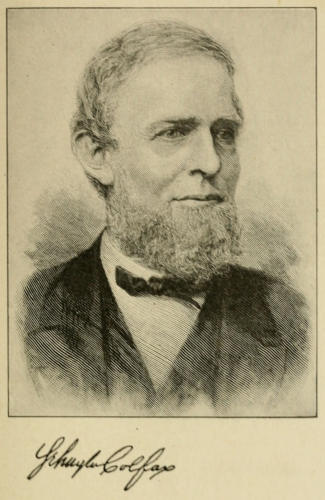
SCHUYLER COLFAX
The painful impressions left by the investigation were heightened by the deliberate action of the houses during the very session which saw it instituted and concluded. They did not scruple to pass an Act which increased the compensation of senators and representatives and which was made to apply retroactively to the sessions of the past two years,—an Act which the country very bluntly dubbed a “salary grab” and deemed quite in keeping with the reputation of a Congress which had censured but did not expel the members whom its own investigation had shown to be guilty of corrupt connection with the Crédit Mobilier.
Other impressions, well or ill founded, supervened which confirmed the country in its distrust of the men who were in control of affairs. In September, 1873, financial panic once more came upon the country with a rush, amidst abundant trade, amidst every sign of prosperity, when wages were good, employment readily found, factories busy, prices normal, money easy. Railways had been built too fast in the West. Within five years no less than $1,700,000,000 had been spent in railway construction. A Northern Pacific Railway was in course of construction, to be pushed forward through a new section of the country; and not a new Pacific railway only but shorter lines also by the score in regions where as yet there were no people, in order that parts of the country otherwise inaccessible might be opened up to quick settlement and profitable use. Such roads could not reasonably look to make a profit for twenty years to come. They were built with borrowed money. Their bonds filled every market, at home and abroad. Some new roads there were which were only extensions of older lines of established earning capacity; but the older portions could not earn enough to pay for the new. Certain as the prospects of profit were, when the country should grow and settlers come to dot the lines of rail with towns, flank them with farms, and put factories at every point of vantage, their construction was for the present purely speculative, and the processes of growth upon which they depended to keep them from bankruptcy could not be sufficiently hurried to save their credit. Early in September, 1873, the break began to come. One by one banking and brokerage firms in New York which had advanced money to western and Canadian railways began to announce their inability to meet their obligations. On the morning of the 18th Mr. Jay Cooke, the agent of the federal government, with $4,000,000 of deposits from all parts of the country and $15,000,000 of the paper of the Northern Pacific company, declared himself unable to meet his debts, and the “Street” knew that the end had come. Firm after firm, company after company, went to the wall, some of them reputed the strongest in the country, and a long, slow winter of panic ensued whose effects the business of the country was to feel for years to come.
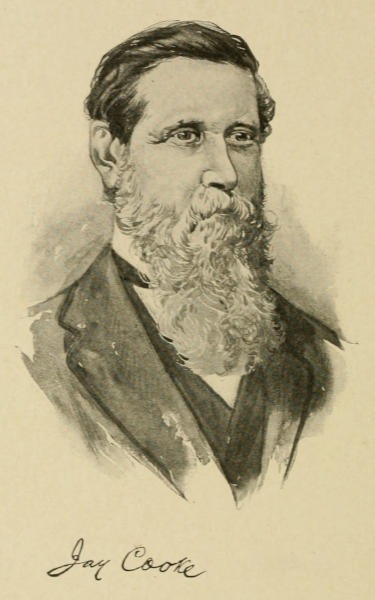
JAY COOKE
Men who did not know how to reason upon such matters or how to distinguish the real forces that governed the credit of the country were inclined to attribute this sudden sweep of calamity across a money market apparently prosperous and at peace to the financial legislation of Congress. On the 12th of February, 1873, an Act had become law which, it was said, had “demonetized” silver and upset values. The Act had dropped from the list of authorized coins the silver dollar of 412½ grains, which had hitherto been the standard silver dollar of the coinage, and had authorized, in partial substitution, a “trade dollar” of 420 grains. No silver dollars of 412½ grains had been coined since 1808; since 1853 there had been no silver dollars in circulation; the Act simply made what was fact also law, and had passed without objection. But when the financial crisis of the autumn of 1873 came many persons recalled the “demonetization” of silver effected at the opening of the year, and made shrewd theories about the causes of a panic whose explanation was obvious and upon its face. The Republicans in Congress had had the ill fortune to alter the law of the currency upon the very eve of a financial disturbance, and those who did not like their conduct of the government and suspected them of more corruption than had been proved were at liberty to add this to the list of things they had done amiss, to the damage of the country. The congressional elections of the autumn of 1874 went heavily against them; the House was lost to the Democrats; their majority in the Senate was retained only because the Senate was guarded by its constitution against sudden change. The impressions of that autumn and the events of the next year lost them also the local elections in many of the northern States which had so far seemed their safe strongholds. Even Massachusetts chose a Democratic governor.
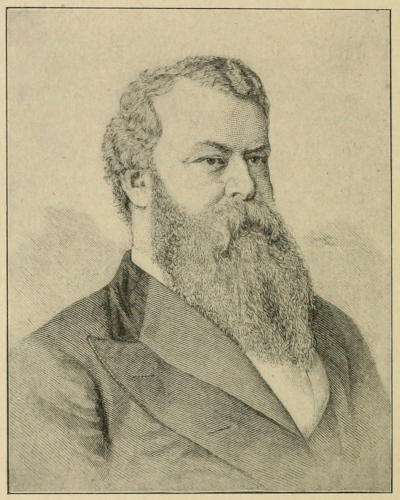
WILLIAM WORTH BELKNAP
The country could not overlook the evidences of demoralization at Washington. In 1875 it was discovered that there was concerted action in the West between distillers and federal officials to defraud the government of large amounts in respect of the internal revenue tax on distilled spirits, a “whiskey ring,” as the newspapers called it, which did not hesitate to use a portion of its fraudulent profits to make good its opportunity and its immunity by political corruption. Mr. Belknap, the Secretary of War, was accused of accepting bribes in dispensing the patronage of his Department, and, upon impeachment on that charge, resigned his office as if in confession, to escape punishment. Venality and fraud began on all hands to be suspected, even where they did not exist, and mere inefficiency began to irritate the country as if it were but a part of the general decadence of official honor. The President himself saw how ill, how discreditably, and with how incorrigible a tendency towards serious and even criminal misconduct, the administrative branches of the public service operated under his hand, and with the simplicity and frankness which were characteristic of him,—the simplicity and frankness which unscrupulous politicians played upon to betray him,—acknowledged his failure and longed for release from duties in the performance of which he knew that he had blundered. His eight years of power had cost his party its predominance.
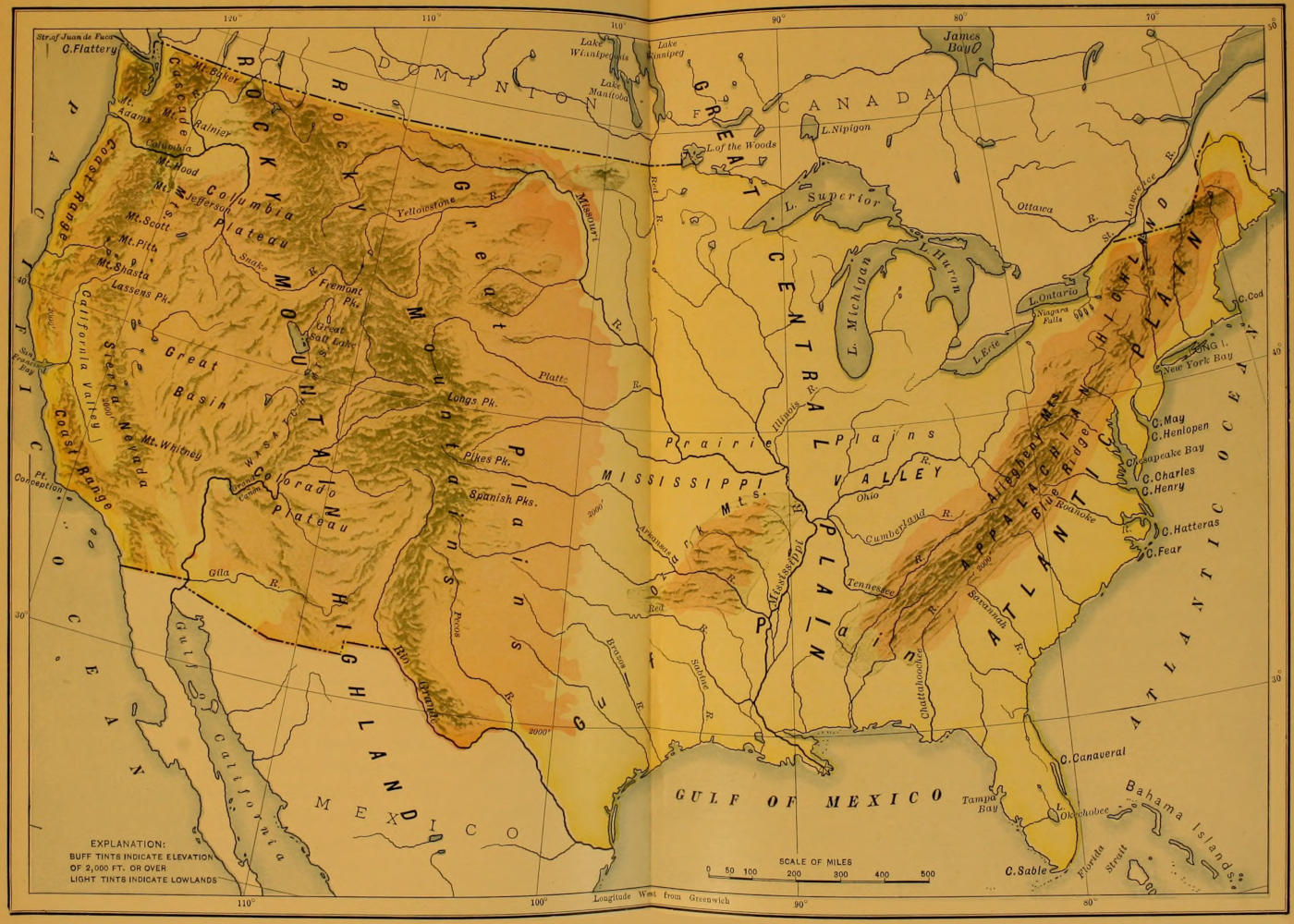
PHYSICAL FEATURES OF THE UNITED STATES.
BORMAY & CO., N. Y.
It was not the condition of the civil service alone, however, or the mere alarm of the country at the too frequent disclosures of malfeasance in office which brought the ascendency of the Republicans to an end. Congress did its part to make it plain that nothing but blunders were to be expected from the political legislation of the men who had devised and forced to their execution the measures of reconstruction. On Christmas day, 1868, President Johnson had proclaimed full pardon and amnesty for all who had participated in secession, without reserve or exception, and by an Act of the 2d of May, 1872, Congress had removed the political disabilities imposed by the third section of the Fourteenth Amendment from all who had served the Confederate States, except only those who had left the Congress of the United States or the judicial, military, or naval service of the federal government, the headship of an executive Department or the post of minister at a foreign court to take part with the seceding States. But, though they thus cleared away the more abnormal obstructions to the return of settled peace and a natural order of life at the South, the congressional leaders could not keep their hands from the race question. Mr. Sumner, in particular, was insistent that the negroes should be given imperative federal law for their support in the assertion of their social no less than of their political rights; and in February, 1875, at last had his way, though he did not live to see it. A bill passed which gave the federal courts the authority, by appropriate process and penalty, to enforce the right of negroes to accommodation in public inns, theatres, railway carriages, and schools, and to service upon all juries, upon the same footing as white persons. The Act became law on the 1st of March, three days before the expiration of the term of the last House of Representatives the Republicans were effectually to control for fifteen years. It was the older leaders’ last Act for creating friction at the South. For eight years it was to fail utterly of accomplishing its object and yet to work its work of irritation, to be set aside at last by the Supreme Court (1883) as an invasion of the legal field of the States which no portion of the constitution, new or old, could be made to sustain.
The reconstruction of the southern States had been the undoing of the Republican party. The course of carpet bag rule did not run smooth. Every election fixed the attention of the country upon some serious question of fraud or violence in the States where northern adventurers and negro majorities were in control. Congress could not remove the political disabilities of the southern white men without increasing their power at the polls and cutting at the foundations of Republican rule in the South; and yet, though the white voters were disfranchised, in at least three of the southern States Republican rule was maintained only by direct aid from Washington,—and sometimes at the point of the bayonet. General Grant had grown infinitely impatient that there should come every year, from State after State, calls for troops to keep the Republican governments at the South in their place of power. “The whole public are tired out with these annual autumnal outbreaks in the South,” he said, in refusing troops to the governor of Mississippi, “and the great majority are ready now to condemn any interference on the part of the government. I heartily wish that peace and good order may be restored without issuing the proclamation. But, if it is issued, I shall instruct the commanders of the forces to have no child’s play.” Here was the right feeling of the man and the grim firmness of the soldier. He was not mistaken as to the feeling of the country; and though he withheld his hand where he could, there was military interference enough to exasperate that opinion to the utmost. Before his term was out the white voters of the South had rallied strong enough in every State except South Carolina, Florida, and Louisiana to take their governments out of the hands of the men who were preying upon them. That they had done it by methods which only an almost revolutionary state of society justified no one doubted: by keeping the negroes away from the polls by every form of intimidation, by forceable interference with their rights when necessary, by every expedient, whether of law or of subtile management, that promised them mastery; but they had triumphed, and there was at least an end of chronic revolution.
But in Louisiana, in Florida, and in South Carolina, though desperately beset, the Republicans had, by desperate means, kept their hold upon the governments they had made. The troops of the United States were first used to adjust the contest in Louisiana. The revised constitution of Louisiana, revised in the interest of the congressional plan of reconstruction, provided, as most of the new southern constitutions did, for the determination of the results of all elections by a returning board so constituted as to be always under the control of the existing administration of the State. That board had the right to reject, without judicial process and upon its own mere opinion, the votes of all counties or precincts where force or fraud had been employed; and it used that power to check the rising Democratic vote wherever it seriously threatened the supremacy of those in authority. Its surveillance went smoothly enough so long as the Republicans were themselves united; but the Republicans of Louisiana had fallen apart into factions, vacancies upon the returning board had been made and filled by removals and appointments, amidst disputes and contests of legal right, until there were at last two boards instead of one, and before the matter was quieted three, each of which claimed to be the legal returning board of the State. The result of the election of the autumn of 1872 turned upon their rival claims. Over one the Democrats had got control by coalition with the “liberal” wing of the Republicans; another declared the Republican state officers and the Republican candidates for the state legislature elected, and federal aid was asked to carry its judgment into effect. A committee of Congress, sent down to investigate the matter, found it impossible to disentangle the hopeless quarrel; Congress failed to pass the only measure of relief its leaders were able to think of, a bill providing for a new election; and the President recognized and installed the Republican governor.
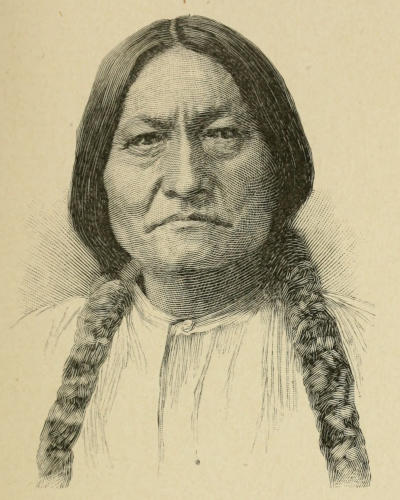
SITTING BULL
It was not an affair which either party could look back upon with complacency, but the Republicans took the greater discredit from it, and the country grew very restive. A committee of the Senate reported that the district judge of the United States for the District of Louisiana had undoubtedly gone far beyond the scope of his power and acted in “flagrant disregard of his duty” in his use of writs of injunction issued in aid of the faction which the President sustained. Some unsavory intrigue had been uncovered at almost every step of the investigation. Moreover, the action of the President was no settlement of the difficulty. It left the State in a heightened temper of revolution. Riots accompanied the efforts of the questionable government he set up to enforce its authority. In September, 1874, the partisans of Mr. McEnery, the leader of the combined Democrats and “liberal” Republicans, rose in arms, put every officer of his opponent’s administration from his place, and assumed control of the government. Again federal troops intervened, and the ousted officers were reinstated. Nice compromises, difficult to maintain and satisfactory to nobody, had to be devised to keep the peace until there should be another trial of strength in the election of a governor at the polls.
The summer of 1876 was darkened by a tragic war with the Indians of the far West. In 1874 gold had been discovered in the Black Hills which lay upon the border line of Wyoming and Dakota, and the rush of settlers and miners thither had exasperated the Sioux tribes to take the war path. Their chief was Sitting Bull, whom the troops of the United States were to find an opponent to put them on their mettle. Gathering his forces within the secluded valley of the Little Big Horn by the upper waters of the Yellowstone, where he could best mask his strength, he struck first at one and then at another of the three small bodies of soldiers sent to converge upon him. One he forced back; another he effectually checked; part of the third he trapped and utterly destroyed. General Terry, coming against him from Bismarck, sent General Custer forward with the seventh cavalry to go round about and attack him at the rear; and on the 25th of June, riding with five companies hard upon the camp, Custer rode into a death trap. The Indians swarmed around him in numbers which utterly overwhelmed and completely cut him off from retreat, and not a man came away to tell the tale. The other seven companies of the regiment were not at hand to fight with them or to give them succor, and found themselves obliged, when at last they came up, to fortify a bluff near at hand as a place of safety and retreat until they should themselves be succored and relieved. The forces of the government gathered at last to complete the work so ill begun, and the Indians retired to the mountains; but it took much painful fighting, and many toilsome marches, prosecuted through all the long autumn and the winter itself, to bring them to terms; and Sitting Bull slipped through their hands across the northern border at last.
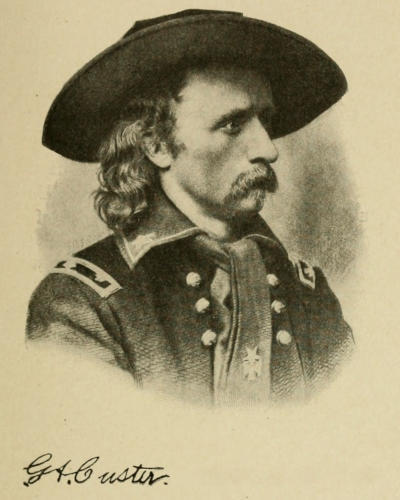
GEORGE ARMSTRONG CUSTER
Meanwhile the presidential election of 1876 had come and the full harvest of the mischief done in the reconstruction of the South was being reaped. The Democrats nominated Mr. Samuel J. Tilden, a man who had shown his quality as governor of the State of New York and won the respect of all thoughtful men, alike for his integrity and for his ability. The Republicans nominated Mr. Rutherford B. Hayes, who had won his place in the public confidence as an officer of volunteers in the war for the Union, as a member of the House of Representatives, and as governor of Ohio. Both men stood removed from the passionate contests of the period of reconstruction. Their candidacy put the emphasis of party contest as much as might be upon the issues of the new day rather than of the old. But the immediate past was a weight upon the fortunes of the Republicans; the country had turned with evident distrust from the work of confusion they had wrought. Again, as in 1874, Democratic majorities seemed to sweep the country. Only the confusion the Republicans themselves had brought about saved them from utter defeat. State elections had been held, as usual, in most of the States at the same time that presidential electors were chosen, and once again the result of the elections in Louisiana, Florida, and South Carolina was in dispute. The electoral votes of all of these States were necessary for the election of Mr. Hayes. Mr. Tilden had carried Connecticut, New York, New Jersey, Delaware, Maryland, Indiana, and Missouri, as well as the ten southern States whose votes were not in dispute; one hundred and eighty-four electoral votes were secured for him beyond a doubt, and one hundred and eighty-five constituted a majority. A single additional electoral vote would bring him into the presidency, and it seemed possible that at least one might be added to his reckoning by Oregon. There three Republican electors had undoubtedly been chosen, but one of them was thought to have been ineligible under the law, and the Democratic governor had appointed in his stead the next candidate on the poll, a Democrat, and given him his certificate.
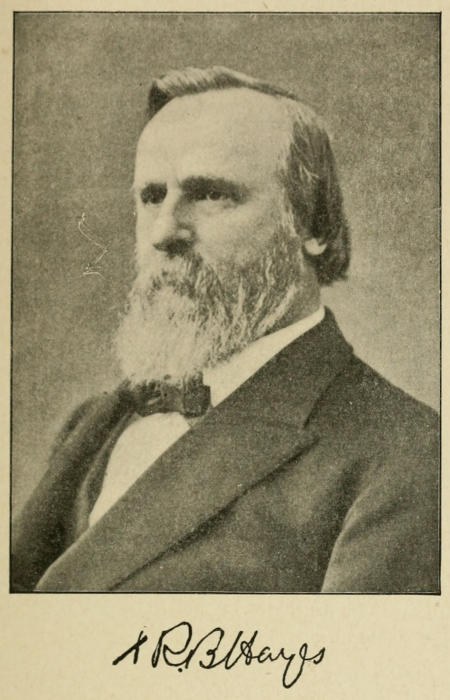
RUTHERFORD BIRCHARD HAYES
In the South nineteen electoral votes were in dispute. In Louisiana there had, apparently, been a clear majority of Democratic votes cast at the polls, alike for presidential electors and for governor and state legislators; but once again the returning board, which was in the hands of Republicans, had turned a Democratic into a Republican majority by rejecting the votes of precincts in which it declared fraud or intimidation to have been used. Certificates had been given to the Republican presidential electors, accordingly, and again a Republican state government had been set up by force of authority. But again the Democrats had refused to yield. They had set up, on their own part, a Democratic administration, and Mr. Nicholls, whom they claimed to have elected governor, gave certificates to the Democratic electors. In Florida the vote had been very close indeed, and turned upon the votes of a single county. The returning board of the State had but a single Democratic member, the Attorney General, and the majority of the board had given the vote of the State to the Republicans. The Attorney General had issued certificates over his own signature to the Democratic electors. In South Carolina federal troops had in many places guarded the polls, and federal troops had assisted the Republican leaders of the State to put the governor and state legislators whom they claimed to have elected into office; but the Democrats claimed that their candidates had in fact been chosen, notwithstanding the obstructions to free voting created by the presence of troops and the interference of federal supervisors acting under the “Force Bills” of 1870 and 1871; inaugurated their own governor, General Wade Hampton, a distinguished cavalry commander of the Confederacy; and set up their own legislature. General Hampton issued certificates of election to the Democratic presidential electors.
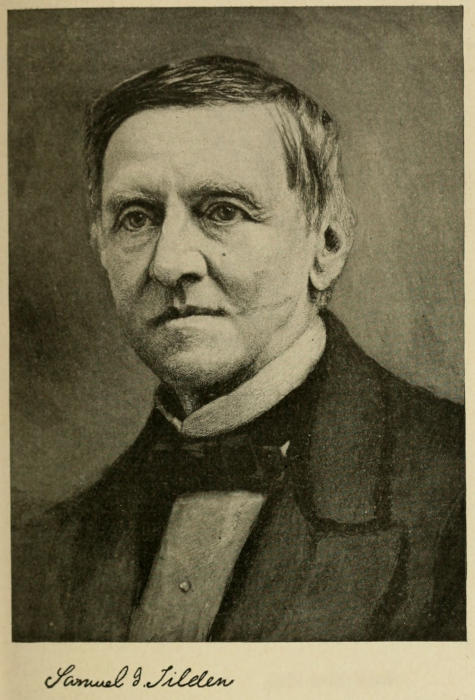
SAMUEL JONES TILDEN
All the country saw, with an instant thrill of misgiving, how perilous a situation was thus created. Here were double returns from three States in a presidential election, and the decision which should be chosen must determine the election. One vote out of the twenty in dispute, though it were only the single questionable vote of Oregon, would give the presidency to the Democrats. The control of the government turned upon the action of the houses when they should come to count the votes in joint session. The House of Representatives was Democratic, the Senate Republican; there was no hope that they could agree. No one could confidently say, though he put partisanship aside and held his judgment at the nicest poise, upon which side the right lay in the disputed southern elections. It was plain enough that in any case the returning boards would have given the vote to the Republicans, whatever the face of the returns, so long as the men for whom they acted felt that they could count upon the support of the Executive at Washington in the maintenance of their authority. It was equally clear, on the other hand, that there were all but indisputable evidences of fraud or at the least irregularity in the votes upon which the Democrats relied. In South Carolina serious riots had occurred whose avowed object had been the intimidation of the negroes. The country had grown very impatient, as General Grant said, of seeing governments maintained at the South by federal arms, and wished very heartily to see the hand of the federal Executive withdrawn, come what come might; and yet it was not as clear as could be wished that this was the occasion for their legitimate overthrow.
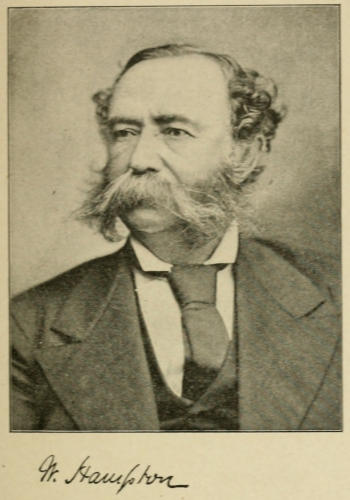
WADE HAMPTON
What the country had really to fear was, not the difficulty of the problem as a question of justice, but the passion of parties, the danger that those who stood at the front of party counsels would seek the success of their party by some intrigue, even by some stroke of violence. Foreseeing a certain deadlock of the houses when it should come to a counting of the votes, there was talk among the more headlong and reckless partisans of each side of taking the law into their own hands. There were signs almost of civil war in the air for a few troubled weeks of that anxious autumn.
But it was never really likely it would come to that. Men trained in the temper of American institutions had never thought to settle a constitutional difficulty after that fashion. Congress listened very willingly to counsels of compromise and moderation. It was agreed that an electoral commission should be constituted, which should consist of five members of the House, three Democrats and two Republicans, five members of the Senate, three Republicans and two Democrats, two Democrats and two Republicans from the supreme bench of the United States, and an additional Justice from the same court selected by the four Justices named in the bill; and that to that commission should be referred every question in dispute. Such a commission was undoubtedly an extra-constitutional body, and its decisions disappointed the country of any display of judicial impartiality it may have hoped for from it. Mr. Justice Bradley, who was chosen by his fellow Justices of the commission to be the fifteenth member of the tribunal, voted in every instance in favor of the Republican claims, as did every other member of the commission, whether judge, senator, or representative, whose affiliations were with the Republican party. Every Democrat of the commission voted in favor of the claims of the Democratic managers. Every question submitted was settled by a vote of eight to seven. But there was at least a settlement, which no one dreamed of disputing or attempting to annul. General Grant gave way to Mr. Hayes, and the government remained in the hands of the Republicans.
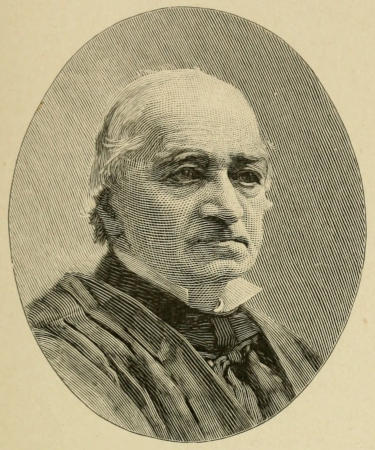
JOSEPH P. BRADLEY
To Mr. Hayes the tacit obligations of the situation were plain. He withdrew the federal troops from the South. The Republican governments of Louisiana and South Carolina were dissolved, and the Democratic governments which had claimed the election quietly took their place. The supreme court of Florida obliged the returning board of the State to accept the returns which had come to them from the disputed county, and a Democratic government came there also into power. The era of reconstruction was at an end.
The quiet figure of the retiring President began to seem almost at once like a figure lingering out of an age gone by. The honest, simple-hearted soldier had not added prestige to the presidential office. He himself knew that he had failed, that the administrative scandals, the stain of corruption, of intrigue, of malversation, the appearance as if of a group of personal allies bent upon their own aggrandizement rather than of a body of public servants devoted to the honest conduct of the nation’s business, which had marked his management of the executive office must always stand as proof that he ought never to have been made President. But the corruption had not touched him. He was unstained. Every one who thought justly of the matter attributed his failure rather to his very honesty and simplicity of nature than to any fault of will. His trustfulness had betrayed him; his desire to be faithful to his friends had led him to shield knaves. He had thought other men as honest, as straightforward as himself. He had come to a great office untrained in affairs. Men’s eyes followed his retreating figure with respect, with veneration, with deep affection, and forgot that he had been duped by politicians; remembered only that he had been the successful leader of the armies of the republic.
Authorities. All the larger and more systematic histories of the country stop short of times so recent as those covered by this chapter. Neither is it any longer feasible to distinguish general authorities from contemporary accounts. All accounts of a time so recent are contemporary. We have for general guidance Judson S. Landon’s Constitutional History and Government of the United States, Alexander Johnston’s American Politics, the same author’s admirable articles on the several topics here treated of, such as Reconstruction, the Ku Klux, Crédit Mobilier, etc., in Lalor’s Cyclopaedia of Political Science, Political Economy, and United States History, John Clark Ridpath’s popular History of the United States, John W. Burgess’s Reconstruction and the Constitution, Edward Channing’s Student’s History of the United States, Edward Stanwood’s History of the Presidency, Appleton’s Annual Cyclopaedia, Edward McPherson’s Handbook of Politics, issued in biennial volumes, except in 1870, from 1868 to 1894, Scribner’s Statistical Atlas of the United States, to 1880, William A. Dunning’s Essays on the Civil War and Reconstruction, G. W. Williams’s History of the Negro Race in America, W. H. Barnes’s History of the Thirty-ninth Congress, Albert Bushnell Hart’s Foundations of American Foreign Policy, and many valuable articles scattered through the volumes of the Atlantic Monthly (especially a series on Reconstruction which appeared in 1901), the North American Review, The Forum, The Nation, and the Political Science Quarterly.
Among the more important memoirs are James G. Blaine’s Twenty Years of Congress, S. S. Cox’s Three Decades of Federal Legislation, 1855 to 1885, Hugh McCulloch’s Men and Measures of Half a Century, John Sherman’s Recollections of Forty Years in the House, Senate, and Cabinet, Dabney Herndon Maury’s Recollections of a Virginian, Bishop R. H. Wilmer’s Recent Past from a Southern Standpoint, Reuben Davis’s Recollections of Mississippi and Mississippians, and G. W. Julian’s Political Recollections.
Adam Badeau’s Grant in Peace, A. R. Conkling’s Life and Letters of Roscoe Conkling, John Bigelow’s Life of Samuel J. Tilden, Albert Bushnell Hart’s Salmon P. Chase in the American Statesmen Series, and Moorfield Storey’s Charles Sumner, in the same Series, cover parts of the period from the point of view of the several men of whom they treat.
Mr. Hilary A. Herbert’s Why the Solid South? and Mr. William Garrott Brown’s The Lower South in American History throw a great deal of light upon the time in regard to the affairs and the sentiment of the South; Mr. J. Lawrence Laughlin’s History of Bimetallism in the United States and Professor F. W. Taussig’s Silver Situation in the United States and Tariff History of the United States, and Mr. A. S. Bolles’s Financial History of the United States, furnish excellent summaries of financial and fiscal conditions; Mr. Carroll D. Wright’s Industrial Evolution of the United States sketches the development of industry and invention, and Mr. David A. Wells’s Recent Economic Changes the altered economic conditions; Mr. Lauros G. McConachie’s Congressional Committees and Miss M. P. Follett’s The Speaker of the House of Representatives discuss the transformations of Congress and its relations to public business; and Mr. Henry Jones Ford’s Rise and Growth of American Politics affords one of the best philosophical analyses of the general history of parties, party organization, and party control, anywhere to be found.
The sources are in the Journals of Congress, the Congressional Record, the House and Senate Documents, the Messages and Papers of the Presidents, and the periodical press of the time.