Chapter II · RETURN TO NORMAL CONDITIONS (continued 2)
Reading edition
Such Acts were but the first fruits of radical economic changes and the rapid developments of trade, industry, and transportation. The laborers and men whom great combinations of capital were in danger of crushing or driving to the wall were making themselves more and more heard and heeded in the field of legislation. The Knights of Labor, who but the other day had numbered only a few more than a hundred thousand, now mustered six hundred thousand strong. What was more significant, airs, not of agitation merely, but of anarchy also were beginning to stir, in a country which until now had been known and envied the world over as a land in which men reverenced “the laws themselves had made,” acted under government as under their own self-control, and kept opinion always within the paths of peace. The cities were filling up with foreigners of the sort the Know Nothings had feared; men who had left their homes dissatisfied not merely with the governments they had lived under but with society itself, and who had come to America to speak treasons elsewhere forbidden. For many a long year their incendiary talk had fallen without effect upon the ears of workingmen in America, and politicians had been wont to boast that men born in America and men trained in America’s school of labor and politics would never listen to it. But the air of the industrial regions of the country had sensibly thickened with the vapors of unwholesome opinion in these last years of unlooked for concentrations of capital and unparalleled growths of corporate power. They still showed themselves most in cities where discontented men and women out of the proletariat of European countries most congregated. The country had startling evidence of the strength and audacity of the anarchist leaders in a great meeting held in May, 1886, in the Haymarket at Chicago, which seemed part of a concerted plan not only to preach but also to practise defiance of law, and which ended in the most serious conflict with the police an American city had ever witnessed. But the infection was spreading outside the cities, too. It began to be seen, when once the matter was laid bare, that men of American training, as well as foreigners, had begun to take the taint of anarchistic sentiment. Even the Knights of Labor were touched with it, despite the conservative influence of their leaders, and nothing but the sharp reaction of opinion caused by the Chicago riot, the country through, checked its quiet spread. Vast organizations like that of the Knights of Labor held loosely together at best; anarchism is the negation of organization; and in proportion as it became anarchistic the great order suffered disintegration and decay. A new order, the American Federation of Labor, sprang up to take its place, and the scene changed very rapidly as one agitation succeeded another. But no one could say that the scene grew more quiet or gave hopeful signs of peace as it shifted.
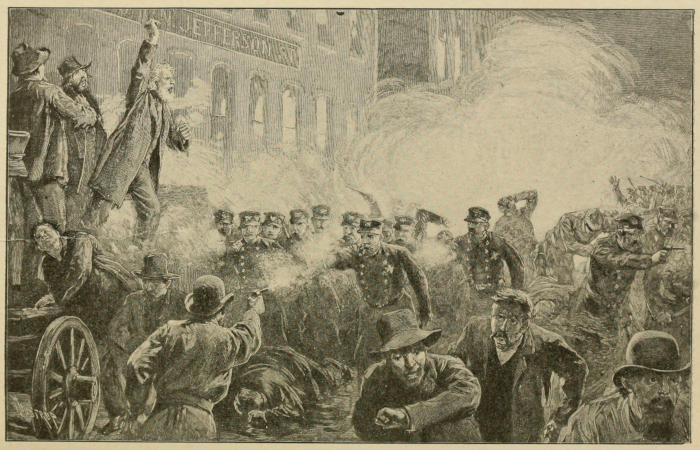
THE ANARCHIST RIOT IN CHICAGO, ILLINOIS. A DYNAMITE BOMB EXPLODING AMONG THE POLICE
To Mr. Cleveland it had become evident that not a little of the economic trouble of the time had its root and source in the operation of the tariff. There, it seemed to him, lay the foundations of those economic preferences of one set of men or one section of the country over another which were so deeply irritating the farmers of the South and West, the laborers of the cities and of the centres of manufacture, and the advocates of free competition. Protective tariffs deliberately extended the favors of the government to particular undertakings; only those who had the capital to take advantage of those favors got rich by them; the rest of the country was obliged to pay the costs in high prices and restricted competition. Such had time out of mind been Democratic doctrine, and every sign of the times seemed a demonstration of its truth. But not every man who called himself a Democrat accepted that creed. The Democratic party had been out of power for twenty-four years; the war had broken its ranks and confused its principles; there were men in it now who would never have been in it had it been, that long generation through, a party of action instead of merely a party of opposition. Notable among such men were Mr. Samuel J. Randall, of Pennsylvania, and the group of members who stood with him in the House of Representatives. These men were avowed protectionists, and Mr. Randall had from 1876 to 1881 been the acknowledged congressional leader of his party. He had during those years been Speaker of the House, and by consequence master of its action in all points of legislation. Leadership in that kind passed away from him when Mr. Cleveland became President in 1885, and Mr. Carlisle, of Kentucky, became Speaker, a Democrat of the older type; but Mr. Randall’s power was not gone. He still, it turned out, held the balance of power and controlled the action of the House in the matter of the tariff. Both in the Congress which preceded Mr. Cleveland’s election and in that which followed it Mr. Morrison, of Illinois, had introduced proposals for the reform of the tariff which were neither radical nor disregardful of vested interests, and had pressed them upon the House with arguments which lacked neither force nor the backing of opinion out of doors. An increasing surplus was being steadily piled up in the Treasury; the rates of duty which yielded the redundant revenue had been laid in time of war to meet extraordinary expenses; many of the articles which carried the burden of the tax were necessary to people of every rank and economic condition, notably wool and woollen goods; relief could be obtained by reductions which were not likely to damage any industry, or to deprive it of any advantage which it was not abundantly able to dispense with. But Mr. Randall led some forty Democrats, who sat for constituencies in Pennsylvania, Ohio, New York, California, and New Jersey, who voted against every reduction, by whatever argument supported, and the rest of the party, though they numbered one hundred and fifty strong, could carry nothing against them.
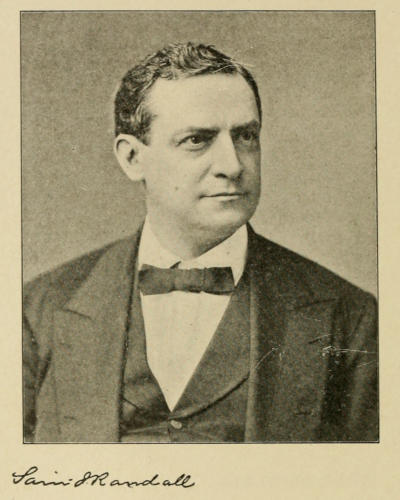
SAMUEL JACKSON RANDALL
It was this situation which Mr. Cleveland determined to change, if plain speaking could change it. In December, 1887, he addressed to the new Congress chosen in 1886 a message which passed all other subjects by and spoke only of the tariff. He asked Congress to put theoretical questions for the nonce aside. “Our progress towards a wise conclusion,” he said, “will not be improved by dwelling upon the theories of protection and free trade.... It is a condition which confronts us,—not a theory.... The question of free trade is absolutely irrelevant.” “Our present tariff laws, the vicious, inequitable, and illogical source of unnecessary taxation, ought to be at once revised and amended,” not only, he maintained, because unused revenue was piling up, but also because consumers were carrying an unjust burden. The message ran strong, imperative in every sentence, and the air was cleared upon the instant. It was the only voice of courage and decision that had been heard upon that matter in a generation; and Mr. Randall’s minority fell into line as if confused. They had felt the compulsion of a leader’s will,—were not converted, but disciplined. The Committee of Ways and Means of the House, under the leadership of Mr. Mills, of Texas, its chairman, at once prepared a bill which attempted a systematic revision of duties, general though not radical, a measure not of free trade but of carefully planned, conservative reduction such as the President had desired; and it passed the House with only four Democratic votes cast in the negative.
The Republican Senate rejected it,—even proposed higher duties in its stead; and the existing law stood unamended. But the issue had been made up. Mr. Cleveland had given his party a distinct, unmistakable policy with which to go to the country in the presidential campaign of 1888. It accepted the issue under protest; but it accepted it. Mr. Cleveland had not taken counsel with the congressional leaders of his party before uttering his imperative message; had asked advice, indeed, of no one; had acted wholly upon his own conclusions as to what was necessary for the relief of the country. His action in the matter had filled the leading politicians of his party with dismay, its rank and file with confusion. He had been warned that to attack the protected interests of the country might cost him his re-election; but that consideration had not moved him. He believed that his party could win upon such an issue at the polls, but he would not wait to make any nice calculations on that subject; he would at least do his party the service of putting it in the right. The country relished his courage, whatever timid politicians thought of it. He stood for the moment the indisputable master of all action within the Democratic party. Its nominating convention nominated him as of course for a second term. The Republicans nominated General Benjamin Harrison, of Indiana, grandson to William Henry Harrison, whom death had taken untimely away to make Mr. Tyler President; and the two parties went to the country on the issue Mr. Cleveland had made.
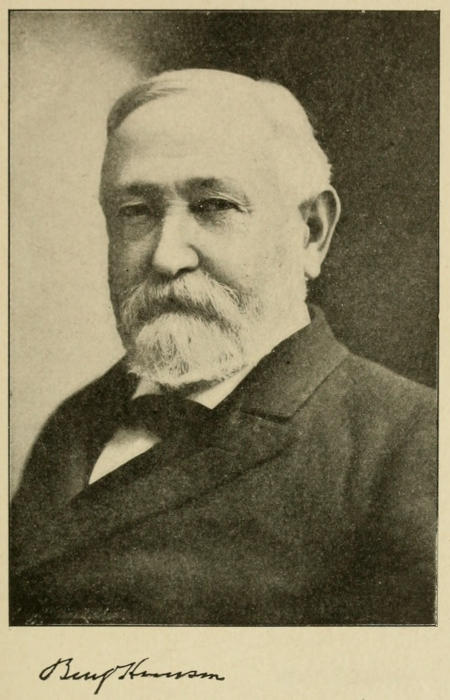
BENJAMIN HARRISON
The Democrats were defeated. The popular vote for Mr. Cleveland, indeed, exceeded that for his opponent by some one hundred and ten thousand, but Mr. Harrison had a majority of sixty-five in the electoral college (233-168). New York and Indiana had turned again to the Republicans. No northern States except Connecticut and New Jersey had voted for the Democratic candidates. Even the control of the House of Representatives was lost by the Democrats; the congressional elections gave the Republicans a working majority of about twelve. The tariff system had come to seem to that generation of voters very like a fixed part of the law of society, of the national life itself; Mr. Cleveland had not given them time enough to adjust their thought to the change he urged. There had been nowhere any sharp reaction of opinion, but everywhere in the North reaction enough to shift the balance of power once again from the Democrats to the Republicans.
On the 4th of March, 1889, Mr. Cleveland quietly gave place to Mr. Harrison and the government passed once more in all its branches into the hands of the party which had made the policy of the last twenty-eight years. But it was not the same government it had been when that party met its first serious check in 1875. It had steadied the judgment of the country in respect of parties to have a Democratic President for four years, and that President a man like Mr. Cleveland, compact of frankness, conviction, and force, no mere partisan but a man of the people, with the spirit of service strong upon him. The people had for a long time endured the deterioration of affairs under the later Republican administrations because they doubted the capacity and the principle of the Democrats. They had now learned at least that a change of parties in the administration meant no jeopardy to the government itself. The choice between parties had become once more a choice between policies merely, and affairs wore a normal aspect again,—such an aspect of peace and businesslike quiet as they had not worn since the painful shock of the Kansas-Nebraska Act. One by one the statutes which had marked the era of war and reconstruction had disappeared from the statute book: some because annulled by the Supreme Court, others by expiration, still others by repeal. Even the Tenure of Office Act had been quietly repealed after Mr. Cleveland’s refusal to submit his reasons for removals to the Senate’s scrutiny and review.
In 1888 the legislature of Massachusetts had adopted a method of balloting at elections borrowed directly from Australia, indirectly from England itself, which, as it spread from State to State, gave a noteworthy impetus to the purification of elections. The main features of the reform were, the facilitation of independent nominations for office outside fixed party lines, the official printing of the ballots to be used, their distribution to the voters only by sworn officers of election, and the isolation of the voter while preparing his ballot, in order perfectly to protect his privacy and independence. Opinion approved the change at once, and legislature after legislature hastened to adopt what opinion unmistakably demanded. It was one of the signs of the times. Opinion was slowly freeing itself as much as possible not only from the older party prejudices, but also from the too inquisitive management of politicians.
The foreign affairs of the government stood as they had stood when Mr. Cleveland came into office. The hostility of the Senate to his administration had rendered it impossible for him to bring any matter of negotiation to a satisfactory conclusion. The only matters of capital importance it had fallen to him to consider had concerned the fishing rights of the United States on the two coasts of the continent. Dissatisfied with the operation of those clauses of the Treaty of Washington which dealt with the Canadian fisheries, Congress had instructed the President in 1883 to give the required notice to Great Britain of the desire of the United States to abrogate them, and on the 1st of July, 1885, pursuant to Mr. Arthur’s notice, they had gone out of effect. In February, 1888, under Mr. Cleveland, a new treaty regarding the fisheries had been negotiated; but the Senate had rejected it. The question which arose on the other side of the continent concerned the rights of the United States over the seal fisheries of the north Pacific. The United States claimed that the purchase of Alaska from Russia in 1867 had brought with it the right to protect the seals of Bering Sea against capture or destruction, having brought with it exclusive jurisdiction over that sea. England denied the right and the jurisdiction; but the government passed out of Mr. Cleveland’s hands before the matter could be brought to a definitive formulation and issue. It passed to Mr. Harrison along with all other pending questions of policy and administration.
Authorities now begin to grow scarce. Mr. Edward Stanwood’s History of the Presidency still affords an excellent sketch of political conditions; Edward McPherson’s Handbook of Politics still records the chief political happenings; Mr. Francis Newton Thorpe brings his Constitutional History of the United States down through this period; Appleton’s invaluable Annual Cyclopaedia makes careful record of events; and the more serious magazines of the country, such as The Atlantic Monthly, The North American Review, The Forum, The Nation, The New Princeton Review, The Political Science Quarterly, and the Quarterly Journal of Economics furnish reviews and discussions of almost all the principal public transactions of the time. The New Princeton Review contains an exhaustive Record of Events (1885-1888), which, after 1888, is continued in The Political Science Quarterly, in which The New Princeton Review was merged. Mr. S. S. Cox’s Three Decades of Federal Legislation covers the years down to 1885; Mr. Hugh McCulloch’s Men and Measures of Half a Century runs a little way into the period of this chapter; Mr. John Sherman’s Recollections of Forty Years in House, Senate, and Cabinet covers all of it; and the collected Works of Mr. George William Curtis shed excellent light on many of the more serious questions of the times. Mr. John Clark Ridpath has prepared The Life and Works of James A. Garfield in such a way as to afford some guidance in the history of the time.
Mr. A. S. Bolles’s Financial History of the United States (to 1885), Mr. Carroll D. Wright’s Industrial Evolution of the United States, Professor F. W. Taussig’s Tariff History of the United States (to 1883) and Silver Situation in the United States, and Mr. David A. Wells’s Recent Economic Changes are our chief authorities on matters fiscal, financial, and economic. Mr. C. Juglar has written A Brief History of Panics; Mr. H. Lambert a sketch of The Progress of Civil Service Reform in the United States; Mr. C. B. Elliott a recital of the principal facts with regard to The United States and the Northeastern Fisheries; and Mr. Eugene Schuyler a treatise on American Diplomacy, which is an excellent manual of the larger international concerns of the country. Mr. Henry Jones Ford’s Rise and Growth of American Politics, Mr. Lauros G. McConachie’s Congressional Committees, and Miss M. P. Follett’s Speaker of the House of Representatives still serve us in explaining congressional influence and procedure and party action.
The sources here, as in the last chapter, are The Congressional Record, the various series of Documents published by House and Senate, the Messages and Papers of the Presidents, the Statutes at Large, and the newspapers and other periodicals of the time.