Chapter II · RETURN TO NORMAL CONDITIONS
Reading edition
With the coming in of Mr. Hayes the whole air of politics seemed to change. Democratic critics of the administration were inclined to dwell with a good deal of acidity upon the flagrant inconsistency of the President’s course in first using the questionable governments of Louisiana and South Carolina to get his office and then forthwith repudiating them and bringing about their immediate downfall by withdrawing the federal troops upon whose presence and support they relied for their existence; and his friends could urge only that the constitution provides that presidential electors shall be “appointed” by each State “in such manner as the legislature thereof may direct,” and that it might with perfect consistency be argued that the legislatures of the southern States could commit to their returning boards the right to choose presidential electors while at the same time maintaining that those boards ought not to be sustained in the virtual selection of state governors and legislatures as well. But, in any case, whether consistent or inconsistent, the President’s action had brought grateful peace. Almost at once affairs wore a normal aspect again. The process of reconstruction, at least, had reached its unedifying end, and the hands of political leaders were free to take up the history of the country where it had been broken off in 1861. Instead of the quick, resistless despatch of party measures from session to session by congressional majorities which even the President’s veto could not check or defeat, there had come a breathing space in which no party was supreme and the slow and moderate ways of compromise and accommodation were once again vouchsafed the country, at last quite out of breath with the pace to which it had been forced in its affairs. Not for fourteen years, from the elections of 1875 to those of 1889, were either Democrats or Republicans to control both Congress and the Executive. There was leisure from passion; men could look about them deliberately and without excitement and note how the country had changed.
It was no longer the country of 1861. Sixteen years, mixed of war which forced industry to a quick, almost abnormal development and of peace that came like a release of energies cramped, pent up, uneasy, had brought something like an industrial revolution with them. The South was of a sudden added as a modern economic force to the nation. Her old system of labor, which had shut her in to a virtual isolation, was destroyed; she was open at last to the labor of the world and was to enter with all her resources the industrial life from which she had so long held off. The great Appalachian region which stretched its mighty highlands from Pennsylvania through Maryland, the Virginias, Kentucky, Tennessee, and the Carolinas full seven hundred miles into Alabama and Georgia, and which spread its broad surfaces of mountain, valley, and plateau one hundred and fifty miles by the way upon either hand, geologists knew to be an almost unbroken coal field, it might be thirty-nine thousand square miles in area. Upon its skirts and in the broken country to the east and west of it iron also abounded, and mineral deposits which no man had looked into. The world still needed the southern cotton and tobacco, and before the first crude processes of reconstruction were over the cotton fields were once more producing almost as much as they had yielded in 1860, the year of greatest abundance ere the war came on,—so readily had free labor taken the place of slave. The industrial development of the South had been joined to that of the rest of the country, and for the first time since the modern industrial age set in capitalists turned to her for investment and the enterprises that bring wealth and power.
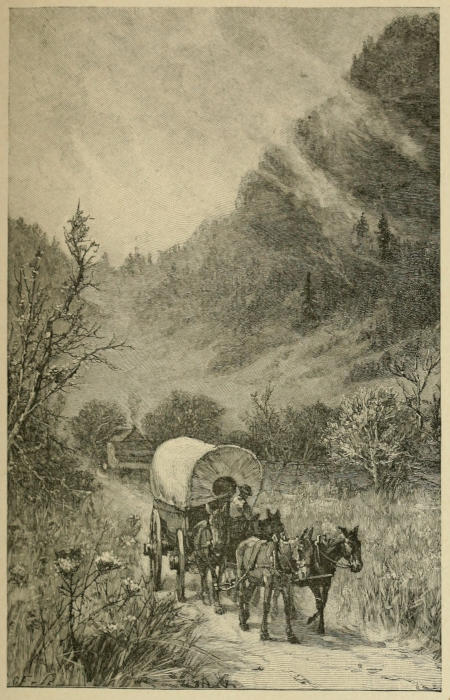
A TYPICAL SCENE IN THE APPALACHIAN MOUNTAINS
And what was for the South as yet but an exciting prospect and confident hope was for the North already a reality. The war had been a supreme test of economic vitality, and the States of the North and West had emerged from it stronger than they went into it. Almost every industry that yielded the necessaries of modern life and action had felt and responded to its quickening compulsion; and when peace came manufacturers but looked about them for wider markets, better and cheaper processes, a broader scope of operation. Artificial stimulation in the shape of heavy tariff duties had been added to the natural stimulation of the time and of the rapid and healthy growth of the nation. Congress had taxed almost every article of use in the country to support the war, and had added to the innumerable direct taxes which it imposed an enormously expanded system of duties on imports. It had done so in part to offset the direct taxes, to enable the manufacturers, who had to pay large sums to the government on the articles they made, to keep the market nevertheless against the importers; but it had made the duties much higher than that consideration taken alone made necessary. It had raised them to a point that made profit, very great profit, certain to accrue to the manufacturer. No considerable body of manufacturers asked for such “protection” that did not get it, and as much of it as they asked for, though it reduced the revenues of the government to grant it. Hardly a month went by while the war lasted that Congress did not add a new duty or increase an old one, and every industry was nursed to make the most of itself in the home markets, until its undisputed monopoly there as against foreign manufactures gave it wide margins of profit of which to avail itself in underselling competitors in the markets of the world.
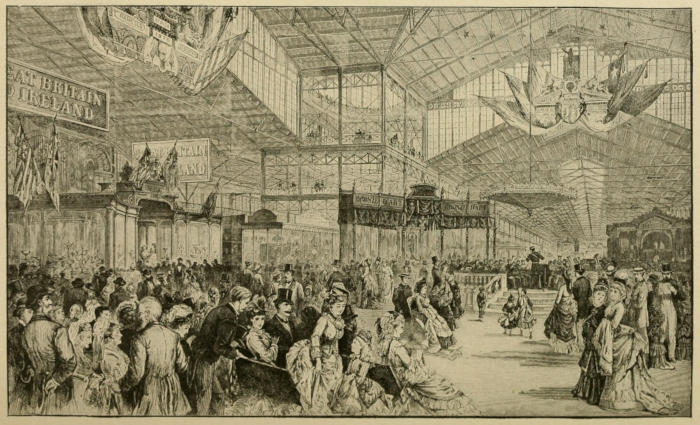
INTERIOR OF THE MAIN BUILDING AT THE PHILADELPHIA CENTENNIAL EXHIBITION
The country got visible proof of its extraordinary material progress at its Centennial Exhibition in Philadelphia. The last year of General Grant’s presidency was the centennial year of the independence of the United States, and the anniversary was celebrated by a great international industrial exposition at the city of Philadelphia, where the Congress had sat which took counsel for the young republic at its birth. All the greater commercial and industrial nations were represented in its exhibits. Foreign governments responded very promptly to the invitation to lend their aid in securing its success, among the rest the government of Great Britain, whose defeat in arms the great fair was meant to celebrate. The presence of her official commissioners made it a festival of reconciliation. America’s own bitter war of civil revolution also was over, and a time of healing at hand. The thronging crowds at Philadelphia, the gay and spacious buildings, the peaceable power of the world’s workmen exhibited upon every hand spoke of good will and the brotherhood of nations, where there was no rivalry but the rivalry to serve and to enrich mankind.
It was significant for America that objects of beauty marked everywhere among those exhibits the refinement and the ennobling art of the world. Throughout all the long hundred years in which they had been building a nation Americans had shown themselves children of utility, not of art. Beauty they had neglected. Everything they used showed only the plain, unstudied lines of practical serviceability. Grace was not in their thought, but efficiency. The very houses they built, whether for homes or for use in their business, showed how little thought they gave to the satisfaction of the eye. Their homes were for the most part of wood and the perishable material hardly justified costly ornament or elaborate design; and yet the men of the colonial time, keeping still some of the taste of an older world, had given even their simple frame dwellings a certain grace and dignity of line, and here and there a detail, about some doorway or the columns of a stately porch, which rewarded the eye. Builders of the later time had forgotten the elder canons of taste and built without artistic perception of form even when they built elaborately and at great cost. The same plainness, the same hard lines of mere serviceability were to be seen in almost everything the country made. The things to be seen at Philadelphia, gathered from all the world, awakened it to a new sense of form and beauty. Foreign governments had generously sent priceless works of painting and sculpture over sea to give distinction to the galleries of the Exhibition. Private citizens and local museums also had freely loaned their chief art treasures. Everywhere there was some touch of beauty, some suggested grace of form. Visitors poured by the million across the grounds and through the buildings of the Exhibition, out of every State and region of the country, and the impressions they received were never wholly obliterated. Men and women of all sorts, common and gentle alike, had from that day a keener sense of what was fitted to please the eye. The pride of life and of great success that came with the vision of national wealth and boundless resources to be got from the countless exhibits of farm and factory had in it also some touch of corrected taste, some impulse of suitable adornment. Men knew afterwards that that had been the dawn of an artistic renaissance in America which was to put her architects and artists alongside the modern masters of beauty and redeem the life of her people from its ugly severity.
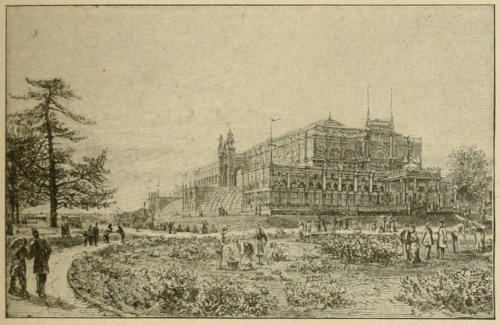
HORTICULTURAL HALL AT THE PHILADELPHIA CENTENNIAL EXHIBITION
That great fair might also serve to mark the shifting stress of the nation’s life. Its emphasis was henceforth, for at least a generation, to rest on economic, not upon political or constitutional, questions. The changing character of public affairs had been indicated as early as the presidential campaign of 1872. That campaign had witnessed not only the emergence of the “Liberal Republican” party, made up upon the questions of political amnesty and a thorough reform of the civil service of the government, but also the creation of a “Labor Reform” party whose programme said little or nothing of the ordinary political issues of the day and spoke mainly of the relations of capital and labor, of the legal limitation of the hours of daily work, of the need of a currency which should render the people less subject to the power of the banks, of the control of the railways and the telegraph lines by the federal government, of the disposal of the public lands. The convention of the new party had been made up chiefly of trades union bosses and political free lances, but it had brought delegates together out of seventeen States and was an unmistakable sign of the times. The workingmen of the country were about to bestir themselves to make their power felt in the choices of government and law. In 1876 an “Independent National” party came upon the field, to make the issue of legal tender notes by the government, in place alike of gold and of silver, the chief point of its protest against the programmes of the two regular parties. To the country it was known as the “Greenback” party. The notes which it demanded should be issued were to be practically irredeemable, being convertible, not into gold or silver, but “into United States obligations merely.” It was practically repeating the demand of the Labor Reform party of four years before for “a purely national circulating medium, based on the faith and resources of the nation, and issued directly to the people without the intervention of any system of banking corporations,” in order that there might be established “a just standard of the distribution of capital and labor.”
On all hands there was manifest a growing uneasiness because of the apparent rise of monopolies and the concentration of capital in the hands of comparatively small groups of men who seemed to be in a position to control at their pleasure the productive industries of the country; because of the power of the railways to determine by discriminating rates what sections of the country, what industries, what sorts of products and of manufactures should be accorded the easiest access to the markets; because of the increase in the cost of the necessary tools of industry and of all manufactured goods through the operation of the tariff,—the inequitable clogs which seemed to many to be put by the law itself upon the free and wholesome rivalries of commerce and production. The farmers of the West and South, no less than the workingmen of the industrial East, had begun, close upon the heels of the war, to organize themselves for the protection and advancement of their own special interests, to which the programmes of the political parties paid little heed. Between 1872 and 1875 the local “granges” of a secret order known as the Patrons of Industry had multiplied in a very significant manner, until their membership rose to quite a million and a half and was spread over almost the entire Union. It was the purpose of the order to promote by every proper means the interests of the farmers of the country, though it was no part of its plan to agitate questions of politics, put candidates for office into the field at elections, or use its gathering power to determine the fate of parties. Politicians, nevertheless, found means to use it,—felt obliged to use it because they feared to let it act for itself. Its discussions turned often on questions of transportation, upon the railways and their power to make or ruin; it was but a short step in such a field from an association for mutual protection and advice to a political party organized for the control of legislation.
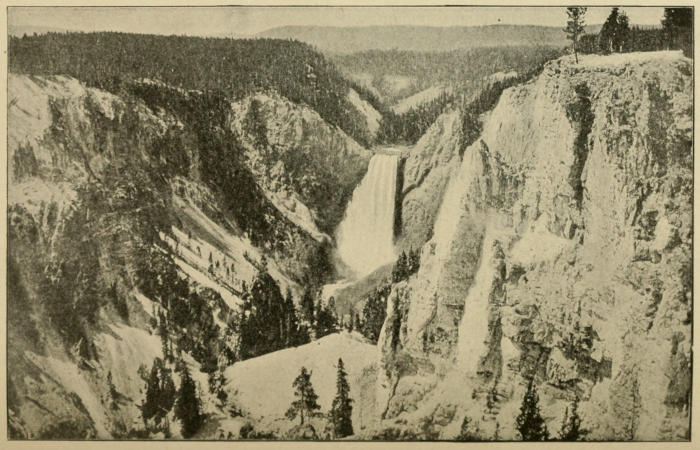
IN YELLOWSTONE PARK. GRAND CAÑON, POINT LOOKOUT, AND GREAT FALLS
“Grangers” were not always to be held off, therefore, by their prudent leaders from using their numbers and their ready concert of action to further or defeat the ambitions of particular groups of politicians; and even while their granges grew other organizations of farmers came into existence whose aims were frankly and openly political. About the time of Mr. Hayes’s accession to the presidency independent associations began to make their appearance in the South and in the West, under the name of the “Farmers’ Alliance,” whose common object it was to oppose monopoly and the power of money in public affairs in the interest of those who had neither the use of capital nor the protection of tariffs. The first “Alliance” made its appearance in Texas, to prevent the wholesale purchase of the public lands of the State by private individuals. The organization spread into other southern States, and with its extension went also an enlargement of its programme of reform. Almost at the same time a “National Farmers’ Alliance” was established in Illinois which quickly extended its organization into Wisconsin, Minnesota, Iowa, Kansas, and Dakota. Many sorts of reform commended themselves to the leaders of the movement, north and south: chief among them, government control of the means of transportation, the entire divorce of the government from the banks, and a paper currency issued directly to the people on the security of their land,—some escape from the power of the money lenders and of the great railways, and a war upon monopolies. These were vague purposes, and the means of reform proposed showed the thinking of crude and ignorant minds; but politicians felt with evident concern that new, it might be incontrollable, forces had begun to play through the matters they handled, and that it must presently be harder than ever to calculate the fortunes of parties at the polls. They perceived how difficult and delicate a task it must prove to keep the tacit pledges of the protective system to the manufacturers and give the free capital of the country the proper support of government and yet satisfy the classes now astir in these new associations of laborers and farmers, whose distress was as real as their programmes of reform were visionary.
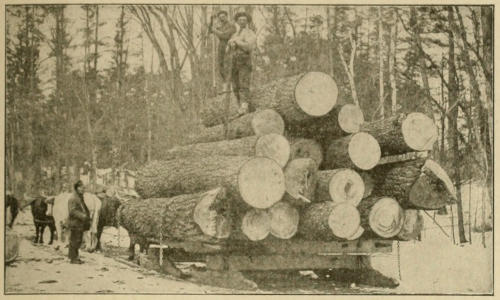
LOGGING IN THE MINNESOTA PINES.
There was a significance in these new movements which did not lie upon the surface. New questions had become national and were being uncomfortably pressed upon the attention of national party leaders because the attitude of the country towards the national government had been subtly changed by the events of war and reconstruction. The war had not merely roused the spirit of nationality, until then but half conscious, into vivid life and filled every country-side of the North and West with a new ardor for that government which was greater than the government of States, the government upon which the unity and prestige of the nation itself depended. It had also disclosed the real foundations of the Union; had shown them to be laid, not in the constitution, its mere formal structure, but upon deep beds of conviction and sentiment. It was not a theory of lawyers that had won when the southern Confederacy was crushed, but the passionate beliefs of an efficient majority of the nation, to whom the constitution was but a partial expression of the ideals which underlay their common life. While the war lasted the forms of the constitution had been with difficulty observed, had, indeed, again and again given way that the whole force of the nation might run straight and unimpeded to meet the exigencies of the portentous struggle. Mr. Lincoln had wielded an authority known to none of his predecessors. There had been moments when it seemed almost as if all constitutional rules were suspended and law superseded by force in order that the contest for nationality might not halt or be hindered. And when the war was over the process of reconstruction showed the same method and temper. No scrupulous care was taken to square what was done in the South with the law of the constitution. The will of Congress operated there like that of an absolute parliament, even while the lawyers of the houses who supported the measures of reconstruction were protesting that the States they were handling like provinces were still members of the Union. The internal affairs of the humbled States were altered at the pleasure of the congressional leaders, and yet it was said that they had not been put forth from the pale of the constitution.
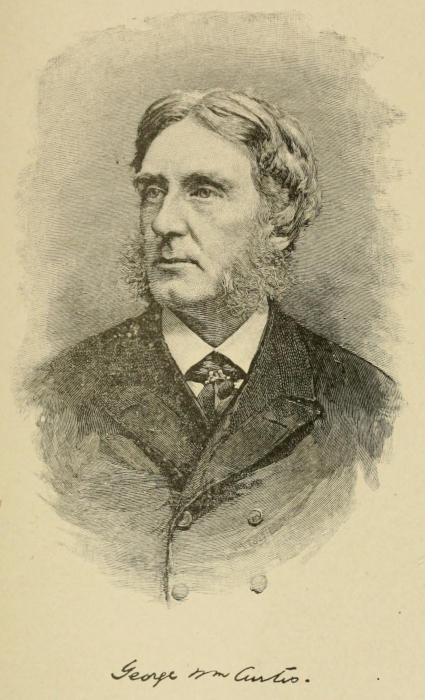
GEORGE WILLIAM CURTIS
It was inevitable that the whole spirit of affairs should be profoundly affected by such events. A revolution had been wrought in the consciousness and point of view of the nation. Parts had shifted and the air had changed. Conceptions were radically altered with regard to Congress, with regard to the guiding and compulsive efficacy of national legislation and the relation of the life of the land to the supremacy of the federal law-making body. A government which had been in its whole spirit federal had, almost of a sudden, become national, alike in method and in point of view. The national spirit which the war had aroused to bring this about had long been a-making. Many a silent force which grew quite unobserved from generation to generation, in quiet times of wholesome peace and mere increase of nature, had been slowly breeding the thoughts which had now sprung so vividly into consciousness. The very growth of the nation, the very lapse of time and uninterrupted habit of united action, the mere mixture and movement and distribution of populations, the mere accretions of policy, the mere consolidation of interests, had been building and strengthening new tissue of nationality the years through, and drawing links stronger than links of steel about the invisible body of common thought and purpose which is the substance of nations. When the great crisis of secession came men knew at once how their spirits were ruled, men of the South as well as men of the North,—in what institutions, in what conceptions of government their blood was fixed to run; and a great and instant readjustment took place, which was for the South, the minority, practically the readjustment of conquest and fundamental revolution, but which was for the North nothing more than an awakening.
There had been no constitutional forms for such a business. For several years, consequently, Congress had been permitted to do by statute what, under the older conceptions of the federal law, could properly be done only by constitutional amendment. The necessity for that gone by, it was suffered to embody in the constitution what it had already enacted and put into operation as law, not by the free will of the country at large, but by the compulsions of mere force exercised upon a minority whose assent was necessary to the formal completion of its policy. The result restored, practically entire, the forms of the constitution; but not before new methods and irregular, the methods of majorities but not the methods of law, had been openly learned and practised, and learned in a way not likely to be forgotten. It was not merely the economic changes of a new age, therefore, that inclined laborers and farmers to make programmes of reform which they purposed to carry out through the instrumentality of Congress; it was also this new conception of the supremacy of the federal law-making body, of the potency of all legislation enacted at Washington. The country was turning thither for all sorts of relief, for assistance in all parts of its life.
And yet other changes had come upon the government at Washington which rendered it a less serviceable instrument of use than it had once been. Nothing had become more emphasized during the reconstruction period than the virtual supremacy of the houses over the President in all matters outside the field of war and foreign affairs,—in foreign affairs even, when they chose. No President since General Jackson had been the real leader of his party until Lincoln; and Lincoln’s term had made no permanent difference in the practices established since Jackson’s day. It had been a time apart. In war the Executive was of course at the front of affairs; Congress but sustained it in the conduct of exigent business which, in the very nature of the case, it could not itself undertake. Parties, too, were silent; the nation had put ordinary questions of policy aside. No man could say how Mr. Lincoln might have ruled the counsels of his party in times of quiet peace. With Mr. Johnson in the presidency, Congress and the Executive had swung violently apart. General Grant had not brought them together. He was no party man and no statesman, had been bred to affairs of another kind, let constructive suggestion alone, made no pretence of political leadership. Under the strong will of Mr. Thaddeus Stevens a real primacy in affairs had been created for the men who led upon the floor of the houses, and old tendencies had been confirmed.
During the first days of the government, while the old order held and English traditions were still strong, the President had been the central figure in affairs,—partly because delicate questions of foreign policy pressed constantly for solution, partly because the early Presidents were chosen from the ranks of actual party leaders, because of their influence with public men, their hold upon opinion, and their experience in public business. Their messages were of the first consequence in the guidance of legislation and the formation of opinion out-of-doors; their spokesmen and friends usually spoke for the President’s party as well as for the President himself on the floor of Congress. Even then, however, there had been signs of a new order coming in. Neither the President nor the members of his cabinet had had access to the floor of Congress since Mr. Jefferson decided not to meet the houses in person, as his predecessors had done. It was the theory of constitutional lawyers that Congress and the Executive were meant to be sharply separated and distinguished in function, in order that each might check and balance the other in ideal accordance with the principles of M. Montesquieu; and there were oftentimes men in the houses whose gifts and impulse of initiative were greater, more efficient, more serviceable than the President’s. Mr. Clay had been notable among such men. While he was Speaker of the House of Representatives it became evident that the speakership could easily be made the chief place of power in the management of parties; and so long as he remained in Congress the whole country knew that he, and no President the Whigs were likely to elect, must be the real leader of his party.
That General Jackson dictated the policy of the Democrats while he was President all the world perceived; but his successors were not men of his stamp. Affairs, moreover, were presently turned from their normal course by the extraordinary pressure of the slavery question. Upon that perplexing matter, so disputable, so full of heat, apparently so impossible of definitive settlement, always holding a crisis at its heart, parties made no confident stand. Definite leadership seemed out of the question, until Mr. Douglas came and brought a revolution on. All things waited upon the slow movement of moral, social, economic forces, upon the migrations of population, upon the insensible shiftings of sentiment, upon change and circumstance. Not until the war came, with issues which needed no definition at the hands of the politician, with tasks which called, not for debate, but for concentration and energy, did the organization of party power in Congress take the shape it was to keep through the next generation,—the new generation which should conduct the war to its close and then attempt to set the policies of peace afoot again. Then, with Congress purged of the southern Democrats and all organized opposition cleared away, the Republican leaders equipped Congress for effective mastery. The Senate, indeed, kept its leisurely rules, still chose its committees by ballot, and declined to put itself under the whip of rigid party discipline as the House did, which seemed to regard itself as meant to be an administrative, not a deliberative body. The House put itself into the hands of its leaders for action. Its leaders were the chairmen of its principal standing committees and its Speaker. The Speaker appointed the committees. In determining the membership of those which were to handle the chief matters of its business he could determine also the policy they were to urge upon the House. For the House put itself very absolutely into the hands of its committees. Individual initiative told for little against them.
The first Speaker of the war time, Mr. Galusha Grow, of Pennsylvania, was a man cast for the rôle of leader, quick, aggressive, confident alike in opinion and in purpose, a thorough partisan, and yet honest and open and ready for responsibility, a man who would use the committees for mastery; and Mr. Schuyler Colfax, who succeeded him, in the second Congress of the war time, was equally well qualified to keep the management of the House in hand, his good nature and easy tact being as influential as his confident initiative in keeping legislation to the paths he had marked out. Both, men acted in close co-operation with Mr. Stevens and the other chief masters of the majority upon the floor. The conferences of a few men decided always what the composition of committees should be, the course of legislative action, the time and part allotted to debate. The necessity for action was constantly pressing upon Congress throughout those anxious years; no man ventured to stand long in the way of the public business; and by the time the war was over the House had been converted into a most efficient instrument of party rule. Mr. Johnson learned what its mastery was, how spirited, how irresistible; General Grant looked to its leaders for initiative in affairs. The Speaker and the little group of party managers drawn about him for counsel were henceforth to be in no small part the framers of the policy of the government.
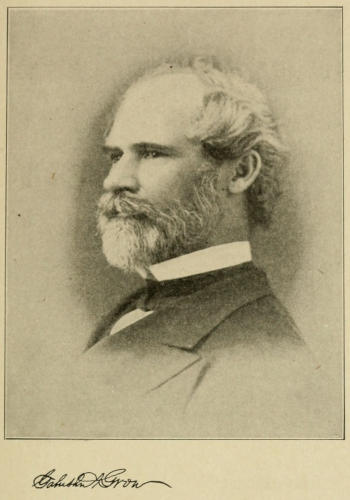
GALUSHA AARON GROW
The change was for a long time not observed by the country at large, because the two parties offset each other in the houses and neither could take entire command of affairs. For fourteen years (1876-1890) neither party during any one session controlled both the houses and the presidency, except for a brief space of two years (1881-1883) when the Republicans, with a Republican President in the chair, had, by the use of the Vice President’s casting vote in the Senate, a majority of a single vote in each house. So scant a margin was not a margin of power, and the Speaker happened for the nonce to be of the older type, not cast for leadership.
That long deadlock of the houses was of much more serious consequence than the mere postponement of a full application of the new methods of party leadership and legislative management. So long as it lasted no change could be made in the laws passed in support of Republican supremacy and negro suffrage in the South. The country had turned away from the Republicans, as the elections to the House showed afresh every two years, but the majority of the nation and the majority of the States were by no means one and the same, and the Senate came only for a little while into the hands of the Democrats, while a Republican President was in the chair. Democratic majorities, accordingly, did not avail to repeal the “Force Acts” and the federal law for the supervision of elections which put the southern political leaders in danger of the federal courts and kept men of the President’s appointment at the polls in the South to act in behalf of the negroes and the Republican managers. Though the white men of the South were at last in control of their state governments, federal law still held them off from excluding negroes from the exercise of the suffrage by any fair or open method which should set aside without breach of law what reconstruction had done. They were driven, if the incubus of that ignorant and hostile vote was to be lifted from their affairs, to resort to covert, tricky, fraudulent means which brought their own deep demoralization.
Every device known to politicians, every plan that could be hit upon that politicians had never before been driven to resort to, was made use of to reduce or nullify the negro vote. It was a great advantage to the men who had regained their power in the South that the whole machinery of elections, at least, was again in their hands. They had never before made such use of it. The older traditions that surrounded the use of the ballot in the South were of the most honorable sort. But the poison of the reconstruction system had done its work,—no man any longer found it hard to learn methods of mastery which were not the methods of law or honor or fair play. The new election officers found many excuses for rejecting or ignoring the negroes’ voting papers. Voting places were often fixed at points so remote from the centres of population that only a small proportion of the negroes could reach them during the hours for voting; or were changed without notice so that only the white voters who had been informed could find them readily. In some cases separate ballot boxes were used for the several offices to be filled at the elections, so lettered that the illiterate negroes distinguished them with difficulty and so shifted in their order from time to time that the sequence in which they stood was constantly being changed, and no vote was counted which was not put into the right box. In districts where the negroes mustered in unusual numbers too few voting places were provided, and the voters were prevented from casting their ballots rapidly by premeditated delays of all sorts, so that the full vote of the district could not be cast.
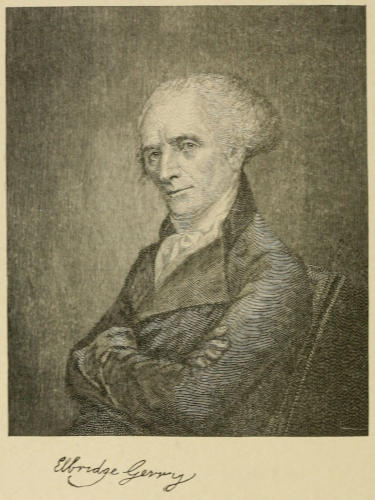
ELBRIDGE GERRY
The southern legislatures hastened to adopt the device long ago originated by Mr. Gerry, of Massachusetts, and so divided the voting districts of the States as to segregate the negroes within a few districts, whimsically drawn upon the map in such a way as to seek out and include the regions in which they were chiefly massed. The “shoe-string district” contrived by the law-makers of Mississippi, which ran its devious way across the State for three hundred miles with a width of but twenty, became known the country over as a type of what was being done to cut the negroes off from political power in the South. Where such shifts and expedients failed of their desired result or could not be made use of actual fraud was practised. The less scrupulous partisans of the white party managers folded tissue ballots within their regular voting papers and overcame the negro majority by multiple voting. Dissuasion, too, and all the less noticeable means of intimidation, played their quiet part the while in keeping the negroes away from the polls, and the negro vote fell off by the thousand. There was presently nothing left of the one-time party organization of the Republicans in the South except that the federal office holders appointed by Republican Presidents still essayed to play an influential part among the negroes, and hold them to their party allegiance.
Slowly cases tried under the various Enforcement Acts which had been meant to secure the negroes against interference and intimidation in the exercise of their civil rights crept up, by appeal, to the Supreme Court of the United States and began one by one to be reached on its interminable docket; and in each case the court declared the powers Congress had assumed in those Acts clearly incompatible with the constitution. The right of the negroes to assemble and to bear arms, for example, which Congress had sought to protect and which southern white men had repeatedly interfered with, was a right which they enjoyed, the court declared, as citizens of the States, not as citizens of the United States, and it was not competent for Congress or the federal courts to punish individuals who interfered with it. The power conferred upon Congress by the Thirteenth, Fourteenth, and Fifteenth Amendments, to secure the negroes equality of civil rights with the whites, was, it decided, a power given to be exercised in restraint of the States, not against individuals, as the Act against the “conspiracies” of the Ku Klux had used it, and the States, not the federal government, must punish those who sought to destroy that equality. The legislation which General Grant had put so energetically into execution was unconstitutional and void. But it was 1882 before that sweeping conclusion was reached; the Acts had been executed long ago and their consequences were complete. Only the thought of constitutional lawyers and the course to be pursued by the federal government for the future were cleared by the belated decisions.
More and more the attention of the country, and even of politicians, was being drawn away from the South to the forces of change which were playing through the whole nation, to the determination alike of policy and of party fortunes. The four years of Mr. Hayes’s term in the presidency, with their restful discontinuance of party legislation, afforded not only a time of calm in which thoughtful men could look about them, but also a clear stage upon which it quickly became evident that new scenes were being set. It was significant that the first summer of Mr. Hayes’s reign of peace was marked by labor disturbances of a magnitude and difficulty hitherto unknown in America. On the 14th of July, 1877, strikes began among the employees of the Baltimore and Ohio, the Pennsylvania, the Erie, and the New York Central railways, the chief trunk lines between East and West, which for a time assumed almost the proportions of an armed insurrection. Thousands of miners at the coal mines of Pennsylvania left their work along with the railway men, until there were presently, it might be, a hundred thousand men not only idle but bent upon mischief also, determined to hold the business of the railways at a standstill and prevent at all hazards the employment of others in their places. Not until troops of the United States had been called out to aid the militia of the States was order restored and the property of the railway companies secured against pillage and destruction. Railway traffic had been held still in a sort of paralysis for two long weeks; property whose value was estimated at ten million dollars had been destroyed; and the country had been given a startling demonstration of the power of the labor organizations.
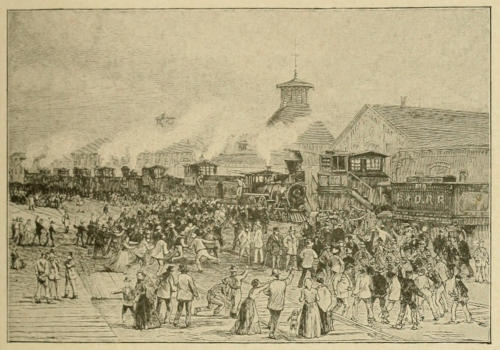
BLOCKADE OF ENGINES AT MARTINSBURG, VIRGINIA
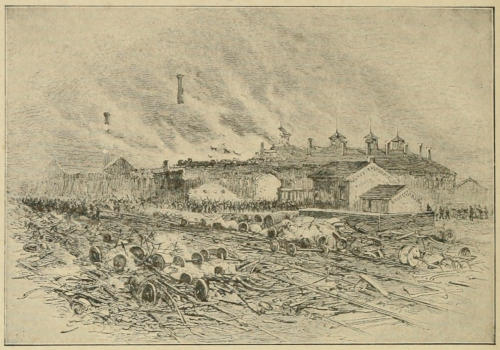
BURNING OF THE ROUND HOUSE AT PITTSBURG, PENNSYLVANIA
Such outbreaks were undoubtedly a sign of the times and showed very plainly the new, unregulated economic forces which were in a future near at hand to exercise a potent influence on politics and the plans of parties. But they were at least gross, tangible, susceptible of being handled by counter force and sheer authority. There were subtler economic forces than these at work, harder to handle, more to be feared. Ideas were rapidly gaining ground in the ranks of all parties which seemed likely, if unchecked, to break party lines athwart in novel confusion and turn the government away from some of its oldest, best established lines of policy. They chiefly concerned the currency. Congress had met the extraordinary expenses of the war by measures which had in fact revolutionized the traditional financial policy of the government. Taxes had not yielded enough, loans could not be had fast enough, and early in 1862 it had begun the issue of notes from the Treasury of the United States which were for the time irredeemable, but which were nevertheless made legal tender in the payment of debts. Late in 1861 (December 28th) the banks of the country had suspended specie payments. The paper of the government became almost the only currency, and its bulk rose steadily from million to million. War and the depreciation of the currency brought in their train an inflation of prices. Farmers had been getting little profit from their crops when the war began. The cost of transporting them to market over the railways had lifted the cost of their production quite to the level of what the merchants would give for them. Many planters used their corn for fuel. But the war made grain exceedingly valuable. The purchases of the government alone changed the whole face of the market. Money was once more easy to get, the paper money of the Treasury, and could be used at its face value as well as gold itself to pay the mortgages off which the older time of stress had piled up. The “greenbacks” of the government became for the agricultural regions of the North and West a symbol of prosperity.
Conservative constitutional lawyers had doubted from the first the legality of these issues. Every serious student of the times in which the constitution had been framed, and of the dominant motives of its framers, was convinced that one of the chief objects of the statesmen who led the convention of 1787 had been to put government in America once for all upon a solid footing of sound financial policy. The constitution explicitly forbade the issue of paper money by the States, and the right to issue it was not to be found among the enumerated powers granted to Congress. It was known to have been intentionally omitted; and in 1869 the Supreme Court had decided that the treasury issues of the war time were, as legal tender, unconstitutional and void. For a little while it had looked as if the law of the constitution was to be made a permanent bar to financial experiment. But the decision of the court had been reached by only a single vote, changes in its personnel occurred almost immediately, and in 1870 the decision was reversed. Congress was at liberty to make what experiments it pleased.
Thoughtful public men saw, nevertheless, that the business interests of the country rendered it imperative that by statute, if not by constitutional compulsion, specie payments should be resumed by the government, the redundant currency of the country contracted, and money transactions put once more upon foundations that would hold fast. Gold had been made the single standard of value in the United States by an Act of Congress passed in 1853. That Act had said nothing about the silver dollar of the earlier coinage, because it had in fact passed out of circulation. The Act of 1873 had simply recognized that fact and dropped the 412½ grain silver dollar from the list of coins. An Act of January 14, 1875, had provided for the resumption of specie payments by the government on the 1st of January, 1879. Every promise of the government was on and after that date to be redeemable in gold. By 1876 an extraordinary fall had taken place in the value of silver. It had been coming in augmented quantities from the mines; Germany and even the states of the Latin Union, associated by treaty for the express purpose of maintaining a stable ratio between gold and silver in their exchanges, had suspended the coinage of silver; the demand for it had greatly fallen off at the very time that its quantity had increased, and the price of silver bullion fell as it had never fallen before. The real functions of money, the real laws of its value, the real standards of its serviceability, its real relations to trade and to industry have always been hidden from the minds of men whose thought in such matters has not been trained by the actual experiences of the open markets of the world, in actual exchange, or in the actual direction of the financial operations of governments. The coincidence of high prices and eager markets with floods of paper poured from the Treasury of the United States, coupled with the indisputable fact that the return to slacker demand, lower prices, and a greater scarcity of money had been accompanied by a considerable contraction of the redundant currency and by laws which were soon to bring about a return to specie payments, a turning back from “cheap” money to “dear,” confused the thinking even of some men who had long been in contact with public affairs; and those who could not go quite the length of the “Greenbackers” turned to silver for relief.
Gold was not abundant enough, they said, to serve as the sole basis of the country’s expanding business, get the farmers’ crops to market, or settle the varied balances of trade. Silver was both cheaper and more abundant. The obligations of the United States had been made payable “in coin”; why must they be paid in the dearest of coins? Why could they not be paid in the old silver dollar of 412½ grains, until 1873 the undisputed standard silver dollar of the national coinage? It was in part the suggestion of the owners of the silver mines of Colorado and Nevada, no doubt, who had influential spokesmen in Congress; but they alone could have created no determining opinion in the matter. The real force of the sentiment came from the uneasy economic conditions of the country. The farmers found themselves at the mercy of the railways in getting their crops to market; prices had fallen; money was not easy to get as it had happened to be when abundant issues of paper came pouring every month from the government’s treasury; the gold which Congress had sought to make the sole basis of the country’s business was in the hands of the great eastern bankers; the railways were in the hands of the capitalists of the East, whom the bankers served. If the bankers set themselves against every proposition to provide an irredeemable paper currency again or even a fresh coinage of silver, there was the more reason to believe that paper or silver was the only real “people’s” money. The sentiment grew within Congress and without and concentrated itself upon the question of a silver coinage. Reason had not established it and reason could not check or dislodge it. It took hold upon Republicans and Democrats alike, and within a year of Mr. Hayes’s accession to the presidency had won majorities in both houses which were large enough to override the President’s veto.
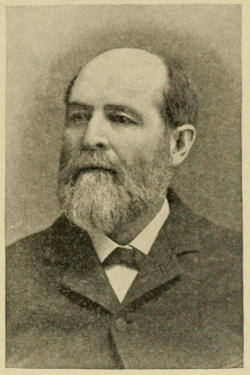
RICHARD P. BLAND
Mr. Bland, of Missouri, introduced in the House a bill which provided for the free and unlimited coinage of silver into standard dollars of 412½ grains at the mints of the United States at the pleasure of those who presented silver bullion which they wished so converted. The finance committee of the Senate, under the leadership of Senator Allison, of Iowa, when the bill reached them, substituted for it a measure which provided for the monthly purchase by the Treasury of not less than two million dollars’ worth of silver bullion and its coinage into standard silver dollars which should be legal, tender, without restriction of amount, in the payment of all debts. The Secretary of the Treasury was authorized at his discretion to expend as much as four millions monthly for the purpose. The House accepted the measure which Mr. Allison’s committee had substituted for its own. Mr. Hayes vetoed it, but the houses passed it over his veto, February 28, 1878. The majority for it was as decisive in the Republican Senate as in the Democratic House. Specie payments were resumed on the 1st of January, 1879, as the Act of 1875 directed, but silver had been added to gold. The Secretary of the Treasury made his purchases of silver bullion at its market value in gold, of course; its price fell in spite of the Bland-Allison Act, because it was governed, as every man of experience in such matters knew it must be, by influences as wide as the markets of the world; and the monthly coinage steadily yielded more than two million coined dollars of the fineness prescribed by Congress, though the Secretary of the Treasury confined himself always to the expenditure of the minimum sum fixed by the Act. Not many of the coined dollars themselves got into the currents of trade. The Act had authorized the Secretary to issue certificates in their place to those who did not wish the actual silver, and the coins steadily accumulated in the vaults of the Treasury, some thirty millions a year.
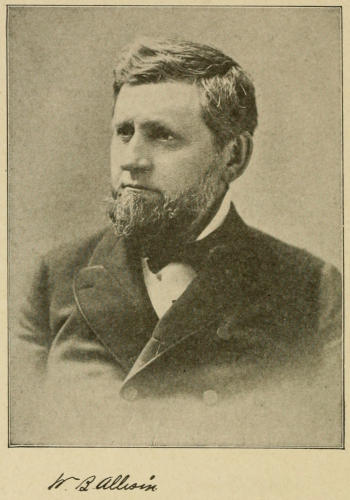
WILLIAM B. ALLISON
This was the only legislation of importance, apart from the routine business of the government, that a Republican Senate and a Democratic House could agree upon. All party purposes of necessity stood in abeyance. Mr. Hayes had as little political authority as Mr. Johnson had had. He had been chosen, as Mr. Franklin Pierce had been twenty-five years before, from outside the ranks of the authoritative leaders of his party. He had no real hold upon the country. His amiable character, his lack of party heat, his conciliatory attitude towards the South alienated rather than attracted the members of his party in Congress. They had been accustomed to see the fight forced for coercion and supremacy in the South, as for the execution of every other party purpose, and the zest for strong measures was still upon them. The President, besides, would not listen to them in matters of appointment to office, as General Grant had listened, to his undoing, but went calmly about to have his own way in dispensing the patronage. The Democrats did not like him because he seemed to them incapable of frank, consistent action. He withdrew the troops from the southern States to let politics there take their normal course, and yet he appointed the one-time members of the discredited returning boards to federal offices, as if to console them for their loss of power. He was not aggressive enough to draw a party of his own about him, and yet he had a character too firm, too self-respecting, too deeply touched with a sense of individual responsibility to accept advice which his own judgment did not approve. He went his own course and kept affairs at their quiet poise, awaiting a change of weather. The second Congress of his term was Democratic in both branches and made trial of every expedient known to parliamentary strategy to force upon him a repeal of the statutes which gave federal supervisors and marshals powers of oversight and arrest at the southern polls; but the President was too stout a partisan to consent and stood fast against them. All things stood as they were until the elections should come again.
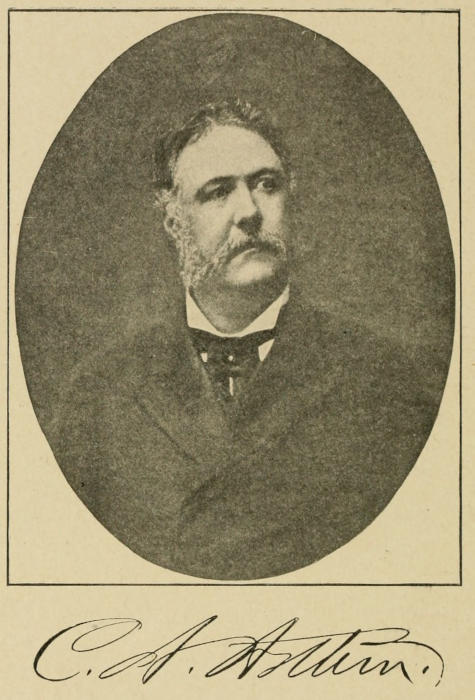
CHESTER ALAN ARTHUR
Mr. Hayes was not nominated for a second term. Determined efforts were made in the Republican nominating convention, which met June 5, 1880, at Chicago, to nominate General Grant again and return to the party’s old régime; but they were defeated, and Mr. James A. Garfield, of Ohio, was named as the party’s new candidate for the presidency, Mr. Chester A. Arthur, of New York, as its candidate for the vice presidency. Neither of the candidates could claim especial eminence. Mr. Garfield had won high rank and enviable distinction as an officer of volunteers in the war, had become a member of the House when the struggle had but just passed its central crisis at Gettysburg, and had served continuously there until chosen a senator of the United States in the very year of his nomination for the presidency, without making himself felt except for his attractive personality, his serviceable confidence and courage as a parliamentary leader, and his power as an orator. But he stood within the intimate counsels of his party as Mr. Hayes did not. Mr. Arthur had been collector of the port of New York, but had stood for the most part aside from national politics, a lawyer and managing servant of his party within the State rather than a conspicuous figure in its general counsels. They were not men to catch the enthusiasm of the country. But the party that was back of them had gathered again some of its old momentum; the Democrats had no policy to propose which seemed vital or of the new age that had come in, and presented as their candidates only an attractive soldier, General Winfield Scott Hancock, and Mr. William H. English, a successful business man of Indiana, who had been no politician since Kansas was admitted to the Union. Though the Democratic voters mustered strong at every polling place and fell but a little more than nine thousand behind the Republicans in a total vote of more than nine millions, they carried no States north of Mason and Dixon’s line except New Jersey, Maryland, California, and Nevada, and Mr. Garfield was chosen President by a majority of fifty-nine in the electoral college (214-155).
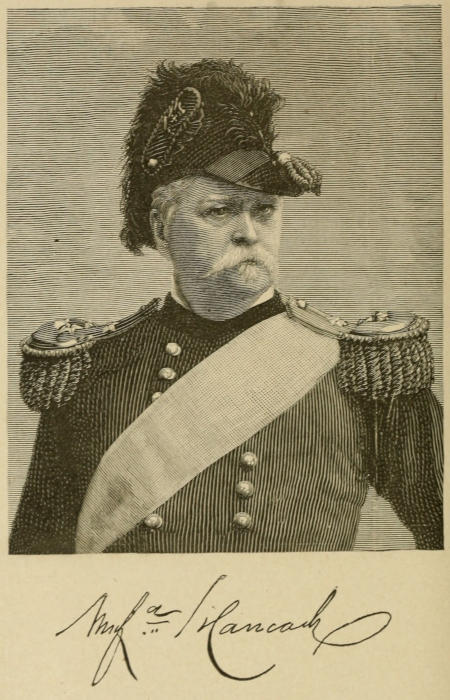
WINFIELD SCOTT HANCOCK
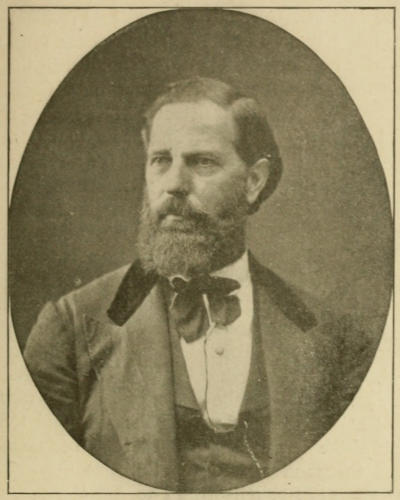
WILLIAM H. ENGLISH
The only note of new questions sounded in the campaign came from the convention of the “Greenback-Labor Party,” in which reformers of the more radical sort had united. It had declared, turning to what seemed for the moment the chief question of the day, that “all money, whether metallic or paper, should be issued and its volume controlled by the government, and not by or through banking corporations, and, when so issued, should be full legal tender for all debts, public and private.” It had demanded that the greenback notes of the war time “should be substituted for the notes of the national banks, the national banking system abolished, and the unlimited coinage of silver, as well as gold, established by law.” But for the present the country preferred to make choice, not among new parties, but between the old, which it knew, and the programme of the new party got but a few more than three hundred thousand votes out of the nine millions cast. The Democrats not only failed to get the presidency but also lost their majorities both in the House and in the Senate, though by a margin so slender that the Republicans were to find that they could make little confident or aggressive use of their advantage.
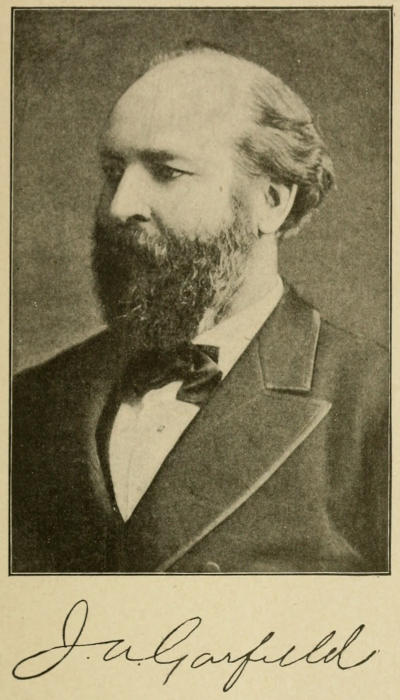
JAMES ABRAM GARFIELD
The transition from Mr. Hayes to Mr. Garfield seemed but a natural exchange of a man who did not lead for a man who had a real hold on the affections and the allegiance of his party and could stand at its front to make policy; but it had scarcely been made when the air seemed to fill with ominous signs of sinister disquiet. The poisonous influences which had long been gathering about the system of appointments to office, the spirit of intrigue and of personal aggrandizement, the insistent scheming and dictation of members of the houses to force their preferences and the arguments of their private interest upon the acceptance of the President, the brazen, indecent clamor of the meaner sort of partisans for preferment, seemed of a sudden to work with fatal violence upon affairs. Mr. Garfield asserted a will of his own in the matter, and the two senators from New York, Mr. Roscoe Conkling and Mr. Thomas Collier Platt, resigned their seats, as if upon some weighty quarrel in matters of state, because he would not heed their wishes and choose their nominee in naming a collector for the port of New York. Office seekers swarmed about the President with quite unwonted arrogance, and before he had been four months in his uneasy place of authority one of the crowding throng whom he had disappointed wreaked foul vengeance upon him. On the morning of the 2d of July, 1881, as he passed through a railway station at Washington on his way to the seaside to seek a much needed respite from the harassments of those first months of bitter wrangle and discord, he was shot by Charles Jules Guiteau, a man maddened by disappointed vanity because he had not obtained the office he sought. For eighty days the President lingered between life and death, but death conquered, and on the 19th of September the end came. On the 20th Mr. Arthur took the oath as President.
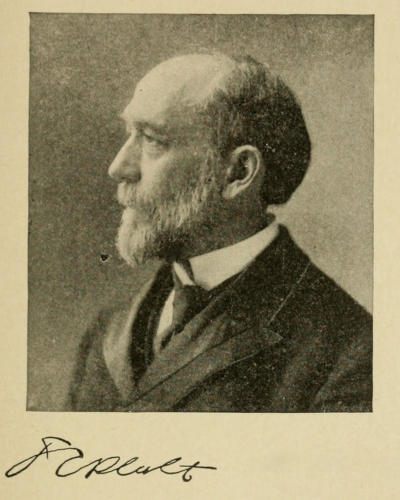
THOMAS COLLIER PLATT
Thoughtful men had looked about them, the while, to see what this new and sinister thing meant. Some part of its explanation lay upon the surface. It might, no doubt, fairly be ascribed, in part at least, to the sharp factional split that had shown itself in the Republican ranks in the convention which had nominated Mr. Garfield. The “stalwarts” of the party, whom Mr. Conkling had led, and who had fought desperately in the convention to secure the renomination of General Grant, were of the older temper of the party, had hated Mr. Hayes very cordially for his mildness and lack of partisan vigor, and were bent upon carrying Republicans back to the methods which others saw had discredited them in their day of power. They had been defeated by the “halfbreeds” of the convention, as they contemptuously designated their opponents within the party, and Mr. Garfield was in their eyes the representative of the halfbreeds. Mr. Conkling had supported him in the campaign, despite his feeling of personal defeat, and Mr. Conkling’s friends felt sure that his eloquence and personal influence had availed as nothing else could have availed to keep the State of New York to its allegiance to the Republicans in the election. His generosity in that matter they deemed worthy of reward. But Mr. Garfield would yield him no special consideration; and, because the President held himself resolutely at a balance as between faction and faction in his use of the patronage and pointedly ignored the wish of the stalwarts in his appointment to the collectorship of the port of New York, Mr. Conkling had flung out of the Senate and appealed to the legislature of New York for re-election, as a demonstration of power against the President. He had failed. The legislature would not so rebuke the President. But factional bitterness had been wrought to the highest pitch, and the tragedy of the President’s death seemed to the country an object lesson in its consequences.
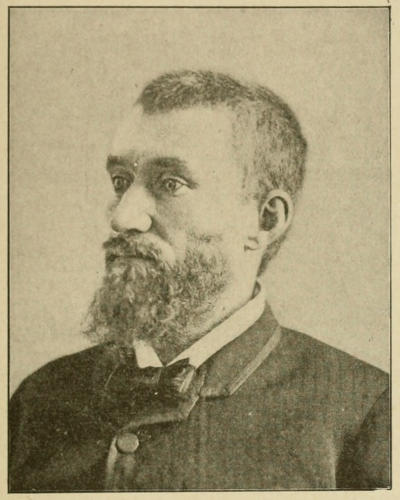
CHARLES JULES GUITEAU
The attention of the country was fixed at last, with painful intensity of interest, upon the character and influence of the civil service. Not a little of the true nature of the existing system of appointments to office had been laid bare by Mr. Conkling’s extraordinary act of self-assertion. The use of appointments as rewards for party services did not, it seemed, bind partisans together, after all, as the advocates of the spoils system claimed, or compact and discipline parties for aggressive and successful action. Worked out through its detail of local bosses, senatorial and congressional “influence,” personal favors, the placating of enemies and the full satisfaction of friends, it must always menace the successful party itself with factional disruption. Guiteau, the assassin, had said that he fired his shots for the “stalwarts,” that Mr. Arthur, their friend, might be President; and those murderous shots still rang in the ear of the country like a startling confirmation of all that the advocates of civil service reform had said. Congressmen saw opinion at last set steadily, irresistibly towards radical measures of reformation, with a force and certainty it had never shown before, and Democrats and Republicans found one more question upon which opinion beating upon them as it did, they must agree. In August, 1881, while the President lay dying, various local associations which had been formed to agitate the question of the reform of the civil service were drawn together, in a meeting held at Newport, Rhode Island, into a National Civil Service Reform League, whose first act was to express its hearty approbation of a bill for the reform of the service which Mr. Pendleton, of Ohio, had introduced the preceding year in the Senate.
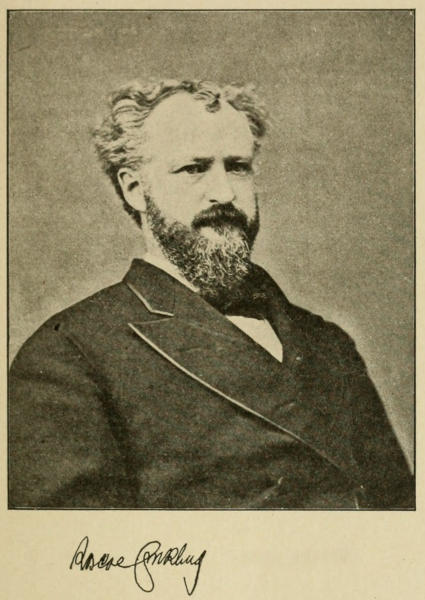
ROSCOE CONKLING
The bill would no doubt have lain almost unnoticed on the docket of the Senate had not Mr. Conkling’s arrogance and Guiteau’s madness of bitter passion disposed all the country to consider what must be done. Mr. Pendleton was a Democrat, but he spoke only for himself and for other men of like conviction in the matter, not for his party, in the bill in which he proposed a return to the system of competitive appointments which Congress had authorized in 1872 and abandoned in 1874. Neither did he speak for the party in power, who regarded such a measure as a mere curtailment of its political influence. Even the tragedy of 1881 did not shake the politicians from their stubborn hostility. For almost two years the bill lingered and made no progress, despite the unmistakable evidences of opinion out-of-doors. But the elections of 1882 sufficed to bring it to life. In the Congress chosen in 1880 the Republicans predominated, by a bare majority, too small to use, in both houses. But the elections of 1882 put into the House a Democratic majority of more than eighty and aroused the Republicans to a sudden sense of their responsibility to the public opinion of the country. The Senate, changing by States, not by the sweep of the popular vote, remained in their hands; their majority there was even increased. In the existing Senate they had had to rely on the casting vote of the Vice President for their majority; in the new Senate they were to command a serviceable majority of four. But they read the signs of the weather with as keen an apprehension as if they had lost both Senate and House. The Democrats, on their part, were ready to enhance their growing credit with the country by showing themselves willing advocates of reform. On the 6th of January, 1883, accordingly, before the new Congress met, the Pendleton bill passed both houses by large majorities, almost as if without serious dissent; and Mr. Arthur signed it at once with hearty approval.
It provided for appointments to office by competitive examination and for the constitution of a Civil Service Commission which should be charged with the execution of its provisions, the establishment of proper tests, the conduct of examinations, and the careful enforcement of the rules of eligibility. It did not include all classes of the civil service, but it at least took rank and file, all clerical offices and all offices not of special trust and confidence, out of the reach of the politicians, and began a reform which the President could, under the terms of the Act itself, extend at his pleasure. Mr. Arthur sought to have it administered efficiently and in thorough good faith, for it had his sincere approval. He had shown from the first a dignity, a tact, a firmness, a sense of public duty in the administration of the great office so unexpectedly thrust upon him which had filled the country not less with surprise than with deep satisfaction. His selection by the Republicans for the vice presidency had given even stout partisans uncomfortable misgivings. He had been known in New York as of the group of office-holding politicians rather than as a man devoted to the larger kind of public service; his company had been that of the petty managers of the party’s local interests, more interested in patronage than in public questions, a “stalwart” who took his cue from larger men. But the presidency brought his finer qualities to light. His messages and state papers read like the productions of a man of unusual capacity, information, and literary power. He seemed to make his chief appointments with a view to the efficiency of the public service rather than with a view to political advantage. He dealt with the bills sent to him by Congress in a way that lacked neither courage nor discrimination. Faction was quieted and the course of affairs ran cool again, with an air in which men could think.
There was need for dispassionate thinking. Each year disclosed more clearly than the year which had preceded it the altered temper of the times, the questions of industrial development, of the relations between capital and labor, of tariff readjustment, and of currency reform which must take precedence of the older questions of politics, of constitutional privilege and civil rights, which had cut the former lines of cleavage between parties. The tariff duties which had been adjusted to the conditions and financial necessities of the war time were now piling up in the Treasury balances too large to be used. Obviously something must be done to ease the country of the unnecessary burden. Democrats and Republicans could not easily agree upon such a question. It was an old question in a new guise and had always separated Democrats from the Whigs from whom Republicans took their traditions in such a matter. The first approaches to reform were made very slowly, therefore, very guardedly, with a handsome show of careful consideration but very little show of action. In the winter of 1881-1882 a commission was appointed to travel through the country and take testimony with regard no less to the local than to the national conditions of trade and industry, for the purpose of supplying Congress with trustworthy data upon which to act in reducing the duties. Its report was in due course made, and an Act was passed which effected a reduction of duties which was in substantial accord with its recommendations. But the majority of the commission had been made up of stout protectionists, and the changes in the tariff which it recommended made little difference either in the revenues or in the incidence of taxation.
It began to be plainly evident, moreover, that the tariff question was but a part of that general question of the development of trade and industry which year by year grew so various, so complex, so difficult to set justly apart in its elements. The country was undoubtedly prosperous. The South, especially, was showing how it could respond to the economic stimulation of the time, to the general development of the resources of the country, now that its corrupt governments, with their negro majorities, were lifted from its shoulders. But the very expansion of industry, the very growth and cumulative productiveness of capital made difficulties of their own,—difficulties novel, unlooked for, in the handling of which statesmen were without experience or precedent and even men of business without standards of judgment. Capitalists were effecting a novel concentration of their power, through corporate association, through united lines of railway, through extensive combinations in industrial undertakings which created a sort of league to control both the output and the prices. And laborers, finding that they had to deal no longer with individual employers, but with powerful groups of men whom they never saw and could speak with only through their agents, themselves drew together in leagues, larger than the old trades unions, in order that workingmen as well as employers might wield the power of wide combination. Even laborers of different occupations drew together. So long ago as 1869 a society had been formed in Philadelphia, upon the initiative of a sagacious tailor, one Uriah Stevens, to unite workingmen of different occupations for their mutual benefit and protection, not only in respect of their relations with their employers, but also in respect of their relations with one another and the general advancement of their interests. Before statesmen saw what new questions were before them it had grown into a “Noble Order of Knights of Labor,” whose membership was numbered in figures which exceeded one hundred thousand. A new economic force had come upon the field.
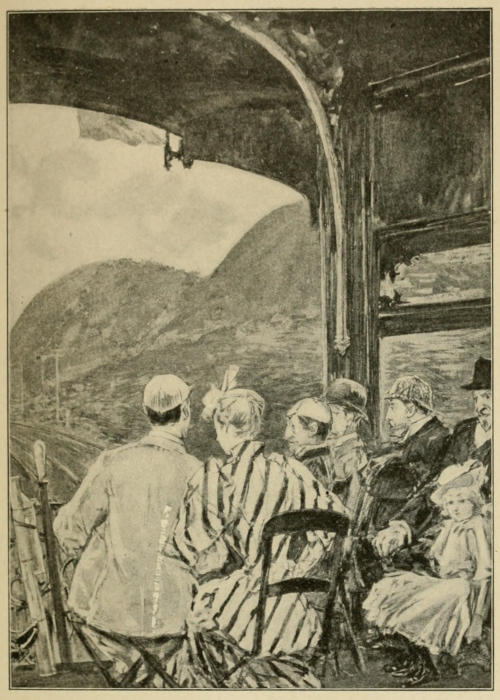
AN OBSERVATION CAR ON THE PACIFIC RAILROAD
Financial disaster, a time of sharp stringency when men looked to their investments, regretted their loans, questioned every adventure of business, and stood dismayed to see the prosperity of the country of a sudden checked, it might be destroyed, added its thrill of excitement and of apprehension to bring the thought of the country to an imperative reckoning upon economic questions. As in 1873, so again now it was the too rapid development of railways, their too desperate competition for earnings which were at best insufficient to support them, and the reckless speculation of those who dealt in their stocks that brought the sudden contraction of values on, and then panic and ruin. The country was growing very rapidly alike in population and in the increase of wealth and the multiplication of resources. The census taken in 1880 had shown that the population had, within the preceding ten years, increased more than thirty per cent., from 38,558,371 to 50,155,783. It was estimated that the actual wealth of the country had within the same period increased quite forty-five per cent., from $30,068,518,507 to $43,642,000,000. Nothing had lagged. Agriculture, manufactures, commerce, the products of the mines and of every industry that added to the resources of the country and made it rich and quick with energy showed a sound and wholesome growth commensurate with crowding numbers and the zest of hopeful enterprise. But the construction of railways had outrun all reason in the attempt to keep pace with the country’s growth. The total railway mileage of the United States had been increased from 52,914 to 93,671 within the decade. New lines had bid against the old for patronage by sharp reductions in the rates of carriage; rates had fallen below the actual cost of the service; and while ruinous competition cut away profits, speculation in railway securities in the stock market completed the mischief. That speculation had reached its highest point of reckless adventure in 1880. After that the prices of railway securities began to decline, at first only a little, then very sharply, and in May, 1884, the inevitable crash came. As usual, some firms upon the Street suffered not only ruin but dishonor also, among the rest the firm of Grant and Ward, in which General Grant had been a silent partner. He had known nothing of the dishonorable transactions of his partners, but the disgrace and ruin in which they involved him touched his last days with humiliation and with a deep sadness which he could not shake off. Unscrupulous men had played upon him in business as they had played upon him in politics, and men’s minds went always backwards to find his time of glory.
Financial crisis did not, of course, touch the real resources of the country; its business went forward without fatal embarrassment, and those who took the large view of affairs perceived that its prosperity was not in fact seriously checked by what had happened in Wall Street. But Wall Street was, none the less, the seat of credit, and acute disturbances in its market could not go by without consequences which all the country felt. Business could not, for a little while, move with as confident a spirit as before. It was evident, too, that in undertakings both great and small the friction between laborers and employers grew, not less, but greater, as if some unwholesome influence were at work to clog the productive processes of the time. Workingmen promptly adapted to their own use against employers the “boycott” which Irish agitators had originated to work the ruin of those who opposed their radical programmes of social and political reform or who stood out for the privileges of the hated land owners. Individuals or companies who would not yield to the dictation of the labor organizations in any matter, whether of employment, wages, or hours of work, they sought to cut off from all patronage and business by terrorizing all who dealt with them or approached their places of business; and the courts were forced to execute, sometimes very harshly, the law against conspiracy, fitting formulas originated in an age gone by to circumstances more difficult to form their judgments upon than any a past age had produced. It added a little, too, to the sense of disquietude created by the crisis in the money market and the chronic disorders of industry that unprecedented and disastrous floods occurred, in the summer of 1884, in the valley of the Ohio, breeding distresses and tumults in the city of Cincinnati which put the place for six days together almost at the mercy of mobs.
The country got from every quarter a disquieting sense of lax government, deranged business, bad management in affairs, and the dissatisfaction and anxiety which such impressions produced inevitably operated to discredit the party in power. Some radical change in leadership began to seem desirable. Opinion more and more wearied of the stale grounds of preference upon which parties and candidates were chosen at the polls. The Republicans had held the presidency ever since the war, and both houses of Congress until 1875, not because they met new questions with new policy, but because, in a day now gone by, they had been the party of the Union and had saved it. Tenure of power through a whole generation, as if by prescriptive right, had worked its own demoralization, as was inevitable among men who made no new plans and had no new impulse of reform. Mr. Hayes had been upright, public spirited, inclined to serve the country unselfishly and in the interest of sound policy; Mr. Arthur had come out of the unpromising ranks of office holders and local party managers and yet had shown himself a man of elevated ideals in administration; but observant lookers on got the impression, none the less, that the lax morals and questionable practices of General Grant’s day were still to be found beneath the surface of the public business at Washington. Men everywhere believed that the fibre of the party in power was relaxed and that new blood must somehow be got into the government before it could be made secure against the bad methods and the vicious standards of action which had got possession of it. It was not an issue as between parties that was shaping itself in the public mind, but rather a desire to choose new men, whichever party should prove ready to supply them,—the newer, the less identified with the party policies of the generation then passing away, the better. Upon that desire the presidential campaign of 1884 turned. Had the Republicans named a man of such qualities as to make the country feel sure of him as an instrument of integrity and sensible rectification in public affairs, no doubt he would have been chosen President; but they did not name such a man. The Democrats did, and won. Mr. Grover Cleveland, whom the Democratic convention put forward, was a new man in the field of national politics, but had proved his quality in public service in the State of New York in a way which had, within the past two or three years, attracted the attention of the whole country. Twenty years before, when he was but a youth of twenty-six, he had been chosen district attorney for the city of Buffalo (1863); in 1871 he had been made sheriff of his county, and ten years later mayor of Buffalo; in 1882 he became governor of the State. In that year the tide of popular reaction against the Republicans had run very strong, and Pennsylvania and Massachusetts, as well as New York, had preferred Democratic to Republican governors; but the reaction had been more marked and extraordinary in New York than anywhere else. In 1880, the year Mr. Garfield was chosen President, the Republicans had carried New York by a safe margin of more than 21,000 votes; and yet in 1882, but two years later, Mr. Cleveland had been preferred to an unimpeachable opponent by a plurality of 190,000.
He was of the open and downright sort that all men who love strength must always relish. Business men felt that they could trust him because he had had business of his own to manage as a lawyer of assured and increasing practice and knew the business interests of the State and meant to guard them. Plain men instinctively trusted him, because they felt sure that they understood him, seeing that he was no subtile politician but a man without sophistication like themselves. He had early been drawn into politics and had followed it with a wholesome relish, finding zest in its comradeships with men of action and resource, men of quick wits and ready expedients, as well as in the sense of action and of service which it brought into his own life. A long apprenticeship in affairs, with local politicians for associates and fellow counsellors, made it very clear to him how men were to be handled and combined and gave him that close acquaintance with the personal side of party combination which is the surest basis of political sagacity among those who lead; and yet, though he knew men of all sorts intimately and at first hand, as Lincoln did, and met them every day in close, sympathetic association, he kept his own principles and point of view unconfused. He was the son of a rural pastor. His father had not had the means to give him a college training, but the lad had got the better training of a Christian household, had brought away from his quiet home standards of right action and a steadfast, candid conscience which told more and more upon the courses of his life as he matured. His associates found candor and courage to be the most characteristic qualities of the man. There was something very satisfactory in the simplicity and frankness with which he went about his duties when in office, without question as to his obligations as a public servant or misgivings as to the effect of what he did upon his personal fortunes. “The affairs of the city,” he said, when he became mayor, “should be conducted as far as possible upon the same principle as a good business man manages his private concerns”; and the voters of the city found, with not a little satisfaction, that he acted upon that principle with extraordinary watchfulness and vigor. They dubbed him the “veto mayor” before his term was out, so frequently did he check the extravagance and the ill considered plans of the city council with his sharp, unhesitating executive negative. As governor the same qualities shone even more conspicuous in him. Courage, directness, good sense, public spirit, as if without thought of consequences either to himself or to his party, made him at once a man whom all the country marked when he came to that great post.
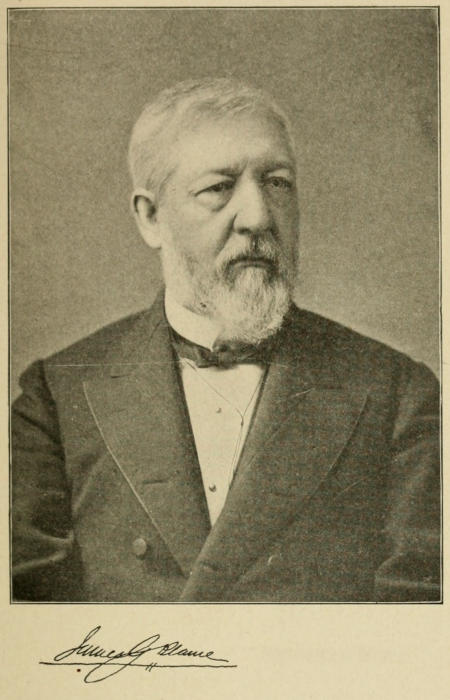
JAMES GILLESPIE BLAINE
There were men in the Republican ranks in New York who had played the chief parts of protest against the tendencies of their party. They meant to reform it, if they could, and so save it, but to oppose it if they could not bring it to a new way of action, a new and better choice of leaders. They sent strong spokesmen to the Republican nominating convention of 1884, and when that convention would not heed them they urged the Democrats to nominate Mr. Cleveland and give independent voters a chance to cast their ballots for a man of their own temper and principles in affairs. The Democratic convention took their advice, and for the first time in twenty-eight years a Democrat was chosen President. The candidate whom the Republicans had preferred was as brilliant a leader as any party had had for a generation; but the country did not want brilliant leadership; it wished for mere solidity of character and for a new and better point of view in the man it should put into its highest office; and it could not satisfy itself with Mr. Blaine. Mr. James G. Blaine was a man turned of fifty-four; Mr. Cleveland was but forty-seven. The one had been known through a whole generation as a man who by sheer force of natural gifts, eloquence, audacity, charm, had made his way to the front in the national counsels; the other had come but yesterday into view, not as a leader in counsel, but as a man of right action in practical public business. But some deeply unpleasant impressions had got abroad concerning Mr. Blaine, and had worked very powerfully upon those who were beyond the reach of his personal charm; and when the Republicans nominated him for the presidency the distrust those impressions had bred cost him the election, with such a man as Mr. Cleveland for opponent. He had played a great part in legislation. Three successive times before they lost control of the House of Representatives (1869-1875) the Republicans had made him Speaker, and he had used the power of that great office to make himself master of party action in the lower house, after the manner of the later Speakers, but with a personal hold upon the members of the House such as no man had enjoyed since Henry Clay. There were rumors that he had used his power also to obtain favors from certain railway and mining corporations and enrich himself. Nothing was proved. When the charges made against him were looked into with careful and impartial scrutiny they turned out to have very disputable foundation. He had engaged in transactions which no doubt left his hands clean, but hardly, it seemed, his conscience. There had been too little of the high punctilio of a nice sense of honor in many of the things he had done. Republicans who had grown critical and uneasy in such matters were convinced that, whatever might be said in defence or justification of Mr. Blaine, he was, at best, not entirely free from the taint that had seemed to fall upon almost every leader of the party who had played a prominent part in Congress during the last, bad days of the period of reconstruction, when the power they wielded was touched with high-handed lawlessness and the government they administered with the spirit of spoilsmen.
The result of the election turned upon the vote of New York. No strong tide of popular preference ran for the Democrats such as had heartened them in 1882. Every northern and western State except Connecticut, New Jersey, Indiana, and New York cast its votes for Mr. Blaine; could he have carried New York, he would have been elected, and he lost it by only the very narrow margin of 1,149 votes. In the thought of the New York voters it was one thing to vote for a governor, quite another to vote for a President. The national prestige of the Republican party was not lost; only the steadfast determination of a few men to rid it, if they could, of its older leaders gave the vote of the State to Mr. Cleveland. Their task called for not a little moral courage in the performance. They were in principle and by preference, not Democrats, but Republicans, and what they were about to do filled their one-time party associates with contempt and bitter resentment. They were dubbed pharisees, who must needs prove themselves a saving and holy remnant, truer than their fellows; “mugwumps,” big chiefs, who would not take their cue from common men but must signalize their valor apart. They accepted the name “mugwump” very cheerfully. It was a name whimsically borrowed from the language of the Algonquin Indians, was native American, accordingly, and had no sting that they flinched under either in its first or in its ironical meaning. They were led by men who cared little what names they were called by if only they satisfied their principles in what they did: men like Mr. Carl Schurz, who had led the revolt of the Republicans of Missouri twelve years before; men like Mr. George William Curtis, as much statesman and orator as man of letters, with whom politics was not a game of power but a career of duty. It was the good fortune of such men that there were others in goodly numbers who were as indifferent as themselves what jibes were uttered against them provided they won and kept their character in the fight they had entered upon. And they did win. No doubt the Mugwumps made Mr. Cleveland President. He was a man of the sort they most desired, not touched with the older sophistications of politics, his face set forward, his gifts the gifts of right action. They trusted him and believed that he would purify the civil service and bring in a new day in which parties should concentrate their purposes on practical questions of the present.
Mr. Cleveland’s task as President was both delicate and difficult. He did not come into power supported by the warm enthusiasm of a people, as General Jackson had come, though no one doubted that he was the people’s, not a party’s, President. His popular majority over Mr. Blaine was but 23,000. Three hundred and twenty-five thousand votes had been cast for the candidates of the Greenback and the Prohibitionist parties, to which many men had turned for the nonce because they could not bring themselves to vote for Mr. Blaine and would not vote for a candidate of the Democrats, and in their extremity what to do threw their votes away. Out of a total popular vote of more than ten millions, therefore, Mr. Cleveland had lacked an absolute majority by more than three hundred thousand. The congressional elections had given the Democrats a strong working majority again in the House, but the Senate was still Republican. And yet the new President’s party wished and expected him to recast the administration of the government in its behoof, as if it were already in its ascendency, and the Mugwumps bade him disregard party, put partisan considerations aside in his appointments to office, and make the government at Washington, as he had made the government at Albany, a sound instrument of public business. It was inevitable that he should disappoint both his party and the leaders of the independents. Fortunately he knew his own mind and was not rendered timid by the difficulties of his task. He accounted himself, not an independent, but a Democrat. His allegiance to his party was of the staunch and loyal sort. He thoroughly believed in its principles and held himself bound to serve it in every legitimate way compatible with the public service. He was a sincere believer in the reform of the civil service which the Mugwumps made so prominent a part of their creed and programme; but he thought it no breach of the principles of that reform to refuse reappointment to Republican officials whose statutory term of four years had expired and to put Democrats in their places, to ask for the resignation of Republican officials whose offices brought them into relations of confidence with the administration, or to dismiss those out of the rank and file who showed themselves disposed to use their offices for partisan purposes. He thought it right and wholesome and an act of sound policy to change a civil service which was exclusively Republican in every rank, and which had been exclusively Republican throughout a whole generation, a service in which Democrats had been virtually proscribed, into a service mixed of men of both parties, and a clear matter of traditional right to put Democrats in every chief post of trust.
The thorough-going politicians of the Democratic party were disappointed to the pitch of dismay to find that Mr. Cleveland meant to make no clean sweep of the offices and set his face like flint against the doctrine that appointments to office were the spoils of victory in a presidential contest. Thorough-going reformers were equally disappointed to find that he did not intend to adopt their principles with their own uncompromising austerity. “They are to be treated with respect,” Mr. Blaine had written to Mr. Garfield of the reformers, in 1880, “but they are the worst possible political advisers, ... foolish, vain, without knowledge of measures, ignorant of men, ... pharisaical, but not practical; ambitious, but not wise; pretentious, but not powerful.” Mr. Cleveland knew too much of the sterling character and wide experience of the particular group of reformers who had made his election possible to utter so superficial a judgment about them, or to feel anything but the profoundest respect for their motives and for their sagacity as men of action. He stood very near them in his own hopes and purposes, and felt no touch of Mr. Blaine’s resentful contempt for them. But he was a practical man of affairs and knew better than they did both the limitations and the theoretical weakness of their programmes. They stood outside the public service as critics; dealt with principles, not with men; were serviceable in the formation of opinion, but not in the conduct of government. The conduct of government they still left to professional politicians and to men who made public life their constant object, as they themselves did not; and Mr. Cleveland understood the public men whom they condemned more justly than they did,—understood them by reason of lifelong association with them, and knew that their qualities were better, their gifts a great deal more serviceable than men who had no dealings with them supposed them to be. Those who came into direct conference with him and learned to know at first hand his principles of action found nothing so strong, so imperative in Mr. Cleveland as his sense of justice, his sense of right and of fair dealing. He had, they found, a big conscience open to the airs of all the various world, approachable by all sorts of men, whether of thought or of affairs. He felt as much bound to meet the reasonable expectations of the right-minded politicians of his party as to come up to the requirements of the reformers. He knew the practice of party government as his critics did not, and felt at liberty to act upon the immemorial understandings of government in that kind wherever he could do so and yet not violate principles of sound administration. He meant to use the principles of the civil service reformers for the purpose of making the government pure and efficient, but not for the purpose of taking it out of the hands of parties as an instrument of policy. It was a reform which he perceived could not be brought on upon a sudden impulse, but must be worked out through the processes of politics as they stood.
It was his conduct of administration and his attitude towards Congress rather than large questions of policy or of party management that held the attention of the country throughout the four years of his term. The House kept its Democratic, the Senate its Republican majority, and party legislation was still out of the question. All energy and initiative seemed for the time summed up in the President. His quality was as unmistakable as General Jackson’s, and yet he had none of General Jackson’s blind impetuosity or mere wilfulness. His individuality was the more marked because he stood apart from the houses as a power set to check and criticise them. He had never been a member of a legislative body. From first to last his experience in public service had been that of an executive officer. He held very literally, therefore, to the theory that Congress and the President were not so much associated as offset in the structure of the government, and was inclined to be a strict doctrinaire in the exercise of a complete independence of congressional suggestion. What most attracted the attention of the country, aside from his action in the matter of appointments to office, was the extraordinary number of his vetoes. Most of them were uttered against pension bills great and small. Both Democratic House and Republican Senate were inclined to grant any man or class of men who had served in the federal armies during the civil war the right to be supported out of the national Treasury, and Mr. Cleveland set himself very resolutely to check their extravagance. He deemed it enough that those who had been actually disabled should receive pensions from the government, and regarded additional gifts, for mere service, both an unjustifiable use of the public money and a gross abuse of charity. When the Senate sought to revive against him the principles of the Tenure of Office Act, which had been passed to thwart Mr. Johnson but suffered to lie forgotten so long as Republicans were in the presidency, and inquired into his reasons for certain removals from office, he met it with an assertion of his constitutional rights as Executive as imperative as General Jackson would have uttered, and put that matter once for all at rest. Both houses learned to respect his intelligence, his conscience, his unhesitating will with a touch of fear such as they had felt towards no other President they could remember.
The new tenor of reform and of individual responsibility he had brought into affairs seemed in some measure to touch Congress also and to dispose it to apply itself to important matters of business which had too long waited to be dealt with, and which could be handled without partisan heat. The most important of these was the establishment of a fixed order of succession to the presidency, in case of the death or disability of both the President and the Vice President. A bill amending the law in that matter had been formulated in the Senate as long ago as the summer of 1882, and since that time had twice been adopted by the Senate; but the House had failed to concur. As the law stood the succession fell to the president pro tempore of the Senate or, if he could not act, to the Speaker of the House of Representatives. But there were times, falling between the sessions of a Congress whose term had expired and the sessions of the Congress chosen to succeed it, when there was neither a president pro tempore of the Senate nor a Speaker of the House. There had been such a season while Mr. Arthur was President. There had been an anxious summer when, had death or serious disability overtaken him, there would have been no one to take up the duties of the chief office of the nation. Another season of the same sort came during the very first year of Mr. Cleveland’s presidency. Mr. Hendricks, who had been chosen Vice President with Mr. Cleveland, died in November, 1885, and there was a brief interval during which there was no one between the President and a legal lapse of the presidential functions. At its first session, therefore, the Congress which had been chosen at the time of Mr. Cleveland’s election passed an Act which placed the heads of the executive Departments in the line of succession, in the order of the creation of their several offices, should they possess the qualifications of age and of birth within the United States prescribed by the constitution in respect of the President and Vice President: the Secretary of State, the Secretary of the Treasury, the Secretary of War, the Attorney General, the Postmaster General, the Secretary of the Navy, the Secretary of the Interior, the Secretary of Agriculture (January 18, 1886); and a matter of much anxiety was happily settled.
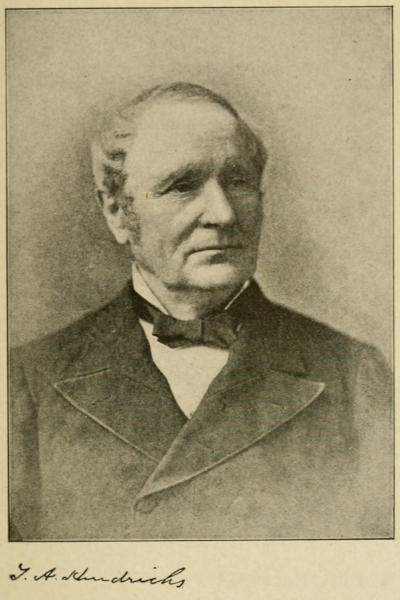
THOMAS ANDREWS HENDRICKS
The leaders of the two parties were at last ready also to agree upon a final settlement of the mode of counting the electoral votes. It was manifestly imperative that the recurrence of such a situation as had been brought about in 1876 by the double electoral returns from South Carolina, Florida, and Louisiana should be prevented by some provision of law which should determine once for all whence the authoritative and final decision should emanate as to the validity of disputed votes, but not until now had the heat of that contest been sufficiently dispelled to enable politicians to come to an agreement in the matter. An Act became law on the 3d of February, 1887, which provided that the decision should rest with the States themselves from which the votes came, and Congress should undertake to judge of matter in dispute only when there was in any State such a conflict between two tribunals of appeal as made it necessary that some outside authority should intervene. In such a case the decision of the houses should be reached by concurrent resolution. It took much debate and many conferences to frame the law to the satisfaction of both houses; but it was felt at last that agreement was necessary, and all sensible men hailed the result with gratification.
There were questions also of business and of economic relief which the houses found it possible to agree upon before Mr. Cleveland’s term was out. By an Act of the 4th of February, 1887, known as the Interstate Commerce Act, railway corporations operating lines which passed from one State to another were forbidden to make discriminations in their rates as between different shippers or to enter into any combination with competing companies for the purpose of sharing earnings or of “pooling” freight receipts in a common fund to be proportionally divided; and a commission of five persons, to be appointed by the President, was constituted which was given very extensive judicial and mandatory powers for the enforcement of the Act. In the following year an Act was passed which excluded Chinese immigrants from the United States. The Interstate Commerce Act had been introduced by Senator Reagan, of Texas, so long ago as 1884, and had been pressed for three years before obtaining majorities in both houses. Its advocates spoke in the interest of the farmers and of all small shippers,—of all who had felt the power of the railways a burden upon them. It was not disputed that the railway companies had granted lower rates of carriage to the greater manufacturers and producers whose shipments were large, or that they had favored one section of the country at the expense of another; and it was manifest that their discriminations had fallen very heavily upon small farmers and men in the smaller ways of trade and manufacture. There was decided satisfaction throughout the country, therefore, that steps had at last been taken to protect the rank and file. The law which excluded Chinese immigrants had been passed at the urgent solicitation of the men of the Pacific coast. Chinese laborers had poured in there, first by hundreds, then by thousands, finally by hundreds of thousands, until the labor situation of the whole coast had become one almost of revolution. Caucasian laborers could not compete with the Chinese, could not live upon a handful of rice and work for a pittance, and found themselves being steadily crowded out from occupation after occupation by the thrifty, skilful Orientals, who, with their yellow skin and strange, debasing habits of life, seemed to them hardly fellow men at all, but evil spirits, rather. For years together the laborers of the coast and all who wished to aid them had demanded of Congress the exclusion of the Chinese. Failing of aid from that quarter, riot had become their almost habitual means of agitation and self-defence—riot which sometimes went the awful length of wholesale slaughter in wanton attacks upon the Chinese quarters of the towns. San Francisco had found the matter a veritable menace to government itself. Congress had passed an exclusion bill in 1879, but Mr. Hayes had vetoed it. Negotiation with China had been tried, but she had refused to agree to the exclusion of her people by her own act and consent; and an end was at last made of the matter by the Act of 1888.