Chapter V · The Ante-Diluvian Patriarchs (Priestly-Code).
Reading edition
In the Priestly Code the interval between the Creation (1¹‒24a) and the Flood (69 ff.) is bridged by this list of ten patriarchs, with its chronological scheme fixing the duration of the period (in Massoretic Text) at 1656 years. The names are traditional, as is shown by a comparison of the first three with 425 f., and of numbers 4‒9 with 417 ff.. It has, indeed, been held that the names of the Cainite genealogy were intentionally modified by the author of Priestly-Code, in order to suggest certain views as to the character of the patriarchs. But that is at best a doubtful hypothesis, and could only apply to three or four of the number. It is quite probable that if we had the continuation of Yahwist’s Sethite genealogy, its names would be found to correspond closely with those of chapter 5.—The chronology, on the other hand, is based on an artificial system, the invention of which may be assigned either to Priestly-Code or to some later chronologist (see page 136 below).—What is thoroughly characteristic of Priestly-Code is the framework in which the details are set. It consists of (a) the age of each patriarch at the birth of his first-born, (b) the length of his remaining life (with the statement that he begat other children), and (c) his age at death.¹ The stiff precision and severity of the style, the strict adherence to set formulæ, and the monotonous iteration of them, constitute a somewhat pronounced example of the literary tendencies of the Priestly school of writers.
¹ Only in the cases of Adam (verse ³), Enoch (22. 24) and Lamech (28. 29) are slight and easily explicable deviations from the stereotyped form admitted. The section on Noah is, of course, incomplete.
The distinctive phraseology of Priestly-Code (אֱלֹהִים, בָּרָא, דְּמוּת, זָכָר וּנְקֵבָה) is seen most clearly in verse 1b. 2, which, however, may be partly composed of glosses based on 126 ff. (see on the verses). Note also תּוֹלְדֹת (1a), צֶלֶם, דְּמוּת (³), הוֹלִיד (throughout), הִתְהַלֵּךְ אֶת־הָאֱלֹהִים (22. 24, compare 6⁹); the syntax of the numerals (which, though not peculiar to Priestly-Code, is a mark of late style: see Gesenius-Kautzsch, § 134 i; Davidson § 37, R. 3); the naming of the child by the father (³).—The one verse which stands out in marked contrast to its environment is ²⁹, which is shown by the occurrence of the name יהוה and the allusion to 3¹⁷ to be an extract from Yahwist, and in all probability a fragment of the genealogy whose first links are preserved in 425. 26.
“The aim of the writer is by means of these particulars to give a picture of the increasing population of the earth, as also of the duration of the first period of its history, as conceived by him, and of the longevity which was a current element in the Hebrew conception of primitive times” (Driver The Book of Genesis with Introduction and Notes page 75). With regard to the extreme longevity attributed to the early patriarchs, it must be frankly recognised that the statements are meant to be understood literally, and that the author had in his view actual individuals. The attempts to save the historicity of the record by supposing (a) that the names are those of peoples or dynasties, or (b) that many links of the genealogy have been omitted, or (c) that the word שָׁנָה denotes a space of time much shorter than twelve months (see Dillmann 107), are now universally discredited. The text admits of no such interpretation. It is true that “the study of science precludes the possibility of such figures being literally correct”; but “the comparative study of literature leads us to expect exaggerated statements in any work incorporating the primitive traditions of a people” (Ryle, quoted by Driver page 75).
The author of Priestly-Code knows nothing of the Fall, and offers no explanation of the ‘violence’ and ‘corruption’ with which the earth is filled when the narrative is resumed (6¹²). It is doubtful whether he assumes a progressive deterioration of the race, or a sudden outbreak of wickedness on the eve of the Flood; in either case he thinks it unnecessary to propound any theory to account for it. The fact reminds us how little dogmatic importance was attached to the story of the Fall in Old Testament times. The Priestly writers may have been repelled by the anthropomorphism, and indifferent to the human pathos and profound moral psychology, of Genesis 3; they may also have thought that the presence of sin needs no explanation, being sufficiently accounted for by the known tendencies of human nature.
Budde (Die biblische Urgeschichte 93‒103) has endeavoured to show that the genealogy itself contains a cryptic theory of degeneration, according to which the first five generations were righteous, and the last five (commencing with Jered [= ‘descent’], but excepting Enoch and Noah) were wicked. His chief arguments are (a) that the names have been manipulated by Priestly-Code in the interest of such a theory, and (b) that the Samaritan chronology (which Budde takes to be the original: see below, page 135 f.) admits of the conclusion that Jered, Methuselah, and Lamech perished in the Flood.¹ Budde supports his thesis with close and acute reasoning; but the facts are susceptible of different interpretations, and it is not probable that a writer with so definite a theory to inculcate should have been at such pains to conceal it. At all events it remains true that no explanation is given of the introduction of evil into the world.
¹ The more rapid decrease of life (in The Samaritan Recension of the Pentateuch) after Mahalalel ought not to be counted as an additional argument; because it is a necessary corollary from the date fixed for the Flood.
1, 2. Introduction.
Consisting of a superscription (1a), followed by an account of the creation and naming of Adam (1b. 2).—1a. This is the book of the generations of Adam] See the critical note below; and on the meaning of תּוֹלְדֹת, see on 24a.—1b. When God created Man (or Adam) he made him in the likeness of God] a statement introduced in view of the transmission of the divine image from Adam to Seth (verse ³). On this and the following clauses see, further, 126 ff..—2. And called their name Adam] v.i.
The verses show signs of editorial manipulation. In 1a אָדָם is presumably a proper name (as in 3 ff.), in ² it is certainly generic (note the plural suffix), while in 1b it is impossible to say which sense is intended. The confusion seems due to an attempt to describe the creation of the first man in terms borrowed almost literally from 126 ff., where אדם is generic. Since the only new statement is and he called their name Adam, we may suppose the writer’s aim to have been to explain how אדם, from being a generic term, came to be a proper name. But he has no clear perception of the relation; and so, instead of starting with the generic sense and leading up to the individual, he resolves the individual into the generic, and awkwardly resumes the proper name in verse ³. An original author would hardly have expressed himself so clumsily. Holzinger observes that the heading זה ספר תולדת אדם reads like the title of a book, suggesting that the chapter is the opening section of an older genealogical work used by Priestly-Code as the skeleton of his history; and the fuller formula, as compared with the usual אלה תולדת, at least justifies the assumption that this is the first occurrence of the heading. Dillmann’s opinion, that it is a combination of the superscription of Yahwist’s Sethite genealogy with that of Priestly-Code, is utterly improbable. On the whole, the facts point to an amalgamation of two sources, the first using אדם as a designation of the race, and the other as the name of the first man.
1. For אדם LXX has 1º ἀνθρώπων, 2º Ἀδάμ; Vulgate conversely 1º Adam, 2º hominem.—2. שְׁמָם] LXXLucian שְׁמוֹ.
3‒5. Adam.
Adam begat [a son] in his likeness, etc.] (see on 1²⁶): implying, no doubt, a transmission of the divine image (verse ¹) from Adam to all his posterity.
3. וַיּוֹלֶד] inserted בֵּן as object (Olshausen al.). הוֹלִיד confined to Priestly-Code in Pentateuch; Yahwist, and older writers generally, using יָלַד both for ‘beget’ and ‘bear.’—בִּדְמוּתוֹ כְּצַלְמוֹ] LXX κατὰ τὴν εἰδέαν αὐτοῦ καὶ κατὰ τὴ νεἰκόνα αὐτοῦ.—avoiding ὁμοίωσις (see the note on 1²⁶).—4. ויהיו ימי אדם] LXXLucian inserted ἃς ἔζησε, as in verse ⁵. Peshiṭtå reads וַיְחִי אדם (but see Ball’s note) as in verses 7. 10 etc. But verses 3‒5 contain several deviations from the regular formula: note אשר חי in verse ⁵, and the order of numerals (hundreds before tens). The reverse order is observed elsewhere in the chapter.
6‒20. Seth to Jered.
The sections on Seth, Enoš, Ḳenan, Mahalalel, and Yered rigidly observe the prescribed form, and call for no detailed comment, except as regards the names.
6‒8. Šēth: compare 4²⁵. For the Jewish, Gnostic, and Mohammedan legends about this patriarch, see Lenormant Les Origines de l’histoire² 217‒220, and Charles, Book of Jubilees, 33 ff.—9‒11. ’Ĕnôš: see on 4²⁶.—12‒14. Ḳênān is obviously a fuller form of Ḳáyin in the parallel genealogy of 417 ff.; and possibly, like it, means ‘smith’ or ‘artificer’ (compare Syrian : see on 4¹). Whether the longer or the shorter form is the more ancient, we have no means of judging. It is important to note that קינן or קנן is the name of a Sabæan deity, occurring several times in inscriptions: see Mordtmann, Zeitschrift der deutschen morgenländischen Gesellschaft, xxxi. 86; Baethgen, Beiträge zur Geschichte Cölestins 127 f., 152.—15‒17. Mahălal’ēl (= ‘Praise of God’) is a compound with the ἅπαξ λεγόμενον מַֽהֲלָל (Proverbs 27²¹). But there the versions read the participle; and so LXX must have done here: Μαλελεηλ = מְהַלֶּלְאֵל, i.e. ‘Praising God.’ Proper names compounded with a participle are rare and late in Old Testament (see Driver Notes on the Hebrew Text of the Books of Samuel 14²; Gray, Studies in Hebrew Proper Names, 201), but are common in Assyrian. Nestle’s inference that the genealogy must be late (Marginalien und Materialien, 7 f.) is not certain, because the word might have been borrowed, or first borrowed and then hebraized: Hommel conjectures (not very plausibly) that it is a corruption of Amil-Arûru in the list of Berossus (see Die altorientalischen Denkmäler und das Alte Testament, 29). מ׳ is found as a personal or family name in Nehemiah 11⁴.—18‒20. Yéred (1 Chronicles 4¹⁸) would signify in Hebrew ‘Descent’; hence the Jewish legend that in his days the angels descended to the earth (The Book of Genesis with Introduction and Notes 6²): compare Jubilees iv. 15; Enoch vi. 6, cvi. 13. On Budde’s interpretation, see page 129 above. The question whether עִירָד or יֶרֶד be the older form must be left open. Hommel (30) traces both to an original Babylonian ‛I-yarad = ‘descent of fire.’

21‒24. Enoch.
The account of Enoch contains three extraordinary features: (a) The twice repeated וַיִּתְהַלֵּךְ אֶת־הָאֱלֹהִים. In the Old Testament such an expression (used also of Noah, 6⁹) signifies intimate companionship (1 Samuel 25¹⁵), and here denotes a fellowship with God morally and religiously perfect (compare Micah 6⁸, Malachi 2⁶ [הָלַךְ]), hardly differing from the commoner ‘walk before God’ (17¹ 24⁴⁰) or ‘after God’ (Deuteronomy 13⁵, 1 Kings 14⁸). We shall see, however, that originally it included the idea of initiation into divine mysteries. (b) Instead of the usual וֵיָּמֹת we read וְאֵינֶנּוּ כּי־לָקַח אֹתוֹ אֱלֹהִים; i.e. he was mysteriously translated ‘so as not to see death’ (Hebrews 11⁵). Though the influence of this narrative on the idea of immortality in later ages is not to be denied (compare Psalms 49¹⁶ 73²⁴), it is hardly correct to speak of it as containing a presentiment of that idea. The immortality of exceptional men of God like Enoch and Elijah suggested no inference as to the destiny of ordinary mortals, any more than did similar beliefs among other nations (Gunkel). (c) His life is much the shortest of the ante-diluvian patriarchs. It has long been surmised that the duration of his life (365 years) is connected with the number of days in the solar year; and the conjecture has been remarkably verified by the Babylonian parallel mentioned below.
The extraordinary developments of the Enoch-legend in later Judaism (see below) could never have grown out of this passage alone; everything goes to show that the record has a mythological basis, which must have continued to be a living tradition in Jewish circles in the time of the Apocalyptic writers. A clue to the mystery that invests the figure of Enoch has been discovered in Babylonian literature. The 7th name in the list of Berossus is Evedoranchus (see Die Keilinschriften und das Alte Testament³, 532),—a corruption (it seems certain) of Enmeduranki, who is mentioned in a ritual tablet from the library of Asshurbanipal (K 2486 + K 4364: translated in Die Keilinschriften und das Alte Testament³, 533 f.) as king of Sippar (city of Šamaš, the sun-god), and founder of a hereditary guild of priestly diviners. This mythical personage is described as a ‘favourite of Anu, Bel [and Ea],’ and is said to have been received into the fellowship of Šamaš and Ramman, to have been initiated into the mysteries of heaven and earth, and instructed in certain arts of divination which he handed down to his son. The points of contact with the notice in Genesis are (1) the special relation of Enmeduranki to the sun-god (compare the 365 of verse ²³); and (2) his peculiar intimacy with the gods (‘walked with God’): there is, however, no mention of a translation. His initiation into the secrets of heaven and earth is the germ of the later view of Enoch as the patron of esoteric knowledge, and the author of Apocalyptic books. In Sirach 44¹⁶ he is already spoken of as אות דעת לדור ודור. Compare Jubilees iv. 17 ff. (with Charles’s note ad loc.); and see Lenormant Les Origines de l’histoire² 223; Charles, Book of Enoch (1893), passim.
22. ויתהלך—את־האלהים] LXX εὐηρέστησεν τῷ θεῷ (LXXLucian adds καὶ ἔζησεν Ἐνωχ), Symmachus ἀνεστρέφετο, Peshiṭtå , TargumOnkelos הליך בדחלתא דיי: Aquila and Vulgate render literally. The article before א׳ is unusual in Priestly-Code (see 69. 11). The phrase must have been taken from a traditional source, and may retain an unobserved trace of the original polytheism (‘with the gods’).—23. ויהי] Read ויהיו (MSS, The Samaritan Recension of the Pentateuch, LXX, etc.).—24. ואיננו] indicating mysterious disappearance (3729 f. 4213. 32. 36 [Elohist] 1 Kings 20⁴⁰); see Gesenius-Kautzsch § 152 m.—לקח] LXX μετέθηκεν, Vulgate tulit, but TargumOnkelos אמית. The verb became, as Duhm (on Psalms 49¹⁶) thinks, a technical expression for translation to a higher existence; compare 2 Kings 2¹⁰, Psalms 49¹⁶ 73²⁴. The Rabbinical exegesis (TargumOnkelos, Bereshith Rabba, Rashi) understood it of removal by death, implying an unfavourable judgment on Enoch which may be due in part to the reaction of legalism against the Apocalyptic influence.


25‒32. Methuselah to Noah.
25‒27. Methuselah.—מְתוּשֶׁלַח commonly explained as ‘man of the dart (or weapon),’ hence tropically ‘man of violence,’ which Budde (99) regards as a deliberate variation of מתושאל (4¹⁸) intended to suggest the wickedness of the later generations before the Flood (see above, page 129). Lenormant (247) took it as a designation of Saggitarius, the 9th sign of the Zodiac; according to Hommel, it means ‘sein Mann ist das Geschoss’ (!), and is connected with the planet Mars.¹ If the 8th name in the list of Berossus be rightly rendered ‘man of Sin (the moon-god),’² a more probable view would be that שֶׁלַח is a divine proper name. Hommel, indeed, at one time regarded it as a corruption of šarraḫu, said to be an ancient name of the moon-god³ (compare Cheyne, Encyclopædia Biblica, 625, 4412).
¹ Die altorientalischen Denkmäler und das Alte Testament [1902], 29. Here Amemphsinus is resolved into Amel-Nisin: formerly (Proceedings of the Society of Biblical Archæology, xv. [1892‒3] 245) Hommel propounded the view now advocated by Zimmern (see next note).
² Zimmern, Die Keilinschriften und das Alte Testament³, 532.
³ Aufsätze und Abhandlungen arabistisch-semitologischen Inhalts ii. [1900] 222. Cheyne (l.c.) relies on the fact that šarḫu (‘all-powerful’) is an epithet of various gods (Delitzsch Handwörterbuch des biblischen Altertums 690 a).
27. After מתושלח LXX inserts ἃς ἔζησεν (compare verse ⁵).
29. An extract from Yahwist, preserving an oracle uttered by Lamech on the birth of Noah.—This (זֶה; compare זֹאת in 2²³) shall bring us comfort from our labour, and from the toil of our hands [proceeding] from the ground, etc.] The utterance seems to breathe the same melancholy and sombre view of life which we recognise in the Paradise narrative; and Dillmann rightly calls attention to the contrast in character between the Lamech of this verse and the truculent bravo of 423 f..
There is an obvious reference backwards to 3¹⁷ (compare עִצְּבוֹן, הָאֲדָמָה—אֵֽרֲרָהּ). The forward reference cannot be to the Flood (which certainly brought no comfort to the generation for whom Lamech spoke), but to Noah’s discovery of vine-culture: 920 ff. (Budde 306 ff. al.). This is true even if the hero of the Flood and the discoverer of wine were traditionally one person; but the connexion becomes doubly significant in view of the evidence that the two figures were distinct, and belong to different strata of the Yahwist document. Dillmann’s objection, that a biblical writer would not speak of wine as a comfort under the divine curse, has little force: see Judges 9¹³, Psalms 104¹⁵.—In virtue of its threefold connexion with the story of the Fall, the Sethite genealogy of Yahwist, and the incident of 920 ff., the verse has considerable critical importance. It furnishes a clue to the disentanglement of a strand of Yahwistic narrative in which these sections formed successive stages.—The fragment is undoubtedly rhythmic, and has assonances which suggest rhyme; but nothing definite can be said of its metrical structure (perhaps 3 short lines of 3 pulses each).
28‒31. Lamech.—The scheme is here interrupted by the insertion of verse.
29. יְנַֽחֲמֵנוּ] LXX διαναπαύσει ἡμᾶς: hence Ball, Kittel יְנִיהֵנוּ. The emendation is attractive on two grounds: (a) it yields an easier construction with the following מן; and (b) a more correct etymology of the name נֹח. The harshness of the etymology was felt by Jewish authorities (Bereshith Rabba § 25; compare Rashi); and Wellhausen (De gentibus et familiis Judæis quæ 1 Chronicles 2. 4 enumerantur 38³) boldly suggested that נֹח in this verse is a contracted writing of נֹחָם = ‘comforter.’—Whether נֹחַ (always written defectively) be really connected with נוּחַ = ‘rest’ is very uncertain. If a Hebrew name, it will naturally signify ‘rest,’ but we cannot assume that a name presumably so ancient is to be explained from the Hebrew lexicon. The views mentioned by Dillmann (page 116) are very questionable. Goldziher (Zeitschrift der deutschen morgenländischen Gesellschaft, xxiv. 207 ff.) shows that in mediæval times it was explained by Arab writers from Arabic nāḥa, ‘to wail’; but that is utterly improbable.—מַֽעֲשֶׁנוּ] Some MSS and The Samaritan Recension of the Pentateuch have מַֽעֲשֵׂינוּ (plural); so LXX, etc.
32. The abnormal age of Noah at the birth of his first-born is explained by the consideration that his age at the Flood was a fixed datum (76. 11), as was also the fact that no grandchildren of Noah were saved in the ark. The chronologist, therefore, had to assign an excessive lateness either to the birth of Shem, or to the birth of Shem’s first-born.
I. The Chronology of Chapter 5.—In this chapter we have the first instance of systematic divergence between the three chief recensions, the Hebrew, the Samaritan, and the LXX. The differences are best exhibited in tabular form as follows (after Holzinger):
Massoretic. Samaritan (Jubilees). LXX. Year (A.M.) of Death.
First- born. Add’l. Total. First- born. Add’l. Total. First- born. Add’l. Total. MT. Sam. LXX.
1. Adam 130 800 930 130 800 930 230 700 930 930 930 930
2. Seth 105 807 912 105 807 912 205 707 912 1042 1042 1142
3. Enos 90 815 905 90 815 905 190 715 905 1140 1140 1340
4. Kenan 70 840 910 70 840 910 170 740 910 1235 1235 1535
5. Mahalalel 65 830 895 65 830 895 165 730 895 1290 1290 1690
6. Jered 162 800 962 62 785 847 162 800 962 1422 1307 1922
7. Enoch 65 300 365 65 300 365 165 200 365 987 887 1487
8. Methuselah 187 782 969 67 653 720 167¹ 802¹ 969 1656 1307 2256
9. Lamech 182 595 777 53 600 653 188 565 753 1651 1307 2207
10. Noah 500 500 500
Till the Flood 100 100 100
Year of the Flood 1656 1307 2242
¹ So LXXLucian. LXXᴬ and other MSS have 187:782; but this is a later correction.
These differences are certainly not accidental. They are due to carefully constructed artificial systems of chronology; and the business of criticism is first to ascertain the principles on which the various schemes are based, and then to determine which of them represents the original chronology of the Priestly Code. That problem has never been satisfactorily solved; and all that can be done here is to indicate the more important lines of investigation along which the solution has been sought.
1. Commencing with the Massoretic Text, we may notice (a) the remarkable relation discovered by Oppert¹ between the figures of the biblical account and those of the list of Berossus (see the next note). The Chaldean chronology reckons from the Creation to the Flood 432,000 years, the Massoretic Text 1656 years. These are in the ratio (as nearly as possible) of 5 solar years (of 365¼ days) to 1 week. We might, therefore, suppose the Hebrew chronologist to have started from the Babylonian system, and to have reduced it by treating each lustrum (5 years) as the equivalent of a Hebrew week. Whether this result be more than a very striking coincidence it is perhaps impossible to say. (b) A widely accepted hypothesis is that of von Gutschmid,² who pointed out that, according to the Massoretic chronology, the period from the Creation to the Exodus is 2666 years:³ i.e. 26⅔ generations of 100 years, or ⅔ of a world-cycle of 4000 years. The subdivisions of the period also show signs of calculation: the duration of the Egyptian sojourn was probably traditional; half as long (215 years) is assigned to the sojourn of the patriarchs in Canaan: from the Flood to the birth of Abraham, and from the latter event to the descent into Egypt are two equal periods of 290 years each, leaving 1656 years from the Creation to the Flood. (c) A more intricate theory has been propounded by Bousset (Zeitschrift für die alttestamentliche Wissenschaft, xx. 136‒147). Working on lines marked out by Kuenen (Abhandlungen, translated by Budde, 108 ff.), he shows, from a comparison of 4 Esdra 938 ff. 1045 f., Josephus Antiquities of the Jews viii. 61 f., x. 147 f., and Assumption of Moses, 1² 10¹², that a chronological computation current in Jewish circles placed the establishment of the Temple ritual in A.M. 3001, the Exodus in 2501, the migration of Abraham in 2071; and divided this last interval into an Ante-diluvian and Post-diluvian period in the ratio of 4 : 1 (1656 : 414 years). Further, that this system differed from Massoretic Text only in the following particulars: For the birth year of Terah (Genesis 11²⁴) it substituted (with LXX and The Samaritan Recension of the Pentateuch) 79 for 29; with the same authorities it assumed 215 (instead of 430) years as the duration of the Egyptian sojourn (Exodus 12⁴⁰); and, finally, it dated the dedication of the Temple 20 years after its foundation (as 1 Kings 6¹ LXX). For the details of the scheme, see the article cited above.
¹ Nachrichten der königl. Gesellschaft der Wissenschaften zu Göttingen., 1877, 201‒223; also his article in Jewish Encyclopædia iv. 66 f.
² See Nöldeke Untersuchungen zur Kritik des Alte Testament 111 ff.; Wellhausen Prolegomena zur Geschichte Israels⁶ 308.
³ Made up as follows:—1656 + 290 (Flood to birth of Abraham: see the Table on page 233) + 100 (birth of Isaac: Genesis 21⁵) + 60 (birth of Jacob: 25²⁶) + 130 (age of Jacob at Descent to Egypt: 479. 28) + 430 (sojourn in Egypt: Exodus 12⁴⁰) = 2666.—The number of generations from Adam to Aaron is actually 26, the odd ⅔ stands for Eleazar, who was of mature age at the time of the Exodus.
These results, impressive as they are, really settle nothing as to the priority of the Massoretic Text. It would obviously be illegitimate to conclude that of b and c one must be right and the other wrong, or that that which is preferred must be the original system of Priestly-Code. The natural inference is that both were actually in use in the first century A.D., and that consequently the text was in a fluid condition at that time. A presumption in favour of Massoretic Text would be established only if it could be shown that the numbers of The Samaritan Recension of the Pentateuch and LXX are either dependent on Massoretic Text, or involve no chronological scheme at all.
2. The Samaritan version has 1307 years from the Creation to the Flood. It has been pointed out that if we add the 2 years of Genesis 11¹⁰, we obtain from the Creation to the birth of Arpachshad 187 × 7 years; and it is pretty obvious that this reckoning by year-weeks was in the mind of the writer of Jubilees (see page 233 f.). It is worth noting also that if we assume Massoretic Text of Exodus 12⁴⁰ to be the original reading (as the form of the sentence renders almost certain), we find that The Samaritan Recension of the Pentateuch counts from the Creation to the entrance into Canaan 3007 years.¹ The odd 7 is embarrassing; but if we neglect it (see Bousset, 146) we obtain a series of round numbers whose relations can hardly be accidental. The entire period was to be divided into three decreasing parts (1300 + 940 + 760 = 3000) by the Flood and the birth of Abraham; and of these the second exceeds the third by 180 years, and the first exceeds the second by (2 × 180 =) 360. Shem was born in 1200 A.M., and Jacob in 2400. Since the work of Priestly-Code closed with the settlement in Canaan, is it not possible that this was his original chronological period; and that the systems of Massoretic Text (as explained by von Gutschmid and Bousset) are due to redactional changes intended to adapt the figures to a wider historical survey? A somewhat important objection to the originality of The Samaritan Recension of the Pentateuch is, however, the disparity between chapter 5 and 1110 ff. with regard to the ages at the birth of the first-born.
¹ 1307 + 940 (see page 233) + 290 (as before) + 430 + 40 = 3007·
3. A connexion between LXX and The Samaritan Recension of the Pentateuch is suggested by the fact that the first period of LXX (2242) is practically equivalent to the first two of The Samaritan Recension of the Pentateuch (1300 + 940 = 2240), though it does not appear on which side the dependence is. Most critics have been content to say that the LXX figures are enhancements of those of Massoretic Text in order to bring the biblical chronology somewhat nearer the stupendous systems of Egypt or Chaldæa. That is not probable; though it does not seem possible to discover any distinctive principle of calculation in LXX. Klostermann (Neue kirchliche Zeitschrift, v. 208‒247 [= Der Pentateuch (1907) 1‒41]), who defends the priority of LXX, finds in it a reckoning by jubilee periods of 49 years; but his results, which are sufficiently ingenious, are attained by rather violent and arbitrary handling of the data. Thus, in order to adjust the ante-diluvian list to his theory, he has to reject the 600 years from the birth of Noah to the Flood, and substitute the 120 years of Genesis 6³! This reduces the reckoning of LXX to 1762 years, and, adding 2 years for the Flood, we obtain 1764 = 3 × 12 × 49.
See, further, on 1110 ff. (page 234 f.).
II. The Ten Ante-diluvian Kings of Berossus.—The number ten occurs with singular persistency in the traditions of many peoples¹ as that of the kings or patriarchs who reigned or lived in the mythical age which preceded the dawn of history. The Babylonian form of this tradition is as yet known only from a passage of Berossus extracted by Apollodorus and Abydenus;² although there are allusions to it in the inscriptions which encourage the hope that the cuneiform original may yet be discovered.³ Meanwhile, the general reliability of Berossus is such, that scholars are naturally disposed to attach considerable importance to any correspondence that can be made out between his list and the names in Genesis 5. A detailed analysis was first published by Hommel in 1893,⁴ another was given by Sayce in 1899.⁵ The first-named writer has subsequently abandoned some of his earlier proposals,⁶ substituting others which are equally tentative; and while some of his combinations are regarded as highly problematical, others have been widely approved.⁷
¹ Babylonians, Persians, Indians, Phœnicians, Egyptians, Chinese, etc. See Lüken, Die Traditionen des Menschengeschlechts oder die Uroffenbarung Gottes unter den Heiden, 146 ff.; Lenormant Les Origines de l’histoire i. 224 ff.
² Preserved by Eus. Chronicon [edited by Schœne] i. 7 ff., 31 f. See Müller, Fragmenta Historicorum Græcorum ii. 499 f.
³ See Jeremias Das Alte Testament im Lichte des alten Orients², 221 f.
⁴ Proceedings of the Society of Biblical Archæology, xv. 243‒246.
⁵ The Expositor Times, 1899, 353.
⁶ Die altorientalischen Denkmäler und das Alte Testament [1902], 23 ff.
⁷ See Zimmern, Die Keilinschriften und das Alte Testament⁸, 531 ff.; Driver The Book of Genesis with Introduction and Notes 50 f.; Nikel, Genesis und Keilschriftforschung 164 ff.
The names of the Kings before the Flood in Berossus are: 1. Ἄλωρος, 2. Ἀλάπαρος, 3. Ἀμήλων [Ἀμίλλαρος], 4. Ἀμμένων, 5. Μεγάλαρος [Μεγάλανος], 6. Δάωνος [Δάως], 7. Εὐεδώραχος, 8. Ἀμέμψινος, 9. Ὠτιάρτης [Read Ὠπάρτης], 10. Ξίσουθρος. Of the suggested Babylonian equivalents put forward by Hommel, the following are accepted as fairly well established by Jeremias and (with the exception of number 1) by Zimmern: 1. Aruru (see page 102), 2. Adapa (page 126), 3. Amelu (= Man), 4. Ummanu (= ‘workman’), 7. Enmeduranki (page 132), 8. Amel-Sin (page 133), 9. Ubar-Tutu (named as father of Ut-Napištim), and 10. Ḫasisatra, or Atraḫasis (= ‘the superlatively Wise,’—a title applied to Ut-Napištim, the hero of the Deluge). On comparing this selected list with the Hebrew genealogy, it is evident that, as Zimmern remarks, the Hebrew name is in no case borrowed directly from the Babylonian. In two cases, however, there seems to be a connexion which might be explained by a translation from the one language into the other: viz. 3. אֱנוֹשׁ (= Man), and 4. קֵינָן (= ‘workman’); while 8 is in both series a compound of which the first element means ‘Man.’ The parallel between 7. חֲנוֹךְ ∥ Enmeduranki, has already been noted (page 132); and the 10th name is in both cases that of the hero of the Flood. Slight as these coincidences are, it is a mistake to minimise their significance. When we have two parallel lists of equal length, each terminating with the hero of the Flood, each having the name for ‘man’ in the 3rd place and a special favourite of the gods in the 7th, it is too much to ask us to dismiss the correspondence as fortuitous. The historical connexion between the two traditions is still obscure, and is complicated by the double genealogy of chapter 4; but that a connexion exists it seems unreasonable to deny.
III. Relation of the Sethite and Cainite Genealogies.—The substantial identity of the names in Genesis 41. 17. 18 with numbers 3‒9 of chapter 5 seems to have been first pointed out by Buttmann (Mythologus, i. 170 ff.) in 1828, and is now universally recognised by scholars. A glance at the following table shows that each name in the Cainite series corresponds to a name in the other, which is either absolutely the same, or is the same in meaning, or varies but slightly in form:
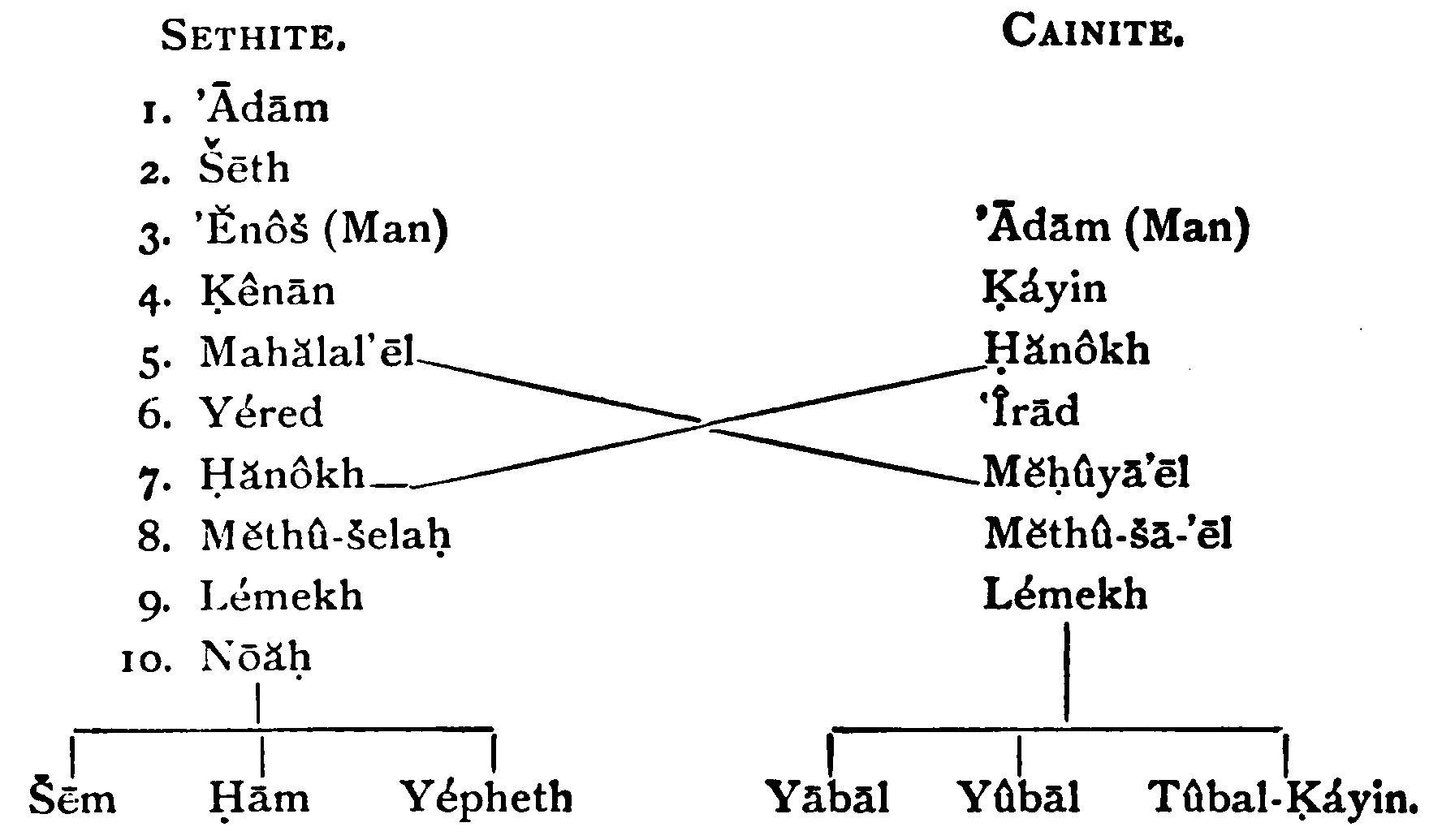
While these resemblances undoubtedly point to some common original, the variations are not such as can be naturally accounted for by direct borrowing of the one list from the other. The facts that each list is composed of a perfect number, and that with the last member the single stem divides into three branches, rather imply that both forms were firmly established in tradition before being incorporated in the biblical documents. If we had to do merely with the Hebrew tradition, the easiest supposition would perhaps be that the Cainite genealogy and the kernel of the Sethite are variants of a single original which might have reached Israel through different channels;¹ that the latter had been expanded by the addition of two names at the beginning and one at the end, so as to bring it into line with the story of the Flood, and the Babylonian genealogy with which it was linked. The difficulty of this hypothesis arises from the curious circumstance that in the Berossian list of kings, just as in the Sethite list of patriarchs, the name for ‘Man’ occupies the third place. It is extremely unlikely that such a coincidence should be accidental; and the question comes to be whether the Assyriologists or the biblical critics can produce the most convincing explanation of it. Now Hommel (Die altorientalischen Denkmäler und das Alte Testament, 26 ff.) argues that if the word for Man is preceded by two others, these others must have been names of superhuman beings; and he thinks that his interpretation of the Babylonian names bears out this anticipation. The first, Aruru, is the creative earth-goddess, and the second, Adapa (= Marduk) is a sort of Logos or Demiurge—a being intermediate between gods and men, who bears elsewhere the title zir amiluti (‘seed of mankind’) but is not himself a man.² And the same thing must, he considers, hold good of Adam and Seth: Adam should be read אֱדֹם, a personification of the earth, and Seth is a mysterious semi-divine personality who was regarded even in Jewish tradition as an incarnation of the Messiah. If these somewhat hazardous combinations be sound, then, of course, the inference must be accepted that the Sethite genealogy is dependent on the Babylonian original of Berossus, and the Cainite can be nothing but a mutilated version of it. It is just conceivable, however, that the Babylonian list is itself a secondary modification of a more primitive genealogy, which passed independently into Hebrew tradition.³
¹ Hommel’s view (Die altorientalischen Denkmäler und das Alte Testament, 29 f.) is that the primary list was Chaldean, that the Sethite list most nearly represents this original, and that the Cainite springs from a modification of it under Babylonian influence. It would be quite as plausible to suggest that the Cainite form came through Phœnicia (see the notes on Jabal, Tubal, and Na‛amah), and the Sethite from Arabia (Enos, Kenan, Hanokh [?], Methuselah).
² But against this interpretation of the phrase, see Jensen Keilinschriftliche Bibliothek, vi. 1, 362.
³ Thus, it might be conjectured that the original equivalent of Aruru was not Adam but Ḥavvah, as earth and mother-goddess (see pages 85 f., 102), and that this name stood at the head of the list. That in the process of eliminating the mythological element Ḥavvah should in one version become the wife, in another remain the mother, of the first man (Adam or Enoš), is perfectly intelligible; and an amalgamation of these views would account for the duplication of Adam-Enos in 425 f. 5. The insertion of a link (Seth-Adapa) between the divine ancestress and the first man is a difficulty; but it might be due to a survival of the old Semitic conception of mother and son as associated deities (William Robertson Smith Kinship and Marriage in Early Arabia², 298 ff.). It is obvious that no great importance can be attached to such guesses, which necessarily carry us back far beyond the range of authentic tradition.
VI. 1‒4. The Origin of the Nĕphîlîm.
This obscure and obviously fragmentary narrative relates how in the infancy of the human race marriage alliances were believed to have been formed by supernatural beings with mortal women (verses 1. 2); and how from these unnatural unions there arose a race of heroes or demi-gods (verse ⁴), who must have figured largely in Hebrew folklore. It is implied, though not expressly said, that the existence of such beings, intermediate between the divine and the human, introduced an element of disorder into the Creation which had to be checked by the special interposition of Yahwe (verse ³).
The fragment belongs to the class of ætiological myths. The belief in Nĕphîlîm is proved only by Numbers 13³³ (Elohist?); but it is there seen to have been associated with a more widely attested tradition of a race of giants surviving into historic times, especially among the aboriginal populations of Canaan (Deuteronomy 1²⁸ 210. 11. 21 9², Joshua 15¹⁴, Amos 2⁹ etc.). The question was naturally asked how such beings came to exist, and the passage before us supplied the answer. But while the ætiological motive may explain the retention of the fragment in Genesis, it is not to be supposed that the myth originated solely in this reflexion. Its pagan colouring is too pronounced to permit of its being dissociated from two notions prevalent in antiquity and familiar to us from Greek and Latin literature: viz. (1) that among the early inhabitants of the earth were men of gigantic stature;¹ and (2) that marriages of the gods with mortals were not only possible but common in the heroic age.² Similar ideas were current among other peoples. The Ḳoran has frequent references to the peoples of ‛sons of Godal races noted for their giant stature and their daring impiety, to whom were attributed the erection of lofty buildings and the excavation of rock-dwellings, and who were believed to have been destroyed by a divine judgment.³ The legend appears also in the Phœnician traditions of Sanchuniathon, where it is followed by an obscure allusion to promiscuous sexual intercourse which appears to have some remote connexion with Genesis 6².⁴
¹ Homer Iliad v. 302 f.; Herodotus i. 68; Pausanias i. 35. 5 f., viii. 29. 3; 32. 4; Lucretius ii. 1151; Virgil Aeneid xii. 900; Pliny, Natural History, vii. 73 ff. etc. Compare Lenormant Les Origines de l’histoire² i. 350 ff.
² Homer Iliad xii. 23: ἡμιθέων γένος ἀνδρῶν; Plato, Cratylus, 33: πάντες [sc. οἱ ἥρωες] δήπου γεγόνασιν ἐρασθέντος ἢ θεοῦ θνητῆς ἢ θνητοῦ θεᾶς (text uncertain): see Jowett, i. 341.
³ Surah vii, xv, xxvi, xli, xlvi, lxxxix: see Sale, Preliminary Discourse § 1.
⁴ Eusebius Præparatio Evangelica i. 10 (see page 124 above): ἀπὸ γένους Αἰῶνος καὶ Πρωτογόνου γεννηθῆναι αὖθις παῖδας θνητοὺς, οἷς εἶναι ὀνόματα Φὼς καὶ Πῦρ καὶ Φλόξ ... υἱοὺς δὲ ἐγέννησαν οὗτοι μεγέθει τε καὶ ὑπεροχῇ κρείσσονας ... ἐκ τούτων, φησὶν, ἐγεννήθη Σαμημροῦμος ὁ καὶ Ὑψουράνιος· ἀπὸ μητέρων δὲ, φησὶν, ἐχρημάτιζον τῶν τότε γυναικῶν ἀνέδην μισγομένων οἷς ἂν ἐ[ν]τύχοιεν.
That the source is Yahwist is not disputed.¹ Dillmann, indeed, following Schrader (Einleitung in das Alte Testament 276), thinks it an extract from Elohist which had passed through the hands of Yahwist; but borrowing by the original Yahwist from the other source is impossible, and the only positive trace of Elohist would be the word נפילים, which in Numbers 13³³ is by some critics assigned to Elohist. That argument would at most prove overworking, and it is too slight to be considered.—The precise position of the fragment among the Yahwistic traditions cannot be determined. The introductory clause “when mankind began to multiply,” etc., suggests that it was closely preceded by an account of the creation of man. There is, however, no reason why it should not have followed a genealogy like that of 417‒24 or 425 f. (against Holzinger), though certainly not that of Priestly-Code in chapter 5. The idea that it is a parallel to the story of the Fall in chapter 3 (Schrader, Dillmann, Wellhausen, Schultz) has little plausibility, though it would be equally rash to affirm that it presupposes such an account.—The disconnectedness of the narrative is probably due to drastic abridgment either by the original writer or later editors, to whom its crudely mythological character was objectionable, and who were interested in retaining no more than was needful to account for the origin of the giants.
¹ The literary indications are not absolutely decisive (except יהוה, verse ³); but the following expressions, as well as the structure of the sentences (in verse 1 f.), are, on the whole, characteristic of Yahwist: הֵחֵל, עַל־פְּנֵי הָֽאֲדָמָה (¹), בָּאָרָץ, הָיָה גִּבּוֹר (⁴): see Budde Die biblische Urgeschichte 6 ff., 39 A.
There remains the question whether the passage was from the first an introduction to the story of the Deluge. That it has been so regarded from a very early time is a natural result of its present position. But careful examination fails to confirm that impression. The passage contains nothing to suggest the Flood as its sequel, except on the supposition (which we shall see to be improbable) that the 120 years of verse ³ refer to an impending judgment on the whole human race. Even if that view were more plausible than it is, it would still be remarkable that the story of the Flood makes no reference to the expiry of the allotted term; nor to any such incident as is here recorded. The critical probability, therefore, is that 61‒4 belongs to a stratum of Yahwist which knows nothing of a flood (page 2 ff.). The Babylonian Flood-legend also is free from any allusion to giants, or mingling of gods and men. O. Gruppe, however (Philologus, Neue Folge, i. 93 ff.; Zeitschrift für die alttestamentliche Wissenschaft, ix. 134 ff.), claims to have recovered from Greek sources a Phœnician legend of intermarriages between deities and mortals, which presents some striking affinities with Genesis 61‒4, and which leads up to an account of the Flood. Of the soundness of Gruppe’s combinations I am unable to judge; but he himself admits that the Flood is a late importation into Greek mythology, and indeed he instances the passage before us as the earliest literary trace of the hypothetical Phœnician legend. Even, therefore, if his speculations be valid, it would have to be considered whether the later form of the myth may not have been determined partly by Jewish influence, and whether the connexion between the divine intermarriages and the Flood does not simply reproduce the sequence of events given in Genesis. That this is not inconceivable is shown by the fact that on late Phrygian coins the biblical name ΝΩ appears as that of the hero of the Deluge (see page 180 below).
1, 2. The sense of these verses is perfectly clear. The sons of God (בני האלהים) are everywhere in Old Testament members (but probably inferior members) of the divine order, or (using the word with some freedom) angels (v.i.).
“The angels are not called ‘sons of God’ as if they had actually derived their nature from Him as a child from its father; nor in a less exact way, because though created they have received a nature similar to God’s, being spirits; nor yet as if on account of their steadfast holiness they had been adopted into the family of God. These ideas are not found here. The name Elohim or sons (i.e. members of the race) of the Elohim is a name given directly to angels in contrast with men ... the name is given to God and angels in common; He is Elohim pre-eminently, they are Elohim in an inferior sense” (Davidson, Job, Cambridge Bible, page 6).
1. וַיְהִי כִּי] peculiar to Yahwist in Hexateuch; 26⁸ 27¹ 43²¹ 44²⁴, Exodus 1²¹ 13¹⁵, Joshua 17¹³. See Budde 6. The apodosis commences with verse ².—הֵחֵל] see Holzinger Einleitung in den Hexateuch 97.—על־פני האדמה] see Oxford Hexateuch i. 187.—2. בני [ה]אלהים] Job 1⁶ 2¹ 38⁷, [Daniel 3²⁵]; compare ב׳ אלים, Psalms 29¹ 89⁷. In all these places the superhuman character of the beings denoted is evident,—‘belonging to the category of the gods.’ On this Semitic use of בן, see William Robertson Smith Kinship and Marriage in Early Arabia², 17; The Prophets of Israel² 85, 389 f. (1) The phrase is so understood by LXX (οἱ ἄγγελοι [also υἱοὶ] τοῦ θεοῦ), Theodotion, Jubilees v. 1, Enoch vi. 2 ff. (Jude ⁶, 2 Peter 2⁴), Josephus Antiquities of the Jews i. 73; Fathers down to Cyprian and Lactantius, and nearly all moderns. [Peshiṭtå transliterates as in Job 1⁶ 2¹.] (2) Amongst the Jews this view was early displaced by another, according to which the ‘sons of the gods’ are members of aristocratic families in distinction from women of humble rank: TargumOnkelos-Jonathan (בני רברביא), Symmachus (τῶν δυναστευόντων), Bereshith Rabba, Rashi, Abraham Ibn Ezra [Aquila (υἱοὶ τῶν θεῶν) is explained by Jeremias as ‘deos intelligens sanctos sive angelos’]. So Spinoza, Herder, al. (3) The prevalent Christian interpretation (on the rise of which see Charles’s valuable Note, Book of Jubilees 33 ff.) has been to take the phrase in an ethical sense as denoting pious men of the line of Seth: Julius Africanus, most Fathers, Luther, Calvin, al.: still maintained by Strack. Against both these last explanations it is decisive that בנות האדם cannot have a narrower reference in verse ² than in verse ¹; and that consequently בני ה׳ cannot denote a section of mankind. For other arguments, see Lenormant, Les Origines de l’histoire² 291 ff.; the Commentary of Delitzsch (146 ff.), Dillmann (119 f.), or Driver (82 f.). On the eccentric theory of Stuart Poole, that the sons of God were a wicked pre-Adamite race, see Lenormant 304 ff.—ויקחו ... נשים] = ‘marry’: 4¹⁹ 11²⁹ 25¹ 36² etc.—מכּל אשר] ‘consisting of all whom,’—the rare מן of explication; Brown-Driver-Briggs, s.v. 3b (e); compare Gesenius-Kautzsch § 119 w²: Genesis 7²² 9¹⁰.


In an earlier polytheistic recension of the myth, they were perhaps called אלהים simply. It is only a desire to save the credibility of the record as literal history, that has prompted the untenable interpretations mentioned in the note below.—2. These superhuman beings, attracted by the beauty of the daughters of men (i.e. mortal women) took to themselves as wives (strictly implying permanent marriages, but this must not be pressed) whomsoever they chose. No sin is imputed to mankind or to their daughters in these relations. The guilt is wholly on the side of the angels; and consists partly, perhaps, in sensuality, partly in high-handed disregard of the rights of God’s lower creatures.—It is to be noted, in contrast with analogous heathen myths, that the divine element is exclusively masculine.
3. A divine sentence on the human race, imposing a limit on the term of man’s life.—My spirit shall not [... in?] man for ever; [...?] he is flesh, and his days shall be 120 years.
A complete exegesis of these words is impossible, owing first to the obscurity of certain leading expressions (see the footnote), and second to the want of explicit connexion with what precedes. The record has evidently undergone serious mutilation. The original narrative must have contained a statement of the effects on human life produced by the superhuman alliances,—and that opens up a wide field of speculation;¹—and possibly also an account of the judgment on the sons of God, the really guilty parties in the transaction. In default of this guidance, all that can be done is to determine as nearly as possible the general sense of the verse, assuming the text to be fairly complete, and a real connexion to exist with verses 1. 2.—(i.) Everything turns on the meaning of the word רוּחַ, of which four interpretations have been given: (1) That רוּחִי is the Spirit of Yahwe as an ethical principle, striving against and ‘judging’ the prevalent corruption of men (as in Isaiah 63¹⁰); so Symmachus, TargumJonathan, Luther, al. There is nothing to suggest that view except the particular acceptation of the verb ידון associated with it, and it is now practically abandoned. (2) Even less admissible is the conception of Klostermann, who understands רוּחִי subjectively of the divine feeling (Gemüt) excited by human sin² (similarly Rashi). (3) The commonest view in modern times (see Dillmann) has been that רוּחַ is the divine principle of life implanted in man at creation, the tenor of the decree being that this shall not ‘abide’³ in man eternally or indefinitely, but only in such measure as to admit a maximum life of 120 years. There are two difficulties in this interpretation: (a) It has no connexion with what precedes, for everything the verse contains would be quite as intelligible apart from the marriages with the angels as in relation to them.⁴ (b) The following words הוא בשׂר have no meaning: as a reason for the withdrawal of the animating spirit they involve a hysteron proteron; and as an independent statement they are (on the supposition) not true, man as actually constituted being both flesh and spirit (2⁷). (4) The most probable sense is that given by Wellhausen (Die Composition des Hexateuchs und der historischen Bücher des Alten Testaments² 305 ff.), viz. that רוח is the divine substance common to Yahwe and the angels, in contrast to בָּשָׂר, which is the element proper to human nature (compare Isaiah 31³): so Holzinger, Gunkel. The idea will then be that the mingling of the divine and human substances brought about by illicit sexual unions has introduced a disorder into the creation which Yahwe cannot suffer to ‘abide’ permanently, but resolves to end by an exercise of His supreme power.—(ii.) We have next to consider whether the 120 years, taken in its natural sense of the duration of individual life (v.i.), be consistent with the conclusion just reached. Wellhausen himself thinks that it is not: the fusion of the divine and human elements would be propagated in the race, and could not be checked by a shortening of the lives of individuals. The context requires an announcement of the annihilation of the race, and the last clause of the verse must be a mistaken gloss on the first. If this argument were sound it would certainly supply a strong reason either for revising Wellhausen’s acceptation of 3a, or for understanding 3b as an announcement of the Flood. But a shortening of the term of life, though not a logical corollary from the sin of the angels, might nevertheless be a judicial sentence upon it. It would ensure the extinction of the giants within a measurable time; and indirectly impose a limit on the new intellectual powers which we may suppose to have accrued to mankind at large through union with angelic beings.⁵ In view of the defective character of the narrative, it would be unwise to press the antagonism of the two clauses so as to put a strain on the interpretation of either.
¹ Compare Cheyne’s imaginary restoration in Encyclopædia Biblica, 3391, with the reconstructed Phœnician myth of Gruppe in Philologus, 1889, i. 100 ff.
² Reading לֹא יִדֹּם רוּחי, ‘shall not restrain itself’ (literally ‘be silent’). See Neue kirchliche Zeitschrift, 1894, 234 ff. (= Der Pentateuch [1907] 28 ff.).
³ On this traditional rendering of ידון, see the footnote, page 143.
⁴ Budde’s argument that the verse is detachable from its present context is, therefore, perfectly sound; although his attempt to find a place for it after 3²¹ is not so successful (see page 3 above).
⁵ Just as in 322. 24 man is allowed to retain the gift of illicitly obtained knowledge, but is foiled by being denied the boon of immortality. The same point of view appears in 111‒9: in each case the ruling motive is the divine jealousy of human greatness; and man’s pride is humbled by a subtle and indirect exercise of the power of God.
3. יהוה] LXX Κύριος ὁ θεός.—יָדוֹן] There are two traditional interpretations: (a) ‘abide’: so LXX (καταμείνῃ), Vulgate, Peshiṭtå, TargumOnkelos; (b) ‘judge’ (Symmachus κρινεῖ: so TargumJonathan). The former is perhaps nothing more than a plausible guess at the meaning, though a variant text has been suspected (ילון, ידור, יִכּוֹן, etc.). The latter traces the form to the √ דין; but the etymology is doubtful, since that √ shows no trace of medial ו in Hebrew (Nöldeke Zeitschrift der deutschen morgenländischen Gesellschaft, xxxvii. 533 f.); and to call it a jussive or intransitive form is an abuse of grammatical language (see Gesenius-Kautzsch § 71 r). A Jewish derivation, mentioned by Abraham Ibn Ezra and Calvin, connects the verb with נָדָן, ‘sheath’ (1 Chronicles 21²⁷),—the body being compared to the sheath of the spirit. The Arabic dāna (medial w) = ‘be humbled’ or ‘degraded,’ yields but a tolerable sense (Tuch, Ewald, al.); the Egyptian Arabic dāna, which means ‘to do a thing continually’ (Socin; see Gesenius-Buhl s.v.), would suit the context well, but can hardly be the same word. Vollers (Zeitschrift für Assyriologie, xiv. 349 ff.) derives it from √ דנן, Assyrian danânu = ‘be powerful’; the idea being that the life-giving spirit shall no longer have the same force as formerly, etc. It would be still better if the verb could be taken as a denominative from Assyrian dinânu, ‘bodily appearance,’ with the sense “shall not be embodied in man for ever.”—בָּאָדָם] LXX ἐν τοῖς ἀνθρώποις τούτοις, whence Klostermann restores באדם הַזֶּה¹ = ‘this humanity,’ as distinguished from that originally created,—an impossible exegesis, whose sole advantage is that it gives a meaning to the גַּם in בְּשֶׂגַּם (v.i.).—לְעוֹלָם—לֹא (thus separated)] here = ‘not ... for ever,’ as Jeremiah 3¹², Lamentations 3³¹; elsewhere (Psalms 15⁵ etc.) the phrase means ‘never.’—בְּשֶׂגָּם] so pointed in the majority of MSS, is infinitive construct of שָׁגַג, ‘err,’ with suffix. This sense is adopted by many (Tuch, Ewald, Budde, Holzinger, al.), but it can hardly be right. If we refer the suffix to הָאָדָם, the enallage numeri (‘through their erring he is flesh’) would be harsh, and the idea expressed unsuitable. If we refer it to the angels, we can avoid an absurdity only by disregarding the accents and joining the word with what precedes: ‘shall not (abide?) in man for ever on account of their (the angels’) erring; he is flesh, and,’ etc. The sentence is doubly bad in point of style: the first member is overloaded at the end by the emphatic word; and the second opens awkwardly without a connecting participle. Moreover, it is questionable if the idea of שׁגג (inadvertent transgression) is appropriate in the connexion. Margoliouth (Expositor, 1898, ii. 33 ff.) explains the obscure word by Aethiopian shegā = ‘body’; but the proposed rendering, ‘inasmuch as their body (or substance) is flesh,’ is not grammatically admissible. The correct Massoretic reading is בְּשֶׂגַּם (i.e. גַּם + שֶׁ + בְּ) = inasmuch as he too. The objections to this are (a) that the relative שֶׁ is never found in Pentateuch, and is very rare in the older literature (Judges 5⁷ 6¹⁷ 7¹² 8²⁶), while compounds like בְּ׳ do not appear before Ecclesiastes (e.g. 2¹⁶); and (b) that the גַּם has no force, there being nothing which serves as a contrast to הוּא. Wellhausen observes that בְּ׳ must represent a causal particle and possibly nothing more. The old translators, LXX (διὰ τὸ εἶναι αὐτοὺς) Peshiṭtå, Vulgate, TargumOnkelos seem to have been of the same opinion; and it is noticeable that none of them attempt to reproduce the גַּם. The conjectures of Olshausen (לָבַשׁ גַּם), Cheyne (בְּמִשְׁכְּנוֹת בָּשָׂר), and others are all beside the mark.—והיו ימיו וגו׳] The only natural reference is to the (maximum) term of human life (so Josephus, Tuch, Ewald, and most since), a man’s יָמִים being a standing expression for his lifetime, reckoning from his birth (see chapter 5. 35²⁸, Isaiah 65²⁰ etc.). The older view (TargumOnkelos-Jonathan, Jerome, Rashi, Abraham Ibn Ezra, Calvin, al.: so Delitzsch, Klostermann), that the clause indicates the interval that was to elapse before the Flood, was naturally suggested by the present position of the passage, and was supported by the consideration that greater ages were subsequently attained by many of the patriarchs. But these statements belong to Priestly-Code, and decide nothing as to the meaning of the words in Yahwist.
¹ Already proposed by Egli (cited by Budde).
4. The Nĕphîlîm were (or arose) in the earth in those days] Who were the נְפִלִים? The name recurs only in Numbers 13³³, where we learn that they were conceived as beings of gigantic stature, whose descendants survived till the days of Moses and Joshua. The circumstantial form of the sentence here (compare 12⁶ 13⁷) is misleading, for the writer cannot have meant that the נ׳ existed in those days apart from the alliances with the angels, and that the result of the latter were the גִּבּוֹרִים (Lenormant, al.). The idea undoubtedly is that this race arose at that time in consequence of the union of the divine ‘spirit’ with human ‘flesh.’—and also afterwards whenever (LXX ὡς ἂν) the sons of the gods came in ... and they (the women) bore unto them] That is to say, the production of Nephîlîm was not confined to the remote period indicated by verse 1 f., but was continued in after ages through visits of angels to mortal wives,—a conception which certainly betrays the hand of a glossator. It is perhaps enough to remove וְגַם אַֽחֲרֵי־כֵן as an interpolation, and connect the אֲשֶׁר with בַּֽיָּמִים הָהֵם; though even then the phrasing is odd (v.i.).—Those are the heroes (הַגִּבּוֹּרִים) that were of old, the men of fame] (אַנְשֵׁי הַשֵּׁם, compare Numbers 16²). הֵמָּה has for its antecedent not אֲשֶׁר as objective to יָֽלְדוּ (Wellhausen), but הַנְּפִלִים. There is a touch of euhemerism in the notice (Wellhausen), the archaic and mythological נְפִלִים being identified with the more human גִּבּוֹרִים who were renowned in Hebrew story.
It is probable that the legend of the Nephîlîm had a wider circulation in Hebrew tradition than could be gathered from its curt handling by the editors of the Hexateuch. In Ezekiel 32 we meet with the weird conception of a mighty antique race who are the original denizens of Sheol, where they lie in state with their swords under their heads, and are roused to a transient interest in the newcomers who disturb their majestic repose. If Cornill’s correction of verse ²⁷ (גבורים נְפִלִים מעולם) be sound, these are to be identified with the Nephîlîm of our passage; and the picture throws light on two points left obscure in Genesis: viz., the character of the primæval giants, and the punishment meted out to them. Ezekiel dwells on their haughty violence and warlike prowess, and plainly intimates that for their crimes they were consigned to Sheol, where, however, they enjoy a kind of aristocratic dignity among the Shades. It would almost seem as if the whole conception had been suggested by the supposed discoveries of prehistoric skeletons of great stature, buried with their arms beside them, like those recorded by Pausanias (i. 35. 5 f., viii. 29. 3, 32. 4) and other ancient writers (see William Robertson Smith in Driver A critical and exegetical commentary on Deuteronomy 40 f.).
4. הַנְּפִלִים] LXX οἱ γίγαντες; Aquila οἱ ἐπιπίπτοντες; Symmachus οἱ βίαιοι; Peshiṭtå ; TargumOnkelos גבריא. The etymology is uncertain (see Dillmann 123). There is no allusion to a ‘fall’ (√ נָפַל) of angels from heaven (TargumJonathan, Jerome¹, Rashi), or to a ‘fall’ of the world through their action (Bereshith Rabba, Rashi). A connexion with נֵפֶל, ‘abortive birth’ (from נָפַל, ‘fall dead’), is not improbable (Schwally, Zeitschrift für die alttestamentliche Wissenschaft, xviii. 144 ff.). An attractive emendation of Cornill (נְפִילִים מֵעוֹלָם) in Ezekiel 32²⁷ not only yields a striking resemblance to this verse, but supports the idea that the נ׳ (like the רְפָאִים) were associated with the notion of Sheol.—אחרי כן אשר] cannot mean ‘after’ (as conjunction), which would require a perfect to follow, but only ‘afterwards, when.’ On any view, יָבֹאוּ; and וְיָלְדוּ are frequentative tenses.—בוא אל] (as euphemism) is characteristic of Jehovist (especially Yahwist) in Hexateuch (Budde 39, Anm.). Compare William Robertson Smith Kinship and Marriage in Early Arabia², 198 ff.—חַגִּבּוֹרִים] literally ‘mighty ones’ (Aquila δυνατοί; Vulgate potentes; LXX, Symmachus, Peshiṭtå, TargumOnkelos do not distinguish from נפילים). The word is thoroughly naturalised in Hebrew speech, and nearly always in a good sense. But passages like Ezekiel 3212 ff. show that it had another aspect, akin to Arabic ǧabbār (proud, audacious, tyrannical). The Arabic and Syrian equivalents are used as names of the constellation Orion (Lane, An Arabic-English Lexicon i. 375 a; Robert Payne Smith Thesaurus Syriacus 646).—אשר מעולם] compare עַם עוֹלָם, Ezekiel 26²⁰, probably an allusion to a wicked ancient race thrust down to Sheol.—The whole verse has the appearance of a series of antiquarian glosses; and all that can be strictly inferred from it is that there was some traditional association of the Nephîlîm with the incident recorded in verse 1 f. At the same time we may reasonably hold that the kernel of the verse reproduces in a hesitating and broken fashion the essential thought of the original myth. The writer apparently shrinks from the direct statement that the Nephîlîm were the offspring of the marriages of verses 1. 2, and tantalises the curiosity of his readers with the cautious affirmation that such beings then existed. A later hand then introduced a reminder that they existed ‘afterwards’ as well.—Budde, who omits verse ³, restores the original connexion with verse 1 f. as follows: [והיה כאשר] יבאו בני האלהים ... [וכן] היו הנפלים בארץ בימים ההם. Some such excellent sentence may very well have stood in the original; but it was precisely this perspicuity of narration which the editor wished to avoid.

¹ “Et angelis et sanctorum liberis, convenit nomen cadentium.”
VI. 5‒IX. 29. Noah and the Flood.
Analysis of the Flood-Narrative.—The section on the Flood (6⁵‒9¹⁷) is, as has often been observed, the first example in Genesis of a truly composite narrative; i.e., one in which the compiler “instead of excerpting the entire account from a single source, has interwoven it out of excerpts taken alternatively from Yahwist and Priestly-Code, preserving in the process many duplicates, as well as leaving unaltered many striking differences of representation and phraseology” (Driver 85). The resolution of the compound narrative into its constituent elements in this case is justly reckoned amongst the most brilliant achievements of purely literary criticism, and affords a particularly instructive lesson in the art of documentary analysis (compare the interesting exposition by Gunkel² 121 ff.). Here it must suffice to give the results of the process, along with a summary of the criteria by which the critical operation is guided and justified. The division generally accepted by recent critics is as follows:
Yahwist Priestly-Code
65‒8
9‒22
71‒5
⁶
7 (8. 9). 10
¹¹
¹²
13‒16a
16b
17a
17b
18‒21
22. 23
7²⁴ 81. 2a
2b. 3a
3b‒5
6‒12
13a
13b
14‒19
20‒22
91‒17
The minutiæ of glosses, transpositions, etc., are left to be dealt with in the Notes. Neglecting these, the scheme as given above represents the results of Budde (to whom the finishing touches are due: Die biblische Urgeschichte 248 ff.) Gunkel and Holzinger. Dillmann agrees absolutely, except that he assigns 7¹⁷ wholly to Yahwist, and 723b to Priestly-Code; and Wellhausen, except with regard to 7¹⁷ (Yahwist) 83. 13, which are both assigned entirely to Priestly-Code. The divergences of Kuenen and Cornill are almost equally slight; and indeed the main outlines of the analysis were fixed by the researches of Hupfeld, Nöldeke, and Schrader.—This remarkable consensus of critical opinion has been arrived at by four chief lines of evidence: (1) Linguistic. The key to the whole process is, of course, the distinction between the divine names יהוה (65. 6. 7. 8 71. 5. 16b 820. 21) and אלהים (69. 11. 12. 13. 22 716a 81. 15 91. 6. 8. 12. 16. 17). Besides this, a number of characteristic expressions differentiate the two sources. Thus Yahwist’s איש ואשתו (7²) answers to Priestly-Code’s זכר ונקבה¹ (6¹⁹ 7(9). 16); מחה (6⁷ 74. 23) to שִׁחֵת and השחית (613. 17 911. 15); מות (7²²) to גָוַע¹ (6¹⁷ 7²¹); כל־היקום (74. 23) to כל־בשר¹ (612. 13. 17 7²¹ and often); קל (88. 11) and שוּב (73a) to חסר (8⁵); חרב (813b) to יבש (8¹⁴) [but see on 813b]; נשמת חיים (8²²) to רוח חיים (6¹⁷); לְחַיּוֹת (7³) to לְהַֽחֲיוֹת (619. 20); כל־ביתך (7¹) to the specific enumerations of 6¹⁸ 7(7). 13 816. 18. (Compare the list in Holzinger Genesis erklärt page 68).—(2) Diversity of representation. In Yahwist clean and unclean animals are distinguished, the former entering the ark by sevens and the latter in pairs (7², compare 8²⁰); in Priestly-Code one pair of every kind without distinction is admitted (619 f. 715 f.). According to Yahwist, the cause of the Flood is a forty-days’ rain which is to commence seven days after the command to enter the ark (74. 10. 12 82b. 6)—the latter passage showing that the waters began to subside after the 40 days. In Priestly-Code we have (7¹¹ 82a) a different conception of the cause of the Flood; and, in 76. 11. 13. 24 83b. 4. 5. 13a. 14, a chronological scheme according to which the waters increase for 150 days, and the entire duration of the Flood is one year (see page 167 ff.).—(3) Duplicates. The following are obviously parallels from the two documents: 65‒8 ∥ 611‒13 (occasion of the Flood); 71‒5 ∥ 617‒22 (command to enter the ark, and announcement of the Flood); 7⁷ ∥ 7¹³ (entering of the ark); 7¹⁰ ∥ 7¹¹ (coming of the Flood); 717b ∥ 7¹⁸ (increase of the waters: floating of the ark); 722 f. ∥ 7²¹ (destruction of terrestrial life); 82b. 3a ∥ 81 f. (abatement of the Flood); 813b ∥ 813a. 14 (drying of the earth); 820‒22 ∥ 98 ff. (promise that the Flood shall not recur).—(4) The final confirmation of the theory is that the two series of passages form two all but continuous narratives, which exhibit the distinctive features of the two great sources of the primitive history, Yahwist and Priestly-Code. The Yahwist sections are a graphic popular tale, appealing to the imagination rather than to the reasoning faculties. The aim of the writer, one would say, was to bring the cosmopolitan (Babylonian) Flood-legend within the comprehension of a native of Palestine. The Deluge is ascribed to a familiar cause, the rain; only, the rain lasts for an unusual time, 40 days. The picturesque incident of the dove (see 8⁹) reveals the touch of descriptive genius which so often breaks forth from this document. The boldest anthropomorphisms are freely introduced into the conception of God (66 f. 716b 8²¹); and the religious institutions of the author’s time are unhesitatingly assumed for the age of Noah.—Still more pronounced are the characteristics of Priestly-Code in the other account. The vivid details which are the life and charm of the older narrative have all disappeared; and if the sign of the rainbow (912‒17) is retained, its æsthetic beauty has evaporated. For the rest, everything is formal, precise, and calculated,—the size of the ark, the number of the persons and the classification of the animals in it, the exact duration of the Flood in its various stages, etc.: if these mathematical determinations are removed, there is little story left. The real interest of the writer is in the new departure in God’s dealings with the world, of which the Flood was the occasion,—the modification of the original constitution of nature, 91‒7, and the establishment of the first of the three great covenants, 98‒17. The connexion of the former passage with Genesis 1 is unmistakably evident. Very significant are the omission of Noah’s sacrifice, and the ignoring of the laws of cleanness and uncleanness amongst animals.²
¹ Phrases characteristic of the style of Priestly-Code generally.
² Traces of Priestly-Code’s general vocabulary are very numerous. Besides some of those (marked by ¹) already enumerated in contrast to Yahwist, we have תּוֹלְדֹת (6⁹); דֹּרֹת (6⁹ 9¹²); הוֹלִיד (6¹⁰); הקים ברית (6¹⁸ 99. 11. 17) and נתן ב׳ (9¹²); אִתּו in enumerations (6¹⁸ 7¹³ 8¹⁶ etc.); מין (6²⁰ 7¹⁴); רֶמֶשׂ, רָמַשׂ (6²⁰ 7(8). 14. 21 817. 19 92. 3); שֶׁרֶץ, שָׁרַץ (7²¹ 8¹⁷ 9⁷); לְאָכְלָה (6²¹ 9³); בעצם היום הזה (7¹³); מאד מאד (7¹⁹); בְּ of specification (7²¹ 8¹⁷ 910. 15. 16); פרה ורבה (8¹⁷ 91. 7); למשפחתיהם (8¹⁹); ברית עולם (9¹⁶).—Of the style of Yahwist the positive indications are fewer: מצא חן (6⁸); מחה in the sense ‘destroy’ (6⁷ 74. 23) [see Holzinger Einleitung in den Hexateuch 101]; עצב (6⁶); על־פני האדמה (74. 23 88 (? 13 LXX)); בעבור (8²¹). See the commentaries of Dillmann, Holzinger, Gunkel, etc.
The success of the critical process is due to the care and skill with which the Redactor (RedactorJahwist/Priestly-Code) has performed his task. His object evidently was to produce a synthetic history of the Flood without sacrificing a scrap of information that could with any plausibility be utilised for his narrative. The sequence of Priestly-Code he appears to have preserved intact, allowing neither omissions nor transpositions. Of Yahwist he has preserved quite enough to show that it was originally a complete and independent narrative; but it was naturally impracticable to handle it as carefully as the main document. Yet it is doubtful if there are any actual lacunæ except (a) the account of the building of the ark (between 6⁸ and 7¹), and (b) the notice of the exit from it (between 813b and ²⁰). The middle part of the document, however, has been broken up into minute fragments, and these have been placed in position where they would least disturb the flow of narration. Some slight transpositions have been made, and a number of glosses have been introduced; but how far these last are due to the Redactor himself and how far to subsequent editors, we cannot tell (for details see the notes). Duplicates are freely admitted, and small discrepancies are disregarded; the only serious discrepancy (that of the chronology) is ingeniously surmounted by making Yahwist’s 40 days count twice, once as a stage of the increase of the Flood (7¹²) and once as a phase of its decrease (8⁶).¹ This compound narrative is not destitute of interest; but for the understanding of the ideas underlying the literature the primary documents are obviously of first importance. We shall therefore treat them separately.
¹ The supposition of Hupfeld and Lenormant (Les Origines de l’histoire i. 415), that the double period occurred in the original Yahwist, has no foundation.
The Flood according to Yahwist.
VI. 5‒8. The occasion of the Flood:—Yahwe’s experience of the deep-seated and incurable sinfulness of human nature. It is unnecessary to suppose that a description of the deterioration of the race has been omitted, or displaced by 61‒4 (Holzinger). The ground of the pessimistic estimate of human nature so forcibly expressed in verse ⁵ is rather the whole course of man’s development as hitherto related, which is the working out of the sinful knowledge acquired by the Fall. The fratricide of Cain, the song of Lamech, the marriages with the angels, are incidents which, if not all before the mind of the writer of the Flood-story, at least reveal the gloomy view of the early history which characterises the Yahwistic tradition.—5. the whole bent (literally ‘formation’) of the thoughts of his heart] It is difficult to say whether יֵצֶר is more properly the ‘form’ impressed on the mind (the disposition or character), or ‘that which is formed’ by the mind (imagination and purpose—Sinnen und Trachten): compare 8²¹, Deuteronomy 31²¹, Isaiah 26³ (Psalms 103¹⁴?), 1 Chronicles 28⁹ 29¹⁸; v.i.—6. The anthropopathy which attributes to Yahwe regret (וַיִּנָּחֶם) and vexation (וַיִּתְעַצֵּב) because He had created man is unusually strong. Although in the sense of mere change of purpose, the former is often ascribed to God (Exodus 32¹⁴, Jeremiah 187. 8 263. 13, Joel 2¹³, Jonah 3¹⁰ etc.), the cases are few where divine regret for accomplished action is expressed (1 Samuel 15¹¹). The whole representation was felt to be inadequate (Numbers 23¹⁹, 1 Samuel 15¹¹); yet it continued to be used as inseparable from the religious view of history as the personal agency of Yahwe.—7. God’s resolve to blot out (מָחָה) the race: not as yet communicated to Noah, but expressed in monologue.—8. But Noah had found favour, etc.] doubtless on account of his piety; but see on 7¹. The Yahwistic narrative must have contained some previous notice of Noah, probably at the end of a genealogy.
5. יהוה LXX Κύριος ὁ θεός (so verse ⁸).—וכל־יצר וגו׳] LXX loosely: καὶ πᾶς τις διανοεῖται (יֹצֵר?) ἐν τῇ καρδίᾳ αὐτοῦ ἐπιμελῶς ἐπὶ τὰ πονηρά; Vulgate cuncta cogitatio. Another Greek rendering (ὁ Ἑβρ., see Field, ad loc.) is φυσικὸν τοῦ ἀνθ.; but in 8²¹ the same translator has τὸ πλάσμα τῆς καρ. ἀνθ. On the later Jewish theologoumenon of the יצר הרע (the evil impulse in man, also called יצר simply) which is based on this passage, and by Jewish commentaries (Rashi on 8²¹) is found here; see Taylor, Sayings of Jewish Fathers², 37, 148 ff.; Frank C. Porter, Biblical and Semitic Studies; critical and historical essays by the members of the Semitic and Biblical faculty of Yale University (1901), 93 ff.—כל־היום] ‘continually’; see Brown-Driver-Briggs, 400 b.—6. יהוה] LXX ὁ θεός (so verse ⁷).—ויתעצב] Genesis 34⁷; compare Isaiah 63¹⁰ (Piel). Rashi softens the anthropomorphism by making the impending destruction of the creatures the immediate object of the divine grief.—7. אמחה] compare 74. 23. In the full sense of ‘exterminate’ (as distinct from ‘obliterate’ [name, memory, etc.]) the verb is peculiar to Yahwist’s account of the Flood; contrast Numbers 5²³ 34¹¹ (Priestly-Code).—The verse is strongly interpolated. The clauses אשר בראתי and מאדם ... השמים are in the style of Priestly-Code (compare 6²⁰ 714. 21 817. 19 9² etc.); and the latter is, besides, an illogical specification of האדם. They are redactional glosses, the original text being אמחה את־האדם מעל פני האדמה כי נחמתי כי עשיתים (Budde 249 ff.; Dillmann 125).—8. מצא חן בעיני] characteristic of, though not absolutely confined to, Yahwist: 19¹⁹ 32⁶ 338. 15 34¹¹ 39⁴ 47²⁵ etc. (Holzinger Einleitung in den Hexateuch 97 f.).
VII. 1‒5. Announcement of the Flood.—The section is an almost exact parallel to 617‒22 (Priestly-Code). Verse ¹ presupposes in Yahwist a description of the building of the ark, which the redactor has omitted in favour of the elaborate account of Priestly-Code. Not till the work is finished does Yahwe reveal to Noah the purpose it is to serve: verse ⁴ is obviously the first intimation that has been given of the approaching deluge. The building of the ark in implicit obedience to the divine command is thus a great test and proof of Noah’s faith; compare Hebrews 11⁷.—1. Thou and all thy house] Yahwist’s brevity is here far more expressive than the formal enumerations of Priestly-Code (6¹⁸ 7¹³ 816. 18). The principle involved is the religious solidarity of the family; its members are saved for the righteousness of its head (compare 19¹²).—thee have I seen (to be) righteous (צַדִּיק, see on 6⁹)] Budde and others take this to be a judgement based on Noah’s obedience in building the ark; but that is hardly correct. The verb is not מצא but ראה, which has precisely the same force as the וירא of 6⁵. Compare also 6⁸.—2. clean (טְהוֹר) means, practically, fit for sacrifice and human food; the technical antithesis is טָמֵא, which, however, is here avoided, whether purposely (Delitzsch 174) or not it is impossible to say. The distinction is not, as was once supposed (see Tuch), a proof of Yahwist’s interest in Levitical matters, but, on the contrary, of the naïveté of his religious conceptions. He regards it as rooted in the nature of things, and cannot imagine a time when it was not observed. His view is nearer the historical truth than the theory of Priestly-Code, who traces the distinction to the positive enactments of the Sinaitic legislation (Leviticus 11, Deuteronomy 14), and consequently ignores it here. The same difference of standpoint appears with regard to sacrifice, altars, etc.: see 43 f. 8²⁰ 12⁷ etc.—שִׁבְעָה שִׁבְעָה] by sevens (Gesenius-Kautzsch § 134 q); i.e. ‘7 (individuals) of each kind’ (Delitzsch, Stade, al.), rather than ‘7 pairs’ (Bereshith Rabba, Abraham Ibn Ezra, Dillmann, Gunkel, al.),—in spite of the following איש ואשתו. It is a plausible conjecture (Rashi, Delitzsch, Strack) that the odd individual was a male destined for sacrifice (8²⁰).—3a presents an impure text (v.i.), and must either be removed as a gloss (Kuenen, Budde, Holzinger, Gunkel, al.) or supplemented with LXX (Ball, Bennett).—3b. to keep seed alive, etc.] reads better as the continuation of ² than of 3a.—4. With great rhetorical effect, the reason for all these preparations—the coming of the Flood—is reserved to the end. Yahwist knows no other physical cause of the Deluge than the 40 days’ rain (compare verse ¹²).—5. Compare 6²² (Priestly-Code).
1. יהוה] The Samaritan Recension of the Pentateuch, Peshiṭtå אלהים; LXX Κύριος ὁ θεός.—צדיק] predicate accusative; Davidson § 76.—2. For שנים, The Samaritan Recension of the Pentateuch, LXX, Peshiṭtå, Vulgate read שנים שנים,—probably correctly.—איש ואשתו (bis)] The Samaritan Recension of the Pentateuch זכר ונקבה, assimilating Yahwist to Priestly-Code.—3a. The distinction to be expected between clean and unclean birds is made imperfectly by The Samaritan Recension of the Pentateuch and Peshiṭtå, which insert הטהור after השמים; and fully by LXX, which goes further and adds the words καὶ ἀπὸ παντῶν τῶν πετεινῶν τῶν μὴ καθαρῶν δύο δύο ἄρσεν καὶ θῆλυ. Ball accepts this, thinking the omission in Massoretic Text due to homoioteleuton. But the phrase זכר ונקבה shows that 3a has been manipulated; and it is on the whole more likely that it is entirely redactional. Birds may be included in the הבהמה of verse ²; though Budde’s parallels (Exodus 813 f. 99. 22. 25, Jeremiah 32⁴³ 3310. 12 36²⁹, Psalms 36⁷) are not quite convincing.—3b. לְחַיּוֹת] Priestly-Code uses Hiphil (619 f.).—זֶרַע] as Jeremiah 31²⁷.—4. לימים] On לְ as denoting the close of a term (compare verse ¹⁰), see Brown-Driver-Briggs, s.v. 6b.—הַיְקוּם] a rare word (only 7²³, Deuteronomy 11⁶), meaning ‘that which subsists’ (√ קום). LXX ἀνάστεμα (other examples in Field, ἐξανάστασιν), Vulgate substantia, Peshiṭtå . On the form see Barth, Die Nominalbildung in den Semitischen Sprachen 181; König ii. 146; Gesenius-Kautzsch § 85 d.


7‒10, 12, 16b, 17b, 22, 23.—Entrance into the ark and description of the Flood.—Yahwist’s narrative has here been taken to pieces by the Redactor, who has fitted the fragments into a new connexion supplied by the combined accounts of Yahwist and Priestly-Code. The operation has been performed with such care and skill that it is still possible to restore the original order and recover a succinct and consecutive narrative, of which little if anything appears to be lost. The sequence of events is as follows: At the end of the seven days, the Flood comes (verse ¹⁰); Noah enters the ark (⁷) and Yahwe shuts him in (16b). Forty days’ rain ensues (¹²), and the waters rise and float the ark (17b). All life on the earth’s surface is extinguished; only Noah and those in the ark survive (22 f.).
The rearrangement here adopted (10. 7. 16b. 12. 17b. 22. 23) is due mainly to the acute criticism of Budde (Die biblische Urgeschichte 258 ff.), who has probably added the last refinements to a protracted process of literary investigation. Some points (e.g. the transposition of verses ⁷ and ¹⁰) are, of course, more or less doubtful; others (e.g. 16b) are seen to be necessary as soon as the components of Yahwist have been isolated. The most difficult thing is to clear the text of the glosses which inevitably accompanied the work of redaction; but this also has been accomplished with a considerable degree of certainty and agreement amongst recent commentaries. The most extensive interpolations are part of verse ⁷, the whole of verses ⁸ and ⁹, and part of ²³. For details see the footnote.
7. וּבָנָיו—אִתּוֹ] The enumeration is in the manner of Priestly-Code (obsolete also אִתּוֹ); the words either replace וכל־ביתו (as verse ¹), or are a pure insertion;—in either case redactional.—מי המבול] so 7¹⁰ (Yahwist), 9¹¹ (Priestly-Code) (contrast הַמּ׳ מַיִם, 6¹⁷ 7⁶).—מַבּוּל] LXX κατακλυσμός; Vulgate diluvium; Peshiṭtå and TargumOnkelos טופנא (TargumJonathan טובענא). The word has usually been derived from יבל, ‘streaming’ (see Gesenius Thesaurus philologicus criticus Linguæ Hebrææ et Chaldææ Veteris Testamenti, Dillmann); but is more probably a foreign word without Hebrew etymology (see Nöldeke Zeitschrift der deutschen morgenländischen Gesellschaft, xl. 732). Delitzsch (Wo lag das Paradies? 156) proposed the derivation from Assyrian nabâlu, ‘destroy,’ which is accepted by König (ii. 153), Ball (page 53), and others. The Babylonian technical equivalent is abûbu, which denotes both a ‘light-flood’ and a ‘water-flood’: the double sense has been thought to explain Priestly-Code’s addition of מַיִם to the word (see on 6¹⁷). A transformation of the one name into the other is, however, difficult to understand (see Die Keilinschriften und das Alte Testament³, 495¹, 546²). In Psalms 29¹⁰ מבול appears to be used in a general sense without a historic reference to the Noachic Deluge (see Duhm, ad loc.).—8, 9 present a mixed text. The distinction of clean and unclean points to Yahwist; but all other features (אלהים [though a reading יהוה seems attested by The Samaritan Recension of the Pentateuch, Vulgate, TargumJonathan, and MSS of LXX]; זכר ונקבה; the undiscriminated שנים שנים; the categorical enumeration [to which LXX adds the birds at the beginning of verse ⁸]) to Priestly-Code. In Priestly-Code the verses are not wanted, because they are a duplicate of 13‒16: they must therefore be assigned to an interpolator (Budde al.).
10. At the end of the 7 days (compare verse ⁴)] The interval (we may suppose) was occupied in assembling the animals and provisioning the ark.—the waters of the Flood] הַמַּבּוּל, a technical name for the Deluge, common to both sources (v.i.).—7. Noah enters the ark on account of the ... Flood: hence verse ⁷ presupposes verse ¹⁰. The same order of events is found in Priestly-Code (11. 13) and in the Babylonian legend: “when the lords of the darkness send at evening a (grimy?) rain, enter into the ship and close thy door” (1. 88 f.).—16b (which must in any case follow immediately on verse ⁷) contains a fine anthropomorphism, which (in spite of the Babylonian parallel just cited) it is a pity to spoil by deleting יהוה and making Noah the implicit subject (Klostermann Neue kirchliche Zeitschrift, i. 717).—12. forty days and forty nights] This determination, which in Yahwist expresses the entire duration of the Flood, seems to have been treated by Redactor as merely a stage in the increase of the waters (compare 8⁶). It obviously breaks the connexion of Priestly-Code. The Babylonian deluge lasted only six days and nights (1. 128).—17b. Parallel to ¹⁸ (Priestly-Code).—22, 23. A singularly effective description of the effect of the Flood, which is evidently conceived as universal.
10. On the construction of the sentence, see Gesenius-Kautzsch § 164 a, and on verse ⁶ below.—12. גֶּשֶׁם] (√ ǧasuma = ‘be massive’) commonly used of the heavy winter rain (Ezra 10⁹, Canticles 2¹¹): see George Adam Smith Historical Geography of the Holy Land, 64.—16b. יהוה] LXX Κύριος ὁ θεός + τὴν κιβωτόν.—17b. Since ¹⁸ belongs to Priestly-Code (ויגברו, מאד), its duplicate 17b must be from Yahwist, where it forms a natural continuation of ¹². 17a, on the other hand (in spite of the 40 days), must be assigned to Priestly-Code (see page 164).—22. נשמת רוח חיים] is an unexampled combination, arising from confusion of a phrase of Yahwist (נשמת חיים, 2⁷) with one of Priestly-Code (רוח חיים, 6¹⁷ 7¹⁵). The verse being from Yahwist (compare חָרָבָה instead of יַבָּשָׁה; מתו instead of ויגוע, ²¹), רוח is naturally the word to be deleted.—23a as a whole is Yahwist (מחה, יקום, על־פני האדמה); but the clause מאדם ... השמים seems again (compare 6⁷) to be redactional, and the three words following must disappear with it. 23b might be assigned with almost equal propriety to Yahwist or to Priestly-Code.—וַיִּמַֿח] (apocopated imperfect Qal) is a better attested Massoretic reading than וַיִּמַּח (Niphal). It is easier, however, to change the pointing (to Niphal) than to supply יהוה as subject, and the sense is at least as good.—Gunkel’s rearrangement (23aα. 22. 23b) is a distinct improvement: of the two homologous sentences, that without וְ naturally stands second.
VIII. (1b?), 2b, 3a, (4?), 6‒12, 13b. Subsidence of the waters.—The rain from heaven having ceased, the Flood gradually abates. [The ark settles on some high mountain; and] Noah, ignorant of his whereabouts and unable to see around, sends out first a raven and then a dove to ascertain the condition of the earth.
The continuity of Yahwist’s narrative has again been disturbed by the redaction. Verse 6a, which in its present position has no point of attachment in Yahwist, probably stood originally before 2b, where it refers to the 40 days’ duration of the Flood (Wellhausen Die Composition des Hexateuchs und der historischen Bücher des Alten Testaments² 5). It was removed by Redactor so as to make up part of the interval between the emergence of the mountain-tops and the drying of the ground.—There are two small points in which a modification of the generally accepted division of sources might be suggested. (1) 1b (the wind causing the abatement of the waters) is, on account of אלהים, assigned to Priestly-Code. But the order 1b. 2a is unnatural, and transpositions in Priestly-Code do not seem to have been admitted. The idea is more in accord with Yahwist’s conception of the Flood than with Priestly-Code’s; and but for the name אלהים the half-verse might very well be assigned to Yahwist, and inserted between 2b and 3a. (2) Verse ⁴ is also almost universally regarded as Priestly-Code’s (see Budde 269 f.). But this leaves a lacuna in Yahwist between 3a and 6b, where a notice of the landing of the ark must have stood: on the other hand, 5b makes it extremely doubtful if Priestly-Code thought of the ark as stranded on a mountain at all. The only objection to assigning ⁴ to Yahwist is the chronology: if we may suppose the chronological scheme to have been added or retouched by a later hand (see page 168), there is a great deal to be said for the view of Hupfeld and Reuss that the remainder of the verse belongs to Yahwist.¹—The opening passage would then read as follows:
¹ It may be noted that in Jubilees v. 28 no date is given for the landing of the ark.
3a. הלוך ושוב] Gesenius-Kautzsch § 113 u. LXX has misunderstood the idiom both here and in verse ⁷.
6a. At the end of 40 days, 2b. the rain from heaven was restrained; 1b. and Yahwe (?) caused a wind to pass over the earth, and the waters abated. 3a. And the waters went on decreasing from off the earth, 4. and the ark rested on the mountains of Ararat.—On the landing-place of the ark, see page 166 below.
6b‒12. The episode of the sending out of the birds appears in many forms of the Deluge-tradition; notably in the Babylonian. It is here related as an illustration of Noah’s wisdom (Gunkel). Tuch quotes from Pliny, vi. 83 (on the Indians): “siderum in navigando nulla observatio; septentrio non cernitur; sed volucres secum vehunt, emittentes sæpius, meatumque earum terram petentium comitantur.”—7. He sent out a raven] The purpose of the action is not stated till verse ⁸; partly for this reason, partly because the threefold experiment with the dove is complete and more natural, the genuineness of the verse has been questioned (Wellhausen, Holzinger, Gunkel, al.). Dahse, Zeitschrift für die alttestamentliche Wissenschaft, xxviii. 5 f., calls attention to the fact that in LXXᴹ the verse is marked with the obelus. The Babylonian account has three experiments, but with different birds (dove, swallow, raven).—8. And he sent out a dove] perhaps immediately; see LXX below. But if verse ⁷ be a later insertion, we must supply and he waited 7 days (see verse ¹⁰).—9. The description of the return and admission of the dove is unsurpassed even in the Yahwistic document for tenderness and beauty of imagination.—10. Seven other days] implying a similar statement before either verse ⁷ or verse ⁸.—11. a freshly plucked olive leaf] The olive does not grow at great altitudes, and was said to flourish even under water (Tuch). But it is probable that some forgotten mythological significance attaches to the symbol in the Flood-legend (see Gunkel page 60). Compare the classical notices of the olive branch as an emblem of peace: Virgil, Aeneid, viii. 116 (Paciferaeque manu ramum prætendit olivæ); Livy, xxiv. 30, xxix. 16.—12. The third time the dove returns no more; and then at last—13b. Noah ventures to remove the covering of the ark, and sees that the earth is dry.
7. הערב] on the article see Gesenius-Kautzsch § 126 r; but compare Smith’s note, Lectures on the Religion of the Semites², 126.—LXX here supplies τοῦ ἰδεῖν εἰ κεκόπακεν τὸ ὕδωρ, as in verse ⁸.—ויצא יצוא ושוב] LXX καὶ ἐξελθὼν οὐχ ὑπέστρεψεν; so Vulgate, Peshiṭtå (accepted by Ball): see on 3a.—8. מֵאִתּוֹ] LXX ὀπίσω αὐτοῦ (= אַֽחֲרָיו); assuming that both birds were sent forth on the same day.—10. וַיָּחֶל] compare וַיִּיָּחֶל, verse ¹² (The Samaritan Recension of the Pentateuch has ויחל both times). Both forms are incorrect: read in each case וַיְיַחֵל (Budde, Dillmann, al.).—13b. מִכְסֵה] possibly described in Yahwist’s account of the building of the ark. Elsewhere only of the covering of the Tabernacle (Priestly-Code); but compare מְכַסֶּה, Ezekiel 27⁷.—חרבו] LXX ins. τὸ ὕδωρ ἀπό.
20‒22. Noah’s sacrifice.—Yahwist’s account of the leaving of the ark has been suppressed. Noah’s first act is to offer a sacrifice, not of thanksgiving but (as verse ²¹ shows) of propitiation: its effect is to move the Deity to gracious thoughts towards the new humanity. The resemblance to the Babylonian parallel is here particularly close and instructive (see page 177): the incident appears also in the Greek and Indian legends.—20. an altar] Literally ‘slaughtering-place.’ The sacrificial institution is carried back by Yahwist to the remotest antiquity (see on 43 f. 72 f.), but this is the first mention of the altar, and also of sacrifice by fire: see page 105 above.—עֹלֹת] holocausts,—that form of sacrifice which was wholly consumed on the altar, and which was naturally resorted to on occasions of peculiar solemnity (e.g. 2 Samuel 24²⁵).—21. smelled the soothing odour] רֵיחַ נִיחֹחַ (κνίση, nidor)¹ becomes a technical term of the Levitical ritual, and is never mentioned elsewhere except in Priestly-Code and Ezekiel. This, Gunkel points out, is the only place where Yahwe is actually described as smelling the sacrifice; but compare 1 Samuel 26¹⁹. It is probably a refinement of the crude eudæmonism of the Babylonian story (see page 177 below); and it is doubtful how far it elucidates primitive Hebrew ideas of the effect of sacrifice. That “the pleasing odour is not the motive but merely the occasion of this gracious purpose” (Knobel), may be sound theology, but it hardly expresses the idea of the passage.—21b is a monologue (אֶל־לִבּוֹ).—כִּי יֵצֶר וגו׳ (see on 6⁵) may be understood either as epexegetical of בַּֽעֲבוּר הָאָדָם (a reason why Yahwe might be moved to curse the ground, though he will not [Holzinger]), or as the ground of the promise not to visit the earth with a flood any more. The latter is by far the more probable. The emphasis is on מִנְּעֻרָיו, from his youth; the innate sinfulness of man constitutes an appeal to the divine clemency, since it cannot be cured by an undiscriminating judgement like the Flood, which arrests all progress toward better things (compare Isaiah 54⁹).—22. The pledge of Yahwe’s patience with humanity is the regularity of the course of nature, in which good and bad men are treated alike (Matthew 5⁴⁵). A division of the year into six seasons (Rashi), or even into two halves (Delitzsch), is not intended; the order of nature is simply indicated by a series of contrasts, whose alternation is never more to be interrupted by a catastrophe like the Flood. This assurance closes Yahwist’s account of the Deluge. It rests on an interior resolve of Yahwe; whereas in Priestly-Code it assumes the form of a ‘covenant’ (9¹¹),—a striking instance of the development of religious ideas in the direction of legalism: compare Jeremiah 3135 f. 3320 f. 25 f..
¹ Iliad i. 317: κνίση δ’ οὐρανὸν ἷκεν ἑλισσομένη περὶ καπνῷ; compare Ovid Metamorphoses xii. 153.
20. ליהוה] LXX τῷ θεῷ.—21. יהוה] LXX Κύριος ὁ θεός (bis).—ריח הניחח] Peshiṭtå —conflate?—לְקַלֵּל] a different verb from that used in 3¹⁷ 4¹¹ 5²⁹ (ארר). Holzinger points out that Piel of קלל is never used with God as subject (compare Genesis 12³); and for this and other reasons regards 21a as an unskilful attempt to link the Noah of the Flood with the prophecy of 5²⁹. But 21a can only refer to the Flood, while the curse of 5²⁹ belongs to the past: moreover, an interpolator would have been careful to use the same verb. The sense given to קִלֵּל is fully justified by the usage of Pual (Psalms 37²², Job 24¹⁸, Isaiah 65²⁰).—בעבור] LXX διὰ τὰ ἔργα, as 3¹⁷.—כי יצר וגו׳] LXX ὅτι ἔγκειται ἡ διάνοια τοῦ ἀνθρώπου ἐπιμελῶς κτλ. See on 6⁵.—22. עֹד] LXX omitted; Ball, עַד—.ישבתו] ‘come to an end’: see on 2².




The Flood according to Priestly-Code.
VI. 9‒12. Noah’s piety; The corruption of the earth.—9. This is the genealogy of Noah] The formula is usually taken as the heading of the section of Priestly-Code dealing with the Flood; but see on 928 f..—Noah is characterised as righteous (צַדִּיק) and faultless (תָּמִים): on the construction v.i. There is perhaps a correspondence between these two epithets and the description of the state of the world which follows; צדיק being opposed to the ‘violence,’ and תמים to the ‘corruption’ of verse 11 f.. צדיק, a forensic term, denotes one whose conduct is unimpeachable before a judge; תמים is sacerdotal in its associations (Exodus 12⁵, Leviticus 1³ etc.), meaning ‘free from defect,’ integer (compare 17¹).—in his generations (v.i.)] i.e. alone among his contemporaries (compare 7¹). That Noah’s righteousness was only relative to the standard of his age is not implied.¹—walked with God] see on 5²². The expression receives a fuller significance from the Babylonian legend, where Ut-napištim, like the Biblical Enoch, is translated to the society of the gods (page 177 below).—11 f. וְהִנֵּה נִשְׁחָתָה] is the intentional antithesis to the וְהִנֵּה טוֹב מְאֹד of 1³¹ (Delitzsch).—All flesh had corrupted its way] had violated the divinely-appointed order of creation. The result is violence (חָמָס, LXX ἀδικία)—ruthless outrage perpetrated by the strong on the weak. A “nature red in tooth and claw with ravin” is the picture which rises before the mind of the writer; although, as has been already remarked (page 129), the narrative of Priestly-Code contains no explanation of the change which had thus passed over the face of the world.
¹ So Jerome: “ut ostenderet non juxta justitiam consummatam, sed juxta generationis suæ eum justum fuisse justitiam.”
The fundamental idea of verse 11 f. is the disappearance of the Golden Age, or the rupture of the concord of the animal world established by the decree of 129 f.. The lower animals contribute their share to the general ‘corruption’ by transgressing the regulation of 1³⁰, and commencing to prey upon each other and to attack man (see 9⁵): so Rashi. To restrict כל־בשר to mankind (TargumOnkelos, Tuch, Strack, Driver, Bennett al.) is therefore unnecessary and unwarranted. The phrase properly denotes ‘all living beings,’ and is so used in 8 out of the 13 occurrences in Priestly-Code’s account of the Flood (Driver ad loc.). In 6¹⁹ 715. 16 8¹⁷ it means animals apart from man; but that in the same connexion it should also mean mankind apart from animals is not to be expected, and could only be allowed on clear evidence.—The difference of standpoint between Priestly-Code and Yahwist (6⁵) on this matter is characteristic.