XI A CENTURY’S PROGRESS IN PHYSICS
Reading edition
By LEIGH PAGE
Dynamics.—At the beginning of the nineteenth century mechanics was the only major branch of physical science which had attained any considerable degree of development. Two centuries earlier, Galileo’s experiments on the rate of fall of iron balls dropped from the top of the Leaning Tower of Pisa, had marked the origin of dynamics. He had easily disproved the prevalent idea that even under conditions where air resistance is negligible heavy bodies would fall more rapidly than light ones, and further experiments had led him to conclude that the increase in velocity is proportional to the time elapsed, and not to the distance traversed, as he had at first supposed. Less than a century later Newton had formulated the laws of motion in the same words in which they are given to-day. These laws of motion, coupled with his discovery of the law of universal gravitation, had enabled him to correlate at once the planetary notions which had proved so puzzling to his predecessors. His success gave a tremendous stimulus to the development and extension of the fundamental dynamical principles that he had brought to light, which culminated in the work of the great French mathematicians, Lagrange and Laplace, a little over a hundred years ago.
Newton’s laws of motion, it must be remembered, apply only to a particle, or to those bodies which can be treated as particles in the problem under consideration. In his “Mécanique Analytique” Lagrange extended these principles so as to make it possible to treat the motion of a connected system by a method almost as simple as that contained in the second law of motion. 336Instead of three scalar equations for each of the innumerably large number of particles involved, he showed how to reduce the ordinary dynamical equations to a number equal to that of the degrees of freedom of the system. This is made possible by a combination of d’Alembert’s principle, which eliminates the forces due to the connections between the particles, and the principle of virtual work, which confines the number of equations to the number of possible independent displacements. The aim of Lagrange was to make dynamics into a branch of analysis, and his success may be inferred from the fact that not a single diagram or geometrical figure is to be found in his great work.
Celestial Mechanics.—Almost simultaneously with the publication of the “Mécanique Analytique” appeared Laplace’s “Mécanique Celeste.” Laplace’s avowed aim was to offer a complete solution of the great dynamical problem involved in the solar system, taking into account, in addition to the effect of the sun’s gravitational field, those perturbations in the motion of each planet caused by the approach and recession of its neighbors. So successful was his analysis of planetary motions that his contemporaries believed that they were not far from a complete explanation of the world on mechanical principles. Laplace himself was undoubtedly convinced that nothing was needed beyond a knowledge of the masses, positions, and initial velocities of every material particle in the universe in order to completely predetermine all subsequent motion.
The greatest triumph of these dynamical methods was to come half a century later. The planet Uranus, discovered in 1781 by the elder Herschel, was at that time the farthest known planet from the sun. But the orbit of Uranus was subject to some puzzling variations. After sifting all the known causes of these disturbances, Leverrier in France and Adams in England independently reached the conclusion that another planet still more remote from the sun must be responsible, and computed its orbit. Leverrier communicated to Galle of Berlin the results of his calculations, and during the next few days the German astronomer discovered Neptune within one degree of its predicted position!
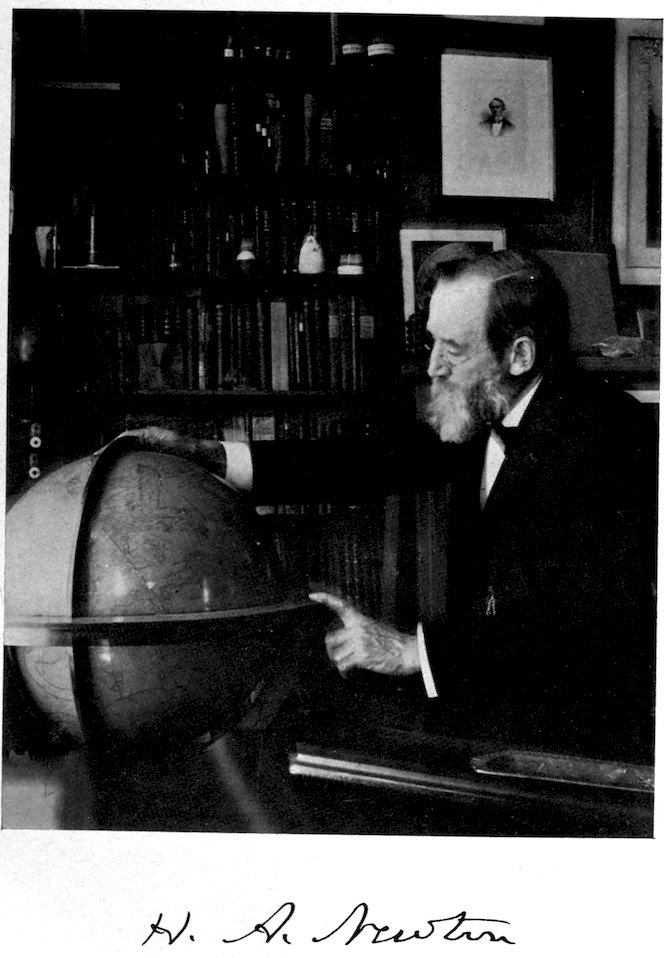
337We shall mention but one other achievement of the methods of celestial mechanics. Those visitors of the skies, the comets, which become so prominent only to fade away and vanish perhaps forever, had interested astronomers from the earliest times. Soon after the discovery of the law of gravitation, Newton had worked out a method by which the elements of a comet’s orbit can be computed from observations of its position. It was found that the great majority of these bodies move in nearly parabolic paths and only a few in ellipses. Of the latter the most prominent is the brilliant comet first observed by Halley in 1681. It has reappeared regularly at intervals of seventy-six years; the last appearance in the spring of 1910 is no doubt well remembered by the reader. Kant had considered comets to be formed by condensing solar nebulæ, whereas Laplace had maintained that they originate in matter which is scattered throughout stellar space and has no connection with the solar system. A study of the distribution of inclinations of comet orbits by H. A. Newton (16, 165, 1878) of New Haven substantiated Laplace’s hypothesis, and led to the conclusion that the periodic comets have been captured by the attraction of those planets near to which they have passed. Of these comets a number have comparatively short periods, and are found to have orbits which are in general only slightly inclined to those of the planets, and are traversed in the same direction. Moreover, the fact that the orbit of each of these comets comes very close to that of Jupiter made it seem probable that they have been attached to the solar system by the attraction of this planet. Further confirmation of this hypothesis was furnished by H. A. Newton’s (42, 183 and 482, 1891) explanation of the small inclination of their orbits and the scarcity of retrograde motions among them.
In 1833 occurred one of the greatest meteoric showers of history. Olmstead (26, 132, 1834) and Twining (26, 320, 1834) of New Haven noticed that these shooting stars traverse parallel paths, and were the first to suggest that they must be moving in swarms in a permanent orbit. From an examination of all accessible records, H. A. Newton (37, 377, 1864; 38, 53, 1864) was able to 338show that meteoric showers are common in November, and of particular intensity at intervals of 33 or 34 years. He confidently predicted a great shower for Nov. 13th, 1866, which not only actually occurred but was followed by another a year later, showing that the meteoric swarm extended so far as to require two years to cross the earth’s orbit. H. A. Newton (36, 1, 1888) in America and Adams in England took up the study of meteoric orbits with great interest, and the former concluded that these orbits are in every sense similar to those of the periodic comets, implying that a swarm of meteors originates in the disintegration of a comet. In fact Schiaparelli actually identified the orbit of the Perseids, or August meteors, with Tuttle’s comet of 1862, and shortly after the orbit of the Leonids, or November meteors, was found to be the same as that of Tempel’s comet.
Electromagnetism.—During the eighteenth century much interest had been manifested in the study of electrostatics and magnetism. Du Fay, Cavendish, Michell and Coulomb abroad and Franklin in America had subjected to experimental investigation many of the phenomena of one or both of these sciences, and in the early years of the nineteenth century Poisson developed to a remarkable extent the analytical consequences of the law of force which experiment had revealed. Both Laplace and he made much use of the function to which Green gave the name “potential” in 1828, and which is such a powerful aid in solving problems involving magnetism or electricity at rest.
Meantime electric currents had been brought under the hand of the experimenter by the discoveries of Galvani and Volta. Large numbers of cells were connected in series, and interest seemed to lie largely in producing brilliant sparks or fusing metals by means of a heavy current. Hare (3, 105, 1821) of the University of Pennsylvania constructed a battery consisting of two troughs of forty cells each, so arranged that the coppers and zincs can be lowered simultaneously into the acid and large currents obtained before polarization has a chance to interfere. This “deflagrator” was used to ignite 339charcoal in the circuit, or melt fine wires, and was for some time the most powerful arrangement of its kind. That “galvanism” is something quite different from static electricity was the opinion of many investigators; Hare considered the heat developed to be the distinguishing mark of the electric current. He says: “It is admitted that the action of the galvanic fluid is upon or between atoms; while mechanical electricity when uncoerced, acts only upon masses. This difference has not been explained unless by my hypothesis, in which caloric, of which the influence is only exerted between atoms, is supposed to be a principal agent in galvanism.”
Questioning minds were beginning to suspect that there must be some connection between electricity and magnetism. For lightning had been known to make magnets of steel knives and forks, and Franklin had magnetized a sewing needle by the discharge from a Leyden jar. Finally Oersted of Copenhagen undertook systematic investigation of the effect of electricity on the magnetic needle. His researches were without result until during the course of a series of lectures on “Electricity, Galvanism, and Magnetism” delivered during the winter of 1819–20 it occurred to him to investigate the action of an electric current on a magnetic needle. At first he placed the wire bearing the current at right angles to the needle, with, of course, no result; then it occurred to him to place it parallel. A deflection was observed, for to his surprise the needle insisted on turning until perpendicular to the wire.
Oersted’s discovery that an electric current exerts a couple on a magnetic needle was followed a few months later by Ampère’s demonstration before the French Academy that two currents flowing in the same direction attract each other, while two in opposite directions repel. The story goes that a critic attempted to belittle this discovery by remarking that as it was known that two currents act on one and the same magnet, it was obvious that they would act upon each other. Whereupon Arago arose to defend his friend. Drawing two keys out of his pocket he said, “Each of these keys attracts a magnet; do you believe that they therefore attract each other?”
340A few years later Ampère showed how to express quantitatively the force between current elements, and indeed developed to a considerable degree the equivalence between a closed circuit carrying a current and a magnetic shell. So convincing was his analysis and so thorough his discussion of the subject, that Maxwell said of this memoir half a century later, “The whole, theory and experiment, seems as if it had leaped, full grown and full armed, from the brain of the ‘Newton of electricity.’ It is perfect in form and unassailable in accuracy; and it is summed up in a formula from which all the phenomena may be deduced, and which must always remain the cardinal formula of electrodynamics.”
Shortly afterwards the dependence of a current on the conductivity of the wire used and the grouping of cells employed, was made clear by the work of Ohm. Many of his results were obtained independently by Joseph Henry (19, 400, 1831) of the Albany Academy, who described in 1831 a powerful electromagnet in which a great many coils of wire insulated with silk were wound around an iron core and connected in parallel with a single cell. He remarks in this paper that with long wires, as in the telegraph, many cells arranged in series should be used, whereas for several short wires connected in parallel a single cell with large plates is more efficient.
Current Induction.—Impressed by the fact that electric charges have the power of inducing other charges on neighboring conductors without coming into contact with them, Faraday was engaged in investigating the possibility of an analogous phenomenon in the case of electric currents. His idea at first seems to have been that a current should induce another current in any closed conducting circuit which happens to be in its vicinity. Experiment readily showed the falsity of this conception, but a brief deflection of the galvanometer in the secondary circuit was noticed at the instant of making and breaking the current in the primary. Further experiments showed that thrusting a permanent steel magnet into a coil connected to a galvanometer caused the needle to deflect. In fact Faraday’s report to the Royal Society on November 24th, 1831, contains a complete 341account of all experimental methods available for inducing a current in a closed circuit.
While Faraday is entitled to credit for the discovery of current induction by virtue of the priority of his publication, it must not pass unnoticed that Henry obtained many of the same experimental results independently and some even earlier. Henry was at this time instructor in mathematics at the Albany Academy, and seven hours of teaching a day made it well nigh impossible to carry on original research except during the vacation month of August. As early as the summer of 1830 he had wound 30 feet of copper wire around the armature of a horseshoe electromagnet and connected it to a galvanometer. When the magnet was excited, a momentary deflection was observed. “I was, however, much surprised,” he says, “to see the needle suddenly deflected from a state of rest to about 20° to the east, or in a contrary direction, when the battery was withdrawn from the acid, and again deflected to the west when it was re-immersed.” In addition a deflection was obtained by detaching the armature from the magnet, or by bringing it again into contact. Had the results of these experiments been published promptly, America would have been entitled to credit for the most important discovery of the greatest of England’s many great experimenters. But Henry desired first to repeat his experiments on a larger scale, and while new magnets were being constructed, the news of Faraday’s discovery arrived. This occasioned hasty publication of the work already done in an appendix to volume 22, 1832, of the Journal.
At almost the same time Henry made another important discovery and this time he was anticipated by no other investigator in making public his results. In the paper already referred to be describes the phenomenon known to-day as self-induction. “When a small battery is moderately excited by diluted acid and its poles, which must be terminated by cups of mercury, are connected by a copper wire not more than a foot in length, no spark is perceived when the connection is either formed or broken; but if a wire thirty or forty feet long be used, 342instead of the short wire, though no spark will be perceptible when the connection is made, yet when it is broken by drawing one end of the wire from its cup of mercury a vivid spark is produced.... The effect appears somewhat increased by coiling the wire into a helix; it seems to depend in some measure on the length and thickness of the wire; I can account for these phenomena only by supposing the long wire to become charged with electricity which by its reaction on itself projects a spark when the connection is broken.”
Soon after, Henry went to Princeton and there continued his experiments in electromagnetism. No difficulty was experienced in inducing currents of the third, fourth and fifth orders by using the first secondary as primary for yet another secondary circuit, and so on (38, 209, 1840). The directions of these currents of higher orders when the primary is made or broken proved puzzling at first, but were satisfactorily explained a year later (41, 117, 1841). In addition induced currents were obtained from a Leyden jar discharge. Faraday failed to find any screening effect of a conducting cylinder placed around the primary and inside the secondary. Henry examined the matter, and found that the screening effect exists only when the induced current is due to a make or break of the primary circuit, and not when it is caused by motion of the primary.
Henry’s work was mainly descriptive; it remained for Faraday to develop a theory to account for the phenomena discovered and to prepare the way for quantitative formulation of the laws of current induction. This he did in his representation of a magnetic field by means of lines of force; a conception which he found afterwards to be equally valuable when applied to electrostatic problems. Every magnet and every current gives rise to these closed curves; in the case of a magnet they thread it from south pole to north, while a straight wire bearing a current is surrounded by concentric rings. The connection between lines of force and the induction of currents is contained in the rule that a current is induced in a closed circuit only when a change takes place in the number of lines of force passing through it. Furthermore the dependence of the current strength on the 343conductivity of the wire employed has led to recognition of the fact that it is the electromotive force and not the current itself which is conditioned by the change in magnetic flux.
Great interest was attached to the utilization of the newly discovered forces of electromagnetism. In 1831 Henry (20, 340, 1831) described a reciprocating engine depending on magnetic attraction and repulsion, and C. G. Page (33, 118, 1838; 49, 131, 1845) devised many others. The latter’s most important work, however, was the invention of the Ruhmkorff coil. In 1836 (31, 137, 1837) he found the strongest shocks to be obtained, from a secondary coil of many windings forming a continuation of a primary of half the number of turns. His perfection of the self-acting circuit breaker (35, 252, 1839) widened the usefulness of the induction coil, and his substitution of a bundle of iron wires for a solid iron core (34, 163, 1838) greatly increased its efficiency.
Conservation of Energy.—Perhaps the most important advance of the nineteenth century has been the establishment of the principle of conservation of energy. Despite the fact that the “principe de la conservation des force vives” had been recognized by the French mathematicians of the early part of the century, the application of this principle even to purely mechanical problems was contested by some scientists. Through the early numbers of the Journal runs a lively controversy as to whether there is not a loss of power involved in imparting momentum to the reciprocating parts of a steam engine only to check the motion later on in the stroke. Finally Isaac Doolittle (14, 60, 1828), of the Bennington Iron Works, ends the discussion by the pertinent remark: “If there be, as is contended by one of your correspondents, a loss of more than one third of the power, in transforming an alternating rectilinear movement into a continuous circular one by means of a crank, I should like to be informed what would be the effect if the proposition were reversed, as in the case of the common saw mill, and in many other instances in practical mechanics.”
A realization of the equivalence of heat and mechanical work did not come until the middle of the century, in 344spite of the conclusive experiments of the American Count Rumford and the English Davy before the year 1800. So firmly enthroned was the caloric theory, according to which heat is an indestructible fluid, that evidence against it was given scant consideration. In fact the success of the analytical method introduced by Fourier in 1822 for the solution of problems in conduction of heat only added to the difficulties of the adherents of the kinetic theory. But recognition of heat as a form of energy was on the way, and when it came it made its appearance almost simultaneously in half a dozen different places. Perhaps Robert Mayer of Heilbronn was the first to state explicitly the new principle. His paper “On the Forces of Inorganic Nature” was refused publication in Poggendorff’s Annalen, but fared better at the hands of another editor. During the next few years Joule determined the mechanical equivalent of heat experimentally by a number of different methods, some of which had already been devised by Carnot. Of those he used, the most familiar consists in churning up a measured mass of water by means of paddles actuated by falling weights and calculating the heat developed from the rise in temperature. However, the work of the young Manchester brewer received little attention from the members of the British Association before whom it was reported until Kelvin showed them its significance and attracted their interest to it. Meanwhile Helmholtz had completed a very thorough disquisition on the conservation of energy not only in dynamics and heat but in other departments of physics as well. His paper on “Die Erhaltung der Kraft” was frowned upon by the members of the Physical Society of Berlin before whom he read it, and received the same treatment as Mayer’s from the editor of Poggendorff’s Annalen. Helmholtz’s “Kraft,” like the “vis viva” of other writers, is the quantity which Young had already christened energy. Not many years elapsed, however, until the convictions of Mayer, Joule, Kelvin and Helmholtz became the most clearly recognized of all physical principles. As early as 1850 Jeremiah Day (10, 174, 1850), late president of Yale College, admitted the improbability of constructing 345a machine capable of perpetual motion, even though the “imponderable agents” of electricity, galvanism and magnetism be utilized.
Thermodynamics.—The importance of the principle of conservation of energy lies in the fact that it unites under one rule such diverse phenomena as gravitation, electromagnetism, heat and chemical action. Another principle as universal in its scope, although depending upon the coarseness of human observations for its validity rather than upon the immutable laws of nature, was foreshadowed even before the first law of thermodynamics, or principle of conservation of energy, was clearly recognized. This second law was the consequence of efforts to improve the efficiency of heat engines. In 1824 Carnot introduced the conception of cyclic operations into the theory of such engines. Assuming the impossibility of perpetual motion, he showed that no engine can have an efficiency greater than that of a reversible engine. Finally Clausius expressed concisely the principle toward which Carnot’s work had been leading, when he asserted that “it is impossible for a self-acting machine, unaided by any external agency, to convey heat from one body to another at a higher temperature.” Kelvin’s formulation of the same law states that “it is impossible, by means of inanimate material agency, to derive mechanical effect from any portion of matter by cooling it below the temperature of the coldest of the surrounding objects.”
The consequences of the second law were rapidly developed by Kelvin, Clausius, Rankine, Barnard (16, 218, 1853, et seq.) and others. Kelvin introduced the thermodynamic scale of temperature, which he showed to be independent of such properties of matter as condition the size of the degree indicated by the mercury thermometer. This scale, which is equivalent to that of the ideal gas thermometer, was used subsequently by Rowland in his exhaustive determination of the mechanical equivalent of heat by an improved form of Joule’s method. He found different values for different ranges in temperature, showing that the specific heat of water is by no means constant. Since then electrical methods 346of measuring this important quantity have been used to confirm the results of purely mechanical determinations.
The definition of a new quantity, entropy, was found necessary for a mathematical formulation of the second law of thermodynamics. This quantity, which acts as a measure of the unavailability of heat energy, was given a new significance when Boltzmann showed its connection with the probability of the thermodynamic state of the substance under consideration. If two bodies have widely different temperatures, a large amount of the heat energy of the system is available for conversion into mechanical work. From the macroscopic point of view this is expressed by saying that the entropy is small, or if the motions of the individual molecules are taken into account, the probability of the state is low. The interpretation of entropy as the logarithm of the thermodynamic probability has thrown much light on the meaning of this rather abstruse quantity. Gibbs’s “Elementary Principles in Statistical Mechanics” treats in detail the fundamental assumptions involved in this point of view, its limitations and its consequences. In his “Equilibrium of Heterogeneous Substances”[154] he had already extended the principle of thermal equilibrium to include substances which are no longer homogeneous. The value of the chemical potential he introduced determines whether one phase is to gain at the expense of another or lose to it. It is unfortunate that the analytical rigor and austerity of his reasoning combined with lack of mathematical training on the part of the average chemist, delayed true appreciation of his work and full utilization of the new field which he opened up.
Liquefaction of Gases.—Meanwhile the problem of liquefying gases was attracting much attention on the part of experimental physicists. Faraday had succeeded in making liquid a number of substances which had hitherto been known only in the gaseous state. His method consists in evolving the gas from chemicals placed in one end of a bent tube, the other end of which is immersed in a freezing mixture. The high pressure caused by the production of the gas combined with the low temperature is sufficient to bring about liquefaction 347in many cases. Failure with other more permanent gases was unexplained until the researches of Andrews in 1863 showed that no amount of pressure will produce liquefaction unless the temperature is below a certain critical value. The method of reducing the temperature in use to-day depends on a fact discovered by Kelvin and Joule in connection with the free expansion of a gas. These investigators allowed the gas to escape through a porous plug from a chamber in which the pressure was relatively high. With the single exception of hydrogen, the effect of the sudden expansion is to cool the gas, and even with it cooling is found to take place after the temperature has been made sufficiently low. By this method all known gases have been liquefied. Helium, with a boiling point of –269°C, or only 4°C. above the absolute zero, was the last to be made a liquid, finally yielding to the efforts of Kammerlingh Onnes in 1907. This investigator[155] finds that at temperatures near the absolute zero the electrical conductivity of certain substances undergoes a profound modification. For example, a coil of lead shows a superconductivity so great that a current once started in it persists for days after the electromotive force has ceased to act.
Electrodynamics.—Faraday’s representation of electric and magnetic fields by lines of force had been of great value in predicting the results of experiments in electromagnetism. But a more mathematical formulation of the laws governing these phenomena was needed in order to make possible quantitative development of the theory. This was supplied by Maxwell in his epoch-making treatise on “Electricity and Magnetism.” Starting with electrostatics and magnetism, he gives a complete account of the mathematical methods which had been devised for the solution of problems in these branches of the subject, and then turning to Ampère’s work he shows how the Lagrangian equations of motion lead to Faraday’s law if the single assumption is made that the magnetic energy of the field is kinetic. In the treatment of open circuits Maxwell’s intuition led to a great advance, the introduction of the displacement current. Consider a charged condenser, the plates of which are suddenly connected 348by a wire. A current will flow through the wire from the positively charged plate to the negative, but in the gap between the two plates the conduction current is missing. So convinced was Maxwell that currents must always flow in closed circuits, that he postulated an electrical displacement in the medium between the plates of a charged condenser, which disappears when the condenser is short-circuited. Thus even in the so-called open circuit the current flows along a closed path.
Maxwell’s theory of the electromagnetic field is based essentially on Faraday’s representation by lines of force of the strains and stresses of a universal medium. So it is not surprising that he was led to a consideration of the propagation of waves through this medium. The introduction of the displacement current made the form of the electrodynamic equations such as to yield a typical wave equation for space free from electrical charges and currents. Moreover, the disturbance was found to be transverse, and its velocity turned out to be identical with that of light. The conclusion was irresistible. That light could consist of anything but electromagnetic waves of extremely short length was inconceivable. In fact so certain was Maxwell of this deduction from theory that he felt it altogether unnecessary to resort to the test of experiment. For the electromagnetic theory explained so many of the details which had been revealed by experiments in light, that no doubt of its validity could be entertained. Even dispersion received ready elucidation on the assumption that the dispersing medium is made up of vibrators having a natural period comparable with that of the light passing through it.
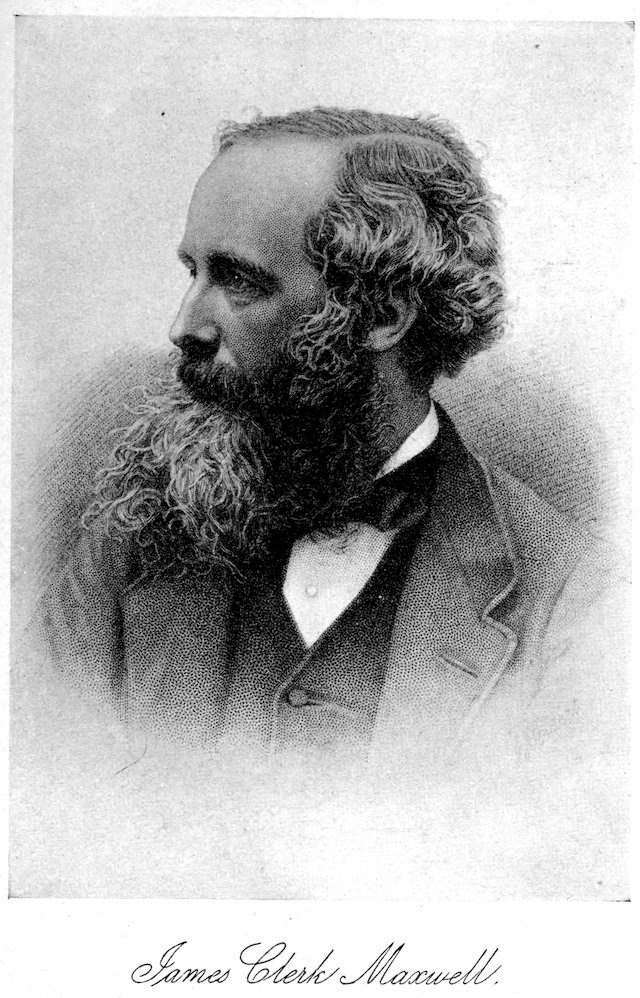
349Maxwell’s book was published in 1873. Fifteen years later, Hertz,[156] at the instigation of Helmholtz, succeeded in detecting experimentally the electromagnetic waves predicted by Maxwell’s theory. His oscillator consisted of two sheets of metal in the same plane, to each of which was attached a short wire terminating in a knob. The knobs were placed within a short distance of each other, and connected to the terminals of an induction coil. By reflection standing waves were formed, and the positions of nodes and loops determined by a detector composed of a movable loop of wire containing an air gap. Thus the wave length was measured. Hertz calculated the frequency of his radiator from its dimensions, and then computed the velocity of the disturbance. In spite of an error in his calculations, later pointed out by Poincaré, he obtained very nearly the velocity of light for waves traveling through air, but a velocity considerably smaller for those propagated along wires. Subsequent work by Lecher, Sarasin and de la Rive, and Trowbridge and Duane (49, 297, 1895; 50, 104, 1895) cleared up this discrepancy, and showed the velocity to be in both cases identical with that of light. The last-named investigators increased the size of the oscillator until it was possible to measure the frequency by photographing the spark in the secondary with a rotating mirror. The positions of nodes and loops were obtained by means of a bolometer after the secondary had been tuned to resonance with the vibrator. The velocity thus found for electromagnetic waves along wires is within one-tenth of one percent of the accepted value of the velocity of light. Hertz’s later experiments showed that waves in air suffer refraction and diffraction, and he succeeded in polarizing the radiation by passing it through a grating constructed of parallel metallic wires.
In order to satisfy the law of action and reaction, it is found necessary to attribute a quasi-momentum to electromagnetic waves. When a train of such waves is absorbed, their momentum is transferred to the absorbing body, while if they are reflected an impulse twice as great is imparted. This consequence of theory, foreseen by Maxwell and developed in detail by Poynting, Abraham and Larmor, has been verified by the experiments of Lebedew, and Nichols and Hull.[157] The latter used a delicate torsion balance from which was suspended a couple of silvered glass vanes. In order to eliminate the effect of impulses imparted by the molecules of the residual gas, such as Crookes had observed in his radiometer, readings were made at many different pressures and the ballistic rather than the static deflection recorded. After the pressure produced by light from a carbon arc had been measured, the intensity of the radiation was determined with a bolometer. Preliminary experiments indicated the existence of a pressure of the order 350expected, and later more careful measurements showed good quantitative agreement with theory. This pressure had already found an important application in Lebedew’s explanation of the solar repulsion of comet’s tails. These tails are made up of enormous swarms of very minute particles, and as the comet swings around the sun they suffer a repulsion due to the pressure of the intense solar radiation which counteracts the sun’s gravitational attraction. Hence the tail, instead of following after the comet in its orbit, points in a direction away from the sun.
Some uncertainty existed as to whether a convection current produces a magnetic field. A compass needle is deflected by a current from a Daniell cell; is the same effect obtained when a conductor is charged electrostatically and then whirled around the needle by means of an insulating handle? The experimental difficulties involved in settling this question are realized when the enormous difference between the electrostatic and electromagnetic units of current is taken into consideration. For a sphere one centimeter in radius, charged to a potential of 20,000 volts, and revolving in a circle sixty times a second, constitutes a current of little over a millionth of an ampere.
This problem was undertaken by Rowland (15, 30, 1878) in Helmholtz’s laboratory at Berlin in 1876. A hard rubber disk coated on both sides with gold was charged and rotated about a vertical axis at a rate of sixty revolutions a second. On reversing the sign of the electrification on the disk, the astatic needle hung above its center showed a deflection of over five millimeters. The current was calculated in electrostatic units from the charge on the disk and its rate of motion, and in electromagnetic units from the magnetic deflection. The ratio of these two quantities gave fair agreement with its theoretical value, the velocity of light.
Although the result of this experiment was confirmed by Rowland and Hutchinson in 1889, Crémieu was convinced by an investigation carried out at Paris in 1900 that the Rowland effect did not exist. Consequently further repetition of the experiment was desirable. So the following year Adams (12, 155, 1901) arranged two 351rings of eight spheres each so that they could be rotated about their common axis from fifty to sixty times a second. One set of spheres was connected by brushes to the positive pole of a battery of 20,000 volts, the other to the negative pole. The deflection of a nearby magnetometer needle was observed when the electrification of the two rings was reversed, and from the reading so obtained the ratio of the electromagnetic to the electrostatic unit of current computed. This quantity was found to differ from the velocity of light by only a few percent. This experiment and the even more exhaustive investigations carried out by Pender, both independently and in collaboration with Crémieu, finally convinced the scientific world that a convection current produces the same magnetic field as a conduction current of the same magnitude.
In discussing the ponderomotive force experienced in a magnetic field by a conductor through which a current is passing, Maxwell had said, “It must be carefully remembered, that the mechanical force which urges a conductor carrying a current across the lines of magnetic force, acts, not on the electric current, but on the conductor which carries it.” Hall (19, 200, 1880), one of Rowland’s students, questioned this statement, and determined to put it to the test of experiment. Efforts to find an increase in the resistance of a wire placed at right angles to the lines of magnetic force were unsuccessful. So the current was passed through a moderately broad strip of gold leaf and the effect of the magnetic field on the equipotential lines investigated. The results obtained confirmed Hall’s belief that the force exerted by the field acts on the current itself, and is transmitted through it to the conductor. Further investigation (20, 161, 1880) revealed the same deflection of equipotential lines in thin strips of other metals, although the effect was found to be reversed in iron.
During the closing years of the nineteenth century occurred three events of far reaching importance. The electron was isolated, and its charge and mass measured by J. J. Thomson in England; X-rays were discovered by Röntgen in Germany; and the first indications of radioactivity were found by Becquerel in France. The first two are certainly to be attributed largely to the 352great advances which had been made in obtaining high vacua, and the last two might not have occurred so soon had it not been for the photographic plate.
The Electron.—The atomic theory of electricity dates from the time of Faraday. His experiments on electrolysis showed that each monovalent atom or radical, whatever its nature, carries the same charge, each bivalent ion a charge twice as great. Only a lack of knowledge of the number of atoms in a gram of the dissociated salt prevented him from calculating the value of the elementary charge. As the discharge of electricity through gases at low pressures became a subject for experimental investigation, another line of approach to the study of the atom of electricity was opened up. As early as the seventies Hittorf and Goldstein had observed that a shadow is cast by a screen placed in front of the cathode of a Crookes tube. Varley suggested that the cathode rays producing the shadow consist of “attenuated particles of matter, projected from the negative pole by electricity.” The discovery that these rays are deflected by a magnetic field led English physicists to the conclusion that they must be composed of charged particles, and the direction of the deflection was such as to require the charge to be negative. Hertz contested this view on the ground that his experiments showed the rays to be unaffected by an electrostatic field, and suggested that they consist of etherial disturbances. Finally Perrin succeeded in passing the rays into a metal cylinder which received from them a negative charge, and Lenard showed how excessively minute these negatively charged particles must be by actually passing them through a thin sheet of aluminium in the wall of a vacuum tube, and detecting their presence in the air outside. Conclusive information as to the nature of the electron, as it was named by Johnstone Stoney, was supplied by the classic experiments of J. J. Thomson.[158] First he showed that Hertz’s failure to find a deflection when a stream of electrons passes between the plates of a charged condenser was due to the screening effect of the gaseous ions produced by the discharge. With a much more highly evacuated tube he found no difficulty in obtaining a deflection in an electrostatic field. By using crossed electric and magnetic 353fields the deflection produced by one was just balanced by that caused by the other, and from the field strengths employed both the velocity of the particles and the ratio e m of charge to mass was calculated. The former was found to be about one-tenth the velocity of light, but the most startling result of the experiment was that the same value of e m was obtained no matter what residual gas was contained in the tube or of what metal the cathode was made.
To calculate e and then m other methods are necessary. C. T. R. Wilson has shown that in supersaturated air, water drops form easily on charged molecules, and that negative ions are more effective in causing condensation than positive ones. By making use of the results of this research Thomson has been able to measure the elementary charge. For suppose a stream of negative ions to pass through supersaturated air. A little drop forms on each charged particle, and the cloud of condensed vapor settles to the bottom of the vessel. The charge carried and the mass of water deposited can be measured directly. Stokes’ law for the rate of fall of a minute particle through a gaseous medium enables the average size of the drops to be computed from the observed rate of descent of the cloud. Hence the number of drops formed and the charge carried by each follows at once. H. A. Wilson improved the method by noting the effect of an electric field upon the rate of fall of the charged drops, and subsequent experiments undertaken by Millikan[159] have been of such a character as to enable him to follow the motion of a single drop. Instead of water, the latter uses oil drops less than one ten-thousandth of a centimeter in diameter. A drop, after one or more electrons have attached themselves to it, is actually weighed in terms of the charge on its surface by applying an upward electric force just sufficient to balance the force of gravity. Then its weight is independently obtained from the density of the oil and the radius of the drop as determined by the rate of fall when the electric field is absent. Comparison of these two expressions gives 4·774(10)–10 electrostatic units for the 354elementary charge. Combining this result with the value of e m found by Thomson, the mass of the electron comes out to be about one eighteen-hundredth that of an atom of the lightest known element, hydrogen.
That the electron is a fundamental constituent of all matter is attested by the fact that charge and mass are the same regardless of the source or manner of production. Whether emitted by a heated metal, under the action of ultra-violet light, from a radioactive substance, by a body exposed to X-rays, as a result of friction, it is the same negatively charged particle that constitutes the cathode ray of the discharge tube. Moreover, it makes its effect felt indirectly in many other phenomena, and from an investigation of some of these the ratio of charge to mass can be determined independently. Of such perhaps the most interesting is the Zeeman effect.
Spectroscopy.—Early in the nineteenth century Fraunhofer had observed that the solar spectrum is crossed by a large number of dark lines. Their presence was unexplained until in 1859 Kirchhoff and Bunsen showed “that a colored flame, the spectrum of which contains bright sharp lines, so weakens rays of the color of these lines when they pass through it, that dark lines appear in place of bright lines as soon as there is placed behind the flame a light of sufficient intensity, in which the lines are otherwise absent.” For intra-atomic oscillators must have the natural frequency of the radiation which they emit, and consequently resonance will take place when they are exposed to rays of this frequency coming from an outside source, and selective absorption ensue. By comparing the bright lines in the spectra of metallic vapors made luminous by a gas flame with the dark lines in the sun’s spectrum these investigators showed that many of the common terrestrial elements exist in the sun. The interest in spectroscopy grew rapidly. The excellent diffraction gratings made by Rutherfurd were succeeded by the superior concave gratings of Rowland. In 1877 Draper (14, 89, 1877) announced the discovery of the bright lines of oxygen in the solar spectrum, but his interpretation of his photographs has not been corroborated by the work of later investigators. Langley (11, 355401, 1901), by the aid of his newly invented bolometer, succeeded in detecting the emission of energy from the sun in the infra-red in amounts far exceeding that contained in the visible spectrum. In 1842 Doppler drew attention to the fact that motion of the source should cause a displacement of the spectral lines, the shift being to the blue if the light is approaching and to the red if it is receding, and a few years later Fizeau suggested the application of Doppler’s principle to the measurement of the velocity of a star moving in the line of sight. Thus the spectroscope has been able to supply one of the deficiencies of the telescope, and the two together are sufficient to reveal all components of stellar motion. When spectra formed by light from the sun’s limb and from its center are compared, the same effect reveals the rotation of the sun about its axis. (C. S. Hastings, 5, 369, 1873; C. A. Young, 12, 321, 1876.)
Further Evidence of the Electron.—In 1845 Faraday discovered a rotation of the plane of polarization when light passes in the direction of the lines of force through a piece of glass placed between the poles of an electromagnet. Examination of the spectrum from a glowing vapor situated between the poles of a magnet, however, failed to reveal any effect of the field. The latter problem was attacked anew by Zeeman[160] in 1896, and with the aid of the improved appliances of modern science he succeeded in detecting a broadening of the lines. Later experiments with more powerful apparatus resolved these broadening lines into several components.
Lorentz[161] showed at once how the electron theory furnishes an explanation of the Zeeman effect. He found that when the source is viewed at right angles to the lines of magnetic force, a spectral line should be split into three components. Of these he predicted that the middle, or undisplaced component, would be found to be polarized at right angles to the direction of the field, and the other components parallel to the field. When the light proceeds from the source in a direction parallel to the magnetic lines of force, two components only should be formed, and these should be circularly polarized in opposite senses. Moreover, from the separation of the components can be calculated the ratio of charge to mass 356of the electronic vibrator which is responsible for the emission of radiant energy. Zeeman’s experiments confirmed Lorentz’s theory in every detail, and yielded a value of e m in substantial agreement with that obtained for cathode rays. Subsequent research, however, has shown that in many cases more components are found than the elementary theory calls for. Hale has detected the Zeeman effect in light from sun spots, proving that these blemishes on the sun’s face are vortices caused by whirling swarms of electrified particles. Recently Stark and Lo Surdo have found a similar splitting up of lines in the spectrum formed by light from canal rays (rays of positively charged particles) passing through an intense electric field. This phenomenon has as yet received no adequate explanation.
On discovering that an electric current is capable of producing a magnetic field, Ampère had suggested that the magnetic properties of such substances as iron might be explained on the assumption of molecular currents. The electron theory considers these currents to be due to the revolution, inside the atom, of negatively charged particles about an attracting nucleus. It occurred to Richardson that this motion should give the atom the properties of a gyrostat. Hence if an iron bar be rotated about its axis, the atoms should orient themselves so as to make their axes more nearly parallel to the axis of rotation. Thus its rotation should cause the bar to become a magnet. Barnett[162] has tested this hypothesis, and has found the effect Richardson had predicted. From the strength of the magnetization produced, the value of e m can be computed. Barnett finds a value somewhat smaller than that for cathode rays, but of the right order of magnitude and sign. Einstein and De Haas have detected the inverse of this effect, i. e., the rotation of an iron rod when it is suddenly magnetized.
X-Rays.—In 1895, on developing a plate which had been lying near a vacuum tube, Röntgen[163] was surprised to find distinct markings on it. As the plate had never been exposed to light, it was necessary to suppose the 357effect to be due to some new and unknown type of radiation. Further investigation showed that this radiation originates at the points where cathode rays impinge on the glass walls of the tube. Besides being able to pass with ease through all but the most dense material objects X-rays were found to have the power of ionizing gases through which they pass and ejecting electrons from metal surfaces against which they strike. The points at which these electrons are produced are in turn the sources of secondary X-rays whose properties are characteristic of the metal from which they come.
Röntgen’s discovery excited intense interest among laymen as well as in scientific circles. Of the many X-ray photographs taken, those of Wright (1, 235, 1896) of Yale were the first to be produced in this country. His experiments were made immediately on receipt of the news of Röntgen’s research, and resulted in the publication of a number of photographs showing the translucency for these rays of paper, wood, and even aluminium.
As X-rays are undeviated by electric or magnetic fields, Schuster, and later Wiechert and Stokes, suggested that they might be electromagnetic waves of the same nature as light, but much shorter and less regular. The great objection to this hypothesis was the failure either to refract or diffract these rays. In fact Bragg contended that they were not etherial disturbances at all, but consisted of neutral particles moving with very high velocities. Finally Laue[164] demonstrated their undulatory nature by showing that diffraction took place under proper conditions. Just as the distance between adjacent lines of a grating must be comparable to the wave length of light for a spectrum to be formed, a periodic structure with a grating space of their very much shorter wave length is necessary to diffract X-rays. Such a structure is altogether too fine to be made by human tools. Nature, however, has already prepared it for man’s use. The distance between the atoms of a crystal is just right to make it an excellent X-ray grating, and Laue had no difficulty in obtaining diffraction patterns when Röntgen rays were passed through a block of zincblende. The distance between adjacent atoms of this 358cubic crystal can be computed at once from its density and molecular weight, and then the wave length of the radiation calculated from the deviation suffered. In this way X-rays are found to have a length less than one thousandth as great as visible light. Further study of this phenomenon, particularly by the two Braggs, father and son, has revealed many of the structural details of more complicated crystals.
The most significant investigation in the field opened up by Laue’s discovery is that undertaken by Moseley[165] only a couple of years before he lost his life in the trenches at Gallipoli. Using many different metals as anticathodes in a vacuum tube, he measured the frequencies of the characteristic rays emitted. He found that if the elements are arranged in order of increasing atomic weight, the square roots of the characteristic frequencies form an arithmetical progression. If to each element is assigned an integer, beginning with one for hydrogen, two for helium, and so on, the square root of the frequency of the characteristic radiation is found to be proportional to this atomic number. Even though Uhler has shown recently that over wide ranges Moseley’s law does not hold within the limits of experimental error, there is undoubtedly much significance to be attached to this simple relation.
Radioactivity.—The year following the discovery of X-rays, Becquerel found that a photographic plate is similarly affected by radiations from uranium salts. Two years later the Curies separated from pitchblende the very active elements polonium and radium. Passage of the rays from these substances through electric and magnetic fields revealed the existence of three types. The alpha rays have been shown by Rutherford and his co-workers to be positively charged helium atoms; the beta rays are very rapidly moving electrons; and the gamma rays are electromagnetic pulses of the same nature as X-rays but somewhat shorter. In 1902 Rutherford and Soddy advanced the theory of atomic disintegration, according to which the emission of a ray is an indication of the breaking down of the atom to a simpler form. Thus in the radioactive substances there is going on before our 359eyes a continual transformation of one element into another, a change, by the way, which appears to be in no slightest degree either hastened or delayed by changes in temperature (H. L. Bronson, 20, 60, 1905) or external electrical condition of the radioactive element. Uranium is the progenitor of a long line of descendants, of which radium was supposed for some time to be the first member. Boltwood (25, 365, 1908) of Yale, however, showed that the slow growth of radium in uranium solutions is incompatible with this assumption, and soon isolated an intermediate product which he named ionium. Radium itself disintegrates into a gas known as radium emanation, which in turn gives rise to a succession of other products. Analyses by Boltwood (23, 77, 1907) of radioactive minerals from the same locality show such a constant ratio between the amounts of uranium and lead present that it is natural to conclude that lead is the end product of the series. This hypothesis is confirmed by the fact that the oldest rocks show relatively the greatest amounts of this element.
In addition to the Ionium-Radium series two others have been discovered. Of these Boltwood’s (25, 269, 1908) investigations seem to indicate that the one which starts with actinium is a collateral branch of the radium series and comes from the same parent uranium. The other begins with thorium and comprises ten members. As yet the end products of the actinium and thorium series have not been identified, although there is some reason for believing that an isotope of lead may be the final member of the latter.
As the amount of a radioactive element which disintegrates in a given time is proportional to the total mass present, an infinite time would be required for the substance to be completely transformed. Hence the life of such an element is measured by the half value period, or time taken for half the initial mass to disintegrate. This time varies widely for different radioactive substances, ranging from a small fraction of a second for actinium A to five billion years for uranium. Boltwood’s (25, 493, 1908) original determination of the life of radium from the rate of its growth in a solution containing ionium gave 2000 years as its result, although 360recent measurements by Miss Gleditsch (41, 112, 1916) agree more closely with the value 1760 years obtained by Rutherford and Geiger from the number of alpha particles emitted.
Under the action of X-rays or the radiations from radioactive substances, gases acquire a conductivity which has been attributed by Thomson and Rutherford to the formation of ions. Zeleny has found that ions of opposite sign have somewhat different mobilities in an electric field, and experiments of Wellisch (39, 583, 1915) show that at low pressures some of the negative ions are electrons. T. S. Taylor (26, 169, 1908 et seq.) and Duane (26, 464, 1908) have investigated the ionization produced by alpha particles, and Bumstead (32, 403, 1911 et seq.) has studied the emission of electrons from metals which are bombarded by these rays. The investigations of Franck and Hertz, and McLennan and Henderson, show a significant relation between the ionizing potential (energy which must be possessed by an electron in order to produce an ion on colliding with an atom) and a quantity, to be considered later in more detail, which has been introduced by Planck into the theory of radiation.
Methods of Science.—Scientific progress seems to follow a more or less clearly defined path. Experimentation brings to light the hidden processes of nature, and hypotheses are advanced to correlate the facts discovered. As more and more phenomena are found to fit into the same scheme, the hypotheses at first proposed tentatively, although often only after extensive alterations, become firmly established as theories. Finally there may appear a fundamental clash between two theories, each of which in its respective domain seems to represent the only possible manner in which a large group of phenomena can be correlated. The maze becomes more perplexing at every step. At last a genius appears on the scene, approaches the problem from a new and unsuspected point of view, and the paradox vanishes. Such changes in point of view are the milestones which mark the progress of science. That science is stagnant whose only function is to collect, classify and correlate vast stores of experimental data. The sign of vitality is the existence of clearly defined and fundamental problems 361any possible solution of which seems irreconcilable with the most basic truths of the science in question. The greater the paradox grows, the more certain the advent of a new point of view which will bring one step nearer the comprehensive picture of nature which is the goal of natural philosophy.
The Ether.—From the earliest times philosophers have been attracted by the possibility of explaining physical phenomena in terms of an all-pervading medium. So strong had this tendency become by the middle of the nineteenth century that the English school of physicists were attributing rigidity, density and nearly all the properties of material media to the ether. In fact most physicists seemed to have forgotten that no experiment had ever given direct evidence of the existence of such a medium. Not until the first decade of the twentieth century was it realized that the experimental evidence actually pointed in quite the opposite direction, and that a new point of view was needed in dealing with those phenomena of light and electromagnetism which had been previously described in terms of a universal medium. Some account of the development of the ether theory and of the origin and growth of the point of view which has its principal exemplification in the principle of relativity is essential for an understanding of present tendencies in formulating a philosophic basis for scientific thought.
In the time of Newton and for a century after there was much controversy between the adherents of two irreconcilable theories of light. Hooke had suggested that light is a wave motion traveling through a homogeneous medium which fills all space, and Huygens had shown that the law of refraction can be deduced at once from this hypothesis if it is assumed that the velocity of light in a transparent body is less than that in free ether. However, Newton, impressed by the fact that a ray obtained by double refraction in Iceland spar differs from a ray of ordinary light just as a rod of rectangular cross section differs from one of circular cross section, and seeing no way of explaining this dissymmetry in terms of a wave motion analogous to longitudinal sound waves, adhered to the view that light consists of infinitesimal 362particles shot out from the luminous body with enormous velocities. So great was his reputation on account of his discoveries in other fields that this theory of light held sway among his contemporaries and successors until the labors of Young and Fresnel at the beginning of the nineteenth century definitely established the undulatory theory. However, in spite of the fact that a corpuscular theory of light made the assumption of an ether unnecessary in so far as the simpler of the observed phenomena are concerned, even Newton postulated the existence of such a medium, partly in order to explain the more complicated results of experiments in light, and partly in order to provide a vehicle for the propagation of gravitational forces.
Now an ether, if it is to explain anything at all, must have at least some of the simpler properties of material media. The most fundamental of these, perhaps, is position in space. As a first approximation in explaining optical phenomena on the earth’s surface, the earth might be supposed to be at rest relative to the ether. But the establishment of the Copernican system made the sun the center of the solar system and gave the earth an orbital speed of eighteen miles a second. It may be remarked parenthetically that the speed of a point on the equator due to the earth’s diurnal rotation is quite insignificant compared to its orbital velocity. Hence as a second approximation the sun might be considered at rest relative to the ether and the earth as moving through this unresisting medium.
The first indication of this motion lay in the discovery of aberration by the British astronomer Bradley in 1728. Bradley noticed that stars near the pole of the ecliptic describe small circles during the course of a year, while those in the plane of the ecliptic vibrate back and forth in straight lines, stars in intermediate positions describing ellipses. The surprising thing, however, was that the time taken to complete one of these small orbits is in all cases exactly a year. Bradley concluded that the phenomenon is in some way dependent on the earth’s motion around the sun, and he was not long in reaching the correct explanation. For suppose the earth to be at rest. Then in observing a star at the pole of the ecliptic 363it would be necessary to keep the axis of the telescope exactly at right angles to the plane of the earth’s orbit. However, as the earth is in motion, the telescope must be pointed a little forward, just as in walking rapidly through the rain an umbrella must be inclined forward so as to intercept the raindrops which would otherwise fall on the spot to be occupied at the end of the next step. The angle through which the telescope has to be tilted is known as the angle of aberration, and the tangent of this angle may easily be shown to be equal to the ratio of the velocity of the earth to the velocity of light. Knowing the velocity of the earth, the velocity of light can then be calculated. This method was one of the first of obtaining the value of this important quantity.
More recently, terrestrial methods of great precision have been devised for measuring the velocity of light. The most accurate of these is that employed by the French physicist Foucault in 1862. A ray of light is reflected by a rotating mirror to a fixed mirror placed at some distance, which in turn reflects the ray back to the moving mirror. The latter, however, has turned through a small angle during the time elapsed since the first reflection, and consequently the direction of the ray on returning to the source is not quite opposite to that in which it had started out. This deviation in direction is determined from the displacement of the image formed by the returning light, and from it the velocity of light is calculated. In order to make the deflection appreciable the distance between the two mirrors should be very great. As originally arranged by Foucault, it was found impractical to make this distance greater than twenty meters, and consequently the displacement of the image was less than a millimeter. Such a small deflection limited the accuracy of the experiment to one percent. In 1879, however, Michelson (18, 390, 1879), then a master in the United States Navy, improved Foucault’s optical arrangements to such an extent that he was able to use a distance of nearly seven hundred meters between the two mirrors. With a rate of two hundred and fifty-seven revolutions a second for the rotating mirror, the displacement obtained was over thirteen centimeters. This experiment gave 299,910 kilometers a second for 364the velocity of light, with a probable error of one part in ten thousand. Later investigations by Newcomb and Michelson (31, 62, 1886) gave substantially the same result. So great has been the accuracy of these terrestrial determinations that recent practice has been to calculate from them and the angle of aberration the earth’s orbital velocity, and hence the distance of the earth from the sun. This indirect method of measuring the astronomical unit has a probable error no greater than the best parallax methods of the astronomer. (J. Lovering, 36, 161, 1863.)
Aberration is a first order effect, i. e., it depends upon the first power of the ratio of the velocity of the earth to the velocity of light, and at first sight it seemed to prove conclusively that the earth must be in motion relative to the luminiferous medium. Other questions had to be settled, however, and one of these was whether or not light coming from a star would be refracted differently when passing through optical instruments from light which had a terrestial origin. Arago subjected the matter to experiment, and concluded that in every respect the light from a star behaved as if the earth were at rest and the star actually occupied the position which it appears to occupy on account of aberration. Finally optical experiments with terrestrial sources seemed to be in no way affected by the motion of the earth through the ether.
In order to account for these facts Fresnel advanced the following theory. To explain the refraction that takes place when light enters a transparent body, it is necessary to assume that light waves travel more slowly through matter than in free ether. Now the velocity of sound is known to vary inversely with the square root of the density of the material medium through which it passes. Hence it is natural to assume that ether is condensed inside material objects to such an extent that this same relation connects its density with the velocity of light traveling through it. But when a lens or prism is set in motion, Fresnel supposed it to carry along only the excess ether which it contains, ether of the normal density remaining behind. This assumption suffices to explain Arago’s results, and yet fits in with the phenomenon of aberration. It gives for light traveling in the 365direction of motion through a moving material medium of index of refraction n an absolute velocity greater than that when the medium is at rest by an amount
(1 − 1/n2)v,
which is only a fraction of the velocity v which would have to be added if convected matter carried along all the ether which resides within it. This expression was tested directly, first by Fizeau in 1851, and later by Michelson and Morley (31, 377, 1886) in this country. The experiment consists in bifurcating a beam of light, passing one-half in one direction and the other in the opposite direction through a stream of running water. On reuniting the two rays the usual interference fringes are produced. Reversing the direction of motion of the water causes the fringes to shift, and from the amount of this shift the velocity imparted to the light by the motion of the stream is computed. The divergence between the experimental value of this quantity and that calculated from Fresnel’s coefficient of entrainment was found by Michelson and Morley to be less than one percent, which was about their experimental error. Thus Fresnel’s expression for the velocity of light in a moving medium is entirely confirmed by experiment. The derivation of it accepted to-day, however, is very different from his original deduction.
It has been noted that the phenomena of polarization led Newton to reject the wave theory of light. The only type of wave known to him was the longitudinal wave, in which the vibrations of the particles of the medium are in the same direction as that of propagation of the wave, and it was impossible to suppose that such a wave could have different properties in different directions at right angles to the line in which it is advancing. But in 1817 Young suggested that this inconsistency between the wave theory and the facts of polarization could be removed by supposing the vibrations constituting light to be executed at right angles to the direction of propagation. Thus in ordinary light the vibrations are to be conceived as taking place haphazard in all directions in the plane perpendicular to the ray, while in plane polarized 366light these vibrations are confined to a single direction. This supposition explained so many of the puzzling results of experiment, that it was accepted at once and led to the complete vindication of the undulatory theory.
Elastic Solid Theory.—Shortly afterwards Poisson succeeded in solving the differential equation which determines the motion of a wave through an elastic medium. His solution shows that such a medium is capable of transmitting two types of wave—one longitudinal, the other transverse. If κ denotes the volume elasticity, η the rigidity and ρ the density of the medium, the velocities of the two waves are respectively
√((κ + (⁴⁄₃)η)/ρ) and √(η/ρ)
Now a solid has both compressibility and rigidity, and transmits in general both types of wave. A fluid, on the other hand, on account of its lack of rigidity, cannot support a transverse vibration. Hence it was natural that Green, in searching for a dynamical explanation of the ether, should have proposed in a paper read before the Cambridge Philosophical Society in 1837 that the ether has the elastic properties of a solid. One great difficulty presented itself; disturbances inside an elastic solid must give rise to compressional as well as to transverse waves. But no such thing as a compressional wave had been found in the experimental study of light. Green attempted to overcome this difficulty by attributing an infinite volume elasticity to the ether. The expression above shows that longitudinal waves originating in such an incompressible medium would be carried away with an infinite velocity, and it may be shown that the energy associated with them would be infinitesimal in amount. The next step was to calculate the coefficients of transmission and reflection for light passing from one material medium to another. Here the elastic solid theory is not altogether successful. If the ether is supposed to have different densities in the two media, as in Fresnel’s theory, but the same rigidity, certain of these coefficients fail to give the values 367demanded by experiment, while if the densities are assumed the same but the rigidities different, other of the coefficients have discordant values. In connection with the phenomena of double refraction even more serious difficulties are encountered.
Electromagnetic Theory.—It was beginning to be felt that an ether must explain more than the phenomena of light, for Faraday’s conception of electromagnetic action as carried on through the agency of a medium had added greatly to its functions. Finally Maxwell’s demonstration that electromagnetic waves are propagated with the velocity of light made the theory of light into a subdivision of electrodynamics. Maxwell himself did not apply electromagnetic theory to the explanation of reflection and refraction. This deficiency, however, was remedied by Lorentz in 1875. The results obtained, as well as those for double refraction (J. W. Gibbs, 23, 262, 1882 et seq.), and metallic reflection (L. P. Wheeler, 32, 85, 1911), provided a complete vindication of the electromagnetic theory of light. This is all the more significant when the extreme precision obtainable in optical experiments is taken into account. For instance, Hastings (35, 60, 1888) has tested Huygens’ construction for double refraction in Iceland spar and found that “the difference between a measured index of refraction ... at an angle of 30° with the crystalline axis, and the index calculated from Huygens’ law and the measured principal indices of refraction” is a matter of only 4–5 units in the sixth decimal place. Since Maxwell’s time the gamut of electromagnetic waves has been steadily extended. The shortest Hertzian waves merge almost imperceptibly into the longest heat waves of the infra-red, and from there the known spectrum runs continuously through the visible region to the short waves of the extreme ultra-violet recently disclosed by Lyman. Here there is a short gap until soft X-rays are reached, and finally the domain of radiation comes to an end with gamma rays a billionth of a centimeter in length.
Maxwell’s ether was not a dynamical ether in the sense of Green’s elastic solid medium. In spite of the fact that Maxwell was always active in devising mechanical analogues 368to illustrate the phenomena of electromagnetism, he was never enthusiastic over the speculations of the advocates of a dynamical ether. The electrodynamic equations provided an accurate representation of the electric and magnetic fields, and beyond that he felt it was needless to go. That Gibbs (23, 475, 1882) held the same view is made evident by the closing paragraphs of a paper in which he shows that the electromagnetic theory of light accounts in minutest detail for the intricate phenomena accompanying the passage of light through circularly polarizing media. He says:
“The laws of the propagation of light in plane waves, which have thus been derived from the single hypothesis that the disturbance by which light is transmitted consists of solenoidal electrical fluxes, ... are essentially those which are received as embodying the results of experiment. In no particular, so far as the writer is aware, do they conflict with the results of experiment, or require the aid of auxiliary and forced hypotheses to bring them into harmony therewith.
In this respect the electromagnetic theory of light stands in marked contrast with that theory in which the properties of an elastic solid are attributed to the ether,—a contrast which was very distinct in Maxwell’s derivation of Fresnel’s laws from electrical principles, but becomes more striking as we follow the subject farther into its details, and take account of the want of absolute homogeneity in the medium, so as to embrace the phenomena of the dispersion of colors and circular and elliptical polarization.”
Further Dynamical Theories.—Kelvin, however, was not satisfied with this type of ether. To him dynamics was the foundation of all physical phenomena, and nothing could be said to be explained until a mechanical model was provided. So he returned to the elastic solid theory, and developed the consequences of the assumption, already made use of by Cauchy, that the ether has a negative volume elasticity of such a value as to make the velocity of the compressional wave zero. In order to prevent such an ether from collapsing it is necessary to assume that it is rigidly attached at its boundaries and that cavities cannot be formed at any point in its interior. Now Gibbs (37, 129, 1889) has pointed out the remarkable 369fact that the equations describing the motion of Kelvin’s quasi-labile ether are of exactly the same form as the electromagnetic equations. Electric displacement is represented by an actual displacement of the ether, magnetic intensity by a rotation. Hence everything which can be explained by the electrodynamic equations finds an analogue in terms of Kelvin’s ether. Still another type of dynamic ether which fits the known facts was proposed by McCullagh and perfected by Larmor. In this ether a rotational elasticity is premised, such as would exist if each particle of the medium consisted of three rigidly connected gyrostats with mutually perpendicular axes. In this ether electrical displacements correspond to rotations, and magnetic strains to etherial displacement.
A New Point of View.—While the dynamical school was still dominant in England, another point of view was developing on the continent. Kirchhoff denied that it was the province of science to provide mechanical explanations of the ether and electrodynamic phenomena such as Kelvin conceived to be necessary in order to make these phenomena intelligible. Kirchhoff’s contention was that the object of science is purely descriptive,—phenomena must be observed, classified, and mutual connections described by the fewest number of differential equations possible. Mach expressed the same idea somewhat more concisely when he asserted that the aim of science is “economy of thought.” For instance, in the time of Newton, planetary motions could be described quite satisfactorily by means of the three laws of Kepler. The motion of falling bodies on the earth’s surface had been described with a fair degree of accuracy by Galileo. The value of Newton’s law of gravitation, however, lay in the fact that this great generalization made it possible to describe these and many other types of motion by a single simple formula, instead of leaving each to be governed by a number of separate and apparently unrelated laws. The importance of such a generalization is measured by the economy of thought which it introduces.
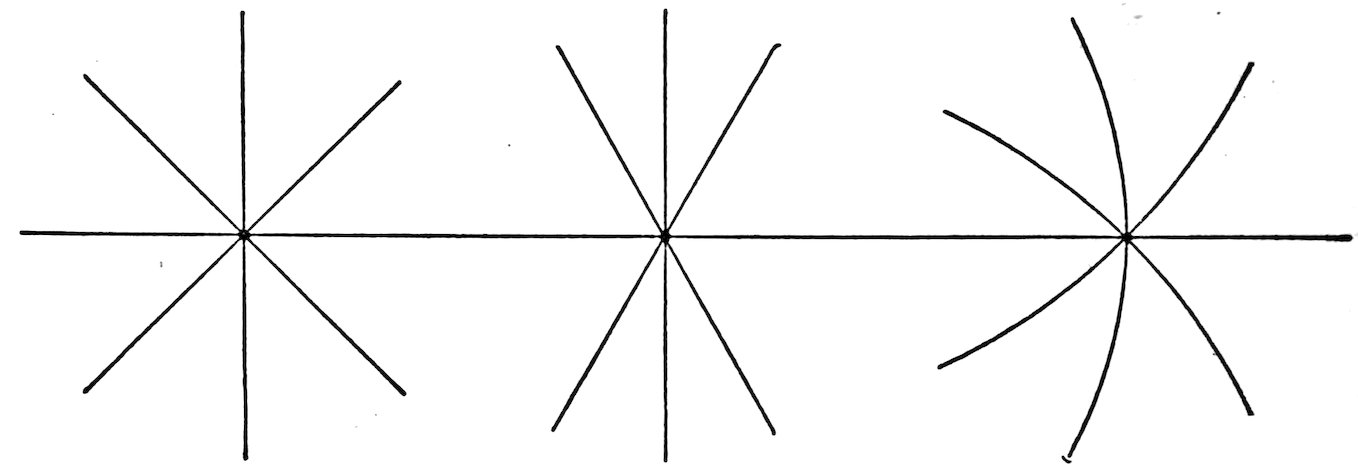
Fig. 1. Fig. 2. Fig. 3.
Electron Theory.—The electron theory was leading to a reversal of Kelvin’s idea that dynamical principles must underlie electrodynamics. Lorentz had shown that a rigorous solution of the electrodynamic equations did away entirely with Maxwell’s displacement current, but made the electromagnetic field at a point in space depend not upon the distribution of charges and currents at the same instant, but at a time earlier sufficient to allow the effect to travel with the velocity of light from the charges and currents producing the field to the point at which the electric and magnetic intensities are to be found. The position of a charge or current element at this earlier time he denoted its “effective position.” The effective distribution, then, is that actually seen by an observer stationed at the point under consideration at the instant for which the intensity of the electromagnetic field is to be determined. This solution of the electrodynamic equations led in turn to rigorous expressions for the electric and magnetic intensities produced by a very small charged particle, such as an electron. Fig. 1 shows the electrostatic field produced by a charged particle at rest. The lines of force spread out radially and uniformly in all directions. In fig. 2 the electron is supposed to have a velocity v horizontally to the right of an amount smaller than, though comparable with, the velocity of light c. It is seen that the lines of electric force still diverge radially from the charge, but are crowded in the equatorial plane and spread apart in the polar regions. The dissymmetry grows as the velocity increases until if the velocity of light should be reached the field would be entirely concentrated in a plane at right angles to the direction of motion. Now it may be shown that fig. 2 is 370obtainable from fig. 1 by reducing dimensions in the direction of motion in the ratio of
√(1 − β2) : 1, where β ≡ v/c.
For a uniformly convected electric field differs from an electrostatic field only in that the dimensions in the direction of motion are contracted in this particular ratio. Fig. 3 represents the electric field of a charged particle which has a uniform acceleration to the right. Consider Faraday’s analogy between lines of force and stretched elastic bands. The symmetry of the first two figures shows that in neither of these cases would there be a resultant force on the charged particle. But in the third figure it is obvious that a force to the left is exerted on the charge by its own field. Calculation shows this force to be proportional in magnitude to the acceleration. Let it be postulated that the resultant force on a charged particle is always zero. Then if F is the applied force, the force on the particle due to the reaction of its field will be — m f, where f stands for the acceleration and m is a positive constant, and we have the fundamental equation of dynamics
F − m f = 0
Hence, instead of admitting Kelvin’s contention that all physical phenomena must be given a mechanical explanation, it would seem more logical to assert that electrodynamics actually underlies mechanics.
Calculation shows the electromagnetic mass m to vary inversely with the radius of the charged particle. Now Thomson’s experiments made it possible to calculate the mass of an electron. Hence its radius can be computed, and is found to be about 2(10)–13 part of a centimeter, or one fifty-thousandth part of the radius of the atom. Since numbers so small convey little meaning, consider the following illustration, due, in part, to Kelvin. Imagine a single drop of water to be magnified until it is as large as the earth. The individual atoms would then have the size of baseballs. Now magnify one of these atoms until it is comparable in size with St. Peter’s cathedral at Rome. The electrons within the atom would appear as a few grains of sand scattered about the nave. 371This separation between the constituent electrons of the atom,—so great in comparison with their dimensions,—explains how alpha particles can be shot by the billion through thin-walled glass tubing without leaving any holes behind or impairing in the slightest degree the high vacuum within the tube. The much smaller high speed beta particles pass through an average of ten thousand atoms without even coming near enough to one of the component electrons to detach it and form an ion.
Michelson-Morley Experiment.—In 1881 Michelson (22, 120, 1881) conceived an ingenious and bold method of measuring the orbital motion of the earth through the luminiferous ether. As the experiment was one involving considerable expense, Bell, the inventor of the telephone receiver, was appealed to successfully for the funds necessary to carry it through. Michelson’s experimental plan was as follows: A beam of light traveling in the direction of the earth’s motion strikes an unsilvered mirror m at an angle of 45°. Part of the light passes through, the rest being reflected at right angles to its original direction. Each ray is returned by a mirror at a distance l from m. On meeting again, the ray whose path has been at right angles to the direction of the earth’s motion passes on through the mirror, while the other ray is reflected so as to bring the two in line and form interference fringes. Now consider the effect of the earth’s motion on the paths of the two rays. In fig. 4 the earth is supposed to be moving to the right. The unsilvered mirror m bifurcates a beam of light coming from a source a. By the time the ray reflected from m has traveled to the mirror b and back, m will have moved forward to m’; a distance 2βl, where the small quantity β is the ratio of the earth’s velocity to the velocity of light. Hence the length of the path traversed by this ray is approximately
2l(1 + ½β2).
The other ray will reach the mirror c after the latter has moved forward a distance
372βl/(1 − β2)
and on returning find m at m’. Hence its path has a length of roughly 2l(1 + β2). The difference in path of the two rays is β2l and consequently they should be a little out of phase on meeting at d. By rotating the apparatus clockwise through 90° the directions of the two rays relative to the earth’s motion are interchanged, and the interference fringes would be expected to shift an amount corresponding to a difference in path of 2β2l. This quantity is of course small,—β2 is about one one hundred millionth,—but so sensitive are the methods of interferometry that Michelson felt confident that he would be able to detect the earth’s motion through the ether. The apparatus consisted of a table which could be rotated about a vertical axis in much the same way as a spectrometer table, and provided with arms a meter long to carry the mirrors b and c. With this length of arm the interference fringes from sodium light should shift by an amount corresponding to four hundredths of a wave length when the table is rotated through a right angle. When the experiment was first performed the apparatus was placed on a stone pier in the Physical Institute at Berlin. So sensitive was the instrument to outside vibrations that even after midnight it was found impossible to get consistent readings. Finally a satisfactory foundation was constructed in the cellar of the Astrophysical observatory at Potsdam. But what was the astonishment of the experimenters to find that the expected shift of the interference fringes did not exist!
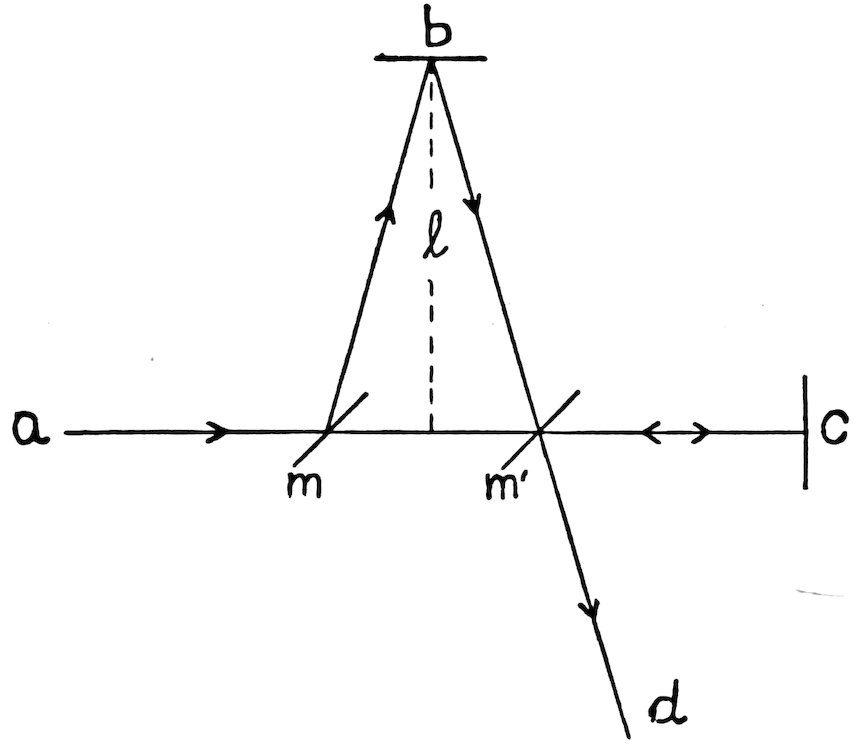
Fig. 4.
373The extreme delicacy of the experiment made it desirable to confirm the result by repeating it. This was done by Michelson and Morley (34, 333, 1887) in 1887. In place of a revolving table a massive slab of stone floating on mercury was used to carry the apparatus. This slab was kept in constant rotation, the observer following it around. Moreover, the precision of the experiment was greatly increased by reflecting each ray back and forth across the slab a number of times between leaving and returning to the mirror m. The accuracy attained was such as to justify Michelson in declaring that if the effect sought actually existed it could not be so great as one-twentieth of its calculated value. In 1905 Morley and Miller[166] repeated the experiment for the second time and succeeded in increasing the sensitiveness of the apparatus to a point such that a motion through the ether of one-tenth of the earth’s orbital velocity could have been detected.
The displacement looked for in the Michelson-Morley experiment is known as a second-order effect in that it depends upon the square of the ratio of the velocity of the earth to that of light. Michelson at first considered that the negative result obtained confirmed a theory proposed by Stokes in which it was assumed that the ether inside and near its surface partakes of the motion of the earth, while that at a distance is practically quiescent. But there are many objections to Stokes’ theory, one of which was brought out by an experiment of Michelson’s (3, 475, 1897) in which he attempted by an interference method to detect a difference in the velocity of light at different levels above the earth’s surface. The negative result obtained led him to conclude that if Stokes’ theory were true the earth’s influence on the ether would have to extend to a distance above its surface comparable with its diameter. Meanwhile a more satisfactory explanation 374was forthcoming. It has been pointed out that a uniformly convected electric field is derivable from an electrostatic field by contracting dimensions in the direction of motion in the ratio
√(1 − β2) : 1.
Fitzgerald and Lorentz showed independently that if moving matter is distorted in this same way the result obtained by Michelson would be just that to be expected. For then the distance of the mirror c from m would be
l√(1 − β2)
instead of l, and the path of the ray moving parallel to the earth’s orbit
2l(1 + ½β2),
which is just that of the other ray. Of course when the apparatus is rotated through 90°, the distance of this mirror from m assumes its normal value again, and the distance of the other mirror becomes shortened. As all measurement consists in comparing the object to be measured with a standard this contraction could never be detected by experimental methods, for the measuring rod would contract in exactly the same ratio as the body to be measured.
In computing its electromagnetic mass Abraham had assumed the electron to be a uniformly charged rigid sphere which keeps its spherical form no matter how great a velocity it may be given. He found that the mass increases with the speed at very high velocities, becoming infinite as the velocity of light is approached, and that its value depends upon the direction of the applied force. After the Fitzgerald-Lorentz contraction was seen to be necessary in order to explain Michelson’s result, Lorentz calculated the electromagnetic mass of a charged sphere which is deformed into an oblate spheroid when set in motion. For this type of electron too, the mass approaches infinity for velocities as great as that of light, and is different for different directions. If a force is applied in the direction of motion the inertia to 375be overcome is a little greater than when the force is applied at right angles to this direction. Thus we have to distinguish between longitudinal and transverse masses. But the masses of Lorentz’s electron are not the same functions of its velocity as those of Abraham’s. Kaufmann and after him Bucherer tested experimentally the relation between transverse mass and velocity by observing the deflections produced by electric and magnetic fields in the paths of high speed beta particles. The latter’s work was such an ample confirmation of Lorentz’s formula that it may be considered as proven that a moving electron at least suffers contraction in the direction of motion in the ratio
√(1 − β2) : 1.
The electromagnetic theory of light had proved so successful when applied to bodies at rest that Lorentz was anxious to extend this theory to the optics of moving media. His problem was to find a group of homogeneous linear transformations that would leave the form of the electrodynamic equations unchanged. The Michelson-Morley experiment had shown that dimensions in the direction of motion must be contracted in the moving system, those at right angles remaining unaltered. But Lorentz soon found that it was also necessary to use a new unit of time in the moving system, and as this time was found to depend upon the position of the point at which it is to be determined, he called it the local time. Lorentz’s transformation is just that of the principle of relativity, but he did not succeed in expressing the electrodynamic equations in terms of the new coördinates and time in exactly the same form as for a system at rest, for the reason that he failed to endow these new units with sufficient reality to justify him in using them when it came to transforming the velocity term involved in an electric current.
Principle of Relativity.—In 1905 appeared in the Annalen der Physik[167] a paper destined to alter entirely the point of view from which problems in light and electromagnetic theory are to be approached. The author was Albert Einstein, of Berne, Switzerland, a young man 376of twenty-six who had already made a number of notable contributions to theoretical physics.
The principle of relativity proposed by Einstein was by no means new to students of dynamics. Newton’s first two laws of motion express very clearly the fact that in mechanics all motion is relative. Force is proportional to acceleration, and the relation between the two is the same whether the motion under consideration is referred to fixed axes or to axes moving with a constant velocity. But in connection with the phenomena of light and electromagnetism the case seemed to be quite different. There everything was referred to a fixed ether, and even though Lorentz had found a set of transformations which left the electrodymanic equations practically unchanged, he continued to think in terms of an ether. So physicists were not a little startled when Einstein postulated that no experiment, practical or ideal, could ever distinguish between two systems in such a manner as to warrant the assertion that one of them is at rest and the other in motion. All motion is relative, and the laws governing physical, chemical and biological phenomena are the same in terms of the units of one system as in terms of those of any other.
Einstein next considers some very fundamental questions. What do we mean when we say that two events, one at A and the other at a point B far from A, occur at the same time? Obviously the expression has no significance unless synchronous clocks are stationed at the two points. But how is it to be determined whether or not these two clocks are synchronous? If instantaneous communication could be established between A and B the matter would be simple enough. Since no infinite velocity of transmission is available, however, let a light wave be sent from A to B and returned to A immediately upon its arrival. If the time indicated by the clock at B when the signal is received is half way between that at which it left A and the time at which it arrives on its return, then the two clocks may be considered synchronous. Now if it desired to measure the length of a bar which is moving parallel to the scale with which the measurement is to be made, it is necessary to note the positions of the two ends of the bar at the same instant. 377So even the measurement of the length of a moving body depends upon the condition of synchronism at different points in space.
The principle of relativity requires that the velocity of light shall be the same in one system as in another relative to which the first is in motion. Hence the definition of synchronism makes it possible to obtain a set of transformations connecting space and time measurement on one system with those on another. This group of transformations is exactly that which Lorentz had found would transform the electrodynamic equations into themselves. But Einstein’s point of view brought out a remarkable reciprocity which Lorentz had missed. If two parallel rods MN and OP are in motion relative to each other in the direction of their lengths, not only does OP appear shortened to an observer at rest with respect to MN, but MN appears shorter than normal in the same ratio to an observer who is moving along with the rod OP.
Einstein’s theory makes the velocity of light the maximum speed with which a signal can be transmitted. This leads to his celebrated addition theorem. Consider three observers A, B and C. Let B be moving relative to A with a velocity of nine-tenths the velocity of light, and C in the same direction with an equal velocity relative to B. In terms of old-fashioned notions of time and space, the velocity of C relative to A would be computed as one and eight-tenths the velocity of light. But the relativity theory gives it as ninety-nine hundredths the velocity of light. For the velocity of light can never be surpassed by that of any material object. This deduction from theory is most strikingly confirmed by the fact that although beta particles have been observed with velocities as high as ninety-nine hundredths that of light, the velocity of light is never quite equalled. It may be remarked in passing that the principle of relativity requires that the masses of all material bodies shall vary with the velocity in the same manner as Lorentz found to be the case for the electromagnetic mass of the deformable electron. In this connection Bumstead (26, 498, 1908) has devised an elegant method of deducing the ratio of longitudinal to transverse mass.
378The close connection between electrodynamics and the principle of relativity is obvious from the fact that both lead to the same time and space transformations. Furthermore L. Page (37, 169, 1914) has shown that the electrodynamic equations can be derived exactly and in their entirety from nothing more than the kinematics of relativity and the assumption that every element of charge is a center of uniformly diverging lines of force. Hence it may safely be asserted that no purely electromagnetic phenomenon can ever come into contradiction with this principle. The simplicity thus introduced into the solution of a certain class of problems is enormous. As an example consider the question as to whether a moving star is retarded by the reaction of its own radiation. This purely electrodynamical problem is of such complexity that attempts to solve it have led to some controversy among mathematical physicists. The principle of relativity tells us without recourse to analysis that no retardation can exist.
Throughout the nineteenth century the ether has played a fundamental part in all important physical theories of light and electromagnetism. But if it is not possible for experiment to detect even the state of motion of the ether, why postulate the existence of such a medium? If it does not possess the most fundamental characteristic of matter, how can it possess such derived properties as density and elasticity,—properties which any conceivable mechanical medium must have in order to transmit transverse vibrations? The relativist does not deny the existence of an ether. To him the question has no more meaning than if he were asked to express an opinion as to the reality of parallels of latitude on the earth’s surface. As a convenient medium of expression in describing certain phenomena the ether has justified much of the use which has been made of it. But to attribute to it a degree of substantiality for which there is no warrant in experiment, is to change it from an aid into an obstacle to the progress of science. From the relativist point of view the distinction is very sharp between those motions of charged particles which are experimentally observable, and such geometrical conventions as electromagnetic fields, or analytical symbols as 379electric and magnetic intensities. These modes of representation have been and still are of the greatest use and importance, but their value in scientific description must not lead to lack of appreciation of their purely speculative character.