IV A CENTURY OF GEOLOGY.—THE GROWTH OF KNOWLEDGE OF EARTH STRUCTURE
Reading edition
By JOSEPH BARRELL
Introduction The Intellectual Viewpoint in 1818.
In 1818, the year of the founding of the Journal, the natural sciences were still in their infancy in Europe. Geology was still subordinate to mineralogy, was hardly recognized as a distinct science, and consisted in little more than a description of the character and distribution of minerals and rocks. America was remote from the Old World centers of learning. The energy of the young nation was absorbed in its own expansion, and but a few of those who by aptitude were fitted to increase scientific knowledge were even conscious of the existence of such a field of endeavor. Under these circumstances the educative field open to a journal of science in the United States was an almost virgin soil. Original contributions could most readily be based upon the natural history of the New World, and the founder of the Journal showed insight appreciative of the situation in stating in the “Plan of the Work” in the introduction to the first volume that “It will be a leading object to illustrate American Natural History, and especially our Mineralogy and Geology.”
At this time educated people were still satisfied that the whole knowledge of the origin and development of the earth so far as man could or should know it was embraced in the Book of Genesis. They were inclined to look with misgiving at attempts to directly interrogate the earth as to its history. Philosophers such as Descartes 154and Liebnitz, the cosmogonists de Maillet and Buffon had been less instrumental in developing science than in fitting a few facts and many speculations to their systems of philosophy. By the opening of the nineteenth century, however, men of learning were coming to appreciate that the way to advance science was to experiment and observe, to collect facts and discourage unfounded speculation. Silliman’s insight into the needs of geologic science is shown in the following quotation (1, pp. 6, 7, 1818):
“Our geology, also, presents a most interesting field of inquiry. A grand outline has recently been drawn by Mr. Maclure, with a masterly hand, and with a vast extent of personal observation and labour: but to fill up the detail, both observation and labour still more extensive are demanded; nor can the object be effected, till more good geologists are formed, and distributed over our extensive territory.
To account for the formation and changes of our globe, by excursions of the imagination, often splendid and imposing, but usually visionary, and almost always baseless, was, till within half a century, the business of geological speculations; but this research has now assumed a more sober character; the science of geology has been reared upon numerous and accurate observations of facts; and standing thus upon the basis of induction, it is entitled to a rank among those sciences which Lord Bacon’s Philosophy has contributed to create. Geological researches are now prosecuted by actually exploring the structure and arrangement of districts, countries, and continents. The obliquity of the strata of most rocks, causing their edges to project in many places above the surface; their exposure, in other instances on the sides or tops of hills and mountains; or, in consequence of the intersection of their strata, by roads, canals, and river-courses, or by the wearing of the ocean; or their direct perforation, by the shafts of mines; all these causes, and others, afford extensive means of reading the interior structure of the globe.
The outlines of American geology appear to be particularly grand, simple, and instructive; and a knowledge of the important facts, and general principles of this science, is of vast practical use, as regards the interests of agriculture, and the research for useful minerals. Geological and mineralogical descriptions, and maps of particular states and districts, are very much needed in the United States; and to excite a spirit to furnish them will form one leading object of this Journal.”
155
The Prolonged Influence of Outgrown Ideas.
Those interested in any branch of science should, as a matter of education, read the history of that special subject. A knowledge of the stages by which the present development has been attained is essential to give a proper perspective to the literature of each period. Much of the existing terminology is an inheritance from the first attempts at nomenclature, or may rest upon theories long discarded. Popular notions at variance with advanced teaching are often the forgotten inheritance of a past generation.
Gneiss, trap, and Old Red Sandstone are names which we owe to Werner. The “Tertiary period” and “drift” are relics of an early terminology. The geology of tourist circulars still speaks of canyons as made by “convulsions of nature.” Popular writers still attribute to geologists a belief in a molten earth covered by a thin crust. Within the present century the eighteenth century speculations of Werner and his predecessors, postulating a supposed capacity of water to seep through the crust into the interior of the earth, resulting in a hypothetical progressive desiccation of the surface, views long abandoned by most modern geologists, have been revived by an astronomer into a theory of “planetology.”
A review of the literature of a century brings to light certain tendencies in the growth of science. Each decade has witnessed a larger accumulation of observed facts and a fuller classification of these fundamental data, but the pendulum of interpretative theory swings away from the path of progress, now to one side, now to the other, testing out the proper direction. For decades the understanding of certain classes of facts may be actually retrogressive. A retrospect shows that certain minds, keen and unfettered by a prevailing theory, have in some directions been in advance of their generation. But the judgment of the times had not sufficient basis in knowledge for the separation and acceptance of their truer views from the contemporaneous tangle of false interpretations.
An interesting illustration of these statements regarding 156the slow settling of opinion may be cited in regard to the significance of the dip of the Triassic formations of the eastern United States. The strata of the Massachusetts-Connecticut basin possess a monoclinal easterly dip which averages about 20 degrees to the east. Those of the New Jersey-Pennsylvania-Virginia basin possess a similar dip to the northwest. Both basins are cut by great faults and the dip is now accepted by practically all geologists as due to rotation of the crust blocks away from a geanticlinal axis between the two basins. Edward Hitchcock, whose work from the first shows an interpretative quality in advance of his time, states in 1823 (6,74) regarding the dip of the Connecticut valley rocks:
“There is reason to believe that Mount Toby, the strata of which are almost horizontal, exhibits the original dip of these rocks, and that those cases in which they are more highly inclined are the result of some Plutonian convulsion. Such irregularity in the dip of coal fields is no uncommon occurrence.”
In Hitchcock’s Geology of Massachusetts, published in 1833, ten years later, geological structure sections of the Connecticut Valley rocks are given, the facts are discussed in detail and the dip ascribed to the elevatory forces. He says (l. c., pp. 213, 223):
“If it were possible to doubt that the new red sandstone formation was deposited from water, the surface of some of the layers of this shale would settle the question demonstrably. For it exhibits precisely those gentle undulations, which the loamy bottom of every river with a moderate current, presents. (No. 198.) But such a surface could never have been formed while the layers had that high inclination to the horizon, which many of them now present: so that we have here, also, decisive evidence that they have been elevated subsequently to their deposition....
The objection of a writer in the American Journal of Science, that such a height of waters as would deposit Mount Toby, must have produced a lake nearly to the upper part of New Hampshire, in the Connecticut Valley, and thus have caused the same sandstone to be produced higher up that valley than Northfield, loses its force, when it is recollected that this formation was deposited before its strata were elevated. For the elevating force undoubtedly changed the relative level of different parts of the country. In this case, the disturbing force must have acted beneath the primary rocks. And besides, we have good evidence which will be shown by and by, that our new red sandstone was formed beneath the ocean. We cannot then reason on this subject from present levels.”
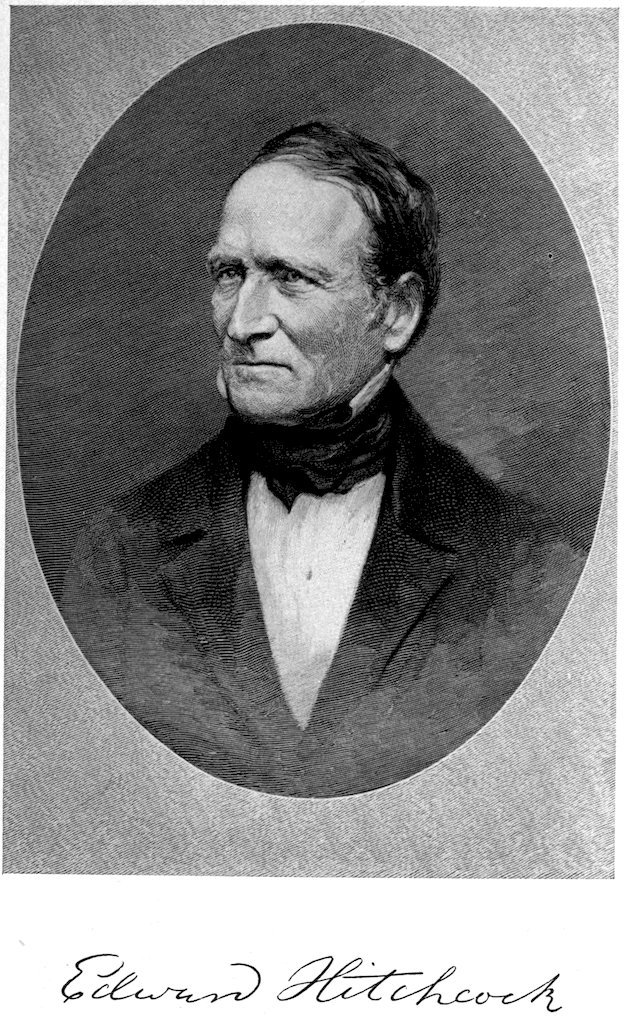
Courtesy of Popular Science Monthly.
157In 1840, H. D. Rogers, a geologist who has acquired a more widely known name than Hitchcock, but who in reality showed an inferior ability in interpretation, made the following statements in explanation of the regional monoclinal dip of the New Jersey Triassic rocks averaging 15 to 20 degrees to the northwest:[78]
“Their materials give evidence of having been swept into this estuary, or great ancient river, from the south and southeast, by a current producing an almost universal dip of the beds towards the northwest, a feature clearly not caused by any uplifting agency, but assumed originally at the time of their deposition, in consequence of the setting of the current from the opposite or southeastern shore.”
In 1842, at the third annual meeting of the Association of American Geologists both H. D. and W. B. Rogers argued (43, 170, 1842) against Sir Charles Lyell and E. Hitchcock that the present dip of the Triassic was the original slope of deposition, stating among other reasons that the footprints impressed upon the sediments often showed a slipping and a pushing of the soft clay in the direction of the downhill slope. In 1858 H. D. Rogers still held to the same views of original dip,[79] notwithstanding that a moderate amount of observation on the mud-cracked and rain-pitted layers would have supplied the proof that such must have dried as horizontal surfaces. The idea of inclined deposition is not yet wholly dead as it has been suggested more than once within the present generation as a means of escaping from the necessity of accepting the very great thicknesses of this and similar formations. Thus, as Brögger has remarked in another connection,—the ghosts of the old time stand ever ready to reappear.
In the present essay on the rise of structural geology as reflected through a century of publication in the Journal, attention will be given especially to two fields, that of structures connected with igneous rocks and that 158of structures connected with mountain making, and emphasis will be placed upon the growth of understanding rather than upon the accumulating knowledge of details. The growth in both of these divisions of structural geology is well illustrated in the volumes of the Journal.
Structures and Relationships of Igneous Rocks.
Opposed Interpretations of Plutonists and Neptunists.
During the first quarter of the nineteenth century the geologic controversy between the Plutonists and Neptunists was at its height; the Plutonists, following the Scotchman, Hutton, holding to the igneous origin of basalt and granite, the Neptunists, after their German master, Werner of Freiberg, maintaining that these rocks had been precipitated from a primitive universal ocean. The Plutonists, although time has shown them to have been correct in all essential particulars, were for a generation submerged under the propaganda carried forward by the disciples of Werner. The “Illustrations of the Huttonian Theory of the Earth,” a remarkable classic, worthy of being studied to-day as well as a century ago, was published in 1802 by John Playfair, professor of mathematics in the University of Edinburgh and a friend of Hutton, who had died five years previously. This volume was opposed by Robert Jameson, professor of natural philosophy in the same university, who had absorbed the ideas of the German school while at Freiberg and published in 1808 a volume on the “Elements of Geognosy,” in which the philosophy of Werner is followed throughout and even obsidian and pumice are argued to be aqueous precipitates. The authority of the Wernerian autocracy caused its nomenclature to be adopted in the new world, but strong evidence against its interpretations was to be found in the actual structural relations displayed by the igneous rocks.
Contributions on Volcanic and Intrusive Rocks.
The accumulation and study of facts constituted the best cure for an erroneous theory. The publications of the Journal contributed toward this end by articles along 159several lines. The most original contributions were those which dealt with the areal and structural geology of eastern North America, but equally valuable at that time for the broadening of scientific interest were the studies on the volcanic activities of the Hawaiian Islands, published through many years. Perhaps most valuable from the educative standpoint were the extensive republications in the Journal of the more important European researches, making them accessible to American readers. In volume 13 (1828), for example, a digest of Scrope’s work on volcanoes is given, covering forty pages; and of Daubeny on active and extinct volcanoes, running over seventy-five pages and extending into vol. 14. Through these comprehensive studies the nature of volcanic action became generally understood during the first half of the nineteenth century and the original publications in the Journal were valuable in giving a knowledge of the activities of the Hawaiian volcanoes.
Early in the nineteenth century the whole of America still remained to be explored by the geologist. The regions adjacent to the centers of learning were among the first to receive attention and the Triassic basin of Connecticut and Massachusetts yielded information in regard to the nature of igneous intrusion. This basin, of unmetamorphic shales and sandstones, is occupied by the Connecticut River except at its southern end. The Formation contains within it sills, dikes, and outflows of basaltic rocks which because of their superior resistance to erosion constitute prominent hills, in places bounded by cliffs.
Silliman in 1806[80] described East Rock, New Haven, Connecticut, as a whinstone, trap, or basalt, and accounted for its presence on the supposition that it had
“actually been melted in the bowels of the earth and ejected among the superior strata by the force of subterraneous fire, but never erupted like lava, cooling under the pressure of the superincumbent strata and therefore compact or nonvesicular, its present form being due to erosion.”
In these conclusions Silliman was correct. With but a limited amount of experience he was able to discriminate between the intrusive and effusive rocks and saw that the 160prominence of this hill was due to the erosion of the sediments which once surrounded it.
An extensive paper on the geology of this region was published by Edward Hitchcock in 1823,[81] then just thirty years of age. This paper shows the evidence of extensive field observations, and his comments in regard to the trap and granite are of interest. Hitchcock gives five pages to the subject of “Greenstone Dykes in Old Red Sandstone” (6, 56–60, 1823) and makes the following statements:
“Professor Silliman conducted me to an interesting locality of these in East-Haven. They occur on the main road from New-Haven to East-Haven, less than half a mile from Tomlinson’s bridge ... (p. 56).
They are an interesting feature in our geology, and deserve more attention; and it is peculiarly fortunate that they should be situated so near a geological school and the first mineral cabinet in our country ... (p. 58).
Origin of Greenstone.
Does the greenstone of the Connecticut afford evidence in favour of the Wernerian or of the Huttonian theory of its origin? Averse as I feel to taking a side in this controversy, I cannot but say, that the man who maintains, in its length and breadth, the original hypothesis of Werner in regard to the aqueous deposition of trap, will find it for his interest, if he wishes to keep clear of doubts, not to follow the example of D’Aubuisson, by going forth to examine the greenstone of this region, lest, like that geologist, he should be compelled, not only to abandon his theory, but to write a book against it. Indeed, when surveying particular portions of this rock, I have sometimes thought Bakewell did not much exaggerate when he said in regard to Werner’s hypothesis, that, ‘it is hardly possible for the human mind to invent a system more repugnant to existing facts.’
On the other hand, the Huttonian would doubtless have his heart gladdened, and his faith strengthened by a survey of the greater part of this rock. As he looked at the dikes of the old red sandstone, he would almost see the melted rock forcing its way through the fissures; and when he came to the amygdaloidal, especially to that variety which resembles lava, he might even be tempted to apply his thermometer to it, in the suspicion that it was not yet quite cool ... (p. 59).
By treating the subject in this manner I mean no disrespect to any of the distinguished men who have adopted either side of 161this question. To President Cooper especially, who regards the greenstone of the Connecticut as volcanic, I feel much indebted for the great mass of facts he has collected on the subject. And were I to adopt any hypothesis in regard to the origin of our greenstone, it would be one not much different from his” (p. 60).
By 1833 and more clearly in 1841 Hitchcock had come to recognize the distinction between intrusive and extrusive basaltic sheets in the Connecticut valley. Dawson also came to regard the Acadian sheets as extrusive, and Emerson in 1882 recalled again the evidence for Massachusetts (24, 195, 1882). Davis, however, went a step further and by applying distinctive criteria not only separated intrusive and extrusive sheets throughout the whole Triassic area, but by using basalt flows as stratigraphic horizons unraveled for the first time the system of faults which cut the Triassic system. His preliminary paper (24, 345, 1882) was followed by many others.
From 1880 onward begins the period of precise structural field work. The older geologists mostly conceived their work after reconnaissance methods. From 1870 to 1880 a group of younger men entered geology who paid close attention to the solid geometry and mechanics of earth structures. In their hands physical and dynamical geology began to assume the standing of a precise and quantitative science. In the field of intrusive rocks the opening classic was by Gilbert, who in his volume on the geology of the Henry Mountains, published in 1880, made laccoliths known to the world. With the beginning of this new period we may well leave the subject of intrusive rocks and turn to the progress of knowledge in regard to those deeper and vaster bodies now known as batholiths. These, since erosion does not expose their bottoms, Daly separates from intrusives and classifies as subjacent. The batholiths consist typically of granite and granodiorite, and introduce us to the problem of granite.
Views on the Structural Relations of Granite.
Conscientious field observations were sufficient to establish the true nature of the intrusive and extrusive rocks. The case was very different, however, with the 162nature and relations of the great bodies of granite, which may be taken in the structural sense as including all the visibly crystalline acidic and intermediate rocks, known more specifically as granite, syenite, and diorite.
The large bodies of granite, structurally classified as stocks, or batholiths, commonly show wedges, tongues, or dike networks cutting into the surrounding rocks. The relations, however, are not all so simple as this. Granites may cover vast areas, they are usually the older rocks, they are generally associated with regional metamorphism of the intruded formations, which metamorphism is now understood to be due chiefly to the heat and mineralizers given off from the granite magma, associated with mashing and shearing of the surrounding rocks. The granite was often injected in successive stages which alternated with the stages of regional mashing. A parallel or gneissic structure is thus developed which is in part due to mashing, in part to igneous injection. Where the ascent of heat into the cover is excessive, or where blocks are detached and involved in the magma, the latter may dissolve some of the older cover rocks, even where these were of sedimentary origin.
Thus between mashing, injection, and assimilation the genetic relationships of a batholith to its surroundings are in many instances obscure. Nevertheless, attention to the larger relations shows that the molten magma originated at great depths in the earth’s crust, far below the bottoms of geosynclines, and consists of primary igneous material, not of fused sediments. From those depths it has ascended by various processes into the outer crust, where it crystallized into granite masses, to be later exposed by erosion. The amount of material which can be dissolved and assimilated must be small in comparison with the whole body of the magma. The original composition of the magma was probably basic, nearer that of a basalt than that of a granite. Differentiation of the molten mass is thought to cause the upper and lower parts of the chamber to become unlike, the lighter and more acidic portion giving rise to the great bodies of granite. With the exception of certain border zones the whole, however, is regarded as igneous rock risen from the depths.
163The complex border relations, but more particularly certain academic hypotheses, led to a period of misunderstanding and retrogression in regard to the nature of granites. It constitutes an interesting illustration of the possibility of a wrong theory leading interpretation astray, chiefly through the magnification of minor into major factors. This history illustrates the dangers of qualitative science as compared to quantitative, of a single hypothesis as matched against the method of multiple working hypothesis. This flux of opinion in regard to the nature of granites may be traced through the volumes of the Journal.
E. Hitchcock in 1824 (6, 12) noted that in places granite appeared bedded, but in other places existed in veins which cut obliquely across the strata. Silliman, although careful not to deny the aqueous origin of some basalts, yet held that the field evidence of New England indicates for that region the igneous or Huttonian origin of trap and granite (7, 238, 1824).
In 1832 the following article by Hitchcock appeared in the Journal (22, 1, 70):
Report on the Geology of Massachusetts; examined under the direction of the Government of that State, during the years 1830 and 1831; by Edward Hitchcock, Prof. of Chemistry and Natural History in Amherst College.
A footnote adds that this is “published in this Journal by consent of the Government of Massachusetts, and intended to appear also in a separate form, and to be distributed among the members of the Legislature of the same State, about the time of its appearance in this work. It is, we believe, the first example in this country, of the geological survey of an entire State.”
This article includes a geological map of the state and covers the subject of economic geology. The report brought forth the following remarks from a French reviewer in the Revue Encyclopédique, Aug. 1832, quoted in the Journal (23, 389, 1833):
“A single glance at this report, is sufficient to convince any one of the utility of such a work, to the state which has undertaken it; and to regret that there is so very small a part of the French territory, whose geological constitution is as well known to the public, as is now the state of Massachusetts. France has the greater cause to regret her being distanced in this race by 164America, from her having a corps of mining engineers, who if they had the means, would, in a very short time furnish a work of the same kind, still more complete, of each of the departments.”
The complete report published in 1833 is a work of 700 pages. Pages 465 to 517 are devoted to the subject of granite. Numerous detailed sketches are given showing contact relations. Nine pages are given to theoretical considerations and many lines of proof are given that granite is an igneous rock, molten from the internal heat of the earth, and intruded into the sedimentary strata. His statement is the clearest published in the world, so far as the writer is aware, up to that date, and marks Edward Hitchcock as one of the leading geologists of his generation in Europe as well as America. Unfortunately his views were largely lost to sight during the following generation.
In 1840 the first American edition of Mantell’s Wonders of Geology gave currency to the idea that granite is proved to be of all geological ages up to the Tertiary (39, 6, 1840). In 1843 J. D. Dana pointed out (45, 104) that schistosity was no evidence of sedimentary origin. He regarded most granites as igneous as shown by their structural relations, but considers that some may have had a sedimentary origin.
Rise and Decline of the Metamorphic Theory of Granite.
Up to 1860 granite was regarded on the basis of the facts of the field as essentially an intrusive rock, but gneiss as a metamorphic product mostly of sedimentary origin. It seemed as though sound methods of research and interpretation were securely established. Nevertheless, a new era of speculation and a modified Wernerism arose at that time with a paper by T. Sterry Hunt, marking a retrogression in the theory of granite which lasted until his death in 1892.
In November, 1859, Hunt read before the Geological Society of London a paper on “Some Points in Chemical Geology” in which he announced that igneous rocks are in all cases simply fused and displaced sediments, the fusion taking place by the rise of the earth’s internal 165heat into deeply buried and water-soaked masses of sediments (see 30, 133, 1860). The germ of this idea of aqueo-igneous fusion was far older, due to Babbage and John Herschel, neither of them geologists, but such sweeping extensions of it had never before been published. Hunt had the advantage of a wide acquaintanceship with geological literature and chemistry. He wrote plausibly on chemical and theoretical geology, but his views were not controlled by careful field observations. In fact he wrote confidently on regions which apparently he had never seen and where a limited amount of field work would have shown him to have been fundamentally in error. A man of egotistical temperament, he sought to establish priority for himself in many subjects and in order to cover the field made many poorly founded assertions. Building on to another Wernerian idea, he held that many metamorphic minerals had a chronologic value comparable to fossils—staurolite for example indicating a pre-Silurian age—and on this basis divided the crystalline rocks into five series. Although there is much of value buried in Hunt’s work it is difficult to disentangle it, with the result that his writings were a disservice to the science of geology. Although carrying much weight in his lifetime, they have passed with his death nearly into oblivion.
Marcou, with a limited knowledge of American geology, and but little respect for the opinions of others, had published a geologic map of the United States containing gross errors. In support of his views he read in November, 1861, a paper on the Taconic and Lower Silurian Rocks of Vermont and Canada. In the following year he was severely reviewed by “T,” who states positively in controverting Marcou (33, 282, 283, 1862) that “the granites (of the Green Mountains) are evidently strata altered in place.”
“Mr. Marcou should further be informed that the granites of the Alpine summits, instead of being, as was once supposed, eruptive rocks, are now known to be altered strata of newer Secondary and Tertiary age. A simple structure holds good in the British Islands, where as Sir Roderick Murchison has shown in his recent Geological map of Scotland, Ben Nevis and Ben Lawers are found to be composed of higher strata, lying in 166synclinals. This great law of mountain structure would alone lead us to suppose that the gneiss of the Green mountains, instead of being at the base, is really at the summit of the series....
We cannot here stop to discuss Mr. Marcou’s remark about ‘the unstratified and oldest crystalline rocks of the White mountains’ which he places beneath the lower Taconic series. Mr. Lesley has shown that these granites are stratified, and with Mr. Hunt, regards them as of Devonian Age. (This Journal, vol. 31, p. 403.) Mr. Marcou has come among us with notions of mountains upheaved by intrusive granites, and similar antiquated traditions, now, happily for science, well nigh forgotten.”
It is seen that Marcou, notwithstanding the general character of his work, happened to be nearer right in some matters than were his critics, and that “T” had adopted to the limit the views of Hunt.
The recovery of geology from this period of confusion was partly owing to the slow accumulation of opposed facts; especially to a recognition of the fact that the overplaced relation of the granite gneisses in western Scotland was due to great overthrusts; also to the evidence of the clearly intrusive nature of many of the Cordilleran granites. The recovery of a sounder theory was hastened, however, by the application of criticisms by J. D. Dana in the Journal. In 1866 (42, 252) Dana pointed out that sedimentary rocks in Pennsylvania, in Nova Scotia, and other regions which had been buried to a depth of at least 16,000 feet are not metamorphic. Mere depth of burial of sediments was not sufficient therefore to produce metamorphism and aqueo-igneous fusion. The baseless and speculative character of the use of minerals as an index of age and of Hunt’s interpretation of New England geology in general was shown by Dana in 1872 (3, 91). The following year Dana pointed out clearly that igneous eruptions in general have been derived from a deep-seated source and did not come from the aqueo-igneous fusion of sediments. As to gradations between true igneous rocks and fused and displaced sediments he makes the following statements (6, 114, 1873):
“Again, the plastic rock-material that may be derived from the fusion or semifusion of the supercrust, (that is, of rocks 167originally of sedimentary origin,) gives rise to “igneous” rocks often not distinguishable from other igneous rocks, when it is ejected through fissures far from its place of origin; while crystalline rocks are simply metamorphic if they remain in their original relations to the associated rocks, or nearly so.
Between these latter igneous rocks and the metamorphic there may be indefinite gradations, as claimed by Hunt. But if our reasonings are right, the great part of igneous rocks can be proved to have had no such supercrust origin. The argument from the presence of moisture or of hydrous minerals in such rocks in favor of their origin from the fusion of sediments has been shown to be invalid.”
The injected marginal rocks and the post-intrusive metamorphism of most of the New England granites has, however, obscured more or less their real igneous nature so that the gradation from metamorphic sediments through igneous gneisses to granites could be read in either direction. These features misled Dana who accepted the prevailing idea of the general metamorphic origin of granite. Dana makes the following statement (6, 164, 1873):
“But Hunt is right in holding that in general granite and syenite (the quartz-bearing syenite) are undoubtedly metamorphic rocks where not vein-formations, as I know from the study of many examples of them in New England; and the veins are results of infiltration through heated moisture from the rocks adjoining some part of the opened fissures they fill.”
Granite, although regarded at this time as the extreme of the metamorphic series and originating from sediments, was looked upon as typically Archean in age, though in some cases younger. Such a doctrine permitted such extreme misinterpretations as that of Clarence King and S. F. Emmons on the nature of the intrusive granite of the Little Cottonwood canyon in the Wahsatch Range. This body cuts across 30,000 feet of Paleozoic rocks and to the careful observer, as later admitted by Emmons, shows clear evidence of its transgressive nature. But at that time it was generally considered that granite mountains were capable of resisting the erosion of all geological time. Consequently it did not seem incredible to King and his associates that here a great granite range of Archean origin had stood 168up through Paleozoic time until gradual subsidence had permitted it to be buried beneath 30,000 feet of sediments.[82]
It may seem to the present day reader that such a misinterpretation, doing violence to fundamental geologic knowledge as now recognized, was inexcusable; but in the light of the history of geology as here detailed it is seen to have been the interpretation natural to that time. It is true that a careful examination of the facts of that very field would have proved the post-Paleozoic and intrusive nature of that great granite body now known as the Little Cottonwood batholith, but Emmons has explained the rapid and partial nature of the observations which they were compelled to make in order to keep up to their schedule of progress (16, 139, 1903).
Whitney had found some years earlier that the granites of the Sierra Nevada were igneous rocks intrusive into the Triassic and Jurassic strata. The Lake Superior geologists began to show in the eighties that granite was there an intrusive igneous rock. R. D. Irving and Wadsworth noted these relations. Lawson in 1887 pointed out emphatically (33, 473) that the granites of the Rainy Lake region, although basal, were younger than the schists which lay above them. The granite gneisses he held were of clearly the same igneous origin as the granites and neither gave any field evidence of being fused and displaced sediments. From this time forward the truly igneous nature of granite became increasingly accepted until now the notion of its being made of sedimentary rocks softened and recrystallized by the rise of the isogeotherms through deep burial is as obsolete as the still older doctrine of the Neptunists that granite was laid down as a crystalline precipitate on the floor of the primitive ocean.
The recognition of the truly igneous nature of granites has been followed in the present generation by a series of studies on their structural relations and mode of genesis. A number of important initial articles on various aspects of structure and contact relations have appeared in the Journal, but this sketch of the history of the subject may well stop with the introduction to this modern period.
169
Orogenic Structures.
Views of Plutonists and Neptunists.
Orogenic structures are, as the name implies, those connected with the birth of mountains. Nearly synonymous terms are deformative or secondary structures. On a small scale this division embraces the phenomena exposed in the rock ledge or quarry face, or in the dips and dislocations varying from one exposure to another. These structures include faults, folds, and foliation. On a larger scale are included the relations of the different ranges of a mountain system to each other, relations to previous geologic history, relations to the earth as a whole, and to the forces which have generated the structures.
In order to see the stage of development of this subject in 1818 and its progress as reflected through the publications of a century, more particularly in the Journal, it is desirable to turn again to those two treatises emanating from Edinburgh at the beginning of the nineteenth century and representing two opposite schools of thought, the Plutonists and Neptunists.
Playfair, in 1802, devotes nineteen pages to the subject of the inflection and elevation of strata.[83] He places emphasis on the characteristic parallelism of the strike of the folds throughout a region, as shown through the intersection of the folds by a horizontal plane of erosion. He contrasts this with the arches shown in a transverse section and enlarges on our ability to study the deeply buried strata through the denudation of the folded structure. He argues from these relations that the structures can not be explained by the vague appeal of the Neptunists to forces of crystallization, to slopes of original deposition, or to sinking in of the roofs of caverns. The causes he argues were heat combined with pressure. As to the directions in which the pressure acted he is not altogether clear, but apparently regards the pressure as acting in upward thrusts against the sedimentary planes, the latter yielding as warped surfaces. His method of presentation is that of inductive reasoning from facts, but he stopped short of the conception of horizontal compression through terrestrial contraction.
170Jameson, professor of natural history in the same university, in 1808 contemptuously ignores the work of Hutton and Playfair in what he calls the “monstrosities known under the name of Theories of the Earth.” In a couple of pages he confuses and dismisses the whole subject of deformation. He states:[84]
“It is therefore a fact, that all inclined strata, with a very few exceptions, have been formed so originally, and do not owe their inclination to a subsequent change.
When we examine the structure of a mountain, we must be careful that our observations be not too micrological, otherwise we shall undoubtedly fail in acquiring a distinct conception of it. This will appear evident when we reflect that the geognostic features of Nature are almost all on the great scale. In no case is this rule to be more strictly followed than in the examination of the stratified structure.
By not attending to this mode of examination, geognosts have fallen into numberless errors, and have frequently given to extensive tracts of country a most irregular and confused structure. Speculators building on these errors have represented the whole crust of the globe as an irregular and unseemly mass. It is indeed surprising, that men possessed of any knowledge of the beautiful harmony that prevails in the structure of organic beings could for a moment believe it possible, that the great fabric of the globe itself,—that magnificent display of Omnipotence,—should be destitute of all regularity in its structure, and be nothing more than a heap of ruins.”
This was the attitude of a leader of British opinion toward the subject of deformational geology from which the infant science had to recover before progress could be made. The early maps were essentially mineralogical and lithological. The order of superposition and the consequent sequence of age was regarded as settled by Werner in Germany and not requiring investigation in America. The early examples of structure were sections drawn with exaggerated vertical scales and those of Maclure do not show detail.
Recognition of Appalachian Structures.
Following the founding of the Journal in 1818 there is observable a growth in the quality and detail of geological mapping. Dr. Aiken, professor of natural philosophy 171and chemistry in Mt. St. Mary’s College, published in the Journal in 1834 (26, 219) a vertical section extending between Baltimore and Wheeling, a distance of nearly 250 miles, on a scale of about 7 miles per inch. The succession of rocks is carefully shown and the direction of dip, but no attempt is made to show the underground relations, the stratigraphic sequence, and the folded structures which are so clear in that Appalachian section. The text also shows that the author had not recognized the folded structure. Furthermore, where the folds cease at the Alleghany mountain front, the flat strata are shown as resting unconformably on the folded rocks to the east.
R. C. Taylor, geologist, civil and mining engineer, was from 1830 to 1835 the leading student of Pennsylvanian geology as shown by the publication in 1835 of four papers aggregating over 80 pages in the Transactions of the Geological Society of Pennsylvania. His work is noticeable for accuracy in detail and no doubt was influential in setting a high standard for the state geological survey which immediately followed.
H. D. and W. B. Rogers have been given credit in this country, and in Europe also, as being the leading expounders of Appalachian structure. Merrill speaks of H. D. Rogers as unquestionably the leading structural geologist of his time.[85] To the writer, this attributed position appears to be due to his opportunities rather than to scientific acumen. The magnificent but readily decipherable folded structure of Pennsylvania, the relationships of coal and iron to this structure, the considerable sums of money appropriated, and the work of a corps of able assistants were factors which made it comparatively easy to reach important results. In ability to weigh facts and interpret them Edward Hitchcock showed much more insight than H. D. Rogers, while in the philosophic and comprehensive aspects of the subject J. D. Dana far outranks him.
H. D. Rogers in his first report on the geological survey of New Jersey, 1836, recognizes that the Cambro-Silurian limestones (lower Secondary limestones) were deposited as nearly horizontal beds and the ridges of pre-Cambrian gneiss (Primary) had been pushed up as 172anticlinal axes (p. 128). He also clearly recognized the distinction between slaty cleavage and true dip as shown in the Ordovician slates (p. 97). Between 1836 and 1840 he had learned a great deal on the nature of folds as is shown in his Pennsylvania report for 1839 and the structure sections in his New Jersey report for 1840.
R. C. Taylor, who had now become president of the board of directors of the Dauphin and Susquehanna Coal Company, published in the Journal in 1841 (41, 80) an important paper entitled “Notice of a Model of the Western portion of the Schuylkill or Southern Coal Field of Pennsylvania, in illustration of an Address to the Association of American Geologists, on the most appropriate modes for representing Geological Phenomena.” In this paper he calls attention to the value of modeling as a means of showing true relations in three dimensions. He condemns the custom prevalent among geologists of showing structure sections with an exaggerated vertical scale with its resultant topographic and structural distortions. Taylor was widely acquainted with the structure of Pennsylvania, Maryland, and Virginia.
Nature of Forces Producing Folding.
In 1825 Dr. J. H. Steele sent to Professor Silliman two detailed drawings and description of an overturned fold at Saratoga Lake, New York. As to the significance of this feature Steele makes the following statement (9, 3, 1825):
“It is impossible to examine this locality without being strongly impressed with the belief that the position which the strata here assume could not have been effected in any other way than by a power operating from beneath upwards and at the same time possessing a progressive force; something analogous to what takes place in the breaking up of the ice of large rivers. The continued swelling of the stream first overcomes the resistance of its frozen surface and having elevated it to a certain extent, it is forced into a vertical position, or thrown over upon the unbroken stratum behind, by the progressive power of the current.”
So far as the present writer is aware this is the first recognition in geological literature of the evidence of a 173horizontally compressive and overturning force as a cause of folding.
To E. Hitchcock belongs the credit of being the first to describe overturning and inversion of strata on a large scale, but without clearly recognizing it as such. In western Massachusetts metamorphism is extreme in the lower Paleozoic rocks in the vicinity of the overthrust mass of Archean granite-gneiss which constitutes the Hoosic range. The Paleozoic rocks of the valley to the west are overturned and appear to dip beneath the older rocks. Farther west the metamorphism fades out and the series assumes a normal position. Such an inverted relation, up to that time unknown, is described in 1833 as follows by Hitchcock in his Geology of Massachusetts (pp. 297, 298):
“But a singular anomaly in the superposition of the series of rocks above described, presents a great difficulty in this case. The strata of these rocks almost uniformly dip to the east: that is, the newer rocks seem to crop out beneath the older ones; so that the saccharine limestone, associated with gneiss in the eastern part of the range, seems to occupy the uppermost place in the series. Now as superposition is of more value in determining the relative ages of rocks than their mineral characters, must we not conclude that the rocks, as we go westerly from Hoosac mountain, do in fact belong to older groups? The petrifactions which some of them contain, and their decidedly fragmentary character, will not allow such a supposition to be indulged for a moment. It is impossible for a geologist to mistake the evidence, which he sees at almost every step, that he is passing from older to newer formations, just as soon as he begins to cross the valley of Berkshire towards the west. We are driven then to the alternative of supposing, either that there must be a deception in the apparent outcrop of the newer rocks from beneath the older, or that the whole series of strata has been actually thrown over, so as to bring the newest rocks at the bottom. The latter supposition is so improbable that I cannot at present admit it.”
Hitchcock tried to reconcile the evidence by a series of unconformities and inclined deposition, but finds the solution unsatisfactory.
In this same year, 1833, Elie de Beaumont, a distinguished French geologist, published his theory of the origin of mountains. He advanced the idea that since 174the globe was cooling it was condensing, and the crust, already cool, must suffer compression in adjusting itself to the shrinking molten interior. He concluded from the evidence shown in Europe that the collapse of the crust occurred violently and rapidly at widely spaced intervals of time. This hypothesis introduced the idea of mountain folding by horizontal compressive forces. The theoretical paper of de Beaumont, together with further observations by Hitchcock and others, led the latter in 1841 to a final belief in the inversion of strata on a large scale by horizontal compression. His conclusions are expressed in an important paper published in the Journal (41, 268, 1841) and given on April 8, 1841, as the First Anniversary Presidential Address before the Association of American Geologists. This comprehensive summary of American geology occupies 43 pages. Three pages are given to the inverted structure of the Appalachians from which the following paragraphs may be quoted:
“We have all read of the enormous dislocations and inversions of the strata of the Alps; and similar phenomena are said to exist in the Andes. Will it be believed, that we have an example in the United States on a still more magnificent scale than any yet described?...
Let us suppose the strata between Hudson and Connecticut rivers, while yet in the plastic state, (and the supposition may be extended to any other section across this belt of country from Canada to Alabama,) and while only slightly elevated, were acted upon by a force at the two rivers, exerted in opposite directions. If powerful enough, it might cause them to fold up into several ridges; and if more powerful along the western than the eastern side, they might fall over so as to take an inverted dip, without producing any remarkable dislocations, while subsequent denudation would give to the surface its present outline....
Fourthly, we should readily admit that such a plication and inversion of the strata might take place on a small scale. If for instance, we were to press against the extremities of a series of plastic layers two feet long, they could easily be made to assume the position into which the rocks under consideration are thrown. Why then should we not be equally ready to admit that this might as easily be done, over a breadth of fifty miles, and a length of twelve hundred, provided we can find in nature, forces 175sufficiently powerful? Finally, such forces do exist in nature, and have often been in operation.”
The advanced nature of these conceptions may be appreciated by contrasting them with those put forth by H. D. and W. B. Rogers on April 29, 1842, before the third annual meeting of the same body (43, 177, 1842) and repeated by them before the British Association at Manchester two months later. In their own words, the Rogers brothers from their studies on the folds shown in Pennsylvania and Virginia, conceived mountain folds in general to be produced by much elastic vapor escaping through many parallel fissures formed in succession, producing violent propulsive wave oscillations on the surface of the fluid earth beneath a thin crust. Thus actual billows are assumed to have rolled along through the crust. They did not think tangential pressure alone could produce folds. Such pressures were regarded as secondary, produced by the propagation of the waves and the only expression of tangential forces which they admitted was to fix the folds and hold them in position after the violent oscillation had subsided (44, 360, 1843). The leading British geologists De la Beche and Sedgwick criticized adversely this remarkable theory, stating that they could see no such analogy in mountain folds to violent earthquake waves and that in their opinion the slow application of tangential force was sufficient to account for the phenomena (44, 362–365, 1843).
H. D. Rogers in the prosecution of the geological survey of Pennsylvania displayed notable organizing ability and persistence in accomplishment, even to advancing personally considerable sums of money, trusting to the state legislature to later reimburse him. Finally, after many delays by the state, the publication was placed directly in his charge and he produced in 1858 a magnificent quarto work of over 1,600 pages, handsomely illustrated, and accompanied by an atlas. It is excellent from the descriptive standpoint, standing in the first class. Measured as a contribution to the theory of dynamical geology, the explanatory portions were, however, thirty years behind the times. The same hypotheses are put forth in 1858 as in 1842. There is no acceptance of the views 176of Lyell concerning the uniformitarian principles expounded by this British leader in 1830, or of the nature of orogenic forces as published by Elie de Beaumont in 1833. Rogers rejects the view that cleavage is due to compression and suggests “that both cleavage and foliation are due to the parallel transmission of planes or waves of heat, awakening the molecular forces, and determining their direction.”[86] Thus a mere maze of words takes the place of inductive demonstrations already published.
In following the play of these opposing currents of geologic thought we reach now the point where a period of brilliant progress in the knowledge of mountains and of continental structures begins in the work of J. D. Dana. In 1842 Dana returned from the Wilkes Exploring Expedition and the following year began the publication of the series of papers which for the next half century marked him as the leader in geologic theory in America. His work is of course to be judged against the background of his times. His papers mark distinct advances in many lines and are characterized throughout by breadth of conception and especially by clear and logical thinking. His work was published very largely in the Journal, of which after a few years he became chief editor. His first contribution on the subject of mountain structures, entitled “Geological results of the earth’s contraction in consequence of cooling,” was published in 1847 (3, 176). The evidence of horizontal pressure was first perceived in France as shown by the features of the Alps. Elie de Beaumont connected it, by means of the theory of a cooling and contracting globe, with the other large fact of the increase of temperature with descent in the crust. Dana credits the Rogers brothers with first making known the folded structures of the Appalachians, but objects to their interpretation of origin. He showed by means of diagrams that the folds are to be explained by lateral pressure, the direction of overturning indicating the direction from which the driving force proceeded.
The Rogers brothers and especially James Hall, in working out the Appalachian stratigraphy, had noted that the formations, although accumulating to a maximum thickness of between 30,000 and 40,000 feet, showed 177evidences that the successive formations were deposited in shallow water. It suggested to them that the weight of the accumulating sediments was the cause of subsidence, each foot of sediment causing a foot of down sinking. This idea has continued to run through various text books in geology for half a century, yet Dana early saw the fallacy and in 1863 in the first edition of his Manual of Geology (p. 717) states “whether this is an actual cause or not in geological dynamics is questionable.” In 1866 in an important article on “Observations on the origins of some of the earth’s features,” Dana deals more fully and finally with this subject (42, 205, 252, 1866). He shows that such an effect of accumulating sediment postulates a delicate balance, a very thin crust and no resistance below. If such a weakness were granted it would be impossible for the earth to hold up mountains. Furthermore such subsidence was not regular during its progress and finally in the long course of geologic time gave place to a reverse movement of elevation.
Hall had pointed out the fact that the sediments were thickest on the east in the region of mountain folding and thinned out to a fraction of this thickness in the broad Mississippi basin. Hall argued that the mere subsidence of the trough would produce the observed folding and that the folding was unrelated to mountain making or crustal shortening. In supposed proof he cited the fact that the Catskills consist of unfolded rock, are higher than the folded region to the south, and nearly as high as the highest metamorphic mountains to the east.[87] Hall and all his contemporaries were handicapped in their geological theories by a complete inappreciation of the importance of subaërial denudation. For subscribing to these errors of their time even the ablest men should not be held responsible. Hall was the most forcible personality in geology in his generation. His contributions to paleontology were superb. His perception of the relation existing between troughs of thick sediments and folded structures was a contribution of the first importance; yet in the structural field his argument as to the production of the Appalachian folds by mere subsidence during deposition indicates a remarkable inability to 178apply the logical consequences of his hypothesis to the nature of the folds as already made known by the Rogers. Dana pointed out in reply to Hall that the folding did not correspond to the requirements of Hall’s hypothesis, especially as the folding took place not during, but after the close of the vast Paleozoic deposition. Dana states in conclusion on Hall’s hypothesis (42, 209, 1866) that “It is a theory of the origin of mountains with the origin of mountains left out.”
The Theory of Geosynclines and Geanticlines.
The fact that systems of folded strata lie along axes of especially thick sediments and that this implied subsidence during deposition was Hall’s contribution to geologic theory, but curiously enough he failed, as shown, to connect it with the subsequent nature of mountain folding. He did not see why such troughs should be weak to resist horizontal compression. The clear recognition of this relationship was the contribution of Le Conte, who in a paper on “A theory of the formation of the great features of the earth’s surface” (4, 345, 460, 1872), reached the conclusion that “mountain chains are formed by the mashing together and the up-swelling of sea bottoms where immense thicknesses of sediment have accumulated.”
As to the cause why mashing should take place along troughs of thick sediments Le Conte adopts the hypothesis of aqueo-igneous fusion proposed independently long before by Babbage and Herschel and elaborated into a theory of igneous rocks by Hunt. Under this view, as the older sediments became deeply buried, the heat of the earth’s interior ascended into them, and since they included the water of sedimentation a softening and metamorphism resulted. Dana had shown, however, six years previously (42, 252, 1866), as the following quotation will indicate, that metamorphism of sediments required more than deep burial and that no such weakening as was postulated by Herschel had occurred:
“The correctness of Herschel’s principle cannot be doubted. But the question of its actual agency in ordinary metamorphism must be decided by an appeal to facts; and on this point I would here present a few facts for consideration.
179The numbers and boldness of the flexures in the rocks of most metamorphic regions have always seemed to me to bear against the view that the heat causing the change had ascended by the very quiet method recognized in this theory....
But there are other facts indicating a limited sufficiency to this means of metamorphism. These are afforded by the great faults and sections of strata open to examination. In the Appalachian region, both of Virginia and Pennsylvania, faults occur, as described by the Professors Rogers, and by Mr. J. P. Lesley, which afford us important data for conclusions. Mr. Lesley, an excellent geologist and geological observer, who has explored personally the regions referred to, states that at the great fault of Juniata and Blair Cos., Pennsylvania, the rocks of the Trenton period are brought up to a level with those of the Chemung, making a dislocation of at least 16,000, and probably of 20,000, feet. And yet the Trenton limestone and Hudson River shales are not metamorphic. Some local cases of alteration occur there, including patches of roofing slate; but the greater part of the shales are no harder than the ordinary shales of the Pennsylvania Coal formation.
At a depth of 16,000 feet the temperature of the earth’s crust, allowing an increase of 1° F. for 60 feet of descent, would be about 330° F.; or with 1° F. for 50 feet, about 380° F.—either of which temperatures is far above the boiling point of water; and with the thinner crust of Paleozoic time the temperature at this depth should have been still higher. But, notwithstanding this heat, and also the compression from so great an overlying mass, the limestones and shales are not crystalline. The change of parts of the shale to roofing slate is no evidence in favor of the efficiency of the alleged cause; for such a cause should act uniformly over great areas.”
The next contribution to the theory of orogeny was a series of papers published in 1873 by Dana, entitled “On some results of the earth’s contraction from cooling, including a discussion on the origin of mountains and the nature of the earth’s interior.”[88] This contribution, viewed as a whole, ranks among the first half dozen papers on the science of mountains. The following quoted paragraphs give a view of the scope of this article:
“Kinds and Structure of Mountains.”
“While mountains and mountain chains all over the world, and low lands, also, have undergone uplifts, in the course of their long history, that are not explained on the idea that all 180mountain elevating is simply what may come from plication or crushing, the component parts of mountain chains, or those simple mountains or mountain ranges that are the product of one process of making—may have received, at the time of their original making, no elevation beyond that resulting from plication.
This leads us to a grand distinction in orography, hitherto neglected, which is fundamental and of the highest interest in dynamical geology; a distinction between—
1. A simple or individual mountain mass or range, which is the result of one process of making, like an individual in any process of evolution, and which may be distinguished as a monogenetic range, being one in genesis; and
2. A composite or polygenetic range or chain, made up of two or more monogenetic ranges combined.
The Appalachian chain—the mountain region along the Atlantic border of North America—is a polygenetic chain; it consists, like the Rocky and other mountain chains, of several monogenetic ranges, the more important of which are: 1. The Highland range (including the Blue Ridge or parts of it, and the Adirondacks also, if these belong to the same process of making) pre-Silurian in formation; 2. The Green Mountain range, in western New England and eastern New York, completed essentially after the Lower Silurian era or during its closing period; 3. The Alleghany range, extending from southern New York southwestward to Alabama, and completed immediately after the Carboniferous age.
The making of the Alleghany range was carried forward at first through a long-continued subsidence—a geosynclinal (not a true synclinal, since the rocks of the bending crust may have had in them many true or simple synclinals as well as anticlinals), and a consequent accumulation of sediments, which occupied the whole of Paleozoic time; and it was completed, finally, in great breakings, faultings and foldings or plications of the strata, along with other results of disturbance.
These examples exhibit the characteristics of a large class of mountain masses or ranges. A geosynclinal accompanied by sedimentary depositions, and ending in a catastrophe of plications and solidification, are the essential steps, while metamorphism and igneous ejections are incidental results. The process is one that produces final stability in the mass and its annexation generally to the more stable part of the continent, though not stable against future oscillations of level of wider range, nor against denudation.
It is apparent that in such a process of formation elevation by direct uplift of the underlying crust has no necessary place. The attending plications may make elevations on a vast scale 181and so also may the shoves upward along the lines of fracture, and crushing may sometimes add to the effect; but elevation from an upward movement of the downward bent crust is only an incidental concomitant, if it occur at all.
We perceive thus where the truth lies in Professor Le Conte’s important principle. It should have in view alone monogenetic mountains and these only at the time of their making. It will then read, plication and shovings along fractures being made more prominent than crushing:
Plication, shoving along fractures and crushing are the true sources of the elevation that takes place during the making of geosynclinal monogenetic mountains.
And the statement of Professor Hall may be made right if we recognize the same distinction, and, also, reverse the order and causal relation of the two events, accumulation and subsidence; and so make it read:
Regions of monogenetic mountains were, previous, and preparatory, to the making of the mountains, areas each of a slowly progressing geosynclinal, and, consequently, of thick accumulations of sediments.
The prominence and importance in orography of the mountain individualities described above as originating through a geosynclinal make it desirable that they should have a distinctive name; and I therefore propose to call a mountain range of this kind a synclinorium, from synclinal and the Greek ὄρος, mountain.
This brings us to another important distinction in orographic geology—that of a second kind of monogenetic mountain. The synclinoria were made through a progressing geosynclinal. Those of the second kind, here referred to, were produced by a progressing geanticlinal. They are simply the upward bendings in the oscillations of the earth’s crust—the geanticlinal waves, and hardly require a special name. Yet, if one is desired, the term anticlinorium, the correlate of synclinorium, would be appropriate. Many of them have disappeared in the course of the oscillations; and yet, some may have been for a time—perhaps millions of years—respectable mountains.
The geosynclinal ranges or synclinoria have experienced in almost all cases, since their completion, true elevation through great geanticlinal movements, but movements that embraced a wider range of crust than that concerned in the preceding geosynclinal movements, indeed a range of crust that comes strictly under the designation of a polygenetic mass.”
“The Condition of the Earth’s Interior.”
“The condition of the earth’s interior is not among the geological results of contraction from cooling. But these results 182offer an argument of great weight respecting the earth’s interior condition, and make it desirable that the subject should be discussed in this connection. Moreover, the facts throw additional light on the preceding topic—the origin of mountains.
It seems now to be demonstrated by astronomical and physical arguments—arguments that are independent, it should be noted, of direct geological observation—that the interior of our globe is essentially solid. But the great oscillations of the earth’s surface, which have seemed to demand for explanation a liquid interior, still remain facts, and present apparently a greater difficulty than ever to the geologist. Professor Le Conte’s views, in volume iv, were offered by him as a method of meeting this difficulty; yet, as he admits in his concluding remarks, the oscillations over the interior of a continent, and the fact of the greater movements on the borders of the larger ocean, were left by him unexplained. Yet these oscillations are not more real than the changes of level or greater oscillations which occurred along the sea border, where mountains were the final result; and this being a demonstrated truth, no less than the general solidity of the earth’s interior, the question comes up, how are the two truths compatible?
The geological argument on the subject (the only one within our present purpose) has often been presented. But it derives new force and gives clearer revelations when the facts are viewed in the light of the principles that have been explained in the preceding part of this memoir.
The Appalachian subsidence in the Alleghany region of 35,000 to 40,000 feet, going on through all the Paleozoic era, was due, as has been shown, to an actual sinking of the earth’s crust through lateral pressure, and not to local contraction in the strata themselves or the terranes underneath. But such a subsidence is not possible, unless seven miles—that is, seven miles in maximum depth and over a hundred in total breadth—unless seven miles of something were removed, in its progress, from the region beneath.
If the matter beneath was not aërial, then liquid or viscous rock was pushed aside. This being a fact, it would follow that there existed, underneath a crust of unascertained thickness, a sea or lake of mobile (viscous or plastic) rock, as large as the sinking region; and also that this great viscous sea continued in existence through the whole period of subsidence, or, in the case of the Alleghany region, through all Paleozoic time—an era estimated on a previous page to cover at least thirty-five millions of years, if time since the Silurian age began embraced fifty millions of years.
The facts thus sustain the statement that lateral pressure 183produced not only the subsidence of the Appalachian region through the Paleozoic, but also, cotemporaneously, and as its essential prerequisite, the rising of a sea-border elevation, or geanticlinal, parallel with it; and that both movements demanded the existence beneath of a great sea of mobile rock.”
The recognition of regional warping as a major factor in the larger structure of mountain systems, and the expression of that factor in the terms geosyncline and geanticline forms a notable advance in geologic thought. Subsequent folding on a regional scale results in the development of synclinoria and anticlinoria. Van Hise has given these latter terms wide currency, but apparently inadvertently has used synclinorium in a different sense than that in which Dana defined it. Dana gave the word to a mountain range made by the mashing and uplift of a geosyncline, Van Hise defines it as a downfold of a large order of magnitude, embracing anticlines and synclines within it; anticlinorium he uses for a corresponding up fold.[89] Rice has called attention to this change of definition,[90] but Van Hise’s usage is likely to prevail, since they are needed terms for the larger mountain structure and do not require a determination of the previous limits of upwarp and downwarp,—of original denudation and deposition. Furthermore, a geosyncline in mountain folding may have one side uplifted, the other side depressed and there are reasons for regarding the folds of Pennsylvania, Dana’s type synclinorium, as representing but the western and downfolded side of the Paleozoic geosyncline. Under that view the folded Appalachians of Pennsylvania constitute a synclinorium in both the sense of Dana and Van Hise.
The Ultimate Cause of Crustal Compression.
The next important advance in the theory of mountains was made by C. E. Dutton who in 1874 published in the Journal (8, 113–123) an article entitled “A criticism upon the contractional hypothesis.” Dutton gives reasons for holding that the amount of folding and shortening exhibited in mountain ranges, especially those of Tertiary date, is very much greater in magnitude and is different in nature and distribution from that which 184would be given by the surficial cooling of the globe. The following quotations cover the principal points in the argument:
“The argument for the contractional hypothesis presupposes that the earth-mass may be considered as consisting of two portions, a cooled exterior of undetermined (though probably comparatively small) depth, inclosing a hot nucleus.... The secular loss of heat, it is assumed, would be greater from the hot nucleus than from the exterior, and the greater consequent contraction of the nucleus would therefore gradually withdraw the support of the exterior, which would collapse. The resulting strains upon the exterior would be mainly tangential. Owing to considerable inequalities in the ability of different portions to resist the strains thus developed, the yielding would take place at the lines, or regions of least resistance, and the effects of the yielding would be manifested chiefly, or wholly, at those places, in the form of mountain chains, or belts of table lands, and in the disturbances of stratification. The primary division of the surface into areas of land and water are attributed to the assumed smaller conductivity of materials underlying the land, which have been left behind in the general convergence of the surface toward the center. Regarding these as the main and underlying premises of the contractional argument, it is considered unnecessary to state the various subsidiary propositions which have been advanced to explain the determination of this action to particular phenomena, since the main proposition upon which they are based is considered untenable.
There can be no reasonable doubt that the earth-mass consists of a cooled exterior inclosing a hot nucleus, and a necessary corollary to this must be secular cooling, probably accompanied by contraction of the cooling portions. But when we apply the known laws of thermal physics to ascertain the rate of this cooling, and its distribution through the mass, the objectionable character of the contractional hypothesis becomes obvious.
That Fourier’s theorem, under the general conditions given, expresses the normal law of cooling, is admitted by all mathematicians who have examined it. The only ground of controversy must be upon the values to be assigned to the constants. But there seem to be no values consistent with probability which can be of help to the contractional hypothesis. The application of the theorem shows that below 200 or 300 miles the cooling has, up to the present time, been extremely little.... At present, however, the unavoidable deduction from this theorem is that the greatest possible contraction due to secular cooling is insufficient in amount to account for the phenomena attributed to it by the contractional hypothesis.
185The determination of plications to particular localities presents difficulties in the way of the contractional hypothesis which have been underrated. It has been assumed that if a contraction of the interior were to occur, the yielding of the outer crust would take place at localities of least resistance. But this could be true only on the assumption that the crust could have a horizontal movement in which the nucleus does not necessarily share. A vertical section through the Appalachian region and westward to the 100th meridian shows a surface highly disturbed for about two hundred and fifty miles, and comparatively undisturbed for more than a thousand. No one would seriously argue that the contraction of the nucleus had been confined to portions underlying the disturbed regions: yet if the contraction was general, there must have been a large amount of slip of some portion of the undisturbed segment over the nucleus. Such a proposition would be very difficult to defend, even if the premises were granted. It seems as if the friction and adhesion of the crust upon the nucleus had been overlooked. Nor could this be small, even though the crust rested upon liquid lava. The attempts which some eminent geologists have recently made to explain surface corrugation by this method clearly show a neglect on their part to analyze carefully the system of forces which a contraction of the nucleus would generate in the crust. Their discussions have been argumentative and not analytical. The latter method of examination would have shown them certain difficulties irreconcilable with their knowledge of facts. Adopting the argumentative mode, and in conformity with their view regarding the exterior as a shell of insufficient coherence to sustain itself when its support is sensibly diminished, the tendency of corrugation to occur mainly along certain belts, with series of parallel folds, is not explained by assuming that these localities are regions of weakness. For a shrinkage of the nucleus would throw each elementary portion of the crust into a state of strain by the action of forces in all directions within its own tangent plane. A relief by a horizontal yielding in one direction would by no means be a general relief.”
Dutton’s criticisms robbed the current hypothesis of mountain-making of its conventional basis without providing a new foundation. It was a quarter of a century in advance of its time, has been seldom cited, and seems to have had but little direct influence in shaping subsequent thought. It, however, gave direction to Dutton’s views, and his later papers were far-reaching in their influence.
If contraction from external cooling is not the cause 186of the compressive forces it is necessary to seek another cause. Two years later, in 1876, Dutton attempted to provide an answer to this open question.[91] A review of this paper, evidently by J. D. Dana, is given in the Journal. The following explanations of Dutton’s theory and of Dana’s comments upon it are contained in a few paragraphs from this review (12, 142, 1876).
“Captain Dutton presents in this paper the views brought out in his article in volume viii of this Journal, with fuller illustrations, and adds explanations of his theory of the origin of mountains. The discussion should be read by all desiring to reach right conclusions, it presenting many arguments from physical considerations against the contraction-theory, or that of the uplifting and folding of strata through lateral pressure. There is much to be learned before any theory of mountain-making shall have a sufficient foundation in observed facts to demand full confidence, and Captain Dutton merits the thanks of geologists for the aid he has given them toward reaching right conclusions. His discussions are not free from misunderstandings of geological facts, and if they fail to be finally received it will be for this reason.
We here give in a brief form, and nearly in his own words, the principal points in his theory of mountain-making as explained in the later part of his memoir.
Accepting the proposition that there is a plastic condition of rock beneath the earth’s crust and that metamorphism is a ‘hydrothermal process,’ and believing that ‘the penetration of water to profound depths [in the earth’s crust] is a well sustained theory,’ he says that great pressure and a temperature approaching redness are essential conditions of metamorphism.... ‘The heaviest portion would sink into the lighter colloid mass underneath, protruding it laterally beneath the lighter portions where, by its lighter density, it tends to accumulate.’ He adds: ‘The resulting movements would be determined, first, by the amount of difference in the densities of the upper and lower masses, and, second, by inequalities in the thickness of the strata: the forces now become adequate to the building of mountains and the plication of strata, and their modes of operation agree with the classes of facts already set forth as the concomitants of those features.’
The views are next applied to a system of plications. ‘It has been indicated that plications occur where strata have rapidly accumulated in great volume and in elongated narrow belts; that the axes of plications are parallel to the axes of maximum deposit; and that the movements immediately followed the 187deposition’—the case of the Appalachians being an example in which the accumulations averaged 40,000 feet. He observes: ‘Wherever the load of sediments becomes heaviest, there they sink deepest, protruding the colloid magma beneath them to the adjoining areas, which are less heavily weighted, forming at once both synclinals and anticlinals.’
With regard to this new theory, we might reasonably question the existence of the colloid magma—a condition fundamental to the theory—and his evidence that water penetrates to profound depths in the earth’s crust sufficient to make hydrous rocks. We might ask for evidence that the rocks beneath the Cretaceous and Tertiary, and other underlying strata of the Uintahs, were in such a colloid state, and this so near the surface, that the ‘beds subsided by their gross weight as rapidly as they grew.’
Again, he says that the movements of mountain-making ‘immediately followed the deposition.’ ‘Immediately’ sounds quick to one who appreciates the slowness of geological changes. The Carboniferous age was very long; and somewhere in that part of geological time, either before the age had fully ended, or some time after its close, the epoch of catastrophe began.”
We see foreshadowed in this paper the theory of isostasy, or condition of vertical equilibrium in the crust which Dutton published in 1889. This theory has borne remarkable fruit, but Dutton attempted to link to it the horizontally compressive forces which have produced folding and overthrusting. Willis in 1907[92] and Hayford in 1911, overlooking Dana’s objections, have attempted to make a lateral isostatic undertow the cause of all horizontal movements in the crust, adopting the mechanism of Dutton. The present writer, although accepting the principle of isostasy as an explanation of broad vertical movements, has published papers which go to show the inadequacy of this hypothesis of lateral pressure; inadequate in time relation, in amount, and in expression.[93]
In 1903 it was determined by several physicists that the materials of the earth’s crust were radioactive and must generate throughout geologic time a quantity of heat which perhaps equalled that lost by radiation into space. By 1907 this had become demonstrated. The remarkable conclusion had been reached that the earth, although losing heat, is not a cooling globe. Dutton’s contentions against mountain growth through external cooling and contraction were thus unexpectedly, 188through a wholly new branch of knowledge, demonstrated to be true.
Nevertheless, all students of orogeny are agreed that profound compressive forces have been the chief agents in developing mountain structures. Chamberlin was the first to arrive at the idea that the shrinkage may originate in the deeper portions of the earth under the urgency of the enormous pressures, apparently by giving rise to slow recombinations of matter into denser forms.[94]
The New Era in the Interpretation of Mountain Structures.
In the meantime, between 1874 and 1904, another advance in the knowledge of mountain structures was taking place in Europe. Suess studied the distribution of mountain arcs over the earth and dwelt upon the prevalence of overthrust structures; the backland being thrust toward and over the foreland, the rise of the mountain arc or geanticline depressing the foredeep or geosyncline. Bertrand and Lugeon from 1884 to 1900 were reinterpreting the Alpine structures on this basis. They showed that the whole mountain system had been overturned and overthrust from the south to an almost incredible degree. Enormous denudation had later dissevered the northern outlying portions and given rise to “mountains without roots,”—isolated outliers, consisting of overturned masses of strata which had accumulated as sediments far to the southward in another portion of the ancient geosyncline.
On a smaller scale similar phenomena are exhibited in the Appalachians. Willis showed that the deep subsidence of the center of the geosyncline gave an initial dip which determined the position of yielding under compression. Laboratory experiments brought out the weakness of the stratigraphic structure to resist horizontal compression. The nature of the stratigraphic series was shown to determine whether the yielding would be by mashing, competent folding, or breakage and overthrust. The problem of mountain structures was thus brought into the realm of mechanics. These results were published in three sources in 1893,—the Transactions of the 189American Institute of Mining Engineers, the thirteenth annual report of the United States Geological Survey, and the Journal (46, 257, 1893).
Finally should be noted the contributions of the Lake Superior school of geology, in which the work of Van Hise stands preeminent. Under the economic stimulus given by the discovery and development of enormously rich bodies of iron ore, hidden under Pleistocene drift and involved in the complex structures of vanished mountain systems of ancient date, structural geology and metamorphism have become exact sciences to be drawn upon in the search for mineral wealth and yielding also rich returns in a fuller knowledge of early periods of earth history.
Crust Movements as Revealed by Physiography.
During the last quarter of the nineteenth century another division of geology, dominantly American, was taking form and growth,—the science of land forms,—physiography. The history of that development is treated by Gregory in the preceding chapter but some of its bearings upon theory, in so far as they affect the subject of mountain origin, are necessarily given here.
Powell, Dutton, and Gilbert in their explorations of the West saw the stupendous work of denudation which had been carried to completion again and again during the progress of geologic time. The mountain relief consequently may be much younger than the folding of the rocks, and may be largely or even wholly due to recurrent plateau movement, a doctrine to which Dana had previously arrived. But the introduction of the idea of the peneplain opened up a new field for exploration in the nature and date of crust movements. Davis by this means began to study the later chapters of Appalachian history, the most important early paper being published in 1891.[95] Since then Davis, Willis, and many others have found that, girdling the world, a large part of the mountainous relief is due to vertical elevatory forces acting over regions of previous folding and overthrust. In addition, great plateau areas of unfolded rocks have been bodily lifted one to two miles, or more, above their earlier levels. 190They may be broad geanticlinal arches or bounded by the walls of profound fractures.
The linear mountain systems made from deep troughs of sediments have come then to be recognized as but one of several classes of mountains. This class, from its clear development in the Appalachians, and the fact that many of the laws of mountain structure pertaining to it were first worked out there, has been called by Powell the Appalachian type (12, 414, 1876). A classification of mountain systems was proposed by him in which mountains are classified into two major divisions, those composed of sedimentary strata altered or unaltered, and those composed in whole or in part of extravasated material. The first class he subdivides into six sub-classes of which the folded Appalachians illustrate one. It appears to the writer that Powell’s classification gives disproportionate importance to certain types which he described; but nevertheless, the fact that such a classification was made, indicates the growth of a more comprehensive knowledge of mountains,—their origin, structure, and history.
Relations of Crust Movements to Density and Equilibrium.
A recent important development in the fields of geophysics and major crust movements consists in the incorporation into geology of the doctrine of isostasy. The evidence was developed in the middle of the nineteenth century by the geodetic survey of India which indicated that the Himalayas did not exert the gravitative influence that their volume called for. It was clear that the crust beneath that mountain system was less dense than beneath the plains of India and still less dense than the crust beneath the Indian Ocean. This relation between density and elevation indicated some approach to flotational equilibrium in the crust, comparable in its nature though not in delicacy of adjustment to the elevation of the surface of an iceberg above the ocean level owing to its depth and its density, less than that of the surrounding medium. This important geological conception was kept within the confines of astronomy and geodesy, however, until Dutton in 1876, but especially in 1889, brought 191it into the geologic field. A test of isostasy was made for the United States by Putnam and Gilbert in 1895 and much more elaborate investigations have since been made by Hayford and Bowie. These investigations demonstrate the importance and reality of broad warping forces acting vertically and related to the regional variations of density in the crust.
There are consequently two major and unrelated classes of forces involved in the making of mountain structures,—the irresistible horizontal compressive forces, arising apparently from condensation deep within the earth, and vertical forces originating in the outer envelopes and tending toward a hydrostatic equilibrium. In this latter field of investigation, America, since the initial paper by Dutton, has taken the lead.
Conclusion on Contributions of America to Theories of Orogeny.
The sciences arose in Europe, but those which treated of the earth were still in their infancy when transplanted to America. The first comprehensive ideas on the nature of mountain structures arose in Great Britain and France. These ideas served as a guide and stimulus to observation in the recognition of deformations in the strata of the Appalachian system. Since 1840, however, America has ceased to be a pupil in this field of research but has joined as an equal with the two older countries. New ideas have been contributed, new and striking illustrations cited, first by the scientists of one nation, next by those of another. The composite mass of knowledge has grown as a common possession. Nevertheless, a review of the progress since 1840 as measured by the contribution of new ideas shows on the whole America at least equal to its intellectual rivals, and at certain times actually the leader. This is true of the science of geology as a whole and also of the subdivision of orogeny.
Thus far no mention has been made of German geologists, with the exception of Suess, an Austrian. German geology is voluminous and the names of many well-known geologists could be cited. But this article has sought to trace the origin and growth of fundamental ideas. 192The Germans have been assiduous observers of detail; preeminent as systematizers and classifiers, seldom originators. Even petrology, which might be regarded as their especial field, was transplanted from Great Britain. In the science of mountains they have followed in their fundamental ideas especially the French.
Turning to the mediums of publication through which this progress of knowledge in earth structures has been recorded, the American Journal of Science stands foremost as the only continuous record for the whole century in American literature, fulfilling for this country what the Quarterly Journal of the Geological Society has done for Great Britain since 1845, and the Bulletin de la Société Géologique for France since 1830.
Notes.
193