VIII THE GROWTH OF MINERALOGY FROM 1818 TO 1918
Reading edition
By WILLIAM E. FORD
Mineralogy to-day would certainly be generally considered one of the minor members of the group of the Geological Sciences. We commonly look upon it in the light of an useful handmaiden, whose chief function is to serve the other branches, and we are inclined to forget that, in reality, mineralogy was the first to be recognized and, with considerable truth, might be claimed as the mother of all the others. Minerals, because of their frequent beauty of color and form, and their uses as gems and as ornamental stones, were the first inorganic objects to excite wonder and comment and we find many of them named and described in very early writings. Theophrastus (368–284 B. C.), a famous pupil of Aristotle, wrote a treatise “On Stones” in which he collected a large amount of information about minerals and fossils. The elder Pliny (23–79 A. D.), more than three centuries later, in his Natural History, described and named many of the commoner minerals. At this time it was natural that no clear distinction should be drawn between minerals and rocks, or even between minerals and fossils. As long as all study of the materials of the earth’s crust was concerned with their superficial characters, it was logical to include everything under the single head. There were some writers in the early centuries of the Christian era, however, who believed that fossils had been derived from living animals but the majority considered them to be only strange and unusual forms of minerals. During many succeeding centuries little was added to the general store of geological knowledge and it was not until the beginning of the sixteenth 269century, that any further notable progress was made. Agricola (1494–1555) was a physician, who, for a time, lived in the mining district of Joachimstal. He studied and described the minerals that he collected there. He was the first to give careful and critical descriptions of minerals, of their crystals and general physical properties. Unfortunately, he also did not realize the fundamental distinction between fossils and minerals, and probably because of his influence this error persisted, even until the middle of the eighteenth century. But, naturally, as the number of scientific students increased, the number of those who rejected this conclusion grew, until at last, the true character of fossils was established. The keen interest in minerals and fossils which was aroused by this controversy, together with the rapid extension of mining operations, drew the attention of scientific men to other features of the earth’s surface and led to a more extended investigation of its characters and thus to the development of geology proper. It is interesting to note also that mineralogy was the first of the Geological Sciences to be officially recognized and taught by the universities.
Although, as has been shown, the beginnings of mineralogy lie in the remote past, the science, as we know it to-day, can be said to have had practically its whole growth during the last one hundred years. Of the more than one thousand mineral species that may now be considered as definitely established hardly more than two hundred were known in the year 1800 and these were only partially described or understood. It is true that Haüy, the “father of crystallography,” had before this date discovered and formulated the laws of crystal symmetry, and had shown that rational relations existed between the intercepts upon the axes of the different faces of a crystal. It was not until 1809, however, that Wollaston described the first form of a reflecting goniometer, and thus made possible the beginning of exact investigation of crystals. The distinctions between the different crystal groups were developed by Bernhardi, Weiss and Mohs between the years 1807 and 1820, while the Naumann system of crystal symbols was not proposed until 1826. The fact that doubly refracting minerals also polarize 270light was discovered by Malus in 1808, and in 1813 Brewster first recognized the optical differences between uniaxial and biaxial minerals. The modern science of chemistry was also just beginning to develop at this period, enabling mineralogists to make analyses more and more accurately and thus by chemical means to establish the true character of minerals, and to properly classify them.
Franz von Kobell, on page 372 of his “Geschichte der Mineralogie,” somewhat poetically describes the condition of the science at this period as follows: “With the end of the eighteenth and the commencement of the nineteenth centuries exact investigations in mineralogy first began. The mineralogist was no longer content with approximate descriptions of minerals, but strove rather to separate the essential facts from those that were accidental, to discover definite laws, and to learn the relations between the physical and chemical characters of a mineral. The use of mathematics gave a new aspect to crystallography, and the development of the optical relationships opened a magnificent field of wonderful phenomena which can be described as a garden gay with flowers of light, charming in themselves and interesting in their relations to the forces which guide and govern the regular structure of matter.”
In the Medical Repository (vol. 2, p. 114, New York, 1799), there occurs the following notice: “Since the publication of the last number of the Repository an Association has been formed in the city of New York ‘for the investigation of the Mineral and Fossil bodies which compose the fabric of the Globe; and, more especially, for the Natural and Chemical History of the Minerals and Fossils of the United States,’ by the name and style of The American Mineralogical Society.” With this announcement is given an advertisement in which the society “earnestly solicits the citizens of the United States to communicate to them, on all mineralogical subjects, but especially on the following: 1, concerning stones suitable for gun flints; 2, concerning native brimstone or sulphur; 3, concerning salt-petre; 4, concerning mines and ores of lead.” Further the society asks “that 271specimens of all kinds be sent to it for examination and determination.”
This marks apparently the beginning of the serious study of the science of mineralogy in the United States. From this time on, articles on mineralogical topics appeared with increasing frequency in the Medical Repository. Most of these were brief and were largely concerned with the description of the general characters and modes of occurrence of various minerals. Nothing of much moment from the scientific point of view appeared until many years later, but the growing interest in things mineralogical was clearly manifest. An important stimulus to this increasing knowledge and discussion was furnished by Col. George Gibbs who, about the year 1808, brought to this country a large and notable mineral collection. In the Medical Repository (vol. 11, p. 213, 1808), is found a notice of this collection, a portion of which is reproduced below:
“Gibbs’ grand Collection of Minerals.
One of the most zealous cultivators of mineralogy in the United States is Col. G. Gibbs of Rhode Island and his taste and his fortune have concurred in making him the proprietor of the most extensive and valuable assortment of minerals that probably exists in America.
This rich collection consists of the cabinets possessed by the late Mons. Gigot D’Orcy of Paris and the Count Gregoire de Rozamonsky, a Russian nobleman, long resident in Switzerland. To which the present proprietor has added a number, either gathered by himself on the spot, or purchased in different parts of Europe.... The whole consists of about twenty thousand specimens. A small part of this collection was opened to amateurs at Rhode Island, the last summer, and the next, if circumstances permit, the remainder will be exposed.”
In 1802 Benjamin Silliman was appointed professor of chemistry and mineralogy in Yale College. After the Gibbs Collection was brought to America he spent much time with the owner in studying it and, as a result, Col. Gibbs offered to place the collection on exhibition in New Haven if suitable quarters would be furnished by the college. This was quickly accomplished and in 1810, 1811 and 1812 the collection was transferred to New Haven 272and arranged for exhibition by Col. Gibbs. Later, in 1825, it was purchased by Yale and served as the nucleus about which the present Museum collection of the University has been formed. There is no doubt but that the presence at this early date of this large and unusual mineral collection had a great influence upon the development of mineralogical science at Yale, and in the country at large.
In the year 1810 Dr. Archibald Bruce started the “American Mineralogical Journal,” the title page of which reads in part as follows: “The American Mineralogical Journal, being a Collection of Facts and Observations tending to elucidate the Mineralogy and Geology of the United States of America, together with other Information relating to Mineralogy, Geology and Chemistry, derived from Scientific Sources.” Unfortunately the health of Dr. Bruce failed, and the journal lasted only through its first volume. It had, however, “been most favorably received,” as Silliman remarks, and it was felt that another journal of a similar type should be instituted. Such a suggestion was made by Col. Gibbs to Professor Silliman in 1817 and this led directly to the founding of the American Journal of Science in 1818 under the latter’s editorship. Although the field of the Journal at the very beginning was made broad and inclusive it has always published many articles on mineralogical subjects. Three of its editors-in-chief have been eminent mineralogists, and without question it has been the most important single force in the development of this science in the country. More than 800 well-established mineral species have been described since the year 1800, of which approximately 150 have been from American sources. More than two-thirds of the articles describing these new American minerals have first appeared in the pages of the Journal. While the description of new species is not always the most important part of mineralogical investigation, still these figures serve to show the large part that the Journal has played in the growth of American mineralogy.
It is convenient to review the progress in Mineralogy according to the divisions formed by the different series, consisting of fifty volumes each, in which the Journal has 273been published. These divisions curiously enough will be found to correspond closely to four quite definite phases through which mineralogical investigation in America has passed. The first series covered the years from 1817 to 1845. In looking through these volumes one finds a large number of mineralogical articles, the work of many contributors. The great majority of these papers are purely descriptive in character, frequently giving only general accounts of the mineral occurrences of particular regions. However, a number of articles dealing with more detailed physical and chemical descriptions of rare or new species also belong in this period. Among the mineralogists engaged at this time in the description of individual species, none was more indefatigable than Charles U. Shepard. He was graduated from Amherst College in 1824, at the age of twenty. In 1827 he became assistant to Professor Silliman in New Haven, continuing in this position for four years. Later he was a lecturer in natural history at Yale, and was at various times connected with Amherst College and the South Carolina Medical College at Charleston. His articles on mineralogy were very numerous. He assigned a large number of new names to minerals, although with the exception of some half dozen cases, these have later been shown to be varieties of minerals already known and described, rather than new species. In spite, however, of his frequent hasty and inaccurate decision as to the character of a mineral, his influence on the progress of mineralogy was marked. His great enthusiasm and ceaseless industry throughout a long life could not help but make a definite contribution to the science. His “Treatise on Mineralogy” will be spoken of in a later paragraph. He died in May, 1886, having published his last paper in the Journal in the previous September.
The first book on mineralogy published in America was that by Parker Cleaveland, professor of mathematics, natural philosophy, chemistry and mineralogy in Bowdoin College. The first edition was printed in 1816 and an exhaustive notice is given in the first volume of the Journal (1, 35, 308, 1818); a second edition followed in 1822. In his preface Cleaveland gives an interesting discussion concerning the two opposing European methods of classifying 274minerals. The German school, led by Werner, classified minerals according to their external characters while the French school, following Haüy, put the emphasis on the “true composition.” Cleaveland remarks that “the German school seems to be most distinguished by a technical and minutely descriptive language; and the French, by the use of accurate and scientific principles in the classification or arrangement of minerals.” He, himself, tried to combine in a measure the two methods, basing the fundamental divisions upon the chemical composition and using the accurate description of the physical properties to distinguish similar species and varieties from each other.
Cleaveland’s mineralogy was followed nearly twenty years later by the Treatise on Mineralogy by Charles U. Shepard already mentioned. The first part of this book was published in 1832. This contained chiefly an account of the natural history classification of minerals according to the general plan adopted by Mohs, the Austrian mineralogist. The second part of the book, which appeared in 1835, gave the description of individual species, the arrangement here being an alphabetical one throughout. Subsequent editions appeared in 1844, 1852 and 1857.
James Dwight Dana was graduated from Yale College in 1833 at the age of twenty. Four years later (1837) he published “The System of Mineralogy,” a volume of 580 pages. The appearance of this book was an event of surpassing importance in the development of the science. The book, of course, depended largely upon the previous works of Haüy, Mohs, Naumann and other European mineralogists, but was in no sense merely a compilation from them. Dana, particularly in his discussion of mathematical crystallography, showed much original thought. He also proved his originality by proposing and using an elaborate system of classification patterned after those already in use in the sciences of botany and zoology. He later became convinced of the undesirability of this method of classification and abandoned it entirely in the fourth edition of the System, published in 1854, substituting for it the chemical classification which, in its essential features, is in general use to-day. The 275System of Mineralogy started in this way in 1837, has continued by means of successive editions to be the standard reference book in the subject. The various editions appeared as follows: I, 1837; II, 1844; III, 1850; IV, 1854; V, 1868; VI, 1892 (by Edward S. Dana).
J. D. Dana also contributed numerous mineralogical articles to the first series of volumes of the Journal. It is interesting to note that they are chiefly concerned with the more theoretical aspects of the subject, in fact they constitute practically the only articles of such a character that appeared during this period. Among the subjects treated were crystallographic symbols, formation of twin crystals; pseudomorphism, origin of minerals in metamorphosed limestones, origin of serpentine, classification of minerals, etc.
The volumes of the Second Series of the Journal covered the years from 1846 through 1870. This period was characterized by great activity in the study of the chemical composition of minerals. A number of skilled chemists, notably J. Lawrence Smith, George J. Brush and Frederick A. Genth, began about 1850 a long series of chemical investigations of American minerals. Very few articles during this time paid much attention to the physical properties of the minerals under discussion, practically no description of optical characters was attempted, and only occasionally were the crystals of a mineral mentioned. J. D. Dana was almost the only writer who constantly endeavored to discover the fundamental characters and relationships in minerals. He published many articles in these years which were concerned chiefly with the classification and grouping of minerals, with similarities in the crystal forms of different species, with relations between chemical composition and crystal form, chemical formulas, mineral nomenclature, etc. The following titles give an idea of the character of the more important series of articles by him which belong to this category: On the isomorphism and atomic volume of some minerals (9, 220, 1850); various notes and articles on homœomorphism of minerals (17, 85, 86, 210, 430; 18, 35, 131, 1854); on a connection between crystalline form and chemical constitution, with some inferences therefrom (44, 89, 252, 398, 1867).
276A great many new mineral names were proposed between 1850 and 1870, a large number of which have continued to be well-recognized species. But there was also a tendency, which has not wholly disappeared even now, to base a mineral determination upon insufficient evidence, and to propose a new species with but little justification for it. In this connection a quotation from the introduction by J. D. Dana to the 3rd Supplement to the System of Mineralogy (4th edition) published in the Journal (22, page 246, 1856), will be of interest. He says:
“It is a matter of regret, that mineral species are so often brought out, especially in this country, without sufficient investigation and full description. It is not meeting the just demands of the science of mineralogy to say that a mineral has probably certain constituents, or to state the composition in a general way without a complete and detailed analysis, especially when there are no crystallographic characters to afford the species a good foundation. We have a right to demand that those who name species, should use all the means the science of the age admits of, to prove that the species is one that nature will own, for only such belong to science, and if enough of the material has not been found for a good description there is not enough to authorize the introduction of a new name in the science. The publication of factitious species, in whatever department of science, is progress not towards truth, but into regions of error; and often much and long labor is required before the science recovers from these backward steps.”
J. Lawrence Smith was born in 1818 and died in 1883. He was a graduate of the University of Virginia and of the Medical College of Charleston and later spent three years studying in Paris. Shortly after the completion of his studies he went to Turkey as an advisor to the government of that country in connection with the growing of cotton there. During this time he investigated the emery mines of Asia Minor, and wrote a memoir upon them which was later published by the French Academy. He served as professor of chemistry in the University of Virginia and later held the same chair in the University of Illinois. He published a long series of papers on the chemical composition of minerals and meteorites, as well as on pure chemical subjects. Among the more notable of his contributions are the “Memoir on Emery” (1850), a series of papers on the “Reëxamination of American Minerals” (1853) written with the collaboration of George J. Brush, and his “Memoir on Meteorites” (1855).
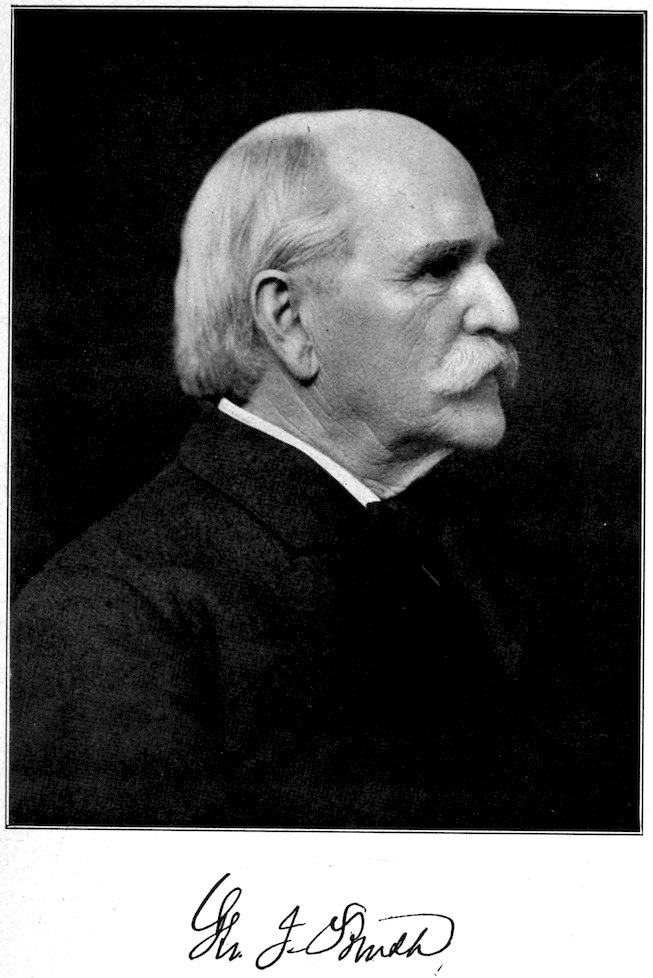
277George J. Brush entered on his scientific career at the moment when science and scientific methods of research were just beginning to be appreciated in this country, and he soon became one of the leading pioneers in the movement. While his half century of active service was largely occupied by administrative duties in connection with the Sheffield Scientific School, his interest in mineralogy never flagged. His papers on mineralogical subjects number about thirty, all of which were published in the Journal. These began in 1849, even before his graduation from college, and continued until his last paper (in collaboration with S. L. Penfield) appeared in 1883. Three of the early papers were written with J. Lawrence Smith as noted above. These papers first set in this country the standard for thorough and accurate scientific mineral investigation. Later in life he was active in the development of the remarkable mineral locality at Branchville, Conn., and, with the collaboration of E. S. Dana, published in the Journal (1878–90) five important articles on its minerals. This locality, with the exception of the zinc deposits at Franklin Furnace, N. J., was the most remarkable yet discovered in this country. Nearly forty different mineral species were found there, of which nine (mostly phosphates) were new to science. There has certainly been no other series of descriptive papers on a mineralogical locality of equal importance published in this country.
In addition to publishing original papers, Brush did considerable editorial work in connection with the fourth (1854) and fifth (1868) editions of the System of Mineralogy and the Appendices to them. His Manual of Determinative Mineralogy, with a series of determinative tables adapted from similar ones by von Kobell, was first published in 1874. It was revised in 1878 and later rewritten by S. L. Penfield. This book did much to make possible the rapid and accurate determination of mineral species. Throughout his life, Brush was an enthusiastic 278collector of minerals, building up the notable collection that now bears his name. Perhaps, however, his most important contribution to the development of mineralogy in America lay rather in his influence upon his many students. With his enthusiasm for accurate and painstaking investigation he was an inspiration to all who came in contact with him and his own field and science in general owes much to that influence.
Among the early mineralogists in this country, who were concerned in the chemical analyses of minerals, none accomplished more or better work than Frederick A. Genth. He was born in Germany in 1820 and lived in that country until 1848, when he came to the United States and settled in Philadelphia. He had studied in various German universities and worked under some of the most famous chemists of that time. His papers in mineralogy number more than seventy-five, in the great majority of which chemical analyses are given. He published fifty-four successive articles, the greater part of which appeared in the Journal, which were entitled Contributions to Mineralogy. In these he gave descriptions of more than two hundred different minerals, most of which were accompanied by analyses. He described more than a dozen new and well-established mineral species. He was especially interested in the rarer elements and many of his analyses were of minerals containing them. Especially interesting was his work with the tellurides, the species coloradoite, melonite and calaverite being first described by him. A long and important investigation was recorded on Corundum, “Its Alterations and Associate Minerals,” published in the Proceedings of the American Philosophical Society in 1873 (13, 361). Dr. Genth died in 1893.
The period from 1860 until 1875 was not very productive in mineralogical investigations. The first ten volumes of the Third Series of the Journal, covering the years 1871–1876, contained mineralogical articles by only some fifteen different authors. But from that time on, the amount of work done and the number of investigators grew rapidly. With this increase in activity came also a decided change in the character of the work. The period between 1871 and 1895 can be characterized as one 279in which all the various aspects of mineral investigation received more nearly equal prominence. While the chemical composition of minerals still held rightly its prominent place, the investigation of the crystallographic and optical characters and the relationships existing between all three were of much more frequent occurrence. Edward S. Dana commenced his scientific work by publishing in 1872 an article on the crystals of datolite which was probably the first American article concerned wholly with the description of the crystallography of a mineral. Samuel L. Penfield began his important investigations in 1877 and the first articles by Frank W. Clarke appeared during this period. The first edition of the Text Book of Mineralogy by Edward S. Dana with its important chapters on Crystallography and Optical Mineralogy was published in 1877 and his revision of the System of Mineralogy (sixth edition) appeared in 1892.
Unquestionably the foremost figure in American mineralogy during this period was that of Samuel L. Penfield. He embodied in an unusual degree the characters making for success in this science, for few investigators in mineralogy have shown, as he did, equal facility in all branches of descriptive mineralogy. He was a skilled chemist and possessed in a high degree that ingenuity in manipulation so necessary to a great analyst. He was also an accurate and resourceful crystallographer and optical mineralogist. His contributions to the science of mineralogy can be partially judged by the following brief summary of his work. He published over eighty mineralogical papers, practically all of which were printed in the Journal. These included the descriptions of fourteen new mineral species, the establishment of the chemical composition of more than twenty others, and the crystallization of about a dozen more. By a series of brilliant investigations he established the isomorphism between fluorine and the hydroxyl radical. He first enunciated the theory that the crystalline form of a mineral was due to the mass effect of the acid present rather than that of the bases. He contributed also a number of articles on the stereographic projection and its use in crystallographic investigations, devising a series of protractors and scales to make possible the rapid and accurate 280use of this projection in solving problems in crystallography.
Penfield was born in 1856, was graduated from the Sheffield Scientific School in 1877 and immediately became an assistant in the chemical laboratory of that institution. At this time he, together with his colleague Horace L. Wells, made the analyses of the minerals from the newly discovered Branchville locality. He spent the years 1880 and 1881 in studying chemistry in Germany, returning to Yale as an instructor in mineralogy in the fall of 1881. Except for another semester in Europe at Heidelberg he continued as instructor and professor of mineralogy in the Sheffield Scientific School until his early death in 1906.
It is difficult to choose for mention the names of other investigators in Mineralogy during this period. Toward its end a great many writers contributed to the pages of the Journal, more than fifty different names being counted for the volumes 41 to 50 of the Third Series. Many of these are still living and still active in scientific research. Mention should be made of Frank W. Clarke, who contributed many important articles concerning the chemical constitution of the silicates. His work on the mica and zeolite groups is especially noteworthy. The work of W. H. Hillebrand, particularly in regard to his analytical investigations of the minerals containing the rarer elements, was of great importance. The name of W. E. Hidden should be remembered, because, with his keen and discriminating eye and active search for new mineral localities, he was able to make many additions to the science.
In glancing over the indices to the Journal the close interrelation of mineralogy to the other sciences is strikingly shown by the fact that so many scientists whose particular fields are along other lines have published occasional mineralogical papers. Frequently a young man has commenced with mineralogical investigations and then later been drawn definitely into one of these allied subjects. Men, who have won their reputation in chemistry, physics, and all the various divisions of geology, even that of palaeontology, have all contributed articles distinctly mineralogical in character. For this 281reason the number of American writers who have published what may be called casual papers on mineralogy is very great in comparison to the number of those who continue such publications over a series of years.
That the subject of meteorites is one which has been constantly studied by American mineralogists and petrographers is shown by the long list of papers concerning it that have been published in the Journal; it should, therefore, be considered briefly here. Many of these papers are short and of a general descriptive nature but others which give more fully the chemical, mineralogical and physical details are numerous. Among the earlier writers on this subject Benjamin Silliman, Jr., and C. U. Shepard should be mentioned. The latter was the first to recognize a new mineral in the Bishopville meteorite which he called chladnite. The same substance was afterwards found in a terrestial occurrence and was more accurately described by Kenngott under the name of enstatite. J. Lawrence Smith later showed that these two substances were identical. Smith did a large amount of important chemical work on meteorites. He was the first to note the presence of ferrous chloride in meteoric iron, the mineral being afterwards named lawrencite in his honor. The iron-chronium sulphide, daubreelite, was also first described by him. Other names that should be mentioned in this connection are those of A. W. Wright who studied the gaseous constituents of meteorites, G. F. Kunz, W. E. Hidden, A. E. Foote and H. A. Ward, all of whom published numerous descriptions of these bodies. Among the more recent workers in this field the names of G. P. Merrill and O. C. Farrington deserve especial mention.
The publication of the Fourth Series of the Journal began in 1896. Although the years since then have seen a great amount of very important work accomplished, the history of the period is fresh in the minds of all and as the majority of the active workers are still living and productive it seems hardly necessary to go into great detail concerning it. Twenty years ago it seemed to some mineralogists that the science could almost be considered complete. All the commoner minerals had certainly been discovered and exhaustively studied. Little 282apparently was left that could be added to our knowledge of them. New occurrences would still be recorded, new crystal habits would be observed, and an occasional new and small crystal face might be listed, but few facts of great importance seemed undiscovered. This view was not wholly justified because new facts of interest and importance have continuously been brought forward, and the finding of new minerals does not appear to diminish in amount with the years. The work of the investigators on the United States Geological Survey along these lines is especially noteworthy.
This last of our periods, however, is chiefly signalized by a practically new development along the lines that might be characterized as experimental mineralogy. New ways have been discovered in which to study minerals. The important but hitherto baffling problems of their genesis, together with their relations to their surroundings, and to associated minerals, have been attacked by novel methods.
In this pioneer work that of the Geophysical Laboratory of the Carnegie Institution of Washington has been of the greatest importance. This laboratory was established in 1905 and, under the directorship of Arthur L. Day, a notable corps of investigators has been assembled and remarkable work already accomplished. While the field of investigation of the laboratory is broader than that of mineralogy, including much that belongs to petrography, vulcanology, etc., still the greater part of the work done can be properly classed as mineralogical in character and should be considered here. Because of its great value, however, it was felt that an authoritative, although necessarily, under existing conditions, a brief, account of it should be given. A concise summary of the objects, methods and results of the investigations of the laboratory has been kindly prepared by a member of its staff, Dr. R. B. Sosman, and is given later.
During the last few years another line of investigation has been opened by the discovery of the effect of crystalline structure upon X-rays. Through the refraction or reflection of the X-ray by means of the ordered arrangement of the particles forming the crystalline network, we are apparently going to be able to discover much concerning 283the internal structure of crystals. And, partly through these discoveries, is likely to come in turn the solution of the hitherto insolvable mystery of the constitution of matter. Without doubt the multitudinous facts of mineralogy assembled during the past century by the painstaking investigation of a large number of scientists are destined to play a large part in the solution of this problem. Further, it does not seem too bold a prophecy to suggest, that the time will come when it will be possible to assemble all these unorganized facts that we know about minerals into a harmonious whole and that we shall be then able to formulate the underlying and fundamental principles upon which they all depend. These are the great problems for the future of mineralogical investigation.
284