VIII—PLANTING A NEW CHURCH—MR. SYMES’ MINISTRY
Reading edition
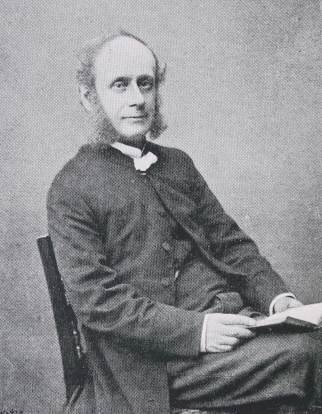
“God buries His workers, but carries on His work.” It is this faith that leads a Church, even under the shock of a bereavement as severe as this one had been, to turn with unabated determination to the prosecution of the work. The more nearly a Church of Christ attains the standard of the Master, the less it depends on any mere human instrumentality for its success. It is not the person of the preacher, but the Person of the Christ and the love of His work, that forms the sacred tie between the members. This it is that prevents the work of God from suffering, and gives permanence to His cause. It was truly with a sad heart that the Church assembled at this time to consult about a successor to Dr. Raleigh; but the claims of “the work” were paramount, and there was a plain but difficult duty before them. Our critics are not slow to remind us that the gravest defect of the Congregational system lies in the fact that, during the period when a church is without a minister, a system of competition among rival candidates is pursued, which is humiliating to the self-respect of those who preach, and calculated to provoke division and contention among those who sit in judgment. This evil is, we believe, being resolutely redressed in most of our Churches to-day, and the Kensington Church has never suffered from it at any period of its history. A trusted committee made careful inquiries with a view to discovering some minister who seemed to be adapted, alike in character and abilities, to the special wants of this neighbourhood. Opportunity was then sought of introducing him to the pulpit, and if he manifestly commended himself to the whole Church—and not a mere majority of the Church—he was invited to become the minister. This admirable plan has averted anything like the evils sometimes associated with a change of pastorate. In the instance before us the committee’s attention was directed to the eminently successful ministry of the Rev. Colmer B. Symes, B.A., of Exeter. In that corner of England Mr. Symes had most worthily maintained for several years the office of the Christian ministry, and had exercised a great power for good. All who knew him esteemed him for the loftiness of his Christian character, as well as for his ministerial gifts. As a man of culture and wide reading, he seemed to be conspicuously suited to the special needs of a locality, where the problems of modern thought occupied the minds of a large proportion of the population. Mr. Symes preached at Kensington, with no intention whatever of being a “candidate”: but as there was an immediate response to his message, a unanimous invitation was sent to him to become the pastor of the Church, and in January, 1881, Mr. Symes was recognised as the minister. The Church records contain many testimonies to the power of the ministry thus begun. The number of Church members steadily grew. The monthly Church meetings were times of continual rejoicing over accessions to the ranks of those who had solemnly taken the sacred pledge of loyalty to Christ. So high was the spirit of the Church, that, in the second year of Mr. Symes’ ministry, it was decided vigorously to pursue the movement, initiated in Dr. Raleigh’s pastorate, of building a new Congregational church at West Kensington. Nothing was more characteristic of the new minister than the cordiality with which he furthered a scheme that must inevitably diminish, at any rate for a time, his own Church and congregation. Thinking, rather, of the necessities of the rapidly growing neighbourhood of West Kensington, Mr. Symes and his Church threw themselves nobly into the enterprise. At a meeting held in the Vestry Hall, Kensington, it was announced that no less a sum than £12,084 had been promised, and the whole cost of over £15,000 was raised at the opening of the church.
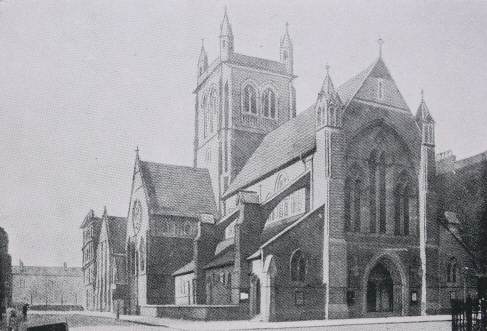
Not thirty years had passed since the opening of Allen Street Chapel, but the new church at West Kensington would seem to indicate a remarkable change in taste and idea as regards the character of ecclesiastical buildings. It is a conspicuously handsome building, with a massive central tower, a chancel, and a general elegance of structure not unworthy to rank among the very best of modern Nonconformist Church edifices. We are all of us familiar with the natural law which leads parents to be far more lavish in expenditure for their children than for themselves. We are consequently not surprised to find that the Church at Allen Street spent twice as much on a building for this child of its own training as it did on the building in which the mother Church still worships. At a special Church meeting, that strikingly recalls the moving and interesting gathering when the first branch Church removed from Kensington to Notting Hill, nearly thirty members took a farewell of Allen Street, and went to the new and difficult work of building up a strong church in West Kensington; and with them went naturally a considerable number of seat-holders, supported in their action by the generous encouragement of the Allen Street minister. Thus the second colony was planted from the mother Church. She had given lavishly of her own life and treasure for the enrichment of others; and by the eternal law of the Cross she reaped her reward in the fuller and deeper life bestowed upon those who remained. There only remains to add that, after years of hard and discouraging labour, the new Church appears to be slowly and steadily rooting itself, and to be destined to become a spiritual power in the locality.
Uneventful years followed. Those who best know the character of modern Kensington are best able to appreciate the difficulty there is of gathering a strong evening congregation. With his previous successful experience at Exeter so fresh in his memory, it is no wonder that Mr. Symes felt, even more acutely than many do who are called to minister in the West of London, this grave discouragement to the preacher. Many of his expedients to meet the difficulty were for a time successful. Largely-attended evangelistic services were periodically held; but the permanent evening congregation did not grow. Still more serious a problem to one of Mr. Symes’ intensely earnest temperament was the decline in the number of those who were led to public acknowledgment of a change of life. He could not reconcile his own conception of what justifies a ministry in any place with the absence of this note of success; and hence, in a characteristically beautiful letter to the Church in March, 1887, he placed his resignation in their hands. The remarkable meeting at which the congregation presented to Mr. Symes a large portrait in oils of himself, and an illuminated address, was the occasion of a demonstration of the affection and regard in which he was universally held. There have been resignations of ministers who have been determined in their action by a variety of considerations that have led them to give the preference to one sphere of labour over another. But surely the highest of all considerations is contained in so deep a sense of the spiritual mission of the minister, and in so lofty an ideal of his work, that even a qualified response to the public and private ministrations suggests that a continuance of the ministry may cause the interests of the Kingdom to suffer. The Kensington Church had had many lessons before this time, from those who had made great and cheerful sacrifices for its interests; but such a lesson was never taught it with more of real Christian dignity and chivalry than when Mr. Symes laid down the office of minister; thus ending a six years’ pastorate for which very many of the congregation to-day continue to thank God.