III—A BRIEF MINISTRY—REV. JOHN CLAYTON
Reading edition
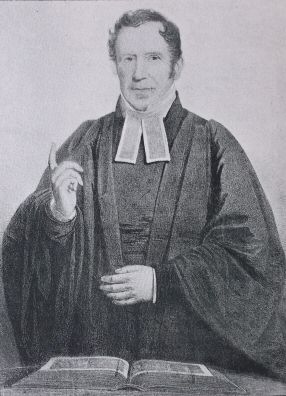
It was in the month of May, 1801, that the members of the congregation united in a very earnest call to Mr. John Clayton to become their minister. As no fewer than a hundred names appear as signatories, we may infer that considerable progress had been made under Mr. Lake’s ministry. Mr. Clayton was still formally unordained, though he had been assistant minister to the Rev. John Winter at Newbury for one year since leaving college. He was barely twenty-one years of age when he came to Kensington to take up the work of the pastorate. The portrait of him that adorns the Deacons’ Vestry, and which is here reproduced, was clearly taken in the maturity of middle-life. He maintained admirably the traditions of the Clayton family. His father, the Rev. John Clayton, was a well-known divine, of the most approved style of pulpit manners. We read with a kind of awe of his “thickly-powdered head” and his general magnificence of demeanour. Both his sons, George and John, inherited their father’s ideal. We have heard it said that the Kensington congregation has never assembled punctually on Sunday morning since John Clayton’s day. It was part of the service to watch the procession of their minister from the vestry to the pulpit. Young as he was, he bore himself so bravely, in full canonicals, with gloved hands and dignified movements, that it is no wonder the congregation conceived a great admiration for his person. No one can look at his portrait without perceiving that he was a man of commanding presence; and we surely cannot wonder if he knew it, and utilised it to the best advantage. And it is only just to him to add, that the effect of his preaching was by no means due solely, or mainly, to his striking appearance. He was a man of great mental abilities, and had had considerable culture. He was thus admirably adapted in many ways to the sphere he was called to occupy. With a liking for the best society, and a distinguished appearance, his courtly habits of speech and carriage gained him a deference that was not commonly paid to Dissenting preachers. If the assiduous cultivation of these personal characteristics had tended to make him less alive to the spiritual necessities of his people, we should have been justified in depreciating them. But it had not that effect. One has only to read the energetic charge, which his father delivered to him at the ordination service at Kensington, to see that the fastidiousness of outward manner and apparel of the elder Clayton were not incompatible with a directness, incisiveness, and even vehemence of speech, that the warmest partisan might covet. It seems probable that John Clayton took his father’s advice not to be an “unfaithful, accommodating pastor” in its most literal sense. He had been told in the ordination charge not only “to feed the flock, but to drive away the grievous wolves”; an exhortation which permitted of a mischievous application. The writer of this sketch dare not indulge in comments on the impatience of youth, and there is very little evidence of any kind in the Church records. But what there is is all in John Clayton’s favour. The Church was by no means clear of the commercial spirit. The only view of its functions still held by many was that it was a society for managing certain business in connection with the expenses of public worship. That such questions must inevitably arise, and that they should be discussed and answered from a Christian standpoint, is beyond dispute. But it says much for John Clayton that the constant intrusion of the merely financial element, and the failure of those in authority to realise the spiritual mission of the Church, caused him such concern, that he felt compelled to resign his ministry. Possibly he was unprepared for the necessarily slow and difficult work of permeating a society of characteristically business men with the deepest religious spirit. The membership of the Church stood still. Mr. Clayton said that he found his sentiments on many subjects, but especially that of the Lord’s Supper, opposed to those of many of the members. He was not himself a man who would be easily carried away with a rush of enthusiasm, and hence he did not carry away others. God was, even then, preparing just such a man to break down the unspirituality of the congregation, and to build up a higher form of Christian society in Kensington; and this man was still at college when John Clayton’s resignation was accepted in December, 1804.