TWO WONDERFUL WASPS (JUNE)
Reading edition
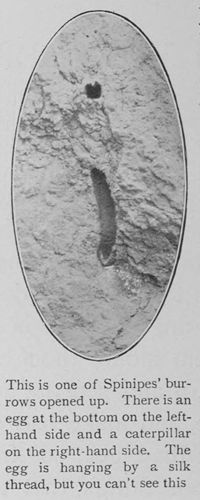
This is one of Spinipes' burrows opened up. There is an egg at the bottom on the left-hand side and a caterpillar on the right-hand side. The egg is hanging by a silk thread, but you can't see this
I expect you all must know the Common Yellow Wasps—the kind that come buzzing into the jam at tea-time; and I want to tell you this about them—that I don't think they ever really get angry if there is jam about and you leave them alone, though, when small people jump up and scream, and edge away from the table, and make bad shots at them with spoons, they get so frightened and bewildered, poor things, that they may sting somebody, because they feel they really must do something exciting.
Perhaps some of you do not know that there are seven different kinds of these Yellow Wasps to be met with in this country of ours, and I should be surprised to hear that any of you know much about the two Black Wasps whose story I am going to tell you. I say "black," because they look black, though both of them have yellow girdles on their bodies. I wish they had English names; for I am sure they both deserve them; and English names are much easier to remember than Latin ones. However, Latin names are the only ones I know for them, so we must make the best of it, and call one of them Spinipes (you must read this as if it were Spiny Peas) and the other Crabro.
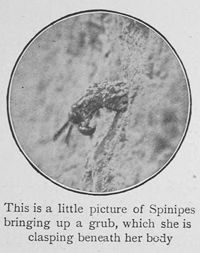
This is a little picture of Spinipes bringing up a grub, which she is clasping beneath her body
We will take Spinipes first.
If you look at the picture on the opposite page, you will see what she is like, and, if you look at the picture in Spinipes the Sand-Wasp (p. 151) you will see one of the clever things she does.
She is building a little tube out of sand which is so delicate that the slightest touch from one of our own clumsy fingers will knock it down like a card-house, but it is strong enough for her to crawl inside; and she has to crawl inside very often, as you will see. I expect you will all want to know how she builds it, and what it is for. I will tell you how she builds it to begin with. You must know first that she has a pair of jaws which work quite differently from ours. Instead of moving up and down, they move across each other from side to side just like a pair of scissors.
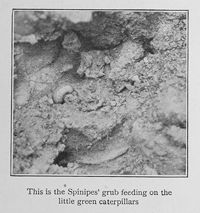
This is the Spinipes' grub feeding on the little green caterpillars
The first thing that Spinipes does is to work this little pair of scissors in the sand so as to make a little hole. I am showing you on page 148 a picture of her when she is just starting to dig. Every little pellet of sand she digs out she puts carefully round the outside of the hole, and presently she glues them all together. She carries the glue somewhere inside her, and brings it out when she wants it, Then she digs a little deeper and glues another layer of sand pellets on the top of the first one, and in a very short time she has dug a hole about two inches deep, and built a little tube round the top of it, which is made of the little sand-pellets she has brought out of the hole. Sometimes the tube stands straight up, but more often it bends about half-way and curves downwards. When she has finished it off, and is sure that the hole is deep enough, and the tube is long enough, she goes right down to the bottom and lays an egg, and she hangs the egg by a tiny thread (which she also makes herself, but I don't know how she does it) to the side of the hole a little above the bottom. You will be able to see this in the picture, but you must remember that in this and in some of the other pictures the sand has been cut away so that you can see exactly how the hole goes. Then, if it is a bright, sunny day, as it usually is when she begins digging, she flies away, and in about half an hour's time comes back carrying something clasped tight against her body. What do you think that is? It is a small green caterpillar. She stops a moment at the entrance of the tube, pushes the caterpillar down in front of her, and disappears after it. In a few seconds she is out again and off, and in another quarter of an hour or so she is back again with another caterpillar and so on, without ever tiring, through six or seven hours of a hot June or July day.
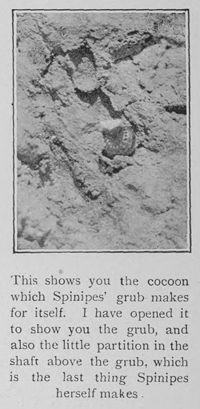
This shows you the cocoon which Spinipes' grub makes for itself. I have opened it to show you the grub, and also the little partition in the shaft above the grub, which is the last thing Spinipes herself makes
I expect you will have guessed what the caterpillars are for. They are food for the wasp grub when it hatches out of the egg. Generally each hole has between twenty and thirty little caterpillars in it, and sometimes, when caterpillars are scarce, the Mother Wasp has to work hard for three or four days. If you dig into a hole yourself and look at the store of little caterpillars, you will see there is something the matter with them. They seem to be alive and yet they don't seem to be able to crawl. Wise men say that the wasp stings them just enough to make them drowsy so that they can't crawl out of the hole, and can't hurt the wasp grub by jostling up against it. It wouldn't do to kill them, because then they would go bad in the hole before the grub had time to eat them. This sounds rather cruel, but I don't think it is really, because it is quite certain that the caterpillars cannot feel as we should perhaps feel, and we may be quite sure that in the wonderful Nature World everything is arranged for the best, so that only the right number of wasp-grubs may be properly fed and grow up to do what it is their duty to do, and only the right number of small green caterpillars may grow up also.
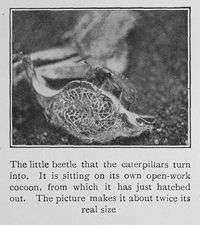
The little beetle that the caterpillars turn into. It is sitting on its own open-work cocoon, from which it has just hatched out. The picture makes it about twice its real size
You will wonder, I expect, why the Mother Wasp troubles to make the little tube above the hole. I think I can tell you one reason and you must remember this, because it was just by chance that I found it out. One hot morning in June I watched Mother Spinipes bringing seven caterpillars to her hole. Then a heavy thunderstorm came on, and the rain came down in buckets, and I had to run away for shelter. Late in the evening when it had cleared up a little, I thought I would like to see what had happened to the tube I had been watching, and I went back to the place and found that the rain had knocked it all to pieces. But I saw something much more interesting than this. The tube had been on the face of a sand-cliff, and in a crack close by there was an ants' nest. I found that the ants were running down the wasp's hole and bringing out the caterpillars as fast as they could (I saw them take six away), and taking them along the face of the cliff into their own stronghold. Now the tube that stands out from the sand somehow frightens the ants (I never saw an ant climb out along the tube and down inside it), and so I think that one of the reasons for the tube must be that it keeps away ants and creatures of that kind who crawl about on the face of the sand cliff and like eating caterpillars.
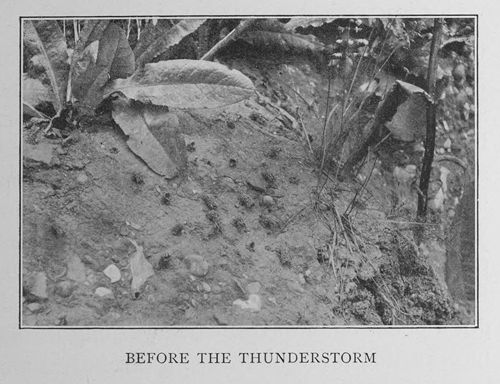
BEFORE THE THUNDERSTORM
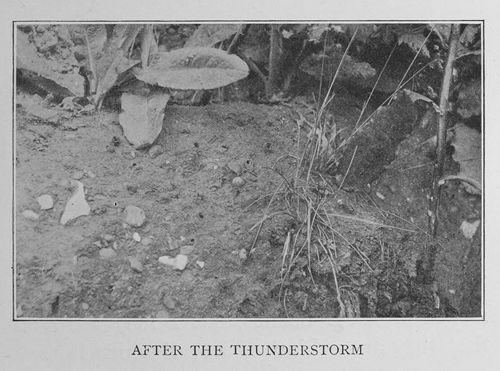
AFTER THE THUNDERSTORM
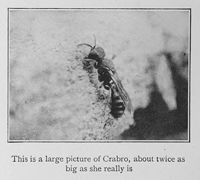
This is a large picture of Crabro, about twice as big as she really is
It was a long time before I found out what kind of creature the caterpillars stored by Spinipes would have turned into if they had not been caught. I thought that it would have been a small moth, but I was quite wrong. At different times I took several caterpillars away from the tubes, and tried to bring them up, but it was of no use, for they all died because they could not eat. One day, however, I happened to be sweeping with a butterfly-net in a field of lucerne—it is great fun sweeping, and you should try it, for you never know what you may get next—and I swept up what I knew at once was the self-same little green caterpillar that Spinipes stocked her larder with. She always brought the same kind. Well, I got a good many of them by sweeping in the lucerne, and brought them up carefully, and, in due time, they spun little open-work cocoons on the lucerne leaves which I fed them with, and at last turned into small, brown, long-nosed beetles. I need not trouble you with the Latin names of these beetles, but I may tell you that they are a kind of weevil which is very common and very destructive to clover and plants of that kind. So, if we consider that every Mother Spinipes lays eight or nine eggs, and stocks eight or nine burrows each with about thirty destructive little caterpillars, we must allow that she is a very useful little wasp.
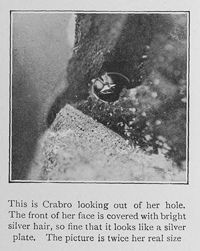
This is Crabro looking out of her hole. The front of her face is covered with bright silver hair, so fine that it looks like a silver plate. The picture is twice her real size
But I am not sure that she is more useful to man than the other little wasp I have to tell of, the Crabro. I found out her usefulness quite by chance, and I expect you will like to hear how. To begin with, I must tell you that all the "Digger" Wasps, as some people call them, Spinipes and the Crabros and several other kinds, store their burrows with insect food for their grubs to feed on.
But each one has her own particular idea as to what is the best food. One will use nothing but little spiders, another nothing but little flies, another, like Spinipes, nothing but little beetle grubs. And the queer part is that they seldom seem to make any mistake as to the kind of food they want. It will be one kind of spider, and one kind of fly, and one kind of beetle-grub. If there are ever more than one kind, they are always very near relations, and, I suppose, taste very much alike.
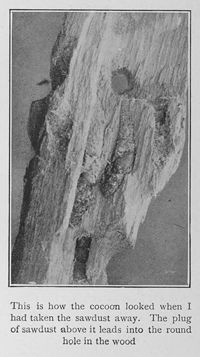
This is how the cocoon looked when I had taken the sawdust away. The plug of sawdust above it leads into the round hole in the wood
Now Crabro's store consists of really large flies, blue-bottles, and green-bottles—I expect most of you know the beautiful shiny green-bottle fly whose proper name is Caesar—and how little Crabro manages to overcome and carry off large bottle-flies who are several times her own size and several times her own weight, I cannot tell. But I have found out for certain that she does so, and the pictures will show you how I found out.
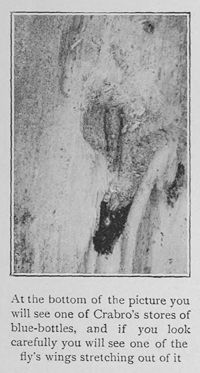
At the bottom of the picture you will see one of Crabro's stores of blue-bottles, and if you look carefully you will see one of the fly's wings stretching out of it
Last autumn a dangerous bough had to be taken down from the top of a high elm-tree in my garden. It was perhaps sixty feet above the ground and it came down with a crash and broke up into little pieces. I picked up one of these tubes and galleries, which I knew were insects' work. But there was something much more exciting than this. A number of the galleries had blind ends to them, and at the bottom of these were masses of dead blue-bottles, tightly packed, which rested on small pillows of sawdust, and had long plugs of sawdust above them.
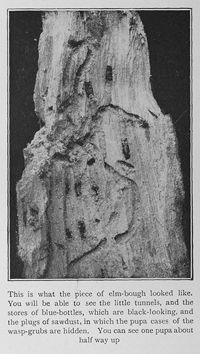
This is what the piece of elm-bough looked like. You will be able to see the little tunnels, and the stores of blue-bottles, which are black-looking, and the plugs of sawdust, in which the pupa cases of the wasp-grubs are hidden. You can see one pupa about half way up
I opened one of the long sawdust plugs and found, as I half expected to find, that at the end of it next to the blue-bottles, was a small brown papery cocoon, and that inside the cocoon was a wasp grub. I need hardly tell you that I collected a lot of the wood, and kept it carefully through the winter, and tried to make the little grubs as much at home as if they had stayed up in their tree. To do this I had to keep the wood in moist and rather dark surroundings. Then when the spring came round I sometimes put the wood in the sunshine, when it was not too hot, and in the first week in June I was rewarded for my trouble, for the little wasps hatched out in dozens, and so I was able to find out what they were.
Look up to the top of the trees some warm summer day, and think of the blue-bottle hunt which may be going on above us, and of the wonderful little hunter, Crabro.
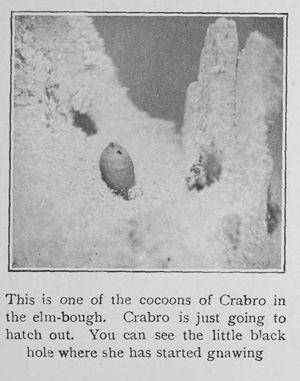
This is one of the cocoons of Crabro in the elm-bough. Crabro is just going to hatch out. You can see the little black hole where she has started gnawing