SHEEP IN WOLVES' CLOTHING AND WOLVES IN SHEEP'S CLOTHING (SEPTEMBER)
Reading edition
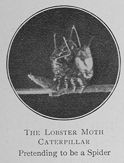
The Lobster Moth Caterpillar Pretending to be a Spider
The wolves and sheep I am going to talk about are all of them insects, or rather all of them but one, for scientific people do not allow us to call spiders insects. Insects have six legs and six legs only, while spiders and mites and those sort of people have eight, and there are a great many other differences between spiders and true insects which would make it quite a dreadful blunder to put them in the same case in the Museum, or to speak of them in the same breath when you know you are talking to clever people.
The Spider, as you might guess, is one of the Wolves, and so is the Dragon in the Water-weed, who turns into one of our largest dragon flies, if he is lucky; while the caterpillars and the Giant Wood Wasp are just silly harmless sheep.
Have you ever thought of the wonderful struggles which are always going on in the insect world—the struggles to eat, and the struggles not to be eaten? Nearly all insects seem to be the food for something or other. Most animals enjoy them thoroughly, so do many birds, and many reptiles and amphibians (frogs and toads) and many fish. I think that spiders live on them entirely, and they have also cannibals to fear among their own kind, for though most insects feed on plant-juice, quite a large number of them turn to stronger meat, and spend their lives in hunting their poor relations. It sounds rather horrible, doesn't it? But we may be quite sure that everything of the kind has been mercifully arranged so that this beautiful world of ours, with all its joy and colour, and its millions and millions of happy children—I do not think that any lives but those of human beings are ever really unhappy—may keep its beauty always. That is why the ichneumon flies have to kill down the caterpillars, for, if there were too many caterpillars, there would be no hedgerows, let alone vegetables for dinner; and the Rove Beetles, who have curly cock-up tails, have to kill down the little boring beetles, for, if there were too many little boring beetles there would be no trees; and the Crabros have to kill down the blue-bottles, for if there were too many blue-bottles—well, goodness knows what would happen to some excitable people.
We must believe then that things are best as they are—that a struggle for life is part of a Great Plan, Greater than our human minds can grasp, and that the lives of the hunters are as useful in their way as the lives of the hunted.
Now how would we ourselves act, if our lives depended on catching things? And how would we act if our lives depended on not being caught? I don't think we could add much to what the insects and spiders have taught us. To hunt successfully you must get so near to your quarry that you can kill it. If you are quicker-footed, well and good. If you are slower-footed you may employ something quicker-footed than yourself—this is what happens in fox-hunting; or you may approach without being seen—this is what happens in deer-stalking: or you may hide yourself and wait for your quarry to approach you—this is what happens in tiger-shooting; or, lastly, you may employ traps and snares, which is how most fishing is done. I don't think that any creatures but ourselves employ lower creatures to hunt for them, but the other ways are used by all sorts of animals, and the last two are used more skilfully by insects and spiders than by anything else.
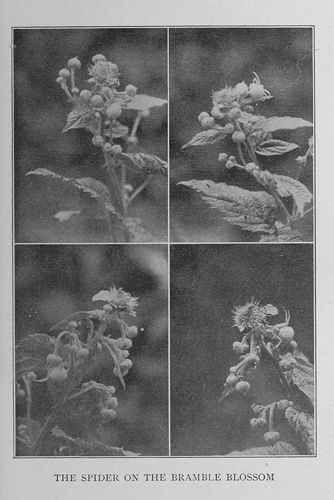
THE SPIDER ON THE BRAMBLE BLOSSOM
Look at the pictures of the spider on the bramble-blossom. This particular spider belongs to a family called Thomisus (I don't know why) and he varies in colour from a bright sulphur yellow to a delicate green, which is an exact match to the green of an unopened bramble-bud. In three of the pictures (a fly has settled close to the spider in two of them) you will be able to make out the spider pretty soon, I expect, for he has stretched his legs out. He keeps quite still in this position, and I think he fancies that he is a bramble-bud. But in the other picture I am pretty sure that, if he did not happen to be a rather fat spider, you would find it very difficult to distinguish him, and you may be certain that a fly would find it just as difficult. He is a wolf in sheep's clothing, and the sheep are bramble-buds.
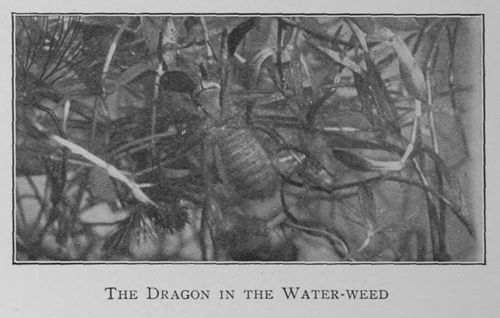
The Dragon in the Water-weed
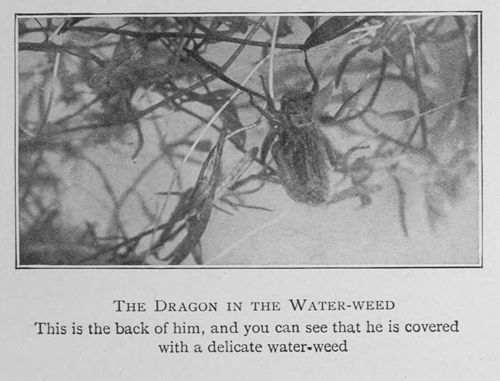
The Dragon in the Water-weed This is the back of him, and you can see that he is covered with a delicate water-weed
And now for the Dragon in the Water-weed. You will not be able to make him out at all at first, but if you look long enough you will see his body which is too thick to be a piece of weed, and if you then let your eyes travel upwards, you will see his "mask," which is like a pair of folding-doors. These open and let his jaws out when he wants to use them. And his disguise is even more slim than that of the spider, for not only does he mimic the Water-weed round him—his straggly legs, which you should be able to make out also, help him in this—but he actually becomes part of his surroundings, for all over him grows a delicate water-weed, and when he is at the bottom of the pond, where he spends most of his time, he is part of the bottom of the pond, and the creatures which he would eat walk past him carelessly. He is a wolf in sheep's clothing, and the sheep are water-weeds.
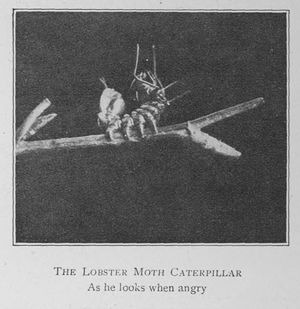
The Lobster Moth Caterpillar As he looks when angry
And now for the sheep who are just as clever really as the wolves. Two of these are caterpillars—quite the most curious pair of caterpillars to be met with in this country—and the third is a sawfly. Sawflies get their name from having an instrument with which they can bore or saw, as the case may be, into leaves or trees, and this is the largest one we have in England.
The hunter-insects, as we have seen, disguise themselves so as to get near their victims unawares, and the hunted disguise themselves very often in the same way so as to avoid being seen, but sometimes in such a way that if they are seen they may appear to be much more terrible creatures than they really are. And so we have the sheep in wolves' clothing.
The hunters of the caterpillars are the ichneumon flies. Ichneumon flies do not eat caterpillars but lay their eggs inside them. They have a special instrument for the purpose, and when the grubs hatch out they gradually eat away the fleshy parts of the caterpillar so that it seldom has strength enough to turn into a chrysalis, let alone a butterfly, or moth, or beetle, as the case may be. Now what is the chief enemy of a fly? Why, of course, a spider. If then something which dreads an ichneumon fly can make itself look like that fly's worst enemy, a spider, it will have a good chance of scoring off the fly.
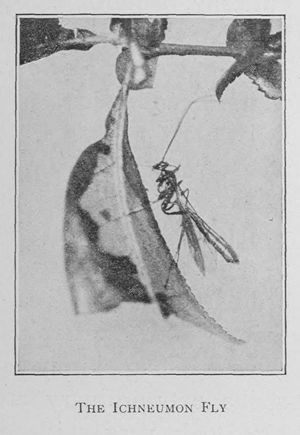
The Ichneumon Fly
The Caterpillar of the Lobster Moth, of which I show you two pictures, can do this to a nicety. He has, as you see, an extraordinary shape for a caterpillar, I don't think that any other caterpillar in this country has the same long skinny legs—and he is able to strike extraordinary attitudes which make him look very spidery indeed, particularly from in front, for then the two little spikes at the end of his lobster body appear over the top of his head and look like a spider's pincers. Mother Nature has been very careful of her Lobster Moth caterpillar. When he is quite a baby he looks just like a little black ant. When he is asleep he folds up his legs and looks like a shrivelled beech-leaf—he usually feeds on beech—and, when he is attacked by an ichneumon fly (you can make him think he is being attacked by tickling him with a paint-brush) he turns himself at once into a sham spider, by throwing back his head as far as it will go and shuddering his skinny legs in the air.
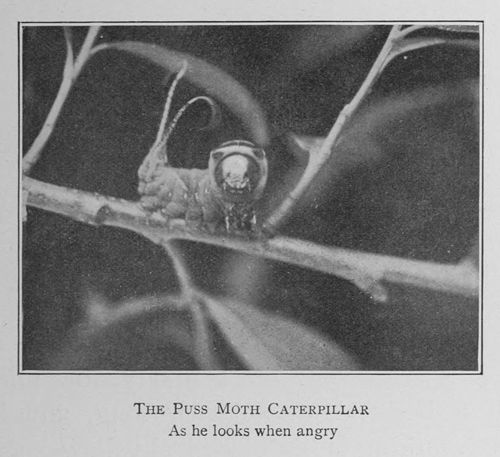
The Puss Moth Caterpillar As he looks when angry
The Puss Moth caterpillar is almost as curious. He, too, strikes fearsome attitudes. He has eye-markings to help him (you will have read about these elsewhere) and he can also squirt out an acid from underneath his chin. These two defences are probably most useful against animals and birds and lizards and creatures of that kind, but they do not seem to be much use against an ichneumon fly, and so Mother Nature has helped him further, by giving him two little pink whiplashes, which shoot out from the prongs at his tail end when he is really annoyed. When a fly comes near him he brandishes them as you see in the picture.
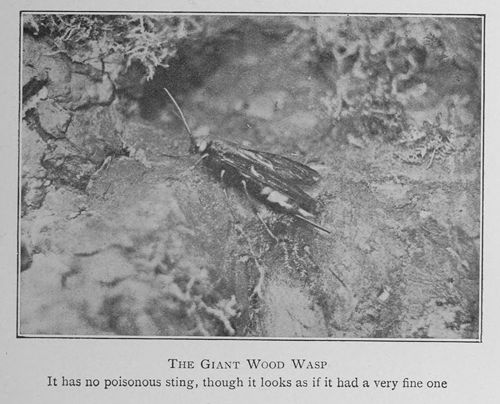
The Giant Wood Wasp It has no poisonous sting, though it looks as if it had a very fine one
Our last sheep is the Giant Wood Wasp, who is not a wasp at all, and is much more common in this country than he used to be. He is a handsome black and yellow insect with a body about an inch long, and his wolf's clothing is his black and yellow colour. This is the commonest wolf's clothing of all. You know I expect that a number of stinging insects, wasps and bees, have a black and yellow, or black and red colouring, and you know too, I dare say, that there are a great many flies who have no stings but are coloured in much the same way. Well, it is thought that these flies without stings, of which the Giant Wood Wasp is one, may sometimes avoid attack because they frighten their enemies by looking as if they had stings. Suppose a young sparrow ate a wasp, he would probably get stung, and it might happen that next time he saw a black and yellow fly, he would mistake it for a wasp and so not eat it. If this did happen, the fly would have owed his life to being black and yellow.