SOMETHING ABOUT BEETLES (APRIL)
Reading edition
I expect that most of you have seen some of the wonderful foreign beetles, whose wing-covers gleam and sparkle with colour as though they were studded with jewels; and some of you, perhaps, may have envied the small Black Folks down south, who have the chance of finding such beautiful things. But if you have a microscope, or even a magnifying glass, or if you know some one who will lend you either, you need not envy the small Black Folks at all, for here, in our own dear country, there are hosts and hosts of beetles as beautiful as any in the world. But there is always a something, isn't there? and the something in this case is that they are so very, very small. There is another something, and that is that nearly all of them have such very, very long names. The reason for this is that the young people were not the first to find them. If they had done so they would certainly have given them names which grownups could understand, just as the young people of long ago christened Tom-Tit and Jenny Wren, and Daddy Long-legs and Flitter Mouse. All these names have lived since they were first made, and they will live, I think, long after some much more learned names for the same things have been altogether forgotten.
Now I must tell you how to find these beautiful little beetles, and I think that you will be able to find them very soon after you have read these lines, for the spring-time will have come, and the May will have flowered, and there is nothing that the little beetles like better than May-buds. All you have to do is to find a May-tree (it doesn't matter if it is white or pink, and it needn't even be a May-tree so long as there is plenty of blossom on it) and hit one of the branches with a stick, and hold a butterfly-net, or an old umbrella, or a piece of newspaper, or even your hat (an old hat is best) underneath, and catch what falls from the branches. You will find all sorts of things, but among them there are sure to be some tiny long-snouted beetles which are called Rhynchophora. That is a dreadful name, isn't it? but I think that the English word "weevils" is just as ugly. Though they are very small indeed, you will see at once that they have very wonderful colours. Probably you will catch an emerald-green one, and a sky-blue one, and perhaps a little square-shaped scarlet one, which is not very uncommon, and there may come a red-letter day when you catch one of the most beautiful little beetles in the world, who is green and crimson and gold. I have done this twice myself.
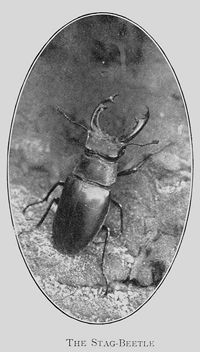
The Stag-Beetle
There are so many different beetles in our country that no one has ever collected all of them. Most are very small indeed, like the weevils, but a few are quite big, and I am showing you pictures of some of the largest.
Perhaps I ought to tell you how to know a beetle when you see one. This sounds easy enough, but it is not quite as easy as it sounds. All beetles have six legs (beetles' bodies are divided into three parts, and the legs grow out of the middle part); nearly all of them have strong, horny covers for their wings, and all of them have their skeletons outside. This sounds a very topsy-turvy arrangement, but it is quite true. We have our bones inside, and our flesh outside, but beetles have their bones outside and their flesh inside. Sometimes you may see beetles crushed flat in the road, but often they are trodden on or run over without being killed; and the reason for this is that their hard, outside skeletons prevent their soft insides from being altogether squashed up. Once I ran over a Stag-beetle on my bicycle—it was nearly dark at the time, and I was over him before I could get out of his way. Now a big Stag-beetle weighs about an eighth of an ounce, and I am rather a heavy person—indeed, with my bicycle thrown in I should think that I must weigh over two hundredweight, which is about thirty thousand times as much as the Stag-beetle. You can imagine how surprised I was to find that the Stag-beetle was not hurt. I ought to tell you, though, that the road was soft, and that my bicycle-tyres were not blown up hard, so perhaps the Stag-beetle did not get all my weight on his back—but, anyhow, it was a wonderful escape for him, wasn't it?
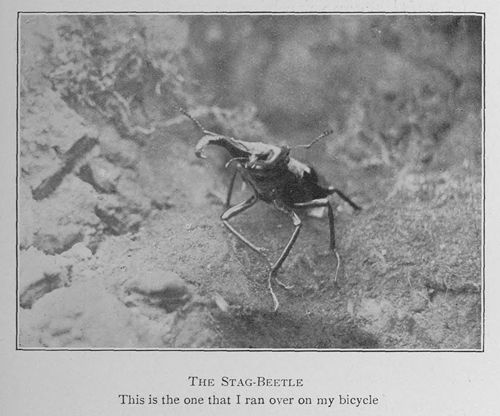
The Stag-Beetle This is the one that I ran over on my bicycle
The two largest beetles in this country are the Stag-beetle and the Great Black Water Beetle. I am not sure which should really be called the larger of the two, for it seems hardly fair to count the Stag-beetle's antlers, and if we leave these out, I fancy that the Great Black Water Beetle has the bigger body. It is curious that these two large beetles should be such quiet, easy-going things, and that they should never dream of eating beetles smaller than themselves.
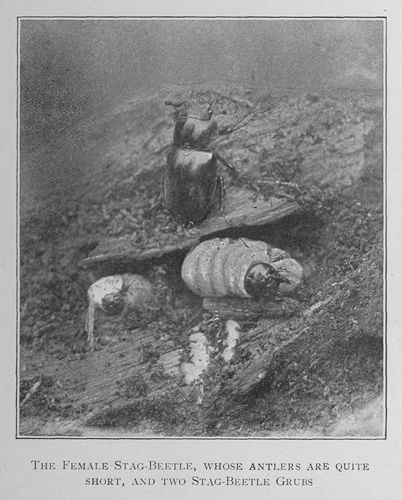
The Female Stag-Beetle, whose antlers are quite short, and two Stag-Beetle Grubs
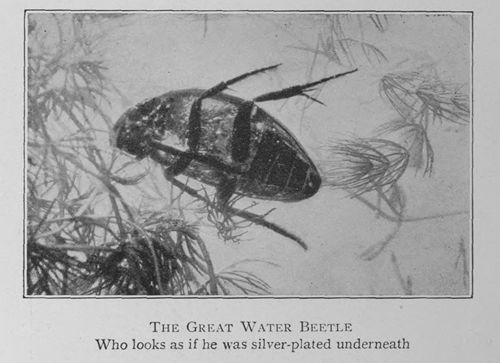
The Great Water Beetle Who looks as if he was silver-plated underneath
But so it is, for both of them, the Stag-beetle on land and the Great Water Beetle in the ditch, eat scarcely anything at all, and, when they do eat, are quite content to suck the juices out of plants. One reason for these big beetles eating so little is, I think, the very long time which they have for feeding while they are caterpillars—beetle caterpillars, by the way, are always called "grubs" or "larvæ," and beetle chrysalises are called "pupæ." The grubs of the Stag-beetle live on decaying wood (you may sometimes find them at the bottom of an old gate post which has decayed under the ground), and take three or four years to become "full-fed." The grub of the Great Water Beetle spends all his time (three or four years, too, I expect) in the water, and I think he feeds on decaying plants, but I am not sure of this. Some people say that the Stag-beetle uses his great antlers to crush twigs and leaves so as to get the juice. This may be so, but I have never seen him do it.
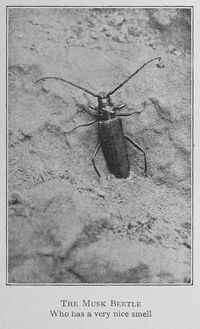
The Musk Beetle Who has a very nice smell
Another big and beautiful insect is the Musk Beetle. As you see in the picture, he has very long horns and a narrow body. He is a beautiful bronze green all over, and must be a wonderful sight when he is flying in the sunshine. I have never seen him fly myself, but people who have say that his legs and horns stream out behind him, so that he must look like a little green Heron. Perhaps the most wonderful thing about him, however, is his scent. I expect most of you know those little round pink sweets which are called "cachous." He smells just like the taste of those, and that is why he is called Musk Beetle.
Another big beetle I have to show you is the Cockchafer. You must look at his picture carefully, because it shows you how a beetle lifts up his hard wing-covers when he is going to fly. Some beetles, the Burying Beetle for one, turn these wing-covers almost upside down when they are flying, so that the hollowed side is uppermost. I expect that this helps to keep them up when they are flying, and perhaps it helps them to start as well.
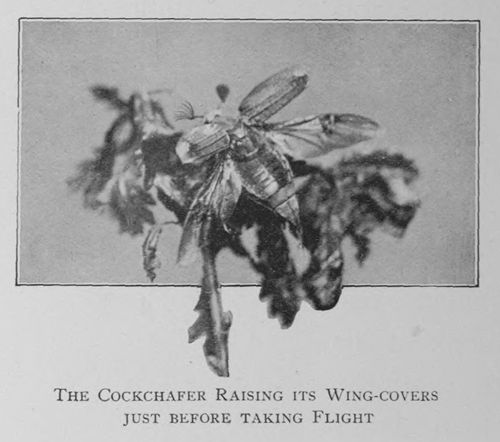
The Cockchafer Raising its Wing-covers just before taking Flight
Of course you have all heard of the wonderful flying machines which are now being made. To fly at all, you must be able to do three things: lift yourself up, keep yourself up, and move about. If you can do these three things just as quickly and just as slowly as you want to, you will be able to fly perfectly. The hardest puzzle of all is how to make a machine which will keep itself up (and the right way up too) without moving about very quickly. This is what many birds can do so beautifully, and I expect that in time (all great inventions take a long time to make perfect, and they are never the work of one man alone, but rather of one man helped by the work of many men who lived before him) machines will be made in which men will be able to fly as perfectly as birds. At present they only fly as perfectly as beetles, but that they should be able to do this is a very wonderful thing. The great difference, in flying, between a beetle and a bird like a gull, is that the beetle has to keep going full speed all the time, or else he will tumble down to the ground, while a bird like a gull can poise balanced in the air, with just a flap or turn of his wings now and then to keep himself the right way up.
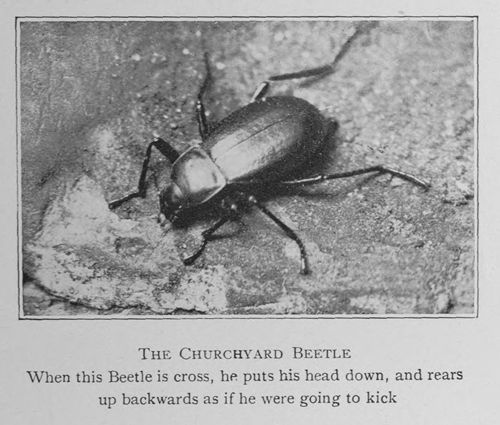
The Churchyard Beetle When this Beetle is cross, he puts his head down, and rears up backwards as if he were going to kick