THE BEASTIES' BEDTIME (OCTOBER)
Reading edition
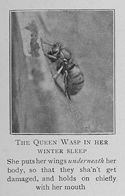
The Queen Wasp in her winter sleep She puts her wings underneath her body, so that they sha'n't get damaged, and holds on chiefly with her mouth
How would you like to sleep straightaway through the winter, and miss Guy Fawkes, and Christmas, and New Year, and Valentine's Day, and skating, and snowballing, and round games in the evening, and having stories read to you by the fire, and all those delightful things which come to cheer us when the weather is damp and gloomy, making us feel somehow that summer is a queer, impossible kind of time, just as in summer we find it hard to imagine what it feels like to be really cold? I want you to remember in this winter which is coming what a number of little creatures in the wide world around you are fast, fast asleep. I want you to think how wonderful it is that these little creatures are able to dream away the time when there is nothing for them to eat, and to wake again when there is food in plenty.
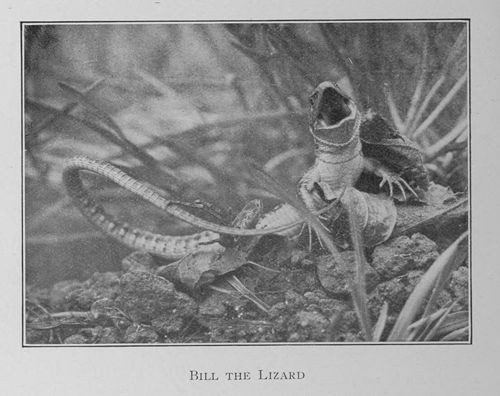
Bill the Lizard
Every year when the evenings begin to come quicker and quicker, and grow colder and colder, Mother Nature, who is the mother of our dear own mothers, puts her babies to bed at the time which she knows is best. A queer set of babies they are! Babies of such different kinds that it is a wonder she can keep them all in her head, and not have to say sometimes to herself: "Good gracious, I forgot my dormouse: and I don't believe my brown lizard was properly tucked up in the grass-tuft; and as for my prickly hedge-pig, I don't remember where I sent him last."
But Mother Nature never does forget, and never spoils her babies. She whispers "bedtime," and they go.
The little insects go first—the flies, and beetles, and earwigs, and frog-hoppers, and myriads of other tiny creatures which you can see in the grass on any warm day by just lying down and opening your eyes.
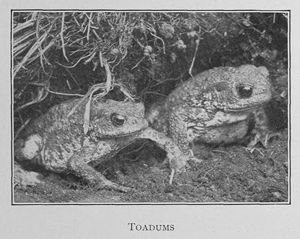
Toadums
For all Mother Nature's care I fear that most of these die, but some may manage to live through the cold, and among the larger kinds of insects some always do. You remember what I told you about the Brimstone Butterfly! The Queen Wasp is another of the lucky ones.
She creeps into some sheltered crevice, where she can find a shred of something small enough to take into her mouth. This sounds queer, doesn't it? I will tell you the reason. The Queen Wasp sleeps hanging by her jaws, and hardly trusting to her legs at all. You can see what she looks like in the picture, and you must notice that she has tucked her wings right underneath her body so that nothing can brush against them.
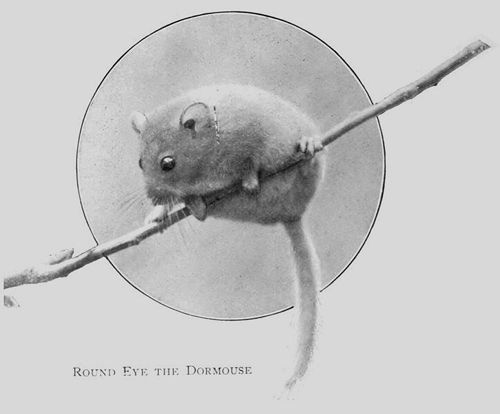
Round Eye the Dormouse
After the insects go the reptiles and the frogs. These are cold-blooded creatures, so they have no need to make a nest to keep them warm, but they don't like to be too cold, and always creep somewhere where the frost will not reach them. Bill the lizard sometimes goes deep down into a large grass-tuft, and sometimes creeps into a mouse-hole. Froggin dives into a pond and wriggles into the mud, or underneath a stone, and there sleeps under the water until the hot sunshine comes again, and he knows, by the feel of things, that it is time to be moving. Toadums prefers to sleep on land. He lies quite flat, with his hands in front of his eyes, and wakes up a little later than Froggin.
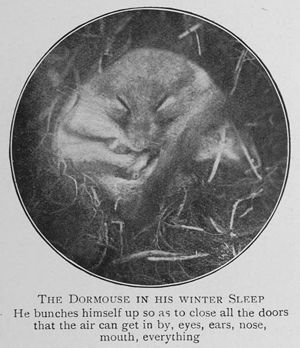
The Dormouse in his winter Sleep He bunches himself up so as to close all the doors that the air can get in by, eyes, ears, nose, mouth, everything
After these the animals. Round Eye the dormouse goes to sleep about November. He builds a nest of leaves and grass all around himself, and, if the winter is cold, sleeps straight away into April. If the winter is warm, however, he may wake up and eat a little food, and if he is a wise little mouse, as he usually is, he keeps a little store of nuts and seeds at hand in case he does wake up. Prickles the hedge-pig does much the same. He has a nest which is even warmer, for, besides the leaves and grass which make the round of it, he rolls his spines into anything soft which will stick to them and so has a nice warm blanket next to his skin. Once he has dropped off to sleep he stays asleep till the spring comes. I don't think he ever wakes up like the dormouse, or ever makes a store of food.
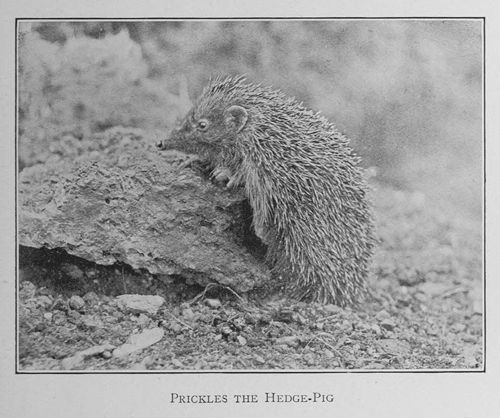
Prickles the Hedge-Pig
The only other animals which sleep the winter through in this country are the bats, and some of them sleep even longer than the dormouse and the hedge-pig; indeed, they are only awake for three or four months in the year. Sometimes there are crowds of them sleeping together in old caves, and tree trunks, and places like that, and it may be that they half wake up and talk to each other to pass away the time. Indeed, if you know their hole and can put your ear close to it, you can sometimes hear them talking and squabbling—faint little squabblings like the sound of a kettle simmering on the hob when you can just hear the tiny bubbles hitting each other and bursting with bad temper.
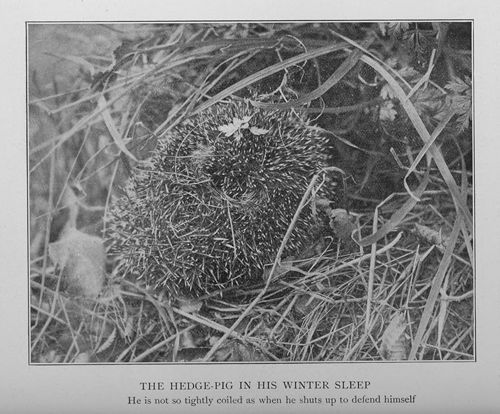
THE HEDGE-PIG IN HIS WINTER SLEEP He is not so tightly coiled as when he shuts up to defend himself
When bats are flying about and hunting for moths they often squeak for joy, and then their voice is quite different. It is so high that some people cannot hear it at all; but you can make a noise just like it by striking two pennies sharply together, and if you can hear that being done when you are several yards away from the person who is doing it, you ought to be able to hear a bat squeak too.
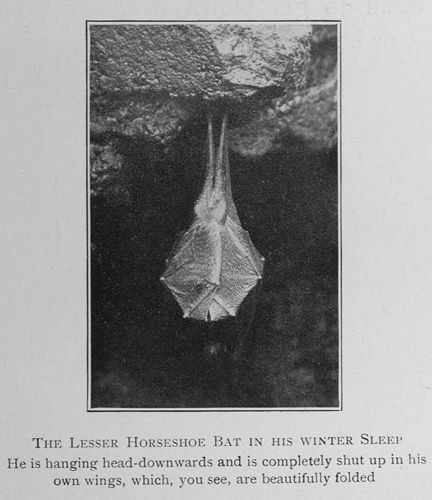
The Lesser Horseshoe Bat in his winter Sleep He is hanging head-downwards and is completely shut up in his own wings, which, you see, are beautifully folded
You have to watch bats very closely before you can tell one kind from another, and I expect some of you will be surprised to hear that there are more different kinds of bats in England than there are of any other kinds of animals. There are, at least, twelve different kinds of English bats, and, as bats now and then seem to get blown over the sea from France, or be brought in the rigging of ships, quite a strange foreign bat may turn up sometimes.