A VERY WEE BEASTIE AND A VERY BIG ONE (AUGUST)
Reading edition
I am going to talk about two animals this time—one a very big one and one a very small one. I am showing you two pictures of the small one and two of some cousins of his. He is quite the wee-est beastie in this country of ours, and nearly the wee-est beastie in all the world. He is called the Pygmy Shrewmouse, and his name, as you see it printed, is just about as long as his soft, velvet body.
I wonder how many of you know which is the largest of our British animals? If you guess quickly you are sure to guess wrong, and so I will tell you, and then there will be no need to put you right. It is the Blue Whale.
Very few of us have ever seen a Blue Whale, or, indeed, have ever had the chance; but he comes to our northern coasts almost every summer, and so, as he is met with in British seas, he is quite rightly called a British animal.
He does not often swim close inshore, for, if he does, he is likely to be caught by the tide, and left high and dry like a jelly-fish, which, indeed, has more than once happened.
The Blue Whales which come to this country are between seventy and eighty feet long (there is really no room to give you a picture of one) and weigh between a hundred and fifty and two hundred tons. The Pygmy Shrewmouse, tail and all, is less than three inches long and weighs about a tenth of an ounce. Now I know that measurements are difficult things for young folks to understand, so I will try to make you see the difference between these two animals of ours in a different way. I expect we all know what a lawn-tennis court looks like. Two Blue Whales would just fill a lawn-tennis court, but if we wanted to fill a lawn-tennis court with Pygmy Shrewmice, we should want five-hundred thousand of them, and if we could lift a Blue Whale on an enormous pair of scales, and tried to balance him with Pygmy Shrewmice, we should want—how many do you think? We should want more than seventy millions of them.
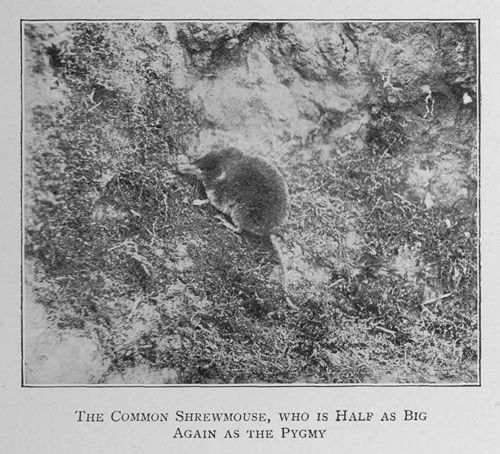
The Common Shrewmouse, who is Half as Big Again as the Pygmy
It is wonderful to think that the wee Pygmy and the huge Whale should belong to the same Class of creatures. But it is so. Nearly all the bones in the Pygmy (some are scarcely thicker than a hair) can be matched by the same sort of bones in the Blue Whale. If the Blue Whale were a fish (and he certainly looks like one) his bones would be quite different and quite differently arranged, and from this we know that the Whale is not a fish like a Shark, but an animal like a Seal, or a Pygmy Shrewmouse or one of ourselves.
Now we must look at the pictures. You will see at once what a long nose the Pygmy has got. This nose is very useful to him, for much of his food is tiny insects, and he pokes his nose into tiny holes after them.
You can't see his teeth in the pictures, which is a pity, for they are very curious teeth, and the front ones, instead of pointing up and down like ours do, point outwards rather, and come together like a pair of tweezers. This helps him to catch insects too, and to pull little snails out of their shells.
I don't think his teeth are strong enough to crack snail shells, but his dark-brown cousin, the Common Shrewmouse (his picture is on page 181), cracks snail shells quite easily, and so does his black cousin, the Water Shrewmouse.
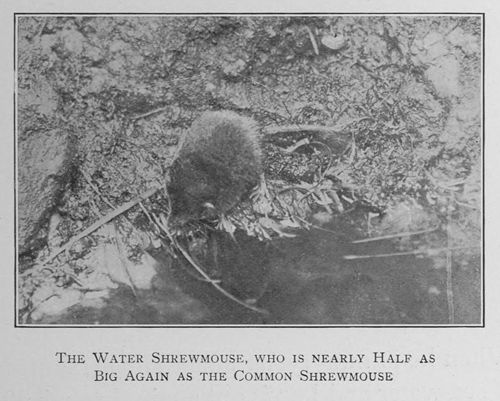
The Water Shrewmouse, who is nearly Half as Big Again as the Common Shrewmouse
What does the great Blue Whale eat, you ask? I expect you will be surprised to hear that he eats much the same kind of things as the Pygmy—small slug-like creatures, scarcely an inch long, which swarm in parts of the sea. Of course he eats barrelfuls at once.
He catches them by a wonderful arrangement in his mouth, which is made of what we call whalebone. It is something like the gratings across drain-pipes, which let the water through but stop everything else, and he can lift it up or drop it down as he pleases. When he is hungry, he takes a huge mouthful of sea-water and lets it out again through this whalebone grating. All the small slug-like things which are swimming in the water are trapped, and, when he has got most of the water out of his mouth, he swallows them.
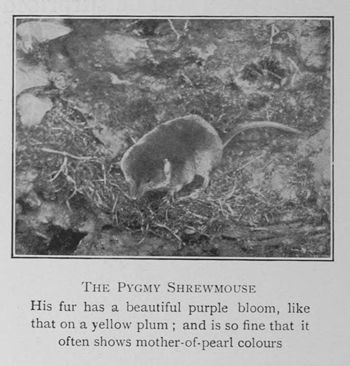
The Pygmy Shrewmouse His fur has a beautiful purple bloom, like that on a yellow plum; and is so fine that it often shows mother-of-pearl colours
I don't think that the Whale can have much trouble about getting his dinner; all he has to do is to find the right piece of sea and then open his mouth; but the Pygmy, I think, has to work very hard, as he has to catch everything separately, and he is such a delicate little creature that he is seldom about unless the weather is warm and fine.
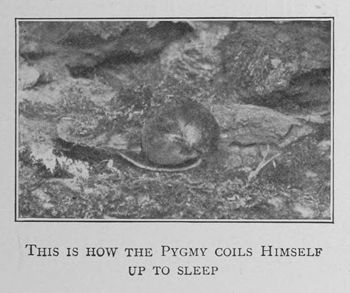
This is how the Pygmy coils Himself up to sleep
Then he has to make up for the hungry time when bad weather has kept him in his hole.
In the autumn one often finds dead shrewmice lying on the paths. Nobody quite knows why they die in the autumn, but I think it is because only a few of them, if any, are strong enough to stand cold and wet and hunger all at once. The rest die just like the leaves die.
You must not think a dead Shrewmouse is like a live one to look at, for he is quite different. When dead, the poor little beastie lies stretched out straight, but when he is alive he is all bunched up together and runs about like a little fur ball on legs.