A BUTTERFLY PAINT-BOX (MAY)
Reading edition
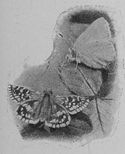
I wonder how many of my young readers know why these dainty flying creatures are called "Butterflies"?
We all know what butter is, and we know, too, that there are quite a number of English words which begin with "butter." It is not a pretty beginning, is it? But there it is. Let us think of a few—butter-fly, butter-cup, butter-wort, butter-fingers, butter-scotch—why, one can think of half a dozen straight away.
Now this shows us clearly that "butter" is a very old word, and that the people of long ago (who were much less clever than we are, perhaps) must have used it quite naturally when they wanted to describe anything which was squashy, or pasty, or greasy, or slippery, or yellow.
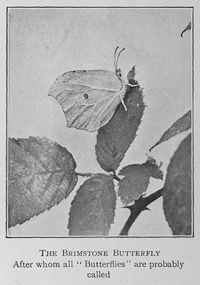
The Brimstone Butterfly After whom all "Butterflies" are probably called
Look at the picture at the top of the next page. I wish I could have given it to you in its proper colours. It looks much nicer like that. Look at it carefully. No other English butterfly has the same pretty curves to its wings, and some of you, I dare say, will know what it is by its shape. But I must tell those who do not know. It is a Brimstone Butterfly, and its colour is bright, bright yellow with an orange spot in the middle of each wing (you can only see one wing in the picture, the other three are hidden behind it; one way to tell a butterfly from a moth is to remember that butterflies' wings close standing up, but nearly all moths' wings close down flat).
It is almost certain that this insect was the first insect to be called "Butter"-fly because of its butter colour. When people began to see that there were other pretty flying things of much the same shape, though of quite different colours, they called them all Butterflies after this first one.
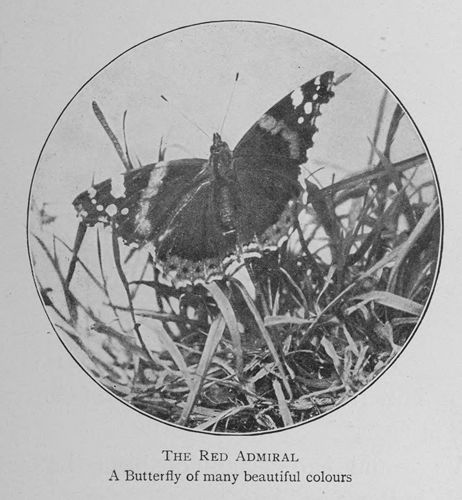
The Red Admiral A Butterfly of many beautiful colours
So we speak, nowadays, without ever thinking of how funny it really is, of blue butterflies and white butterflies and black butterflies and purple butterflies, and red and yellow and green butterflies—all the colours of the rainbow, in fact.
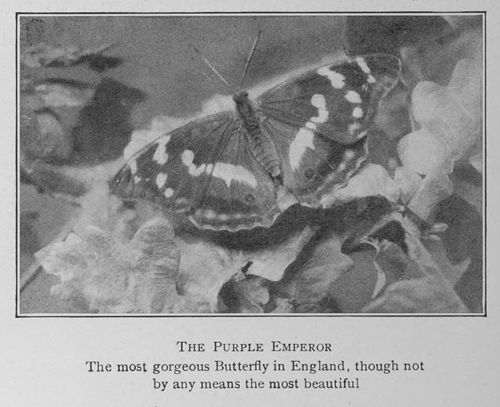
The Purple Emperor The most gorgeous Butterfly in England, though not by any means the most beautiful
We would hardly talk of black butter or purple butter, would we?
Some of you will perhaps wonder why the Brimstone Butterfly was the first to be noticed when there are so many others which are just as common.
I think I can tell you.
The Clifden Blue
The Brimstone is almost always the first butterfly to be seen in the spring. Most butterflies die towards the autumn, and leave eggs behind, which hatch out in the following year, but the Brimstone, and a few others, sleep through the cold winter months and come out in the first warm days of spring and then lay their eggs. The Brimstone comes out first of all, often quite early in February, and so he is the first butterfly that is likely to be noticed in the year.
Perhaps his coming out at a time when cows began to give more milk, and butter began to be more plentiful, had something to do with his being called "butterfly," but I think that his colour had more to do with it.
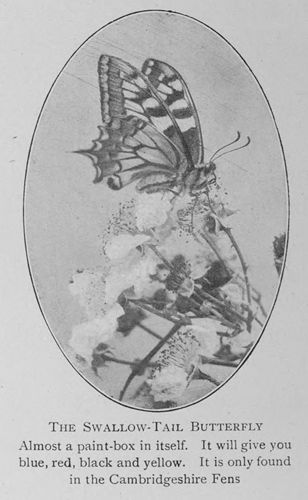
The Swallow-Tail Butterfly Almost a paint-box in itself. It will give you blue, red, black and yellow. It is only found in the Cambridgeshire Fens
What lovely colours butterflies are! Have you ever fancied a butterfly paint-box? Let us think of a few common colours, and see how we could fill it. Suppose we wanted a blue? Why we should have a whole family of butterflies "The Blues" to choose from, and we should be just as well off for blacks and browns. For red we could take the beautiful scarlet ribbon of the Red Admiral. "Why is he called Admiral?" you ask. Well, Admiral is the same as Admirable, and his old name was Red Admirable. For purple we should have the Purple Emperor and the Purple Hair-streak—there is no purple quite so glorious as the purple that these have on their wings. For orange, the Orange-tip and the Clouded Yellow. For yellow, the Brimstone and several others. For white, of course, the Whites. Green might bother us a little, but there is one English butterfly, the Green Hair-streak, whose wings are a beautiful green underneath. As he is our only green butterfly I give you his picture. He is the upper butterfly in the first picture and, as you see, quite a little one.
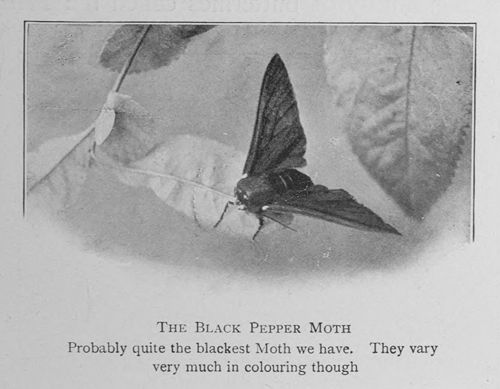
The Black Pepper Moth Probably quite the blackest Moth we have. They vary very much in colouring though
We must not forget gold and silver. When I was young, I expected to find gold and silver in a really nice paint-box, and I do not suppose young people have changed much since then. Silver we should have no trouble about. There is a big family of butterflies called the Fritillaries, who have wonderful patches and ribbons of silver on their wings. I do not think you will find gold, except perhaps a little gold powder, on any English butterfly, but you will find it on several chrysalises. Indeed, Chrysalis means "the little golden one," and the name was given to these queer spiky things because gold patches were so often seen on them.
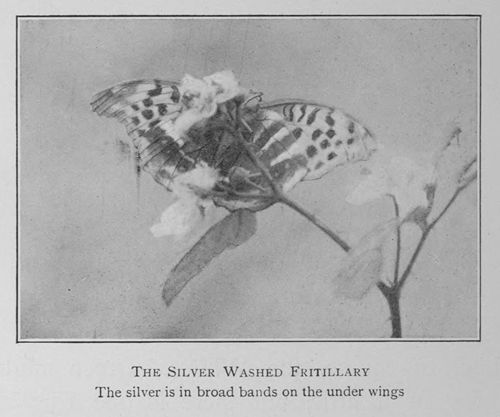
The Silver Washed Fritillary The silver is in broad bands on the under wings
I have seen little pictures made with the scales of butterflies' wings, with blue skies and green trees and everything. So you see a butterfly paint-box is not altogether a make-believe, though it is not an easy paint-box for young people to paint with.