WHERE THE AMERICAN PEOPLE AND THEIR CIVILIZATION CAME FROM
Reading edition
INTRODUCTION
First settlers from a built-up Europe
253. Why Boys and Girls Should Know about Europe. In the part of the book just studied, you have become acquainted with men and women who have been great American leaders. Did you ever stop to think that the early settlers in this country, from whom most of our great men sprang, came from countries in Europe already built up? What the settlers gave to this country they got from people who had lived a long time ago. Therefore in many ways their habits and institutions were different from ours now. They had their own ways of living, their own schools, churches, and forms of government.
The rulers
In most European countries kings and queens ruled the people. Next to the king stood the lords, who were great men and owned acres and acres of land. They had their own soldiers and many servants to do their work and to wait on them.
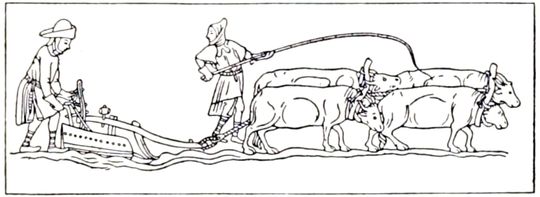
From an early 14th century psalter
SERFS OF THE MIDDLE AGES
The serfs
Below the lords, who spent their time in war, in the chase, and in going to see play-battles, called mock-fights, were the common people. In some countries these people were not free, as you are, but lived in huts in small villages on the great man's land. They had to work on his land, and were only a little better off than slaves. These people were called serfs.
In the few large cities there lived at that time rich merchants who traded in slaves, or went on long journeys to buy and sell their wares. In the cities, too, lived workers in wool, cotton, brass, iron, wood, and other materials. After a time the workers of a given class gathered into a sort of union called a guild, to protect themselves.
The roots of our civilization
But in neither country nor city did the common man have the many rights and privileges he has now-a-days in America.
These people, so different from us, got their habits and their ways of doing things from still older nations in Asia, in Africa and in Europe.
THE OLDEST NATIONS
254. Egypt, the Land of the Nile and the Pyramids. Egypt has always been a land of curious things. It lies across the Mediterranean, southeast of Europe. It is a land of sunshine day after day. Were it not for the Nile River, it would be a part of the Great Sahara Desert. Every year for ages, the Nile has risen in a great flood and its waters have spread out over Egypt. In coming down from their mountain home these waters carry rich earth which they spread over a part of Egypt. The result is that Egypt, in an early day, became the garden spot for nations less favored.
Egypt in Bible times
Many of you can recall the Bible story of Joseph's brethren who were sent down into Egypt to buy corn because there was a famine in their land. Thanks to the Nile, there was plenty of corn in Egypt. The people of Egypt were among the first of the world's farmers and gardeners of which history has any record.
Carrying the waters of the Nile to the land
255. Irrigation Systems of the Egyptians. In a great many parts of western United States where little rain falls, how do farmers and gardeners get water for their plants? "Irrigation" is the word that tells the story. The Egyptians taught the people of the world how to save water for irrigation by building great dams in the Nile. This water they carried in ditches throughout the land so that the thirsty crops would have the moisture they needed for growing.
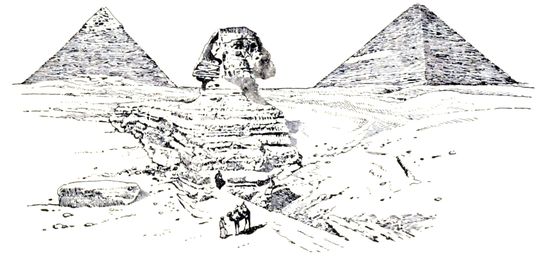
THE PYRAMIDS OF GIZEH AND THE SPHINX
The tombs of the kings
256. Egypt Ruled by Kings. For several thousand years Egypt was ruled by kings. The most famous of these rulers was a great warrior called Rameses II. He built great tombs or monuments called "pyramids." These were built out of huge blocks of stone much larger than any now used in buildings. For many years he had the common man or the slave doing this work for him.
The Bible tells us about Moses, who became a great leader among the Israelites. The Israelites were slaves to the kings of Egypt. Moses led them forth from Egypt to escape the hard tasks of one of their kings.
257. What the Egyptians Gave to Other Nations. Among the Egyptians there were great students for that early time. A few men among them studied the stars and learned about the movements of the heavenly bodies. In arithmetic they could count up to millions. They could weave cloth, cut jewels, and make most beautiful objects out of glass.
Egyptian hieroglyphics
But above all the Egyptians could write. Not as we do, of course, but they used letters, not rude pictures as seen in most early writings. Scholars have named the characters used in writing by Egyptians and other ancient peoples "hieroglyphics."
258. Babylon and Nineveh. Asia, too, had early peoples. Perhaps some of them were older than the Egyptians. There lived in southwestern Asia, in the valleys of the Tigris and Euphrates rivers, two mighty nations whose chief cities were Babylon and Nineveh.
The hanging gardens of Babylon
Babylon on the Euphrates was a splendid city. It had great walls to protect it against enemy nations. Its hanging gardens were the wonders of the ancient world.
To the north, on the banks of the Tigris, lay the great city of Nineveh. The fierce kings of Nineveh conquered many nations and forced them to pay tribute.
In this region, nature furnished the kings no building stone such as was found in Egypt. But they made their homes and their palaces out of sun-dried brick. This soft material, as the years rolled on, fell into decay, and now men can find the ruins of these wonderful cities only by digging where they lay.
How the Babylonians wrote
The Babylonians did their writing upon bricks or clay tablets before they dried them. They had their own way of writing, using a sharp piece of metal for making wedged-shaped lines instead of letters. They used a sort of picture-writing too, making rude cuts of birds, animals, and man. On these clay tablets, buried centuries ago, we may read the stories of what they did and how they lived.
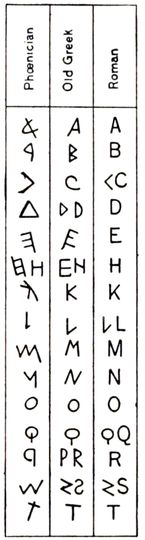
TYPES OF EARLY ALPHABETS
259. How Jews and Phoenicians Helped Mankind. Along the eastern end of the Mediterranean lies Palestine, which was conquered by the Jews early in their history, and became their home. The Jews as a people interest us because they have given us our religious ideas. They have never been a warlike nation, but at times they could fight. David was one of their great kings, and Solomon another.
During long years this people has held faithful and true to the idea of one God. Although the Jews were driven from Palestine and scattered among the nations of the world they have never given up their religion. They have always looked forward to the time when they might return to Jerusalem and set up a Jewish nation once more. As a result of the World War that time seems to have come.
Phoenicians helped to advance learning
The Phoenicians were akin to the Jews. They lived near the Jews on the Mediterranean and were a sea-going people, the traders of that early time. In their ships, driven by oar and sail, they braved the dangers of the Atlantic and reached Spain and England. To these people must be given the credit of carrying to the Greeks and Romans much of the learning of Egypt and Asia. To the Phoenicians also belongs the honor and fame of inventing an alphabet much like the one we have to-day, although with fewer letters.
SUGGESTIONS INTENDED TO HELP THE PUPIL
The Leading Facts. 1. The first settlers in America came from old and well-established countries in Europe. 2. Their ways of living were very different from ours. 3. The classes of people were very different from those we have. 4. Egypt the oldest nation. 5. What the Nile does for Egypt. 6. What Egypt taught the world. 7. Babylon and Nineveh, the early cities of Asia. 8. How they differed from Egypt. 9. How Egypt, Babylon, and Nineveh recorded their deeds. 10. What the Jews were noted for. 11. Who were great among them? 12. How the World War has changed the hope of some Jews. 13. The Phoenicians were celebrated for carrying trade and learning. 14. They also invented the alphabet.
Study Questions. 1. Name the different classes of people in Europe. 2. What would have happened if a great lord had carried his people to America in an early day? 3. Make a list of useful things that the Egyptians knew. 4. How do you imagine we know about the ancient cities of Babylon and Nineveh? 5. Why did they use brick? 6. Why is it better to use letters than pictures in writing?
Suggested Readings. Dopp, The Tree Dwellers; The Early Cave-men; The Later Cave-men; The Early Sea People; Stories of Ancient Peoples; Ragozin, A History of the World, Vol. I. Earliest Peoples; Retold from St. Nicholas, Stories of the Ancient World, 3-52, 69-77, 92-124; Mace-Tanner, Old Europe and Young America, 14-24.
GREECE, THE LAND OF ART AND FREEDOM
260. Greece, a Beautiful Land. Among the countries of the ancient world Greece was the one bright spot where men had the right to think and act for themselves.
The geography of Greece
Greece is a small peninsula in southeastern Europe cut up by many deep gulfs and bays and crossed by rugged mountains. The colors of its landscape have been thus described: "Against a deep blue sky, its bold hills and mountains, often powdered with snow, stand out in clear outline, and its fertile valleys please the eye with their green vineyards and groves of silver-gray olive trees."
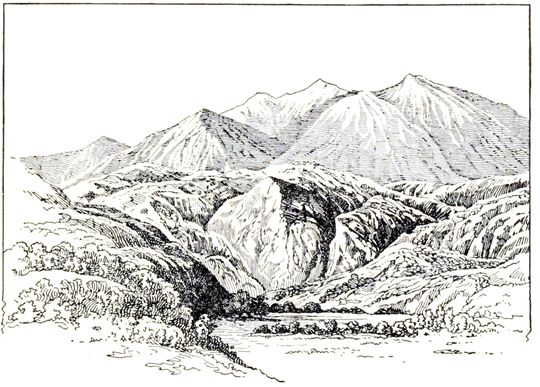
MOUNT OLYMPUS, IN GREEK MYTH THE HOME OF THE GODS
Greece is kissed by gentle winds of the Mediterranean Sea and has the warm, balmy climate that all the shores of this inland ocean have.
Greek colonies
261. The Greeks of the Olden Times. The Greeks were bold people and many of them went on long voyages in their small vessels. These voyages were not for plunder, but for trade and for planting colonies. Under the lead of some brave Greek they made their way to France, to Italy, to Africa, to Asia Minor, and to the shores of the Black Sea. Some of these colonies became rich and prospered greatly. There were so many Greeks living in southern Italy that it was called "Greater Greece." In the island of Sicily stood the largest and most splendidly built city in Greater Greece, called Syracuse.
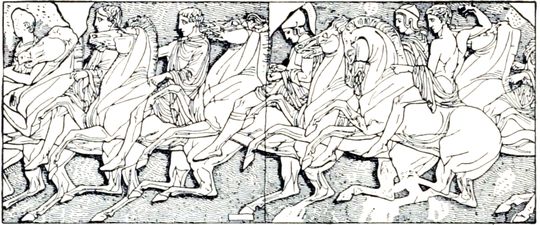
PART OF THE FRIEZE OF THE PARTHENON, THE GREAT ATHENIAN TEMPLE
An old Greek myth
262. The Brave Deeds of Ancient Greek Heroes. The story of the Greek heroes was the invention of her early poets. The most famous of these heroes was Hercules, the most powerful man that ever lived, according to story. He performed twelve mighty labors, among them killing with his hands a big lion, and a terrible water serpent or snake which bore many heads.
The blind singer of Greece
263. The Favorite Story of the Greeks. The favorite tale of the old Greeks was the story of the capture of Troy. It was written by one of their poets, the blind Homer. He told how Paris, son of the king of Troy, stole Helen, the wife of the king of a Greek city called Sparta. Helen was said to be the most beautiful woman in the ancient world.
The king of Sparta called upon all Greeks for help. From every city of Greece came bold warriors. The Trojans were great fighters, too. For nine years war was waged under the walls of Troy. The Greek leaders quarreled among themselves and the Trojans drove them to their ships. This united the Greeks, and their great leader Achilles, clad in new armor made for him by the god Vulcan, rushed forth and slew Hector, leader of the Trojans. There was great sorrow among the people of Troy, but they fought on.
The fall of Troy
Now Ulysses, another Greek of great fame, had built a huge wooden horse. The Greeks left the horse standing near the walls of Troy. Then they pretended to sail home. The Trojans drew the great wooden beast within the walls of the city. It was full of Greek warriors. They climbed out at dead of night and opened the gates. The Greeks rushed in, slew the Trojans, burned their city, and carried home the beautiful Helen to be queen of Sparta again. The ancient Greeks never tired of telling their children the wonderful story of these brave deeds.
264. Socrates, the Philosopher. After ages had gone by the Greek nation still flourished, having improved in many ways, especially in art and in education.
One of the world's greatest men
One of the wisest of their great men was Socrates. Socrates was an ugly old man with a scolding wife. In spite of these drawbacks he stands out as one of the foremost teachers of the world. Socrates was truly a wise man, because he knew that the wisest man knows very little. He did not pretend to know things that he did not know.
The method Socrates used
Socrates taught, for the most part, by going among the people and asking them questions. Some people liked him, but some hated him because he asked questions that led persons on from one point to another until they saw their own mistakes.
His enemies grew in numbers and brought false charges that Socrates had not respected the gods of the city.
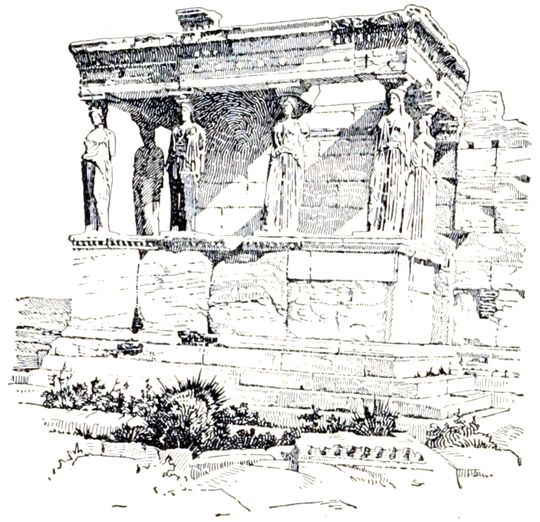
PORCH OF THE CARYATIDES, ATHENS
There came a day when he was called before the city's judges, who heard the charges against him. The judges decided that he must die by drinking a cup of poison. Some of the friends of Socrates found a way by which he could escape death. But the brave old Greek had faced death on the battlefield and was not afraid to die.
The death of Socrates
Socrates believed that the laws of the city should be obeyed even if they were unjust. He drank the fatal cup while telling his friends and followers of a life beyond the grave. It was a favorite doctrine of Socrates that men would live again after the body died.
We know what Socrates taught from the writings of his most famous pupil, Plato. These Dialogues of Plato's, in the form of question and answer, are among the greatest books ever written.
A very learned man
265. Aristotle, the Scientist of Ancient Times. Aristotle was one of the later Greeks. He was celebrated for his learning. He was called a "Scientist," for he was not simply a philosopher as Socrates and Plato were.
Followed without question for ages
Aristotle was indeed a wonderful man. He studied about every subject known to the ancients and won honors in all subjects; people for centuries and centuries after Aristotle's time accepted what he said and did not try very hard to study further. They thought that the giant mind of Aristotle had found out all there was to know.
Aristotle studied animals and plants, putting them in different classes and finding out many of their characteristics. He also knew a great deal about music and his Logic has been the great text book even down to modern times.
One of the earliest geographers
We have a special interest in Aristotle because in his studies in geography he taught that the world is round. From men who accepted Aristotle's teaching about the shape of the earth, Columbus, the discoverer of America, got his idea of sailing west to find eastern countries.
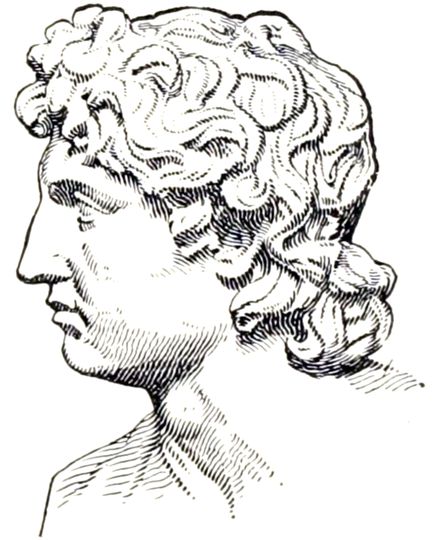
ALEXANDER AT TWENTY
266. The Father of Alexander the Great. Macedon was a country just north of Greece. Its great king was Philip, father of Alexander the Great. Philip was a brave king and had good soldiers. He taught them to form in bodies sixteen ranks deep and armed them with lances or spears fourteen feet long. A body of soldiers so formed and armed was called a Macedonian phalanx. "When the Macedonians leveled their long spears and advanced with steady step they bore down" the ranks of the enemy.
Alexander seeks to imitate the old Greek heroes
With these soldiers Philip conquered Greece, but he ruled the Greeks kindly. He even employed one of them to give lessons to his young son. Aristotle was the teacher who opened to this young man all the learning of the Greeks. Alexander was a bright boy and learned quickly. Although not born a Greek, he admired their learning. He was fond of the blind poet Homer, and it was said could repeat his poems by heart.
Achilles was his favorite among the Greek heroes, and he finally made himself believe that Achilles was one of his forefathers. At any rate he resolved to imitate his hero and to conquer cities more splendid than Troy.
HOW THE GREEKS TAUGHT MEN TO BE FREE
267. Self-Government among the Greeks. The Greeks were not many in number, if we compare them with modern nations. But we admire them because they were free and had the most democratic government in the ancient world.
Greece a city-state
They lived in little cities located in the valleys shut in by hills or mountains. Around their cities they built strong walls to shut out dangerous enemies. There were some benefits growing out of living in small cities. The people could know each other. The men could come together quickly and easily to talk of things needed for the good of the city. Only a small part of the men and women in a modern city can get together. These Greeks could know the best men for office, for they were their own neighbors. Now but a few men who want office can be known to all the voters in a city, and still fewer who want to run for governor or for president can be known by all the voters of a state or country.
The most famous of the cities in ancient Greece were Athens and Sparta. Their history is well known to us because of the great deeds of their people. Another reason for remembering them is that the two cities were so very different, as we shall see.
The Greeks their own rulers
268. The Government of the Cities. At first, just as in the case of other nations, the Greeks had kings in all their cities. But unlike the other nations, the Greeks drove their kings out and made for themselves a kind of government called a republic. This was the best and wisest government for a people as intelligent as the Greeks. In a republic all the people, or a majority of them, take part in making and in carrying out the laws. This is the kind of government we have.
But while a republican government is the best, it is also the hardest to run. It demands that each one of its citizens shall be educated so that he may be able to vote wisely.
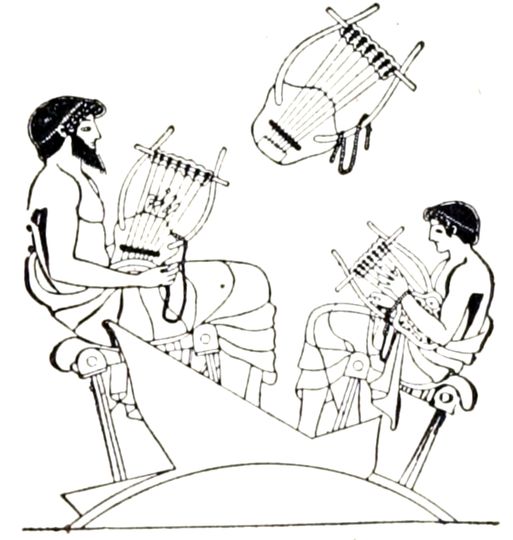
AN ATHENIAN SCHOOLBOY LEARNING TO PLAY THE LYRE
From an Athenian vase
The Greeks had a hard time keeping their self-government. There were shrewd men among them who seized the power in the city and compelled the people to obey them. Such a man the Greeks called a "tyrant." A tyrant was either good or bad. He sometimes gave the people a better government than they had when they ruled themselves. But the Greeks were liberty-loving and liked to govern themselves even though their government was worse than a tyrant's government. So they generally drove out the tyrants and again set up a government under rulers of their own choosing.
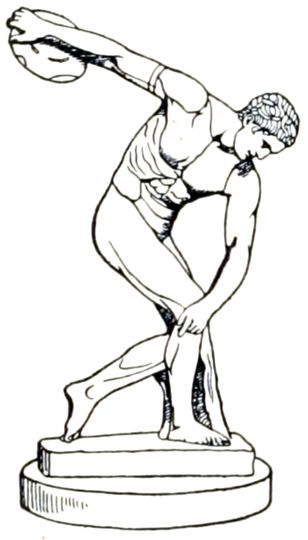
THE DISCUS THROWER
269. The Two Rival Cities, Athens and Sparta. The people of Athens were the most democratic in all Greece. The Spartans, on the other hand, were the most soldier-like of the Greeks. The Athenians loved new things while the Spartans liked old ways best. The Athenians made Athens the most beautiful city in the Old World. The Spartans cared nothing for beautiful things. They loved only things that were useful.
All the citizens of Athens came together to make the laws. In the center of their city they met in their assembly, a semicircle of stone seats rising one above another. Here the men of Athens listened to their speakers. Each speaker placed a wreath upon his head before he began speaking.
The public life of the Athenians
Often there were exciting debates between great speakers called orators. They spoke eloquent words and sometimes stirred people deeply. The Athenians enjoyed these debates almost as much as they did their Greek plays.
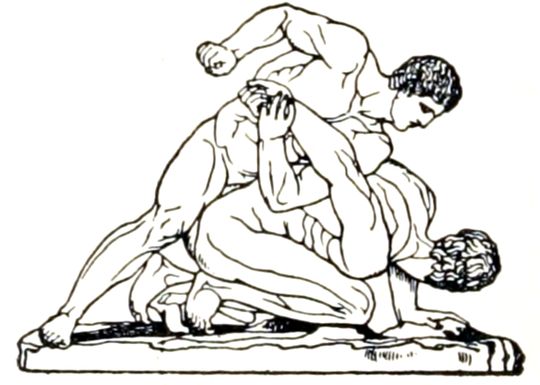
THE WRESTLERS
Athenian orators
The people of Athens, because they made their laws after debating them in the assembly, placed emphasis on public speaking. All the citizens were taught how to speak in public and how to appear before the assembly. It was natural for the best orators to have the most influence. But the people were keen and quick to see the difference between orators who were interested only in winning applause and honor for themselves through their speeches and the ones who were true patriots and spoke for the good of the city.
Yet while the people of Athens trained their citizens to make the laws they saw to it that their young men were trained to be good soldiers. Training began with the school boy. There were two schools, one called the music school and the other the wrestling school.
The music school
In the music school the Greek boys did not study music alone, but learned to read and write and do simple sums in arithmetic. More than this, their teachers wanted them to learn the poems written by blind Homer, their wonderful old poet. They learned to play and sing. A stringed instrument called a lyre was the favorite among the Greeks.
The gymnasium
In the wrestling school the boys learned to run, to jump, to dance, and especially to throw the javelin. At fifteen they attended the gymnasium where they were taught the more difficult athletic games. This led up to the next great event in the young man's life, his preparation for becoming a citizen.
Soldier-citizens
This important event came at the age of eighteen. It began with a great ceremony. The young men came into the assembly before all the men of the city. Here they were given a spear and shield. With their hands raised they took an oath never to bring shame upon the city nor to desert a companion in arms. They pledged themselves to give over the city of Athens to their children greater than when they had found it.
After this ceremony was over, the young men marched away to be trained for two years more in the art of being soldiers. When they had reached their twentieth year, they returned to Athens to become citizens of the republic, to work for its good, and to enjoy the pleasures of that charming city.
Character of Pericles
270. Pericles, the Wise Statesman. Pericles lived in the "Golden Age of Athens." He was born nearly 500 years before Christ. He was trained in the same manner as any other boy in Athens. He became one of the first orators of Greece and his ability as a speaker gave him great power over his people. He became one of their leading officers. Pericles stood for the people and against those men of aristocratic ways who wanted the city ruled by the few.
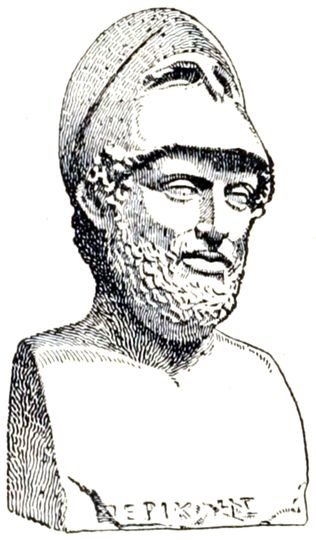
HEAD OF PERICLES
After the original in the British Museum
Cimon was the leader of the aristocracy. The people of Athens voted to banish him. But after a time Pericles had him brought back to Athens. This shows how very kind-hearted Pericles was toward his great political enemy.
For thirty years Pericles was the most popular man in Athens. He ruled the people kindly and well during this time.
It was Pericles who made Athens the City Beautiful. When you are older you may read all about the many wonderful buildings and monuments he erected.
The rule of Pericles had one bad result: He was so popular and had been the great man in the government so long that when he passed away there was no one who could take his place. The time in which he lived is often called the "Age of Pericles." After his death history handed his high ideas on to Rome and the rest of the world. No doubt these ideas influenced the great men of Rome.
SPREAD OF GREEK CIVILIZATION
The Greeks of Asia Minor
271. The Old Wars of the Greeks. The once greatest enemies of the Greeks were the Persians, living in western Asia. The Persians conquered Asia Minor. Here on its coast the Greeks had planted many cities, and they naturally sent ships and soldiers to aid their kinsmen.
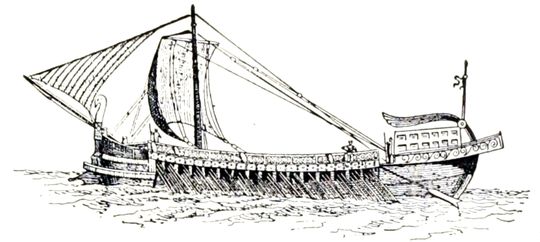
AN ATHENIAN WAR GALLEY
The battle of Marathon
The king of the Persians, Darius by name, whom we read about in the Bible, sailed with a great army across the sea to Greece. One hundred thousand Persians met ten thousand Greeks on the battlefield of Marathon. The Greeks won.
The old folks and children among the Greeks waited for the news with breathless anxiety. The minutes grew into hours. At last they saw a runner coming. He was covered with dust. He had been on the battlefield and was running to tell the waiting people of the great victory. He dropped dead as he called out, "Victory!" He had run twenty-four miles!
Both Europe and America have celebrated the victory at Marathon by naming one of their races in the great Olympic contest the Marathon race.
Xerxes' forces
Again, a new king, Xerxes, who reigned over Persia, decided to overthrow Greece. He gathered a vast host from forty-six tributary states. He also gathered a fleet greater than any Greece had.
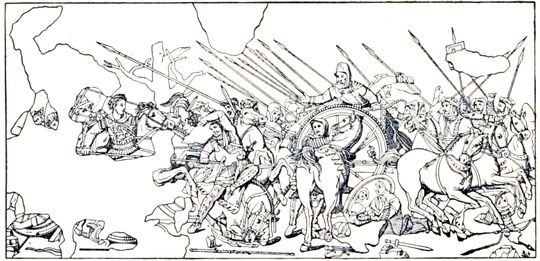
THE PERSIAN KING FLEEING IN THE BATTLE OF ISSUS
The city of Sparta gave three hundred brave soldiers. Their leader was Leonidas. The Persian army had to march along the narrow pass of Thermopylae that ran between high mountains and the sea. Here stood the brave Spartans. For two days Leonidas held the pass. Through a mountain road the Persians gained the rear of the Spartan army. But the Spartans did not retreat. Every Spartan fell fighting for his country. A noble example!
The battle of Salamis
The Greek warships met the Persians in the Bay of Salamis and overthrew them completely. Xerxes took his army and hastened back to Persia. Asia might be ruled by tyrants but the Greeks were bound to be free.
272. How Alexander Spread Greek Ideas. But these wonderful deeds were not all the Greeks were to do. We have seen Alexander come to the head of the Greek Empire. He had a wonderful army and resolved to teach the Persians a lesson or two as well as to spread Greek ideas.
The march of the Greeks
Alexander's army was not large, but it was the best trained in the world. Think of the Macedonian phalanx! All the cities of Persia fell into his hands. Before he was thirty years old, southwestern Asia and Egypt recognized his rule. Alexandria, situated at the mouth of the Nile River, was founded by him. It became a center of Greek ideas and boasted the largest library in the Old World.
273. Why Alexander Failed. Alexander's army made its way to India. But its great general, now only thirty-two, was drunk with power. He even permitted the people he conquered to worship him as a god. He loved the wine-cup too well and was stricken with a fever and died.
There was no one to take his place, but much that was finest and best in Greek life remained to the world.
SUGGESTIONS INTENDED TO HELP THE PUPIL
The Leading Facts. 1. Greece, a land of hills, mountains, plains, bays, and gulfs. 2. Greeks traded and planted colonies. 3. The deeds of Greek heroes. 4. The great men of the newer Greece. 5. The reason why the Persians attacked the Greeks. 6. Marathon, Thermopylae, and Salamis. 7. Alexander the Great, his father, his education, his army, and his victories. 8. Spread of Greek ideas.
Study Questions. 1. See map for the boundaries of "Greater Greece." 2. Name heroes among the ancient Greeks. Do you know of any others? 3. What was their favorite story? 4. What was the cause of the Trojan War? 5. Who was Helen and for what was she famous? 6. Who was Socrates? Plato? Aristotle? 7. How is Aristotle connected with Columbus? 8. Who were the Persians? 9. Why did they attack the Greeks? 10. Name the great battles. 11. How was Alexander able to beat the Persians in their own land? 12. How did Alexander benefit the world in what he did?
Suggested Readings. Guerber. The Story of the Greeks; Hall, Life in Ancient Greece, II, 166; Harding, Stories of Greek Gods, Heroes, and Men; Tappan, The Story of the Greek People; Yonge, Young Folks' History of Greece; Mace-Tanner, Old Europe and Young America, 24-73; Hall, Four Old Greeks.
WHEN ROME RULED THE WORLD
274. Rome, the Eternal City. Italy looks like a big boot hanging from the Alps Mountains down into the Mediterranean Sea. "Sunny Italy," people call it.
An old Roman myth
The ancient Romans all believed that their city, Rome, was founded by a hero called Romulus. He had a twin brother, Remus. A wicked uncle threw them while babies into a basket and set it adrift on the river Tiber. But the boys—so the story runs—were found by a she-wolf that nursed them until they became men, strong and cruel. With the aid of others as brave as himself, Romulus founded the city of Rome.
How Rome was ruled
275. Rome Becomes a Republic. Romulus was the first of six kings. The people drove out the sixth because he was cruel, and Rome became a republic. The republic was ruled by two men called "consuls," aided by the advice of great men called "senators." These senators were among the wisest men in the Old World.
276. Stories of Roman Heroes. The people of Rome, like the Greeks, had their tales of what the bold heroes of olden times had done.
Horatius saves Rome
One of the most famous stories is about a hero named Horatius. The Romans sent for him to lead their soldiers against the last king, who was trying to get back the Roman throne. Bold Horatius took his stand on a narrow bridge leading across the Tiber to the city. Here he met the enemy, and defended the bridge with only his good sword until the Roman soldiers broke down the bridge behind him. When the bridge fell, he plunged into the fast rolling stream and swam ashore.
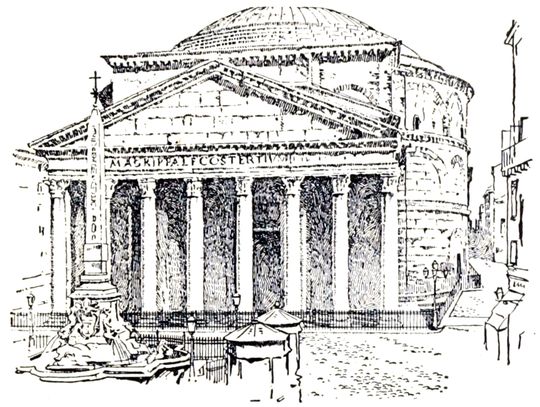
THE PANTHEON, A ROMAN TEMPLE DEDICATED TO ALL THE GODS
The story of Cincinnatus
The story that American boys and girls like best, perhaps, is one the Romans never tired of telling their children. It is about an old farmer-soldier named Cincinnatus. Rome's enemies were knocking at the very doors of the "Eternal City." The Romans called for Cincinnatus to head the army. They found him ploughing on his little farm. He left his plough and oxen in the field, took command of the Roman army, and by a night attack completely defeated the enemy. He was the most popular man in Rome and could have held any office in the government. But he returned to his plow as if nothing had happened.
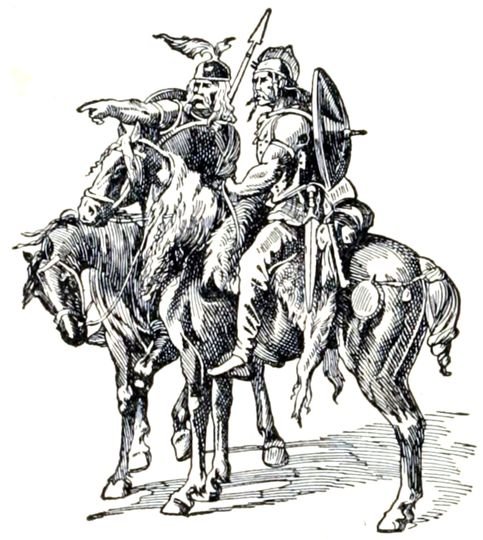
SAVAGE GAULS AND THEIR WEAPONS
George Washington is often called the American Cincinnatus, for he, too, at the close of our Revolution, laid down his arms and went to live on his farm on the banks of the Potomac.
How the common people gained new rights
277. The First Battle between Rich and Poor. A fierce war between the rich and poor threatened to destroy the republic itself. The rich were selfish and thought they should have all the power. After a long struggle the poor gained some political rights by all moving to a sacred hill and beginning to build a rival city. The rich gave in and the poor in Rome had a right to choose a man who could raise his hand in the assembly and say: "I forbid," which he did by using the Latin word, "veto." This is where we get our word "veto."
278. The People Called Gauls Take Rome. For many years the Romans quarreled among themselves. How could they defend Rome from the great bands of brave and fierce people who swarmed down from the North? These were the Gauls. They were very large men who dressed in skins of beasts. They defeated the Romans, burned their cities, and murdered the people.
Gauls become Romans
After a time the Gauls lived among the Romans and finally became so mixed with them you could hardly tell them apart. They all became Romans, and Rome was then united and strong. The natural result was that Rome conquered all the other tribes or peoples living in Italy.
HANNIBAL TRIES TO CONQUER ROME
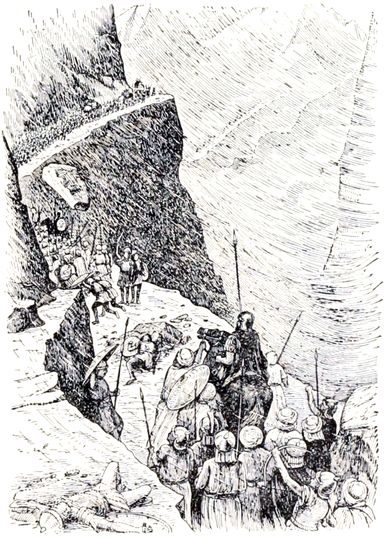
HANNIBAL'S ARMY CROSSING THE ALPS
A Phoenician colony
279. Carthage the Rival of Rome. Just as Persia was the rival of Greece, so Carthage was the rival of Rome. Carthage had been settled by the Phoenicians, the traders of the ancient world. Carthage, the richest of their colonies, was just across the Mediterranean from Rome. In the days of her greatest power Carthage was said to have nearly a million people. Rome and Carthage quarreled about the island of Sicily, lying midway between them, and Rome was successful in driving her enemy out of the island. The great Carthaginian general, Hannibal, when only a boy took a solemn oath to carry on war with Rome without ceasing. When he later became a famous general he still remembered his oath against Rome. He gathered a mighty army from all Carthaginian colonies as well as from the homeland. Soldiers came from all parts of Spain and Gaul. From Africa came the finest body of cavalry in the world. The strangest part of the body was a long line of war elephants driven by their riders to trample down the Roman soldiers and to break their solid lines.
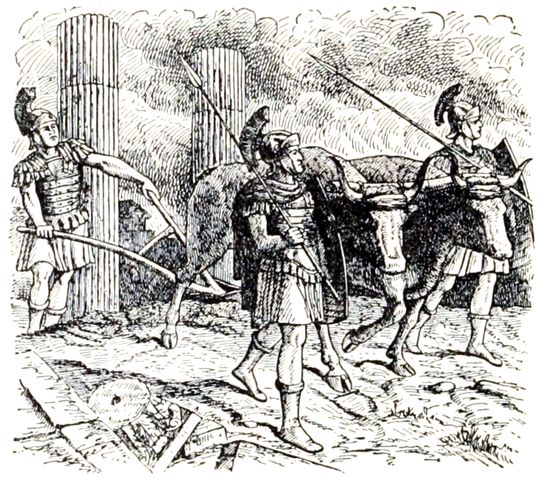
ROMANS PLOWING THE GROUND WHERE CARTHAGE HAD STOOD
The army came together in Spain and marched over the mighty Alps into Italy. Their march was slow and hard. There were no roads at all through the mountains. The army was often attacked by people living in the mountains who hurled huge stones upon it.
After five months the army finally reached the plains of Italy, though hundreds of brave soldiers had been lost.
Rome was stirred to her depths. A great army was raised to meet the Carthaginians. But Rome had no general like Hannibal. For fifteen years he remained in Italy, defeating every general sent against him.
How Hannibal made war
Hannibal's greatest victory was on the field of Cannae. Rome raised a mighty army, 86,000 men. Hannibal had only 50,000, but he had faith in his veterans, especially in the African horsemen. He arranged his troops so that his center gave way easily. When the Romans thought victory near, Hannibal's heavy troops on each wing attacked them from both sides and his African horsemen struck them in the rear. The Romans lost in killed and wounded 70,000 men.
The Romans hit upon the plan of sending an army to attack Carthage. Hannibal had to rush his troops home to save his beloved city. In the great battle of Zama Hannibal was defeated and Carthage fell.
The fate of Carthage
Rome would not permit a rival, so she wholly destroyed Carthage, her great fleets of ships, her hoards of money, her stores of goods and her great buildings. It is said that Romans sowed salt where Carthage once stood so that nothing might ever grow there.
ROME CONQUERS THE WORLD BUT GROWS WICKED
280. How Rome Came to Win Victories. The wars made great soldiers out of the Romans, who, now that they had trained generals, began to conquer all the nations about them. They invaded Macedonia, Greece, Asia, and Africa, destroying the mighty nations which had grown out of the work of Alexander the Great.
How the Romans defeated the phalanx
How do you suppose the Romans defeated the Macedonian phalanx? The Roman generals planned the battle with the Macedonians so that it always occurred in a forest or on rough broken ground where the phalanx could not stand in solid columns. With the phalanx already in disorder the Romans charged and defeated them easily.
Roman slaves
281. The Effect on the Romans. Long before the Romans began to conquer other nations they were a simple farmer-like people living by raising grain and horses and cattle and sheep. But as soon as they began to conquer other nations many of the Romans grew proud and haughty. A great many grew rich from what they took from the defeated nations. Hundreds of Romans who had been small farmers now lived on great farms. On these farms or plantations the work was done by slaves, who were prisoners taken in battle. Some of these slaves were rude men taken in wars against half-savage people. Others, like the Greeks, were well educated, and really knew more than their masters. Those who belonged to this class of slaves were treated kindly and often played the part of tutors to the children of their rich masters.
282. The Rich and Poor Quarrel Again. The rich men oppressed the poor in many ways. A great many poor went to Rome to live because they found it hard to make a living on their little farms. Then, too, the great city was full of interesting doings. Besides, the city did not permit her poor to starve. Great shiploads of grain were brought from Egypt to feed them.
The Gracchi
In Rome at this time there lived two brothers called the Gracchi. They were both great orators and rose to high positions in Rome. They saw their city was in a bad way on account of the many poor that were flocking to it.
The Gracchi tried to change this by taking away from the very rich landowners a part of their land and giving it to the poor. The Gracchi wanted to make farmers out of the poor. This plan roused the anger of the rich. They raised riots against the brothers and both men were killed. Rome never forgot the Gracchi, and even in our time they are looked upon as noble men laboring for the good of their country.
SUGGESTIONS INTENDED TO HELP THE PUPIL
The Leading Facts. 1. What Italy looks like on the map. 2. Romulus and Remus. 3. The founding of Rome; the six kings. 4. A republic with "consuls" and "senators." 5. The story of Horatius; of Cincinnatus. Our Cincinnatus. 6. The first quarrel, and the removal to the second hill. 7. The capture of Rome by the Gauls; the Gauls become Romans. 8. Rome and Carthage rivals. 9. Quarrel over Sicily. 10. Hannibal takes a great oath. 11. Hannibal's army. 12. How it reached Italy and how long it remained. 13. Hannibal's victory at Cannae. 14. The Romans invade Carthage and defeat Hannibal at Zama. 15. How Rome defeated the phalanx. 16. Romans before conquests a simple people. 17. Effect on the Romans of conquering the world. 18. Second great contest between rich and poor. 19. The Gracchi to the rescue. 20. Death of the Gracchi and why they are remembered.
Study Questions. 1. Why did the Romans believe the story of Romulus and Remus? 2. Tell the story of Horatius and Cincinnatus. Which do you like best? 3. Tell the origin of the word "veto." 4. Who was Hannibal and how could he stay so long in Italy with his army? 5. Who built Carthage? 6. Describe the battle of Cannae. 7. Why did the Romans scatter salt over the ground where Carthage stood? 8. How did Rome overcome the Macedonian phalanx? 9. What bad effect did the world conquest have upon Rome? 10. Tell the story of the Gracchi.
Suggested Readings. Tappan, The Story of the Roman People, 1-122; Yonge, Young Folks' History of Rome, 13-202; Harding, The City of the Seven Hills, 7-165; Lang, The Red Book of Heroes, 43-94; Guerber, The Story of the Romans; Mace-Tanner, Old Europe and Young America, 74-93.
THE ROMAN REPUBLIC BECOMES THE ROMAN EMPIRE
Conditions that favored Caesar
283. The Rise of Julius Caesar. When a country is torn by quarrels between rich and poor, very often some great man rises, seizes the government, and rules the country himself. He may use the army in compelling all parties to submit quietly to his rule. So it was in Rome.
Caesar was "tall and erect, with hooked nose, and piercing glance." He made the common people believe him to be their friend. They probably thought that he was another Gracchus.
Governor of Gaul
284. Caesar Governor of Gaul. Caesar was chosen consul, and then later made governor of Gaul. In Gaul the people were half savage and were constantly fighting.
They made friends with Caesar because he helped them defeat the Germans. The Germans were carrying fire and sword into Gaul until Caesar put them to rout.
War with the Gauls
Caesar now decided that he must conquer all the country of the Gauls. He called for more of the Roman legions, such as had defeated the Macedonian phalanx. One after another the tribes of Gaul were overcome. Then suddenly, when Caesar least expected it, the Gauls rose as one man and defeated the Romans. But Caesar would not give up. He finally defeated the Gauls and sent their great leader a prisoner to Rome.
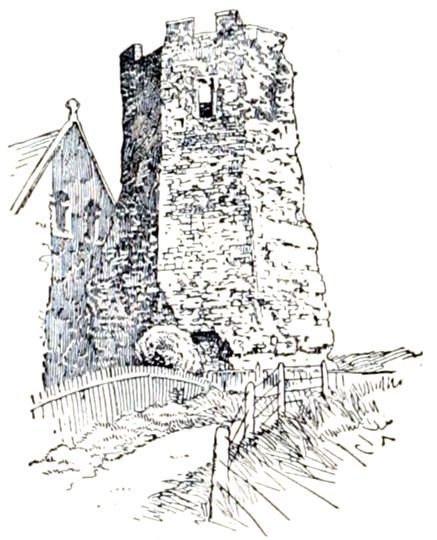
ROMAN REMAINS IN GREAT BRITAIN
The Lighthouse, Dover Castle
285. His Invasion of England. The Britons were kinfolk of the Gauls and had sent them help in the fight against Caesar. The Britons were also half savage, and Caesar resolved to make them feel the power of Rome. But Caesar found the Britons ready for him when his ships tried to land his soldiers. The Britons, though bravely fighting for native land, were finally defeated.
Caesar made two invasions into England, but when his soldiers were needed at home, he withdrew.
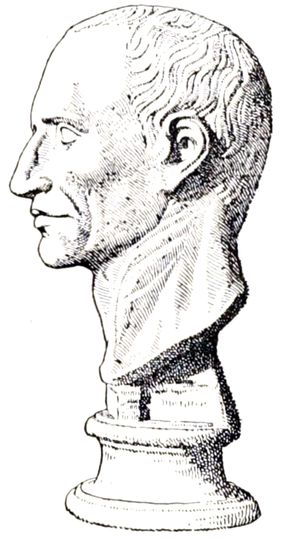
JULIUS CAESAR
Trouble at home
286. He Crosses the Rubicon. There were other great generals in Rome and they now became jealous of Caesar's many victories and of his popularity. They prepared to punish him. But Caesar was too quick for them. He marched his army rapidly into Italy until he reached a little stream called the Rubicon. To cross this stream meant war—victory or defeat. He stood awhile—so the story runs—in deep study. "The die is cast," said Caesar, and plunged into its waters.
287. Caesar the Ruler of Rome. Caesar's enemies fled from Rome, so quickly did he come. He now held the great city in his hands. He followed his enemies and defeated them in a great battle. Other armies were raised against him, but he was the final victor. He sent a famous dispatch to Rome: "I came, I saw, I conquered." Julius Caesar was now master of the civilized world.
The plot against Caesar
But in ruling the world Caesar had changed Rome from a republic into an empire. Many good Roman nobles could never forget that fact. Caesar planned to give Rome a good government. He was in many ways a wise ruler. Still many people could not forgive him. So those who believed Rome should still be a republic and others who were merely jealous of him, planned to kill him. As he came into the Senate Hall one day they stabbed him.
But the death of Rome's greatest man did not set her free. Another and a worse tyrant ruled Rome.
WHAT ROME GAVE TO THE WORLD
How Rome ruled
288. Great Lawmakers and Governors. Of all the ancient nations Rome was the most famous in establishing laws in regard to the ownership of property and in regard to the way men should act toward one another.
Her consuls and senators were men skillful in planning laws not only for Rome but for the nations which she had conquered.
The Colosseum
289. Romans Were Great Builders. The buildings of Greece were beautiful but those of Rome were large and strong. The Colosseum, built as a place of entertainment for the people, was a gigantic affair seating 87,000 people. In this were held fights between gladiators, men trained to kill each other, and between men and wild beasts. The effect was to make the Romans lovers of such cruel sports.
Other famous buildings put up by the Romans were the Forum and the Pantheon. You may see remains of these now in Rome. They are visited by hundreds of Americans every year.
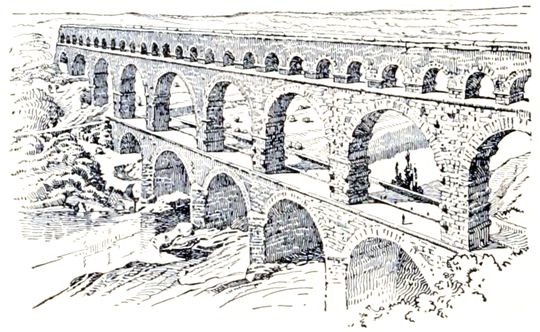
ROMAN BRIDGE AND AQUEDUCT NEAR NIMES, FRANCE
Roman roads
The Romans also built wonderful roads in all parts of the empire for the use of armies and for travel and trade. Some of these roads are still used. They built strong bridges over the rivers and erected aqueducts in different parts of the empire. These Roman aqueducts brought good, pure water from the hills to supply the needs of the townspeople.
290. The Romans Gave a Literature to the World. Not all Romans were educated. All boys and girls did not then go to school, as they do in America. Only the sons of the well-to-do could become educated.
Classic Roman writers
Rome became famous for her great writers. Even Julius Caesar found time to write the story of his war against the Gauls. High school boys and girls read Caesar's Commentaries. There was Vergil, a great poet, who told the story of how the Greeks beat the Trojans. Vergil made these Greek heroes the ancestors of the Romans. Horace was another of Rome's great poets. He amused the Romans "by his genial and quiet humor." But Cicero was the great orator of Rome. His voice went ringing down the senate halls as he challenged Catiline, who had plotted to overthrow the republic.
291. Rome Prepared the Way for the Spread of Christianity. When Rome seemed sunk in wickedness there came out of Palestine the story of Jesus. His disciples were carrying the glad news everywhere over the empire. Paul, the most learned of these followers of Christ, carried the story to Greece and to Rome.
Early Christian martyrs
The emperors tried to stamp out the new religion, but the more they opposed the more it grew. Hundreds of Christians perished holding firm to the faith. Many were destroyed by wild beasts in the Colosseum before the eyes of thousands of Romans. But the new religion appealed to many, and especially to the poorer classes. The Emperor Constantine (305 A. D.) soon accepted the new religion and gave it protection. It then spread rapidly. Priests were sent into the villages to preach and to set up churches. Above the priest was a bishop in charge of all the churches in a district or province.
The government of the new church was formed like that of the empire and became strong. Other religions were driven out. In time the many offices of the empire were in the hands of the priests or under their influence. Many years later these two governments of the church and the empire quarreled over their rights to rule the people.
THE DOWNFALL OF ROME
How the Teutonic tribes lived
292. The Coming of the Huns and Teutons. North of the Alps, beyond the Danube and the Rhine, and between the North Sea and the Black Sea, was a vast region of wild lands. Here the German or Teutonic tribes had lived for hundreds of years. They had made little advance in ways of living. They still dwelt in poor villages. They loved to fight, or waste their time in idleness and feasts. They were noted for their love of liberty and pure family life. At the time of the invasions (4th century) they were learning to live in towns, to unite in confederations, and to be ruled by elected kings. They had so increased in numbers that more land was needed to afford them a living. This was the main cause of their moving south to the Roman frontiers.
Gradual coming of the Germans
For three hundred years the Germans were restless in their northern homes. But the Roman armies were strong enough to keep them beyond the Danube. Some had come over as soldiers in the Roman legions. By 330 half the troops were German. Some of the more peaceful Germans were allowed to make settlements within the empire. Other Germans came in as slaves, but mainly to work on the farms.
By the end of the fourth century after Christ the Romans had become too weak to keep the Germans back.
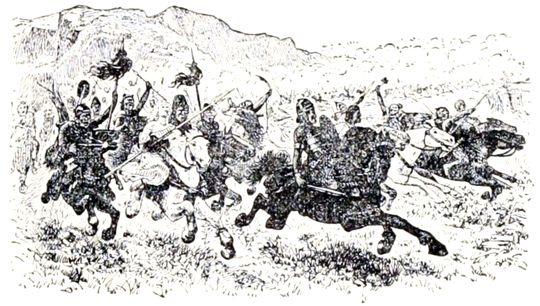
THE COMING OF THE HUNS
From a print after the painting by Ulpiano Checa
Battle of Chalons
But the Germans were gentle compared with the fierce Huns from Asia who made the next great invasion into Europe. And under their terrible chief, Attila, they swept over Europe like firebrands, laying waste all they could not carry away. At last the Germans and the Romans united and defeated the Huns at Chalons (451). The Huns moved eastward, passed through northern Italy, and soon reëntered Asia. Europe was saved.
293. End of the Empire. Other German tribes entered the empire, took possession of the lands, and even formed governments under their chiefs. In a quarrel over lands the German troops removed the Roman emperor and declared their chief, Odoacer, king (476). This marks the end of the Roman Empire and the rise of the kingdom of Italy, though the present United Kingdom, formed after centuries of division, among small, jealous city states, is only sixty years old.
Other invasions went on for many years. Europe was in disorder and confusion for nearly four hundred years. It was a time of seeding, when the rough, brave, liberty-loving German peoples were intermarrying with the Greeks and Romans and learning from them the finer ways of living. From this fusion a new society was built on the ruins of the old, as shown in the nations of Italy, France, and Spain.
THE ANGLES AND SAXONS IN GREAT BRITAIN
294. The Britons. There were already two groups of people in these islands. Under the rule of the Romans one group, the Britons, had been weakened as fighters.
Britons fight among themselves
Rome called her legions out of Britain to fight the Germans. This left the Britons without good soldiers to keep order and the tribes began fighting one another. One tribe, the Britons proper, invited bands of Jutes from Denmark (449) to help them. After the Britons had forced back their enemies the Jutes refused to go away. They took possession of the land, making it their home.
Where the name England came from
295. Coming of the Anglo-Saxons. Other German tribes, chiefly the wild Angles and Saxons, now came over from Europe. The new tribes soon brought the Britons under their rule. They gave their names to the land they had taken—Angle land or England. The Angles and Saxons are the forefathers of the "English" people. The Britons who would not submit were driven into the lands to the west known as Wales, and became the "Welsh."
296. Rome Brings Christianity to the Germans. When the western Roman Empire passed away in 476, the church remained the only strong central government in all that vast territory. It acted as a steady light when all about was dark and changing. Its priests came to be the only educated class, giving it great influence.
Clovis, king of the Franks, converted
Even before the invasions began, missionaries went among the German tribes on the frontiers to preach the religion of Christ. Many of the Germans had accepted the new religion either before or soon after entering Roman territory. Clovis, king of the Franks, was influenced by his Christian wife to accept the new religion. His army followed, and was baptized with its leader.
England becomes Christian
Missionaries under Augustine were sent from Rome to England. Through their earnest preaching and noble living the king of Kent and his followers accepted the new religion. A church was built at Canterbury. Others carried on the work until all England had accepted Christianity. Other missionaries went to the northern Germans, and many of these people became Christians.
These early missionaries were mostly monks. Their homes (monasteries) were like small settlements among the people. They not only preached the new religion, but showed people better ways of farming and living. In their schools, they taught people to read and write.
CHARLES THE GREAT, RULER OF THE FRANKS
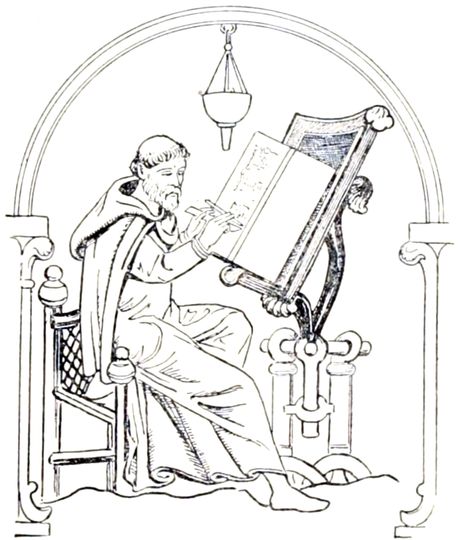
After an engraving in Green's History of England
WORK COPYING MANUSCRIPT, 1200 A. D.
297. Charlemagne. While the Germans were still moving into the Roman Empire the Franks had set up a government under Clovis. They had become Christians and lived on friendly terms with the church. They grew strong and settled down to a more orderly and quiet way of living. Their first great king, Charles Martel, the Hammer, checked the invasion of the Mohammedans at Tours (732), and again Europe and Christianity were saved. But the greatest of all the leaders of the Franks was Charlemagne, the grandson of Charles Martel, for he was not only a great conqueror but a wise and able ruler.
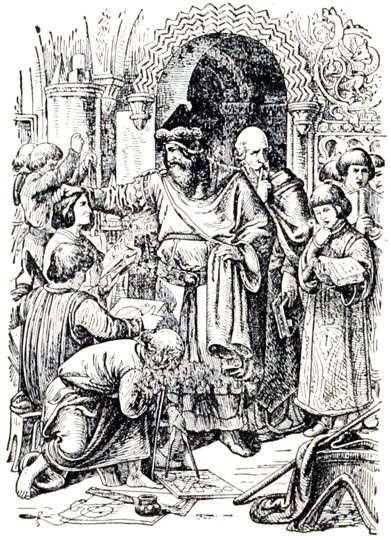
CHARLES THE GREAT AT THE SCHOOL OF THE PALACE
Charlemagne, or Charles the Great, was by far the most famous man of his time. He seemed to be a happy fusion of Germanic strength and Roman learning. He was tall and strong, with large, bright eyes, fair hair, and a face round and laughing. He exercised much, riding, hunting, and swimming. He liked the Frankish costume: "... next to his skin a linen shirt and linen breeches, and above these a tunic fringed with silk; while hose fastened by bands covered his lower limbs, and shoes his feet, and he shielded his shoulders and chest in winter by a close-fitting coat of otter or marten skin. Over all he cast a blue coat: always too he had a sword girt about him."
Character of Charles
The School of the Palace
Charles ate and drank with care, never taking too much of either food or drink. During his meals his attendants entertained him with reading and music. He liked the stories and deeds of the olden time and the books of Augustine. He was a good speaker, easily understood. He loved learning, but had little education himself. He had the famous School of the Palace in his own home to educate his own children and those of the nobles. Wise teachers like Peter of Pisa, and Alcuin of England were brought to his court. He helped the priests in their study and in building schools. Charles loved the church and gave much to aid its educational and religious work. He really brought learning to the people.
Charlemagne's wars
Charles the Great was for three years ruler with his father (768-771), then sole ruler until 814. His kingdom was surrounded on all sides by fierce enemies. Most of his long rule was taken up in fighting the wild Germans to the north and east, the Arabs in Spain, or the Lombards and others to protect the church in Italy. He was a great warrior. Before his death he had brought most of western Europe under his rule.
Crowned Emperor of Rome
298. The Crowning of Charlemagne. So successful was he that it seemed the Roman Empire was again to live in the memories of men. God was surely with him. How simple it then seemed to bestow the symbol of divine blessing upon Charles! On Christmas day, 800, Charles was in Rome. And on that sacred day of the Christians he entered the great church and knelt in prayer before the altar. In that solemn moment the pope, as the messenger on earth of God, quietly stepped to where Charles was kneeling. Lifting the crown which he held in his hands, he placed it upon the head of the king of the Franks and proclaimed him Emperor of Rome (800). What glorious memories it must have brought to the thousands gathered there! In their joy they cried out: "Long life and victory to the mighty Charles, the great and pacific emperor of the Romans, crowned of God!"
How he governed
299. The Ruler Charlemagne. Charles was a great ruler as well as soldier. He divided his territory into districts over each of which a count ruled. An army officer cared for all military matters. At certain times inspectors passed over the several districts. These three officers reported directly to Charles and were checks on the conduct of each other.
His just laws
Some of the orders which he sent to his officers show how great and just a ruler he was. He orders that "all shall live entirely in accordance with God's precept, justly and under a just rule, and each one shall be admonished to live in harmony with his fellows." Let no one "do injury to the churches of God, or to the poor, or the widows, or the wards, or any Christian." He then lays down the rules of living for the clergy, nuns, bishops, and other church officers, that their lives may be holy and their influence good.
He wanted to see justice done all over his kingdom—to the poor as well as to the rich. Wonderful stories, some true, have been woven about the name of the great emperor.
Why his empire fell
He built up a great empire, but it was too great to live long. There were too many races with different ways of living, and the provinces were too far apart. When the strength and wisdom of his hand and head passed away in death, the great empire began to crumble and fall apart.
SUGGESTIONS INTENDED TO HELP THE PUPILS
The Leading Facts. 1. Julius Caesar takes the popular side. 2. Governor of Gaul. 3. Conquest of Gaul and the Germans. 4. Caesar invades Britain. 5. Crosses the Rubicon and becomes ruler of the Roman Empire. 6. Why he was assassinated. 7. What Rome gave to the world. 8. Rome famous for its wonderful buildings and roads. 9. Her great literature. 10. How Rome prepared the way for Christianity. 11. Coming of the Huns and Teutons marks the downfall of Rome. 12. The removal of the Roman emperor and Odoacer made king. 13. Anglo-Saxons in Britain. 14. Rome takes Christianity to the Germans. 15. Charles the Great. 16. The Palace School. 17. The crowning of Charlemagne.
Study Questions. 1. Who was Julius Caesar? 2. What did he do to make people remember him? 3. Why did good men join in murdering him? 4. Name the different things given to the world by Rome? 5. Explain how Rome helped Christianity. 6. Who were the Huns and the Teutons? 7. Tell about the following in Charlemagne's career: (1) The battle of Tours; (2) How Charlemagne looked and dressed; (3) His Palace School; (4) How he ruled the Franks; (5) How he was crowned; (6) Why his empire crumbled at his death.
Suggested Readings. Tappan, The Story of the Roman People, 123-237; Harding, The City of the Seven Hills, 184-211; Yonge, Young Folks' History of Rome, 229; Clarke, The Story of Caesar; Guerber, The Story of the Romans.
THE COMING OF THE NORTHMEN
The vessels of the Northmen
Movements of the Northmen
300. The Vikings or Sea-Rovers. The Northmen lived in the lands of Denmark, Norway, and Sweden. They lived on the inlets of the ocean, or viks, and were called "vikings." Their boats were long, and each one had a high prow with the head of a dragon or other fierce-looking animal upon it. They drove their vessels by sail or oar. Often there were as many as fifty rowers in a boat, their bright shields hanging over the sides. When the sun shone on them they looked like great moving lights. The Northmen were great sea-rovers and pirates.
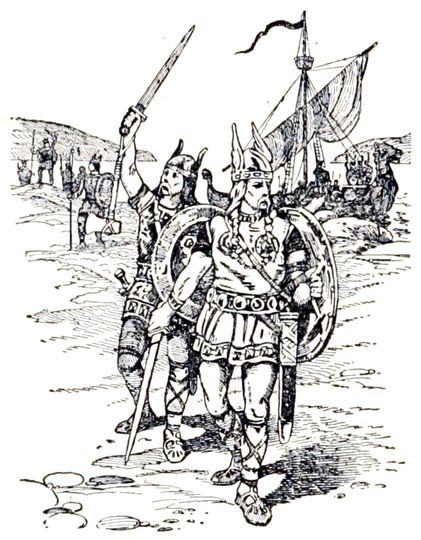
THE LANDING OF LEIF ERICSON IN AMERICA
In the eighth and ninth centuries these Northmen or Norsemen began moving out in great bands. Some overran the northern part of France and settled on the river Seine. They were called "Normans," and this region is now Normandy. Others sailed to the west and founded Iceland and Greenland. And their "sagas" or records tell us that Leif Ericson and his men even sailed as far as the coast of North America, although the settlements they made then did not prove to be lasting.
The conquest of England
The Northmen, called Danes by the English, had made many attacks on the coasts of England. Now they came in armies to take the land for homes. As they were heathen they took the riches from the churches and slew the priests. They captured place after place, driving the English before them, until the greater part of England fell into their hands. Young Alfred, king of Wessex, finally forced them to stop. While he drove them back some distance, he could not make them leave England.
ALFRED THE GREAT
Childhood of Alfred
301. Alfred the Boy. Alfred was born in 849. His mother was a good woman who gave much time and care to her children. Alfred learned early to read and to love books. A story is told of how Alfred won a beautiful book as a prize from his mother for learning to read it sooner than the other children. He spent much time in learning about wise men, in order to become wise himself.
Alfred fights the Danes
As he grew older he found other serious work to do. He aided his brother Ethelred, king of Wessex, to give battle to the Danes, who were moving south. In one battle Alfred led the English "with the rush of a wild boar," and defeated the Danes. Later the Danes drove them back and killed the English king. Alfred now became king of Wessex (871).
The story of the cakes
302. Alfred as King. Soon after Alfred became king his army was beaten and his men fled. With a little band of followers he hid in the marshes and there built a fort on an island. A story is told of how he was lost while wandering alone, and asked for shelter at the hut of a herdsman. The good wife told him to watch some cakes on the fire while she was busy. Alfred was bending his bow and arrows, and forgetting the cakes, let them burn. When she came back and saw the burnt cakes the good wife scolded the king.
"Can't you mind the cakes, man? And don't you see them burn? I'm bound you'll eat them fast enough, As soon as 'tis the turn."
Of course she did not know he was the king or she would not have scolded him.
Makes a treaty with the Danes
The next spring Alfred raised a large army, drove the Danes back, and forced them to make peace. By this treaty, and another later one, the Danes were given that part of England north and west of the river Thames. Alfred and his people ruled over the country south of them. The land of the Danes was called "Danelagh." They soon settled down to till the soil. Years later they became Christians and intermarried with the English.
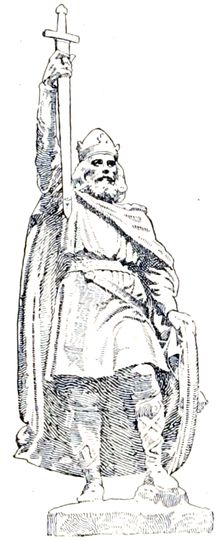
STATUE OF ALFRED AT WINCHESTER
To protect England from other sea-rovers, Alfred now built many ships, and thus became the father of the English navy. The army was also made larger. Later, Vikings again reached the shores of England, but Alfred's navy beat them off. Peaceful times now gave Alfred a chance to help his people in other ways.
303. What Alfred Did for England. It is difficult to know what the law is if it is not written, and injustice is often done to the people. Alfred now began the work of collecting and changing the laws of England. It is interesting to know what he thought of his work, as shown in his writing: "I, Alfred, gathered these laws together, and commanded many of them to be written which our forefathers held, those which seemed to me good. And many of those which seemed to me not good, I rejected, and in other wise commanded them to be held. For I durst not venture to set down in writing much of my own, for it was unknown to me what if it would please those who should come after us."
Advances learning
In those far-away days learning and schools were found in monasteries and in the churches. When the Danes came they destroyed most of these buildings. The people, therefore, were growing up in ignorance. Alfred felt then, as we feel now, that the people should be educated. So he invited wise men from other countries to come to England to teach his people. He built many churches and monasteries, and set up schools where the people might go to learn. But there must be books for them to read.
The learning of that day was mostly in Latin. Besides the priests and monks very few could read that language. "I wondered extremely," said Alfred, "that the good and wise men who were formerly all over England, and had perfectly learned all the books, did not wish to translate them into their own tongue."
Translates Latin books into English
He now began earnestly the work of making English books for his people. He translated a book containing a history of the world, and an account of two voyages to the north seas. He then put into English the famous book Bede's History of England. A book on religion by Pope Gregory the Great, and another of wise sayings, were soon after translated into English. In this way Alfred helped his people to learn to read, and to read good books. The English people have saved these works that their children for many generations to come might learn good things from them. Now, however, they must be translated into the English of our day before most of us can read them, for our language has changed greatly since Alfred's time.
Alfred also helped his people to learn new trades, and to do their work better in those trades they already knew. He had skilled workers from other countries come to England to help his people.
King Alfred's purpose
Alfred was a true and good man. He loved his home and his people. He said: "To sum up all, it has ever been my desire to live worthily while I was alive, and after my death to leave to those that should come after me my memory in good works."
His time well-ordered
The daily life of the king was orderly. The twenty-four hours were divided into three parts; eight hours were given to the business of the people (governing), eight hours to study and prayer, and eight hours to exercise and rest. "As he had no clock, he measured out his time by burning candles, each of which lasted for four hours. In order that the candles might burn evenly and mark the time properly, he enclosed them in lanterns of thin horn" which he had invented.
Alfred the Great
Good King Alfred died in 901. A thousand years later the English raised a statue to him at Winchester. Because of his many good works he is called "Alfred the Great." He is one of the noblest men in all history.
THE NORMAN CONQUEST
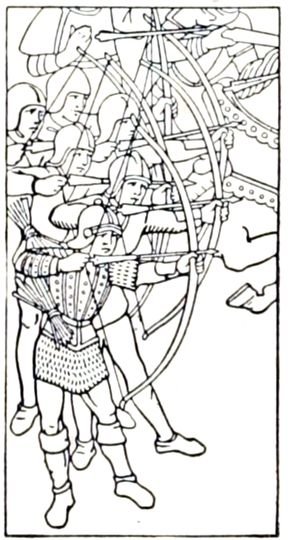
From an old print
ENGLISH ARCHERS
304. England Conquered Many Times. England had been conquered by the Romans, the Anglo-Saxons, and the Danes. Now she was conquered for the last time. The people who defeated her were the Normans of France. We have seen them come into France when the Normans scattered from their native lands in the north of Europe.
After Alfred died several kings ruled in England. When Harold was chosen king, the Duke of Normandy claimed the throne of England. He made this claim on the ground that the former English king had promised it to him. The Duke of Normandy has always been called William the Conqueror. He was a stern man who knew how to rule and fight. To establish his claim to the English throne he gathered together an army, crossed the Channel, and landed at Senlac, near Hastings.
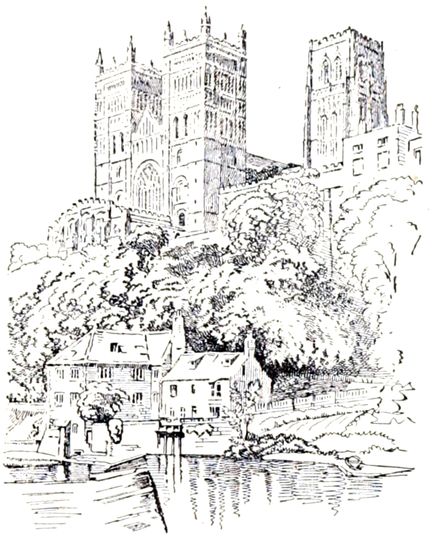
ST. CUTHBERT, A NORMAN CATHEDRAL
305. The Battle of Hastings (1066). Harold had gathered his soldiers to resist the Normans. They fought bravely, as any good soldiers do when defending their native land. "All day long they stood stubbornly together on a hilltop and beat back every attack with their swords and axes." When Harold was wounded, his men still fought on. William of Normandy now thought of a trick. He ordered his soldiers to pretend to be beaten and to retreat. This they did. The English soldiers now rushed forward to follow on their heels and cut down as many as they could. What was their dismay to see the Normans turning around and cutting down the English! When night came the English army was no more.
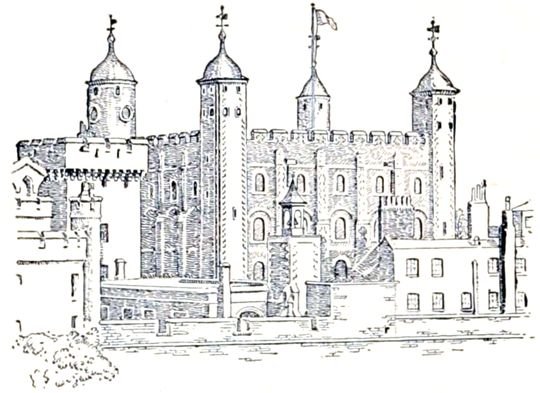
A NORMAN CASTLE BUILT IN 1078, NOW PART OF THE TOWER OF LONDON
Character of the Normans
England had staked all and had lost. Most of the country gave up. William was crowned king. He divided the land among his nobles, and England, which was democratic under the Anglo-Saxon became aristocratic under the rule of William. The Normans built the huge castles and cathedrals that dot the face of England. From their castles they lorded it over the Anglo-Saxon. But slowly this condition changed. After many years Normans and Anglo-Saxons commenced to grow friendly and their sons and daughters began to marry one another. The fusion of these two classes made the English people a more hardy and daring race than before.
How the Anglo-Saxons conquered the Normans
The local institutions which had grown up under the Anglo-Saxons now began to appear again. And in time the Normans may be said to have been conquered by the Anglo-Saxons. The Anglo-Saxon way of doing things belonged to the shire, the county, and the township. The people were called together in the different districts and practiced self-government.
THE STRUGGLE FOR THE GREAT CHARTER
Lawlessness of the nobles
306. Henry II a Great Ruler. Nearly a hundred years had gone by since William the Conqueror ruled England. There was great confusion in England. The Norman nobles were doing about as they pleased. They rode forth from their castles with their little armies and attacked each other, or attacked the citizens of a town, sometimes murdering them.
Then Henry II, the grandson of William the Conqueror, came to the throne. He was like his ancestor in many ways. He could brook no opposition. He was short and powerfully built. "He had red hair, a bull neck, and bow legs." He was careless about his dress, but was a hard worker. He saw that England needed order first. He therefore first of all compelled the nobles to behave by destroying some of their castles and driving the soldiers, which they had hired, back to France.
Trial by jury
He changed the way of finding out whether or not a man was guilty. Instead of employing the "ordeal by fire," by water, or by battle, he sent judges around to different places. These judges called together sixteen good men who told them about those who they thought had broken the law. These men made up the Grand Jury.
Twelve other men were selected to examine into all the facts of a given case before the man was condemned or set free. This way of "trying men by jury" was a great improvement over the old way. In these ways Henry II brought the evildoers in England, whether high or low, to obey the law or be severely punished. England was now once more an orderly country.
John a worthless king
307. King John and the Pope. The son of Henry II, John, was about the worst king that England ever had. John was bad; he would not keep a promise, was a great liar, was cruel, was cowardly, was a traitor and a tyrant.
All the churches closed
Ever since the days of William the Conqueror the kings of England had been the dukes of Normandy. In a war with the French king, John lost all of Normandy. The Pope named as Archbishop of Canterbury a man whom John opposed. The Pope and John quarreled. "The Pope closed every church in England. No bells rang to call the people to prayer or to service on the Sabbath. No priest could preach. The dead could not be buried; the living might not marry. Every church stood silent and grass grew about the doors."
The Pope called on the king of France to take John's place, for in the eyes of the Pope John was no longer king of England. John turned about and begged for the Pope's mercy. He promised to submit to his will and to pay him a large amount of money each year.
The barons revolt
308. John Compelled to Grant Magna Charta. John was so cruel to his own people that the barons rose in revolt. Their forefathers had been free, and "why not we?" they asked. John only "laughed in his sleeve." But the barons meant business. They met in a meadow, called Runnymede, and summoned the king to face them. He came.
The meeting at Runnymede
It was a great scene. There stood the barons with their soldiers not far away. Their faces showed their anger and their decision to have their rights. The head of every house had his great banner which he had carried to victory on many a field of battle. But worse than all, there John saw the very Archbishop of Canterbury whom he had refused to permit to enter England. John was furious, but he could not help himself, for he heard the clanking of cold steel all around him.
What the Great Charter meant
The barons told him plainly that he must give all England a pledge to do right according to England's law. They told him that this promise must be signed by his own hand and on the signed paper he must place the royal seal. This great paper is called the Great Charter—"Magna Charta" (1215). Englishmen love it and have often shed their blood in defense of it.
The Petition of Right
For more than four hundred years this charter was the foundation of the rights of Englishmen. But they found in the charter only the old laws which had come down from good Edward the Confessor (1042-1066). In 1628 another English king, Charles I, was compelled by Parliament to sign another charter, called the "Petition of Right." In this new pledge to the English people they found nothing very new but mostly the old laws or principles contained in Magna Charta.
The Bill of Rights
When James II was driven from the throne by the English people they drew another charter, which King William signed (1689). This was called the "Bill of Rights." In this there were not many new things, but it contained mostly the principles of Magna Charta and the Petition of Right. Besides, this last charter contained several rules which made Parliament superior to the king.
When the American people after their Revolution came to make a Constitution, they put in it many principles found in the English Bill of Rights. We ought to admire and love our Constitution because it contains ideas that have been tried out for more than ten centuries.
SUGGESTIONS INTENDED TO HELP THE PUPIL
The Leading Facts. 1. England almost ruined by the Danes. 2. Alfred's youth. 3. Alfred as king. 4. What he did for his people. 5. The Norman conquest. 6. Battle of Hastings. 7. Norman nobles built castles and brought confusion to England after William's time. 8. The Normans and Anglo-Saxons mix. 9. Henry II a great king. 10. Nobles forced to behave. 11. Established the Grand Jury and the jury to try cases. 12. King John lost Normandy and quarreled with the Pope. 13. John submits to the Pope. 14. Barons at Runnymede force John to sign Magna Charta. 15. The Petition of Right, the Bill of Rights, and the American Constitution.
Study Questions. 1. Why did the Danes go to England? 2. Tell all the anecdotes about Alfred the Great. 3. Prove that he was a good man. 4. Why did the Normans invade England? 5. Tell the story of Hastings. 6. Explain the mixture of races in England. 7. How did the Anglo-Saxons conquer the Normans? 8. Who was Henry II, and what did he do? 9. How did he prepare the way for Magna Charta? 10. Prove that John was a bad king. 11. Tell the story of Runnymede. 12. Give the date of Magna Charta, the Petition of Right, and the Bill of Rights. 13. What do Americans owe these charters?
Suggested Readings. Mowry, First Steps in History of England, 38-97; Tappan, England's Story, 24-93; Blaisdell, Stories from English History, 27-77; Dickens, A Child's History of England, 18-24, 50-63, 89-110, 122-168; Guerber, Story of the English, 42-53, 73-84, 117-128; Yonge, Young Folks' History of England; Mace-Tanner, Old Europe and Young America, 162-183.