THE MEN WHO CROSSED THE MOUNTAINS, DEFEATED THE INDIANS AND BRITISH, AND MADE THE MISSISSIPPI RIVER THE FIRST WESTERN BOUNDARY OF THE UNITED STATES
Reading edition
DANIEL BOONE, THE HUNTER AND PIONEER OF KENTUCKY
Boone born in Pennsylvania
105. A Famous Frontier Hero. Daniel Boone was born in Pennsylvania in 1735. He was only three years younger than Washington. While yet a boy he loved the woods, and often spent days deep in the forest with no companion but his rifle and dog.
Moved to the Yadkin
Boone's parents moved to North Carolina, and settled on the Yadkin River. There he married at the early age of twenty, and, pioneer-like, moved farther into the forest, where people were scarcer and game more plentiful. He built a log cabin for his bride, and made a "clearing" for raising corn and vegetables. But his trusty rifle furnished their table with all kinds of wild meat, such as bear, deer, squirrel, and turkey.
Crossed the mountains in 1760
In 1760 Boone with a friend crossed the mountains to the Watauga in east Tennessee, on a hunting expedition, where he killed a bear, and cut the date of the event on a beech tree, which still stands on Boone's Creek in east Tennessee.
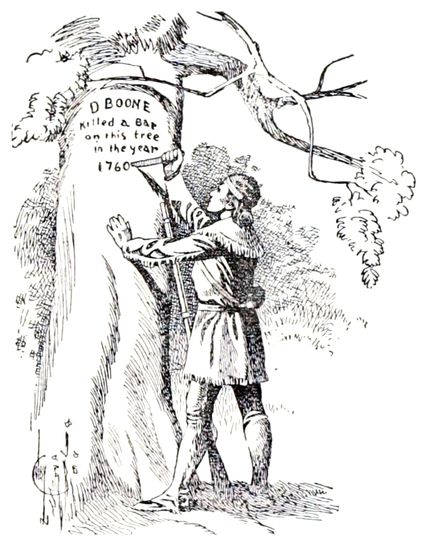
BOONE AND HIS BEAR TREE
News from across the Cumberland
One of Boone's hunter friends came back from a journey across the Cumberland Mountains and told of the beauty of the land beyond—its hills and valleys, its forests and canebrakes, full of game. Boone was anxious to go. Too many people were settling near him. But Kentucky was a dangerous country, even if beautiful. It was called "No-man's-land," because not even Indians lived there, and also the "dark and bloody ground," because the tribes from the north and from the south met there in deadly conflict.
Boone and companions go to Kentucky
106. Boone Goes to the Land of Canebrakes and Blue Grass. While the people along the seacoast were disputing with the king, Boone and five companions, after climbing over mountains, fording rivers, and making their way through pathless forests, reached Kentucky, the land of salt springs, canebrakes, and blue grass.
Danger from animals
They built a log camp and spent several months enjoying the wild life so dear to the hunter. But it was full of danger. Sometimes it was a battle with a father and a mother bear fighting for their little ones. The sneaking panther or the lurking wildcat threatened their lives. Now and then, hundreds of buffaloes came rushing through the canebrakes.
Danger from Indians ever present
But danger from the Indians was present every moment. Day and night, sleeping in their camp or tramping through the woods, the hunters had to be ready for the death grapple. One day Boone and a companion named Stewart were off their guard. The Indians rushed upon them and captured them.
Captured but escapes
Boone and his companion understood the ways of the Indians, and won their confidence. One night, as the savages slept around the camp fire, Boone arose and quietly awoke Stewart. They stole silently from the camp and hastened by night and day back to their old camp, only to find it destroyed and their comrades gone.
News from the old home
One day Daniel Boone saw his brother coming through the woods. What a happy meeting five hundred miles from home! The brother brought good news from kindred and friends.
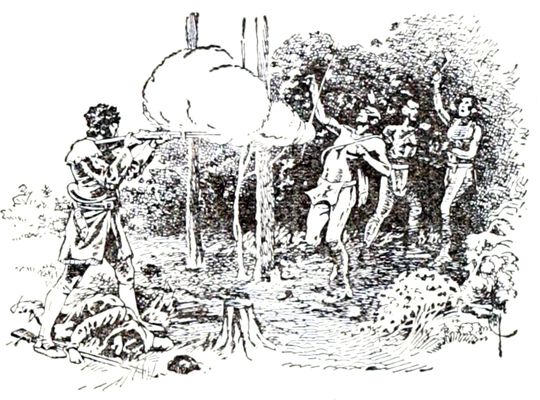
BOONE FIGHTING OVER THE BODY OF HIS SON
His brother returns home for supplies
Stewart was shot by the Indians, but Boone and his brother remained all winter in Kentucky. Powder, lead, and salt were growing scarce. What should be done? Boone's brother returned home for supplies, but Daniel remained without even a dog for a companion. He very seldom slept twice in the same place for fear of the Indians.
He wandered to the banks of the Ohio, and was charmed with all he saw. He then decided that some day he would make Kentucky his home.
Brings supplies and both go home
Boone's brother returned in the spring, bringing supplies on two pack horses. After further explorations the two brothers returned to their home on the Yadkin and told their neighbors of the wonders of the new land.
An Indian attack
In the fall of 1773 several families, with cattle and horses, bade farewell to their friends and started for Kentucky, a "second Paradise," as Boone called it. Before they reached the new land Indians fell upon them and killed six. Among the killed was Boone's eldest son. The party returned for a time to a settlement in Virginia.
Making the "Wilderness Road"
Richard Henderson, a rich planter, claimed a great tract of land in Kentucky, and put Boone at the head of thirty brave men to cut and blaze a road from the Holston River over the mountains, through Cumberland Gap to the Kentucky River. The result was the famous "Wilderness Road," the first road across the mountains, and over which hundreds of pack horses and thousands of settlers made their way.
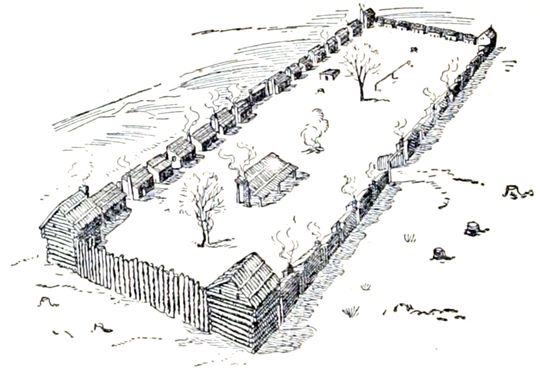
FORT BOONESBORO IN WINTER
After the plan by Colonel Henderson in Collins' "Historical Collections of Kentucky"
Fort Boonesboro
When the road was finished to the banks of the Kentucky River, Daniel Boone built Fort Boonesboro. The fort was about two hundred sixty feet long, and one hundred fifty feet wide. At each corner of it stood a two-story blockhouse with loopholes, through which the settlers could shoot at Indians. Cabins with loopholes were built along the sides of the fort. Between the cabins a high fence was made by sinking log posts into the ground. Two heavy gates were built on opposite sides of the fort. Every night the horses and cattle were driven inside the fort.
His family in the "second Paradise"
107. Boone Takes His Family to Kentucky. When the fort was finished Boone brought his family, and several others, over the mountains to his "second Paradise." Other settlers came, and Boonesboro began to grow. Some of the bolder settlers built cabins outside of the fort, where they cut away and burned the trees to raise corn and vegetables.
Three girl prisoners
To the Indian all this seemed to threaten his hunting ground. The red men were anxious, therefore, to kill and scalp these brave pioneers. One day Boone's daughter and two girl friends were out late in a boat near the shore opposite the fort when the Indians suddenly seized the girls and hastened away with them. The people heard their screams for help, but too late to risk crossing the river.
The chase and the capture
What sorrow in the fort that night! Had the Indians scalped the girls, or were they hastening to cross the Ohio with them? The next day Boone with eight men seized their guns, found the Indian trail, and marched with all speed. What if the Indians should see the white men first! On the second day Boone's party came upon the Indians building a fire, and fired before they were seen. Two of the Indians fell, and the others ran away, leaving the girls behind, unharmed, but badly frightened.
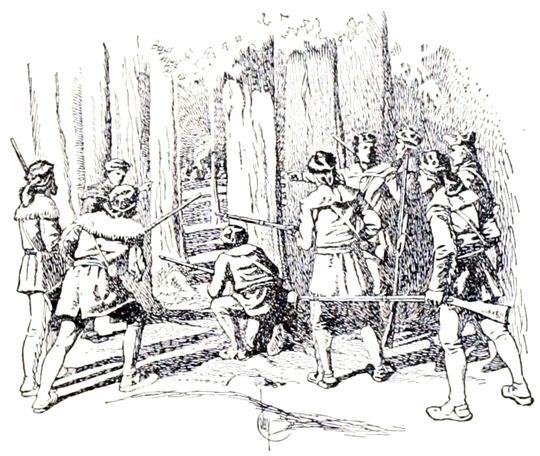
BOONE AND HIS MEN TRAILING THE INDIANS
Kentucky in the War of the Revolution
The War of the Revolution was already raging east of the mountains, and the Indians were taking the side of the British. In April, 1777, a small army of Indians crossed the Ohio and attacked Boonesboro. The little fort made a bold fight. The Indians retreated, but returned on the Fourth of July in large numbers, to destroy the fort and scalp the settlers. For two days and nights the battle went on. The fierce war cry of the Indians filled the woods around the fort. The white men took deadly aim. The women aided by melting lead into bullets. The Indians again failed, and finally retreated.
The prize prisoner
While making salt at the "Blue Licks," Boone and twenty-seven of his men were captured by the Indians and marched all the way to Detroit, the headquarters of the British army in the Northwest. The British offered the Indians five hundred dollars for Boone, but the savages were too proud of their great prisoner, and marched him back to their towns in what is now Ohio.
Adopted by an Indian family
Here he was adopted by an Indian chief. They plucked out all of Boone's hair except a "scalp lock," which they ornamented with feathers. They painted and dressed him like an Indian. His new parents were quite proud of their son. Sometimes he went hunting alone, but the Indians counted his bullets and measured his powder. But Boone was too shrewd for them. He cut the bullets in two, and used half charges of powder.
Steals away to Boonesboro
One day he saw four hundred fifty painted warriors getting ready to march against Boonesboro. He went hunting that day, but he did not come back. What excitement in that Indian town! Soon the woods were full of Indians hunting for Boone. In five days—with but one meal—he reached Boonesboro.
All hands fell to repairing the fort. The horses, cattle, and provisions were brought inside the fort, and water was brought from the river.
The Indians came, and Boone's Indian "father" called on him to surrender. Boone asked for two days to think about it, but he used this time in getting ready to fight. At the end of the two days Boone told him that his men would fight to the last.
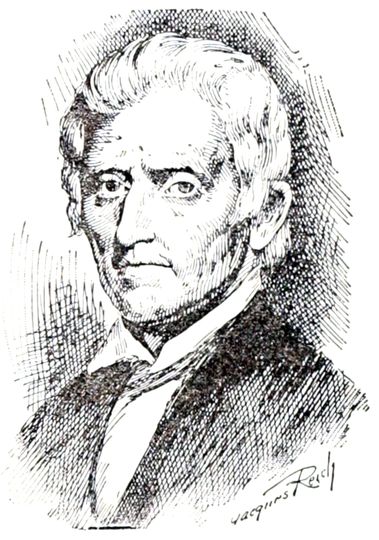
DANIEL BOONE
From a portrait made in 1819 when Boone was 85 years old, painted by Chester Harding, and now in possession of the Massachusetts Historical Society, Boston, Massachusetts
An Indian trick spoiled
The Indians then proposed that twelve from each side meet to make a treaty of peace. Boone took his strongest men. While parleying, each Indian suddenly seized a white man. The white men broke away, and ran for the fort. Boone's riflemen were ready, and poured a hot fire into the Indians.
The Indians cannot capture Boone's fort
The Indians climbed into trees to shoot down into the fort. They tried to set the fort on fire, but failed. They then tried to dig a tunnel under the fort, but failed in that also.
After nine days of failure, and after losing many warriors, the Indians gave up the fight and recrossed the Ohio. Although the settlers had to keep a daily watch for Indians, and had to fight them in other parts of Kentucky, they never attacked Boonesboro again.
Boone's reason for again moving west
During the Revolutionary War other brave men came as pioneers into Kentucky, and built forts, and defended their settlements against the Indians. As the settlements grew thicker, game grew scarcer. Boone resolved once more to move farther west. When asked why, he replied: "Too much crowded. I want more elbow room."
Moves to Missouri
At the age of sixty, while Washington was still president, and after he had seen Kentucky become a state, Daniel Boone and his faithful wife made the long journey to the region beyond the Mississippi, into what is now Missouri. There he lived and hunted. He saw this region pass from Spain to France, and from France to the United States (1803). He was still a hunter at eighty-two, and saw Missouri preparing to enter the Union as the twenty-fourth state.
Died in 1820
He died in 1820 at the age of eighty-six. Years afterward, remembering the noble deeds of the great pioneer, Kentucky brought his body to the capital city and buried it with great honors.
The Louisiana country and the French
108. Life in the Mississippi Valley. When Boone led his brave men into Kentucky, white men had been living for years in the Mississippi Valley, farther west. These were the French of Louisiana, as they called their country. Their chief settlement was St. Louis.
These people came at first to dig lead from the old Indian mines of southern Missouri and to trade for furs. They were a quiet people who knew little and cared less about the rest of the world. They did not work hard, and they loved good times. A traveler who visited them says they were "the happiest people on the globe."
JOHN SEVIER, "NOLICHUCKY JACK"
Sevier born in Virginia
Early life in the Shenandoah
109. A Famous Indian Fighter. John Sevier was born in the Shenandoah Valley in 1745. His mother taught him to read, but he obtained most of his schooling in Washington's old school town, Fredericksburg. He quit school at sixteen. He built a storehouse on the Shenandoah and called it Newmarket. He lived there, selling goods and fighting Indians, until, at the early age of twenty-six, he was a wealthy man. He had already made such a name as an Indian fighter that the governor made him captain in the militia of which George Washington was then colonel.
Fine looking
Sevier was a fine-looking man. He was tall, slender, erect, graceful in action, fair skinned, blue eyed, and had pleasing manners, which had come to him from his French parents. He charmed everybody who met him, from backwoodsmen up to the king's governor at Williamsburg.
He goes to the Watauga
A most promising future opened before him in Virginia. But hearing of a band of pioneers on the Watauga, he rode over one day to see them and resolved to cast in his lot with them.
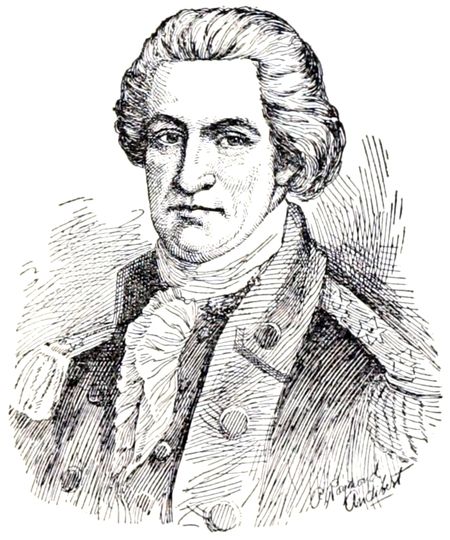
JOHN SEVIER
After an engraving from a miniature now in possession of one of his descendants at New York
Tennessee in the Revolution
During the Revolutionary War, British agents went among the Cherokee Indians and gave them guns and ammunition. Indian-like, they planned to take Fort Watauga by surprise. They came creeping up to the fort one morning just at daybreak. Forty deadly rifles suddenly blazed from portholes and drove them back to the woods. During the siege of three weeks, food grew scarce at the fort, and the men became tired of being cooped up so long. Some of them ventured out and were shot or had very narrow escapes from death.
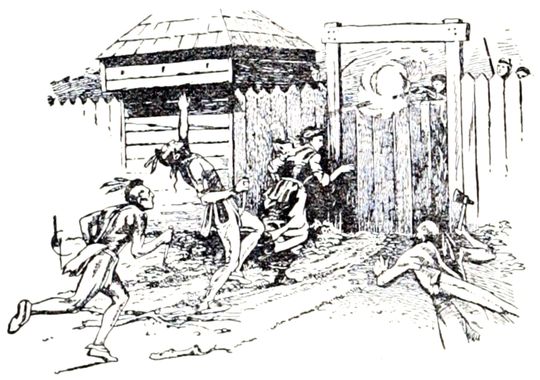
KATE SHERRILL RACING FOR LIFE
The story of Jack Sevier and Kate Sherrill
The story is told that Sevier, during the siege, fell in love with the beautiful, tall, brown-haired Kate Sherrill. One day she ventured out of the fort. It was a daring act, for four men had lost their lives in this way. The Indians tried to catch the girl, for they did not want to kill her. But she could run like a deer, and almost flew to the fort. Sevier was watching, and shot the Indian nearest her. The gate was closed, but she jumped with all her might, seized the top of the stockade, drew herself up, and sprang over into the arms of Sevier. Not long after she became his wife.
Sevier acts quickly
In 1778 Sevier heard that the Indians were coming again. He quickly called his men together, took boats, and paddled rapidly down the Tennessee to the Indian towns. He burned the towns, captured their store of hides, and marched home on foot. How surprised the Indians were when they returned!
Moves to the Nolichucky
110. Nolichucky Jack. The Watauga Settlement was growing in numbers, and Sevier went to live on the Nolichucky, a branch of the French Broad River. There he built a large log house, or rather two houses, and joined them by a covered porch. Outside were large verandas, while inside were great stone fireplaces.
Welcomes rich and poor
Here Sevier gave hearty welcome to friend and stranger, no matter how poor, if they were honest. The settlers far and wide, and new settlers from over the mountains, partook of his cider, hominy, corn bread, and of wild meat of many kinds. Sometimes he invited them with their families to a barbecue. Whether people came for advice or to call him to arms against the Indians, no one was turned away. "Nolichucky Jack," as his neighbors loved to call him, held a warm place in every settler's heart.
British challenge
In 1780 Cornwallis, then victorious in South Carolina, sent Colonel Ferguson with one thousand British soldiers into western North Carolina to punish the backwoodsmen. Ferguson grew bold, and sent word across the mountains, threatening to punish Sevier and his brave riflemen. This was enough. Colonel Shelby of Kentucky and Sevier resolved to rouse the frontiersmen, cross the mountains, and teach Colonel Ferguson a lesson. Colonel Campbell with his men from the Holston, in Virginia, joined them. A thousand well-mounted backwoodsmen, with their long rifles, fringed hunting shirts, and coonskin caps, began the march from the Watauga across the mountains. Once across they were joined by several hundred Carolinians. Ferguson retreated to Kings Mountain, too steep on one side to be climbed. He felt safe behind his thousand gleaming bayonets.
The plan of battle
Battle of Kings Mountain
The backwoodsmen picked nine hundred men to make the charge up the mountain in face of the bayonets, although among themselves there was not a bayonet. Three divisions, one for each side, marched up the mountain. Down the mountain side came the flashing bayonets. The backwoodsmen in the center retreated from tree to tree, firing steadily all the time. The British, now shot at from both sides as well as in front, turned and charged at one side. Then one division fired into their backs and the other on their side. What could bayonets do in the midst of trees?
The result
The backwoodsmen kept to the trees and their rifles seldom missed their aim. The British retreated to the top of the mountain. Colonel Ferguson was killed and his entire army was killed or captured. This victory caused great rejoicing among the Americans and prepared the way for the work of Greene and Morgan.
A deadly blow
Sevier and Campbell hastened back over the mountains, for the Indians were scalping and burning again. With seven hundred riflemen, they marched against the Indian towns and burned a thousand cabins and fifty thousand bushels of corn. This was a hard blow, but the Indians kept fighting several years longer.
Sevier, in all, fought thirty-five battles. He was the most famous Indian fighter of his time.
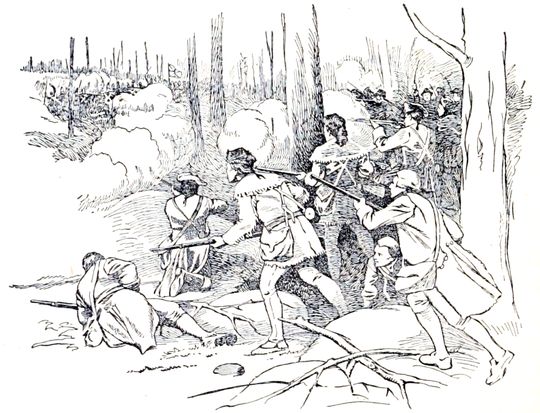
THE BATTLE OF KING'S MOUNTAIN
Where 900 frontiersmen attacked and totally destroyed 1,000 British soldiers entrenched and better armed
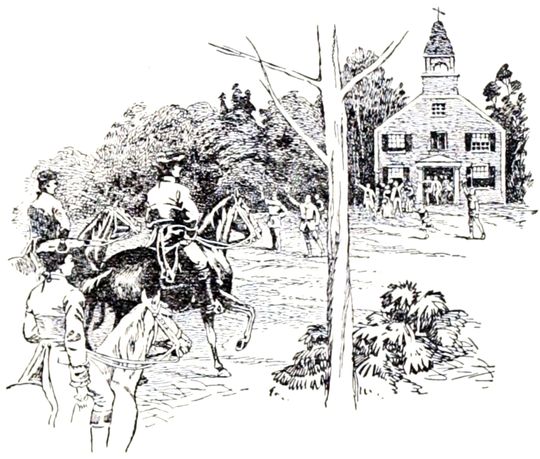
"NOLICHUCKY JACK'S A-COMING"
Sevier welcomed by the congregation of the country church
Governor of Tennessee many times
Indians trusted him
When Tennessee became a state the people elected him governor. They reëlected him till he had held the office for twelve years. The people of Tennessee almost worshiped the bold pioneer. He had spent all his time and all his wealth in their service. And while he was governor, and living in Knoxville, the early capital, one or more of his old riflemen were always living at his home. Even the Indian chiefs often came to visit him. When the people of Tennessee were debating questions of great importance, they always asked: "What says the good old governor?"
The boy's disappointment
One Sunday, when all the people of a backwoods settlement were at the country church, a bareheaded runner rushed in and shouted, "Nolichucky Jack's a-coming!" The people rushed out to see their governor. As he came near, he greeted one of his old riflemen, put his hand upon the head of the old soldier's son, spoke a kindly word, and rode on. The boy looked up at his father and said: "Why, father, 'Chucky Jack' is only a man!"
Died in 1815
Sevier died in 1815, while acting as an officer in marking the boundary line between Georgia and the Indian lands. Only a few soldiers and Indians were present. There he lies, with only the name "John Sevier" cut on a simple slab. But for generations the children of the pioneers went on repeating to their children the story of the courage and goodness of "Nolichucky Jack." His name is yet a household word among the people of eastern Tennessee. Their children are taught the story of his life. In the courthouse yard at Knoxville stands a monument erected to his memory.
GEORGE ROGERS CLARK, THE HERO OF VINCENNES
Clark born in Virginia
A surveyor
111. A Successful Leader against the Indians and the British. George Rogers Clark was born in Virginia in 1752. From childhood Clark liked to roam the woods. He became a surveyor and an Indian fighter at the age of twenty-one. Like Washington, with chain and compass, and with ax and rifle, he made his way far into the wild and lonely forests of the upper Ohio.
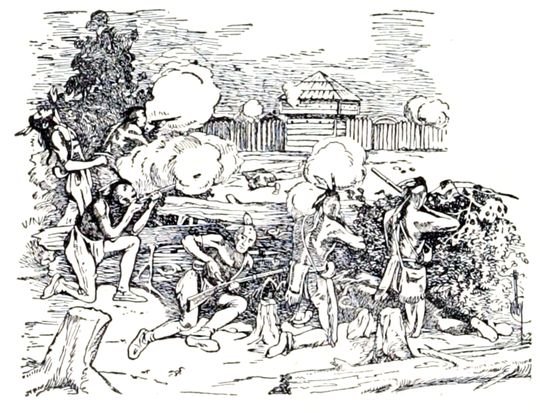
INDIANS ATTACKING A FORT
Again and again, when a surprise was not possible, the Indians from safe hiding places picked off the men in a garrison
A scout
Clark was a scout for the governor of Virginia in the expedition which defeated the great Shawnee chief Cornstalk at the mouth of the Kanawha.
Two years later Clark made his way alone over the mountains and became a leader in Kentucky, along with Boone. The Kentucky hunters chose Clark to go to Virginia as their lawmaker.
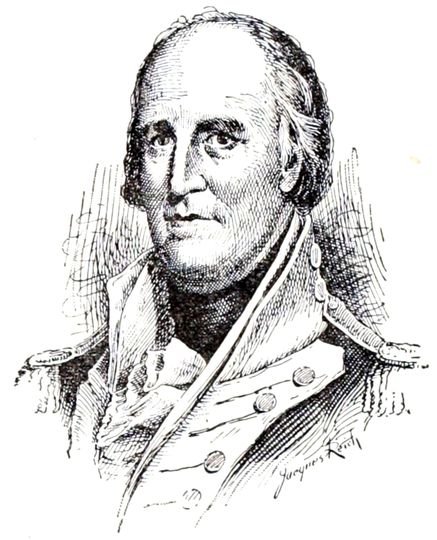
GEORGE ROGERS CLARK
From a painting on wood by John Wesley Jarvis, now in the State Library at Richmond, Virginia
In Kentucky
He told Governor Patrick Henry that if Kentucky was not worth defending against the Indians, it was not worth having. At this the Virginian lawmakers made Kentucky into a Virginia county and gave Clark five hundred pounds of powder, which he carried down the Ohio River to Kentucky.
Life at Harrodsburg
Clark lived at Harrodsburg where, for more than a year, he was kept busy helping the settlers fight off the Indians. This was the very time when Boonesboro and other settlements were so often surrounded by Indians who had been aroused by the British officers at Detroit. These officers paid a certain sum for each scalp of an American the Indians brought them.
Turns to Patrick Henry in time of need
After having seen brave men and women scalped by the Indians, Clark decided to strike a blow at the British across the Ohio. But where could he find money and men for an army? Kentucky did not have men enough. Clark thought of that noble patriot across the mountains, Patrick Henry. He mounted his horse and guided some settlers back to Virginia, but kept his secret. In Virginia he heard the good news that Burgoyne had surrendered.
Governor Henry was heart and soul for Clark's plan. He made Clark a colonel, gave him six thousand dollars in paper money, and ordered him to raise an army to defend Kentucky.
A colonel with a secret
112. The Campaign against Old Vincennes. In May, 1778, Clark's little army of about one hundred fifty backwoodsmen, with several families, took their flatboats and floated down the Monongahela to Fort Pitt. Clark did not dare tell the riflemen where they were going, for fear the British might get the word. Here they took on supplies and a few small cannon.
Floating down the beautiful Ohio
On they floated, in the middle of the river to keep away from the Indians who might be hiding in the deep, dark forests on the river banks. At the falls of the Ohio, on Corn Island, Clark landed his party. He built a blockhouse and cabins, and drilled the riflemen into soldiers while the settlers planted corn. This was the beginning of the city of Louisville.
Clark tells his secret
One day Clark called his men together and told them the secret—he was really leading them against the British forts on the Illinois and the Wabash rivers.
A few of the men refused to go so far from home—a thousand miles—but the rest were willing to follow their leader.
A long march begun
In June, Clark's boats "shot the falls" and were soon at the mouth of the Tennessee, where a band of hunters joined the party. There Clark hid the boats and began the long march through tangled forests and over grand prairies. But they did not know what minute the Indians might attack, or some British scout discover them and carry the news to General Hamilton at Detroit.
Kaskaskia, July 4, 1778
They reached the old French town of Kaskaskia at dusk on July 4. They did not dare give a shout or fire a gun, for the British officer had more men than Clark.
Surrounds the town
Clark sent part of his men silently to surround the town, while he led the others to the fort, where they heard the merry music of the violin and the voices of the dancers.
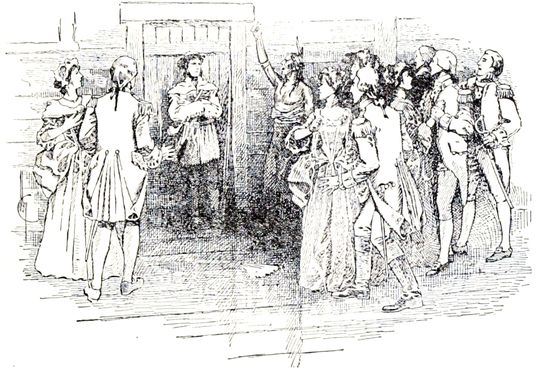
CLARK'S SURPRISE AT KASKASKIA
Virginia, not Great Britain
The French settlers alarmed
Clark himself slipped into the great hall, folded his arms, and looked in silence on the dimly lighted scene. An Indian lying on the floor saw Clark's face by the light of the torches. He sprang to his feet, and gave the terrible war whoop. Instantly the dancing ceased, the women screamed, and the men rushed toward Clark. But Clark simply said: "Go on with your dance, but remember that you dance under Virginia and not under Great Britain!" The British general surrendered, and the French inhabitants trembled, when they learned that the backwoodsmen had captured the town. They sent their priest, Father Gibault, and other chief men to beg for their lives. Imagine their surprise and joy when Clark told them that not only were their lives safe, but that the new republic made war on no church, and protected all from insult.
The treaty with France
He also told them that the King of France had made a treaty with the United States and was sending his great war ships and soldiers to help America. The town of Cahokia also surrendered.
Vincennes surrenders
Father Gibault went to Vincennes to tell the French settlers about the doings of Clark and to give them the news that France had taken sides with the Americans. The people rejoiced, and ran up the American flag. Clark sent Captain Helm to command the fort.
General Hamilton at Detroit was busy planning to attack Fort Pitt and to encourage the Ohio Indians to kill and scalp Kentuckians.
General Hamilton stirred up
Stays in Vincennes until spring
How astonished he was when he heard that the forts on the Illinois and the Wabash had fallen! He gathered a mixed army of British, Canadians, and Indians, crossed Lake Erie to the mouth of the Maumee, and "poled" and paddled up that river to the portage. Down the Wabash they floated, five hundred strong. Vincennes surrendered without a blow. Hamilton decided to stay there for the winter and march against Clark in the spring. This was a blunder. He did not yet know Clark and his backwoodsmen.
"I must take Hamilton or Hamilton will take me," said Clark, when he heard the news. He immediately set to work to build a rude sort of gunboat, which he fitted out with his cannon and about forty men. He sent the Willing, as it was called, down the Mississippi, around into the Ohio, and up the Wabash to meet him at Vincennes.
Clark begins the march
All was excitement in the French towns. Forty or fifty French joined Clark's riflemen. Father Gibault gave them his blessing, and the march overland to Vincennes began.
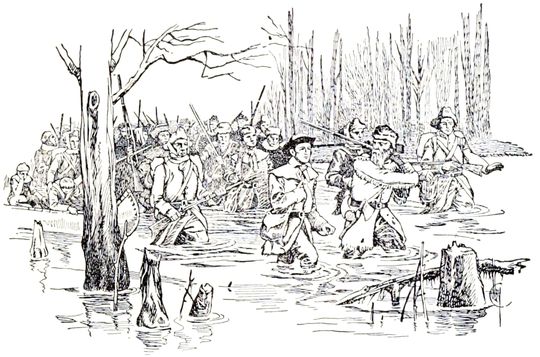
CLARK'S MEN ON THEIR WAY THROUGH THE DROWNED LANDS OF THE WABASH VALLEY
On the march
Clark divided his men into parties. Each, in its turn, did the hunting, and at night invited the others to sit around great camp fires to feast on "bear ham, buffalo hump, elk saddle, and venison haunch." They ate, sang, danced, and told stories. No doubt they often talked of their loved ones far away in the cabins of Virginia and Kentucky.
The drowned lands
On they pushed till they came to the "drowned lands of the Wabash," and there they saw miles and miles of muddy water. They made a rude boat to carry them over the deepest parts. The horses had to swim.
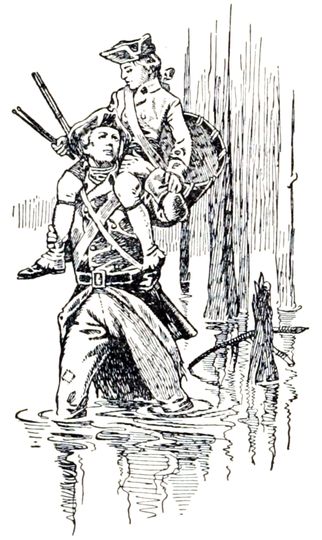
THE BIG TROOPER CARRIED THE DRUMMER BOY
The morning gun
Soon they were near enough Vincennes to hear the "morning gun" at the fort, but they did not dare fire a gun themselves for fear of being discovered by parties of hunters. Food grew scarce, game was hard to find, and starvation threatened them.
Terrible suffering
Sometimes, after wading all day, they could hardly find a dry spot to camp for the night. Some grew too weak to wade and were carried in boats. The stronger sang songs to keep up the courage of the weak. When they finally reached the opposite shore of the Wabash many fell, worn out—some lying partly in the water.
Those who were well built great fires and warmed and fed the faint ones on hot deer broth. But these brave men soon forgot their hardships and again were full of fight.
Clark's letter
Clark now decided to take a bold course. He sent a letter to the people of Vincennes telling them that he was about to attack the town. He advised all friends of America to remain quietly in their homes, and asked all friends of the British to go to the fort and join the "hair buyer," as the backwoodsmen called Hamilton.
The attack
At dark, Clark's men charged into the town and attacked the fort. The fight went on all night. As soon as it was daylight the backwoodsmen fired through the portholes and drove the gunners from the cannon.
Hamilton surrenders
Clark's men begged to storm the fort. Only one American had been wounded, but several British soldiers had been killed and others wounded. In the afternoon Hamilton surrendered and once more the Stars and Stripes floated over "old Vincennes."
The Willing appeared in a few days. Her men were deeply disappointed because they were too late to take part in the fight.
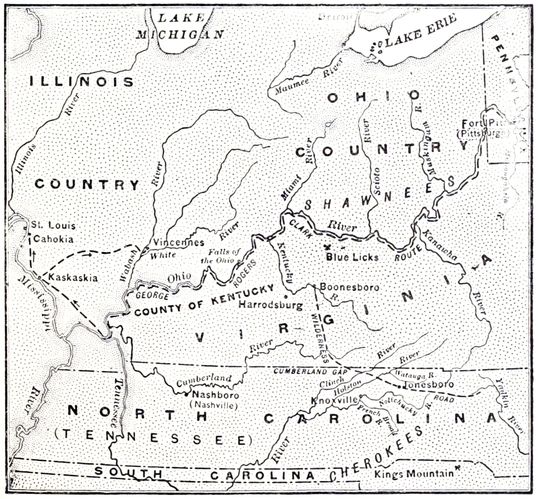
EXPEDITIONS TO THE WEST AND THE SCENE OF GEORGE ROGERS CLARK'S CAMPAIGN
Clark put men in the forts at Kaskaskia, Cahokia, and Vincennes, and made peace with the Indians round about. But he was never able to march against Detroit, as once he had planned to do.
Clark's Grant
Virginia rewarded the brave men who had followed Clark by giving to each three hundred acres of land in southern Indiana. The land was surveyed and is known to-day as "Clark's Grant."
Clark and his men had performed one of the greatest deeds of the Revolutionary War. They made it possible for the United States to have the Mississippi River for her western boundary when England acknowledged our independence.
Clark unrewarded
George Rogers Clark was never properly rewarded. He spent his last days in poverty at the falls of the Ohio, on Corn Island, and died in 1818. In 1895 a monument was erected in honor of his memory in the city of Indianapolis, Indiana.
SUGGESTIONS INTENDED TO HELP THE PUPIL
The Leading Facts. 1. Boone loved the woods, crossed the mountains into east Tennessee, and later went to Kentucky. 2. He wintered alone in Kentucky; his brother returned home for supplies. 3. Boone built the "Wilderness Road," and also built Fort Boonesboro. 4. Boone took part in the War of the Revolution, was captured by the Indians, carried to Detroit, but escaped. 5. Years after his death his remains were taken to Frankfort, Kentucky.
6. John Sevier studied at Fredericksburg; fought Indians in the Shenandoah. 7. He went over to the settlement on the Watauga; helped defend it against the Indians. 8. Sevier helped win the great victory at Kings Mountain. 9. He was many times governor of Tennessee.
10. George Rogers Clark loved the woods; was a surveyor and an Indian fighter at twenty-one. 11. Moved to Kentucky, saw men and women scalped, and resolved to capture the British posts north of the Ohio. 12. Clark received permission from Patrick Henry, collected his little army, and floated down the Ohio to the falls. 13. He drilled his men; set out for Kaskaskia, which he captured. 14. Clark marched for Vincennes through the drowned lands; attacked and captured Vincennes. 15. Clark was not rewarded by the government, but the state of Indiana has erected a great monument to his memory.
Study Questions. 1. What did Boone do that was pioneer-like? 2. What was the country doing in 1760? 3. Why did Boone wish to leave North Carolina? 4. What were the early names of Kentucky, and what did these names mean? 5. Tell the story of Boone's first visit to Kentucky. 6. Picture the capture and escape of Boone and Stewart. 7. Find the places on the map which are named on Boone's Wilderness Road. 8. Picture the scene in Boonesboro the night of the capture of the girls and also their rescue and return home. 9. Go with Boone to Blue Licks and help make salt. 10. Be captured, and tell of the long journey to Detroit, what you saw there, and how and why Boone made his escape. 11. Tell the story of the last attack on Boonesboro. 12. Why did Boone move to Missouri?
13. What famous men went to school at Fredericksburg? 14. What famous men have lived a part of their time in the Shenandoah? 15. What changed Sevier's career? 16. Tell what happened to Sevier at the siege of Fort Watauga. 17. Why did Sevier leave Watauga, and what sort of life did he lead on the Nolichucky? 18. Tell of the gathering of the clans, and picture the battle of Kings Mountain. 19. Why did the people of Tennessee love Sevier? 20. Why was the boy disappointed?
21. What were Clark's surroundings in boyhood? 22. When was he a scout? a leader in Kentucky? 23. What made Clark learn to hate the British? 24. Tell the story of his secret. 25. Picture the voyage to the falls of the Ohio. 26. What did Clark do here? 27. Tell the story of events from the falls of the Ohio till he reached Kaskaskia. 28. Picture the scene of the dance at Kaskaskia. 29. What news did Clark give Father Gibault? 30. Where were the British, and what did they do? 31. Picture Clark's march to Vincennes. 32. Be one of the soldiers of Clark and tell what was seen, heard, and done the night of the attack on Vincennes and the next day. 33. Where was Clark's Grant? 34. Why do we call Clark's conquest of Kaskaskia and Vincennes one of the greatest events in American history? 35. Where is a monument erected to his memory? 36. Find on the map the places mentioned in the campaign.
Suggested Readings. Daniel Boone: Wright, Children's Stories of American Progress, 1-40; Glascock, Stories of Columbia, 138-147; Hart, Camps and Firesides of the Revolution, 101-116; McMurry, Pioneers of the Mississippi Valley, 68-83.
John Sevier: Blaisdell and Ball, Hero Stories from American History, 90-104; McMurry, Pioneers of the Mississippi Valley, 104-123; Phelan, History of Tennessee, 57-66, 241-257.
George Rogers Clark: McMurry, Pioneers of the Mississippi Valley, 124-149; Blaisdell and Ball, Hero Stories from American History, 1-17; Eggleston, Tecumseh and the Shawnee Prophet, 41-51; Roosevelt, The Winning of the West, II, 31-85.