THE MEN WHO WON TEXAS, THE OREGON COUNTRY, AND CALIFORNIA
Reading edition
SAM HOUSTON, HERO OF SAN JACINTO
Houston among the Cherokees
142. Sam Houston. Young Houston was born of Scotch-Irish parents, in Virginia (1793). His father had fought under General Morgan in the Revolution. Sam Houston did not have much schooling, and when but thirteen his family moved to east Tennessee. Made angry by his older brother, he left home and went to live with the Cherokee Indians. He liked the wild life of the Indians and took part with the Indian boys in their pastimes of hunting, fishing, and playing at games.
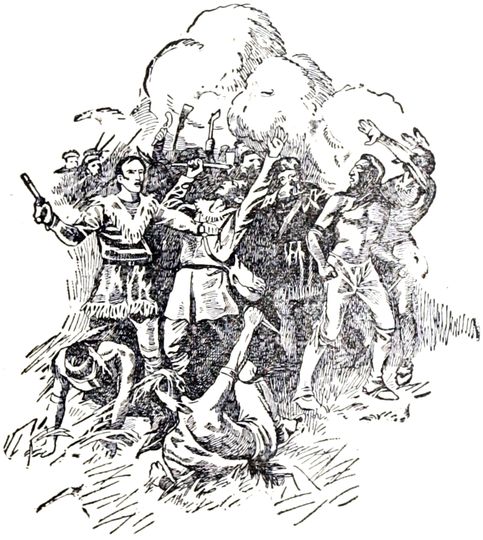
THE BATTLE OF HORSESHOE BEND
Here Houston, under Jackson in the victory over the Creeks, won great distinction
Returns home
Wounded in battle
He was now eighteen. He returned home and went to school a term at Marysville Academy. In the war of 1812 General Jackson called the men of Tennessee to arms. Young Houston responded to the call, and fought against the Indians in the great "Battle of Horseshoe Bend." After doing heroic deeds, he was dangerously wounded. Houston was a long time in getting well.
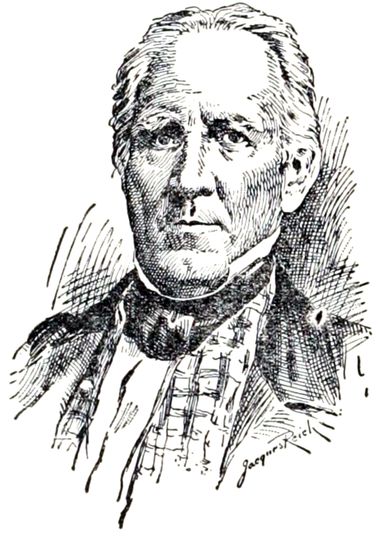
SAM HOUSTON
From a photograph by Matthew B. Brady in the collection of the War Department, Washington, D.C.
Elected to Congress
At twenty-five he began to study law in Nashville and in six months—just a third of the time said to be necessary—he was ready to practice. Houston's rise in the law and in the favor of the people was rapid. He went from one position to another until the people elected him to Congress.
Governor of Tennessee
Forsakes his home
He was in Congress four years. He won many friends by his gracious behavior. The people of Tennessee made him their governor. But suddenly, without warning, Houston resigned as governor, and forsook his home and friends. He sailed down the Mississippi River to the Arkansas, and up this river several hundred miles to the land of his early friends, the Cherokees, whom the United States government had sent to that far-away country.
Returns to the Cherokees
The old chief's welcome
Here Houston found the old chief—now the head of his tribe—who had adopted him as a son years before on the banks of the Tennessee. The chief threw his arms around him in great affection and said: "My son, eleven winters have passed since we met. My heart has wondered often where you were; and I heard you were a great chief among your people.... I have heard that a dark cloud had fallen on the white path you were walking, and when it fell ... you turned your thoughts to my wigwam. I am glad of it,—it was done by the Great Spirit.... My wigwam is yours, my home is yours, my people are yours,—rest with us."
Visits Washington
When Andrew Jackson became President of the United States Houston went, in his Indian dress, on a visit to Washington. He was warmly received by his old friend from Tennessee.
Visits Tennessee
Once more he turned his face toward the wilderness. He stopped in Tennessee and was warmly greeted by old friends. He did not stay long in Tennessee.
Hastens to Texas
Neither did he stay long with the Cherokees, but hastened to Texas, where the people were already murmuring against the treatment they were receiving from Mexico.
Texas declares independence
The people of Texas finally issued a declaration of independence. Thereupon the Mexicans resolved to send a large army into Texas and force the revolutionists into submission to the government.
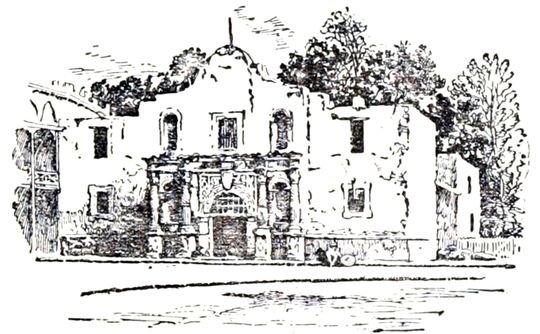
THE ALAMO, SAN ANTONIO
Of its defense by Travis, Crockett, and their few men it was said, "Thermopylae had her messenger of woe—the Alamo had none"
A most important event of this war was the capture, by a large Mexican force, of an old mission building used as a fortress, called the Alamo. It was defended by one hundred forty men, among them the famous "Davy" Crockett, Colonel Travis, and Colonel Bowie—the inventor of the bowie knife. Only six Texans were alive after the capture of the fortress. These heroic men died, fighting the Mexicans to the last.
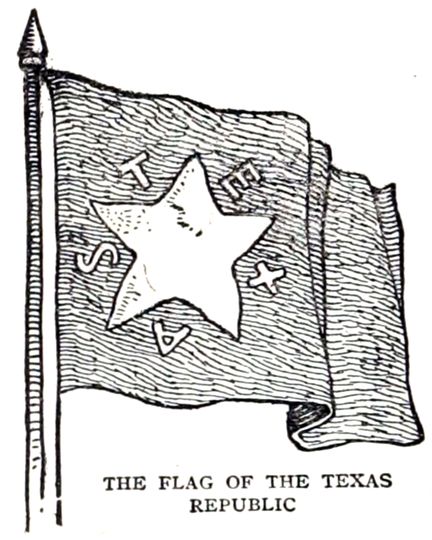
THE FLAG OF THE TEXAS REPUBLIC
"Remember the Alamo!"
"Remember the Alamo!" became the war cry of every Texan. The Mexicans were approaching, five thousand strong, under General Santa Ana. General Houston commanded the Texans, about seven hundred in all.
Massacre of Goliad
Suddenly the news came that General Fannin and his men, five hundred in number, had been massacred by the Mexicans at Goliad. The cause of Texan independence looked dark indeed.
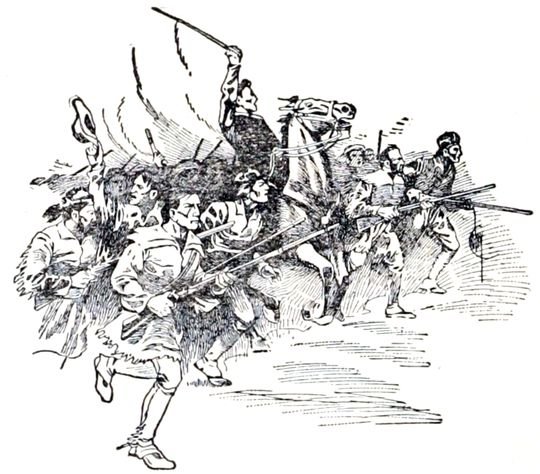
HOUSTON AT SAN JACINTO
Where his battle cry, "Remember the Alamo!" won Texas independence from Mexico
Houston's retreat
Houston began a retreat of two hundred fifty miles to the eastward. Santa Ana followed closely after him, but scattered his men, just as Houston wanted him to do, until he had with him only eighteen hundred men. They were now on the banks of the San Jacinto.
Battle of San Jacinto
Houston waited till the Mexicans were a bit careless, then seven hundred Texans charged the breastworks of the Mexicans. After the first fire they clubbed their guns and went at it, pioneer fashion, with the cry, "Remember the Alamo!" The right and the left wings of the Mexicans gave way first, and then the center.
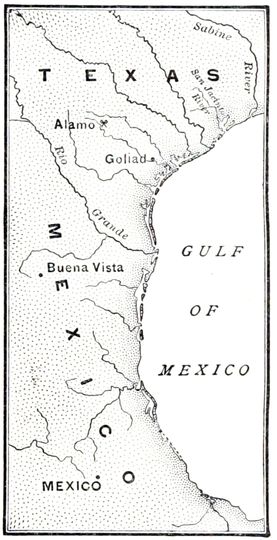
SCENE OF HOUSTON'S CAMPAIGN
Retreat of the Mexicans
They retreated, expecting to cross a deep, narrow bayou or stream on a log bridge, but Houston had had the bridge destroyed. The slaughter was terrific. The stream was choked with Mexicans and their horses.
Santa Ana captured and sent to visit Washington
Santa Ana was captured and was turned over to the Texan government. Many thought he ought to die because of the massacres at the Alamo and Goliad, but Houston, generous toward the beaten man, sent him on to visit Washington.
Houston elected president of Texas
Houston had been badly wounded, and sailed to New Orleans for medical care. He returned to be elected first president of the "Lone Star Republic," as Texas was called. He was reëlected for a second term and served his country well.
Annexation of Texas
Houston wanted Texas made a part of the United States. This was afterwards done, and war followed with Mexico.
In 1845 Texas sent Houston to the United States Senate, where he served his state for fourteen years. He was devoted to our national Union. He died in 1863.
DAVID CROCKETT, GREAT HUNTER AND HERO OF THE ALAMO
Crockett found his schooling in the woods
143. A Brave Backwoodsman. At the close of the Revolution, Tennessee was still largely a wilderness. Here David Crockett was born in 1786. In those days schools on the frontier were few and poor, and young "Davy" found most of his schooling in the backwoods. He learned to know the woods and streams and the animals that lived in them. As a boy he spent most of his time hunting and trapping. As a young man he was one of the most famous rifle shots in the United States.
When the Creek War broke out, he enlisted under Andrew Jackson to march against the Indians. The young rifleman fought so well under "Old Hickory" that Tennessee made him a colonel.
Elected to Congress
He had become a famous hunter and fighter. He thought he would try politics next. Instead of making political speeches, he went about from place to place telling stories. The people liked both him and his stories so well that they elected him to the legislature. A few years later they sent him to Congress.
Returns to the wilderness
Joins the fight at the Alamo
By and by Crockett grew tired of civilization. He wanted to get back to the wilderness. His old home was too well settled to suit him. So he wandered to Texas. Here he heard that the Mexicans were surrounding the Americans at San Antonio. "Davy" Crockett loved a good fight too well to stay away. He hastened to join the small band of brave men who were defending the Alamo. All could have escaped had they chosen to do so, but with iron courage these hundred and forty stayed and defied Santa Ana's thousands.
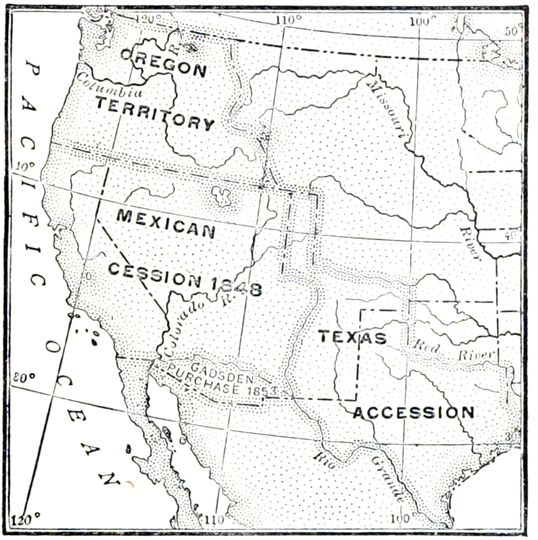
MAP OF THE WEST AFTER THE WAR WITH MEXICO
Showing the territory added to the United States after the Louisiana Purchase
For several days the Mexicans were held at a distance. They dared not bring their cannon close to the building, for the concealed sharpshooters picked off the men who tried to man the guns. Old Crockett himself laid low five men in charge of one cannon.
David Crockett fights to the last
The fall of the Alamo was however merely a question of time. Little by little the walls were battered down, and finally the Mexicans were ready to storm. On they came, a great charging mass. The American riflemen shot them down by scores, but when one Mexican fell another took his place. One by one the fearless defenders fell. The last man to go down was Davy Crockett.
It is said that he stood with his back to the wall, fighting to the last, and that the Mexicans, afraid to meet him hand to hand, shot him down from a distance.
JOHN C. FREMONT, THE PATHFINDER OF THE ROCKY MOUNTAINS
His father a French refugee
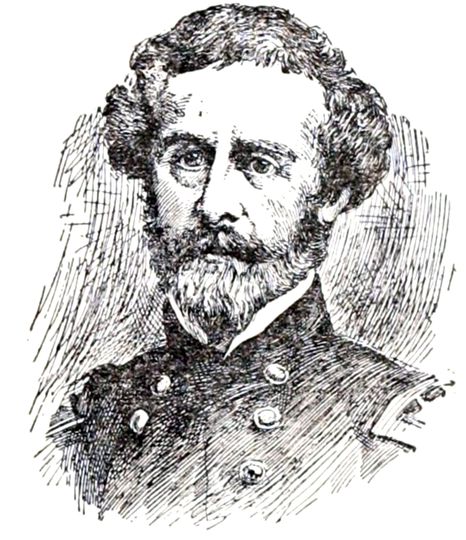
144. A Great Explorer. Fremont's father was a Frenchman who was driven to America by the terrible French Revolution. John Charles Fremont was born at Savannah (1813) while his parents were on a journey through the South. His father died soon after, and his mother went to live in Charleston, South Carolina.
Goes to South America
After a time at a good school, Fremont entered the junior class in Charleston College (1828). After leaving college he spent two and a half years on a voyage to South America.
Becomes a civil engineer
On his return he joined a company of engineers sent by the governor to explore the mountains between South Carolina and Tennessee, in order to find a suitable place for a railroad. This work was through a region rough, wild, and full of beauty. It gave young Fremont a taste for exploration which never left him.
Fremont's longing for a wild life was gratified when he was made assistant to a famous Frenchman who was exploring the wild region between the upper Missouri River and Canada.
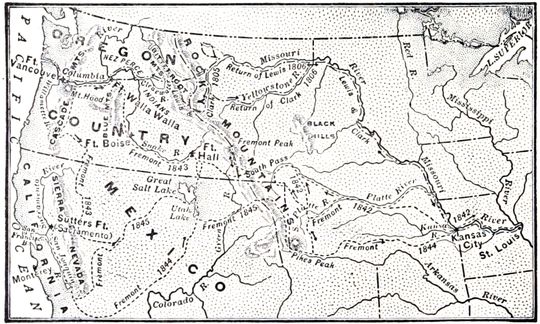
THE PATHWAYS OF THE EARLY EXPLORERS OF THE WEST
Marries Senator Benton's daughter
After this work Fremont returned to Washington and later married Jessie Benton, the daughter of the senator from Missouri. Thomas H. Benton was a great friend of President Jackson.
JOHN C. FREMONT
After a photograph from life
Fremont was now related to a powerful man who was deeply interested in the growth of the "Great West." Benton's repeated speeches on the "West" and on the "Oregon Country" called attention to the importance of the Pacific slope.
Receives permission to explore South Pass
In 1842 Fremont, now a lieutenant of engineers, received permission from the government to explore the South Pass of the Rocky Mountains. With a party made up largely of French Canadians, and assisted by that famous guide, Kit Carson, he passed up the Kansas River, crossed to the Platte, went up this river, and thus reached the South Pass.
Unfurls the Stars and Stripes on Fremonts Peak
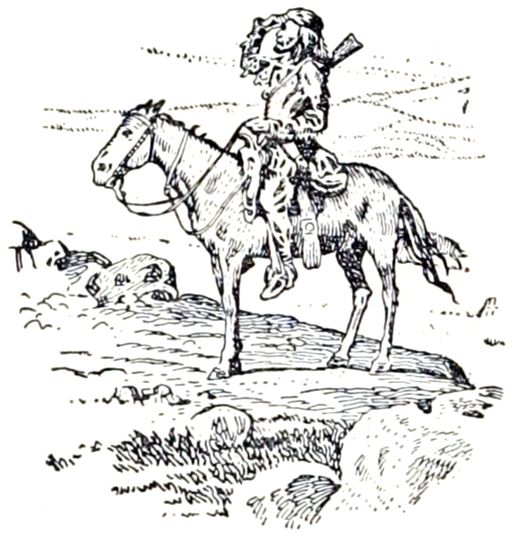
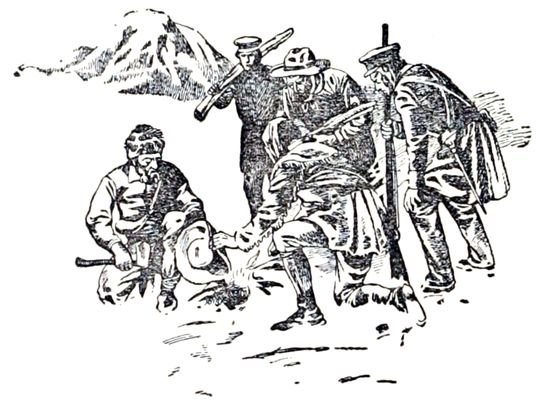
145. On the Watershed. Standing on the watershed of a continent, he saw the beginnings of rivers that flow into the Atlantic, and of others that stretched away through unknown regions to the Pacific. He took four men and climbed what has since been called Fremonts Peak, one of the highest of the Rockies, about 13,800 feet above the sea. At the top Fremont unfurled the Stars and Stripes in all its glory!
146. A Pathway to the Pacific. Fremont reported his discovery at Washington and immediately applied for orders to make an expedition to discover a more southerly route to California and Oregon.
GAZING OUT AT THE BEGINNINGS OF RIVERS
Beholds Great Salt Lake
He left the little town of Kansas City with his guide, Kit Carson, in May, 1843. In September, after traveling seventeen hundred miles, the little party beheld the shores of Great Salt Lake. What feelings must have stirred the breasts of men shut in for months by mountains, at seeing what appeared to be an ocean, here in the midst of a continent! Little did they dream of that hardy band of immigrants, so soon to follow, who would make the shores of this sea blossom like a garden. Fremont wrote: "As we looked over that vast expanse of water and strained our eyes along the silent shores, over which hung so much doubt and uncertainty, I could hardly repress the almost irresistible desire to continue our exploration."
FREMONT'S MEN BUILDING A FIRE IN THE SNOW
Reaches Fort Vancouver
After making preparations, the party crossed over to a branch of the Columbia River. Down this stream they traveled until Fort Vancouver was reached on November 4. Here Fremont was the guest of the governor of the British Hudson Bay Company.
FREMONT'S EXPEDITION REACHING SUTTER'S FORT, CALIFORNIA
Travel in deep snow
Crossing the Sierra Nevada
November 10, on the way home, the little party started to make the circuit of the Great Basin, a vast depression beyond the east wall of the Sierra Nevada. But very soon they found deep snow on the mountains. Turning to the west at about the latitude of San Francisco, Fremont determined to cross the Sierra Nevada into the valley of the Sacramento. The river was not many miles distant.
But what miles! Up and down, up and down that snowy mountain range, which the Indians told him no man could cross in winter, with snow lying upon it as deep as the dark forest trees were high, and places where, if a man slipped off, he would fall half a mile without stopping!
In the Valley of the Sacramento
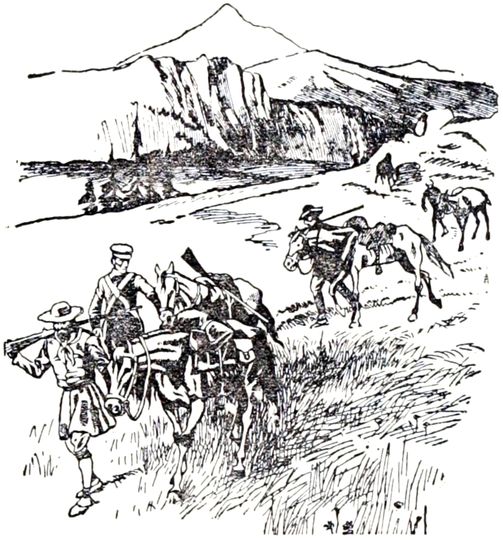
They attempted to cross without a guide, in the dead of winter. In forty days the men and the surviving horses—a woeful procession crawling along one by one, skeleton men leading skeleton horses—arrived at Sutter's Fort (Sacramento) in the beautiful valley of the Sacramento. Here genial warmth, trees in foliage, grassy ground, and flowers made a fairy contrast to the famine and freezing they had met on the mountains they had climbed.
After enjoying the hospitality of Colonel Sutter, Fremont again crossed the mountains farther to the south, where the beautiful San Joaquin River makes a gap or pass.
Sees the Mohave Desert
When he reached the top of the pass Fremont beheld the plains of the Mohave Desert. An Indian said to him: "There is neither water nor grass—nothing; every animal that goes upon them dies."
End of second expedition
Pushing forward with great energy, he reached Utah Lake, thus having nearly made the circuit of the Great Basin.
Fremont hastened to Washington with the story of his discoveries. General Scott now recommended that he be made captain.
Third expedition
Fremont's third expedition, with Carson as a helper, began in the spring of 1845, and aimed to explore the Great Basin and the coast of California and Oregon.
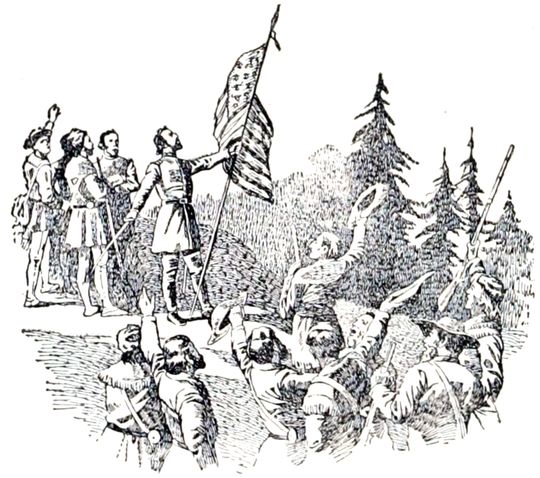
THE UNFURLING OF THE AMERICAN FLAG IN CALIFORNIA
The Stars and Stripes were raised for the first time in California near Monterey in 1846
War breaks out
147. In the Mexican War. Little did Fremont—or any of his men—think what fortune had in store for them. On his way to the Oregon Country Fremont received news that the Mexicans were planning to kill all the Americans in the Sacramento Valley. War had already broken out between the United States and Mexico, but he did not know it. He returned, reaching the valley in May, 1846. The settlers rushed to join him, and in one month northern California was declared independent.
Conquest of California
Fremont then marched to Monterey and joined Commander Sloat, who had raised the American flag there, July 7, 1846. This practically finished the conquest of all California in sixty days.
Fourth expedition
Elected to United States Senate
148. Becomes a Private Citizen. Soon after this event Fremont returned to Washington, gave up his place in the regular army, and went to live in California. His journey to California made up his fourth expedition. But the people would not let him long remain in private. The state elected him to the United States Senate. Fremont was not long in Congress, but was of great service in giving advice concerning the long-talked-of railroad to the Pacific.
Early in 1848 gold was discovered in the sand near the American River at Sutter's Mill, the site now occupied by Coloma. As the news spread, great excitement arose, and everybody wanted to dig gold. This was the "gold fever" of 1848 and 1849. The rush to the coast was tremendous. It made the building of a railroad urgent. Fremont made his fifth expedition to survey three routes to the Pacific. After great hardships he returned to Washington to report what he had found.
Nominated for president
He now took up his residence in New York City and became a member of the party opposed to the extension of slavery. The new party, the Republican, nominated him as its first candidate for president (1856). He was defeated after a most exciting time, yet he carried all the northern states but four.
A major-general in the Civil War
During the Civil War he was made a major-general, but after a year or two he resigned. He was talked of for president in 1864, but did not make the race.
After the war was over he was interested in a great continental railroad. From 1878 to 1881 he was governor of Arizona. Congress voted him a pension just before he died in 1890.
SPANISH MISSIONS IN THE SOUTHWEST
Spanish missionaries baptize Indians
149. How the Franciscans Ruled the Southwest. Centuries before Fremont or Kit Carson or any other American had seen the wonders of our western country, Spaniards made their homes there. Before the Mayflower landed at Plymouth, Spanish missionaries had built many churches in the Southwest and had baptized thousands of Indians into the Christian faith.
Franciscan friars friends of the oppressed
The story of the Spaniards in New Mexico, Arizona, and California is not of victories won by the sword, but by the cross. The men who ruled this country were not soldiers, but pious Franciscan friars.
Many years ago there lived in Italy a godly man, St. Francis, who looked upon all poor and oppressed people as his children and devoted his life to their care. His followers, who are called Franciscan friars, have gone into all parts of the world to be missionaries to the poor and the heathen.
Serra builds a mission at San Diego
Greatest of the Franciscans who worked in the Southwest was Junipero Serra. One warm day in 1769 he came riding into San Diego on mule-back, a tall, thin figure, wrapped in a long gown. There were no missionaries at this time in California. He had come from Mexico with a small party to convert the Indians. At San Diego he saw "valleys studded with trees, wild vines covered with grapes, and native roses as fair and sweet as those of Castile."
Here was just the place to build a mission. First he set up a great wooden cross and said mass. There was no organ music, so the soldiers fired their arms instead. The simple Indians stood by in wonder and awe. Junipero Serra was a man of energy and action, and in a short time he had his first mission built. From San Diego he went northward and planted mission after mission as far north as San Francisco. When he died the Franciscan missions controlled practically all of southern California.
Mission buildings surrounded by gardens
Wherever the friars built a mission they made sure the soil was good and that there was plenty of water near by. For in much of that country little rain falls and many crops grow only when watered by irrigation. Having found a suitable place, they would then build a church. This was always the largest building of the mission. Some of the churches were very beautiful. Around the church clustered the houses of the friars and the huts of the Indians. Each mission was surrounded by beautiful gardens and orchards. A little farther away were the fields in which the grain was grown. All of these were watered by irrigation ditches that drew their water from some mountain stream. Beyond the cultivated land lay the ranches on which cattle and sheep grazed in great numbers.
Indians taught useful occupations
All the Indians in the neighborhood were made to live at the mission, and here they were taught the Christian religion. They were also taught many useful occupations. The men were shown how to farm, to make saddles, work at the forge and the carpenter bench, and other useful trades. The women were instructed in spinning and weaving.
In the morning the angelus called every one to mass. After breakfast the day's work began and each Indian was sent to his task. Some cultivated the fields, some took care of the stock, some worked in the shops. Each one had to do his share of the work, and was punished if he disobeyed. He had to work, pray, and live as the friars told him.
Missions fall to ruin
When Mexico freed itself of Spanish rule, California became a part of Mexico. The new government put an end to the missions. The friars were forced to leave, and the Indians drifted back into their old wild life.
To-day nothing remains of the work of the friars except the old mission buildings. Most of them are in ruins, but they still tell of the quiet by-gone days when the gentle Franciscans ruled in California.
SUGGESTIONS INTENDED TO HELP THE PUPIL
The Leading Facts. 1. Houston had little schooling and went to live with the Cherokee Indians. 2. Wounded at Horseshoe Bend; studied law in Nashville; was sent to Congress for four years; and was elected governor of Tennessee. 3. Went to live with the Cherokees again, and then went to Texas. 4. Houston won the battle of San Jacinto; was made president of the republic of Texas; and later elected to the United States Senate. 5. David Crockett was born in Tennessee, had little schooling, and became an expert rifle shot. 6. He fought the Indians under Andrew Jackson. 7. Won an election to the legislature by telling stories; later elected to Congress. 8. Crockett grew tired of civilization and returned to the wilderness. 9. Fought against the Mexicans at the Alamo, where he was killed with all his companions. 10. Fremont went to school in Charleston, but left for a voyage to South America. 11. He worked for exploring parties; married, and thus became related to a great man interested in the Far West. 12. Fremont explored the South Pass on his first expedition; on his second, saw Great Salt Lake, and crossed the mountains with great suffering. 13. Fremont crossed a third time, and aided in conquering California; was made a United States senator, and became first candidate of the Republican party for the presidency. 14. Franciscan friars, long before the landing of the Pilgrims, entered what is now New Mexico, Arizona, and California. 15. They taught the Indians the Christian religion and many useful occupations.
Study Questions. 1. What was peculiar in Houston's early life? 2. What had he done before he began to study law? 3. What made people like him? 4. Where was the battle of Horseshoe Bend fought? 5. How did the Cherokee chief welcome him? 6. Why did Houston go back to Tennessee? 7. What drew him to Texas? 8. What were the first bad defeats of the Texans? 9. Tell the story of San Jacinto. 10. What kind of a general, a president, and a senator did Houston make? 11. Where did Crockett spend his boyhood, and what fame did he gain? 12. How did he win his way to the legislature? 13. What made Crockett go back to the wilderness? 14. Describe the fight at the Alamo. 15. Who was John Charles Fremont? 16. What of his youthful days? 17. What experience in early days after college prepared him for his great work? 18. Who was Kit Carson? 19. Describe Fremont's journey to the South Pass. 20. Tell what was seen and what was done there. 21. What expedition did he now plan? 22. Picture the scene on the discovery of the Great Salt Lake. 23. Picture his exploration of the Great Basin and crossing the mountains. 24. What was the contrast at Sutter's Fort? 25. Describe the Digger Indians. 26. At what was Fremont's third expedition aimed, and what did it really accomplish? 27. Who was St. Francis? 28. Describe Serra's arrival at San Diego. 29. Why did he build a mission at San Diego? 30. Describe life at a Spanish mission. 31. What happened when Spanish rule was ended in California?
Suggested Readings. Houston: Bruce, Life of General Houston.
David Crockett: Crockett, Life of Davy Crockett; Lodge and Roosevelt, Hero Tales from American History, 171-181.
Fremont: Bigelow, Life of John Charles Fremont, 1-216, 319-373, 379-466.