THE MEN WHO MADE THE NATION GREAT BY THEIR INVENTIONS AND DISCOVERIES
Reading edition
ROBERT FULTON, THE INVENTOR OF THE STEAMBOAT
How boats were driven
128. The Invention of the Steamboat. Once there were no steam engines to drive boats. On sea and river they were driven by wind, and on canals they were pulled along by horses.
Inventors before Fulton
James Rumsey on the Potomac, John Fitch on the Delaware, and William Longstreet on the Savannah had each invented and tried some kind of steamboat, before Robert Fulton.
Fulton was born of Irish parents, in New Britain, Pennsylvania, in 1765. At the age of three he lost his father. Young Fulton had a great taste for drawing, painting, and inventing.
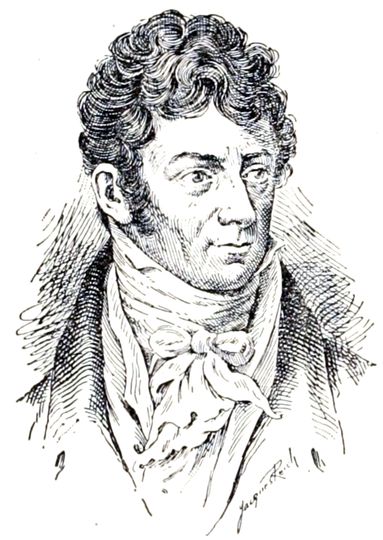
ROBERT FULTON
After the painting by Benjamin West
He went to Philadelphia, then the largest city in the Union, when he was twenty, and engaged in painting and drawing. His first savings were given to his widowed mother to make her comfortable.
Studied under Benjamin West
Fulton finally decided to be an artist, and went to England to make his home with Benjamin West, a great painter who once lived at Philadelphia.
Influenced to become an engineer
There he became acquainted with the Duke of Bridgewater, who influenced him to become a civil engineer. Fulton now met James Watt, who had greatly improved the steam engine. At one time the young man aided Watt in building an engine.
Meets Livingston in France
Fulton next went to France, where he became interested in plans for inventing diving boats, torpedoes, and steamboats. Here he met Robert R. Livingston, a signer of the Declaration of Independence, then United States Minister to France. Livingston took a deep interest in his experiments in driving boats by steam, and furnished him the means to make them.
Fulton's trial boats
Fulton made a "model" boat, which he left in France. Shortly afterward, he built a boat twenty-six feet long and eight feet wide. In this vessel he put a steam engine. The trial trips proved beyond a doubt that steamboats could be made.
Twenty years' rights
Livingston believed in Fulton and his steamboat. When he returned to New York, Livingston obtained from the legislature the right to navigate the waters of the state by steam for twenty years. The one condition was that the boat should go against the current of the Hudson at the rate of four miles an hour.
Gets engine in England
The "Clermont"
Fulton got his engine from the inventors, Watt and Boulton, in England—the only place where suitable engines could be found. The engine came in 1806. A boat called the Clermont was built to carry it. She was one hundred thirty feet long and eighteen feet wide. She had a mast with a sail. At both ends she was decked over, and in the middle the engine was placed. Two large side-wheels dipped two feet into the water.
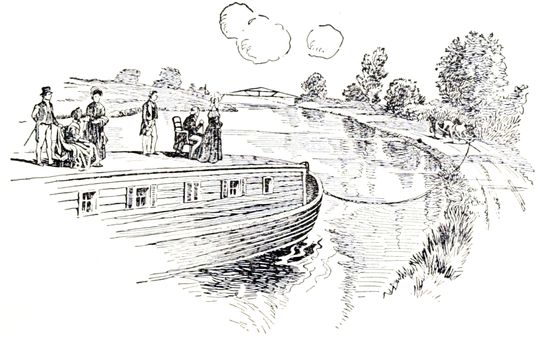
SCENE ON A CANAL
129. The "Clermont" Moves. At one o'clock in the afternoon of August 7, 1807, a great crowd gathered to see the first voyage of the Clermont. Many people did not expect to see the vessel go. They believed Fulton and Livingston had spent their money for nothing. Fulton gave his signal from the deck of the Clermont. The people looked on in astonishment as the boat moved steadily up the pathway of the Hudson.
A great victory for Fulton and Livingston
The Clermont kept on going till out of sight, and the crowds of wondering people went home hardly believing the evidence of their eyes. Up the river, against the current of the mighty Hudson, she made her way till Albany was reached. She had gone one hundred fifty miles in thirty-two hours, and won a great victory for Fulton and Livingston.
Name of boat changed to "North River"
When winter came the Clermont was taken out of the water and rebuilt. They covered her from stem to stern with a deck. Under the deck they built two cabins, with a double row of berths. Everything was done to make her attractive in the eyes of the people. They changed her name to the North River. In the spring she made her trips regularly up and down the Hudson.
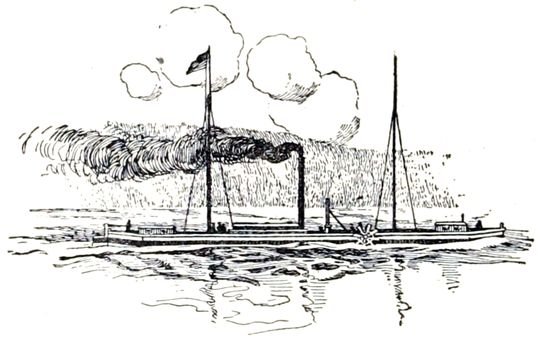
THE "CLERMONT"
Steamboats appear on different rivers
130. Steamboats on All the Rivers. In 1809 a steamboat was built on Lake Champlain, another on the Raritan, and a third on the Delaware. From this time forward, steamboats, carrying passengers and freight from place to place, began to appear on all the great rivers in the settled portions of the United States.
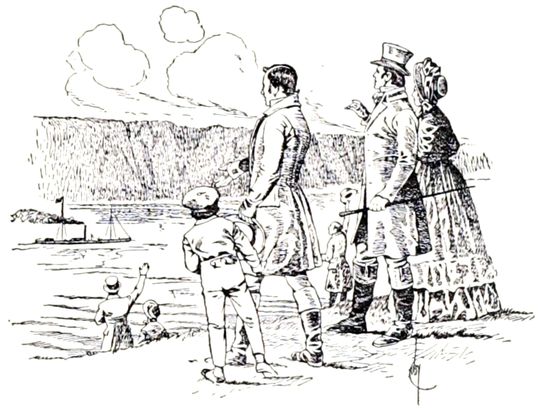
WATCHING THE "CLERMONT" ON ITS FIRST VOYAGE UP THE HUDSON
People along the Ohio frightened
In 1811 a steamboat was built on the Ohio River at Pittsburgh. It started on its trip down the beautiful Ohio. People gathered on the banks of the river to see it go by. The steamboat, at first, made a frightful noise. Hence when it came to places where news traveled slowly, the people were sometimes frightened, and the negroes, terror stricken, ran crying into the woods.
A steamboat helped Jackson
In 1814 a steamboat carried supplies to General Jackson at New Orleans, and helped him to win the great battle fought there.
Seven steamboats were running on the Ohio and the Mississippi at the close of the War of 1812. Before another year went by, a steamboat had made its way from New Orleans against the currents of the Mississippi and the Ohio rivers to Louisville, laden with goods from Europe.
The steamboat had now won a place on the American rivers. It aided in the rapid settlement of the country. It made travel quick and easy, and it carried the goods of settlers up and down the rivers.
Robert Fulton dies, 1815
Robert Fulton died in 1815, deeply mourned by all his countrymen, and was buried in Trinity churchyard, New York City.
Steamboats carry goods up the Mississippi
Erie Canal across New York
131. The Erie Canal. Before Fulton invented the steamboat, supplies had been carried to the western settlers over the mountains from the East. Now, however, steamboats puffed up the Mississippi from New Orleans loaded down with goods that had been brought all the way from Europe. The settlers could get all the supplies they wanted and at a much lower cost. For this reason the merchants of New York and the East were in danger of losing all their trade with the settlers. They saw that they must have some connection with the West by water, and so they planned the Erie Canal. It took seven years to dig. When it was finished it was three hundred sixty-three miles long, forty feet wide, and four feet deep. The depth was later increased to seven feet. It stretched straight across the state of New York from Lake Erie to the Hudson River.
In the autumn of 1825, when the canal was finished, there was a great celebration. A "fleet" of canal boats carried Governor Clinton of New York and a number of other distinguished men across the state.
New York recovered her trade
The merchants of the East were no longer afraid of the Mississippi route, for they had a route of their own. The canal became the great highway of commerce from the East to the West and from the West to the East. New York recovered her trade, and flourishing cities grew up along the canal.
But there were cities in the East that could not use the canal. Farther south they could not dig a canal across the mountains. All their goods had to be carried over the Cumberland Gap on the backs of horses. But a new means of travel and transportation had been invented, which was to far surpass the steamboat and which was to help every city no matter where located.
The first railroad
132. Railroad Building. The first railroad in America was a very rude affair. There were no "palace cars" or steel rails, nor did the trains run at a speed of sixty miles an hour. Instead, cars that looked like huge wagons ran on wooden rails and were dragged along by horses.
Stephenson's "Puffing Billy"
But George Stephenson had thought out a plan for a machine that would pull the cars along by steam. He called his engine "Puffing Billy." He kept at work always improving it. In 1825, after eleven years of hard work, he made an engine that could pull both passengers and freight.
The first long railroad
In 1828 the first long railroad in America was started. A great ceremony took place. It was a very solemn occasion. Charles Carroll, the only living signer of the Declaration of Independence, drove the first spade into the ground where the first rail was to be laid. As he did so he said, "I consider this among the most important acts of my life, second only to that of signing the Declaration of Independence." This railroad was the famous Baltimore & Ohio.
Inventors continued to improve the locomotive. In 1831 an American company built one which ran at the rate of fifteen miles an hour. At that time that was considered a very rapid rate.
By rail from Boston to Buffalo
Since then railroad building and transportation have improved wonderfully. By 1842 one could travel by rail from Boston to Buffalo. But it was not until ten years later that Chicago was connected by rail with the East.
To the Pacific coast
Gradually the railroads spread a network over the country. In 1857 St. Louis and Chicago were connected. A railroad to the Pacific coast was much needed, and Congress voted an appropriation of $50,000,000 for the work. By 1869 the great work was completed. Other lines to the coast were started, and to-day many railroads cross the mountains, connecting the Pacific with the North, South, and Atlantic regions.
SAMUEL F. B. MORSE, INVENTOR OF THE TELEGRAPH
Morse, 1791
133. The Coming of the Telegraph. Samuel Morse was born in Massachusetts (1791). His father was a Presbyterian minister. Young Morse went to the common schools and to Yale College.
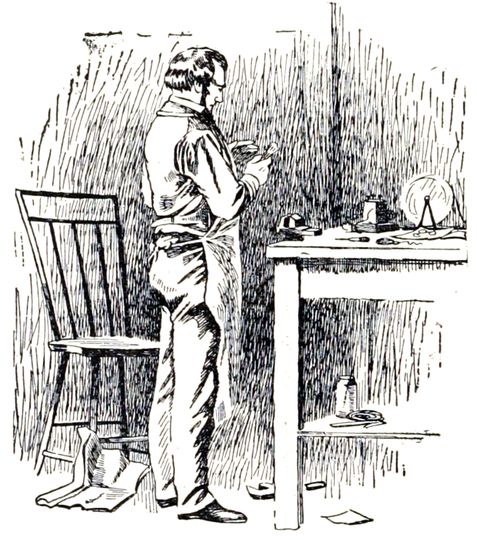
MORSE WORKING ON HIS MACHINE
Paints portraits
In college he used his spare time in painting, and after graduation he went to England and studied under the best artists. He came home and for a time painted portraits for a living.
The idea came to him of sending news by electricity
After having spent some years abroad, in work and study, Morse was again returning home from France when the idea of sending news by electricity first came to him.
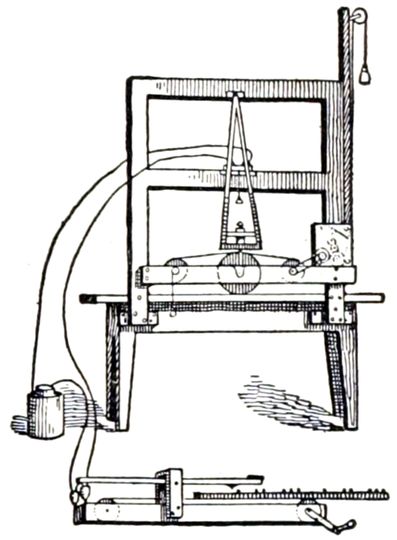
THE FIRST TELEGRAPH INSTRUMENT
A machine and an alphabet
"Why can't it be?" said Morse to a friend, who answered, "There is great need of sending news by electricity." He began, then and there, to plan a machine and to invent an alphabet. This was all done on shipboard. When he reached land he went to work with a will at his new-found problem.
The hungry inventor
For a long time the work went on very slowly, for inventors must eat and sleep and pay their way in the world. While Morse was struggling over his machine and trying to make himself master of the strange force called electricity, he was very often hungry and at times even on the point of starvation.
Alfred Vail
Now came a bright spot in his career. A young man named Alfred Vail, an excellent mechanic, saw Morse's telegraph instruments, and immediately believed they would be successful. Young Vail borrowed money and became Morse's assistant in the great work. For what he did he deserves credit next to Morse himself.
Getting ready for Congress
Behind locked doors
A patent must now be had and the telegraph must be so improved that they could show it to a committee of Congress. It was arranged that Vail and a mechanic by the name of Baxter should do the work behind locked doors. For, if some one should happen to see the instruments, and obtain a patent first, then Morse and Vail would be ruined.
The dot and dash alphabet
In the locked shop the two men worked steadily day after day. Vail made many improvements. Among these was the new "dot and dash" alphabet. At last, one day in January, 1838, everything was in complete working order. Baxter, hatless and coatless, ran for Mr. Vail's father to come at once and see the telegraph work.
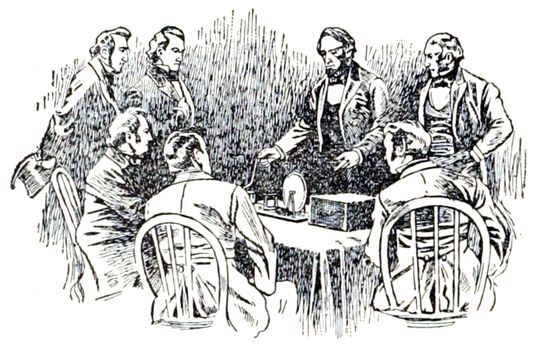
MORSE SHOWING HIS COMPLETED WORK
The final test
Patented in Morse's name
At one end of the wire stood young Vail, and at the other stood Morse. This wire was stretched around the room so that it was three miles in length. The elder Vail wrote: "A patient waiter is no loser." He said to his son: "If you can send this message, and Mr. Morse can read it at the other end, I shall be convinced." It was done, and there was great rejoicing. The invention was hurried to Washington, and young Vail took out a patent in the name of Morse.
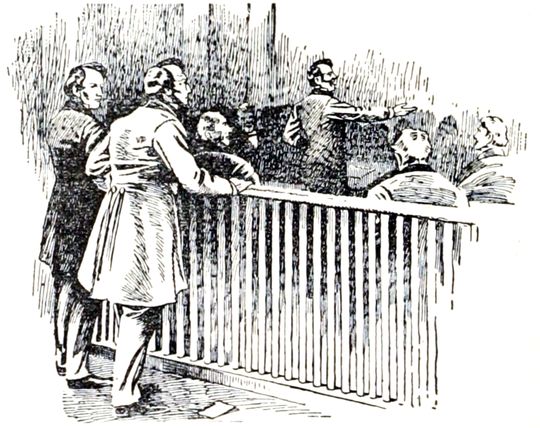
MORSE LISTENING TO CONGRESS MAKING FUN OF HIS INVENTION
Congressmen watch the instruments
Morse obtained permission to set up his telegraphic instruments in rooms in the capitol. These rooms were filled with congressmen watching the strange business. Members in one room would carry on witty conversations with persons in the other room. This was great fun for those looking on. But it was slow work talking with members of Congress and winning their help.
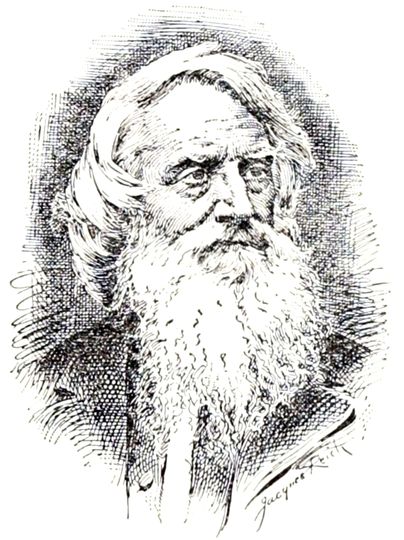
SAMUEL F. B. MORSE
From a photograph taken by Abraham Bogardus, New York City
Congress makes fun of the idea
134. The Government Aids. Finally Morse asked for thirty thousand dollars to build a line from Washington to Baltimore. The bill met opposition, one member moving that a part of the money be used in building a railroad to the moon, another that it be used in making experiments in mesmerism.
Morse ruined if bill does not pass
Morse stood leaning against the railing which separated the outsiders from the members. He was greatly excited, and turning to a friend, said: "I have spent seven years and all that I have in making this instrument perfect. If it succeeds, I am a made man; if it fails, I am ruined. I have a large family, and not money enough to pay my board bill when I leave the city."
Telegraph line to Baltimore built
The first message
It was ten o'clock, March 3, 1843, the last night of that Congress. Morse gave up and went to his hotel. In the morning a friend met and congratulated him on the action of Congress in granting thirty thousand dollars for his telegraph line—the last thing Congress did that night. Morse was surprised. The telegraph line to Baltimore was built and the first dispatch was ready to send. Morse called the young woman who had been the first to congratulate him, to send this first message: "What hath God wrought."
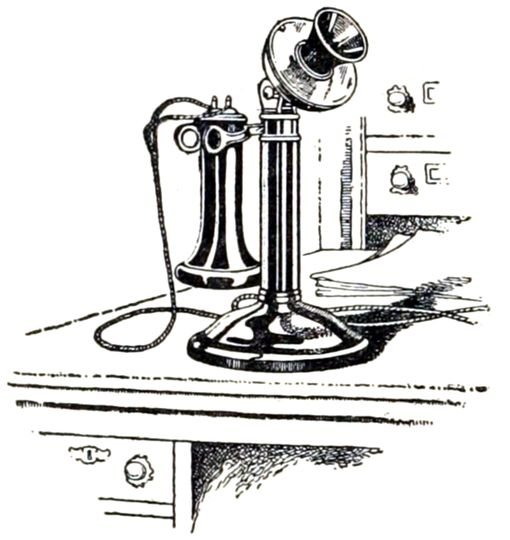
THE TELEPHONE
Honors heaped on the inventor
The success of Morse was slow at first, but he lived to see the day when his instrument was used in Europe. He visited Europe again, was given gold medals, and received other rewards and honors from many of the rulers of the different European countries.
Morse dies, 1872
He died in 1872 at the good old age of eighty-one. Congress and state legislatures paid tribute to his memory.
The telephone
135. A Wider Use for Electricity. Samuel Morse was hardly in his grave before a wonderful invention was made which called electricity into far wider use in carrying news. This new invention was the telephone, and two men, Bell and Gray, applied for patents on it at almost the same time.
The instruments are wonderful conductors of sound, carrying, as they do, the actual words and tones of the voice.
Marconi beats them all
But Marconi has gone beyond them all in his invention. He sends the electric wave forth without the aid of a wire, thus giving rise to wireless telegraphy.
CYRUS WEST FIELD, WHO LAID THE ATLANTIC CABLE BETWEEN AMERICA AND EUROPE
Cyrus W. Field, 1819
In business for himself
136. The Atlantic Cable. Cyrus W. Field was born in Massachusetts in 1819. His grandfather was a Revolutionary soldier. Cyrus went to school in his native town of Stockbridge, and at fifteen was given a place in a New York store at fifty dollars a year. Before he was twenty-one he went into business for himself. At the end of a dozen years he was the head of a prosperous firm. In 1853 he retired from active business.
Why not span the Atlantic?
Field became interested in a man who was joining Newfoundland with the mainland by means of a telegraph line. "Why not make a telegraph line to span the Atlantic?" thought Field. He went to work, and put his schemes before Peter Cooper and other generous men. They believed in them.
Englishmen also approve the plan
Field next went abroad and laid his plan before a number of Englishmen. He pleaded so eloquently that they, too, were convinced. He returned to America to lay the matter before Congress and ask that body to vote him a sum of money.
President Pierce signs the bill
Congress was very slow about it, and the bill did not pass until the last days of that session. President Pierce signed it the last day of his term as president.
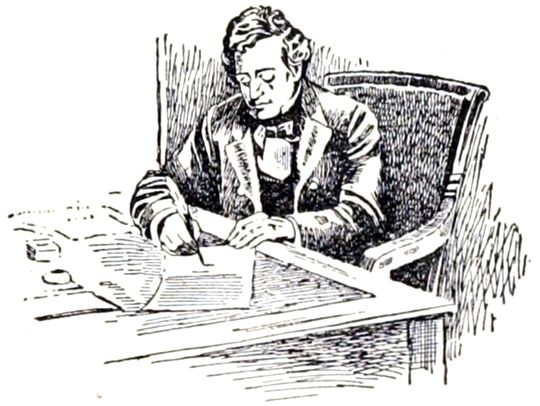
PRESIDENT PIERCE SIGNING THE FIELD BILL
Half a million dollars gone
Field returned to England and watched over the making of his "cable." In August, 1857, everything was ready. The cable lay coiled on shipboard, ready to be let out in the Atlantic. The great ship started, and everything went well till three hundred thirty-five miles of the cable had been let out, when it broke in two. It was the same as losing half a million dollars.
A second trial
Breaks again
Field went back to England and began promptly to prepare for a second trial. He then came to America and made arrangements to use the Niagara, a large vessel. The British ship, Agamemnon, was also taken to help in this second trial. The ships started in mid-ocean, one going one way and one going the other way. This time only one hundred eleven miles were laid, when the cable again parted.
A council of war
Field hastened to London to meet the men who had backed him in his undertaking with their money. It was a council of war after a terrible defeat! But Mr. Field did not believe in surrender, even to the sea.
Success
On the seventeenth of July, 1858, the ships again set sail for mid-ocean. They "spliced" the cable, and the Niagara with Mr. Field on board sailed away for Newfoundland. The British ship went the other way. This time they were successful. Both countries were excited. Queen Victoria flashed a message under the sea to President Buchanan.
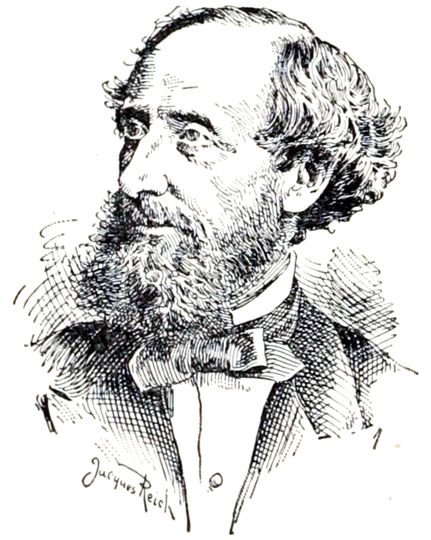
CYRUS W. FIELD
From a photograph by Elliott and Fry, London
A great day in New York
Great was the rejoicing in New York, the home of Mr. Field. A religious service, expressive of the deep interest of the people in the success of his work, was held in Trinity Church, at which two hundred clergymen in gowns appeared; national salutes were fired, a great procession was formed, an address was made by the mayor of the city and, at a very late hour, a grand banquet was held. While the banquet was going on, the cable gave its last throb, and parted.
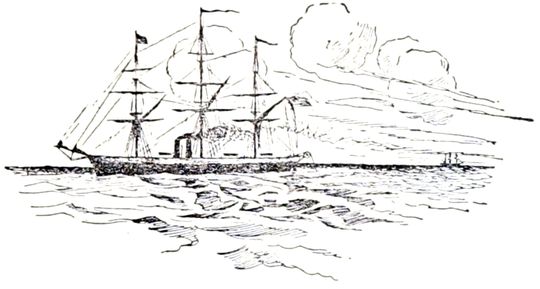
LAYING THE FIRST ATLANTIC CABLE
The cable parts the third time
The very day that a whole city rose up to do honor to the Atlantic telegraph and its author, it gave its last flash and then went to sleep forever in its ocean grave.
After a wait of five years
After five years of slow and toilsome work, caused by the fact that the Civil War was raging in the United States, Cyrus W. Field was again ready. When the vessel, bearing the cable, was within six hundred miles of land, the cable broke again.
The money subscribed
137. The Final Success. An Anglo-American Telegraph Company was now formed. Mr. Field subscribed $50,000, Daniel Gooch $100,000, and another person promised to bear a part of the expense. On a Friday they set out and on another Friday they reached America with the cable safely laid. Mr. Field sent this message to England:
"Hearts Content"
"Hearts Content, July 27, 1866. We arrived here at nine o'clock this morning. All well. Thank God, the cable is laid, and is in perfect working order."
Effect on the civilized world
Great honor for Mr. Field
The success of this undertaking, after so many years of failure, produced a great effect throughout the civilized world. Mr. Field was the center of all rejoicing. Congress voted him a gold medal. England did honor to his name. The Paris Exposition of 1867 gave him the highest medal it had to bestow. From Italy he received a decoration. States and chambers of commerce in all parts of the nation passed resolutions in praise of his great work.
Finally he took a trip around the world and received honors from many nations. Mr. Field lived at Tarrytown, New York. He died in New York City in 1892, at the age of seventy-three.
CYRUS H. McCORMICK, INVENTOR OF THE REAPER
138. Making Bread More Plentiful for Millions. It was only natural that Cyrus H. McCormick should be interested in inventions. His father, Robert McCormick, had fitted up many labor-saving devices for use on his farm. He tried to make a reaper, but it was a failure.
One hundred years ago the common method of harvesting in this country was by "cradling" the grain. For this, a scythe with prongs on its handle was used. The prongs caught the grain and laid it in rows, ready to tie.
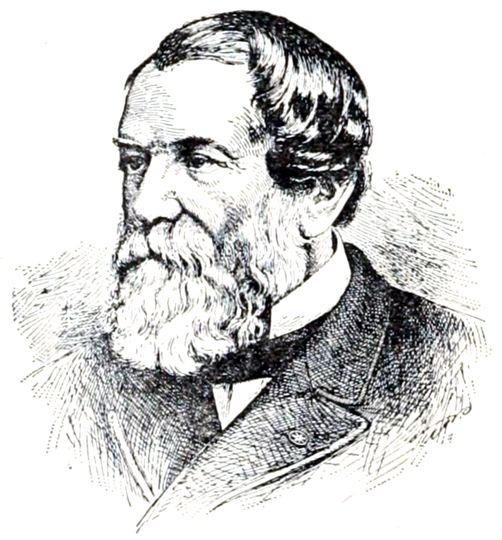
CYRUS HALL McCORMICK
Cyrus Hall McCormick was born at Walnut Grove, West Virginia, in 1809. The boy was always interested in inventing. When fifteen, he invented a better grain cradle. At twenty-one he made a hillside plow that surpassed his father's. His great invention, the reaper, was made the following year. His friends all laughed at his machine, but he went on perfecting it. All his life Cyrus McCormick had to meet ridicule or bitter competition. But he came of Scotch-Irish fighting stock. He had the determination which battles its way to success.
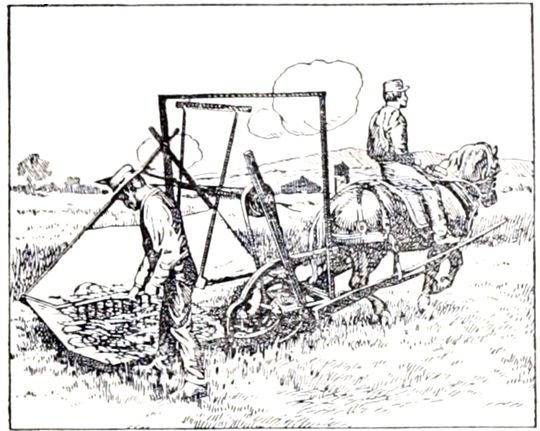
THE FIRST McCORMICK REAPER
After a model of the original reaper
In 1834 the reaper was patented. It was shown at the World's Fair in London in 1851. It won a prize as the most valuable thing in the whole fair.
Cyrus H. McCormick started to manufacture his machine at Chicago in 1847. The demand for reapers grew rapidly. When the Civil War called out one man in three from the North, there were enough reapers in use to equal the labor of one million slaves. The North not only fed itself but sent great quantities of grain to England. Cyrus McCormick's great invention did much to help the North abolish slavery.
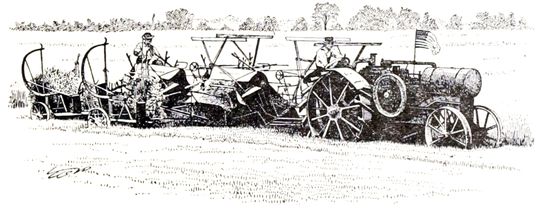
HARVESTING WITH MODERN MACHINERY
139. Reapers for the West. The invention of the reaper made it possible for the West to be quickly settled. Before, farmers raised only the few acres they could be sure of harvesting. Grain is lost, if not cut a few days after it is ripe. The wide prairies of the West could not be harvested by the old methods. Now on these great plains huge reapers drawn by engines sometimes cut forty-eight feet of grain in a single swathe.
Because of the labor it saves, McCormick's invention has made the cost of bread low for millions of people. With hand-reaping half the people of the country would be busy producing nothing but bread. In the past most nations were never free from the danger of starvation. Now the world produces enough for all.
A noted French society, when it elected McCormick a member, said that he had "done more for the cause of agriculture than any other living man."
ELIAS HOWE, INVENTOR OF THE SEWING MACHINE
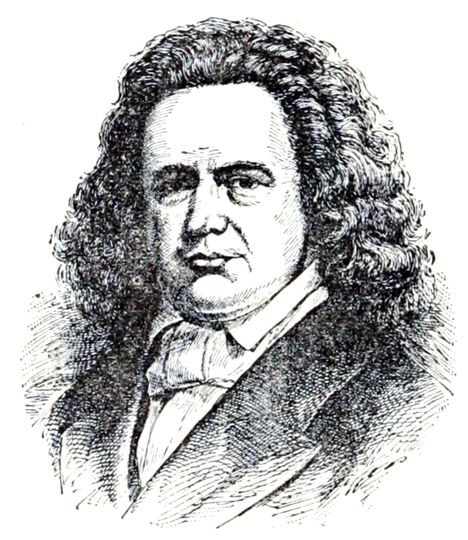
ELIAS HOWE
140. A Time-Saving Invention. Elias Howe was a poor boy who won great riches through his invention, but spent most of his years in a long, dreary struggle with poverty.
Elias was born in Massachusetts in 1819. His father was a poor man. He worked in his father's mill and then in the cotton mills of New England until he came to have a thorough knowledge of machinery. When he was twenty-four he began his great invention, the sewing machine.
Sewing machines using a chain stitch had already been invented in England and France, but a chain stitch ravels easily. Howe invented a lock stitch machine. Like earlier machines, it had a needle with an eye in its point to bring a loop of thread through the cloth. In chain stitching the needle at the next stitch passes through this loop. Howe instead passed a shuttle carrying a second thread through the loop. This made a firm lock stitch.
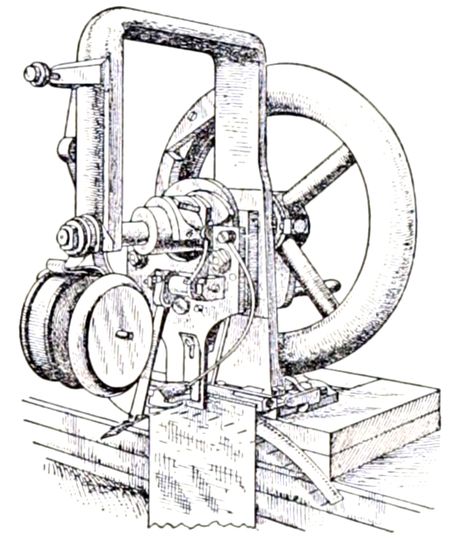
HOWE'S FIRST SEWING MACHINE
Howe tried to get tailors to buy his machine. He proved that it would sew seven times as fast as the best needleworkers. But they were afraid it would take work away from their men, and would have nothing to do with it.
After patenting his machine, Howe took it to England, but there he remained as poor and unknown as before.
Returning to New York he heard that unscrupulous men had stolen or "pirated" his ideas, and that the sale of sewing machines was now a thriving business. But Howe was determined to uphold his rights. In 1859, after a battle of many years in the law courts, he secured the full and complete title to his invention.
141. A Turn in Fortune. The man who had faced poverty and rebuffs all his days now came into great wealth. His income each year would be equal to-day to at least a million dollars.
Sewing machines have now become almost a necessity in all American homes. It is hard to realize the amount of close, slow, exacting work from which Howe's machine has released women everywhere. The work of the most skillful needlewomen is not to be compared in speed and evenness with machine stitching. Garments now can be produced in vastly greater quantities than by hand work, and machine stitching is much more durable.
When the Civil War came, Howe's sewing machine made tents, shoes, and uniforms for the great Union army which would not have had them in time otherwise. Howe himself enlisted as a private and served while his health lasted. He died in 1867 when only forty-eight years old.
SUGGESTIONS INTENDED TO HELP THE PUPIL
The Leading Facts. 1. Fulton's invention greatly increased commerce before the coming of railroads. 2. Congress granted Morse money to build a telegraph line, after many delays. 3. Bell and Gray invented the telephone. 4. Marconi invented wireless telegraphy. 5. Cyrus Field after many failures laid a permanent cable across the Atlantic in 1866. 6. McCormick's reaper hastened the settlement of the West. 7. Howe became rich through the invention of the sewing machine.
Study Questions. 1. Tell of early attempts to build steamboats. 2. Give the story of the Clermont. 3. Give an account of the steps by which Morse won success. 4. How many attempts did Field make before a permanent cable was laid? 5. What was the great importance of McCormick's reaper? 6. Describe Howe's first sewing machine.
Suggested Readings. Robert Fulton: Glascock, Stories of Columbia, 186-188; Wright, Children's Stories of American Progress, 104-120; Thurston, Robert Fulton.
Samuel F. B. Morse: Trowbridge, Samuel Finley Breeze Morse; Mowry, American Inventions and Inventors, 270-277; Holland, Historic Inventions, 168-188.
Bell and Gray: Holland, Historic Inventions, 215-232.
Cyrus West Field: Judson, Cyrus W. Field; Doubleday, Stories of Inventors, 3-16; Mowry, American Inventions and Inventors, 278-285.
Cyrus H. McCormick: Brooks, The Story of Corn, 218-220; Forman, Stories of Useful Inventions, 91-96; Sanford, The Story of Agriculture in the United States, 144-149.
Elias Howe: Hubert, Inventors, 99-110.