THE MEN WHO HELPED WIN INDEPENDENCE BY FIGHTING ENGLAND ON THE SEA
Reading edition
JOHN PAUL JONES, A SCOTCHMAN, WHO WON THE GREAT VICTORY IN THE FRENCH SHIP, "BON HOMME RICHARD"
John Paul born in Scotland
100. John Paul. In 1747, in far-away Scotland, on the arm of the sea called Solway Firth, a great sailor was born. John Paul played along the seashore, saw tall ships, and heard wonderful stories of a new land called America, whose ships filled with tobacco came into the firth.
Sails on the "Friendship" to America
John Paul did not get much schooling, and at the age of thirteen he went as a sailor lad on the Friendship to America. The ship sailed into Chesapeake Bay and up the Rappahannock River to the town of Fredericksburg, where he found his brother William living on a plantation. In the very same town where George Washington had just been to school, John Paul also went to school. He studied hard to make up for lost time, and left a great name among the boys.
Returns and sails for Africa
He afterward returned to Scotland, and at the age of nineteen sailed as an officer on a slave-trading ship to Africa, and carried a load of negroes away from their native land. Many people did not then think it wrong to do this, but John Paul hated the cruel business, and left the slave ship as soon as he reached Jamaica.
Made captain
On his way back to Scotland the officers of the ship died, and John Paul, although but twenty years old, had to take charge. The owners of the vessel were so pleased with the way he handled it that they made him captain, and he went on many voyages to different countries.
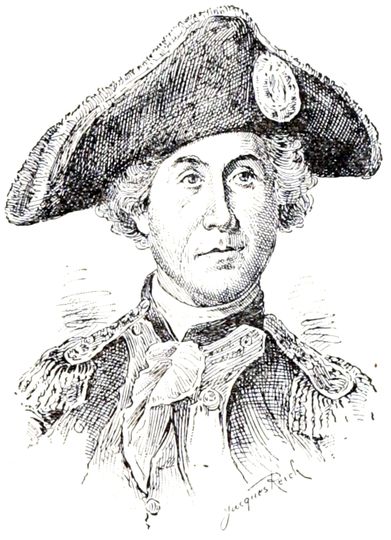
JOHN PAUL JONES
From a painting by Charles Wilson Peale in Independence Hall, Philadelphia
In Virginia again
After a time John Paul went to Virginia to take care of his dead brother's plantation. While he was living in Virginia he watched the quarrel between England and her colonies break out in open war.
Offers his services to Congress
101. John Paul Jones Enters the American Navy. He hastened to Philadelphia and offered his services to Congress. He knew England would send thousands of soldiers to America; and that she would send her war ships along our seacoasts and up and down our bays and rivers, to capture and burn our towns. He also knew that the Congress did not own a single war ship when the war began.
Congress ordered war ships to be built. While these were being made, Congress ordered trading vessels to be fitted with cannon and sent out to capture British ships.
Changes his name
When John Paul went to Philadelphia he gave his name as Paul Jones, probably in honor of Willie Jones, a friend who lived in North Carolina. Some have thought that he did not want the British to know him, if they should capture him in a sea fight.
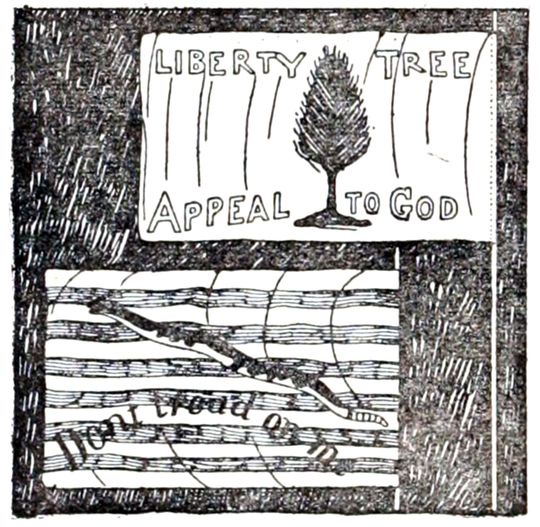
THE FIRST AMERICAN ENSIGN
This, the first flag to float above an American man-of-war, was raised by John Paul Jones
Really wants to fight
What he could do
Although Paul Jones really knew more about war ships than most of the men in Philadelphia, Congress gave him a very low office. But that made no difference to him, for he really wanted to get into a sea fight. In 1775 he was made a lieutenant, and joined an expedition to capture cannon and powder from the British in the West Indies. He did so well that Congress made him captain and gave him a ship. He then went on a cruise to the West Indies, where in six weeks he captured sixteen prizes and destroyed a number of small vessels.
Sent to France
Congress afterward gave him command of the ship Ranger, and sent him to carry letters to Benjamin Franklin, who was in France trying to get the king to take sides with the Americans.
With the "Ranger" at Whitehaven
Franklin planned for Jones to take the Ranger to the coast of England, and show that American as well as English ships could burn, destroy, and fight. He captured two vessels, made straight for his old town of Whitehaven, "spiked" the cannon in the fort, set some ships on fire, and escaped without harm.
Near by this place, his sailors took all the silver from the home of a rich lady. This robbery troubled him so much that, afterward, at great expense to himself, he returned the silver to its owner.
"Paul, the Pirate"
"Look out for Paul Jones, the pirate!" the people said; and the Drake, carrying two more cannon than the Ranger, was sent to capture her. Five boatloads of people went to see the pirate captured. The fight lasted more than an hour. When the Drake surrendered, her captain and forty-two men had been killed. The Ranger had lost only two men. After this fight the English towns were still more afraid of Paul Jones.
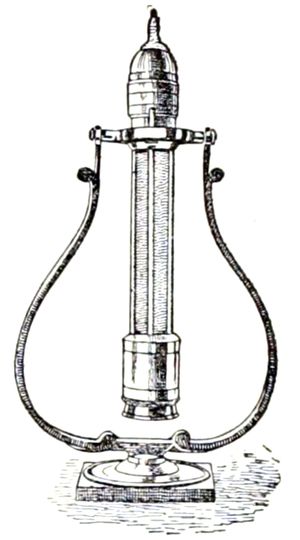
MARINE CANDLESTICK
From man-of-war "Constitution"
The "Good Man Richard"
There was great joy in France when Paul Jones sailed into port. The king, who was now making war on England, promised him a larger fleet of war vessels. So, in 1779, he found himself captain of a large ship armed with fifty cannon. He called the ship the Bon Homme Richard in honor of Franklin's Almanac, the "Poor Richard." Three smaller vessels joined him, and he again set sail for the English coast. The news of his coming caused great alarm.
The "Richard" and the "Serapis"
102. A Great Sea Fight and a Great Victory. As Paul Jones sailed along the British coasts he captured many trading ships and frightened the people. At last he came upon two British war ships. Just at dark the Richard attacked a larger English ship, the Serapis. At the first fire two of Jones' cannon burst, tearing up the deck and killing a dozen of his own men.
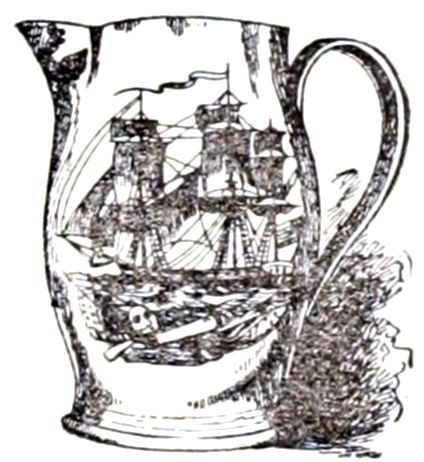
NAVAL PITCHER
This was made in commemoration of the American Navy, 1795
The great sea fight
The fight went on for an hour, when the Serapis came near, and Jones ran the Richard into her. "Have you struck your colors?" called out the English captain. "I have not yet begun to fight!" replied Captain Jones. When the ships came together again Paul Jones himself seized a great rope and tied them together. Now the fighting was terrific. The cannon tore huge holes in the sides of the ships.
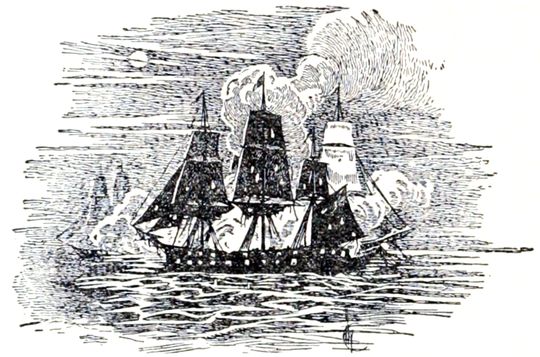
THE CAPTURE OF THE SERAPIS
Because of this victory three nations, France, Russia, and Denmark, bestowed special honors upon John Paul Jones as "the valiant assertor of the freedom of the sea"
A great explosion on the Serapis killed twenty of her men. Both ships were on fire, and the Richard began to fill with water. The men on each ship had to fight fire. It was ten o'clock at night.
The British prisoners on the Richard had to help pump out water to keep the ship from sinking.
A great victory
Only a few cannon on each ship could be fired. The decks of both ships were covered with dead and wounded, but neither captain would give up. Finally Paul Jones, with his own hands, pointed two cannon at the great mast of the Serapis. Just as it was about to fall, the English captain surrendered.
A great naval hero
All night Jones and his men were kept busy fighting fire and pumping water, while the wounded were removed to the Serapis. The Good Man Richard sank the next day at ten o'clock. Paul Jones sailed to France with his two English ships, where he was praised and rewarded by the King of France. He was a great hero in the eyes of the French people, and in the eyes of the Americans, too.
Finally buried in America
After the war Paul Jones was an officer in the Russian navy. He died in France in 1792. His grave was forgotten for many years, but was discovered in 1905, and his bones were brought to America with great honor, and buried at Annapolis, Maryland.
JOHN BARRY, WHO WON MORE SEA FIGHTS IN THE REVOLUTION THAN ANY OTHER CAPTAIN
Barry visits America
103. John Barry. Although born on a farm in Ireland (1745), John Barry wanted to be a sailor lad. While still young he was put to service on board a merchant ship. Here young Barry learned more than being a mere sailor. Between voyages he studied hard, and soon gained a useful education. At the age of fifteen he came to Philadelphia, and was so pleased with the country and the people that he resolved to make America his home.
Offers his services to Congress
He rose rapidly as a sailor and, when the news of the first bloodshed between England and her colonies came, he offered his services to Congress.
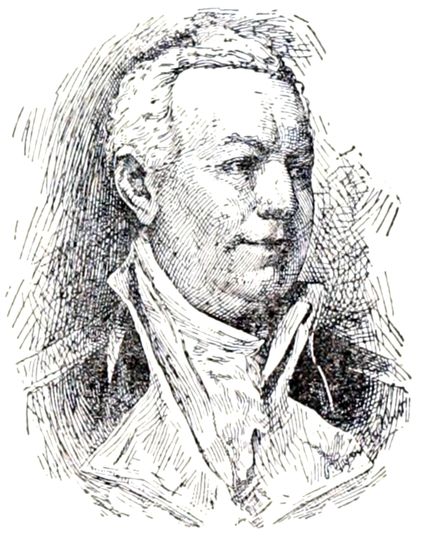
JOHN BARRY
From the portrait painted by Colin Campbell Cooper after the Stuart painting, now in Independence Hall, Philadelphia
Made captain of the "Lexington"
In 1776 Congress made him captain of the ship Lexington, the first Continental vessel to sail from William Penn's old city. Barry immediately put to sea, and met and captured the Edward after a fierce fight. Thus the Lexington was the first ship to bear the American flag to victory.
Congress, pleased with the result, put him in charge of a larger ship, called the Effingham. The British, however, bottled up the Effingham in the Delaware.
But Barry was not idle. Arming four boatloads of men, with muffled oars he rowed down the Delaware at night.
He captures a British vessel and four transports
Just as the sun was rising Barry saw a British vessel of ten guns. With this ship were four transports loaded with forage for the British army. Barry's boats made for the British ship. His men climbed on board with guns and swords in hand. The British soldiers threw down their arms and ran below. Barry fastened down the hatchways, and then turned his attention to the four transports, which quickly surrendered. Barry then took his five prizes across the river to an American fort.
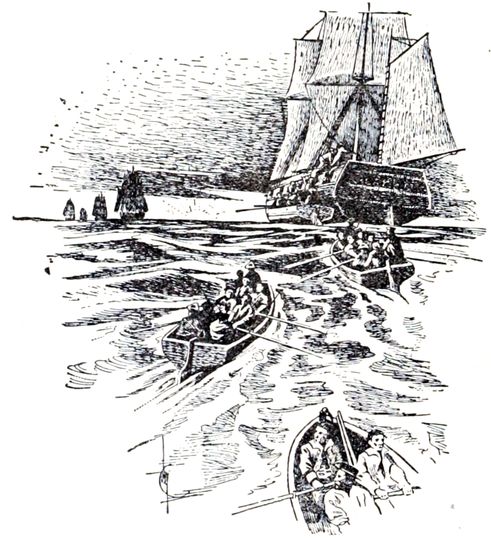
BARRY'S BOATS ATTACKING THE BRITISH
He takes command of the "Raleigh"
In 1778 Congress promoted John Barry to the command of the Raleigh. He set sail for Boston, and on his way met a British ship carrying thirty-two guns. His sailors had taken an oath never to surrender. They fought bravely, and had every hope of winning, when a British 64-gun ship came in sight. To keep their oaths, they ran the Raleigh ashore, and set her on fire. The British put out the fire and saved the ship.
Wounded, but forces the British to strike their colors
104. Barry Given Command of the "Alliance." In 1781 Barry was placed in command of the Alliance, a ship whose name was given in honor of France's helping America in this war. In May the Alliance met two British ships, and a hard battle followed. Barry was badly wounded, but would not surrender. He fought on and forced the British ships to strike their colors.
In 1783 Barry, in the Alliance, sailed on his last voyage of the Revolution. His companion ship was the Luzerne. Three British ships discovered the Americans and quickly gave chase. The Luzerne was slow and threw her guns overboard.
On his last voyage of the Revolution
Another vessel came into view; it was a French ship of fifty guns. With her aid Barry immediately decided to fight. He made a speech urging the men not to fire until ordered. A terrific battle with the foremost British ship followed. After fifty minutes' fighting, the British showed signals of distress. The remaining British ships now came up to rescue her, and the Alliance sailed away. The French ships took no part in the battle.
Named first commander of a navy
After the war was over, Congress provided for a navy, and General Knox, Washington's Secretary of War and of the Navy, named John Barry as first commodore. He served as the senior commander of the American navy until his death, in 1803. The people of Philadelphia have erected a monument to his memory (1907).
SUGGESTIONS INTENDED TO HELP THE PUPIL
The Leading Facts. 1. John Paul was born a sailor in Scotland and went to America. 2. He was in America when war broke out; offered his service and was made lieutenant. 3. Congress sent him to France, and Franklin sent him to prey on English commerce. 4. Paul Jones won the great sea fight in the Bon Homme Richard. 5. John Barry was born in Ireland, and went to sea early. 6. Congress made him captain in 1776, in charge of the Lexington. 7. Barry set the country talking by capturing a war vessel and four transports. 8. John Barry won more naval victories in the Revolutionary War than any other office. 9. Named first commodore in 1794 by the Secretary of the Navy.
Study Questions. 1. Give an account of John Paul's boyhood. 2. What of his first visit to America? 3. How did Paul happen, at so early an age, to have full charge of a vessel? 4. Why did he go to Virginia a second time? 5. Why did he hasten to Congress as soon as war began? 6. How did Paul Jones prove his right to be captain? 7. Tell the story of the battle between the Drake and the Ranger. 8. Picture the battle between the Bon Homme Richard and the Serapis. 9. What rewards came to Paul Jones? 10. Where is he buried? 11. Give an account of John Barry's youth. 12. When the war came, what was Barry's action? 13. What was the first victory on the part of the navy? 14. What was the outcome of the battle on the Raleigh? 15. What were Barry's experiences in the Alliance? Picture Barry's last battle.
Suggested Readings. Paul Jones: Beebe, Four American Naval Heroes, 17-68; Abbot, Blue Jackets of '76, 83-154; Frothingham, Sea Fighters, 226-266; Hart, Camps and Firesides of the American Revolution, 285-289; Hart, How Our Grandfathers Lived, 217-219; Seawell, Paul Jones.
John Barry: Griffin, Commodore John Barry, 1-96.