THE MEN WHO MADE AMERICA KNOWN TO ENGLAND AND WHO CHECKED THE PROGRESS OF SPAIN
Reading edition
JOHN CABOT ALSO SEARCHES FOR A SHORTER ROUTE TO INDIA AND FINDS THE MAINLAND OF NORTH AMERICA
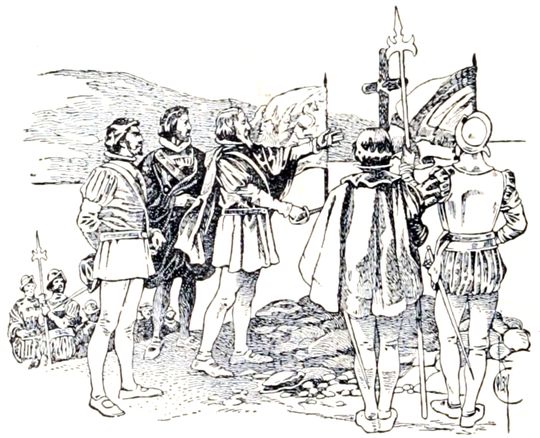
CABOT TAKING POSSESSION OF NORTH AMERICA FOR THE KING OF ENGLAND
On the spot where he landed Cabot planted a large cross and beside it flags of England and of St. Mark
The effect in England of Columbus' discovery
22. Cabot's Voyages. When the news of Columbus' great discovery reached England, the king was sorry, no doubt, that he had not helped him. The story is that Columbus had gone to Henry VII, King of England, for aid to make his voyage. But England had a brave sailor of her own, John Cabot, an Italian, born in Columbus' own town of Genoa, who also had learned his lessons in voyages on the Mediterranean. Cabot had gone to live in the old town of Venice. Afterward he made England his home and lived in the old seaport town of Bristol, the home of many English sailors.
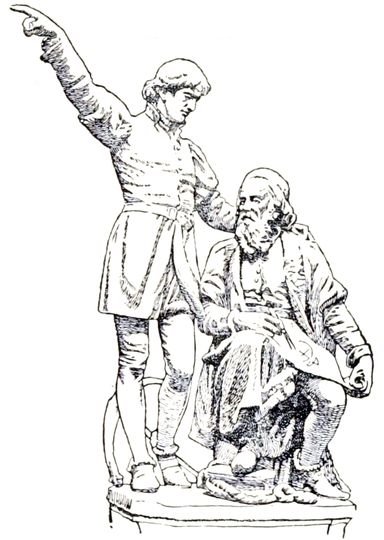
JOHN CABOT AND HIS SON SEBASTIAN
From the statue modeled by John Cassidy, Manchester, England
He, too, believed the world to be round, and that India could be reached by sailing westward. King Henry VII gave Cabot permission to try, providing he would give the king one fifth of all the gold and silver which everybody believed he would find in India.
What John Cabot discovered
Accordingly, John Cabot, and it may be his son, Sebastian, set out on a voyage in May, 1497. After many weeks, Cabot discovered land, now supposed to be either a part of Labrador or of Cape Breton Island. He landed and planted the flag of England, and by its side set up that of Venice, which had been his early home.
Later, he probably saw parts of Newfoundland, but nowhere did he see a single inhabitant. He did, however, find signs that the country was inhabited, but he found no proof of rich cities or of gold and silver. In the seas all around Cabot saw such vast swarms of fish that he told the people of England they would not need to go any more to cold and snowy Iceland to catch fish.
The king and people pay honor to Cabot
How John Cabot was treated by the king and people of England when he came back is seen in an old letter written from England by a citizen of Venice to his friends at home. "The king has promised that in the spring our countryman shall have ten ships, armed to his order. The king has also given him money wherewith to amuse himself till then, and he is now at Bristol with his wife, who is also a Venetian, and with his sons. His name is John Cabot, and he is called the great admiral. Vast honor is paid to him; he dresses in silk, and the English run after him like mad people, so that he can enlist as many of them as he pleases, and a number of our own rogues besides. The discoverer of these places planted on his new-found land a large cross, with one flag of England and another of St. Mark, by reason of his being a Venetian."
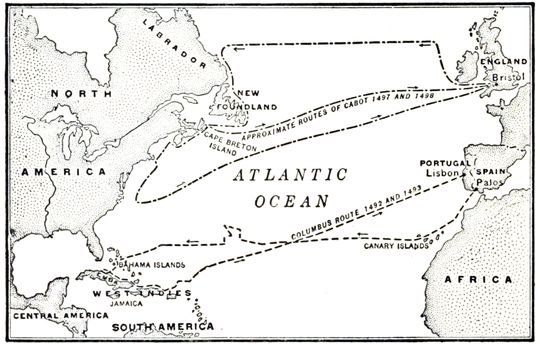
THE FINDING OF AMERICA
The first voyages of Columbus, the discoverer of the New World, and of Cabot, the first man to reach the mainland of North America
Cabot's second voyage
Again, in May, 1498, John Cabot started for India by sailing toward the northwest. This time the fleet was larger, and filled with eager English sailors. But Cabot could not find a way to India, so he altered his course and coasted southward as far as the region now called North Carolina.
Now because of these two voyages of Cabot, England later claimed a large part of North America, for he had really seen the mainland of America before Columbus. Spain also claimed the same region, but we have seen how Mexico and Peru drew Spaniards to those countries.
Why England was slow in settling America
If England had been quick to act and had made settlements where Cabot explored, she would have had little trouble in getting a hold in North America. But she did not do so. Henry VII was old and stingy. Cabot had twice failed to find India with its treasures of gold and silver, so little attention was given to the new lands.
SIR FRANCIS DRAKE, THE ENGLISH "DRAGON," WHO SAILED THE SPANISH MAIN AND WHO "SINGED THE KING OF SPAIN'S BEARD"
23. The Quarrel between Spain and England. After John Cabot failed to find a new way to India, King Henry did nothing more to help English discovery. His son, Henry VIII, got into a great quarrel with the King of Spain. He was too busy with this quarrel to think much about America. But during this very time, Cortés and Pizarro were doing their wonderful deeds. Spain grew bold, seized English seamen, threw them into dungeons, and even burned them at the stake. Englishmen robbed Spanish ships and killed Spanish sailors in revenge.
Their sailors take up the quarrel
Why Drake hated the Spaniards
24. Sir Francis Drake. A most daring English seaman was Sir Francis Drake. From boyhood days he had been a sailor. His cousin, Captain Hawkins, gave him command of a ship against Mexico, but the Spaniards fell upon it, killed many of the sailors, and took all they had. Drake came back ruined, and eager to take revenge. Besides, he hated the Spaniards because he thought they were plotting to kill Elizabeth, the Queen of England.
In 1573 Drake returned to England with his ship loaded with gold and precious stones, captured from the Spaniards on the Isthmus of Panama.
Begins his most famous voyage
25. Drake's Voyage around the World. After four years Drake, with four small but fast vessels, sailed direct for the Strait of Magellan. He was determined to sail the Pacific, which he had seen while on the Isthmus of Panama. In June his fleet entered the harbor of Patagonia where Magellan had spent the winter more than fifty years before.
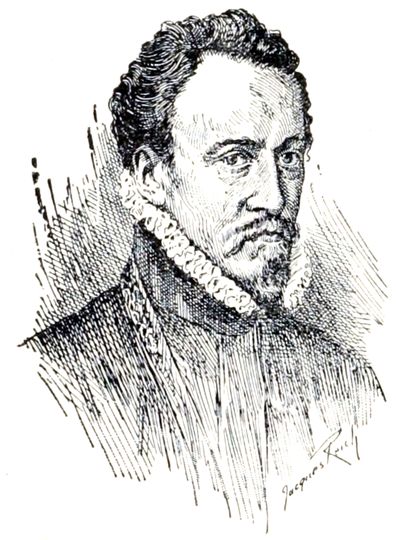
SIR FRANCIS DRAKE
From the original portrait attributed to Sir Antonis van Moor, in the possession of Viscount Dillon, at Ditchly Park, England
After destroying his smallest vessel, which was leaky, Drake sailed to the entrance of the Strait. Here he changed the name of his ship from the Pelican to the Golden Hind, with ceremonies fitting the occasion.
The fleet passed safely through the Strait, but as it sailed out into the Pacific a terrible storm scattered the ships. One went down, and one returned to England, believing that Drake's ship, the Golden Hind, had been destroyed.
But Drake had a bold heart, good sailors, and a stout ship. After the storm he sailed north to Valparaiso, where his men saw the first great treasure ship. The Spanish sailors jumped overboard, and left four hundred pounds of gold to Drake and his men. Week after week Drake sailed northward until he reached Peru, the land conquered by Pizarro.
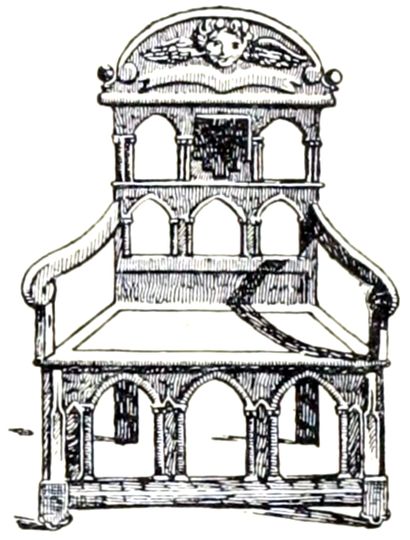
DRAKE'S CHAIR, OXFORD UNIVERSITY
It was made from the timbers of the "Golden Hind"
Capturing treasure ships on the Pacific coast
Another great treasure ship had just sailed for Panama. Away sped the Golden Hind in swift pursuit. For a thousand miles, day and night, the chase went on. One evening, just at dark, the little ship rushed upon the great vessel, and captured her. What a rich haul! More than twenty tons of silver bars, thirteen chests of silver coin, one hundredweight of gold, besides a great store of precious stones.
The "Golden Hind" winters in California
The little ship continued northward. Hoping for a northeast passage to the Atlantic, Drake sailed along the coast as far as what was afterward known as the Oregon country. But the increasing cold and fog and the strong northwest winds made him turn southward again. Sailing close inshore, he found a small harbor, just north of the great bay of San Francisco. Here his stout little ship came to anchor. The natives believed that Drake and his men were gods, and begged them to remain with them always. Drake named the country New Albion and took possession in the name of the queen, Elizabeth. When he had refitted his ship for the long voyage home, Drake set sail, to the great sorrow of the natives.
Drake crosses the Pacific and Indian oceans
Week after week went by, until he saw the very islands where Magellan had been. He made his way among the islands and across the Indian Ocean until the Cape of Good Hope was rounded, and the Golden Hind spread her sails northward toward England.
Drake given a title by Queen Elizabeth
Drake reached home in 1580, the first Englishman to sail around the world. The people, who had given him up as lost, shouted for joy when they heard he was safe. Queen Elizabeth visited his ship in person, and there gave him a title, so that now he was Sir Francis Drake. Years after, a chair was made from the timbers of the famous Golden Hind and presented to Oxford University, where it can now be seen.
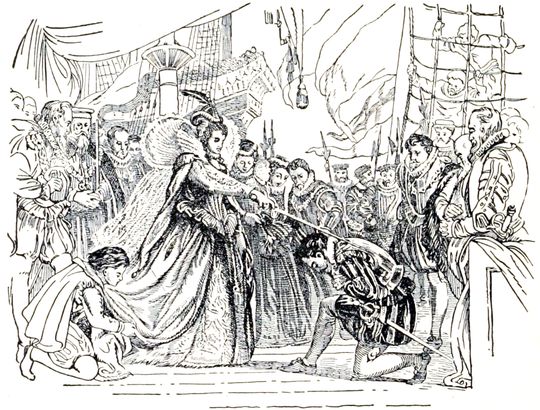
QUEEN ELIZABETH MAKING DRAKE A NOBLEMAN
After the drawing by Sir John Gilbert. It pictures the scene that took place on board the "Golden Hind" at the close of the great voyage. Queen Elizabeth visited Drake in his ship and conferred knighthood on him for his great services to England
He goes to find the Gold Fleet
26. Drake Again Goes to Fight the Spaniards. Drake soon took command of a fleet of twenty-five vessels and two thousand five hundred men, all eager to fight the Spaniards (1585). He sailed boldly for the coast of Spain, frightened the people, and then went in search of the Gold Fleet, which was bringing shipload after shipload of treasure from America to the King of Spain.
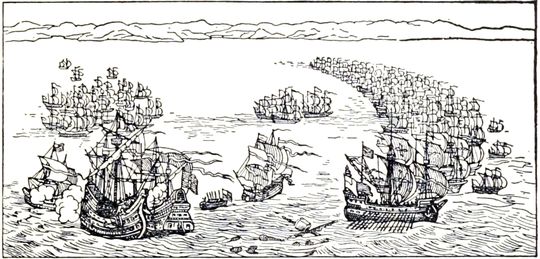
THE SPANISH ARMADA
More than one hundred twenty-five vessels sailed from Lisbon to conquer England, but only about fifty returned to the home port
In the West Indies
No sooner had Drake missed the fleet than he made direct for the West Indies, where he spread terror among the islands. The Spaniards had heard of Drake, the "Dragon." He attacked and destroyed three important towns, and intended to seize Panama itself, but the yellow fever began to cut down his men, so he sailed to Roanoke Island, and carried back to England the starving and homesick colony which Raleigh had planted there.
Singeing the King of Spain's beard
The Spanish king was angry. He resolved to crush England. More than one hundred ships, manned by thousands of sailors, were to carry a great army to the hated island. Drake heard about it, and quickly gathered thirty fast ships manned by sailors as bold as himself. His fleet sailed right into the harbor of Cadiz, past cannon and forts, and burned so many Spanish ships that it took Spain another year to get the great fleet ready. Drake declared that he had "singed the King of Spain's beard."
Spain aims to crush England, but is badly defeated
27. The Spanish Armada. The King of Spain was bound to crush England at one mighty blow. In 1588 the Spanish Armada, as the great fleet was called, sailed for England. There were scores of war vessels manned by more than seven thousand sailors, carrying nearly twenty thousand soldiers. Almost every noble family in Spain sent one or more of its sons to fight against England.
When this mighty fleet reached the English Channel, Drake and other sea captains as daring as himself dashed at the Spanish ships, and by the help of a great storm that came up, succeeded in destroying almost the whole fleet. No such blow had ever before fallen upon the great and powerful Spanish nation.
From that time on her power grew less and less, while England's power on the sea grew greater and greater. Englishmen could now go to America without much thought of danger from Spaniards.
SIR WALTER RALEIGH, THE FRIEND OF ELIZABETH, PLANTS A COLONY IN AMERICA TO CHECK THE POWER OF SPAIN
Raleigh, student, soldier, seaman
28. Sir Walter Raleigh. Born (1552) near the sea, Raleigh fed his young imagination with stories of the wild doings of English seamen. He went to college at Oxford at the age of fourteen, and made a good name as a student.
In a few years young Raleigh went to France to take part in the religious wars of that unhappy country. At the time he returned home all England was rejoicing over Drake's first shipload of gold. When Queen Elizabeth sent an army to aid the people of Holland against the Spaniards, young Raleigh was only too glad to go.
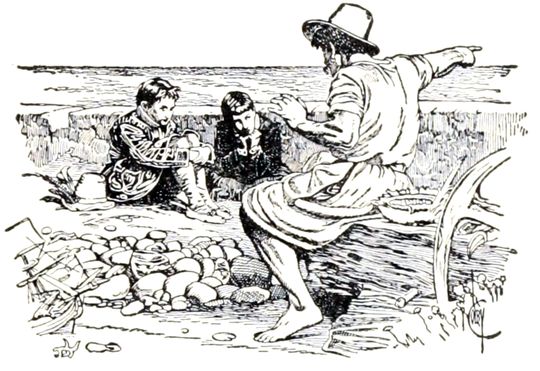
THE BOYHOOD OF RALEIGH
After the painting by Sir John E. Millais
On his return from this war he went with his half-brother, Sir Humphrey Gilbert, on two voyages to America, at the very same time Drake was plundering the Spanish treasure ships in the Pacific Ocean. Afterward Raleigh turned soldier again and, as captain, went to Ireland, where Spain had sent soldiers to stir up rebellion. Thus, before he was thirty years old, he had been a seaman and a soldier, and had been in France, Holland, America, and Ireland.
Raleigh when thirty years old
At this time Raleigh was a fine-looking man, about six feet tall, with dark hair and a handsome face. He had plenty of wit and good sense, although he was fond, indeed, of fine clothes. He was just the very one to catch the favor of Queen Elizabeth.
One day Elizabeth and her train of lords and ladies were going down the roadway from the royal castle to the river. The people crowded both sides of the road to see their beloved queen and her beautiful ladies go by. Raleigh pressed his way to the front.
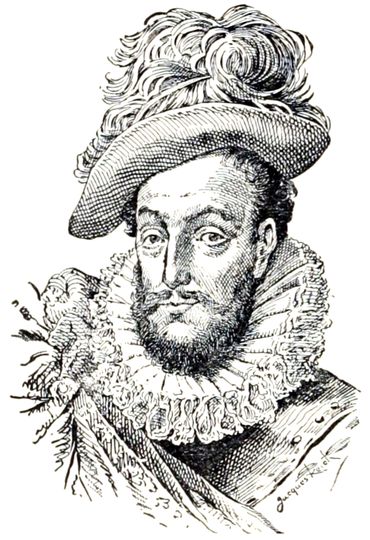
SIR WALTER RALEIGH
From the original portrait painted by Federigo Zuccaro
How he won the favor of the queen
As Elizabeth drew near, she hesitated about passing over a muddy place. In a moment the feeling that every true gentleman has in the presence of ladies told Raleigh what to do, and the queen suddenly saw his beautiful red velvet cloak lying in the mud at her feet. She stepped upon it, nodded to its gallant owner, and passed on. From this time forward Raleigh was a great favorite at the court of Queen Elizabeth.
Raleigh's plan for checking the power of Spain
29. Trying to Plant English Colonies. In 1584 Raleigh caused a friend to write a letter to the queen, explaining that English colonies planted on the coast of North America would not only check the power of Spain but would also increase the power of England. That very year the queen gave him permission to plant colonies. Thus a better way of opposing Spain was found than by robbing treasure ships and burning towns.
The Indians welcome the English
Why the land was named Virginia
Raleigh immediately sent a ship to explore. The captain landed on what is now Roanoke Island. The Indians came with a fleet of forty canoes to give them a friendly welcome. After a few days an Indian queen with her maidens came to entertain the English. "We found the people most gentle, loving, and faithful, void of all guile and treason," said Captain Barlow. His glowing account of the land and people so pleased Elizabeth that she named the country Virginia, in honor of her own virgin life.
Raleigh next sent out a kinsman, Sir Richard Grenville, with a fleet of seven vessels and one hundred settlers, under Ralph Lane as governor. But the settlers were bent on finding gold and silver, instead of making friends with the Indians.
Why the Indians became hostile
An Indian stole a silver cup from the English. Because of this theft Lane and his men fell upon the Indian village, drove out men, women, and children, burned their homes, and destroyed their crops. This was not only cruel but also foolish, for the story of his cruelty spread to other tribes, and after that wherever the English went they were always in danger from the Indians.
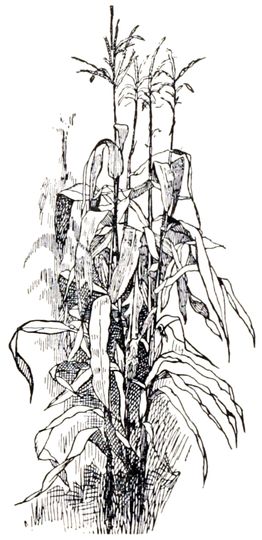
INDIAN CORN
Indian corn and the white potato taken to England
When Drake came along the next spring with his great fleet, the settlers were only too glad to get back to England, and be once more among friends. They took home from America the turkey and two food plants, the white potato and Indian corn—worth more to the world than all the gold and silver found in the mines of Mexico and Peru!
Raleigh tries again
Although Raleigh had already spent thousands of dollars, he would not give up. He immediately sent out a second colony of one hundred fifty settlers, a number of whom were women. John White was governor. Roanoke was occupied once more, and there, shortly afterwards, was born Virginia Dare, the first white child of English parents in North America. Before a year went by, the governor had to go to England for aid.
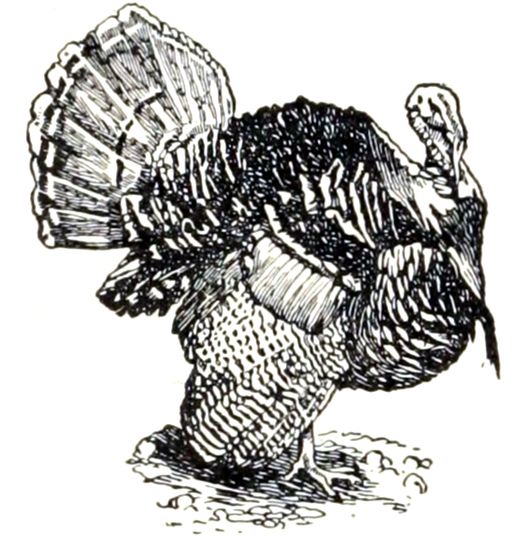
A WILD TURKEY
But Raleigh and all England had little time to think of America. The Armada was coming, and every English ship and sailor was needed to fight the Spaniards. Two years went by before Governor White reached America with supplies. When he did reach there practically no trace of the colony could be found. Not a settler was left to tell the tale.
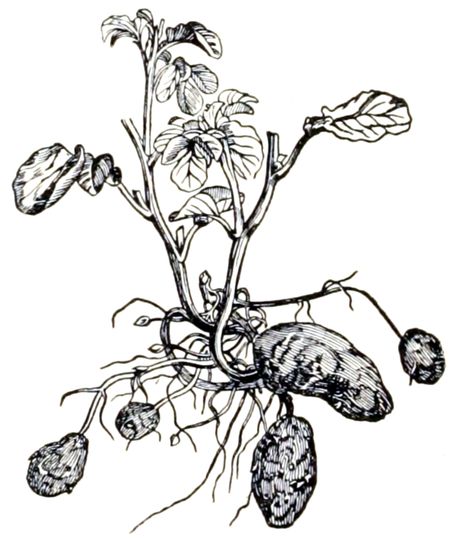
POTATO PLANT AND TUBERS
The "lost colony"
The only trace of Raleigh's "lost colony" was the word "Croatoan" cut in large letters on a post. Croatoan was the name of an island near by. White returned home, but Raleigh sent out an old seaman, Samuel Mace, to search for the lost colony. It was all in vain. Many years later news reached England that a tribe of Indians had a band of white slaves, but the mystery of the lost colony never was cleared up.
Raleigh's money gives out, but not his hope
Raleigh had now spent his great fortune. But he did not lose heart, for he said that he would live to see Virginia a nation. He was right. Before he died a great colony had been planted in Virginia, and a ship loaded with the products of Virginia had sailed into London port and an Indian "princess" had married a Virginian and had been received with honor by the King and Queen of England.
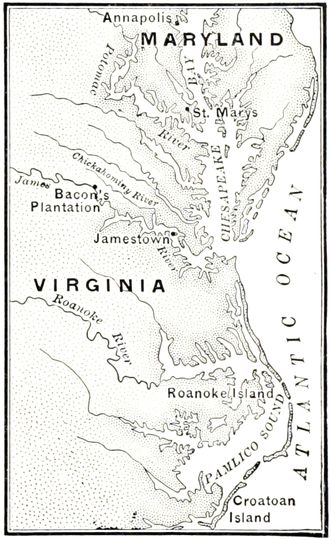
EARLY SETTLEMENTS IN VIRGINIA AND MARYLAND
30. The Death of Raleigh. But the great Elizabeth was dead, and an unfriendly king, James I, was on the throne. He threw Raleigh into prison, and kept him there thirteen years. The Spaniards urged the king to put Raleigh to death. He had been a life-long enemy of Spain and they knew they were not safe if he lived.
Raleigh bravely meets death
At last Spanish influence was too strong, and Sir Walter faced death on the scaffold as bravely as he had faced the Spaniards in battle.
Thus died a noble man who gave both his fortune and his life for the purpose of planting an English colony in America.
SUGGESTIONS INTENDED TO HELP THE PUPIL
The Leading Facts. 1. John Cabot, trying for a short route to India, discovered what is supposed to be Labrador, or Cape Breton. 2. On a second voyage he coasted along eastern North America as far south as the Carolinas. 3. Later, England claimed all North America. 4. Francis Drake sailed to the Pacific in the Pelican and then turned northward after the Spanish gold ships. 5. He wintered in California, and then started across the Pacific—the first Englishman to cross. 6. Drake reached England, and was received with great joy. 7. Once more Drake went to fight the Spaniards, until the Great Armada attacked England. 8. Walter Raleigh, a student, a soldier, and a seaman, won the favor of the queen. 9. He hated the Spaniards, and planted settlements in what is now North Carolina. 10. What was Raleigh's prophecy?
Study Questions. 1. Tell the story of John Cabot before he came to England. 2. What did Cabot want to find when he sailed away and what did he find? 3. How was Cabot treated by King Henry VII, according to a "Citizen of Venice," after he returned? 4. Why was little attention given to the new lands by the English?
5. Prove that Spanish and English sailors did not like each other. 6. Who was Francis Drake? 7. What was Magellan after and what was Drake after? 8. Find out why Drake renamed his ship the Golden Hind. 9. Tell the story of Drake's voyage from Valparaiso to Oregon. 10. Tell the story of the voyage across the Pacific and how he was received at home. 11. What did Drake do when he missed the "Gold Fleet"? 12. What did Drake mean when he said he had "singed the King of Spain's beard"? 13. What became of the Spanish Armada, and what effects did its failure produce?
14. What other brave man went to America before the Armada was destroyed? 15. Give the early experiences of Raleigh before he was thirty. 16. Make a mental picture of the cloak episode. 17. Explain how kind the Indians were; how did the English repay the Indians? 18. What did the colonists take home with them? 19. Who was the first white child of English parents born in America? 20. How did the destruction of the Armada affect Englishmen who wanted to go to America? 21. Read in other books about Raleigh's death. 22. How did the English treatment of the Indians compare with that of the Spaniards?
Suggested Readings. Cabot: Hart, Colonial Children, 7-8; Griffis, Romance of Discovery, 105-111.
Drake: Hart, Source Book of American History, 9-11; Hale, Stories of Discovery, 86-106; Frothingham, Sea Fighters, 3-44.
Raleigh: Hart, Colonial Children, 165-170; Pratt, Early Colonies, 33-40; Wright, Children's Stories in American History, 254-258; Higginson, American Explorers, 177-200; Bolton, Famous Voyagers, 154-234.