"A Romance of the Harem and the Great Sahara" (continued 7)
Reading edition
“No,” she answered calmly. “Have courage, O Cecil! Dost thou not remember what stake thou hast in the result of this attack?”
Again the rifles of the defenders belched forth their ominous red flashes, as amid the din and rattle a perfect hail of bullets whistled about us; yet she seemed to shed a charmed halo around her, for neither Hadj Absalam nor myself were struck. With teeth firmly set, we struggled on, cutting, slashing, striking death at every blow, amid a scene indescribably weird and ghastly, until each well-delivered volley of the defenders felled dozens of our band to earth, and I knew that the slaughter of my undaunted companions-in-arms would be complete.
The fortune of the fight trembled in the balance. Zoraida’s cool, inspiring demeanour and encouraging words stirred the nomadic Ennitra to bold, fearless deeds, and many were the feats of prowess the brigands of the plains in that dark hour accomplished. My life was saved by one of the faithful followers who had assisted Halima and myself to escape. A gigantic, fierce-eyed negro slave of the Fáda had rushed towards me, brandishing his crooked jambiyah, and I had fired, missing him. Next moment he closed with me, gripping my throat with long, sinewy fingers, as with a demoniacal, exultant laugh he raised his knife to plunge it deep into my breast, when Halima’s slave, fortunately noticing my peril, raised his sword and clave my enemy’s skull so swiftly that the warm blood spurted forth over my hands. Without uttering a sound, the dark, evil-visaged brute who intended to kill me staggered and fell back stone dead, while I remained breathless but unharmed.
I gasped a word of thanks to my deliverer, but, shrugging his shoulders, he merely answered, “The Ennitra assist those who fight with them side by side, be they Infidels or Allah’s chosen. Thou art our friend and the friend of the Lalla Halima, therefore we are loyal unto thee, and require no thanks for obeying that which is written.”
“May Allah honour thee!” I said, fervently thankful, fully realising how narrowly I had once again escaped a violent end.
“And may He be as a lamp shining upon thy path,” the man murmured in pious response.
In the desperate onslaught made a few minutes later by the soldiers of the Sultan, now reinforced by a squadron of horsemen who had approached with all speed from the opposite side of the city, Zoraida and I found ourselves together in the thick of the fray. Grappling with their enemies, the Ennitra, with all their bellicose instincts now thoroughly aroused, closed with them in a terrible death-struggle. Each desert-wanderer, determined to sell his life dearly, bade defiance to the great body of janissaries, eunuchs, palace guards, and soldiers, and, armed to the teeth, cut, thrust, and charged, pressing the defenders hard, bearing the brunt of the fight, and showing a bold front in a manner truly astonishing.
With their white drapery flowing in the wind, as they spurred on their horses in repeated efforts to successfully storm the gate of the Fáda, my companions fought like demons. But the defenders held together in solid phalanx, and repulsed us time after time, until many more of our bold, undaunted horsemen lay weltering in their blood.
Again and again Zoraida, whose slim form still showed under the dark standard of the outlaws in the very midst of the desperate conflict, shouted words of encouragement, and each time we swept forward upon the stubborn ranks of the janissaries, only to be ignominiously driven back under a withering fusillade of bullets. Hadj Absalam’s gruff voice, raised in desperate imprecation, roared above the din of the fray, but he was unheeded. They obeyed only the commands of the Daughter of the Sun, whom they still implicitly believed would lead them to victory.
In deadly embrace we fought with ferocious strength, grappling our adversaries, and using our knives with horrible fiendishness. Janissaries and eunuchs, slashed and mutilated by the dexterous blows of my dauntless fellow-horsemen, fell groaning to earth, staining the burnouses of the outlaws with their blood; but even then, when slight success aroused redoubled energy within us, any hope of the investment of the Fáda still seemed utterly forlorn.
Suddenly above the noise and tumult there was a loud rumbling, which at first I thought was distant thunder.
“Hearken!” eagerly shouted Zoraida, at that moment only a few feet from me. “Give ear unto me! Lo! it is the rolling of the Drum of Nâr! Fight on! Our brothers are advancing! For evil men Hell, the Worst life; for the righteous the Best Mind, Paradise!”
With a shrill whoop, the Ennitra took up the last sentence as a war-cry, and, with courage strengthened by the knowledge that at last assistance was at hand, dashed forward wildly towards the great arched gateway, many of them being in their reckless onslaught impaled upon the defenders’ spears. Then, ere five minutes had passed, with loud, reassuring shouts, mingling with the monotonous thumping of the Drum of Victory, the three bodies of the Ennitra, who, it afterwards appeared, had effected a junction near Tanou-n-Toungaïden, made a vigorous demonstration, by which, in the course of a quarter of an hour, the defenders became hemmed in between two galling fires.
Closely pressed, they were at last, after holding out with dogged resistance until the first flush of dawn, driven back against the gloomy walls of the palace, and there slaughtered without mercy.
The tide of battle turned in favour of the brigands.
There ensued a revolting massacre, from which Zoraida, breathless and panting, turned and shut out its sight by covering her eyes with her delicate hands. The soldiers of the Ahír, finding themselves overpowered by the dreaded band whose vengeance was feared throughout the Soudan, threw down their arms and craved for quarter. But the Ennitra had given rein to their savage bloodthirstiness, and no words from their beautiful leader could avert that fierce, horrible brutality which caused them to be held in dread. Upon their knees proud janissaries of the Sultan Abd-el-Kerim sank in the blood of their comrades, crying hoarsely for mercy, but none was shown them. Dismounted, the men whom Zoraida had rallied and incited to victory threw themselves upon their adversaries, butchering them in cold blood. Murder, mutilation, and torture were rife everywhere in the vicinity of the Fáda, and as the bright streaks of saffron spread in the east, heralding the sun’s coming, the massacre was awful.
“Spare the Mesállaje!” cried Zoraida, pointing to the square minaret that loomed dark against the grey of dawn. “Defile not the Great Mosque! The curse of the One of Might rest upon any who dare to enter the holy place with blood upon their hands!”
Quickly the order, shouted aloud, was passed from mouth to mouth, and a few moments later, Zoraida, as she rode swiftly past me, exclaimed—
“With the Mosque free from attack, thou wilt of a surety find the imam thou seekest. When it is time I will tell thee;” and away she galloped to where a large force of our people, climbing over the great heap of slain, were battering in the heavy gate of the Fáda, that for centuries had withstood all attack.
At last, by dint of supreme effort, the door was burst open, and with loud, victorious yells, there rushed into the first of the great courts a legion of ferocious brutes, who ruthlessly murdered those who stood in their path. Guards, servants, courtiers, and eunuchs were ferreted from their hiding-places and slaughtered with horrible ferocity, as, headed by Hadj Absalam under his green standard, the thieving hordes swept onward through the luxuriant palace to the Court of the Eunuchs, with which I was so familiar. Then, storming the three great doors of the Sultan’s harem, they at last gained that most luxuriant portion of the Fáda.
Zoraida drew back, as if fearing to enter, and for a few seconds stood beside me in the gateway trembling. Summoning courage at last, she allowed herself to be carried on over the bloodstained floors of polished sardonyx and agate into the great arcaded courts, with their columns of marble, plashing fountains, and cool palms. Huddled together in little groups stood the beautiful prisoners of the Sultan, with fear depicted on their handsome faces, as if they had received forewarning of their untimely end. Uttering fiendish yells, the flint-hearted Ennitra, intoxicated by success, bounded towards them, and the awful scenes of loot and massacre that ensued I will not attempt to describe. Suffice it to say that no mercy was shown even to the women. Their jewels were torn from them, fingers on which were valuable rings being unceremoniously hacked off, and their slim white throats and bare breasts were cut and slashed with hellish fiendishness. A few of the more beautiful were chosen by Hadj Absalam to grace his own harem, but the remainder were simply butchered with merciless ruthlessness, the jewels filched from them being flung unceremoniously into a great heap in the centre of the gorgeous Courts of Love, and over it a dozen of the outlaws mounted guard.
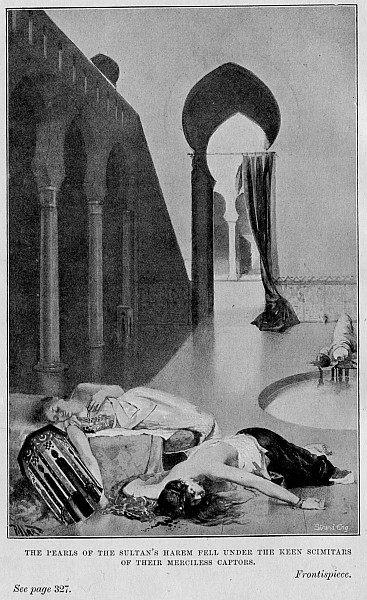
The massacre was sickening. Piercing screams of the women as they fell under the knives of their pitiless captors echoed along the great arcades, mingling with the jeers of the outlaws and the hoarse cries of the dying. Blood ran across the polished floors, and, trickling into the fountains, tinged their waters, the walls of marble were bespattered with it, and the once-beautiful Courts of Love were rendered hideous by their piles of mutilated corpses, and became a ghastly Inferno, to be remembered with a fearsome shudder until one’s dying day.
Horrified by the terrible sights I had witnessed, I endeavoured to draw back, but with loud shouts the crowd, excited to madness by their work of murder and pillage, made a sudden rush to the Sultan’s pavilion, and involuntarily I was carried onward.
“Seek Abd-el-Kerim!” they cried. “Kill him! kill him!” Through the harem-garden, along the edge of the great lake, and on into the Hall of the White Divan they pressed. On entering, we found under the great baldachin of silk and gold the young Sultan, with his Grand Vizier Mukhtar and Amagay, the chief of his eunuchs, on either side, standing erect, regarding our entrance with regal air and unflinching eye. He had drawn his scimitar and was prepared to defend himself.
“What meaneth this intrusion?” he cried, the fierce fire of anger in his face. “Verily hast thou rushed into the Wrath, and the blow of destruction shall descend upon thee!”
“Spare us!” cried Mukhtar, rushing forward, trembling, cringing coward that he was.
“We are thy slaves,” added Amagay, throwing away his sword. “Have mercy upon us! Take what thou mayest, but slay us not!”
The fierce, dishevelled band, heedless of all appeal, dashed onward, led by Hadj Absalam. A dozen men rushed forward to dispatch the Sultan, but the latter, wielding his jewelled scimitar, felled the first outlaw who approached, inflicting a mortal wound. Next moment, however, the youthful ruler of the Ahír, pulled unceremoniously off the divan, was struggling powerless in the hands of his ragged conquerors.
For his curses they cared naught, but at a signal from Hadj Absalam, who had in the meantime mounted to the deposed monarch’s place, Labakan stepped forward, armed with the executioner’s heavy doka, which he had just found while searching for plunder.
“Let him die!” exclaimed Hadj Absalam briefly.
“Ah! spare me, O conqueror!” gasped the unhappy youth. “It is written—it is written that the blessings of Allah rest upon the merciful! Spare me!”
But the Sultan, pale and haggard, was quickly forced to his knees upon the polished pavement before his own divan and held with his hands behind his back. Piteous were his appeals, but they softened not his captors’ murderous, sanguinolent hearts. The great diamond aigrette was ruthlessly torn from his turban and handed to the robber Sheikh, and then, as the men held him down firmly, Labakan stepped forward, and, swinging the doka with both hands, smote off his head at a single blow.
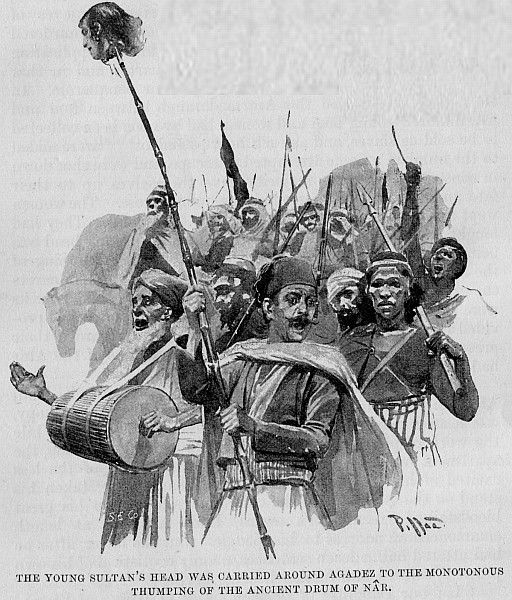
The body, quickly despoiled of its jewels, was kicked aside into a corner, while the head, mounted on a spear, was sent forth into the city in order to strike awe into the hearts of those citizens who refused to submit to the conquerors.
Mukhtar and Amagay were also decapitated in like manner and without ceremony by the villainous Labakan, who, judging from the self-satisfied grin upon his sinister countenance, delighted in the gruesome duties of his self-assumed office. Once he glanced at me and smiled. Doubtless it would have afforded him considerable pleasure to strike off my head by the same means.
In their frenzied thirst for blood, many of my companions, rushing onward, pillaged the Sultan’s private apartments and the Treasury. Thence they went to the Hall of Audience.
Here a band of janissaries at first made a desperate stand, but they were eventually butchered, even to the last man.
Through the city wildly yelling bands of the Ennitra were rushing with fire and sword. The hours were spent by them in murder and pillage, in mutilation, in every conceivable kind of nameless atrocity. Into the houses they rushed, penetrating to the apartments of the women, murdering the occupants, and carrying off all that was valuable. Deeds of violence and lawlessness were committed with cruel brutality and heartlessness; women and children were slaughtered before the eyes of husbands and fathers, who in their turn were also murdered in cold blood. Many went down on their knees, supplicating with heads bent to the ground, crying for quarter, and in that attitude were butchered mercilessly by their conquerors. In the open space called the Azarmádarangh between four and five hundred young men and women had by noon been collected to be sold as slaves, and as each hour passed, others were added to the number. Some attempted to escape, and were shot down in consequence, but the majority gave themselves up to their fate, and squatted on the ground silent and morose. The women wept and wailed, but the men made no complaint. They had fought, Fortune had deserted them, and their Sultan’s head was being carried around Agadez to the monotonous thumping of the ancient Drum of Nâr. Upon the pinnacles and minarets the great vultures of dirty-greyish plumage with naked necks were awaiting impatiently the feast that the marauders had provided for them, and the captives, noticing them, regarded their presence as an omen that the power of the Sultans of the Ahír had been broken for ever.
In Abd-el-Kerim’s pavilion, where I remained, Hadj Absalam, with his banner planted over the great canopy, was seated upon the divan with Zoraida at his side. While the work of plunder was proceeding throughout the Fáda, the apartment was filled to overflowing by a crowd of the less excited of his bloodthirsty band. Labakan having taken his stand on the other side of the chieftain, resting upon his great bloodstained executioner’s sword, Hadj Absalam at length commenced an address to his people. But the latter, after he had uttered half a dozen sentences, mainly egotistical of his own prowess, refused him further hearing, crying—
“Let our Daughter of the Sun speak, O Mirror of Virtue! We trusted her and were not afraid. Let her have speech with us!”
“Speak then,” he said, annoyed, turning to Zoraida. “May the fear of thy Ruler lie upon thy lips.”
Casting a quick inquiring glance at him, she smiled pleasantly upon those around her, saying—
“Lo! thy Sheikh, thy Branch of Honour, hath led thee through these courts of the Fáda—wherefore dost thou not honour him?”
“It was thy voice alone that rallied us when we were failing, and guided us at the critical moment unto a victory great and glorious!” cried one of the warriors, a statement that was hailed with extreme approbation.
Gracefully she bowed in recognition of the compliment, saying, “What I have done hath been in accordance with the promise given unto me. Once again have I led thee to victory, though it be for the last time.”
A murmur of dissent went round, and a voice inquired the reason.
“Because,” she said,—“Because thou hast conquered the City of the Ahír, therefore thou hast no further need of my services—”
“I have. Thou shalt now become Pearl of my Harem!” Hadj Absalam interrupted, with a scowl of displeasure upon his furrowed face.
This declaration produced a sensation almost electrical, and it seemed that, even though the prospect might be distasteful to them, none dare challenge the autocrat. Zoraida, too, turned pale, clenched her tiny hands, and bit her lips to the blood.
“Brothers,” she gasped, her voice faltering, “I, Daughter of the Sun, am thy sister. Oft-times have I risked my life to ensure success in thy forays. Art thou still loyal unto me?”
“We are,” they answered, as with one voice.
“Then I fear not mine enemies,” she exclaimed, drawing herself up and flinging back her blood—besmirched silken robe with a defiant air. “To-day thou hast broken the power of a great Sultan and beheaded him; thou hast invested the palace that all thought impregnable; thou hast captured many slaves, and thou hast secured plunder almost as valuable as the Treasure of Askiá, which lieth hidden. I led thee hither, but the tenure of my leadership is at an end. Bow now unto the authority of thy Sheikh, and treat me only as one who hath rendered thee a service.”
“It is but fitting that, now we have conquered Agadez, thou shouldst become Malieah of the Ahír,” Hadj Absalam protested. “I appeal to thee, my people. Do I give voice unto thy wish?” The armed men looked at one another in hesitation. Then one, a big, hulking, half-witted fellow, stepped forward, and, turning back to his companions, exclaimed—
“Is not the beauty of our Daughter of the Sun known throughout the Great Desert; is she not our Lady of Wondrous Beauty, with whom none can compare? Did not the great Sultan, Mulai Hassan, of Fez, offer one hundred bags of gold for her? Why should she not grace our people by becoming the chief wife of our wise and just ruler? She would still retain her power to bring victory unto us, and would at the same time reflect upon us perpetually the light of her beauteous countenance.”
Labakan grinned. It was, I felt sure, one of his devilish schemes. “Are any of the houris whom thou hast spared in yonder harem half as beautiful as the Lalla Zoraida?” he asked. “Surely she with the loveliest face should become Queen?”
“Hearken unto me, O my brothers!” Zoraida cried anxiously. “Until this moment thou hast granted me freedom. It is a privilege that as long as I live I will not forego; if thou forcest upon me this marriage, remember that my self-sought death will fall upon thee as a curse, swift and terrible.”
“Thy beauty designateth thee as our Sultana!” they answered, influenced by the arguments of the wily Labakan and the others. “Thou must become Queen of the Courts of Love!”
“And is this—is this how thou repayest one who hath acted as a lamp in thy darkness; thy Lode Star that hath led thee unto prosperity?” she cried, with bitterness. “Of a truth herein thou showest—”
“Daughter, thou treatest the generous gift of thy Ruler with contempt,” Hadj Absalam roared in anger.
“I utter no contemptuous words,” she answered, resolutely calm. “Thou hast conceived a plan to marry me against my will, because of what thou art pleased to call my fair face. Verily, I tell thee that if thou attemptest to force thine hateful favours upon me, my knife here shall score mine own cheeks and render them hideous unto thy sight! Failing that, I—I will kill myself!”
“Bah!” cried the Sheikh, impatiently tugging at his beard. “Thou lovest the white-faced Roumi to whom we have given succour!”
“If he were killed, her objection would be removed,” observed Labakan, gesticulating with hands that were smeared and sticky with blood. His cool suggestion was received with mingled approbation and dissent.
“Wouldst thou murder one who hath proved himself thy firm friend?” Zoraida asked, her eye fixed upon the man who had already attempted to assassinate me. Shrugging his shoulders, he showed his even white teeth in a hideous grin, but made no reply.
“Vengeance cometh—vengeance just upon the faithless and those who betray their friends. Their couch shall be in hell!” she continued. “If thou forcest me to sacrifice my life, of a verity wilt thou deliver the Lie unto Truth, and bring upon thee ruin and shame abiding. Cama tafakal kathâlik tolâ ki!” (“Such as you will do, so will you find.”)
But the fierce, brutal murderers grouped around only laughed. Her strange power over them seemed to have suddenly vanished, for, with her uncovered face handsome in their eyes, there was, alas! a consensus of opinion that she should become the chief wife of their chieftain! What could I do to save her? Nothing. Glancing across at me with a look of mute appeal, she stood silent, her hand upon the hilt of her knife. She seemed deeply agitated, for though her lips moved, no sound escaped them.
Again the half-witted brute who had urged the desirability of the hateful union turned to his companions, asking: “Is it thy desire that the Daughter of the Sun should be exalted and become our Queen of Delights and the Light of our Darkness?”
“Thy words are truly words of wisdom!” his companions cried loudly, with only two or three dissentients. “Our Ruler must take her as his wife.”
The cruel face of Hadj Absalam broadened into a benign smile, while Labakan’s eyes glittered with murderous craftiness, as, with hands tightly clasped and tears upon her beautiful cheeks, Zoraida made a final desperate appeal—
“A moment ago didst thou vow loyalty unto me, my brothers. Yet even now wilt thou force me into a loveless union that is distasteful—that—that will cause me to seek death by mine own hand! If I have offended, cast me from thee, but wreck not my happiness by an odious marriage! Ever have I been unswervingly loyal unto thee, and He in whose hand is the Kingdom of all Things will assuredly be swift in punishing those who seek my self-destruction. Blessings are the lot of the pure and the merciful. Force this not upon me, O my brothers! Hear and grant this my most fervent supplication!”
There was silence. Fierce words in her defence were upon the tip of my tongue, but—fortunately perhaps—I managed to suppress them.
“It is to-day, peradventure, too early to carry out my generous proposal,” Hadj Absalam observed, utterly unmoved by her appeal. “In one moon shall I compel the Lalla Zoraida to become the Pearl of my Harem.”
“Thy will be accomplished, O Ruler of exalted merit,” they answered. But the woman I loved, hearing his decision, clasped her hands to her temples, murmuring in dismay, “One moon! One moon!” and, taking two or three quick, uneven steps, tottered forward and fell heavily upon her face ere a hand could be outstretched to save her.
A dozen men rushed forth, I among the number. Water was given her quickly, and in obedience to an order from the Sheikh she was carried away, helpless and unconscious, to one of the apartments in the great harem, which, alas! was now strewn with the corpses of its former luxury-loving inmates. I dared not follow, so remained, to hear my companions extolling the wisdom of Hadj Absalam’s brutal decision.
Nauseated by the hideous sights of blood that everywhere met my gaze as I wandered through the spacious courts so familiar to me, the afternoon passed heavily. None of my companions, save the wounded, sought their siesta; all were too absorbed in their work of plunder, bringing the treasure they discovered before the Sheikh, who remained seated beneath the royal canopy, so that he might inspect all that was found. Every hole and corner of the spacious Fáda was ransacked, and the pile of gold and silver vessels, jewels, ornaments, and pearl-embroidered robes swelled larger and larger, until it formed a heap that reached almost to the painted ceiling of the pavilion. Backwards and forwards I passed unnoticed, for all were now totally absorbed in their diligent search for articles of value. My only thought was of Zoraida. The decree of the cruel, heartless Sultan of the Sahara had gone forth, endorsed by the decision of the people, and to rescue her from becoming an inmate of the old brigand’s harem seemed an impossibility.
An hour after sundown, as I was wandering through the wrecked Court of the Eunuchs, revisiting the scene of those toilsome days of my slavery, a veiled woman approached. Drawing aside her adjar, the bright, smiling face of Halima was revealed. The women we had left outside the city prior to the attack had already arrived, for in a few brief words she told me that Zoraida had been placed under her care. Her mistress, who had recovered from her faint, had expressed a desire to see me immediately, therefore she had come in search of me.
“Enter the harem,” she said. “Walk down the arcade on the right until thou comest unto the third door. Push it open, and therein wilt thou find our Daughter of the Sun.”
I briefly thanked her, and, rearranging her veil, she strolled leisurely away to avoid arousing suspicion. Within ten minutes I was speeding along the arcade, gloomy in the darkening hour, and rendered ghastly by the presence of the mutilated dead. My heart beat as if it would burst its bonds. At the third door I halted, and, pushing it open, passed through a kind of vestibule into a small thickly-carpeted apartment, hung with rich silken hangings, and fragrant with sweet odours that rose from a gold perfuming-pan.
From her soft, luxuriant divan, Zoraida, still in her masculine dress, rose to meet me. She was pale, and her hand trembled, as for a few moments we remained clasped in affectionate embrace, while I kissed her in rapture, with many affectionate declarations of love.
“What must I do?” I asked breathless, at last. “How can I save thee?”
“By performing the mission thou hast promised,” she answered, the pressure of her hand tightening upon mine as she gazed into my eyes.
“That I will do most willingly,” I said.
“Then lo! here is the Crescent of Glorious Wonders,” she said, producing that mysterious object from between the cushions of her divan, “and here also is a letter to Mohammed ben Ishak. Deliver it, and learn the Secret. Then canst thou extricate me from the danger that threateneth.”
“But must I be absent from thee long?”
“I know not. Thy mission may perchance occupy thee many days.”
“And in the meantime thou mayest be forced to become the wife of that brute, Hadj Absalam!”
“Never!” she cried, setting her teeth. “I will kill myself!”
“Is it imperative that I should be absent from thy side in this the hour of thy peril?” I asked, placing my arm tenderly around her neck and drawing her closer towards me.
A flash of love-light gleamed on her sweet face.
“Yes. Seek the imam to-night, ere it be too late. Whatever he telleth thee, investigate at all cost. If thou art successful in obtaining a revelation of the Wondrous Mystery, assuredly thou wilt save me from a fate that I fear worse than the grave.”
“Trust me, O Zoraida!” I answered, kissing her fervently, as I took the Crescent and the scrap of paper, concealing them in my clothing. “On leaving thee, I will not halt until I have found the holy man, and have gained from him that knowledge which he alone can give. But what of thee? While I am absent, thou wilt be friendless!”
“Allah, the One Merciful, all things discerneth; to us shall it be as He willeth,” she said, slowly raising my hand and pressing my fingers to her lips.
“If thou art, alas! forced to become Queen of this kingdom of murderers! If thou art—”
“I am a follower of the Faith, and place my trust in the Uniter of the Lover and Beloved,” she interrupted softly, clasping me in her clinging arms. “By woman’s wit I may perchance escape the hateful doom that Hadj Absalam hath devised, under the advice of our enemy, Labakan; therefore let the burdens of my peril be uplifted from thine heart. Seek the director of those who tread the Path, and attend with faith and minuteness unto his instructions.”
“The thought that we may be for ever parted must fill me until my return,” I said. “But canst thou not fly with me, even now?”
“Alas! no,” she answered gloomily. “Escape ere thou hast fathomed the Great Mystery is impossible. I must abide in patience, overshadowed by deadly peril and the dread thought that we may never meet again. But”—and she hesitated—“tell me—answer me with thine own lips one question I would address unto thee.”
“What wouldst thou know?”
“Tell me,” she said, burying her head upon my breast—“Tell me if thou wilt forgive me for—for the awful massacre that hath to-day been committed?”
“Forgive thee!” I cried, my kisses warming her waxen hands. “Of course I do. Forced to occupy a strange position, thou canst not struggle against thy fate, therefore the horrible butchery is due to neither plot nor strategy of thine, but to the fierce avarice and brutal bloodthirstiness of those who now prove themselves thine enemies.”
“Ah! verily thou art generous!” she exclaimed, with tears in her luminous eyes, around which dark rings were showing. “The life of cities, as the life of men, is a vain and uncertain thing, and none knoweth the weal or ill thereof, and none knoweth the end or the way of the end, save only Allah. To thee I entrust my life. Go! seek the key to the Great Mystery, the knife by which my bonds can only be severed. I will fight to preserve mine honour until I die. I am thine until the heavens shall be cloven in sunder, and the stars shall be scattered. May Allah shadow thee in His shadow, and give unto thee strength to perform in faithfulness thy covenant! May He bless and preserve thee, and may He cause thee to drink from the cup of His Prophet, Mohammed, that pleasant draught, after which there is no thirst to all eternity! It is time, O Cecil! Go!”
“Farewell, my one beloved,” I said, with a lingering kiss, as her fair head still rested upon my breast. “May the One who sweepeth away darkness guard thee and disappoint not thine hopes! Verily will I set out upon this mission at once, for as steadfastly true thou art unto me, so am I unto thee.”
For a long time, as we stood in silence, I rained passionate kisses upon her lips, cold as marble. She trembled, fearing the worst, yet, gathering her strength in a supreme effort to preserve her self-control, she at last pushed me from her with gentle firmness, saying—
“Hasten! Night draweth quickly on, and thou hast but little time to spare. Hourly shall I think of thee until thou returnest with the glad tidings. Slama! Allah knoweth the innermost parts of the breasts of men. May His mercy and His bounteous blessing be upon thee!”
“Verily He is Praised and Mighty!” I responded. Then, with a long kiss of farewell, I breathed a few whispered words of passion into her ear, and, promising to return at the earliest moment, I released her supple form from my embrace, and, stumbling blindly out, left her standing, pale, friendless, and alone.
Devoutly-murmured words of a fervent prayer fell upon my ears as I turned from her presence, but I halted not, striding onward—onward in search of the knowledge and elucidation of the Great Mystery, onward to an unknown, undreamed-of bourne.
Chapter Thirty Nine.
Mohammed Ben Ishak.
That night, while the ferocious horde, half demented by delight, still continued their fell work of massacre and pillage, I slipped through the small arched gate into the courtyard of the Great Mosque.
Outside, in the roadway, corpses thickly strewn showed how desperate had been the conflict. Bodies of men were lying about the streets in hundreds, perhaps thousands, for I could not count—some with not a limb unsevered, some with heads hacked and cross-cut and split lengthwise, some ripped up, not by chance, but with careful precision down and across, disembowelled and dismembered. Indeed, groups of prisoners, tied together with their hands behind their backs, had been riddled with bullets and then hewn in pieces. The sight was awful; but why repeat it in all its painful detail?
The Ennitra had, however, faithfully obeyed Zoraida’s injunctions, and the sacred building remained deserted and untouched, although a guard was stationed at the gate to prevent any fugitive from seeking shelter there. In the lurid glare cast by the burning houses to which the firebrand had been applied, I saw how spacious was the open court. A great fountain of black marble, with ancient tiles of white and blue, plashed in the centre, inviting the Faithful to their Wodû; a vine, centuries old, spread its great branches overhead in a leafy canopy, shading worshippers from the sun’s scorching rays; while the stones, cracked and broken, the exquisitely dented horse-shoe arches, the battered walls of marble and onyx, all spoke mutely of the many generations who had performed their pious prostrations there. Like sentinels, fig and orange trees stood black against the fire-illumined sky, and as I halted for a moment, the tumult beyond the sacred precincts grew louder, as those whom I had been compelled to call “friends” spread destruction everywhere.
The white façade of the majestic structure presented a most picturesque aspect, with its long arcade of many arches supported by magnificent pillars of marble, while above rose a handsome cupola, surmounted by its golden crescent and its high square minaret, bright with glazed tiles, whence the mueddin had for centuries charted his call to prayer.
Kicking off my shoes at the great portal of porphyry, I was about to enter, when my eyes fell upon a stone above, whereon an Arabic inscription had been carved. Translated, it read as follows—
“The virtues of this sanctuary spread themselves abroad Like the light of the morning, or the brilliancy of the stars. O ye who are afflicted with great evils, he who will cure them for you Is the son of science and profound nobility, ABDERRAHMAN. 745 of Hedjira.” (A.D. 1353.)
On entering, all seemed dark and desolate. At the far end of the spacious place a single lamp burned with dull, red glow, and as with bare feet I moved noiselessly over the priceless carpets, my eyes grew accustomed to the semi-obscurity, and I saw how magnificent was the architecture of the lofty interior. Three rows of horse-shoe arches, supported by curiously-hewn columns, divided it into three large halls, the roofs of which were of fine cedar, with wonderful designs and paintings still remaining. From the arches hung ostrich eggs in fringed nets of silk, the walls were covered with inscriptions and arabesques in wood and plaster, while marbles of divers colours formed a dado round the sanctuary, and the glare of fire outside sent bars of ruddy light, through the small kamarîyas, or windows, placed high up and ornamented with little pieces of coloured glass. Lamps of enamelled glass, of jasper, of wrought silver and beaten gold hung everywhere, and the niche, or mirhâb, indicating the direction of Mecca, before which a solitary worshipper had prostrated himself, was adorned with beautiful mosaics of marble, porphyry, and mother-of-pearl, with sculptured miniature arcades in high relief, framed with a border of good words from the Korân.
Astonished at the vast extent and imposing character of the building, I halted behind the mimbar, or pulpit of the imam, and, gazing round upon the dimly-lit but magnificent interior, awaited in silence the termination of the single worshipper’s prayer. At last, as he rose, slowly lifting his hands aloft in final supplication, I saw he was one of the hezzabin. As he turned, I advanced, addressing him, saying—
“May the peace of Allah, who taught the pen, rest upon thee, O Header of the Everlasting Will!”
“And upon thee peace amid the tumult!” he answered.
“I seek the Hadj Mohammed ben Ishak, director of the Faithful,” I said. “Canst thou direct me unto him?”
But even as I spoke, the reader of the Korân had detected by my dress that I was one of the hated devastating band, and poured upon me a torrent of reproach and abuse for daring to defile the mosque by my presence. Assuring him that I had the best intentions, and showing him the scrap of paper Zoraida had given me, whereon the imam’s name was inscribed, I at length appeased him.
“If thou desirest to convey unto the Hadj Mohammed the written message, I will take it,” he said reluctantly, at length convinced by the strenuous manner in which I urged the importance of my business with the head of the Mesállaje.
“I am charged to deliver it only into the hands of the imam himself,” I answered. “Wilt thou not lead me unto him, when I tell thee that the matter concerns the life of one who is his friend?”
Still he hesitated; but further appeal moved him, and, ordering me to remain, he reluctantly passed through a small panelled door, inlaid with ivory and ebony, that led from the lîwân, or eastern recess, leaving me alone. Nearly ten anxious minutes went by ere he returned; then, without utterance, he motioned me to follow him. This I did with alacrity, passing through the door, so constructed as to be indistinguishable from the other panels which formed the dado in that portion of the sanctuary, and as it closed behind us noiselessly, I found myself in total darkness. There was a smell of mustiness and decay; but I was prepared for any adventure, for was I not seeking to obtain knowledge of a mysterious and extraordinary secret?
“Let me guide thy footsteps,” muttered my companion, and, taking me by the arm, he led me along a narrow passage apparently running parallel with the sanctuary, and constructed in the width of its massive walls. Stumbling along for some distance, we at last turned sharply, where in a small niche there stood a lighted hand-lamp, so placed that its rays remained concealed. Taking it up, he held it before him, and by its yellow, uncertain glimmer we descended a long zig-zag flight of steep, broken steps, deep down into the earth. At the bottom he suddenly drew aside a heavy curtain that hung behind a low arch, and I found myself in a small subterranean chamber, dimly-lit by a brass hanging lamp.
“Lo! the stranger entereth thy presence!” my guide exclaimed, withdrawing almost before my eyes could take in the details of my strange surroundings.
“Mìn aine jûyi!” exclaimed a thin, weak voice, and I saw enshrined upon a divan on the opposite side of the apartment a venerable old man of stately presence, his long white beard and portly figure adding materially to the dignity of his bearing.
Returning his greeting, I advanced, noting his thin face, parchment-like skin, and his wasted fingers grasping the black rosary that showed he had made the pilgrimage.
“Know, O Director of those who follow the Right Way, that I bear unto thee a message from Zoraida, who is called the Daughter of the Sun!”
“A message—at last!” he cried, removing his pipe in sudden surprise, as, struggling to his feet, he strode to the door, drew back the curtain, and looked up the stairs, to make certain that the reader of the Korân had actually departed. Quickly returning, with his wizened face full of agitation and his piercing coal-black eyes fixed upon me, he requested me to hand him the letter.
Breaking the seal, he opened the crumpled but precious piece of paper and eagerly devoured the lines of Arabic. As he held it beneath the lamp, I caught a furtive glimpse of it. The scrawled lines had apparently been hastily penned, and beneath there was a dark oval blotch. Straining my eyes, I could just distinguish that it was the impression of a thumb that had been dipped in blood—a seal that could not be imitated!
Without a word, the aged man crossed to an ancient cabinet, inlaid with ivory and silver forming texts from the Korân, and therefrom took a parchment. With trembling hands he unrolled it, and, bringing it to the light, compared it minutely with Zoraida’s letter. Upon the parchment was a similar impression, which apparently corresponded to his satisfaction with that on the paper I had brought.
“So thou art the Roumi from beyond the sea upon whom our Lady of Beauty hath gazed with favour?” he exclaimed, turning and surveying me critically after he had carefully put away both documents.
“I am, O Father,” I answered. “For many moons have I travelled to seek thee, but have been thwarted in all my efforts until this moment. I am bearer of a precious object, the secret of which thou alone knowest;” and from beneath my gandoura I drew forth the Crescent of Glorious Wonders.
“Verily hast thou acted with faith and fearlessness,” he said, taking the piece of metal in his talon-like fingers and seeking the mystic inscription. “Undaunted, thou hast faced many perils in order to fulfil thine oath. Already the report of thy sufferings and thine hardships, and the attempts made upon thy life, hath been conveyed unto me. While thou wert a slave in the Fáda, I knew of thy bondage, and tried to reach and release thee, but without avail. To me the circumstances of the loss and extraordinary recovery of this strangely-shaped phylactery entrusted to thy keeping are no new thing, for while upon thy wanderings thou hast been watched by eyes unseen.”
“Didst thou know that I was endeavouring to reach thee?” I asked, amazed. “How didst thou obtain thy knowledge?”
“The Wearer of the Flower knoweth all things he desireth,” the aged imam answered simply. But his words were full of meaning, for they implied that I had been watched by secret emissaries of the Senousya. Members of this secret brotherhood of Al-Islâm are initiated by the taking of a flower, of which there are fifteen, each being significant of a certain sect.
When two Believers meet as strangers, one will say to the other, “What blossom wearest thou?” a question which is the “Who goes there?” of the affiliation. If the individual to whom the question is addressed has not been initiated into the Senousya, he will reply, “I am no Wearer of the Flower. I am simply the humble servant of Allah.”
“The Wearers of the Flower are all-powerful,” I said.
“Thou speakest the truth,” he answered; piously adding: “Of a surety will the Prophet send his liberator, who will drive the Infidel invaders into the sea. Then will True Believers rise in their millions, and the land of Al-Islâm will be delivered out of the hands of the oppressor. As the locusts devour all green things, so shall the Senousya smite and destroy the Infidels with a strength as irresistible as the falchion of Fate.”
“I am one of thine oppressors,” I hazarded, smiling.
“No. Thou, although a Roumi, art a respecter of our laws and a friend of our people. At what is written thou hast never scoffed, but hast sought to deliver the fairest woman of Al-Islâm from dangers that have beset her feet.”
“Wherein lie those dangers?” I asked anxiously. “In vain have I tried to obtain explanation.”
“Unto thee the truth will be revealed in due course. From her own lips wilt thou obtain knowledge,” he replied impressively. “Thou lovest her. Some day thou wilt tread the Right Path and believe in Allah, Lord of the Three Worlds. Then shalt thou marry her.”
“She hath sent me unto thee because, in Algiers, the Secret of the Crescent was denied me,” I said.
“Of that I am aware,” he exclaimed. “Already hast thou sought the Unknown and witnessed some of our marvels; but there are others more wondrous that must convince thee. Faith shutteth the seventy doors of evil, and giveth passage over Al-Sirât, the bridge, sharp as a sword and finer than a hair, that stretcheth between hell and Paradise.”
“I have faith,” I said fervently, remembering the weird things Zoraida had shown me. “Thou knowest the Great Secret, and if thou art so inclined, canst impart unto me knowledge whereby I may rescue the woman I love.”
The holy man asked me what peril appeared to surround Zoraida, and in reply I briefly described the scene that had been enacted in the Fáda that day, and told him of Hadj Absalam’s declaration of his intention to make her his wife. My words aroused within him the fiercest anger, and as he paced the apartment with feverish steps, he uttered terrible threats against the Sheikh of the despoilers.
“Twice would the Sultan of the Sahara have taken my life, had not Zoraida saved me,” I pointed out.
“Allah showeth mercy only to the merciful,” he observed, halting suddenly before me. “Cast thine eyes about thee here in Agadez, and gaze upon the frightful ruin wrought to-day by those hell-hounds. Verily are they the sons of Eblis, who walk in the darkness, and to whom all blessings are denied. May their vitals be burned with the fire unquenchable, and may their thirst be slaked with molten metal. Abuser of the salt, and unfaithful Wearer of the Flower, Hadj Absalam seeketh now to crown his many villainies by forcing the Lalla Zoraida, who is pure as the jasmine blossom, to become his wife! Hâsha! We shall see! We shall see!”
“She telleth me that I can save her if I discover the Great Secret,” I said, with anxious impatience.
“Thou hast not been initiated into the Senousya, neither art thou a True Believer; nevertheless, thou hast kept thy word even at risk of thine own life,” he exclaimed, reflectively twisting his rosary between his thin, nervous fingers. The thought of Zoraida’s peril seemed to have completely unnerved him.
“Hither have I journeyed from Algiers on purpose to seek explanation of thee,” I urged. “Think! the liberty, nay, the life, of one who is as innocent as she is fair is at stake. If thou refusest, I can do nothing. She will become the wife of a man whose fiendish brutality is a by-word and a reproach to the Moslem world. Is it surprising that she hath decided to take her life rather than fall into his polluted hands? Consider, O Reciter of the Prayers—thou who teachest goodwill towards men—reveal unto me, I beseech thee, that which is hidden and the elucidation of which can alone secure the safety of my betrothed.”
“But thou art not a True Believer,” he protested, shaking his head gravely. “How dare I invoke the Wrath by revealing unto thee the Great Secret, with which I alone of men have been entrusted?”
“Wilt thou not—for Zoraida’s sake?” I urged again, growing alarmed at his increasing inclination to preserve the mystery.
“Within this steel there lieth hidden a secret which none know,” he said, again examining the Crescent carefully. “Through ages hath it been passed from hand to hand, experiencing many vicissitudes, stranger even than the tales of the story-tellers, or the romances of the Thousand and One Nights, yet its true power hath remained hidden from its various owners, and its secret influence is to all undreamed of.”
“How can its power avert Zoraida’s peril and give unto her peace?” I inquired anxiously.
“I know not. Peradventure there are minor secrets connected with it of which even I am in ignorance. Yet assuredly must a man believe that there is no God but Allah ere he can rest beneath the tree called Tûba (the tree of happiness), or dwell within the Jannat al Naïm.” (The garden of pleasure.)
“Though an Infidel, I respect thy belief profoundly,” I said, endeavouring to break down the barrier of his fanatical prejudice. “That I have never reproached a True Believer, impugned his devoutness, or ridiculed that which thou boldest sacred, thou hast already acknowledged. Indeed, I follow many of thy beliefs, and acknowledge the truth of the declaration of thy Khalîf Omar ebn Abd’alaziz, that prayer carrieth us half-way to Allah, fasting bringeth us to the door of His palace, and alms procureth us admission. But not as one who respecteth and honoureth thy people of Al-Islâm seek I the elucidation of the Great Mystery; it is in order that the life of the Lalla Zoraida may be spared, and that she and I may at last become united in wedlock.”
The patriarchal head of the old imam was bent as he mumbled over his rosary. The words I uttered were intensely in earnest, for Zoraida’s final appeal still rang in my ears, and I knew that I had but one short month in which to rescue her from the clutches of the inhuman brute who would snatch her from me for ever.
“Believe,” he urged at last. “Turn not to folly, but learn thou the truth, and live in piety; for verily I tell thee that the Holy War is near at hand. Then all of us,—with the exception of the Ennitra, who are the thrice-cursed sons of Eblis,—laying aside all fear and dread, will, guided by the Giver of Strength, strive with one accord against the enemies of the Faith; for Allah the Comforter knoweth that if any man die, he dieth for the truth of the Faith, for the salvation of his land, for the protection of the tombs and holy cities, and the defence of the Belief. Therefore shall he obtain of Him the bounteous reward in the Jannat al Ferdaws, peopled by the beautiful Hûr al oyûn, that He alone can give.”
“I believe in the marvels I have already witnessed,” I answered. “I am convinced that thou canst reveal unto me means by which I can release the woman I love from the harem of villainy, ere it be too late. Has she not in her letter requested thee to afford me explanation, in order that I may gain the knowledge for our mutual advantage?”
He hesitated. With his dark, gleaming eyes fixed steadfastly upon me, he remained motionless in deep reflection.
“Darest thou leave this City of the Doomed to go forth in search of what may appear unto thee but the merest phantom?” he asked slowly.
“Zoraida is in deadliest peril,” I urged. “Would my absence be of long duration?”
“I cannot answer. Thou art young and reckless. With a stout heart thou mightest obtain knowledge of the truth within short space.”
“But within one moon, Zoraida—with whom no woman of Al-Islâm can compare—will be imprisoned in the harem of the conqueror, and she will be irretrievably lost to me!” I urged.
He shrugged his shoulders. “Art thou still undaunted?” he asked. “Art thou still prepared to continue thine efforts to effect her rescue?”
“I am, O Father,” I answered fervently. “Tell me, I beseech thee, how to act.”
“The medium through which thou canst alone seek to elucidate the Great Mystery hath been hidden from man through many ages,” he said in a strange, croaking voice, handling the Crescent of Glorious Wonders as tenderly as if it were a child. “This ancient talisman, which bringeth good fortune and victory to its possessor, containeth a property which is unknown to the wise men of our generation, though when Cleopatra reigned in Egypt the hidden force was well known and freely utilised. To the True Believer this Crescent giveth valour and power over his enemies, besides averting the evil eye, like the hand of Fathma; but profaned by the touch of the Roumi, it assuredly bringeth ruin, disaster, and death. Over our Lalla Zoraida there hangeth a fate that is worse than death, yet that can be averted, provided thou canst fathom that which the wise of successive ages have attempted and failed. She now chargeth me to impart to thee the key of the Wondrous Marvel, the Secret entrusted unto me alone. Verily I declare unto thee, only the deadly peril of the fair woman thou lovest causeth me to unloose my tongue’s strings—only the imminent likelihood of her abandonment to that fiend in man’s shape induceth me to withdraw the veil.”
“Before thee I stand prepared to attempt any task that hath for its reward her escape from the power of the brigand,” I said.
“Until now thine heart hath not failed thee. Despair not, for peradventure thou mayest crush those who, while calling themselves her friends, nevertheless seek her destruction,” he said encouragingly, stroking his white beard in thought.
“Guide thou my footsteps, O director of men, and I will speed upon the path that leadeth unto truth,” I said.
“So be it,” he answered, after a pause, waving his thin hand. “Be not sceptical of what strange things thou mayest witness; only believe, and the Way may be opened up unto thee.” His small jet-black eyes glittered with a brilliant fire unnatural to one so old, as, placing both his hands upon a portion of the dark wall, he pushed it, revealing a door constructed by a section of the wall itself being made to revolve upon a pivot. Then, pointing to the cavernous darkness beyond, he said in a commanding tone, “Come, follow me!”
Excited at the prospect of ascertaining at last the Great Secret so long promised, I obeyed instantly, and when a few seconds later the piece of the wall slowly swung back into its place, closing with a clang which made it clear that it was of iron painted to resemble stone, I found myself in another passage. The brass lamp, which he had detached from its chain, revealed that the strange corridor was carpeted and hung with rich fabrics, and as we proceeded along, the close air seemed heavy with a sweet, fragrant perfume.
“Fearest thou Azraïl?” he suddenly asked in a deep, mysterious voice, halting for a moment to gaze into my anxious eyes, as if to detect any sign of faltering.
“All men who have dear ones upon earth live in terror of the eternal parting,” I said. “Azraïl, inexorable conqueror of the mighty, causeth even Sultans to crave mercy on bended knee. Truly he is the Terrible!”
My aged companion grunted, apparently satisfied with my reply to his abrupt question, for he moved along noiselessly over the thick carpets, and I followed, wondering whither he was leading me, and puzzled over the sentences he continued to mumble to himself over and over again: “The gainsaying of the unbelievers ceaseth not. The two-edged sword is already whetted. Verily shall they writhe their mouths, for their iniquities shall eat away their tongues like a corrosive acid.” When we had walked along the curious subway for some distance, we came to a flight of spiral stairs so narrow as to admit of only one person at a time. My guide commenced to ascend, and I followed, filled with curiosity. Upward he went, without a pause, and with footsteps so agile that I was at length compelled to halt to regain breath. He smiled disdainfully at my fatigue, but waited a few moments; then on again he went, higher and still higher, until I felt convinced that we had ascended to the level of the earth. This suspicion was soon afterwards confirmed, for we came to a small door, the heavy latch of which he lifted, and on opening it, I was surprised to find myself in the open space before the palace, at a considerable distance from the courtyard by which I had entered. Gazing round upon the roaring flames that seemed to leap up in every direction, casting a lurid light that revealed the hideousness of the piles of dead about us, and cast long, grotesque shadows over the wide roadway, the old imam drew his haick closer to conceal his features, and in a hoarse voice said—
“Come, let us quicken our footsteps, so that thou mayest bear witness, ere it be too late.”
Chapter Forty.
The Key to the Mystery.
Onward we went across the camel market, where a body of the Ennitra were carousing, and, having managed to escape their notice in the deep shadow, we hurriedly traversed several irregularly-built streets, wherein corpses lay thickly, mute witnesses of the frightful massacre; then suddenly we plunged into a narrow, tortuous passage that I remembered I had sped along in my wild scamper for life after fleeing from my taskmasters. The further we went, the nearer we approached the houses that were burning unchecked like veritable furnaces, and as we rounded a bend in the narrow, alley-like thoroughfare, where was situated the well called Shedwánka, and came into full view of the great fire, my guide gave vent to an ejaculation of dismay.
“Behold!” he cried excitedly. “The flames! They are spreading rapidly, and will consume that upon which thine eyes must rest. Let us hasten with all speed!”
This portion of the city seemed deserted, therefore we dashed forward with one accord, the imam’s nimbleness of foot surprising me. It was well that none of Hadj Absalam’s cut-throats detected us, otherwise my guide would no doubt have fallen a victim to their ever-increasing bloodthirstiness. No one had been spared. The whole city had been mercilessly swept with fire and sword.
As we drew nearer, we could see plainly that the great conflagration was spreading in our direction, for the heat and smoke stifled us, and great sparks fell in showers around. Suddenly, however, he halted before the arched door of an ancient house, towards which the flames were rapidly darting. Indeed, only two houses remained uninjured between us and the blazing, roaring mass, and already they were being licked by great tongues of fire.
“Though dangers beset thee, O Roumi, let not fear dwell within thee,” my aged companion said, taking a key from the inner pocket of his gandoura and quickly unlocking the heavy door. “Know, O wanderer from beyond seas, thou now goest in with me unto the bower of Al Barzakh, the Presence-chamber of the Marvellous, whence those who enter issue forth changed men!”
“Changed?” I cried, amazed. “Shall I also be changed?”
“A transformation, strange but invisible, is wrought in all who enter here,” he croaked, as, breathless and excited, with eyes smarting under the choking volumes of smoke, I stumbled onward after him. Closing the door quickly, he sped across the open patio, into which pieces of ignited wood were falling thickly, and entered another door the arch of which was supported by handsome twisted columns of marble. Through two small apartments, hung with beautiful hangings and furnished with luxurious divans, we passed, until he halted at a door which sprang open at his touch. Evidently it opened by means of a spring, but I sought not explanation, for I held my breath, wondering into what strange chamber I was about to enter. With mumbled words, as he fingered his rosary, Mohammed ben Ishak advanced slowly into the darkness, where a single light in a globe of cut crystal glimmered without illuminating the objects around. As we stepped inside, and the door closed after us automatically, there was a loud, vicious hiss close to me.
I halted, startled, for I knew the sound was that of a serpent, and I feared to tread, lest its deadly fangs should be fastened in my feet.
The old imam, droning a strange incantatory chant, advanced to the altar upon which the light was burning, and, turning the wick higher, so that it shed a brighter light, raised both hands piously and called aloud for forgiveness.
Glancing about me in amazement, I found that my surroundings, weird and extraordinary, were almost an exact reproduction of the mysterious subterranean temple to which Zoraida had conducted me in Algiers! The black carpet and hangings reminded me vividly of European funeral palls, while the curious open-work screen, the inlaid kursy, or table, of arabesque filigree, and, most remarkable of all, the stone sarcophagus, were all of exactly the same design as those in the mysterious chamber wherein the Crescent of Glorious Wonders had been first revealed unto me.
Amazed, I stood with transfixed gaze and bated breath. There were movements on the carpet, and I became aware of the unpleasant proximity of several snakes. Some coiled themselves and raised their heads, holding them immovable, with their tiny, bead-like eyes riveted upon us, while others darted away, holding themselves on the defensive in darker corners.
A few seconds of silence, and Mohammed ben Ishak turned to me, with hands still uplifted, asking—
“Believest thou that unto Allah belong the hosts of heaven and earth; that Allah is mighty and wise; that unto those who obey the Everlasting Will He showeth mercy?”
“I do,” I answered.
“Speak not with thy tongue that which is not in thine heart, for of a surety they who believe not will be chastised with a severe chastisement,” he exclaimed solemnly. Then again facing the altar, he cried, “Whoso believeth not in the One Allah and in Mohammed his Prophet, verily shall he be cast into the fire prepared for the unbelievers; but whosoever shall perform that which he hath covenanted, so surely shall he receive great reward, and be admitted to the gardens beneath which rivers flow, to dwell therein for ever. Verily hath a Sura been revealed commanding war against the Workers of Iniquity, and they look towards us with the look of those whom death overshadoweth. Those are they whom Allah hath cursed and hath rendered deaf, and whose eyes He hath blinded. Assuredly have we armed ourselves with an armour invulnerable, and we await the word from the Holy City to rise in our might and sweep from earth the Infidels, in obedience to the law that is written. In that day will the Senousya, whose teeth are as spears, and whose tongues are as sharp swords, fight valiantly and persevere with constancy, for they are the True Believers, who will, ere many moons, rejoice with a great rejoicing.”
He paused, prostrating himself, devoutly gabbling a two-bow prayer with many quotations from the Korân, at the same time swaying himself backwards and forwards, throwing his head energetically to and fro till the perspiration streamed down his face. In his paroxysm of religious fervour, he suddenly grasped a serpent and wound it around his head in such a manner that it remained there with its flat head reared in front in the place where an aigrette might have been. Then he arose, and, with the snake still coiled upon him, advanced and held my hands. Instinctively I drew back, for the energy of his devotions had wrought in him a hideous transformation. His cheeks were more sunken, his face seemed but a skull covered by brown, wrinkled skin, and from his wild, wide-open eyes there flashed the terrible fire. With his glittering orbs upon mine, he held me in a grip of steel. Under his searching gaze I flinched, and tried to extricate my hands, but he had pinned me powerless, and so strange was his demeanour that I grew alarmed. He seemed possessed of demon strength; in his hands I was helpless as a child.
I was an Infidel, and he a religious fanatic. Might not this sudden fit of uncontrollable diablerie cause him to kill me?
The fiery eyes had fixed themselves searchingly upon me in a manner that seemed to fascinate and draw me closer towards him, causing my strength to fail, and inducing a feeling of languor and helplessness. Setting my teeth, I struggled against it, and, remembering we were in a house that in a few minutes must fall a prey to the flames, demanded release.
But he took no heed. Crying aloud his intentions of leading the Ghuzzat in a merciless campaign against the Infidel invaders, and predicting that the soldiers of the Faith would obtain great spoils, he suddenly released my left hand, but still kept his grip upon the right.
“Thou desirest to learn the Great Secret,” he exclaimed. “Thou, the beloved of our Queen of Beauty, art the only person to whom the strange wonders may be revealed. Verily I say unto thee, thou must fight a great fight in regions unknown, exerting a power that I will impart to thee, the secret whereof none can discover.”
His eyes seemed to dilate and glow like live coals, while the pain at first caused by the steady pressure upon my wrist was succeeded by a strange tingling sensation, rather pleasant than otherwise. Held in fascination by his glance, every nerve was strained to its utmost tension; then gradually I seemed to sink into a dreamy half-consciousness. With all the self-control I possessed, I strove against the curious delirium into which I was slowly lapsing, but without avail. He held my hand, and with his glaring eyes riveted to mine he seemed gradually to bring me under his thrall by some irresistible magnetic influence. Mingled sensations of delight and repugnance such as I had never before experienced ran through me, and I seemed seized by an indescribable horror of being compelled to perform deeds that in my inner consciousness I regarded as crimes. I felt myself in a state of mind that permitted the creation of hallucinations, for rapidly I saw the weird objects around me distorted into grotesque shapes, sometimes ludicrous, sometimes horrible, with the ever-changing face of Mohammed ben Ishak always the central figure. My limbs felt limp, and I had an inaptitude for any spontaneous action. I was fully conscious of all this, and the inertia alarmed me.
“Verily shalt thou know the Truth that hath so long remained hidden. Thou shalt save the woman thou lovest and who loveth thee so passionately. Behold!” he cried in a loud voice. “Hearken, and likewise let thine eyes bear witness!” and, releasing me, he stepped back to the altar, and, taking a pinch of some white powder, he cast it into the flame of the lamp. Instantly the place was filled by a brilliant light, followed by pungent, suffocating fumes. Then, having repeated this action three times, he drew forth the Wonderful Crescent from his girdle and placed it upon the altar, bowing low in silence.
The strange feeling of half-consciousness faded quickly, and in a few moments I had quite regained my normal state of mind. All had been, I felt convinced, due to over-excitement, combined with the weakness induced by the wound from which I had not yet completely recovered.
“Miserable shall be the abode of the proud!” cried the aged reciter of the daily prayers. “Verily, the Day of the Great Wrath is at hand, when the unbelievers who dwell in darkness shall be driven before the troops of the Senousya. The world shall become paralysed by the awful slaughter of the Christians, who will be cast into hell, therein to dwell for ever. It is written that excellent is the reward of those who work righteousness, and turn not aside from the right path. To Thee who alone canst direct us unto the Behishst of Delights we make supplication, and ask of Thee Thine aid.”
Impatiently I awaited the conclusion of his curious prayers, rites, and ceremonies. He seemed to have forgotten the imminent peril in which the house was placed, as with his string of black beads between his skinny fingers, he murmured prayer after prayer, expressing at every breath fervent hope that I might turn from the ways of the Infidels and embrace the Faith.
With a long, final appeal for forgiveness for bestowing the key to the Great Secret upon one who had not been initiated into the mysteries of the Senousya, he turned slowly, and, walking towards the tomb of carved stone, commanded, “Come hither.”
As I obeyed, he raised the heavy lid with his hands and cast it aside. Then, peering in, I saw a body. I recognised the face. It was the same man who had been so strangely resuscitated by Zoraida!
Her actions in stabbing the body were repeated by the old imam with almost identical sequence, and at length, in response to Mohammed ben Ishak’s command, he rose slowly from his tomb, and, stepping forth in his white grave-clothes, advanced in silence to the altar. Taking up two asps that squirmed and writhed under his touch, he knotted them together, heedless of their vicious bites. As he placed them upon the slab of hewn jade that formed the altar, my companion uttered some incantation which was to me unintelligible, and then a few seconds later the ghastly visitant who had risen from the tomb took up the Crescent and with it smote the serpents as they lay. The single blow killed them.
“Assuredly as the af’á are in an instant struck dead, so also will the Senousya smite the Infidels and sweep away all evil from our land,” Mohammed ben Ishak cried, his voice growing deeper. In the short pause that followed, the weird figure at the altar placed the Crescent upon a great perfuming-pan of gold, afterwards lighting the small brazier of wrought silver beneath. Again my companion, the imam, droned his guttural chant, while the white-robed figure, whose back was always turned towards me, sank upon his knees and remained statuesque and motionless.
“Bear witness, O Roumi,” cried the aged official of the mosque. “Earnestly I seek permission to impart unto thee that knowledge which thou seekest;” and, taking from a niche in the wall a great golden goblet, filled to the brim with water, he placed it upon the little inlaid table in the centre of the sanctuary. Advancing to the altar, he took from it the crystal lamp and held it over the goblet. In his hand was a lump of yellow wax, and, uttering an incantation in a language unknown to me, save that the words abarkan (black), adhu (wind), and thamat’t’uth (woman), I distinguished as being in the Kabyle tongue, he presently melted the wax in the flame, and allowed the liquid drops to fall into the water. Breathless, and with eager eyes, he gazed into the bright goblet, watching each drop as it fell and hardened, until suddenly his contenance relaxed, and he ejaculated—
“Yes! Thou mayest know! The key to the Great Mystery may now be given into thy keeping.”
Casting the wax down, he replaced the lamp, for the ceremony was over. By the formation of the drops in the water, he had become convinced that he might, without harm accruing, divulge the secret locked in his heart. On putting the lamp back into its place, he took from the altar a crystal mirror, about a foot square, in a broad frame of solid gold, delicately chased. Placing it in my hands, he said—
“Breathe upon this; then tell me what thou seest.”
I dimmed the surface with my breath, as he had commanded, and, lo! in an instant there appeared a picture that entranced me.
“What seest thou?” he inquired.
“There is revealed unto me a landscape, strange and weird,” I answered. “By what magic is this effect produced?”
“Describe what is therein revealed,” he urged.
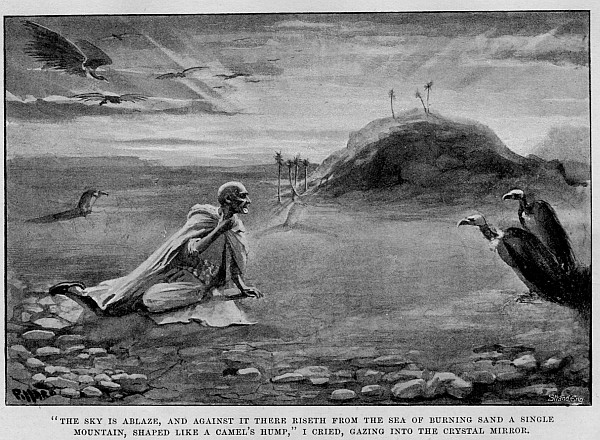
“I see the Desert at sunset,” I said. “The sky is ablaze, and against it there riseth from the sea of burning sand a single mountain, shaped like a camel’s hump. It is far distant, and growing purple in the evening hour, but I can distinguish upon its summit three giant palms. In its side there is apparently a cave.”
“And in the foreground?”
“There is a single traveller. He is an old man, who hath fallen from his horse, and while one hand clutcheth at his throat, the other is outstretched towards the mountain. He is in pain,” I added; “apparently he is dying of thirst, for birds of prey hover about him, and his eyes have in them the glitter of madness. The picture is beautiful, yet terrible!”
“Good!” he said. “It is finished!” and taking the mirror from me, he returned it to its place. The illusion puzzled me, yet he would not allow me to investigate. At that moment, however, I became aware that the place was filling with a dense smoke, and from beyond the closed door there came a noise as of the roaring and crackling of flames.
The house in which we were was already on fire!
Pointing out the fact to him in alarm, I urged him to tell me at once how to use the Crescent; but he heeded not my words, so absorbed was he, bowing before the mysterious tenant of the grave in pious devotions.
“Tell me,” I cried. “For Zoraida’s sake, withhold not from me the Secret which thou hast promised, so that I may save her!”
The flames had burst through some panelling behind the altar, and the place was filled with sparks and dense smoke. Just at that instant the statuesque figure turned, raising its hand wildly. For a moment a gleaming knife trembled aloft in the dull glare of the flames, and next second it was buried deep in the breast of Mohammed ben Ishak!
I shrieked, but my companion only laughed a mocking, hideous laugh, and, reeling slightly, stood contemplating the approaching flames quite calmly. The shock seemed to have paralysed him.
“Come, let us fly!” I urged, dashing wildly across to save him. “See, the door is still intact! There is yet time!”
Turning upon me fiercely, he shook me off. It was a terrible moment. I stood transfixed by horror.
“No,” he cried, with a strange light in his eyes. “It—it is the blood revenge, the swift vengeance that I dreaded, the punishment I deserve for my sin against the Brotherhood—I—I am a traitor—but I fear not to die—I go—through fire—to the cool waters of Tasnîm!”
“Surely thou wilt not seek thine own destruction, and take thy Secret with thee?” I gasped.
He remained silent; he did not even turn towards the man who had struck the fatal blow. The flames were roaring, and the heat had become so intense that the perspiration in big drops rolled from my face.
“Speak!” I shrieked. “For the sake of the woman whose young life dependeth upon thy word! Be merciful unto her! Tell me what to do!”
But, with a hoarse, defiant laugh, he folded his arms, saying, “I refuse!”
“By Heaven!” I burst out, in sudden anger, “this is no time for dallying words. If thou wilt not, then may the curse of the Daughter of the Sun, whose life thou sacrificest, hang upon thy neck, heavy as a millstone, and may it drag thee down to the place that is prepared for evil doers.”
The effect of my words was electrical.
“No! No!” he cried, evidently in as deadly fear of the imprecations of Zoraida as the Ennitra had been. “No! I—I have reconsidered!” he gasped.
As the words left his lips, I saw that the flames had ignited the flowing robes of the man from the tomb, and though he rushed about in paroxysms of intense pain, and at last fell, unconscious, he uttered not a sound! Swiftly, indeed, was he punished for his crime.
“Tell me, quickly!” I cried aloud. “In another moment we shall both be lost. Fly! Let me assist thee. Even now we can escape!” and as I spoke, a tongue of fire singed my hair and burned my eyebrows.
“No!” he shrieked, his voice sounding shrill above the dull roar, as his eyes rolled wildly. Undoubtedly a terrible madness had seized him, and so vigorously did he threaten, rave, and curse, that I felt half inclined to make a desperate dash for life through the door by which we had entered.
Again I clutched him, frantically appealing to him to tell me the secret, and as I did so, the flames leaped past us, and we were both half suffocated by the smoke. Fortunately, I possessed sufficient presence of mind to snatch up the Crescent, and, regardless of the manner in which it blistered my fingers, I wrapped it in my burnouse, crying—
“Impart unto me the Great Secret, I beseech thee! Quickly!”
Reeling, he staggered and fell. The mysterious vengeance of the Senousya had descended upon him, and the life-blood flowed from the ugly wound. In a moment I dropped upon my knees and supported his head, determined that he should not lapse into unconsciousness, and so carry with him to the grave the key to the extraordinary enigma.
In desperation, I shrieked a final appeal to him to fulfil his pledge. Death stared us both in the face, for already had I become seized with a sudden faintness.
It all occurred in a few brief moments.
“Yes,” he gasped, wildly and with difficulty, at last. “I—I will save the beauteous Lalla Zoraida. She shall lead the Senousya into—into the holy war, as she hath done the Ennitra. In the great fight every Infidel shall be slain with sharp swords. Yes!—I will tell thee how thou canst save her. Travel with all speed over the Desert to the Oasis of Agram, in the country of the Kanouri, which lieth in the direction of the sunrise. Thence ride onward across the plain of Ndalada, past the town of Dibbela, until thou comest to the Well of Tjigrin, and when thou hast accomplished two days’ journey still due eastward from the latter place, past the ruins of a town, thou wilt find a single clump of palms. Then take the Crescent, and—”
His thin lips moved, but no sound came from them. His eyes slowly closed! It was, indeed, a critical moment. My heart sank, for it seemed as though he was no longer aware of the things about him.
“Speak!” I yelled in his ear. “What must I do with the Crescent?”
His eyes opened, but they were dim. In their depths a film was gathering, as life fast ebbed. With a supreme effort, however, he raised his bony hand, pulling down my head until my ear was close against his mouth. Then, struggling to articulate, he whispered hoarsely, and with extreme difficulty—
“Obey my injunctions strictly. Take the Crescent, and—and when thou hast arrived at the spot I have indicated—not before, or thou wilt never gain the Great Secret—place—it—upon—thy brow! Then—will—marvels—undreamed of—be revealed. Remember—attempt not to fathom the Mystery until—until thou hast passed the Well of Tjigrin two whole days! May—may Allah—preserve and guard thee, and may thy—”
But his final blessing was never completed, for convulsions shook his frame, and he fell back heavily and breathed his last.
Springing to my feet, I stood for a second. Flames seemed threatening me from every side, but, with a sudden desperate dash, I rushed, half blinded, towards the door, which at that moment was being licked by the darting fire. Then, opening it by raising a curious latch, I fled quickly through the two small apartments, now filled with smoke, out across the patio, finding myself in a few moments standing in the road fainting and unsteady, clutching at a wall for support.
How I accomplished that flight for life I scarcely know. Panting, I stood, unable for a few moments to realise how near I had been to a horrible end. Though my clothes were brown and scorched, my arms blistered, and my hair and beard severely singed, I cared not. Zoraida’s future was now in my hands, for at last I had succeeded in obtaining the key by which the Great Mystery might be elucidated—at last I should know the Truth—at last the hidden Secret of the Crescent, the undreamed-of marvel, would be revealed to me!
Chapter Forty One.
Through Rose Mists.
Mounted on a méheri, and alone, I toiled with all speed onward over the glaring, sun-baked Desert, towards the spot indicated by the man from whom I had, at the eleventh hour, wrung the key of the Great Secret.
Had he fooled me? Were not his instructions remarkable; did they not bear suspicion of some ulterior object? Even as I rode along, with face set sternly towards the sunrise, the thought that the dead man had sent me on a bootless errand caused me considerable anxiety. Reviewing his words and actions, I saw how ineffectually he had striven to conceal the bitter prejudice he entertained for unbelievers, how intensely he hated all Christians, and with what eagerness he contemplated the eventual triumph of the Senousya. Such being the case, I reflected, what more natural than he should resolve to retain Zoraida in the ranks of the conspirators, in order that she might lead them to the contemplated victory; what more natural than he should refuse to impart to me the knowledge whereby I might rescue the Daughter of the Sun from the dangers that were fast closing in upon her? Again, by the Ennitra, and in all possibility by the Senousya also, the Wonderful Crescent was believed to be a talisman that gave triumph to its possessor. Was it probable that he would, even though Zoraida had commanded, reveal to me, a Christian, the elucidation of the problem that he had denied to all True Believers?
No. In both word and action the old imam had betrayed a firm disinclination to assist me to elucidate the Great Secret, and as I journeyed on day after day, lonely and friendless, in that barren, unfamiliar country, the conviction within me grew stronger that the revelation he had gasped with his last breath was merely a base device to part me from the woman I worshipped.
Yet it was a relief to get away from that doomed city, with its flood of fiendish exultation; to escape from the revolting ebullition of barbarism, and the fiendish glee of my treacherous friends, who were no doubt overwhelming their Daughter of the Sun with attentions that she loathed, like caresses from the ghouls of hell. Even the dead silence of the wilderness was preferable to the din of the hard-fought conflict, with its sickening sequel.
The camel I rode I had found straying at some distance from Agadez, when on the eventful dawn I fled from the city on foot. It was handsomely caparisoned, and, to my delight, I had found that its provision-bags, ornamented in a manner that showed its owner to be a cadi, were packed with necessaries for a long march. In all probability its hapless owner had prepared to fly at the approach of the bandits, but had been murdered when on the point of starting. After a hurried inspection of the bags, satisfying myself that there was a supply of comparatively fresh water in the skin, I concealed the Crescent of Glorious Wonders within a bag of fodder, and, mounting, had started off, without map or plan, upon what, from various appearances, I judged was the caravan route to the well of Tin-dâouen. This surmise fortunately proved correct, for in three days I reached it; then, after halting the night, I discovered a valley full of luxuriant vegetation, with high doum and talha trees and great patches of camomile flowers growing in rich profusion. Continuing through this verdant glen, where antelopes and giraffes disported themselves, I ascended over the rough, rocky ground to a high, barren plateau, and, with my face always to the east, plunged, with a reckless disregard for the consequences, into the great unexplored desert which forms an effectual barrier between the country of the Ahír and that of the Kanouri.
I pushed on with all haste, so that if it proved, as I feared, a fool’s errand, I might, by almost ceaseless travel, be enabled to return again to Agadez before the moon had run her course. Armed with a rifle, powder-horn, and crooked dagger that I had taken from the body of an unfortunate janissary, I sped onward through the great lone country. From sundown until dawn I journeyed, resting through the day in what little shade I could devise, then setting forth again, always leaving the setting sun behind, always remembering that each stride of the faithful animal beneath me took me further and further from the woman whose life lay in my hands.
Gradually and irresistibly had I been drawn into a vortex of mystery and treachery, from which I was struggling to extricate myself. Zoraida’s piteous appeal rang in my ears; the very thought of her as the wife of that villainous archrebel caused me to grind my teeth. Feeling convinced that the errand I had undertaken must be futile, I was, in my more gloomy moments, sorely tempted to disobey Mohammed ben Ishak’s injunctions, and try the effect produced by placing the Crescent of Glorious Wonders upon my brow. Each time, however, the intensely earnest, agonised face of the aged prayer-reciter, as he implored me not to try to fathom the Great Mystery before arrival at the spot indicated, came vividly before me, causing me to stay my impatient hand.
The fatigue of those long anxious nights and blazing days was so terrible, that, on more than one occasion, faintness seized me, and I had a recurrence of those strange hallucinations from which I suffered after Labakan had dealt me the cowardly blow. I seemed at times light-headed, eager and jubilant one hour, despondent and contemplative of suicide the next. But the recollection of the deadly peril of Zoraida, whom I loved with a true and fervent devotion, spurred me onward over shifting sands and treacherous rocks, onward to the place where the dead man had promised the Great Secret should be revealed.
On the seventh day after leaving Agadez, I slept under the palms of the Agram Oasis, filled my water-skin at the well, and, representing myself as a straggler from a trading caravan, begged some food from the camp of the Bedouins of the peaceful Kanouri. It has always struck me as curious how rapidly news travels in the Desert. Already these men had heard rumours of desperate fighting in the city of the Ahír, although it must have been conveyed by way of Tin-Telloust and Bir-ed-Doum, the circuitous route by which caravans travel on account of the wells, and fully one hundred miles further than the straight journey I had accomplished. For several reasons I had deemed it best to feign ignorance, therefore to all my anxious inquirers I represented I had travelled direct from Akoukou without touching Agadez.
Spending one day only with these tent-dwellers, tall, bronzed, handsome, good-natured fellows, I gave them peace, and, with the brilliant sunset once more behind me, rode away through great patches of a poisonous plant my friends called “karugu,” and out again upon the plain towards the remote little Arab town of Dibbela, where I arrived two days later, after a somewhat perilous journey across some almost inaccessible rocks which the Arabs call the Tefraska. At dawn on the second day after leaving this place, having travelled due south under the direction of the leader of a caravan conveying ivory and rose oil from the Tsâd to exchange for cotton goods, razors, sword-blades, and pieces of paper with the sign of the three moons, I came upon the Oasis of Tjigrin, rich in herbage, date palms, and clusters of tangled bushes, among which ostriches and gazelles were moving. Here, wearied out, I tethered my méheri to a palm tree, and, reflecting that in two days I should know the truth, flung myself down and slept soundly in a dream of quiet ecstasy.
My awakening, however, was sudden, for, feeling myself grasped roughly by the shoulder, my hand instinctively sought my knife, but a loud, hearty laugh caused me to rub my eyes and look up into the sun-tanned, bearded face which shadowed the glare from my eyes.
“Que diabe!” cried a voice in surprise. “Then I’m not mistaken. It is you!”
“Eh bien! eh bien! old fellow!” I cried, amazed, jumping to my feet and grasping the rough brown hand that shot from between the folds of the burnouse. “This is indeed a pleasant meeting!”
The man who stood holding the bridle of his milk-white horse was none other than Octave Uzanne, the Spahi who, when we had met on the fatal Meskam Oasis, had told me his life’s romance!
“Really, I can scarce believe my eyes,” I continued, speaking in French. “I was at Tuggurt when a messenger arrived with the news that Paul Deschanel’s column had been cut up and massacred at the Well of Dhaya, near Aïn Souf, by the Ouled Ba’ Hammou. I naturally concluded you had also fallen.”
“Sapristi! Je suis un veinard,” he answered in the slang of the Army of Africa, still holding my hand in his hearty grip. Then, with a sigh, he added, with seriousness, “It is, alas! true that our column was enticed into an ambush by the Ennitra, assisted by the Ouled Ba’ Hammou, and slaughtered, myself with eight others being the sole survivors. For two months we were held prisoners by Hadj Absalam, until at length I managed to escape and travel back alone to Tuggurt to relate the terrible story. Poor Deschanel! his was indeed a sad end—very sad!”
For a moment he seemed overcome by thoughts of his dead comrades, but in a few seconds he had reassumed his old buoyancy, and, offering me a cigarette, took one himself, and, having lit up, we squatted side by side in the shadow to talk.
“Well, what brings you here, so far from Biskra?” I asked presently, after he had related to me his adventures at the mountain stronghold of the Ennitra, which were almost as exciting as my own.
“Duty,” he answered briefly, with a hard look upon his handsome face quite unusual to him.
“You are not alone?” I queried.
“No—not exactly alone,” he answered abruptly, without apparently intending to tell me the object for which he had penetrated so far south, for he suddenly exclaimed, “You have not yet told me what sort of life you have been leading among the Bedouins—or why you are here alone.”
Briefly I related the story of my capture, my slavery, and my escape, without, however, telling him the real object for which I was working, or mentioning the assault on Agadez.
“You are a born adventurer; I am one by circumstance,” he exclaimed, with a good-humoured laugh, when I had concluded. Then he added, “Although my life with the Ennitra was one of terrible drudgery, yet, after all, I would rather have remained with them—had I but known;” and he sighed regretfully.
“Why?” I asked, surprised.
“She is here!” he answered meaningly.
“Do you mean Madame de Largentière?” I asked, remembering in that moment how dearly he loved the woman who had been so cruelly snatched from him, and with what self-sacrifice he had buried himself beneath the scarlet drapery of a homard of the Desert. “Is she in Algeria?” I inquired.
For answer he blew a cloud of smoke slowly from his lips, then from beneath the folds of his burnouse he drew forth a worn but carefully folded copy of the Algiers newspaper, L’Akhbar, which he handed to me, saying, “Read the first column.”
Opening the limp paper, I noticed it was dated two months before, and on glancing at the column indicated, my eyes fell upon the heading in large type: “The New Governor-General of Algeria: Arrival of Monsieur de Largentière.”
Eagerly I read on. The report described the landing and enthusiastic reception of Monsieur de Largentière, who had been appointed Governor-General. The streets had been gaily decorated with Venetian masts and strings of flags, salutes had been fired from the warships in the harbour and from the Kasbah, as the vessel conveying his Excellency from Marseilles had cast anchor, and as the party stepped on shore, the little daughter of the General of Division had presented a bouquet of choice flowers to Madame de Largentière, who, the journal incidentally mentioned, was “well known as one of the most beautiful women in Paris, and a leader of fashion.” Algerian society, continued L’Akhbar, welcomed her as its queen. No doubt, during the coming season the Governor’s palace would be the scene of many a brilliant festivity, and the colony owed a debt of gratitude to the Government for appointing as its representative an official so upright, so experienced, and so genuinely popular. All Algeria, it concluded, extended to the new Governor and his beautiful wife a boundless and heartfelt welcome.
“Well?” I exclaimed, handing back the paper. “You will have an opportunity of seeing her very soon, I suppose?”
“See her? Never!” he answered, with poignant bitterness. “Already I have discovered that she is instituting inquiries about me; that is the reason why I have not sought to return to Biskra. I do not desire the past disinterred;” and he thoughtfully watched the ascending rings of smoke.
“Fate plays us some sorry tricks sometimes. Most probably you will meet her just when you least expect—”
“What?” he cried, interrupting. “Face her? To hold her hand as before—to tell her that her husband, the man whose ring she wears, and over whom the journalists gush and drivel, is—is a murderer! No! No! I never will!”
“But, my dear fellow, is it not your duty to denounce him if you possess absolute proof of his guilt?” I argued.
“My duty? Bien” he answered reflectively. “But the denunciation would bring no satisfaction to me—on the contrary, it would kill her.”
“You are right,” I conceded reluctantly, after a pause. “Your silence and self-denial is the greatest kindness you could show towards her. Indeed, your affection must be very deep-rooted, or your patience would long ago have been exhausted amid this hard life and social ostracism.”
“Ah! Heaven knows how well I love her,” he said, turning to me with a deep, wistful look. “She loves me too, and the fact that she has sought to find out where I am shows that she thinks sometimes of me. But I mean to keep the resolve I made long ago, for under an assumed name and in the Spahis she will never discover me.”
“Now that De Largentière is Governor, he is all-powerful,” I observed. “I wonder what he would do if he discovered you, and found out that you held absolute proof of his guilt?”
“Cr-r-r!” he exclaimed, as with a sad smile he drew his finger across his throat. “If he dared not commit the crime himself, he would hire one of the many obliging Arab desperadoes who hang about the fringe of the Desert.”
“Yes,” I said. “He would, no doubt, make some serious attempt to seal your lips.”
“I shall give him no opportunity. As far as I am concerned, he will, for Violet’s sake, enjoy his reputation for honesty and uprightness,” he declared. Then he added quickly, “But why should we drift to a subject that is to me so painful? The romance of my life has ended. I am a derelict, a piece of human wreckage drifting helplessly upon the sea of despair.”