"A Romance of the Harem and the Great Sahara" (continued 5)
Reading edition
Over me blank despair had cast her sable pall, and, reviewing my career, I saw my fond hopes, once so buoyant, crushed and shattered, and the future only a grey, impenetrable mist. My skull seemed filled with molten metal that boiled and bubbled, causing me the most frightful nauseating torment which nothing could relieve, yet with appalling vividness sights, strange and startling, passed in panorama before my unbalanced vision. By turns I witnessed incidents picturesque, grotesque, and ghastly, and struggled to articulate the aimless, incoherent chatter of an idiot.
Once I had a vision of the green fields, the ploughed land, the tall poplars and stately elms that surrounded my far-off English home. The old Norman tower of the church, grey and lichen-covered, under the shadow of which rested my ancestors, the old-fashioned windmill that formed so prominent a feature in the landscape, the long, straggling village street, with its ivy-covered parsonage and its homely cottages with tiny dormer windows peeping forth from under the thatch, were all before my eyes, and, notwithstanding the acute pain that racked me, I became entranced by the rural peace of the typical English scene to which I had, as if by magic, been transported. Years had passed since I had last trodden that quaint old street; indeed, amid the Bohemian gaieties of the Quartier Latin, the ease and idleness of life beyond the Pyrenees, and the perpetual excitement consequent on “roughing it” among the Arabs and Moors, its remembrance had become almost obliterated. Yet in a few brief seconds I lived again my childhood days, days when that ancient village constituted my world; a world in which Society was represented by a jovial but occasionally-resident city merchant, an energetic parson, a merry and popular doctor, and a tall, stately, white-haired gentleman who lived in a house which somebody had nicknamed “Spy-corner,” and who, on account of his commanding presence, was known to his intimates as “The Sultan.”
I fancied myself moving again among friends I had known from my birth, amid surroundings that were peaceful, refreshing, and altogether charming. But the chimera faded all too quickly. Green fields were succeeded by desolate stretches of shifting sand, where there was not a blade of grass, not a tree, not a living thing, and where I stood alone and unsheltered from the fierce, merciless rays of the African sun. Fine sand whirled up by the hot, stifling wind filled my eyes, mouth, and nostrils, and I was faint with hunger and consumed by an unquenchable thirst. Abnormal incidents, full of horror, crowded themselves upon my disordered intellect. I thought myself again in the hands of the brutal Pirates of the Desert, condemned by Hadj Absalam to all the frightful tortures his ingenious mind could devise. Black writhing asps played before my face, scorpions were about me, and vultures, hovering above, flapped their great wings impatient to devour the carrion. I cried out, I shouted, I raved, in the hope that someone would release me from the ever-increasing horrors, but I was alone in that great barren wilderness, with life fast ebbing. The agonies were awful! My brain was aflame, my head throbbed, feeling as if every moment it must burst, and upon me hung a terrible weight that crushed my senses, rendering me powerless.
Visions, confused and unintelligible, passed in rapid succession before my aching eyes, and I became awestricken by their revolting hideousness. The dark, villainous face of Labakan grinned at me exultingly, and the scarred, sinister visage of Hadj Absalam, the mighty Ruler of the Desert, regarded my agonies with a fierce, horrible expression, in which the spirit of murder was vividly delineated. Suddenly despair gave place to joy. Demented and rambling, I imagined that my hand was grasping the Crescent of Glorious Wonders, the lost talisman that would restore me to happiness with the woman I loved. But, alas! it was only for a brief second, for next moment in a sudden pang of excruciating pain a darkness fell, and everything, even my physical torment, suddenly faded.
I think I must have slept.
Of time I had no idea, my mind having lost its balance. My lapse into unconsciousness may have lasted for minutes or for days, for aught I knew. At last, however, I found myself again wrestling with the terrible calenture of the brain. My temples throbbed painfully, my throat was so contracted that I scarce could swallow, and across my breast acute pains shot like knife-stabs.
Dazed and half conscious, I lay in a kind of stupor. In the red mist before my heavy, fevered eyes a woman’s countenance gradually assumed shape. The pale, beautiful face of Zoraida, every feature of which was distinct and vivid, gazed upon me with dark, wide-open, serious eyes. Across her white brow hung the golden sequins and roughly-cut gems, and upon her bare breast jewels seemed to flash with brilliant fires that blinded me. Nearer she bent towards me, and her bare arm slid around my neck in affectionate embrace.
Almost beside myself with joy, I tried to speak, to greet her, to tell her of the treachery of the outlaw who had struck me down; but my lips refused to utter sound. Again I exerted every effort to articulate one word—her name—but could not. A spell of dumbness seemed to have fallen upon me! Her lips moved; she spoke, but her words were unintelligible. Again I tried to speak, yet, alas! only a dull rattle proceeded from my parched throat. Upon her face, flawless in its beauty, there was an expression of unutterable sorrow, a woeful look of blank despair, as slowly and solemnly she shook her head. Her arm rose, and its sight shocked me. The hand had been lopped off at the wrist! Then, with her beautiful eyes still fixed upon mine, she bent still closer, until I felt her lips press softly upon my cheek.
Her passionate kiss electrified me. From my brain the weight seemed suddenly lifted, as the phantom of the woman I loved faded slowly from my entranced gaze. So distinctly had I seen her that I could have sworn she was by my side. Her warm caress that I had been unable to return, was still fresh upon my cheek, the tinkle of her sequins sounded in my ears. The sweet breath of attar of rose and geranium filled my nostrils, and the fair face, full of a poignant, ever-present sorrow, lived in my memory.
Thus, slowly and painfully, I struggled back to consciousness.
It was sunset when the villain Labakan struck me down, but, judging from the brilliance of the bar of sunlight that fell across me when at last I opened my eyes, it was about noon. At least twenty hours must have elapsed since I had fallen under the assassin’s knife; perhaps, indeed, two whole days had run their course!
As I stretched my cramped, aching limbs, a sudden spasm shot through my breast, causing me to place my hand involuntarily there, and I was amazed to discover that my gandoura had been torn open and my wound hastily but skilfully bandaged with strips torn from a clean white burnouse. Who could have thus rendered me aid? Labakan certainly had not, therefore it was equally apparent that some other person had discovered and befriended me. Again I glanced at the bandages in which I was swathed, and found they were fastened by large jewelled pins that were essentially articles of feminine adornment. It seemed cool and dimly-lit where I was lying, and presently, when full consciousness returned, I made out that I was in a subterranean chamber built of stone and lighted from the top by a crevice through which the ray of sunlight strayed. Let into the dark walls were iron rings. They showed that the place was a dungeon!
With some of my clothing removed and my body covered by a coarse rug, I was lying upon a broad stone bench, and when presently I felt sufficiently strong to investigate, I was astonished to discover that my couch had been rendered comfortable by a pile of silken and woollen garments—evidently the contents of a woman’s wardrobe—which had been placed on the stone before I had been laid thereon. Upon the floor beside me lay a small skin of water, some dates, Moorish biscuits, and sweetmeats. Whoever had brought me there had done all in their power to secure my bodily comfort, and it seemed evident that I owed it all to a woman. Apparently she had emptied the contents of her camel’s bags in order to make me a bed, for my head was pillowed on one of the soft silken cushions of a jakfi, and the blanket that covered me bore a crude representation of Fathma’s hand in order to avert the evil eye.
(Jakfi: A kind of cage mounted on a camel in which the wealthier Arabs carry their wives across the desert. Sometimes called a shugduf.)
Who, I wondered, had snatched me from the grave and placed me in that silent underground tomb?
The painful throbbing in my head that had caused my temporary madness was now gradually abating, and after considerable difficulty I succeeded in raising myself upon my elbow, gazing anxiously on all sides with calm consciousness. The opposite end of the curious stone chamber was plunged in cavernous darkness, and I strained my eyes to ascertain what mystery might there be hidden. While doing so, my gaze fell upon a piece of paper which lay upon the water-skin close to my hand. Taking it up eagerly, I held it in the golden streak of sunshine, and saw upon it Arabic characters that had been rudely traced, apparently with a piece of charred wood. After considerable difficulty, on account of the hurried manner in which the words had been scrawled, I deciphered it to be a message which read as follows:—
“Praise be to Allah, opener of locks with His name and withdrawer of veils of hidden things with His beneficence. Upon thee, O stranger from beyond seas, be the best of blessings, and salutation, and perfect peace. O Elucidator of the Great Mystery, know thou that a friend hath given thee succour and will not forsake thee, even though the vials of murderous wrath have been poured out upon thee. If thou readest these words, hope for thou mayest yet confound the plots of thine enemies and discover that which thou seekest. Though strange things may meet thine eyes, fear not, for in the darkness there is yet light. Thy presence will be demanded ere long. Therefore rest and recover, in the knowledge that thou art under the secret protection of an unknown friend. Praise be upon thee, and may Allah’s wrath fall heavily upon those who seek thy destruction!”
A sudden faintness again seized me. The paper fell from my nerveless grasp, as with a strange, sinking feeling I lapsed again into unconsciousness. Hours must have passed; how many I know not, but when I again awoke, the grey light of early dawn was struggling through the small crevice. My wound felt easier, and, supporting myself upon one arm, I drank a few drops of water from the skin. Close to my hand I found a tiny paper packet bearing the label of a French pharmacy in Constantine which showed it to contain quinine. The drug would, I thought, prove beneficial to me, so I swallowed some of the powder, and ate two or three dates to remove the bitter taste. As the light increased, and I found myself in full possession of my faculties, I re-read the mysterious message, and commenced a minute examination of my bandages. The latter had been skilfully adjusted, evidently by a woman. With the exception of a dull soreness in my chest, the pain had left me, and my temperature had fallen considerably. The fever had abated, and I felt confident that the drug that had so frequently been of benefit to me in the past would once more prove serviceable. I tried to rise, but could not, therefore I lay throughout that day, vaguely wondering where I was and how I came to be there alone, yet not uncared for. My eyes fixed themselves upon the impenetrable darkness of the opposite end of the mysterious chamber, vainly striving to pierce the gloom. Now and then a lizard or some other reptile would emerge from the crevices and scuttle along over the stones in search of food, otherwise there prevailed the dead silence of the tomb.
I desired to rise, in order to ascertain whether I was actually a prisoner. The entrance to the strange chamber was apparently at the opposite end, hidden in the darkness. As the light grew stronger, I examined the walls, finding they were constructed of huge blocks of stone now black with age. Indeed, my surroundings were decidedly uncanny, and although the place was cool, yet light and air would have been preferable. Satisfying my hunger with some ajwah (dates stoned and pressed into a paste) and kahk, (a kind of bread), I spent the day in alternate dozing and silent thoughtfulness until the single ray of sunlight disappeared, and night crept slowly on. For hours I slept, and when I awoke refreshed, it was again day. My wound seemed even less painful, and, having eaten and drawn some water from the skin, I succeeded, after some difficulty, in rising. The woman’s dresses of silk and gauze that had formed my couch were sadly creased and tumbled, and upon some of them were dark, ugly stains where blood had flowed from my breast.
But it was my intention to explore thoroughly and without delay the sepulchral place into which I had been so mysteriously introduced. I had not the slightest knowledge of where I was; and could only suppose that some persons, having found me, had taken me to that chamber, and, being compelled to continue their way, had left all they could devise for my comfort. Yet, whoever had done this knew me, and was well aware of the object of my journey, facts which were plainly proved by the message traced in charcoal.
Girding my loins with my sash, and sticking into it the jewelled-hilted knife which I found lying near, I started, with unsteady gait caused by weakness, on a tour of investigation. With my feet falling noiselessly upon the dust of years, I strode to the opposite end of the chamber, where the light did not penetrate, and then discovered that it led into a second chamber of about the same size, situated at right angles with the one I had been occupying. At the further end of this bare, gloomy apartment a faint glimmer showed in the arched roof, where the light struggled through between a long but narrow space between the massive masonry. Groping onward, my foot suddenly caught some object, and, stumbling, I fell prone upon my face. As I put out my hand to break the fall, I grasped something, over which a moment later I ran my hands to ascertain its nature. Horrified, I drew back with a cry.
My fingers had touched a heap of bones!
Regaining my feet, I stood for a few moments in hesitation, but ere I stepped over the obstruction to move forward, my eyes had grown accustomed to the gloom, and then, where the shaft of uncertain light struck the wall a grim and startling spectacle met my gaze. Lying in a niche similar to that in which I had spent so many hours of agony and unconsciousness was a complete human skeleton! With the grey light struggling through the roof and falling full upon it, the remains presented an appearance hideous and ghastly. The lower part of the skull had fallen away, an arm had dropped off, and the cavities where eyes once gleamed gave the upturned skull a hideous appearance. A wisp of long dark hair, twisted and matted, was still attached to the skin of the skull, a portion of which seemed mummified, and upon the thin finger-bones that rested upon the stone some rings of gold and tarnished silver still remained. By the length of the hair, the character of the rings, and the fact that on one of the ankles there still remained a bangle, it was apparent that the remains were those of a woman.
Approaching closer, I examined the bones, and found a small collar of iron encircling the neck, to which was attached a chain that was riveted to a ring in the wall a few feet away. The woman, whoever she had been, had died in captivity.
Looking around, I was surprised to notice another object crouched down against the wall, and this proved on investigation to be the skeleton of a second woman, chained like the first, and who had evidently died while seated cross-legged upon the floor. In the soft dust that had been whirled in by the sandstorms, skulls and bones of all kinds were lying about in profusion, showing that in that dungeon captives were either murdered or starved to death, and that the corpses of previous victims were allowed to remain there and rot within sight of those confined there. What horrors must those prisoners have suffered, compelled to spend day and night with a body in the most hideous stages of decay!
I stood gazing at the gruesome remains. For several days had I lived in this charnel-house, in ignorance that the bones of the departed were my companions, but now, on discovering the truth, I desired to leave the tomb-like dungeon without delay.
Near the skeletons were two saddle-bags apparently well filled, but I did not pause to investigate their contents, for I was too anxious to leave the place. True, the written message; said I should gaze upon strange things, but I had been utterly unprepared for the discovery of these hideous relics of the dead. Onward among the bones with which the place seemed thickly strewn I groped, in eager search of some means of exit, until I came to the wall at the further end of the dark chamber; then, failing to discover any door, I started to go slowly around the place, feeling the walls carefully with both hands. Nearly two hours I spent in a search that was tedious, and which in my enfeebled condition caused my wound to pain me considerably. All, however, was in vain. Noon came and went, and my active fingers travelled rapidly over every portion of the rough, dust-covered walls of the rectangular dungeon, but no trace of a door could I discover, though I made a systematic investigation of every portion of the place. There were no means of escape. It seemed suspiciously as if I had been brought there and walled in to share the fate of the other unfortunate wretches whose whitening bones told so horrible a tale!
Sinking upon the couch that had been arranged for me by unknown hands, I endeavoured to devise some means of extricating myself. If it had been intended that I should die in that gloomy tomb, why had means of sustenance been provided for me; why had my janitors provided me with a bed composed of a woman’s wardrobe? The letter told me to rest and to recover in order to pursue my search. Alas! had I not been pursuing a will-o’-the-wisp? Had I not been actually in Agadez, and passed under the shadow of the mosque, yet unable to seek the old imam who held the key to the mystery? The Crescent of Glorious Wonders—the strange object that was to bring Zoraida and me prosperity and happiness—was lost, and, weak and ill, I was now a shattered and rudderless derelict drifting on the lonely sea of despair.
Time after time I deciphered the mysterious message I had found by my side when consciousness returned to me, but it brought no satisfaction. Anxious to escape from that grim sepulchre, yet failing to discover any way out, I paced to and fro, wildly agitated. It was indeed strange. I had certainly been brought there, yet there was no door through which I had passed. I examined the whole of the roof minutely as far as I was able, but there was nothing whatever to show that entrance was gained from the top, while every part of the walls was of stone, which led me to the conviction that there was no secret door. Again and again I stumbled onward, with eager hands feeling the ancient, roughly-hewn blocks, but failing to discover anything to raise my hopes. Indeed, as the afternoon wore by and the light slowly faded, I became dejected, feeling that at last I had fallen hopelessly into the hands of enemies who had resolved that, walled up in that sepulchre, I should endure the tortures of hunger and thirst, and afterwards die a horrible and lingering death.
I ate only a few mouthfuls of kahk and took only a few drops of water, just sufficient to moisten my parched throat, for I was determined not to give in without a struggle, and therefore intended to make my supplies last as long as possible. After an elaborate calculation, I arrived at the conclusion that with economy I should have sufficient to sustain life for about a week, therefore I partook only of what was absolutely necessary for subsistence.
Through the crack above my couch I could see daylight had faded, and at last, in despair, I cast myself down, wearied and faint, and fell asleep.
My wound became very painful, and I think the delirium must have again crept over me, for during the night strange phantoms seemed to haunt me with horrifying vividness, and my mind became partially unbalanced by the mental torture which fastened itself upon me. Through those long dark hours wild words that had neither context nor meaning fell from my fevered lips, as periods of imaginary joy were succeeded by hideous debauches of despair. Consciousness returned after I had indulged in a kaylúlah, (a sleep about 9 a.m. It is believed among the Arabs to cause poverty and wretchedness), and when the narrow bar of sunlight fell across me, I rose and ate the few mouthfuls of food I allowed myself. Then once more there commenced a search for means of egress.
Every crevice and corner I searched diligently, hoping to discover some secret door; but in an hour I paused to rest. Feeling weaker, for the least exertion overcame me, I suddenly remembered the two saddle-bags, and out of sheer curiosity, and perhaps a desire to occupy my time, resolved to see what they contained. Dragging one of them into the light close to my couch, I drew the knife from my sash and ripped it open. It contained a miscellaneous collection of articles almost valueless, yet to me they were of considerable interest, as they were mostly of European manufacture, and at some time or another had evidently belonged to unfortunate travellers. A couple of watches bore the names of London makers, and there were knives from Sheffield, several British-made revolvers, a sovereign purse, and other things which belonged unmistakably to Western civilisation.
After I had turned out the first bag, I dragged in the second and cut it open in a like manner, finding a similar assortment inside. One by one I pulled them out, inspected them, and cast them in a heap upon the floor, when suddenly I grasped some object larger than the rest and drew it forth.
Its appearance amazed me. I could scarcely believe my eyes, half persuaded for the moment that I had again lapsed into delirium, and that it was merely a chimera of my disordered imagination. But no, I was in perfect possession of all my senses. My eager, trembling fingers tore open the worm-eaten leathern case, and a second later there was disclosed to my gaze an object which caused me to utter a loud cry of joy.
I had regained that for which I had long mourned as lost. Reposing in its case, uninjured and apparently untouched, was that half-hoop of cabalistically-engraven iron upon which all my hopes were founded—the Crescent of Glorious Wonders!
Chapter Thirty Two.
The Ghuzzat of the Senousya.
Grasping the Crescent with both hands, I examined it minutely, convincing myself that it actually was the strange object that Zoraida had given me. I recognised its curious engraving and the undecipherable hieroglyphics that had so puzzled me.
How it came to repose where I had discovered it was a profound mystery. Apparently the thief of the Kel-Fadê, who had snatched it from me, had replaced it in its case and pushed it into his saddle-bag along with the miscellaneous proceeds of other raids, and then, by some means, both the bags had been deposited in that chamber for safe keeping. The entrance to that gruesome sepulchre was, no doubt, a hidden mystery, therefore the thief imagined his treasure safe from prying fingers. But I had regained it, and meant to retain possession of it, and to learn the great insolvable Secret even though my life might be jeopardised. If Zoraida still lived, I might, after all, be enabled to carry out her extraordinary commission, and so earn that peace and happiness that was my promised reward. By this thought hope revived within me, as with redoubled energy I endeavoured to detect some means by which to escape. With the Crescent of Glorious Wonders once again in my possession it was my determination to return to Agadez, even at the risk of arrest, and seek Mohammed ben Ishak, the one person in the whole world who could impart to me the abstruse knowledge upon which depended my future. Yet, with the Crescent within my grasp, and only a few days distant from Agadez, I was, nevertheless, an utterly helpless prisoner, doomed to the companionship of the ghastly dead, until I too should pass the threshold of the Silent Kingdom.
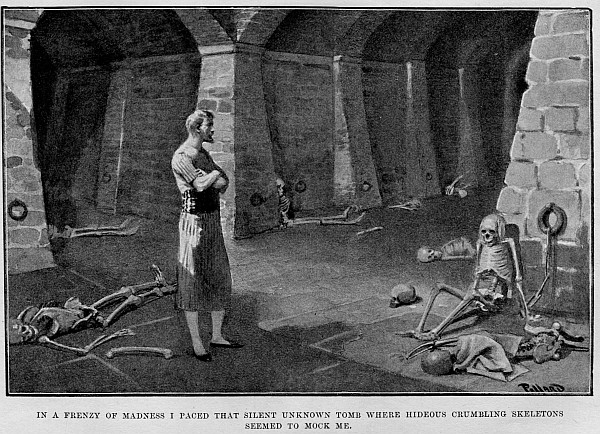
Through the day I searched for means of exit, unceasingly examining the roof of my prison, but finding nothing to lead me to suppose that a door was concealed. How I had been placed there was a mystery. Once, about noon, I was startled by hearing a voice deep and resonant, yet I reassured myself that it was merely fancy, and that I was alone. After long search, I ate and drank, then sat helpless and dejected, examining my regained prize, which, alas! was still useless to me. To return to Agadez with it in my possession seemed a forlorn hope. All my thoughts centred upon the woman whose grace and beauty held me enmeshed. In a frenzy of madness I rose and paced that silent unknown tomb where hideous, crumbling skeletons seemed to mock me, and where the stillness and gloom were so complete and appalling.
Suddenly an object caught my eye that I had not before noticed. Close to the niche in which the bones of one of the victims reposed, an iron ring was fastened in the wall about a foot from the floor. The slanting ray of light from above was falling at that hour quite close to it, revealing that the dust encrusting other parts of the floor had been removed in the vicinity. Upon the white beaten earth there was a large dark stain, about the size of my hand. This aroused my curiosity, for it appeared suspiciously like a stain of blood, and I remembered that my wound was still open when I had been brought there. The thought flashed across my mind that some secret mode of entrance was therein hidden, yet I examined carefully the ring, and found it an ordinary one, evidently used to chain up prisoners, and securely embedded in a huge block of roughly-hewn stone about two feet square.
My hands carefully felt the ring, but it was rough and deeply rusted, showing that it had not been used as a handle. It was curious, though, why the dust should have been removed from the floor at that spot, and why at that place only should there remain a trace of blood. With the hilt of my knife I rapped upon the stone, but there was no sound to give rise to further suspicion, neither was there any opening around the block. It fitted closely like the others, and had probably been built in there for centuries.
Taking the ring in both hands, I tugged at it, at the same time, however, feeling the effort was useless. The idea of moving a gigantic block of stone of that size was preposterous, and when I found I had expended my strength in vain, I laughed aloud as I wiped my brow. Pausing, I again examined its surroundings minutely. Though there was nothing whatever to show the block was movable, I instinctively felt that some secret mode of exit lay concealed there.
Again a voice startled me. Like a muffled wail it sounded, and I was undecided as to whether it might not have been caused by the wind passing over the crevice above that admitted light and air into the charnel-house. Having rested to regain breath, I essayed another attempt. Setting my feet firmly on either side of the block, I threw my whole weight backward, and pulled frantically at the ring of iron. Holding my breath, and setting my teeth firmly, I was exerting every muscle, when suddenly there was a harsh, grating sound.
The great block of stone moved forward nearly six inches!
In my weak state the smallest exertion produced hard breathing, therefore I was compelled to pause for a few moments in intense anxiety. At last I had discovered the secret!
Again I tugged at the great rusty ring, moving it towards me still further. Then, on careful investigation, I discovered that the block of stone was not solid, but formed the front of a great stone drawer, long and narrow like a coffin, and just large enough to admit the body of a man.
By dint of herculean effort I drew the great drawer out nearly four feet, then, taking the Crescent of Glorious Wonders in its worm-eaten case, together with some ajwah for sustenance, I entered the coffin-like receptacle. With difficulty I squeezed through the shallow trough, that proved several feet longer than the thickness of the wall, and, to my relief, I found myself, a moment later, in a narrow, subterranean passage, enveloped in an impenetrable darkness. With feet falling silently in the thick white dust, I felt my way along for some distance, taking several abrupt turnings, until strange noises caused me to halt, listening breathlessly.
Human voices were raised in a solemn, mournful chant!
Noiselessly I crept forward in the darkness, coming at length to a blank wall, and then, turning sharply to the right, a thick plush curtain arrested my progress. Drawing it aside slightly, and with infinite care, I gazed in wonderment upon a scene weird and remarkable. It held me spellbound.
The underground apartment was about fifteen feet wide, forty feet long, and nine feet high, with one end slightly raised as a kind of platform. Illumined by a great fire that burned in a sort of brazier in the centre, there were nine flat stones ranged round, and upon these sat aged, white-bearded Arabs. They were councillors of one of the secret societies of Al-Islâm. Around were assembled other younger Sons of the Desert, presenting a strange and weird appearance. Each bore an ostrich feather, stuck in the rope of camel’s hair that encircled his head, and carried in his left hand a green-painted derbouka.
The councillors, swaying their bodies in unison, were uttering strange, monotonous incantations, when suddenly a very old and feeble man, in scarlet burnouse, descended from the platform where he had been enthroned, bearing in his hand a small black snake that writhed and twisted itself around his bony wrist. Advancing to the brazier, he cast the reptile into the fire, and as it was consumed, the whole of those present set up a long, shrill wail.
“Accursed be the race of dogs!” they cried. “May the entrails of the Infidels who have over-run the glorious land of the True Believer be burned like yonder serpent, and may the pestilence overtake them. May the vultures lay bare their bones, and may their dust be scattered across the plains, even unto the Great Sea.”
The words revealed to me their purpose. During my travels, I had, on many occasions, heard rumours of secret Moslem societies, although their existence had often been denied in the European press, the Paris Figaro excepted. Frequently had I longed for an opportunity of investigating these associations, formed for the purpose of concerted and decisive action against the Christians, and now, by a most curious circumstance, I found myself present at one of their secret meetings. The most violent and far-reaching of these organisations was, I had been told, the Ghuzzat, a development of an offshoot of the Senousya, and was composed of the wildest fanatics of the Aïssáwà sect who were followers of the elder Senousi, a Shereef, or descendant of the Prophet. Leaving Mecca some years before, the marabout had wandered through Egypt, Tripoli, and Tunis, finally building a large zawya (Hermitage) at El-Beida, near the fountain of Apollo. At that time the Arabs of the province were pagans. He preached against the Christian invaders, healed the sick, performed “miracles,” and established for himself a reputation, so that the Bedouins carried his fame across the Desert, through the Oasis of Ojila-Jalo, into Wadai and Mourzouk, Agadez, and Timbuktu, and even into Morocco. The present head of this society for the simultaneous massacre of all Christians throughout the Soudan, was a descendant of Senousi, named El-Mahdi, and its members were the most mad-brained fanatics, who took oaths upon the Korân to exterminate the dogs of Infidels. (El-Mahdi. Meaning “Led by God.” There are many families of that name in the Sahara.) Thus it was with combined interest and trepidation that I stood gazing upon a remarkable sight that no European had ever before witnessed. Though the Christian invader had been tolerated along the Barbary littoral, it was apparent that the fierce hatred and treachery of Al-Islâm was only stifled, and the teaching of fanatical societies, such as these, was that all Roumis should, in an unguarded moment, be massacred without mercy. Indeed, the weird chant that fell upon my ears at that moment was to the effect that Allah, Requiter of good and evil, bade them rise and revenge the wrongs that followers of the Great Prophet had suffered at the defiling hands of the accursed.
The blazing brazier was, I noticed, very similar in shape to that in the mysterious chamber in Algiers, to which Zoraida had conducted me. Could it be that she too was a member of this widespread secret league to secure the extermination of the Christians?
The chant concluded, the strange rites of the Ghuzzat (Fighters for the Faith) commenced. After performing a sujdah, (a single “prostration,” with the forehead touching the ground, performed from a sitting position), the whole of those present recited the Surat-al-Ikhlas, which is also sometimes called the Kul Huw’ Allah, or the Declaration of Unity, of which the following is the translation:—
“Say, He is the one God! The eternal Allah! He begets not, nor is He begot! And unto Him the like is not.”
The aged man in the scarlet burnouse, who seemed to be the high priest of the order, turned towards the raised platform, and, amid a sudden silence, clapped his hands. When lo! a curtain at the rear was drawn aside, revealing a kind of small circular hut, built of dried palm branches, with an opening at the top. Those assembled cried aloud, as if in fear, but the priest comforted them with an Ayat, or Korânic verse, and almost at the same moment, eleven men, barefooted, with their burnouses cast aside, marched in single file before the hut.
The secret ceremony was a strange admixture of religion and paganism, for, as they descended from the dais and marched round the circle of seated councillors, the chief sprinkled them with blood from the tip of an ostrich feather. Then they were lined up with their backs to the hut, and in the uncertain light shed by the flaming brazier presented a most weird spectacle. Suddenly, at a word from the man in the red robe, the conspirators gathered around, thumped their derboukas, and set up a plaintive howl, while the eleven kept perfect cadence with the right foot.
A slight pause ensued, when the eleven turned and moved onward, until the first—a lad not over ten years of age, apparently just initiated into the mysteries of the foul plot against Europeans—reached the mysterious hut. Then, halting for a second, he deliberately plunged his arm down the hole in the top, and, amid low, guttural expressions of approbation that sounded from all sides, dragged forth a huge serpent, about five feet in length, and the size of a man’s wrist. Struggling desperately, he attempted to hold it about four inches from the head with his teeth, but at first he could not open his mouth wide enough, and this seemed to cause the onlookers considerable anxiety. The head of the reptile was to the left, and to break the dead weight of the great snake, the lad held its writhing body up with his left hand. The boy was not four feet in height, so the contrast was remarkable. At length, however, he succeeded in fastening his teeth firmly in the serpent’s back, and the march and chant were resumed, to the accompaniment of monotonous drumming. The man behind the snake-carrier took his feather from his head and seemed to be chasing the serpent towards the left, so as to keep the reptile’s fangs from the lad’s face.
The third man picked out a snake from the little hut and carried it as did the boy, while the fourth acted as the second man did; thus it went on till eight of the men were in motion. By the time the fifth couple were ready to take a snake, the first had completed a few circuits of the space. Then he took the reptile from his mouth and gently threw it upon the ground, where it lay motionless in a state of catalepsy, and, marching round while the onlookers prostrated themselves, murmuring strange incantations, he again reached the hut, and took another of the writhing reptiles. This was continued until all the snakes had been used.
Meanwhile, the reptiles that had been thrown at the feet of the silent, statuesque councillors of the order were brushed by feathers by half a dozen men, and then handed one by one to the conspirators grouped around, who gripped them near the head, and, while holding them still and motionless at arm’s length, recited a declaration of adherence to the secret league. When all the snakes had gone through the weird ceremonial, and were in the hands of the dark-faced wanderers of the plains, the grave councillors rose, and their places were taken by a similar number of mysterious-looking women, enveloped from head to foot in black haicks, which entirely covered them, except for the two holes through which their bright eyes peered.
As they seated themselves upon the flat stones, the note of the dismal chant was changed to a more shrill one, and the men, led by the venerable chief of the conspirators, formed a circle around them, while each drew from beneath his burnouse a Hamáil, or pocket Korân.
“The grave is darkness and good deeds are its lamp,” they commenced chanting, moving slowly round the seated women. Then followed a supplication which commenced, “O Prince! O Ruler! O Ancient of Benefits! O Omniscient! O Lord of the Three Worlds! O Thou who givest when asked, and who aidest when Aid is required, receive this our prostration, and preserve us from dangers, and make easy our Affairs, and broaden our Breasts.”
From the remainder of their remarkable prayer I gathered that as they, the Ghuzzat of the Senousya, had been able to hold in submission the venomous serpents in their hands, so would they, on the day when the standard of revolt was raised in Algeria, in Tunis, and in Egypt, hold in their clutches the swaggering Roumis who had defiled their land. Then, as they proceeded one after another to kill the reptiles, they declared, with one accord, that with as little compunction as they now treated these snakes, so would they slaughter without mercy the men, women, and children of the Infidels. Their extermination, like vermin, would alone, they declared, “bring coolness to the eyes of True Believers.”
Suddenly, almost before I was aware of it, the eyes of the aged chief met mine! I had, in my eager desire to witness the strange scenes, indiscreetly pulled back the curtain too far, revealing the whole of my head!
The high priest, clapping his hands, produced in a moment a dead silence.
“Lo!” he shouted in a loud voice. “My sons and daughters, prying eyes have fallen upon us. We are discovered!”
His words produced an effect that was electrical. Fifty voices, with one accord, demanded further explanation.
“We have, O children, been watched from behind yonder curtain!” he cried. “Our secret is known!”
I waited for no more. A dozen fierce fanatics dashed towards the spot where I had been standing, but without thinking of any place of refuge, I plunged down the dark passage. In a second I was pursued. Oaths and vows of vengeance sounded behind me, and with the Crescent of Glorious Wonders grasped tightly in my hand, I sped onward until I ran headlong against a wall. Turning quickly at right angles, I found another long, unlighted subterranean passage. Dashing headlong down it, I turned to right and then to left through its intricate windings, and as the footsteps of my pursuers sounded behind me, I suddenly became aware that I was retracing my steps to my tomb-like dungeon. From those who sought me I could expect no mercy. Death only could expiate my crime. I had discovered the intentions of Al-Islâm, and even though I might declare myself a follower of the Prophet, I had not been initiated into the mysteries of the Ghuzzat, and would therefore be put to death as a spy.
The fierce fanatics, with knives unsheathed, were at my heels, and, redoubling my speed, I tore along, stumbling over the rough floor and grazing both legs and arms in my wild flight. To strike me down the conspirators were straining every muscle, yet I managed to keep on, until, taking two sudden turns immediately after one another, I remembered that I was near the entrance to the secret chamber.
It was my only chance. If they were unaware of the existence of the charnel-house with its crumbling bones, then, perchance, I might escape. In the darkness I could distinguish nothing. What if I had passed the entrance, and came at last to a blank wall! The thought unnerved me. Voices behind me sounded harsh and deep, still I dashed onward until my feet caught in something, and, stumbling, I fell.
I knew the accident must result in my death. In a few moments the keen knives of the conspirators must reach my heart.
My hands came into contact with stone. Frantically I grasped it, realising with gratification that I had fallen over the great coffin-like drawer that gave entrance to my prison. In a second I recovered myself, and, entering the half-open trough, crawled through it, with the Crescent still in my hand.
Finding myself on the opposite side of the wall, I lost no time in grasping the iron ring, and, with the last strenuous effort of which I was capable, succeeded in dragging the drawer towards me. It was done on the impulse of the moment; then I waited, not daring to breathe.
Hurrying footsteps sounded outside, with shouts of “Death to the spy! He holdeth our secrets, and must not evade us! Kill him! His entrails shall be burned with the snakes!”
Nearer they came, as if searching for the secret entrance.
In pulling the drawer inside I had closed it, and, clinging on to the ring, determined that it should not be opened while strength was left to me.
For a second the footsteps, sounding dull and muffled in the dust, seemed to halt outside. Then joy filled my heart a moment later, when they hurried onward, and the angry cries receded in the distance.
Evidently, with the stone trough drawn inside, nothing remained in the subterranean passage to denote the whereabouts of a hidden entrance. Likewise it was apparent that they knew not the existence of the secret sepulchre.
Panting and exhausted, I sank upon the ground. I had again escaped!
Chapter Thirty Three.
A Penalty of Beauty.
The glimmer of sunset struggling through the chink above faded quickly. Upon my strained ears the sound of hurrying footsteps fell, but again died away. My pursuers were returning after their fruitless errand. Yet would they relinquish the search now they knew a stranger held their secrets?
The conspiracy was against Christians in general and the power of France in Algeria and Tunis in particular, therefore they knew that if the military authorities in Algiers were acquainted with the facts, the great Army of Africa would be held in readiness to crush the revolt in its earliest stages. No doubt the memory of the great insurrection which commenced at Souk Ahras in 1871, and which eventually proved so disastrous to them, had not yet been obliterated, and they still recollected how, although the revolt spread everywhere through Kabylia at the word of the Sheikh el-Haddad, yet their people had struggled in vain against the invaders, and the standard of Al-Islâm was at last torn down by the Infidels, and their mosques were defiled by their conquerors’ feet. Since that day, Turcos, Spahis, Zouaves, artillery, and infantry had posts everywhere throughout the French sphere of influence, and conspiracy was punishable by the guillotine. True, the plot I had discovered was being perfected beyond the frontier, yet the conspirators were no doubt members of a tribe under French rule, therefore amenable to the laws of their conquerors. Thoughts such as these caused me to reflect that these men who had schemed revenge were not likely to content themselves with the knowledge that I had escaped. If, as I supposed, I was still in the ruined Hall of the Great Death, it would be impossible for a man to get away unnoticed, the ruins being situated on high ground in the centre of a barren wilderness. But evidently they were unaware of the existence of that secret chamber, and doubtless they considered my sudden disappearance most remarkable.
As, however, the dead silence remained unbroken, I at length resolved to wait patiently till the morrow, and in the pitch darkness groped my way towards my couch. The violent exertion had almost exhausted me, and I sat for some time feeling very faint and ill. My wound pained me considerably, for the bandages had shifted and haemorrhage had again been produced. Presently, however, I felt better, and after a draught of water and a few dates, I stretched myself and fell asleep.
Until the streak of sunlight told me that the noon had passed, I waited patiently, with ears open to catch every sound, and, hearing nothing, I at last resolved to make another dash for liberty. Placing some food and the leathern case containing my prize in my sash, I pushed forth the stone drawer gently and crept through its narrow aperture. Gaining the dark passage, I hesitated for a few seconds, then decided to explore it in the opposite direction, for I had no intention of again approaching the chamber wherein the secret rites had been performed. A few feet from where I had emerged, the passage, like a rabbit’s burrow, declined steeply, and grew so narrow and low that I was compelled to stoop. Advance was difficult in the darkness, yet I crept on, hoping to arrive eventually at some exit. To my disappointment, however, the passage penetrated still deeper into the earth, and gradually narrowed until I was compelled to creep along on all fours. The atmosphere was choking, and I began to fear asphyxiation.
Suddenly I emerged into what appeared to be a larger space, and my feet struck stone steps. Finding I could now stand upright again, I ascended, wondering whither they might lead. Not a ray of light showed, and in the darkness I stumbled onward, for the steep stairs were worn and in some places fallen away. As I toiled upward, the air seemed more fresh, and I felt that in the immediate vicinity there must be some outlet from that subterranean labyrinth. Gaining the top, I groped about until I felt a door strengthened by strips of iron. It was small, but very heavy. What, I wondered, did it conceal?
Discovering a handle, I slowly turned it. To my satisfaction, the door yielded noiselessly, and I found myself in a great luxuriously-furnished chamber, the air of which was fragrant with attar of rose and the downy divans were of pale yellow silk.
Scarce daring to enter, I paused. It was, I could see, a woman’s apartment.
A man’s deep voice was raised in anger, and I saw lying in a lazy attitude on a divan before me, with her hair unbound, a beautiful girl with face unveiled. She was richly dressed in silk of palest heliotrope, with a heavy golden girdle and a tiny sleeveless zouave jacket of rose-pink velvet, heavily trimmed with gold. Her skin was as fair as an Englishwoman’s, but her eyebrows were darkened with kohl, and her forehead was almost hidden beneath its sequins. A dainty little fez trimmed with seed pearls was set jauntily upon her handsome head, and as she lay, one bare foot hanging over the edge of the divan in an attitude full of languid grace, she toyed with her rings, and her bejewelled breast heaved and fell in a long, heavy sigh.
Her companion, a well-dressed Arab, tall, long past middle life, with a face in which brutality was strongly marked, was striding up and down the sweet-scented apartment, hurling at her fearful imprecations and insults, and expressing profound disgust that he had ever stooped to caress her.
My feet fell so noiselessly upon the soft carpet that neither had noticed my entrance, therefore I stepped back, re-closing the door, but leaving it ajar, in order that I might witness the domestic disagreement.
“Thine harsh words wound more deeply than thy blows,” she observed, with a sigh, as the man paused to gain breath.
“By my beard, wench! thou art verily the off-scum of Eblis, upon whom the mercy of the One Merciful can never rest! Thou hidest in thine heart secrets, and refusest to tell me that which I demand. I will degrade thee, woman, to the meanest slavery; thou shalt wash the feet of those who have been thy slaves. Though thou art a beauteous damsel—a houri fitted for the Sultan of the Ahír—thou—”
“Hast thou lived thy threescore years, and failed to discover that sometimes the face is not an index to the mind?” she interrupted, with a flippant air.
“With thee, accursed betrayer of secrets and worker of iniquity, have I learned that soft caresses may prove as the coils of a venomous serpent, and that a woman’s lips may conceal poison!” he cried, halting before her with clenched fist.
Throwing her head back upon her silken cushion, she laughed at his passion.
“Thou thinkest that thou hast cleverly deceived me—eh?” he hissed. “Thy dark eyes sparkle like the stars, because thou, thrice-cursed offspring of Satan, knowest that—that I have been fooled, tricked by thee, who hast received from me every luxury! Had it not been for me, thou wouldst have been at this moment the slave of some common camel-driver, and—”
“Even that would have been preferable to imprisonment within thine harem. Would that thine accursed generosity had been showered upon some other woman than upon me,” she cried, rousing herself and looking straight and fearlessly into his angry, bearded visage. “True, in return for thy favours, I have tried to love thee. Thou hast been pleased to exalt me to be chief of thy wives, to bestow upon me jewels of great price, and to place me above those who were envious because their faces pleased thee not. Towards thee I have been faithful, and I have ever kept thy private affairs locked within my bosom.”
“And thou hast now exposed the greatest of all our secrets—the intentions of the Senousya!” he said.
“I tell thee thou liest!” she cried in anger, clenching her small white hand; “I have divulged nothing—I swear!”
“Perhaps not personally; nevertheless thou hast been instrumental in allowing the designs of our brotherhood to become known, and punishment will of a verity overtake thee. May the judgment of Allah fall upon thee! upon thy father, and upon thy tribe of murderers and harlots, and may their vitals be devoured by the fire unquenchable! Thou, bringer of evil upon our house, hast done thy best to thwart the Jihad, (Holy War) against the dogs of Infidels.”
“I cannot understand thy meaning,” she said, puzzled. “Thine accusations are as complicated as the lock of the Holy Ka’abah.”
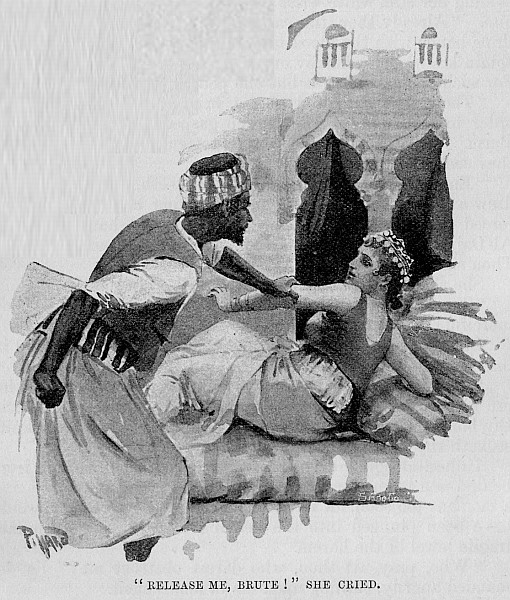
“Vile offspring of Shirm!” he cried in a sudden paroxysm of passion, seizing her roughly by the wrist. “To feign ignorance will not avail thee. I have discovered the depths of thy perfidy. Perhaps thou wilt deny that, on thy return hither with thy slaves, thou didst discover amid the ruins of the Hall of the Great Death a man who had been wounded?”
She started, turned pale, and looked at him with an expression that betrayed fear of his terrible wrath.
“Thou, cursed handmaiden of hell, viewing this stranger from beyond the Atlas with compassion because his face found favour in thine eyes, bound up his wound, and, placing him in a jakfi upon one of thy camels, secretly bore him hither. Though thou didst not know him, thou gavest him food, and tended him while he lay fever-stricken and unconscious; and when thou arrivedst here, thy women, acting under thine orders, assisted thee to secrete him in some place the existence of which thyself only hast knowledge. Speak!” he added, twisting her white arm until a cry of pain escaped her. “Speak, woman! tell me if I utter the truth.”
“Release me, brute!” she cried, springing to her feet, with her beautiful eyes flashing angrily. “Thinkest thou that I will endure thy tortures longer? No! I hate thee! I will depart. Another may rule thine harem, and may she find her position happier than mine hath been!”
“But remember thou art my prisoner. Dost thou admit or deny what I have said?” he demanded, pale with passion.
“If thou accusest me of infidelity, I can deny it upon the Book of the Everlasting Will,” she replied, drawing herself up haughtily. “Other allegations I deign not to answer, even though thou art my captor, and I am in thy power.”
“Then know, O woman of evil, who hast been defiled by the eyes of a stranger, the man thou hast aided now holdeth the secret of the Ghuzzat, and—”
“He—he hath learned of the plot against our Oppressors?” she gasped. “Tell me, how did it occur?”
“At the council of the Brotherhood he was discovered behind a curtain in the secret Chamber of Assembly, and no doubt can exist but that he watched and obtained knowledge of our rites and intentions. Upon me, therefore, will fall the fierce and fatal wrath of the Brotherhood, for within my walls hath their secret been betrayed!”
“But—how did he gain the Chamber of the Assembly?” she stammered.
“Thou canst best answer that question,” the old Arab replied sternly.
“I am in ignorance, truly,” she declared, a deadly pallor overspreading her fair countenance. “I have done naught of which I am ashamed.”
“But canst thou not, perfidious wench, see that our secret is out?” he continued angrily. “The stranger, though pursued, disappeared mysteriously, and though every search hath been made, he hath not been found. By this time he is most probably on his way into Algeria, where he will spread the warning, and thus the armed hordes of the Roumis will be on the alert, and our aims utterly defeated.”
“And thou hast attributed the misfortune of thy fellow-conspirators to me?” she exclaimed, in a tone of reproach.
“I tell thee thou alone art the author of the evil that hath befallen us,” he cried, with flashing eyes. “For women of Eblis who betray True Believers, the fire of hell is already prepared. There, the flame and smoke shall surround thee like a pavilion, and if thou beggest relief, thou shalt be relieved with water like molten brass that shall scald thy face. The mischief is worked, the secret is divulged, and already the Brotherhood are leaving, never to return. Thee, devilish daughter of Waila, have we to thank for introducing secretly a spy into our midst!”
“I have acted as I thought fit. Leave my presence!” she commanded, with imperious gesture. “I will no longer suffer the brutal insults of a man I hate. Ere the sun hath set I shall have freed myself of thine hateful bonds and left thine accursed roof.”
“Thou shalt never go from here alive!” he hissed in her ear, holding her slim white wrist and dragging her roughly towards him. “Already thou, the cause of our downfall, hast defiled thine hands with the blood of a stranger, and allowed him to obtain knowledge whereby our secret designs will be thwarted. For such offences there is but one penalty. It is death!”
“Thou, who art tired of me, bring these accusations in order to justify my murder!” she gasped in indignation and alarm. “My people have not forgotten, and assuredly will they seek blood revenge.”
“Enough!” he growled between his teeth, as in a second he drew a knife from his waist, and, clutching her by the throat, forced her upon her knees. “Thou art the handmaiden of Al-Dajjâl, and the mark of the Câfer is set upon thy brow. Thou shalt die!”
She shrieked as his powerful arm poised in mid air.
“Spare me! Spare me!” she implored piteously. “Be thou merciful!”
But he jeered at her appeal, and, forcing her backward in his iron clutches, gripped the gleaming, murderous weapon.
“Thy people, thou Misriyah! will never know thy fate, for ere sundown thou wilt be as offal, and vultures will strip thy bones,” he said, with a fiendish grin. “See! this my knife seeketh thy polluted heart.”
Unhesitatingly I dashed forward, springing upon him from behind and wrenching the weapon from his grasp. I was not a moment too soon, for in another instant the keen steel would have been plunged into the heaving white breast of the fair, fragile jewel of the harem.
“Who, pray, art thou, who darest obstruct me?” he demanded angrily, turning upon me in amazement.
“Thy wife hath saved my life, and it is my duty to save hers,” I answered boldly.
“See!” she panted, suddenly recognising me. “See! it is the stranger who was wounded!”
“The stranger who hath learned at his peril the secret of the Ghuzzat,” he added, with grim sarcasm. “As he is thy protector, he is most probably thy lover also!”
“That I deny,” I answered quickly. “I have known nothing of this lady until to-day.”
“Liar!” he shrieked in rage. “Thou boldest our secret. Only thy death will expiate thine eavesdropping!” and ere I could realise his intention, he had drawn a second knife from his waist and made a desperate lunge at me. With difficulty I managed to parry the blow, and for a few moments we engaged in deadly combat. His young wife, alarmed, rushed to a door which led into a beautiful courtyard, and shouted for help. Her cries were answered immediately by two black slaves of gigantic stature, who, in obedience to her commands, flung themselves upon their master, twisted the knife from his fingers, and in a trice had bound his hands behind his back with a cord they seemed to have brought for the purpose.
“Slaves! Suffer not thine hands to thus defile me!” he cried, with a look of murder in his flashing eyes, but they gagged him immediately.
His wife, addressing the two negroes, exclaimed—
“It is as I expected. He hath attempted to strike me to earth, and had it not been for this stranger, I should have been murdered. Three days ago I gave thee certain instructions—carry them out.”
“We will, O Lady of Great Beauty,” they both replied.
“Then remove him.”
The two black giants opened the small door by which I had entered, and almost before the old Arab could mumble a protest, they had hurried him out and down into the dark subterranean passage that led away into the unknown maze below.
“That course is my only chance of escape,” she said, turning to me in explanation, when the door had closed. “Had I fallen, thou too must have perished, for thy food in the secret chamber could not have lasted long,” she panted, holding her hand to her breast as if in pain.
“I have to thank thee for rescuing me from death,” I said. “I had no idea who was my deliverer until I overheard thy conversation.”
“But thou didst not obey the instructions I left thee in my letter,” she said in a tone of reproach. “Searching for a means of exit, it seemeth, brought thee unto the Chamber of Assembly; hence my disgrace and thine own peril.”
“But thine husband—whither have they taken him?”
“To the chamber in which thou hast remained hidden these few days. Before he is placed there, he will be rendered unconscious, so that he may not know of the secret entrance. There will he remain while I reach a place of safety.”
“Merely detained?” I asked dubiously.
“Yes. Though in his wrath he tried to kill me, I bear him no malice, for when I get back to mine own people, I shall be safe. If he discovers how to get out of his prison, then he will live. If not”—and she shrugged her shoulders.
“Though thou art his wife, thou dost not appear to regret thy departure.”
“Why should I, when I have been detained here over a year against my will? If thou only knewest the dreary life a woman leadeth in the hands of a brute she hates and despises—ah!” and she shuddered.
“Then thou wilt now regain freedom?” I said, surprised.
“Yes. For many moons have I waited in patience for this moment, and at last I have accomplished what I sought. Already the preparations are being made. My two trusty slaves will return when their work hath been accomplished, and in an hour camels will be packed in readiness for our journey.”
“Our journey? Dost thou intend that I should accompany thee?” I asked.
“Certainly. To disguise thyself as a female slave, veiled and enshrouded by a haick, is thine only chance of escape. La bodd annak taroóh maaki!” (“You must go with me”) and she sank back again upon her divan, as if the exertion had utterly exhausted her.
“Thou art stronger than when I found thee lying as one dead in the ruins of the great Palace of the White Sultan,” she exclaimed, as she lay stretched among her cushions, with her bright, beautiful eyes looking up to mine. “Dost thou feel well enough to withstand the fatigue of travel?”
“Yes, quite,” I answered. “But ought we not to prepare for flight immediately?”
“There is no need for haste,” she answered. “This is mine own private apartment where none dare enter, so take thine ease, for we must journey far before el maghrib.”
All trace of her agitation had now disappeared, and as we chatted calmly, I asked, “Why didst thou take compassion upon me—a stranger?”
“I had accompanied two of the wives of the man who hath held me in hateful bondage on a portion of their journey towards Assiou, and in returning we halted to rest under the shadow of the Hall of the Great Death. There I discovered thee, and, in order to give thee succour, was compelled to resort to the expedient of placing thee within the secret chamber. Some time previously I had heard that thou wert journeying south.”
“Who told thee? What didst thou know of me?”
“I knew that thou, a Roumi, hadst undertaken to reach Agadez in order to perform a secret mission, and that thou hadst proved loyal and true to the woman who loved thee. For her sake as well as for thine I snatched thee from certain death, and if Allah giveth us His mercy and blessing, we both shall now regain our freedom.”
“Art thou aware of the name of the woman to whom I am betrothed?” I inquired, in amazement.
“She is—or was—called Zoraida, and was known to our people as the Daughter of the Sun.”
“Thy people? Then thou art of the tribe of the Ennitra?” I exclaimed.
“True,” she answered, with a smile. “I am the daughter of those who have so long and eagerly sought thy destruction.”
“But what of Zoraida? Tell me; is she still alive?” I asked anxiously.
“Alas! I am uncertain. Here in this my prison only strange and vague rumours have reached me. Once I heard that she had been murdered in Algiers, but soon afterwards that report brought by the caravans was denied, and since then much curious gossip regarding her hath been circulated. The last I heard was, that, disguised as a camel-driver, she had followed thee to Agadez.”
“To Agadez?” I cried. “How long ago did that astounding news reach thee?”
“Early last moon. One of my slaves heard it while travelling with some of the women to Assiou. I am inclined to regard it, however, like so many other rumours, as mere idle talk of the bazaars, for only a few days before that, I heard of her holding sway at the palace of our lord Hadj Absalam.”
“Canst thou tell me nothing authentic?” I asked, disappointedly.
“Alas! nothing,” she answered, with a sigh. “Our Lalla Zoraida is mighty and of wondrous beauty, but the mystery that surroundeth her hath never been penetrated.”
Chapter Thirty Four.
Under the Green Banner.
Through a vast, barren wilderness, peopled only by echoes, we journeyed over drifted sand-heaps, upon which every breath of the hot poison-wind left its trace in solid waves. It was a haggard land of drear silence, of solitude, and of fantastic desolation. In the Desert a vivid sense of danger is never absent; indeed, even more so than upon the sea, for the mere lameness of a camel or the bursting of a water-skin is a disaster that must inevitably prove fatal to the traveller.
Our caravan consisted of ten persons only, six trusted and well-armed male slaves, two females, my pretty companion, and myself. Our departure from the great ancient stronghold in which the handsome girl had been held captive had not been accomplished without much exciting incident; but luckily my disguise as a female slave, in ugly white trousers and a haick that hid my features, proved complete, and, the imperious pearl of the Sheikh’s harem having announced her intention of journeying to Assiou to join his two other wives, we were at last allowed to depart without any opposition on the part of her husband’s armed retainers. The whole thing had been most carefully arranged, and the details of the escape were cleverly carried out without a hitch.
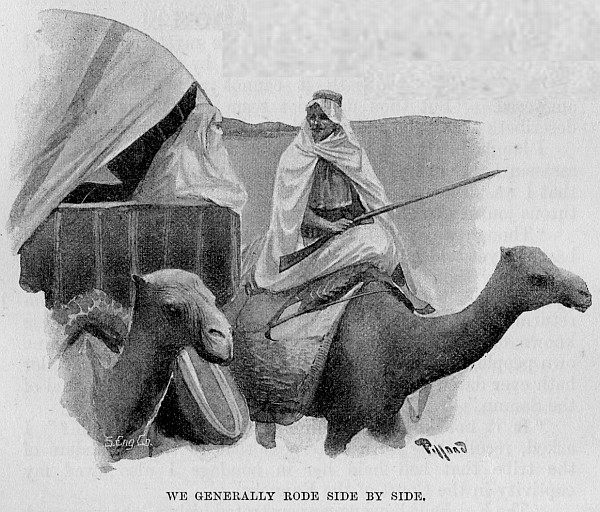
On setting out, Lalla Halima—for such she told me was her name—and myself, as her attendant, travelled together in one jakfi placed upon a swift camel, gaily caparisoned with crimson velvet; but as soon as we had got fairly away, I slipped off my white shroud, and, resuming a fez and burnouse, mounted one of the animals whereon our food was loaded. In camping during those blinding days under a dead, milk-white sky, I spent many pleasant, idle hours with Halima, and when travelling—which we usually did at night—we generally rode side by side. Notwithstanding the terrific heat, life in the Desert seemed to suit her far better than the seclusion of her sweet-perfumed harem, for, true child of the plains as she was, she felt her heart dilate and her pulse beat stronger; declaring to me that she experienced a keen enjoyment in “roughing it” in that trackless wilderness. Indeed, the spirits of all of us became exuberant, the air and exercise seemed to stir us to exertion, and, altogether, we constituted a really pleasant party.
Lolling lazily at her ease among the silken cushions in her jakfi, she would chat with charming frankness through the night, as in the moonlight we plodded steadily onward guided by one of the slaves to whom the route was familiar. She told me all about herself, of her childhood, spent in the barren desert of the Ahaggar, of a visit she paid to Algiers one Ramadân, and of the attack by the Kel-Fadê upon the little village of Afara Aouhan, her capture, and her subsequent life in the harem of the Sheikh. From her I gleaned many details regarding her people, of their wanderings, their power in the Desert, and their raids upon neighbouring nomad tribes. Many were the horrible stories she told me of the fierce brutality of Hadj Absalam, who was feared by his people as a wicked, unjust, and tyrannical ruler, and who, despising the French military authorities, delighted in the torture of Christian captives, and endeavoured to entice the Zouaves and Spahis into his mountain fastnesses where he could slaughter them without mercy. The Great Pirate’s impregnable palace, the fame of which had long ago spread from Timbuktu to Cairo, she described in detail, and if what she said proved correct, the place must be of magnificent proportions, and a very remarkable structure. The harem, she said, contained over four hundred inmates, the majority of whom had fallen prisoners in various raids, but so fickle was the pirate Sultan of the Sahara, that assassination was horribly frequent, and poison, the silken cord, or the scimitar, removed, almost weekly, those who failed to find favour in the eyes of their cruel captor.
Yet, regarding Zoraida, I could gather scarcely anything beyond the fact that the subjects of Hadj Absalam knew her by repute as the most beautiful of women, and that few, even of the female inmates of the palace, had ever looked upon her unveiled face. One evening, as we rode beside each other in the brilliant afterglow, I admitted how utterly mystified I was regarding the woman I loved; to which Halima replied softly—
“Who she is no one can tell. Her name is synonymous for all that is pure and good, her benevolence among our poorer families is proverbial, and she possesseth a strange power, the secret of which none hath ever been able to discover.”
“Thou didst tell me that thy people sought my destruction,” I said. “Dost thou know the reason for their secret hatred?”
“I have heard that thou holdest the mysterious power of defeating thine enemies once possessed by the Lalla Zoraida, and that until thy death it cannot return to her,” she answered. “But thou dost not seem so terrible as report describeth thee,” she added, with a coquettish smile.
I laughed. It was nevertheless strange that my would-be assassin Labakan had made a similar allegation. Remembering that I was accompanying my fair companion upon an adventurous journey to an unknown destination, I said—
“Though we have travelled together these six days, thou hast not yet told me whither our camels’ heads are set.”
Puffing thoughtfully at the cigarette between her dainty lips, she replied, “Already have I explained that I am returning to my people. The route we are traversing is known only to the trusty slave who guideth us and to mine own people, for there are no wells, and no adventurous traveller hath ever dared to penetrate into this deserted, silent land of the Samun.”
“Is it not known to thine enemies, the Kel-Fadê?” I asked, recollecting with bitterness that to the marauders of the tribe that had held her in bondage I also owed my captivity in the Court of the Eunuchs.
“The Kel-Fadê have never penetrated hither,” she answered, gazing away to where the purple flush was dying away on the misty horizon. “In three days—if Allah showeth us favour—we shall reach the rocky valley wherein my people are encamped. Ana fíkalák hatta athab ila honâk.” (“I am very anxious to get there.”)
“But for what reason are thy people so many weeks’ journey from their own country?” I asked.
Moving uneasily among her cushions, she contemplated the end of her cigarette. Apparently it was a question which she did not care to answer, for she disregarded it, exclaiming grimly, “I wonder if the occupant of the secret chamber will discover the means of exit?”
“Suppose he faileth? What then?”
“He will share the fate that hath befallen others immured there,” she answered, raising her arched brows slightly.
“Immured there by thee?” I hazarded, smiling.
“No,” she replied, with a musical laugh. “Thou must not judge me with such harshness, even though my life hath become embittered by captivity in the harem of a monster I hated.”
Suddenly I recollected the strange recovery of my mysterious talisman, the Crescent of Glorious Wonders, which was now reposing safely in its case within one of the bags beneath me. Evidently it had been hidden with other booty taken from the caravan with which I had travelled by some one who had regarded it with curiosity.
“Is the existence of that hidden prison known to anyone besides thyself?” I inquired.
“Why askest thou that question? Art thou afraid my lord will escape ere we reach a place of safety?” she exclaimed, with a low, rippling laugh.
“No,” I replied. “I have a serious object in seeking information.”
“What, wert thou troubled by unwelcome visitors?” she asked, smiling mischievously.
“No; on the contrary, the silence was appalling and the companionship of the dead horrible.”
“Ah, forgive me!” she exclaimed apologetically. “It was not my fault that I could not have the place cleared of the bones. There was no time. But in my written message I told thee to fear not.”
“But whoever placed me there knew of the secret entrance,” I urged.
“True,” she answered. “Two of my slaves—he who guideth us towards the encampment of the Ennitra and the man leading yonder camel—carried thee to thine underground tomb, and placed food there for thee.”
Her words gave me instant explanation. From the first the countenance of our guide had seemed familiar, and I now remembered where I had seen it. He was one of those who had held me when the Mysterious Crescent had been wrenched so suddenly from my grasp! No doubt it had come into his possession with other loot, which, in order to secure to himself, he had hidden in that place where none could obtain entrance. As he rode on top of his camel quite close to me, I peered into his dark, aquiline face and found its features unmistakable. It was he who had secured me, who had subjected me to slavery, and who had mounted guard over me until I had been purchased by the agent of the Sultan Hámed. Apparently he had not recognised me, and as I again held my treasure safely in my own keeping, I had no desire to claim acquaintance with this slave, who was himself a slave-raider. They were all brave, sturdy fellows, loyal to their mistress, a quality that I admired, for both she and I had interests in common in putting a respectable distance between ourselves and the irate Sheikh of the Kel-Fadê.
“If thy people seek my death, am I not unwise in accompanying thee into their midst?” I queried, after a pause.
“By thine aid I, one of their daughters, have escaped from the bonds of their enemies, therefore fear not, for though the Ennitra rule the Desert harshly with rifle and bastinado, they harm not those who lend them assistance.”
I told her of my first experience of Hadj Absalam, and how I had been tortured with the snake, concealing the fact that Zoraida had set me at liberty.
“Tabakoh câsi. (His disposition is cruel.) He is hated even by our own people,” she exclaimed, when I had concluded. “His brutality is fiendish to us and to strangers alike; but when Infidels are brought into his presence, his rage is absolutely ungovernable. Thy torture was not so horrible as some I myself have witnessed. Once, near Téhe-n-Aïeren, at the foot of Mount El Aghil, a young Zouave soldier strayed into our camp, and, being captured, was brought before him. Because the Infidel’s eyes had rested upon one of his women, he ordered them both to be gouged out and sent to the French commandant at Ideles. Then the man’s ears followed, then his nose, then his hands, and after keeping him alive in fearful torture for nearly three weeks, the body of the wretched prisoner was covered with date juice and placed upon an ant-hill, where he was literally devoured by the insects.”
“Horrible!” I said, shuddering. “Are such tortures common among thy tribe?”
“Alas!” she answered, rearranging her pillow; “cruelties such as these are frequently practised, even upon us. Neither men, women, nor children are safe. Those who give our mighty lord offence always pay the penalty with their lives, but never before they have been tortured.”
“Yet thou art anxious to return among them?”
“Yes,” she replied, with an earnest look. As she lay curled up in her cage-like litter, she had the air of a little savage with the grace of a child. “I do not wish to be loved as I have been, like a slave,” she added in a confidential tone.
“But thou hast ruled the harem of the Sheikh, and hast been chief of his great household,” I observed.
“True,” she answered. “But there are circumstances in our lives we cannot forget; there are people who dwell always in the house of our memory.”
I nodded. The truth was easily guessed.
“Two days before being torn from my people,” she continued bitterly, “I met, by mere chance, a man of mine own people whom I have never ceased to remember. It was a chance meeting, and by no fault of mine own was my veil drawn aside. Neither of us spoke, but I knew we loved each other. My father told me he was one of the most daring of the men-at-arms Hadj Absalam sends against the homards, a notorious thief and cut-throat, to secure whose capture the Roumis away at Algiers have offered two bags of gold.” She sighed, then added simply, “Though he may be a murderer, I shall love him, even until Allah bringeth me to Certainty.” (The hour of death.)
She spoke with the passionate ardour of her race. The love of the Arab woman knows neither the shame nor the duplicity of vice. Proud of her submission as a slave, she can love even a murderer without losing any of her self-respect. In her eyes, her tenderness is legitimate; her glory is to conquer the heart. The man she loves is her master, she abandons herself to him without failing in any duty. A daughter of Al-Islâm, she fulfils her destiny according to the moral traditions and beliefs of her country, and she remains faithful to them by loving the man she chooses; her religion has no other rule, her virtue no other law.
“And you have escaped in order to seek this man?” I observed, smoking calmly.
“Yes. I seek him because I love him. His eyes gave me a sign of affection, the remembrance of which time hath not effaced. I shall find him, even though I am compelled to journey from Ghat to Mequinez, or from the Tsâd to Algiers.” The eventuality did not occur to her that, being a warrior of an outlaw band, his bones might long ago have been bleaching in the Desert like those of so many of his fellow marauders. Such a thought, I reflected, would cause her acute anxiety, therefore I did not suggest it. She was hopeful, confident, content; tender and passionate in her love, fierce and relentless in her revenge. Night had fallen, and as under the myriad stars we travelled over rising ground towards the camp of the Desert pirates, she formed a delightful study. Her ingenuous ignorance and intuition of coquetry, the Eastern fascination striving with modest reserve, charmed and amused me, and although the wind commenced to blow up choking clouds of fine sand, compelling her to adjust her veil, yet she would not draw the curtains of her jakfi, but continued chatting until we halted an hour after dawn.
The slave guiding us predicted a sandstorm, therefore, before encamping, we turned our faces towards the Holy City, and, as pious travellers, recited the Hizb al-Bahr, the prayer which is supposed to make all safe on either land or sea. Halima with her slaves prostrated themselves upon the sand, and in impressive tones repeated aloud the prayer that commences—
“O Allah, O Exalted, O Almighty, O All-pitiful, O All-powerful, Thou art my God, and sufficeth to me the knowledge of it!” and which has the following strange conclusion:—“Thou didst subject the Moon and Al-Burak to Mohammed, upon whom be Allah’s mercy and His blessing! And subject unto us all the Seas in Earth and Heaven, in Thy visible and in Thine invisible Worlds, the Sea of this Life, and the Sea of Futurity. O Thou who reignest over everything, and unto whom all Things return. Khyas! Khyas! Khyas!” (Mystic words that cannot be translated.)
Halima told me afterwards that in this great waterless region of shifting sand, so fraught with perils, a storm was always brewing and the dreaded poison-wind always blowing, therefore men raised their hands to pray as they crossed it.
At sunrise three days later my pretty companion was lying unveiled in her jakfi, smoking and chatting to me, her two women riding a little distance behind, when our guide suddenly raised a loud shout of warning which in a moment alarmed the whole caravan. Halima instinctively twisted her veil across her face as she inquired the cause.
The slave drew up his camel near her, replying, while he glanced to make certain that his gun was loaded, “Know, O beauteous Lalla, that we are discovered! Six mysterious, armed horsemen are spurring towards us!” and with his finger he indicated the direction in which his keen, hawk-like eyes had detected them. We all gazed away into the dusky grey where he pointed, and there I saw several mounted Bedouins tearing headlong across the desert in our direction, their long guns held high above their heads, and their white draperies flowing in the wind.
Each of us grasped our rifles, prepared to fight for the protection of our fair charge, while Halima herself, pale and determined, drew a long and serviceable-looking poignard from her girdle and felt its edge. It was evident that the strangers had from afar espied Halima’s jakfi, and were resolved to possess themselves of its occupant. In this country of lawless slave-raiders those who show fight are treated with scant mercy, therefore we could expect no quarter, and dismounted ready for the combat. On came the horsemen, fleet as the wind, until they got within a short distance of us, when suddenly, without slackening, and still holding their weapons high above them, they poured out a sharp, decisive volley upon us. It was a warning that they intended attack, and that we might surrender if we were so disposed. The bullets sang over our heads unpleasantly, but no one was hit, and without hesitation our seven rifles rang out almost simultaneously. Again and again we fired, but without result, for the six fierce Sons of the Desert galloped onward, shouting a weird war-cry, and dashed in upon us, calling upon us to lay down our arms. One of them, evidently the leader, swinging himself from his grey stallion, seized Halima by the wrist before we could prevent him, but in a second, with a sudden movement, the harem beauty had slashed him with her dagger, inflicting an ugly wound across his hairy arm.
Raising his rifle, he would have shot her dead, had not one of her slaves flung himself between them, crying—
“Pause, O strangers! Tell us of what tribe thou art. If thou leviest tax upon us in this thy country, our Lalla is prepared to accede to thy just demands. If a hand is raised against her, the wrath of the Kel-Fadê will assuredly fall upon thee!”
“Naught care we for the Kel-Fadê, who are accursed by Allah, for they pray not, neither go they upon pilgrimages!” the man answered, with a harsh laugh. “From the waters of the Tsâd, even unto the green slopes of the Atlas, we hold power supreme, and none dare withstand us, for we are feared alike by the Roumis of Algeria and the True Believers of the Desert.” Then, brandishing his jambiyah (a very keen crooked dagger) above his head, he added, “We are of the Ennitra, and our lord is the mighty Hadj Absalam, Sultan of the Sahara!”
“Then hear me, O brothers!” Halima exclaimed in a loud, firm voice. “I am thy sister!”
“Our sister? But thou art of the Kel-Fadê, our enemies!” the horsemen cried with one accord.
“True. Hear thou mine explanation. Dost thou not remember that the Kel-Fadê—whom may Allah confound!—attacked and burned our village of Afara Aouhan?”
“The sons of dogs killed my father in the massacre,” declared one of the men, a brawny giant, who stood leaning on his gun.
“Mine shared the same fate. He was the oukil,” cried the beautiful girl, whose veil had in the struggle been torn away.
“His name—quick!” exclaimed the leader of the marauders in surprise.
“Hámed ben Abderrahman.”
“Then thou art—”
“His daughter Halima.”
The black-bearded scoundrel immediately released her, and, bowing, expressed sorrow at having caused her undue alarm, after which, in a few quick sentences, she told him of her captivity and her escape, afterwards presenting me as one by whose aid she was enabled to return to her own people. She did not, however, declare me to be a Christian, therefore they thanked me and gave me peace. They told us that we were distant three hours from the encampment, which they, as scouts, were guarding, but advised us to rest till sundown, as the poison-wind was unusually virulent. Acting upon their suggestion, our tents were pitched, and the six outlaws ate with us, afterwards wrapping themselves in their burnouses and sleeping through the long, blazing day. From them I could gather but little regarding the movements of their people, and though I mentioned that I had heard many reports of the wondrous powers possessed by their Daughter of the Sun, they nevertheless preserved a studied silence. They did not even descant upon her beauty, as I expected they would do. They only grunted approbation. Towards four o’clock, Halima, wrapped in her haick, came from her tent, and very shortly afterwards we were on our way to the camp, guided by the six cut-throats of Hadj Absalam, who rode along with careless ease, carrying their weapons across their saddles, smoking cigarettes, and talking gaily. Strange indeed was this latest freak of Fate. Long had I regarded these people as the most deadly of my enemies, yet I was now entering their camp as their friend!
Our way wound among bare rocks and hills of granite and over broken ground, weird in its desolation, flanked by high blocks and boulders. Several parties of horsemen, evidently scouts, appeared, but, on recognising our escort, allowed us to pass unmolested, until at length, about the hour of el maghrib, we came to a vast cleft in the hideous face of earth, and, passing through, found ourselves in a valley in the midst of a great encampment. The ravine seemed covered with tents; indeed, it appeared as if a whole army had encamped there, and I was not surprised when one of the outlaws told me that the fighting force numbered over three thousand.
On descending the rocky defile, I saw in an open space in the centre of the camping-ground three tents close together and more handsome than the rest, while against the clear, rose-tinted evening sky there waved over the centre pavilion the dreaded green silken banner of Hadj Absalam.
“Then thy lord is present with thee?” I exclaimed in surprise, addressing the marauder who rode beside me.
“Yes. When he leadeth us we fear no evil, for he is the Great Sultan of the Sahara, who cannot be overthrown.”
Wending our way slowly onward among the tents, our arrival caused a good deal of excitement and speculation among the robbers, who doubtless believed us to be captives. One incident impressed me as especially remarkable. Just as we had entered the camp, three women, enshrouded in silken haicks and wearing their ugly, out-door trousers, were strolling together slowly, as if enjoying the cool zephyr after the breathless day.
No word escaped either of them, but one reeled and clutched her companion’s arm, excited and trembling, as if her eyes had met an apparition. I smiled at her intense agitation, wondering whether she had recognised in Halima a hated rival; but until we had turned to wend our way among the tents, she stood motionless, staring at us fixedly through the small aperture of her veil, apparently much to the consternation of her two companions.
The tragic little scene, though unusual, was apparently not noticed by my companions.
Was it Halima’s presence that caused the closely-veiled woman such sudden and profound consternation—or was it mine?
Chapter Thirty Five.
Betrayed!
That night, as I lay without undressing in the little tent the outlaws of the Desert had assigned to me, I was kept awake for a long time by the sound of voices and the clang of arms. While half the camp slept, the remainder were apparently cleaning their rifles, and sharpening their jambiyahs, preparatory, I presumed, to some wild foray. For a long time I lay wondering whether Halima would find her undeclared lover in the camp, or whether he was lying in the sand, sleeping until the blast of Israfîl’s golden trumpet. Under my pillow reposed the time-worn case containing the Crescent of Glorious Wonders, but my letter of introduction had, alas! been filched from me by Labakan. Was it not possible, I thought, that this evil-faced scoundrel was in the camp. If so, what more probable than that, finding he had not killed me as he intended, he would denounce me to Hadj Absalam as the Roumi who had escaped them after being condemned to death? Such reflections were not calculated to induce sleep; nevertheless, weakened as I was by my wound, the journey had greatly fatigued me, and at last I grew drowsy and unconscious, and became haunted by strange dreams.
I must have been asleep for some hours when a light pressure upon my shoulder awakened me.
“Utter not a word,” whispered a soft female voice in my ear. “Danger besetteth thee, but thou, O stranger, art with friends solicitous of thy welfare.”
Turning, I glanced upward, and the streak of moonlight that entered revealed a woman enshrouded so completely by her garments that I could not tell whether she were old or young.
“Who art thou?” I whispered, now wide awake and on the alert at her warning of danger. About her there clung an odour of attar of rose.
“I am but a messenger. Rise and follow me in silence,” she answered.
“Whither dost thou desire to conduct me?” I inquired, rather dubiously, for I had a vague, apprehensive feeling now that I was among these murderous outlaws.
“To the presence of one who must speak with thee immediately. Ask no further question, for in a few moments thine eyes shall behold, and thine ears shall hear.”
Silent and motionless she stood awaiting me, looking like a ghost in the bright moon’s rays. Wondering who desired an interview with me at that hour, and half suspecting that Halima had something secret to communicate, I rose, replaced my haick, rearranged the hang of my burnouse, and then announced my readiness to accompany my mysterious visitant.
“There is no Ilah but Allah,” the woman whispered piously. “May the Ruler of Death grant unto thee perfect peace!”
“And upon thee peace,” I answered, as in obedience to her silent injunction indicated by her raised finger, I followed her stealthily out.
“Let thy lips be sealed,” she whispered, conducting me past many tents the occupants of which were soundly sleeping. Silently we sped onward, until we came to the open space, in the centre of which were erected the three pavilions of the pirate chieftain. The entrance to the centre one was guarded by four superbly-dressed negroes with drawn scimitars, who stood motionless as statues. On seeing me, they raised their glittering blades, and made a sudden movement as if to bar my progress, but on a sign from my veiled guide they immediately fell back, allowing us to pass unmolested. Next second, however, a man’s voice sounded, and the armed outlaws closed around me. I glanced back, and saw in the white moonbeams the crafty, villainous face of Labakan!
He laughed exultantly, as I saw to my chagrin how cleverly I had been tricked.
Helpless in the hands of these five armed warriors of the plains, I was hurried unceremoniously into the large and luxurious pavilion. On the ground rich rugs were spread, and divans had been improvised out of saddles and boxes. Above, from a lamp of curiously-worked brass, a subdued light fell upon the occupants, three men who, stretched at their ease, were smoking. The central figure, attired in a large white turban and a rich robe of bright amaranth silk, was that of an old man of patriarchal appearance, and as he lifted his head at our entrance, our eyes met.
It was Hadj Absalam!
Betrayed into the hands of my enemy, I stood helpless and dismayed. I had hoped he would not recognise me, and that I should pass as the rescuer of Halima until an opportunity of escape presented itself; but, alas! some one had detected me, and, without doubt, the person responsible for my discovery was the adroit assassin Labakan, the self-styled Grand Vizier of the Sahara, who now stood grinning with pleasure at my discomfiture.
Removing his chibouk, the Pirate of the Desert glared at me fiercely for several moments without uttering a word, slowly raising himself into a sitting posture, an example followed by his two brutal-looking companions. The air was heavy with tobacco smoke that seemed to hang like a pall over the three occupants of the divan.