"A Romance of the Harem and the Great Sahara" (continued 2)
Reading edition
“Horrible!” I exclaimed. “But why does not the Government send a sufficient force to follow him into his fastness and capture him?”
“For several reasons,” answered the commandant. “Firstly, because that portion of the Ahaggar where he has his abode has never been explored; secondly, because, by reason of the zealously-guarded mountain pass by which it is approached, access is impossible except by a strong column, who would meet with a most desperate resistance, and would have to take it by storm. The third, and perhaps most important, reason is, because the region of the Ennitra is declared by all the neighbouring nomad tribes to be a sacred place, where several miracle-working marabouts are buried, and any attempt at desecration by Europeans would certainly cause a holy war all through the Sahara. Therefore the War Department, although the General has urged them times without number to send a column in pursuit of Hadj Absalam, prefer to wait and capture him when in the act of plunder.”
“That will never be, it seems,” I remarked.
“No. Il sait le fin des fins,” laughed Carmier. “It is said that he attributes his extraordinary success in evading us to a woman who is gifted with second sight.”
“A woman?” I exclaimed, surprised. “She’s believed to be a witch, I suppose?”
“Yes, and a young and very pretty one, too. They say her beauty is marvellous, and her power supernatural. While I was in command of the advanced post at Tihodayen, near the salt mines of Sebkha d’Amadghor, three Spahis ventured into the Ikerremoïn Oasis in search of forage, and they declare that they came across her. She was surrounded by a number of slaves, and was lying unveiled under a canopy of white and gold. According to their account, she possesses the beauté du diable, her women make obeisance to her, and the men who approach fall upon their knees before her, kiss the ground, and ask her blessing. It is said, too, that Mulai Hassan, Sultan of Morocco, saw her on one occasion when he crossed the frontier, and offered Hadj Absalam an enormous sum for her, but the superstitious Ennitra threatened a revolt if she were sold. Whether that’s true I don’t know,” he added, shrugging his shoulders and sipping his cognac. “She is evidently Queen of the Desert, and I merely tell you what’s rumoured.”
“But is she Moorish, Arab, or a Negress?” I asked. “What is her name?”
“She is from the mountains, they say, and the Ennitra know her as Daughter of the Sun.”
“Daughter of the Sun?” I cried, starting. I remembered that Zoraida had, in reply to my questions, told me that that was her name. Could this strange woman of incomparable beauty, who was believed by her people to be possessed of supernatural power, be none other than my mysterious Zoraida, the woman whose veiled face was in my waking hours and in my dreams constantly before my eyes?
“Is her name familiar?” asked the Captain, noticing my ill-concealed surprise.
“No—not at all!” I stammered. “Surely that designation is common enough among the Arabs! It seems an extraordinary fact, nevertheless, that a young and beautiful woman should direct the movements of a band of outlaws.”
“True,” replied Carmier, thoughtfully twisting his waxed moustache. “And there is, moreover, considerable mystery with regard to her which nobody has up to the present been able to solve. One thing, however, appears certain, that this veiled prophetess is an inmate of Hadj Absalam’s harem.”
His words stung me. Could it be possible that this woman who held the murderous nomads under her sway was the same to whom I owed my life? Nay, was it not most probable that she, the graceful incarnation of Eastern beauty whom I adored, was one of the four wives allowed to Hadj Absalam by the Prophet? The mystery was bewildering. The very thought drove me to despair, for I confess I loved her to the verge of madness.
My companion smoked on in lazy contemplative silence. Above, the stars were bright in a steely sky; the ancient court, with its horse-shoe arches, wide arcades, and trailing vines, looked ghostly in the dim light. The quiet was only broken by the running water of the fountain as it fell with pleasant music into its time-worn blue-tiled basin, and the measured tramp of the sentry in the outer court beyond. Upward the cigarette smoke dissolved into the cool night air, carrying with it bitter thoughts of the past, and strange, dreamy visions of an unknown future.
Chapter Eleven.
The City of the Sun.
I was awaiting Zoraida, my enchantress.
After a few days in Tuggurt, and a lengthened stay in the date-groves of Biskra with my genial friend the General of Division, I found myself once again in old El Djezaïr, that quaint Franco-Arab city known to Europeans as Algiers. Here Western civilisation and Oriental fanaticism mingle, but never blend. It is a city of glare and darkness, of mosques and marabouts, of Parisian politeness and Berber barbarity, of wide, modern-built boulevards and narrow, crooked streets, as yet untouched by the hand of the colonising vandal.
Till a comparatively recent date it was a nest of fierce pirates who were a terror to Europe, and even now one cannot look upon the gigantic mole and other works prior to the French occupation without remembering that they were constructed by Christian slaves, who were beaten, tortured, and made to toil under the blazing sun until their gyves wore into their flesh, and death relieved them of their miseries. The great white Kasbah on the hill-top, once the gorgeous Palace of the Deys, now echoes to the tramp of Zouaves and artillery. If those gigantic walls could speak, what tales of outrage, torture, and butchery they, alas! could tell! In the great harem, where hundreds of English and French women captured by the Corsairs have pined and died, smart officers on colonial service now lounge, smoke, and discuss the topics of their beloved Paris as revealed by the Petit Journal and the Figaro; while down in the Rue de la Lyre British tourists in suits of astounding check stare in abject astonishment at Fathma or Khadidja, who, veiled and shrouded in her white haick, has descended the ladder-like streets of the native quarter to make purchases in the Rue de Constantine or the Marché de la Lyre.
This City of the Sun is one of violent contrasts. Seen from the sea, it fully bears out its Arab comparison of being a “diamond set in emeralds,” for in terraces of intensely white, flat-roofed houses, each with little square windows like pips upon a dice, it rises high upon the bright green Sahel hills. In the centre the Arab town with its cupolas and minarets is crowned by the great fortress, while right and left are the pleasant suburbs of St. Eugène and Mustapha, their white houses and handsome villas gleaming forth from dark luxuriant foliage.
In the French quarter, the Boulevard de la République, running along nearly the whole front of the town facing the sea, the wide Place du Gouvernement, with its oasis of palms, and the Rue d’Isly, with its avenue of trees, are all hot and full of busy, bustling French; but turn away up any of the side streets from the Rue de la Lyre, cross the Quartier Juif, and in a few moments one is in a bewildering labyrinth of steep, shady, and tortuous streets, so narrow in places that two asses cannot pass with their panniers.
Herein lies the charm of Algiers. Those narrow passages, where the Arabs sit on rush mats outside the kahoua, drinking tiny cups of coffee, smoking cigarettes, and killing time by playing damma, are the same at this moment as they were in the days of Yousuf Zeri; and although the religious prejudices of the Arab, the Moor, the Jew, and the Biskri have perhaps become somewhat modified by contact with the civilising Roumis, yet their mode of life is still the same, and at heart they hate the Christians as fiercely as ever. Indolent and content, they love to lean upon the long parapet of the Boulevard de la République, gazing with deep-set, thoughtful eyes away over the bright blue sea, to lounge in groups at street corners gossiping, to sit at the garish French cafés driving bargains with European merchants, or hand-in-hand to stroll leisurely across to the mosque to their daily prayers. Side by side with dainty ladies in Paris-made gowns and the high-heeled boots of fashion, Arab women, with foreheads heavily laden with tinkling sequins, their dark, flashing eyes peeping over their veils, and all looking exactly the same in their spotlessly white but hideous out-door dress, shuffle along with waddling gait, and turn to glance surreptitiously at the stranger after he or she has passed.
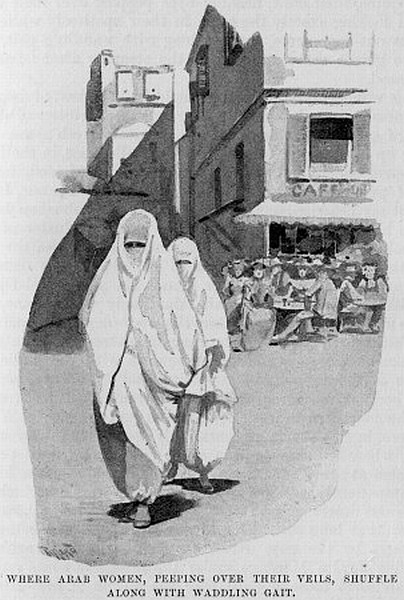
This wonderful old city of sunlight and shadow, of dazzling brightness and sombre gloom, of strange incongruities of dress, of language, and of religion, was by no means fresh to me. On taking up my quarters at the Hôtel de la Régence, in the Place du Gouvernement, I was welcomed as an old friend, for on several previous occasions, while idling in El Djezaïr, I had made it my headquarters in preference to the suburban hotels on the hill at Mustapha. Before the house a cluster of fine date palms throw a welcome shade, and beyond lies the bay, with the great, misty mountains of Kabylia in the distance. Forming one side of the Place stands the Djamäa el-Djedid, with its plain windowless walls, dazzlingly white dome, and square minaret, whereon at sunset the mueddin appears and calls the Faithful to prayer. Here, again, extremes meet. The monotonous voice of the priest mingles with the jingle and chatter of the French café opposite, and Europeans, sipping their bock or mazagran, watch the devout Moslems trooping into the courtyard to wash before entering the house of Allah.
Here, in this the most charmingly cosmopolitan city in the world, where subjects for the artist are presented in perfect panorama at every turn, I wandered and idled at cafés, killing time impatiently, and eagerly awaiting the day on which my mysterious desert acquaintance would go upon her pilgrimage. At last that long-wished-for Friday dawned, and leaving the city early by the gate Bab-el-Oued, I strolled through the charming Jardin Marengo, under the intensely white walls of the handsome mosque built over the shrine of Sidi Abd-er-Rahman, and then out on the road which wound up through the dark, wild ravine of the Bou-Zarea.
In the fresh, cool morning air the walk up that well-shaded road to the Frais-Vallon was delightful, even though the aloes and prickly pears were white with dust and the sun had scorched the foliage of the almond and orange trees. At the top of the glen, where the road narrowed into a footpath, I found a little Arab café, and upon a stone bench before it I seated myself to watch for the woman who held me under her spell.
This smiling, fertile country beside the sea, where grapes, olives, and sweet flowers grew in such wild abundance, was charming after the great wastes of arid sand; and while the birds sang gladly above in the cloudless vault of blue, I sat alone, smoking and sipping a tiny cup of coffee, watching the veiled women in their white baggy trousers and haicks, in pairs and singly, slowly toiling past up the steep road on their way to adore the koubba of Sidi-Djebbar.
That Zoraida should repair to this shrine was puzzling. It added considerably to the mystery which enveloped her. Sidi-Djebbar is the patron saint of divorced Arab women, and, according to a local tradition, whenever a divorced lady makes three pilgrimages to his tomb and drinks of the waters of Aioun Srakna, she will marry again before the next fast of Ramadân. Was Zoraida the divorced wife of some man who had bought her from her parents and had soon grown tired of her? Was she an outcast from the harem?
Thoughts such as these filled my mind as I watched the veiled houris pass in silent, pious procession. To distinguish one from another was impossible. The only way in which I could tell a lady from a woman of the people was by her feet and by the texture of her haick. The feet of the lower classes were bare and thrust into heavy, roughly-made slippers, while on the neat ankles of wealthier women gold bangles jingled, their feet were encased in stockings of silk, they wore tiny Paris-made patent-leather shoes, and as they brushed past, they left upon the air a scent of attar of rose. The women of Al-Islâm are seldom allowed to visit the mosques, so on Friday, their day of prayer, they go on foot to venerate the koubbas of their saints instead.
A weary journey extending over a month, had brought me at last to this spot, yet how among all these shrouded figures could I distinguish the woman I adored? Suddenly it occurred to me that, although I had taken up a position of vantage, Zoraida would not approach me, an Infidel, at any spot where she might be observed; therefore I rose and strolled leisurely on up the steep shaded track that led in serpentine wanderings among the fig trees, oranges, and vines.
Half convinced that her promise would never be kept, and that she was still in the far Sahara, I walked on very slowly for some distance. Suddenly, at a bend in the hill-path, where the wide branches of the cork oaks, the ilex, and the chêne-zeen met overhead, and the giant aloes grew abundantly, a voice amongst the leafy scrub startled me, and a short, stout figure appeared from among the foliage. Glancing round to reassure herself she was unobserved, she ran towards me. Only her eyes were visible, but they disappointed me, for I could see that they were not those of the woman for whom I was searching. She was old; her forehead was brown, wizened, and tattooed.
“Art thou the Angleezi whom Allah delivered into the hands of our master Hadj Absalam? Art thou named the Amîn?” she asked, almost breathlessly, in Arabic.
“Yes,” I replied. “Who art thou?”
“Know, O Roumi, that I have been sent by my mistress, Zoraida Fathma,” she said, drawing her haick closer with her brown, bony hand. “My lady of exalted dignity said unto me, ‘Go, seek the foreigner Cecil Holcombe, wákol loh inni moshtâk ilich.’” (“Tell him that I am desiring to see him.”)
“To see her? I expected she would be here!” I said.
“Alas! no. The koubba of Sidi-Djebbar cannot be graced by my lady’s presence this moon.”
“Is she here, in El Djezaïr?” I asked quickly.
“Yes. Although thou hast not known it, her lustrous eyes, the Lights of the Harem, hath already gazed upon thee since thy sojourn here. She desireth to have speech with thee.”
“When?”
“Two hours after the sun hath set.”
“And where may I see her?” I asked, impatiently.
“Knowest thou, O Roumi, that in the Jardin Marengo there is a path under the wall of the holy Zaouia of Sidi Abd-er-Rahman. If thou wilt meet me there under the great cedar tree when the moon hath risen, I will conduct thee to her presence. My lady hath named thee Amîn, and must see thee.”
“I will await thee,” I replied. “Go, tell thy mistress that the hours have passed at snail’s pace since we met, that the Amîn weareth her ring, and that he hath not forgotten.”
“Behold! Some one cometh!” she exclaimed in alarm, as a tall Arab appeared at the bend of the path sauntering slowly in our direction. “I must not be seen speaking with thee, an Infidel, within the sacred precincts of the koubba. Till to-night, sidi, slama.”
And, turning quickly, the messenger from my mysterious enchantress strode onward towards the tomb of the patron saint of divorce.
Chapter Twelve.
An Oath to Messoudia.
With eager anticipation of once again meeting Zoraida, I left the Place Bab-el-Oued, and, ascending the steep incline, entered the Jardin Marengo.
The sun had disappeared into the broad Mediterranean, flooding the sea with its lurid blaze of gold; the light had faded, the muddenin had, from the minarets of the mosques, called the Faithful to their evening devotions, and the dusky, mystic gloom had now deepened into night. From the garden, situated a hundred feet or more above the sea, on the edge of the city but within the fortifications, a beautiful picture was presented. Above, the square castellated minaret of the mosque of Sidi Abd-er-Rahman stood out distinctly against the calm night sky; below, in the hollow, the houses of the lower town clustered with a dream-like picturesqueness in every line and angle. Beyond, lay the harbour with its breakwater and tall white lighthouse; in the gently undulating water were long perpendicular twinklings of light, and against the darkness, which was not wholly dark, the bold lines and tapering masts of half a dozen vessels were sharply silhouetted. The distant strains of one of the tenderest airs from “Carmen,” played by the fine Zouave band, floated upward out of the shadow; and as I stood under the giant cedar which the old Arab woman had indicated, it was hard to say whether one’s looking or one’s listening brought a finer sense of restfulness and remoteness. It was probably the alliance of the two that gave to those moments their special fascination.
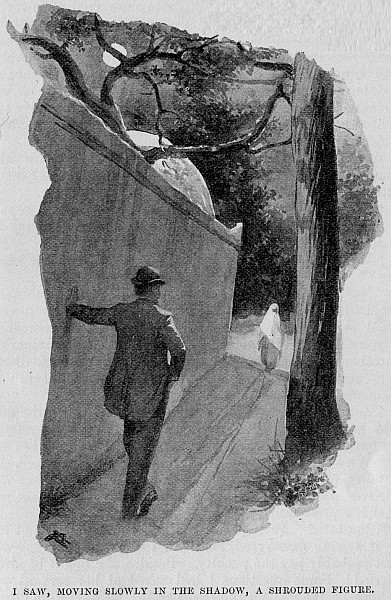
The ancient mosque, under the walls of which I waited, was silent. Among the dark foliage lights glimmered, and overhead in the spacious quiet were a few stars. At last the air from “Carmen” died in its final poignant chords, the succeeding silence remained far a long time unbroken, and the moon shone forth from behind the light scud. Its white brilliance was shedding a silvery light over the trees and gravelled walks, when suddenly I saw, moving slowly in the shadow of the ilex trees, a shrouded figure approaching noiselessly, like some ghostly visitant from the graveyard of the mosque.
A few moments later the old Arab woman with whom I had made the appointment, emerged into the moonlight and halted before me.
“Thou, the Amîn, the stranger from over seas, hast kept thy promise,” she said, slowly. “Know, O Roumi, that my lady awaiteth thee.”
“Whither wilt thou conduct me?” I asked. “Is the journey long?”
“No,” she answered. “First, before I, Messoudia, conduct thee to her, thou must swear by thine own Deity never to reveal to any one, Mussulman or Christian, her whereabouts, or, even though strange things may occur,—more remarkable than thou hast ever dreamed,—thou wilt never seek to discover their cause, neither wilt thou approach her in the future unless she commandeth thee.”
The weird old woman’s words mystified me. In the moonlight her white-robed figure looked ghostly and mysterious, and her small dark eyes peered earnestly at me over her veil.
“Why should I give such an undertaking?” I asked.
“Because—because it is my lady’s desire. It is her words I deliver unto thee; if thou dost not obey, thou canst never enter her presence.”
I hesitated. Perhaps, after all, it would be best not to go, for if I were discovered, Zoraida’s life as well as mine would most probably pay the penalty. Besides, she might be already married! Some questions I had asked of her servant, when we met at the Frais-Vallon earlier in the day, were directed towards clearing up that point, but I had only received vague, evasive answers.
Noticing my indecision, the old woman continued—“Thy thoughts, O Roumi, are that thy presence in my lady’s apartment would be an insult to our creed. O’ há kki k lak annoh lise fi hâtha al-amr éhátar.” (“I assure thee there is no danger in that matter.”)
“And if I undertake to respect her wishes although my curiosity be aroused, what then?” I asked, still undecided.
“My lady will admit thee to her presence, and have speech with thee alone. Remember, O Infidel, she risked her life to save thee, and thou, in return, may now redeem thy promise to her.”
“Then I will accompany thee,” I said at last, determined to see my fair Enchantress of the Desert again. “And if her commands are imperative, I give my word of honour as an Englishman that I will never make inquiry regarding things I may witness, unless she giveth me sanction.”
“May all the blessings of Allah be extended unto thee!” she replied, with evident satisfaction at my resolve, for seldom will a True Believer express such a wish to an Infidel. “I, a Moslem, cannot walk with thee, but follow me, and I will lead thee unto her.”
Then, drawing her haick closer, she moved onward in the deep shadow of the orange and ilex trees, while I, with mixed feelings of pleasure and distrust, strode on after her.
I had exchanged my haick and burnouse for European dress, now that I was back in Algiers. The spirit of adventure was strong within me, yet I felt curiously apprehensive of some untoward event. I was about to enter the abode of some fanatical Moslem, to converse with a woman of Al-Islâm, to tread upon ground that must always be highly dangerous to a Christian. Yet the world was before me, and there is always pleasure and excitement in plunging single-handed into its chilling depths.
Ascending the short flight of steps at the side of the mosque we emerged from the Jardin Marengo, and, turning into the broad but unfrequented Boulevard Valée, the highest point of the ancient town, we walked for some distance until nearly opposite the great grey walls of the prison, when suddenly my guide crossed the road and dived into the Arab quarter, a puzzling labyrinth of narrow crooked streets and gloomy little passages, of maze-like windings and dark impasses. As we passed down the steep, ill-lit streets, white-burnoused men were squatting in groups on the mats outside their cafés, drinking coffee, playing damma, and smoking “the pipe of permanence;” or inside the kahoua they lounged upon the benches, discussing the topics of the day. In the deep dens that serve as shops, shoemakers were still plying their trade, makers of horn rings were still at their primitive lathes, and embroiderers were still busily sewing in the yellow lamplight.
The streets were crowded, for it was pleasant in the evening hour, and amid the chatter of Arabic we sped on, wending our way in and out the tortuous turnings until I had no idea in what portion of the Arab quarter we were. The streets bore names in French on little plates, it is true, but after we had crossed the Rue de la Kasbah, the principal native business street, I discovered nothing that gave me a clue to the direction in which I was going. A dozen turns to right and left, now ascending through some dark tunnel-like passage, now descending where the ancient thoroughfare was wide enough to admit three asses abreast, we at last came to where two narrow streets met. Straight before us was an arched door in a great, gloomy, whitewashed house, windowless except for a few little square holes high up, protected by lattices of thick iron bars. The house was very old, built in the time of the Deys, and as my guide rapped upon the door, I noticed that the step was worn deeply by the feet of generations, and above the arch the hand of Fathma in brass was nailed to avert the evil eye.
It was a strange inartistic-looking exterior, but, ere I had time to gaze around, the heavy iron-studded door swung open, and, entering, we passed through a narrow vestibule, or skiffa, into a spacious oust, or open court, where a vine trailed above and a fountain fell gently into its marble basin. Then, for the first time since we left the Jardin Marengo, my guide spoke. In a low half-whisper, she said—
“Thy voice must not be heard. This meeting is strictly secret, therefore follow me in silence and noiselessly.”
“Ma ansash,” I replied.
“And thy promise?” she whispered.
“My oath bindeth me to obey her.”
“Then thou art truly the Amîn. Peace be unto thee, and upon thy descendants and companions,” she said. “Hush! make no noise. Let us seek her.”
Crossing the dark courtyard, she unlocked a small door, and I followed her in. The mingled perfume of musk, geranium, and attar of rose was almost overpowering, and my feet fell with noiseless tread upon a thick, soft carpet. A great hanging lamp of filigree brass shed a welcome ray, and as we ascended the broad stair, I thought I heard whisperings and the rustle of silken garments. Upstairs, a big, handsomely-dressed negro stood apparently awaiting us, for, with a sharp, inquiring glance and the exchange of some whispered words in Kabyle dialect, which I could not distinctly catch, he conducted me along a well-carpeted passage to the end, where closed plush curtains barred our passage.
As I advanced, he suddenly drew them aside, and in a low deep voice announced me in Arabic, inviting me to enter.
Stepping forward, I gazed around in curiosity and amazement.
I was in the harem!
Chapter Thirteen.
Night in the Harem.
“Ah, Ce-cil! At last!—at last! Marhaba.”
There was a movement on the other side of the dimly-lit, luxurious chamber, and from her silken divan Zoraida half rose to greet me. Reclining with languorous grace upon a pile of silken cushions, her hand outstretched in glad welcome, the jewels she wore flashed and gleamed under the antique Moorish hanging lamp with an effect that was bewildering. But alas! from her eyes to her chin a flimsy veil still concealed her features.
Taking her small white hand, I stood by the divan and looked down at her steadily in silence, then raised her fingers slowly and reverently to my lips.
The curtains had fallen; we were alone.
Presently, when we had gazed into each other’s eyes with tender, passionate earnestness, I addressed her in Arab simile as light of my life from the envy of whose beauty the sun was confused, and told her how slowly time had dragged along since I had escaped from the poison of the asp; how glad I was to bow once again before the Daughter of the Sun.
She listened to my affectionate words without replying. One of her little pale green slippers had fallen off, leaving a tiny bare foot lying white upon the dark silk.
Her dress was gorgeous, fully in keeping with her costly surroundings. She was a veiled enchantress in gold-spangled embroidery, filmy gauzes, and silver brocade. Her dark crimson velvet rlila, or jacket, cut very low at the throat, exposing her white, bare breast, was heavily embroidered with gold, the little chachia stuck jauntily on the side of her head was of the same hue, thickly ornamented with seed pearls, while her wide, baggy serroual, reaching only mid-leg, were of palest eau de nil silk, fine as gauze, and brocaded with tiny coloured flowers. Her vest, that showed below the rlila, was of silver brocade, and her sash, of many-coloured stripes, was looped in front, the fringes hanging gracefully. Across her forehead a string of gold sequins was stretched, with a centre-piece consisting of a great cluster of lustrous diamonds, while three particularly fine gems, set in pendants, hung upon her white brow. Around her slim, delicate throat were two splendid diamond necklaces, a dozen rows of seed pearls, and a necklet composed of large, golden Turkish coins. Suspended by four heavy gold chains about her neck was her golden perfume-bottle, encrusted with roughly-cut diamonds and sapphires; on her arms she wore mesais of gold and silver studded with gems, her fingers glittered with diamonds, and on her neat, bare ankles golden redeefs jingled.
Indeed, she was the fairest and most dazzling woman my eyes had ever gazed upon.
The air of the harem was heavy with sweet perfumes, mingling with the sensuous odour of burning pastilles. In the apartment everything betokened wealth and taste. The silken divans, with their downy, brightly-coloured cushions, the priceless inlaid tables, the genuinely antique cabinets with doors of mother-of-pearl, the Eastern rugs of beautifully-blended shades, the rich embroideries, and the profusion of flowers, all combined to render it the acme of comfort and luxury, and graced by such a bewitching vision of Eastern beauty, the scene seemed more like a glimpse of fairyland than a reality.
“Thou hast not forgotten me, then?” she said, raising herself slowly, and placing under her handsome head a cushion of pale primrose silk.
“No,” I replied. “How can I ever forget thee?”
Her white breast rose and fell in a deep-drawn sigh.
“Already Allah, the Most Merciful, hath directed thy footsteps and vouchsafed me the felicity of conversing with thee. Thou hast kept thy promise unto me, O Cecil, for when the homards would follow us, thou didst not betray our whereabouts. Therefore I trust thee.”
“I assure thee that any confidence thou placest in me shall never be abused,” I replied. “Yet,” I added, “thou dost not place in me that perfect trust that I have.”
“Why?” she asked, in quick surprise.
“Still hidden from my gaze is that countenance I am longing to look upon.”
“Wouldst thou have me cast aside my religion? I am a woman; remember what is written,” she exclaimed, half reproachfully.
“The adoration of the Christian is none the less passionate than the love of the True Believer,” I said. “A woman is not defiled by the gaze of the man she loveth. But,” I added thoughtfully, “perhaps, after all, thou hast no thought of me, and my fond belief that in thy breast burneth the fire of love is only a vain delusion.”
“Thou—thou thinkest I can care nothing for thee—a Roumi? Why?” she cried, starting up.
“Because of thy refusal to unveil.”
She hesitated; her brows were momentarily contracted. Her hand trembled.
“Then, though I cast aside the creed of my forefathers and the commands of the Prophet, I give thee definite answer. See!” With a sudden movement she withdrew a golden pin, and, tearing away her white silken veil, her countenance was revealed.
I stood amazed, fascinated, half fearing that the wondrous vision of beauty was only a chimera of my distorted imagination that would quickly fade.
Yet it was a reality. The face turned upward to mine with a merry, mischievous smile was that of Zoraida, the woman who had now so plainly demonstrated her love.
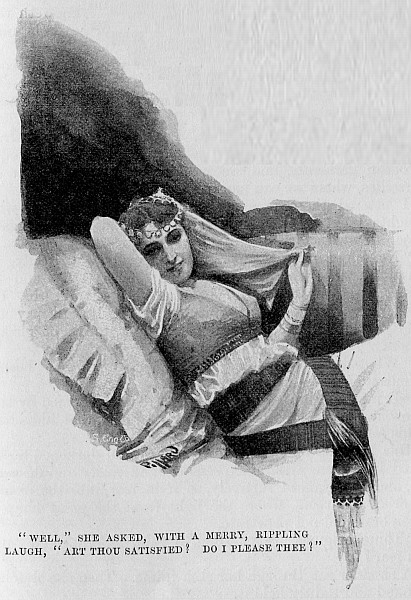
“Well,” she asked, with a merry, rippling laugh, “art thou satisfied? Do I please thee?”
“Thou art, indeed, the fairest daughter of Al-Islâm,” I said, slowly entwining my arm about her neck and bending to kiss her. She was fair as the sun at dawn, with hair black as the midnight shades, with Paradise in her eye, her bosom an enchantment, and a form waving like the tamarisk when the soft wind blows from the hills of Afiou.
Her lips met mine in a long, hot, passionate caress; but at last she pushed me from her with firmness, saying—
“No, I must not—I must not love thee! Allah, Lord of the Three Worlds, Pardoner of Transgressions, knoweth that thou art always in my thoughts—yet we can never be more than friends.”
“Why?” I asked, in dismay. “May we not marry some day?”
“Thou art a Roumi, while I—I am a dweller in the mansion of grief.”
“But all things are possible,” I said. “If thou art afraid of thy people, trust in me. Meet me clandestinely, attired in European garments, and we will leave by the steamer for Marseilles, where we can marry.”
I uttered these passionate words scarce knowing what thoughts I expressed. As soon as they had left my mouth I was filled with regret.
“No. Ask me not,” she replied, firmly. “Already, by bringing thee hither, by unveiling before thee, and by suffering thee to kiss me, I have invoked the Wrath. The curse is already upon me, and—and, alas! I shall pay the penalty soon enough,” she added, with a touch of gloomy sadness.
“What dost thou mean?” I asked, gazing into her beautiful, entrancing face.
“It meaneth that I, Zoraida Fathma, am consumed by that sorrow and despair that is precursory of death; that Eblis hath set his fatal seal upon me—that I am doomed!”
Her lustrous eyes, with their arched and darkened brows, looked into mine with an expression of intensity and desperation, and she glanced furtively, as if in fear, into the distant corner of the room, where the light from the great lamp of beaten brass did not penetrate.
“Thine enigmas are puzzling,” I said. “What evil canst thou fear?”
A shudder ran through her slim frame. Then she clutched my hand and tightly held it.
“I cannot—I—It is forbidden that I should love thee, O Cecil,” she said, sighing and setting her teeth firmly.
“Why?”
“Because a greater and more insurmountable obstacle than our difference of race and creed preventeth it.”
“But tell me what it is?” I demanded.
“Isbir showhyyah,” (“Have patience a little”), she replied. “Though I may love thee, my Amîn, thou canst never be my husband. I am as much a captive as any of my slaves, and, alas! far, far more unhappy than they.”
Why did she have slaves? I wondered. Slavery in Algeria had, I knew, been abolished since the overthrow of the Dey, although in the far south, beyond the Areg, the tribes still held many in bondage.
“Unhappy?” I cried. “What is the cause of thy misery? Art thou thyself a slave, or—or art thou wedded?”
She started, staring at me with a strange expression.
“I—I love thee!” she stammered. “Is not that sufficient? If I wish at present to conceal certain facts, why dost thou desire me to tell lies to thee? To my woman Messoudia thou didst take oath to seek no further information beyond what I give thee.”
“True, O Zoraida,” I said. “Forgive me. Yet the mystery that surroundeth thyself is so puzzling.”
“I know,” she said, with a tantalising laugh. “But when a woman loves, it is imprudent of her to compromise herself;” and she beat an impatient tattoo with her fingers, with their henna-stained nails, upon a derbouka lying within her reach.
I did not reply. I was engrossed in thought. All that she had said made it plainer to me that she was the wife of Hadj Absalam.
She watched me in silence. Then, with a sudden impetuousness, she sprang from her divan, and, standing up, flung her arms about my neck, kissing me passionately. The silk of her serroual rustled, her bangles jingled, and in her quick movement she lost her remaining slipper, and stood barefooted, a veritable Queen of the Harem, a houri of Paradise.
“Hark!” she whispered, starting in alarm as we stood locked in each other’s arms, while I rained kisses upon her fair face. “Hark!” she cried. “Listen! What was that?”
I held my breath, but could detect nothing.
“My foolish fancy, I suppose,” she added, a few moments later, after she had strained her ears to again catch the sounds that had alarmed her. “Think! If we were betrayed! It would mean torture and death!” she said hoarsely, and, disengaging herself from my arms, she walked quickly over to the opposite wall, and, drawing aside a heavy curtain, reassured herself that a door it concealed was securely bolted.
Returning, she flung herself upon her divan among her cushions and motioned me to a seat beside her. Then, taking from the little mother-of-pearl stool a box of embossed gold filled with cigarettes, she offered me one, and, lighting one herself, reclined with her head thrown back gazing up to me.
“We are more than friends, Ce-cil,” she said presently, thoughtfully watching the smoke that curled upward from her rosy lips. “I only wish it were possible that I could leave this land and go to thine. Ah! If thou couldst but know how dull and colourless is my life, how rapidly my doom approaches—how horrible it all is!”
“What is this strange destiny that the Fates have in store for thee?” I asked, mystified.
“Have I not already told thee that thy curiosity cannot be satisfied?”
“Yes. But I love thee,” I protested. “Surely I may know the character of any danger that threateneth?”
She shook her head, and, taking my hand, noticed upon my finger a plain gold signet ring that had belonged to my father. Slowly she drew it off and placed it upon her middle finger, saying, “I take this in remembrance of to-night.”
“But is there nothing I can do to avert this mysterious evil which thou apprehendest?” I asked.
She did not reply. With her face turned towards the painted ceiling, her dark, serious eyes gazed away into space. Her bare breast, with its profusion of pearls and diamonds, heaved and fell as she breathed, and the sweet odour of rose and geranium that pervaded her filled my nostrils with intoxicating fragrance.
“Why canst thou not escape from here?” I continued. “If danger threateneth, fly from it. I will assist thee. And is not Allah merciful? He giveth life and death.”
“Hákk,” she replied. “Yet to leave this place unobserved would be impossible. I have been able by a ruse to gain thine admittance here, but any attempt to leave would only result in my death.”
“Are not thy servants amenable to bribery?” I suggested.
“Alas! as they are my slaves, so are they my gaolers. They are charged with my safe custody, and if I eluded their vigilance, they would pay the penalty of their negligence with their lives. Ah! thou knowest not the more terrible of the tortures practised by my people. Thou knowest not the Ennitra. Soon I shall return again to the Ahaggar, and then the Great Desert and the Atlas will separate us. For me escape is impossible. Thou wilt go to thine own land ere many moons, and—and forget me!”
“Never!” I exclaimed, vehemently.
“Thou wilt marry one of thine own women who have no prejudices, and who may go unveiled, like those who come to Mustapha at Ramadân.”
“No, Zoraida,” I said; “I love only thee.”
She gazed long and earnestly into my eyes, at the same time toying with my ring.
“And thou art ready to serve me implicitly?” she inquired eagerly.
“I am. Command me.”
“Then know, O Cecil, my life is at stake,” she said, in a low, hoarse whisper, drawing herself up with one arm still entwined tenderly about my neck.
“Why art thou threatened?” I asked, in surprise.
“Because I—because I am guilty of a crime; I possess the secret of a hidden marvel. Having dared to penetrate the hideous mysteries of Eblis, one of them, undreamed of and astounding, hath been revealed unto me. Its knowledge placeth in my hands a secret power that I might use with fearful effect, but the awful curse hath now fallen upon me, and I am doomed. Only thy willing assistance can save me. Yet”—and she paused. “Yet I feel doubtful whether thou, a Roumi, wouldst dare to undertake the mission that is necessary for my safety; whether thou couldst place sufficient confidence in me to carry out instructions which to thee may seem so extraordinary.”
“I have perfect trust in thee,” I said. “I am ready from this moment to serve thee blindly, implicitly, if I can save thee and further the prospect of our marriage.”
“Marriage? No! no! Do not speak of it now,” she exclaimed hastily. “Hast thou never heard of the truth uttered by our Harikar al-Hakim, who said, ‘Marriage is a joy for a month and a sorrow for a life, and the paying of settlements, and the breaking of the back under a load of misery, and the listening to a woman’s tongue.’ To thee I can promise nothing, for my life may end at any moment.”
“But thy death can be averted. How?”
“By rendering me assistance thou canst save me from the awful physical and mental torture—from the horrors of the grave. Wilt thou consent to become my secret agent?”
“Yes. I am ready to perform any task thou mayest require of me.”
“Then remember the oath of secrecy thou didst take before Messoudia brought thee hither; for, first of all, thou, trusting to thine own Deity, must enter with me into the presence of the Great Unknown.”
And as she touched a little silver gong, the great negro in handsome blue livery, who had announced me, entered the harem and prostrated himself before his mistress until his forehead touched the carpet; while two houris, in clinging robes of white silk, entered bearing a great gold bowl of sweet perfume in which Zoraida, with an imperious gesture, washed her hands, and bade me follow her example.
“Thou wilt not be timid,” she asked, “even though we go voluntarily together to the very threshold of the grave; even though we may peradventure taste of the horrors of death?”
“No,” I replied, endeavouring to remain calm.
My nerves were strung to their highest pitch, and my heart beat quickly. I stood breathless, watching one of the houris, who lit a small gold lamp that burned with a thin blue flame. What, I wondered, was the character of the strange scene I was about to witness? Zoraida, my enchanting Pearl of the Harem, and I were going together voluntarily into the presence of the Great Unknown!
Chapter Fourteen.
Seeking the Unknown.
Having placed the quaintly-shaped lamp on the pearl and silver stool in the centre of the harem, the negro went out, returning immediately with a small bronze urn marvellously chased, which on bended knee he carefully handed to his mistress. At a word from Zoraida, her women and the tall Soudanese prostrated themselves facing the table, pressing their foreheads to the carpet. Then, turning to me, she said in deep earnestness—
“Knowest thou that the deeds we are about to commit are a terrible sacrilege? Though thou wilt witness strange things, yet peradventure they may cost us our lives—nay, our very souls.”
“Why?” I asked, somewhat alarmed at her sudden seriousness. “Is it imperative that we should risk everything?”
“Every sin beareth its fruit,” she replied, as, slowly rising from her divan and holding above her head the urn the negro had brought, she added, “Hath not the Prophet told us that when the earth shall be shaken by a violent shock, and the mountains shall be dashed to pieces and shall become as dust scattered abroad, we shall be separated into three distinct classes? Those who have preceded others in the Faith shall precede them to Paradise. The Companions of the Right Hand shall go and dwell in the Gardens of Delight, among lote trees free from thorns and trees of mauz always fruitful; but the Companions of the Left Hand—how miserable shall they be! They who, like ourselves at this moment, invoke the secret power of Eblis the Terrible, will dwell amidst the burning winds under the shade of the great black smoke. They are the damned, for they, in their error, have gone astray in the Valley of Perdition. Then know, O Roumi! that thou hast chosen to accompany me unto the dreaded Shrine of Darkness, to seek of the beneficent Granter of Requests what is hidden, to face the terrors of the tomb, so that thou mayest hold over thy fellows a power terrific, fatal, awful!”
Her eyes were dilated, filled with a strange, unnatural light, and I stood aghast at her solemn speech.
“Art thou not one of the chosen?” I asked. “Art thou not—”
“Hold thy peace!” she commanded. Then, holding forth the bronze urn, she exclaimed, “See! in this vessel are the ashes of the great Masinissa, the Numidian king, whose body was entombed at Medrassen two thousand years ago. By their light we will search for the Great Unknown.”
With a sudden movement she took from the urn a small handful of white dust, and, holding it high over the lamp, sprinkled it slowly into its faint blue flame. In a moment the place was illuminated by a white glare so brilliant that I was compelled to shade my blinking eyes with my hands, while at the same time the apartment was filled with a dense smoke of a light green hue, but so pungent as to plunge me into the agonies of asphyxiation.
Thrice she threw into the flame the ashes of the King; thrice she uttered strange words in a drawling monotone, that were repeated by the three servants who lay prostrate and appalled. Then, dipping her finger in the dust, she drew it across my forehead from left to right, and afterwards made the same sign across her own bejewelled brow and across her bare breast.
“Rise,” she said, turning to her servants. “Bring hither the elixir. Then leave us.”
All three scrambled to their feet in haste to do the bidding of their imperious mistress, and, after the lapse of a few moments, the two houris in white reappeared, one bearing a tiny bowl containing a colourless liquid, while the other brought between her fingers a long thin poignard, the hilt of which was studded with rubies and turquoises. When they had placed them beside the lamp, and the heavy curtains had fallen behind the two girls, Zoraida turned her great dark eyes upon me, exclaiming—
“Thou wilt ere long learn a wonderful secret which hath been revealed to none on earth except myself. Already hast thou taken an oath never to disclose what thou mayest see between these walls. Know, O Cecil! that by thy passionate love for me thou wilt bind thyself to one who can produce strange effects from simple causes, and who can show thee wonders undreamed of. Yonder knife and potion will bind thy soul unto mine; thou wilt become one of the Companions of the Left Hand, whose habitation is the shadowless Land of Torment, where the burning wind scorches and water scalds like boiling pitch.”
“Is there then no hope for those who love thee?” I asked, so mystified and my senses so dulled by the curious odour of the smoke, that I scarce knew what words escaped me.
“None,” she replied, sighing. “Neither rest, mercy, nor the Garden of Delights can fall to the lot of he who loveth me.”
“Why?”
“Because, by regaining the wondrous secret lost to the world for so many ages, the mark is set indelibly upon thee. Knowest thou not what is written in Al Korân? The Prophet hath declared that when the heavens shall be rent in sunder and shall become red as a rose and shall melt like ointment, then neither man nor genius shall be asked concerning his sin. The wicked will be known by their marks, and they shall be taken by the forelocks and the feet and cast into the place of grievous torments.”
“Yes,” I said. “But why is the search after this hidden force an act of such heinous wickedness?”
“Because the secret is only to be obtained at the Shrine of Darkness. Dost thou, after the warnings I have given thee, still consent to accompany me among the Companions of the Left Hand—to gain the knowledge that is forbidden?”
I gazed upon her marvellous beauty. Her magnificent eyes, bright as those of the gazelle, were turned to mine with a look of earnest appeal as the little hand I held trembled with suppressed excitement. The mystic rite she had practised had intoxicated me with a burning desire to learn more of these strange revelations that she promised, and, dazzled by her loveliness, I was utterly reckless of the future.
“I do not fear,” I replied. “I place implicit confidence in thee, and am prepared to serve thee, and to seek the wisdom so long withheld.”
“Ibtidâ-an,” she exclaimed. “Thou, the Amîn, must be inoculated with the elixir;” and, taking up the gleaming poignard, she felt its point. “It is a deadly decoction. One drop is sufficient to cause death, yet, strangely enough, three drops have only the effect of stimulating the brain and preparing the vision for the strange things of which thou must remain a silent witness.”
Taking my hand in hers, she pushed back the sleeve of my coat, exposing my arm. Then, grasping a small rod of glass that lay beside the bowl, she dipped it in the liquid and allowed a single drop to fall upon my flesh. It burned and ate into my arm like an acid, causing me to draw back quickly in pain, but ere I realised her intention, she had raised the dagger and made a punctured wound, thus allowing the poison to enter my veins and mingle with my blood.
“Quick! The second drop!” she cried, dipping the rod into the bowl again.
“It feels like molten metal,” I gasped, drawing my arm away. “It—”
“Do not hesitate,” she exclaimed concernedly. “If thou dost not receive the three drops into thy veins, the poison will prove fatal. Come, let me conclude the formality;” and, grasping me firmly, she placed another spot of the acid upon my arm and punctured the flesh with her knife, repeating the operation a third time, until I had been fully inoculated with the mysterious virus.
Then, stretching forth her own well-moulded white arm, whereon I noticed several small red spots,—which she explained were the marks of previous inoculations,—she stuck the point of the dagger three times into her own delicate flesh, until the blood flowed and the fluid she had placed upon the spots was wholly absorbed.
Casting the dagger from her with an expression of repugnance, she passed her hand quickly across her brow, saying—
“Henceforward, O Cecil, an affinity existeth between us. Though deserts, mountains, and rolling seas may separate us, our souls will hold converse. We shall no longer be strangers.”
The poison was taking effect upon me. Its action was slow, but a strange, sickening giddiness crept over my brain, a feeling that the objects around me were gradually fading. Even Zoraida’s voice sounded hollow and distant in the dreamy half-consciousness that the secret decoction of my enchantress produced.
Was she, so young, so eminently handsome, so bewitching, the ingenious sorceress who, according to the rumour current among the Spahis, directed the movements of Hadj Absalam and his daring band of outlaws? Could it be possible that beneath those fair features was a heart so brutal and depraved as to plot murder, robbery, and horrible atrocities? As she stood before me in her dainty silks and flashing gems, she had no appearance of a wild freebooter and desert-wanderer, but rather that of an Oriental child of Fortune into whose languorous life the demon ennui had entered.
Had she not, however, called herself the Daughter of the Sun? Was not that the name by which the homards knew the guiding star of the murderous Ennitra?
“Hearken, O Cecil!” she said, placing her hand suddenly to her breast as if a pain shot through her heart. “The inoculation is accomplished, and life is now fast ebbing—we are dying—”
“Poisoned!” I gasped, alarmed. “Thou dost not mean that the three punctures will prove fatal?”
“Thou, the Amîn, hast placed thy faith in me. Of a verity will I reveal unto thee that which is known to me alone. Only by thus inviting death can we seek converse with the Great Unseen who ruleth the Kingdom of Shades. Our mental power, our sensibility, our very souls must be severed from our bodies and concentrated into separate existence, ere we may seek the knowledge that giveth us power. Even now at this moment our souls are parting from our bodies, the dim spark of life flickers, and we stand together on the threshold of the grave!”
I was touched and awed by the extraordinary change that came over her while she had been speaking. Something in her tone appealed to my sympathy, while at the same time her words made my heart sink. A woman lying in her coffin, ready to be buried alive, might have had such a strain in her voice. Her face was white, with that ghastliness which comes in extreme moments to a brunette, and her eyes, starting from their sockets, burned with a dusky, deep-set brilliance. When her voice, that sounded in my ears like a far-off wail, had ceased, she stood motionless, and her countenance assumed an inscrutable mask of quiet, almost serene resignation, behind which something suggested immeasurable depths of poignant suffering. Pale, haggard, and deathlike, she gazed at me with dry, half-parted lips. Then I saw in her wild eyes the fearful but unmistakable light of madness!
I was appalled at the slow, mysterious transformation of the woman I loved.
Chapter Fifteen.
At the Shrine of Darkness.
Under the singular magnetism of her lustrous eyes, I stood dazed, speechless, fascinated. My head throbbed with the burning of fever, my throat contracted, my limbs trembled as if palsied, and my heart was filled with an all-consuming terror.
Truly I was on the brink of the grave; I was peering into the yawning chasm of the Unknown. Suddenly an awful thought occurred to me. Was Zoraida, my idol, insane?
Bewildered and blinded in the rose-mist of happiness, the deepest significance of her strange actions had been entirely lost to me. Love had predominated everything, for the gracefulness of my Pearl of the Harem had so far surpassed expectation, so dwarfed all former visions of feminine attractiveness, that I had been struck to the heart by her first glance after the veil had fallen from her countenance. Therefore, was it not possible that, in failing to regard her extraordinary acts as those of a person whose mind was unbalanced, I had foolishly allowed myself to fall a victim to her homicidal tendencies? Though I strove to remain calm, I involuntarily shuddered. I tried to speak, but my tongue clave to the roof of my mouth and refused to articulate.
“Al-ân. We are ready,” she exclaimed at last, still keeping her bright eyes fixed upon me. “With our souls distinct from our bodies, we may now seek the knowledge withheld from mankind. Thou hast, I know, believed me to be a common charlatan, a sorceress who imposeth upon those who put their faith in occult arts. Now, however, that we love each other; now that our souls are wedded in the Unseen, I will invoke the revelation of the extraordinary secret, which, if it pleaseth the Great Unknown, thou shalt hold as my pledge. Prepare thine eyes for the witnessing of strange marvels, and follow me.”
Walking towards me, she raised her face to mine, kissing me fondly, then, slowly drawing back, she passed her hand quickly over her aching forehead, and, bidding me accompany her, tottered forward to the hidden door which previously in the evening she had ascertained was secure.
“Addonya dâr gorour,” (“The world is a house of deceit”), she said, drawing a small key from her bosom. “In the grave there is none. Hovering as we now are, between life and death, with the conquest of the soul over the impulses of the body, we may catch a glimpse of the Unknown. Therefore, let us go down and search for light at the Shrine of Darkness. Náhhi hâtha.”
The ancient key grated in the lock, and the ponderous door swung slowly open, revealing a narrow stone passage, the darkness of which was cavernous and impenetrable. Taking up the lamp into which she had sprinkled the ashes of Masinissa, she passed through the door, bidding me close it and follow her. Her face was pale and determined, and her wealth of dark hair, that had become unbound, fell to her waist in luxuriant profusion. I crossed the threshold into the close, damp passage, and pulling the door behind me it clanged loudly, the lock securing itself with an ominous snap.
I knew I was a prisoner in this, the innermost and secret chamber of the harem, and held my breath in expectation and alarm. Her sequins tinkled as she walked firmly and upright with the little lamp held high above, as down the long stone corridor that was evidently cut in the thickness of the wall I stumbled on after her, with reeling head and unsteady gait. A strange, sickly odour of cinnamon and musk filled my nostrils, the air was hot and offensive, and upon the rough-hewn walls lodged the dust of ages. A door at the end of the passage groaned as she pushed it open, and the dim light revealed a passage still narrower, running at right angles to that which we had traversed. Down this we walked in silence, until our progress was barred by a thick curtain of dark plush.
Halting, she turned towards me. In her countenance a change had been effected that startled me. The poison with which she had inoculated herself had wrought a terrible transformation. Round her fine, clear, luminous eyes were large dark rings that gave her bloodless face an expression of haggard hideousness, the bloom of youth had faded from her cheeks, now sunken, and her mouth was hard and drawn, showing the agony she was suffering.
“Thou art ill,” I exclaimed in alarm. “Let me assist thee.”
“No,” she replied huskily. “It is the crucial test. Preserve thine own courage, and now, ere we enter the Shrine of Darkness that is the portal of the Kingdom of Shades, let me urge thee, O Cecil! to maintain a level head and clear judgment. Examine what thou seest by the light of reason. Thou hast bound thyself irrevocably to me by the burning of the ashes and the puncture of the poignard, and together we are seeking that knowledge that will give us power over our fellow-creatures. Ours is a solemn investigation, to be undertaken in no spirit of idle curiosity or frivolity, for of a verity we are both fast sinking to the grave, and it is only in our dying moments that the Great Secret of the Unseen World that is forbidden to the living may be revealed unto us.”
“I fear not while thou art my companion,” I replied, determined not to betray nervousness, although the sickening and excruciating pains in my head caused everything to appear dim and hazy as a dream.
“And to the world thy lips will remain for ever sealed? Awa lam?” she asked in earnestness.
“I have pledged myself to preserve silence,” I replied.
“Then enter to the Shrine, and perfect peace be upon thee,” she said, summoning all her courage and drawing aside the curtain.
Upon the threshold of a grim, dark chamber I stood dumbfounded and amazed at the strange sight that presented itself to my gaze. The apartment was not very large, but the roof was vaulted, the arches were curiously wrought, and by the ruddy light diffused by a single hanging lamp, I saw it was a weird and altogether extraordinary place. Upon the floor was a black carpet, soft as velvet, around the walls were several rich divans, and behind a fine latticework of marble at the farther end of the luxurious dungeon—for such it seemed to be—was a circular altar of agate, jasper, and gold, over which a burning censer of gold was swung by an unseen hand. Behind the altar a large luminous star shone above with a dull red glow, and upon the altar itself stood a small brazier which, burning brightly, rendered the atmosphere close and oppressive.
Such was the extraordinary scene that met my dazzled eyes as I moved forward into the secret chamber.
Zoraida, rushing wildly on before me and uttering a loud cry, fell upon her knees before the altar, bowing until her lips touched the carpet, at the same time murmuring some strange incantation that I could not understand. So rapidly did she repeat the words, and so quickly she swayed her body backwards and forwards, that she was at last seized with hysteria. Suddenly regaining her feet, she raised her hands above her head, uttering a curious supplication in some language with which I was unacquainted.
At that moment I made an alarming discovery. There was a slight movement on the carpet, and, bending to examine it, I was horrified to find that upon the floor were venomous snakes! On the divans asps were lying, with their flat heads erect within their coils, together with vipers and scorpions. On every side tiny brilliant eyes seemed watching us, and now and then a slight hiss was heard from the remoter corners of the place. But Zoraida heeded them not. At the door she had kicked off her embroidered slippers, and now walked barefooted among the reptiles.
When she had concluded her strange prayer, she crossed the chamber hastily, and, tossing the velvet cushions and striped silk covering from one of the divans, there was disclosed an ancient tomb of carved sardonyx that was crumbling by age.
Grasping my hand, she then led me to the altar, whispering to me to prostrate myself before it. Hand in hand we passed the marble screen and threw ourselves down, kissing the ground; then, as we rose, she drew from her breast a small stiletto and pricked her wrist three times with its keen point. Holding it over the burning brazier, she allowed the blood to drip slowly into the fire, each drop hissing loudly as it touched the live coals.
Once she groaned, and a shudder went over her like the passing of the wind of sundown over still water. Then, in a firm voice, she exclaimed—
“Blessed be they who overcome human folly, vanity, and error. Blessed be they to whom the wondrous manifestations of the Terrible Unknown are accorded, for they shall be concealed under the dome of magnificence, and veiled by the curtain of purity. We, Companions of the Left Hand, on whom, alas! no peace resteth, present ourselves in quest of the knowledge of the Crescent of Glorious Wonders, so that our lives may be united and our happiness assured. Fervently pray we that an assurance of favour may be granted unto us, and that the Great Secret, dead to the world through so many ages, may be revealed.”
Scarcely had she uttered these words, when from the still swinging censer there rose a single puff of thick smoke. Zoraida was watching for it, and as the smoke dissolved, she remarked to me in low, impressive tones—
“Behold! our petition hath been stamped by the seal of response! It is well. Our quest will not be in vain.” Then, after a pause, she added, “Thou, O Roumi! hast believed I am a sorceress and a charlatan. Come hither.”
She walked to the sarcophagus, and, grasping the stone that formed the lid, pushed it off with almost superhuman effort, so that it fell heavily down behind. Then, taking up the lamp she had brought, she held it over the stone coffin and bade me gaze into it. With eager eyes I obeyed her, but started back in horror.
It contained a corpse!
An old man of pale complexion, with long white beard, and dressed in the habiliments of the grave, lay stretched with upturned face, motionless in death.
“This man, a holy marabout, died, and entered the Garden of Delights three years ago, yet, behold! his body hath not decayed. His misery hath been changed to peace and his grief to tranquillity,” she observed. “That he is actually dead prove for thyself. Touch him.”
I bent, placing my hand upon his white cheek. Its contact thrilled me. It seemed icy as marble! The sightless eyes seemed to gaze into mine with a grim, stony stare, and I drew away my hand as if I had been stung.
“Howa-thâ!” she cried. “I will prove further that there is no life;” and, raising the knife in her hand, she plunged it into the breast of the corpse.
“Art thou satisfied that he is really dead?” asked Zoraida grimly.
“Yes,” I answered, shuddering, for my whole surroundings in that subterranean Chamber of the Serpents were so uncanny, that I began to long for light and fresh air. Was she performing all these strange rites merely for the purpose of impressing and mystifying me; or was she an enthusiastic devotee of some secret sect of Al-Islâm? To poison one’s self before invoking the aid of the occult seemed an extraordinary proceeding, and the whole of the rites were so curious, that, fascinated as I was by the mysticism of the East, I regarded them with the most intense interest.
“At the Shrine of Darkness death loseth its sting,” she said. “To communicate with Eblis, the Terrible, it is necessary that one who is already a dweller in the Garden of Delights shall return to life and assist us. Here, in this charnel-house, the abode of death and of the serpents, strange knowledge may be imparted; but ere we proceed further, the sacrifice must be made.”
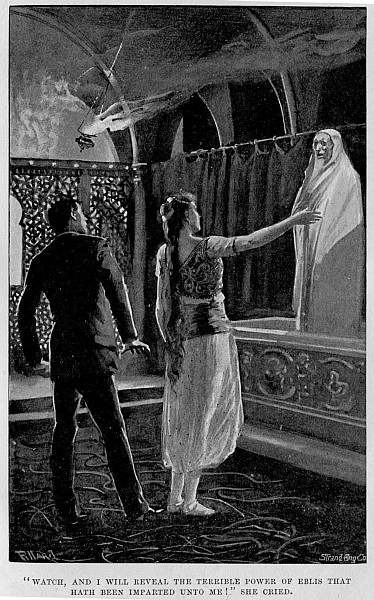
Snatching up a viper that lay coiled upon one of the divans, she grasped it dexterously near the head, and, walking to the altar, held it for a few moments above the burning brazier, repeating some weird word’s, then, as the reptile squirmed under the pain, she dropped it upon the burning coals.
Flinging herself upon her knees, with her hands outstretched above her head, she again invoked the aid of the mysterious Power. Pushing back her hair, that had fallen over her shoulders, she again rose, and, coming towards me, exclaimed—
“Watch, and I will reveal unto thee the terrible power of Eblis that hath been imparted unto me. Cathâ!”
She looked more haggard than before. The strain upon her nerves was evidently awful. Taking my hand, she led me back to the sarcophagus, repeating some words in such a low tone as to be inaudible. Suddenly she dashed forward, and with her right hand made mysterious passes over the face of the corpse.
“Sidi Mammar ben-Mokhala, chosen of the Merciful. Peace! Again I call upon thee, holy man of the Faith, tenant of the tomb of dignity and light of the eyes of the discerning, to assist this Roumi to the sight of the Crescent of Wonders, for none save myself knoweth aught of the way thither. Blessing upon thee, and great peace on those who went before thee!”
She paused. There was a wild look in her eyes, and her bare bosom heaved and fell quickly.
“Arise!” she cried in a loud voice. “I, Zoraida Fathma, Daughter of the Sun, command thy soul and body to reunite for brief space, so that thou mayest minister at this our sacred Shrine.”
A sound came from the ancient stone tomb like a long, deep-drawn sigh. There was a slight movement, and then, as I gazed in speechless expectancy, the corpse of the aged marabout slowly rose from its resting-place, white, rigid, and ghastly. The amazing resurrection appalled me. I stood with bated breath, my eyes were riveted upon the weird figure, and I was rooted to the spot. The hair upon my head was lifted as corn is lifted when the wind ceases suddenly, and the sweat rolled from my brow. Truly, this mysterious woman to whom I had voluntarily and blindly bound myself was gifted with some weird power that was utterly amazing and incomprehensible.
Chapter Sixteen.
The Crescent of Glorious Wonders.
Slowly the dead marabout stepped from his tomb and stood erect before me.
He glided mechanically, rigidly; his limbs did not bend, neither did his eyes move. In his grave-clothes he looked hideous, for so thin was his face that the bones could be seen beneath the brown withered skin, and his fleshless fingers with long nails had the appearance of talons.
“Thou hast never before witnessed the return of the dead to the world!” Zoraida exclaimed, noticing how scared I was.
“Is he really dead?” I asked, feeling somewhat sceptical, and beginning to think I was being imposed upon by some ingenious trickery.
“Dead? I call thee to witness!” she cried, and again drawing her long, keen dagger, she plunged it for the second time into his side.
There was no doubt that it had penetrated.
“Enough!” I gasped. “It is sickening.”
“Thou art at last convinced. Good!” she said, withdrawing the knife. Then, turning to the man she had recalled from the grave, she addressed him—
“Greeting to thee who followeth the guidance. Thou who hast enjoyed the pleasures of the Garden of Delights among the Companions of the Right Hand, and hast tasted the sweet waters of Salsabil, knowest the Secret of the Crescent. I, who fear the Omnipotent Avenger, command thee to intercede, that I may gain knowledge whereby to triumph over the Satans of Eblis—on whom may the Merciful not have mercy—and henceforward find perfect peace.”
Zoraida looked frightened herself, trembling like a slender cord suspended in a well, yet standing erect and queenly, with her jewels flashing and gleaming with dazzling brilliancy. To her words, however, the marabout made no reply. He remained motionless as a statue, gazing straight at me with his black glassy eyes.
Picking up an asp, a symbol of the Aïssáwà, that was darting over the carpet, Zoraida placed it in his icy hand. His bony fingers gripped the reptile as in a vice as slowly he moved across the strange apartment, and, without uttering a sound, sacrificed it on the blazing brazier.
Motioning me to kneel, and sinking upon her knees at my side, the woman I adored twisted a serpent around her head, and flung herself forward with her lips pressed to the sable carpet. Venomous reptiles were around us, but none ventured to attack. Indeed, she had kicked a viper aside with her bare foot as unconcernedly as if it had been an almond husk.
Strange passes were being made by the dead saint, standing at the altar with his back to us, and as he performed the mystic rite in silence I noticed that the smoke from the censer became thicker, and the fire in the brazier glowed until the iron seemed at white heat. Bowing slowly three times, the marabout stretched forth his hands above his head, and, turning, faced us.
Zoraida’s strained voice broke the silence.
“Blessed be he to whom the lifetime of the ruby is as the lifetime of the rose. O thou of exalted dignity, behold me, the least and least worthy of all them that praise the One worthy of praise. May I never endure prosperity as a gift from the accursed, for I seek the Secret of the Crescent, and ask of the One of unbounded favour and infinite bounty that which thou alone canst reveal.”
Again the marabout faced the altar, again he made passes over the fierce fire. The censer, still kept swinging by some unseen power, emitted a column of thick smoke, the odour of which, at first sulphurous, then sensuous and overpowering, caused me to feel intolerably drowsy. Then suddenly, with a noise as loud as the firing of a pistol, a great rent appeared in the stone front of the altar, as the slab of jasper broke in twain and a portion fell to the ground.
“Lo! it is at last revealed!” cried Zoraida, turning to me excitedly. “Life remaineth unto us! The poison will take no further effect, since we shall possess the Great Secret.”
Bowing to earth, the marabout approached close to the altar, and, dropping upon one knee, placed his hand in the aperture that had been so suddenly created. From the hole he drew forth a semicircular box of time-stained leather, about twelve inches across, and, opening it carefully, took therefrom a piece of rusted iron, shaped in the form of a crescent, about two inches wide in the centre and tapering to horns at each end. Its form was almost like a sickle, covered with strange hieroglyphics deeply graven, and it was about a quarter of an inch in thickness in every part, with a notch in the centre, as if another portion that had once been welded to it had been broken away.
Zoraida, still kneeling, eagerly watched the ghastly figure, who, bowing once again, held the strange object over the flame until it became heated.
“Beseech of the Power, O Sidi Mammar ben-Mokhala, if the secret may be wholly revealed unto the Roumi,” she said in a loud, clear voice.
Again the corpse that had been awakened from its sardonyx casket bowed and raised its hands aloft in obedience to her request, as we all three watched the censer. The thin column went slowly up, but the puff of thick smoke—that seemed to be regarded as a sign of the affirmative—was not emitted. Yet again the marabout bowed in silent intercession, but, though we waited for some minutes, no reply was vouchsafed.
“Thou art not a True Believer, O Cecil,” Zoraida said, in bitter disappointment. “The Great Secret, although revealed unto me, is withheld from thy knowledge. Alas that it should be so! Truly I bear the yoke of misfortune and taste the venom of grief.”
“Of what use is the Crescent?” I said, regarding with curiosity the rusted relic in the bony hand of the aged marabout.
“It is the will of the Unseen that thou mayest not know its Secret,” she replied. “Therefore I can reveal nothing.”
“But surely thou mayest tell me what it is for?”
“Not at present. Have patience until thou hast passed beyond the portals of this, the Kingdom of Shades.”
The silent priest, having heated the iron sufficiently, placed it upon a great gold tray, which Zoraida procured from a corner of the chamber and held for him; then she went out, bearing it with her, and announcing her intention of returning again immediately. Before the broken altar the man from the tomb stood immovable as a statue, his hands uplifted; and there was no sound save the hissing of a snake, hiding in a corner where the light did not penetrate.
Five minutes elapsed; they seemed an hour. When Zoraida re-entered, she bore the mysterious Crescent in her hand, and, strangely enough, her face had assumed much of its usual beauty. In her eyes a look of happiness and contentment had succeeded that expression of mad despair that had for the last half-hour spoiled her countenance, and she appeared to have derived every satisfaction from the strange rites she had practised.
“At last,” she cried, “the Great Secret is again mine! A year ago I discovered its existence, but the mere suggestion of its use seemed so utterly absurd, that I hesitated to seek death by the deadly potion until absolutely compelled.”
“Wert thou compelled to-night?” I ventured to inquire.
“Yes. Thou knowest I love thee. It was for thy sake that I sought the Great Secret. Thou wert not afraid, and gave me courage to knock at the gate of the dreaded Kingdom of Shades—to face the King of Terrors.”
“And yonder marabout? What of him?”
“He will return to the green banks of the river Al Cawthar, whence I called him to do my bidding and act as intermediary. See! I will send him back unto his sepulchre.”
Advancing to where the ghastly figure was standing with transfixed gaze without moving a muscle, she placed her hand firmly upon his shoulder.
“Know, O Sidi Mammar ben-Mokhala! thy work hath ended. Thou mayest return to the Shadow of the Lote Tree, and to the houris awaiting thee in the Garden beside the ever-flowing stream. May the blessing of Allah—Gracious Bestower of abundant benefits—ever rest upon thee and thy sons’ sons, and may the Destroyer of Mankind—on whom may the Merciful not have mercy—have no power over them. To thy grave I command thee to return, to rest until I again seek thine aid to triumph over Eblis.”
She grasped his cold thin hand, and he allowed himself to be led to the sarcophagus as meekly as a lamb. Into his stone coffin he stepped, and then sank back and disappeared. A few moments later, Zoraida beckoned me, and, standing beside the great sardonyx tomb, I peered in. The marabout lay stretched out as before, with wide-open, sightless eyes, and when I touched his cheek, it was hard and icy cold.
“There is no life. See!” she said, and, taking the knife, she once again plunged it into the corpse, afterwards withdrawing it and replacing it in the velvet sheath hanging at her girdle.
The old man had again returned to the Great Unknown, leaving Zoraida in possession of the curiously-wrought piece of metal, the fantastic inscription upon which puzzled me greatly.
Chapter Seventeen.
Strange Confidences.
Gradually the golden censer ceased swinging; the fire in the brazier slowly died out, and the only light in the mysterious chamber was shed by the blue flame of the lamp that had guided our footsteps thither.
“Come, let us return,” she said, with a shudder. She took up the lamp and gazed into the cavernous darkness where the light did not penetrate. Suddenly, just as she was about to turn towards the door, she noticed my face, and became alarmed.
“Ah!” she cried, horrified. “I had forgotten thee. See; thine eyes are already glazing. Thou art dying!”
“Dying?” I gasped, holding my breath.
“Yes. Thou hast not learned the Secret of the Crescent, therefore thou art not rendered invulnerable against the hand of the King of Terrors. The poison hath done its work, and thy spark of life will die out like yonder brazier.”
“Why? Dost thou mean that thou hast actually murdered me?”
“I am no murderess,” she answered, reproachfully. “Thou hast submitted to the fatal inoculation, yet to every poison there is an antidote.” Then, drawing from her breast a little jewelled scent-bottle, about the size and shape of a pigeon’s egg, that was suspended by a chain around her neck, she removed the cap and shook into the hollow of her hand a small quantity of a dark brown powder.
“See! place this upon thy tongue and swallow it. Life and health will return to thee, and no ill effects wilt thou feel to-morrow of thy near approach to the Realm of Silence.”
She emptied it into my hand, and I swallowed it. The drug was bitter as gall and burned my mouth with fiery pungency, but ere I could make another observation, she had snatched up the lamp and was disappearing through the arched doorway. Following, we retraced our steps along the gloomy corridors, until at last she pushed open a door, and we found ourselves back again in the fragrant, luxurious harem.
Placing the lamp upon one of the little tables of ebony and pearl, she sank upon her divan exhausted, but still grasping the Crescent. Her long hair strayed over her shoulders and breast, and as she lay back in utter abandon she panted as if the strain of the past hour had been too great. Taking one of the great silken cushions I placed it tenderly under her wearied head, then sank upon my knee at her side.
“Tell me, Zoraida,” I said. “Tell me more of the strange scenes which I have just witnessed. What giveth thee the wondrous power to recall the dead from the grave, and invoke the assistance of the Great Unknown?”
Turning her brilliant eyes to mine, she hesitated.
“True, O Cecil,” she exclaimed, after a short, silent interval, “I have power that is not vouchsafed to some; but what thou hast seen to-night is not so wonderful as the secret contained within this piece of Damascus steel;” and she raised the Crescent for me to gaze upon.
“What secret can a piece of metal possibly contain?” I inquired, almost inclined to laugh at her earnest assertion.
“Thou thinkest that I fool thee,” she answered in a tone of reproach. “I tell thee, nevertheless, that knowledge of certain things giveth me power over both friend and enemy, power that I use at will for good or for evil. They who are cursed from my lips find no solace in this life, and descend to Eblis, where hot winds blow and there is no water; but those who have my blessing prosper, grow wealthy, and find peace.”
“Have I thy blessing?”
“Thou hast,” she murmured calmly, raising her lips to mine in a long, fierce caress. “My wishes are that thou mayest find happiness and riches, and that thou mayest receive the mercy of the Merciful is my heartfelt desire.”
“My only happiness is at thy side,” I said, with fervent promptitude.
“Ah! it is, alas! but brief,” she replied, sighing. “There are circumstances which prevent our marriage—even though we love each other so well.”
“Circumstances? What are they? Tell me. Thou always speakest in enigmas.”
“The first and most serious is the uncertainty of my life. Even to-night I may die;” and she raised her finely-moulded hand and thoughtfully examined my ancient signet ring upon her finger.
“Absurd!” I said. “What ground hast thou for such gloomy apprehensions? Art thou not safe here, surrounded by every luxury, with slaves to do thy bidding, and guarded from every evil?”
“Not from every evil,” she replied slowly. “When thou art absent, unhappiness consumeth me, and sadness, like a corrosive acid, eateth away all life and gaiety from mine heart.”
“But I may see thee more often, surely? How long wilt thou remain here?”
“I cannot tell,” she answered, speaking like one in a dream. “To-morrow thou mayest only find my corpse.”
“Bah! Why entertain Despair when Joy desireth to dwell within thine heart? We love each other, and may meet often, even though these mysterious circumstances of which thou speakest may, for a time, prevent our marriage.”
With a look of bitter sorrow she shook her head, replying, “No. We must not meet, or our friendship may prove fatal. When I invited thee hither, it was to impart to thee the secret of the Crescent of Glorious Wonders that would give thee power to work for our mutual benefit. But, alas! thou, an infidel, mayest not learn the extraordinary truth; the Unseen hath decreed that thou shalt remain in the outer darkness called Ignorance.”
“But how can I act in order to break down this strange barrier that precludeth our happiness? Hast thou—hast thou already a husband?”
She started. Her lips quivered, and the colour left her cheeks.
“If I had a husband, I should not ask thee hither, neither would I dare to enter the Kingdom of Shades with thee, a lover. To endeavour to learn my secret at present will be futile. Suffice it for thee to know that there is more mystery to penetrate than thou hast ever dreamed of, and that only by seeking knowledge from afar canst thou hope ever to bring us nearer to each other—to—”
A sigh finished the sentence.
“I am prepared to do anything, to go anywhere, to render thee service,” I replied, pressing her jewelled fingers to my lips.
“Then hearken,” she said, raising herself upon her arm and looking earnestly at me. “The secret of this, the Crescent of Glorious Wonders, is forbidden thee; yet if thou darest to travel to a distant country far away over the waterless regions beyond the Touareg; if thou wilt penetrate the lands of hostile tribes in the disguise of a True Believer, thou canst learn that which will give thee wealth and power, and will at last bring us together.”
“To marry?”
“Yes. To marry.”
“Tell me all I must do,” I exclaimed excitedly. “Can I learn that which thou callest the Great Secret?”
“Alas! it is impossible,” she replied. “If thou wilt undertake this perilous journey, thou shalt carry with thee the Crescent of Glorious Wonders as my pledge that I do not deceive thee, and as a talisman which, if thou canst learn its secret, will make thee wealthy beyond the dreams of avarice.”
“But what of thyself—what of happiness with thee?”
“Until thou hast accomplished thy mission, I shall remain with my clansmen awaiting thee. Remember, whatever gossip thou mayest hear, or whatever may be revealed to thee about myself, seek no explanation. Set out upon thy journey as soon as possible, and travel on the wings of haste, for the way is long and the approach difficult. My movements concern thee not until thy return, for although to-night thou art here in the harem, do not forget the awful fate that awaiteth women of Al-Islâm who hold converse with Infidels. Therefore, before I give thee instructions, swear by thine own Deity, thine Allah, to heed nothing that thou mayest see or hear concerning me, but perform thy journey speedily, and learn the Great Secret ere thou seekest any explanation.”
“I swear I will obey thee unswervingly. I will act upon thy commands as blindly and devotedly as I have to-night.”
“Then know, O Cecil,” she said, regaining her feet slowly and standing erect before me, “there is but one spot on earth where the Great Secret may be imparted unto thee, now that it hath been withheld even at the portal of the Land of Shades. Before thou mayest again enter my presence, thou must have gained the power and the riches that it can bestow. Whilst thou art in the distant Desert I shall not forget thee; it is even possible that secret communications may pass between us, for do not forget that in future a fatal affinity existeth between our souls, and that, irrespective of distance, we may have a dream-like consciousness of each other’s well-being.” Her dark eyes fixed upon me seemed to hold me with a strange magnetism. Truly I was under her spell. Even in the brief space that had elapsed, she had now entirely reassumed her marvellous beauty. Stretching forth her hand she poured water from an ewer of chased silver into two drinking-cups. Over them both she passed her fingers swiftly, and then sipped one of them. The sweet odours that hung about the harem had caused a dryness in my throat, and, raising the other cup to my lips, I took several gulps, while she regarded me keenly.
“Shall I always know thy whereabouts?” I asked eagerly.
“No. There will be a certain affinity between our thoughts, but I shall remain hidden from thee until thou hast returned.”
For a few moments we were silent. She was no longer haggard and cold as she had been while the poison coursed through her veins, but the rose-garden of her beauty had forthwith recovered its freshness; in the delicate, rounded limbs and bust there glowed the natural warmth and yielding softness of flesh and blood. Her great lustrous eyes, standing well apart under her darkened brows, the broad white forehead, the perfect nose, the small, well-formed mouth, the pearly teeth, the rounded chin, each added grace to grace. Her beauty was perfect.
“Wilt thou remain here, or go back to the Desert with thy tribe?” I asked, gazing at her enraptured.
“To—to the Desert—peradventure,” she replied hesitatingly. “If the homards are thrown off our scent.”
“What! are thy people about to resume their murderous marauding expeditions?” I asked in surprise.
“I—I know not, Cecil,” she replied, laying her hand upon my arm. “I would prevent their terrible crimes if I could, but, alas! it is impossible. Thou knowest not in what constant peril I exist, or—or how unhappy is my life. A single imprudent word may seal my fate. I may be tied in a sack even to-night, and cast into the sea!”
“How can I help thee? How can I save thee?” I asked, with eagerness.
“Only by undertaking the journey of which I have already spoken,” she answered slowly. “If thy mission is accomplished successfully, then thou wilt rescue me from a cruel fate—a fate far worse than death.”
Chapter Eighteen.
A Hidden Tragedy.
So earnestly she spoke that I felt convinced there was in her life some hideous mystery, and that those who held power over her she regarded with abject terror. Besides, her frequent allusions to the uncertainty of her life made it plain that she was apprehensive of a swift and terrible doom.
Though some of her words and actions were, strange and incomprehensible, and the effects I had witnessed at the weird Shrine of Darkness had, I reflected, been probably produced by some kind of mechanical ingenuity, yet there was something even more remarkable about this Pearl of the Harem than her entrancing beauty. Her actions led me to the conclusion that she was actually the woman reputed by the Ennitra to be possessed of superhuman power, and every moment I now spent in her company deepened my curiosity concerning her.
The mystery by which she was enveloped was puzzling. I felt myself bewildered.
That she was well versed in Oriental mystic, rites was certain, but whether she had actually produced the results I had witnessed without some ingenious trickery I was half inclined to doubt.
Nevertheless, I loved her blindly. Her beauty fascinated me, and her words in soft, musical Arabic that fell upon my ears entranced me.
“Then thou wilt go?” she said fondly, entwining her arm around my neck. “Thou, the Amîn, to whom may the Bestower of Good Gifts be merciful, art willing to face all the terrors of the long journey for my sake?”
“Yes, Zoraida,” I replied, looking straight into her dark orbs. “Already thou hast saved my life. If it lieth within my power I will save thine.”
“Then we must lose no time,” she exclaimed suddenly. Leaving me, she crossed the harem, and took a sheet of paper and an ink-horn from a little cabinet inlaid with silver and mother-of-pearl, returning to where I was standing. Sinking upon her soft divan, she spread out the paper upon a little coffee-stool, and wrote in Arabic character the following:—
“O revered servant of Allah, learned and mighty, thou whose face is as a lamp unto those who walk in the darkness and in error stray from the path, unto thee I send salutation. The One Worthy of Praise made earth for a carpet, and it is written upon the tablet that Allah, Giver of Good Gifts, is the living One. May he who despiseth the revelation enter into the Companionship of the Left Hand, and dwell for ever in Al Sâhira. To seek an elucidation of the Great Mystery, the Roumi, into whose hands have I given the Crescent of Glorious Wonders, journeyeth afar unto thee. Know, O Friend, deadly peril surroundeth me. Of a verity the day hath come when the Great Secret may be revealed, for by its knowledge my life may be spared. Wherefore I beseech thee to grant him audience, and direct his footsteps into the valley of felicity, for assuredly mine enemies may be dumbfounded if thou wiliest.
“In fear have we flown into the refuge of patience, praying to the Answerer of our Supplications to grant us endurance. When our prayer for the Great Elucidation hath been responded to, the skirts of thine innocence shall be purified from the mire of suspicion, and—if it pleaseth Allah—by the blessing of thy devotions will our petition be heard, and from us will our affliction be removed. May the Beneficent Granter of Requests be gracious unto the Roumi and give him prosperity. Upon thee likewise be perfect peace. Sister.”
As she carefully penned the intricate lines, I noticed for the first time that across the back of her right hand—the hand that bore my ring—was a small red scar about an inch in length, and I silently wondered how it had been caused.
“There,” she exclaimed at last, as she appended with a flourish the characters “Okht” which apparently she used as her signature, “together with the Crescent of Glorious Wonders convey this my message to Hadj Mohammed ben Ishak, the chief imam of the mosque at Agadez. He will understand my desire. Tell him that thou hast accompanied me unto the Shrine of Darkness, where I recovered the key to the hidden mystery, but that knowledge was, alas! not imparted to thee. He will then instruct thee how to act.”
“To Agadez?” I echoed, dismayed, remembering that it lay far south beyond the Great Sahara, with nearly two thousand miles of trackless and almost waterless wilderness between it and civilisation.
“Yes; I told thee that the only spot where knowledge can be given thee, and by which thou canst effect my rescue, was far distant. Dost thou fear to travel thither?”
I hesitated in uncertainty. Well I knew how tedious and perilous would be the long journey, for the hostility of the tribes through whose country I should have to pass constituted a terror even as great as the enormous difficulties and frightful hardships that I must encounter for many weeks, perhaps months, in the Great Sahara itself. But the earnest look of pleading in her splendid eyes decided me.
“I will go, Zoraida. If it is thy will, I shall start to-morrow,” I said.
“Thou wilt traverse the Great Desert for my sake—for my sake?” she exclaimed, kissing my hand as I took the missive she had folded. “When I named thee the Amîn I was not mistaken. Hadj Mohammed will be expecting thee.”
“Why?”
“Because he will receive early knowledge that the Crescent of Glorious Wonders is in thy custody. Remember, if lost, it could never be replaced, having been revealed and given unto us by the Power that is all-powerful. Thou wilt undertake this mission in order to save my life, to save me from the horrible fate that threateneth to overwhelm me. When the Secret hath been imparted, and thou hast used it according to instructions that will be given by the aged chaplain of the daily prayers, then wilt thou return to me—and to peace.”
“But how shall I find thee? Many moons may perchance rise and fade ere I return to Algiers.”
“Assuredly I shall know thy whereabouts,” she replied briefly. “Travel swiftly. The horse I gave thee on the night I severed thy bonds will carry thee back from Biskra to El Biodh. Then with camels travel over the vast northern Touareg and the mountains of Adrar, guarding well thy life through Djanet until thou comest to Mount Equelles. From there thou wilt be compelled to guide thyself by the sun over the Desert to the palms of Issalà, where thou wilt find also dates, forage, and water. Another long and weary course of travel will bring thee at last to Assiou, thence journeying due south past Azarara and along the great rocky valleys of Aïr, where dwell thine enemies, thou wilt at length enter the gate of Agadez, the City of the Sorcerers, wherein the strange mystery lieth hidden.”
The exact position of Agadez was, I reflected, somewhat uncertain. Generally believed to be about eighteen hundred miles from Algiers as the swallow flies, it was placed by most maps at the extreme south of the Azarara country, to the west of Lake Tsâd; but among European geographers there was a certain amount of doubt as to its exact position and best approach, for maps of that remote district differ considerably. However, I had decided to set out to seek this aged imam for Zoraida’s sake, and meant to do my utmost to accomplish my mission.