"A Romance of the Harem and the Great Sahara" (continued 4)
Reading edition
A bloody drama had been enacted! Another secret tragedy had occurred within those grim, massive walls that concealed the gorgeous Courts of Love!
Even as I gazed wonderingly at the great arched doorway through which so many hundreds of women had passed never to return alive, its iron portals again opened, and there appeared four black eunuchs, gaily attired in bright blue and gold, bearing upon a board some long object covered with a black cloth, from beneath which bright silks and filmy gauzes showed. Silently they marched onward close to where I stood, and as they passed, I saw a woman’s bare white arm hanging underneath the sable pall. It swung limp and helpless as the men strode through the court with their burden, and when they had gone, there remained on the still night air a subtle breath of attar of rose.
The pretty head of one of the Pearls of the Harem had been struck off by order of Hámed e’ Rufäy—the iron will of the great Sultan, Ruler of the Ahír and Defender of the Faith, had been obeyed!
Chapter Twenty Five.
The Eunuch’s Scimitar.
What dire events had led to the summary execution of the beauty who had just been carried out a corpse? Probably she had held brief sway over His Majesty, ruling the land from her soft silken divan, until one of her jealous sisters had, by intrigue, succeeded in displacing her in her fickle lord’s affections, and immediately the new favourite’s influence was sufficiently strong, she had used it to cause the death of her discarded but troublesome rival.
Sitting in my little den, with the shutter half closed, I was trying to picture to myself the scenes of brilliant festivity, of fierce hatred, and merciless revenge that were ever occurring within those zealously-guarded Courts of Love, when suddenly I heard Arabic spoken softly quite close to the entrance to my workshop. Without stirring, I listened with bated breath.
“But apparently thou dost not fully realise that, now the Sultana Krenfla is dead, our power hath vanished,” exclaimed a voice, the tones of which I instantly recognised as those of the Grand Vizier.
“Nakrifoh colloh,” replied his companion. “Thou art indeed right. Well do I remember that when we were but janissaries at yon gate, we conveyed messages for the pretty Krenfla to her lover, and sometimes would allow her to secretly meet him. But he was killed in the war against Awelimimiden, and then his mistress, having mourned for him many days, devoted herself wholly to our lord the Sultan, and became Sultana. In recognition of our services as Cupid’s messengers, she caused our advancement, you to be Grand Vizier of the Ahír, and I to be Chief of the Eunuchs. But, alas! her sway hath ended, and consequently our careers are abruptly cut short. To-morrow we too may lose our heads—who knoweth?”
“True, O Amagay! unless Allah showeth us mercy, the death of Krenfla sealeth our doom. If it pleaseth our lord the Sultan to fall under the bewitching caresses of Khadidja, our degradation and dismissal will be inevitable; while if Zobeide should secure the favour of Hámed, her power will be immediately directed towards our decapitation. Long hast thou held in the harem the lives of the houris in thine hands, and in consequence thou art held in awe and hatred; while, to tell the truth, I, as Grand Vizier, have ruled with the sword and bastinado, and the people would rejoice could they see my head mounted on a spear in the Azarmádarangh (place of execution). But,” His Excellency added with a pause, “art thou convinced we shall not be overheard?”
“Quite,” replied my master reassuringly, peering in at my half-open shutter, but failing to detect me in the deep shadow. “Fear not eavesdroppers here. In thine own pavilion the very walls have ears; here, in the Court of the Eunuchs, it is different.”
“Then it is thine opinion that we must act quickly if we would save our heads?”
“Ma akindana al-ân wákt lilliakb” (“We have no time to play at present”), acquiesced the Chief of the Eunuchs.
“Taakâla challina náhn al-ithnine natáhaddath showy-yah,” the Grand Vizier said. Then, dropping his voice until I could scarcely catch his words, he continued, “Viewed from all sides, our position is one of extreme peril, therefore we must set ourselves to avert the disaster which threateneth. The choice of the Sultan remaineth between Khadidja and Zobeide, and even to-night one or other may secure His Majesty’s favour. In any case, our necks at this moment lie under the scimitar of the executioner, therefore must we act swiftly, firmly, and in a manner that showeth not mercy.”
“But how? I can see no way of saving ourselves except by flight.”
“Thy suggestion is impracticable. Such a course would condemn thee,” interrupted the Grand Vizier. “Unless we could first secure the contents of the treasury, flight would avail us nought, and even then we should be overtaken ere we could get away to the Tsâd. No; long have I foreseen the downfall of Krenfla, and have evolved a scheme by which men shall still abundantly utter the memory of our great goodness and sing of our greatness.”
“Thou hast? How?”
“Listen. My words are for thine ears alone,” whispered the Grand Vizier. “My opinion is that Hámed, our Sultan, hath ruled the Ahír for sufficient time. Dost thou agree?”
“Yes,” replied the Chief of the Eunuchs eagerly. “Art—art thou thinking of his deposition?”
“Hath it never occurred to thee that his son, ’Abd-el-Kerim, who is already in his twentieth year, is now fitted to rule?” he asked slowly.
“Once or twice I have reflected that the youth hath been always under our tuition and influence, and that, trusting us as implicitly as he doth, we should be absolute masters were he to reign in his father’s stead.”
“Truly, O Amagay, thou hast wisdom. If we placed ’Abd-el-Kerim upon the White Divan, I should most certainly remain Grand Vizier, while thou mightest even secure a post more lucrative than Chief of the Eunuchs. Instead of death, such an event meaneth for us increased wealth and the retention of our power.”
“But how dost thou propose to effect this sweeping change?” asked Amagay, interested.
“Render me thine assistance, and the means are simple. Our Sultan Hámed hath already ruled too long,” exclaimed Mukhtar, adding, in a low, intense voice, after a pause, the ominous words, “He must die—to-morrow!”
“Dost thou then intend to assassinate him?” gasped the Chief Eunuch, amazed at the bold daring of the high official’s suggestion.
“Certainly. If he were thrown into prison, those who now bask in his favours would raise a serious agitation for his release; whereas, once dead, his memory will immediately be forgotten, and we shall hold the fortunes of the Fáda entirely in our own hands. Think, O Amagay, will it not be better to act fearlessly, and by one sharp, decisive blow attain increased riches and honour, than to remain inactive and fall hapless victims to the hatred of those black-eyed doves in yonder cage who would deliver us unto the sword. We must decide upon our policy now—to-night.”
“Hast thou the co-operation of any others in this thy daring scheme?” asked his companion.
“Yes, the Chamberlain, and the Aga of the Janissaries have both promised to bear their part; but thine own trusty, unerring scimitar must deliver the death blow.”
“No! no!” he cried in a low voice. “By the Prophet! I cannot strike. My nerve would fail!”
“Bah! Didst thou not strike off the heads of rebellious houris by the score; didst thou not for two years act as executioner in the Place of Azarmádarangh, where heads fell under thy keen doka every day? Surely thou, of all men, hast courage with thy sword and confidence in thine arm? A single blow, and the deed is done!”
“But suppose I fail?”
“Even then, our fate will be not one whit the worse than it is at this moment,” answered Mukhtar.
There was a short pause. Then Amagay, who had apparently become convinced by the strength of his fellow-conspirator’s argument, answered—
“I agree with thee, O Mukhtar. Thy mouth uttereth wisdom. Only the mighty Hámed’s death can save us; so, if Allah willeth, my keen steel shall strike the tyrant to the dust.”
“Then we shall count upon thee,” exclaimed the Grand Vizier, apparently well pleased. “Hearken, and I will show thee how the removal of His Majesty can be best accomplished. He hath sent information to the Keeper of the Treasure that to-morrow, after the midday meal, it will please him to repair unto the Treasury, in order to choose jewels to present to his new favourite. The jewels of great price are to be laid out for his inspection. On his way from the court to the Treasure House he will be compelled to pass across the Great Hall of Audience and through the long, dark passage that divideth that chamber from the Court of the Treasury. In that passage are niches where one mayest remain concealed, and it is there that thy steel must strike.”
“But may not others accompany him?”
“Leave that unto me. After he hath eaten, I shall detain him in conversation about certain pressing matters of state, so that his guards will pass before him, and he will walk alone past the spot where thou art secreted with thy companions, the Chamberlain and the Aga of the Janissaries. Then wilt thou rush out, and in a second the Sultan Hámed will be no more.”
“Will not the guards rush back and kill us?” the Chief Eunuch asked doubtfully.
“No. The conspiracy hath already been well planned in every detail. When the tyrant falleth, the heads of Khadidja and Zobeide will be struck off by thy guardians of the harem, and thus will the three persons whose power threateneth us have disappeared, and so secretly that not twenty of those within the Fáda will be aware of the tragedy.”
“Thou art indeed, O Mukhtar, a man of much foresight and one fitted to rule,” exclaimed Amagay, in admiration of the old villain’s cunning. “True, the Sultan Hámed is as a shadow betwixt us and the shining of the sun, and he must be removed. In thee, upon whom the One Merciful hath bestowed bounteous wisdom, I place my trust, and will assist thee in placing upon the Great Divan ’Abd-el-Kerim, the Son of the Doomed. Thy servant’s scimitar shall strike this daring blow for liberty. Peace.”
“Hush! Listen!” whispered the Grand Vizier in a tone of alarm. “One of thy men approacheth from the harem. Let us part to allay suspicion. I will await thee in my pavilion two hours after the sun hath arisen. Until then, slama!”
A slight jingling of keys and softly-receding footsteps; then all was quiet again.
Alone I sat for a long time reflecting upon the secret of the great plot of which I had accidentally obtained knowledge. At noon the Sultan Hámed, dreaded throughout Fezzan, Tripoli, and the Sahara as the most powerful and tyrannical of rulers, would be struck down, and his son proclaimed monarch, while the assassination would, no doubt, bring death to many of the inmates of the harem. The palace was asleep, its lotus-eating inmates little dreaming of the great coup d’état that had been so cunningly planned, or of the startling sensation in store for them. The black guardians of the harem stood silent and statuesque on either side of its carved portals, and the dead silence of the Court of the Eunuchs remained unbroken.
Enslaved as I was, my thoughts were always of liberty whereby I might deliver Zoraida’s message to the imam, and I now saw in this knowledge of the attempt on the Sultan’s life a means to regain my freedom. Though excited over the discovery, I resolved to remain calm and act judiciously, for I foresaw that any desire I might express to seek audience of His Majesty would arouse suspicion among the conspirators. Through that night I pondered deeply over the strange events of the past few months, endeavouring time after time to convince myself that Zoraida no longer lived. Yet my mind refused to accept any indistinct theory of which I had not absolute proof. She had entrusted to me a mission in which, alas! I had by sheer ill-luck failed, nevertheless I recollected her earnest words when she had given the Crescent of Glorious Wonders into my keeping, and it was more than possible, I argued, that the imam was daily expecting my arrival and wondering what mishap had befallen me.
From him alone I could obtain the Great Secret, yet what would that knowledge avail, now that I had lost the mysterious half-circle of steel? Where was Zoraida? If alive, she would, I reflected, probably be journeying with her people in the Great Desert, the all-powerful prophetess of the most desperate band of fleet horsemen that ever rode over the Sahara. She, the dazzling, mysterious Daughter of the Sun, held in awe by the Ennitra, was possibly directing their marauding expeditions, sharing the plunder with her own delicate fingers, and causing death and desolation among neighbouring caravans; yet, when I recollected how at heart she hated that life of rapine and murder, how she shrank from the position in which, by some unaccountable combination of circumstances, she was forcibly held, my blood rose within me. Had she not acknowledged that she loved me? Were we not actually betrothed? Truly, the Omen of the Camel’s Hoof which I had ridiculed had been a presage of impending evil that was gradually being fulfilled. Mystified by the strange, weird rites that Zoraida had practised, fascinated by her marvellous beauty, filled with admiration at the cool courage she had displayed when saving my life, I had travelled steadily onward, meeting misfortune with a smile and disregarding danger and fatigue, until my capture. Then I knew that to declare myself a Christian would mean certain death, so I had been compelled, much against my will, to conceal my nationality and act as a devout follower of the Prophet until an opportunity for escape should present itself. That opportunity, I felt, was now at hand, and though the flush of dawn appeared, sleep came not to my eyes, for I sat devising various schemes, one of which, however wild and hazardous, it was imperative should be carried out successfully before noon.
As the sun rose, and the great courts of the Fáda grew animated, I resumed my work, burnishing swords, spears, and shields until they shone like mirrors, yet keeping an ever-vigilant eye upon the gate of the harem, in case His Majesty should emerge. Unfortunately, the Sultan seldom eared to pass outside his private apartments. Only once had I seen him, and then only at a distance. To all save his high officers and body-servants he was absolutely unapproachable. When he made a tour of the palace,—which I learned was of very rare occurrence,—he was surrounded by men-at-arms with drawn swords, and none dared address him for fear of incurring his displeasure, which meant unceremonious decapitation.
As the hours sped on, and the shade in the sunlit court grew smaller, I began to consider all hope of averting the triple tragedy futile. Once or twice, Amagay, a giant in stature, had passed and repassed with heavy, thoughtful brow and arms folded under his burnouse, as if preoccupied with the details of the widespread conspiracy, and my astonishment was sudden when presently he entered my den, and, drawing his splendid scimitar, the hilt of which was encrusted with jewels, said—“This weapon hath no edge upon it. Sharpen it quickly. Whet it upon thy stone.”
With hands trembling with excitement, I took the great sword, such as could only be wielded by one of enormous strength, and proceeded to sharpen it as he commanded.
“Take thy time. Make the blade so keen that it will cut a single hair.”
“Thy will be done, O lord Amagay,” I answered, not daring to look up lest my agitation should betray me, while the Chief of the Eunuchs lit a cigarette, and, lolling against the door, watched me until I had sharpened to a keen edge the scimitar that was to strike dead the Sultan Hámed. Then, replacing the weapon in its scabbard, he settled the hang of his burnouse and strode away.
By the shadows I became aware that the noon was nigh. I had sharpened the assassin’s weapon, yet I dared speak to no one of the foul plot about to be carried out. For aught I knew, many of those around me were implicated, and my confession that I had acted as eavesdropper would certainly bring wrath upon me. If I could only see the Sultan, one word could save him. But how?
Suddenly I conceived a most desperate plan. It seemed utter madness to attempt it, yet, knowing that my liberty, my whole future, depended upon frustrating the terrible coup d’état, I was determined to risk everything. There was little time to lose, so I set about my preparations immediately. In my little den I had a canister half full of gunpowder and about a dozen cartridges. Boring a hole through the lid of the tin box, I placed the cartridges within, and, taking an old piece of flexible hoop iron, I bound it tightly round the sides and ends of the canister, taking care, however, to leave open the hole in the lid. Thus the bomb was quickly constructed, and, placing it under the bench at which I worked, I sprinkled a train of powder from it, and when all was ready, I lit a rudely-constructed slow match.
Hurriedly ascertaining that the match was fairly alight, I left the place, and, with my copper pitcher, lounged leisurely across to the well close to the gate of the harem, as if to obtain water. Scarcely had I gained the impassable portals when there was a bright flash, followed by a terrific explosion that shook the palace to its very foundations, wrecked my workshop, and tore up the masonry like pasteboard.
In an instant the most intense excitement and confusion prevailed. The two guards at the door of the harem, almost taken off their feet by the concussion, left their posts panic-stricken, and, with others who emerged from the seraglio, rushed over to the scene to ascertain the cause, while, in a few seconds, the court was filled by officials, eunuchs, soldiers, and slaves.
The moment for which I had been waiting had arrived. The outer gate of the harem was ajar, and while everybody was hurrying in alarm to the spot where the explosion had occurred, I managed to slip inside unobserved. Dashing along into the unknown region of the Fáda, scarcely daring to breathe and unaware of what armed resistance I might encounter, I sped like lightning across a wide, tiled hall, where, to my delight, I saw the second iron door was also half open. Passing this, I crossed yet another similar hall, rather smaller than the first, and leaped towards the third and last door. It was closed.
Grasping the great iron ring that served as handle, I tried to turn it, but though I exerted all my strength until the veins stood knotted on my forehead and the perspiration dropped from me, it would not yield. Fate was against me—I was doomed to failure. The door was locked!
Chapter Twenty Six.
In the Courts of Love.
Again and again I tried the handle, failing utterly to move it. Another moment’s delay might cost me my life!
Shaking the great door in frantic desperation, and turning to see whether I had been detected, I suddenly noticed that on each side of this gate hung heavy curtains of bright yellow silken brocade. One appeared to have been disarranged, for it did not hang in such graceful folds as the other, and this attracted my attention. After a careful examination, I discovered a small square handle in the centre of the gate, painted black, so as to appear as one of the big nails with which the door was studded. In a moment the truth flashed upon me. Eagerly I tried the handle, and found I could turn it with ease, and that a small and cunningly-concealed door, just large enough to admit one person, was the means by which the private apartments of His Majesty could be entered.
Stepping through without hesitation and closing the door silently after me, I found myself in a great wide court, with fine arched arcades on either side. In the centre a splendid fountain of perfume was playing, the sparkling, scented water falling into a huge basin of crystal. The spectacle was gorgeous and dazzling. The brilliant colours, the green palms, the rich brocades, the woven carpets, the glittering gold with which the arcades were decorated, and the glimpse of cool and beautiful gardens in the vista away through several open courts, seemed a veritable fairyland.
From the great gilt perfuming-pans, columns of thin blue smoke diffused sensuous odours. Bright-eyed women with faces of flawless beauty were half-sitting, half reclining on their luxurious divans, lazily smoking cigarettes, or allowing themselves to be slowly fanned by their slaves. Resplendent in bright-hued silks, heavy gold ornaments and flashing gems, some were seated in little groups gossiping, others had stretched themselves on silken couches in languid indolence, while one or two, leaning against the columns of marvellously-carved marble, with their delicate hands clasped behind their heads, were indulging in day-dreams—dreams perhaps of joyous hours bygone before they were torn away from the ones they loved to adorn the Sultan’s harem. With brows covered by strings of pearls and sequins, white arms with massive bracelets, bare bosoms half hidden by necklaces and scintillating gems, bare feet encased in tiny slippers embroidered with gold and jewels, and neat ankles heavy with golden bangles, the beautiful prisoners of Hámed the Mighty were idling away the day with careless, dreamy indifference amid the sweetly-scented atmosphere of love.
Entranced by the wondrous scene of beauty, I stood for a few seconds while my eyes travelled quickly around in search of His Majesty. He was, however, not present; therefore, summoning courage and dashing forward, I sped on through the three great Courts of the Sultanas towards the distant garden, beyond which I had heard lay His Majesty’s private pavilion. Without daring to notice the profound sensation my sudden appearance was causing throughout the harem, I ran quickly through court after court, until, just as I had gained the great arch which led into the garden, my passage was barred by a big black eunuch who had recognised me as a slave.
To close with him would have been folly, for his muscles were like iron; therefore, redoubling my speed, I bent down quickly just as he was about to grasp me, and thus dodged under his hands. Pursued, I rushed across the beautiful garden, red with roses and green with many leaves, along the edge of a clear lake, through an open gate, and into a richly-furnished magnificent pavilion, the pavement of which was of polished sardonyx and agate.
In the centre was a great baldachin of amaranth silk enriched with long fringes of silver, stretched on twelve pillars of twisted gold, and underneath there sat upon the Great White Divan, Hámed, son of Mohammed el Bákèri, the all-powerful Sultan of the Ahír. Upon his head was a turban of pale green silk, in front of which was a splendid diamond aigrette, while the robes he wore were of rich white silk brocade. Behind His Majesty stood two negro slaves cooling him with large fans of peacocks’ feathers. Around him were his gorgeously-attired body-servants, to whom he was giving some instructions, being just about to rise from his midday meal. As I burst upon them, with the gigantic eunuch in pursuit, the guards were in a moment on the alert, and those who were prostrate before their sovereign sprang to their feet and drew their swords.
“Seize him!” cried the eunuch excitedly. “He is a slave who hath escaped!”
“My gracious lord the Sultan!” I gasped breathlessly, prostrating myself before the royal divan as the slaves pounced upon me. “Hear me, I beseech thee! Let not thy servants remove me before I have spoken.”
“The slave hath merely some paltry grievance,” exclaimed the eunuch, with ceremonious obeisance.
“It is no grievance,” I cried wildly. “I come to give thee warning, O Sultan, Mighty of the Earth, that ere the shadows lengthen thou wilt die!”
“Silence, slave! Heed what thou sayest!” the Sultan thundered, pale with anger as he rose stately and superb from his divan. He was tall and of majestic presence, though his dark, sinister features bore distinct impress of the vile and brutal passions which actuated him. “Silence!” he cried again, and his servants fell before him with genuflections inspired by awe. “Slave! thou, who hast passed the portals of the private courts of thy Sovereign to prophesy his discomforture, hast dared to address thy Ruler without leave! Knowest thou not that none are allowed in this our pavilion unless commanded, under pain of instant death?”
“I come to forewarn thee, O August Ruler, of impending evil—”
“Stop thy chatter, dog!” he shouted, his face livid with sudden passion. The storm burst, and the dark cloud, swollen with his accumulated exasperation, exploded in a tremolo full of threats. When the Sultan Hámed broke out, he was terrible. “I heed not the croakings of a common slave who—”
“But men, jealous of thy position, have plotted to compass thy death ere to-day’s sun hath set!”
“Liar! Thou art indeed demented,” he cried, in full combustion. Then, in the frightful rumbling of his phrases, in the incessant crackling of his words, he roared bitter corrosive invectives that caused his robust frame to vibrate as they issued forth. Suddenly, turning to his trembling body-servants, he added, “Seize him! Let his prophetic tongue be torn out as a punishment for daring to predict evil in our presence!”
“Hear me, I pray thee, Just and Mighty one, slow to anger and of great mercy! It is to save thy Majesty’s life that—”
“The Sultan of the Ahír desireth not the aid of a slave!” he answered proudly. “I would send thee to execution at Azarmádarangh at once, only I think thy mind is deranged, and if so, thy boldness is not of thine own fault. But the chatter of the idiot annoyeth the sane, therefore thy tongue shall be removed, so that, though mad, thou wilt in future be dumb.” Turning quickly to my captors, he added, “Let him be cast into prison and rendered speechless. Away with him!”
For this rebuff I was totally unprepared, and my courage sank.
“Wilt thou show no mercy towards thine humble slave, who hath risked his life to prostrate himself before thee and give thee warning?” I ventured to cry earnestly, in final appeal.
“Take him from my sight,” commanded the Sultan, waving his hand angrily. “See that his glib tongue wags not after sundown.”
“Merciful Allah!” I implored, struggling violently with those who held me. “Behold, I am thy slave, O lord the Sultan! Hear me, I beseech of thee!”
But His Majesty, uttering a string of voluble curses upon my family through generations, turned his back towards me with a gesture of impatience, and I was unceremoniously hurried from his terrible presence.
The Sultan had, however, stepped from his divan, therefore, at the entrance to the pavilion I was held back by the four stalwart guards in order to let him pass through to the spacious Hall of Audience. Surrounded by his body-servants, he strode along with regal gait and keen, observant eye; then, after he had gone, I was dragged onward at a distance behind not so great as to prevent me watching his progress.
Gaining the Hall of Audience, one of the most gorgeous apartments of the Fáda, Mukhtar, the Grand Vizier, suddenly appeared, and, bowing low, craved a hasty and private word with his royal master. The plot was being carried out before my eyes! The Sultan, halting at the entrance to the long arched arcade that gave access to the Court of the Treasury, waved his hand, motioning those surrounding him to pass onward.
The armed janissaries standing erect and mute as statues along the walls of the audience-chamber exchanged expectant glances full of meaning, and I knew that they were anxiously awaiting the commission of the dastardly crime. I would, even at that moment, have shouted a last warning, but, alas! the men in whose hands I stood powerless had gagged me in compliance with the desire of their irate master.
Until the servants and guards had passed through the long dimly-lit arcade and crossed the paved court beyond, Mukhtar held his royal master in earnest conversation, then, prostrating himself humbly, he rose and took his leave, while His Majesty, hitching his robes of spotless silk about him, moved onward briskly and alone down the silent arcade.
Upon Mukhtar’s lips a momentary smile of satisfaction played as he stalked away. It told me that the doom of the Sultan Hámed was at hand! Walking still in the grip of the guards, I watched the upright and truly regal figure of His Majesty receding until he had passed half-way along the great arched corridor. Then suddenly a second figure was sharply silhouetted against the brilliant sunlight at the end of the vista. A strong arm was raised, a gleaming scimitar whirled aloft, and a loud cry of surprise and dismay echoed until it reached the spot where we stood.
Next second the headless body of Hámed, Sultan of the Ahír, lay at the Chief Eunuch’s feet, and upon the polished marble pavement a dark, ugly pool was rapidly forming.
My four captors, paralysed and amazed, released me and dashed along towards the prostrate body of their master, but in an instant the scimitars of the guards of the Hall of Audience were hovering over their heads, and after a desperate but brief struggle they were secured and gagged.
So swiftly indeed had the secret assassination been accomplished, that, ere I could realise that the plot had been carried out, the body had been thrust into a sack and removed, slaves who had actually held water in readiness had washed the stains from the marble, and almost before one could regain breath, every trace of the terrible crime had been erased.
Chapter Twenty Seven.
The False Cadi.
The gulf of accident lies between what is and what might have been. Strangely enough, the very tragedy which I had endeavoured to avert saved me from the torture and imprisonment to which the brutal autocrat had condemned me, for when my guards were hurried away to the prison cells, and I explained to my master, the murderer Amagay, the fate to which the dead Sultan had condemned me without telling him the cause, he bade me return immediately to the Court of the Eunuchs, sending two of the guardians of the harem to escort me thither.
Thus once again I became a slave and prisoner. Escape seemed hopeless, and the delivery of Zoraida’s letter impossible. Though so near the one person who held the Secret of the Crescent, I was yet held in bondage, unable to seek him, unable to fulfil my promise. The beautiful face of Zoraida with its dark, wistful eyes was ever before me, and my thoughts were constantly of the mysterious one of enchanting loveliness who had placed her faith in me. Time does not change a heart, and love memories are not written in sand—they last while life lasts.
The explosion in my workshop had, I ascertained, been attributed to accident, therefore, as soon as I returned, I found another corner, and, removing those of my polishing stones and cloths that had escaped injury, I resumed my work, resolved to hope on and wait. So swiftly and silently had the coup d’état been carried out, that only the conspirators themselves knew of it, those of the dead monarch’s bodyguard who had witnessed the brutal assassination being all safely in prison pending the Grand Vizier’s decision as to their fate. True, the sudden disappearance of the Sultan caused some anxiety in the harem and among the Fadáwa-n-serki, or royal courtiers, but this was at once allayed by a report that was spread that His Majesty had unexpectedly set out upon a journey.
It was only at night, when Khadidja and Zobeide, the Sultan’s two favourites, were, without warning, decapitated by the eunuchs in the centre of one of the Courts of Love, that the doves of the gilded cage vaguely guessed the truth. Trembling, they huddled together upon their mats, none knowing who might fall the next victim of the wrath of their absent unknown lord.
That night, and through many nights following, dark terrible dramas were enacted in that dazzling female hive. The plots, jealousies, and intrigues of the past were bearing fruit, and when darkness fell, eunuchs would bring me their scimitars wet with blood to be cleaned and burnished, while others carried out the bodies of the fair ones in silent gloomy procession. More than once I saw upon a passing bier a form that moved and struggled desperately, though no cry came from beneath the black pall. They were those unfortunate ones doomed to torture, who at daybreak would be conveyed by the guards far into the desert, secured, and there left to die of heat and thirst, affording a feast for the flies and the great grey vultures.
The history of the Sultans of Agadez is a bloody story—one long chapter of murder, fierce combats, and poisonings, that, had the secrets ever leaked out, would form a startling volume. How many dark plots had been hatched within those painted walls! What passionate love, what unbridled hate! A despot is always all-powerful; but the Sultan Hámed was a despot of despots. A favourite one day; the next a carcase eaten by dogs at the city gate. A wife one day, robed in brocade and dazzling with diamonds; the next a slave washing the feet of her who only a day ago waited upon her, and was cuffed and beaten at her command. Truly indeed the Grand Vizier Mukhtar and his accomplice, the Chief of the Eunuchs, were now revenging themselves upon those who had sought to compass their downfall, and the scenes of fiendish cruelty and bloodshed witnessed nightly within those gorgeous Courts of the Sultanas must have been awful. Until the new monarch could be publicly proclaimed, they ruled the Fáda, and were removing with horrible brutality those of its inmates whose existence might in the future prove detrimental to their interests.
At last, on the morn of the Nahr-el-Djemäa following Hámed’s assassination, his son ’Abd-el-Kerim was publicly proclaimed Sultan of the Ahír. Through the city of Agadez the news spread rapidly, announcements were made in the camel market and in the market of slaves, the cadis gave forth the astounding intelligence from their divans, invoking at the same time the blessing of Allah, while from the great gates of the Fáda horsemen spurred away fleet as the storm-breeze, through the oasis and across the lonely Desert for many days, bearing the news to the furthermost limits of His Majesty’s domains.
So carefully had the secret of the tragedy been preserved, that until that day the people knew not that their ruler had died, and with the intelligence there came the news that his son was already reigning in his stead. None mourned, but in the palace and throughout the land there was general feasting and rejoicing. Even the slaves were allowed a day of idleness, and I, among them, lolled upon the bench in my den, and enjoyed a calm siesta, notwithstanding the life and movement in the wide sunlit court outside. Glad of the brief relaxation from wearying toil, I dozed through the hot, brilliant afternoon, and only awakened to a consciousness of things about me by words being whispered into my ear.
“Awake, O Roumi,” exclaimed a negro, hunchbacked and of dwarfed stature, whom I beheld standing before me. “Take care lest thou attractest the attention of thine enemies.”
I started up, alarmed that the deformed stranger should have discovered my creed. A Christian would, I knew, quickly meet his death at the hands of that fierce fanatical people.
“How—how darest thou declare that I am no believer in the Prophet?” I demanded, with feigned anger.
“Hush! Fear not. Thou art the one who hast journeyed from afar over the Great Desert, and art detained as slave of the Sultan. For thee I bear a secret message.”
“A message. Who hath sent it?” I gasped.
“I know not,” he answered. “See! it is here;” and, slipping his hand into mine cautiously, he left in my palm a small pomegranate. “Remember that thine enemies regard thee with suspicion, therefore make no sign, and do not open it until I have passed through the outer courts. At last I have, by good fortune, been enabled to reach thee unnoticed amid the crowds now congregated everywhere. May the Giver of Mercy—whose name be ever praised—preserve thee, strengthen thine arm, and guide thy footsteps into the paths of freedom.”
And without another word my mysterious visitor slipped away, and in a moment I lost sight of him amid the gaily-attired throng who, promenading in the spacious court, across which the shadows were already lengthening, smoked and discussed excitedly the all-absorbing topic of the unexpected accession of young ’Abd-el-Kerim as their lord and master.
Eagerly I cut open the pomegranate when I thought myself unobserved, and discovered in a small cavity from which the fruit had been removed a scrap of parchment cunningly concealed. On opening it, the following words, penned in ill-formed Arabic characters, met my eyes—
“Know, O Roumi, faithful lover of Zoraida, beauteous Daughter of the Sun, a friend sendeth thee greeting. Remain watchful, for when the moon hath shed her light two hours, thou, Slave of the Eunuchs, mayest be rescued. A friend that thou canst trust with thy life will utter the word ‘dáchchân.’ (Smoke of a pipe.) Then obey, follow without seeking explanation, and thou mayest pass unchallenged the vigilantly-guarded portals of the Fáda, even unto the outer gate where freedom lieth. Upon thee be perfect peace.”
The paper almost fell from my hands. At last secret steps were being taken to secure my release! But by whom? The mention of Zoraida’s name told me that by some unknown means the imam had discovered me, and was exerting every effort to secure my rescue from the palace-fortress, a task which, I well knew, was no easy matter. Gazing upon the message, I remained spellbound. Anticipations of freedom gave me a certain amount of happiness, yet the bitter recollection that the strange object which Zoraida had entrusted to my care was lost irretrievably, filled me with gloomiest forebodings. Over nearly two thousand miles of rugged mountain and sun-baked wilderness I had travelled, on an errand the aim of which had suddenly vanished, and the vague uncertainty whether Zoraida really still lived caused me to view the result of this attempt to leave the Fáda with a cool indifference begotten of despair.
Weeks of hard, monotonous toil had caused me to look upon my future with hopelessness, and regard life within the Court of the Eunuchs as preferable to an aimless freedom without the woman I loved. If she were dead,—if, as I half feared, the mysterious disaster which she dreaded had actually fallen upon her,—then life’s empty pleasures had no further attraction for me. By day and by night, dreaming or waking, the horrible vision of the white cut-off hand, with its thin, shrivelled fingers and its scintillating gems, haunted me continuously, strengthening my misgivings as to her safety, and horrifying me by its ghastly vividness.
Why had it been stolen from me? Why, indeed, had it ever been sent to me, and by whom? All were points as deeply strange and mysterious as the hidden properties of the lost Crescent, the marvels of the secret chamber in the weird old house in Algiers, or the identity of Zoraida herself.
The shadows in the spacious court crept slowly onward, the warm tints of sunset flooded the great open space aglow with colour and alive with promenaders, and as I resumed my work, brightening scimitars and daggers until they shone like mirrors, the brilliant rays deepened into a fiery crimson, then faded in a mystic twilight.
Toiling on in order to pass the intervening hours more rapidly, I watched and waited until the moon shone forth, and then, anxious and impatient, I held my ears open in readiness for the secret word. By the flickering light of an oil lamp I was engaged cleaning the jewelled handle of a dagger, when, on turning suddenly, I was startled to observe a tall, dignified-looking man of middle age in the silken courtiers’ robes of the Fadáwa-n-serki.
“Dáchchân!” he whispered, adding quickly, “Extinguish thy lamp. We must not be observed.”
Involuntarily I bent to blow out the flame, but, suddenly remembering that no true son of Islâm would commit such an unholy act, I put out the light with my fingers. As I did so, he quickly slipped off his robe, revealing the fact that he wore two similar garments, one over the other, and a second later he produced a yellow turban, similar to the one he himself was wearing.
“Trust in me, O my friend,” he whispered. “Assume this disguise, and follow me.”
I dressed quickly, and, arranging the turban upon my head, we were about to leave when, pointing to the long dagger upon the bench, he said in an ominous undertone, “Take that with thee. Peradventure thou mayest want it.”
Snatching it up, I placed it in my sash, and quickly we went forth together.
“Remember thou art no longer a slave,” he whispered.
“Have no fear, but bear boldly thy part as one of the Fadáwa-n-serki.”
Without any attempt at concealment, we walked onward together in the brilliant moonlight to the gate leading to the Court of the Janissaries, whereat stood two great negroes, their naked swords gleaming in the white moonbeams. Holding my breath, I scarce dared to gaze upon them, but, after an inquiring glance at us, they pushed open the heavy gate, ceremoniously allowing us to pass into the first vestibule. Again we passed the second gate unchallenged, and then the third, finding ourselves in the great court of the guardians of the Fáda. Some of the brightly-attired soldiers of the Sultan were squatting under the spacious arches, smoking keef, amusing themselves with damma, or taking coffee, while others strolled about in pairs gossiping. The presence of the Fadáwa-n-serki was nothing unusual, therefore we attracted no notice as in silence we crossed the court to the great dark portals, beyond which, again unchallenged, we passed, gaining a smaller court, where a fountain plashed with cool refreshing sound into a basin of carved porphyry. Through this region of the Fáda we went without inquiry being addressed to us, and, judging from the obsequious manner of the guards, I felt convinced that my unknown friend was some high official whom janissaries dared not question.
Another court was passed, and as I was wondering who my rescuer might be, we came to the great outer gate, which, next to the gate of the harem, was the most carefully guarded entrance in the whole of the Fáda. As we approached, the chief of the guards, a Soudanese of great height and muscular development, loudly demanded our business.
My heart gave a leap, and again I held my breath. The result of this interview would, I knew, decide my fate. If it were discovered that I, a slave purchased by Hámed’s gold, was endeavouring to escape, a sudden and violent death was the punishment I must expect.
“Art thine eyes so dimmed as not to recognise ’Abd e Rahman, cadi of Egemmén, and Hadj Beshir, sheikh of the Kel-Ikóhanén? Open thy gate quickly and let us pass. We have no time to bandy words, for we are on an urgent mission for our new lord the Sultan ’Abd-el-Kerim.”
The black giant, either recognising my companion, or becoming impressed by the importance of our rapid departure, bowed ceremoniously, and shouted to his men to unbar the door in the great dark arch. In the deep shadow six janissaries were drawn up on either side, armed with long curved swords, and as we stood in the full, bright moonlight, they could easily see our faces distinctly, though they themselves remained hidden. Chains clanked, and slowly the heavy door that never opened after sunset grated upon its hinges; then, having given peace to the chief of the guard, we were about to pass out into the city, when suddenly one of the soldiers cried—
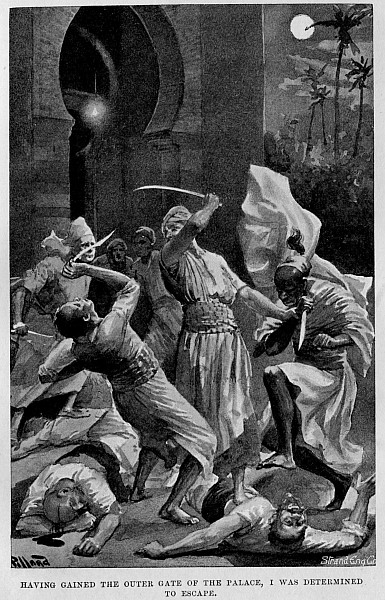
“Hold! That man is a false cadi! He is the fierce pirate of the Desert known as Hámma, and is a terror to our people along the shores of the Tsâd! The other I recognise as a slave of the eunuchs!”
The words caused the greatest sensation among his companions. For a moment they remained dumbfounded at our audacity.
“Seize them!” cried the chief gate-keeper, rushing forward excitedly. Next second a dozen scimitars were playing around us, but ere we could be secured my mysterious companion had drawn his formidable knife from its sheath, and with a dexterous blow had sent the first man who laid a hand upon him reeling back, stabbed through the heart.
In an instant I drew the dagger I had brought with me, and as I did so, closed with a big negro who endeavoured to hold me. I fought for life, and the struggle was short and desperate. Having gained the outer gate, I was determined to escape, and I defended myself with greater strength than I had imagined I possessed. As the negro wrestled with me, clasping me in his iron embrace in an endeavour to throw me to the ground, we swayed backwards and forwards, both exerting every muscle to gain the mastery. Suddenly I felt my strength failing, for the pain caused by his grasp was excruciating, but with a quick movement I managed to wrench my right arm free, and with my dagger struck him a blow in the throat which caused him to release his hold. Then, staggering, he fell back mortally wounded.
With a spring like that of a leopard, another negro pounced upon me, while a second seized me by the shoulder. It was a critical moment. Capture I knew meant death, and as I turned in struggling with my latest assailants, I saw my companion struck a coward blow by a scimitar from behind. He fell like a log, and, judging from the terrible wound inflicted on his skull, death must have been instantaneous.
His fate filled me with a strength that was almost demoniacal, for while the others assembled round the prostrate bodies of the false cadi and the man he had killed, I fought desperately, determined to struggle on till the last. My knife, wet with the blood of the first janissary who had attacked me, was still in my hand, and, feeling myself being overpowered by the fierce black-faced brutes, I dealt one a blow in the side which caused him to spring away, and as he did so, I again brought the keen blade full across the other’s face, inflicting a frightful gash. Shrieking with rage and pain, he released me, clapping both hands to his ebon countenance.
A moment later I dashed headlong into the darkness, followed at full speed by half a dozen enraged and howling janissaries who, waving their scimitars, cried: “Kill the slave! Let him not escape! Kill him! Kill him!”
Chapter Twenty Eight.
On the Pinnacle of Al Arâf.
It was a mad dash for liberty. Ignorant of where my footsteps would lead me, I sped swiftly onward across a great open space, which I afterwards learnt was called the Katshíu, past the Mesállaje, or Great Mosque, with its high square minaret, and running beside the walls of several spacious whitewashed buildings, evidently the residences of wealthier merchants, I turned the first corner I came to, and, passing a stagnant pool, found myself in a maze of squalid, narrow, ill-built streets, which, though bearing marks of former grandeur, were unpaved and filthy. The houses, mostly of one storey, were mean, flat-roofed, and half in decay, and as I wound my way through the unlighted, crooked thoroughfares, I could still hear the hurrying footsteps and shrill cries of the palace guards, who, eager for revenge, were determined that I should not escape them.
Panting, well knowing that a halt meant death by torture, I ran forward until I found myself in the Erárar-n-Zákan, or Camel Market, a small square with the usual arched arcade running along one side. Then, the angry shouts of the janissaries sounding on my ears, I resolved upon a desperate expedient, namely, to dash along a street which led back in the direction I had come, and so return towards the Mosque. Even in my desperation I was determined to seek the holy man and deliver Zoraida’s letter which for so many months had reposed in the little leathern charm-case suspended round my neck; but as I rushed headlong across a deserted market-place and emerged into an open space, I noticed a youthful Arab horseman mounted and leading a horse saddled but riderless.
My footsteps attracted him, and, having gazed at me for a moment intently, and apparently taking in the situation, he spurred across to cut off my retreat. As he rode down upon me, his flowing white robe looking ghostly in the darkness, my heart sank, for I was thoroughly exhausted and no longer hoped for freedom.
Judge my amazement, however, when, pulling up suddenly close to me, he exclaimed—
“Peace! Mount yonder steed quickly, and let us away! Dáchchân!”
The word gave me courage. It had been uttered by the mysterious man who at the cost of his own life had accomplished my deliverance! The fierce, brutal guards, accompanied by a number of Arabs who considered it sport to hunt a slave, were still in full cry after me. Already they had gained the Katánga, therefore, without losing a moment, I rushed towards the horse, swung myself into the saddle, and sped away like the wind, my rescuer leading.
Shots sounded in rapid succession, but we remained unharmed, and with loud, angry curses sounding in the distance, we rode speedily forward, to where there was a breach in the city walls, and then away through the fertile oasis. As in silence we pressed onward at a wild, mad gallop, I was filled with admiration at the magnificent manner in which my companion sat his horse. He seemed merely a youth, for he was not tall, and his haick, well drawn over his face, half concealed his features, yet he rode at a pace that was killing, regardless of obstacles or the uneven nature of the ground.
“For me this day hath indeed been one full of events,” I managed to gasp at length, when, in ascending the rising ground, our horses slackened.
“And for me also,” he replied, without glancing towards me. “How sad it is that the daring Hámma, hero of a hundred fights, should have fallen in his valiant attempt to rescue thee!”
“Yes,” I answered. “He fought bravely, indeed. But how didst thou know of his death?”
“I was awaiting thee outside the mosque opposite the Fáda gate, with a horse for Hámma and thyself,” he answered. “I saw him fall, and then I witnessed thy flight. I could not reach thee in time, but by the shouts of the janissaries I knew the direction thou hadst taken, and posted myself in readiness. Praise be unto Allah that thou hast escaped those fiendish brutes!”
“But it is all a mystery,” I said. “Tell me who plotted my deliverance; why should it be attempted by an outlaw?”
“I know nothing,” he replied, “save that it was imperative that thy life should be saved.”
“Why?”
“Because thou art the Amîn, and the Well-Beloved.”
“What dost thou know of me?” I asked, in surprise. “Nothing, beyond the fact that thou, who hast undertaken a secret mission, fell into the hands of the slave-raiders and became a prisoner in the inner court of the Fáda.”
“Then thou art aware of my mission?”
“I am aware that thou art a Roumi from across the sea.”
“Knowest thou Hadj Mohammed ben Ishak, the imam of the Mesállaje?” I asked.
“Yes, I knew him. He was a man pious and full of learning.”
“What! hath the Avenger claimed him?”
“No. He hath gone on a journey.”
“On a journey?” I cried in dismay. “When will he return?”
“I know not.”
We had reached the brow of the hill, and our horses started off again at the same terrific pace as before. Noticing our saddle-bags were packed as if for travel, I inquired where we were going, but the only answer vouchsafed was—
“Trust thyself unto me.”
For another hour we rode onward through a great grove of date palms, until at last we plunged into a dense tropical forest, along what appeared to be a secret, unfrequented path. Presently, however, my guide suggested that we should rest until sunrise, and, dismounting, we unsaddled our horses, and, throwing ourselves down with our heads upon our saddle-bags, slept soundly.
It was bright daylight when, on opening my eyes, I made an amazing discovery. The sex of my companion had changed! My guide to whom I owed my freedom was not a youth, as I had believed, but a young and pretty Arab woman, whose bright-hued silk garments had been concealed by a man’s burnouse, while on her head she had worn the fez and haick instead of the dainty embroidered cap and sequins which she had now resumed.
“Thou art astonished at my transformation,” she laughed roguishly, standing before me with her pretty face unveiled. “Man’s attire doth not suit me in the light of day.”
“Why hast thou practised such deception upon me?” I asked, amazed.
“Because it was necessary. It was arranged that I should merely hold the horses in readiness, but when thou alone escaped, it became imperative that I should act as thy servant and guide.”
“I owe thee a great debt indeed,” I said. “Tell me thy name.”
“My name and tribe are of no consequence,” she answered. “An explanation will be given thee some day; at present I am bound to secrecy.”
“Even though thou art of the sect of the Aïssáwà and of the tribe of the Ennitra—eh?” I asked.
“How didst thou know?” she asked, startled. But I refused to satisfy her curiosity, although, truth to tell, I had noticed neatly tattooed upon her forehead a serpent, the symbol of the more fanatical of the followers of Sidi ben Aïssa, and upon her wrist was a curiously-wrought Kabyle bracelet of white metal, similar in form to one Zoraida had worn. The presence of this woman so far south puzzled me greatly, and I sat silent and thoughtful while she produced from her saddle-bag some dates, with a little skinful of water in which úzak seeds had been dipped, and which I found a cooling and refreshing drink.
When we had eaten, she twisted her haick around her head, leaving just a slit for her eyes, then she sprang lightly into her saddle and we moved on again. Our way lay through a great thicket, where the mimosas and abísga attained such an exuberance as I had never before seen in the Sahara, and being closely interwoven by “gráffeni,” or climbing plants, were almost impenetrable.
As we rode along the secret path, I endeavoured to persuade her to tell me of Zoraida, but her lips were closely sealed. She admitted that she had heard of the Daughter of the Sun, but with artful ingenuousness declared that she had never seen her.
“I have heard that she died in Algiers somewhat mysteriously,” I said, watching her dark eyes narrowly.
“Yes,” she exclaimed, quite calmly. “I have heard a similar report, and it is a curious circumstance that none have seen her since she went to El Djezaïr.”
“She could foretell coming events and divine the thoughts of those with whom she came into contact,” I observed.
“True, O Roumi. Whenever she accompanied our people into battle, they returned with much spoil and many slaves. Her love was a fierce, unbridled passion, and her hatred bitter and lifelong.”
“And the Sheikh, Hadj Absalam, what of him?”
“I know not. I am merely thy servant and thy guide. Ask me not things of which I have no knowledge;” and with this rebuff she commenced chattering and laughing gaily, leading the way through the dense forest in the depths of which it would have been easy enough to lose one’s self and perish. That she had before traversed the secret route was apparent, and her anxiety to push onward showed her impatience to bring our journey to a conclusion. Any little gallantry I offered when she found herself in difficulty owing to her dress catching in the twigs was accepted with dignity and murmured thanks, but regarding our ultimate destination she refused to utter a single word, beyond stating that for three days longer we should be travelling companions, and vaguely hinting that the journey might prove beneficial to my interests.
Riding at slow pace behind her through the tangled tropical vegetation, where flowers grew in wild, luxuriant profusion, and monkeys, alarmed at our appearance, swang from tree to tree, I reflected how utterly fruitless my journey over the Great Desert had proved. The mysterious conspiracy of silence regarding Zoraida into which everyone seemed to have entered appeared directed against myself, for with the exception of what she had told me with her own lips, I knew absolutely nothing of her. The mystic rites practised in the secret chamber, the discovery of the Crescent of Glorious Wonders, and the unknown object of my mission to Agadez, were all enigmas so puzzling as to drive me to the verge of madness. Although a strenuous, desperate effort had been made to release me from the Sultan’s palace, nevertheless every precaution had apparently been taken in order that I should obtain no knowledge of Zoraida’s past, of her present whereabouts, or even whether she still lived.
For a brief rest we halted about noon, ate our scanty meal which my pretty guide prepared, and then, declaring that she was not fatigued, we moved on again, still through the great forest unknown to geographers that seemed appallingly weird and impenetrable. I had no idea that the Oasis of the Ahír comprised such an extensive tract of wooded land. From the sun it appeared as though we were travelling in a north-westerly direction. The path wound and turned in a manner that would have been puzzling and amazing to the stranger, and at times it was lost sight of altogether, as if to prevent those who discovered it accidentally from following it up.
The afternoon passed, and the mellowing rays of sunlight glinting through the trees tinted the long tresses of my fair companion, who, having now removed her haick, laughed and talked gaily, telling me of her exciting adventures as the child of a thieving band. Though she would not utter Zoraida’s name, she told me many curious things. She had, it appeared, been in the camp of the Ennitra when, after the successful attack on the caravan of Ali Ben Hafiz, I had been brought in and sentenced to be tortured with the asp, and she told me how, after I had escaped, Hadj Absalam had sworn vengeance and sent a force after me. This force it was who subsequently attacked the Spahis and was slaughtered by them.
“And why art thou here, so far from thy mountain home?” I asked presently, determined if possible to elucidate some of the tantalising mystery which seemed ever increasing.
“I travelled alone to Agadez to arrange with Hámma to effect thy liberty,” she answered. “Allah, the One Gracious and Merciful, hath preserved thee, while he who dared to enter the Fáda fell under the janissaries’ swords.”
“Allah grant his soul peace!” I said, adding fervently, “I am truly thankful to thee. Thou art indeed brave to risk so much, to accomplish this lonely journey, and to trust thyself upon this lonely path.”
“A woman of the Ennitra knoweth not fear,” she answered proudly. Then, with a calm, serious look, she added, “I am the servant of one who could not travel here in person. Allah directeth whom He pleaseth and casteth the unbeliever into the torments of hell. To-day thou standest upon the pinnacle of Al Arâf, the partition which divideth everlasting joy from eternal sorrow. Already the test hath been applied to thee, and it hath been proved that thou art the Amîn—the Well-Beloved.”
“Thou knowest the ordeal through which I am passing with feet treading the unknown paths of ignorance where the light of truth shineth not. Canst thou not give me one word of hope as to the successful accomplishment of the mission that hath been entrusted to me?” I asked, rather surprised at her enigmatical speech.
“I give thee no empty word of confidence. Thine own courage and stout heart in this strange land wherein thou art wandering will, in itself, prove a test the severity of which will not be forgotten. Peace be upon us, and upon all righteous servants of Allah!”
With this last sentiment I expressed devout concurrence, and under the foliage reddened by the crimson afterglow we wended our way onward until we came to a small rivulet, where we halted, watered our horses, and prepared our food. Then, when it had grown dark, my fair guide, wrapping herself in the burnouse she had worn when I first met her, lay down to rest, arranging herself in a manner which showed her to be a true Bedouin to whom sleeping under the starlit canopy of heaven was no fresh experience.
Next day and the day following went by in a similar manner, with the exception that, having passed through the forest, we found ourselves on the edge of the oasis, and with our horses well pleased at the freedom, we galloped out straight as an arrow into the wild, inhospitable wilderness, which stretched away as far as the eye could discern, a great arid, barren plain. She sat her horse splendidly, as side by side we rode onward hour after hour, stopping now and then to drink from our water-skins, yet not once did she complain of the terrible burning heat or fatigue. On the contrary, there was always in her dark sparkling eyes a roguishness that is the peculiar charm of all Oriental women, and she entertained me with many stories of the valour and chivalry of her tribesmen. That night we encamped in the desert, and at dawn on the third day moved onward again towards our unknown goal.
An hour before sundown she suddenly drew rein, and, shading her eyes with her little sun-tanned hand, cried—
“Behold! They are within sight!”
Straining my aching eyes in the direction indicated, I saw in the far distance a small speck against the horizon, which proved, on our approach, to be a clump of palms, and almost as soon as I had been able to make them out, I noticed that we had been observed, and that a Bedouin horseman in white burnouse was spurring out towards us.
In half an hour we met. As he came nearer, there appeared something about him that seemed to me familiar, and when at last he galloped up, amid the jingling of his horse’s trappings, holding his rifle high above his head, I recognised his dark evil face.
It was the rascally caitiff Labakan, who had followed me so suspiciously from Algiers, and against whom the dispatch-bearer Gajére had forewarned me! The man who gave me greeting was the sinister, villainous-looking outlaw who had stolen the cut-off hand!
Chapter Twenty Nine.
Labakan.
Misgivings were aroused within me by the discovery, but, concealing them, I gave him “peace,” as in flowery language and with many references to Allah’s might, he bade me welcome to their shade. Scarcely deigning to notice the brave girl who had secured my liberty and acted as my guide, he wheeled round and rode beside me, expressing hope that I had in no way suffered from my detention within the Fáda of Agadez, and uttering profuse greetings with every breath.
To these I remained somewhat indifferent. I was wondering what fate was about to overtake me, and whether, after all, I had not been ingeniously betrayed into the hands of my enemies. This dark-visaged brigand who had followed me nearly two thousand miles had evidently done so with evil purpose. His words of well-feigned welcome and apparent delight at my arrival at that lonely spot were the reverse of reassuring, and, for aught I knew, I was about to fall into some cunningly-devised trap. The reason of this strange vengeance which he apparently desired to wreak upon me remained a hidden and mystifying enigma. To my knowledge, I had never harmed him, and, indeed, previous to our meeting in the kahoua in Algiers, I had never before set eyes upon him. Yet, with the fire of a terrible hatred burning within his heart, he had tracked me with the pertinacity of a bloodhound over the Great Sahara, through the many vicissitudes that had befallen me, and at last, by his clever machinations, I was now actually being led irresistibly to my fate!
At first the thought flashed across my mind that the woman whom the outlaw addressed as Yamina had brought me there, well knowing the reason this villain desired my release. Why had she observed that I was standing insecurely upon Al Arâf, between paradise and torment? Did not that imply that there was a vile plot against my life? Heedless of the outlaw’s well-turned Arabic sentences, I pondered, half inclined to condemn her. Yet no, I could not. She had, I felt sure, rescued me without dreaming that I should fall a victim under the knife of a secret assassin, and as she rode along in silence, unveiled, and looking a trifle pale and jaded, I was compelled to admit that to secure my release she had placed her own life in serious jeopardy.
At length we galloped into the small palm-grove that surrounded a well where camels and horses were resting, and a sharp turn brought us upon a small encampment. I half expected to fall into an ambush, and my hand instinctively sought the hilt of the dagger that had done me such good service at the Fáda gate, but when the shouts of the assembled men, all of them fierce-looking, well armed, and carrying daggers and powder-horns, gave me hearty welcome, I became reassured, dismounting, and following my enemy to the principal tent, before which a morose old Arab sat smoking his long pipe. He was very old, with a dark face thin and wizened, yet age had not dimmed the pair of keen, searching eyes he fixed upon me.
“Behold! the stranger!” exclaimed Labakan, as we advanced.
“Roumi from afar, thou art welcome to our encampment,” the old man exclaimed solemnly, removing his pipe and waving his brown, bony hand.
“Blessings on thy beard!” I answered, when I had given him peace. “As a stranger in this thy land, I appreciate thine hospitality, even though I know not the name of my host.”
“Thou art weary, thou hast journeyed long through the forest and over the plain, and thou requirest rest,” he went on, motioning me to the mat spread beside him, and ordering a slave to bring me food and water. I was in the camp of my enemies, which accounted for his disinclination to tell me who he was. Besides, I heard conversations being carried on in tamahaq, the dialect of the Touaregs, in order, apparently, that I might not understand. Whatever the object for which I had been conducted to that lonely spot, the chief of the encampment treated me as his honoured guest, and gave me to eat the best fare his people could provide. Such conduct was exceedingly puzzling, and, after I had eaten the kousskouss and chick peas, and accepted the pipe he offered, I suddenly asked—
“What have I done that I should merit this thy friendship?”
“Are we not commanded to succour our friend’s friend?” he answered. “Thou owest me no debt of gratitude, for it was Labakan yonder who arranged thine escape from the Fáda;” and, raising his hand, he indicated the outlaw of the Ennitra who had stolen the severed hand, and who was now smoking a cigarette, and lounging lazily with another man as repulsive-looking as himself at a little distance from us.
I was silent. Was it not at least remarkable that the man who had offered Gajére gold to assist in my murder, should now exert himself so strenuously on my behalf? Expectation fettered me.
“Fidelity towards a friend, magnanimity towards an enemy, are the pride of my people,” the old man continued. Then, turning towards me, he added, “Thy brow beareth traces of a poignant grief. Perhaps we may be able to calm thy sorrow, for we would most willingly help a brother, though he be of different creed.”
His words struck me as ominous. Was he joking grimly, meaning that my sorrow would be “calmed” in death?
Nevertheless I replied to his confidential address: “I feel much relieved by thy words, O friend, for in thine eyes there lurketh no treachery. True, I have passed through many terrible days since last I trod mine own far-distant land; yet I have no sorrow, only the regret of what might have been which is common alike to True Believer and to Roumi.”
“Why dost thou journey in this the land of thine enemies?” asked the strange old man, calmly puffing at his pipe.
“I have a secret object,” I replied, still keeping my eyes upon the hulking lounger who remained in conversation with one of the armed band, now and then casting furtive glances towards me. “I am seeking a phantom fortune.”
“Ah! thou art young. Thou hast the careless indifference that youth giveth, and art no doubt prepared to meet Eblis himself if he promiseth an adventure. Yet, alas! the mark upon thy brow telleth me that the canker-worm of love eateth away thine heart. Fair tresses oft ensnare a man, and cause him to seek Sindbad’s diamond valley, of which the story-teller singeth.”
Evidently he was aware of my mission to that distant region!
“When one is wounded by the keen shafts of a woman’s eyes, there is no peace,” I said, impressed by my venerable companion’s seriousness. “True love createth a mad fascination, a partial insanity that refuseth to be calmed.”
“And so it is in thy case, I wager,” he observed. “From thy mouth fall pearls of wisdom. Yet to-day, how little of genuine love is there among thy people, the Roumis! Have I not witnessed it among the Franks of El Djezaïr! Fascination is a gift of Allah; it hath no limits of age or condition. It is as indescribable as the steam that propelleth thy caravans of iron, or the invisible power that carrieth thy commands along wires of great length; therefore, it is not possible to simulate it. Yet what a tendency there existeth among thy people from over seas to coquette with love! We True Believers when in El Djezaïr, gaze upon the white uncovered faces of thy women in the streets, in the gardens, in the cafés, everywhere, and watch them in amazement. In the people of Al-Islâm, as in the Infidels, the heart is the same; but it seemeth to us that thy women, foolish and vain, know not true affection, and live only to attract men by feigning an imitation of love that is ridiculous. It astoundeth us.”
“Thou speakest of what we term flirts,” I said, surprised that he should have observed so keenly the manners of European society as portrayed at Algiers. “It is true that fashion hath taken a wrong turn. Tragic, romantic, frivolous, and heroic love-affairs will succeed each other, for the heart of a woman beateth alike under the gauzes of Al-Islâm and the tightly-laced corsets of Christianity, and the pulses of the Bedouins of the Desert and the idler of the Franks are alike moved by a pretty face; but, as thou rightly sayest, the fashion of flirtation only leadeth to factious disturbances, misery, and ruin.”
“Thy criticism is just, O Roumi! Truth never loseth its rights, though falsehood may have a long day. Thy women, who affect love in order to be considered fascinating, are the falsehoods of thy society, veritable houris from Hâwiyat. A woman who loveth deeply, passionately, really, though wrongly, may have our pity, compassion, sympathy, but she who simulateth a passion for vanity’s sake hath neither. We of Al-Islâm feel a pity for the heart that breaketh beneath a smile; we honour a hidden sorrow; but for the trifling, idle, gay, and foolish married woman of thy people, who with uncovered face seeketh to fascinate the men who move about her, we entertain no such feelings. She feigneth love for them, entranceth them, and then—may Allah confound her!—she mocketh them. Such is one of the developments of thy so-called Christian civilisation!”
He spoke the truth; I was compelled to admit it. Was there any wonder that a devout Moslem, witnessing the ways of European society, where the women bare their chests at night for the public gaze, and laboriously try to appear to have done something wrong, in order that scandal may be whispered about them,—“being talked about” being the high road to fashionable eminence,—should express amazement at the commanding egotism of those of our fair sex who consider it “smart” and a necessary adjunct of fashion to be seen flirting. How utterly contemptible must our whole social system appear in the eyes of these wise, thoughtful Sons of the Desert, who, far from bustling cities and the ways of men, dream away their silent, breathless days!
The old man, although a pleasant companion, would answer no question I addressed to him, and though I felt safe under his protection, yet the presence of the man Labakan caused me considerable uneasiness. When the last rays of sunset had faded, and some negro girls danced before our tent, the evil-visaged scoundrel sat beside me smoking haschish. In a semicircle the people squatted, listening with rapture to the humdrum voices of the singers and story-tellers, mingling with the thumping of derboukas, and the shrill notes of the flute-like djouak. From time to time a prolonged “Ah!” plaintively modulated, was uttered in applause of the song, dance, or story; and as I spoke now and then with him, I watched his face narrowly, detecting in his eyes a crafty look of unmistakable hatred. When he laughed, his white teeth shone spectral in the twilight, and when he addressed me, his thin, sinister face was so nigh to mine that I could mark each line that Time had turned upon his sallow cheeks, and watch the slow, cruel smile that wrinkled about his moving lips.
When at length the camp grew quiet, and I cast myself down to rest, all slumber was prevented by reason of the terrible sandstorm that sprang up, roaring over the oasis and screaming most melancholy in the palms. In claps of the veriest passion, the sand-laden, suffocating wind swept through the clumps of trees, and the night was in the possession of a thousand evil powers that seemed to mock at me. In that hour but one hope held me; but one fear. Death seemed to shriek about the tent, and wander whining through the storm-torn trees; on my heart Fear laid his chilly fingers, tightening his hold, and straining as though drawing me nearer to the end. But determined to remain calm and defiant, in order to learn the Great Secret, I was prepared to encounter all risks, even in that wild, unknown country, in the camp of the outlaws. In the midst of the howling sirocco, two furtive figures, almost obscured by the whirling sand, passed my tent silently. The misty silhouettes were those of Yamina and Labakan! Swollen to a monstrous horror, Fear, a hideous, torturing spectre, loomed beside me, and all past delight, all future evil, laughed me to derision in his presence. Through the night the tempest raged with fury unabated, and as I lay with my hand grasping my only weapon, my knife, I knew not from one moment to another whether a coward’s dagger would strike me a swift death blow. Thus, vigilant and feverishly anxious, I waited until the sandstorm passed and the dawn was no longer obscured, then rose, half surprised that I still lived to witness the glorious sunrise.
Judge my amazement, however, when, on gazing round, I found that the tents had disappeared, and I was alone!
In the hours of darkness during the storm, the camp had been struck, the camels packed, and even while I lay with eyes and ears open, the Bedouin band had silently departed, leaving me to my fate in an unknown region! Even the spots on the sand where the fires had burned had been carefully dug over, and every trace of the recent encampment had been carefully obliterated. Tied by its nose-cord to a palm was a méheri camel, kneeling upon the sand with bent head, disconsolate and neglected, and as I gazed around among the tall trunks, seeking to discover whether any of the band remained behind, I suddenly caught a glimpse of a fluttering burnouse.
“Sabâh elker!” (“Good morning!”) I shouted in greeting, but next moment I was startled to recognise in the approaching figure the lean, sinewy form of Labakan.
“Slamalik!” (“Good day to you!”) he cried, hastening towards me with a broad, fiendish smile upon his coarse, brutal features. “Thou art forgotten.”
“Thy people could scarcely have overlooked me when they left my tent untouched,” I said, angered that this man should still be haunting me like an evil shadow. “Besides, they departed by stealth, so as not to attract my attention. For what reason have they plunged again into the desert?”
“For reasons known only to ourselves,” the crafty brigand replied, displaying his teeth in the hideous grin that seemed natural to him. “A secret message received after el maghrib made it necessary to move.”
“Didst thou fear attack?”
“We fear nothing, save the wrath of Allah,” was his prompt reply, as without further words he proceeded to pull down my tent and pack it quickly upon the back of the kneeling camel.
“We of the Roumis endeavour to be loyal to those who eat salt with us,” I said, presently. “Thy people, however, desert the stranger to whom they give succour.”
Shrugging his shoulders, he drew his haick closer about his narrow chest, replying, “If thou hadst full knowledge of our affairs, thou wouldst be aware that circumstances had combined to render it imperative that my people should leave this spot, and proceed by a certain route, of which thou must remain in ignorance. In order, however, that thou shouldst not be left to starve in this vast region of the Great Death, I am here to guide thee onward to a spot where we may in two days rejoin our friends.”
Of all men he was the last I should have chosen as travelling companion, for treachery lurked in his curling lip, and in his black eye there beamed the villainous cunning of one whose callous hands were stained by many crimes. To refuse meant to remain there without food, and quickly perish, therefore I was compelled, when he had carefully removed all traces of the tent, to mount the camel, and submit to his obnoxious companionship. He had his own camel tethered near, and as he straddled across the saddle the animal rose, and together we started out upon our journey.
Chapter Thirty.
The Hall of the Great Death.
Labakan’s appearance was just as unkempt, his burnouse just as ragged, as on the day he snatched from me the box containing the horrible souvenir. As we rode side by side into the shadowless plain, he addressed many ingenious questions to me about my past. His thinly-veiled curiosity, however, I steadfastly refused to satisfy. That he knew more of me than I had imagined was quite apparent, otherwise he would not have taken such infinite pains to secure my escape from the palace of the Sultan. Puzzled over his strange conduct, I journeyed with him throughout the greater part of the day. Conversing pleasantly, and making many observations that contained a certain amount of dry humour, he never for a moment acted in a manner to cause me further misgivings. With the craftiness characteristic of his piratical tribe, he was endeavouring to disarm any suspicions I might perchance entertain, if—as to him seemed impossible—I recognised him as the man who followed me into the little kahoua in the far-distant city.
After nearly five hours on the level, sandy plain, under the torrid rays of a leaden sun, we passed along a valley, desolate and barren, until we had on our left a broad mount, rising first with gradual ascent, but in its upper part forming a steep and lofty wall. Then, having passed a small defile and crossed another valley, we gained the open, stony hamada (plateau) again, and travelled on until, in the far distance, I detected a great, gaunt ruin. Plodding onward wearily through the furnace-heat of sunshine, we reached it about two hours later, and halted under its crumbling walls.
Like a solitary beacon of civilisation, the ruined arches of a great stronghold rose over the sea-like level of desolation which spread out to an immense distance south and west. The rugged, uneven valley below, with its green strip of herbage, continued far into the stony level, and beyond, northwards, the desolate waste stretched towards a great dark mountain.
Astonished, I stood gazing at the spacious dimensions of this time-worn relic of the power of the ancients. It seemed half a castle, half a temple, built of hewn stone, without cement, and ornamented with Corinthian columns. Apparently the place had suffered considerably by the depredations of the Arabs, who, during succeeding centuries, had carried away most of the sculptures; nevertheless, there was much about this relic of a bygone age to excite curiosity, and to cause one to recollect the fact that years before our era the Romans had penetrated as far as that place. That their dominion was not of a mere transitory nature the ruin seemed clearly to show, for it had nearly two thousand years ago been a great castle, and, no doubt, a centre of a departed and forgotten civilisation. Yet to-day this region is unknown to European geographers, and upon both English and French maps of the Great Sahara it is left a wide blank marked “Desert.”
Of Labakan I learnt that it was known to his people as the Hall of the Great Death. According to the Arab legend he related, a Christian ruler called the White Sultan, who lived there ages ago, once made war upon the Sultan of the Tsâd, defeating him, and capturing his daughter, a girl of wondrous beauty. Intoxicated by success, and heavily laden with booty, the White Sultan returned to his own stronghold, followed, however, by the defeated monarch, who travelled alone and in disguise. Attired as a magician, he obtained audience of his enemy, then suddenly threw off his disguise and demanded the return of his daughter. But the White Sultan jeered at him, refused to part with the pearl of his harem, and ordered the sorrowing father to leave his presence, or be consigned to a dungeon. He withdrew, but as he went he cast his ring of graven jacinths upon the ground, and prophesied that ere two moons had run their course, a disaster, terrible and crushing, would fall upon his Infidel foe. Then, retiring to a cavern, he lived as a hermit, and through the months of Choubát and Adâr, for fifty-nine nights and fifty-nine days, he invoked continuously the wrath of the Wrathful upon his enemy. On the sixtieth day his prophecy was fulfilled, for a terrible fire from heaven smote the palace of the White Ruler, and the poisonous fumes from the burning pile spread death and desolation throughout the land. Through the whole of the White Sultan’s broad domains the death-dealing vapours wafted, and the people, the wise men, ministers, and the Sultan himself, all fell victims to the awful visitation. The only person spared an agonising death was the daughter of the Sultan of the Tsâd, who, after the fire was subdued, found the treasure stolen from her father untouched, and carried it back with her to the shores of the Great Lake. Thus was she avenged.
“Since that day,” added the pirate of the desert, “the Hall of the Great Death, with its courtyards and gardens, has been tenantless, the wealthy city that once surrounded it has been swallowed up by the shifting sand, and so completely did Allah sweep away the dogs of Infidels, that even their name is now unknown.”
Much interested in this magnificent monument of the Roman occupation, I left Labakan squatting and smoking in its shadow to wander through the ruins. Upon the centre stone of the arched gateway that gave entrance to the great hall I deciphered the inscription “PBO. AFR. ILL.,” (Provincia Africae illustris.) encircled by a coronal, while below was a trace of a chariot and a person in curious attire following it on foot. Besides a representation of an eagle and a few Berber names roughly graven, I could, however, find no other inscription on the portals, so proceeded to examine the grey walls of the inner courts.
While thus engaged, a stealthy movement behind me caused me to start suddenly, and as I did so, I beheld my enemy!
Silently, with his long, bright knife ready in his hand, he had crept up, and at the very instant I turned he sprang upon me. Ere I could unsheath my poignard, he held my throat in iron grip, and his eyes, flashing like those of some wild animal, were fixed with murderous hatred upon mine.
“Thou art at last in the Hall of the Great Death, which is the Grave of the Infidels, and thou shalt die!” he cried, holding his knife uplifted ready to strike.
I was held to the spot, stricken by a sudden dread.
“So this is how thou treatest the stranger who falleth into thy merciless clutches!” I gasped, scarcely able to articulate, but struggling desperately.
“Thou, dog of hell, art no stranger!” he said, with a string of blasphemies. “Thou hast escaped from our camp and brought upon us disaster, defeat, and dishonour. Thou hast obtained actual possession of the Crescent of Glorious Wonders, and even at this moment there is concealed upon thy person a secret message to the Hadj Mohammed ben Ishak, of Agadez. Confess where thou hast hidden the Crescent, or thou shalt assuredly die!” His knife was poised aloft; his hand trembled, impatient to strike me down. Yet I was powerless in his grasp!
“I cannot tell thee!” I answered.
“Thou liest!” he cried. “Dost thou deny also that thou hast any secret message addressed to the imam, upon thee?”
“I deny nothing,” I gasped. “It was thee, paltry pilferer, who stole the box from me in the kahoua in Algiers; thee who offered Gajére a bag of gold to assist in my murder! I know thee, Labakan! Rest assured, that if thou killest me, my assassination will speedily be avenged.”
His fierce, brutal countenance, hideously distorted by uncontrollable anger, broadened into a fiendish grin as, with a loud, defiant laugh, he cried—
“Hadj Absalam is Sultan of the Desert, and Labakan his Grand Vizier. We care naught for Infidels who seek to avenge thee, nor for the homards who bear arms against us. Speak! Dost thou still refuse to disclose the hiding-place of the Crescent of Glorious Wonders, or to deliver unto me thy secret message?”
“I do,” I gasped.
“Too long then have I tarried and wasted words upon thee, courier of evil!” he shrieked, shaking me in his rage and tightening his painful grip upon my throat. At that moment, however, I succeeded in wrenching free my right hand from the outlaw’s grasp, and, desperately clutching the hilt of my thin, curved blade, unsheathed it. It was a struggle for life. Again he grasped my wrist and held it immovable.
“Cur of a Christian! thou who hast sought to bring ill-luck, disaster, and destruction upon us, shalt no longer pollute True Believers with thy baneful presence!” he roared furiously, adding, “Die! rot in the grave of the Infidels that is called the Hall of the Great Death! Curse thee! May Eblis condemn thee and all thine accursed race to the horrible tortures that are eternal, and may Allah burn thy vitals!”
“Thou hast brought me here to murder me!” I cried. “Yet I am willing to explain to thee the whereabouts of the Crescent, if thou wilt tell me of the fate of Zoraida, Daughter of the Sun.”
“The Lalla Zoraida?” he cried, in surprise. “Then it is true thou knowest her! We have not been mistaken! Thy dog’s eyes have rested upon her unveiled face; her beauty hath been defiled by thy curious gaze, and she hath spoken with thee, telling thee of wonders the secret of which she was charged to preserve under penalty of death!”
“She hath told me nothing,” I answered, still helpless in his murderous grasp. “For many moons have I journeyed over oasis and desert, hamada and dune, in search of the truth, but nothing, alas! hath been revealed.”
“She entrusted to thy keeping the Crescent of Glorious Wonders; she unveiled before thee, an Infidel; therefore the punishment to which she was condemned is just.”
“What was her punishment?” I gasped breathlessly. “At least tell me whether she still lives.”
“The hand that wrought treacherous deeds was sent thee, so that thou mightest gaze upon the result of thy gallant adventure,” he answered sternly.
“Yes, yes, I know. Its sight was horrible!” I said, shuddering, his words bringing back to my memory the cold, dead, bejewelled lingers in all their sickening hideousness.
“Disgraced in the eyes of the people of Al-Islâm, untrue to her creed, faithless to her people, she hath already received the just reward of spies and those who play us false. The vengeance of the Ennitra shall also fall upon thee!”
“Was she murdered?” I demanded. “Tell me.”
“She, the One of Beauty, who was possessed of powers strange and inexplicable, exhibited to thee wonders that none have seen, marvels that she alone was able to work,” he continued, murder lurking in every line of his dark, forbidding countenance. “The Great Secret that hath for generations been so zealously-guarded by our people she gave into thine unscrupulous hands. To thee, a dog of a Christian—upon whom may the wrath of Allah descend—she transferred her power, thus allowing her people to be ignominiously defeated and slaughtered by the homards. Of the disasters that have fallen upon us, of the misfortune that ever dogs the footprints of those of our men who set out upon expeditions, of all the discomforture that hath been experienced by us; nay, of the terrible doom that hath overtaken the perfidious Daughter of the Sun who entranced thee, thou art the author.”
“Merciful Allah!” I cried loudly. “I have been unconscious of having brought catastrophe upon thee. True, I am not of thy creed, but—”
“Silence, thou bringer of evil! Let not the name of the One of Might pass thy polluted lips,” he cried, glaring into my face with fierce, passionate anger. “To thee we owe the loss of the Marvellous Crescent. With it our good fortune hath departed. Crushed by defeat, the downfall of Hadj Absalam seemeth imminent, owing to the false, fickle sorceress Zoraida—may Allah burn the hell-vixen!—having fallen under thine amorous glances. Upon thee her power hath fallen, and as thou refusest to give back to us that which is our own, thou shalt not live to witness the rising of to-morrow’s sun.”
“Doth thy Korân teach thee to murder those who are innocent?” I shouted in a tone of reproach, struggling strenuously, but in vain, to free my hand.
“The Book of the Everlasting Will saith that those who fight against the True Believers and study to act corruptly shall be slain, or shall have their hands and feet cut off, and that the Infidel shall have none to help him.”
“Loosen thine hold!” I cried again, vainly exerting every muscle. “Felon and outlaw! thou hast seized me by coward stealth, fearing to fight in open combat. If thine hand strikest me, my blood will swiftly be avenged!”
“Spawn of a worm! I have brought thee hither to kill thee!” he hissed between his firmly-set teeth. “Christian dog! Son of a dungheap! Thou, whose ill-favoured white features so fascinated the One of Beauty as to cause her to forsake her people and leave them powerless in the hands of their hated enemies—thou hast uttered thy last word! To-morrow thou wilt be carrion for the vultures!”
“Curse thee, cut-throat!” I shrieked, turning my dagger upon him, but only succeeding in inflicting a gash upon his brown wrist. “Thou, brigand of bloody deeds, hast followed me here into the distant desert to assassinate me secretly, to satisfy thy craving for the shedding of blood, but I prophesy that thou wilt—”
In the terrible death-embrace the words froze on my parched lips. His brown, sinewy arm fell swiftly between my aching eyes and the golden blaze of sunlight. A sharp twinge in the breast told me the horrible truth, and the hideous, dirty, repulsive face glaring into mine seemed slowly to fade into the dark red mist by which everything was suddenly overspread.
I felt myself falling, and clutched frantically for support, but with a nauseating giddiness reeled backwards upon the sand.
A rough hand searched the inner pocket of my gandoura, and tore from my breast my little leathern charm-case, without which no Arab travels. Upon my ears, harsh and discordant, a short, exultant laugh sounded hollow and distant.
Next second a grim shadow fell, enveloping me in a darkness that blotted out all consciousness.
Chapter Thirty One.
Kaylúlah.
Insanity had seized me. Dimly conscious of the horrible truth, I longed for release by death from the awful torture racking me.
The pain was excruciating. In my agony every nerve seemed lacerated, every muscle paralysed, every joint dislocated. My brain was on fire. My lips dry and cracking, my throat parched and contracted, my eyes burning in their sockets, my tongue so swollen that my mouth seemed too small to contain it, and my fevered forehead throbbing, as strange scenes, grim and terrifying, flitted before me. Pursued by hideously-distorted phantoms of the past, I seemed to have been plunged into a veritable Hâwiyat. Forms and faces, incidents and scenes that were familiar rose shadowy and unreal before my pain-racked eyes, only to dissolve in rapid succession. My closest friends mocked and jeered at my discomforture, and those I had known in my brighter youthful days renewed their acquaintance in a manner grotesquely chaotic. In this awful nightmare of delirium scenes were conjured up before me vividly tragical, sometimes actually revolting. Bereft of reason, I was enduring an agony every horror of which still remains graven on the tablets of my memory.