"A Romance of the Harem and the Great Sahara" (continued 6)
Reading edition
Labakan, raising his brown, sinewy hand towards me, was the first to break the painful silence.
“Behold! O gracious Master!” he cried. “Report hath not lied. Thine enemy liveth!”
The great Sheikh of the Ennitra rose, his countenance livid with rage.
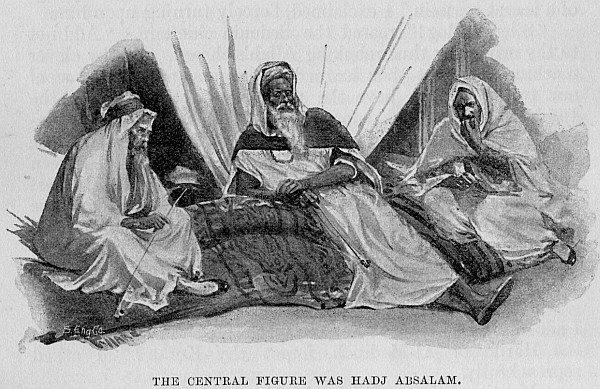
“Lo! it is verily the accursed son of Eblis, thief of our secrets!” he burst forth in fiery passion. “At length thou art revealed unto us! Thou—who hast brought upon us despair, defeat, and death, who hast defiled the land that we inhabit—art now within our power, and, upon the Book of Everlasting Will, I swear thou shalt not escape. For many moons hast thou evaded us, and though our horsemen have scoured the plains of Ahaggar, the Areg, and the Ahír, even unto the waterless Desert of Tibbou, in search of thee, thou disappearest like the shadow of a cloud. Neither the terrors of the wilderness, nor the knife of our servant Labakan, have daunted thee, but at last thy career hath ended—at last thy doom is nigh!” he cried, thundering forth the final sentence, and shaking his clenched and sinewy fist.
“True, O Ruler of the Desert,” I answered, as he paused to take breath, “I have again fallen into thine hands, yet the judgments of the Bedouins are tempered with—”
“Again?” he ejaculated, his black eyes full of angry fire. “All yes! I remember. Thou wert put to the torture which we reserve for dogs of thine accursed race, and thy strength burst the bonds that held thee.”
“The influence of this son of an unbeliever, who hath stolen our power, was the cause of our defeat when our brave sons attacked the homards on the Oasis of Meskam,” added Labakan, apparently determined that the Great Sheikh should forget none of the allegations against me.
“The Ruler of the Desert hath no need of the promptings of a secret assassin,” I exclaimed, fiercely turning upon him.
“Silence, dog!” roared the Bedouin chieftain. “Add not to thy crimes by thus rebuking Allah’s chosen. By thy clever machinations hast thou learned our secrets and divested us of our power. Thrice have the armed men of thy brethren, the Infidels, attacked and defeated us; thrice have we been compelled to flee from those who have plotted to conquer the True Believers, and all owing to thy crafty theft of the unseen power that once was ours. While thou livest, thou bearest upon thee influence to work our destruction wheresoever we go, but when thou hast been consigned to the darkness of Hâwiyat, then will power and success return unto our people. Ere to-morrow’s sun hath set, thou shalt be a corpse, for Allah is swift in punishing.”
“He, the One to be praised, is also gracious and merciful,” I added. “Dost thou, who hast performed thy sujdah within the Harem of Al-Medinah, forget thy Korân?” I asked reproachfully.
“Mention not our Faith with thy polluted lips!” he cried, adding, ”‘The Infidels are smitten with vileness wheresoever they are found.’”
These words of the Prophet, with which he endeavoured to crush my argument, gave the utmost satisfaction to the men about me, who murmured approbation in an undertone, and nodded their heads expressive of admiration at the wisdom of their sinister-faced, tyrannical chief.
“For many moons have I dwelt within thy land, O mighty Sultan of the Sahara,” I said. “Though I have ever acted with honour towards thy people of Al-Islâm, yet I am far spent with travel, and clothed with calamity as with a garment. Why seekest thou my death?”
“Have I not already told thee? Thou hast filched from us the wondrous secret power by which we vanquished our enemies; the unseen force that hath enabled us to rule the Desert. While thou remainest alive, of a surety ruin and extinction threaten us.”
“But I am, alas! ignorant of thy strange allegation,” I said, earnestly endeavouring to get the angry Arab to speak more calmly. “By what means have I taken from thee this extraordinary influence that once was thine? Tell me, for a slave may not be condemned for an unknown crime.”
“Thou knowest well,” he answered distinctly, with loud emphasis and glittering eye, placing one hand upon the hilt of his jewelled jambiyah, and standing erect with regal air. “It is useless for thee to deny deeds which have worked our defeat, and actions that must ere long be the cause of our downfall.”
“I deny nothing, O mighty Sheikh of the Ennitra,” I protested. “Years ago, thy valiant race filled me with admiration, and because of that, I learned to speak thy tongue, and read the commands of the Prophet. Times without number have I been the willing servant of thy people of Al-Islâm; nay, even to-day have I brought hither under my protection a fair woman of thy tribe, whom I assisted to escape from a harem in the land of thine enemies.”
“A woman?” he exclaimed, with an expression of surprise, and, turning to his attendants, asked, “Who is she?”
“She is named Halima, O Master,” answered Labakan. “To me hath she explained that the Infidel intended to convey her to his own land, and only by a ruse did she succeed in getting to our camp. He carried her off from the harem of the Sheikh of the Kel-Fadê, in order to possess her himself.”
“Miserable parasites!” ejaculated Hadj Absalam angrily, on hearing the mention of the hostile tribe, “May their vitals be devoured by insects, and may their bodies be given unto the wild beasts! Did the chief of these locusts of the sands hold our kinswoman in bondage?”
“Yes,” I answered. “We escaped from the palace of the Sheikh together.”
“Behold, O Master!” said the bandit who had attempted to kill me. “He admits that they journeyed in company. He tried by force to cause her to fly with him across the Atlas and beyond the sea, unto the land of the Infidels.”
“It’s a lie!” I shouted warmly. “Bring her hither, and let her, O Sheikh, relate unto thee her story.”
“Already she hath told it,” the old chieftain replied. “Already thou art proved to be no respecter of our women, for thine eyes have defiled their unveiled faces, and by thy speeches hast thou caused them to forget the commands of the Prophet, and look upon thee, a white-faced son of offal, with favour.”
“My acquaintance with any woman of thy race will not preclude her from drinking of the fountain of Salsabil,” (a spring in Paradise), I answered defiantly.
“Thou wilt deny next that thou hast ever spoken with our beauteous Daughter of the Sun!” exclaimed the irate Despot of the Desert, who, as he uttered Zoraida’s name, bowed low in reverence, an example imitated by all his followers.
“I deny not my actions, neither shall I attempt to refute the allegations made against me by a murderer,” I answered.
My captors laughed jeeringly. I knew by their manner that they were determined that I should die, and I expected no mercy. Yet, despite an inward feeling of despair, I determined to show a bold front. I had been betrayed; but they should not see that I feared them.
“Secretly hast thou entered her private apartment, and remained there alone with her. To thee, son of Malec (the principal angel who has charge of hell), she hath disclosed our secrets—secrets which thou now holdest; hence, thou art the one Infidel in the world who possessest power to work evil upon us.”
“Whatever secrets I may have learned I have not used,” I protested firmly. “With me a secret remaineth always a secret.”
One of the men who had been reclining on a divan smoking, rose, whispering a word into the ear of his angry master. For a moment Hadj Absalam reflected, then asked: “What was the nature of this secret revealed unto thee?”
“To the Lalla Zoraida I promised not to disclose.”
“But if, peradventure, I chose to regard thy crimes leniently,—if I even spared thy life,—wouldst thou not explain the nature of the secret wonders thine eyes have beholden?”
“No,” I answered firmly. “Not all the Treasure of Askiá, added to my liberty, would unlock my lips.”
“The Treasure of Askiá!” gasped the Hadj, glancing quickly round to his attendants with an expression of amazement and alarm that reflected itself upon their countenances. “What knowest thou of it?”
“In the Desert I learned the story of the great king’s hidden wealth,” I replied innocently.
“Ah!” cried the Sheikh, with sudden ferocity. “I had expected as much. Truly thou art a son of Eblis whose actions are accursed; truly hast thou tasted of the bitter fruit of Al-Zakkum, which hath its roots in hell!”
“Peace be upon thee, O Ruler!” I said. “Thy servant knoweth naught of any such thing as this whereof thou speakest, for never hath he committed any deed to warrant this thy wrath.” But he flew into a fit of uncontrollable rage, and hurled upon me every curse that his voluble tongue could utter. To argue was useless. I tried to induce him to explain how I had stolen from his people the secret of their victories, declaring that I held no power which could detract from the success of their raids. But he would vouchsafe no answer to my questions, and only shouted his intention of submitting me to a most horrible series of tortures, before my body should be given to the vultures. The old despot’s anger was fearful to behold. He stamped, he raved, he tore into shreds his silken garments, and actually foamed at the mouth.
Voiceless, I stood before him. Amid these fierce marauders, who regarded not the lives of enemies or friends and were awaiting impatiently the order to hurry me off to my death, I was a doomed man. The frowns of Fortune had never been so ominous as at that moment.
Suddenly he paused, panting and breathless, his eyes aflame with hatred, and his face hideously distorted by anger and revenge.
“Speak, dog of a Christian!” he shouted. “Speak! or, by the Prophet and the One, thy profane tongue shall be torn out by the roots. How earnest thou to possess thyself of the Crescent of Glorious Wonders? What hath its possession availed thee? Answer, or—”
There was a sudden movement among the men behind me, who with one accord uttered ejaculations of surprise, as the Sheikh’s threat was interrupted by a loud voice crying—
“Silence! Let not another word pass thy lips, on pain of the most damnifying curses that tongue can utter!”
Turning sharply to ascertain who dared thus command the dreaded Sultan of the Sahara to close his lips, I beheld a woman with bare, beautifully-moulded arm outstretched, pointing imperiously towards the proud, regal figure on the divan. The pirate Sheikh trembled before her, staggered as if he had received a blow, then stood silent, not daring to complete the sentence.
Her sudden appearance had caused a pallor to creep over his countenance, as anger gave place to fear.
Advancing, the strange veiled figure stood before the divan just in front of me, with face turned away and arm still uplifted, as in the lamplight her bracelets flashed and gleamed with dazzling brilliancy. She was a veritable Light of the Harem, dressed superbly in gauzy garments of palest mauve, with magnificent jewels in her hair, upon her brow, upon her bare white breast, and upon her delicate ankles. Her heavy golden girdle was richly studded with rubies and sapphires; her long dark tresses, unbound, fell in rich profusion upon her bare shoulders; and about her there clung a sweet, subtle breath of geranium that filled my nostrils. Her attitude was marked with a strange suppleness, astonishingly graceful, and the men who had held me captive before their tyrannical master fell back, as if awestricken by her dazzling presence.
“Hearken!” she exclaimed in clear, musical Arabic, as she unwound the veil from her face. “Knowest thou me?”
“We do! Peace be upon thee, O beauteous Woman of Wisdom, O Lady amongst Women!” they answered with one accord, even to the Sheikh himself, all bowing before her abashed.
“Then behold! I stand at thy divan of judgment to answer for the offences of this Roumi, who hath, by cowardly device, been delivered into thine hands!”
Turning, she suddenly faced me. I was rendered mute by amazement. The woman before whom these outlaws bowed as if in worship was none other than Zoraida!
Upon me there gazed, with unmistakable glances of affection, the calm, beautiful face that had for so long existed only in my dreams, but which was at this moment before me, a living reality!
For an instant my tongue refused to articulate, but, dashing forward and seizing her right hand, I rained kisses upon it, notwithstanding the fierce, guttural exclamations of disapproval uttered on all sides by my enemies. That the lips of an Infidel should thus defile a woman of Al-Islâm, was to them infamous; but in that brief second, the woman I loved whispered in imperfect French—
“Obey. I may save thee!”
The horrible souvenir I had received in Algiers flashed across my mind, and I sought her hand. Almost beside myself with joy, I found it was intact and uninjured! The severed member that had been sent me, and afterwards stolen so mysteriously, was not Zoraida’s!
“By what right dost thou, O Daughter of the Sun, interfere between thy Ruler and his foes?” the old Sheikh asked angrily at that moment.
“Against me have thine unfounded allegations been levelled,” she answered bitterly, standing by my side, holding my hand in hers. “It is true that this Roumi and I have met, and that he holdeth certain secrets; but I warn thee that if a hair of his head is injured, of a surety will the fearful vengeance of the Unknown fall upon and crush thee and thy people.”
“Thou canst not—thou shalt not wrest him from our hands!” cried Hadj Absalam, boiling over with rage. “My will hath already been spoken. He shall die!”
“Then the peril is thine,” she said in slow, impressive tones. Her hand quivered, and I could see that she was trembling lest her bold and gallant effort to save my life should prove unavailing.
“Already hath he brought the direst evil upon us,” cried the Ruler of the Ennitra. “Besides, for aught we know, he may be the mysterious stranger who, according to report, was present as spy at a meeting of the Ghuzzat, held by the Kel-Fadê, and who escaped so strangely.”
“How thinkest thou that a Roumi can understand our symbols of the serpents? Even if he were the mysterious eavesdropper, what could he have gathered with regard to our brotherhood?” she asked, adding, “It seemeth thou art determined to take his life, so thou formulatest unfounded charges against him!”
“Bah! he is thy lover,” the sinister-faced old brigand observed, with a sneer. “In thine eyes he is no doubt innocent.”
“I acknowledge that upon mine own head should be the punishment for the evils that have befallen our people. Yet, nevertheless, I declare unto thee—”
“If thou lovest a dog of an Infidel,” cried Hadj Absalam, interrupting, “thou art no longer worthy our confidence.” Then, turning to those about him, he asked, “Do I give utterance to thy thoughts?”
“Yes. Thy words are words of wisdom, O Ruler,” they answered with one voice.
Releasing my hand, she raised her alabaster-like arm towards the chief of the outlaws, exclaiming in a loud voice, “If the Ennitra have no longer confidence in me, I will to-night sever the bond that bindeth me to them. Into battle have I led thy people many times, against Infidel and the enemy of our own race alike, and thou hast vanquished thy foes, and compelled them to bite the dust. Against thee have the legions of France been arrayed, yet powerless, and at this moment, thou, Hadj Absalam, art the mighty Sultan of the Sahara, the ruler whose power causeth all men to tremble, from Ghat even unto far Timbuktu. To-day thou hast advanced to this spot hopeful and confident, prepared to wage a war that must be bloody and deadly; but as thou hast lost faith in thy Daughter of the Sun, I shall leave thee to thine own devices. If thou killest the man I love, I shall depart. We twain are in thine hands.”
“Canst thou not, O Ruler, kill the false Prophetess too?” suggested a voice from behind. I recognised the tones as those of Labakan!
“If thou takest my life, thou too wilt fall within one moon under the fiery scimitar of Azraïl, even though each man hath the strength of Jalût and the courage of Al-Jassâsa,” she exclaimed, with the calm dignity of a queen.
The men jeered at her prophetic utterances, but she looked at them with withering scorn, and heeded them not. For my life she was striving, and cared for naught else. Her beauty intoxicated me, and I stood, even in those critical moments, entranced, as I had before been, by her extraordinary loveliness.
“Al-Sijil hath registered thy deeds,” she continued, casting calm, imperious looks at the brigandish band about her. “If thou committest the crime of shedding the blood of those who possess the power by which thou existest as the most powerful people of the Desert, thou wilt assuredly never lave in the stream Zenjebil.”
Her words created a visible impression upon them, and seriously they whispered among themselves, until suddenly their Sheikh addressed them, saying—
“Already have I decided that the Infidel shall be put to the torture, that his ears shall be cut off, his eyes put out, and his tongue removed. Are those thy wishes?”
“Thy will be done, O Ruler,” they answered; and Labakan added, “Our Woman of Wisdom hath no longer power to lead us unto victory. She is enamoured of this accursed Christian dog who bringest the direst evil upon us.”
“Then away with him!” cried Hadj Absalam, waving his arm towards me. “Let his hands be lopped off, and let his end be one of long suffering.”
Four men seized me roughly, and were dragging me out, when Zoraida, advancing a few steps, uttered a final earnest appeal. In her beautiful face was a look of intense anxiety, as she stood alone in the centre of the pavilion, pale, erect, queenly.
“Hearken!” she cried wildly. “If this man—who is not our enemy—be put to death, remember that upon thee will fall the curses of one whose incantations can produce good or evil, life or death! Thou sayest that he holdeth the power that I should hold, but I tell thee—”
“Hath he not by thine aid possessed himself of the Crescent of Glorious Wonders?” interrupted the Sheikh.
“The Crescent is no longer possessed by an Infidel,” she answered quickly. “During a fight with the Kel-Fadê it was lost, and hath since that time lain undiscovered.”
“I found it at—”
“Hush! Remain silent,” she whispered, speaking in broken French and glancing at me significantly.
“The Crescent, O Mighty Ruler, hath been seen in his saddle-bag,” Labakan urged, muttering a curse under his breath.
“The leathern case may be there,” continued Zoraida, with intense earnestness, “but undoubtedly the Crescent of Strange Wonders, the mysterious secret of which is as impenetrable as the wall of Dhu’lkarnein (built to prevent the incursions of Gog and Magog), was lost among the plunder secured by our enemies. It is probably still in the hands of the Kel-Fadê.”
“Let the Infidel’s saddle-bags be at once searched,” ordered the chieftain, and two men hurried forth with that object. I stood anxious to see what turn events would take when the strange object was found secreted in the bag that had served me as pillow, but judge my amazement when, a few minutes later, the men returned with the case, declaring that they had found it empty! Had it again been stolen from me? When they announced the futility of their errand, a smile of satisfaction played about Zoraida’s mouth, a fact which puzzled me when I reflected how explicit her instructions had been over its safe custody.
“If it remaineth in the hands of the Kel-Fadê, we must compel them to restore it, or fight as an alternative,” said the Sheikh decisively. “We must repossess ourselves of it at all hazards;” adding thoughtfully, “The Great Secret which it conceals must be revealed unto us. Knowledge of its utility in revealing the mystery must be obtained, even at the point of the sword.”
On all hands muttered words of approbation greeted this declaration. Then, after a slight pause, he continued—
“If the Roumi possesseth not the Crescent, he cannot hold our vanished power!”
“Why then should he die?” queried the woman whose face had mastery over me.
“Because he is of the accursed race, and hath defiled with his eyes thine own countenance, and those of other of our daughters.”
“But thou wilt not darken the world unto me at this moment—when I am leading thee to glorious success and the acquisition of great wealth?” she urged on my behalf.
“And if he liveth—what then?”
“He will accompany us. The country we are entering is already known unto him, thus will he be enabled to choose our route, and lead us to a great and decisive victory,” she argued.
The old Sheikh paused, consulting in an undertone with his two advisers who had smoked on in contemplative silence. Anxiously Zoraida and I awaited their verdict, not without feelings of despair, for we both had realised the terrible prejudice against me. At last, however, Hadj Absalam exclaimed—
“The sentence of death by torture having been declared upon the Infidel, it must remain. Nevertheless, it will not be carried out until the result of our expedition hath been seen. If we are victorious, then shall he lead us against the Kel-Fadê, in order to recover the Crescent of Glorious Wonders.”
“My Amîn!” whispered Zoraida in French, with tears of joy in her brilliant eyes. “Thou hast a brief respite; use it well. We must now part, but remember that I love thee always—always!”
“But the Crescent?” I gasped. “How shall I act?”
“Remain patient. For the present thou art safe, but be wary of the man who hath already attempted to take thy life. He may strike thee a secret blow at the orders of Hadj Absalam. Go thou back to thy tent and sleep, and when opportunity ariseth, I will communicate with thee, and direct thy footsteps unto the path of freedom.”
Then, snatching up her flimsy veil, she deftly twisted it across her face, and walked out with regal gait, proudly acknowledging the obeisance of the dark-faced outlaws, who in apparent fear bowed before her.
A few minutes later, I was back again in the tent from which I had been so mysteriously called, and until the dawn, sat coolly contemplating the remarkable and unexpected turn events had taken.
Chapter Thirty Six.
The Bond of Blood.
Sleep was impossible. Thoughts of Zoraida absorbed me. Her position was an extraordinary, yet perilous one, and she herself was still enveloped in a mystery that seemed utterly impenetrable. Apparently she was well aware of the secret plans of the Senousya, and by her grace and beauty had charmed these wild, merciless outlaws, ruling even Hadj Absalam himself. Queen of that fierce piratical band, she seemed to have held them so completely under her sway, that the great Sultan of the Sahara himself had been led by her into battle, and had carried out her orders with implicit confidence and passive obedience. The whole situation seemed unintelligible. It appeared impossible that this fair woman, scarcely more than a girl, with such amazingly beautiful features and gracefully-moulded half-bare limbs, who seemed to lead an exotic existence, half consumed by the ennui of the harem, should be responsible for the plunder and carnage, the heartless outrages and brutal massacres, which had during the past few years appalled both Christians and True Believers throughout North Africa. Yet had I not already heard rumours of this from the Spahis? Was it not now proved by her own admissions that she had led the Ennitra against the Zouaves, Turcos, and homards?
Why, I wondered, had the dead hand been sent to me; why had some unknown person endeavoured to convince me of her death; why, indeed, had those who knew her all conspired to keep from me the knowledge that she still lived? The facts formed a strange enigma which I hoped would ere long be solved, for this latest disappearance of the Crescent of Glorious Wonders had added considerably to the mystery. Nevertheless she had promised to communicate with me, so I existed from hour to hour in intense expectancy, hoping to receive a summons to enter her bewitching presence.
I had not long to wait, for, on the following evening, while the people had assembled on the opposite side of the camp and were performing their evening prayer, I was strolling slowly past the three silken pavilions of the self-styled Sultan, when suddenly there appeared at the door of one of the two smaller tents, that were zealously and constantly guarded by armed men, a black female slave. For a few seconds she disappeared, then, coming forth again, she beckoned me. As I approached, my passage was immediately barred by a dozen unsheathed swords, but on a word from the negress the men’s arms were relegated to their scabbards, and I followed her into the pavilion.
The sweetly-scented interior was replete with every comfort and luxury. From a golden lamp above a soft, subdued light fell upon bright divans, velvet hangings, dark-hued rugs, and little mother-of-pearl tables, whereon there stood fresh fruits in vessels of gold; while stretched upon a lion’s skin, with which her low couch was covered, lay Zoraida, a radiant, dazzling vision of beauty.
Throwing down her cigarette as I entered, she raised herself upon her elbow and greeted me with a smile of glad welcome, at the same time ordering her slave to bring me cigarettes, and motioning me to a seat beside her.
In silence our hands clasped until the negress disappeared. She had gone to mount guard at the door, in order to give us warning if enemies approached. The armed guards were, Zoraida explained in a few hasty words, her own trusted servants, and would keep my presence a secret. Thus placing me at my ease, and assuring me that we had naught to fear, she entwined her bare arms around my neck, and, gently pulling my head down to hers, kissed me passionately.
“Through long, weary days, my Amîn, have we been parted. So long! And thou hast always been so faithful, so unswerving in thy devotion unto me!”
“I have merely striven to fulfil my promise,” I said, enravished by her beauty, and returning her tender caress. “For many moons have I journeyed in order to accomplish the mission I undertook, yet until yesterday I mourned for thee as dead. Canst thou imagine my joy now that we are once again together?”
“Ah!” she exclaimed, throwing one arm over her head, as her white, scented bosom, half-covered with flashing jewels, slowly rose and fell. “Thou didst think me dead? Perhaps it would have been better for me—better for thee—if I had really died. On the night we parted I was near indeed to death.”
“How?” I asked anxiously. “I heard thy screams, but was held powerless to return and render thee help. Tell me what occurred?”
“Strive not to penetrate secrets that are mine alone, Ce-cil,” she answered, kindly but firmly. “I can only show thee evidence of the coward’s blow;” and raising herself into a sitting posture, she tore asunder the transparent, pearl-embroidered lace which was the only covering of the upper part of her body, revealing to my astonished eyes a great ugly wound only half-healed. She had been struck in the left side, half-way between arm-pit and waist, evidently with a keen, crooked jambiyah, which had inflicted a terrible injury. The white, delicate flesh was red and inflamed around a deep wound about three inches in length, from which bandages had apparently only recently been removed.
“Who attempted thy murder?” I asked, enraged that anyone should thus strike down a defenceless woman.
“An enemy,” she answered, readjusting her filmy garments, the transparency of which caused her no concern. The gauzes of the harem had always been her attire from childhood, and she knew nothing of rigid Western conventionalities. To the fair daughters of Al-Islâm the follies and foibles of Parisian fashion are a mystery. It is the mission of the inmates of the harem to look beautiful, but they trust to their own personal attractions, not to Worth’s creations or Truefitt’s coiffures. The corsets, tailor-made gowns, and other arts that transform a hag of sixty into a “smart” Society woman, are unknown in the dreamy Courts of Love, for the velvet zouaves, the gauzy serroual, and the garments of brilliant silk brocade are practically the same from Fez to Teheran.
“Name the man who struck thee!” I cried. “He shall answer to me.”
“No, no,” she replied, turning slowly among her luxurious cushions, causing her golden anklets to jingle. “It is best that, for the present, thou shouldst not know.”
“But a dead hand, with thy rings upon its lifeless fingers, was sent to me, and I thought thou hadst—”
“Yes, yes,” she answered quickly, interrupting. “But thou mayest not know for what object the severed hand was sent thee. Forget the incident now; some day shalt thou know all.”
“When?”
Taking my hand gently in hers, she raised it slowly to her lips, replying, “When we are free to love each other.”
“Are we not free now? What obstacle is there?”
“One that seemeth insurmountable,” she answered, looking earnestly at me with her fine dark eyes, so full of love and passion. “By a secret bond am I held unto the Ennitra, and thou alone canst sever it and give me freedom.”
“How?” I asked eagerly.
“By faithfully carrying out the mission that I entrusted unto thee; by obtaining the secret from Mohammed ben Ishak at Agadez.”
“I have done my best,” I said. “I have actually been in Agadez, but only as slave in the Fáda of the Sultan.”
“Yes,” she replied, with a sweet, tender smile, lifting her dark lashes for an instant; “already have I heard of thy perilous adventures, of the gallant attempt thou hast made, risking thy life fearlessly among thine enemies for my sake. True, we love each other devotedly, but, alas! we—we are not yet free;” and her bright eyes became dimmed with tears.
“When shall we have liberty?” I asked, entwining my arm about her neck, so that her sensuously-beautiful head pillowed itself upon my shoulder.
For a few moments she remained silent; then, gazing up into my eyes with an intense, wistful look, she answered—
“When thou hast learned the Secret, and used it upon our mutual behalf; then only can I extricate myself from the Bond of Blood.”
“The Bond of Blood! What is that?” I asked eagerly.
“Ah, no!” she responded, with a touch of sorrow in her voice. “I am unable to give thee explanation. When thou hast gained the Secret, then wilt thou learn the truth, and penetrate the veil of Great Mystery. Until that day have patience, and seek not that which must remain hidden.”
“But I—I have lost the Crescent,” I blurted forth despondently.
“It is in my possession,” she replied, with a smile, rising from her divan, kneeling beside me, and placing her arms about my neck. “When last night I recognised thee on thine arrival in our camp, I foresaw thy deadly peril. Labakan, who had been ordered to kill thee, was also aware of thy presence; therefore I had thy travelling companion, Halima, brought before me, and from her ascertained that on thy journey thine eyes had been constantly upon one of thy saddle-bags. I therefore felt confident that the Crescent thou hadst lost had been recovered. Later, I caused search to be made among thy belongings, and it being found there, it was abstracted and brought hither.”
“Hadst thou a reason for this?” I asked, puzzled.
“Yes. I knew that if the Crescent of Glorious Wonders were found in the possession of thyself, an Infidel, no argument of mine would save thee from death.”
“But thou hast again rescued me, Zoraida,” I murmured in ecstasy. “Again my life hath been in thine hands.”
“I love thee,” she responded, briefly and simply.
“And thou art risking everything for my sake—even thy position as Queen of the Ennitra!”
“Art thou not doing the same for me?” she asked. “As lovers it is our duty to assist each other, and to stand together in the hour of danger.”
“How didst thou know I had lost that which thou hadst entrusted to my care?” I asked, much interested in this remarkable phase of the extraordinary affair.
“I ascertained that when thou wert a slave in the Fáda thou hadst not the Crescent. Then I learnt of the circumstances of thy fall into the hands of the Kel-Fadê, and it was at once apparent that it was they who had filched it from thee.”
“Thou didst not know how I recovered it?” I asked, transported by her beauty.
“No,” she answered. “Tell me; I am interested to learn the truth;” and with charming ingenuousness she imprinted upon my cheek another warm, affectionate kiss.
Briefly, I told her of my journey after my adventurous escape from Agadez, of the dastardly attempt to take my life, my strange rescue, and my wanderings in the gloomy subterranean passages beneath the Sheikh’s palace. As I related how I had suddenly entered the hall where the conspirators of the Senousya had assembled to practise their mystic rites, she grew excited and alarmed, eagerly drinking in every word of my description. When I had finished, she placed her hand upon my arm, and said with intense earnestness—
“Tell no one of this, O Ce-cil! Thine eyes have beholden, and thou hast, alas! learned the secrets of the League of Terror. I fear that the punishment of eavesdroppers may be meted out to thee. Know thou that the terrible vengeance of the Senousya is so far-reaching that the man or woman it condemneth can never escape a violent death, even though he or she may flee beyond seas unto the uttermost corners of the earth. Wherever shineth the sun, there also are emissaries of the Senousya. Therefore take every precaution for thy safety; tell no one of the knowledge thou hast thus acquired; and upon the subject of the Holy War remain always silent as the grave. Take warning, and exercise caution—for my sake. The vengeance is always fatal!”
“I will heed thy words,” I said. “But I care naught for enemies while I am nigh unto thee;” and as I drew her slowly towards me, her lips met mine in a warm, entrancing caress, enough to make any man’s senses whirl.
“I—I wish we could meet daily,” she declared wistfully; “but for thee to tread the enchanted ground of my pavilion is impossible. At the peril of our lives, and by the connivance of those placed as janitors over me, am I enabled to-night to speak with thee for one brief hour, to hear thee tell me of thy love.” Then, grasping my hand tightly, and gazing with a fervent love-look into my face, she added, “For days, for weeks have I been longing to see thee, hoping against hope. In the dim, silent seclusion of mine own apartment strange rumours and distorted reports have reached me regarding thy fate. Although those I employed lied unto me, I felt confidence in thee. I knew thou wouldst strain every nerve to obtain knowledge of the Great Secret that is essential to our happiness. We meet now only to part again; to part perhaps for a few days, perhaps for many moons. Let me dwell within thy memory, so that thou wilt ever remember that she who loveth thee followeth thee unseen, and that all her trust is in thine own brave heart.”
She spoke with the fierce passion of love, and in her fine brilliant eyes tears were welling. I was silent in the devout worship of my entrancing idol—this woman whose face was perfect in its beauty, whose supple figure and exquisite grace charmed me, and whose soft, tuneful Arabic sounded as sweetest music. With her slight form in my embrace, her cheek, fresh as an English girl’s, lying upon my breast, her long dark unplaited hair straying over my white burnouse, she filled me with a restful, dreamy languor, a feeling of perfect enchantment and bliss, enhanced by the heavy perfumes and the sensuousness of her luxuriant surroundings.
“While wandering afar, the thought of thine affection hath given me heart; thou art always my Pole Star, my light, my guide,” I said, enraptured. “Though I have failed to obtain the knowledge which I sought, it was purely owing to the fickleness of fortune.”
“Yes,” she answered gravely. “I know thou hast done thy best. Yet there are still means by which thou canst ascertain the truth, and elucidate the Great Mystery.”
“How?”
“By becoming one of us; by bearing arms under the green banner of Hadj Absalam, and accompanying us to Agadez.”
“Art thou actually on thy way thither?” I asked, amazed. “Surely it is dangerous?”
“Dangerous only for the Sultan of the Ahír,” she laughed.
“I cannot understand,” I said. “What is the object of thy journey?”
“The same as the object of all our expeditions,” she answered, the smile dying from her lips. “The trade of the Ennitra is marked always by rapine and murder, plunder and bloodshed;” and she shuddered.
“Do thy people intend fighting?” I asked.
“Hearken, and I will give thee explanation,” she said excitedly. “For many moons hath Hadj Absalam contemplated an attack upon the Sultan of the Ahír, and the looting of the great Fáda wherein thou wert held a slave. At last the expedition hath been arranged, and is now being carried out. Divided into four sections, our people, mustering all their strength for the supreme effort, have stealthily moved hither, and are now encamped at various points on the border of the Sultan’s territory, ready to advance upon Agadez like swarms of locusts at the moment the drum of victory is conveyed unto them. Armed to the teeth, and eager for a struggle that must be brief though deadly, they are awaiting the completion of our plans. Two days hence all will be ready, the drum that beateth us to arms will be carried forth, our tents will be packed, and, acting in conjunction with the three other forces of our fighting men, we shall advance, dealing blows swift and terrible among a people who little dream of the approach of an enemy, and are entirely unprepared.”
“Hast thou actually a sufficient force to attack the almost impregnable kasbah of Agadez?” I asked incredulously.
“Yes. In two days the green standard will be raised, the drum will be sent round to the three other camps, and with one accord shall we sweep onward to the great stronghold of the Ahír.”
“And thou desirest that I should become a Bedouin of the Ennitra—an outlaw of the Sahara?” I said.
“Thou must!” she answered, with enthusiasm, her slim lingers closing tightly upon my hand. “Dost thou not see that I have obtained a respite for thee, only on condition that thou throwest in thy lot with us?”
“What is this mysterious influence which Hadj Absalam declareth hath been transferred unto me?” I inquired, eager to ascertain the meaning of the strange words she had so boldly addressed to the robber Sheikh.
But she laughed, and, evading my question, answered with light coquetry—
“The power that draweth us together; the influence that causeth us to love each other.”
“But why didst thou urge thy Ruler to compel me to become a freebooter?”
“It was my last extremity,” she said. “I pleaded for thee, and—almost failed. To fight beside us is thine only chance of reaching Agadez, and of finding he whom thou seekest.”
“To be near unto thee I am prepared to join thy people, even though they are mine enemies,” I said, as she looked into my eyes with trusting gaze.
“Although thou wilt be near me, thou must never seek to have speech with me,” she exclaimed quickly. “We meet here at imminent risk, but we must not again invite the wrath of those who desire thy death. To thee I must be as a stranger, for remember that thou art a Roumi, and thy very glance defileth mine unveiled face!” and she laughed lightly.
“Ah! the religious prejudices of thy people are indeed curious,” I said. “How long must we affect this estrangement?”
“Until Agadez hath fallen, and thine errand be accomplished.”
“But if thou hast the Crescent in thy possession, canst thou not snap thy bonds and escape with me?” I suggested. “Surely thy place is not upon the field of battle, amid the carnage that must inevitably ensue from such a combat?”
“Impossible!” she answered, moving uneasily, and wafting to me the sweet perfume that clung to her draperies. She was agitated, for her hand holding mine trembled violently, and her lips were tightly compressed. “The Bond of Blood bindeth me more firmly than fetters of steel, and if I attempted to desert the camp, the death of both of us would be inevitable. No! To Agadez must we advance. From to-day thou art an outlaw of the plains, and I am thy leader! Obey me, but speak not; for upon thy silence and obedience dependeth thy life. Hidden in my possession the Crescent will remain until such time as thou wilt require it; then, once inside the Great Mosque, the secret knowledge will be imparted unto thee, and will peradventure be of profit.”
“It grieveth me sorely to think that thou, the woman I adore, art the head of this fierce band of murderous marauders, and wilt lead them to commit merciless massacre and pillage, to—”
“Ah, no!” she cried, raising both her hands as if to arrest my words. “Reproach me not, O Ce-cil! I cannot bear it from thee! Thinkest thou that were I not compelled, I would be the cause of this widespread death and desolation; thinkest thou that I would urge onward these wild hordes to deeds horrible and revolting? Thou believest I have a heart of stone, that I have no woman’s tenderness, that—that I, a woman of the Desert, am”—and, unable to complete her sentence, she burst into a passionate torrent of tears.
“No, Zoraida, I blame thee not,” I tenderly hastened to reassure her. “I know there are circumstances connected with thine hidden past of which I have no knowledge, therefore I love thee fondly, awaiting the time when thou art enabled to renounce thy people and become my wife.”
“What canst thou think of a woman such as I?” she sobbed bitterly. “Even to thee, so faithful as thou hast been, I am compelled to still preserve my secret, appearing in thine eyes as one to whom the clash of arms is sweeter than the music of the derbouka, and the wail of the vanquished the pleasantest sound upon mine ear!”
“But thy position is not of thine own choosing,” I said, quietly endeavouring to soothe her.
“No!” she cried wildly, starting up. “I hate it all! Though each raid enricheth me with gold and jewels of great price, yet there is a curse upon the treasure, obtained, as it is, by the relentless slaughter of the weak. Ah, Ce-cil! if thou couldst only know how acutely I suffer, how these jewels upon me glitter with the fire of deadly hatred as each one telleth its mute but horrible story, a story of rapine and murder for which I—the woman thou lovest, the woman who would willingly give her life for thee—am responsible! Is not my existence one of hollow shams, of feigned daring and wretched duplicity? I loathe myself; and were it not that I look forward to happiness with thee, I would—I would end it all with this!” and she drew from her breast a small keen dagger, with hilt encrusted with turquoises, that she always kept concealed there.
“Speak not of that,” I said firmly. “Place thy knife in its sheath. I love thee, Zoraida, I trust in thee, and none shall ever come between us.”
“Dost thou place thy faith in me implicitly, notwithstanding that I appear in thine eyes debased, and am unable to give thee explanation?” she asked, half credulously, through her blinding tears.
The jewels upon her flashed with a brilliancy that was dazzling, and the sweet odours of her apartment seemed intoxicating.
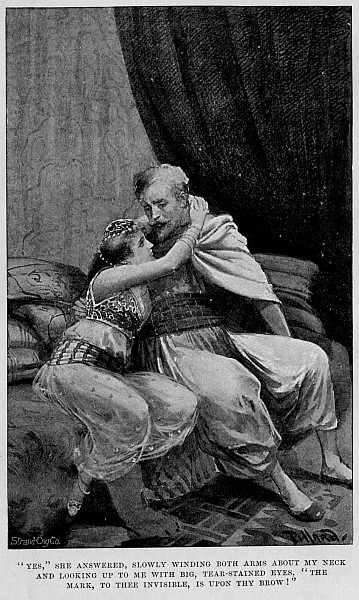
“I do,” I answered, fervently kissing her with a mad, fierce passion. “Indeed, had it not been for thine exertions, my bones would long ago have been stripped by the vultures.”
“Ah! my Amîn, thou too art performing for me a mission, the result of which will effect stranger things than thou hast ever dreamed,” she exclaimed earnestly; adding, “Our story-tellers relate wondrous things, but none have described such marvels as thou shalt behold. I told thee in Algiers that I was in peril of death, and that thou couldst avert the danger that threatened. These words I now repeat, and trust in thee to save me.”
“To save thee I will again face our enemies fearlessly, and strive to reach the imam who holdeth the Secret, even though I have been told that the Omen of the Camel’s Hoof hath been revealed unto me,” I said, entranced by her beauty, and smiling in an endeavour to chase away the gloomy shadow that seemed to have settled upon her.
“Yes,” she answered, slowly winding both arms about my neck, and looking up to me with big, tear-stained eyes. “The mark, to thee invisible, is upon thy brow, yet hath not that presage of evil already been fulfilled in thy failure to elucidate the Mystery of the Crescent? Is it not possible that henceforward good fortune and success may attend thine efforts?”
“Truly, O my beloved One of Wondrous Beauty!” I said, “thy words renew hope within me, and restore confidence. I will seek the imam of the Mesállaje, and at any risk learn the hidden wonders.”
In silence she gazed at me with a look of unutterable sadness. The pallor of her countenance enhanced her delicate beauty, and the trembling of her hands showed me how intensely agitated she had become. She loved me with all the fiery passion of her race, yet it seemed as though she kept from me, with tantalising persistency, just those facts I desired explained. She seemed half incredulous, too, that I should be prepared to make another strenuous effort to reach Mohammed ben Ishak merely upon the expression of her desire, for after a short silence, during which her peach-like cheek, fragrant with perfume, lay against mine, she suddenly exclaimed—
“Dost thou, O Ce-cil! believe me blindly, even though I admit to thee that I—I am unworthy thy generous love? To me, alas! debased and degraded as I am, the fruit of the great lote tree is forbidden, and the water of Salsabil may never cool my lips.” Then, sinking upon her knees before me, she suddenly burst again into tears, covering her face with her hands.
“Come,” I said, “let not thoughts of thy past cause thee unhappiness. There is danger; and we must arm ourselves, and both bear our burdens bravely.”
“Ah!” she cried in accents of poignant bitterness, “it is impossible that thou canst ever love me sufficiently to make me thy wife, even when thou, at last, knowest my story. See!” and, throwing out her arms wildly, she stretched forth her open palms towards me. “See! I am held to this horde of cut-throats by gyves invisible yet unbreakable! I kneel before thee, my Amîn! a despicable, vile-hearted woman, whose whole life hath been one of ignominy and deceit, whose very name is a by-word of reproach! Forsaken by Allah, defamed by man, I confess myself unworthy thy thoughts. I cannot—nay, I will not bring upon thee disgrace and shame, for my hands!—they are stained by heinous crimes!” she added hoarsely, bowing low and hiding her face.
Taking her by the wrist, I was about to assist her to rise, when she snatched away her arm as if she had been stung.
“No, no!” she cried in heart-thrilling tones. “Place not thine hand upon me! My touch polluteth thee! It will perhaps be best—best for both of us if we part to-night to never meet again!”
“Tell me,” I demanded quickly, “have not thy crimes been committed under compulsion?”
“Yes, they have! I swear—they—have!” she answered brokenly.
“And thou art the wife of Hadj Absalam?” I said fiercely, half convinced that I spoke the truth.
“Ah! no, no!” she protested, with feverish anxiety, raising her pale, haggard face imploringly to mine. “Judge me not too harshly,” she cried. “Though the awful stigma of sin lieth upon me, and my life is accursed, yet here at thy feet I tell thee I am neither wife nor slave. I have suffered no man to hold me in fond embrace, nor to kiss my lips, save thee. I take oath upon the Book of Everlasting Will.”
“Canst thou not tell me why thou, a pure and innocent woman, art here among these barbaric Sons of the Desert?” I asked, now convinced by her terrible earnestness that my suspicions were groundless.
“I am not innocent, I confess to thee. How can I be, when to my vile cunning is due that inhuman butchery which causeth the Ennitra to be held in terror throughout the Desert? Until thine eyes met mine, I knew neither mercy nor remorse, but now—Faugh! I see my crimes in all their revolting hideousness, and I—I hate—I loathe myself—for I am the Slave of the Destroyer!”
“Let us bury the past,” I said, slowly and with sincerity, assisting her to rise, and, holding her again in my arms, I rained passionate kisses upon her sequin-covered brow. “Though much that is incomprehensible remaineth like a curtain obscuring thee, yet I am satisfied that I bestow not my affection in vain—”
“Ah, my Amîn! thou knowest not how dearly I love thee,” she interrupted, raising her lips slowly until they met mine.
“I can gauge thy feelings by mine own,” I answered. “Thou must leave this life of outlawry; but ere thou canst escape from thy people, I am compelled to gain certain knowledge. This will I strive once again to accomplish; but in the meantime I desire not to gaze down the uninviting vista of thy past, or tear the veil from unpleasant facts that thou wouldst hide from me. I am confident in the knowledge that thou art neither a wife nor an inmate of thy Sheikh’s harem, and that, though morally guilty of the massacres that have sent a thrill through two continents, yet thy position hath, in some way unexplained, been thrust upon thee. I consider this in considerable measure palliates thy crimes, and—”
“I vow I have acted always against my will—always! It was horrible!” she interrupted.
“Yes, I know,” I said, tenderly stroking her long silky hair. “Thou hast my love, sympathy, and forgiveness. Some day, when we are wedded, peradventure thou wilt tell me how thou earnest to rule this piratical band.”
“It was to save mine honour,” she declared, with fervour.
“Then I will demand no further explanation,” I said. “It sufficeth that we are confident in each other’s love.”
“Yes, we are, we are!” she cried, with a wild outburst of passionate affection, kissing me again and again. “I have spoken the truth as clearly as circumstances will allow, nevertheless, thou hast faith in me. Thou art still my Amîn, generous and true. For thee will I live in the hope of eventual freedom, and should misfortune overtake us, by thy side will I die!”
“Let us anticipate success,” I said.
“Yes,” she answered, smiling, as she dashed away her tears.
“If thou gainest the Great Secret, thou wilt obtain strange knowledge, which will prove to thee amazing, and reveal an unheard-of marvel. Therefore strive on. Though thou mayest see me sometimes, seek not to hold converse with me. Remember always while thou art with us that we are watched closely by those only too eager for a pretext for killing thee. Indeed, if thou wort discovered here, thine head would quickly be smitten off and mounted upon thy tent-pole, so likewise any attempt to speak with me would inevitably cause a dozen knives to pierce thine heart. Henceforth we are strangers until I restore to thee the Crescent, and thy mission is safely accomplished.”
“I will preserve silence, and seek thee not.”
“Make me one other promise,” she exclaimed in grave earnestness. “Whatsoever thou mayest witness during our advance upon Agadez, never wilt thou think ill of me. Remember always that I am forced to act as I do in order to preserve mine own honour.”
“I promise,” I replied, sealing the compact with a lingering, ecstatic kiss.
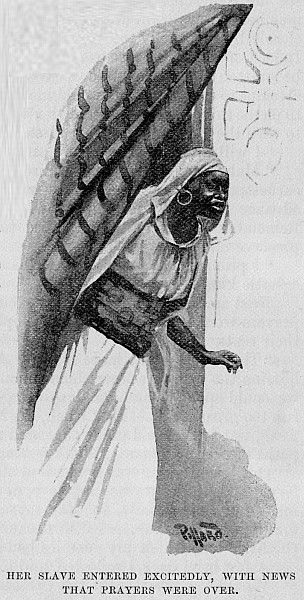
Next second her slave entered excitedly, with the news that prayers were over, and that the people were flocking back to their tents.
“Thou must, alas! leave me, my Amîn,” Zoraida cried, on hearing the negress’s unwelcome announcement. “Would that we could spend some hours longer together! but we must not run too great a risk. May Allah, the Merciful Protector of the weak, watch over and guide thee, and may thy footsteps fall in paths of peace. Slama. Allah iselemeck!”
Our leave-taking was tender and affectionate, for I saw how fervid and passionate was her love, nevertheless she compelled me, firmly yet kindly, to tear myself from her, and a few minutes later I was seated in dreamy thoughtfulness outside the little tent which my enemies had given me.
A few brief days, I reflected, and my fate would be decided. Would the mystery of the Crescent of Glorious Wonders, with its undreamed-of marvels that she had promised, ever be revealed?
Chapter Thirty Seven.
By the Drum of Nâr.
The bid for fortune was desperate and perilous.
I had become an outlaw, a member of one of the most daring bands of freebooters that ever robbed a caravan or tortured a wanderer of the plains. To the civilising influence of French authority Hadj Absalam was as defiant and his identity as mysterious as the Mahdi himself; while his followers were for the most part an ill-dressed, well-armed horde, whose torn and dirty burnouses and general negligence of attire showed plainly that they were Desert rovers, whose ramshackle tents were their only homes, and whose existence depended on the result of their depredations.
The knowledge that I was an Infidel, combined with the secret inflammatory utterances of Labakan, created bitter prejudices against me, causing them to jeer and make matters exceedingly unpleasant generally. Among that legion of marauders I had not a single friend, with the exception of Zoraida and Halima, neither of whom were ever visible. Fierce guttural oaths and exclamations of disgust that a dog of a Christian should be permitted to live among them were muttered by dark-skinned, evil-faced ruffians, who squatted idly before their tents cleaning guns, burnishing knives, and filling powder-flasks. Sometimes, after I had passed, they would spit upon the ground to emphasise their contempt, or openly declare that I was a harbinger of evil, a precursor of defeat.
Affecting to take no notice of the variety of insults flung into my face, I suppressed any rebuke that rose to my lips, remembering Zoraida’s words, and determined that when the time came, I would show them that a Christian could handle a rifle with as deadly effect as a True Believer.
The long hot day following my interview with the woman I loved I spent in lonely unhappiness, and my sense of insecurity was very considerably increased by receiving a secret visit, at the mild and balmy dawn of the following day, from one of the men who, after assisting Halima and myself to escape from the Sheikh’s house, had accompanied us on our journey. On recognising him, I extended to him a warm greeting, much gratified that at last I had found a friend; but I paused when, raising his hand quickly, he exclaimed in a deep whisper—
“Hush! Let not thy voice be heard! I come to thee, unseen by thine enemies, to give warning unto thee!”
“Is there danger?” I gasped.
“Know, O Roumi,” he answered, “thine enemy Labakan—on whom may Allah not have mercy!—hath formed a dastardly plot to kill thee! Our Lady of Beauty, Halima, hath heard of it, and sendeth thee word. Be careful of thyself, or of a surety thou wilt yet fall beneath the knife of the assassin.”
“Tell the Lalla Halima I send her greeting. Thank her for placing me upon my guard, and from me give unto her perfect peace,” I said; adding, “Is it possible that I might see her?”
“Alas! no,” the man replied in consternation. “Seek not to converse with the women of the Faith of our Lord Mohammed. The eye of the Infidel defileth them.”
“Why?” I asked, laughing at the Moslem prejudice which even his friendship could not stifle.
“It is written,” he answered piously.
Without attempting to argue the point, I learnt from him, in reply to my questions, that in travelling to the camp we had journeyed due south, and that the valley where we were in hiding was called Akoukou, distant seven days from Agadez, and almost inaccessible from that city. Other hordes of the Ennitra had migrated in small parties, so as not to attract the attention of those they intended to attack, and were now congregated to the number of about four thousand, one body being at the Efigaguen Oasis to the north-east of the City of the Sorcerers, another at the well of Enouaggued, and a third lying in ambush to the north-west, in a secluded valley in the waterless wilderness known to the Arabs as the Kahir d’ Ibn Batouta.
With that cunning of which the Ennitra were past masters, they had gradually moved from their own region across the Great Desert, many of them under the guise of traders, to the points indicated, and now, having collected their forces, had practically surrounded the country of the young Sultan Abd-el-Kerim, and for several days had been awaiting the order from Hadj Absalam to make a concentric movement upon Agadez.
He told me that in our camp we had over three thousand fighting men, but that, even with such forces at their command, we should experience some hard fighting, for the men-at-arms of the Sultan of the Ahír were more than double our number. Then he questioned me as to my future movements, and I told him briefly that I intended to fight side by side with the warriors of Hadj Absalam. To this he answered—
“Verily, O Roumi, thou art a friend of the Faith. May Allah honour thy face and perfect thy light! May the One Giver of Life abandon thee not to the consequences of thy sins without pardoning them, or to thy griefs without consoling them, or to thy fears without removing them!”
“I salute thee with salutation, O friend,” I answered. “To our Lalla Halima, and unto thee likewise, I hope to be enabled to show my thankfulness, for I was a stranger, and thou didst give me succour.”
“Some day thou wilt turn from thy paths of infidelity,” he murmured in an impressive tone, his dark, deep-set eyes riveted upon mine. “If Almighty Allah, the Omniscient, pleaseth, thou wilt at last know the great Truth and drink of the fountain of joy and gladness. Verily, none but He can remit a sin; of a truth He veileth our offences, broadeneth our breasts, and causeth our last words in the supreme hour of life to be the words, ‘There is no Ilah but Allah.’”
Assuring him that I was no “abuser of the salt,” that I entertained nothing but profound respect for the people of Al-Islâm, and thanking him for conveying Halima’s message, we wished each other a cordial farewell, and he crept away from my tent without apparently having attracted any attention.
My wound was still rather painful, yet the fever had entirely left me, and I felt much better, although far from strong. Throughout the greater part of the blazing day I remained alone in my tent, drowsily smoking some cigarettes Zoraida had given me, and making a meal of some dates and lentils brought by a negro who was one of Hadj Absalam’s slaves. An hour before el maghrib, however, a great consternation seemed to be produced throughout the camp, for armed men hurried past my tent, and the few women who had accompanied them into the land of their enemies waddled along after them, closely veiled. Evidently something unusual was taking place, therefore I donned my burnouse, tarboosh, and haick, and, strolling out, followed the crowd to the open space before the three pavilions of the self-styled Sultan of the Sahara.
Here the marauders had assembled, and were the most brigandish-looking horde of ruffians that my eyes had ever encountered. As I pushed my way in among the throng, the abhorrence in which I was held was plain, for scowling men drew aside their burnouses so that they should not come in contact with me, and women shrank from me and turned away to avoid my glance. Fortunately I was enabled to get to the front of the great ring of spectators that had been formed, and as I did so, the crowd opened to allow the tall, regal figure of Hadj Absalam to advance into the open space, followed by the two cadis who had lounged on his divan when I had been brought before him, as well as his Grand Vizier Labakan, and four other men in silken robes. Wild with excitement, the crowd raised their voices, shouting—
“Howa-thâ! O Just and Generous Ruler! Marhaba! O Sultan of the Great Desert! Hail! O Conqueror of Roumis, O Exterminator of Infidels! O Fearless Defender of the Faith! Hail! Hail! Hail!”
Halting in the centre upon an improvised dais, the old Sheikh, arrayed in robes of bright green silk embroidered with gold, and wearing in his white head-dress an aigrette of sparkling diamonds, raised his hands, an action which commanded instant silence.
“Know, O my people! thy Sheikh standeth now before thee!” he cried in a loud voice, as with resolute bearing he gazed round upon the circle of bronzed and bearded faces. “He hath decided that the time hath come when it is meet for thee to spur onward unto Agadez; that the hour hath arrived when salutation should be sent unto our brethren, so that they may co-operate with us in the swift and merciless attack. If there be anyone who craveth to offer advice unto us, let him now speak.”
The Pirates of the Desert whispered expressions of satisfaction among themselves, but no word was uttered in response to Hadj Absalam’s invitation. Several minutes thus elapsed, when suddenly there was a movement in the crowd in the direction of the pavilions, and then the fierce piratical band again shouted themselves hoarse in enthusiastic cheers and utterances of welcome, as a veiled woman, wearing a dainty zouave of amaranth velvet embroidered with emeralds and seed pearls and serroual of golden sheen, advanced and took up her stand on the daïs beside the Sheikh, being followed by six men armed to the teeth and mounted on splendid Arab stallions. She was attended by two female slaves, who, between them, carried an ancient conical-shaped drum, the skin of which was almost black with age. Having placed the instrument on the ground, they unveiled her.
The woman who had received the wildly-enthusiastic plaudits of the robbers was Zoraida!
Pale, erect, calm, she gazed slowly around her, apparently in search of someone, and heedless of a second outburst of cordial welcome. Suddenly her eyes met mine. She started visibly, turned a shade paler, I thought, then set her teeth firmly, as if bracing herself up for some supreme effort.
Her handsome face, with the slight touch of sorrow in its expression, looked even more beautiful than in the subdued light of the harem, and as the brilliant sunset tipped her dark unbound hair with gold and fell upon her breast, whereon lay a great single emerald suspended by a chain of pearls, she seemed standing in hesitancy, as if shrinking from some action she was compelled to perform. Once again she lifted her long lashes in my direction, but only for a second, for, drawing a deep breath, her gaze wandered round the sea of dark, anxious countenances, as she raised her white bare arm heavenward.
In a moment there was a dead silence. The men about her, who had given vent to words of admiration on seeing her unveiled, were breathless in expectancy.
“Behold! my people! At my feet lieth the Drum of Nâr!” she cried in clear, resolute tones, though at first there seemed a slight quiver in her voice. “Times without number hast thou and thy forefathers gone down into battle to its sound. Its note is to thee of a verity a note of victory; to thine enemies a knell of speedy death. To its tones hast thou defeated the legions of the Infidels, and to its roll canst thou now, if thou wilt follow me, overthrow the Sultan of Agadez.”
“Wheresoever thou goest, there also will we go!” shouted the evil-looking crowd enthusiastically with one accord, flourishing their rifles high above their heads. “Lead us, O our Malieah! (Queen) O Beauteous Daughter of the Sun! O Bringer of Victory! We will follow thee!”
“Give ear unto me!” she cried again, silencing the wild tumult of enthusiasm with uplifted hands. “I would have brief speech with thee before we commence the advance to Abd-el-Kerim’s stronghold. Verily I tell thee that—”
“Cease thy chatter, I command!” cried Hadj Absalam, in a sudden ebullition of anger. “Have I not forbidden thee to address unto the people words other than those which have received my sanction?”
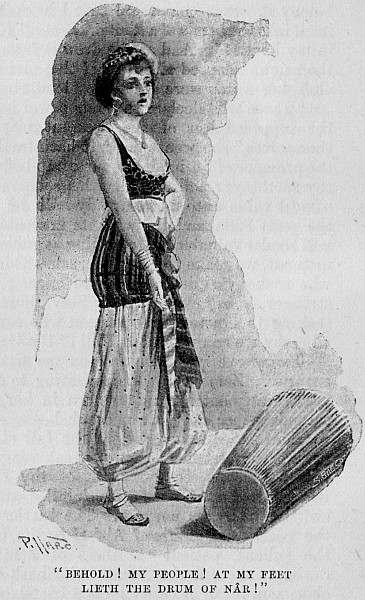
Glancing towards him, the colour left her face, and she trembled as if in fear, but the people, noticing the dispute, cried loudly, “Let the Lalla, Queen of the Noor, speak unto us, O our Father! In her wisdom do we place our trust.” This popular demonstration in her favour gave her courage, and heedless of the fiercely-uttered imprecations of the pirate chieftain, Zoraida, drawing a long breath, continued—
“For many moons now past there hath been amongst thee, my foster-brethren, signs of discontent,” she said.
“Grim whisperings have caught mine ear, and many a sinister rumour regarding myself hath been conveyed unto me. To-day, ere we set out towards the dazzling Palace of Delights, where some of us will peradventure find a grave, I desire to render thee personal explanation.”
She paused, glancing at me with unwavering eye. Every voice was hushed, every face expectant.
“It hath been alleged against me that I have betrayed the secret of the Crescent of Glorious Wonders, but before thee all I deny it. Some have said that I have delivered the Crescent itself into the hands of a Roumi. Behold! I have our treasure still in my hands!” And as she drew it from beneath the folds of the bright-coloured silken scarf that girt her waist, and held it aloft, her words were greeted by loud, ringing cheers.
“Those who declare that our power hath been weakened by the supposed loss of the Crescent may here witness it for themselves,” she went on. “It hath further been alleged that the presence of an infidel in our camp bodeth ill-fortune; but I, thy soothsayer, tell thee that his companionship will be of the utmost value unto us. Already hath he been held captive in the great Fáda, and, knowing its intricate courts and pavilions, will render valuable aid in serving as guide when, in the supreme moment, we make the final onrush. Think, then, those of you who seek by sinister device to encompass the death of this stranger from beyond seas! Stay thine hands, thou who art seeking to destroy the one man who can show us the means whereby we can reach the Hall of the Great Divan!”
Every eye was turned upon me with mingled scorn and surprise. Zoraida was endeavouring to ensure my safety! A wild excitement seemed to burn in her veins, and after a few seconds’ pause she again proceeded—
“This expedition requireth the fall strength of each one of us, therefore let none seek to wreak vengeance upon his neighbour. Heed these the words of thy Daughter of the Sun, whose prophecies have been fulfilled, and whose curse falleth swiftly upon her enemies. The barriers of Agadez, held by the peerless scimitars of Abd-el-Kerim, can only be broken by the gallant, patient ‘brothers of Zoraida’—the soldiers of destiny. Accept the Roumi who hath eaten thy salt as thy clansman, for of a verity he is a friend of True Believers, and will fight by thy side under this the glorious banner of the Ennitra, our green standard that striketh terror into all hearts from Khartoum unto Timbuktu! Let not thy belief in our power be shaken, but act with one accord, follow me with faith, and, striking down thine enemies, thou shalt dash onward through the iron-barred gate of the great Fáda, whence thou wilt bring forth many camel-loads of treasure and many scores of slaves. Verily, I tell thee, thou shalt drive thine enemies to their doom, even as cattle are driven unto water.”
Hadj Absalam stood scowling, with folded arms. His Argus eyes were everywhere. By the expressions of approbation and loudly-uttered promises to carry out her wishes, it was plain that Zoraida’s words had the effect she desired. Over this fierce horde of cut-throats she exercised such regal sway that her every wish was law. So attentive were they to her utterances, that it seemed as if her marvellous beauty entranced them, causing them to fight for her. How strange was her position; how strenuously was she struggling on my behalf! An undying bitterness, a hatred born of fanaticism, the scorn of the Moslem for the accursed Roumi, had been conquered by her words; for ere she had finished speaking, the fierce warriors of the Desert, who a few minutes before had cursed me under their breath, were wildly enthusiastic, and gave me “peace” on every hand.
Again raising the mysterious Crescent above her head, she demanded in a loud voice, “Hast thou still confidence in me?”
The echoes were awakened by shouts in the affirmative, and one man near me cried, “We fear not the stars when the moon is with us.”
“And thou entrustest to me the success of this bold dash into the stronghold of our most powerful enemy?” she asked again.
“Thou art our light!” they cried. “Lead us, O Daughter of the Sun! and we will follow thee.”
“Is the Roumi yonder thine ally and friend?”
“Yes,” they answered. “Already have we given him ‘peace.’”
“May the Giver of Good Gifts bestow upon thee blessing!” I cried, in acknowledgment of their declaration of friendship. I was about to address some words to the woman I loved, when suddenly I remembered she had forbidden me to speak, and stood gazing at her in silence. Upon the sinister face of Hadj Absalam there rested a dark look of displeasure. Zoraida was doing her best to save me, but in the crafty eyes of the Sheikh there lurked treachery and deadly hatred.
A pause ensued. Zoraida, standing erect and glancing around her, smiled as if a great weight had been at last lifted from her mind, while her women on either side slowly moved their great fans of yellow ostrich plumes.
A few seconds later, the two cadis who had accompanied the Sheikh advanced, and, taking up the Drum of Nâr, knelt before her.
“Lo! the note of victory soundeth!” she cried. “From this moment none shall rest until the banner of the Ennitra hath been planted on the Fáda of Agadez!” and with her open palms she suddenly struck the drum, and beat a rolling tattoo, that swelled louder and louder, and then gradually died away.
The call to arms caused the wildest enthusiasm, and the final notes of the rude, ancient instrument were drowned by the fierce war-cries that rent the air on every side. All seemed filled with delight at the prospect of the fight, and these shouts were repeated as the Drum of Nâr was beaten in a similar manner by the outlaw Sheikh himself, whose bearded face seemed harder than flint.
The stallions of the six mounted Arabs pawed the ground, impatient as their riders, who, on hearing the sound of the drum, yelled themselves hoarse, throwing back their burnouses and flourishing their rifles high aloft.
“Whomsoever thou shalt fight we will fight, O Ruler of the Desert!” they shouted, and again the cry was taken up by the people, who, amid a scene of intense excitement, handled their knives, swords, and guns, vowing to give no quarter to their enemies, and to make no halt until the Fáda had fallen into their hands.
Zoraida and Hadj Absalam were standing side by side, a strangely incongruous pair—she young, fair, and smiling; he aged and scowling, with merciless brutality portrayed in every line of his sun-tanned, aquiline features. Turning to her, he uttered some words in a low tone, intended for her ear alone. What they were none knew, but she glanced at him, shrugged her shoulders, and, without replying, glanced across at me with a kindly look of recognition.
Yet I dared not to approach her.
Just at that moment a standard was raised aloft, and a green silken banner, embroidered with gold, unfurled, hung over the pair motionless in the heavy, sultry air. The sight of this emblem of war was greeted with renewed shouts of delight, and as Zoraida slowly waved it, there went up on every side deep, fervent declarations of devotion to the Daughter of the Sun.
“Whithersoever thou goest, O Malieah of Beauty! we will go. Thou art still our Bringer of Victory, and we fear not while thou art at our head!” they shouted hoarsely, half mad with eager anticipation.
With queenly air her head bowed slowly in graceful acknowledgment of their compliments, then, raising both arms to heaven, she uttered some words that were lost in the tumult of excitement. The six horsemen drew up before the dais, one of them dismounting, and taking his capacious saddle-bag, held it open, while Zoraida with her own hands placed in it the Drum of Nâr. In a few moments the bag was again upon the animal’s back, the tall Arab vaulted into his high-backed saddle, and waited immovable as a statue.
There was a dead silence. At last Hadj Absalam addressed them in a loud voice, saying—
“Speed thee onward, my sons. Halt not until the Drum of Nâr hath sounded its note of victory in the Efigaguen, the Kahir d’ Ibn Batouta, and at the well of Enouaggued. Unto our people carry forth our greeting, and tell them that on the tenth day from to-morrow shall we make the dash upon the Fáda, where we shall expect them to aid us in the attack, and to destroy our enemies as were destroyed the tribes of Ad and Thamud. Away! Linger not until thou hast returned unto us with the Drum of Victory.”
“Go!” added Zoraida, stretching forth her tiny white hand. “Upon thee be perfect peace, and may Allah, Answerer of thy Supplications, shadow thee with His shadow, and guard thee in thy peril. Fi amâni-illah!”
The six sturdy horsemen bowed till their foreheads touched their horses’ necks, then, raising loud shouts, they fired their rifles into the air, and, spurring on, dashed through the wildly-excited crowd that opened to let them pass, and in a few minutes were galloping away down the rocky valley, where the misty shadows of sunset had already gathered.
Hadj Absalam’s orders had been despatched, and the Ennitra were now working themselves into a frenzy of excitement, preliminary to a mad ride over the ashes of burned homes and the bodies of their enemies, to pillage the richest and most extensive palace in the Great Sahara. Half demented by enthusiasm, each endeavoured to talk more bravely than his fellow, commenting in anticipation of the amount of loot to be obtained from the Sultan’s abode. Upon this point I was closely questioned, and, in reply, I gave a brief description of the place. The ceremony of sending forth the Drum of Nâr was over, for Zoraida’s women had wrapped her haick about her, and, with a last wistful glance at me, she turned and walked between them back to her pavilion, followed by the great Sheikh and his companions, who, amid the plaudits of the slowly-swaying crowd, bore aloft the green standard under which we were so soon to fight.
Zoraida had gone. Half an hour later, while my companions were repeating their Fâtiha, I stood aside deep in thought. The unquenchable flame of love, I knew, glowed within her heart. Stone to all else, she, forced by some extraordinary circumstance to be the leader of a band of cut-throats, had promised to become my wife. The Ennitra had replaced their faith in her with renewed confidence by reason of her possession of the Crescent, and this she had turned to the best advantage by securing my immunity from molestation. Yet I remembered that, after all, the chances of safety were exceedingly small, and wondered how many of those who were now so ready to murder and plunder would fall under the keen scimitars of the janissaries of the Fáda, and be food for the ever-hungry vultures.
Night fell. The bright white stars shone forth in the clear vault of deep blue with a brilliance that is nowhere seen except in the Great Desert, but through the dark hours the men who had pledged themselves as my friends were busy packing their tents, and at dawn, headed by the green and gold standard, we moved away on the first stage towards the City of the Ahír.
In order to allow time for the other bands of our people to reach Agadez simultaneously with ourselves, we had ten days in which to accomplish a seven days’ journey; therefore the first part of our march was at an easy pace, and with everybody buoyant and in excellent spirits, it was not unenjoyable.
Throughout the long day we travelled onward, first down the rocky ravine until we came to a great open, sun-baked plain, devoid of even a blade of herbage, where the way was rough and progress slow, then out into the trackless, stony desert, wherein few, even of the people of Ahír, had ever ventured. Wild, barren, and parched, the broad expanse of uneven stones and patches of sand stretched away as far as the eye could discern, a lone, silent, nature-forsaken land, where not a living thing could exist. Onward over the uneven ground our méheris plodded, their spongy feet falling with slow, tedious tread, and our horses stumbling at every step, causing the arms to clank and jingle. Upon a milk-white horse, handsomely caparisoned in gold and purple, Hadj Absalam rode, with keen eye, imperious and commanding, surrounded by his people, to whom his merest gesture was law. Behind him, in litters on the backs of camels, were several women, but the silken curtains of each were drawn to shade them from the sun, therefore I could not distinguish in which Zoraida rode. Around them were a number of faithful horsemen, with rifles across their saddles, while following came a great body of the Ennitra, heavily armed and eager for the attack. My horse, a fine bay thoroughbred, carried me splendidly; nevertheless, the heat was terrific, and throughout the day I suffered greatly from thirst and fatigue. But my companions, careless and light-hearted, discussed on all sides the probabilities of a successful attack, and whiled away the weary, monotonous hours by singing snatches of quaint Arab songs. Thus we marched forward, day after day, over the rugged, waterless wilderness, towards the gilded courts of the Sultan Abd-el-Kerim. Our guns and pistols—many of them ancient flint-locks, with curiously inlaid stocks—were primed, our daggers whetted, and we were all ready for the desperate, bloody struggle into which we must quickly plunge. The Drum of Nâr had gone forth; the Ennitra were rapidly closing in upon the proud and wealthy city.
Spies, who met us in the garb of camel-men, reported that the people of Agadez were continuing their merry-making, in celebration of the formal accession of the young Sultan, and were not dreaming of attack, therefore the way was clear, and a sudden dash would carry us onward, unchallenged, to the Fáda. During the sunniest hours, from noon to el maghrib, we usually encamped, making our long, weary journeys over the almost impassable country through the night and early morning; and this having continued for nine days, we at length found ourselves twelve hours’ march from the city we intended to plunder. Encamping, we spent six breathless hours, lying hot, panting, and thirsty under what small shade we could improvise; then the order went forth, horses were resaddled, camels, struggling under heavy burdens, regained their feet, and onward we moved again, every eye strained straight before, endeavouring to catch the first glimpse of the square minaret of the Great Mosque which was my goal. In the direction of Agadez the sun sank, and the grey, misty horizon was streaked with lines of blood-red light, Nature’s presage, it seemed, of a reign of terror, fire, and sword.
The crowd of stern-faced, hawk-eyed horsemen around me was, for the most part, a motley collection of brutal, villainous-looking Arabs; indeed, from their physiognomy, one could almost imagine that all the criminals of the Algerian cities had formed themselves into a tribe to wage war against their law-abiding compatriots. With coarse jest, low laugh, and murmured imprecation, they spoke of bloodshed and murder with a flippant air, exhibiting always a keen anticipation as to the amount of loot that would fall to their lot, and discussing the probabilities of the women they might capture from the Sultan’s harem realising good prices in the slave-markets of the south. Before me was the upright, statuesque figure of the pirate chieftain, and beside him, mounted on a black stallion, with rich gold trappings, was the slight figure of a youth in a dress similar to my own, with white haick, burnouse of palest amaranth silk, and many yards of camels’ hair twisted around his head. The rider, whose back was towards me, was unfamiliar, but presently I managed to rein up level with him, and, turning to look, I was amazed to find that the face was that of Zoraida!
Her beautiful countenance was unveiled, and as our eyes met, she nodded and smiled a graceful recognition.
Involuntarily I was prompted to ride up and speak with her, but again remembering her strict injunctions, refrained, and, laughing back to her, spurred onward in front, where the dreaded banner waved lazily in the breath of hot, sand-laden wind. Hiding like any scarred warrior of her tribe, she sat her horse as firmly as if she were part of it, and, heedless of the cloud, of dust raised by those riding on before, or of the constant stumbling of the animal over the rough ground, she seemed the least fatigued of any. Her pale, delicate features, with eyebrows darkened by kohl, were by no means ferocious in the spotless haick that surrounded them, yet it was apparent that she had assumed male attire in order to place herself at the head of these fierce brigands, and that her wistful eyes were constantly turned in my direction, as if wishing to speak, yet not daring to do so.
Once she left Hadj Absalam’s side and galloped up to a camel whereon a woman was reclining in a rich, cage-like litter. The occupant drew aside the curtains to speak with her, when I recognised it was Halima. Exchanging a few hurried sentences, they glanced significantly in my direction, by which I knew that I was the object of their conversation, and then Zoraida, with a parting word which seemed like an injunction, spurred back again to the Sheikh’s side, while Halima, laughing and waving her hand towards me, drew her curtains again to exclude the hot gusts of whirling sand.
Throughout the evening Zoraida rode onward, smiling with an outward show of happiness, and although I pressed on close to her, she addressed not a word to me. Now and then the Daughter of the Sun would laugh, and the love-look in her eyes told me that her thoughts were constantly of me, and that her silence was enforced. She was leader of the marauders, and her orders were obeyed instantly and faithfully. Hadj Absalam had delivered his authority into her hands, and she had assumed command with the firmness of a military officer, in a manner which showed that it was not the first time that she had occupied that strange position. In galloping, she rode as swiftly and well as any of the bronzed Sons of the Desert, though her hair became unbound and fell in profusion over her shoulders, and she lost one of the tiny heel-less slippers, which, however, was afterwards searched for and recovered by two of her younger cavaliers, one of whom placed her bare foot in it, and received a smile and a word of thanks as reward.
Over sharp rocks and treacherous tufts of hulfa grass, through pebbly ravines and soft sand, into which the horses’ hoofs sank deeply at every step, we spurred onward. Zoraida, the beauteous Bringer of Victory, led us to the attack, and of that host none were afraid. From four directions the pirates of the plains were advancing on the City of the Ahír, and all were enthusiastic and confident except myself.
What, I wondered, would be the outcome of this carefully-planned attack on the great Fáda? For Zoraida’s safety I trembled. What her fate would be should she chance to fall into the hands of the brutal janissaries, I feared to contemplate. However, though no word was exchanged between us, I was determined to fight by her side, to protect her from her enemies, and dash with this horde of thieves onward to the city in which my one hope was centred.
The Arab had spoken the truth. We had the moon with us, and cared naught for the stars. Zoraida was our light, and we were following her, stout-hearted and strong-armed, prepared to plunder, to murder, to deal death and to spread desolation at every step.
Chapter Thirty Eight.
Hadj Absalam’s Decree.
The attack delivered during the moonlit hours was sharp, decisive, and, being unexpected, was at first little short of a massacre. Yelling with wild, fiendish delight, my companions, Zoraida at their head, swept onward through the gate of Agadez up to the great, gloomy portals of the Fáda, ruthlessly shooting down those who attempted to bar their passage, and engaging in desperate mortal combat with the armed guards, who offered stubborn resistance.
Our success, however, was brief, for our reinforcements had unfortunately not reached us. Recovering quickly from the first shock, the alarm was at once sounded throughout the city. All those capable of bearing arms united to repel us, and as the janissaries in strong bodies poured forth from the Palace gate, the fray soon became fierce and bloody. The Ennitra struggled with desperate courage begotten by the knowledge that they were surrounded by hundreds of the defenders, who would slaughter them and torture those who fell into their hands as prisoners. Knowing not a man would survive if they were defeated, they fought on, madly reckless in their insatiable desire for blood, as with their keen knives they dealt deathblows at those who were defending the gateway, being in turn slashed and maimed by the keen scimitars of the janissaries, until the roads ran with blood, and our horses leaped and stumbled over piles of dead and wounded.
The fight was desperate; the carnage horrible.
On every side men yelled and struggled, while the ill-fated ones fell to earth and died with curses upon their lips. The scene was awful, almost demoniacal, for the shrieks of the vanquished, mingled with the shouts of the victors and the continuous rattle of rifles, drowned the clash of arms.
Amid the desperate conflict I kept as close to Zoraida as possible, though the Ennitra pressed around her, fiercely repelling those who attempted to capture their banner. The Daughter of the Sun, sitting on her sable stallion, with face firm set, gripped in her bejewelled hand a small curved dagger, which from time to time she flourished over her head, urging her outlaw cavaliers to valiant deeds. Time after time her slim, supple figure showed in the very thickest of the mêlée, as with desperate rushes we dashed onward towards the great horse-shoe arch which gave entrance to the Fáda, being, alas! on each occasion met with such strenuous opposition that we were compelled to fall back again, leaving dozens of corpses strewn upon the roadway. Men and horses were hacked in a manner truly horrible by the scimitars of the Sultan’s guard, and once or twice Zoraida herself had a narrow escape of death. At moments of extremest peril she behaved in a manner that would have done credit to any trained soldier. Once, as I engaged a well-armed janissary hand to hand in mortal combat, I saw that the guards had broken the ring of fierce warriors who had formed themselves around our standard and dashed into the centre of the group, causing a frightful conflict. Fighting at such close quarters, the long-barrelled guns of the Ennitra were useless, therefore they were compelled to use their knives and swords. Just as, by a lucky cut, I had slashed the right arm of my adversary, I turned to witness a gigantic guard of the harem rush up to Zoraida, brandishing his heavy scimitar, a formidable weapon that I had often burnished and whetted.
“Die, thou accursed son of Eblis!” he shrieked loudly, bringing down his broad, curved blade, that gleamed for a second in the moonbeams; but the fearless leader of the marauders had already become aware of her danger, and, lifting her left hand until it was only a foot from his great brutal countenance, fired her old-fashioned pistol full into his face. The sword fell from his paralysed fingers, and back he staggered next second with half his skull blown away.
Her escape was almost miraculous, yet she betrayed not the slightest trace of fear, although the rust of dust had settled upon the mirror of her beauty. Without a second glance at the body of her slain enemy, she sat her black horse firmly and well, re-primed her pistol, and then fought on with calm courage, heedless of the fact that those whom she led were slowly but surely being swept into eternity by the well-organised opposition they were encountering. Again and again the soldiers of Abd-el-Kerim closed around us in a frantic endeavour to capture the green banner that swayed gloomy and ominous in the brilliant night; but with dogged persistency our men, better armed than their adversaries, fired their rifles with deadly effect, and stood together prepared to fight on desperately until the end. Many were the deeds of cool daring I witnessed during that midnight hour, while men in white burnouses, looking almost ghostly in the deep, enmassed shadows cast by the high walls of the Fáda, struggled with the gorgeously-attired retainers of the Sultan.
Unfortunate wretches, mortally wounded, struggled on till they sank of sheer exhaustion and were trampled to death, and their fellows, some horribly mutilated, with dark, ugly stains upon their burnouses, fought again ere they died, killing their enemies in a frenzy of mad revenge. The encounter grew more desperate every moment. Our hands and faces were besmirched with blood, as larger and more impassable grew the barrier of the slain.
Hadj Absalam had miscalculated the time which must be occupied by the march of our reinforcements, and we had made the assault too early!
Again the heavy gate of the Fáda opened; again there emerged another body of troops. For a moment they halted, then there was a bright, blinding flash, as into our midst a volley was poured, by which a dozen men around me fell from their horses dead. Breathlessly I glanced towards Zoraida, half fearful lest a bullet should strike her, but breathed more freely when I saw her unharmed, still brandishing her knife aloft and shouting words of encouragement to the desperate group of horsemen pressing around her.
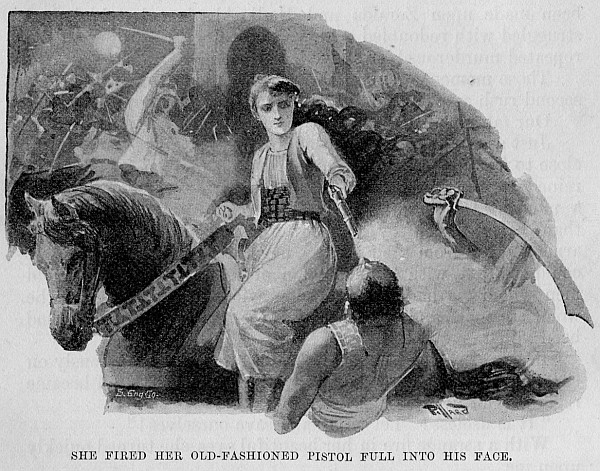
“Courage! brothers, courage!” she shouted. “Keep thine enemies at bay, for ere long thou shalt seek revenge within yonder walls. Give no quarter. Let thy strong arms sweep to earth the gilded popinjays of the Sultan!”
“Behold!” cried Amagay, commanding the janissaries, and speaking in a voice that sounded loud above the din of battle. “Lo! the horseman who commandeth the Ennitra seemeth frail, like a woman! What trickery is this? Falter not, fight on! Let not thy scimitars return unto their scabbards until all have fallen!”
Responding to these words, the janissaries made an onward rush that almost overpowered us. With great difficulty, however, we managed to make a stand against it, firing our rifles and slashing at our adversaries in frantic desperation, just managing at length to repulse them sufficiently to prevent our banner from falling into their hands. A serious attack had been made upon Zoraida and Hadj Absalam, but both had struggled with redoubled energy, succeeding in warding off the repeated murderous blows levelled at them.
Those moments were critical ones. Each of us felt that a second rush as powerful as the first would totally annihilate us.
Our fate, indeed, seemed sealed.
Just as our enemies fell back a little, I managed to draw so close to Zoraida that my hand brushed her silken robe. As I reined up, she shouted an order, a dozen rifles rang out, and in a moment the conflict became even more fiercely contested than before. One by one, however, our men dropped their arms and fell from their horses, never to mount again, and I could see that, with the exception of the couple of dozen old men whom we had left on the previous day in charge of the women, camels, and tents, nearly three-fourths of our body had been killed or wounded.
Beside Zoraida I sat in the bright moonbeams, anxiously on the alert. When I saw how critical was our position, I became regardless of her injunctions, and cried—
“It is useless! Let us fly and save ourselves!”
With a strange fire in her beautiful eyes, she turned quickly upon me.