XVII NAJMA’S LAST CHRISTMAS
Reading edition
Our little Arab friend, Najma, was born a long distance from the place where last Christmas was spent. Bagdad is the city, you remember, where Sinbad the sailor lived, and in this very city on the old river Tibris Najma was born. Her father and mother were both good Moslems and she was their first-born child, and yet not very welcome, because all Moslems like to have boy babies and not girls. They gave her the name of Fatima after the daughter of Mohammed, their prophet. When she was afterwards baptized into the Christian faith with her mother the name Najma was given her which means a “star.” Her father suffered much persecution for changing his religion, and when he was sent into exile far away from his home, she with her mother and brothers came down the river to Busrah and down the Persian Gulf to Bahrein. It was a long zigzag journey for them by flat-bottom river boat and ocean steamer, and then in the little harbour boat, tacking with the wind to shore.
Until the family came to us they did not know what Christmas meant, and of course had never celebrated it. When her third Christmas came, and it was her last, it was still a fresh and joyful occasion to her, therefore, as it was to all of us in that lonely island and amongst our little group of converts. Not only was it the last Christmas to Najma but for others in that company gathered to celebrate the birthday of our Saviour. Two other little voices that sang so sweetly
“Where do all the daisies go? I know, I know! Underneath the snow they creep, Drop their heads and go to sleep. In the spring-time up they peep. That is where they go,”
were silent before the next Christmas came around. And then the mother of Najma who looked so strong and sat in the corner, interested so deeply in all the recitations and songs, with two others of that little company had gone Home before the end of the new year.
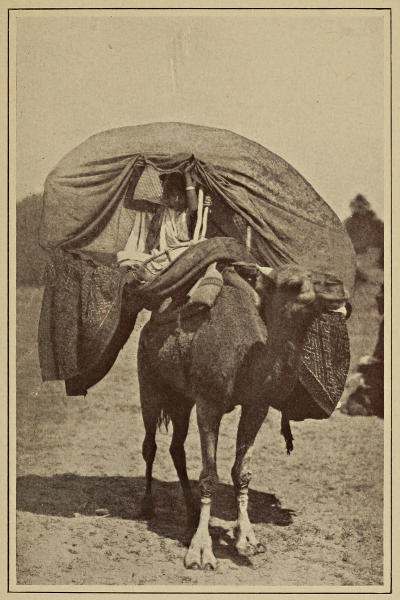
A Bedouin Girl playing peek-a-boo on a camel
It was Najma’s last Christmas, however, that I was going to tell about. We had been busy all morning decorating the little chapel in the hospital and getting the simple gifts all in order for the afternoon celebration. Najma had not been well for a few days, suffering with those attacks of fever that are so common in the Persian Gulf. When Christmas came we thought she would not be well enough to attend, but she begged so hard and was so sure that she would be all right that we sent around a donkey to her home; and when her mother had put on all her new garments, so bright and pretty, she rode to the hospital. Although she was weak, when she came with the other children she brightened up considerably and took a keen interest in everything, even helping to sing the Christmas carols. When the others had said their pieces, she insisted on saying hers and repeated beautifully the whole fifty-first Psalm. Then she waited until the refreshments were served—that most important part of a Christmas celebration—and afterwards wishing everybody a Happy Christmas she was placed on the back of the donkey and went home.
I wish you could have seen our Christmas tree on that occasion. It consisted of a number of palm branches tied together and the gifts were hung from the spikes of the branches,—presents old and new for all who came. Most people would have been surprised at the absence of dolls, but in Arabia these have to be given out sparingly and judiciously because some of the Moslems are too much afraid of idol worship to appreciate dolls in their homes. Therefore, we gave the children writing pads and pencils, books and toys, beads and new dresses, small bags of rice for the poorer scholars,—something for everybody. How joyfully each received his or her gift!
Najma gathered up all the little things given to her and kept them close by her side all the next day and took a great deal of pleasure in them; but in the evening of that day we were suddenly called out to see her and found her dying from heart failure following that week of fever. It was a surprise and a shock to us all. In spite of her faults those who knew her best could not help loving her. With tremendous difficulty she learned to read the Gospel and was very proud of her attainment as it is only one girl in a thousand among the Arabs who can read. To lose such a bright little Arab girl seemed very sad at that time, but God makes no mistakes, and we are so glad that this little girl had such a bright Christmas as her last on earth. Think of the children who are in the hospital to-day, many of them for the first time in contact with Christians, and that some of them have never yet had their first Christmas in Arabia. There are many, many little girls in this neglected country who would enjoy a Christmas so much if only they knew as Najma did about the Babe born in a manger for their sakes. It is nineteen hundred years ago that He came to the world as its Saviour and yet there are so many countries where the boys and girls have not yet heard of His coming.
If we would win the whole, round world for Jesus we must tell His story all around the earth and give everybody a chance to read the story of His life. Do you remember those beautiful verses of Father Tabb in regard to the First Christmas?
“A little Boy of Heavenly birth And far from Home to-day, Comes down to find His ball, the earth, Which sin has cast away. Come, comrades, let us one and all Join in to get Him back His ball.”