XI PEARLS AND PEARL DIVERS
Reading edition
Nearly all the British India steamers in their zigzag journeys up the Persian Gulf, calling first at the Arabian coast and then at the Persian coast, stop at the pearl islands of Bahrein. Half-way up the Gulf and thirty miles from the mainland of Arabia, this group of islands has been famous for centuries as the most valuable pearl fishery in the world. For at least two thousand years the Arabs have been diving in these waters and bringing up the costly shells. Before the days of Christ, and even before the time of Solomon, pearls from Bahrein were shipped to the Western world, and it is probable that the dress and the conversation of the men and the boys of to-day is about the same as it was a thousand years ago. The boats are probably of the same pattern, with very little improvement.
Bahrein is an Arabic word which means the two seas, and this name was given to the islands because the Arabs fancied that here two seas met, the fresh water and the salt water mingling together. The islands have very little rainfall—during the summer none at all—and yet they are famous for their fresh-water springs, which find their source on the mainland of Arabia or Persia, and the water not only bubbles out in pools and wells on shore, but below the tide level there are fresh-water springs several miles out at sea. You would be interested to see the Arabs go out in their boats, place a bamboo over the opening in the rock and then collect fresh water above sea level in their great leather skins.
Bahrein is historically most interesting, because here the old Chaldeans and Phœnicians made their home. Some of the mounds on the island are older than the ruins of Babylon, and it is said that the Phœnicians worshipped the fish-god who, it is supposed, carried Noah’s ark over the flood.
The pearl fisheries at Bahrein employ about 3,500 boats, large and small. The boats measure from one to fifty tons. The smaller boats carry from three to fifteen men and work near the shore; the large boats, employing from fifteen to thirty men, fish all over the Gulf. It is a pretty sight to see the fleet sailing out of the harbour, the large sails, set to the wind, gleaming white in the sun, the blue waters underneath and the bluer sky overhead. Have you ever seen a diving outfit? It looks rather ungainly to me. The Arab divers do not use anything so elaborate as do the divers in America. White overalls to cover their dark skin (because they say sharks do not care for white people), a fatam, or clothes-pin on the nose, and leather thimbles for scratching up the shells, and a basket to hold the catch, with a rope attached to a girdle to draw them up with—this is the complete outfit. When prayers have been said and a Bismillah, down he goes, quickly fills the basket, and with a tug on the rope, he is hauled up, his basket is emptied while he takes a short breathing spell, then down again; and so on from sunrise to sunset.
The divers pass through many dangers in bringing the pearls from the bottom of the ocean to the surface. Sharks are the most terrifying, and during the pearl season a number of divers lose their lives, or are maimed; a leg or an arm has to be amputated because the cruel, sharp, powerful mouth of the shark caught the fisherman while he was seeking goodly pearls for us. A large number of them are afflicted with rheumatism as a consequence of their calling. In the boat, besides the men who are doing the work, is a man who is a substitute for them in prayer. The divers are too busy to observe the stated hours of prayer, so this man will repeat the prayers in place of each man. He is the Levite, and performs the religious ceremonies for every other man and boy. He must be occupied all the time on the boats where there is a crew of thirty men, and he must say the prayers five times a day for each man.
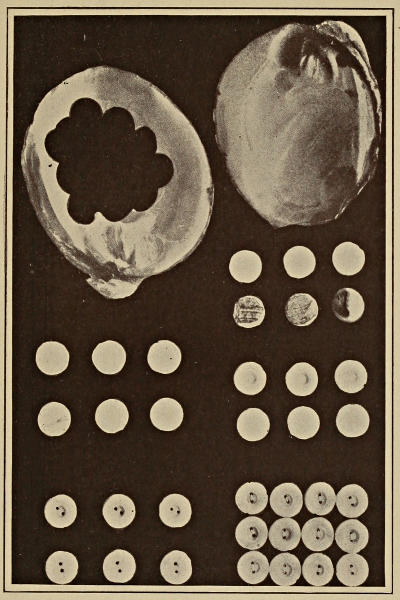
The Evolution of a Pearl Button
The Arabs say that pearls come from a raindrop which fell while the oyster had its mouth open; each drop of rain thus caught is a prize for the diver. “Heaven born and cradled in the deep blue sea,” it is the purest of gems and, in their eyes, the most precious. When the pearl oysters are brought up, they are left on deck over night, and next morning are opened by means of a curved knife six inches long. Until a few years ago, all the shells were thrown back into the sea as useless, but now they are brought to shore by the ton and deposited in some merchant’s yard. He employs natives to scrape off the outside roughness, and then they are packed in wooden crates and exported in large quantities.
On shore the pearls are classified according to weight, size, shape, colour and brilliancy. You would think the pearl merchants a strange kind of people. They carry the most valuable pearls around with them everywhere, tied up in turkey-red twill. They have no safes nor banks, so the only safe way they can think of is to carry them around and run the risk of being knocked down and robbed; but since the Indian government has made Bahrein a protectorate, such robberies are rare.
The pearl merchants are called tawawis, which means those who handle the brass sieve, or tas. When the pearls are brought on shore, they are classified according to size first of all, and to do this, each merchant has a nest of beautiful sieves fitting one into the other. The smallest has holes as big as the end of a pencil, and they go down gradually in size until the largest sieve, which is about six inches across, has holes as fine as mustard seeds. Any day during the pearl season you may see the Arab merchants sitting cross-legged in their houses, sifting pearls, and when they are classified and piled up in little heaps, white and shining in the bright sunlight on the red cloth that covers the floor, it is a sight worth seeing.
The total value of the pearl harvest each year is at least a million dollars, but most of the profit goes into the hands of the dealers. The divers work for wages, and many of them are heavily in debt. In spite of the dangers they incur, the divers love their work, because pearl diving always has in it the element of gambling. One may work a whole day and find only pearls of small value, and then perhaps bring up a fortune in an hour. The most beautiful pearl I ever saw was found in the waters at Bahrein some ten years ago, and was sold for ten thousand dollars. It must have been to such a fortunate pearl diver that Browning referred in his verses:
“There are two moments in a diver’s life: One when, a beggar, he prepares to plunge, Then when, a prince, he rises with his prize.”
The time for pearl diving is from May until the end of September. During the winter months the cold weather interferes with the work, and the men live inshore. Then it is that they come in crowds to our hospital, and we have the joy of preaching to them from the parable of the Pearl of great price, and no audience appreciates a sermon on that text as much as the men who know what it costs to bring up the pearls. You remember the parable: “The kingdom of heaven is like unto a man that is a merchant seeking goodly pearls, and having found one pearl of great price, he went and sold all that he had and bought it.” When we tell the Arabs that the Pearl of great price was the kingdom of God, peace and righteousness and joy, which Jesus Christ purchased for us at the cost of His own life and now offers freely to all who will believe in Him, they understand something of the message.
Will you not pray for the pearl divers of Bahrein that many of them may find the Pearl of great price, and that their humble homes,—mat-huts along the shore of the great sea—may be made glad by the joy of a Christian civilization and the knowledge of our Saviour? It is not hard to love them for their own sake, and I well remember many a happy hour spent with them in their boats or sitting on the beach, talking over their work. Sir Edwin Arnold referred to them in these lines:
“Dear as the wet diver to the eyes Of his pale wife, who waits and weeps on shore, By sands of Bahrein in the Persian Gulf; Plunging all day in the blue waves; at night, Having made up his toll of precious pearls, Rejoins her in their hut upon the shore.”