XV THE ACORN SCHOOL
Reading edition
To the American schoolboy a Moslem school and school-books would appear the dullest things possible. Yet the Arab boys do enjoy school for there is always something to distract the attention, especially if the teacher is a shopkeeper. While a customer bargains, or the water carrier passes, or the coffee-house man brings the daily “cup of cheer,” or, in the case of a woman teacher, callers come, all eyes and ears are open not towards the lesson but the conversation and the sights.
The earliest and only text-book is the Koran or portions of it cheaply lithographed on common paper. There are no pictures in their primers, for a Moslem tradition says that Mohammed cursed all who would paint or draw men and animals. There is neither singing nor prayer when school opens. Mohammed said, “Singing or hearing songs causeth hypocrisy to grow in the heart even as rain causeth corn to grow in the field.” The school has no special building, but may be in the corner of a mosque or in the yard of the teacher; or part of his shop (if he is a merchant) will form the schoolhouse. There is no furniture except mats and folding bookstands. These look like tiny sawbucks. The schoolmaster sits amongst his boys on the floor, and they all drone out their lessons together. There are no grades, neither is there order in the schoolroom. One lad may be at the alphabet; another one as far as counting numbers; a third child may be spelling out the first chapter of the Koran, while others are reading from the middle of the book at the top of their voices. The education of a boy should begin at the age of four years, four months and four days. On that day he is taught to say the Bismillah, or opening chapter of the Koran. Soon after that he may be sent to one of the day-schools to learn the alphabet.
When a boy has finished the reading of the whole of the Koran for the first time and has learned the rudiments of writing, he graduates from the primary school. On this occasion he has a rare holiday. Dressed in fine clothes, perhaps mounted on horseback, he visits the neighbours, receives gifts and sweetmeats and brings a handsome present to his tutor. If he does not intend to become a doctor of divinity or of herbs, this is the end of his school-days, and the lad is put to learning a trade or helping his parents.
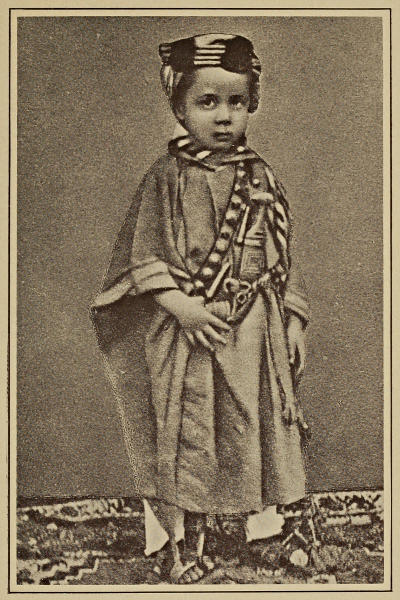
A Meccan Boy
As to moral training, tradition commands pious Moslems to teach the boy of seven to say his five daily prayers; at the age of ten, if he omits them they are to admonish him by blows. Boys are taught early the proprieties of conversation and behaviour according to Oriental etiquette. They are also taught the ceremonial washings and the correct postures for devotions. But purity of conversation and truth are seldom taught by precept, and never by example.
Writing is taught on a wooden slate or in copy-books made by the teachers. Slates and slate pencils are practically unknown, and the youngest child begins with a reed pen and ink. Caligraphy is not only a science, but the chief fine art in that part of the world which abhors painting, statuary and music. To write a beautiful Arabic hand is the height of youthful scholarly ambition.
A country that has only such schools cannot progress; and so the missionaries open schools with a broader course of study and with better training for the mind and heart.
The first Christian school in East Arabia was opened in 1899 on the veranda of the old mission house overlooking the sea. The little children of Ameen who was in prison for his faith were living with their mother in our house, and they needed to be taught; two of the rescued slave boys from Muscat, who had come to help in the housework, had some spare hours in the morning, and it was better for them to study than to sit around doing nothing, for Satan finds an awful amount of mischief for idle hands to do in Bahrein, and so the little school was started for the children in the house. We gave it the name of the “Acorn School” in faith that as “tall oaks from little acorns grow,” so some day education in Arabia would be what it is now in America. We had lessons for two hours each morning, marching, singing, etc., for the little ones, baby Bessie lying on the couch nearby while the children were being taught; others wished to join, but neither accommodations nor strength would allow us to enlarge our borders at that time.
After some months an Arabic teacher was assigned to the station to teach a new missionary the language, and about that time we moved into a larger house. Then our numbers increased, and one of those early pupils was a young Jewish girl; another was a Jewish boy, who remained about three years, and was always a docile and clever pupil in English and Arabic; he has a complete Bible in Arabic, which they read in his home. The girl was a great help to us in every way—first in school, and later in the hospital; she is quite a changed girl and a superior one, and we trust the day will come when she will openly confess Christ and follow Him. Some grown-up lads were among those first scholars, and they came to learn English. One of the older boys was such an apt pupil that he was taken on the staff of the English Political Agent as interpreter for the Persians; another advanced so far that he is able to buy and sell for the wholesale business, and for this reason is a great help to his father, a merchant in Bahrein. These boys have learned much of the truth along with their English, and neither of them now believe that the sun sets in a pool of black mud!
The reflex influence of the school is felt even in their homes, changing some of the habits and language. Some of those early scholars have gone to the Eternal Home. Quite a number of the missionaries and native helpers have helped from time to time in this school, for when one left, another would take up the work. The last few years the girls have been doing needlework and learning how to make their own clothes neatly.
There are a great number of Christians and Jews, but the greater number in good weather are Moslems, and in the cool season the little room is overcrowded, and one teacher is very busy trying to keep all employed. The school is still in the initial stage, but it has proved its right to exist, and when we look into the brightening faces of those who gather to be taught, and listen to the Scripture portions repeated and the hymns spiritedly sung, we can only say: “What hath God wrought!” To outsiders the school may seem a small thing, but to us, who have watched its slow growth, it is encouraging. The teaching has always in view the honour of Christ in a land where His title, “Son of God,” is disputed.
If you could see our new school building you would know how much better off the children are who come to the Christian school than those who still attend the native schools. The rooms and the seats, and windows through which glorious sunshine and light shine, the blackboards and maps and pictures all help to educate through “eye gate.” The boys and girls are graded and separated, for coeducation is not yet a good thing in Arabia. When I taught in the school I used to surprise the girls occasionally by bringing to school some little treat of fruit, dates or candy; and I wish you could have heard their hearty “Thank you” and listened to them as they left the yard and went over the desert to their houses, singing at the top of their voices in Arabic Christian hymns which they had learned in school. They thought it would please me and impress us with their goodness. And it was good to hear these girls and sometimes small boys singing “My Faith Looks up to Thee,” “Jesus Loves Me, This I Know,” etc. And even if they did not understand the deep meaning nor enter into it, it gave them pleasure to sing the bright tunes. And while they sang, they were out of mischief at least. It was so new for these Moslem girls to have any one to care anything about them.