X THE LANGUAGE OF THE ANGELS
Reading edition
The Arabs are a proud and noble race. They are proud of their liberty and of their free open-air desert customs. They are proud of their religion and of their prophet. They are proud of their history and of their patriarchal descent. But most of all, they are proud of their language, one of the oldest and most wonderful forms of human speech. Mohammed himself in his Koran, which you know is the Moslem Bible, speaks of the Arab tongue as “the language of the angels.” He and the Arabs believed that Adam and Eve spake Arabic in Paradise, and that the language of revelation in which God spoke to His prophets, Abraham, Moses and Solomon, was none other than the language of the desert, the speech of the Arabs.
One of the most learned Arabs who lived about three hundred years after Mohammed said: “The wisdom of God hath come down upon three things:—the brain of the Franks, the hand of the Chinese and the tongue of the Arabs.” What this Arab philosopher meant was that while the people of Europe are distinguished for their power of invention and discovery, the Chinese are distinguished as artists and artisans, but the Arabs are all of them born orators and poets. The people of Europe, he meant to say, have brain power, the people of the Orient skill in handicraft, but the Arabs, eloquence. If you will read the Book of Job, which was doubtless written in Arabia and describes early Arabian life, or read the latter chapters of Mohammed’s Koran, or better still some of the Arabian poetry, you will appreciate the truth of this wonderful statement.
The first thing that is remarkable about the language of the Arabs is its wide-spread use. Like English it has spilled itself all over the map of the world, far beyond its original limits, and like English it was carried by commerce and by conquest, by merchants and by missionaries.
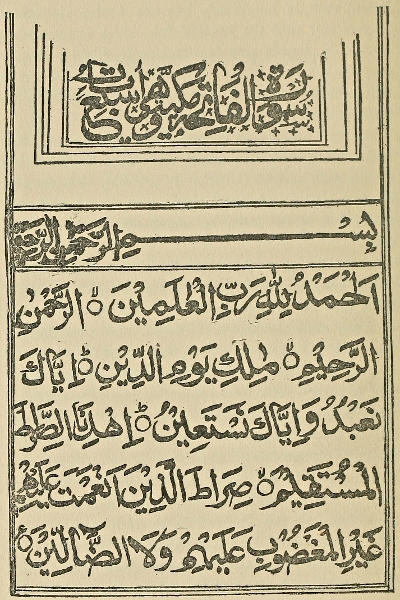
FIRST CHAPTER OF THE KORAN
Some time ago an American typewriter firm in advertising a machine with Arabic characters made the statement that the Arabic alphabet is used by more people than any other alphabet in the world. Some one thought that this was an exaggeration, and asked a professor of languages, “How big a lie is that?” He answered: “It is true.” The total population of all the countries whose inhabitants use the Arabic “A B C”—if they use any at all—is larger than the number of those who use the Latin alphabet or the Chinese character. The Arabic Koran is read by the Moslem boys in the day-schools not only of Arabia, but of Turkey, of Afghanistan, Persia, Java, Sumatra, the whole of North Africa and throughout Central Asia. In the Philippine Islands there are three hundred thousand Mohammedans whose only alphabet came from Arabia, and as far west as the mosques of Morocco the Arabic tongue has travelled and become the language of law and commerce and religion.
When the early Arabs in their conquests crossed the strait between Africa and Spain and conquered that country they left many words behind. And therefore many of the place names in Spain to-day are Arabic. Gibraltar, for example, is the corrupted form of Jebel Tarik, which means the mountain of Tarik, the Arab general who first crossed the straits with his soldiers. And Quadiliquiver, one of the rivers of Spain, should be spelled Wady El Kebir, or the Big River.
Even the English language has a number of words that came as Arab guests to the feast of reason and have been adopted into our family and put into our dictionary. When you speak of algebra, ciphers, zero, alchemy, alcove, minaret, alcohol, coffee, sofa, amber, artichokes, gazelles or magazine you are using good Arabic words which nearly every Arab would understand. To use these words, however, is quite a different thing from speaking “the language of the angels” correctly. It is easier to borrow a carpenter’s jack-knife than to acquire his skill in building a house. Many languages have borrowed from the Arabs and the Arabs have borrowed from them in return, but no language is richer than the Arabic in its number of words.
Would you like to know how the boys and girls talk in Arabia? If you have read “Topsy Turvy Land” you will remember how they write their words backward and begin to read at what we call the end of the book. Their talk as well as their writing seems to us at first very topsy turvy. Of course, I need not tell you how much they talk, for in that respect they are just like the boys and girls in America. As they speak a language, however, very different from English, I am sure you would like to hear a little about it. Arabic is one of the oldest and most beautiful languages, and also one of the hardest to learn. It has so many words that their name for a dictionary is “Kamoos,” which means “an ocean.” They have five hundred different names for a lion and two hundred words for serpent. It is said that there are one thousand different terms in Arabic for sword, and eighty different words for honey.
Like English the Arabic language has grammar with many rules (and more exceptions) and the boys dislike it just as much as some of you do. They have a severe struggle with the alphabet because each letter has three different forms, as it is used in the beginning, the middle or the end of a word; and then there are but fifteen conjugations and twenty different ways of forming the plural, not to speak of all the moods and tenses and the irregular verbs.
Some people think that Arabic is the most difficult language in the world. Keith Falconer, the first missionary to Arabia, said, “Arabic grammars should be strongly bound because learners are so often found to dash them frantically on the ground.” Another missionary said that he would rather cross Africa from Alexandria to the Cape of Good Hope than undertake a second time to master the Arabic speech.
I shall never forget my early struggles with the language, nor the place where I sat down to learn my lesson with Dr. Cornelius Van Dyke. He was a master of Arabic and with Dr. Eli Smith translated the whole Bible into the Arabic speech. Here it was in the shade of his beautiful veranda at Beirut, Syria, that I began to learn the irregular verb. It takes a long time for grown-up people to learn a new language, but it does not seem hard for the Arab boys and girls.
Beside the proper talk of grown-up people there is baby talk in Arabia which mothers teach the little brown toddlers before they walk out of the mat-huts and the black, camel-hair tents into the wide world. Yes, and there are also slang words which the camel drivers and the donkey boys use with and on each other.
The baby talk is much like English. Father is baba; dog is wowwow; pretty is noonoo; stop is tootoo; chicken is kookoo, and when baby falls they say baff!
The language of these little angels and the grown-up ones in Arabia is very poetical. The Arabs, because they live in the desert and look up into the big, blue sky and far out to the horizon where the mirage paints desert pictures every day, are full of imagination and live in an atmosphere of poetry. They love jingling words and proverbs and pretty sayings and figures of speech.
A mosquito has only a sting in New Jersey. In Arabia they call him aboo fas, which means “father-of-an-ax”! In America a tramp is a tramp, but the Arabs call him a son-of-the-road. And what could be prettier than their name for echo, bint-el-jebel, “daughter of the mountain”? Why, there is a whole fairy story in that one word! And if you go down the columns of the Arabic dictionary you can find many a story locked up in some word and only waiting to be opened.
In North Arabia when they say, “How-do-you-do,” the proper expression is, “What is the colour of your condition?” This may be philosophical, but it does not make good sense in English. Strawberries are called French mulberries, and the name given to potatoes when first brought to Bahrein was aliyeywellam; why this name was given, I cannot tell. Where could you find a better name for wine than the Arab um-el-khabaith, “mother of vices”? No wonder all the Arab children are staunch prohibitionists. And you will know more about the nights in Arabia when I tell you that the common name for jackal is “son-of-howling”!
“The language of the angels” is not altogether lovely and beautiful; alas, it bears the marks of a false religion all over it like scratches on marble or ink-stains on a beautiful piece of handwriting. Mohammed’s life and Mohammed’s teaching were not like the life and teaching of Jesus Christ, and so the Arabic language abounds in words that are not pure and not lovely. The missionaries in Egypt and in Syria have done much to purify and elevate the language of the Arabs by giving them Christian books and papers and above all the Holy Bible in their own tongue. The Arab children in the mission schools now sing Christian hymns and many of the stories that you love to read, such as “Ben Hur” and “Black Beauty” and “Robinson Crusoe,” have been translated into Arabic. At the Beirut press alone about twenty-five million pages of Christian books are printed every year.
When the Bible takes the place of the Koran, the Arab speech with all its beauty and strength will become more than ever “the language of the angels.”