XIII ACROSS THE DESERT OF OMAN
Reading edition
Oman is a little peninsula that sticks out eastward from the big peninsula of Arabia, and it might almost be called an island. On three sides are the waters of the Indian Ocean and the Persian Gulf, and on the west is the great sea of sand which the Arabs call the “empty abode,” and which has never been crossed by any traveller as far as we know. The Arabs themselves are afraid to venture beyond the limits of the oases that touch its borders, and on all the maps of Arabia this desert is marked “blank and unexplored.” Because the people of Oman for centuries past lived on such an island with the sea on one side and the desert on the other, they are quite distinct from the other Arabs. The language they speak has a peculiar accent, and their religion, although they are Mohammedans, is in many respects different from that of the other parts of Arabia.
I want to tell you of two journeys taken across this province. Many others have been made since, and our medical missionaries can now visit all the villages in the mountains back of the coast. On May 9, 1900, a colporteur and I put our two chests of books and medicines on board a small sailing-boat, and at four o’clock the wind was favourable to leave Bahrein harbour. We intended to visit the pirate coast, and thence, if the way proved open, to cross the horn of Oman to Muscat, overland.
The captain and crew of our boat were all strict Moslems, and made no secret of the fact that formerly they were slave-traders. Crossing by zigzag lines to the Persian coast to avoid shoals and catch the wind, we reached Bistana and then sailed across the Gulf direct for Sharkeh. Half-way across is the little island of Abu Musa, with a small Arab population, but splendid pasturage, good milk and water. The chief export is red oxide, of which there are two hills with a boundless supply. Steamers occasionally call here for this cheap, marketable ballast; we left our witness in the shape of Arabic Gospels.
On May 14th we reached Sharkeh, the chief town on the pirate coast. Formerly this entire region was noted for the savage ferocity of its inhabitants. Thanks to English commerce and gunboats, these fanatic people have become tamed; most of them have given up piracy and turned to pearl-diving for a livelihood; their black tents and rude rock dwellings are making room for the three or four important towns of Sharkeh, Debai, Abu Thabi, and Ras el Kheima. We found the Arabs rather hospitable, and quite willing to hear our message. The mat-hut, set apart for our use, we for seven days made dispensary and reception-room. Here over two hundred Arabs came to get medicines, buy books, or discuss the reason of our errand. Many were the quiet talks during those days with all sorts and conditions of Arabs. There was often no rest until long after sunset; and no sooner had the muezzin called to daylight prayer than the visitors began to walk in again. They were a pleasant lot of people, and more sociable than the Arabs of Yemen, while less dignified than those from Nejd.
We heard on every side that travelling in the interior of Oman was safe, so, after bargaining with camel-drivers, we secured two companions and five camels to take us to Sohar for the sum of twenty rials or Arabian dollars. At 9 P. M. on May 20th we left, and after a short rest at midnight to water the camels, marched until nine o’clock the next day. By going as much as possible by starlight to avoid the heat, and resting during the day under some scraggy acacia tree or in the shadow of a Bedouin fort, we completed the distance of ninety odd miles in a little over four days. A large part of the way we took was desert, with no villages or even nomad booths; the more usual route by Wady Hom being a little unsafe, we followed Wady Hitta.
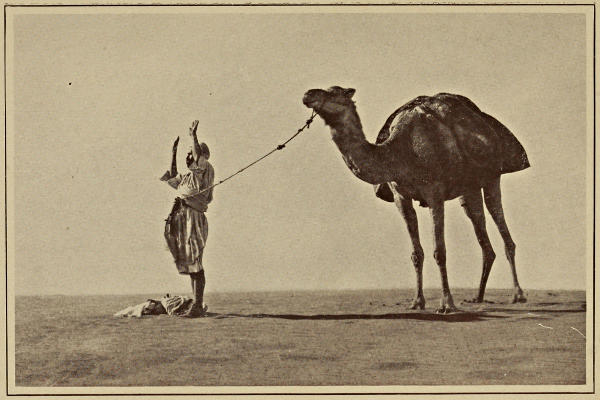
Prayer in the desert
Sometimes our caravan would pass a camel’s skeleton bleached by the torrid sun. When a camel grows footsore or breaks down, there is no alternative: the poor beast is left to die in the wilderness. The second day we passed villages and cultivated fields; that night we spread our blankets on the soft sand, surrounded by thousands of sheep and goats, driven in by Bedouin lasses from their mountain pastures. Even among these shepherds we found readers, and the colporteur sold books wherever the camels halted long enough to strike a bargain. It was late on Wednesday, May 23d, that we entered the narrow pass of Hitta. Our guides preceded, mounted, but with rifles loaded and cocked; then followed the baggage camel, to which mine was “towed,” and in similar fashion my companion on the milch camel followed by its two colts. We were not troubled with the heat at night, but during the day it was intense, and it was refreshing to come to an oasis (common in this part of Oman) where water burst from a big spring, and trees and flowers grew in luxury. In the mountainous parts of Oman the roads run almost invariably along sandy watercourses or deep, rocky ravines. Tamarisks, oleanders, euphorbias, and acacias are the most common trees and shrubs. Where the country appears almost barren, we were surprised to find a considerable population of shepherds and goatherds. Their dwellings are mere oval shanties constructed of boulders or rocks. In the fertile valleys the population always centres in villages, and scarcely ever is a dwelling found at any distance from this common centre.
Just at the top of the pass of Hitta is the village ’Ajeeb rightly named “wonderful.” The view down the mountains over the fertile stretch of coast called the Batinah and out over the boundless Indian Ocean was grand. We descended to the sea, and the turbulent mountain stream, so cold to our bare feet as we waded it in the early dawn, dwindled to a brook, and at last ebbed away along the beach a tiny stream of fresh water. These perennial streams are the secret of a coast fertile for nearly a hundred and fifty miles.
At Shinas, on the sea, we spent a hot day. The mosque was our pulpit and salesroom. One graybeard took us to his hut after noonday prayer to offer us simple hospitality. He spoke with fervour of my brother, Peter J. Zwemer, who came to his village three years previous. From Shinas our camels took us to Sohar. At the large village of El Wa we were unable to stop, as the camel-men were afraid of smallpox, which was prevalent there. Every one we passed on the way was friendly to a remarkable degree. The women brought fresh milk and fruit to us ere we dismounted, and the boys, instead of mocking the strange foreigners, salaamed, delighted to hear that in spite of our appearance we spoke Arabic. Not one copper did we spend for food and lodging; it is the land of large-hearted hospitality. To help a sick child or give quinine to some ague-tormented Arab was to them a large return for their kindness to a “son-of-the-road.”
My second journey across the northern horn of Oman was made in May, 1901, with the same travelling companion; and sailing from Bahrein to Abu Thabi we went straight east to the coast of Oman and then along its shores all the way to Muscat by camel. It was the longest camel journey that ever I made, and when I reached Muscat I was convinced that the camel is not only the ship, but the hardship of the desert.
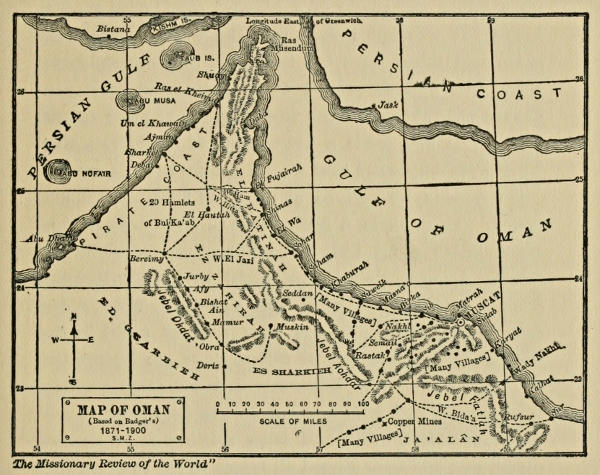
“The Missionary Review of the World” Map of Oman
The town of Abu Thabi from which we started is situated on a sort of island formed by the back-water of its harbour. A chasm about two hundred yards wide, and even at low water, four or five feet deep protects the town against desert invasion, and a fort has been built close to this water barrier. After our camels had waded through the water breast deep and nearly soaked our luggage, we began the desert journey. For three hours the road was as level as a table and equally barren; then we passed some outcropping rocks called the devil’s castle. All that day and the next we rode through sandy deserts with scarcely any vegetation, resting at noon under the shade of a blanket roped over our two boxes. It was hot indeed, and the water in our water skins had taken on a bad taste after the long and jerky ride. We had dates and made some soup from condensed vegetables, but the Bedouins of our party caught big lizards and made a boiled mess of them, with rice. They were displeased that we did not share their meal.
On Sunday we arrived at an Arab encampment and rested. They made a feast for us of fresh milk, and at night killed a fat kid, and made cakes baked on hot ashes. At nine o’clock that night we left our Bedouin friends, and rode on until past midnight, always due east by the stars. It was very cold at night in the desert. These extremes of temperature are trying, but not unhealthy. The following day we came across a poor nomad girl who was lost in the desert and nearly dying of thirst. She had been seeking for a strayed camel, and had then missed all traces of the road herself. For two days she had been alone in the desert, and had almost given up hope. Our guide gave her some water and dates and showed her the nearest way to the encampment. All this stretch of country as far as Bereimy is a wide wilderness of sand for miles and miles in every direction; not level sand, but sand in big folds and billows a hundred feet high, that change with every storm.
It was a delightful change to reach the oasis of Bereimy with its seven villages, joined by streams of fresh water, and date plantations, as well as high mango trees and gardens of vegetables. Beyond this oasis the mountain road passed numerous villages to Obri and Dank. We took the shorter road through Wady-el-Jazi, direct to Sohar. The Arabs in this part of the world are perpetually at war with each other. Everybody gets up armed and goes to bed with a rifle by his side. Even little boys carry a dagger in their belts, and old men will part with anything rather than their shotguns. We met with no mishap by the way, however, and reached Sohar safely, but we did not go to Muscat by sea because there was no wind. Instead we encouraged each other to stick to our rough camel saddles for four days more, which made the entire distance from Abu Thabi to Muscat nearly three hundred miles.
The whole country is most interesting. In spite of continual warfare, the peasants seem to find time to cultivate every fertile spot, and raise all sorts of crops. We saw barley, wheat, sesame, vegetables and even tobacco. In one village we rested on the wide threshing floor where the old-fashioned instrument with sharp teeth, of which the Bible speaks, lay idle. The Oman plow is much better than those in North Arabia. There they plow with a crooked stick, whose sharp prong is strong enough to break up the sandy loam, but in this mountain region the peasants make a real coulter of iron and fit it to a heavy frame, braced to an upright handle of three bars set at right angles. The dress of the men and women is quite distinct from that in other parts of Arabia, and their houses are built like castles. Nearly every well is protected by a fort, and villages only a mile or two apart often carry on war with each other for many, many years. This is the chief obstacle to travel in the hill country of Oman.
Before you forget our journey across this part of Arabia, I want you to think of an Arab praying in the desert. One of the names the Arabs give to the desert is the “Garden of Allah,” because they say there is nothing but God; no other life, or sound or scene to distract one’s attention; only the great blue vault above, without a cloud, and the wide stretch of sand and rock all around the horizon. No wonder that the desert has been God’s training school for many of His prophets and teachers. Think of Moses, and Elijah and Paul and Christ.