Volume 3 — OLD-FASHIONED STORIES (continued 5)
Reading edition
"We will make her amends," said Quidd, "all the money we get shall be hers."
"Oh yes; that is quite fair," said I.
When the evening came and it was quite dark, Simon and I went to the back part of Quidd's father's house. After waiting some little time we heard a knock. Presently Quidd opened the gates and came out.
"There, get it," said he. "Look about to see if anybody is coming, and you can take it away."
We did so. The coast was clear, and out rolled the chair.
Simon and I took hold of it, one behind and one before at the handle-stick. Away we went, as had been preconcerted between us in the stable-yard of another schoolfellow of ours in the plot, who placed it near the gate and covered it over with loose straw, so that no one could see it.
The next evening, which was the fourth of November, we met again by appointment at the dark hollow of the churchyard. This meeting was for the purpose of determining about the way in which Dame Clackett should be dressed in her triumphal entry to the Town Hall, the place where the bonfires were usually made. Hardy had brought what was of essential service—namely, an old coat which had formerly belonged to his father when in the yeomanry cavalry, an old helmet, a cartridge-box, and a pair of boots.
"We shall never get the boots on," said I.
Another boy brought an old lantern with the horn burnt out, a third a bunch of matches; then there was a mask and a lath-sword and a drum, with sticks and straw in abundance. They were all deposited in the same place with the chair. The conspirators (for conspirators we were) then made a promise to each other not to split, as they call it—that is, not to betray each other, and to go through with our work like Britons; so we all shook hands and parted.
The next morning was a holiday, and we were up betimes. After a consultation it was determined that I and Quidd should go to the old dame and see how she was, and if she was determined to go to church, and if there would be any difficulty to get her to accept of the convenience of our vehicle; so off we set. In less than half-an-hour we reached the old dame's cottage, and found her at that very moment dressing her foot.
Quidd was the first who spoke.
"Good morning, Goody," said he. "What, is not your foot well yet? Why, I hear you have not been to church lately. The curate was at father's last night, and said if you were so lame that you could not walk, you might have our easy four-wheeled chair. But I suppose you won't go to church to-day—it is only the fifth of November?"
"Not go to church!" said the old woman—"not go to church! I have always gone on the fifth of November for forty years. My poor husband was in a French prison, and he knew well enough what the Jacobites are. Was he not blown up, poor fellow, in the 'Glorious?' and were not King James and all his people to have been blown up so high by the horrid Papist plot that I suppose they would not have been down by this time? No Popery, I say! I would sooner crawl to church on my hands and knees than not go to-day, young gentlemen. And then Mr. Hassock, the kind, good curate, to ask for me!"
"Yes, and then there is the 'coal money' given on the fifth, that all the widows in the parish may have a good fire through the winter, you know, Goody."
"Yes, I must go to church," said Mrs. Clackett.
"That you must," said Quidd, "and I will tell you what these young gentlemen and I will do. We will bring down the chair, and take you there ourselves. I am sure it would please Mr. Hassock. Would it not, Parley?"
"Yes, and the rector also," said I. "And I have no doubt but the churchwardens would like to see Goody at church, for the tickets for flannel petticoats are to be given away to-day."
"What is that?" said Mrs. Clackett. "Oh, yes, I could not keep away from my church! Good young gentlemen, I shall never forget your kindness."
We stopped to hear no more. We were overjoyed with the success of our plot. Away we ran to our companions, and, without stopping to explain, cried out:
"The chair! the chair! We shall have a guy, the best in the whole country!"
So away we ran with the chair, and all our other preparations for dressing and tying and securing.
The whole party surrounded the chair, some pushing, some pulling. When, however, we got within a convenient distance of the old lady's hut, Hardy and the others stepped on one side, and placed the helmet, coat, lantern, matches, etc., under a hedge, to be ready when required, while Quidd, Sapskull, and myself went with the chair to the old lady's cottage.
When we got there we found her spruce and prim with her best black silk bonnet, something in shape like a coal-scuttle, her stick in her hand, and her shoes on her feet. We drove up the chair in fine style. There were several cottages close by, and the neighbors came out to see the old lady ride. At last some one who knew Quidd said:
"Why, that is the lawyer's son. Sure enough old Goody has got some money left her."
So then there was a talking and surmising, and before Goody got to church it was reported all over the town that she was made the possessor of several thousand pounds prize-money; that she was to be a lady, and ride in her carriage. Being sent for, as it was supposed, by the lawyer must be for something—a large legacy, no doubt.
The chair wheeled on with Goody in it. The boys looked as if they were up to something, and sure enough they were. When they came to that part of the lane at which the various habiliments had been left, the chair stopped, and out rushed the other conspirators.
"Do not be alarmed, Goody," said Hardy. "We are only going to make a guy of you for an hour or two. No one shall harm you, and you shall have all the money we get."
"I want to go to church—I want to go to church!" said the old lady, and tried to get out of the chair.
Hardy, however, very dexterously threw some cord round the arms, and tied the poor old creature down.
"We won't hurt you, Goody," said he. "We only want you for a guy. You shall have all the money."
"I won't be a guy! I won't be a guy!" said Goody. "I do not want any money. Let me out! let me out!"
She then made a blow with her broomstick, and struck Master Hardy on the nose, from which the blood flowed freely. This, however, only made him the more determined, and in a few minutes the poor old woman's arms were secured as well as her legs.
"Oh, help, neighbors! They are going to burn me!" said the old lady, and then she fell coughing, for she had long suffered from asthma.
While convulsed with this fit, the boys took the opportunity to besmear her face with red and black paint, and to place the helmet on her head, and the coat round her, so that the arms hung on each side with nothing on them. The chair was then crammed with straw, and the lantern and the matches suspended from it. In this state the chair was wheeled rapidly along in the direction of the town.
Other boys soon joined, and surrounded the vehicle, shouting and laughing. The old lady, made several ineffectual attempts to get out of the chair. She called out, "A plot! a plot! a Popery plot! No Popery! Oh! I shall be killed!" and many such exclamations. The populace took this as a part of the character, and laughed most heartily. The greatest number of persons thought the guy to be a boy dressed up, and cried out that he acted his part well. No one suspected it was old Dame Clackett.
Away they went in the midst of the hubbub, up one street and down another, over the market-place and by the church. Just as the clock struck twelve the boys of the Free School came from the latter place, and joined the procession. It was now a national affair, and, as it proceeded from the church doors, it was thought to be the church Guy Fawkes—and so it was.
"Hurrah! hurrah!" shouted a hundred voices; and while Hardy and his companions held on the chair, Quidd and I went about with our hats to collect as much money as we could.
The old lady was vociferous, and struggled to get out. She flung her arms about, and cried out, "Deliver me from the flames! Save me from being burnt!" and everybody thought that the part of guy was acted to perfection.
Quidd and I got a great deal of money—silver, and copper, and even gold. Seven-shilling pieces were in circulation at that time, and the squire and Mr. Hassock passing us, one threw sixpence and the other a seven-shilling piece to us, for which we gave a louder cheer than usual. In short, our hats were very nearly half full of money.
The old woman began to be more pacified as she saw the money coming in, particularly as we put it all into her lap, and told her it should be hers. But the sight of the squire and the curate, and the seven-shilling piece, which latter we put into her mouth, seemed quite to reconcile her to her fate. She became then as gentle as a lamb. She said:
"Do as you like—do as you like, only don't burn me for a guy; and give me a drop of something to drink."
"Oh yes," said Quidd, "here is something for you. Hold up your head."
And half a pint of good strong ale soon found its way down the throat of the dame. After this the chair again moved on, till at last it came to the market-place, opposite the Town Hall, where an enormous bonfire was in preparation, over which stood a gallows.
The old lady, when she saw the gallows, screamed "Murder! fire! brimstone!" and all sorts of horrid cries; but nobody took any heed of it, except to laugh. They thought it was in keeping with her character.
"We will not hurt you, we will not hurt you," said I.
But it was of no use; the old lady refused to be pacified.
Just at this moment Quidd felt a severe blow from behind, which sent him sprawling. I also received a push or a drive, and a loud laugh burst from those around.
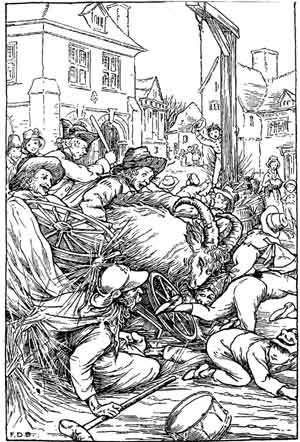
When I turned to see what was the cause of the laughter, what should I observe but Hannibal, the goat, who had, it appeared, followed his mistress, and, being excited by her cries, dashed at my schoolfellow in the way described. Several of the spectators now tried to seize the goat, but he being of extraordinary strength, butted and pushed so vigorously that several measured their length upon the earth, to the no small merriment of the clownish persons who had collected together to the burning of the guy.
During all this time Dame Clackett cried out loudly, and in the confusion her chair was upset, and she became liberated from her duress. As soon as she was free, she laid about on all sides of her with her stick, pulled off the helmet and jacket in which she had been nearly smothered, and cried out at the top of her voice:
"I am no guy! I am Dame Clackett! For goodness' sake do not burn me for a witch!"
She, however, kept her apron close in which the money was, and took care not to let the seven-shilling piece fall out of her mouth.
The mob cheered. It would have been well if this had been all, but no: as soon as ever the old lady told her story that she had been seized for a guy, an effort was immediately made to secure the offenders. The constable, who happened to be present, laid hold of me and cousin Simon; several others were seized by the bystanders; and the whole, with the exception of Quidd, were dragged off to what in the country is called the goose-house—that is, the cage. Quidd, lawyer-like, contrived to get out of the scrape, leaving others in it. So we were all put into the cage, and bolted and barred. It was very dark, and as we were terribly frightened, we all began to howl most hideously.
the goat dashed in among them and the chair was upset
As to Quidd, he went homewards, as if nothing had happened, and soon made his reappearance, prepared for the usual squibbing and cracking, with his pockets full of squibs and crackers. He was so pleased with the success of the scheme in which he had been so forward an actor that he determined to have more fun before he went to bed; so he looked about, and it was not long before he saw a fit object, as he thought.
At the corner of the street leading to the market-place sat poor old Hannah Grimly, as she was called. She had sold roasted chestnuts on the fifth of November for a score of years, and many a pinch of gunpowder had been put under the lid of the saucepan upon which the chestnuts were laid. Quidd determined to have a good explosion, and took the opportunity, while the chestnuts were being put into his hand, to introduce a packet of gunpowder into the kettle. He thought to run away before it should ignite, but there being a small hole in the paper, the moment it touched the fire the whole went off with a loud explosion. Quidd's hand was shattered to pieces, and he fell stunned with the effects of the powder. He was taken home senseless, and put to bed.
The rest of the conspirators, including myself, were kept in the cage all night in bitter tears. The next morning we were taken before the magistrates. The chairman, who happened to be the very squire who had given us the seven-shilling piece, looked very severely at us, and said:
"This is the most horrible plot I ever heard of—seizing an old woman for a guy! Gentlemen," said he to those around him, "if this be permitted none of us are safe."
Some people used to call the magistrates old women, and so this raised a laugh.
He then called to the clerk to look over the Act of Parliament to see what could be the punishment for such an offence, but found none. Quidd was right—there was no law against seizing an old woman for a guy. The bench were puzzled what to do. At last Quidd's father said we should be indicted for stealing his chair, and be put on our trial for robbery and sacrilege—the first for the abduction of the chair, the second for keeping the old lady from church.
Our fathers and mothers, however, pleaded so eloquently that, after a severe admonition, we got off upon payment of the costs and a handsome compensation to Dame Clackett. When I reached home my father took me into the stable and gave me a sound whipping, and at the conclusion of the flagellation said:
"Now, Peter Parley, I think you will not again seize an old woman for a guy!"
And I never did.
UNCLE DAVID'S NONSENSICAL STORY ABOUT GIANTS AND FAIRIES
By KATHERINE SINCLAIR
In the days of yore children were not all such clever, good, sensible people as they are now. Lessons were then considered rather a plague, sugar-plums were still in demand, holidays continued yet in fashion, and toys were not then made to teach mathematics, nor storybooks to give instruction in chemistry and navigation. These were very strange times, and there existed at that period a very idle, greedy, naughty boy, such as we never hear of in the present day. His father and mother were—no matter who, and he lived—no matter where. His name was Master No-book, and he seemed to think his eyes were made for nothing but to stare out of the windows, and his mouth for no other purpose but to eat. This young gentleman hated lessons like mustard, both of which brought tears into his eyes, and during school hours he sat gazing at his books, pretending to be busy, while his mind wandered away to wish impatiently for dinner, and to consider where he could get the nicest pies, pastry, ices, and jellies, while he smacked his lips at the very thoughts of them.
Whenever Master No-book spoke it was always to ask for something, and you might continually hear him say in a whining tone of voice: "Father, may I take this piece of cake?" "Aunt Sarah, will you give me an apple?" "Mother, do send me the whole of that plum-pudding." Indeed, very frequently, when he did not get permission to gormandize, this naughty glutton helped himself without leave. Even his dreams were like his waking hours, for he had often a horrible nightmare about lessons, thinking he was smothered with Greek lexicons or pelted out of the school with a shower of English grammars, while one night he fancied himself sitting down to devour an enormous plum-cake, and all on a sudden it became transformed into a Latin dictionary.
One afternoon Master No-book, having played truant all day from school, was lolling on his mother's best sofa in the drawing-room, with his leather boots tucked up on the satin cushions, and nothing to do but to suck a few oranges, and nothing to think of but how much sugar to put upon them, when suddenly an event took place which filled him with astonishment.
A sound of soft music stole into the room, becoming louder and louder the longer he listened, till at length, in a few moments afterwards, a large hole burst open in the wall of his room, and there stepped into his presence two magnificent fairies, just arrived from their castles in the air, to pay him a visit. They had traveled all the way on purpose to have some conversation with Master No-book, and immediately introduced themselves in a very ceremonious manner.
The fairy Do-nothing was gorgeously dressed with a wreath of flaming gas round her head, a robe of gold tissue, a necklace of rubies, and a bouquet in her hand of glittering diamonds. Her cheeks were rouged to the very eyes, her teeth were set in gold, and her hair was of a most brilliant purple; in short, so fine and fashionable-looking a fairy never was seen in a drawing-room before. The fairy Teach-all, who followed next, was simply dressed in white muslin, with bunches of natural flowers in her light-brown hair, and she carried in her hand a few neat small volumes, which Master No-book looked at with a shudder of aversion.
The two fairies now informed him that they very often invited large parties of children to spend some time at their palaces, but as they lived in quite an opposite direction, it was necessary for their young guests to choose which it would be best to visit first; therefore they had now come to inquire of Master No-book whom he thought it would be most agreeable to accompany on the present occasion.
"In my house," said the fairy Teach-all, speaking with a very sweet smile and a soft, pleasing voice, "you shall be taught to find pleasure in every sort of exertion, for I delight in activity and diligence. My young friends rise at seven every morning, and amuse themselves with working in a beautiful garden of flowers, rearing whatever fruit they wish to eat, visiting among the poor, associating pleasantly together, studying the arts and sciences, and learning to know the world in which they live, and to fulfil the purposes for which they have been brought into it. In short, all our amusements tend to some useful object, either for our own improvement or the good of others, and you will grow wiser, better, and happier every day you remain in the palace of Knowledge."
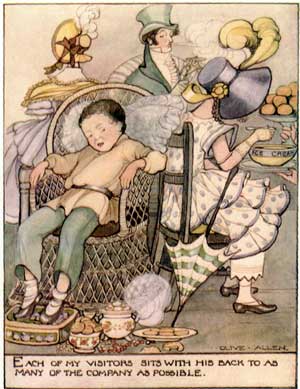
"But in Castle Needless, where I live," interrupted the fairy Do-nothing, rudely pushing her companion aside with an angry, contemptuous look, "we never think of exerting ourselves for anything. You may put your head in your pocket and your hands in your sides as long as you choose to stay. No one is ever asked a question, that he may be spared the trouble of answering. We lead the most fashionable life imaginable, for nobody speaks to anybody. Each of my visitors is quite an exclusive, and sits with his back to as many of the company as possible, in the most comfortable arm-chair that can be contrived. There, if you are only so good as to take the trouble of wishing for anything, it is yours without even turning an eye round to look where it comes from. Dresses are provided of the most magnificent kind, which go on themselves, without your having the smallest annoyance with either buttons or strings; games which you can play without an effort of thought; and dishes dressed by a French cook, smoking hot under your nose, from morning till night; while any rain we have is either made of lemonade or lavender-water, and in winter it generally snows iced punch for an hour during the forenoon."
each of my visitors is quite an exclusive
Nobody need be told which fairy Master No-book preferred, and quite charmed at his own good fortune in receiving so agreeable an invitation, he eagerly gave his hand to the splendid new acquaintance who promised him so much pleasure and ease, and gladly proceeded in a carriage lined with velvet, stuffed with downy pillows, and drawn by milk-white swans, to that magnificent residence, Castle Needless, which was lighted by a thousand windows during the day, and by a million of lamps every night.
Here Master No-book enjoyed a constant holiday and a constant feast, while a beautiful lady covered with jewels was ready to tell him stories from morning till night, and servants waited to pick up his playthings if they fell, or to draw out his purse or his pocket-handkerchief when he wished to use them.
Thus Master No-book lay dozing for hours and days on rich embroidered cushions, never stirring from his place, but admiring the view of trees covered with the richest burnt almonds, grottoes of sugar-candy, a jet d'eau of champagne, a wide sea which tasted of sugar instead of salt, and a bright, clear pond, filled with gold fish that let themselves be caught whenever he pleased. Nothing could be more complete, and yet, very strange to say, Master No-book did not seem particularly happy. This appears exceedingly unreasonable, when so much trouble was taken to please him; but the truth is that every day he became more fretful and peevish. No sweetmeats were worth the trouble of eating, nothing was pleasant to play at, and in the end he wished it were possible to sleep all day, as well as all night.
Not a hundred miles from the fairy Do-nothing's palace there lived a most cruel monster called the giant Snap-'em-up, who looked, when he stood up, like the tall steeple of a great church, raising his head so high that he could peep over the loftiest mountains, and was obliged to climb up a ladder to comb his own hair.
Every morning regularly this prodigiously great giant walked round the world before breakfast for an appetite, after which he made tea in a large lake, used the sea as a slop-basin, and boiled his kettle on Mount Vesuvius. He lived in great style, and his dinners were most magnificent, consisting very often of an elephant roasted whole, ostrich patties, a tiger smothered in onions, stewed lions, and whale soup; but for a side-dish his greatest favorite consisted of little boys, as fat as possible, fried in crumbs of bread, with plenty of pepper and salt.
No children were so well fed or in such good condition for eating as those in the fairy Do-nothing's garden, who was a very particular friend of the giant Snap-'em-up's, and who sometimes laughingly said she would give him a license, and call her own garden his "preserve," because she always allowed him to help himself, whenever he pleased, to as many of her visitors as he chose, without taking the trouble to even count them; and in return for such extreme civility, the giant very frequently invited her to dinner.
Snap-'em-up's favorite sport was to see how many brace of little boys he could bag in a morning; so, in passing along the streets, he peeped into all the drawing-rooms, without having occasion to get upon tiptoe, and picked up every young gentleman who was idly looking out of the windows, and even a few occasionally who were playing truant from school; but busy children seemed always somehow quite out of his reach.
One day, when Master No-book felt even more lazy, more idle, and more miserable than ever, he lay beside a perfect mountain of toys and cakes, wondering what to wish for next, and hating the very sight of everything and everybody. At last he gave so loud a yawn of weariness and disgust that his jaw very nearly fell out of joint, and then he sighed so deeply that the giant Snap-'em-up heard the sound as he passed along the road after breakfast, and instantly stepped into the garden, with his glass at his eye, to see what was the matter. Immediately, on observing a large, fat, overgrown boy, as round as a dumpling, lying on a bed of roses, he gave a cry of delight, followed by a gigantic peal of laughter, which was heard three miles off, and picking up Master No-book between his finger and thumb, with a pinch that very nearly broke his ribs, he carried him rapidly towards his own castle, while the fairy Do-nothing laughingly shook her head as he passed, saying:
"That little man does me great credit. He has only been fed for a week, and is as fat already as a prize ox. What a dainty morsel he will be! When do you dine to-day, in case I should have time to look in upon you?"
On reaching home the giant immediately hung up Master No-book by the hair of his head, on a prodigious hook in the larder, having first taken some large lumps of nasty suet, forcing them down his throat to make him become still fatter, and then stirring the fire, that he might be almost melted with heat, to make his liver grow larger. On a shelf quite near Master No-book perceived the bodies of six other boys, whom he remembered to have seen fattening in the fairy Do-nothing's garden, while he recollected how some of them had rejoiced at the thoughts of leading a long, useless, idle life, with no one to please but themselves.
The enormous cook now seized hold of Master No-book, brandishing her knife with an aspect of horrible determination, intending to kill him, while he took the trouble of screaming and kicking in the most desperate manner, when the giant turned gravely round, and said that, as pigs were considered a much greater dainty when whipped to death than killed in any other way, he meant to see whether children might not be improved by it also; therefore she might leave that great hog of a boy till he had time to try the experiment, especially as his own appetite would be improved by the exercise. This was a dreadful prospect for the unhappy prisoner, but meantime it prolonged his life a few hours, as he was immediately hung up in the larder and left to himself. There, in torture of mind and body, like a fish upon a hook, the wretched boy began at last to reflect seriously upon his former ways, and to consider what a happy home he might have had, if he could only have been satisfied with business and pleasure succeeding each other, like day and night, while lessons might have come in as a pleasant sauce to his play-hours, and his play-hours as a sauce to his lessons.
In the midst of many reflections, which were all very sensible, though rather too late, Master No-book's attention be- came attracted by the sound of many voices laughing, talking, and singing, which caused him to turn his eyes in a new direction, when, for the first time, he observed that the fairy Teach-all's garden lay upon a beautiful sloping bank not far off. There a crowd of merry, noisy, rosy-cheeked boys were busily employed, and seemed happier than the day was long, while poor Master No-book watched them during his own miserable hours, envying the enjoyment with which they raked the flower-borders, gathered the fruit, carried baskets of vegetables to the poor, worked with carpenter's tools, drew pictures, shot with bows-and-arrows, played at cricket, and then sat in the sunny arbors learning their tasks, or talking agreeably together, till at length, a dinner-bell having been rung, the whole party sat merrily down with hearty appetites and cheerful good humor, to an entertainment of plain roast meat and pudding, where the fairy Teach-all presided herself, and helped her guests moderately to as much as was good for each.
Large tears rolled down the cheeks of Master No-book while watching this scene, and remembering that if he had known what was best for him, he might have been as happy as the happiest of these excellent boys, instead of suffering ennui and weariness, as he had done at the fairy Do-nothing's, ending in a miserable death. But his attention was soon after most alarmingly roused by hearing the giant Snap-'em-up again in conversation with his cook, who said that, if he wished for a good large dish of scolloped children at dinner, it would be necessary to catch a few more, as those he had already provided would scarcely be a mouthful.
As the giant kept very fashionable hours, and always waited dinner for himself till nine o'clock, there was still plenty of time; so, with a loud grumble about the trouble, he seized a large basket in his hand, and set off at a rapid pace towards the fairy Teach-all's garden. It was very seldom that Snap-'em-up ventured to think of foraging in this direction, as he never once succeeded in carrying off a single captive from the enclosure, it was so well fortified and so bravely defended; but on this occasion, being desperately hungry, he felt as bold as a lion, and walked, with outstretched hands, straight towards the fairy Teach-all's dinner-table, taking such prodigious strides that he seemed almost as if he would trample on himself.
A cry of consternation arose the instant this tremendous giant appeared, and, as usual on such occasions, when he had made the same attempt before, a dreadful battle took place. Fifty active little boys bravely flew upon the enemy, armed with their dinner-knives, and looked like a nest of hornets, stinging him in every direction, till he roared with pain, and would have run away; but the fairy Teach-all, seeing his intention, rushed forward with the carving-knife, and brandishing it high over her head, she most courageously stabbed him to the heart.
If a great mountain had fallen to the earth it would have seemed like nothing in comparison with the giant Snap-em-up, who crushed two or three houses to powder beneath him, and upset several fine monuments that were to have made people remembered for ever. But all this would have seemed scarcely worth mentioning had it not been for a still greater event which occurred on the occasion, no less than the death of the fairy Do-nothing, who had been indolently looking on at this great battle without taking the trouble to interfere, or even to care who was victorious; but being also lazy about running away, when the giant fell, his sword came with so violent a stroke on her head that she instantly expired.
Thus, luckily for the whole world, the fairy Teach-all got possession of immense property, which she proceeded without delay to make the best use of in her power.
In the first place, however, she lost no time in liberating Master No-book from his hook in the larder, and gave him a lecture on activity, moderation, and good conduct, which he never afterwards forgot; and it was astonishing to see the change that took place immediately in his whole thoughts and actions. From this very hour Master No-book became the most diligent, active, happy boy in the fairy Teach-all's garden; and on returning home a month afterwards, he astonished all the masters at school by his extraordinary reformation. The most difficult lessons were a pleasure to him, he scarcely ever stirred without a book in his hand, never lay on a sofa again, would scarcely even sit on a chair with a back to it, but preferred a three-legged stool, detested holidays, never thought any exertion a trouble, preferred climbing over the top of a hill to creeping round the bottom, always ate the plainest food in very small quantities, joined a temperance society, and never tasted a morsel till he had worked very hard and got an appetite.
Not long after this an old uncle, who had formerly been ashamed of Master No-book's indolence and gluttony, became so pleased at the wonderful change that on his death he left him a magnificent estate, desiring that he should take his name; therefore, instead of being any longer one of the No-book family, he is now called Sir Timothy Blue-stocking, a pattern to the whole country around for the good he does to everyone, and especially for his extraordinary activity, appearing as if he could do twenty things at once. Though generally very good-natured and agreeable, Sir Timothy is occasionally observed in a violent passion, laying about him with his walking-stick in the most terrific manner, and beating little boys within an inch of their lives; but on inquiry it invariably appears that he has found them out to be lazy, idle, or greedy; for all the industrious boys in the parish are sent to get employment from him, while he assures them that they are far happier breaking stones on the road than if they were sitting idly in a drawing-room with nothing to do.
THE INQUISITIVE GIRL
Dr. Hammond was a physician in great practice in the West of England. He resided in a small market-town and his family consisted of one son, named Charles, and two daughters, Louisa and Sophy.
Sophy possessed many amiable qualities, and did not want for sense, but every better feeling was lost in her extreme inquisitiveness. Her faculties were all occupied in peeping and prying about, and, provided she could gratify her own curiosity, she never cared how much vexation she caused to others.
This propensity began when she was so very young that it had become a habit before her parents perceived it. She was a very little creature when she was once nearly squeezed to death between two double doors as she was peeping through the keyhole of one of them to see who was in the drawing-room; and another time she was locked up for several hours in a closet in which she had hid herself for the purpose of overhearing what her mother was saying to one of the servants.
When Sophy was eleven and her sister about sixteen years old their mother died. Louisa was placed at the head of her father's house, and the superintendence of Sophy's education necessarily devolved on her. The care of such a family was a great charge for a young person of Miss Hammond's age, and more especially as her father was obliged to be so much from home that she could not always have his counsel and advice even when she most needed it. By this means she fell into an injudicious mode of treating her sister.
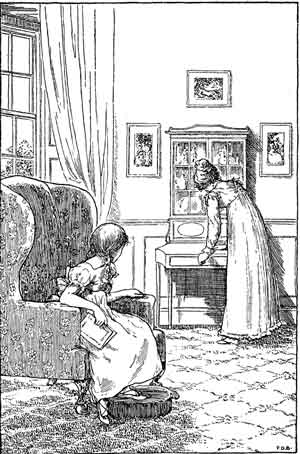
If Louisa received a note she carefully locked it up, and never spoke of its contents before Sophy. If a message was brought to her she always went out of the room to receive it, and never suffered the servant to speak in her sister's hearing. When any visitors came Louisa commonly sent Sophy out of the room, or if they were intimate friends she would converse with them in whispers; in short, it was her chief study that everything which passed in the family should be a secret from Sophy. Alas! this procedure, instead of repressing Sophy's curiosity, only made it the more keen; her eyes and ears were always on the alert, and what she could not see, hear, or thoroughly comprehend she made out by guesses.
The worst consequence of Louisa's conduct was that as Sophy had no friend and companion in her sister, who treated her with such constant suspicion and reserve, she necessarily was induced to find a friend and companion among the servants, and she selected the housemaid Sally, a good-natured, well-intentioned girl, but silly and ignorant and inquisitive like herself, and it may be easily supposed how much mischief these two foolish creatures occasioned, not only in the family, but also among their neighbors.
It happened soon after, that for an offence which was the cause of very great vexation to her brother, and was the occasion of his being for a time deprived of the friendship of Sir Henry and Lady Askham, two of Dr. Hammond's nearest and most intimate neighbors, her father ordered Sophy, as a still further punishment, to be locked up in her own room till the Sunday following. This was on Friday, and Sophy had two days of solitude and imprisonment before her. The first day she passed very dismally, but yet not unprofitably, for she felt truly ashamed and sorry for her fault, and made many good resolutions of endeavoring to cure herself of her mischievous propensity. The second day she began to be somewhat more composed, and by degrees she was able to amuse herself with watching the people in the street, which was overlooked by the windows of her apartment, and she began, almost unconsciously to herself, to indulge in her old habit of trying to find out what everybody was doing, and in guessing where they were going.
if louisa received a note, she carefully locked it up
She had not long been engaged in watching her neighbors before her curiosity was excited by the appearance of a servant on horseback, who rode up to the door, and, after giving a little three-cornered note to Dr. Hammond's footman, rode off. The servant she knew to be Mrs. Arden's, an intimate friend of her father, and the note she conjectured was an invitation to dinner, and the guessing what day the invitation was for, and who were to be the company, and whether she was included in the invitation, was occupying her busy fancy, when she saw her sister going out of the house with the three-cornered note in her hand, and cross the street to Mr. McNeal's stocking shop, which was opposite. Almost immediately afterwards Mr. McNeal's shopman came out of the shop, and, running down the street, was presently out of sight, but soon returned with Mr. McNeal himself. She saw Louisa reading the note to Mr. McNeal, and in a few minutes afterwards return home. Here was a matter of wonder and conjecture. Sophy forgot all her good resolutions, and absolutely wearied herself with her useless curiosity.
At length the term of her imprisonment was over, and Sophy was restored to the society of her family. At first she kept a tolerable guard over herself. Once she saw her father and sister whispering, and did not, though she longed much to do it, hold her breath that she might hear what they were saying. Another time she passed Charles's door when it was ajar and the little study open, and she had so much self-command that she passed by without peeping in, and she began to think she was cured of her faults. But in reality this was far from being the case, and whenever she recollected Mrs. Arden's mysterious note she felt her inquisitive propensities as strong as ever. Her eyes and ears were always on the alert, in hopes of obtaining some clue to the knowledge she coveted, and if Mrs, Arden's or Mr. McNeal's names were mentioned she listened with trembling anxiety in the hope of hearing some allusion to the note.
At last, when she had almost given up the matter in despair, an unlooked-for chance put her in possession of a fragment of this very note to which she attached so much importance.
One day Louisa wanted to wind a skein of silk, and in looking for a piece of paper to wind it upon she opened her writing-box, and took out Mrs. Arden's note. Sophy knew it again in an instant from its three-cornered shape. She saw her sister tear the note in two, throw one-half under the grate, and fold the other part up to wind her silk upon. Sophy kept her eye upon the paper that lay under the grate in the greatest anxiety, lest a coal should drop upon it and destroy it, when it seemed almost within her grasp. Louisa was called out of the room, and Sophy, overpowered by the greatness of the temptation, forgot all the good resolutions she had so lately made, and at the risk of setting fire to her sleeve, snatched the paper from among the ashes, and concealed it in her pocket. She then flew to her own room to examine it at her ease. The note had been torn the lengthway of the paper, and that part of it of which Sophy had possessed herself contained the first half of each line of the note. Bolting her door for fear of interruption, she read, with trembling impatience, as follows:
Will you be kind enough to go to Mr. McNeal, and tell him he has made a great mistake the last stockings he sent; charging them as silk) he has cheated of several pounds.—I am sorry to say that he has behaved very ill And Mr. Arden tells me that it must end in his being hanged I am exceedingly grieved but fear this will be the end
When Sophy had read these broken sentences she fancied that she fully comprehended the purport of the whole note, and she now saw the reason of her sister's hastening to Mr. McNeal's immediately on the receipt of the note, and of the hurry in which he had been summoned back to his shop. It appeared very clear to her that he had defrauded Mrs. Arden of a considerable sum of money, and that he was no longer that honest tradesman he had been supposed. The weight of this important discovery quite overburdened her, and, forgetful of her past punishment, and regardless of future consequences, she imparted the surprising secret to Sally. Sally was not one who could keep such a piece of news to herself; it was therefore soon circulated through half the town that Mr. McNeal had defrauded Mrs. Arden, and that Mr. Arden declared he would have him hanged for it. Several persons in consequence avoided Mr. McNeal's shop, who saw his customers forsaking him without being able to know why they did so. Thus the conduct of this inconsiderate girl took away the good name of an honest tradesman, on no better foundation than her own idle conjectures, drawn from the torn fragments of a letter.
Mr. McNeal at length became informed of the injurious report that was circulated about him. He immediately went to Mrs. Arden to tell her of the report, and to ask her if any inadvertency of his own in regard to her dealings at his shop occasioned her speaking so disadvantageously of him. Mrs. Arden was much astonished at what he told her, as she might well be, and assured him that she had never either spoken of him or thought of him but as thoroughly an honorable and honest tradesman. Mrs. Arden was exceedingly hurt that her name should be attached to such a cruel calumny, and, on consulting with Sir Henry Askham, it was agreed that he and Mrs. Arden should make it their business to trace it back to its authors. They found no real difficulty in tracing it back to Sally, Dr. Hammond's servant. She was accordingly sent for to Mr. McNeal's, where Sir Henry Askham and Mr. Arden, with some other gentlemen, were assembled on this charitable investigation. Sally, on being questioned who had told her of the report, replied, without hesitation, that she had been told by Miss Sophy, who had seen all the particulars in Mrs. Arden's handwriting.
Mr. Arden was greatly astonished at hearing this assertion, and felt confident that the whole must have originated from some strange blunder. He and the other gentlemen immediately proceeded to Dr. Hammond's, and having explained their business to him, desired to see Sophy. She, on being asked, confirmed what Sally had said, adding that to satisfy them she could show them Mrs. Arden's own words, and she accordingly produced the fragment of the note. Miss Hammond, the instant she saw the paper recollected it again, and winding off the silk from the other half of Mrs. Arden's note, presented it to Mr. Arden, who, laying the two pieces of paper together read as follows:
"My dear Miss Hammond,—Will you as soon as you receive this be kind enough to go to your opposite neighbor, Mr. McNeal, and tell him I find by looking at his bill he has made a great mistake as to the price of the last stockings he sent; and it seems to me (by not charging them as silk) he has cheated himself, as he'll see, of several pounds.—I am sorry to say of our new dog, that he has behaved very ill and worried two sheep, and Mr. Arden tells me he very much fears it must end in his being hanged or he'll kill all the flock. I am exceedingly grieved, for he is a noble animal, but fear this will be the end of my poor dog.
"I am, dear Louisa, yours truly
"Mary Arden."
Thus by the fortunate preservation of the last half of the note the whole affair was cleared up, Mrs. Arden's character vindicated from the charge of being a defamer, and Mr. McNeal from all suspicion of dishonesty. And all their friends were pleased and satisfied. But how did Sophy feel? She did feel at last both remorse and humiliation. She had no one to blame but herself; she had no one to take her part, for even her father and her brother considered it due to public justice that she should make a public acknowledgment of her fault to Mr. McNeal, and to ask his pardon.
BUSY IDLENESS
By JANE TAYLOR
Mrs. Dawson being obliged to leave home for six weeks, her daughters, Charlotte and Caroline, received permission to employ the time of her absence as they pleased; that is, she did not require of them the usual strict attention to particular hours and particular studies, but allowed them to choose their own employments—only recommending them to make a good use of the license, and apprising them, that, on her return, she should require an exact account of the manner in which the interval had been employed.
The carriage that conveyed their mother away was scarcely out of hearing, when Charlotte, delighted with her freedom, hastened upstairs to the schoolroom, where she looked around on books, globes, maps, drawings, to select some new employment for the morning. Long before she had decided upon any, her sister had quietly seated herself at her accustomed station, thinking that she could do nothing better than finish the French exercise she had begun the day before. Charlotte, however, declined attending to French that day, and after much indecision, and saying "I have a great mind to" three several times without finishing the sentence, she at last took down a volume of Cowper, and read in different parts for about half an hour. Then throwing it aside, she said she had a great mind to put the bookshelves in order—a business which she commenced with great spirit. But in the course of her laudable undertaking, she met with a manuscript in shorthand; whereupon she exclaimed to her sister, "Caroline, don't you remember that old Mr. Henderson once promised he would teach us shorthand? How much I should like to learn! Only, mamma thought we had not time. But now, this would be such a good opportunity. I am sure I could learn it well in six weeks; and how convenient it would be! One could take down sermons, or anything; and I could make Rachel learn, and then how very pleasant it would be to write to each other in shorthand! Indeed, it would be convenient in a hundred ways." So saying, she ran upstairs, without any further delay, and putting on her hat and spencer, set off to old Mr. Henderson's.
Mr. Henderson happened to be at dinner. Nevertheless, Charlotte obtained admittance on the plea of urgent business; but she entered his apartment so much out of breath, and in such apparent agitation, that the old gentleman, rising hastily from table, and looking anxiously at her over his spectacles, inquired in a tremulous tone what was the matter. When, therefore, Charlotte explained her business, he appeared a little disconcerted; but having gently reproved her for her undue eagerness, he composedly resumed his knife and fork, though his hand shook much more than usual during the remainder of his meal. However, being very good-natured, as soon as he had dined he cheerfully gave Charlotte her first lesson in shorthand, promising to repeat it regularly every morning.
Charlotte returned home in high glee. She at this juncture considered shorthand as one of the most useful, and decidedly the most interesting of acquirements; and she continued to exercise herself in it all the rest of the day. She was exceedingly pleased at being able already to write two or three words which neither her sister nor even her father could decipher. For three successive mornings Charlotte punctually kept her appointment with Mr. Henderson; but on the fourth she sent a shabby excuse to her kind master; and, if the truth must be told, he from that time saw no more of his scholar. Now the cause of this desertion was twofold: first, and principally, her zeal for shorthand, which for the last eight-and-forty hours had been sensibly declining in its temperature, was, on the above morning, within half a degree of freezing point; and, second, a new and far more arduous and important undertaking had by this time suggested itself to her mind. Like many young persons of desultory inclinations, Charlotte often amused herself with writing verses; and it now occurred to her that an abridged history of England in verse was still a desideratum in literature. She commenced this task with her usual diligence; but was somewhat discouraged in the outset by the difficulty of finding a rhyme to Saxon, whom she indulged the unpatriotic wish that the Danes had laid a tax on. But, though she got over this obstacle by a new construction of the line, she found these difficulties occur so continually that she soon felt a more thorough disgust at this employment than at the preceding one. So the epic stopped short, some hundred years before the Norman conquest. Difficulty, which quickens the ardor of industry, always damps, and generally extinguishes, the false zeal of caprice and versatility.
Charlotte's next undertaking was, to be sure, a rapid descent from the last in the scale of dignity. She now thought, that, by working very hard during the remainder of the time, she should be able to accomplish a patch-work counterpane, large enough for her own little tent bed; and the ease of this employment formed a most agreeable contrast in her mind with the extreme difficulty of the last. Accordingly, as if commissioned with a search warrant, she ransacked all her mother's drawers, bags, and bundles in quest of new pieces; and these spoils proving very insufficient, she set off to tax all her friends, and to tease all the linen drapers in the town for their odds and ends, urging that she wanted some particularly. As she was posting along the street on this business, she espied at a distance a person whom she had no wish to encounter, namely, old Mr. Henderson. To avoid the meeting she crossed over. But this maneuver did not succeed; for no sooner had they come opposite to each other, than, to her great confusion, he called out across the street, in his loud and tremulous voice, and shaking his stick at her, "How d'ye do, Miss Shorthand? I thought how it would be! Oh, fie! Oh, fie!"
Charlotte hurried on; and her thoughts soon returned to the idea of the splendid radiating star which she designed for the centerpiece of her counterpane. While she was arranging the different patterns, and forming the alternations of light and shade, her interest continued nearly unabated; but when she came to the practical part of sewing piece to piece with unvarying sameness, it began, as usual, to flag. She sighed several times, and cast many disconsolate looks at the endless hexagons and octagons, before she indulged any distinct idea of relinquishing her task. At length, however, it did forcibly occur to her that, after all, she was not obliged to go on with it; and that, really, patchwork was a thing that was better done by degrees, when one happens to want a job, than to be finished all at once. So, with this thought (which would have been a very good one if it had occurred in proper time), she suddenly drew out her needle, thrust all her pieces, arranged and unarranged, into a drawer, and began to meditate a new project.
Fortunately, just at this juncture some young ladies of their acquaintance called upon Charlotte and Caroline. They were attempting to establish a society among their young friends for working for the poor, and came to request their assistance. Caroline very cheerfully entered into the design; but as for Charlotte, nothing could exceed the forwardness of her zeal. She took it up so warmly that Caroline's appeared, in comparison, only lukewarm. It was proposed that each member of the society should have an equal proportion of the work to do at her own house; but when the articles came to be distributed, Charlotte, in the heat of her benevolence, desired that a double portion might be allotted to her. Some of the younger ones admired her industrious intentions, but the better judging advised her not to undertake too much at once. However, she would not be satisfied till her request was complied with. When the parcels of work arrived, Charlotte with exultation seized the larger one, and without a minute's delay commenced her charitable labors. The following morning she rose at four o'clock, to resume the employment; and not a little self-complacency did she feel, when, after nearly two hours' hard work, she still heard Caroline breathing in a sound sleep. But, alas! Charlotte soon found that work is work, of whatever nature, or for whatever purpose. She now inwardly regretted that she had asked for more than her share; and the cowardly thought that after all she was not obliged to do it next occurred to her. For the present, therefore, she squeezed all the things, done and undone, into what she called her "Dorcas bag;" and to banish unpleasant thoughts, she opened the first book that happened to lie within reach. It proved to be "An Introduction to Botany." Of this she had not read more than a page and a half before she determined to collect some specimens herself; and having found a blank copy-book she hastened into the garden, where, gathering a few common flowers, she proceeded to dissect them, not, it is to be feared, with much scientific nicety. Perhaps as many as three pages of this copy-book were bespread with her specimens before she discovered that botany was a dry study.
It would be too tedious to enumerate all the subsequent ephemeral undertakings which filled up the remainder of the six weeks. At the expiration of that time Mrs. Dawson returned. On the next morning after her arrival she reminded her daughters of the account she expected of their employments during her absence, and desired them to set out on two tables in the schoolroom everything they had done that could be exhibited, together with the books they had been reading. Charlotte would gladly have been excused her part of the exhibition; but this was not permitted; and she reluctantly followed her sister to make the preparation.
When the two tables were spread, their mother was summoned to attend. Caroline's, which was first examined, contained, first, her various exercises in the different branches of study, regularly executed the same as usual. And there were papers placed in the books she was reading in school hours, to show how far she had proceeded in them. Besides these, she had read in her leisure time, in French, Florian's "Numa Pompilius," and in English, Mrs. More's "Practical Piety," and some part of Johnson's "Lives of the Poets." All the needlework which had been left to do or not, at her option, was neatly finished; and her parcel of linen for the poor was also completely and well done. The only instance in which Caroline had availed herself of her mother's license, was that she had prolonged her drawing lessons a little every day, in order to present her mother with a pretty pair of screens, with flowers copied from nature. These were, last of all, placed on the table with an affectionate note, requesting her acceptance of them.
Mrs. Dawson, having carefully examined this table, proceeded to the other, which was quite piled up with different articles. Here, amid the heap, were Charlotte's three pages of shorthand; several scraps of paper containing fragments of her poetical history; the piece (not large enough for a doll's cradle) of her patchwork counterpane; her botanical specimens; together with the large unfinished pile out of the Dorcas bag, many of the articles of which were begun, but not one quite finished. There was a baby's cap with no border, a frock body without sleeves, and the skirt only half hemmed at the bottom; and slides, tapes, and buttonholes were all, without exception, omitted. After these, followed a great variety of thirds, halves, and quarters of undertakings, each perhaps good in itself, but quite useless in its unfinished state.
The examination being at length ended, Mrs. Dawson retired, without a single comment, to her dressing-room; where, in about an hour afterwards, she summoned the girls to attend her. Here also were two tables laid out, with several articles on each. Their mother then leading Caroline to the first, told her that, as the reward of her industry and perseverance, the contents of the table were her own. Here, with joyful surprise, she beheld, first, a little gold watch, which Mrs. Dawson said she thought a suitable present for one who had made a good use of her time; a small telescope next appeared; and lastly, Paley's "Natural Theology," neatly bound. Charlotte was then desired to take possession of the contents of the other table, which were considerably more numerous. The first prize she drew out was a very beautiful French fan; but upon opening it, it stretched out in an oblong shape, for want of the pin to confine the sticks at bottom. Then followed a new parasol; but when unfurled there was no catch to confine it, so that it would not remain spread. A penknife handle without a blade, and the blade without the handle, next presented themselves to her astonished gaze. In great confusion she then unrolled a paper which discovered a telescope apparently like her sister's; but on applying it to her eye, she found it did not contain a single lens—so that it was no better than a roll of pasteboard. She was, however, greatly encouraged to discover that the last remaining article was a watch; for, as she heard it tick, she felt no doubt that this at least was complete; but upon examination she discovered that there was no hour hand, the minute hand alone pursuing its lonely and useless track.
Charlotte, whose conscience had very soon explained to her the moral of all this, now turned from the tantalizing table in confusion, and burst into an agony of tears. Caroline wept also; and Mrs. Dawson, after an interval of silence, thus addressed her daughters:
"It is quite needless for me to explain my reasons for making you such presents, Charlotte. I assure you your papa and I have had a very painful employment the past hour in spoiling them all for you. If I had found on your table in the schoolroom any one thing that had been properly finished, you would have received one complete present to answer it; but this you know was not the case. I should be very glad if this disappointment should teach you what I have hitherto vainly endeavored to impress upon you—that as all those things, pretty or useful as they are in themselves, are rendered totally useless for want of completeness, so exertion without perseverance is no better than busy idleness. That employment does not deserve the name of industry which requires the stimulus of novelty to keep it going. Those who will only work so long as they are amused will do no more good in the world, either to themselves or others, than those who refuse to work at all. If I had required you to pass the six weeks of my absence in bed or in counting your fingers, you would, I suppose, have thought it a sad waste of time; and yet I appeal to you whether (with the exception of an hour or two of needlework) the whole mass of articles on your table could produce anything more useful. And thus, my dears, may life be squandered away, in a succession of busy nothings.
"I have now a proposal to make to you. These presents, which you are to take possession of as they are, I advise you to lay by carefully. Whenever you can show me anything that you have begun, and voluntarily finished, you may at the same time bring with you one of these things, beginning with those of least value, to which I will immediately add the part that is deficient. Thus, by degrees, you may have them all completed; and if by this means you should acquire the wise and virtuous habit of perseverance, it will be far more valuable to you than the richest present you could possibly receive."
THE RENOWNED HISTORY OF LITTLE GOODY TWO-SHOES
Ascribed to OLIVER GOLDSMITH
INTRODUCTION
All the world must allow that Two-Shoes was not her real name. No; her father's name was Meanwell; and he was for many years a considerable farmer in the parish where Margery was born; but by the misfortunes which he met with in business, and the wicked persecutions of Sir Timothy Gripe, and an overgrown farmer called Graspall, he was effectually ruined.
The case was thus: The parish of Mould well, where they lived, had for many ages been let by the lord of the manor in twelve different farms, in which the tenants lived comfortably, brought up large families, and carefully supported the poor people who labored for them, until the estate by marriage and by death came into the hands of Sir Timothy.
This, gentleman, who loved himself better than all his neighbors, thought it was less trouble to write one receipt for his rent than twelve; and Farmer Graspall offering to take all the farms as the leases expired, Sir Timothy agreed with him, and in process of time he was possessed of every farm but that occupied by little Margery's father, which he also wanted; for as Mr. Meanwell was a charitable, good man, he stood up for the poor at the parish meetings, and was unwilling to have them oppressed by Sir Timothy and this avaricious farmer. Judge, O kind, humane, and courteous reader, what a terrible situation the poor must be in, when this covetous man was perpetual overseer, and everything for their maintenance was drawn from his hard heart and cruel hand. But he was not only perpetual overseer, but perpetual churchwarden; and judge, O ye Christians, what state the church must be in, when supported by a man without religion or virtue. He was also perpetual surveyor of the highways, and what sort of roads he kept up for the convenience of travelers, those best knew who have had the misfortune to pass through that parish. Complaints indeed were made, but to what purpose are complaints, when brought against a man who can hunt, drink, and smoke, without the lord of the manor, who is also the justice of peace?
The opposition which Little Margery's father made to this man's tyranny gave offense to Sir Timothy, who endeavored to force him out of his farm; and, to oblige him to throw up the lease, ordered both a brick-kiln and a dog kennel to be erected in the farmer's orchard. This was contrary to law, and a suit was commenced, in which Margery's father got the better. The same offense was again committed three different times, and as many actions brought, in all of which the farmer had a verdict, and costs paid him; but notwithstanding these advantages, the law was so expensive, that he was ruined in the contest, and obliged to give up all he had to his creditors; which effectually answered the purpose of Sir Timothy, who erected those nuisances in the farmer's orchard with that intention. Ah, my dear reader, we brag of liberty, and boast of our laws; but the blessings of the one, and the protection of the other, seldom fall to the lot of the poor; and especially when a rich man is their adversary. How, in the name-of goodness, can a poor wretch obtain redress, when thirty pounds are insufficient to try his cause? Where is he to find money to fee counsel, or how can he plead his cause himself (even if he was permitted) when our laws are so obscure and so multiplied that an abridgment of them cannot be contained in fifty volumes folio?
As soon as Mr. Meanwell had called together his creditors, Sir Timothy seized for a year's rent, and turned the farmer, his wife, Little Margery, and her brother out of doors, without any of the necessaries of life to support them.
This elated the heart of Mr. Graspall, this crowned his hopes, and filled the measure of his iniquity; for, besides gratifying his revenge, this man's overthrow gave him the sole dominion over the poor, whom he depressed and abused in a manner too horrible to mention.
Margery's father flew into another parish for succor, and all those who were able to move left their dwellings and sought employment elsewhere, as they found it would be impossible to live under the tyranny of two such people. The very old, the very lame, and the blind were obliged to stay behind, and whether they were starved, or what became of them, history does not say; but the characters of the great Sir Timothy, and the avaricious tenant, were so infamous, that nobody would work for them by the day, and servants were afraid to engage themselves by the year, lest any unforseen accident should leave them parishioners in a place where they knew they must perish miserably; so that great part of the land lay untilled for some years, which was deemed a just reward for such diabolical proceedings.
But what, says the reader, can occasion all this? do you intend this for children? Permit me to inform you, that this is not the book, sir, mentioned in the title, but an introduction to that book; and it is intended, sir, not for that sort of children, but for children of six feet high, of which, as my friend has justly observed, there are many millions in the kingdom; and these reflections, sir, have been rendered necessary by the unaccountable and diabolical scheme which many gentlemen now give in to, of laying a number of farms into one, and very often a whole parish into one farm; which in the end must reduce the common people to a stage of vassalage, worse than that under the barons of old, or of the clans in Scotland, and will in time depopulate the kingdom. But as you are tired of the subject, I shall take myself away, and you may visit Little Margery.
I
HOW AND ABOUT LITTLE MARGERY AND HER BROTHER
Care and discontent shortened the days of Little Margery's father. He was forced from his family, and seized with a violent fever in a place where Dr. James's powder was not to be had, and where he died miserably. Margery's poor mother survived the loss of her husband but a few days, and died of a broken heart, leaving Margery and her little brother to the wide world; but, poor woman, it would have melted your heart to have seen how frequently she heaved her head, while she lay speechless, to survey with languishing looks her little orphans, as much as to say, "Do, Tommy, do, Margery, come with me." They cried, poor things, and she sighed away her soul; and I hope is happy.
It would both have excited your pity, and have done your heart good, to have seen how these two little ones were so fond of each other, and how hand in hand they trotted about.
They were both very ragged, and Tommy had no shoes, and Margery had but one. They had nothing, poor things, to support them (not being in their own parish) but what they picked from the hedges, or got from the poor people, and they lay every night in a barn. Their relations took no notice of them; no, they were rich, and ashamed to own such a poor little ragged girl as Margery, and such a dirty little curly-pated boy as Tommy. Our relations and friends seldom take notice of us when we are poor; but as we grow rich they grow fond. And this will always be the case, while people love money better than they do God Almighty. But such wicked folks who love nothing but money, and are proud and despise the poor, never come to any good in the end, as we shall see by and by.
II
HOW AND ABOUT MR. SMITH
Mr. Smith was a very worthy clergyman, who lived in the parish where Little Margery and Tommy were born; and having a relation come to see him, who was a charitable, good man, he sent for these children to come to him. The gentleman ordered Little Margery a new pair of shoes, gave Mr. Smith some money to buy her clothes, and said he would take Tommy and make him a little sailor.
After some days the gentleman intended to go to London, and take little Tommy with him, of whom you will know more by and by, for we shall at a proper time present you with his history, his travels, and adventures.
The parting between these little children was very affecting. Tommy cried, and they kissed each other an hundred times: at last Tommy thus wiped off her tears with the end of his jacket, and bid her cry no more, for that he would come to her again when he returned from sea.
III
HOW LITTLE MARGERY OBTAINED THE NAME OF GOODY TWO-SHOES, AND WHAT HAPPENED IN THE PARISH
As soon as Little Margery got up in the morning, which was very early, she ran all round the village, crying for her brother; and after some time returned greatly distressed.
However, at this instant, the shoemaker very opportunely came in with the new shoes, for which she had been measured by the gentleman's order.
Nothing could have supported Little Margery under the affliction she was in for the loss of her brother, but the pleasure she took in her two shoes. She ran out to Mrs. Smith as soon as they were put on, and stroking down her ragged apron thus cried out, "Two shoes, ma'am, see two shoes." And so she behaved to all the people she met, and by that means obtained the name of Goody Two-Shoes.
Little Margery was very happy in being with Mr. and Mrs. Smith, who were very charitable and good to her, and had agreed to bring her up with their family: but as soon as that tyrant of the parish, that Graspall, heard of her being there, he applied first to Mr. Smith, and threatened to reduce his tithes if he kept her; and after that he spoke to Sir Timothy, who sent Mr. Smith a peremptory message by his servant, that he should send back Meanwell's girl to be kept by her relations, and not harbor her in the parish. This so distressed Mr. Smith, that he shed tears, and cried, "Lord, have mercy on the poor!"
The prayers of the righteous fly upwards, and reach unto the throne of heaven, as will be seen by the sequel.
Mrs. Smith was also greatly concerned at being thus obliged to discard poor Little Margery. She kissed her, and cried, as did also Mr. Smith; but they were obliged to send her away, for the people who had ruined her father could at any time have ruined them.
IV
HOW LITTLE MARGERY LEARNED TO READ, AND BY DEGREES TAUGHT OTHERS
Little Margery saw how good and how wise Mr. Smith was, and concluded that this was owing to his great learning, therefore she wanted of all things to learn to read. For this purpose she used to meet the little boys as they came from school, borrow their books, and sit down and read till they returned. By this means she got more learning than any of her playmates, and laid the following scheme for instructing those who were more ignorant than herself. She found that only the following letters were required to spell all the words; but as some of these letters are large, and some small, she with her knife cut out of several pieces of wood ten sets of each of these:
a b c d e f g h i j k l m n o p q r s t u v w x y z.
And having got an old spelling book, she made her companions set up all the words they wanted to spell, and after that she taught them to compose sentences. "You know what a sentence is, my dear. 'I will be good' is a sentence; and is made up, as you see, of several words."
I once went her rounds with her, and was highly diverted, as you may see, if you please to look into the next chapter.
V
HOW LITTLE TWO-SHOES BECAME A TROTTING TUTORESS, AND HOW SHE TAUGHT HER YOUNG PUPILS
It was about seven o'clock in the morning when we set out on this important business, and the first house we came to was Farmer Wilson's. Here Margery stopped, and ran up to the door, tap, tap, tap. "Who's there?" "Only Little Goody Two-Shoes," answered Margery, "come to teach Billy." "Oh! Little Goody," says Mrs. Wilson, with pleasure in her face, "I am glad to see you Billy wants you sadly for he has learned his lesson." Then out came the little boy. "How do, Doody Two-Shoes," says he, not able to speak plain. Yet this little boy had learned all his letters; for she threw down this alphabet mixed together thus:
b d f h k m o q s u w y x f a c e g i l n p r t v z j,
and he picked them up, called them by their right names, and put them all in order thus:
a b c d e f g h i j k i m n o p q r s t u v w x y z.
The next place we came to was Farmer Simpson's.
"Bow, wow, wow," says the dog at the door. "Sirrah," says his mistress, "what do you bark at Little Two-Shoes? come in, Madge; here, Sally wants you sadly, she has learned all her lesson." "Yes, that's what I have," replied the little one, in the country manner: and immediately taking the letters she set up these syllables:
ba be bi bo bu, ca ce ci co cu, da de di do du, fa fe fi fo fu,
and gave them their exact sounds as she composed them.
After this, Little Two-Shoes taught her to spell words of one syllable, and she soon set up pear, plumb, top, ball, pin, puss, dog, hog, fawn, buck, doe, lamb, sheep, ram, cow, bull, cock, hen, and many more.
The next place we came to was Gaffer Cook's cottage. Here a number of poor children were met to learn, who all came round Little Margery at once, who having pulled out her letters, asked the little boy next her what he had for dinner? Who answered, "Bread" (the poor children in many places live very hard). "Well then," says she, "set up the first letter." He put up the B, to which the next added r, and the next e, the next a, the next d, and it stood thus, Bread.
And what had you, Polly Comb, for your dinner? "Apple Pie," answered the little girl; upon which the next in turn set up a great A, the two next a p each, and so on, till the two words Apple and Pie were united and stood thus, Apple Pie.
The next had potatoes, the next beef and turnips; which were spelled, with many others, till the game of spelling was finished. She then set them another task, and we proceeded.
The next place we came to was Farmer Thomson's, where there was a great many little ones waiting for her.
"So, Little Mrs. Goody Two-Shoes," says one of them, "where have you been so long?" "I have been teaching," says she, "longer than I intended, and am, I am afraid, come too soon for you now." "No, but indeed you are not," replied the other; "for I have got my lesson, and so has Sally Dawson, and so has Harry Wilson, and so have we all;" and they capered about as if they were overjoyed to see her. "Why, then," says she, "you are all very good, and God Almighty will love you; so let us begin our lessons." They all huddled round her, and though at the other place they were employed about words and syllables, here we had people of much greater understanding who dealt only in sentences.
The letters being brought upon the table, one of the little ones set up the following sentence:
"The Lord have mercy upon me, and grant that I may be always good, and say my prayers, and love the Lord my God with all my heart, with all my soul, and with all my strength; and honor the King and all good men in authority under him."
Then the next took the letters, and composed this sentence:
"Lord, have mercy upon me, and grant that I may love my neighbor as myself, and do unto all men as I would have them do unto me, and tell no lies; but be honest and just in all my dealings."
LESSON FOR THE CONDUCT OF LIFE
He that would thrive, Must rise by five. He that hath thriven, May lay till seven. Truth may be blamed But can't be shamed. Tell me with whom you go, And I'll tell what you do. A friend in your need, Is a friend indeed. They never can be wise, Who good counsel despise.
As we were returning home, we saw a gentleman, who was very ill, sitting under a shady tree at the corner of the rookery. Though ill, he began to joke with Little Margery, and said, laughing, "So, Goody Two-Shoes, they tell me you are a cunning little baggage; pray can you tell me what I shall do to get well?" "Yes, sir," says she, "go to bed when your rooks do and get up with them in the morning; earn, as they do, every day what you eat, and eat and drink no more than you earn: and you'll get health and keep it. What should induce the rooks to frequent gentlemen's houses, only but to tell them how to lead a prudent life? they never build under cottages or farmhouses, because they see that these people know how to live without their admonition.
"Thus wealth and wit you may improve. Taught by tenants of the grove."
The gentleman, laughing, gave Margery sixpence, and told her she was a sensible hussy.
VI
HOW THE WHOLE PARISH WAS FRIGHTENED
Who does not know Lady Ducklington, or who does not know that she was buried at this parish church? Well, I never saw a grander funeral in all my life; but the money they squandered away would have been better laid out in little books for children, or in meat, drink, and clothes for the poor.
All the country round came to see the burying, and it was late before the corpse was interred. After which, in the night, or rather about two o'clock in the morning, the bells were heard to jingle in the steeple, which frightened the people prodigiously, who all thought it was Lady Ducklington's ghost dancing among the bell ropes. The people flocked to Will Dobbins, the clerk, and wanted him to go to see what it was; but William said he was sure it was a ghost, and that he would not offer to open the door. At length Mr. Long, the rector, hearing such an uproar in the village, went to the clerk, to know why he did not go into the church, and see who was there. "I go, sir?" says William; "why, the ghost would frighten me out of my wits!" Mrs. Dobbins, too, cried, and laying hold of her husband, said he should not be eat up by the ghost. "A ghost, you blockhead," says Mr. Long, in a pet; "did either of you ever see a ghost in a church, or know anybody that did?" "Yes," says the clerk, "my father did once in the shape of a windmill, and it walked all around the church in a trice, with jack boots on, and had a gun by its side, instead of a sword." "A fine picture of a ghost, truly," says Mr. Long; "give me the key of the church, you monkey, for I tell you there is no such thing now, whatever may have been formerly." Then taking the key, he went to the church, all the people following him. As soon as he had opened the door, what sort of a ghost do you think appeared? Why, Little Two-Shoes, who being weary had fallen asleep in one of the pews during the funeral service, and was shut in all night. She immediately asked Mr. Long's pardon for the trouble she had given him, told him she had been locked into the church, and said she should not have rung the bells, but that she was very cold, and hearing Farmer Boult's man go whistling by with his horses, she was in hopes he would have gone to the clerk for the key to let her out.
VII
CONTAINING AN ACCOUNT OF ALL THE SPIRITS OR THINGS SHE SAW IN THE CHURCH
The people were ashamed to ask Little Madge any questions before Mr. Long, but as soon as he was gone, they all got round her to satisfy their curiosity, and desired she would give them a particular account of all that she had heard or seen.
HER TALE
"I went to the church," said she, "as most of you did last night, to see the burying, and, being very weary, I sat me down in Mr. Johns's pew, and fell fast asleep. At eleven of the clock I awoke; which I believe was in some measure occasioned by the clock's striking, for I heard it. I started up, and could not at first tell where I was; but after some time I recollected the funeral, and soon found that I was shut in the church. It was dismal dark, and I could see nothing; but while I was standing in the pew, something jumped up upon me behind, and laid, as I thought, its hands over my shoulders. I own I was a little afraid at first; however, I considered that I had always been constant at prayers, and at church, and that I had done nobody any harm, but had endeavored to do what good I could; and then thought I, what have I to fear? Yet I kneeled down to say my prayers. As soon as I was on my knees, something very cold, as cold as marble, ay, as cold as ice, touched my neck, which made me start, however, I continued my prayers, and having begged protection from Almighty God, I found my spirits come, and I was sensible I had nothing to fear; for God Almighty protects not only all those that are good, but also all those who endeavor to be good—nothing can withstand the power, and exceed the goodness of God Almighty. Armed with the confidence of his protection; I walked down the church aisle, when I heard something pit, pat, pit, pat, pit, pat, come after me, and something touched my hand, which seemed as cold as a marble monument. I could not think what this was, yet I knew that it could not hurt me, and therefore I made myself easy; but being very cold, and the church being paved with stones, which were very damp, I felt my way, as well as I could, to the pulpit; in doing which something rushed by me and almost threw me down, However, I was not frightened, for I knew that God Almighty would suffer nothing to hurt me.
"At last I found out the pulpit, and having shut the door, I laid me down on the mat and cushion to sleep; when something thrust and pulled the door, as I thought, for admittance, which prevented my going to sleep. At last it cries, 'Bow, wow, wow;' and I concluded it must be Mr. Saunderson's dog, which had followed me from their house to church; so I opened the door, and called Snip, Snip, and the dog jumped upon me immediately. After this, Snip and I lay down together, and had a comfortable nap; for when I awoke again it was almost light. I then walked up and down all the aisles of the church to keep myself warm; and though I went into the vaults, and trod on Lady Ducklington's coffin, I saw nothing, and I believe it was owing to the reason Mr. Long has given you, namely, that there is no such thing to be seen. As to my part, I would as soon lie all night in a church as in any other place; and I am sure that any little boy or girl, who is good and loves God Almighty, and keeps his commandments, may as safely lie in the church, or the churchyard, as anywhere else, if they take care not to get cold, for I am sure there are no things either to hurt or to frighten them; though any one possessed of fear might have taken Neighbor Saunderson's dog with his cold nose for a ghost; and if they had not been undeceived, as I was, would never have thought otherwise." All the company acknowledged the justness of the observation, and thanked Little Two-Shoes for her advice.
REFLECTION
After this, my dear children, I hope you will not believe any foolish stories that ignorant, weak, or designing people may tell you about ghosts; for the tales of ghosts, witches, and fairies are the frolics of a distempered brain. No wise man ever saw either of them. Little Margery was not afraid; no, she had good sense, and a good conscience, which is a cure for all these imaginary evils.
VIII
OF SOMETHING WHICH HAPPENED TO LITTLE MARGERY TWO-SHOES IN A BARN, MORE DREADFUL THAN THE GHOST IN THE CHURCH; AND HOW SHE RETURNED GOOD FOR EVIL TO HER ENEMY, SIR TIMOTHY.
Some days after this, a more dreadful accident befell Little Madge. She happened to be coming late from teaching, when it rained, thundered, and lightened and therefore she took shelter in a farmer's barn at a distance from the village. Soon after, the tempest drove in four thieves, who not seeing such a little creep-mouse girl as Two-Shoes, lay down on the hay next to her, and began to talk over their exploits, and to settle plans for future robberies. Little Margery, on hearing them, covered herself with straw. To be sure she was frightened, but her good sense taught her that the only security she had was in keeping herself concealed; therefore she lay very still and breathed very softly. About four o'clock these wicked people came to a resolution to break both Sir William Dove's house and Sir Timothy Gripe's, and by force of arms to carry off all their money, plate, and jewels; but as it was thought then too late, they all agreed to defer it till the next night. After laying his scheme, they all set out upon their pranks, which greatly rejoiced Margery, as it would any other little girl in her situation. Early in the morning she went to Sir William, and told him the whole of their conversation. Upon which he asked her name, then gave her something, and bid her call at his house the day following. She also went to Sir Timothy, notwithstanding he had used her so ill, for she knew it was her duty to do good for evil. As soon as he was informed who she was, he took no notice of her; upon which she desired to speak to Lady Gripe, and having informed her ladyship of the affair she went away. This lady had more sense than her husband which indeed is not a singular case; for instead of despising Little Margery and her information, she privately set people to guard the house. The robbers divided themselves, and went about the time mentioned to both houses, and were surprised by the guards and taken. Upon examining these wretches (one of which turned evidence), both Sir William and Sir Timothy found that they owed their lives to the discovery made by Little Margery; and the first took great notice of her and would no longer let her lie in a barn; but Sir Timothy only said that he was ashamed to owe his life to the daughter of one who was his enemy; so true it is, "That a proud man seldom forgives those he has injured."
IX
HOW LITTLE MARGERY WAS MADE PRINCIPAL OF A COUNTRY COLLEGE
Mrs. Williams, who kept a college for instructing little gentlemen and ladies in the science of A, B, C, was at this time very old and infirm, and wanted to decline this important trust. This being told to Sir William Dove, who lived in the parish, he sent for Mrs. Williams, and desired she would examine Little Two-Shoes, and see whether she was qualified for the office. This was done, and Mrs. Williams made the following report in her favor, namely, that Little Margery was the best scholar, and had the best head and the best heart of any one she had examined. All the country had a great opinion of Mrs. Williams, and this character gave them also a great opinion of Mrs. Margery, for so we must now call her.
This Mrs. Margery thought the happiest period of her life; but more happiness was in store for her. God Almighty heaps up blessings for all those who love him, and though for a time he may suffer them to be poor, and distressed, and hide his good purposes from human sight, yet in the end they are generally crowned with happiness here, and no one can doubt their being so hereafter.
THE RENOWNED HISTORY OF MRS. MARGERY TWO-SHOES
PART TWO
In the first part of this work the young student has read, and I hope with pleasure and improvement, the history of this lady, while she was known and distinguished by the name of LITTLE TWO-SHOES. We are now come to a period of her life when that name was discarded, and a more eminent one bestowed upon her; I mean that of MRS. MARGERY TWO-SHOES; for as she was now president of the A, B, C college, it became necessary to exalt her in title as in place.
No sooner was she settled in this office, but she laid every possible scheme to promote the welfare and happiness of all her neighbors, and especially of her little ones, in whom she took great delight; and all those whose parents could not afford to pay for their education, she taught for nothing but the pleasure she had in their company; for you are to observe that they were very good, or were soon made so by her good management.
I
OF HER SCHOOL, HER USHERS, OR ASSISTANTS, AND HER MANNER OF TEACHING
We have already informed the reader, that the school where she taught was that which was before kept by Mrs. Williams. The room was very large and spacious, and as she knew that nature intended children should be always in action, she placed her different letters, or alphabets, all round the school, so that every one was obliged to get up and fetch a letter, or to spell a word when it came to their turn; which not only kept them in health, but fixed the letters and points firmly in their minds.