Volume 3 — OLD-FASHIONED STORIES (continued 3)
Reading edition
When they arrived in town, she was dragged (for to walk she was unable) to a miserable hole down several steps, where they gave her some bread and butter to eat, and then desired her to go to bed.
The bed, if such it might be called, was little else than a bundle of rags thrown into a corner of the room, with a dirty blanket spread across it; and there she was left by her inhuman kidnapper to mourn her misfortunes and lament having disregarded her fathers' injunctions.
The next morning she was forced to rise the moment it was light, and to walk as far as her little legs would carry her before they stopped anywhere to take refreshment. The second night was passed in a barn, and about five o'clock the third afternoon they knocked at the door of a neat-looking cottage, where nine or ten children were sitting in a little room making lace.
"Why, Peggy," said the woman, as she opened the door, "I thought you never would have come again! However, I see you have got me a hand at last, and God knows I'm enough in want of her; for two of my brats have thought proper to fall sick, and I have more to do than ever I had in my life."
On the following day Eliza's filthy rags were all taken off, and she was dressed in a tidy brown-stuff gown, a nice clean round-eared cap, and a little colored bib and apron; and she was ordered, if any person asked her name, to say it was Biddy Bullen, and that she was niece to the woman who employed her.
The severity with which all this wretch's commands were enforced wholly prevented any of the helpless victims who were under her protection from daring to disobey them; and though most of them were placed under her care by the same vile agent who had decoyed Eliza, yet they were all tutored to relate similar untruths.
But I now think it is high time to carry my little readers back to the cottage scene, where Susan was arranging things in order for breakfast, and Sophia and her sister were anxiously watching the moment when the cake was pronounced completely ready.
The old woman soon returned with the milk-pail on her arm, and Susan eagerly demanded: "Where's Miss Eliza?"
"Oh, the pretty creature!" replied her mother, "she'll be here in a minute, I warrant her; but she has gone skipping after our Billy, and the two sweet innocents they are together."
She then went to the oven, produced the cake, and began buttering it with all expedition, while Sophia joyously ran to the door of the cow-house, and began loudly calling her sister Eliza.
No answer being returned, Susan began to feel alarmed, but the young ladies told her not to be frightened, as they knew it was only one of Eliza's pranks. But, alas! too soon were they convinced it was no joke, but some dreadful misfortune must have happened.
"Miss Eliza! Miss Eliza!" was vociferated through the village, not only by Susan and her mother, but by all the neighbors who had heard of the calamity, while her sisters ran about frantic with grief, crying, "Eliza, my love! my darling! Oh, if you are hid, for pity's sake speak!"
Nurse Chapman got up about half-past nine, and, hearing the children were not returned from their walk, sent the housemaid directly after them.
The garden, the shrubbery, and the lawn were all searched without success; and just as Betty was returning to inform the nurse they were not to be found, she perceived Susan and the two children enter a little green gate at the bottom of the shrubbery.
"Where's Miss Eliza?" called Betty, in a voice as loud as she could articulate.
"God knows! God knows!" replied the careless girl, sobbing so loud she could scarcely speak.
"How! where! when!" said the others. "Why, poor nurse will go stark, staring mad!"
By that time the poor woman had quitted her room, and walked into the garden to see what had become of her little charges; and, not directly missing Eliza from the group, which was then fast approaching towards the house, she called out:
"Come, my dear children—come along! I thought you would never have returned again." And, observing Eliza was not with them, she continued: "But, Susan, what's become of my sweet bird? Where's my little darling, Miss Eliza?"
"Oh, nurse! nurse!" said Sophia, "my sister's lost! indeed she's lost!"
"Lost!" exclaimed the poor old woman—"lost! What do you tell me? What do I hear? Oh, my master! my dear master! never shall I bear to see his face again!"
Susan then repeated every circumstance just as has been related, and with sighs and tears bewailed her own folly in suffering herself to be over-persuaded. And the children declared they dare not encounter their father's displeasure.
The men servants were instantly summoned and sent on horseback different ways. That she had been stolen admitted of no doubt, as there was no water near the cottage; and had any accident happened, they must have found her, as they had searched every part of the village before they ventured to return home.
One servant was sent to Rochester, another towards London, and a third and fourth across the country roads; but no intelligence could be obtained, nor the slightest information gathered, by which the unfortunate child could be found, or her wicked decoyer's footsteps traced.
When Mr. Darnley was apprised of the calamitous event, the agitation of his mind may be easily conceived, but can never be described.
Handbills were instantly circulated all over the country, the child's person described, and a reward of five hundred guineas offered for her restoration.
Sophia and Amanda were inconsolable, and Susan was ordered to be discharged before Mr. Darnley returned home, which he did not for more than a month after the melancholy circumstance happened, as he was not satisfied with sending messengers in pursuit of his lost treasure, but went himself to all those wretched parts of London where poverty and vice are known to dwell, in the hope of meeting the object of his solicitude, and at length gave up the interesting pursuit, because he found his health rendered him incapable of continuing it.
Nine tedious months passed away without any intelligence of the lost Eliza; and time, which is a general remedy for all misfortunes, had not softened the severity of their affliction. Mrs. Collier had engaged a lady to be governess to her nieces, as her attention had been wholly devoted to her unfortunate brother, whose agitated state of mind had produced a bodily complaint which demanded her unremitting care and tenderness.
Although Emily loved Eliza with the fondest affection, yet her grief was much less poignant than either of her sisters', as she could not accuse herself with being accessory to her loss.
"Never, never shall I forgive myself," Sophia would often say, "for having deviated from my dear father's command! Oh, so good and indulgent as he is to us, how wicked it was to transgress his will! I was the eldest, and ought to have known better, and my poor Eliza is the sufferer for my crime!"
Thus would she bewail her folly and imprudence, until, agonized by the torture of her own reflections, she would sink down in a chair quite exhausted, and burst into a flood of tears.
While the family at Darnley Hall were thus a prey to unavailing sorrow, the lovely little girl who had occasioned it was beginning to grow more reconciled to the cruelty of her destiny, and to support her different mode of life with resignation and composure. She had acquired such a degree of skill in the art of lacemaking (which was the business her employer followed) as generally to be able to perform the tasks which were allotted her; and if it so happened she was incapable of doing it, Sally Butchell, a child almost two years older than herself, of whom she was very fond, was always kind enough to complete it for her.
The cottage in which the vile Mrs. Bullen resided was situated about a quarter of a mile from High Wycombe; and whenever she was obliged to go to that place, either to purchase or to dispose of her goods, she always went either before her family were up, or after they had retired to rest, locking the door constantly after her, and putting the key in her pocket, so that the poor little souls had no opportunity of telling their misfortunes to any human creature.
One intense hot afternoon, in the month of August, as the children were sitting hard at work with the door open for the sake of air, an elderly lady and gentleman walked up to it, and begged to be accommodated with a seat, informing Mrs. Bullen their carriage had broken down a mile distant, and they had been obliged to walk in the heat of the sun.
The appearance of so many children, all industriously employed, was a sight particularly pleasing to the liberal-minded Mrs. Montague, and she immediately began asking the woman several questions about them; but there was something of confusion in her manner of replying that called forth Mrs. Montague's surprise and astonishment.
"They really are lovely children, my dear," said she, turning to Mr. Montague, who had stood at the door watching the approach of the carriage, which he perceived coming forward; "and as to that little creature with the mole under her left eye, I declare I think it is a perfect beauty."
Mr. Montague turned his head, and regarded Eliza with a look that at once proved that his sentiments corresponded with those of his lady.
"What is your name, my love?" said he, in a tone of kindness which poor Eliza had long been a stranger to.
The child colored like scarlet, and looked immediately at her inhuman employer, who, catching the contagion, replied with evident marks of confusion:
"Her name is Biddy Bullen, sir; she's my niece; but 'tis a poor timid little fool, and is always in a fright when gentlefolks happen to speak to her. Go, Biddy," she continued—"go up into my bedroom, and mind that thread which you'll find upon the reel."
"You should try to conquer that timidity," said Mr. Montague, "by making her answer every stranger who speaks to her; but by taking that office upon yourself, you absolutely encourage the shyness you complain of. Come hither, my little girl," continued he, observing she was retiring upstairs, "and tell the lady what your name is."
Encouraged by the kindness of Mr. Montague's address, the agitated child obeyed the summons, although Mrs. Bullen attempted to force her into resistance.
"Well," continued the old gentleman, patting her on the cheek, "and where did you get that pretty mole?"
"My mother gave it me, sir," replied the blushing child; "but I did not see her do it, because Nurse Chapman told me she went to heaven as soon as I was born."
"Your mother! And what was your mother's name?" said Mr. Montague.
"Darnley, sir," said the child, and suddenly recollecting the lesson that had been taught her—"but my name is Biddy Bullen, and that is my aunt."
"Darnley!" exclaimed Mrs. Montague—"the very child that has been for these twelve months past advertised in all the papers"—then turning to convince herself of the fact—"and the very mole confirms it."
Mr. Montague immediately attempted to secure the woman, but her activity eluded his grasp, and darting out at the back door she was out of sight in a few moments.
"Is she really gone? Is she gone?" all the little voices at once demanded, and upon Mr. Montague's assuring them she was really gone for ever, their joy broke out in a thousand different ways—some cried, some laughed, and others jumped. In short, there never was a scene more completely calculated to interest the feelings of a benevolent heart.
Mr. Montague's carriage at this period arrived, and the footman was desired to fetch a magistrate from Wycombe, while the worthy clergyman resolved to remain there until his arrival, and began questioning all the children. Two had been there from so early a period that they could give no account of their name or origin, but all the rest were so clear in their description that the benevolent Mr. Montague had no doubt of being able to restore them to their afflicted parents.
The magistrate soon arrived, attended by the worthy rector of the place, who, hearing from Mr. Montague's servant that a child had been stolen, came with the intent of offering his services.
All but Eliza were immediately put under his protection, but Mrs. Montague was so anxious she should be their earliest care that she begged her husband to order a post-chaise directly, and set off immediately for town. This request was willingly complied with, and by three o'clock the next afternoon the party arrived at Darnley Hall.
Mrs. Collier was standing at the window when the carriage stopped, and looking earnestly at her niece suddenly exclaimed in a tone of rapture: "My child! My child! My lost Eliza!"
Mr. Darnley, who was reading, sprang from his seat, and flew to the door in a ecstasy of joy. In less than a minute he returned folding his Eliza to his throbbing heart. The joyful intelligence ran through the house, and the other children impatiently flew to this scene of transport.
To describe their feelings or express their felicity would require the aid of the most descriptive pen, and even then would be but faintly told, and therefore had much better be passed over.
From that moment the children all unanimously agreed strictly to attend to their father's orders, and never in the slightest instance act in opposition to his will.
Mr. and Mrs. Montague were laden with caresses, and earnestly entreated to remain Mr. Darnley's guests. The hospitable invitation would have been gladly accepted had not the thoughts of the poor children who were still at Wycombe seemed to claim his immediate attention, and so great was the philanthropy of Mr. Montague's character that he could never rest satisfied if a single duty remained unfulfilled.
DICKY RANDOM
OR GOOD NATURE IS NOTHING WITHOUT GOOD CONDUCT
"In festive play this maxim prize— Be always merry—always WISE!"
"Do you know what hour it is when you see a clock?" said Mr. Random to his little son Richard.
"Yes, father," said Richard; "for I can count it all round. When both hands are at the top of the clock, then I know it is time to leave school."
"Then go and see what time it is," said his father.
Away ran Richard, and brought back word in a moment that it was exactly six o'clock.
In a few minutes after came in a friend with a young lady, the former of whom asked Mr. Random why he was not ready to go with them to the concert that evening, as he had promised. Mr. Random replied that it was but six o'clock, which, however, he was soon convinced was a mistake of Richard's, who, on being asked what he saw when he looked on the clock, replied, "I saw the two hands together close to the six, and that made me say it was six, for I always call it twelve when they are right opposite."
"Remember, my dear," said his father, "that the long hand never tells the hour, except on the stroke of twelve. You ought to know that the minute hand overtakes its fellow somewhat later every hour, till at noon and midnight they again start exactly even; and when a bigger boy I shall expect you to tell me how much difference is increased every time they come into conjunction. You now see, Dicky, that through such a mistake I must make my friends wait; pray, therefore, mind better another time."
In a few minutes after his father bid him go into the dining-room, and bring down a bottle of wine, which stood in the hither corner of the cellaret, that he might help the gentleman, and lady to a glass.
"Yes, father," said little Dick, and up he went. On the stairs he met puss, and stopped to play with her, during which he forgot what had been told him. Having gotten a bottle, downstairs he came, and, pouring out a couple of glasses, he returned with it. But, when on the landing-place, he naughtily drew out the cork to have a taste himself. It was not only very vulgar to drink out of the neck of a bottle, but wrong to make free slily with that which he was merely entrusted to serve out. However, it rushed so fast into his mouth, and was so hot, that he was afraid of being strangled. It happened that he had bitten his cheek that morning, and the liquor bathing the sore place made it smart so that he put down the bottle on the floor, when, in stamping about, it rolled downstairs and made a fine clatter. His father ran out on hearing the noise, but was stopped in the way by seeing the young lady almost gasping for breath, and it was some minutes before she could say that he had given her brandy instead of wine.
Mr. Random next proceeded upstairs, where little Dick was picking up the pieces of broken glass, in doing which he cut a deep gash in his hand.
"Where did you take the bottle from?"
"Out of the farther side of the cellaret," said Dicky.
"I told you to take it from the hither side," replied Mr. Random. "But, however, you shall smart for your neglect: what remains of the brandy will serve to bathe your hand, and I hope the pain will make you reflect that the loss is the same to me, whether you spilt it from design or inattention."
He one day made his mother look very simple at table, for which he deserved to have suffered much more than her good nature required. Young Random was to have a grand rout in the evening with some of his little favorites. A few nice tarts, custards, etc., had been made in the morning for the occasion, and had been most temptingly baked in the forenoon.
It happened that two gentlemen called on Mr. Random about two o'clock, and he insisted upon their staying to dinner; in consequence of which his lady had the pastry removed from the side board to the china-closet.
All children must frequently have heard their mothers say, when they wish to have anything saved for another occasion, "My friends, you see your dinner before you; I hope you will consider yourselves at home and not spare." This is always thought to be a sufficient excuse for not bringing anything of another sort to table.
When the meat was nearly done with, Mrs. Random made the above remark to her visitors, who declared that nothing more was requisite. She then bid the servant put the cheese on the table.
"What, mother," said Richard, "is there nothing else?"
"No, my love," said his mother; "I am sure you want nothing more."
"Why, yes, mother. Where are the tarts and custards you put into the closet?"
"Surely you dream?" said his mother.
"No, I don't indeed," replied Dicky. "You put them away directly the gentlemen said they would stay to dine, and observed what a deal of trouble visitors do give."
Any one will easily believe that this made Mrs. Random look very confused. She hardly knew what to reply, but she turned it off in the best manner she could, and said:
"It is you, Richard, who trouble me more than the visits of my friends. I am happy to see them always, but on some days more than others. To-day, you know, we have been preparing for your company, and therefore the reserve I have kept would not have been made but on your account. The pastry was intended for your visitors, and not your father's. However, if you are such a child that you cannot wait till night, they shall be brought to table now; but, remember, I will not order any more to be made, and you shall provide for your playmates out of the money put by to purchase the magic-lantern and the books."
Richard looked quite down when he heard this sentence, and more so when he saw the pastry placed on the table.
Dear me, how soon had the tarts and custards disappeared, if one of each had been served round to the company! But the gentlemen were too polite even to taste them, and father and mother declined eating any. Richard's sister said she could very well wait till supper; hence they were all saved. But Dicky was afterwards very severely taken to task for speaking out of time, when he was not spoken to.
When evening came, and the little visitors were assembled, Richard, who had seen some of the sports at a country fair, would show his dexterity to amuse his young party. He took up the poker, and, supposing it to be a pole, performed some imitations. But, unable long to preserve it upright from its weight, the sooty end fell on Master Snapper's book, who was reading a little work upon "Affability." The blow fairly knocked it out of his hand, and made a great smear on his frilled shirt, at which a loud laugh ensued. Now Master Snapper could not bear to be laughed at, and was so much out of humor all the evening that he would not play.
Little Dick never once, all this time, thought that if it had fallen on his playfellow's toe, it might have lamed him, and he would at least have had to carry him a pick-a-back home; nor did he think who was to have paid the doctor; but, pleased with the mirth he had made, he went upstairs and fetched down one of the pistols, which his father kept in a private drawer. Then, pulling in his rocking-horse, he fancied he was one of the Light Horse, and mounted it to show the sword exercise, and how he could shoot a Frenchman or a Turk at full gallop. He had no business with a rocking-horse or a pistol among young ladies, but he never thought if it were proper or not, and much less if the pistol were loaded.
While he was going on a full canter, he gave the words, "Present! fire!" and off it went, knocked him backwards, and shivered a beautiful mirror into a thousand pieces. Oh, what a sad scene of confusion ensued! Some of the young ladies screamed out with fright. Miss Timid, knocked down by Dicky in falling backwards, lay on the ground bleeding at the nose. Some were employed in picking up the pieces of glass, or pinning their handkerchiefs over the fracture, to prevent its being seen while they stayed; but such a hope was vain.
The noise brought Mr. and Mrs. Random and all the servants upstairs, who too soon found out the havoc that had been made, and demanded how it happened. All the children would willingly have screened Dicky, because they knew he had not done it to frighten, but to amuse them. Master Snapper, however, now thinking it was his turn, in a very ill-natured speech made the worst of the story. But the spiteful way in which he spoke did little Dick no harm, as he seemed more rejoiced at his misfortune than sorry for Mr. Random's loss; hence it had the effect not to increase the latter's anger.
"Playing with balancing poles and pistols," said Mr. Random in a stern accent to his son, "is very well in a proper place, but quite inadmissible in a room full of company. Now, sir, what business had you to take this pistol out of my room?"
"Indeed, father," said Dicky, crying, "I did not know it was loaded."
"It is but last week," continued his father, "that you were told never to take such a thing without asking, and not even then till some one had tried if it were loaded. So many accidents have happened with firearms which have been supposed not to be loaded, that he who unguardedly shoots another ought to take a similar chance for his own life; for you know the Scripture says: 'An eye for an eye, and a tooth for a tooth.' Think, Richard, that if I had been standing before the mirror, what would have been the consequence. You would have shot your father! Your mother would have died of grief, and you and Letitia have been orphans!"
"Ah, then I should have died too!" said Dicky, wiping the tears from his eyes with the back of his hand. "But how came you to load the pistol last night, father?"
"Because," replied his father, "I thought I heard something fall in the parlor, and the passage-door being directly after shut to in a still manner. I loaded the pistols, thinking that thieves had broken into the house, and pushed up the sash to shoot the first that came out."
"Then it was lucky," said Richard, "I did not come out again, or you might have killed me; for I got up in the night to let Juno out of the shed, where I had tied her up, and she was making a sad howling. Indeed, before I was aware, she ran into the parlor, and, as it was quite dark, I tumbled over her."
"And broke the geranium tree," added his father.
"Yes, I did indeed," said Dicky, "but I did not go to do it. After that I turned Juno into the yard, and this I dare say is all the noise you heard."
"There is an old saying, my dear little friends," said Mr. Random, "which I wish you to attend to, because it has a great deal of truth in it: 'The pitcher that goes often safe to the well may come home broken at last.' And so, though the thoughtless and giddy may go on for a long while without danger, it will overtake them sooner or later. Here is a strong instance of escape from the consequences which might have attended Richard's thoughtlessness; besides which, his mother could get no more sleep all night, and I, after running the risk of catching cold in searching over the house, have this morning been at the expense of new fastenings to the doors and windows. The next time, however, you rise, Richard, to alarm the family, you shall in future roost with the hens or bed in the stable."
Dicky now thought that his parent's resentment had subsided, and, upon the latter's calling to him to come, he sprang across the room with the greatest alertness; but how suddenly was his smile cast down when Mr, Random, taking his hand, ordered him to wish his young friends much mirth and a good appetite, while he was going to be punished for his misconduct. At once were all their little hands put out to prevent Mr. Random's resolution of taking him away, but all their petitions were in vain. Richard was forced into an empty cellar, and left with no other companion than a glimmering rushlight. Here he was told he might do as much mischief as he pleased. The iron bars kept him from getting out on one side, and the door was padlocked on the other. In this dilemma he marched round and round, crying, with his little candle, and saw stuck on the walls the following lines:
"Empty caves and commons wild Best befit a thoughtless child, A solid wall, an earthen floor, Prison lights, a padlock'd door, Where's no plaything which he may Turn to harm by random play, For in such sport too oft is found A penny-toy will cost a pound. Be wise and merry;—-play, but think; For danger stands on folly's brink."
After having been kept in confinement nearly half an hour, Mr. Random could no longer resist the pressing solicitations of his son's guests, who declined partaking of the supper till Richard was returned to them.
Having learned the above lines by heart, he repeated them to his young company, and, on his promising to remember their contents, he was permitted to sit down to table.
The rest of the evening was spent in innocent cheerfulness, and for some time after little Random played with more caution.
We must omit many of the less important neglects of young Random, such as letting the toast fall in handling it, shooting his arrow through the window, riding a long stick where it might throw persons down, leaving things in the way at dark, etc., and proceed to relate a good-natured fancy of his which tended more than any of the preceding events, to show him the folly of taking any step without first looking to what it might lead.
In Mr. Random's garden was a fine tall pear-tree, and that year a very fine pear grew on the topmost twig. His mother and sister had several times wished for the luscious fruit, but it seemed to bid defiance to every attack that was not aided by a tall ladder. "Oh!" thought Dicky, "if I can get it down and present it to my mother, how pleased she will be!" So, when he was alone, he picked out some large stones and threw at it, but without any success. The next day he renewed his attack in the evening, and to insure a better chance employed several large pieces of brick and tile.
Now all these dangerous weapons went over into a poor man's garden, where his son and some other boys were weeding it. One of them fell upon the little fellow's leg, and cut it in so desperate a manner that he cried out, quite terrified at the blow and sight of the blood. The other boys directly took the alarm, and picking up some stones as large as that which had done the mischief, they mounted on a high bench, and discharged such a well-directed volley at the person of Master Random that he was most violently struck upon the nose, and knocked backwards into a glass cucumber-frame.
Here he lay in a most pitiable condition, calling upon his mother, while the wounded boy on the other side joined in the concert of woe.
"Oh, it served you rightly!" exclaimed the young assailants, who were looking over the wall, and ran away as soon as they saw Mr. Random come into the garden to inquire the cause of the uproar.
His first concern was to carry Dicky indoors, and then, having wiped away the blood and tears, he asked him how it happened.
"I was only trying to get a pear for my mother," said Richard, "when these boys threw stones at me, and hit me!"
"That was very cruel," said his father, "to meddle with you when you were doing nothing to them, and if I can find them out they shall be punished for it."
Mr. Random immediately set off to the next house, but was met at his own door by the father of the wounded boy, who was coming with him in his arms to demand satisfaction. This brought the whole truth out, and the artful little fellow was found to have concealed a part of the real case. Instead of saying "he was only getting a pear," he should have said that he was throwing large stones at the topmost pear on the tree, and that every stone went over the wall, he could not tell where.
"Ah, Richard," said his father, "it is little better than story-telling to conceal a part of the truth. The affair now wears quite a new face. It was you that gave the first assault, and will have to answer for all the bad consequences. It is my duty to see that this unoffending boy is taken care of; but if his leg be so cut or bruised that he cannot get so good a living when he comes to be a man as he might otherwise have done, how would you like to make up the deficiency? You cannot doubt that he has a demand upon you equal to the damage you may have done to him. He is poor, and his father must send him to the hospital, but it would be unjust of me to suffer it. No, on the contrary, I shall prevent this by taking him home and sending you there, where Dr. Hardheart makes his patients smart before he cures them. Come, get ready to go, for delays in wounds of the head are not to be trifled with."
Mr. Random then ordered the servant to go for a coach, in which Dicky most certainly would have been sent off had not word been brought back that there was not a coach on the stand. During this time Dicky had fallen on his knees, entreating that he might remain at home, and offering promises to be less heedless in future; nay, he was willing to yield up all his toys to the maimed little gardener.
The boy's father, though but a laboring man, had a generous mind; he wanted nothing of this kind, but only wished him to be more cautious in future, as the same stones, thrown at random, might have either blinded his son or fractured his skull, instead of merely hurting his leg. Mr. Random then insisted on Richard's giving him half-a-crown, and asking pardon for the misfortune occasioned by his carelessness.
This heavy sum was directly taken out of the hoard which had been laid by for the purchase of a set of drawing instruments, but he had a yet heavier account to settle with his father for damaging the cucumber-frame. He had broken as much of it as would come to fifteen shillings to mend, and as payment was insisted on, or close confinement until the whole was settled, he was compelled to transfer to his father all his receipts for the ensuing five months before he could again resume his scheme of laying by an adequate sum to purchase the drawing utensils. Independently of which he always carried a strong memorial of his folly on his nose, which was so scarred that he endured many a joke, as it were, to keep alive in his memory the effect of his folly. Indeed, he never looked in the glass without seeing his reproach in his face, and thus at length learned never to play without first thinking if it were at a proper time and in a proper place.
EMBELLISHMENT
By JACOB ABBOTT
One day Beechnut, who had been ill, was taken by Phonny and Madeline for a drive. When Phonny and Madeline found themselves riding quietly along in the wagon in Beechnut's company, the first thought which occurred to them, after the interest and excitement awakened by the setting out had passed in some measure away, was that they would ask him to tell them a story. This was a request which they almost always made in similar circumstances. In all their rides and rambles Beechnut's stories were an unfailing resource, furnishing them with an inexhaustible fund of amusement sometimes, and sometimes of instruction.
"Well," said Beechnut, in answer to their request, "I will tell you now about my voyage across the Atlantic Ocean."
"Yes," exclaimed Madeline, "I should like to hear about that very much indeed."
"Shall I tell the story to you just as it was," asked Beechnut, "as a sober matter of fact, or shall I embellish it a little?"
"I don't know what you mean by embellishing it," said Madeline.
"Why, not telling exactly what is true," said Beechnut, "but inventing something to add to it, to make it interesting."
"I want to have it true," said Madeline, "and interesting, too."
"But sometimes," replied Beechnut, "interesting things don't happen, and in such cases, if we should only relate what actually does happen, the story would be likely to be dull."
"I think you had better embellish the story a little," said Phonny—"just a little, you know."
"I don't think I can do that very well," replied Beechnut. "If I attempt to relate the actual acts, I depend simply on my memory, and I can confine myself to what my memory teaches; but if I undertake to follow my invention, I must go wherever it leads me."
"Well," said Phonny, "I think you had better embellish the story, at any rate, for I want it to be interesting."
"So do I," said Madeline.
"Then," said Beechnut, "I will give you an embellished account of my voyage across the Atlantic. But, in the first place, I must tell you how it happened that my father decided to leave Paris and come to America. It was mainly on my account. My father was well enough contented with his situation so far as he himself was concerned, and he was able to save a large part of his salary, so as to lay up a considerable sum of money every year; but he was anxious about me.
"There seemed to be nothing," continued Beechnut, "for me to do, and nothing desirable for me to look forward to, when I should become a man. My father thought, therefore, that, though it would perhaps be better for him to remain in France, It would probably be better for me if he should come to America, where he said people might rise in the world, according to their talents, thrift, and industry. He was sure, he said, that I should rise, for, you must understand, he considered me an extraordinary boy."
"Well," said Phonny, "I think you were an extraordinary boy."
"Yes, but my father thought," rejoined Beechnut, "that I was something very extraordinary indeed. He thought I was a genius."
"So do I," said Phonny.
"He said," continued Beechnut, "he thought it would in the end be a great deal better for him to come to America, where I might become a man of some consequence in the world, and he said that he should enjoy his own old age a great deal better, even in a strange land, if he could see me going on prosperously in life, than to remain all his days in that porter's lodge.
"All the money that my father had saved," Beechnut continued, "he got changed into gold at an office in the Bouleyard; but then he was very much perplexed to decide how it was best to carry it."
"Why did he not pack it up in his chest?" asked Phonny.
"He was afraid," replied Beechnut, "that his chest might be broken open, or unlocked by false keys, on the voyage, and that the money might be thus stolen away; so he thought that he would try to hide it somewhere in some small thing that he could keep with him all the voyage."
"Could not he keep his chest with him all the voyage?" asked Phonny.
"No," said Beechnut; "the chests, and all large parcels of baggage belonging to the passengers, must be sent down into the hold of the ship out of the way. It is only a very little baggage that the people are allowed to keep with them between the decks. My father wished very much to keep his gold with him, and yet he was afraid to keep it in a bag, or in any other similar package, in his little trunk, for then whoever saw it would know that it was gold, and so perhaps form some plan to rob him of it.
"While we were considering what plan it would be best to adopt for the gold, Arielle, who was the daughter of a friend of ours, proposed to hide it in my top. I had a very large top which my father had made for me. It was painted yellow outside, with four stripes of bright blue passing down over it from the stem to the point. When the top was in motion, both the yellow ground and the blue stripes entirely disappeared, and the top appeared to be of a uniform green color. Then, when it came to its rest again, the original colors would reappear."
"How curious!" said Madeline. "Why would it do so?" "Why, when it was revolving," said Beechnut, "the yellow and the blue were blended together in the eye, and that made green. Yellow and blue always make green. Arielle colored my top, after my father had made it, and then my father varnished it over the colors, and that fixed them.
"This top of mine was a monstrous large one, and being hollow, Arielle thought that the gold could all be put inside. She said she thought that that would be a very safe hiding-place, too, since nobody would think of looking into a top for gold. But my father said that he thought that the space would not be quite large enough, and then if anybody should happen to see the top, and should touch it, the weight of it would immediately reveal the secret.
"At last my father thought of a plan which he believed would answer the purpose very perfectly. We had a very curious old clock. It was made by my grandfather, who was a clockmaker in Geneva. There was a little door in the face of the clock, and whenever the time came for striking the hours, this door would open, and a little platform would come out with a tree upon it. There was a beautiful little bird upon the tree, and when the clock had done striking, the bird would flap its wings and sing. Then the platform would slide back into its place, the door would shut, and the clock go on ticking quietly for another hour.
"This clock was made to go," continued Beechnut, "as many other clocks are, by two heavy weights, which were hung to the wheel-work by strong cords. The cords were wound round some of the wheels, and as they slowly descended by their weight, they made the wheels go round. There was a contrivance inside the clock to make the wheels go slowly and regularly, and not spin round too fast, as they would have done if the weights had been left to themselves. This is the way that clocks are often made.
"Now, my father," continued Beechnut, "had intended to take this old family clock with him to America, and he now conceived the idea of hiding his treasure in the weights. The weights were formed of two round tin canisters filled with something very heavy. My father said he did not know whether it was shot or sand. He unsoldered the bottom from these canisters, and found that the filling was shot. He poured out the shot, put his gold pieces in in place of it, and then filled up all the interstices between and around the gold pieces with sand, to prevent the money from jingling. Then he soldered the bottom of the canisters on again, and no one would have known that the weights were anything more than ordinary clock-weights. He then packed the clock in a box, and put the box in his trunk. It did not take up a great deal of room, for he did not take the case of the clock, but only the face and the works and the two weights, which last he packed carefully and securely in the box, one on each side of the clock itself.
"When we got to Havre, all our baggage was examined at the Custom House, and the officers allowed it all to pass. When they came to the clock, my father showed them the little door and the bird inside, and they said it was very curious. They did not pay any attention to the weights at all.
"When we went on board of the vessel our chests were put by the side of an immense heap of baggage upon the deck, where some seamen were at work lowering it down into the hold through a square opening in the deck of the ship. As for the trunk, my father took that with him to the place where he was going to be himself during the voyage. This place was called the steerage. It was crowded full of men, women, and children, all going to America. Some talked French, some German, some Dutch, and there were ever so many babies that were too little to talk at all. Pretty soon the vessel sailed.
"We did not meet with anything remarkable on the voyage, except that once we saw an iceberg."
"What is that?" asked Madeline.
"It is a great mountain of ice," replied Beechnut, "floating about in the sea on the top of the water. I don't know how it comes to be there."
"I should not think it would float upon the top of the water," said Phonny. "All the ice that I ever saw in the water sinks into it."
"It does not sink to the bottom," said Madeline.
"No," replied Phonny, "but it sinks down until the top of the ice is just level with the water. But Beechnut says that his iceberg rose up like a mountain."
"Yes," said Beechnut, "it was several hundred feet high above the water, all glittering in the sun. And I think that if you look at any small piece of ice floating in the water, you will see that a small part of it rises above the surface."
"Yes," said Phenny, "a very little."
"It is a certain proportion of the whole mass," rejoined Beechnut. "They told us on board our vessel that about one-tenth part of the iceberg was above the water; the rest—that is, nine-tenths—was under it; so you see what an enormous big piece of ice it must have been to have only one-tenth part of it tower up so high.
"There was one thing very curious and beautiful about our iceberg," said Beechnut. "We came in sight of it one day about sunset, just after a shower. The cloud, which was very large and black, had passed off into the west, and there was a splendid rainbow upon it. It happened, too, that when we were nearest to the iceberg it lay toward the west, and, of course, toward the cloud, and it appeared directly under the rainbow, and the iceberg and the rainbow made a most magnificent spectacle. The iceberg, which was very bright and dazzling in the evening sun, looked like an enormous diamond, with the rainbow for the setting."
"How curious!" said Phonny.
"Yes," said Beechnut, "and to make it more remarkable still, a whale just then came along directly before the iceberg, and spouted there two or three times; and as the sun shone very brilliantly upon the jet of water which the whale threw into the air, it made a sort of silver rainbow below in the center of the picture."
"How beautiful it must have been!" said Phonny.
"Yes," rejoined Beechnut, "very beautiful indeed. We saw a great many beautiful spectacles on the sea; but then, on the other hand, we saw some that were dreadful.
"Did you?" asked Phonny. "What?"
"Why, we had a terrible storm and shipwreck at the end," said Beechnut. "For three days and three nights the wind blew almost a hurricane. They took in all the sails, and let the ship drive before the gale under bare poles. She went on over the seas for five hundred miles, howling all the way like a frightened dog."
"Were you frightened?" asked Phonny.
"Yes," said Beechnut. "When the storm first came on, several of the passengers came up the hatchways and got up on the deck to see it; and then we could not get down again, for the ship gave a sudden pitch just after we came up, and knocked away the step-ladder. We were terribly frightened. The seas were breaking over the forecastle and sweeping along the decks, and the shouts and outcries of the captain and the sailors made a dreadful din. At last they put the step-ladder in its place again, and we got down. Then they put the hatches on, and we could not come out any more."
"The hatches?" said Phonny. "What are they?"
"The hatches," replied Beechnut, "are a sort of scuttle-doors that cover over the square openings in the deck of a ship. They always have to put them on and fasten them down in a great storm."
Just at this time the party happened to arrive at a place where two roads met, and as there was a broad and level space of ground at the junction, where it would be easy to turn the wagon, Beechnut said that he thought it would be better to make that the end of their ride, and so turn round and go home. Phonny and Madeline were quite desirous of going a little farther, but Beechnut thought that he should be tired by the time he reached the house again.
"But you will not have time to finish the story," said Phonny.
"Yes," replied Beechnut; "there is very little more to tell. It is only to give an account of our shipwreck."
"Why, did you have a shipwreck?" exclaimed Phonny.
"Yes," said Beechnut. "When you have turned the wagon, I will tell you about it."
So Phonny, taking a great sweep, turned the wagon round, and the party set their faces toward home. The Marshal was immediately going to set out upon a trot, but Phonny held him back by pulling upon the reins and saying:
"Steady, Marshal! steady! You have got to walk all the way home."
"The storm drove us upon the Nova Scotia coast," said Beechnut, resuming his story. "We did not know anything about the great danger that we were in until just before the ship went ashore. When we got near the shore the sailors put down all the anchors; but they would not hold, and at length the ship struck. Then there followed a dreadful scene of consternation and confusion. Some jumped into the sea in their terror, and were drowned. Some cried and screamed, and acted as if they were insane. Some were calm, and behaved rationally. The sailors opened the hatches and let the passengers come up, and we got into the most sheltered places that we could find about the decks and rigging, and tied ourselves to whatever was nearest at hand. My father opened his trunk and took out his two clock-weights, and gave me one of them; the other he kept himself. He told me that we might as well try to save them, though he did not suppose that we should be able to do so.
"Pretty soon after we struck the storm seemed to abate a little. The people of the country came down to the shore and stood upon the rocks to see if they could do anything to save us. We were very near the shore, but the breakers and the boiling surf were so violent between us and the land that whoever took to the water was sure to be dashed in pieces. So everybody clung to the ship, waiting for the captain to contrive some way to get us to the shore."
"And what did he do?" asked Phonny.
"He first got a long line and a cask, and he fastened the end of the long line to the cask, and then threw the cask overboard. The other end of the line was kept on board the ship. The cask was tossed about upon the waves, every successive surge driving it in nearer and nearer to the shore, until at last it was thrown up high upon the rocks. The men upon the shore ran to seize it, but before they could get hold of it the receding wave carried it back again among the breakers, where it was tossed about as if it had been a feather, and overwhelmed with the spray. Presently away it went again up upon the shore, and the men again attempted to seize it. This was repeated two or three times. At last they succeeded in grasping hold of it, and they ran up with it upon the rocks, out of the reach of the seas.
"The captain then made signs to the men to pull the line in toward the shore. He was obliged to use signs, because the roaring and thundering of the seas made such a noise that nothing could be heard. The sailors had before this, under the captain's direction, fastened a much stronger line—a small cable, in fact—to the end of the line which had been attached to the barrel. Thus, by pulling upon the smaller line, the men drew one end of the cable to the shore. The other end remained on board the ship, while the middle of it lay tossing among the breakers between the ship and the shore.
"The seamen then carried that part of the cable which was on shipboard up to the masthead, while the men on shore made their end fast to a very strong post which they set in the ground. The seamen drew the cable as tight as they could, and fastened their end very strongly to the masthead. Thus the line of the cable passed in a gentle slope from the top of the mast to the land, high above all the surges and spray. The captain then rigged what he called a sling, which was a sort of loop of ropes that a person could be put into and made to slide down in it on the cable to the shore. A great many of the passengers were afraid to go in this way, but they were still more afraid to remain on board the ship."
"What were they afraid of?" asked Phonny.
"They were afraid," replied Beechnut, "that the shocks of the seas would soon break the ship to pieces, and then they would all be thrown into the sea together. In this case they would certainly be destroyed, for if they were not drowned, they would be dashed to pieces on the rocks which lined the shore.
"Sliding down the line seemed thus a very dangerous attempt, but they consented one after another to make the trial, and thus we all escaped safe to land."
"And did you get the clock-weights safe to the shore?" asked Phonny.
"Yes," replied Beechnut, "and as soon as we landed we hid them in the sand. My father took me to a little cove close by, where there was not much surf, as the place was protected by a rocky point of land which bounded it on one side. Behind this point of land the waves rolled up quietly upon a sandy beach. My father went down upon the slope of this beach, to a place a little below where the highest waves came, and began to dig a hole in the sand. He called me to come and help him. The waves impeded our work a little, but we persevered until we had dug a hole about a foot deep. We put our clock-weights into this hole and covered them over. We then ran back up upon the beach. The waves that came up every moment over the place soon smoothed the surface of the sand again, and made it look as if nothing had been done there. My father measured the distance from the place where he had deposited his treasure up to a certain great white rock upon the shore exactly opposite to it, so as to be able to find the place again, and then we went back to our company. They were collected on the rocks in little groups, wet and tired, and in great confusion, but rejoiced at having escaped with their lives. Some of the last of the sailors were then coming over in the sling. The captain himself came last of all.
"There were some huts near the place on the shore, where the men made good fires, and we warmed and dried ourselves. The storm abated a great deal in a few hours, and the tide went down, so that we could go off to the ship before night to get some provisions. The next morning the men could work at the ship very easily, and they brought all the passengers' baggage on shore. My father got his trunk with the clock in it. A day or two afterward some sloops came to the place, and took us all away to carry us to Quebec. Just before we embarked on board the sloops, my father and I, watching a good opportunity, dug up our weights out of the sand, and put them back safely in their places in the clock-box."
"Is that the end?" asked Phonny, when Beechnut paused.
"Yes," replied Beechnut, "I believe I had better make that the end."
"I think it is a very interesting and well-told story," said Madeline. "And do you feel very tired?"
"No," said Beechnut. "On the contrary, I feel all the better for my ride. I believe I will sit up a little while."
So saying, he raised himself in the wagon and sat up, and began to look about him.
"What a wonderful voyage you had, Beechnut!" said Phonny. "But I never knew before that you were shipwrecked."
"Well, in point of fact," replied Beechnut, "I never was shipwrecked."
"Never was!" exclaimed Phonny. "Why, what is all this story that you have been telling us, then?"
"Embellishment," said Beechnut quietly.
"Embellishment!" repeated Phonny, more and more amazed.
"Yes," said Beechnut.
"Then you were not wrecked at all?" said Phonny.
"No," replied Beechnut.
"And how did you get to the land?" asked Phonny.
"Why, we sailed quietly up the St. Lawrence," replied Beechnut, "and landed safely at Quebec, as other vessels do."
"And the clock-weights?" asked Phonny.
"All embellishment," said Beechnut. "My father had no such clock, in point of fact. He put his money in a bag, his bag in his chest, and his chest in the hold, and it came as safe as the captain's sextant."
"And the iceberg and the rainbow?" said Madeline.
"Embellishment, all embellishment," said Beechnut.
"Dear me!" said Phonny, "I thought it was all true."
"Did you?" said Beechnut. "I am sorry that you were so deceived, and I am sure it was not my fault, for I gave you your choice of a true story or an invention, and you chose the invention."
"Yes," said Phonny, "so we did."
THE OYSTER PATTIES
There was once a little boy who perhaps might have been a good little fellow if his friends had taken pains to make him so; but—I do not know how it was—instead of teaching him to be good, they gave him everything he cried for; so, whenever he wished to have anything, he had only to cry, and if he did not get it directly, he cried louder and louder till at last he got it. By this means Alfred was not only very naughty, but very unhappy. He was crying from morning till night. He had no pleasure in anything; he was in everybody's way, and nobody liked to be with him.
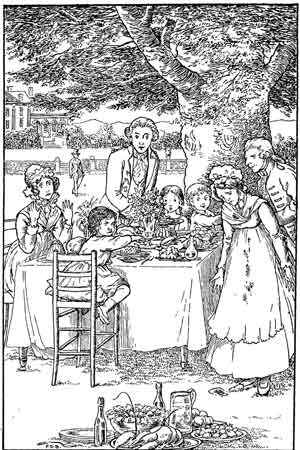
Well, one day his mother thought she would give him a day of pleasure, and make him very happy indeed, so she told him he should have a feast, and dine under the great cedar tree that stood upon the lawn, and that his cousins should be invited to dine with him, and that he should have whatever he chose for his dinner. So she rang the bell, and she told the servants to take out tables and chairs and to lay the cloth upon the table under the tree, and she ordered her two footmen to be ready to wait upon him.
She desired the butler to tell the cook to prepare the dinner, and to get all sorts of nice dishes for the feast; but she said to Alfred:
"What shall you like best of all, my dear boy?"
So Alfred tried to think of something that he had never had before, and he recollected that one day he had heard a lady, who was dining with his father and mother, say that the oyster patties were the best she had ever eaten. Now Alfred had never tasted oyster patties, so he said he would have oyster patties for dinner.
"Oyster patties, my dear boy? You cannot have oyster patties at this time of the year; there are no oysters to be had," his mother said to him. "Try, love, to think of something else."
But naughty Alfred said:
"No, I can think of nothing else."
So the cook was sent for, and desired to think of something that he might like as well. The cook proposed first a currant pie, then a barberry pie, or a codlin pie with custard.
"No, no, no!" said Alfred, shaking his head.
"Or a strawberry tart, my sweet boy? or apricot jam?" said his mother, in a soothing tone of voice.
But Alfred said:
"No, mother, no. I don't like strawberries. I don't like apricot jam. I want oysters."
"But you cannot have oysters, my little master," said the cook.
"But I will have oysters," said the little boy, "and you shan't say that I can't have them—shall she, mother?"
And he began to scream and to cry.
"Do not cry, my sweet soul," said his mother, "and we will see what we can do. Dry up your tears, my little man, and come with me, and, the cook, I dare say, will be able to get some oysters before dinner. It is a long time to dinner, you know, and I have some pretty toys for you upstairs, if you will come with me till dinner is ready."
So she took the little crying boy by the hand and led him up to her room, and she whispered to the cook, as she passed, not to say anything more about it now, and that she hoped he would forget the oyster patties by the time dinner was ready. In the meantime she took all the pains she could to amuse and please him, and as fast as he grew tired of one toy she brought out another.
At last, after some hours, she gave him a beautiful toy for which she had paid fifteen shillings. It was a sand toy of a woman sitting at a spinning-wheel, and when it was turned up the little figure began spinning away, and the wheel turned round and round as fast as if the woman who turned it had been alive. Alfred wanted to see how it was done, but, instead of going to his mother to ask her if she would be so good as to explain it to him, he began pulling it to pieces to look behind it. For some time he was very busy, and he had just succeeded in opening the large box at the back of the figure when all the sand that was in it came pouring out upon the floor, and when he tried to make the little woman spin again, he found she would not do it any more. She could not, for it was the sand dropping down that had made her move before.
Now, do you know that Alfred was so very silly that he began to be angry even with the toy, and he said, "Spin, I say! spin directly!" and then he shook it very hard, but in vain. The little hands did not move, and the wheel stood still. So then he was very angry indeed, and, setting up a loud cry, he threw the toy to the other end of the room. Just at this very moment the servant opened the door and said that dinner was ready, and that Alfred's cousins were arrived.
"Come, my dear child; you are tired of your toys, I see," said his mother, "so come to dinner, darling. It is all ready under the tree."
So away they went, leaving the room all strewed with toys, with broken pieces, and the sand all spilt in a heap upon the floor. When they went under the dark spreading branches of the fine old cedar-tree, there they saw the table covered with dishes and garnished with flowers. There were chickens, and ham, and tongue, and lobsters, besides tarts, and custards, and jellies, and cakes, and cream, and I do not know how many nice things besides. There was Alfred's high chair at the head of the table, and he was soon seated in it, as master of the feast, with his mother sitting by him, his cousins opposite to him, his nurse standing on the other side, and the two footmen waiting besides.
As soon as his cousins were helped to what they liked best, his mother said:
"What will you eat first, Alfred, my love? A wing of a chicken?"
"No," said Alfred, pushing it away.
"A slice of ham, darling?" said nurse.
"No," said Alfred, in a louder tone.
"A little bit of lobster, my dear?"
"No, no," replied the naughty boy.
"Well, what will you have, then?" said his mother, who was almost tired of him.
"I will have oyster patties," said he.
"That is the only thing you cannot have, my love, you know, so do not think of it any more, but taste a bit of this pie. I am sure you will like it."
"You said I should have oyster patties by dinner-time," said Alfred, "and so I will have nothing else."
"I am sorry you are such a sad, naughty child," said his mother. "I thought you would have been so pleased with all these nice things to eat."
"They are not nice," said the child, who was not at all grateful for all that his mother had done, but was now in such a passion that he took the piece of currant tart which his nurse again offered to him, and, squeezing, up as much as his two little hands could hold, he threw it at his nurse, and stained her nice white handkerchief and apron with the red juice.
Just at this moment his father came into the garden, and walked up to the table.
"What is all his?" said he. "Alfred, you seem to be a very naughty boy indeed; and I must tell you, sir, I shall allow this no longer. Get down from your chair, sir, and beg your nurse's pardon."
Alfred had hardly ever heard his father speak so before, and he felt so frightened that he left off crying and did as he was bid. Then his father took him by the hand and led him away.
His mother said she was sure he would now be good and eat the currant tart; but his father said:
"No, no, it is now too late; he must come with me."
So he led him away, without saying another word.
He took him into the village, and he stopped at the door, of a poor cottage.
"May we come in?" said his father.
"Oh yes, and welcome," said a poor woman, who was standing at a table with a saucepan in her hand.
"What are you doing, my good woman?"
"Only putting out the children's supper, your honor."
"And what have you got for their supper?"
"Only some potatoes, please you, sir; but they be nicely boiled, and here come the hungry boys! They are coming in from their work, and they will soon make an end of them, I warrant."
As she said these words in came John, and William, and Thomas, all with rosy cheeks and smiling faces. They sat down—one on a wooden stool, one on a broken chair, and one on the corner of the table—and they all began to eat the potatoes very heartily.
But Alfred's father said:
"Stop, my good boys; do not eat any more, but come with me."
The boys stared, but their mother told them to do as they were bid, so they left off eating and followed the gentleman.
he took the currant tart, and ... threw it at his nurse
Alfred and his father walked on till they arrived once more under the cedar-tree in the garden, and there was the fine feast all standing just as they had left it, for Alfred's cousins were gone away, and his mother would not have the dinner taken away, because she hoped that Alfred would come back to it.
"Now, boys," said the gentleman, "you may all sit down to this table and eat whatever you like."
John, William, and Thomas sat down as quickly as they could, and began to devour the chickens and tarts, and all the good things, at a great rate; and Alfred, who now began to be very hungry, would gladly have been one of the party; but when he was going to sit down, his father said:
"No, sir; this feast is not for you. There is nothing here that you like to eat, you know; so you will wait upon these boys, if you please, who seem as if they would find plenty that they will like."
Alfred at this began to cry again, and said he wanted to go to his mother; but his father did not mind his crying, and said he should not go to his mother again till he was quite a good boy.
"So now, sir, hand this bread to John, and now take a clean plate to Thomas, and now stand ready to carry this custard to William. There now, wait till they have all done."
It was of no use now to cry or scream; he was obliged to do it all.
When the boys had quite finished their supper they went home, and Alfred was led by his father into the house. Before he went to bed, a cup of milk and water and a piece of brown bread were put before him, and his father said:
"That is your supper, Alfred."
Alfred began to cry again, and said he did not want such a supper as that.
"Very well," said his father, "then go to bed without, and it shall be saved for your breakfast."
Alfred cried and screamed louder than ever, so his father ordered the maid to put him to bed. When he was in bed, he thought his mother would come and see him and bring him something nice, and he lay awake a long while; but she did not come, and he cried and cried till at last he fell asleep.
In the morning, when he awoke, he was so hungry he could hardly wait to be dressed, but asked for his breakfast every minute. When he saw the maid bring in the brown bread again without any butter, and some milk and water, he was very near crying again; but he thought if he did he should perhaps lose his breakfast as he had lost his supper, so he checked his tears, and ate a hearty meal.
"Well," said his father, who came into the room just as he was eating the last bit of bread, "I am glad to see the little boy who could not yesterday find anything good enough for him at a feast eating such simple fare as this so heartily. Come, Alfred, now you may come to your dear mother."
TWO LITTLE BOYS
By THOMAS DAY
I
THE GOOD-NATURED LITTLE BOY
A little boy went out one morning to walk to a village about five miles from the place where he lived, and carried with him in a basket the provision that was to serve him the whole day. As he was walking along a poor little half-starved dog came up to him, wagging his tail and seeming to entreat him to take compassion on him.
The little boy at first took no notice of him, but at length, remarking how lean and famished the creature seemed to be, he said: "This animal is certainly in very great necessity. If I give him part of my provision I shall be obliged to go home hungry myself; however, as he seems to want it more than I do, he shall partake with me." Saying this, he gave the dog part of what he had in his basket, who ate as if he had not tasted victuals for a fortnight.
The little boy went on a little further, his dog still following him and fawning upon him with the greatest gratitude and affection, when he saw a poor old horse lying upon the ground, and groaning as if he was very ill. He went up to him, and saw that he was almost starved, and so weak that he was unable to rise. "I am very much afraid," said the little boy, "if I stay to assist this horse that it will be dark before I can return, and I have heard there are several thieves in the neighborhood. However, I will try. It is doing a good action to attempt to relieve him, and God Almighty will take care of me." He then went and gathered some grass, which he brought to the horse's mouth, who immediately began to eat with as much relish as if his chief disease was hunger. He then fetched some water in his hat, which the animal drank up, and seemed immediately to be so much refreshed that after a few trials he got up and began grazing.
He then went on a little further, and saw a man wading about in a pool of water without being able to get out, in spite of all his endeavors. "What is the matter, good man?" said the little boy to him. "Can't you find your way out of this pond?" "No, God bless you, my worthy master, or miss," said the man, "for such I take you to be by your voice. I have fallen into this pond, and know not how to get out again, as I am quite blind, and I am almost afraid to move for fear of being drowned." "Well," said the little boy, "though I shall be wetted to the skin, if you will throw me your stick, I will try to help you out of it."
The blind man then threw the stick on to that side on which he heard the voice; the little boy caught it, and went into the water, feeling very carefully before him, lest he should unguardedly go beyond his depth. At length he reached the blind man, took him very carefully by the hand, and led him out. The blind man then gave him a thousand blessings, and told him he could grope his way home, and the little boy ran on as hard as he could to prevent being benighted.
But he had not proceeded far when he saw a poor sailor, that had lost both his legs in an engagement by sea, hopping along upon crutches.
"God bless you, my little master!" said the sailor. "I have fought many a battle with the French to defend poor old England, but now I am crippled, as you see, and have neither victuals nor money, although I am almost famished." The little boy could not resist his inclination to relieve him, so he gave him all his remaining victuals, and said: "God help you, poor man! This is all I have, otherwise you should have more."
He then ran along, and presently arrived at the town he was going to, did his business, and returned towards his own home with all the expedition he was able.
But he had not gone much more than half-way before the night shut in extremely dark, without either moon or stars to light him. The poor little boy did all he could to find his way, but unfortunately missed it in turning down a lane which brought him into a wood, where he wandered about a great while without being able to find any path to lead him out.
Tired out at last and hungry, he felt himself so feeble that he could go no further, but sat himself down upon the ground, crying most bitterly. In this situation he remained for some time, till at last the little dog, who had never forsaken him, came up to him, wagging his tail, and holding something in his mouth. The little, boy took it from him, and saw it was a handkerchief nicely pinned together, which someone had dropped and the dog had picked up; and upon opening it he found several slices of bread and meat, which the little boy ate with great satisfaction, and felt himself extremely refreshed with his meal. "So," said the little boy, "I see that if I have given you a breakfast you have given me a supper, and a good turn is never lost, not even to a dog."
He then once more attempted to escape from the woods, but it was to no purpose; he only scratched his legs with the briars, and slipped down in the dirt, without being able to find his way out. He was just going to give up all further attempts in despair, when he happened to see a horse feeding before him, and going up to him saw, by the light of the moon which just then began to shine a little, that it was the very same horse he had fed in the morning. "Perhaps," said the little boy, "this creature that I have been so good to will let me get upon his back, and he may bring me out of the wood, as he is accustomed to feed in this neighborhood."
The little boy then went up to the horse, speaking to him and stroking him, and the horse let him mount his back without opposition, and then proceeded slowly through the wood, grazing as he went, till he brought him to an opening which led to the high road. The little boy was much rejoiced at this and said: "If I hadn't saved the creature's life in the morning I should have been obliged to have stayed here all the night. I see by this that a good deed is never lost."
But the poor little boy had yet a greater danger to undergo, for as he was going along a solitary lane two men rushed out upon him, laid hold of him, and were going to strip him of his clothes; but just as they were beginning to do it the little dog bit the leg of one of the men with so much violence that he left the little boy and pursued the dog, which ran howling and barking away. In this instant a voice was heard that cried out: "There are the rascals! Let us knock them down!" which frightened the remaining man so much that he ran away, and his companion followed him.
The little boy then looked up, and saw that it was the sailor whom he had relieved in the morning, carried upon the shoulders of the blind man whom he had helped out of the pond. "There, my little dear!" said the sailor. "God be thanked! we have come in time to do you a service in return for what you did us in the morning. As I lay under a hedge I heard these villains talk of robbing a little boy that from the description I concluded must be you; but I was so lame that I should not have been able to come time enough to help you if I had not met this honest blind man, who took me upon his back, while I showed him the way." The little boy thanked them very gratefully for thus defending him, and they went all together to his father's house, which was not far off, where they were all kindly entertained with a supper and bed.
The little boy took care of his faithful dog as long as he lived, and never forgot the importance and necessity of doing good to others if we wish them to do the same to us.
II
THE ILL-NATURED LITTLE BOY
There was once a little boy who was so unfortunate as to have a very bad man for his father, who was always surly and ill-tempered, and never gave his children either good instruction or good example. In consequence of this, this little boy, who might otherwise have been happier and better, became ill-natured and quarrelsome, and disagreeable to every one. He very often was severely beaten for his impertinence by boys that were bigger than himself, and sometimes by boys that were less; for though he was very abusive and quarrelsome, he did not much like fighting, and generally trusted more to his heels than his courage when he had engaged himself in a quarrel. This little boy had a cur dog that was the exact image of himself; he was the most troublesome, surly creature imaginable, always barking at the heels of every horse he came near, and worrying every sheep he could meet with, for which reason both the dog and the boy were disliked by all the neighborhood.
One morning his father got up early to go to the ale-house, where he intended to stay till night, as it was a holiday; but before he went out he gave his son some bread and cold meat and sixpence, and told him he might go and divert himself as he would the whole day. The little boy was very much pleased with this liberty, and as it was a very fine morning he called his dog Tiger to follow him, and began his walk.
He had not proceeded far before he met a boy that was driving a flock of sheep towards a gate that he wanted them to enter. "Pray, master," said the little boy, "stand still, and keep your dog close to you, for fear you frighten my sheep." "Oh yes, to be sure," answered the ill-natured little boy. "I am to wait here all the morning till you and your sheep have passed, I suppose! Here, Tiger, seize them, boy"! Tiger at this sprang forth into the middle of the flock, barking and biting on every side, and the sheep, in a general consternation, hurried each a separate way.
Tiger seemed to enjoy this sport equally with his master, but in the midst of his triumph he happened unguardedly to attack an old ram that had more courage than the rest of the flock. He, instead of running away, faced about and aimed a blow with his forehead at his enemy with so much force and dexterity that he knocked Tiger over and over, butting him several times while he was down, and obliged him to limp howling away.
The ill-natured little boy, who was not capable of loving anything, had been very much diverted with the trepidation of the flock of sheep, but now he laughed heartily at the misfortune of his dog, and he would have laughed much longer had not the other little boy, his patience provoked at this treatment, thrown a stone at him, which hit him full upon the temples and almost knocked him down. He immediately began to cry in concert with his dog, when, perceiving a man coming towards them, whom he fancied might be the owner of the sheep, he thought it most prudent to escape as speedily as possible.
But he had scarcely recovered from the smart which the blow had occasioned when his former mischievous disposition returned, which he determined to gratify to the utmost. He had not gone far before he saw a little girl standing by a stile, with a large pot of milk at her feet. "Pray," said the little girl, "help me with this pot of milk. My mother sent me out to fetch it this morning, and I have brought it alone a mile on my head; but I am so tired that I have been obliged to stop at this stile to rest me, and if I don't return home presently we shall have no pudding to-day, and, besides, my mother will be very angry with me."
"What," said the boy, "you are to have a pudding to-day, are you, miss?" "Yes," said the girl, "and a fine piece of roast beef, for there's Uncle Will, and Uncle John, and grandfather, and all my cousins, to dine with us, and we shall all be very merry in the evening, I can assure you; so pray help me up as speedily as possible." "That I will, miss," said the boy, taking up the jug, and pretending to fix it upon her head. Just as she had hold of it he gave it a little push, as if he had stumbled, and overturned it upon her. The little girl began to cry violently, but the mischievous boy ran away, laughing heartily, and saying: "Good-by, little miss! Give my humble service to your Uncle Will, and grandfather, and the dear little cousins."
This prank encouraged him very much indeed, for he then felt that now he had certainly escaped without any bad consequences; so he went on applauding his own ingenuity, and came to a farm where several little boys were at play. He desired leave to play with them, which they allowed him to do. But he could not be contented long without exerting his evil disposition, so taking an opportunity when it was his turn to fling the ball, instead of flinging it the way he ought to have done, he threw it into a muddy ditch. The little boys ran in a great hurry to see what was become of it, and as they were standing all together upon the brink he gave the outermost boy a violent push against his neighbor; he, not being able to resist the violence, tumbled against the next, that against the next, and that next against another, by which means they all soused into the ditch together.
They soon scrambled out, although in a dirty plight, and were going to have punished him for all his ill behavior; but he patted Tiger upon the back, who began snarling and growling in such a manner as made them desist. Thus this little mischievous boy escaped a second time with impunity.
The next thing he met with was a poor jackass feeding very quietly in a ditch. The little boy, seeing that nobody was within sight, thought this was an opportunity of plaguing an animal that was not to be lost, so he went and cut a large branch of thorns, which he contrived to fix to the poor beast's tail, and then, setting Tiger at him, he was extremely diverted to see the fright and agony the creature was in. But it did not fare so well with Tiger, who while he was baying and biting the animal's heels receive so severe a kick upon his head as laid him dead upon the spot.
The boy, who had no affection for his dog, left him with the greatest unconcern when he saw what had happened, and, finding himself hungry, sat down by the wayside to eat his dinner. He had not long been there before a poor blind man came groping his way out with a couple of sticks. "Good morning to you," said the boy. "Pray did you see a little girl come this road with a basket of eggs upon her head, dressed in a green gown, with a straw hat upon her head?" "God bless you, master!" said the beggar, "I am so blind I can see nothing, either in heaven above or in the earth below. I have been blind these twenty years, and they call me 'poor old blind Richard.'"
Though the poor old man was such an object of charity and compassion, yet the little boy determined, as usual, to play him some trick, and as he was a great liar and deceiver, he spoke to him thus: "Poor old Richard, I am heartily sorry for you with all my heart. I am just eating my breakfast, and if you will sit down by me I will give you part, and feed you myself." "Thank you with all my heart!" said the poor man; "and if you will give me your hand I will sit by you with great pleasure, my dear good little master."
The little boy then gave him his hand, and, pretending to direct him, guided him to sit down in a large heap of wet mud that lay by the roadside. "There," said he, "now you are nicely seated I am going to feed you." So, taking a little of the dirt in his fingers, he was going to put it into the blind man's mouth; but the man, who now perceived the trick that had been played him, made a sudden snap at his fingers, and getting them between his teeth bit them so severely that the wicked boy roared out for mercy, and promised never more to be guilty of such wickedness. At last the blind man, after he had put him to very severe pain, consented to let him go, saying as he went: "Are you not ashamed, you little scoundrel, to attempt to do hurt to those who have never injured you, and to want to add to the suffering of those who already are sufficiently miserable? Although you escape now, be assured, sir, that if you do not repent and mend your manners, you will meet with a severe punishment for your bad behavior."
One would think that this punishment would have cured him entirely of this mischievous disposition, but, unfortunately nothing is so difficult to overcome as bad habits that have been long indulged. He had not gone far before he saw a lame beggar that had just made a shift to support himself by the means of a couple of sticks. The beggar asked him to give him something, and the mischievous little boy, pulling out his sixpence, threw it down before him, as if he intended to make him a present of it; but while the poor man was stooping with difficulty to pick it up, the wicked little boy knocked the stick away, by which means the beggar fell down upon his face; and then snatching up the sixpence, the little boy ran away laughing very heartily at the accident.
This was the last trick this ungrateful boy had it in his power to play, for seeing two men come up to the beggar and enter into discourse with him, he was afraid of being pursued, and therefore ran as fast as he was able over several fields. At last he came into a lane which led to a farmer's orchard, and as he was preparing to clamber over the fence a large dog seized him by the leg and held him fast. He cried out in an agony of terror, which brought the farmer out, who called the dog off, but seized the boy very roughly, saying: "So, sir, you are caught at last, are you? You thought you might come day after day and steal my apples without detection; but it seems you are mistaken, and now you shall receive the punishment you have so long deserved." The farmer then began to chastise him very severely with a whip he had in his hand, and the boy in vain protested he was innocent, and begged for mercy. At last the farmer asked him who he was and where he lived; but when he heard his name, he cried out: "What! are you the little rascal that frightened my sheep this morning, by which means several of them are lost? and do you think to escape?" Saying this he lashed him more severely than before, in spite of all his cries and protestations. At length, thinking he had punished him enough, he turned him out of the orchard, bade him go home, and frighten sheep again if he liked the consequences.
The little boy slunk away crying very bitterly, for he had been very severely beaten, and now began to find out that no one can long hurt others with impunity; so he determined to go away quietly home, and behave better for the future.
But his sufferings were not yet at an end, for as he jumped down from a stile he felt himself very roughly seized, and, looking up, found that he was in the power of the lame beggar whom he had thrown upon his face. It was in vain that he now cried, entreated, and begged for pardon; the man, who had been much hurt by his fall, thrashed him very severely with his stick before he would part with him.
He now again went on crying and roaring with pain, but at least expected to escape without any further damage. But here he was mistaken, for as he was walking slowly through a lane, just as he turned a corner he found himself in the middle of the very troop of boys that he had used so ill in the morning. They all set up a shout as soon as they saw him, their enemy, in their power, without his dog, and began persecuting him in a thousand various ways. Some pulled him by the hair, others pinched him, some whipped his legs with their handkerchiefs, while others covered him with handfuls of dirt. In vain did he attempt to escape; they were still at his heels, and, surrounding him on every side, continued their persecutions.
At length, while he was in this disagreeable situation, he happened to come up to the same jackass he had seen in the morning, and, making a sudden spring, jumped upon his back, hoping by this means to escape. The boys immediately renewed their shouts, and the ass, who was frightened at the noise, began galloping with all his might, and presently bore him from the reach of his enemies.
But he had little reason to rejoice at this escape, for he found it impossible to stop the animal, and was every instant afraid of being thrown off and dashed upon the ground. After he had been thus hurried along a considerable time the ass on a sudden stopped short at the door of a cottage, and began kicking and prancing with so much fury that the little boy was presently thrown to the ground, and broke his leg in the fall.
His cries immediately brought the family out, among whom was the very little girl he had used so ill in the morning. But she, with the greatest good nature, seeing him in such a pitiable situation, assisted in bringing him in and laying him upon the bed. There this unfortunate boy had leisure to recollect himself and reflect upon his own bad behavior, which in one day's time had exposed him to such a variety of misfortunes; and he determined with great sincerity that if ever he recovered from his present accident he would be as careful to take every opportunity of doing good as he had before been to commit every species of mischief.